
Pakistan Military Offensive in North Waziristan Unleashed
Because I was away on an extended family trip ending last week, I was unable to comment on Pakistan launching a full-blown military operation in North Waziristan. Many had long held the view that such action would never be undertaken, but it would seem that terrorist attacks in several locations around Pakistan at a time when the government was attempting to hold peace talks with the Taliban finally provoked military action. Dawn provides this interactive map of major events so far. As you mouse over the map, blue circles are air strikes, green circles are ground attacks and red circles are drone strikes. Details should pop up at each circle:

The operation is named Zarb-e-Azb. In the Express Tribune’s summary of the actions, we get this translation of the name:
The meaning of Zarb-e-Azb is sharp and cutting. It’s reportedly the sword used by Prophet Muhammad (pbuh) in the battle of Badar.
The same Express Tribune story carries the June 15 announcement of the offensive by ISPR (Inter-Services Public Relations):
ISPR press release announces launch of military operation.
“DG ISPR has said that on the directions of the Government, Armed forces of Pakistan have launched a comprehensive operation against foreign and local terrorists who are hiding in sanctuaries in North Waziristan Agency. The operation has been named Zarb-e-Azb,” said the press release.
The ISPR statement went on to add that terrorists in North Waziristan had waged a war against the state of Pakistan and had been disrupting life in all its dimensions, stunting our economic growth and causing enormous loss of life and property. “They had also paralysed life within the agency and had perpetually terrorised the entire peace loving and patriotic local population,” the statement added.
“Our valiant armed forces have been tasked to eliminate these terrorists regardless of hue and colour, along with their sanctuaries. With the support of the entire nation, and in coordination with other state institutions and Law Enforcement Agencies, these enemies of the state will be denied space anywhere across the country. As always, armed forces of Pakistan will not hesitate in rendering any sacrifice for the motherland,” said the statement.
The operation has included air strikes by Pakistan’s air force along with ground action. Notably, there also have been at least three US drone strikes apparently coordinated with the offensive.
Remarkably, Pakistan’s Foreign Office is warning diplomats in Karachi to be on guard and to restrict their movements. Although the warning does not appear to mention a link to the action in North Waziristan, it seems likely that the military action is seen as contributing to increased risk of terror attacks across the country.
As might be expected, the military action has precipitated a huge spike in internally displaced people. Since those displaced are coming from the region where radical groups have disrupted vaccination plans, there is concern that polio will be spreading as residents are displaced. However, officials are making the best of a bad situation and are using the movement of families as an opportunity to vaccinate children as they cross checkpoints:
On the one hand, the movement of internally displaced persons (IDPs) from North Waziristan Agency provides officials an opportunity to vaccinate children who were inaccessible to health workers since June 2012, on the other hand, there are concerns that the virus could spread with the movement of these children.
These fears are exacerbated by the fact that the movement is taking place during the summer season, a high transmission season for the poliovirus.
Speaking with The Express Tribune, Acting Country Head of World Health (WHO) in Pakistan Dr Nima Saeed Abid said all efforts are being made to vaccinate children from Waziristan at checkpoints set up for IDPs.
/snip/
So far a total of 221,253 children have been vaccinated against polio at check posts set up, according to the Prime Minister’s Polio Monitoring and Coordination Cell.
I will try to keep an eye on developments in this operation but will be traveling again next week.
Postscript: While this post was being written, Pakistan announced that the Haqqani Network is among the targets of the offensive but that the offensive is Pakistan’s alone rather than a joint US-Pakistan action. How can US drone strikes be part of a Pakistan-only offensive? It also should be noted that the military is providing death toll information for “terrorists” and soldiers but does not mention civilian deaths.
Iraq Crisis Puts US on Same Side With Assad, Iran Quds Force
As I pointed out two weeks ago, US foreign and military policy is now so muddled that the primary response to any ongoing crisis is to choose a side to arm without thought to the inevitable blowback that will come from trying to pick winners and losers in otherwise internal affairs of far-flung countries. As the meltdown of the US-trained Iraqi military accelerates, we now see a situation whose supreme irony would be hilarious if only so many lives were not senselessly caught in the crossfire. Two developments of that sort stand out today.
First is the news that Syrian aircraft have carried out a strike against ISIS targets inside Iraq. Because Iraq has been pleading with the US to carry out attacks of this sort, it appears that early reports first assumed that US drones had been involved:
Syrian government aircraft bombed Sunni militant targets inside Iraq on Tuesday, further broadening the Middle Eastern crisis a day after Israeli warplanes and rockets struck targets inside Syria.
Iraqi state media initially reported that the attacks near Iraq’s western border with Syria were carried out by U.S. drones, a claim that was quickly and forcefully denied by the Pentagon.
Think about that one for a minute. Last fall, the US was agonizing over how to find and arm only those groups fighting the Assad government in Syria that are “moderate” so that we didn’t arm the then fledgling ISIS group. But now, inside Iraq, state media is initially unable to distinguish an action taken by Assad from one taken by the US. That is, Assad, whom we are fighting inside Syria, is on our side inside Iraq.
The second development is a pairing of US interests with one we have been fighting for a much longer time. The New York Times brings us the latest on Iranian assistance to Iraq in its struggle against ISIS. The initial part of the report seems routine:
Iran is flying surveillance drones over Iraq from an airfield in Baghdad and is secretly supplying Iraq with tons of military equipment, supplies and other assistance, American officials said. Tehran has also deployed an intelligence unit there to intercept communications, the officials said.
The secret Iranian programs are part of a broader effort by Tehran to gather intelligence and help Prime Minister Nuri Kamal al-Maliki’s government in its struggle against Sunni militants with the Islamic State in Iraq and Syria.
But when the Times drills down to detail on how the assistance is being delivered, we get into more strange times:
Gen. Qassim Suleimani, the head of Iran’s paramilitary Quds Force, has visited Iraq at least twice to help Iraqi military advisers plot strategy. And Iran has deployed about a dozen other Quds Force officers to advise Iraqi commanders, and help mobilize more than 2,000 Shiite militiamen from southern Iraq, American officials said.
Wait. Iran’s IGRC, and especially its Quds Force, is supposed to be still absolutely opposed to the US and even drops comments trying to disrupt the P5+1 negotiations on Iran’s nuclear program now and then. And yet, here they are, sending their head to Iraq to prop up al-Maliki as well as sending “about a dozen other Quds Force officers to advise Iraqi commanders”. Hmm. Advisers. That sounds familiar. Returning to the Washington Post story cited above: Read more →
Maybe It’s Time Liz and Dick Cheney Registered Under FARA?
In my Salon piece last week, I noted that in their attack on Obama, Liz and Dick Cheney were talking about interests, but made it clear they were really presenting the interests of “capitals from the Persian Gulf to Israel.”
And we should note whose interests Cheney represents.
Clearly, his temper tantrum serves, in part, to distract from his own culpability.
But note who else’s views Cheney cites? He claims he heard “a constant refrain in capitals from the Persian Gulf to Israel,” complaining about Obama’s actions. He describes a senior official in an Arab capital laying out ISIS’ aspirations on a map. He portrays those same figures in the Middle East demanding, “Why is he abandoning your friends?” “Why is he doing deals with your enemies?”
Even while Cheney parrots the interests of Middle Eastern leaders and conflates their interests with America’s, he scoffs at Obama’s (belated) efforts to address a far more immediate risk for America, climate change.
They’re back at it:
“I think the notion that somehow the Iranians have any interests in common with us is outrageous,” [Liz] Cheney said Tuesday on Rush Limbaugh’s radio show, according to a transcript. “The fact that we might be working with the Iranians again just gives our allies — you know — they’re apoplectic.”
This whole “Alliance for a Stronger America” schtick seems to do nothing else but lobby for the use of American service members and weapons to serve the interests of our “friends” — presumably Saudi Arabia and Israel — in the Middle East.
If they want to advocate for risking US lives and treasure to serve the Saudis, that’s their prerogative. But the law — the Foreign Agents Registration Act — requires that “ persons acting as agents of foreign principals in a political or quasi-political capacity to make periodic public disclosure of their relationship with the foreign principal, as well as activities, receipts and disbursements in support of those activities.”
It’s probably time for the Cheney’s to disclose who they’re working for here. No matter how prominently they feature the word “America” in their organization name, they appear to be working for other governments. Given that they’re acting like agents of a foreign power, they probably should admit that formally.
Immunity Empire
The Daily Beast has a story about how, having withdrawn in 2011 from Iraq because it could not get immunity approved for US troops approved by Iraq’s parliament, the US will now be satisfied with an immunity deal signed only by Iraq’s Foreign Minister.
Yet this time around, Obama is willing to accept an agreement from Iraq’s foreign ministry on U.S. forces in Iraq without a vote of Iraq’s parliament. “We believe we need a separate set of assurances from the Iraqis,” one senior U.S. defense official told The Daily Beast. This official said this would likely be an agreement or exchange of diplomatic notes from the Iraq’s foreign ministry. “We basically need a piece of paper from them,” another U.S. official involved in the negotiations told The Daily Beast. The official didn’t explain why the parliamentary vote, so crucial three years ago, was no longer needed.
That the US is in a rush to forgo parliamentary approval is all the stranger given how many people are calling for Nuri al-Maliki to be replaced.
The Maliki government, candidly, has got to go if you want any reconciliation,” said U.S. Senator Dianne Feinstein, Democratic chairwoman of the Senate Intelligence Committee.
Republican Senator John McCain, speaking in the Senate, called for the use of American air power, but also urged Obama to “make it make very clear to Maliki that his time is up.”
The Obama administration has not openly sought Maliki’s departure, but has shown signs of frustration with him.
“This current government in Iraq has never fulfilled the commitments it made to bring a unity government together with the Sunnis, the Kurds and the Shia,” Defense Secretary Chuck Hagel told the congressional hearing.
White House spokesman Jay Carney said Maliki had not done enough “to govern inclusively and that has contributed to the situation and the crisis that we have today in Iraq.”
He stopped short of calling for Maliki – in power for eight years and the effective winner of a parliamentary election two months ago – to resign. Asked if Maliki should step down, Carney told reporters: “That’s not, obviously, for us to decide.”
Even beyond the irony that we’re willing to accept immunity from a government we tacitly want to replace, take a few steps back and consider the plight of the late American Empire, in which we refuse to project our power unless we get immunity from those we’d like to project our power over first.
I get why the US won’t stay in Afghanistan and Iraq without legal protection. You can cite either their dysfunctional legal systems or you can cite all the crimes our troops committed during occupation, giving the state reason to demand jurisdiction. I’m not endorsing exposing our service members to Nuri al-Maliki’s concept of justice.
But it is an interesting approach to hard power, requiring immunity before exercising that power.
The Petraeus Failure Legacy in Iraq Grows
There are of course many people to blame for the war crime of US invasion of Iraq, but David Petraeus’ role as the falsely constructed hero of Iraq who in reality was the author of some of its most profound failures stands out. Recall the heady days of the fall of 2007 when Washington was paralyzed by the Congressional hearings on Iraq. Washington had already forgotten Petraeus’ false claims of training prowess in his September, 2004 Washington Post op-ed that launched his career in a political direction and helped Bush get re-elected. Instead, Petraeus was granted a mulligan on troop training and was promoted to head US troops in Iraq to preside over the surge so that his vaunted “new” COIN strategy could be implemented. Petraeus then of course was given credit for that COIN strategy being behind the decline in violence, even though we learned from Lt. Col. Daniel Davis and others that the drop in violence was more likely due to Iraqi Sunnis turning to the US because of the excessive brutality of al Qaeda in Iraq.
Sadly, with all the Washington circus atmosphere surrounding the hearings and the Move-On Betrayus ad, a key document prepared by the GAO (pdf) was all but ignored during the hearings. There were in fact 18 benchmarks for the Iraq war effort outlined in the legislation passed in January of 2007 authorizing the surge. The opening of the document provides the most telling one sentence summary of what the US hoped to achieve at the time:
The January 2007 U.S. strategy seeks to provide the Iraqi government with the time and space needed to help Iraqi society reconcile.
Although the vaunted Petreaus COIN strategy paid lip service to winning “hearts and minds”, the sad reality is that the US spent zero effort on achieving any sort of social reconciliation in Iraq. The huge Sunni-Shia schism remained intact and was even further fed by the US’ hand-picked Prime Minister, Nouri al-Maliki. On the list of benchmarks from the legislation, unlucky number 13 held the key:
Reducing the level of sectarian violence in Iraq and eliminating militia control of local security.
Needless to say, the GAO found that particular benchmark unmet in September, 2007 and it remains unmet today as Sunni extremist ISIS troops gain territory throughout Iraq while al-Maliki’s Shia forces melt away. A tremendous window opened for reconciliation when the Sunni militias abandoned al Qaeda in Iraq and joined with the US, but these groups were given no standing by al-Maliki, who even continued to send his Shia-dominated military into Sunni regions, laying groundwork for local support once ISIS came into the picture.
But it is Petraeus’ failure as the leading figure behind the training of Iraq’s forces that stands out today. From the New York Times:
Recent assessments by Western officials and military experts indicate that about a quarter of Iraq’s military forces are “combat ineffective,” its air force is minuscule, morale among troops is low and its leadership suffers from widespread corruption.
As other nations consider whether to support military action in Iraq, their decision will hinge on the quality of Iraqi forces, which have proved far more ragged than expected given years of American training.
The Washington Post piles on with more bad news:
After tens of thousands of desertions, the Iraqi military is reeling from what one U.S. official described as “psychological collapse” in the face of the offensive from militants of the Islamic State of Iraq and Syria (ISIS).
The desperation has reached such a level that Prime Minister Nouri al-Maliki is relying on volunteers, who are in some cases receiving as little as a week’s military training, to protect his ever-shrinking orbit of control.
“Over time, what’s occurred is that the Iraqi army has no ability to defend itself,” said Rick Brennan, a Rand Corp. analyst and former adviser to U.S. forces in Iraq. “If we’re unable to find ways to make a meaningful difference to the Iraqi army as they fight this, I think what we’re looking at is the beginning of the disintegration of the state of Iraq.”
In the end, all of the years and the billions of dollars spent on “training” Iraqi forces has given a force that is “combat ineffective’, “far more ragged than expected” and melts away at the first sign of resistance. But wait. Any day now, we will see that those 300 “advisers” we are sending into Iraq will magically train a new force that will get it right this time. Who knows, maybe Petraeus will be given yet another chance to lead that training. What could go wrong?
Post Snowden: The Government Doubles Down on Hard Power
I was asked to participate in a CATO debate about where we are a year post Snowden. My contribution to that debate — in which I argue any big drama going forward will come from the newly adversarial relationship between Google and the NSA — is here.
As part of that, I argued that the government made a choice after Snowden: to double down on hard power over soft power.
The conflict between Google and its home country embodies another trend that has accelerated since the start of the Snowden leaks. As the President of the Computer & Communications Industry Association, Edward Black, testified before the Senate last year, the disclosure of NSA overreach did not just damage some of America’s most successful companies, it also undermined the key role the Internet plays in America’s soft power projection around the world: as the leader in Internet governance, and as the forum for open speech and exchange once associated so positively with the United States.
The U.S. response to Snowden’s leaks has, to a significant degree, been to double down on hard power, on the imperative to “collect it all” and the insistence that the best cyberdefense is an aggressive cyberoffense. While President Obama paid lip service to stopping short of spying “because we can,” the Executive Branch has refused to do anything – especially legislatively – that would impose real controls on the surveillance system that undergirds raw power.
And that will likely bring additional costs, not just to America’s economic position in the world, but in the need to invest in programs to maintain that raw power advantage. Particularly given the paltry results the NSA has to show for its domestic phone dragnet – the single Somali taxi driver donating to al-Shabaab that Sanchez described. It’s not clear that the additional costs from doubling down on hard power bring the United States any greater security.
Because I was writing this essay, that’s largely where my mind has been as we debate getting re-involved in Iraq.
In the 3 or 4 wars we’ve waged in the Middle East/South Asia since 9/11 (counting Afghanistan, Iraq, Libya, and Syria), we’ve only managed to further destabilize the region. That was largely driven by a belligerence that goes well beyond our imperative to collect it all.
But I do think both the Snowden anniversary and the Iraq clusterfuck should focus far more energy on how we try to serve American interests through persuasion rather than bombs and dragnets.
US Foreign Policy in a NUTshell
This partial screen capture from the “World” section of today’s New York Times really needs no further explanation of the incompetence of US diplomats and military strategists:
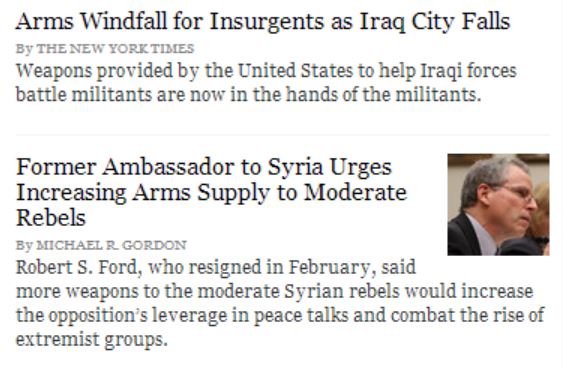
There simply are no words to adequately describe the insanity at work here. Even as each misadventure winds down in disastrous fashion, the new ones follow the same perverted script.
Dunford Declares Taliban’s Political Space “Significantly Reduced” on Day of Their Biggest Propaganda Win
I often note how the US military, throughout its nearly 13 year quagmire in Afghanistan, continues to spout “we’re winning” messages when it is clear that the entire effort has been an utter failure from the start. Juxtaposing a story in today’s Washington Post with another in today’s New York Times shows how the military’s rosy statements are devoid of all connection to reality on the ground.
The Post story centers on the military, with Joseph Dunford in the lead, filling in more details on projected troop staffing levels in Afghanistan beyond the end of this year. The article ends with this gem:
U.S. and NATO officials described a Taliban force that has been greatly debilitated since the beginning of this year and pointed to the successful first round of Afghanistan’s presidential election in April as a defeat for the militants. The top two vote-getters are competing in next week’s runoff to succeed President Hamid Karzai, who has refused to sign the bilateral security and status-of-forces agreements.
“In the wake of the election, for the first time . . . the Taliban are on the defensive in the information space,” the senior military official said. For 10 years, he said, the Taliban has had two messages — that the United States was occupying their country and ultimately would abandon it. In the wake of the turnover of combat operations to Afghan national forces over the past year, and Obama’s announcement for the future, those messages have less resonance, the official said. The coalition has made clear, the official said, that we “won’t fall off the cliff at the end of 2014.”
Dunford described “friction” within the Taliban and said that although the militants are still carrying out lethal attacks against Afghan forces, “if you compare the political space of the Taliban, it’s significantly reduced.”
Okay, then. The Taliban is “greatly debilitated”, are “on the defensive in the information space” and are “significantly reduced” in “the political space”. Yet, on the very day that Dunford and a “senior military officer” made such outrageous claims, the Taliban were happily scoring their biggest propaganda victory of the entire war in Afghanistan. From the Times:
The Taliban seem loose, almost offhand, on camera as they wait for the American Black Hawk to land. Two fighters walk their hostage, Sgt. Bowe Bergdahl, out to American troops, greeting their enemies eye to eye as they quickly shake hands. They wave as the Americans retreat back to the chopper.
In their viral video to the world on Wednesday, framing dramatic images of their transaction with the United States with music, commentary and context, the Taliban scored their biggest hit yet after years of effort to improve their publicity machine — one bent on portraying them as the legitimate government of Afghanistan in exile.
Within hours of the video’s release, the Taliban website where it was posted was overwhelmed with traffic and the page hosting it crashed, according to Zabiullah Mujahid, a spokesman for the insurgents. The video has since been uploaded in dozens of different versions on YouTube.
It is the product of a Taliban propaganda effort that has grown increasingly savvy.
It’s hard to imagine a better example of how the US has lost all credibility when it comes to describing conditions in Afghanistan. Granted, the statements in the Post stem initially from claims made around the election going “smoothly“, but the sweeping statements quoted clearly are meant to apply to the Taliban’s situation generally, not just regarding the election. But the Taliban even covered that:
And they suggested that they had purposefully held back on attacking civilians on election day in April, and that Afghans should trust the Taliban over a government being chosen by Western ways.
We can only wonder how Dunford and his associates will ever be able to top this one.
What Role Will Released Taliban Detainees Have in Afghanistan’s Future?
A provincial governor and one of the more moderate co-founders of the Taliban, a top military commander (who was betrayed by our war criminal Rashid Dostum, and against whom credible war crimes complaints have been raised), another provincial governor, Deputy Chief of Taliban Intelligence, and a minor judge.
These are — according to an Afghanistan Analysts Network report drawing on years of engagement — the men whom President Obama just traded for the released of Bowe Bergdahl. They will remain under a travel ban in Qatar for a year. Then what?
While the usual sources are declaring all of them — rather than just some of them — among the most dangerous men at Gitmo and warning they’ll be attacking American soldiers imminently, I’m more interested in what role these men — four of whom are clearly key leaders, including legitimate military and intelligence leaders — will play in Afghanistan after we leave.
I ask that because, while I believe Obama has botched the legalities of the transfer (he should have noticed Congress, even if not the full 30 days in advance; bmaz should have more to say on that later), I think the most useful way to approach the swap is the way Ken Gude does: we would have had to release these men within a year or so anyway, and so we’re better off freeing Bergdahl in the process.
When wars end, prisoners taken custody must be released. These five Guantanamo detainees were almost all members of the Taliban, according to the biographies of the five detainees that the Afghan Analysts Network compiled in 2012. None were facing charges in either military or civilian courts for their actions. It remains an open question whether the end of U.S. involvement in the armed conflict in Afghanistan requires that all Guantanamo detainees must be released. But there is no doubt that Taliban detainees captured in Afghanistan must be released because the armed conflict against the Taliban will be over.
Sgt. Bergdahl was a U.S. soldier captured in an active zone of combat. The circumstances of his capture make him a Prisoner of War, not a hostage as some have erroneously claimed. In traditional conflicts, both sides would release their prisoners at the conclusion of hostilities. This is not a traditional conflict, however, and the Obama administration rightly had no expectation that Sgt. Bergdahl would have been released when U.S. forces redeployed out of Afghanistan. As that date neared, any leverage the United States possessed would have been severely undermined.
But I’m also fascinated by the messaging problem years of conflating the Taliban and Al Qaeda is now causing.
Regardless of the allegations against some — and the evidence against Mullah Fazl Mazlum — as Taliban (and Haqqani, in the case of the judge) they were also lawful combatants (if that — several were civilians when captured) of a state at war with the United States. If we plan on ending that war, these men will be entitled to engage in the politics and fighting that will determine Afghanistan’s future going forward. Several of these men appear to have the kinds of skills Afghans will need to rebuild their country — though it’s unclear what kind of credibility they’ll have after years of rotting in an American prison. And of course, it’s not even clear what role the Taliban will have after we leave. We certainly haven’t defeated the Taliban!
(Some of) these men may be dangerous, in the same way Stanley McChrystal would rightly be viewed as dangerous if captured by our adversaries. But they are also members of entity that governed Afghanistan when this war started, an entity that is likely to play some role, for better and worse, going forward.
And yet the debate about their release seems to forget that distinguishes them from the terrorists.
Will Successful Bergdahl Negotiations Get US-Taliban Peace Negotiations Going Again?
This weekend’s swap of Bowe Bergdahl for five Afghan Taliban prisoners from Guantanamo has triggered responses on a large number of fronts. For now, I will leave it to others to sort through whether Obama was required to inform Congress, whether the move provides incentive to the Taliban to capture more prisoners and whether Bergdahl was a deserter. Instead, I want to focus on the fact that this prisoner exchange stands as a significant accomplishment in negotiation among parties who have seen previous attempts at negotiation fail.
Recall that back in early 2012, we first learned that the Afghan Taliban was opening an office in Qatar:
The Taliban said in a surprise announcement last week they had reached a preliminary agreement to set up a political address in Qatar and asked for the release of prisoners held by the U.S. military at Guantanamo Bay.
So the release of Afghan Taliban prisoners from Guantanamo was at the top of the list for setting up the office in Qatar and beginning negotiations. It is also important to note that the Haqqani Network, who held Bergdahl in Pakistan, was also to be included in the talks at the same time that the opening for negotiations was first noted and that Pakistan helped to move things along:
The US has taken Pakistan into confidence over the unprecedented development of allowing the Taliban a political office in Qatar to advance the Afghan reconciliation process, sources revealed.
A senior Pakistani official stated that the Obama administration not only sought Pakistan’s consent over the Taliban office but had also given a ‘green light’ to allow the deadliest Afghan insurgent group, the Haqqani network, to be a part of the reconciliation process.
The move by Washington was a clear deflection from its previous policy of keeping Islamabad at bay over its peace overtures with the Afghan Taliban.
“Yes, we were onboard,” said the senior Pakistani official referring to the latest push by Washington to seek a political settlement of the Afghan conflict.
The process suffered a major setback when the office was found to be flying the flag the Taliban used when they ruled Afghanistan and when the sign on the door seemed to suggest that the Taliban felt they were still the legitimate governing body. Hamid Karzai threw a huge fit over that development, and even though his government hadn’t been invited to the talks, he managed to stall the process. About a year and a half later, things settled down a bit and the provocative sign and flag were removed.
In today’s New York Times, we are warned not to infer that the prisoner swap means that additional talks look likely: Read more →