On America’s Spent Moral Standing

You’ll be hearing these two assertions repeated, made by someone who voted for the Iraq War in the 21st Century, a lot in coming days (see after 0:50).

You just don’t, in the 21st Century, behave in 19th Century fashion by invading another country on completely trumped up pretext so it is a very serious moment.

[snip]

That’s not the act of somebody who is strong. That’s the act of somebody who is acting out of weakness, who is acting out of a certain kind of desperation.

I guess someone in the Obama White House believed that if we call Vladimir Putin weak after he’s just called our bluff, it will get him to back down, even as Putin knows we have no great options against him.

But it all shows one of the downsides of having so badly spent our moral standing already this century. Whatever the objective of these statements, whether in other circumstances they might have worked, they just come off as a joke. Especially coming from Kerry.

Share this entry

How Will Pakistan Implement New Security Policy?

Earlier in the week, I wondered whether John Brennan had helped to shape the new counterterrorism policy that Pakistan is rolling out and whether it might be a ploy by Pakistan to capture some of the US counterterrorism dollars that would suddenly become available after a full withdrawal of US troops from Afghanistan. Under such a scenario, the key event to watch for would be any action taken by Afghanistan against the Haqqani network or other groups that find haven in Pakistan but carry out their attacks only in Afghanistan. More details of the policy are now being revealed, and with them come some suggestions that the Haqqanis might not be targeted, but other major developments suggest that tighter cooperation with the US is occurring.

Tom Hussain of McClatchy seems to have been first to break the news (on Wednesday) that Pakistan may still choose not to go after the Haqqani network:

Pakistan announced Wednesday that it was ending its 7-month-old policy of trying to reconcile with its Taliban insurgents and vowing to answer each terrorist attack with military strikes on the militants’ strongholds in northwest tribal areas bordering Afghanistan.

But the government stopped short of abandoning its attempts to engage willing Taliban factions in a peace dialogue, underlining that Pakistan’s national security policy remains focused on restricting attacks within its borders, rather obliterating the militants altogether.

That means that militants who use Pakistan for a staging base to attack U.S. and Afghan forces in neighboring Afghanistan will still be allowed to operate, as long as they observe a cease-fire in Pakistan.

He continues:

Political analysts said the national security policy unveiled Wednesday offered an easy way out for militant factions that wanted to disassociate themselves from the TTP, however: They simply have to stop attacking Pakistani government forces.

That makes it likely that Pakistan won’t take any military action against the Haqqani network, an ally of the Afghan Taliban that controls significant territory in the North Waziristan and South Waziristan tribal agencies.

The network is a major source of friction between Pakistan and the United States, which previously has accused Pakistan’s security services of complicity in several of the network’s high-profile attacks on Afghan government and U.S. targets in Kabul and elsewhere in Afghanistan.

Widely viewed as a projector of Pakistan’s influence into Afghanistan, the Haqqani network has distanced itself from the TTP during the Taliban group’s six-year insurgency by signing peace agreements, fronted by the local Wazir tribe, that predate the 2009 launch of counterterrorism operations.

Accordingly, it won’t be targeted by the Pakistani military as long as it doesn’t side with the TTP.

A very similar interpretation was offered by AFP on Thursday: Read more

Share this entry

Preparations Underway for Zero Option in Afghanistan

As I posited yesterday, Pakistan appears to be putting together a US-style counterterrorism structure. This morning, we see even stronger hints that a full-blown military offensive against the Taliban may soon be launched by Pakistan. Although we have not seen any evidence that they have done so yet, I fully expect Pakistan to include both the Afghan Taliban and Haqqani network among their targets in this operation. In fact, the Washington Post article mentions that Pakistan “would ‘not discriminate’ among the TTP, the Haqqani network and other militant groups in North Waziristan, including al-Qaeda”. In return for this offensive, look for Pakistan to get a massive amount of US financial and intelligence assistance. The US also appears to be making a renewed push against the Haqqani network inside Afghanistan and this report from Missy Ryan and Phil Stewart describes that effort while noting that the US wants Pakistan to take on the Haqqanis and any other groups that use Pakistan as a sanctuary from which to launch attacks in Afghanistan.

These moves by Pakistan and the US make more sense when we see that the US has come to the realization that an ongoing troop presence in Afghanistan is increasingly unlikely. There was significant movement on that front yesterday, with President Obama speaking to Afghan President Hamid Karzai on the telephone. From the White House readout of the call:

President Obama called President Karzai today to discuss preparations for Afghanistan’s coming elections, Afghan-led peace and reconciliation efforts, and the Bilateral Security Agreement.

/snip/

With regard to the Bilateral Security Agreement, in advance of the NATO Defense Ministerial, President Obama told President Karzai that because he has demonstrated that it is unlikely that he will sign the BSA, the United States is moving forward with additional contingency planning. Specifically, President Obama has asked the Pentagon to ensure that it has adequate plans in place to accomplish an orderly withdrawal by the end of the year should the United States not keep any troops in Afghanistan after 2014. At the same time, should we have a BSA and a willing and committed partner in the Afghan government, a limited post-2014 mission focused on training, advising, and assisting Afghan forces and going after the remnants of core Al Qaeda could be in the interests of the United States and Afghanistan. Therefore, we will leave open the possibility of concluding a BSA with Afghanistan later this year.  However, the longer we go without a BSA, the more challenging it will be to plan and execute any U.S. mission. Furthermore, the longer we go without a BSA, the more likely it will be that any post-2014 U.S. mission will be smaller in scale and ambition.

The United States continues to support a sovereign, stable, unified, and democratic Afghanistan, and will continue our partnership based on the principles of mutual respect and mutual accountability.  We remain fully supportive of our partners in the Afghan security forces, and we continue to proudly work side by side with the many Afghans who continue to work to ensure the stability and prosperity of their fellow citizens.

Although there is no clear deadline date, this phone call has the hallmarks of a “final warning” to Karzai. If the US doesn’t see movement from him on the BSA soon, look for the zero option of a full US withdrawal from Afghanistan to take place. As noted in the readout, the lack of a signed BSA is causing trouble for NATO, as well. A NATO gathering (called a Defense Ministerial)  opened today, but with no BSA in place, Afghanistan planning can’t be done, prompting a very uncomfortable opening press conference for Secretary General Rasmussen.

Adam Goldman brings us another strong indicator that the US is moving toward a full withdrawal from Afghanistan: Read more

Share this entry

Afghan Army Post in Kunar Province Overrun by Taliban, 21 Killed

[youtuber youtube=’http://www.youtube.com/watch?v=RiVw94CuwGg’]


In the worst attack in at least six months, Taliban fighters overran an Afghan army base in Kunar province near the Pakistan border, killing 21 Afghan soldiers who were said to have been sleeping at the time of the attack. It appears that a very large Taliban force carried out the attack. The New York Times carried a statement from the Afghan Defense Ministry that “hundreds” of fighters were in the attack and that the battle lasted four hours, while the Washington Post stated that “more than 100” Taliban fighters carried out the attack.

The Times article informs us that at least one version of events suggests that the Taliban had infiltrators on the base who helped the assault forces:

One of the Afghan soldiers taken prisoner, who later escaped and was interviewed in the eastern city of Asadabad, said he believed that the insurgents had entered the fortified base with the collusion of infiltrators who had been on guard duty in the base’s three watchtowers and outside its barracks. He spoke on the condition of anonymity because he was not authorized to speak to the news media.

“I believe these four soldiers had links with the Taliban,” he said. “They shot our soldiers while they were sleeping. When others woke up, they were taken alive, along with me.” He said that he and three other soldiers had managed to escape from the insurgents as they fled the area.

The Times article also states that as the US draws down its forces, Afghan units no longer are accompanied by US forces and “do not have the close air support they often enjoyed”. It should be noted, though, that Afghan forces have already retaken the base. Also note that, as seen in the accompanying video of the funeral in Kabul for those killed, and as noted in this article in ToloNews, Afghan helicopters were at least available to ferry the dead, and so we are left to wonder if they were also involved in the re-taking of the base.

Afghan President Hamid Karzai canceled a planned trip in response to the attack and called for Pakistan to take action against the Afghan Taliban forces which find refuge in Pakistan. It is not clear if Karzai was aware that on Sunday, Pakistan killed at least 38 suspected militants in North Waziristan in air raids carried out by Pakistani jets. Yet another high ranking member of Pakistan’s Taliban also was gunned down today, as well.

Interestingly, at least one person the New York Times talked to about the attack seemed to think that there are still problems with screening of Afghan security forces since there are hints that sympathizers let the Taliban onto the base:

“My cousin was killed in the attack yesterday,” Hajji Alif Khan, from Khost Province, said at the ceremony at the military hospital. “I want to see the bloodshed ended in this country in my lifetime. It is enough, we lost thousands of people. Let’s stop this war,” he said.

But in the meantime, he said, “They should check every soldier’s background.”

Gosh, we were told about a year and a half ago that screening was now very good

Share this entry

Peace Talks Prove Fatal for Yet Another Participant

Earlier this week, I noted that a ranking member of Afghanistan’s Taliban, Abdul Raqib, was gunned down in Peshawar, Pakistan. It turns out that Raqib wasn’t just any Taliban leader, though. He had in fact just returned from Dubai, where he had been participating in peace talks with the Afghan government.

Afghan President Hamid Karzai spoke out against the killing. From ToloNews:

President Hamid Karzai Tuesday condemned the assassination of Taliban commander Mullah Abduil Raqib, calling him a victim of peace. He went on to invite Raqib’s group Tehreek-Islami Taliban to return to Afghanistan.

Mullah Abdul Raqiq was gun downed in the Pakistani city of Peshawar by unidentified attackers on Monday. On Tuesday, a military helicopter transferred his body to his native town in northern Takhar province.

This is not the first time a Taliban leader has been targeted in Pakistan. The U.S. has waged an intensive drone war on Taliban commanders throughout Pakistan in recent years. Karzai has been highly critical of the attacks on Taliban leaders, claiming the U.S.’ aggression has pushed Taliban leaders away from negotiations.

“We saw several green lights from those willing to start the peace negotiation process, but most of them were assassinated,” Karzai’s deputy spokesman Fayeq Wahidi said. “The killing of Maullah Raqiq is part of the coordinated murders.”

Although the ToloNews article doesn’t come out and say it explicitly, a report by BakhtarNews does say that Raqib had been to Dubai for the peace talks and had just returned when he was killed:

President Hamid Karzai condemned the killing of Maulawi Abdul Raqib Takhari member of Tehrek Taliban and called him an open e[sic] victim of the path of peace.  Maulawi Abdul Raqib former minister of refugee affairs of Taliban government who has been supporter of peace and understanding in Afghanistan, after participating at the recent peace talks in Dubai led by Mullah Agha Jan Mutasim returned to Peshawar and he was killed there on Monday.

Returning to the ToloNews article, we see that while Karzai had blamed “US aggression”, the attendees of the funeral blamed Pakistan’s ISI for the killing:

Participants in the burial ceremony accused the Pakistani intelligence service (ISI) of being behind the assassination.

“People shared their sorrows in the burial ceremony. He was working for peace. People chanted slogans against those killing him; they blamed ISI for the killing,” Takhar Governor Abdul Latif Ibrahimi said.

The Taliban is not a monolithic entity, and Mutasim Agha Jan’s moderate faction is often opposed by more militant members of the group. As might be expected, they are speaking out once again to say that Jan does not speak for them and that they do not condone the peace talks:

The Taliban militants group in Afghanistan denied reports regarding peace talks between the Afghan government officials and Taliban group leaders in United Arab Emirates.

Zabiullah Mujahid, spokesman for the Taliban group, following a statement, said Mullah Agha Jan Mutasim does not represent the Taliban group and has not links with the movement.

Mujahid his statement further added that no member of the Taliban group has attended any talks with the Afghan government officials in Dubai.

Clearly, the talks between Karzai’s government and Agha Jan’s group are opposed by the US (as seen here), the ISI (as seen in the funeral comments above) and by more militant factions of the Afghan Taliban itself.

Keep in mind, though, that the US has tentatively reached out to another faction of Taliban figures active in Afghanistan. We saw earlier this week that the US is seeking a prisoner exchange that could free Bowe Bergdahl. In this case, it appears that the Haqqani network is now holding Bergdahl, and so they are the target of the talks. An article in today’s Dawn accounts for what appears to be a new-found urgency on the part of the US to find Bergdahl:

Highly credible sources told DawnNews that during meetings with Pakistan’s top defence and military officials, General Lloyd J Austin, chief of the United States Central Command, sought Pakistan’s help in tracing the kidnapped US soldier before any possible military operation was launched in North Waziristan.

If Pakistan does indeed launch military action in North Waziristan, it appears that the US fears that Bergdahl could be in danger. Pakistan has long been accused by the US of harboring and even assisting the Haqqani network, so it is quite interesting that this potential military action has raised concerns. It isn’t clear whether these concerns relate to Bergdahl simply being in an area of military action or if the US thinks that Pakistan will actually attack suspected Haqqani network hideouts.

The question now becomes why any member of the Haqqani network would show up for negotiations with the US, given the recent death rates for negotiators.

Share this entry

Meanwhile, Back in Syria…

The last time I checked in on Syria, there was much consternation over the delays in getting Syria’s chemical weapons precursors sent to the staging area in Latakia so that they can be moved on to the next steps in the process that will eventually result in destruction of the chemicals at sea aboard the Cape Ray. I had noted that stories covering the delay had put all of the blame on Syria for not moving the chemicals (even though they were said already to be at “marshaling” spots) while ignoring that the US was over a month late in making the Cape Ray ready. There has now been a third batch of chemicals sent to Latakia by Syria, but the amount shipped represents a small fraction of the materials to be removed. Despite this, Syria still maintains that the the June deadline for full destruction of the materials will be met.

Going further back, recall that back in September, we were hearing about how wonderful General Salim Idriss is. We were told that he was a moderate (well, that is if we ignore the fellow from his forces who eat hearts of dead foes) and that he had a foolproof plan for maintaining control of arms we shipped to him. It turns out that Idriss wasn’t much of a leader after all. Idriss now has been removed:

The sudden replacement of the Free Syrian Army commander is the strongest sign yet that the rebel group is restructuring to address concerns of its Western backers that it fight both the regime and extremist opposition factions.

Gen. Salim Idriss, the public face of the FSA for the past 14 months, leaves ahead of an expected delivery of new and more sophisticated weapons from Gulf Arab states to rebels aligned with his group.

Complaints against Gen. Idriss have been mounting for some time. His critics said his forces were ineffective and he was too slow to deliver weapons to fighters.

It’s all about the weapons when it comes to “aid” for the Syrian rebels. And Idriss’ control of those weapons? How about this in The Guardian’s coverage of Idriss’ sacking:

The Islamic Front recently seized weapons warehouses from the FSA.

Gosh, I sure hope Idriss got the Islmaic Front to give him a handwritten receipt for those weapons.

But did you notice that bit in the quote above from the Wall Street Journal article, where we learn that Idriss’ removal comes “ahead of an expected delivery of new and more sophisticated weapons from Gulf Arab states”? Iran explains to us in a Fars News article that this really means the weapons will come from Saudi Arabia: Read more

Share this entry

US Decries Rule of Law in Afghanistan While Calling for Overruling Afghan Attorney General

Update: Reuters is reporting that the 65 prisoners were released on February 13.

Without a single hint of awareness of the irony involved, the US military yesterday released a statement decrying Afghanistan’s decision calling for the imminent release of 65 prisoners held at the Afghan National Detention Facility at Parwan, stating that the release would be a “major step backward for the rule of law in Afghanistan”. There are 88 prisoners over whom the US and Afghanistan disagree, but so far only 65 are subject to the current release orders (with the release order for 37 of the 65 dating back to January). Recall that an independent commission, headed by Abdul Shakor Dadras, has been reviewing the status of the prisoners handed over from US control. Despite US bleating that Karzai and Dadras are releasing hardened insurgents bent on returning to battle, it is hardly noted that over 100 of the prisoners have been ordered held over for trial and that the US has not disputed the release of hundreds of others (648 out of 760 reviewed as of January) against whom there was no evidence of crimes.

In their rush to transcribe the complaints from the US military, articles by the New York Times and Los Angeles Times quickly brush over the fact that the results of the Dadras board have been reviewed both by the Afghan attorney general’s office and Afghanistan’s National Directorate of Security, which is the main intelligence agency. In fact, the New York Times doesn’t mention the NDS review at all. From the Los Angeles Times article:

Afghan officials issued a sharp rebuttal, saying the attorney general’s office and the National Directorate of Security – Afghanistan’s CIA – had reviewed the U.S. information and found insufficient evidence to continue to hold the prisoners. “According to Afghan laws there is no information gathered about these detainees to prove them guilty, so they were ordered released,” Abdul Shakoor Dadras, head of the Afghan government committee responsible for the prisoner issue, said in an interview Tuesday.

The New York Times has also posted a document (pdf) purporting to lay out the evidence against the 37 disputed prisoners cleared for release in January. Remarkably, although the military is expressing concern for rule of law, there is a strong reliance on failed polygraph tests in the evidence cited. Of course, polygraph results are so unreliable that they are not admissible in most US states, but that doesn’t seem to matter to the military. Fingerprints and other biometric matches are also cited in the document for some prisoners, but whether these matches are strong or weak is not discussed, even though a court would be very interested in the level at which the match is said to occur. Similarly, evidence of explosive residue is cited for some of the prisoners without any discussion of how conclusive the test result was. Laughably, possession of firearms is cited for many of the prisoners, despite the fact that the country in which they live has been at war for over the last twelve years after the US military invaded.

Back in January, Dadras had this to say about some of the evidence:

Mr. Dadras said in an interview on Monday that he was only being true to Afghan law. He insisted that he had to discard any evidence that was collected without a defense lawyer present, which would appear to include anything in the suspect’s possession when captured. He also said he distrusted evidence collected years after suspects were detained, and was not persuaded when lab analysis found residue from chloride chemical compounds used in explosives. Suspects could have picked up the residue other ways, he said.

“The air is contaminated with chlorides, given the fighting; there is bombing and the wind,” Mr. Dadras said.

Returning to the US military statement, they do acknowledge that Afghanistan’s attorney general’s carried out a review of the disputed cases. However, they dismiss that review: Read more

Share this entry

Civilian Casualties Rise Yet Again in Afghanistan, Confirming Surge Failure

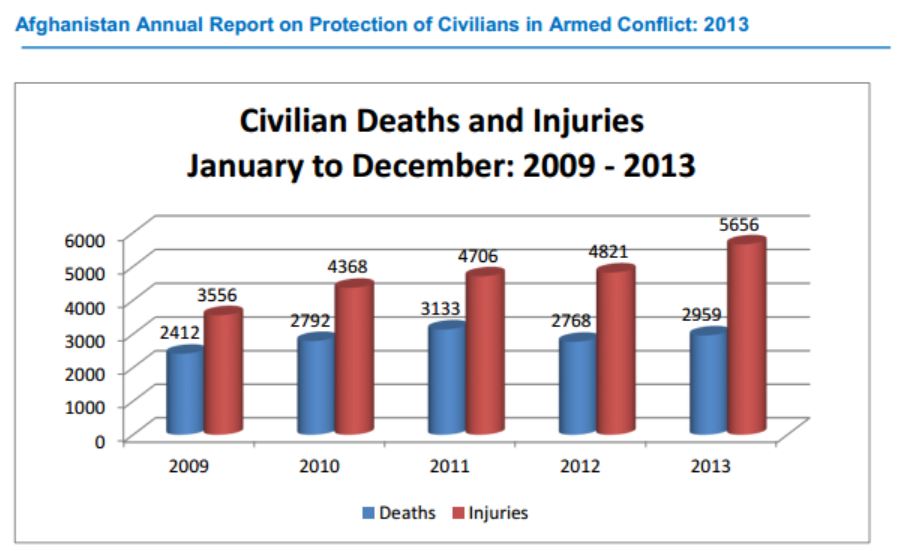
UNAMA 2013

Click on image for a larger view.

The United Nations is the best source of information on the impact of the war in Afghanistan on civilians. They released their latest data this weekend (pdf), and their results show that the vaunted “surge” of US troops into the country in early 2010 through late 2012 failed to protect civilians. In fact, the data show that civilian injuries have shown a steady rise from 2009 pre-surge levels through 2013’s post-surge period. Civilian deaths rose in 2010 and 2011. They went down slightly in 2012 before rising again in 2013.

Despite this clear indication that the surge was a waste of lives and money, recall that the Pentagon continued to spew its positive spin as troops were drawn down. From September, 2012 as the surge ended:

Very quietly, the surge of troops into Afghanistan that President Obama announced to such fanfare in late 2009 is now over.

Defense Secretary Leon Panetta said today that 33,000 troops have been withdrawn, calling the Afghan surge “a very important milestone” in a war the Obama administration is winding down; there are sill 68,000 U.S. troops in Afghanistan.

The “surge did accomplish its objectives of reversing the Taliban momentum on the battlefield and dramatically increase the size and capability of the Afghan national security forces,” Panetta said.

As seen in the UN data, the surge did nothing to reverse attacks on civilians, with civilian casualties continuing a steady increase. How about Panetta’s other claim, the one about dramatically increasing the size and capability of Afghan national security forces? To answer that, we depend on data supplied by the Special Inspector General for Afghanistan Reconstruction. Their latest report can be found here (pdf). Once again, the target for ANSF size was not achieved, even after moving the goalposts (footnotes removed):

This quarter, ANSF’s assigned force strength was 334,852, according to data provided by CSTC-A. This is short of the goal to have an end strength of 352,000 ANSF personnel by October 2012. That goal had been in the Department of Defense’s (DOD) April 2012 Report on Progress Toward Security and Stability in Afghanistan. When that end strength was not met, DOD revised the goal to 352,000 ANSF by 2014 (187,000 ANA by December 2012, 157,000 ANP by February 2013, and 8,000 Air Force by December 2014). Neither the ANA nor the ANP met their end-strength goal by the revised deadline, as shown in Table 3.6.

But the reality could be far worse than those numbers indicate. While the force size falls just barely short of the target, the functionality of those troops is suspect. Further, it appears that Afghanistan may be playing games with the meaning of “available” (sorry, this bit of text won’t copy, so I have to use images instead): Read more

Share this entry

Breaking: Four Senators Rediscover Congress Has Oversight Role for Committing Troops

Don’t look for this important bit of news in the New York Times or Washington Post. At least at the time I started writing this, they hadn’t noticed that Senators Jeff Merkley, (D-OR), Mike Lee (R-UT), Joe Manchin (D-WV), and Rand Paul (R-KY) put out a press release yesterday calling for a Congressional vote on whether to authorize keeping US troops in Afghanistan beyond 2014. President Barack Obama and the Pentagon have been bargaining with Afghan President Hamid Karzai for over a year now to get a Bilateral Security Agreement that will authorize keeping US troops there after the current NATO mission officially ends at the end of this year, but we have heard almost nothing at all from Congress. Well, we did have some hypocrisy tourists calling for Karzai to sign the agreement immediately or suffer the financial consequences, but they didn’t call for using their Constitutional role in authorizing use of troops.

This bipartisan group had some pretty strong language about the push to exclude Congress from the decision-making on keeping troops in Afghanistan:

Today, Senators Jeff Merkley (D-OR), Mike Lee (R-UT), Joe Manchin (D-WV), and Rand Paul (R-KY) announced the introduction of a bipartisan resolution calling for Congress to have a role in approving any further United States military involvement in Afghanistan after the current mission ends on December 31, 2014. The Administration is reportedly negotiating an agreement that could keep 10,000 American troops or more in Afghanistan for another ten years.

“The American people should weigh in and Congress should vote before we decide to commit massive resources and thousands of troops to another decade in Afghanistan,” Merkley said. “After over 12 years of war, the public deserves a say. Congress owes it to the men and women in uniform to engage in vigorous oversight on decisions of war and peace.”

“After over a decade of war, Congress, and more importantly the American people, must be afforded a voice in this debate,” Lee said. “The decision to continue to sacrifice our blood and treasure in this conflict should not be made by the White House and Pentagon alone.

“After 13 years, more than 2,300 American lives lost and more than $600 billion, it is time to bring our brave warriors home to the hero’s welcome they deserve and begin rebuilding America, not Afghanistan,” Manchin said. “We do not have an ally in President Karzai and his corrupt regime. His statements and actions have proven that again and again. Most West Virginians believe like I do money or military might won’t make a difference in Afghanistan. It’s time to bring our troops home.”

“The power to declare war resides in the hands of Congress,” Paul said. “If this President  or any future President has the desire to continue to deploy U.S. troops to this region, it should be done so only with the support of Congress and the citizens of the United States.”

After 12 years and hundreds of billions of dollars spent, the Administration has declared that the war in Afghanistan will be wound down by December 31, 2014. However, the Administration is also negotiating an agreement with the Government of Afghanistan that would set guidelines for U.S. troops to remain in training, support, and counter-terrorism roles through at least 2024.

In November, the Senators introduced this bill as an amendment to the Defense Authorization bill, but it wasn’t allowed a vote. In June, the House of Representatives approved a similar amendment to the NDAA stating that it is the Sense of Congress that if the President determines that it is necessary to maintain U.S. troops in Afghanistan after 2014, any such presence and missions should be authorized by Congress.  The House amendment passed by a robust, bipartisan 305-121 margin.

But Merkley added yet another zinger. From the AFP story on the move, as carried in Dawn (emphasis added):

“We are introducing a bipartisan resolution to say before any American soldier, sailor, airman or Marine is committed to stay in Afghanistan after 2014, Congress should vote,” Democratic Senator Jeff Merkley told reporters.

Automatic renewal is fine for Netflix and gym memberships, but it isn’t the right approach when it comes to war.

Wow. What a concept. Read more

Share this entry

Afghanistan, Pakistan Peace Talks With Taliban Continuously Marred by Posturing, Intervention

For both Afghanistan and Pakistan, the prospect of a future not marred by terrorist attacks is a strong incentive to explore peace talks with the Taliban groups that have fueled the bulk of the violence in both countries. Over the past few years, there have been many attempts to start such talks, but these efforts have not been successful so far. At times, one or more of the many sides involved in the talks has proposed an opening stance that was known to be untenable to another side. Also, parties not involved in particular sets of talks have taken active steps to derail them, such as when Karzai went ballistic over the sign on the door of the Taliban office in Doha (disrupting US-Taliban talks) and a US drone strike took out Hakimullah Mehsud just before he joined a set of talks in Pakistan (disrupting Pakistan-Taliban talks).

Today’s New York Times informs us that Hamid Karzai has been secretly working to establish talks with the Afghan Taliban since announcing in November that he would not sign the Bilateral Security Agreement even though his own loya jirga urged him to do so. This disclosure, mostly communicated to the Times through anonymous sources, but confirmed by Karzai spokesman Aimal Faizi, seems to account for a fair amount of Karzai’s behavior while refusing to sign the BSA and taking repeated steps that seem aimed at creating more friction between the US and the Karzai government.

Those providing the new narrative to the Times paint the talks between Karzai and the Taliban as not getting beyond initial contact and into discussion of substantive issues. The reasoning, according to these sources, is that by merely maneuvering Karzai into refusing to sign the BSA, the Taliban can achieve their primary goal of getting the US out of Afghanistan completely, so they would have no incentive to enter into an actual peace agreement with Karzai:

Western and Afghan officials, who spoke on the condition of anonymity because of the private nature of the peace contacts, said that the outreach was apparently initiated by the Taliban in November, a time of deepening mistrust between Mr. Karzai and his allies. Mr. Karzai seemed to jump at what he believed was a chance to achieve what the Americans were unwilling or unable to do, and reach a deal to end the conflict — a belief that few in his camp shared.

The peace contacts, though, have yielded no tangible agreement, nor even progressed as far as opening negotiations for one. And it is not clear whether the Taliban ever intended to seriously pursue negotiations, or were simply trying to derail the security agreement by distracting Mr. Karzai and leading him on, as many of the officials said they suspected.

So we now have a complete reversal of stances from early last summer. Recall that US diplomats had quietly worked for over a year to establish talks with the Taliban, with the Taliban going so far as to open an office in Doha. However, Karzai felt that the office presented too many of the trappings of a government in exile and he managed to scuttle those US-Taliban talks. I held out hope for the ascendance of a more moderate faction of the Afghan Taliban in the aftermath of that fiasco. Whether the secret approach to Karzai came from these more moderate elements is an interesting question worth considering, especially since only a few month elapsed between Karzai’s tantrum over the office in June and the secret communications starting in November. At any rate, we have gone from the US appearing to promote the talks and Karzai disrupting them to Karzai promoting talks and the US releasing information that seems aimed at scuttling them.

If the US truly cared about bringing peace to Afghanistan, an interesting new bargaining position would be to threaten both Karzai and the Taliban that they intend to stay in Afghanistan beyond the end of the year even if Karzai doesn’t sign the BSA, but that if a peace agreement is reached, the US would leave and provide a portion of the funding that the US now dangles as incentive for signing the BSA. Such a position by the US would allow the Taliban and Karzai to unite behind their one common goal–the removal of all US troops. With public opinion of the US effort in Afghanistan at an all-time low, promoting a full withdrawal would be a welcome development in the US.

Meanwhile, in Pakistan, the issue of peace talks with the Taliban is as muddy as it is in Afghanistan. Consider how the first screen of today’s Washington Post story on the talks loaded on my phone this morning: Read more

Share this entry