Body of Zakaria Kandahari’s Videotaped Torture Victim Surfaces, 200 Yards from US Nerkh Base

When last we left the saga of the US role relating to the “rogue” Afghan death squad in the Nerkh District of Maidan Wardak province of Afghanistan, the New York Times was studiously transcribing denials from various US government officials of any US involvement  in the torture, disappearances and murders that are both the touchstone of US-trained death squad operations dating back at least to Central America in the 1980’s (if not all the way back to Vietnam) and the atrocities that prompted Hamid Karzai to announce that he was expelling US Special Forces from the province. Although Karzai eventually relented somewhat and agreed to only expel US Special Forces from the Nerkh District instead of the entire province, as I pointed out in my post on the Times’ transcription of US denials, evidence continues to accumulate that CIA paramilitary operations personnel almost certainly seem to have been involved in the training and deployment of the “rogue” Afghan Local Police unit based in Nerkh. With today’s new development, it seems very likely that these CIA paramilitary personnel (and their Afghan trainees) are still operating, with impunity, at the Nerkh base.

What we learn today is stunning and looks like a calculated move intended to strike fear into the local population around the Nerkh base (which is, of course, the aim of US-trained death squads organized under the COIN rubric). From the New York Times:

Family members on Tuesday found the body of a man missing since last November near the American Special Forces base to which he was last seen being taken, according to Afghan officials and victims’ representatives.

Afghan investigators said that after his disappearance, the man, Sayid Mohammad, was seen in a video undergoing torture at the hands of an Afghan-American named Zakaria Kandahari, who was the chief translator for an American Army Special Forces A Team stationed at the base in the Nerkh district of Wardak Province.

Mr. Mohammad’s body was found about 200 yards outside the perimeter of the Nerkh base, which is now occupied by Afghan special forces after the American unit was removed following protests by Afghan officials, including President Hamid Karzai.

Relatives of Mr. Mohammad said his body was largely intact but both of his feet had been cut off. They took his remains to the Nerkh district government center in protest. The partial remains of another missing person were also found near the base, family members and Afghan officials have said.

The article is silent on the question of how long the victim appeared to have been dead. Note that the Times reminds us that the Nerkh base no longer has US Special Operations Forces. I find it very hard to believe that a group of Afghan Local Police and Afghan Special Forces, after having drawn so much local anger and international attention to themselves through prompting Karzai’s outburst and expulsion of US Special Forces, would carry out such a brazen and brutal move on their own. However, if CIA paramilitary operatives are still present at the base and still directing (and protecting) the Afghan team, the move seems less surprising.

We also learn in today’s article that at least 17 people are now known to have been disappeared by this death squad. Nine of those victims have been found dead and eight are still missing. Afghan investigators are considerably less credulous of US denials of involvement than the Times is:

“There is no question that Zakaria directly tortured and murdered,” the investigator said. “But who is Zakaria? Who recruited him, gave him his salary, his weapons? Who kept him under their protection? He worked for Special Forces. That a member of their team was committing such crimes and they didn’t know it is just not credible.”

The description of the videotape of the torture session conducted by Kandahari (which still has not been released) has changed in one respect. Today’s article informs us that the Afghan investigator who was interviewed now says there were no voices with American accents on the tape.

Not that it really needs pointing out, but involvement of CIA paramilitary personnel at the Nerkh base would by definition be a covert mission covered by false, but official US government denials.

Oh, and there’s one last question I would have added to the Afghan investigator’s list above: Who helped Zakaria Kandahari to escape without a trace?

The answers to those questions would go a long way toward confirming or denying my speculation on CIA paramilitary personnel (including contractors) being central to these awful events.
Share this entry

State Department, US Press Hide Important Karzai Statement on Bilateral Security Agreement

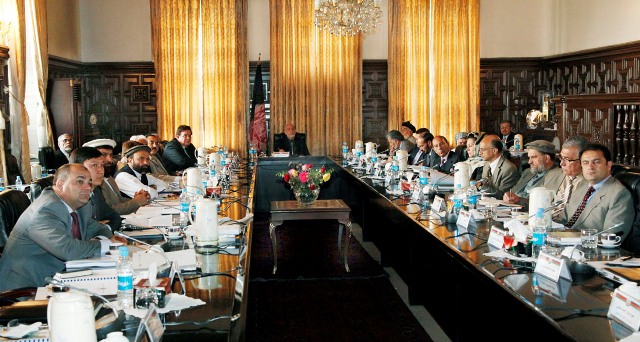
Karzai addressing his cabinet. Photo is from the web posting of Karzai's statement on the Bilateral Security Agreement.

Karzai addressing his cabinet. Photo is from the web posting of Karzai’s statement on the Bilateral Security Agreement.

Although there really is only one controlling issue in the quest to sign a new SOFA (Status of Forces Agreement) BSA (Bilateral Security Agreement) governing US troops in Afghanistan after official NATO actions conclude at the end of next year, Afghan President Hamid Karzai seems to be taking perverse pleasure in taking sweeping actions and making broad statements that seem to alternately encourage and then discourage those seeking to finalize the agreement. As I explained late last year, the US will keep troops in Afghanistan after 2014 only if they are granted criminal immunity. Without immunity, the US will withdraw fully just as it did in Iraq when immunity was denied there.

Recall that Karzai called for all US Special Forces to leave Maidan Wardak province back in late February. Just about three weeks later, he appeared to relent somewhat and it appears that SOF only left one district. On May 9, Karzai surprised everyone by announcing that the US could maintain nine bases in Afghanistan after 2014, apparently catching the US off-guard. In response, the US claimed they want to house troops at Afghan bases, because there is no desire for permanent US bases in Afghanistan.

Lest those negotiating the agreement get too encouraged by the base proposal, though, Karzai has now placed what appears to be a completely impossible precondition on signing the agreement, but citizens in the US would be hard-pressed to know anything about it. At the State Department briefing on May 17, there was an acknowledgement that Karzai had released a statement, but we don’t learn what Karzai actually said from the exchange with a reporter:

Walitz, do you have something?

QUESTION: Afghanistan.

MS. PSAKI: Mm-hmm.

QUESTION: President Karzai’s office issued a brief statement today that he spoke to Secretary Kerry. Do you have any details on the readout, what were the issues they discussed?

MS. PSAKI: I do, I do.

QUESTION: Thank you.

MS. PSAKI: So Secretary Kerry spoke this morning with President Karzai. They discussed our joint progress on the bilateral security agreement, border issues, and the status of the ongoing peace process. Secretary Kerry also affirmed that he and President Karzai remain committed to the same strategy and the same goal of a stable, sovereign Afghanistan, responsible for its own security and able to ensure that it can never again be a safe haven for terrorists.

QUESTION: Do you know when this BSA will be signed? What’s the status on that?

MS. PSAKI: I don’t have any specific update on that. Again, it’s obviously something that we continue to work on, work very closely on at many levels with the Government of Afghanistan.

So neither Jen Psaki, the State Department spokesperson, nor the reporter referred to as Walitz bothers to actually mention what Karzai said in his statement that was released. Here is what Karzai’s statement says regarding the bilateral security agreement:

On the bilateral security agreement that the United States is seeking to sign with Afghanistan at the soonest, President Karzai has said to the US Secretary of State that Afghanistan would sign the agreement only if conditions of the Afghan people were accepted and the first precondition is to bring peace and to end war in Afghanistan.

President Karzai clarified to John Kerry, it was impossible for the people of Afghanistan to be pleased with signing of the security agreement whereas violence and war continue in the country.

The President said to the Cabinet meeting that the security agreement if signed without the return of peace, and with continuation of violence and bombings means that the people of Afghanistan would continue to suffer every day from blasts, terrorist attacks and foreign invasions.

President Karzai added, the fundamental precondition of Afghans for the agreement is bringing peace, security and stability to Afghanistan if this is fulfilled, then the Afghan people would agree with signing of the agreement with the United States.

Just wow. Karzai has said he will not sign the agreement while “violence and war” continue in Afghanistan, and neither the “press” nor the Department of State “spokesperson” found it necessary to put that particular tidbit into the public record. I can find no reports on Karzai’s statement in the US press. It has been reported by ToloNews in Afghanistan. It would appear that when the State Department gives its own “readout” on a conversation, it is very important to check other original sources for what really took place in the conversation.

[Brief note on dates: the reporter mentions that Karzai’s office released a brief statement “today” that Karzai had spoken to Kerry. From the records I can find, this press briefing took place at 12:30 pm in Washington on May 17, which would be 9 pm in Kabul on the same day. The statement from Karzai’s office that I quote here is dated May 18, so it is unclear whether Walitz had seen the full Karzai statement at the time the question was posed. I can find no reference to the Karzai-Kerry conversation on the Karzai website that is dated May 17.]

Share this entry

Group Behind Deadly Kabul Blast Upset by Negotiations on US Troops Remaining in Afghanistan

There was a deadly blast in Kabul yesterday, shattering what had been several months of relative peace in the capitol. The suicide blast targeted a convoy of US vehicles. From the New York Times:

Hezb-i-Islami, a relatively small insurgent faction that often competes with the Taliban for influence, claimed responsibility for the attack, which also wounded more than three dozen Afghans. Haroon Zarghon, the group’s spokesman, reached by telephone in Pakistan, said the bombing was carried out by a 24-year-old man who had grown up south of Kabul.

More attacks against Americans will come soon, Mr. Zarghon added, saying that Hezb-i-Islami was dismayed by the current talks between Afghanistan and the United States about a long-term security deal under which thousands of American soldiers could be based in Afghanistan for years to come.

Hezb-i-Islami has a complex history and has been around Afghanistan for a long time. Even Kimberly Kagan’s Instutite for the Study of War admits that the CIA funneled significant support to this group in fighting the Soviets:

Hizb-i-Islami Gulbuddin (HIG), led by Gulbuddin Hekmatyar, is an insurgent group active in Afghanistan. It is a splinter group of one of the prominent , and the most radical of the seven mujahedeen factions fighting the Soviets in the 1980s. Hekmatyar , a favorite of the CIA and Pakistan’s Inter-Services Intelligence (ISI) Directorate, received the greatest portion of foreign assistance to the mujahedeen.  Hekmatyar trained Afghan and foreign guerilla fighters in the refugee camps of Shamshatoo and Jalozai in Pakistan’s Northwest Frontier Province (NWFP) and also ran numerous schools and hospitals in NWFP. His organization  also received funds from Saudi charity organizations, Muslim Brotherhood, al-Qaeda leader, Osama Bin Laden, and other wealthy Arabs.

The political side of the group, however, is active in the current government and is contemplating fielding a candidate for the upcoming Presidential elections:

The party’s deputy chief Ghairat Bahir said that a delegation of four senior party figures are in Kabul meeting local members to discuss the election and possible presidential candidates.

“We have sent a delegation to Kabul. The delegation is led by Mohammad Rassoul. Its purpose is to visit and discuses [sic] with Hezb-e-Islami members in Kabul, not to talk with [Afghan] government officials,” he told TOLOnews via telephone from Pakistan.

“The delegation has talked with the party members about the election and the party decided to introduce a candidate or support a competent candidate. We will soon make a final decision on this. I cannot name the candidate but our party’s nomination will be a prominent person in the country,” Bahir said.

The presence of US troops in Afghanistan is the primary concern for the group: Read more

Share this entry

What Is the Attrition Rate for Afghan Special Operations Forces?

Yesterday, Major General Tony Thomas, who heads US Special Operations Forces in Afghanistan, fielded questions via satellite from a number of reporters gathered in Washington. The transcript of the session can be found here. One claim by Thomas that stood out to me as  I listened was an assertion that Afghan Special Operations Forces do not suffer the same high level of attrition that is seen generally for ANSF. Here is the exchange, where Thomas’ response to the first half of the question has been edited out and emphasis has been added:

 Q: General, it’s Luis Martinez with ABC News. Can I ask you about what your command’s role is going to be after 2014? What — will there be a shift in emphasis? What exactly will your operators be doing?

And also, the Afghan national army as a whole seems to suffer from attrition and retention problems. How does that manifest itself in the commando kandaks, if at all?

MAJ. GEN. THOMAS:

/snip/

We are not suffering similar attrition or, as we prefer to look at it, retention challenges with the commandos and with other formations. But again, here again, we’re lucky. We’ve been working with them for a while. They are on a cycle which has a built-in break, so it’s a great, amber, red cycle, where green, combat is on the schedule, they are going into operation and they know that they’ll have, you know, a — they’ll be applied in the hardest possible scenarios. But on the other cycles, they’ll have a chance to recoup, take leave. They’ll also have a chance to train as they come back into green cycle.

And I know that others are attempting to apply that same cycle to the rest of the force. That’s been the great challenge for the rest of the Afghan security forces, is they’re almost in a relentless combat cycle, and it’s breeding some of the retention challenges. But we are — we are looking to fix that over time, and, again, the special operations example is applicable to the rest of the force. We just need to bring that into line.

I noted at the time Thomas said this that it should be fairly easy to fact-check Thomas on his claim that Afghan Special Forces do not suffer the same high attrition rate as the rest of ANSF. One reason for my thinking this is that Afghan Special Forces are not nearly as highly trained as US Special Forces. There is only a twelve week extra training period for Afghan troops to be classified as special. I have a hard time seeing how such a short period of additional training will add significantly to retention rate.

If we look fist to Defense Department claims only, the most recent Report on Progress Toward Security and Stability in Afghanistan (pdf), dated December 2012, has this paragraph (emphasis added):

ANASOC continues to develop its institutional capacity to conduct training programs. Currently, a majority of courses taught at the Division School of Excellence are Afghan-led, with minimal Coalition Force oversight. The ANASOC has produced 11,710 Commandos and 955 ANASF. Graduation rates for both CDO and SF operators remained steady and are on schedule to meet end-strength targets. From April through September 2012, the School of Excellence produced a total of 621 new CDO, and 282 new SF operators. Based on current recruiting and graduation trends, ANASF are anticipated to achieve their end-strength force level of 1,863 personnel by the 4th quarter of 2013. ANA Commandos (ANACDO) are currently at their endstrength force level of 12,525. Staff training at all levels is occurring through uniformed and civilian mentorship programs; the target of ANASOC reaching FOC for all units is 2014, with the exception of the SMW.

There are several different categories of ANSF troops described in the paragraph, but from the context of Thomas’ remarks and the reports analyzed here, the category of commando is what is relevant. Note that this Defense Department report claims 621 new commandos trained in an approximately five month period and that the commandos are at the endstrength force level of 12,525.

However, if we check these numbers against the more independent information from the Special Inspector General for Afghanistan Reconstruction, we find both Thomas’ claim of low attrition for commandos and the current force level for commandos in the Defense Department report to be misleading. Read more

Share this entry

Declaring “Wars” the President Didn’t Ask For

I’ll probably have a few posts on Harold Koh’s speech opposing what he calls the “Forever War” at the Oxford Union. For now, I want to look at his argument against a new Authorization to Use Military Force.

I strongly disagree with those who claim that new legislation is now necessary to authorize the Administration to fight against new enemies. The burden of proving that such legislation would be either necessary or wise should fall on the proponents. As a lifelong international and constitutional lawyer who has worked on these legal issues for a decade, I see no proof that the U.S. lacks legal authority to defend itself against those with whom we are genuinely at war or who pose to us a genuine and imminent threat. Significantly, Congress has never declared war against an enemy when the President has not asked for such a declaration. Nor would adopting new domestic legislation make actions in preemptive self-defense lawful under international law. And unless we can clearly define just who the new enemies are–and why existing legal authorities are insufficient to defend ourselves against them–we have no basis for passing new laws that would perpetuate the Forever War against shadowy foes whose association with those who have attacked us on 9/11 cannot be proven.

It’s hard to tell where the boundaries between good faith and deception lie here. After all, in several places in the speech — including this passage purportedly distinguishing what Obama has done from what Bush did — Koh’s language admits the possibility that Congressional sanction for military force is not the only authority Obama is working with (though he does admit that Congressional authority is one source of authority).

First, the Obama Administration has not treated the post-9/11 conflict as a Global War on Terror to which no law applies, in which the United States is authorized to use force anywhere, against anyone. Instead, it has acknowledged that its authority under domestic law derives from Acts of Congress, not just the President’s s vague constitutional powers.

And so when he says things like “I see no proof that the U.S. lacks legal authority to defend itself against those with whom we are genuinely at war or who pose to us a genuine and imminent threat,” it seems likely he’s preserving the ability to rely on Article II authority for something called an “imminent threat.” The same is true when he invokes “existing legal authorities” when he talks about fighting people who are clearly not Al Qaeda.

In other words, even while he seems to be opposed to treating our newer enemies as war opponents, he also seems to be reserving the right to rely on Article II authority to go after them. Which is not necessarily a better proposition for those who truly value other tools rather than killing.

That’s why I’m struck by this sentence.

Significantly, Congress has never declared war against an enemy when the President has not asked for such a declaration.

What Koh seems to be worried about is shifting the balance of the Youngstown test — whether Presidential power is expansive or limited — of the AUMF itself (Koh pretends authorizing military force is the same thing as declaring war, but in any case, last I checked, the authority to declare war belonged to Article I).

That’s true, first of all, because the way the existing AUMF was written — which allows the President to determine the enemy and has been interpreted consistently but wrongly as authorizing war powers here in the US. A new AUMF might (though probably wouldn’t) explicitly clarify the limits to war powers in the US or at least with US citizens.

But as even the 2012 NDAA showed, it can work the other way, with Congress requiring that Obama default to military detention and commissions with any new terrorist suspects. Mind you, Obama took the limits on what he could do in Gitmo far, far more seriously than he did the requirement that DOD give every one of its detainees a meaningful review, so he’s already picking and choosing what legislative requirements he fulfills. But in theory at least, Congress can mandate the President treat certain targets as enemies of war, rather than criminals.

But that, it seems to me, is ultimately what this debate about a new AUMF comes down to. Koh and, presumably, others who have served the President won’t want Congress to change the delicate balance that offers the President a great deal of flexibility to operate under both the AUMF and Article II. And to some degree, they’re right to worry about what batshit stuff the Lindsey Grahams of the world will mandate. But I suspect they’re just as worried that a new AUMF will put real limits to the President’s current fairly unlimited authority.

Look, I don’t trust Congress to write a new AUMF either. If they do one, it’s going to contain all manner of batshittery.

But bizarrely, in our crazy world, passing a new one might actually be a more effective way to limit what the President can and can’t do as anything else that has been tried. If we want to force the Executive Branch to stop waging war against Americans in America, we’re going to have to do so explicitly.

Share this entry

Dunford Once Again Shows Complete Lack of Budget Awareness

When we last heard from General Joseph (We Are Winning in Afghanistan, We Really Are!) Dunford, he was showing total incompetence in terms of budget awareness in front of the Senate Armed Services Committee. Defense Secretary Chuck Hagel had announced on March 28 that DoD was $7 billion over budget in Afghanistan. By the time Dunford was asked about the over-budget situation during the hearing on April 16, Mike Lee stated that the overage had grown to $10 billion. Despite being in charge of US and NATO troops in Afghanistan, Dunford professed complete ignorance of the over-budget situation. That is a stunning lack of situational awareness for someone who is supposed to be in charge. After bumbling on a bit, Dunford did promise to eventually get back to Lee on the budget issue.

It would appear that even if he has gone back and looked over his own money management failures, Dunford has looked no further than the DoD budget. The New York Times posted a story yesterday based on an interview with him, and Dunford made another statement that is mind-boggling in terms of its lack of awareness of budget realities for the region. Recall that back in February, NATO defense ministers proposed that instead of allowing Afghan National Security Forces to drop by about a third after the end of 2014, the full force size of “352,000” (that’s in quotes because I think the SIGAR audit is going to finally destroy the 352,000 force size myth) should be maintained through at least 2018. My response to this suggestion was that it appeared to be a $22 billion bribe being offered to Afghan authorities in return for their agreeing to a Status of Forces Agreement that would grant criminal immunity to US forces remaining after the end of the official NATO mission at the end of 2014.

In the interview with the Times, Dunford continued his previous agreement with the concept of extending the time frame for the larger ANSF force size, but then made a suggestion that is stunningly stupid regarding how the extended force size should be funded:

He has concluded as well that plans to reduce the number of Afghan security forces — the army and police combined — to 228,000 after 2015 from the current target level of 352,000 are not realistic, given the threats in the country. “The consensus now both from the Afghans and certainly from us is that we ought to sustain that for some period time to come,” said General Dunford, referring to the 352,000 head count.

What is less clear is how such a force could be paid for. The international community, led by the United States, has agreed to pay roughly $4.1 billion in aid per year for the Afghan security forces after 2014, based on estimates of what a smaller Afghan security contingent would cost. If the Afghans want to keep a larger force, they will either have to field a cheaper army and police force or come up with more money themselves to pay for it. General Dunford suggested that the Afghans could economize, although he did not give examples of where they might find the savings.

That’s right. A totally dysfunctional, stunningly corrupt government should just somehow “economize” and find an additional $22 billion to fund a mythically large defense force.

Oh, and just like his own war effort in Afghanistan that has been mis-managed into a huge budget deficit, if Dunford only read the New York Times, he would be aware that the IMF has found Afghanistan’s government to be facing a serious budget shortfall:

The Afghan government is supposed to cover less than half its own bills this year, yet achieving even that modest goal is proving an unexpected challenge, Afghan and Western officials said.

A confidential assessment of Afghan finances by the International Monetary Fund said the potentially severe cash crunch was caused by widespread tax evasion abetted by government officials, the increasing theft of customs revenues by provincial governors and softening economic growth.

The I.M.F. assessment, which has not been publicly released but was described by American and European diplomats who were recently briefed on its findings, estimated that Afghan revenue in the first quarter of the year was roughly 20 percent to 30 percent short of an informal target the fund had set for the government.

Yeah, sure. With revenues already 20 to 30 percent short of projections, that’s a government that can just poke around a bit and find another $22 billion in the SOFA.

Share this entry

The Folks Who Brought You Military Detention in the NDAA Are Rewriting the AUMF

Yesterday, the Senate Armed Services Committee announced a hearing to revisit the 2001 Authorization to Use Military Force. In addition to a bunch of DOD figures (but not the recently departed Jeh Johnson, the DOD-connected person who said the most interesting things about the AUMF), it’ll have (I’ve linked their most salient comments on the AUMF):

Rosa Brooks, Professor of Law, Georgetown University Law Center

Geoffrey Corn, Professor of Law, South Texas College of Law

Jack Goldsmith, Professor of Law, Harvard Law School

Kenneth Roth, Executive Director, Human Rights Watch

Charles Stimson, Manager, National Security Law Program, The Heritage Foundation

Curiously, John Bellinger who (as far as I understand) started the discussion of a new AUMF is not slated to testify. Also note that the Deputy Director of Special Operations for Counterterrorism will testify, but no one from CIA is scheduled to; while JSOC can operate under the President’s inherent authority, it likely prefers the legal cover of an AUMF (and therefore may be one of the entities pushing for an AUMF that matches reality on the ground).

Politico reports that this hearing is more than speculative: Levin and no-longer-SASC-Ranking-Member-but-he-might-as-well-be John McCain are planning to rewrite the AUMF, with help from Bob Corker, Dick Durbin, and Lindsey “all detainees must be military” Graham.

And if the inclusion of Graham in that group doesn’t scare you, remember that this crowd is substantively the same one that enshrined military detention in 2012’s NDAA. While that effort might be regarded as “reasonable” Carl Levin and John McCain’s attempt to present something more reasonable than House Armed Services Committee Buck McKeon was pushing for, and while the NDAA originally included exceptions for US citizens, in the event, the White House pushed Carl Levin to effectively rubber stamp its claims to unlimited authority, including detaining (or killing) US citizens.

And if that doesn’t have you worried enough about this effort, consider this quote, which mocks the contributions Rand Paul or Ted Cruz might make to this debate.

“Can you imagine what Paul or Cruz would do with this?” said one top Democratic aide. “It could be a disaster. And it would be worse in the House.”

As a threshold matter, a top aide who can’t distinguish between Paul’s more heartfelt libertarianism from Cruz’ authoritarianism pretending to be libertarianism is a concern. But to call the influence of both as “a disaster” is troubling.

Ultimately, though, what is likely to happen with this debate is that all players will be unwilling to discuss openly what we’ve actually been doing in the name of war against al Qaeda, up to and including waging war in the “homeland.”  That’s one thing the 2001 AUMF was written to exclude. And I can almost guarantee you, it’s an authority the President — and the top Democratic aides who mock Rand Paul — will want to preserve.

Share this entry

Even With Non-Validated Afghan Self-Reporting, SIGAR Finds ANSF Falls Short of 352,000 Goal

A central tenet of DoD dogma regarding withdrawal of US troops from Afghanistan rests on Afghan National Security Forces reaching a force size of 352,000 and taking over full responsibility for security in the country as US forces leave at the end of 2014. There are multiple problems surrounding the myth of ANSF force size of 352,000. As reported last quarter by the Special Inspector General for Afghanistan Reconstruction (SIGAR), the “official” force size reported by DoD relies on self-reporting by Afghanistan and can not be validated. Further, NATO ministers proposed back in February that financial support for the 352,000 size should be extended through 2018, rather than allowing the force size to drop by about a third at the end of 2014. I equated this offer to dangling an extra $22 billion in front of Afghan government officials for embezzling in return for a grant of criminal immunity for US forces remaining behind after the official withdrawal.

SIGAR released its latest quarterly report yesterday (pdf), covering the first quarter of 2013, and we see that the problems surrounding the myth of 352,000 ANSF force size persist and show no prospect of improving.

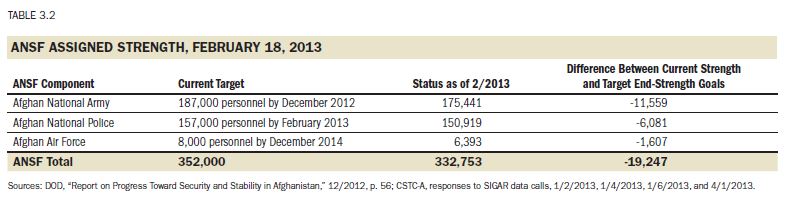
From the report, we see that even with Afghanistan self-reporting in an unvalidated way, and with US goals clearly known, force size falls short of the goal:

ANSF force size

Although the reported force size is only about 5.5% below the goal, it seems remarkable that Afghan officials developing their own numbers in a non-validated way were not able to reach the goals that are clearly known to them.

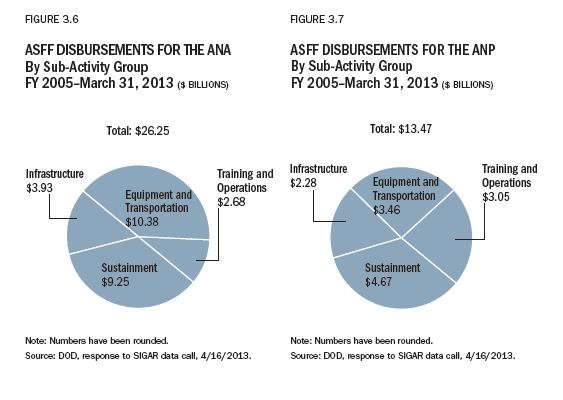
This process of developing the ANSF has drawn the largest portion of US funds that have been allocated to Afghanistan. Here is how funds have been allocated since the beginning of the Afghan war:

As of March 31, 2013, the United States had appropriated approximately $92.73 billion for relief and reconstruction in Afghanistan since FY 2002. This total has been allocated as follows:

• $54.27 billion for security
• $22.97 billion for governance and development
• $6.39 billion for counter-narcotics efforts
• $2.43 billion for humanitarian aid
• $6.66 billion for operations and oversight

Of all the funds allocated to Afghanistan by the US, over half have gone to developing ANSF. Here is how security money breaks down from 2005 to the present time:

ASFF breakdown

Note that since the beginning of the 2005 fiscal year, we have provided nearly $14 billion in salaries for troop sizes that are self-reported in a non-validated system and therefore ripe for embezzlement. Further, another $13.8 billion was provided for “equipment and transportation” of ANSF, which would also seem a good source for corruption. That is a huge amount of money and it appears to be very poorly spent, given the lack of preparedness for ANSF.

SIGAR calls DoD into question on its claims that the 352,000 ANSF force size has been met: Read more

Share this entry

CIA Bags O’ Cash Total Tens of Millions of Dollars, But Over $4.5 Billion Left Afghanistan in 2011

Today’s New York Times carries a frank exposure of blatant moves by the CIA to curry favor with Hamid Karzai and high ranking members of Afghanistan’s government through direct cash payments brazenly dropped off at Karzai’s office:

For more than a decade, wads of American dollars packed into suitcases, backpacks and, on occasion, plastic shopping bags have been dropped off every month or so at the offices of Afghanistan’s president — courtesy of the Central Intelligence Agency.

All told, tens of millions of dollars have flowed from the C.I.A. to the office of President Hamid Karzai, according to current and former advisers to the Afghan leader.

Perhaps the most disturbing aspect of these cash payments is that they seem to have been designed in large part to pay off Afghan warlords:

Moreover, there is little evidence that the payments bought the influence the C.I.A. sought. Instead, some American officials said, the cash has fueled corruption and empowered warlords, undermining Washington’s exit strategy from Afghanistan.

And it’s not just any warlords who are being funded by this cash. We learn in the article that the current corruption pay for Rashid Dostum, who committed the largest single war crime in the Afghan war, is now $80,000 per month.

And in the funding of warlords, keep in mind that they form the backbone of David Petraeus’ Afghan Death Squads Local Police under the “direction” of US special operation forces and the CIA. After particularly egregious behavior by one of these groups earlier this year, Karzai first expelled US special forces from Maidan Wardak province and then eventually backed off somewhat on that move. Today’s article suggests that Karzai is trying to play a major role in controlling these groups. Given the main topic of the article, we are left to presume that Karzai’s control is through the allocation of these CIA funds:

Now, Mr. Karzai is seeking control over the Afghan militias raised by the C.I.A. to target operatives of Al Qaeda and insurgent commanders, potentially upending a critical part of the Obama administration’s plans for fighting militants as conventional military forces pull back this year.

Although an off the books cash influence-buying program that has totaled tens of millions of dollars over the course of a decade sounds like a huge scandal, this is chump change compared to the real theft of US funds in Afghanistan. The Special Inspector General for Afghanistan Reconstruction noted in the January, 2013 report (pdf) that huge sums of cash exit Afghanistan through the Kabul airport:

The U.S. government has long had serious concerns about the flow of cash out of the Kabul International Airport. According to the Congressional Research Service, some $4.5 billion was taken out of Afghanistan in 2011.

Where does all this cash come from? The largest flow of money into Afghanistan of course comes from the US and the biggest program we fund there supports Afghan security forces:

The Congress created the Afghanistan Security Forces Fund (ASFF) to provide the ANSF with equipment, supplies, services, and training, as well as facility and infrastructure repair, renovation, and construction.

Here is a figure from the SIGAR report showing how lavishly the ASFF has been filled with US funds: Read more

Share this entry

Feinstein Calls for Review of Her Moratorium on Release of Yemeni Prisoners from Gitmo

Finally sensing that US policy on Yemeni prisoners at Guantanamo is a disaster of epic proportions, and after playing a key role in putting the moratorium on release of Yemeni prisoners into place, Dianne Feinstein on Thursday took the first step toward trying to resolve the crisis before hunger striking prisoners begin to die in large numbers. Feinstein penned a letter to National Security Director Tom Donilon on Thursday, asking for renewed efforts to release those Guantanamo prisoners who have been cleared for release. It is clear that a central step in that process is to review the moratorium on release of cleared Yemeni prisoners.

There is a craven semantics game that is played in the arena of prisoners who have been cleared for release. Government and military officials only ever refer to “detainees” who are cleared for “transfer”, even when those prisoners have been completely cleared of any wrong-doing. Because of that semantics problem, the Guantanamo Review Task Force final report (pdf), issued in January of 2010, provides a muddled description of two groups of Yemeni prisoners who are cleared at various levels for release:

Falling into the category of those who really should be released outright, but classed in the report as “Detainees Approved for Transfer”, we see 29 from Yemen:

29 are from Yemen. In light of the moratorium on transfers of Guantanamo detainees to Yemen announced by the President on January 5, 2010, these detainees cannot be transferred to Yemen at this time. In the meantime, these detainees are eligible to be transferred to third countries capable of imposing appropriate security measures.

A second category of Yemeni detainees cleared for release are those that the government believes still warrant some sort of detention in Yemen. They appear in the category “Detainees Approved for Conditional Detention”:

30 detainees from Yemen were unanimously approved for “conditional” detention based on current security conditions in Yemen.

The status of these prisoners is described further:

After carefully considering the intelligence concerning the security situation in Yemen, and reviewing each detainee on a case-by-case basis, the review participants selected a group of 30 Yemeni detainees who pose a lower threat than the 48 detainees designated for continued detention under the AUMF, but who should not be among the first groups of transfers to Yemen even if the current moratorium on such transfers is lifted.

These 30 detainees were approved for “conditional” detention, meaning that they may be transferred if one of the following conditions is satisfied: (1) the security situation improves in Yemen; (2) an appropriate rehabilitation program becomes available; or (3) an appropriate third-country resettlement option becomes available. Should any of these conditions be satisfied, however, the 29 Yemeni detainees approved for transfer would receive priority for any transfer options over the 30 Yemeni detainees approved for conditional detention.

About that “moratorium” on release of Yemeni prisoners. The review task force report informs us that of 36 Yemeni detainees initially cleared for full release, one was released by court order in September 2009 and another six were released in December 2009. But then the Undie Bomber episode took place on Christmas Day of 2009, and the release of Yemeni prisoners somehow became politically impossible. From the review report: Read more

Share this entry