It’s Like No One Noticed What Happened to Saddam and Qaddafi

I’m just now catching up to the Joby Warrick “explanation” of the Syrian chemical weapons scare from two weeks ago. Particularly coming on the heels of the NYT’s replay of its old Iraq A1 cutout play (see Moon of Alabama on that), I expected to react to it as propaganda first and foremost.

But mostly, I think the story is an awful mess.

A very central part of the story is that no one (“Western” and “Middle Eastern” sources are cited) knows whether Syrians began to mix the chemicals because of an order of Bashar al-Assad or because a rogue officer ordered it.

Intelligence analysts said the orders to prepare the weapons were issued about two weeks ago. They said it was not clear whether the decision came from senior Syrian leaders, possibly including President Bashar al-Assad, or from a field commander acting on his own, the officials said.

Since concerns surfaced in the summer that Syria was moving chemical weapons among several sites across the country, officials in Damascus have repeatedly pledged not to use the banned munitions. After the warnings last week from Obama and other foreign leaders, the Syrian Foreign Ministry repeated that it would not use chemical weapons against the rebel forces.

Still, the discovery that steps had been taken to activate weapons at at least one military base alarmed intelligence officials, because of fears that a single commander could unleash the deadly poisons without orders from higher up the chain of command.

In spite of this reported uncertainty, sources (including Leon Panetta, on the record) act like Assad “got the message.”

“We haven’t seen anything new indicating any aggressive steps to move forward in that way,” Panetta told reporters during a visit to Kuwait. Referring to Obama’s warning to Assad, the defense secretary said, “I like to believe he’s got the message.”

That would seem to indicate a belief, perhaps within the US, that Assad gave the order.

Nevertheless the possibility that a rogue officer might launch a CW attack allows Warrick’s sources to entertain the possibility that a rogue officer would use the weapons while Assad would not because the officer might believe he has nothing left to lose.

“Once you’ve used the weapons, you know the world is coming after you,” the official said. “But if you’re a general and you think you’re not going to survive this, you might not care.”

What?!?!?

The standard treatment by the US for vanquished dictators these days–given the recent history of Saddam and Qaddafi–is a sloppy, humiliating death. Is it really possible that all the anti-Assad intelligence agencies have failed to think through the implications of this? Assad, far more than a rogue General, would have to believe he wasn’t going to live.

Not to mention that the latter half of Warrick’s article suggests why CW would be hard to use effectively in a civil war, with rebels and the regime mixed in close proximity.

Now, for the record, someone (I forget who) floated the idea that if Assad were to use CW, he might be more interested in using them against Turkey, which is the launching pad for this war. None of Warrick’s sources seem to consider that fairly out of the box suggestion. (There’s always the possibility he’d use them as a threat against Israel).

But then there’s the issue I brought up shortly after this happened. The CW mixing happened on November 28. The next day, Syria’s Internet went down (something that goes unmentioned in Warrick’s piece). I suggested in my earlier article that Western assertions that the outage had nothing to do with the CW mixing suggested we, not Assad, brought the Toobz down.

Whether we did or Assad did, though, you’d think this now central concern about rogue officers would have made the Internet outage a really fucking big deal, given that it would have disrupted the command and control that Western intelligence were purportedly already worried about. Nope! We had great visibility, we said.

Oh, did I mention that just after this went down Syria’s Foreign Ministry (the folks who supposedly reassured us on the CW) spokesperson, Jihad Makdissi, defected? You think he might have something to say about the broken Toobz and the alleged CW prep? You think it’s possible he was an asset getting out just after he had carried out two big ops for us, one an InfoOp, the other tactical?

Now, obviously the CW and the Scud missile allegations are designed to gin up a coalition of the willing (and persuade Russia and other members of the coalition of the unwilling) so we can go to war in Syria.

But their narrative is so problematic and dodgy I can’t make sense of whether they really are that stupid or just their narrative is.

Share this entry

Amid Reports of Near Agreement and IAEA, Iran Followup Meeting, Jahn Eats Crow

Despite the best efforts of those who want a military attack on Iran to paint Iran as hiding attempts to develop a nuclear weapon, cooler heads appear to be prevailing as yesterday’s talks in Tehran produced reports of a likely agreement and a follow-up meeting between the IAEA and Iran in only a month. One of the most important signs of progress is that the AP’s George Jahn, who has served as a conduit for many of the most flimsy charges against Iran even gave space at the end of his report today to provide an alternate viewpoint that calls most of his reporting for the past year into significant question.

From Reuters, Fred Dahl (who at times has dabbled in the same rumor-mongering as Jahn, but not as blatantly) reports on the progress made yesterday:

The U.N. atomic agency failed to gain access to a military site in talks with Iran this week but expects to reach a deal in January to resume a stalled nuclear probe, the chief U.N. inspector said after returning from Tehran on Friday.

Even though the International Atomic Energy Agency was not allowed to see the Parchin complex during Thursday’s visit to the Iranian capital, IAEA team leader Herman Nackaerts said progress had been made in the meeting.

/snip/

“We expect to finalize the structured approach and start implementing it then shortly after that,” he said, referring to a framework agreement that would enable the IAEA to restart its investigation into suspected atomic bomb research in Iran.

“We had good meetings,” Nackaerts added. “We were able to make progress.”

It is not just the IAEA who characterized the meeting as productive. From PressTV, we also get positive news from the Iranian side of the meeting:

Earlier, Iran’s Ambassador to the IAEA Ali-Asghar Soltanieh told Press TV that Tehran and the UN nuclear body agreed at the end of the one-day meeting to hold a next round of talks in January.

“This round of talks was constructive and good progress was made,” Soltanieh added.

Adding to the possible momentum generated yesterday, both the Reuters article linked above and this Fars News piece from Iran report that a new round of the P5+1 talks also could be taking place soon.

But perhaps the most encouraging news of all comes from what appears in today’s report from the AP’s George Jahn, who has been at the center of controversy many times during the last year because of the way he publishes “leaked” material coming from countries that favor military action in Iran and who want to disrupt diplomatic negotiations. In today’s story, he does recite some of his litany of charges against Iran and the claims that work at the Parchin military site may have been carried out to develop an explosive trigger device for a nuclear weapon. He also relates that David Albright emailed to AP a “series of commercial satellite photographs of the Parchin site” detailing activities at the site that Albright and Jahn have been hyping as aimed at “cleansing” the site of radioactive signatures of the trigger development work. Presumably, Albright had to email the photos to Jahn because Jahn is not able to find them on Albright’s website where he posted them along with a “they’re still at it” type of “analysis” earlier this week.

However, after giving space for more information from Albright, Jahn makes the remarkable move of providing an alternate viewpoint from an authoritative source [emphais added]:

But a former IAEA inspector questioned what the information shown on the satellite photos actually mean.

This ‘sanitization story’ is an old wives’ tale,” said Robert Kelley, in an email Friday to the AP. “It is clear from examination of the satellite images that there is no concerted effort to disguise possible uranium contamination outside the building.”

Kelley said the activities at Parchin reflected “a construction project, not a demolition effort,” adding: “This is clearly not a sanitization.

Seeing his last year of work on behalf of war mongers dismissed as “an old wives’ tale” and then including it in his report had to hurt Jahn. He is due a bit of respect for reporting it, even if he did hide it at the very end of his report.

Share this entry

Shorter Gen. Nicholson: “Yeah, We Lied Earlier About Afghan Troop Capabilities, But You Can Believe Us This Time”

It would appear that even the Washington Post is beginning to see through the way that the Defense Department continues to make outrageous claims regarding the capabilities of Afghan National Security Forces. An article published last night to the Post’s website carries the headline “Panetta, other U.S. officials in Kabul paint rosy picture of Afghan situation”. The article opens in conventional news-as-transcription-of-government-narrative fashion:

With Defense Secretary Leon E. Panetta in Kabul to take stock as the Obama administration weighs how quickly to draw down troops over the next two years, a senior U.S. military commander on Wednesday hailed the progress Afghan security forces have made.

Marine Maj. Gen. Lawrence D. Nicholson, the head of operations for the U.S.-led coalition in Afghanistan, said NATO troops have begun a radical shift in mission: doing the bare minimum to support Afghan troops, who, he said, are starting to operate unilaterally. “We’re now un-partnering from” Afghan forces, Nicholson told reporters Wednesday evening. “We’re at that stage of the fight.”

The article then plants a hint, stating that if Afghan forces are seen as achieving capability to function on their own, the US withdrawal can be accelerated from the current plan of taking another two years.

Remarkably, the Post then moves on to provide some perspective for Nicholson’s claim:

The assessment Nicholson offered, however, is far rosier than the one that U.S. officials have provided recently. They have been citing the resilience of the Taliban and the shortcomings of the Afghan government and military.

Just one of 23 Afghan army brigades is able to operate on its own without air or other military support from the United States or NATO, according to a Pentagon report to Congress that was released Monday.

But Nicholson wants us to believe that even though the Defense Department has been lying for years about Afghan troop capabilities, they really, really mean it this time and we should believe them:

Nicholson said that although U.S. commanders have made “disingenuous” claims in the past about the extent to which Afghans were acting as equal partners in joint missions, officials now see the Afghan army as ready to operate largely on its own, albeit with key logistical and financial support from NATO. The new strategy as the United States tries to transfer greater responsibility to the Afghan government and military is one of “tough love,” Nicholson said.

Sadly, Nicholson’s claims appear to have no more credibility than previous DoD claims on ANSF capabilities. Consider this exchange from the briefing held Monday at the Defense Department, featuring as speakers Senior Defense Official “[Briefer name deleted]” and Senior State Department Official “[briefer name deleted]” where we see that the Post isn’t the only media operation that sees through the duplicity. This exchange starts with a question from Lita Baldor of AP [emphasis added]: Read more

Share this entry

Delay in Publishing Afghan War “Progress” Report Forces Panetta Into “Clarification” Mode re Safe Havens in Pakistan

By law, the Department of Defense is required to prepare reports on “progress” in the war in Afghanistan twice a year. The first report for 2012 was published (pdf) in April, so one would expect the second report to follow in October. Even though this second report was provided to Congress around that time, it was not published (pdf) until yesterday. It seems likely to me that the Obama administration did not want the public to be reminded so close to the November elections just how big a failure the war effort in Afghanistan has become, and so release of the report was significantly delayed, first by the election and then presumably to allow time for more panty-sniffing in the Petraeus-Broadwell-Allen-Kelley scandal.

It turns out that delaying important reports before releasing them has consequences. Pakistan took exception to a claim in the report regarding safe havens for terrorists in Pakistan and whether Pakistan is cooperating in taking action against those terrorists. From the Express Tribune:

Pakistan on Tuesday rejected as ‘baseless’ the latest US report accusing Islamabad of undermining security in Afghanistan by allowing safe havens for insurgents.

A Pentagon report released on Monday said that Pakistan is persistently undermining security in Afghanistan by permitting safe havens for insurgents and its failure to effectively combat the flow of improvised explosive devices (IED) materials.

The October 2012 report, published by the US Department of Defense (DoD), is from the period of April to October of this year. The report says, “The insurgency’s safe havens in Pakistan, the limited institutional capacity of the Afghan government, and endemic corruption remain the greatest risks to long-term stability and sustainable security in Afghanistan.”

However, a senior security official told The Express Tribune on Tuesday on condition of anonymity that “as the drawdown approaches, the US appears to make Pakistan a scapegoat to cover up its own failures in Afghanistan.”

The accusations and Pakistan’s response continue:

The DoD report stated that the insurgency in Afghanistan receives support including sanctuary, training infrastructure, operational and financial support from within Pakistan. “The availability of sanctuary inside of Pakistan enables key elements of the insurgency to remain potent and threatening, including the Afghan Taliban and the Haqqani Taliban Network.”

But Taliban havens across the border in Pakistan, the limited capacity of the Afghan government and “endemic corruption” posed the greatest risks as the US prepares to pull out troops by the end of 2014, the Pentagon said.

Reacting to the Pentagon assessment, the official insisted that Pakistan had not permitted any “terrorist sanctuaries” on its soil. “If they (US) have any evidence about safe heavens, they should share with us,” he added.

Defense Secretary Leon Panetta was forced into issuing the equivalent of a Nixon-era “that statement is no longer operational” response to Pakistan. From Dawn: Read more

Share this entry

2012 Afghan Fighting Season Data Are In: Daniel Davis Was Right on Surge Failure

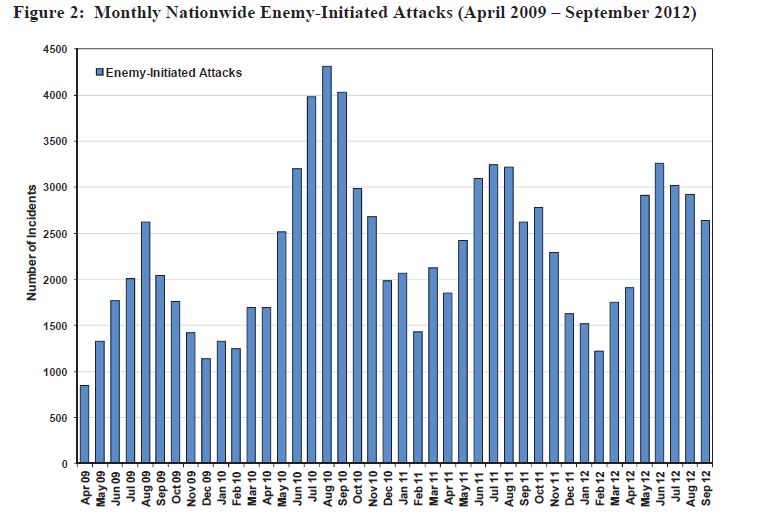
As the “fighting season” for the tenth full year of US forces being in Afghanistan comes to a close, the Defense Department has released its most recent report (pdf, required every Friedman Unit by law) on “progress” in the war. Although the military does its best, as always, to couch its report in language describing progress against goals which always must be redefined in order to claim any progress, those who have been paying attention knew from the report prepared early this year by Lt. Col. Daniel Davis that the vaunted surge of troops in Afghanistan, despite being billed as guaranteed to work as well as the Iraq surge, has been a complete failure.

Here are the latest results on enemy initiated attacks, on a monthly basis:

Note that in order to not remind us of how violence escalated in Afghanistan while our troops were present, this figure cuts off the early years of the war. A similar chart, with the early years included (but showing events on a daily basis rather than monthly, so the scale is different) can be seen in this post from early last year. However, by cutting off the early years, the Defense Department allows us to concentrate on the surge and its abject failure. Obama’s surge began with his order in December, 2009, so this graph gives us 2009 as the base on which to compare results for the surge. Despite a small decrease in violence from the peak in 2010, both 2011 and 2012 are worse than 2009, the last pre-surge year.

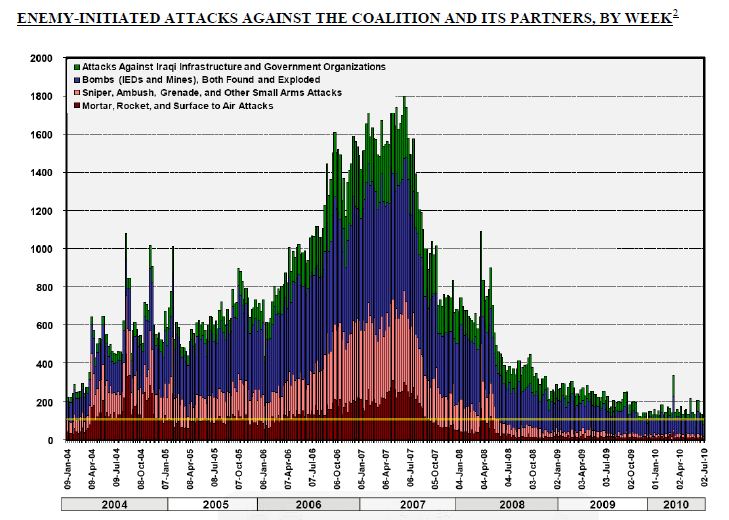
But how could the surge fail? Recall the “awesome” results from the Iraq surge (pdf). That eighteen month surge ended in July of 2008:

Daniel Davis explains how the reduction in violence in Iraq was unrelated to the surge or Petraeus’ vaunted COIN strategy. From my February post on the Davis report:

Once we realize the fact that the surge in Afghanistan has not worked, the natural question arises of why it didn’t since the Iraq surge is so widely credited with turning around the violence trend there. After all, both surges have been sold as the model for the new COIN centered around the idea of protecting the population.

The answer here is that we were sold lies about the underlying forces behind the decrease in violence in Iraq. In short, violence decreased for reasons mostly unrelated to the surge and the new COIN approach. From page 57:

“As is well known, the turning point in 2007 Iraq came when the heart of the Sunni insurgency turned against al-Qaeda and joined with US Forces against them, dramatically reducing the violence in Iraq almost overnight. The overriding reason the Sunni insurgency turned towards the United States was because after almost two years of internal conflict between what ought to have been natural allies – al Qaeda in Iraq (AQI) and the greater Sunni insurgency – a tipping point was reached whereby the Iraqi Sunnis finally and decisively turned against AQI. Had this unnatural split not occurred, by all accounts I have been given on both the Iraqi side and the US military side, “we would still be fighting in Iraq today,” in the words of two officers I know who fought there.”

There simply has been no turning against insurgents in Afghanistan in the same way there was in Iraq. The COIN strategy has been the same in both places, so it is impossible to escape the conclusion that the military’s current version of COIN alone is insufficient to end violence in Afghanistan.

The Petreaus-Allen-Broadwell-Kelley scandal very conveniently will prevent this evidence of failure receiving the attention it deserves. Should Congress decide to take a realistic look at Afghanistan, it’s hard to see how they can conclude anything other than that our presence has accomplished nothing but death and destruction. Getting out now rather than two years from now is the only responsible decision.

Share this entry

Warrick Selectively Edits Amano Remarks to CFR

[youtube]http://www.youtube.com/watch?v=Dfr8NQXmYKM[/youtube]

Yukiya Amano, Director General of the IAEA,  appeared on the record yesterday at the Council on Foreign Relations. He presented a very brief statement and then the bulk of his time was spent in a wide-ranging question and answer session. The lineup of questioners included Barbara Slavin leading off, David Sanger near the middle and Gareth Porter getting in just before questioning was brought to a close.

Joby Warrick took advantage of Slavin’s question to present Iran in the worst possible light:

International Atomic Energy Agency Director General Yukiya Amano said the nuclear watchdog would try again next week to visit the Parchin military base, a sprawling complex where Iran is thought to have conducted tests on high-precision explosives used to detonate a nuclear bomb.

Iran has repeatedly refused to let IAEA inspectors visit the base, on the outskirts of Tehran. Instead, in the months since the agency requested access, satellite photos have revealed what appears to be extensive cleanup work around the building where tests are alleged to have occurred.

“We are concerned that our capacity to verify would have been severely undermined,” Amano told a gathering of the Council on Foreign Relations in Washington. He noted Iran’s “extensive” cleanup effort at the site, which has included demolishing buildings and stripping away topsoil.

“We cannot say for sure that we would be able find something,” Amano said.

Notice the careful way in which Warrick has excerpted parts of what Amano said and inserted his own spin into the statements. If you listen carefully to what Amano says in response to Slavin’s question around the 27 minute mark of the video, you will see that Amano never characterizes the activities by Iran as sanitizing the site (as said in Warrick’s headline) or even that it was cleanup work, as Warrick says in the body of the article. Amano does mention removal of soil, demolition of buildings and extensive use of water, but maintains that access to the site is necessary in order to have a clear understanding of both past and current activities there.

Amano sits in a a position of high tension. He must deal with the Wikileaks disclosures showing that he is much more aligned with the US than his predecessor, Mohamed ElBaradei. Perhaps helping him to navigate this delicate position, the host of the CFR event, George Perkovich of the Carnegie Endowment for International Peace, provided some background comments and posed questions to Amano aimed at allowing Amano to voice his overall goal of resolving issues diplomatically. Despite this claim by Amano that his goal is diplomatic solutions, he must deal with the fact that the issues his organization has been raising are cited (often in an embellished way, as Warrick does above) as grounds for an attack on Iran. Perkovich also used these comments as a way to provide an endorsement of sorts for a second term for Amano.

One of the better questions posed by Perkovich related to whether it is possible to come to agreement with Iran regarding boundaries for future activities while leaving unresolved questions about what may have taken place in the past. Read more

Share this entry

Pinheads Dance on Nuclear Accusations Against Iran

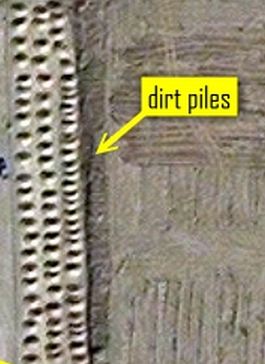
Cringe before the power of the dirt piles!

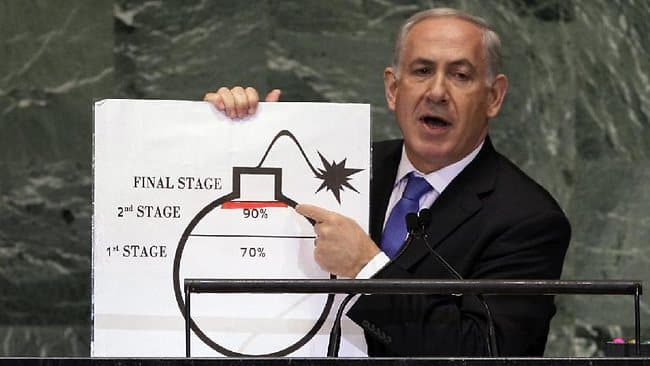
I noted on Tuesday that Fredrik Dahl of Reuters dutifully transcribed accusations from anonymous “Western diplomats” to report that satellite images (which David Albright finally published yesterday–I’m so happy we get to see those dirt pile photos!) revealed that Iran had brought fill dirt to the Parchin site where there have been accusations that Iran may have carried out work on developing an explosive trigger for a nuclear weapon. That post had barely been up for an hour or two when George Jahn unleashed a spectacularly bad graph purporting to show Iranian calculations on nuclear bomb yields. Glenn Greenwald did a terrific debunking of the graph yesterday, showing, among other things, how profoundly wrong the science in the graph was. I had noted back in September, when Jahn first started hinting at what turned out to be his beloved graph, that this particular accusation first came to light in the November, 2011 IAEA report. Jahn and those who are feeding him his “exclusives” sat on this graph for a year before releasing it, presumably because it is so craptastically ridiculous that it could not be made public until the laughter over Bibi’s bomb cartoon and the pink tarps had died down.

The timing of this nearly simultaneous flinging of poo by Dahl and Jahn is explained by the fact that the IAEA is meeting now to discuss the most recent report on Iran’s nuclear activities. The US is using this meeting to roll out a new bit of “leverage” against Iran, stating that if Iran does not comply with IAEA requests by the time of the next IAEA report in March, the US will request that the IAEA refer Iran to the UN Security Council for its intransigence. Aside from how hypocritical this announcement looks, coming within just a few hours of the US condemning the UN for allowing Palestine to achieve non-member observer status, it also appears that Iran knew this ploy was coming. Today we see a report from Mehr News noting that Iran has reported the US to the UN for violating Iranian airspace at least eight times during October.

Lost in all of this noise is the fact that for all the posturing over Iran’s 20% enriched uranium being “close” to weapons grade, Iran continues to divert significant amounts of the 20% enriched material into fuel plates for the Tehran reactor where the uranium has become chemically incapable of further enrichment to weapons grade. From David Albright’s summary of the most recent IAEA report (pdf), we see that Iran has produced 232.8 kg of 20% enriched uranium but has diverted 95.5 kg, or 41%, of this to fuel plates. Back in August, Moon of Alabama explained the significance of the chemical changes that take place when fuel plates are produced [emphasis in original]: Read more

Share this entry

Peshawar Jail Retaliates Against Afridi for Fox News Interview, Afridi Goes on Hunger Strike

The day before the fateful attack in Benghazi that killed four Americans and gave the Republicans Mitt’s desired “Jimmy Carter moment“, Fox News published an interview purported to be with Dr. Shakil Afridi, who helped the CIA in its quest to locate Osama bin Laden by carrying out a bogus “immunization” program aimed at collecting DNA. At the time, it was entirely unclear whether the interview was genuine. Now, however, there is no doubt that the interview was real. In response to his actions, authorities at Peshawar’s Central Jail have beaten and tortured Afridi and put him into more restrictive solitary confinement with no family or attorney visits allowed. In response, Afridi has started a hunger strike in an apparent attempt to bring attention to his plight and to get back the amenities which were taken away from him.

Reuters gives us the bare bones of the solitary confinement and hunger strike:

The Pakistani doctor who helped the U.S. Central Intelligence Agency (CIA) hunt down Osama bin Laden started a hunger strike in his jail cell this week to protest against his living conditions, prison officials said on Thursday.

/snip/

Prison officials in the northwestern city of Peshawar said they are keeping Afridi in solitary confinement and will not allow him to have visitors nor speak to anyone by telephone as punishment for a media interview he gave in September.

“After the interview in which Dr. Shakil Afridi levelled serious allegations against the country’s top spy agency, the prison authorities barred his family members and lawyers from meeting him,” said a prison official, who asked not to be identified because he was not authorized to speak to the media.

“In protest, Dr. Shakil has begun a hunger strike for an indefinite period.”

The “prison official, who asked not to be identified because he was not authorized to speak to the media” appears to have no appreciation of the irony of his making an unauthorized statement to the media describing Afridi’s punishment for making an unauthorized statement to the media.

It appears that Afridi made more telephone calls than just the one in which Fox News interviewed him:

An investigation following the September interview found that Afridi had bribed guards to use their cell phones to speak to journalists, family and friends, making a total of 58 calls, prison officials said. Six prison guards have been suspended.

I had suggested in my September post that if the interview were real, then Afridi must have accomplished it through bribing guards: Read more

Share this entry

AQ Khan Organizes Political Party: What Could Go Wrong?

Perhaps proving that the recent attempts to prepare JEB! Bush for another political run was not the only movement in the world intended to rehabilitate a name with a nuclear level of toxicity, Pakistan’s “Father of the Bomb”, AQ Khan, has registered a new political party. The party is named Tehreek-e-Tahaffuz Pakistan, which Wikipedia says translates to “Movement for the Protection of Pakistan”.

The Express Tribune brings us more details on the party:

TTP Secretary General Chaudhry Khurshid Zaman said Khan had yet to decide whether to stand himself for election. He added that as the chairman, Khan would guide the party through the campaign.

“Our party has been registered, we will take part in the elections with full strength,” Zaman told AFP.

“The whole country is burning, price hikes, unemployment, the energy crisis, poverty and other heinous problems have made public life miserable.”

“Dr Abdul Qadeer Khan has joined politics to change this face of Pakistan and he is the only hope. All other political parties have failed.”

Rohail Akbar, TTP spokesman, said the party would form an alliance with right-wing parties, but not those in government or main opposition party Pakistan Muslim League-Nawaz (PML-N).

We get a slightly different take on the issue of Khan himself running as a candidate from PakPakistan.org:

Dr. Khan said he did not plan, at the moment, to contest the election. However, further fruition of his political organization is “in the hands of God”.

It would appear that the good doctor was paying attention to the number of Republican Presidential candidates in the US who stated during the primary that God wanted them to run. More from this same source on the religious connection:

He is considered as the star in Pakistan, while the religious right acclaims him for having created the “Islamic bomb”.

A brief refresher on Khan’s role in selling nuclear technology can be found at GlobalSecurity.org: Read more

Share this entry

Where Are the Dirt Photos? We Must Have Dirt Photos!

As I have noted many times, there is a prescribed, choreographed sequence for getting reports of “cleanup” activities at Iran’s Parchin site into the US news media. First, “diplomats” release information (arising from intelligence agencies or the IAEA) to George Hahn of AP or Fredrik Dahl of Reuters, and then David Albright emerges within just a few hours with an “analysis”, usually including satellite imagery. The choreography and imagery reached a comedic highpoint when Iran covered a number of buildings at the Parchin site with pink tarps last summer. Once Albright provides his viewpoint, various US media chime in to tell us how devious the Iranians are being with this military site that might house work that could somehow, one day, sort of help Iran produce a nuclear weapon.

Now, however, the cycle appears to have been broken. Late Wednesday, Fredrik Dahl published an article where he reported that a “closed-door” IAEA briefing had disclosed that satellite images of Parchin dated November 7 found new piles of dirt. Whether due to the Thanksgiving holiday or a lack of enthusiasm after the embarrassment of the pink tarp photos, Albright has not yet followed up by publishing these all-important photos of the piles of dirt.

Here is Dahl’s report:

Iran has been hauling dirt to a military site U.N. nuclear inspectors want to visit, Western diplomats said on Wednesday, saying the findings were based on satellite images and they reinforced suspicions of a clean-up.

They said the pictures, presented during a closed-door briefing for member states of the International Atomic Energy Agency (IAEA), suggested Iran was continuing to try to hide incriminating traces of any illicit nuclear-related activity.

The allegations come a few days after the IAEA said in a report on Iran that “extensive activities” undertaken at the Parchin site since early this year would seriously undermine its inquiry, if and when inspectors were allowed access.

Albright clearly was already aware of the new piles of dirt. From his comments (pdf) put up along with publication of the November 16 IAEA report (pdf) (clearly marked “Restricted Distribution”):

The third and final points about removal of external pipework from the containment vessel building and about a depositing of new earth where earth was removed are new observations and ones that were not previously reported by ISIS. (See previous ISIS imagery analysis on the apparent sanitization activities at Parchin here.) Iran undertook sanitization activities, including the removal of earth and deposit of new earth, at Lavisan Shian in 2004. These activities are suspected to be related to Iran hiding evidence of efforts of the Physics Research Center, a military entity linked to parallel military nuclear activities that was sited there until the late 1990s.

On the date that the IAEA provided for restricted distribution its latest report on Iran, Albright was already aware that new imagery showed the additional fill dirt being brought to the Parchin site, and yet more than ten days later, and nearly a week after being prompted by Dahl, Albright still has not given us the dirt photos. If he doesn’t come around soon, Albright will be in danger of being left out of the noise amplification loop and in the future new photos will bypass him and go directly to Barbara Starr.

Update: Ha ha ha ha. I guess George Jahn was feeling left out. He just published a diagram proving that the Iranians can calculate the yield of an atomic weapon. Quick! Prepare the fainting couch! Even Albright wasn’t too impressed with this one, as quoted by Jahn:

David Albright, whose Institute for Science and International Security is used by the U.S. government as a go-to source on Iran’s nuclear program, said the diagram looks genuine but seems to be designed more “to understand the process” than as part of a blueprint for an actual weapon in the making.

I’m sure Barbara Starr will be along shortly to tell us how frightened we should be by this diagram.

Share this entry