NATO Figures: Green on Green Death Rate Exceeds Green on Blue. What About Blue on Blue?

The skyrocketing rate of green on blue attacks, where Afghan security forces turn their weapons on NATO troops, is forcing such desperate measures that NATO has given orders for all coalition troops to remain armed at all times, even when “inside the wire” on US bases, and General John Allen went so far yesterday as to suggest that Ramadan fasting may have contributed to the latest uptick in these attacks. We learn today from the New York Times that NATO has released figures for green on green attacks, where Afghan troops kill one another. The green on green killings exceed the green on blue figures.  Recent history tells us, however, that even if NATO releases the final set of data to complete the full picture on inside the wire deaths (the depressingly high suicide rate, which exceeds the combat death rate, is known) and gives us data on blue on blue deaths (more commonly referred to in the US press as “friendly fire” deaths), those numbers are likely to be so low as to lead to speculation that the real rate is being hidden.

The Times story on green on green deaths begins in a straightforward way:

Even as attacks by Afghan security forces on NATO troops have become an increasing source of tension, new NATO data shows another sign of vulnerability for the training mission: even greater numbers of the Afghan police and military forces have killed each other this year.

So far, Afghan soldiers or police officers have killed 53 of their comrades and wounded at least 22 others in 35 separate attacks this year, according to NATO data provided to The New York Times by officials in Kabul. By comparison, at least 40 NATO service members were reported killed by Afghan security forces or others working with them.

NATO displays a remarkable bit of ironic cluelessness when they describe to the Times how they think these killings come about. After first mentioning Taliban coercion of new recruits in the Afghan forces, NATO then moves on to describe the same sorts of cultural clashes among Afghan recruits that have been described as underlying green on blue attacks in a report that the US chose to retroactively classify. NATO has steadfastly refused to acknowledge the cultural clashes that underlie green on blue attacks but is now rolling them out to describe green on green:

Further, there are concerns about cultural clashes within the rapidly expanding Afghan forces themselves, Afghan and NATO officials say, raising questions about their ability to weather the country’s deep factional differences after the NATO troop withdrawal in 2014.

“Three decades of war can play a pivotal role in the internal causes,” said Maj. Bashir Ishaqzia, commander of the Afghan National Police recruitment center in Nangarhar Province. He said one of the biggest challenges for the army and police forces was a lasting “culture of intolerance among Afghans, as well as old family, tribal, ethnic, factional, lingual and personal disputes.”

Compare the “culture of intolerance” with this bit from the executive summary of the retroactively classified report, titled “A Crisis of Trust and Cultural Incompatibility” (pdf): Read more

Share this entry

Allen Makes Worst Excuse Yet for Green on Blue Attacks: Ramadan Fasting

Robert Burns of AP has a new story out today on the issue of green on blue killings. It appears that the increasing frequency of these attacks has driven General John Allen, commander of US forces in Afghanistan, to grasping for even the lamest excuse for why these attacks have spiked of late:

The rising number of attacks on U.S. troops by Afghan police and soldiers may be due in part to the stress on Afghan forces from fasting during the just-concluded Muslim holy month of Ramadan, the top U.S. commander in Afghanistan said Thursday.

/snip/

He cited Ramadan and the requirement for Muslims to not eat or drink during daylight hours as another factor.

“It’s a very tough time for these (Afghan) forces,” he said, particularly since they were fasting during the heat of the summer and the peak of the fighting season and have been facing combat strains for many years.

“We believe that the combination of many of these particular factors may have come together during the last several weeks to generate the larger numbers” of attacks, he said. Already this month there have been at least 10 “insider” attacks by Afghans, killing 10 Americans. The latest was Sunday when an Afghan police officer opened fire inside a police station in the southern district of Spin Boldak, killing a 55-year-old U.S. Army soldier.

Allen seems to want us to ignore that Ramadan ended with the Eid al-Fitr feast on Saturday night and the attacker on Sunday would have been able to eat on a normal schedule. Maybe the stress of fasting lingers after daytime eating has returned. In his coverage of Allen’s press conference, Spencer Ackerman noted that Ramadan moves around on the Western calendar:

One possible contributing factor: the holy month of Ramazan, which most of the Muslim world calls Ramadan. Although Ramazan is an annual event, it doesn’t occur at the same time annually on the western calendar, and this year it fell during the summer fighting season. The “daily pressures” of war and the “sacrifices associated with fasting,” especially with a larger and newer force of Afghan recruits, may have contributed to some Afghan forces snapping.

Last year, Ramadan also was in August, so it’s hard to see how it had a huge effect this year and not last year.

But the ongoing push by the military to ignore the retroactively classified report explaining that extreme cultural insensitivity on the part of American soldiers plays a major role in Afghans turning their weapons on them continues to have a horrible fallout as more and more Afghans attack American and other NATO troops. With the looming deadline of withdrawal of NATO forces by the end of 2014 and NATO trainers knowing that this can only occur if Afghan forces are seen as capable of taking over security responsibility, it is easy to see how there might a bit more pressure exerted in the training process and how this pressure could cross cultural boundaries, prompting attacks.

Although Ackerman portrayed Allen in the press conference as “not…telling the public — or the Pentagon, or the Karzai government, or the Obama administration — what it might want to hear”, I see no evidence of Ackerman (or Burns, for that matter) following up on an interesting discrepancy in the description of the role of the Taliban in green on blue attacks.

On August 18, CNN quoted NATO spokesman Gunter Katz on green on blue attacks: Read more

Share this entry

Signs of Intelligence Sharing Give Way to Call for “Divorce”: US-Pakistan Relations Continue Extreme Swings

[youtube]http://www.youtube.com/watch?v=FqJPYlu8qls[/youtube]

Back on August 2, I noted a very interesting development. At a time when the US and Pakistan were holding high-level meetings both in Washington and Pakistan, a terror plot in Afghanistan reported to be in preparation by the Haqqani network was disrupted. This was a surprising development to me because at the time I was predicting that the talks between the new head of Pakistan’s ISI and CIA head David Petraeus would go badly and that the US would launch poorly targeted drone attacks in retaliation, perhaps even while General ul-Islam was in transit back to Pakistan. Instead, there seemed to be a distinct possibility that Pakistan had provided intelligence on movement of Haqqani network members from Pakistan into Afghanistan and that this intelligence allowed the plot to be disrupted before it was carried out.

Once the meetings in Washington ended, no new drone strikes occurred in Pakistan. In fact, another attack plot was thwarted in Afghanistan on August 12. Although this plot was not believed to be at the hands of the Haqqani network, there was evidence that Pakistanis were involved, which again led me to postulate that this plot also was disrupted with the help of intelligence information from Pakistan.

The absence of drone strikes continued and then on August 13 Defense Secretary Leon Panetta was interviewed by Lolita Baldor and Robert Burns of AP. As seen in the video excerpt above, Panetta said that he expected Pakistan to launch military operations soon against Taliban militants in Pakistan’s Federally Administered Tribal Areas. As Bill Roggio noted at Long War Journal, this was a shocking development. After opening with “This is absolutely stunning”, Roggio went on to list his reasoning for why the announcement didn’t make much sense. He concluded:

How many times has Pakistan promised to take action in North Waziristan, or claimed to take action there, only to make fools of top US defense officials?

The lull in drone strikes continued.

Did the US lose patience with Pakistan’s promise to launch an operation in North Waziristan? On August 18, the lull in drone strikes ended (don’t bother looking this or any other drone strike up in New America Foundation’s database, as it now appears to have been taken down). And it ended in a particularly ugly way, at midday on the day when the religious feast of Eid al-Fitr would begin at sunset. That strike has been followed up with three others, so that as of Tuesday, there were four drone strikes in as many days. The lull does not match up with Ramadan. Ramadan started on July 20 and The Bureau for Investigative Journalism’s database shows attacks on July 23 and July 29. Instead, that last strike prior to the lull was just before ul-Islam’s meetings in Washington, which started on August 1.

This sequence of events suggests to me that if there was indeed a time of increased cooperation in which ISI shared intelligence on movement of militants from the tribal areas into Afghanistan for attacks in return for no drone strikes occurring, this agreement has now fallen apart. The intense rate of drone strikes once they re-started is typical of US actions when retaliation is desired. It would not be surprising, then, for the next attack by militants moving from Pakistan to Afghanistan to be successful instead of being disrupted before it can take place.

It appears that I am not alone in thinking we are again at a low point in US-Pakistan relations. Former Pakistani envoy to the United States Hussein Haqqani suggested yesterday that the US and Pakistan should “divorce”. This latest outbreak of drone attacks could then be seen as the US serving notice of separation.

Share this entry

NATO: “Afghanistan Will Not Unravel After Withdrawal” — Probably Because It’s Unraveling Now

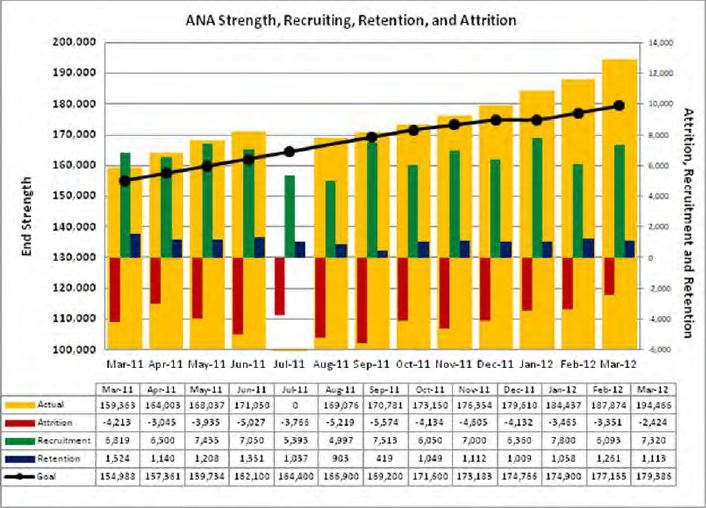
Overall force size, recruitment and attrition for the Afghanistan National Army from latest DoD report.

The situation in Afghanistan is falling apart so quickly and so dramatically that a senior NATO civilian official took it upon himself today to put out an assurance that Afghanistan will not unravel after NATO withdraws its security forces. One can only infer from this statement that NATO can make this assurance because the unraveling is already underway and will be complete prior to the late 2014 date for full withdrawal.

Consider the array of ways in which Afghanistan has forged its way into the news cycle in the last 24 hours at a time when “legitimate rape” should have edged out all other issues. President Obama made an “unscheduled” appearance in the White House Briefing Room yesterday, and Jake Tapper was able to force Obama onto the record on the issue of rapidly escalating green on blue attacks.  Yesterday’s brilliant idea from the Defense Department on stemming the tide of green on blue attacks was to claim that Afghanistan now will spy on its own troops to prevent the attacks. Robert Caruso provided the best response to this revelation on Twitter: “riiiiiiiiiiight.” Perhaps the most stunning development, though, is that while General Martin Dempsey, Chairman of the Joint Chiefs, was in Kabul for emergency meetings on the green on blue issue, insurgents were able to get close enough to Bagram Air Base to damage his plane (which was unoccupied at the time) in a rocket attack.

I have long maintained that the principal failure in the coalition’s plans for Afghanistan is the abject failure of David Petraeus’ training program that he started in Iraq and moved to Afghanistan. The figure above is taken from the most recent DoD “Report on Progress Toward Security and Stability in Afghanistan” (pdf). The bar graph and the figures below it (click on the image for a slightly larger view) show us figures for Afghanistan’s National Army. If we consider the twelve month period from March April 2011 to April March 2012, we see that the size of the ANA grew from 164,003 to 194,455. However, in order to achieve that growth, it was necessary to recruit a total of 79,501 troops during that time. Such massive recruiting was necessary because the same twelve month period saw attrition of 48,577 troops. Compared to the force size at the end of this period, that is an attrition rate of 25% (actually 24.98%) for the year.

It simply does not make sense to call the ANA a “combat ready” force that can take the lead on security any time in the foreseeable future when it has an annual attrition rate of 25%. Such a high rate of turnover in the force means that the Afghan population from which the force is drawn does not ascribe subscribe to the idea of a national army. The entire NATO “mission” of preparing Afghan security forces to take responsibility for security is built on a fable that the Afghan people do not support. Green on blue attacks may be dominating the news today, but the failure of the people of Afghanistan to get behind the concept of a national army is what will ultimately end the current NATO strategy.

Share this entry

On the Questions of Drones, First Responders and Collective Punishment in Pakistan

Yesterday evening, I took the ill-advised step of jumping into an already ongoing Twitter discussion with Professor Christine Fair on the topic of drones in Pakistan. My jumping in was ill-advised on two fronts: I had not seen the comments to which Fair was responding, but, more importantly, I can’t come close to the experience, language skills and overall knowledge Fair brings to the issues of South Asia.

My first entry into the discussion was to respond to a statement from Fair in which she said that she supports drones and does not believe their use to be collective punishment. I asked whether the use of drones to attack first responders and mourners in Pakistan qualified as collective punishment and in a follow-up provided a link to the work by Chris Woods and Christina Lamb at The Bureau of Investigative Journalism where they document such attacks. Fair’s response was to point out that Woods and Lamb have not been to FATA and that the Pakistani press is heavily manipulated. She referred me to a piece she wrote for Monkey Cage for elaboration on the points she was making.

It appears that this is the post Fair was asking that I read. Before diving into it, I should point out that it is about a year old and was written primarily in response to earlier work by Woods and Lamb. For fairness, I should also point out that from the context of other tweets later in the evening, Fair was a passenger in a car during our conversation and so would have been working with fewer resources at hand than if at home and using a computer.

With that as prologue, here is Fair’s dissection of the reliance on press reports for analysis of drone attacks in Pakistan’s tribal areas (BIJ is The Bureau of Investigative Journalism and NAF is the New America Foundation, where Peter Bergen and others have produced another drone strike database):

Their methodologies and data are fundamental weaknesses, although neither seem aware of this. Both NAF and BIJ claim that they have assembled a database which covers each individual strike in Pakistan in detail.  Unfortunately, both efforts fundamentally rely upon Pakistani press reports of drone attacks. Both claim that they use non-Pakistani media reports as well. For example the BIJ explains in their methodology discussion that the “…the most comprehensive information on casualties lies in the thousands of press reports of drone strikes filed by reputable national and international media since 2004. Most reports are filed within a day or two of an attack. Sometimes relevant reports can be filed weeks – even years – after the initial strike. We identify our sources at all times, and provide a direct link to the material where possible.”

/snip/

While these methodologies at first blush appear robust, they don’t account for a simple fact that non-Pakistani reports are all drawing from the same sources: Pakistani media accunts [sic]. How can they not when journalists, especially foreign journalists, cannot enter Pakistan’s tribal areas?  Unfortunately, Pakistani media reports are not likely to be accurate in any measure and subject to manipulation and outright planting of accounts by the ISI (Pakistan’s intelligence agency) and the Pakistani Taliban and affiliated militant outfits.

The more recent report from Woods and Lamb (in which the first responder accusations are made), however, appears to have taken steps to address at least a portion of the shortcomings Fair has pointed out. Since it is not safe for foreign journalists to enter the tribal areas, Woods and Lamb engaged a group of local researchers to carry out interviews on their behalf: Read more

Share this entry

Good Thing Obama Kept that Iraq AUMF Lying Around

Remember how both Congress and the Administration refused to repeal the Iraq AUMF?

Maybe they wanted to have it to hang over Nuri al-Maliki’s head for the time when Iraqis were discovered helping Iran evade sanctions? The NYT reports that Elaf Islamic Bank–which Obama called out last month–is just one of a number of Iraqi institutions helping Iran bust our sanctions.

The little-known bank singled out by the United States, the Elaf Islamic Bank, is only part of a network of financial institutions and oil-smuggling operations that, according to current and former American and Iraqi government officials and experts on the Iraqi banking sector, has provided Iran with a crucial flow of dollars at a time when sanctions are squeezing its economy.

[snip]

In announcing that he was “cutting off” Elaf Islamic Bank, Mr. Obama said it had “facilitated transactions worth millions of dollars on behalf of Iranian banks that are subject to sanctions for their links to Iran’s illicit proliferation activities.”

[snip]

Iraqi banking experts said last week that the bank was still allowed to participate in the Iraq Central Bank’s daily auction at which commercial banks can sell Iraqi dinars and buy United States dollars. These auctions are a crucial pathway for Iranian access to the international financial system.

It’s an interesting predicament for the Administration. At the same time as they’re systematically taking out Iran’s allies and/or implicating them as expansively as they dare, they’re in a bit of a pickle with Iran’s closest geographic ally, the one with the biggest oil reserves.

Which may explain why James Risen (with Duraid Adnan) is reporting this story. Sure, he has written some of the key financial flow stories in the last decade. But he’s not exactly in good grace with this–or any recent–Administration. And the whole story reads like one that the Administration–which hasn’t found a Syrian or Lebanese insinuation they wouldn’t magnifiy–doesn’t want reported.

The Obama administration is not eager for a public showdown with the government of Prime Minister Nuri Kamal al-Maliki over Iran just eight months after the last American troops withdrew from Baghdad.

That sheepish tone continues through the rest of the article.

Consider. The one country were Obama can’t engage in the same kind of hardass approaches as he has elsewhere (at least not before the election) is helping Iran to flout sanctions. Obama can’t admit the truth–that Iran won the Iraq War. If he does, the neocons will accuse him of withdrawing prematurely. If he takes a hard stance, I might no longer be the one person talking about the extant AUMF.

And yet Iraq seems to be a key hole in the sanctions.

Share this entry

Poor Responses by US Military, Press to Increased Green on Blue Attacks

Yesterday, I noted the dramatic increase recently in green on blue attacks in Afghanistan, where Afghan security personnel turn their weapons on NATO forces. This disturbing development clearly has rattled both the US military and the press, because their responses have been entirely bungled.

Late yesterday, we learned from CNN that all NATO troops will now be required to carry loaded weapons at all times, even while on their bases:

The uptick in attacks by Afghan security forces against coalition troops has hit home, with all troops at NATO headquarters and all bases across Afghanistan now ordered to carry loaded weapons around the clock, CNN learned Friday.

Gen. John Allen, the NATO commander in Afghanistan, ordered the move, according to a U.S. official with direct knowledge of the orders. The order, made in recent days, was divulged amid two more so-called green-on-blue or insider attacks Friday.

This move sets the stage for accidental friendly fire deaths (blue on blue in this case) set off by an unexpected noise. If I were an enlisted US soldier with brown skin and black hair, you can bet I’d wear my uniform 24/7 on the base and be ready to dive for the floor quickly when the bullets start flying.

NATO official posturing on the attacks is at least changing slightly. Despite increasing documentation of green on blue killings and outright defections by Afghan forces, NATO now grudgingly admits some infiltration is occurring, but their estimate seems to me to be a serious lowball:

NATO says the majority of attacks by Afghan security forces against coalition troops are driven primarily by personal grievances rather than an infiltration by insurgents.

“Some 10% we know are related to the insurgency,” Brig. Gen. Gunter Katz, a spokesman for the NATO-led International Security Assistance Force, said late Friday.

Perhaps the most stunning failure of all, though, in the surge of coverage of increased green on blue (I still can’t get completely to the new official-speak of “insider”) attacks, is this morning’s brainless Washington Post article looking “behind the scenes” at an attack from last week. The Post opens by laying out a number of facts surrounding the attack:

The teenage assailant who killed three Marines last week on a U.S. military base in southern Afghanistan had easy access to the weapons arsenal of the Afghan police. He was in near-constant contact with U.S. troops, often when they were without their guns and body armor.

But although Aynoddin, 15, lived among American and Afghan security forces, he was not a soldier or a police officer. He had never been vetted. According to U.S. and Afghan officials, his role on base was hardly formal: He was the unpaid, underage personal assistant of the district police chief.

Officials would later learn that the quiet, willowy boy was also working for the insurgency.

Nowhere in the article, however, does the Post point out that it is the US, and specifically the “advisors” whom the infiltrator targeted, who had been responsible for training the Afghan security forces the youth infiltrated. Read more

Share this entry

Green on Blue (Insider) Killings Too Common for Reuters Headlines

The rapidly increasing trend of green on blue (or, in new ISAF-speak, insider) killings has become so common that the killings are no longer headline news for at least one news outlet. Today’s Reuters dispatch from Afghanistan takes its headline from the fact that Mullah Omar has issued a message in conjunction with Eid al-Fitr. Reuters leads with Omar calling for fewer civilian deaths in Taliban attacks, but in his message, Omar also touts that the Taliban has successfully infiltrated Afghan forces to carry out green on blue attacks. It is not until the tenth paragraph of the story that we learn that two more US trainers were killed by an Afghan policeman today. By contrast, an AP story carried by the Washington Post draws its headline from the killings and then moves on to mention the Mullah Omar message later. The New York Times has nothing as of this writing on either the killings or the Mullah Omar message.

From the AP story in the Post:

A member of the Afghan security forces killed two U.S. troops Friday morning — the most recent in a string of insider attacks that threaten to undermine U.S.-Afghan military relations.

An officer in the Afghan Local Police shot and killed two Americans in Farah province during a training exercise on an Afghan base, according to Abdul Rahman, a spokesman for the provincial governor.

U.S. military officials confirmed the two deaths. The assassin was shot and killed, according to a statement.

Reuters allows Defense Secretary Leon Panetta and other military officials to continue their claim that infiltration is not a significant problem:

“Mujahideen have cleverly infiltrated in the ranks of the enemy according to the plan given to them last year,” he [Omar] said. “They are able to (safely) enter bases, offices and intelligence centers of the enemy. Then, they easily carry out decisive and coordinated attacks.”

So called green-on-blue shootings, which NATO-led forces recently began calling “insider incidents”, have so far this year have accounted for 13 percent of foreign troop deaths, according to the Long War Journal website.

The coalition has said most were the result of stress or personal disagreements between NATO mentors and Afghan police or soldiers, rather than insurgent infiltration.

But U.S. Defense Secretary Leon Panetta acknowledged this week that the Taliban had been behind at least some of them, but said they did not “reflect any kind of broad pattern”.

“The reality is, the Taliban has not been able to regain any territory lost, so they’re resorting to these kinds of attacks to create havoc,” Panetta told reporters.

It is particularly insidious that US spokesmen continue to push the “personal disagreement” approach. When a report on fratricide in June of 2011 suggested that deep cultural differences that are not addressed in the training of US troops contributed to green on blue killings, the US responded by retroactively classifying the report. In trying to hide the report, it was clear that the military was trying to hide behind an explanation of personal grievances leading to the killings. Now that the distrust of coalition forces has gone so far that the Taliban can exploit it to achieve infiltration of Afghan forces, the US has to go all the way to the Defense Secretary to continue using this same deflection from the truth while clinging to the personal disagreement cover story.

The US commander of troops in Afghanistan, General John Allen, found it necessary to respond to Omar’s message. With regard to the question of infiltration, it appears that Allen is no longer claiming it is not significant:

Omar also says his thugs have infiltrated the ranks of Afghanistan’s legitimate armed forces.  The pride of the Afghan people has been smeared by killers who pose as Soldiers and police, yet they represent the worst of humanity.  Today, the Afghan Army and National Police are trying to build a better future for the Afghan people, yet Omar wants to stop these efforts. Coalition forces are here to help the people; we have no other reason for being here other than to make Afghanistan a stable country, founded on educated and healthy citizens.

Allen’s message might as well paraphrase the old Ronald Reagan smear “We’re from the United States military and we’re here to help.” If the US is reduced to repeating that we are there to help, it seems to me that the battle for hearts and minds is over and the US did not win.

Share this entry

10 Years Later, Information Asymmetry Could Launch Another War

Ten years ago, the Bush Administration was planning the last details of the new product announcement it would roll out in September, a new product announcement that would lead to an expensive, illegal war that killed hundreds of thousands of Iraqis.

A key part of that product rollout was the manipulation of information asymmetry: the leaking of out-of-context classified information to Judy Miller. After she published it on the front page of the NYT, the warmongers pointed back to it as the complete truth. Yet because the information was classified–because it was illegal for experts to counter the claims made by Judy’s sources–the other side barely came out. It wasn’t until well into the war that enough of the Iraq NIE was declassified to reveal that the warmongers had presented a completely imbalanced picture of Iraq’s WMD program and that dissenters had rightly debunked some of the warmongers claims.

Which is worth remembering as you read this piece from Jeffrey Lewis (of ArmsControlWonk fame). While I think Jim would have issue with some of the claims Lewis makes on technical grounds, but Lewis addresses recent Israeli claims about new intelligence on Iran’s nuke program to argue for reading NIEs and other WMD intelligence with some nuance (you can click through to read his nuanced take, both on the 2007 Iran NIE and the purportedly new piece of intelligence). But one of several reasons why we’re not getting that nuance, Lewis argues, is because Congress and others are cracking down on responsible, nuanced communication.

Unfortunately, the White House’s concerted campaign to criminalize national security discourse has prevented officials from discussing the estimate with journalists, allowing the most alarmist conjecture to dominate public debate.

Among other things, DiFi has proposed curtailing background briefings that could provide the kind of nuanced reading Lewis speculates at here. In addition, DOD has reportedly made a top secret request for staffers to identify whether they’ve spoken with one of the journalists who has covered this issue most closely (for better and worse), David Sanger.

In short, even assuming the leak witch hunts are in good faith, they may well bring us to war just as surely as the leaks to Judy Miller did a decade ago.

Apparently, we haven’t even figured out how to avoid being snookered into war by A1 cutouts.

Share this entry

National Sickness: No Debate Allowed on Civilians Owning Weapons of War

Three fatal mass shootings within three weeks should be providing an opportunity for a national conversation on civilians having easy access to semiautomatic weapons and high capacity clips that are designed for use in war. Two of the killers in these cases were known by family and/or medical personnel to be dealing with mental issues while the third had generated at least some attention from both government and private groups that monitor groups harboring violent extreme racist views. Despite these clear warning signs in the shooters’ backgrounds, all three legally purchased and possessed their weapons that were designed for wartime use.

Instead of the nation assessing what can be done to prevent weapons designed solely for killing large numbers of people getting into the hands of those who are most likely to put them to that use, we have major players in our society fanning some of the issues that contribute to the problem. Last week, Congressman Joe Walsh delivered a speech casting Muslims as dangerous extremists bent on killing:

“One thing I’m sure of is that there are people in this country – there is a radical strain of Islam in this country -– it’s not just over there –- trying to kill Americans every week. It is a real threat, and it is a threat that is much more at home now than it was after 9/11,” Walsh said.

Walsh went on to claim that radical Islam had found its way into the Chicago suburbs, including some that he represents.

It’s here. It’s in Elk Grove. It’s in Addison. It’s in Elgin. It’s here,” he said.

Just a few days later, a man was arrested in nearby Morton Grove for firing at a mosque while people were inside praying. Fortunately, this time the shooter only used a pellet gun instead of a weapon of war, which could have led to yet another disaster.

Joe Walsh and other extremists in Congress like Michele Bachmann and Steve King happily spout their venom that fires up racists, but we also learned this week that the man behind the 2009 Department of Homeland Security report on right wing extremist groups capable of violence had his report repudiated and his team dissolved. He subsequently left DHS. Both Democracy Now and Danger Room have chronicled Johnson’s plight. Sadly, Johnson’s work was quite accurate when it came to the shooting at the Sikh temple. From Spencer Ackerman at Danger Room:

Daryl Johnson had a sinking feeling when he started seeing TV reports on Sunday about a shooting in a Wisconsin temple. “I told my wife, ‘This is likely a hate crime perpetrated by a white supremacist who may have had military experience,’” Johnson recalls. Read more

Share this entry