George Jahn Once Again Grants Anonymity for Dubious Iran Accusation

Just under two weeks ago, AP’s George Jahn released the infamous cartoon around which he built a dubious nest of mostly anonymous charges that Iran had conducted work toward developing a neutron trigger device for nuclear weapons, using an explosive containment chamber at the Parchin military site. Jahn further repeated anonymous claims from “diplomats” that satellite imagery showed activity claimed to be Iran “cleaning” the site to remove traces of radioactivity.

It is simply impossible to “clean” radioactivity from a steel chamber in which uranium has been used to generate neutrons, as the neutrons would result in making the entire thickness of the steel chamber radioactive, as I showed in this post. The only way that Iran would be able to hide evidence of work on a neutron trigger device at Parchin would be to dismantle and remove the entire chamber. It most likely would be necessary to raze the entire building as well, since the structural steel in the building surrounding the chamber also likely would have been made radioactive by the neutrons.

Since negotiations between Iran and the P5+1 countries will continue next month in Moscow, those who prefer a war with Iran now must find new areas in which to accuse Iran of weapons work. George Jahn dutifully stepped up to play his role in this process again today, granting anonymity to “diplomats” who make a vague accusation that Jahn dressed up into a highly sensational headline that is backed up by few facts and then rendered essentially meaningless when he goes further into the information. At the AP’s site, Jahn’s article carries the headline “APNewsBreak: Higher enrichment at Iranian site“. The Washington Post decided that headline wasn’t incendiary enough, and so their version reads “APNewsBreak: Diplomats say UN experts find enrichment at Iranian site closer to arms level“.

The story itself is quite short. It opens:

 Diplomats say the U.N. nuclear agency has found traces of uranium at Iran’s underground atomic site enriched to higher than previous levels and closer to what is needed for nuclear weapons.

Wait a minute. This whole thing is about “traces” of uranium enriched to a higher level. Missing from the entire article is any detail of how much material was found or to what level the uranium was enriched. The highest level of enrichment currently declared by Iran is 20%, which the press in the recent past has been describing as only a short “technical step” away from the the 90%+ needed for a nuclear weapon.

The next two paragraphs from Jahn basically render his entire story moot:

The diplomats say the finding by the International Atomic Energy Agency does not necessarily mean that Iran is secretly raising its enrichment threshold.

They say the traces could be left during startup of enriching centrifuges until the desired level is reached. That would be a technical glitch only.

So, in other words, these “diplomats” are doing their best to create a crisis over something that is a mere “technical glitch” and represents an insignificant amount of material. Of course, for those who only see the headline, especially the one on the Post’s website, the idea will have been planted that Iran is cheating on its declared enrichment program and secretly producing material that is ready to be placed into a weapon.

As I pointed out in this post, all of these incendiary press reports about Iran and uranium enrichment overlook a very important basic set of facts: Read more

Share this entry

Afridi’s Trial: Similar to Gitmo Military Commissions? Bonus: Rohrabacher Goes Bold

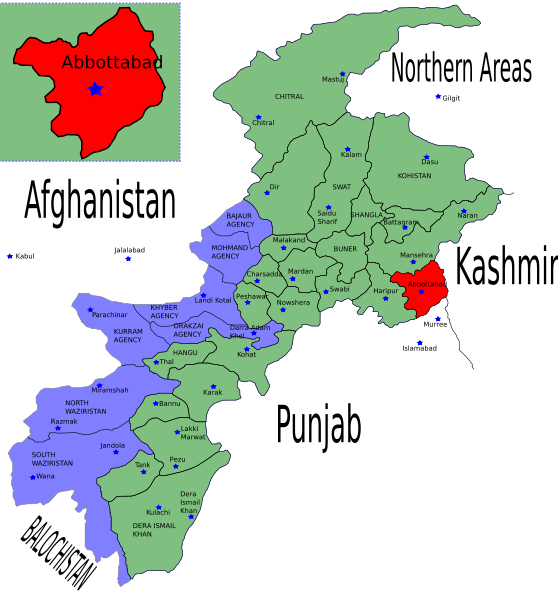
Abbottabad district, red, is within Kyhber Pakhtunkhwa Province, green, which is next to the Federally Administered Tribal Areas, blue, where the town of Bara is in Khyber Agency. (Wikimedia Commons)

Fallout continues from yesterday’s sentencing of Dr. Shakeel Afridi, the doctor who helped the CIA to identify Osama bin Laden prior to the US raid that killed him. Marcy commented yesterday on the poor outcome from Leon Panetta disclosing Afridi’s cooperation with the CIA and I noted how the sentencing may have been one motivation behind the potential political impetus for yesterday’s drone strike in Pakistan (which has been followed up by yet another drone strike today).

I will get to the obligatory statement of outrage from Dana Rohrabacher in a bit, but first there is a very interesting article in Dawn that has a few details from Afridi’s trial. Although Afridi’s cooperation with the CIA occurred in Abbottabad, which is in the Khyber Pakhtunkhwa Province (formerly referred to as North West Frontier Province), Afridi was tried in the town of Bara, which is in the Khyber Agency of the Federally Administered Tribal Areas (FATA). The map on the left shows the FATA in blue, most of Khyber Pakhtunkhwa in green and the Abbottabad district in red.

In the Dawn quotations below, “Khyber” refers to Kyber Agency within FATA and not Khyber Pakhtunkhwa, as far as I can tell.

Dawn describes where the trial took place and the convictions that were handed down:

Officials said Afridi had been tried at the office of assistant political agent (APA) in Bara. He was sentenced on the charges of conspiring “to wage war against Pakistan or depriving it of its sovereignty”, “concealing existence of a plan to wage war against Pakistan” and “condemnation of the creation of the state and advocacy of abolition of its sovereignty”.

“The trial conducted under the Frontier Crimes Regulation continued for one year during which Dr Afridi was denied the right to engage a lawyer,” said Rahat Gul, an administrative official at the Khyber House.

Dawn then moved on to citing criticism about where the trial took place:

Critics have said he should not have been tried under tribal law for an alleged crime that took place outside tribal jurisdiction, in the town of Abbottabad where he ran a fake vaccination programme designed to collect bin Laden family DNA.

A senior official in Khyber, Nasir Khan, defended Afridi’s trial.

“We have powers to try a resident of FATA (the federally administered tribal areas) under the FCR enforced in tribal areas,” he told AFP.

Hmmm. Venue-shopping. That would never happen in the US, especially when the chosen venue is seriously lacking in due process.

And the trial had to be secret so that Afridi would not be attacked: Read more

Share this entry

US Drone Strike in Pakistan Reeks of Political Retaliation Yet Again

Map of the Federally Administered Tribal Areas in Pakistan. Note Orakzai and North Waziristan are as close as 50 milies in some spots. (Wikimedia Commons)

Today, US drones killed four more people in North Waziristan in Pakistan’s Federally Administered Tribal Areas (FATA). This strike comes at a critical time in US-Pakistan relations, as many believed that the US and Pakistan would announce an agreement reopening NATO supply routes through Pakistan at last weekend’s NATO summit in Chicago. Instead of reaching agreement, however, Pakistan’s President Asif Ali Zardari was essentially shunned at the meeting. Today’s strike adds to that insult, as Pakistan has been objecting strenuously to US drone strikes as an imposition on Pakistan’s sovereignty. Despite US claims that Pakistan does nothing to stop insurgents in the FATA, Pakistani jets also killed 12 people today in Orakzai Agency, which is near North Waziristan and also within the FATA.

Drone strikes in Pakistan by the US have occasionally been interrupted by various diplomatic issues. For example, there was a lull of over a month at the height of negotiations over the release of Raymond Davis.  One of the most notorious US drone strikes was on March 17, 2011, the day after Raymond Davis was released. This signature strike killed over 40, and despite US claims (was that you, John Brennan?), that those killed “weren’t gathering for a bake sale” it was later determined that the majority of those killed were indeed civilians at a jirga to discuss local mineral rights. Because it was so poorly targeted, this strike always stood out in my mind as the product of an attitude where high-level US personnel demanded a target, no matter how poorly developed, simply to have something to hit since drone strikes had been on hold over the Davis negotiations and there was a need to teach Pakistan a lesson.

Not too long after that strike, another strike seemed to be timed as a response to negotiations gone bad. On April 13, 2011, there was a drone strike in South Waziristan that occurred while Pakistan’s ISI chief was in transit back to Pakistan after discussions with the US over drones was cut short.

With those strikes as background, today’s strike may well be another example of the US deciding to send in a strike to make a political point. The Guardian seems to see the strike in the same way, and notes how the strikes may affect negotiations:

The attack came as Washington runs out of patience with Islamabad’s refusal to reopen supply routes for Nato troops in Afghanistan. Read more

Share this entry

Rorhrabacher’s Attempt to Defund Pakistan Falls 335-84

[youtube]http://www.youtube.com/watch?v=v2p9H77tj8c[/youtube]

[youtube]http://www.youtube.com/watch?v=ZAKdZvetng0[/youtube]

Congressman Dana Rohrabacher (R-CA) worked himself into quite a bit of anger yesterday defending his amendment to the NDAA which was intended to cut off funding for Pakistan. He gave a remarkable performance, railing against practices by the Pakistani government which he avidly endorses when carried out by the US.

He railed against Pakistan providing haven for Osama bin Laden even though Rohrabacher actually took up arms and fought alongside the mujahideen, which included bin Laden, back in the mid-80’s when they were fighting the Soviets. He blasted Pakistan for supporting terrorists like the Haqqani network at the same time that he is agitating for the delisting of the MeK as a terrorist group. He decried the arrest and detention without charges of Dr. Shakeel Afridi, who carried out the polio vaccine ruse on behalf of the CIA at the bin Laden compound, and yet he has for years been at the forefront of advocating in favor of the prison at Guantanamo, where many remain held indefinitely without charge.

Here is how Rohrabacher described his amendment in a press release:

Rep. Dana Rohrabacher (R-CA) has introduced H.R. 5734, the “Pakistan Terrorism Accountability Act of 2012.” The legislation would require the Department of Defense to list all Americans killed by terrorist groups operating with impunity inside Pakistan and Afghanistan and supported by elements of the Pakistani government. For each person killed, $50 million would be subtracted from U.S. foreign assistance to Pakistan, a requested $2.2 billion, and given to the victim’s family.

“For too long America has funded the Pakistani government, giving it free money, while elements of the ISI and Pakistan’s military operate radical Islamic groups that are actively murdering Americans,” said Rohrabacher. “Americans will not accept this.” 

“Pakistan has for decades leveraged radical terrorist groups to carry out attacks in India and Afghanistan,” continued Rohrabacher. “Pakistan helped to create the Taliban and Pakistan’s intelligence service hid Osama Bin Laden from the U.S. for years. Today, one of the most dangerous and sophisticated groups killing American troops in Afghanistan is the Haqqani Network, which is closely operated by the Pakistani government.” 

I suppose it’s too much to hope for that someone who operates on the fringes of American politics might realize that the Pakistani government is not a monolith that always acts with all of its participants working together for the same outcome. Rather than supporting those within Pakistan who will advance US interests, Rohrabacher wants to punish all of Pakistan because of those who work against US interests.

Rohrabacher’s attempt at lead pipe diplomacy has failed miserably, going down by a vote of 335 to 84.  Here is how Pakistan Today described the outcome:

Dashing Congressman Dana Rohrabacher’s drastic designs, the US Congress on Thursday turned down the bill proposing curbs on American aid to Pakistan.

/snip/

The House of representative rejected the bill as 335 votes were cast against the bill while 84 in favour. Pakistan ambassador to US, Sherry Rehman played an active role against the bill.

At least he did a better job pronouncing Balochistan

Share this entry

McClatchy Confirms One Shooter at Alkozai

McClatchy has gone back to do more reporting on the Panjwai massacre that happened in March. (h/t Agonist) It provides a gruesome account of what happened at Alkozai. But also provides more details on the attack and the investigation.

McClatchy’s interview of survivors from Alkozai appear to confirm what had appeared to be the case already: there was just one killer at that village (though they appear not to have interviewed anyone from Najiban, where witnesses testified to multiple killers).

Rafiullah told McClatchy that Afghanistan’s president, Hamid Karzai, phoned him in the aftermath of the attack and U.S. authorities later interviewed him while he was in the hospital. “Two times they talked to me,” he said.

A day or two after the massacre, he also spoke to the man Karzai had appointed as his chief investigator into the killings, Gen. Sher Mohammad Karimi, the Afghan army chief .

“To all of them I said the same thing,” Rafiullah said. “I saw only one shooter.”

The story reveals that after multiple US interviews (and fewer Afghan ones), one of the surviving adults at Alkozai was grilled about setting the IED that had gone offer the week before the Robert Bales attack.

The only official contact he’d had since his discharge from the hospital was when he was summoned, still wounded, to Kandahar city and interrogated by an officer from Afghanistan’s much-feared intelligence service, the National Directorate of Security.

“That man was a bastard,” Naim said. “He accused me of having laid IEDs” – improvised explosive devices, or homemade bombs – “before the massacre to target the American forces.”

Naim said he’d previously seen Taliban members placing such devices near his home in Alkozai, but that he’d told them not to, as he and his family might be targeted in response. Like many civilians in southern Afghanistan, he felt he was caught in a struggle between the insurgents and U.S.-led forces. Sadiqullah had been wounded earlier by shrapnel from an American mortar round that had landed near his home.

Sadiqullah underwent surgery at the U.S. military hospital in Kandahar after that attack, too, and his wound had barely healed by the night of the massacre.

Sadiqullah is 11, and he has already hospitalized twice this year by American fire. Not only is that a testament to the simmering relations between Americans and villagers in Panjwai. But it’s a pretty good indication of whether we’re going to be able to win the support of the next generation of Afghan fighters.

Share this entry

Despite Progress on Iran-IAEA Talks, US Envoy Emphasizes War Plans

Both Bloomberg and the AP’s George Jahn reported yesterday that the second session of talks in Vienna between the IAEA and Iran produced progress and that additional talks are now scheduled for May 21 in Vienna. But don’t look for news of this progress in the New York Times, because it’s not there. And don’t look for statements from the US praising the progress (although China did praise it) and urging further progress at Monday’s talks in Vienna or the P5+1 talks later in the week in Baghdad. Instead, US Ambassador to Israel Dan Shapiro chose to emphasize in an interview on Army Radio in Israel that US plans for war with Iran are ready to be put into action.

First, the good news on the progress. From Bloomberg:

Iran and International Atomic Energy Agency inspectors extended a round of negotiations over the Persian Gulf nation’s suspected nuclear-weapon work after both sides said progress had been made.

IAEA inspectors will meet again with their Iranian counterparts on May 21 in Vienna. They ended today two days of talks in the Austrian capital.

“We discussed a number of options to take the agency verification process forward,” IAEA chief inspector Herman Nackaerts told reporters. “We had a good exchange of views.”

/snip/

“We had fruitful discussions in a very conducive environment,” Iran’s IAEA Ambassador Ali Asghar Soltanieh said. “We have had progress.”

More details on the progress are reported by Mehr News:

Iran and the International Atomic Energy Agency have agreed to develop a modality for further cooperation, the Mehr News Agency has learnt.

The responsibilities and commitments of each side will be determined by the modality and the measures necessary will be taken based on the agreement.

In his report on the progress of negotiations, George Jahn couldn’t resist a partial reprise of his report over the weekend in which he breathlessly released a cartoon purporting to depict an explosives chamber where nebulous “Western diplomats” have leaked to Jahn that work to develop an explosive neutron trigger for an atomic bomb has been carried out. In an interesting development, Jahn has put a new accusation into this scenario. On Tuesday, I pointed out that if the accused work has been carried out in the chamber, then the steel walls of the chamber will be radioactive due to neutron activation and that this radioactivity will be dispersed throughout the entire thickness of the steel. That means the chamber cannot have its radioactivity removed by the cleaning process claimed by David Albright:

The process could involve grinding down the surfaces inside the building, collecting the dust and then washing the area thoroughly.  This could be followed with new building materials and paint.  It could also involve removing any dirt around the building thought to contain contaminants.

Jahn now allows for the possibility that Iran could not leave a chamber that is radioactive due to neutron activation in the building for an IAEA inspection:

 Some fear that Iran may even dismantle the explosives containment chamber believed to be inside the suspect building, taking it out in small pieces, if given enough time.

Why has Jahn’s language evolved from “scrubbing” the chamber to removing it? Read more

Share this entry

Afghanistan Meltdown Continues

As we get closer to the NATO summit next week in Chicago, the meltdown of Afghanistan continues. It is clear that the intent of the Obama administration is to maintain the stance that the surge of US troops into the country over the past two years has stabilized the situation and that developments are on pace for a complete handoff of security to Afghan forces and full NATO withdrawal by the end of 2014. Any deviation from this script could trigger a Congressional review of strategy for Afghanistan just when the campaign season is heating up for the November election. Such a review, the Obama administration fears, would be fodder for accusations that their strategy in Afghanistan has failed.

The news today is not good for maintaining the “success” point of view. Yesterday, yet another member of Afghanistan’s High Peace Council was gunned down in Kabul. This morning, a bomb placed on a bicycle killed nine people in what Reuters described as “the relatively peaceful Faryab province of northern Afghanistan”. A provincial council member was among those killed. Reuters also reminds us this morning that there are over 500,000 refugees displaced within Afghanistan. Furthermore, at the mid-point of the surge, that total increased by 100,000 during the first half of 2011. The situation has not improved, as 400 more people are displaced daily.

“Isolated events” of green on blue killings appear to be picking up in pace. One American was killed on Friday in Kunar province and two British soldiers were killed on Saturday in Helmand province. These attacks bring the total to 16 isolated incidents for the year. The Department of Defense is now moving closer to adapting the language of the clumsily and retroactively classified report “A Crisis of Trust and Cultural Incompatibility” (pdf), now saying ““We believe, again, that most of these [attacks] are acted out as an act of honor for most of them representing a grievance of some sort.” Rather than acknowledging that the grievances arise out of cultural insensitivities displayed by NATO forces, however, DoD is offering the grievance explanation as a way of saying the attacks do not stem from Taliban infiltration (although the release does mention that “less than half” of the attacks have such an influence).

Interestingly, it appears that there is another publication that can shed some light on internal DoD analyses of green on blue attacks. Conservative blogger Bob McCarty is on the trail of a publication titled “Inside the Wire Threats — Afghanistan”. He is about a month into an FOIA fight to get a copy of the publication from the Army.

There are two recent stories on Afghanistan that are not entirely bad news. AP has a story this morning from an interview with Agha Jan Motasim, who sits on the Taliban council. They quote Motasim: “I can tell you, though, that the majority of the Taliban and the Taliban leadership want a broad-based government for all Afghan people and an Islamic system like other Islamic countries.” Motasim tells AP that only a few hard-liners are responsible for the violence carried out by the Taliban. On Friday, the Washington Post informed us that on “more than a dozen” occasions since control of night raids was handed over to Afghanistan, Afghan commanders have refused to act, citing a concern for innocent civilians who would be nearby. It appears that there might actually be a healthy process working in this case:

“In the last two months, 14 to 16 [night] operations have been rejected by the Afghans,” said Gen. Sher Mohammad Karimi, the top Afghan army officer. “The U.S. has said, ‘This operation better be conducted. It’s a high-value target.’ Then my people said, ‘It’s a high-value target. I agree with you. But there are so many civilian children and women [in the area].’ ”

Many of the rejected night operations are later conducted once civilians are no longer in the vicinity of the targets, Karimi said.

What a concept: waiting until no civilians are present to carry out a raid that is likely to be violent. Why couldn’t US forces have come up with that idea on their own?

Share this entry

Nearly Eight Years After Petraeus’ “Tangible Progress” WashPo Op-Ed, Iraq Security Training Still a Failure

Petraeus likes pineapple, but only if it's fresh. (Kyle McDonald photo, Creative Commons license)

One of the topics I seem to find myself posting on the most frequently is the remarkable lack of accountability for the spectacular failure of David Petraeus’ efforts to train the Iraqi security apparatus. Petraeus has repeatedly touted how wonderfully his training work went and yet whenever the failures of this training actually make it into corporate journalism, Petraeus’ name is nowhere to be found.

Such is the case again today. An article titled “U.S. May Scrap Costly Efforts to Train Iraqi Police” appears on the front page of today’s New York Times and it shows, once again, that the tremendous amounts of money and effort that have gone into “training” in Iraq are a complete waste (and since training is shown to be a failure in this article, Petraeus’ name does not appear):

In the face of spiraling costs and Iraqi officials who say they never wanted it in the first place, the State Department has slashed — and may jettison entirely by the end of the year — a multibillion-dollar police training program that was to have been the centerpiece of a hugely expanded civilian mission here.

But wait, this is the State Department. How did the effort get in their hands? It turns out that they started it originally, turned it over to Petraeus and then recently took it back:

Since 2003, the American government has spent nearly $8 billion training the Iraqi police. The program was first under the State Department, but it was transferred to the Department of Defense in 2004 as the insurgency intensified. Yet the force that the American military left behind was trained to fight a counterinsurgency, not to act as a traditional law enforcement organization. Police officers here, for example, do not pull over speeding drivers or respond to calls about cats stuck in trees.

Petraeus burst onto the scene politically in September of 2004, when he penned an op-ed in the Washington Post in which he praised himself for his wonderful work in training Iraqi security forces:

Helping organize, train and equip nearly a quarter-million of Iraq’s security forces is a daunting task. Doing so in the middle of a tough insurgency increases the challenge enormously, making the mission akin to repairing an aircraft while in flight — and while being shot at. Now, however, 18 months after entering Iraq, I see tangible progress. Read more

Share this entry

Son Of “Dumbest Fucking Guy On The Planet” Shills For More War In Afghanistan And Elsewhere

Old craven chickenhawks don’t die, they just breed chickenshit progeny. And so it is with Douglas Feith, famously, and arguably correctly at the time, labeled “the dumbest fucking guy on the planet” by no less than real military man General Tommy Franks. A dilettante son of a “Revisionist Zionist”, Doug Feith went to Harvard and Georgetown Law instead of war when his country actually was at war. Now, granted, I didn’t fight in Vietnam either, thankfully; however, unlike Doug Feith, I did not carve out a career of belligerently advocating for wars of aggression for the sons and daughters of my generation to kill and die in. Feith’s record on hawking the Iraq war, and other neo-con aggressive military action, is legend, and it is exactly what earned him his enduring moniker from Gen. Tommy Franks.

Which brings us to the chickenhawk’s chickenshit progeny. That would be David Feith, the “assistant editorial features editor” at the Wall Street Journal. Feith the younger took today to the pages of the Wall Street Journal to shill for once and future hawkish US warmaking and the proposition that “victory” can be had in Afghanistan if we just keep on killing and dying. David Feith’s vehicle for this attempt is surgemeister Gen. H.R. McMaster:

The political and psychological dimensions of warfare have long fascinated the general, who first became famous in the Army when he led his vastly outnumbered tank regiment to victory at the Battle of 73 Easting in the first Gulf War. Six years later, he published “Dereliction of Duty,” based on his Ph.D. thesis indicting the Vietnam-era military leadership for failing to push back against a commander in chief, Lyndon Johnson, who was more interested in securing his Great Society domestic agenda than in doing what was necessary—militarily and politically—to prevail in Southeast Asia. For 15 years it’s been considered must-reading at the Pentagon.

But Gen. McMaster really earned his renown applying the tenets of counterinsurgency strategy, or COIN, during the war in Iraq. As a colonel in 2005, he took responsibility for a place called Tal Afar. In that city of 200,000 people, the insurgents’ “savagery reached such a level that they stuffed the corpses of children with explosives and tossed them into the streets in order to kill grieving parents attempting to retrieve the bodies of their young,” wrote Tal Afar’s mayor in 2006. “This was the situation of our city until God prepared and delivered unto them the courageous soldiers of the 3d Armored Cavalry Regiment.”

What is most interesting about David Feith’s interview with the once and future hawk H.R. McMaster is that it seems to be Feith, not McMaster, that longs for the US to keep going for “the win” in Afghanistan and parlay into future war. McMaster talks in terms of the Afghanis curing their corrupt society, and of the US additions to the inherent problems in the Afghan culture:

“We did exacerbate the problem with lack of transparency and accountability built into the large influx of international assistance that came into a government that lacked mature institutions.”

McMaster also talks of the desires and powers growing in the Afghan nation to right their own ship. In fact, if you separate McMaster out from Feith, you actually get some semi-intelligent perspective.

But not from Feith. Oh no. Instead, Feith tries to lead McMaster by the bit right back to more US warmaking:

Near the end of our interview, we turn to the future of American warfare. U.S. troops are scheduled to end combat operations in Afghanistan in 2014, perhaps sooner. Focus is turning from the Middle East to East Asia, and to the air and sea power required in the Pacific.

McMaster refuses to bite on Feith’s apple, in spite of Feith’s determination to hold it out. Neo-con apples fall not far from the tree, and David Feith dropped particularly close to “the dumbest fucking guy on the planet”.

Share this entry

As NATO Summit Approaches, Taliban Strength Accumulates

Violence in Afghanistan continues its steady increase.

NATO found it necessary yesterday to trot out a high-ranking spokesman to try to tamp down the suggestion from Dianne Feinstein and Mike Rogers over the weekend that the Taliban has increased in strength. Unfortunately for NATO, however, there are more reasons to believe that the Taliban is in a strong position than just statements emanating from Washington power players. The Taliban themselves seem also to sense their stronger position, as evidenced by their abandoning the “secret” negotiations that the US had entered into with them over the winter. The caution exhibited by Hamid Karzai as he prepares to accept the handoff of security control for more of Afghanistan also reflects a strengthening of the Taliban’s position.

It seems only fitting that since CNN was where Feinstein and Rogers made their claim that the Taliban is stronger that NATO would choose CNN for their push-back on the idea:

A top coalition official on Wednesday disputed lawmakers’ assertions that the Taliban are increasing their strength in Afghanistan.

“I’m afraid for the Taliban the evidence is rather different,” said British army Lt. Gen. Adrian Bradshaw, deputy commander for NATO’s International Security Assistance Force, in a briefing with reporters from Kabul.

The Taliban’s ability to deliver attacks in Afghanistan was reduced by almost 10% in 2011, said Bradshaw, adding that the NATO-led force is seeing a similar trend early this year.

“We get reporting, reliable reporting of Taliban commanders, feeling under pressure with lack of weapons and equipment, with lack of finance,” he said.

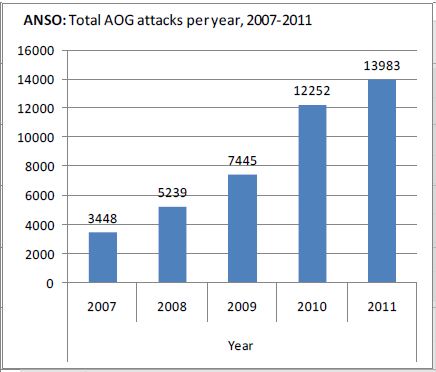
Bradshaw is of course gaming the figures. The independent group Afghanistan NGO Safety Office, or ANSO, reported that for 2011 (pdf), attacks by Armed Opposition Groups (AOG, described as the Taliban, Haqqani Network and Hezb-i-Hekmatyar) continued its upward trend in 2011, as seen in the figure above, rather than going down as Bradshaw would have us believe.

Reuters reports on the concerns surrounding the next step in handing over security control in Afghanistan:

Afghanistan faces tougher security challenges in the next phase of a transition from foreign to Afghan forces as insurgents step up their attacks, Afghan officials said on Thursday.

President Hamid Karzai is expected to announce on Sunday the transfer of 230 districts and the centers of all provincial capitals to Afghan control in the third phase of a handover before most NATO troops pull out by the end of 2014.

/snip/

There are, however, few signs of improving security in Afghanistan. Read more

Share this entry