As US-Iran Threat Exchange Continues, Pakistan Detains Three Iranian Border Guards

[youtube]http://www.youtube.com/watch?v=yaqllTmpcKc[/youtube]

Iran and the US continued to exchange threats over the long holiday weekend. On Saturday night, Barack Obama signed the NDAA, which put into place the ability to enact strong sanctions on banking institutions involved in the sale of Iranian oil. Substantial flexibility is built into the legislation to allow the US to exempt various players in the oil market, so it is still quite uncertain how the sanctions will be implemented. As the video here shows, Iran also test-fired two types of missiles over the weekend prior to the ending of the ten days of naval war games. However, the threats have not ceased, as Iran has now issued a vague warning to the US not to bring the aircraft carrier John C. Stennis, which exited the Persian Gulf on Tuesday, back into the Gulf.

With all of these events taking place, it would be easy to overlook a strange incident on the Iran-Pakistan border on Sunday. Both Iran and Pakistan now say that Pakistan has detained three Iranian border guards who crossed into Pakistan. The guards shot two men who were in a car they were chasing, and one of the men died. The shooting victims are Pakistani nationals.

One of the most detailed accounts appears in the Washington Post via AP:

Pakistani authorities have yet to decide what to do with three Iranian border guards who they say crossed into southwestern Pakistan while chasing after smugglers and killed one them, a government official said Monday.

The incident occurred Sunday in the Mazah Sar area of Baluchistan province, a desolate, unpopulated region where the border is not clearly marked.

Aalam Farez, a senior government official in Washuk district, where Mazah Sar is located, said the Iranians admitted to inadvertently crossing into Pakistan. But, he said, they claimed the two people they shot — one of whom died — were bystanders and that the people they were chasing escaped.

After the shooting, Pakistani border personnel chased the Iranians back across the border and detained them, Pakistani officials have said. They also seized the surviving gunshot victim and determined both of those who had been shot were petty smugglers.

The Express Tribune (via AFP) adds significant background on the region where this event took place:

The Iranians reached Mazan Sar Mashkail, in Washuk district, three kilometres (1.8miles) inside Pakistan where they opened fire on a vehicle they were chasing, according to officials in Balochistan.

“All three personnel of Iranian border security force were taken into custody for their penetration inside Pakistan and killing a Pakistani national on our soil”, Saeed Ahmad Jamali, Deputy Commissioner of Washuk district told AFP.

/snip/

Mazan Sar Mashkail is around 600 kilometres southwest of Quetta, the main town of insurgency hit Baluchistan province, which borders Iran’s Sistan-Baluchestan province.

Iranian embassy officials in Islamabad were unavailable for comment late Sunday but Iran in the past has blamed a Sunni extremist group, called Jundallah, for launching attacks inside Pakistan [sic] from Sistan-Balochistan.

Jundallah says it is fighting Tehran’s Shiite rule to secure rights for Sunni Balochis who form a significant population in Sistan-Balochistan, which borders both Afghanistan and Pakistan. Read more

Share this entry

Predicting a New Paradigm

In my seven plus years of blogging, I’ve never done year-end reviews or predictions and I don’t intend to start now.

But I do want to point to two pieces taking stock of this moment in history–the AJE piece on the decline of the American empire above (the transcript is here), and Juan Cole’s piece declaring the end to US hyperpower.

The AJE piece is generalized and describes a decline in both our economic and military hegemony. And while Cole includes this generalized framework,

The end of the Cold War, which had stretched from 1946 to 1991, had left the political elites of the United States and Western Europe without a bogeyman or security threat on which they could run for office and through which they could funnel resources to the military-industrial complex that largely pays for their political campaigns. With Russia in steep decline in the 1990s and China still run as a small, cautious power, the US emerged as what the French called a Hyperpower, the sole superpower. US hawks were impatient that Bill Clinton seemed not to realize that he had complete freedom of movement for a brief window of time. It was the new US status of hyperpower that allowed the G. W. Bush administration to respond to the September 11 terrorist attacks by launching two major wars and a host of smaller struggles, all against targets in the Muslim world.

As of 2011, the age of the US hyperpower is passing, along with the possibilities for American wars of choice, i.e., wars of aggression.

He situates it, not surprisingly, in the Middle East.

Some years are pivotal and serve to mark off eras of history. 2011 saw the end of American hyperpower, and it announced the end of a decade of US-Muslim conflict that began with 2001. It saw the killing of Usama Bin Laden, the virtual rolling up of al-Qaeda, the repudiation of al-Qaeda’s methods by the masses of the Arab world, and the US military withdrawal from Iraq. The upheavals of the Arab Spring and subsequent elections have led to Muslim fundamentalist parties being drawn into parliamentary politics on a Westminster model, rather than remaining sect-like corporate groups outside the body politic.

While I’m not certain that, fifty years from today, 2011–and specifically our withdrawal from Iraq–will mark the end of our hyperpower or empire (we might measure that date from the financial crisis in 2008; there might be some more spectacular loss in the future that will have that symbolism; or it could be something else entirely), I do generally agree that we’re at the twilight of the American mode of power that has dominated since the end of World War II.

I think that’s why predictions looking forward will be so hard to get right. Partly because there’s no telling how Americans–both those who run our domestic and foreign policy, and those average citizens facing a future without the self-importance derived from the country’s dominance–will react as this new state of affairs becomes evident. At both levels, we could just get a whole lot more violent.

But also because, as Tom Englehardt says in the AJE piece, I don’t think we’re seeing a simple matter of imperial succession, as happened when England passed the baton of world hegemon to us.

I don’t think it’s like the US is going down and you’re gonna get a Chinese empire rising. I think you’ve got a planet in crisis and we’re just barely beginning to feel it.

Rather, I think we’re going to see a new paradigm, one that not only robs average Americans of the arrogance of being the “best,” but also robs many around the world of their traditional means of understanding the world.

So while it may be interesting to think about President Obama dealing with a Republican Senate or President Mitt dealing with Speaker Pelosi, while it may be interesting to predict how many TBTF banks will fail over the next year, even while it may be interesting to start thinking about what Europe will look like after the Euro zone ends, I think all those exercises might be end up showing far too little imagination about what the future holds.

As I’ve said before, it’s fairly clear that 2011–like 1968 and 1989–was a year of great historical importance. But I’m not sure if we can even conceive of just how important it might be or why.

Share this entry

No Straight Talk, Only Posturing Between US, Iran on Strait of Hormuz

[youtube]http://www.youtube.com/watch?v=z8yG5G2Kwt0[/youtube]

Iran’s threats to close the Strait of Hormuz are getting a lot of play in the press the past few days. As the ten days of naval war games for Iran that began on Saturday have continued, Iran’s bluster has gotten stronger, as have the US responses.

Ironically, Iran’s stated purpose when it began the war games included the desire to “convey a message of peace and friendship to regional countries” and yet, as can be seen in the video here, Iranian authorities are now saying that should their ability to export oil be curtailed through sanctions put in place by the US and European allies, they would close down the Strait of Hormuz, preventing exports by other countries in the region.

The impact of a real closure would be huge. Many of the numbers involved can be gleaned from this Bloomberg article published this morning. Iran’s oil exports amount to 3.6 million barrels a day, which means Iran only accounts for 23% of the 15.5 million barrels a day that pass through the Strait. It is believed that Saudi Arabia could produce an extra 2.5 million barrels a day in the event of sanctions halting Iran’s supply, and up to 200,000 more barrels a day could come from other countries in the region, so about 75% of Iran’s output probably could be replaced quickly.

However, with the Strait closed, the entire 15.5 million barrels a day could be disrupted. There is a pipeline being built by the United Arab Emirates that the Bloomberg article says will be ready “soon” and could bypass the Strait with 1.4 to 1.8 million barrels a day, but this would be only a very small fraction of the lost supply.

Even though such a closure would be seen as a direct response to the US and its European allies, the impact on China should not be overlooked. The CIA world factbook informs us that the US imports 10.3 million barrels a day and the EU imports 8.6 million, but China is next in line at 4.8 million barrels a day.  How would China respond to such a huge disruption of their supply, especially if it comes about through a series of disagreements where they have not been included in the discourse? Read more

Share this entry

With US Attention on Memogate Fallout and Taliban, Khan’s Tsunami Gathers Strength

[youtube]http://www.youtube.com/watch?v=iidC31wuEpE[/youtube]

As reported late yesterday by the New York Times, the US is finally acknowledging that it faces a diminished role in Pakistan. However, restoring even a diminished level of relations with Pakistan after the November 26 airstrike that killed 24 Pakistani troops is complicated by the fact that “civilian and military leaders are clashing over purported coup plots”. At the same time, the US continues its efforts at negotiating with the Taliban on a peace agreement for Afghanistan once the US leaves, and has even arranged for the Taliban to open an office in Qatar. These diplomatic moves are all focused on the scheduled 2014 withdrawal of combat troops from Afghanistan, but standing between now and then are the scheduled Pakistan elections in 2013.  Former cricket star Imran Khan appears to be gaining a huge political following and so it seems likely that whether it is the long-rumored military coup or an electoral loss, the Zardari government appears to have lame duck status while participating in these critical discussions.

The Times describes the reduced US role with Pakistan:

With the United States facing the reality that its broad security partnership with Pakistan is over, American officials are seeking to salvage a more limited counterterrorism alliance that they acknowledge will complicate their ability to launch attacks against extremists and move supplies into Afghanistan.

The United States will be forced to restrict drone strikes, limit the number of its spies and soldiers on the ground and spend more to transport supplies through Pakistan to allied troops in Afghanistan, American and Pakistani officials said. United States aid to Pakistan will also be reduced sharply, they said.

It appears that the reduced number of “spies and soldiers” is down to about 100 from a high of 400. It is also very interesting to note that there have been no drone strikes in Pakistan since November 16, a full ten days before the November 26 border post attack. Today marks the one month mark for the blocking of supply lines through Pakistan in response to the border post attack.

While trying to sort out whether the Zardari government is stable enough to negotiate with over US involvement, the US is continuing its frequently ill-fated attempts to negotiate with the Taliban.   Read more

Share this entry

Iranian Navy Plans Wargames for Saturday: Will the Filipino Monkey Show Up?

[youtube]http://www.youtube.com/watch?v=jRbYKKM5cAE[/youtube]

In January of 2008, at a time very similar to now (just under a year out from Presidential elections and with anti-Iran propaganda at a fever pitch in the US media), the Bush administration embarrassed itself mightily in its response to an encounter in the Persian Gulf. As US warships were being approached by five small Iranian craft, a voice came over the airwaves stating “I am coming to you”. A bit later it added “You will explode after a few minutes”. The US quickly claimed this was a threat from the Iranian vessels, but after cooler heads prevailed (and after Iran supplied additional video and audio from the encounter), it was realized that the voice did not match those of the Iranians in the encounter and that the behavior matched that of the legendary radio prankster, the Filipino Monkey.

We learn today from Fars News that Iran plans very large naval wargame exercises on Saturday, in both the Sea of Oman and the Indian Ocean:

Iranian Navy Commander Rear Admiral Habibollah Sayyari said at a press conference on Thursday that the naval maneuvers dubbed Velayat 90 will start on Saturday and will cover an area stretching from the east of the Strait of Hormuz in the Persian Gulf to the Gulf of Aden.

According to Sayyari, this is the first time that Iran’s Navy carries out naval drills in such a vast area.

He added the exercises will manifest Iran’s military prowess and defense capabilities in the international waters, convey a message of peace and friendship to regional countries, and test the newest military equipment among other objectives of the drills.

It would have been nice if we had seen all of the objectives in the drills rather than a partial list, but it is quite interesting to see the list of weapons systems and equipment that will be involved:

Rear Admiral Sayyari said that the newest missile systems and torpedoes will be employed in the maneuvers, adding that the most recent tactics used in subsurface battles will also be demonstrated in the maneuvers.

He also said that Iranian destroyers, missile-launching vessels, logistic vessels, drones and coastal missiles will also be tested.

With all those torpedoes, missiles and drones running around, what could possibly go wrong? Given the level of posturing by both the US and Iran lately over nuclear technology, assassination plots, spies and drones, these naval wargames seem particularly ripe for generating the type of “misunderstanding” that can quickly escalate to outright hostilities. Throw in the wildcard of spurious, but well-timed, radio provocation, and the Filipino Monkey could move from comedy to tragedy in the blink of an eye.

Share this entry

Zardari Returns to Pakistan; Liaison Officers Return to Border Centers; Stage Set for Haqqani as Double Scapegoat

Two major steps toward stability in Pakistan and restoration of relations with the United States have taken place, as President Asif Ali Zardari returned to Pakistan yesterday while liaison officers have now returned to the border coordination posts from which they were withdrawn as part of the response to the November 26 NATO attack that killed 24 Pakistani troops. NATO supply routes remain blocked, however.  In a very interesting move, former Pakistani Ambassador to the United States Husain Haqqani has been forced to submit a statement and to appear before the Abbotabad Commission. The Commission is seeking information on visas issued by the Washington embassy during his tenure as Ambassador.

Despite the earlier statements that Zardari would take two weeks of rest before resuming his duties, Zardari yesterday returned to Pakistan from Dubai:

Pakistani President Asif Ali Zardari returned home from medical treatment in Dubai to face rising tension between his civilian government and the military over a memo accusing the country’s generals of plotting a coup.

It’s not clear when the deeply unpopular leader who has uneasy ties with the army will return to work. He flew into the southern city of Karachi after treatment for a heart condition.

It would appear that Zardari immediately took up at least ceremonial duties:

State television showed him at his residence, looking relaxed as he met senior provincial officials.

Multiple media reports had addressed the fact that Zardari and Army Chief Ashfaq Kayani had talked on the phone prior to Zardari’s return. An article today by Dawn provides more details on that conversation: Read more

Share this entry

Zardari Released From Hospital, Remains in Dubai; Memogate Reply Delayed

Pakistan’s President Asif Ali Zardari was released from the hospital in Dubai on Wednesday, but has not returned to Pakistan. His reply to Pakistan’s Supreme Court investigation into the Memogate scandal had been expected today, but could be submitted tomorrow since the deadline has been extended.

Reuters gives us details on Zardari’s release from the hospital:

“President Zardari has been discharged from the hospital and he has moved to his residence in Dubai,” presidential spokesman Farhatullah Babar said.

The article also has more information on the ongoing question of whether Zardari suffered a stroke:

Zardari’s office had released a statement earlier on Wednesday from his doctor saying the president had been admitted to hospital with numbness and twitching in his left arm and had lost consciousness for a few seconds.

“All investigations are within normal range and he was kept for observation for a few more days,” Khaldoun Taha said, adding that Zardari would now rest at home and continue with his regular heart medications.

Zardari likely suffered a transient ischemic attack, senior sources in Zardari’s party said last week, an ailment that can produce stroke-like symptoms but no lasting damage to the brain.

Admitting to a TIA appears to thread the needle nicely in providing a few symptoms consistent with the widespread rumors of a stroke while avoiding any long-term stroke damage which would be obvious should Zardari return to public life. With Zardari now out of the hospital, his need for “rest” begins to look more suspicious, especially with the rest taking place in Dubai. I’m having a hard time seeing how Zardari can take two weeks of rest outside the country at a time when such crucial questions are facing Pakistan’s government and then come back and resume his duties.

One immediate crisis facing Zardari is the investigation into Memogate being carried out by the Supreme Court. Read more

Share this entry

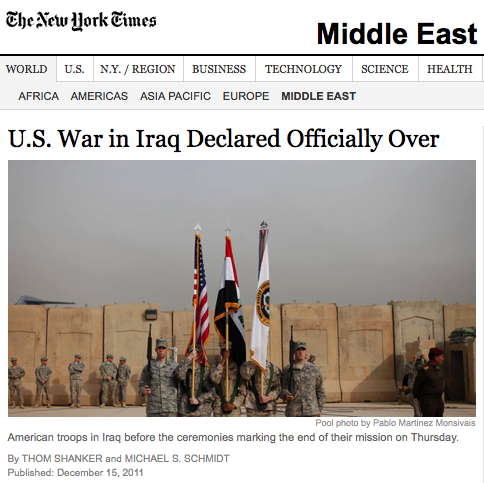
No, the Iraq War Is NOT Over

The NYT, which played a key propaganda role in getting us into the Iraq war, has a 1000-word article telling us the Iraq war has officially been declared over.

And while it is true that the Administration had a campaign event dog and pony show yesterday declaring the war over, it is not.

After all, Rand Paul tried to formally, legally end the Iraq war last month. And 67 Senators refused to do so.

The fact that the Iraq AUMF remains on the books matters. It matters because no matter how many times we wax eloquent about Iraqis controlling their own destiny, Nuri al-Maliki knows that little prevents Obama from bringing in troops again–or dropping drones in his country. Maybe that’s why Maliki is doing unfathomable things like laying a wreath at the military cemetery of the country that has occupied and ravaged his country for 8 years.

And, as I keep noting, the Iraq AUMF serves another purpose. That AUMF’s general language on “terrorism” has been used to authorize the use of “war powers” against people the Executive Branch claims are terrorists who have nothing to do with al Qaeda. The Iraq AUMF has been interpreted by the Executive Branch to authorize a war against all so-called terrorists, not just the terrorists who hit us on 9/11. And based on that argument, it was used to authorize the wiretapping of American citizens in the US.

Credulous journalists may want to accept the Administration’s propaganda about the Iraq war ending. But until we take the expanded powers given to the President pursuant to a vile propaganda campaign away from him, the Iraq war is not over. And Obama should not be able to use it as a campaign line until he actually gives up those powers.

Share this entry

Iran Seeks Interpol Prosecution of Neoconservatives Jack Keane, Reuel Marc Gerecht

Jack Keane, on left, and Reuel Marc Gerecht, on right.

Multiple news outlets in Iran are reporting that Iran has asked Interpol to prosecute former General Jack Keane (co-author of the Iraq surge) and former CIA operative Reuel Marc Gerecht on the basis of their open calls for the assassination of Iranian figures during a meeting of two House Homeland Security Subcommitttees on October 26.

From Mehr News:

In a letter to Interpol, Iranian National Prosecutor General Gholam Hossein Mohseni-Ejei has called for the prosecution of the U.S. officials, IRNA reported on Monday.

/snip/

According to the online magazine Firstpost, at a session of the committee, Jack Keane, a retired four-star general who helped plan the U.S.-led occupation of Iraq, called for the assassination of the leaders of Iran’s Qods Force in retaliation for their alleged role in a plot to kill the Saudi ambassador to Washington, a claim vehemently denied by Iranian officials.

“Why don’t we kill them? We kill other people who are running terrorist organizations against the United States,” he said.

The other witness, Reuel Marc Gerecht, a former CIA officer who is now a senior fellow at the neoconservative think tank the Foundation for Defense of Democracies, told the committee, “I don’t think that you are going to really intimidate these people, get their attention, unless you shoot somebody.”

The article then goes on to report that Congressmen Peter King, Michael McCaul and Patrick Meehan signed a November 22 letter stating “that the U.S. should undermine Iranian officials and damage the country’s infrastructure through increasing covert operations”.

Fars News Agency claims that Interpol stands ready to help in the effort:

Iran’s Deputy Police Chief Brigadier General Ahmad Reza Radan announced that the International Criminal Police Organization (Interpol) has promised to help Tehran prosecute the two former US officials who had called on the Obama administration to assassinate Iran’s top military commanders.

“The Interpol will take the steps for the prosecution of two Americans who sponsor terrorism,” Radan told FNA on Tuesday. Read more

Share this entry

Gilani to BBC: Zardari to Remain in Dubai Hospital Two More Weeks

[youtube]http://www.youtube.com/watch?v=yxfZ2706b0U[/youtube]

Pakistan’s Prime Minister Yousef Raza Gilani granted an extended interview to BBC on Sunday.

Although many important topics were covered in the interview, the subject of the health of Pakistan’s President Asif Ali Zaradari was perhaps the most crucial.  The health part of the interview starts at around 1:50 of the video.  I find it interesting that Gilani states that Zardari has now been moved from the ICU to “his room” at the hospital.  If I recall correctly, early reports had stated that Zardari was in the ICU in order to cut down on the number of visitors. Gilani’s reference to this move to a regular room appears to be more in the context of Zardari’s recovery, so now there is reason to believe that Zardari’s health when he arrived in Dubai was poor enough to warrant an extended stay in the ICU.

Gilani rejected outright the rumors that Zardari has suffered a stroke.  Those rumors have persisted on Twitter for the entire time that Zardari has been hospitalized.

Most importantly, though, is Gilani’s statement that Zardari now will “take rest” and that the rest will be for “about two weeks”.  Recall that when it was first revealed that Zardari was hospitalized in Dubai, the story was that he had suffered a mild heart attack and that he had undergone angioplasty.  In my post about that news, I had this to say:

It should be kept in mind that if Zardari did suffer a mild heart attack and then was treated with angioplasty, patients in this situation often are discharged from the hospital the next day and are usually free to resume normal activities fairly quickly. Should the hospitalization continue into next week, then either the status of Zardari’s health or the status of the political situation should be assumed to be different from what has been reported.

If we were to work only from the assumption that this was a mild heart attack followed by angioplasty, then Zardari remaining in Dubai for two more weeks would seem to point pretty strongly to the likelihood that Zardari has deemed it either not safe or not prudent for his return to Pakistan.  However, that interpretation is complicated by Gilani linking Zardari’s shift out of the ICU as part of his recovery.  A stay of four or five days in the ICU is not consistent with the initial health status that was reported.  As a result, it appears that we are stuck in a holding pattern where we cannot fully ascribe Zardari’s extended hospital stay as wholly health-dependent or wholly politics-dependent. Read more

Share this entry