Did Obama Order Total Information Shutdown on Afghanistan?

In a stunning and blatantly obvious move to try to hide its failed efforts in Afghanistan, the military suddenly decided back in October that they would classify any and all information on the capabilities of Afghan National Security Forces (ANSF) despite data having been provided to the Special Inspector General for Afghanistan Reconstruction (SIGAR) for the 24 quarterly reports that preceded the one dated October 30, 2014 (pdf). Initial digging on that classification decision appeared to put the classification decision in the hands of ISAF Joint Command. The head of ISAF Joint Command then broke his own classification of ANSF capability a few days later when he proclaimed that ANSF is a “hugely capable fighting force” in a news briefing.

The timing for this classification couldn’t have been worse. US forces were in the final stages of the handoff of Afghan security to ANSF and Barack Obama eventually relied on butchered semantics to proudly proclaim that the war was over, despite a residual fighting force to which he had secretly given expanded combat powers.

Today, though, the classification of ANSF capability last quarter looks less like an arbitrary move by the Commander of ISAF Joint Command and more like a total information shutdown on Afghanistan. Perhaps Lt. Gen. Anderson just got the call for a shutdown before everyone else. In the SIGAR quarterly report released today (pdf), we learn that the military now has classified “nearly every piece of data used by the inspector general to assess the Afghan security forces.” In an appendix to the report, SIGAR lists the more than 140 questions that the military previously responded to openly but now says the answers are classified. Here is a sampling that SIGAR provided in the email sent out releasing the report:

–The over 140 SIGAR questions that received classified or otherwise restricted responses are listed starting on page 211. Sample of questions:
–Please provide a broad definition of the terms “unavailable” and “present for duty.” (page 211)
–Total amount of funding that the United States has expended on Afghan National Army food from Afghan Security Forces Fund (ASFF) for the current year. (page 211)
–How has the $25 million authorized by Congress for women in the Afghan army been used? (page 212)
–Total amount of funding that the United States has expended on Afghan National Police salaries from ASFF for the current year. (page 212)
–Please provide details of DOD/NATO-funded contracts to provide literacy training to the ANSF, including: a. the cost of the contract(s) and estimated cost(s) to complete (page 213)
–Please confirm that the Combined Joint Interagency Task Force-Afghanistan (CJIATF-A) is dissolved. (page 215)
–Please offer an assessment of the anticorruption initiatives of Afghan Ministry of Defense and Afghan Ministry of Interior (page 215)

As the New York Times article linked above points out, the military also initially tried to classify the number of US forces present in Afghanistan and only relented on that point when it was pointed out that the number had already been released by the Obama Administration.

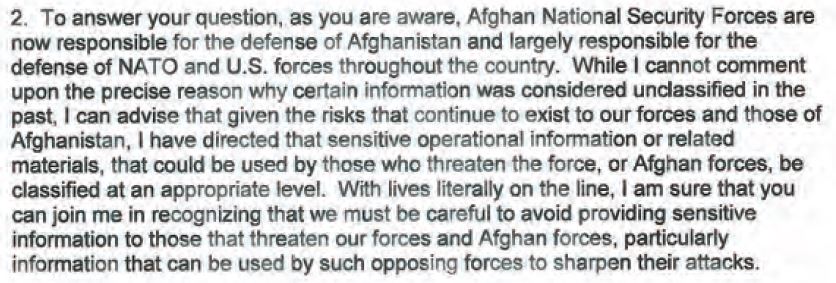
The “explanation” offered by the Commander of US troops in Afghanistan, General John F. Campbell, is far from satisfactory. Here is an excerpt from his letter to SIGAR explaining the sudden expansion of classification:

Campbell

Campbell then had the temerity to add later in his letter that he is “committed to maximum transparency in our operations”. Just wow. That sounds like Obama declaring himself the most transparent President ever, and then going on to rely on expanded classification coupled with unprecedented levels of prosecution of whistleblowers.

But instead of just looking like a move Obama would make, perhaps it did come at his behest. Not only is the military clamming up on virtually all information out of Afghanistan, it appears that the State Department is as well. From page 147 of SIGAR’s report:

Despite the requirement of Public Law 110-181 that federal agencies provide requested information or assistance to SIGAR, the State Department did not answer any of SIGAR’s questions on economic and social-development this quarter, and failed to respond to SIGAR’s attempts to follow up.

Had only one Federal agency, the Defense Department, suddenly shut down the flow of information, it would have been easy to believe that they were ones trying to hide their own failures. But now that a second agency, the State Department, has shut down information flow at the same time, and won’t even provide an explanation for their move, it seems clear to me that the order to shut down information flow had to come from above. With both the Defense Department and State Department going silent, could such an order have come down from anyone other than Obama himself? The failure that is our Afghanistan war has entered its fourteenth year, has spanned two presidents and is now being summarily swept under the rug by the Most Transparent Administration Ever®.

Postscript: For more evidence on just how failed the Afghanistan effort has been, recall that John Kerry’s brokered extra-constitutional National Unity Government was over three months late in finally announcing a full slate of 19 cabinet nominees. Sadly, the slate included poorly screened candidates and the Afghan Parliament yesterday rejected 10 of those nominees while voting to confirm only 9.

Share this entry

Shell Announces $11 Billion Petrochemical Plant for Iraq: What Could Go Wrong?

Today’s entry in the “What Could Go Wrong?” sweepstakes is quite a beauty, courtesy of Reuters:

Royal Dutch Shell (RDSa.L) has signed a deal with Iraq worth $11 billion (7 billion pounds) to build a petrochemicals plant in the southern oil hub of Basra, Industry Minister Nasser al-Esawi said on Wednesday.

Esawi told a press conference in Baghdad the Nibras complex, which is expected to come on line within five to six years, would make Iraq the largest petrochemical producer in the Middle East.

“The Nibras complex will be one of the largest (foreign) investments (in Iraq) and the most important in the petrochemical sector in the Middle East,” Esawi said.

Proponents of the deal undoubtedly will point to the fact that Basra is in the far southeastern part of Iraq, far from the swathe of territory controlled by ISIS. Others will even point to the apparent defeat of ISIS in Kobane and how that might signal a turning of the tide in the battle against them. And yes, oil output in Iraq has been steadily rising since that little blip in 2003. As of the time of that linked report from the US Energy Information Administration from 2013, there were other plans for another $24 billion or so in new refineries in Iraq’s oil-producing regions, so why not jump on this Shell plan?

It turns out that there is plenty of fodder for fans of Lee Corso to shout “Not so fast, my friend!” when it comes to this deal. Back in June, there were already rumblings that the big uptick in Iraq violence could threaten expansion of Iraq’s oil sector. Even that article, though, attempted to support the notion that the Basra area remained relatively safe:

As grim as the worst-case situations may be, most analysts still say there is no immediate threat to Iraq’s southern oil fields, which account for approximately 90 percent of the country’s production and oil export. Basra, the heart of Iraq’s oil economy, is situated in an area strongly dominated by Shiites who generally support the central government and are implacable enemies of the Sunni forces on the march in the north.

Badr H. Jafar, chairman of Pearl Petroleum, a consortium that operates in Iraqi Kurdistan, said it was “highly unlikely” that terrorists could disrupt production and operations in southern Iraq.

The New York Times article containing the quote above is dated June 13, 2014. Just a couple of days later, though, we have this:

Turkey’s consulate in the Iraqi city of Basra has been evacuated due to security concerns, Foreign Minister Ahmet Davutoğlu announced June 17. The 18 staff members at the consulate, including the consul general, were were taken to Kuwait, Davutoğlu wrote via his Twitter account.

And that wasn’t just a one-off thing. Consider this tweet from October:

A number of airlines discontinued flights to Baghdad because a civilian airplane was hit by bullets there yesterday while landing, but coverage of that halt notes that flights continue in and out of Basra. There was a report January 12 of a plot to attack the port just 20 miles or so from Basra.

There is one more situation that suggests future problems around Basra:

Thousands of Iraqis are living in penury and running out of money after fleeing fighting and settling in the south of the country, the UN’s food agency said on Tuesday, warning that the situation was becoming critical for families in Najaf, Kerbala and Babil.

Jane Pearce, the World Food Programme’s (WFP) country director for Iraq, said structures had not yet been put in place to cater for the people fleeing into the three southern provinces.

WFP is distributing food to 50,000 displaced families in Basra, Dhi Qar, Qadisiya, Missan, Wasit, Muthanna, Najaf, Kerbala and Babil.

/snip/

WFP needs $292m for its operations in Iraq this year, and has a shortfall of $200m.

Imagine that. Yet another region where the US has no trouble finding funds for bombs, weapons and “training” and yet the WFP is facing a shortfall of hundreds of millions of dollars. But never fear, I’m sure my adorable little troll will be around shortly to stamp his foot and inform us how disaster responders in all their glory have the situation safely in hand and the US can continue its work to create even more refugees because sufficient scraps will be found just in time to avert the worst.

And of course, folks living on the edge of starvation and death from exposure will never, ever be radicalized by such an experience. Sure, go ahead and build that $11 billion petrochemical plant. The US war-industrial complex will be happy to spend hundreds of times more than that amount defending the facility.

Share this entry

Afghan Cabinet: Nominate First, Screen Later

Just under two weeks ago, it appeared that one of the final hurdles in getting the Afghan government functioning after the disputed election may have been cleared, as a full slate for the cabinet was announced. Sadly, even though Ashraf Ghani and Abdullah Abdullah took over three months to come up with the list of nominees to run their “Unity Government”, it is clear that no screening of these candidates took place, as many are now falling by the wayside. One turns out to have an Interpol red notice, as many as eleven may have dual citizenship (a direct violation of the Afghan constitution) and one may not meet the minimum age requirement.

Rod Nordland describes some of the problems that have been encountered:

Choosing the Afghan cabinet is to government what the national sport of buzkashi is to polo: a wild and woolly version with uniquely local characteristics and notably more carnage.

President Ashraf Ghani’s presentation of new cabinet nominees to Parliament on Tuesday was a case in point. One proposed nominee had just pulled out after revelations of an Interpol warrant for his arrest. Another dropped out, complaining that he did not have enough money and jobs to bribe Parliament into approving him. A third was subject to a social media smear campaign alleging that she had just gotten a new identity card so she could add a few years to her age to qualify for the job.

Several other would-be ministers were reportedly headed to the exits before Parliament got a chance to vote on them, as revelations tumbled out about dual citizenships, frowned on by the Afghan Constitution, or even, in one case, allegedly not being fluent in any national language.

It’s impossible to make this stuff up. Nordland continues:

“The candidate for rural development studied urban development, and the candidate for urban development studied rural development,” said Ramazan Bashardost, an anticorruption crusader and member of Parliament, famous for his outspokenness.

Corruption is running rampant in the confirmation process:

A more prominent nominee, Jilani Popal, a well-regarded former government official, withdrew his name from nomination as finance minister. While he is believed to have dual United States and Afghan citizenship, Mr. Popal told friends that he had pulled out when members of Parliament asked him for a total of 400 jobs in exchange for their votes, most of them in the lucrative customs service, leaving him with no slots for unstained candidates.

We get more on bribes from ToloNews:

However, a number of MPs have told TOLOnews that presidential advisor Mohammad Akram Akhpalwak has made promises of gifts to lawmakers if they vote in favor of the nominees. MPs said they had been promised IPHONE 6 mobile sets and 5-10,000 USD. Mr. Akhpalwak has meanwhile rejected the allegations.

That same ToloNews article informs us that seven of the nominees believed to have dual citizenship have been rejected by the Foreign Affairs Commission of Parliament. But over at Khaama Press, we learn that the rejection was quite the event:

The Lower House of the Parliament – Wolesi Jirga on Thursday witnessed brawl among the lawmakers over the issue of cabinet nominees holding dual citizenship.

/snip/

In the meantime, a number of the lawmakers insisted that the nominees holding dual citizenship should also be called in the session so that they can present their plans.

The lawmakers said the cabinet nominees have signed documents to surrender their second citizenship and the decision to reject the nominees with dual citizenship was not taken by the house of representatives.

Brawl among the Afghan lawmakers started after MP Shukria Barekzai critized the recent decision by joint parliamentary commission to reject the nominees insisting that the Parliament House is not authorized to deprive the rights of an Afghan national from election and voting.

The article goes on to describe a pathway through which the nominees might be brought back into eligibility. Given the slow, argument-filled route that has brought the Afghan “government” to its present state, I wouldn’t expect these questions about potential cabinet ministers to be resolved any time soon.

Share this entry

SIGAR Finds Huge Problems With $300 Million Afghan National Police Payroll

SIGAR, the Special Inspector General for Afghanistan Reconstruction, has released a report (pdf) describing very disturbing problems with salaries for the Afghan National Police. The report concludes:

The U.S. government is spending more than $300 million annually for ANP salaries with little assurance that these funds are going to active police personnel or that the amounts paid are correct. ANP identification cards with unique numbers are the primary control mechanism to help protect against fraud and abuse, but they are not being used properly—including for attendance and payroll purposes—and there are almost twice as many cards in circulation as there are active police personnel. Further, after 9 years of effort, an electronic human resources system—critical for ensuring the proper personnel are being paid and paid the correct amount—has still not been successfully implemented. Despite lengthy and costly U.S. government attempts to implement this system, AHRIMS, and a payroll system, EPS, the two systems are still not integrated. This lack of integration serves to negate critical controls, such as the ability to reconcile personnel between systems, that should be in place to protect U.S. salary funding from waste and abuse. It is not surprising, therefore, that reports have disclosed inflated police rosters, payments being made to more police personnel than are authorized in particular locations, and police personnel receiving inflated salaries. Achieving full functionality and integration of these systems would only partially resolve existing problems. Such improvements would still not address concerns about low-level ANP attendance procedures or the integrity of the data once it leaves EPS for final salary payment calculations. Also of concern is the payment of ANP personnel in cash via trusted agents, as there are even fewer controls over these salary payments. The fact that as much as half of these payments are possibly diverted from intended recipients is alarming.

The U.S. government and international community plan to continue funding ANP salaries. Some requirements to help safeguard U.S. funds are in place, but neither CSTC-A nor UNDP are fully following them. U.S. Forces-Afghanistan (USFOR-A) should enforce these requirements and—where there are accountability gaps—create new, binding procedures to better safeguard funds. USFOR-A, UNDP, and the MOI must do a better job of coordinating to ensure that ANP personnel numbers match on-the-ground realities and that their salaries are accurate and provided only to actively serving Afghan forces.

We learn from the report that the flawed ANP identification card program was developed by DynCorp, but I don’t see in the report where the equally flawed AHRIMS and EPS programs came from. The fact that after 9 years of trying, we still don’t have a basic system for “taking attendance” for ANP personnel on the job is staggering. As a result, the system is still rife for corruption at all levels as ghost employees can be put on the roles and their salary embezzled. Here is more detail on the corruption enabled by part of the payroll being disbursed in cash:

SIGAR found that nearly 20 percent of ANP personnel are at risk of not receiving their full salaries because they are paid in cash by an MOI-appointed trusted agent, a process that lacks documentation and accountability. CSTC-A and UNDP officials told SIGAR that there is limited oversight of trusted agents and a higher risk that funds may be subject to corruption. Further, CSTC-A reported that corrupt practices within the trusted agent system of salary payments “could take as much as 50 [percent] of a policeman’s salary.”

On a separate but highly related front, Afghanistan finally has announced the full roster of nominees for its cabinet. This move will fill 27 positions. Conveniently, TOLONews has broken those nominees down by where they came from. Thirteen were nominated by Ashraf Ghani and twelve by Abdullah Abdullah. Two are “neutral”, the head of security (who carries over from the previous government) and the head of the banking system.

Returning to the problems in the SIGAR report, ANP falls under the Ministry of the Interior, whose new leader, nominated by Abdullah Abdullah, will be Noor-ul-haq Ulumi. He is a former general as well as having served in the lower house of Afghanistan’s Parliament. He will face quite a challenge in implementing the changes that SIGAR suggests in its report.

Share this entry

Ghani Institutes Night Raids While Facing Treason Accusations Over Absence of Cabinet

Despite the rampant corruption of his administration and his many other faults, Hamid Karzai was a consistent critic of US-led night raids that led to many senseless civilian deaths, disappearances and torture. Those raids, and the US death squads that carried them out, were right at the top of the list of reasons Karzai refused to sign the BSA authorizing the continued presence of US troops in Afghanistan beyond the beginning of this year. Now that Ashraf Ghani has signed the BSA, the US has retained its right to “counterterrorism operations”, meaning that US-led night raids are still authorized despite Barack Obama’s declaration that combat operations have ended (while relying on a semantic sleight of hand in omitting that counterterrorism operations continue).

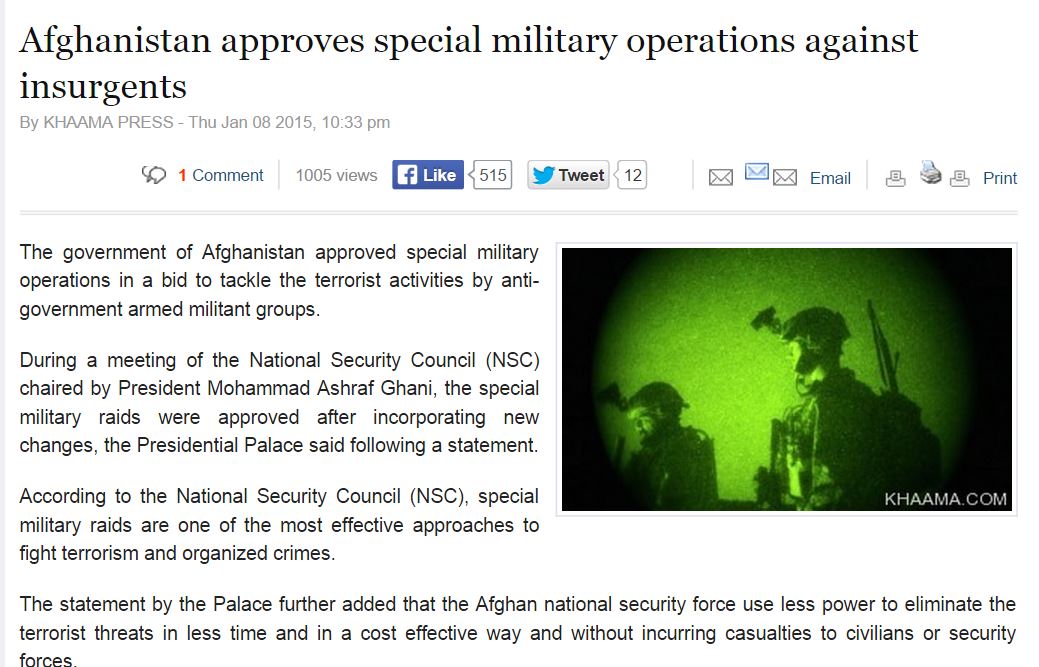
Ashraf Ghani seems to feel that US-led night raids are not enough, and so he called a meeting of Afhganistan’s National Security Council to authorize more night raids carried out by Afghan forces. Learning from Obama, Ghani has termed these raids “special military operations” rather than the unpopular night raids, but Khaama Press clearly knows that this is about night raids. Here is a partial screen capture of their article on the move, where we see that the chosen illustration for the story is a photo taken at night, showing forces wearing night vision equipment routinely employed in night raids:

Khaama Press article on Ghani's move to institute night raids.

Khaama Press article on Ghani’s move to institute night raids.

Perhaps in a bit of a nod to Karzai’s previous objections to US-led night raids, the article notes:

The Afghan national security forces were instructed to take all necessary measures to respect the Islamic values, the Afghan culture, Afghan constitution and other laws of the country while executing a special military operation.

It’s hard to see how that instruction can be carried out, though, since the ANSF have been trained by US forces whose actions led to those very charges against them by Karzai. Even though Karzai forced the US to sign an “agreement” supposedly reforming US night raids in 2012, Karzai was still complaining about the US violating Afghan homes more than a year and a half later. Ghani is now authorizing these crimes to be committed by Afghan troops as well as US troops.

On a separate front, a number of Afghan Members of Parliament have declared that the failure of the Unity Government led by Ghani to establish a cabinet more than three months after assuming power rises to the level of a charge of treason. Ghani, however, appears to be shrugging off the charge.

With the idea of impeachment already in the air, Ghani’s move to institute night raids by Afghan forces might just provide a stronger basis for moving ahead with charges.

Share this entry

Pentagon Slowly Coming to Realization That There Might Possibley Be Civilian Deaths from Airstrikes On ISIS

Hell froze over yesterday:

The United States military is investigating reports of civilian casualties that may have occurred as part of the American-led fight against the Sunni militancy known as the Islamic State, a senior Pentagon official said Tuesday.

Rear Adm. John Kirby, the Pentagon press secretary, told reporters during a news conference that investigators with the United States Central Command had begun looking into whether coalition airstrikes, which have targeted Islamic State fighters, equipment and oil depots, may have inadvertently hit civilians. Admiral Kirby said he had no additional information. It was the first time that the Pentagon had acknowledged that the air campaign against the Islamic State may have caused civilian deaths.

Recall that US air strikes began in early August. In late September I looked into some of the reports of civilian casualties, and it was not difficult at all to find credible reports. Later on the same day of that post, Michael Isikoff reported that the White House had exempted ISIS air strikes in Iraq and Syria from the new standards of preventing civilian deaths in drone strikes that Obama had announced in 2013.

The Pentagon provided the flimsiest of excuses for having no evidence of civilian deaths at that time:

Earlier Monday, the Pentagon admitted that some assessments of civilian casualties were “inconclusive” since the U.S. was only using drones to assess the results of strikes from the air.

“The evidence is going to be inconclusive often. Remember we’re using [intelligence, surveillance and reconnaissance] to determine the battle damage assessment,” Pentagon spokesman Army Col. Steve Warren said Monday.

A defense official told The Hill earlier this month that accurate assessments of damage from strikes are impossible without U.S. forces on the ground to exploit the attack sites, since Iraqi and Syrian partners did not have the capability.

So the Pentagon claims that they have sufficient intelligence resources to choose targets for attacks, but those same resources magically become incapable of determining the outcome of those attacks.

It’s not like the Pentagon would have to work hard to find credible reports of civilian deaths in their air strikes. Reuters reported back in October that in Syria alone, the Syrian Observatory for Human Rights had documented 32 civilian deaths from US air strikes in a one month period.

The numbers are much worse when we move to Iraq. CNN cited Iraq Body Count data for 2014:

But according to Iraq Body Count’s analysis, 1,748 civilians were reported killed by Iraqi military airstrikes, while 4,325 were killed by ISIS. There were also 118 civilians reported killed by U.S. coalition airstrikes last year.

So while Iraqi air strikes dwarfed US strikes in terms of civilian deaths, it still is remarkable that the Pentagon is finding it so hard to find incidents to investigate when there are over a hundred known dead from our strikes in Iraq in the last year.

Despite those staggering numbers, here is all Central Command could come up with in followup to Kirby’s statement at the top:

Sgt. First Class Sheryl Lawry, a spokeswoman for Central Command in Tampa, Fla., said in an email that Centcom was investigating two instances, one in Iraq and one in Syria, that may have resulted in civilian casualties. The investigations are a result of Centcom’s internal review process. Another three reports of civilian casualties are pending an internal assessment before determining whether they need to be investigated, she said.

The military has examined the credibility of 18 allegations that coalition airstrikes led to civilian casualties in Iraq and Syria from Aug. 8 to Dec. 30 last year, Sgt. Lawry said. Of those, 13 have been determined not to be credible.

Imagine that. Of the the 13 investigations completed, all 13 have cleared the US of killing civilians. There are two that are credible enough that they are still under investigation. Presumably, it is taking some time to manufacture a basis for claiming the reports are not credible. And who knows what those three events still under “assessment” means; we can only guess that they are more recent events and the Pentagon is merely determining how large the whitewash brush needs to be.

Share this entry

No, the War in Afghanistan Did Not End

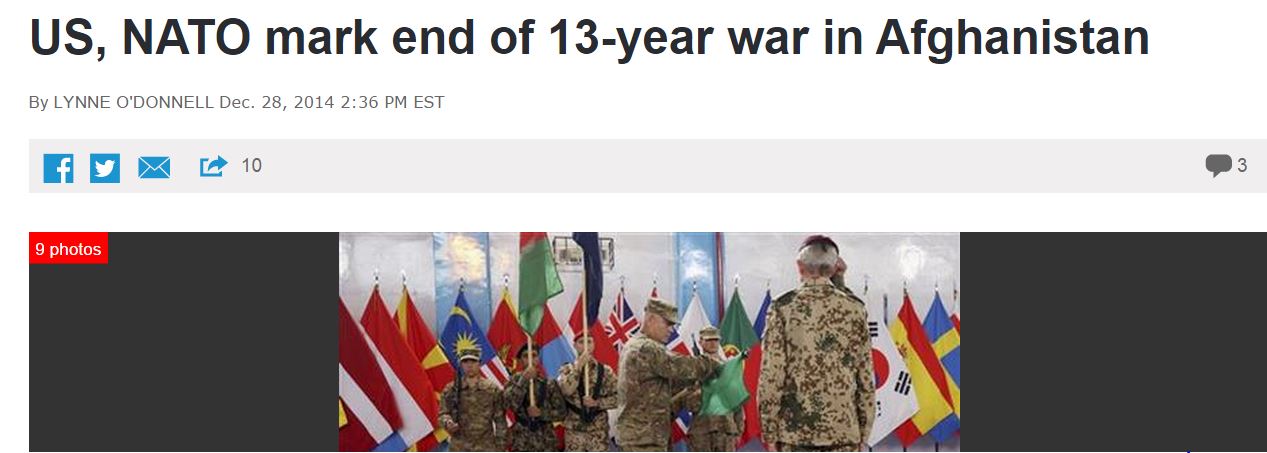
Yesterday afternoon, an AP article proudly announced to us that the war in Afghanistan has ended:
AP hed

Unfortunately, the AP headline is total bullshit. There was indeed a ceremony in Kabul yesterday. And yes, it did mark (for the second time), the end of the international force called ISAF (International Security Assistance Force) assembled under NATO as the lead in the war in Afghanistan. The new NATO mission, dubbed Operation Resolute Support, also under NATO leadership, is proclaimed most often to consist only of training and support to Afghan forces who will do all the fighting.

The problem with that description is that it is a lie. Just over a month ago, Barack Obama “secretly” expanded the role of US troops remaining in Afghanistan:

President Obama decided in recent weeks to authorize a more expansive mission for the military in Afghanistan in 2015 than originally planned, a move that ensures American troops will have a direct role in fighting in the war-ravaged country for at least another year.

Mr. Obama’s order allows American forces to carry out missions against the Taliban and other militant groups threatening American troops or the Afghan government, a broader mission than the president described to the public earlier this year, according to several administration, military and congressional officials with knowledge of the decision. The new authorization also allows American jets, bombers and drones to support Afghan troops on combat missions.

In an announcement in the White House Rose Garden in May, Mr. Obama said that the American military would have no combat role in Afghanistan next year, and that the missions for the 9,800 troops remaining in the country would be limited to training Afghan forces and to hunting the “remnants of Al Qaeda.”

The decision to change that mission was the result of a lengthy and heated debate that laid bare the tension inside the Obama administration between two often-competing imperatives: the promise Mr. Obama made to end the war in Afghanistan, versus the demands of the Pentagon that American troops be able to successfully fulfill their remaining missions in the country.

But to AP, the only message worthy of being in their headline and lede paragraph is that the war has ended:

The war in Afghanistan, fought for 13 bloody years and still raging, came to a formal end Sunday with a quiet flag-lowering ceremony in Kabul that marked the transition of the fighting from U.S.-led combat troops to the country’s own security forces.

The reader has to hang in there for another dozen paragraphs or so before reaching the admission of the expanded role of US troops and the reason for that expansion:

Obama recently expanded the role of U.S. forces remaining in the country, allowing them to extend their counter-terrorism operations to the Taliban, as well as al-Qaida, and to provide ground and air support for Afghan forces when necessary for at least the next two years.

In a tacit recognition that international military support is still essential for Afghan forces, national security adviser Mohammad Hanif Atmar told the gathered ISAF leaders: “We need your help to build the systems necessary to ensure the long-term sustainability of the critical capabilities of our forces.”

More than ten years after starting our “training” mission, Afghan troops remain unable to defend the country on their own and must rely on US troops.

Of course, the military knows that they have this expanded role. Here is the video the military provided on the transition ceremony:

Note that at around 38 seconds, the narrator says “combat by American forces on counterterrorism operations will continue”. You can bet they will.

Oh, and for a righteous rant on this whole charade, scroll back to yesterday on James Risen’s Twitter feed.

Share this entry

Israel’s Newest Ballistic Missile Shield System Fails Test

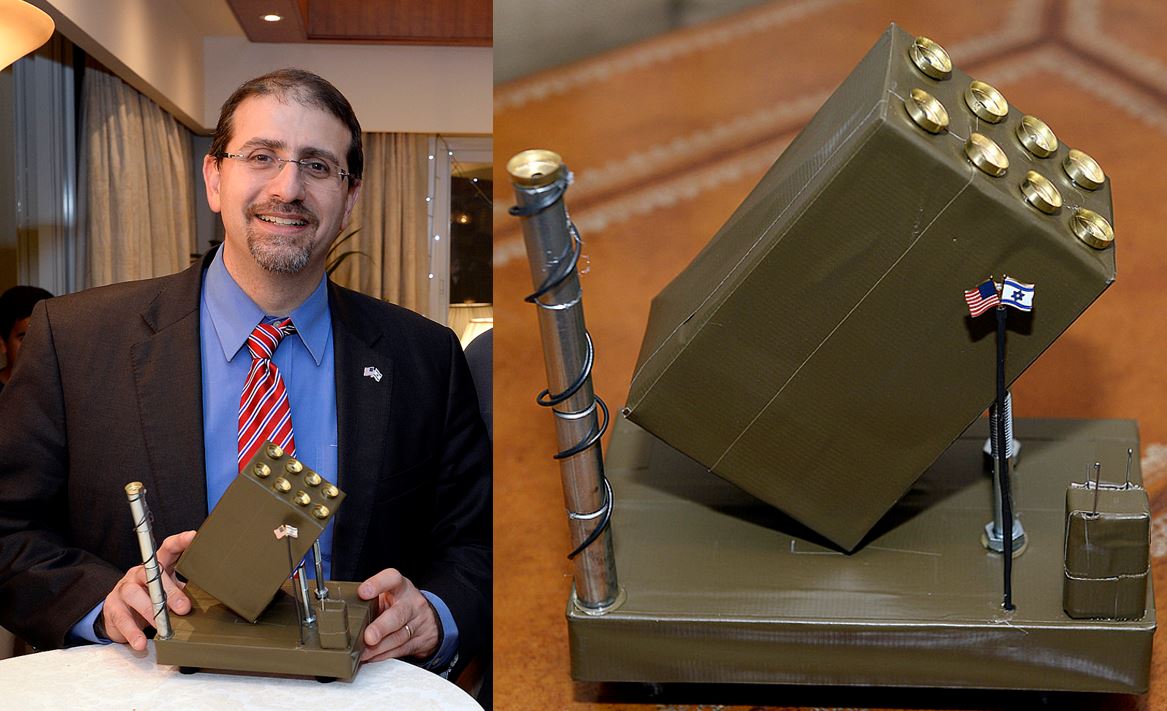
Ambassador Daniel Shapiro proudly displays the disgusting menorah in the shape of an Iron Dome missile battery, complete with tiny flags from the US and Israel.

Ambassador Daniel Shapiro proudly displays the disgusting menorah in the shape of an Iron Dome missile battery, complete with tiny flags from the US and Israel.


Despite having raked in over a billion dollars on the failed Iron Dome system, US and Israeli defense contractors are eagerly promoting their latest addition to Israel’s ballistic defense system, the Arrow 3. That system was tested yesterday, and it failed:

Israel’s upgraded ballistic missile shield failed its first live interception test on Tuesday, security sources said, a fresh setback for the U.S.-supported system billed as a bulwark against Iran.

Operators of the Arrow 3 battery at Palmahim air base on the Mediterranean coast canceled the launch of its interceptor missile after it failed to lock on to a target missile fired over the sea, the sources said.

“There was a countdown to the launch and then nothing happened,” one source told Reuters on condition of anonymity. “A decision was made not to waste the interceptor missile.”

Israel’s Defense Ministry tried to deny the failure, and the Jerusalem Post parroted them:

Defense officials said they decided to abort the firing of the interceptor due to the failure of a series of conditions to materialize, adding that the trial was “neither a success nor a failure.”

During the test, a target missile was fired at Israeli air space from over the Mediterranean Sea. In future trials, the Arrow system will be ordered to intercept incoming mock missiles, something that did not occur this time, the ministry added.

The ministry later clarified that during the trial, the target missile flew along its planned path and was tracked by Arrow, but that “the conditions for firing an interceptor were not ripe, and we therefore decided to class the trial as a target missile exercise only.”

Yair Ramati, of the Defense Ministry’s Administration for the Development of Weapons and Technological Infrastructure, said the trial was to have consisted of two parts, Ramati said. “The first part of the launch involved tracking the target missile, which was fired over the Mediterranean Sea toward Israel. In the second phase, the Arrow 3 interceptor was supposed to be fired after a series of conditions we set for the trial are met. At an early phase, we collectively decided that the conditions have not been met. In accordance to our criteria, we decided not to launch the Arrow 3 interceptor.”

But for a defense program where failure is a way of life, one more failure is just another milestone in product development:

He stressed that conditions for a trial are very different than those need for an operational launch. “This is not the first time that not all conditions are met for a trial,” Ramati added.

“This trial represents a milestone in the development of the system,” the Defense Ministry added.

Haaretz informs us that this failure comes quickly on the heels of another:

This is the second Arrow test to fail within a short time: In September a trial involving the Arrow 2 missile did not succeed either. In that incident Defense Ministry officials concealed the results for many hours. Even after Haaretz reported the failure, they made no comment.

Despite all these failures, Boeing happily touts the Arrow system on its website:

Arrow 3, the newest addition to the Arrow Weapon System, is the upper tier in the Arrow family of weapons that incorporates the latest technology to combat a continually advancing threat. Short- and medium-range ballistic missile threats require prompt and effective self-defense capabilities. The threat of more sophisticated missiles, including the threat of weapons of mass destruction, requires a multi-tier approach to achieve a zero leakage rate. As the world’s first operational national missile defense system, the Arrow Weapon System successfully destroys targets using the latest – technology to achieve a higher probability of a successful engagement. The Arrow Weapon System is affordable and has low total ownership costs.

The Arrow Weapon System is Israel’s national missile defense system. The Arrow system uses the two-stage Arrow II interceptor to destroy an incoming target with a fragmentation warhead. Arrow 3, also a two-stage interceptor, will destroy an incoming target with an exo-atmospheric kill vehicle and provide additional defense capability for evolving threats. Other system elements are a launch control center, fire-control radar and battle management center. Arrow provides Israel with flexible and cost-effective protection from ballistic missile threats.

Come on down, folks! With “low total ownership costs”, you too can have your own ballistic defense missile system that doesn’t work!

Meanwhile, is there anything in the world more vile and disgusting than the photos at the top of this post? They were downloaded from the Flickr account of the US Embassy in Tel Aviv, which I reached from the Embassy’s web page. Who could have thought that a menorah in the shape of an Iron Dome missile battery, complete with little flags from the US and Israel, would be a good idea?

Share this entry

As Last Piece of Business, Carl Levin Reiterates that Dick Cheney Lied Us into War

As one of the last things Carl Levin did before retiring, he released a letter he received from John Brennan demonstrating what a liar Dick Cheney is.

For years, Levin has been trying to get the CIA to declassify a March 13, 2003 cable assessing a source’s claim that Mohammed Atta met Iraqi intelligence officer Ahmad Samir al-Ani in Prague before 9/11, a purported meeting Cheney repeatedly used to insinuate a tie between Iraq and al Qaeda justified the war in Iraq. While Brennan still refuses to declassify the cable, but his letter does explain some of CIA’s assessment of that source.

On 13 March 2003, CIA headquarters received a communication from the field responding to a request that the field look into a single-source intelligence report indicating that Mohammed Atta met with former Iraqi intelligence officer al-Ani in Praque in April 20001. In that communication, the field expressed significant concern regarding the possibility of an official public statement by the United States Government indicating that such a meeting took place. The communication noted that information received after the single-source report raised serious doubts about that report’s accuracy.

The context — and CIA’s long refusal to declassify the cable — suggests that the source was yet another planted lead designed to justify the war, a last ditch attempt to create a tie between Iraq and al Qaeda that did not exist.

Brennan’s letter goes on to quote on line from the report.

The field added that, to its knowledge, “there is not one USG [counterterrorism] or FBI expert that … has said they have evidence of ‘know’ that [Atta] was indeed [in Prague]. In fact, the analysis has been quite the opposite. [brackets original]

Four days after this report, Cheney fought mightily to make the Atta claim once more, just before the attack, even though the entire intelligence community thought the claim was not credible.

I raise all this when I should instead be talking about the torture report because it gets to the point I made here, which I keep making in every radio appearance I do on the torture report.

This all was about exploitation, not intelligence. And for over a year, Dick Cheney’s goal for exploitation was to create a fraudulent case for the Iraq war, whether via torture or dubious single source claims in Prague. As Cheney complains that the torture report (which reported on the anal rape done in the guise of rectal rehydration done on his order) is “full of crap,” we should never forget that one end result of this was the disastrous Iraq war.

Share this entry

Where Are They Now? Dozens of Prisoners Unaccounted For With Closure of US Bagram Prison

Both NBC and Reuters are reporting that the US has closed its prison at the Bagram air base that was used to house non-Afghan prisoners. After many fits and starts, the US had ceded control of (mostly?) all Afghan prisoners to Afghanistan last year. As far as I can tell, the last time we had an accounting of the foreign prisoners held at Bagram was in February, when the number sat at 49, although Adam Goldman noted that the US was busy trying to reduce that number.

There was a report of two Yemenis being transferred out of the facility back in August and Russian prisoner Irek Ilgiz Hamidullin was brought to the US for trial in November, but even as recently as earlier this week, when Latif Mehsud and two of his guards were repatriated to Pakistan, Dawn still reported that conventional wisdom put the number of foreign prisoners held at Bagram in the dozens. The Dawn report relayed a statement from the US embassy that the population was being reduced:

The US Embassy in Kabul said the three prisoners had been held at a detention centre near Bagram airfield.

The facility is believed to house several dozen foreign prisoners who the United States will no longer be allowed to keep in Afghanistan when the mission for the US-led force there ends later this month.

“We’re actually just going through and returning all the third-country nationals detained in Afghanistan to resolve that issue,” a US embassy spokeswoman said.

Note especially that the spokeswoman said “all the third-country nationals”. That stands out because Hamidullin was not the only prisoner held at Bagram who was expected to be brought to trial. Goldman’s report in February said that the “number of people being looked at for prosecution is in the single digits”. Are more of these prisoners already being held in the US in preparation for the filing of charges? Are they held elsewhere? Or were they repatriated instead?

But there were also some prisoners who can’t be tried but are still deemed “too dangerous to release”:

And bringing some of them to the United States for trial in a military commission, an option being considered by the Obama administration, could run into political opposition or may be stymied by a lack of court-ready evidence.

What happened to the prisoners whom the US deemed too dangerous to release but who lacked “court-ready evidence”?

The US prison at Bagram and Defense Department operated prisons throughout both Afghanistan and Iraq have a long, checkered history of lies and misdirection about facilities and their population. Further, this facility at Bagram has been used to house prisoners who were tortured. It seems likely that most of the 49 foreign prisoners known to be there in February have been repatriated without public announcements, but what about those who had been slated for indefinite detention? We now have a number of prisoners who were deemed dangerous and have disappeared in the last several months. Will their status ever be clarified? Will we be forced to concoct more crazy theories on where they went?

Update: It should be noted that both of the stories linked at the beginning of this post state that the last two prisoners transferred out of the US facility at Bagram were handed over to Afghan authorities. This represents a huge change in policy for Afghanistan. Under Hamid Karzai, Afghanistan was adamant that no foreign prisoners would be held in Afghan jails. With this move, it is clear that Ashraf Ghani has changed the policy. So perhaps Afghan prisons are where we will find all of the prisoners the US had slated for indefinite detention without charges?

Share this entry