Shorter Mac Thornberry: the Armed Services Committees Do Oversight, Not Intelligence

As Bobby Chesney lays out, the GOP Chair of the Intelligence, Emerging Threats and Capabilities Subcommittee of the House Armed Services Committee, Mac Thornberry, has introduced legislation to codify oversight over kill-or-capture missions. Before you read the actual legislation, it’s worth reading how Thornberry described the legislation to Craig Whitlock. According to Thornberry, this is mostly about codifying what is already in place, so that mere citizens will take comfort that the oversight is in place.

“We’ve been doing a lot of this oversight anyway,” Thornberry said in an interview. “But I think it is time, for a variety of reasons, to formalize that in statute and make it clear to the American people that it’s happening, because a lot of the oversight that has gone on, most people don’t know about it.”

[snip]

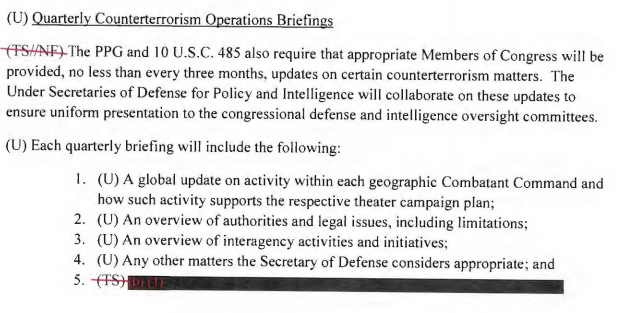
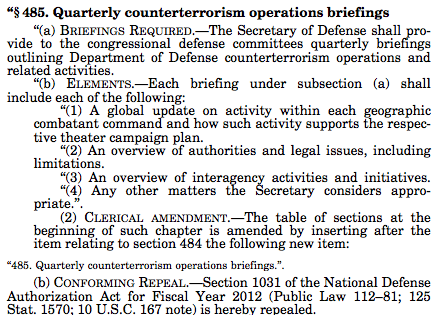
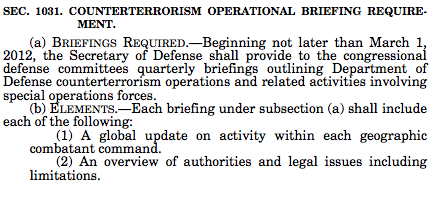
In recent years, the Armed Forces subcommittee has modified the military’s reporting requirements to keep up with changes in the nature of warfare, he said. Two years ago, lawmakers passed a measure requiring the Defense Department to provide a formal quarterly briefing on counterterrorism operations. Last year, it did the same for cyber operations.

“There’s been a comfort level that’s been achieved and that’s even an additional reason to say, ‘Okay, we’ve got this down to where it’s working pretty well, so let’s put it in statute so everybody knows,’ ” he said.

At one level, this seems like Thornberry’s just trying to claim credit for what is actually taking place (that’s a read Micah Zenko also had).

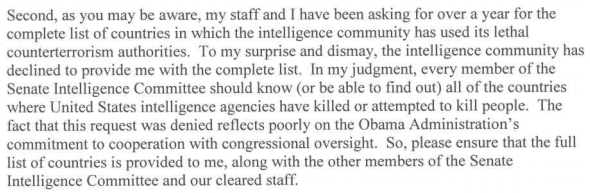
But with that claim — and Ron Wyden’s year-plus effort to get a list of all the countries we’re using targeted killing authorities in — consider this aspect of the legislation.

  • Section 130f(c) – defines “sensitive military operations” (SMOs) with four elements:
  1. Operation involves lethal force or attempt to capture
  2. Carried out by US armed forces (without respect, notably, to whether those armed forces are acting in a Title 10 or Title 50 capacity, thus closing an oversight gap that arguably emerged thanks to the Traditional Military Activities exception to the Title 50 covert action definition and also ensuring that SASC and HASC stay informed on a timely and relatively granular basis when it comes to SOF or other armed forces acting temporarily within a Title 50 framework; note that the language would not obviously encompass a “proxy force” scenario involving close support to direct action conducted by a foreign security service/military).
  3. Carried out abroad (but see section 130f(d) below, which excludes Afghanistan for now)
  4. Carried out under color of the 2001 AUMF or Article II authority (that is, generally applicable except in the event of some future AUMF or some future declaration of war; obviously this element could have interactions with a possible revision to the 2001 AUMF…in the event there is a revision to the 2001 AUMF, either this passage in the SMO oversight bill would need to be tweaked or else the AUMF renewal legislation should speak directly to the SMO scenario) [my emphasis]

The legislation requires the military to inform the Armed Services Committees of such SMOs after the fact. As Chesney describes, this is a similar, though not necessarily parallel, notification system as mandated by the National Security Act for CIA’s covert ops.

Section 130f(a) – requires written, post-hoc notification to SASC and HASC.  No specific deadline; the language is “promptly.”  Not necessary that POTUS sign it, so this is not quite analogous to notification to SSCI and HPSCI of covert action findings (though there are obvious parallels).

I tend to believe that last difference — that this notification requirement doesn’t mandate sign-off from the President — is a significant one, but maybe that’s because I’m obsessed with the way Obama has hidden Bush’s role in setting up the rendition and torture program.

In any case, given Thornberry’s and Wyden’s public comments, my takeaway from all this is that it serves silence concerns that the Intelligence Committees aren’t getting briefings on JSOC’s targeted killings (or the logic underlying the killings), because the Armed Services Committees are.

Well, fine.

But does that really satisfy oversight needs? Is there a reason for the Intelligence Committees to know everything that done under Title 50, even while the Armed Services Committees know of everything done by DOD? Given the overlap between Defense and Intelligence at this point, is there a reason to sustain this dual reporting (it seems the Intelligence Committees increasingly serve as a legal way to spread propaganda about secret programs). Is either of the committees able to perform independent oversight (Intelligence clearly isn’t; I suspect some on Armed Services are, but both committees are becoming increasingly means for politicians to tap into a steady stream of campaign donations).

Perhaps this legislation is just a means to make us comfortable with the current stance of the turf battle between these two committees. And I’m not actually opposed to codifying this, particularly the requirement that the Defense Secretary brief the committees on the targeting process (though I think it should be shared in unclassified form with the public).

I’m just not sure that it actually gives us adequate oversight.


Obama: We’re Force-Feeding Cleared Detainees Because We Couldn’t Try Them in Civilian Courts

At a press conference today, Obama had this to say about hunger strikers at Gitmo.

Q: Mr. President, as you’re probably aware, there’s a growing hunger strike at Guantanamo Bay, among prisoners there. Is it any surprise, really, that they would prefer death rather than have no end in sight to their confinement?

PRESIDENT OBAMA: Well, it is not a surprise to me that we’ve got problems in Guantanamo, which is why, when I was campaigning in 2007 and 2008 and when I was elected in 2008, I said we need to close Guantanamo.

I continue to believe that we’ve got to close Guantanamo. I think — well, you know, I think it is critical for us to understand that Guantanamo is not necessary to keep America safe. It is expensive. It is inefficient. It hurts us in terms of our international standing. It lessens cooperation with our allies on counterterrorism efforts. It is a recruitment tool for extremists. It needs to be closed.

Now Congress determined that they would not let us close it and despite the fact that there are a number of the folks who are currently in Guantanamo who the courts have said could be returned to their country of origin or potentially a third country.

I’m going to go back at this. I’ve asked my team to review everything that’s currently being done in Guantanamo, everything that we can do administratively, and I’m going to re-engage with Congress to try to make the case that this is not something that’s in the best interests of the American people.

And it’s not sustainable. I mean, the notion that we’re going to continue to keep over a hundred individuals in a no man’s land in perpetuity, even at a time when we’ve wound down the war in Iraq, we’re winding down the war in Afghanistan, we’re having success defeating al-Qaida core, we’ve kept the pressure up on all these transnational terrorist networks, when we’ve transferred detention authority in Afghanistan — the idea that we would still maintain forever a group of individuals who have not been tried — that is contrary to who we are, it is contrary to our interests, and it needs to stop.

Now, it’s a hard case to make because, you know, I think for a lot of Americans, the notion is out of sight, out of mind, and it’s easy to demagogue the issue. That’s what happened the first time this came up. I’m going to go back at it because I think it’s important.

Q: (Off mic) — continue to force-feed these folks — (inaudible) –

PRESIDENT OBAMA: Well, I don’t — I don’t want these individuals to die. Obviously, the Pentagon is trying to manage the situation as best as they can. But I think all of us should reflect on why exactly are we doing this. Why are we doing this?

I mean, we’ve got a whole bunch of individuals who have been tried who are currently in maximum security prisons around the country. Nothing’s happened to them. Justice has been served. It’s been done in a way that’s consistent with our Constitution, consistent with due process, consistent with rule of law, consistent with our traditions. The — the individual who attempted to bomb Times Square — in prison serving a life sentence. Individual who tried to bomb a plane in Detroit — in prison serving a life sentence. A Somali who was part of al-Shahab (sic) who we captured — in prison.

So we can handle this. And I understand that in the immediate aftermath of 9/11, with the traumas that had taken place, why, for a lot of Americans, the notion was somehow that we had to create a special facility like Guantanamo, and we couldn’t handle this in — in a normal, conventional fashion. I understand that reaction.

But we’re not over a decade out. We should be wiser. We should have more experience at — in how we prosecute terrorists. And this is a lingering, you know, problem that is not going to get better. It’s going to get worse. It’s going to fester.

And so I’m going to — as I’ve said before, we’re — examine every option that we have administratively to try to deal with this issue. But ultimately, we’re also going to need some help from Congress. And I’m going to ask some — some folks over there who, you know, care about fighting terrorism but also care about who we are as a people to — to step up and — and help me on it.

To review, he was asked about hunger strikers’ desperation. In response, Obama talked about Gitmo in terms of efficacy — citing cost and image, which only indirectly relate to the plight of those who have been cleared. He then blames Congress for not letting him close Gitmo. Then ultimately he admits that Gitmo amounts to keeping “a hundred individuals in a no man’s land in perpetuity.”

Continue reading


Did an Intelligence Asset Persuade Abdulrahman al-Awlaki to Search for His Father?

There’s an inconclusive — but nevertheless intriguing — detail in Jeremy Scahill’s Dirty Wars that might explain why Abdulrahman al-Awlaki decided, in September 2011, to go search for his father. After the boy ran away from home, the family tried to figure out why, having expressed no plans to go search for his father, he would up and leave like he did.

The family called around to Abdulrahman’s friends. Someone told [Awlaki's father] Nasser that a teacher at the school had recently gotten close to Abdulrahman, and Nasser believed the teacher had been encouraging Abdulrahman to find his father and to reconnect with him, that it would be good for the boy. “He had influence on him, an they used to go to a pizza parlour to eat pizza.” Nasser said. When Nasser tried to find the teacher to ask him if he had any information about Abdulrahman’s whereabouts, the teacher had “vanished.”

Granted, this amounts to no more than an observation that someone who had become influential on the boy disappeared right as the family started looking for answers; there’s no affirmative evidence there was a connection.

That said, the CIA had already twice tried to use family ties to get to Awlaki by this point. As the Danish agent Morten Storm has described, he arranged a marriage between a Croatian convert to Islam and Awlaki in a failed attempt to track the cleric.

In addition, as Scahill laid out in his book and excerpted in the Nation, a CIA officer unsuccessfully approached Awlaki’s brother, Ammar, in February 2011 to help them find Awlaki.

Chris made it clear that he worked for the CIA. He told Ammar that the United States had a task force dedicated to “killing or capturing your brother”—and that while everyone preferred to bring Anwar in alive, time was running out. “He’s going to be killed, so why don’t you help in saving his life by helping us capture him?” Chris said. Then he added, “You know, there’s a $5 million bounty on your brother’s head. You won’t be helping us for free.”

Ammar told Chris that he didn’t want the money, that he hadn’t seen Anwar since 2004 and had no idea where he was. The American countered, “That $5 million would help raise [Anwar’s] kids.”

“I don’t think there’s any need for me to meet you again,” Ammar told Chris. Even so, the American told Ammar to think it over, perhaps discuss it with his family. “We can meet when you go to Dubai in two weeks,” he said. Ammar was stunned: his tickets for that trip had not yet been purchased, and the details were still being worked out. Chris gave Ammar an e-mail address and said he’d be in touch.

Clearly, by 2011, the CIA was willing to try any scheme that might help them find Awlaki, regardless of the family bounds it abused. So it is conceivable, at least, that they might try to use Abdulrahman as “bait,” a word Awlaki’s mother used.

I wonder if John Brennan considered this possibility in his review of why the United States assassinated one of its teenaged citizens?


Are We Confusing CIA’s Leader-Centered Collection and Debates about Its Paramilitary or Military Focus?

In his written testimony for yesterday’s drone hearing, Peter Bergen noted that the CIA keeps failing to warn policy makers of important developments.

Has the increased emphasis at the CIA on targeted killings hampered the agency’s ability to understand really important political developments in the Muslim world, such as the Arab Spring? As a senior Obama official has noted: “The CIA missed Tunisia. They missed Egypt. They missed Libya.” Even after the Egyptian revolution occurred, the CIA appears to have entirely missed the fact that the ultra-fundamentalist Salafists would do very well at the election box, winning around quarter of the votes in the 2011 parliamentary election, making them the second largest political bloc in Egypt after the Muslim Brotherhood.

At the hearing, Bergen more closely connected what he called CIA’s paramilitary focus and its recent intelligence failures.

Bergen: CIA seems to have missed 1/4 seats by Salafists. CIA should be abt strategic warning. If CIA deformed bc paramilitary that’s problem

It’s a judgment often repeated: that the CIA has had some big recent intelligence failures because it has been too busy running drone programs in Pakistan and Yemen.

But is that right?

Continue reading


Drone Strikes: Misunderstanding Asymmetry

I guess the moment of the Senate Judiciary Committee hearing on drones when I got really frustrated was when Retired Colonel Martha McSally said we didn’t need any special rules for drones (which she tried to insist be called Remotely Piloted Aircraft; though she admitted the military has used two different acronyms incorporating “unmanned,” she suggested it amounts to an Al Qaeda PsyOp to call drones drones because that implies they’re unmanned). In particular, we didn’t have to think specially about the asymmetric advantage drones give us.

McSally: [drones] are an asymmetrical advantage we have. It’s okay to use our asymmetrical advantage. Rules should not be different.

Don’t get me wrong. If the issue is about winning an all out battle for the physical survival of the US, I can see using America’s asymmetrical advantage.

But McSally was sitting four seats away from Farea al-Muslimi, who had just described how his Yemeni village of Wessab had responded when Hameed Al-Radmi was droned to death in his home village less than a week ago.

Just six days ago, this so-called war came straight to my village. As I was thinking about my testimony and preparing to travel to the United States to participate in this hearing, I learned that a missile from a U.S. drone had struck the village where I was raised. Ironically, I was sitting with a group of American diplomats in Sana’a at a farewell dinner for a dear American friend when the strike happened. As I was leaving my American friends, both of my mobile phones began to receive a storm of text messages and calls.

For almost all of the people in Wessab, I’m the only person with any connection to the United States. They called and texted me that night with questions that I could not answer: Why was the United States terrifying them with these drones? Why was the United States trying to kill a person with a missile when everyone knows where he is and he could have been easily arrested?

[snip]

After the strike, the farmers in Wessab were afraid and angry. They were upset because they know Al-Radmi but they did not know that he was a target, so they could have potentially been with him during the missile strike. Some of the people that were with Al-Radmi when he was killed were never affiliated with AQAP and only knew Al-Radmi socially. The farmers in my village were angry because Al-Radmi was a man with whom government security chiefs had a close connection. He received cooperation from and had an excellent relationship with the government agencies in the village. This made him look legitimate and granted him power in the eyes of those poor farmers, who had no idea that being with him meant they were risking death from a U.S. drone.

[snip]

In the past, most of Wessab’s villagers knew little about the United States. My stories about my experiences in America, my American friends, and the American values that I saw for myself helped the villagers I talked to understand the America that I know and love. Now, however, when they think of America they think of the terror they feel from the drones that hover over their heads ready to fire missiles at any time.

It’s not that I question McSally’s uber-competence; her competence and intelligence were clear from her testimony.

It’s just that she — and Lindsey Graham, who had a gleam on his face as he said something virtually identical about asymmetry — seems to misunderstand the relationship here. Indeed, Lindsey even dismissed al-Muslimi’s testimony by suggesting that, after invoking a visit to Yemen, he knew that Pakistan and Yemen’s governments were unreliable counterterrorism partners and therefore we had to use drone strikes.

But that all forgets that we’re trying to do two things: neutralize the few terrorists who are legitimately targeting the United Staes in Pakistan and Yemen, and convincing Yemenis and Pakistanis and others not only that their government better represents their interests than al Qaeda, but that we have their best interests in mind, too.

And yet neither McSally nor Lindsey seemed to get that using asymmetric weapons against  Hameed Al-Radmi also communicated to the villagers of Wessab that we felt entitled to use asymmetric weapons against them, too.

So  here we had a young man who we’ve invested a lot of energy and money into preparing to be an American-friendly leader going forward, testifying before the Senate, and two of the participants in that hearing responded to a story (really, multiple stories) about how drones impact on completely innocent people we’re trying to persuade by boasting that we prefer to use these drone strikes because no one in his country can do anything about them.

I don’t think you can separate this — the gleeful use of asymmetry against those we’re trying to kill from the impact that asymmetry has on those we’re trying to persuade.


John Brennan’s Review of How He Killed an American Teenager

Jeremy Scahill’s book, Dirty Wars, comes out tomorrow. I’m sure I’ll have more to say about it over the next few weeks.

But for now, he’s got an adaptation at the Nation that describes a Senior Administration Official involved in drone targeting, who would have left sometime between October 14, 2011 and now (so, maybe Petraeus, Panetta, Clinton, or Vietor?? Update: Or Jeh Johnson?), claiming that the strike was all a mistake, launched in response to apparently crappy intelligence from Ali Abdullah Saleh’s government (or possibly the Saudis?) claiming that senior AQAP leader Ibrahim al-Banna was present, alone.

A former senior official in the Obama administration told me that after Abdulrahman’s killing, the president was “surprised and upset and wanted an explanation.” The former official, who worked on the targeted killing program, said that according to intelligence and Special Operations officials, the target of the strike was al-Banna, the AQAP propagandist. “We had no idea the kid was there. We were told al-Banna was alone,” the former official told me. Once it became clear that the teenager had been killed, he added, military and intelligence officials asserted, “It was a mistake, a bad mistake.”

The now-former SAO goes on to describe how pissed the Moral Rectitude Drone Assassination Czar John Brennan was about the strike, because he believed Abdulrahman was deliberately set up to be killed (though Scahill’s source doesn’t appear to specify whom Brennan thought was setting up an American teenager for death, JSOC, Yemeni partners, or the Saudis).

However, John Brennan, at the time President Obama’s senior adviser on counterterrorism and homeland security, “suspected that the kid had been killed intentionally and ordered a review. I don’t know what happened with the review.”

So Brennan sets up a review … that apparently got stashed in the same black hole as every other report on drone killing.

Because the whole thing is embarrassing.

Brennan, who is now director of the CIA, recently answered an inquiry from the Senate Intelligence Committee on such after-strike reviews. When civilians are killed, Brennan said, “we not only take account of the human tragedy, but we also go back and review our actions.” Analysts “draw on a large body of information—human intelligence, signals intelligence, media reports, and surveillance footage—to help us make an informed determination about whether civilians were in fact killed or injured,” Brennan asserted in his written response. “In those rare instances in which civilians have been killed, after-action reviews have been conducted.” No such review of Abdulrahman’s killing has ever been made public.

The consensus that has emerged from various anonymous officials commenting on Abdulrahman’s killing was that it was a mistake. I asked the former senior administration official why, if that was the case, the White House didn’t publicly acknowledge it. “We killed three US citizens in a very short period,” he told me. “Two of them weren’t even targets: Samir Khan and Abdulrahman Awlaki. That doesn’t look good. It’s embarrassing.”

Recall, when JSOC killed almost an entire Bedouin clan in al-Majala, David Petraeus claimed that only the alleged targets immediate family had been killed, well after people had been to the site to document the carnage. Immediately after Abdulrahman’s death, the Administration immediately, almost boisterously, claimed the boy was 21, either based on crappy intelligence or in an attempt to justify a “military aged male” claim.

This is why it is so important to declassify the documents on targeted killing. Even according to the Moral Rectitude Drone Assassination Czar, this kid was set up.

He just won’t tell us by whom.


Outsourcing America’s Bad Human Rights Reputation

Given all the attention to the Administration’s decision, thus far, to neither Mirandize nor charge Dzhokhar Tsarnaev, I wanted to point back to two things that happened last week.

First, in a hearing before the House Appropriations Committee, in response to Congressman Frank Wolf’s frustrated declaration (for a variety of totally justified — such as Holder’s delay in implementing a prison rape preventing program — and totally bogus reasons) that he was just going to ignore Eric Holder, Holder made a case that his DOJ is doing a great job. Josh Gerstein describes his little speech:

I’m proud of what we’ve done across the board at the Justice Department in the last four and a half years. I’m proud of what I’ve done as attorney general. The department that we have now is fundamentally different than the department I found when I got there. We don’t hire people on the bsis of political orientation. We don’t do things as was done in the previous administration. We don’t write memos that say that torture is appropriate when dealing with interrogation techniques. [my emphasis]

No. As far as we know, at least (given the secrecy of the Administration), they have not written memos saying torture is appropriate when dealing with interrogation. They have, however, written memos stretching the concept of public exception beyond its intended function. They have also written memos reinterpreting due process before execution to mean “what John Brennan says in secret.”

In other words, Eric Holder’s DOJ has written memos authorizing practices that are alternatives, but arguably not much better, than the policies his predecessors rubber stamped.

Meanwhile Micah Zenko has a great post summarizing how many of the counterterrorism acts presumably conducted in cooperation with US forces — if not by US forces yet blamed on local ones — fall under the State Department’s definition of human rights violations.

Today—eighty-nine days past its legal deadline—the State Department released its annual Country Reports on Human Rights Practices for 2011. The new, user-friendly interface allows you to find and read individual country chapters much more quickly and easily (and might explain the delay). For all its flaws, the report remains a must-read for its reporting and candor. It serves as a generally honest counter to the rosier assessments of U.S. partners and allies’ human rights practices.

From my vantage point of trying to understand the Obama administration’s policies and practices of target killings, the report is also notable for what it does not include; namely, any mention of U.S. involvement in or responsibility for such operations.

The chapter on Yemen, for instance, has an entire section dedicated to “killings:”

The government also employed air strikes against AQAP and affiliated insurgents in Abyan, with some strikes hitting civilian areas. Although some accused the government of intentionally striking civilians in Abyan, most if not all noncombatant casualties from these bombardments were attributed to a lack of air force training and technical capability.

First, because U.S. targeted killings in Yemen are “covert,” the State Department cannot acknowledge American complicity or collusion. But it stands to reason that some, if not a majority, of these air strikes were carried out by CIA or Joint Special Operations Command (JSOC) drones, or even U.S. Navy assets offshore.

Zenko goes on to point to passages criticizing human rights abuses in Turkey, Somalia, and Pakistan that likely have US involvement.

It’s bad enough that the Attorney General’s measurement of his Department’s performence is measured against John Yoo’s standards, not the law, but we’re probably helping other countries violate State’s own standards for human rights.

All the while dodging the real shame that ought to come from such abuses.


CAIR-MI Alleges the FBI Engaged in a Cover-Up in Imam Abdullah Luqman’s Death

Back in February, I suggested that the killing of Imam Abdullah Luqman by members of FBI’s Hostage Rescue Team is what a targeted killing in the US would look like. I was not asserting it was a targeted killing, just that a targeted killing would be a raid with a seemingly unplanned death, and we would likely never know if it were a targeted killing.

At the time, I described how the FBI had basically blown off Luqman’s survivors’ wrongful death suit, which was supported by CAIR-MI.

Today, CAIR-MI and the survivors have filed an amended complaint.

The complaint gets around the FBI’s previous strategy of refusing to name the four FBI Agents most directly responsible for killing Luqman by also naming the former SAC for Detroit, Andrew Arena, who said on a video that “I made the final decision to use that dog [sicced on Luqman]. That was the last decision I made” and the FBI’s local SWAT team member.

And it gets around the expiration of statute of limitations by accusing the FBI of fraudulently concealing the cause of action. In addition to putting out a false story claiming Luqman was armed, the complaint alleges, Arena made sure the killers and the weapon allegedly used by Luqman were removed from the scene before local law enforcement arrived. In addition, all video surveillance was removed from the site, and Abdullah’s body was moved.

62. Upon information and belief, during the time that the FBI had complete control of the interior warehouse crime scene, Defendant Arena arranged for the evacuation of the Unidentified FBI Agents and their transport to FBI Headquarters.

63. Accordingly, the Unidentified FBI Agents were unavailable to provide witness statements to local police crime scene investigators.

64. Upon information and belief, during the time that the FBI had complete control of the interior warehouse crime scene, and pursuant to instructions by Defendant Arena, an alleged semi‐automatic handgun was allegedly removed from the crime scene and taken to FBI Headquarters.

65. Accordingly, the alleged semi‐automatic handgun was unavailable for forensic analysis by local crime scene investigators.

66. Upon information and belief, during the time that the FBI had complete control of the interior warehouse crime scene, and pursuant to instructions by Defendant Arena, FBI Agents removed all hard drives and video surveillance equipment from the warehouse before local crime scene investigators were allowed to gain access to the hard drives or view the video footage.

67. Upon information and belief, during the time that the FBI had complete control of the interior warehouse crime scene, and pursuant to instructions by Defendant Arena, the body of Abdullah was already moved to a different location inside the warehouse before local crime scene investigators and the medical examiner were allowed to gain access to the crime scene.

As a result, it was not until one of Luqman’s alleged accomplices, Muhammad Abdul Salaam, was released from prison until Luqman’s estate learned what really happened at the site.

Here’s where things get interesting. Continue reading


Is the Government Going to Claim Bradley Manning “Harmed” the US by Exposing Drone Details?

Screen shot 2013-04-17 at 9.46.44 PMLast week’s Bradley Manning hearing significantly focused on how much the government could hide about its witnesses. A big part of the discussion pertained to how a Seal Team 6 member would testify to finding WikiLeaks material at Osama bin Laden’s compound. But the government also advanced its case to have a list of other government employees testify, at least partly, in secret, mostly in the “harm” phase of sentencing.

Here’s Alexa O’Brien’s transcription of that list (click through for the list). There are a number of interesting names on this list. But the one that popped out at me is Ambassador Stephen Seche.

You see, while Seche was Chargé d’Affaires in Syria mid-decade and more recently was in charge of Near Eastern affairs at State, he will almost certainly testify about how WikiLeaks disclosures of cables he wrote while Ambassador to Yemen “harmed” relations with that country.

Indeed, as the image above shows, Seche wrote one of the most newsworthy cables ever released by WikiLeaks, the January 4, 2010 cable recounting a January 2 meeting between then CentCom head David Petraeus and Yemeni President Ali Abdullah Saleh.

The cable is best known for this statement, laying out the agreement by which Saleh would lie about missile and drone strikes and pretend they were Yemen’s.

“We’ll continue saying the bombs are ours, not yours,” Saleh said, prompting Deputy Prime Minister Alimi to joke that he had just “lied” by telling Parliament that the bombs in Arhab, Abyan, and Shebwa were American-made but deployed by the ROYG.

But there are several other inflammatory details in this cable. There’s the nugget of our agreement to shift from using cruise missiles to drones.

Saleh did not have any objection, however, to General Petraeus’ proposal to move away from the use of cruise missiles and instead have U.S. fixed-wing bombers circle outside Yemeni territory, “out of sight,” and engage AQAP targets when actionable intelligence became available.

Potentially more damning still, there’s the passage that suggests Anwar al-Awlaki was an intended target of the December 24, 2009 attack (a day before the US believed he was an operational and at least a month before it had evidence he was). In addition, there’s Petraeus’ absolutely incorrect contention that only three civilians had died at al-Majala instead of the Bedouin clan we know died.

(S/NF) Saleh praised the December 17 and 24 strikes against AQAP but said that “mistakes were made” in the killing of civilians in Abyan. The General responded that the only civilians killed were the wife and two children of an AQAP operative at the site, prompting Saleh to plunge into a lengthy and confusing aside with Deputy Prime Minister Alimi and Minister of Defense Ali regarding the number of terrorists versus civilians killed in the strike. (Comment: Saleh’s conversation on the civilian casualties suggests he has not been well briefed by his advisors on the strike in Abyan, a site that the ROYG has been unable to access to determine with any certainty the level of collateral damage. End Comment.) AQAP leader Nassr al-Wahishi and extremist cleric Anwar al-Awlaki may still be alive, Saleh said, but the December strikes had already caused al-Qaeda operatives to turn themselves in to authorities and residents in affected areas to deny refuge to al-Qaeda. [my emphasis]

At the very least, this passage demonstrates how shoddy our intelligence was both before and after we killed a bunch of civilians. But it may also support the case that the first time we tried to kill Awlaki, we didn’t believe he met the standards laid out in the memo that would ultimately authorize his killing: being a senior operational leader of AQAP involved in planning attacks against the US.

In other words, this cable, by itself, may include evidence of possible war and domestic crimes.

And yet the government wants to send Seche to a classified hearing to talk about the “harm” Bradley Manning caused.

While I think it possible that release of this particular cable made it harder for Djibouti to partner with us (recall we moved the drones targeting Awlaki to Saudi Arabia in 2011), the government at least maintains that Yemen continues to allow us to shoot drones in the country.

Yet it seems highly likely the government wants to claim disclosures of crimes like this amounted to “harm” of the US.

But here’s the punchline.

Continue reading


House Judiciary Makes (Partial) Progress on Drones, But Not the Senate

Just as the House Judiciary Committee was about to vote to subpoena OLC’s targeted killing memos, DOJ finally agreed to share them with the committee tasked with overseeing OLC.

Just before the hearing, however, DOJ agreed to provide the documents. Goodlatte, the chairman, announced he would postpone the meeting to authorize the subpoena and cancel it once arrangements are made for viewing the documents.

“It’s unfortunate that it took a subpoena notice for the Department to cooperate with the House Judiciary Committee,” Goodlatte said. “The House Judiciary Committee is charged with oversight over the Justice Department and U.S. Constitution and it is imperative that we explore the issues raised by the Administration’s policy.”

Though, from the context, it sounds like DOJ agreed to hand over only the memos authorizing Anwar al-Awlaki’s killing. I’m checking on this, but if this is the case, it’s the partial cave I’ve been expecting from DOJ for some time.

The Administration really doesn’t want to share its signature strike memos.

But that’s just memos. The Administration still refuses — as it did earlier when the House Judiciary Committee held a hearing on drone killing — to send a live body to talk about its killing program.

“We do not currently plan to send a witness to this hearing and have remained in close contact with the committee about how we can best provide them the information they require,” Caitlin Hayden, a National Security Council spokeswoman, wrote in an email to McClatchy.

She added that the White House would continue working with lawmakers “to ensure not only that our targeting, detention and prosecution of terrorists remains consistent with our laws and system of checks and balances, but that our efforts are even more transparent to the American people and the world.”

Hayden declined to say why the administration doesn’t plan to provide a witness for the hearing.

Add this to John Brennan’s refusal to answer Jan Schakowsky’s questions about drones last week, and the Administration really just refuses any oversight on this issue.

But really, they promise they’re being transparent.

Update: I was correct. House Judiciary Committee will only get what the Senate Judiciary Committee got, which is understood to be the Awlaki memos.