The Non-Counterterrorist Drone Loophole: Did Clapper Admit We Targeted Iranian Scientists?

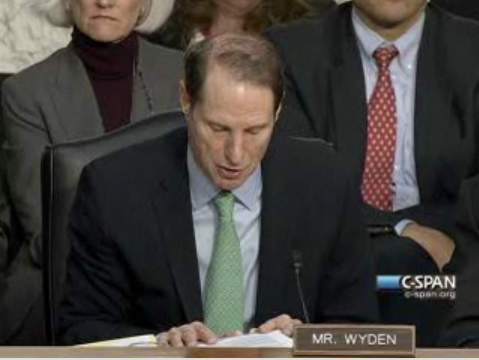
One of the most interesting exchanges in yesterday’s Threat Assessment hearing occurred between Ron Wyden and James Clapper–with David Petraeus, whom Wyden calls out, observing silently (the exchange starts at 1:01).

Wyden: Let me wrap up with you Director Clapper on an issue that I’ve asked about before at this open hearing. General Petraeus knows about this, this is a question about the use of force and a speech that was given by Mr. Koh, Harold Koh of the State Department, a lawyer. Let me note at the beginning it’s a matter of public record that the intelligence community sometimes takes direct action against terrorists and this direct action sometimes involves the use of lethal force. And as you know Director [sic] Koh gave a speech outlining our policy with respect to various terrorist groups, talked about detention, talked about the use of unmanned drones and noted that under US law, the use of force against terrorist groups is permitted by Congressional authorization, while under international law it is permitted by America’s right to self defense. But in spite of having asked about this on a number of occasions, and General Petraeus, you know that I, too, share the Chair’s view with respect to your working with us here on this committee and your being forthright, I’ve not been able to get an answer to this specific question. And I would like to know whether that speech that Mr. Koh gave contained unstated exceptions for intelligence agencies?

Clapper: With respect to counterterrorism, it does not. So it applies to all components of the government involved in counterterrorism be it military or non-military.

Wyden: Are there other exceptions other than counterterrorist activities?

Clapper: I believe his speech dealt with counterterrorism.

Wyden: So you believe that his speech, the text of the speech–cause this would be important–applies to all agencies. It applies to the intelligence community, his entire speech, the overall thrust of the speech applies to all of the intelligence community.

Clapper: With respect to counterterrorism, yes.

Now, it seems clear that Wyden is referring to the portion of Koh’s speech that deals with drone strikes, which is reproduced in full below the line.

And my impression is that Wyden–who emphasizes targeting terrorists when he asks the question–was asking whether there was an exception to the principles of distinction and proportionality for the CIA when they used drones. Or, to put it more plainly, Wyden seemed to be asking whether the CIA could use drones to target civilians.

My guess is that Petraeus has refused to answer that question not to hide a CIA exception for the use of drones with civilian terrorists (say, with Anwar al-Awlaki) but rather to hide the CIA involvement in targeting of civilians in other contexts.

That’s the implication of Clapper’s response: “with the respect to counterterrorism, yes.” And Wyden’s expression as he delivers the question, “Are there other exceptions other than counterterrorist activities?” is worth watching.

There may be further confusion stemming from the language of Koh’s speech. While he was, in this section, specifically addressing “the Law of 9/11,” he does claim that his comments apply to “all of our operations involving the use of force.” Clapper’s caveat seems to belie that claim.

Koh’s language also addressed the use of force generally, not just those dealing with drones. We do use drones for missions outside of counterterrorism–including in drug operations, so Clapper’s caveat might suggest the CIA can target civilians in such context.

But if I had to guess, I’d say this had to deal with non-drone use of lethal force, possibly the assassinations of Iranian nuclear scientists. Was Clapper suggesting CIA targeted civilian nuclear scientists?

And while we may not have attached the bombs to Iranian civilian scientists’ cars (though our surrogates did), remember the suggestions that our drone surveillance of Iran was involved in those assassinations.

Continue reading


Dianne Feinstein Calls James Clapper a Polyanna on Afghanistan

The takeaway the stenographers have gotten from yesterday’s intelligence threat assessment is that the Scary Iran Plot means Iran wants to target us in this country.

They reported that even as Dianne Feinstein made it clear James Clapper was bullshitting us on another front.

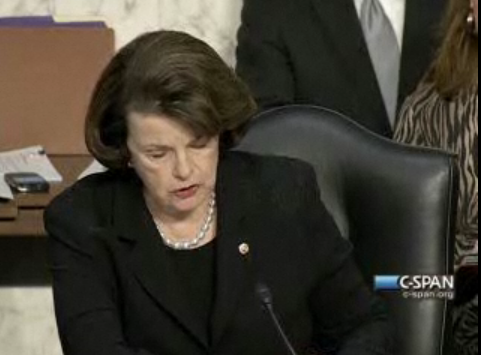
In her statement, she  noted that James Clapper’s assessment of our Afghanistan war is more optimistic than what the still-classified NIE says. (starting after 7:50)

I’m also concerned by what appears to the the disparity between the discussion of Afghanistan in Director Clapper’s statement for the record and the bleaker description in the December 2011 NIE. The Director’s statement notes modest improvements in the challenges that remain. While I’m unable to describe the NIE, as it remains a classified document, news reports of the NIE describe it as “sobering” and “dire” (those words in quotes, include phrases like, “mired in stalemate” (end quote). So I would like to ask the witnesses how they assess how stable Afghanistan will be in 2012 as well as in 2014 and beyond.

Here’s some of the public reporting on the NIE she’s talking about:

The U.S. intelligence community says in a secret new assessment that the war in Afghanistan is mired in stalemate, and warns that security gains from an increase in American troops have been undercut by pervasive corruption, incompetent governance and Taliban fighters operating from neighboring Pakistan, according to U.S. officials.

[snip]

In a section looking at future scenarios, the NIE also asserts that the Afghan government in Kabul may not be able to survive as the U.S. steadily pulls out its troops and reduces military and civilian assistance.
“Its viability is tenuous,” said one official, citing the report.

Clapper’s statement, however, says the following:

In terms of security, we judge that the Afghan police and Army will continue to depend on ISAF support. ISAF partnering and mentoring have begun to show signs of sustainable progress at the tactical and ministerial levels; however, corruption as well as poor leadership and management will threaten Afghan National Security Forces’ (ANSF) operational effectiveness.

[snip]

The Karzai government did achieve some success in 2011. The first phase of the process to transition security to Afghan leadership proceeded smoothly, and the second tranche of the transition is progressing as scheduled. The Karzai administration successfully convened a Loya Jirga in November to socialize the strategic partnership with the United States. Now that the fall 2010 electoral crisis is resolved, the Wolesi Jirga will likely regroup during the current winter recess and return its focus to limiting President Karzai’s authority, likely using the parliamentary approval process for ministerial appointees as a way to highlight the Parliament’s independence.

I find several things interesting about this: first, Clapper’s statement does admit that the ANSF isn’t ready to defend the country. The area where Clapper seems to most deviate from the reported details of the NIE is on Karzai’s government. Clapper would have us think it is improving, the NIE doesn’t agree.

But I’m also amused. After DiFi made it clear that Clapper’s statement had been spun, why did reporters (note, an exception is Josh Gerstein, who pointed out these comments as well) believe the other things he said, notably about Scary Iran?


The False Flag Waves in the Fog

“Absolute nonsense!” Israel has responded to Mark Perry’s “False Flag” claim that Mossad agents recruited Jundallah members by posing as CIA officers. They’ve responded clearly, they claim, because they don’t want US-Israeli intelligence cooperation to get as bad as it did when we caught Jonathan Pollard spying for Israel.

But I’m just as interested in the “proof” Israel offers that this didn’t happen: that Meir Dagan is still welcome in Washington.

The senior Israeli government official said that if there were any truth the claims in Perry’s report, Meir Dagan, the head of the Mossad at the time of the alleged operation, would have been declared a persona non grata in the U.S. and that “Dagan’s foot would not have walked again in Washington”.

Now, it is true that Dagan ran Mossad at the time–2007-2008–when the recruitment in question is alleged to have taken place. And it is true that under Dagan Mossad got rather embarrassingly caught using US (and other Western allies’ passports to facilitate their assassination squads in the Dubai assassination of Quds Force surrogate Mahmoud al-Mabhouh.

But it is also notable that Dagan has made a series of increasingly strident remarks against war with Iran and for the kind of engagement that the latest scientist assassination seems designed to undercut. And then there’s the presumably intentional irony in the statement: Dagan’s ability to travel is limited not by his welcome among Western allies, but because Bibi Netanyahu revoked Dagan’s diplomatic passport last summer in response to his efforts to prevent war against Iran. Since traveling without diplomatic immunity would expose him to arrest for acts that include the al-Mabhouh assassination, Dagan, the former head of Israel’s assassination agency, cannot travel freely to prevent such assassinations in the future.

In other words, this is a very witty but nevertheless quite serious reminder that the same people now trying to find a peaceful path forward are themselves thoroughly implicated in the same crimes they now disown. This is Bibi’s camp reminding that everyone has been breaking the rules in ways that could cause significant legal trouble.

Right on cue, Iran has sent diplomatic notes to both the US and Britain, claiming that the CIA is behind the most recent assassination.

The message addressed to the U.S. government, read, “According to authentic documents and reliable information, the assassination plot was directed, supported, and planned by the U.S. Central Intelligence Agency (CIA) and was carried out with the direct involvement of the agents affiliated with this organization, and the government is directly responsible for it and should be answerable based on international regulations and rights and bilateral commitments.”

[snip]In the protest note, Iran also said, “The Islamic Republic of Iran condemns the inhumane assassination, calls on the U.S. government to provide an immediate explanation, seriously warns about its repercussions, and calls on the (U.S.) government to stop supporting any kind of anti-humanitarian terrorist action against the lives of Iranian citizens, which is in contravention of international rights and the relevant commitments and pose a serious danger to international peace and security. In addition, the government of the Islamic Republic of Iran reserves the right to pursue the issue.”

In the note addressed to the British government, the Foreign Ministry pointed to the remarks that MI6 chief Sir John Sawers made on October 28, 2010, in which he said, “Stopping nuclear proliferation cannot be addressed purely by conventional diplomacy. We need intelligence-led operations to make it more difficult for countries like Iran to develop nuclear weapons.”
The note read, “The Foreign Ministry of the Islamic Republic of Iran takes into consideration the fact that the assassinations of Iranian scientists began right after the announcement of the very attitude of the British government by Mr. John Sawers, the head of Britain’s Secret Intelligence Service, and once again expresses its protest about the repercussions of the mentioned attitude of the British government and holds the country responsible for such terrorists acts.”

Gosh, Iran could have drafted these letters using the letters the US issued after it busted the Scary Iran Plot allegedly involving Manssor Arbabsiar as a model! (Which reminds me. Has anyone checked in on the Saudi involvement to defeat Iran, of late? And what they–and the Pakistanis–think about Israelis purportedly running terrorists out of Pakistan?)

Remember, too, according to Perry’s “False Flag,” the recruitment of the Jundallah members–by whomever–largely took place in London, “under the nose of U.S. intelligence officers.” So if Perry’s piece was meant as preemptive inoculation against evidence his sources knew might be revealed, it would not be surprising if such evidence implicated both the US and Britain.

Now, if it weren’t for the latent lethality behind all this posturing (and if weren’t so clear that, whatever Iran has, Israel surely has evidence of our complicity here, if they ever feel the need to reveal it), this might be a somewhat amusing and overdue spat between Israel and the US.

But as it is, it seems the winner of this conflict between Israeli and US neocon Hawks (some of who presumably remain in government positions) on one side, and those trying to avoid war (if not regime change) on the other threatens may depend most on who wins the infowar that has broken out. Clearly, all sides have the goods on the others, but no one can risk having all this damning information come out.

Update: Corrected post to reflect that Mossad did not use US passports in the Dubai hit.


How to Indefinitely Detain Jamie Dimon

Kagro X and I were engaging in a little thought experiment on Twitter to show how easy it would be to solve our dangerous bankster problem by indefinitely detaining them.

It turned out to be pretty easy to do. Here’s how.

First, before you indefinitely detain a bankster, you need to show either that he is,

A person who was part of or substantially supported al-Qaeda, the Taliban, or associated forces that are engaged in hostilities against the United States or its coalition partners, including any person who has committed a belligerent act or who has supported such hostilities in aid of such enemy forces.

Or, you need to show he has supported (using the Iraq AUMF that we’re keeping around to make sure the President’s authority isn’t limited to just al Qaeda),

another international terrorist group that the President has determined both (a) is in armed conflict with the United States and (b) poses a threat of hostile actions within the United States;

Now, making that case with Jamie Dimon is very easy to do, because his company, JP Morgan Chase, has materially helped Iran. We have several pieces of proof it has done so. First, there’s the Treasury Report showing that JPMC:

  • Gave a $2.9 million loan on December 22, 2009 to the Islamic Republic of Iran Shipping Lines, which the Office of Foreign Assets Control has found to be involved in WMD proliferation
  • Advised and confirmed a $2,707,432 letter of credit on April 24, 2009, in which the underlying transaction involved a vessel identified by OFAC as blocked due to its affiliation with the same Iranian shipping line
  • Processed nine wire transfers between April 27, 2006 and November 28, 2008, which totaled $609,308, some of which involved sanctioned Iranian and terrorist entities
  • Transferred 32,000 ounces of gold bullion valued at approximately $20,560,000 to benefit a sanctioned Iranian bank on May 24, 2006

We need no further proof that JPMC has done these things. Not only has JPMC admitted to them, but as Janice Rogers Brown has made clear, we cannot question the Executive Branch’s intelligence reports, so all of OFAC’s claims must be accepted as true for the purposes of indefinite detention. And all of that illegal support for Iran happened while Jamie Dimon was President of JPMC.

But there may even be proof–enough, anyway, to satisfy Rogers Brown–that JPMC materially supported an attempt to deploy a WMD in a terrorist attack on American soil. As I have shown, the bank account to which Manssor Arbabsiar transferred almost $100,000 as downpayment for the alleged Quds Force plot to assassinate Saudi Ambassador Adel al-Jubeir was probably a Chase account. And that affidavit should be enough. The FBI, after all, is an intelligence agency. And Janice Rogers Brown does not find redactions–even much more extensive ones–to in any way impair the reliability of Administration claims to justify indefinite detention.

In other words, the Administration has provided sufficient proof that JPMC materially supported Iran to the tune of at least $23 million in illegal financial transactions.

Now, if Chase is indeed the bank that accepted the downpayment for the Scary Iran Plot, we need no further basis to indefinitely detain Jamie Dimon. After all, the government’s Amended Complaint (from the FBI, an intelligence agency whose reports we cannot question) asserts that Abdul Reza Shahlai was the mastermind behind the Scary Iran Plot, and at the time of the plot, he had already been sanctioned as a supporter of the insurgency in Iraq. That was based on a questionable intelligence report, admittedly, but Janice Rogers Brown says we cannot consider such problems. So if Chase did, indeed, play a role in the Scary Iran Plot, then that’s all we need to indefinitely detain Jamie Dimon as head of the entity that materially supported that terrorist attack.

But even if Chase wasn’t involved in the Scary Iran Plot, the Executive Branch can still indefinitely detain Jamie Dimon. After all, the Executive Branch has been claiming that Iran was harboring al Qaeda since 2003. In addition, an official Executive Branch report–a September 12, 2009 diplomatic cable–includes the following hearsay claim, made by Saudi Arabia’s then Minister of the Interior, now the Crown Prince, Nayif bin Abdulaziz:

Iran has hosted Saudis (all Sunnis) — including Osama bin Laden’s son Ibrahim — who had contacts with terrorists and worked against [Saudi Arabia]

And Janice Rogers Brown has said that so long as it appears in an official government document, any hearsay problem is overcome. And as recent reporting makes clear, there’s even some evidence that Iran was at least aware of, and in some ways facilitated, the 9/11 plot itself. That assertion is based on NSA reports which, as official government documents, would meet Rogers Brown’s standard for claims supporting indefinite detention.

All of which would seem to reach the bar of making Iran a force associated with al Qaeda. I don’t necessarily buy these reports, mind you, but again, it’s not for me to question these official government records. And helping such an associated force access $23 million of funding sure seems to qualify as “substantial support.”

Now let me be clear. I don’t advocate indefinitely detaining Jamie Dimon–or anyone else either, particularly not American citizens, no matter how loathsome or dangerous to the United States. But given that our country maintains it is more important to “incapacitate” terrorists and those who support them than to punish those who did trillions of dollars of damage to our economy, we may well have to treat Jamie Dimon as a material supporter of terrorism to get some justice.

And Jamie? If I were you I would report to an Embassy or some other official government office right away, as the government claims Anwar al-Awlaki should have. Because while Obama seems uninterested in indefinitely detaining American citizens, he has been known to kill those he claimed were particularly dangerous.

The Scary Used Car Broker Plot

Consider these two data points. First, Jo Becker reports that the money laundering scheme run by the Canadian Lebanese Bank involved brokering used cars purchased in America.

In that inquiry, American Treasury officials said senior bank managers had assisted a handful of account holders in running a scheme to wash drug money by mixing it with the proceeds of used cars bought in the United States and sold in Africa. A cut of the profits, officials said, went to Hezbollah, a link the organization disputes.

[snip]

Eventually an American team dispatched to look into Mr. Joumaa’s activities uncovered the used-car operation. Cars bought in United States were sold in Africa, with cash proceeds flown into Beirut and deposited into three money-exchange houses, one owned by Mr. Joumaa’s family and another down the street from his hotel. The exchanges then deposited the money, the ostensible proceeds of a booming auto trade, into the Lebanese Canadian Bank, so named because it was once a subsidiary of the Royal Bank of Canada Middle East.

But the numbers did not add up. The car lots in the United States, many owned by Lebanese émigrés and one linked to a separate Hezbollah weapons-smuggling scheme, were not moving nearly enough merchandise to account for all that cash, American officials said. What was really going on, they concluded, was that European drug proceeds were being intermingled with the car-sale cash to make it appear legitimate.

Hezbollah received its cut either from the exchange houses, or via the bank itself, according to the D.E.A. And the Treasury Department concluded that Iran also used the bank to avoid sanctions, with Hezbollah’s envoy to Tehran serving as go-between.

And we only indicted the guy running this plot, Ayman Joumaa, in November, 10 months after Treasury designated Ayman Joumaa as a Specially Designated Narcotics Traffickers.

Of course, November 23 is roughly two months after Manssor Arbabsiar, an Iranian used car broker whose finances had a remarkable uptick in the last two years, during which period he largely left South Texas, was arrested.

And while all of the ties Treasury noted in January were to Colombian drug networks, November’s indictment rolled out this week includes a Los Zetas angle.

It was part of the conspiracy that the defendant and his co-conspirators coordinated the shipment of at least tens of thousands of kilograms of cocaine from Colombia, through Central America and Mexico, to the United States, including but not limited to 85,000 kilograms ofcocaine shipped from Colombia for sale to Los Zetas drug cartel from in and around 2005 through in and around 2007.

I’ll come back to this later–I’m watching Robert Mueller repeat that it’s more important for FBI to entrap Muslim kids than to crack down on financial fraud at SJC.

But I’d suggest that the discovery of Scary Iran Plot as a side angle to Scary Used Auto Broker Plot would explain a lot of the problems with the case.

Update: One other thing: I’m curious why DOJ sealed the Joumaa indictment from November 23 to December 12. I don’t know the answer to that, but it’s worth noting that Hezbollah and Iran rolled up US and Israeli spy rings during that period.


Obama to Iran: Please Give Our Assassination Surveillance Drone Back

Sorry, this is absurd.

“We have asked for [our Sentinel drone] back. We’ll see how the Iranians respond,” Obama said during a joint news conference with Iraqi Prime Minister Nuri al-Maliki after the two met at the White House.

We violate Iran’s airspace, almost certainly conducting surveillance to support illegal assassinations, and we have the audacity to ask for our legally-suspect drone back?!?!

What are we going to offer them in exchange? Manssor Arbabsiar and a number of other, more competent spies to be named later? Because doesn’t the request for the drone implicitly suggest assassinations are acceptable and really shouldn’t interfere with polite diplomacy?

Besides, doesn’t this violate trade sanctions on Iran?


The Two Scary Iran Plot Complaints: A Comparison

As I wrote on Wednesday, earlier this month, the government released Manssor Arbabsiar’s original complaint in the Scary Iran Plot. As I showed, comparing the original with the amended complaint reveals that the government tried to hide the roles of Arbabsiar’s brother and several western banks (possibly including Chase) in transferring the money for the plot.

A comparison of the two complaint shows a number of interesting things, which I’ll detail below. But the two most striking details are the complete absence of any mention of Gholam Shakuri in the original complaint and the complaint’s silence on the opium deal that formed part of Arbabsiar and Narc’s discussions.

Remember what I’ve observed before: four of the five charges against Arbabsiar are conspiracy charges which couldn’t be charged without evidence of another conspirator. Now, I expected to see a lot more implicating Shakuri in the second complaint. After all, along with getting a confession during the period when Arbabsiar purportedly waived his Miranda rights, they also got him to make 3 calls to Shakuri that, while they were are inconclusive about whether Shakuri knew of an assassination, make it clear he did know about the transfer of $100,000. But the original complaint doesn’t even include the information at ¶33(d) in the amended complaint showing Shakuri delivering more funds to Arbabsiar (and therefore, not surprisingly, the earlier complaint does not include ¶3(c) claiming the earlier funding was one of the overt acts in this conspiracy). In fact, the only co-conspirator alleged in the first complaint is Arbabsiar’s cousin, Abdul Reza Shahlai, described as CC-1. Now, I assume the government has a ton of intelligence-derived evidence in this case they don’t want to show us. But in their original complaint, they show very little real evidence of a conspiracy. Which makes Arbabsiar’s “cooperation” all the more striking, given that that cooperation forms the key evidence (at least that we’ve seen) for most of the charges against him.

The complaint’s silence on the drug deal is just as interesting. I had speculated that they might have charged Arbabsiar on trafficking charges and used the threat of hard time to convince him to waive Miranda and flesh out the assassination plot. But obviously that’s wrong; they didn’t include the drug charges in the earlier complaint. So why would the government not charge the Quds Force on efforts to set up drug deals with Los Zetas? Two possibilities are, first, that longer term drug deals are the basis for Arbabsiar’s relationship with Narc; revealing that would damage the story line that Arbabsiar just found Narc by accident. A closely related possibility is that the FBI and DEA had recruited Arbabsiar to set up these deals as a way to infiltrate Quds Force, in which case Arbabsiar would be granted immunity for such things. Or maybe they just wanted to keep the focus tightly on the flashy part of the plot?

In any case, here are the other differences, laid out by paragraph (unless specified, the numbering comes from the amended complaint, which has more paragraphs).

Intro and ¶14. Two different agents wrote these complaints. James F. Walsh Jr, who has been a Special Agent since just September 2004, wrote the original complaint (this article refers to an FBI Special Agent who was probably Houston-based in 2005). O. Robert Woloszyn, who has been a Special Agent since March 1999, wrote the second complaint. In spite of having two different ostensible authors, though, the language is almost exactly the same; for the most part Woloszyn just copied oevr Walsh’s language. That’s one thing that makes amendments so interesting.

¶1, •. The amended complaint describes the start date of the conspiracy “spring 2011,” as compared to the “May 2011″ date in the original complaint. That may reflect earlier conversations Arbabsiar had with Quds Force figures revealed in his confession.

¶3(a-c). As noted, the amended complaint replaces the origin of the money–probably a European bank–with “a foreign entity.” And the amended complaint adds language about Arbabsiar’s spending money being part of the over conspiracy.

Continue reading


Is the Government Hiding Chase’s Cooperation in the Scary Iran Plot?

As I noted in this post, earlier this month, the government unsealed the redacted first complaint in the Scary Iran Plot. I will do a post summarizing the differences between the original and amended complaint later (short version: in a number of ways seeing both complaints weakens their case slightly against Quds Force).

But in this post, I want to suggest–and this is speculation–that the secrecy about the complaint may serve, in part, to protect JP Morgan Chase.

Continue reading


Did the US Coerce a Miranda Waiver (Again) by Threatening Family Members?

The NYT reveals that the lawyer for Manssor Arbabsiar has suggested she will challenge the voluntary nature of Arbabsiar’s 12 days of waiving his Miranda rights.

Mr. Arbabsiar’s lawyer, Sabrina Shroff, said in a recent interview that she intended to seek a hearing on whether the “consent was freely given, or whether it was unlawfully extracted,” given the gap in time between her client’s arrest and his initial court appearance on Oct. 11.”There has to be a deep concern about the voluntariness of consent to that long a period of detention,” she said.

Her comments provide an early look at the defense’s legal strategy in a case that has gained widespread attention because of questions over Iran’s alleged role, and because of the wealth of information that prosecutors said they obtained from Mr. Arbabsiar after he waived his Miranda rights.

[snip]

The interrogation of Mr. Arbabsiar was cited in a sealed, four-page letter that the office of Preet Bharara, the United States attorney in Manhattan, sent to the court on Oct. 6, while questioning was under way. The letter said Mr. Arbabsiar had “without counsel, knowingly and voluntarily waived his Miranda rights and his right to a speedy presentment” each day, and had signed waivers to that effect.

The letter, now public, described how agents were “vigorously and expeditiously pursuing leads relating to the defendant’s statements,” and said “regular access” to Mr. Arbabsiar had allowed them “to promptly verify with him the accuracy of information developed in the investigation.”

The story led me to check the docket, only to discover they’ve unsealed Arbabsiar’s first complaint. I’ll have much more to say about the unsealed complaint (including the weaknesses it shows in the US case that this was an attack primarily directed against the US).

But for now, the complaint suggests one means they used to coerce a  man who had insisted on legal representation in at least four prior brushes with the law to waive his Miranda rights in a case that risks putting him away for life: by threatening to take action against his brother.

Continue reading


Confirmed: the Government Hid–and Is Still Hiding–Manssor Arbabsiar’s First Docket

I first raised questions of why the government had charged Manssor Arbabsiar–the Scary Iran Plotter–with an amended complaint almost two weeks ago. As I noted then, the obvious existence of an earlier sealed complaint might suggest the possibility that Arbabsiar was charged with something entirely different than the murder-for-hire charges he got charged with on October 11.

First (and this is what got me looking at the docket in the first place), the complaint is an amended complaint. That says there’s a previous complaint. But that complaint is not in the docket. Not only is it not in the docket, but the docket starts with the arrest on September 29 (notice the docket lists his arrest twice, on both September 29 and October 11), but the numbering starts with the amended complaint (normally, even if there were a sealed original complaint, it would be incorporated within the numbering, such that the docket might start with the amended complaint but start with number 8 or something).

Two things might explain this. First, that there was an earlier unrelated complaint–say on drug charges, but the charges are tied closely enough to this op such that this counts as an amended complaint. Alternately, that Arbabsiar was charged with a bunch of things when he was arrested on September 29, but then, after at least 12 days of cooperation (during which he waived Miranda rights each day), he was charged with something else and the new complaint incorporated Ali Gholam Shakuri’s involvement, based entirely on Arbabsiar’s confession and Shakuri’s coded conversations with Arbabsiar while the latter was in US custody. [emphasis original]

If Arbabsiar were originally charged with something different than he was charged with on October 11–for example, if he were charged with drug charges that might put him away for hard time–it might explain why he waived Miranda rights for 12 days in a row, when he had, on 5 different occasions in his past, hired lawyers to represent him when he got in legal trouble.

Well, this filing not only confirms that an earlier complaint exists–the earlier complaint is dated September 28–but it confirms my suspicion the complaint is in an different docket that is entirely sealed.

On September 28, 2011, Magistrate Judge James C. Francis IV authorized a complaint bearing docket number 11 Mag. 2534 (“Sealed Complaint”), charging the above-listed defendant. The Sealed Complaint is attached hereto as Exhibit A.

On October 11, 2011, Magistrate Judge Michael H. Dolinger authorized an Amended Complaint (11 Mag. 2617) charging the defendant and Gholam Shakuri (“Amended Complaint”). By order of the Honorable Loretta A. Preska, dated October 11, 2011, the Sealed Complaint was ordered to remain sealed. On October 11, 2011, the defendant was presented on only the Amended Complaint.

The Government respectfully requests that the Court enter a limited unsealing order permitting the Government to produce the Sealed Complaint in redacted form to defense counsel as part of the discovery process. The Sealed Complaint would otherwise remain sealed.

First, compare the docket numbers:

First Complaint: 11-mg-2534

Amended Complaint: 11-mg-2617

Criminal Indictment: 11-cr-897

These are three entirely different dockets.

A search for criminal magistrate docket 11-2534 returns nothing. Which means the docket–the entire docket–is and remains sealed.

This increases the likelihood that the first complaint charges entirely different charges–such as opium charges–than the amended complaint does.

Indeed, the language of this letter appears to suggest that only Arbabsiar was charged in the first complaint. Even if this earlier complaint pertained to murder-for-hire charges, this might make sense–as I have pointed out, most of the current charges are conspiracy charges that would involve at least two defendants. But the letter suggests–by stating only that “the defendant was presented on only the Amended Complaint”–that there may be charges unique to Arbabsiar, completely unrelated charges that hang over him still–that weren’t charged because of his 12-day cooperation to implicate Shakuri.

And here’s the kicker. The government isn’t even telling Arbabsiar’s defense counsel all of what was in that first complaint. They are asking that she receive the complaint in redacted form.

So not only are they hiding the original basis of his arrest from us–US citizens and the world community, to whom the government claimed this is an international incident. But they’re hiding parts of this earlier complaint even from the public defender tasked to actually represent this guy.