Declaring “Wars” the President Didn’t Ask For

I’ll probably have a few posts on Harold Koh’s speech opposing what he calls the “Forever War” at the Oxford Union. For now, I want to look at his argument against a new Authorization to Use Military Force.

I strongly disagree with those who claim that new legislation is now necessary to authorize the Administration to fight against new enemies. The burden of proving that such legislation would be either necessary or wise should fall on the proponents. As a lifelong international and constitutional lawyer who has worked on these legal issues for a decade, I see no proof that the U.S. lacks legal authority to defend itself against those with whom we are genuinely at war or who pose to us a genuine and imminent threat. Significantly, Congress has never declared war against an enemy when the President has not asked for such a declaration. Nor would adopting new domestic legislation make actions in preemptive self-defense lawful under international law. And unless we can clearly define just who the new enemies are–and why existing legal authorities are insufficient to defend ourselves against them–we have no basis for passing new laws that would perpetuate the Forever War against shadowy foes whose association with those who have attacked us on 9/11 cannot be proven.

It’s hard to tell where the boundaries between good faith and deception lie here. After all, in several places in the speech — including this passage purportedly distinguishing what Obama has done from what Bush did — Koh’s language admits the possibility that Congressional sanction for military force is not the only authority Obama is working with (though he does admit that Congressional authority is one source of authority).

First, the Obama Administration has not treated the post-9/11 conflict as a Global War on Terror to which no law applies, in which the United States is authorized to use force anywhere, against anyone. Instead, it has acknowledged that its authority under domestic law derives from Acts of Congress, not just the President’s s vague constitutional powers.

And so when he says things like “I see no proof that the U.S. lacks legal authority to defend itself against those with whom we are genuinely at war or who pose to us a genuine and imminent threat,” it seems likely he’s preserving the ability to rely on Article II authority for something called an “imminent threat.” The same is true when he invokes “existing legal authorities” when he talks about fighting people who are clearly not Al Qaeda.

In other words, even while he seems to be opposed to treating our newer enemies as war opponents, he also seems to be reserving the right to rely on Article II authority to go after them. Which is not necessarily a better proposition for those who truly value other tools rather than killing.

That’s why I’m struck by this sentence.

Significantly, Congress has never declared war against an enemy when the President has not asked for such a declaration.

What Koh seems to be worried about is shifting the balance of the Youngstown test — whether Presidential power is expansive or limited — of the AUMF itself (Koh pretends authorizing military force is the same thing as declaring war, but in any case, last I checked, the authority to declare war belonged to Article I).

That’s true, first of all, because the way the existing AUMF was written — which allows the President to determine the enemy and has been interpreted consistently but wrongly as authorizing war powers here in the US. A new AUMF might (though probably wouldn’t) explicitly clarify the limits to war powers in the US or at least with US citizens.

But as even the 2012 NDAA showed, it can work the other way, with Congress requiring that Obama default to military detention and commissions with any new terrorist suspects. Mind you, Obama took the limits on what he could do in Gitmo far, far more seriously than he did the requirement that DOD give every one of its detainees a meaningful review, so he’s already picking and choosing what legislative requirements he fulfills. But in theory at least, Congress can mandate the President treat certain targets as enemies of war, rather than criminals.

But that, it seems to me, is ultimately what this debate about a new AUMF comes down to. Koh and, presumably, others who have served the President won’t want Congress to change the delicate balance that offers the President a great deal of flexibility to operate under both the AUMF and Article II. And to some degree, they’re right to worry about what batshit stuff the Lindsey Grahams of the world will mandate. But I suspect they’re just as worried that a new AUMF will put real limits to the President’s current fairly unlimited authority.

Look, I don’t trust Congress to write a new AUMF either. If they do one, it’s going to contain all manner of batshittery.

But bizarrely, in our crazy world, passing a new one might actually be a more effective way to limit what the President can and can’t do as anything else that has been tried. If we want to force the Executive Branch to stop waging war against Americans in America, we’re going to have to do so explicitly.


The Folks Who Brought You Military Detention in the NDAA Are Rewriting the AUMF

Yesterday, the Senate Armed Services Committee announced a hearing to revisit the 2001 Authorization to Use Military Force. In addition to a bunch of DOD figures (but not the recently departed Jeh Johnson, the DOD-connected person who said the most interesting things about the AUMF), it’ll have (I’ve linked their most salient comments on the AUMF):

Rosa Brooks, Professor of Law, Georgetown University Law Center

Geoffrey Corn, Professor of Law, South Texas College of Law

Jack Goldsmith, Professor of Law, Harvard Law School

Kenneth Roth, Executive Director, Human Rights Watch

Charles Stimson, Manager, National Security Law Program, The Heritage Foundation

Curiously, John Bellinger who (as far as I understand) started the discussion of a new AUMF is not slated to testify. Also note that the Deputy Director of Special Operations for Counterterrorism will testify, but no one from CIA is scheduled to; while JSOC can operate under the President’s inherent authority, it likely prefers the legal cover of an AUMF (and therefore may be one of the entities pushing for an AUMF that matches reality on the ground).

Politico reports that this hearing is more than speculative: Levin and no-longer-SASC-Ranking-Member-but-he-might-as-well-be John McCain are planning to rewrite the AUMF, with help from Bob Corker, Dick Durbin, and Lindsey “all detainees must be military” Graham.

And if the inclusion of Graham in that group doesn’t scare you, remember that this crowd is substantively the same one that enshrined military detention in 2012′s NDAA. While that effort might be regarded as “reasonable” Carl Levin and John McCain’s attempt to present something more reasonable than House Armed Services Committee Buck McKeon was pushing for, and while the NDAA originally included exceptions for US citizens, in the event, the White House pushed Carl Levin to effectively rubber stamp its claims to unlimited authority, including detaining (or killing) US citizens.

And if that doesn’t have you worried enough about this effort, consider this quote, which mocks the contributions Rand Paul or Ted Cruz might make to this debate.

“Can you imagine what Paul or Cruz would do with this?” said one top Democratic aide. “It could be a disaster. And it would be worse in the House.”

As a threshold matter, a top aide who can’t distinguish between Paul’s more heartfelt libertarianism from Cruz’ authoritarianism pretending to be libertarianism is a concern. But to call the influence of both as “a disaster” is troubling.

Ultimately, though, what is likely to happen with this debate is that all players will be unwilling to discuss openly what we’ve actually been doing in the name of war against al Qaeda, up to and including waging war in the “homeland.”  That’s one thing the 2001 AUMF was written to exclude. And I can almost guarantee you, it’s an authority the President — and the top Democratic aides who mock Rand Paul — will want to preserve.


Zoe Lofgren Didn’t Vote to Let Presidents Wage Unlimited War, But John Yoo Did

As a series of Presidents continue to claim the September 18, 2001 Authorization to Use Military Force authorizes fairly unlimited power on an unlimited battlefield, I keep coming back to this Tom Daschle op-ed, in which he described how Congress refused to extend the AUMF to US soil.

Just before the Senate acted on this compromise resolution, the White House sought one last change. Literally minutes before the Senate cast its vote, the administration sought to add the words “in the United States and” after “appropriate force” in the agreed-upon text. This last-minute change would have given the president broad authority to exercise expansive powers not just overseas — where we all understood he wanted authority to act — but right here in the United States, potentially against American citizens. I could see no justification for Congress to accede to this extraordinary request for additional authority. I refused.

The op-ed is, as far as I know, the only public statement describing how Congress narrowed a breathtakingly broad claim for military force.

Until Wednesday’s drone hearing, that is.

In response to a comment from John Bellinger that it was appropriate for the Executive Branch to refuse to share its OLC memos with Congress, Zoe Lofgren suggested (1:36 and following) the President was exceeding the terms of the AUMF (she comes very close to saying the President broke the law, but stops herself). She refers to — as Daschle did — negotiations leading up to the AUMF that actually did get passed.

Lofgren: If you take a look at the Authorization to Use Military Force, which all of us voted for — those of us who were here (there was only one no vote in the House) — it says “the President is authorized to use all necessary and appropriate force against those nations, organizations, or persons he determines planned, authorized, committed, or aided the terrorist attacks.” Now, are we to believe that everyone on this list was responsible for the 9/11 attack? I mean, is that the rationale?

Bellinger: No, your exactly right. All four of us agree with you that the 2001 AUMF, which was only about 60 words long — I was involved in drafting it literally almost on the back of an envelope while the World Trade Center was still smoldering — now is very long in the tooth. The good government solution, while extremely difficult and controversial, would be for Congress to work together with the Executive Branch to revise that AUMF. It’s completely unclear about what it covers, who it covers, where it covers.

Lofgren: If I may, I think it’s not as unclear as you suggest. There are — this was a limitation, and there were big arguments about it as you’re, I’m sure, aware, there was a prior draft that was  much more expansive. There was a prior draft that was much more expansive and it was narrowed so we could get bipartisan consensus and it was narrowed for an important reason. And I guess I — yes, the Executive has the ability to keep his legal advice confidential, that’s a long-standing principle, but since it looks like — at least, questions are raised — as to whether the executive is complying with the law, then if he feels he is, then I feel it would be a very positive thing for the Administration to share that legal advice with this committee and with the American people. Continue reading


New Global Terrorism Index Demonstrates US War on Terror Is Abject Failure

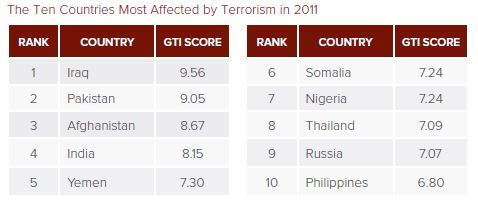
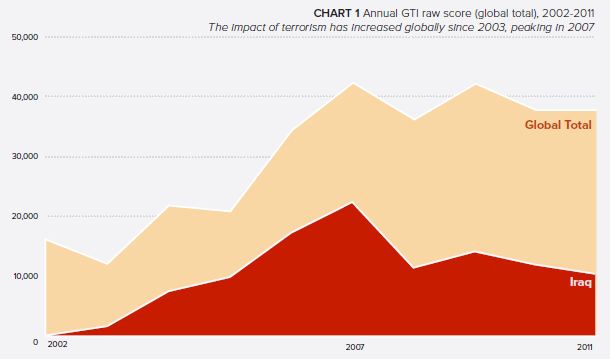
Australia’s Institute for Economics and Peace released a study (pdf) today in which they have tabulated terrorist attacks over the past ten years. They have developed a Global Terrorism Index which, on a country by country basis, quantifies attacks by number of fatalities, number of injuries and property damage incurred and allows for trends over time. The top three countries in the index are, in order, Iraq, Pakistan and Afghanistan, where the US has spent the bulk of its efforts in the Great War on Terror since the attacks of September 11, 2001. The fact remains that after over ten years of effort, over a trillion dollars spent and thousands of US troops killed, terrorism remains at greatly elevated levels in those countries compared to the level at the beginning of the study in 2002. There has been a slight plateauing of the number of attacks since its peak in 2007, but there is no real trend toward lower numbers of attacks. The top ten countries, from the report:

What qualifies as terrorism differs greatly depending on the definition employed. The definition employed here is:

the threatened or actual use of illegal force and violence by a non-state actor to attain a political, economic, religious, or social goal through fear, coercion, or intimidation

The study notes that in this context, drones are excluded:

This definition excludes perceived acts of state terror, such as drone attacks resulting in civilian casualties.

It should be noted that the scale employed is logarithmic and so small differences in the terror index number reflect large differences in the numbers of attacks and fatalities. For 2011, there were 1228 incidents in the top country Iraq with 1798 fatalities while the number nine country Russia saw 182 incidents with 159 fatalities. An interactive map of the data can be found here.

As mentioned above, attacks increased greatly from 2002 through 2007 and then plateaued. The trend of attacks over time can be seen here:

The study looked at the data in an attempt to find potential causes of terrorism (emphasis in original):

Analysis has also been carried out against a range of socioeconomic data to determine what factors may be associated with terrorism. The factors that correlated the strongest with the GTI were group grievances, intergroup cohesion, human rights, and political stability.

Interestingly, even though the US embarked on its Great War on Terror in response to an attack by al Qaeda, the study found only one incident in 2011 attributed to it. However, there are many offshoots of the group which remain active:

According to GTD data, however, the al-Qa’ida organization itself was responsible for only one incident – a kidnapping – out of the 5000 terrorist incidents in 2011, while 11 of the most 20 [sic] active groups globally were al-Qa’ida linked.

So while the primary al Qaeda organization is essentially defunct with regard to terror attacks, its offshoots remain active.  In terms of fatalities, the top three groups for the time period 2002 through 2001 were the Taliban, al Qaeda in Iraq and Islamic State of Iraq. Despite all the effort by the US, its targets remain the most effective actors in global terrorism in terms of deaths.

In a rational world, this report would prompt long, careful review in Washington and a reassessment of how our country goes about trying to stop terrorism. Instead, it is more likely to result in allocation of even more lives and treasure to tactics and strategies that have proven completely useless.


Jeh Johnson on the “Military’s Domestic Legal Authority”

In addition to suggesting that the 16 year old American citizen Abdulrahman al-Awlaki was a legitimate military target, Jeh Johnson spoke yesterday about the “military’s domestic legal authority.” Now, rest assured, Johnson said the Administration does not rely on aggressive interpretations of such authority.

Against an unconventional enemy that observes no borders and does not play by the rules, we must guard against aggressive interpretations of our authorities that will discredit our efforts, provoke controversy and invite challenge.

He acknowledges that posse comitatus requires express authorization from Congress before extending the reach of the military onto US soil.

As I told the Heritage Foundation last October, over-reaching with military power can result in national security setbacks, not gains.  Particularly when we attempt to extend the reach of the military on to U.S. soil, the courts resist, consistent with our core values and our American heritage – reflected, no less, in places such as the Declaration of Independence, the Federalist Papers, the Third Amendment, and in the 1878 federal criminal statute, still on the books today, which prohibits willfully using the military as a posse comitatus unless expressly authorized by Congress or the Constitution. [my emphasis]

Then he proceeds directly from describing the express authorization required from Congress to a discussion of the AUMF–as the basis for the “military’s domestic legal authority.”

Second: in the conflict against al Qaeda and associated forces, the bedrock of the military’s domestic legal authority continues to be the Authorization for the Use of Military Force passed by the Congress one week after 9/11.[2]  “The AUMF,” as it is often called, is Congress’ authorization to the President to:

use all necessary and appropriate force against those nations, organizations, or persons he determines planned, authorized, committed, or aided the terrorist attacks that occurred on September 11, 2001, or harbored such organizations or persons, in order to prevent any future acts of international terrorism against the United States by such nations, organizations or persons.

Ten years later, the AUMF remains on the books, and it is still a viable authorization today. [my emphasis]

Then Johnson describes how the Administration–with no express authority from Congress until the NDAA–stretched an authorization limited to those people and groups with ties to 9/11 to include those “associated with” such groups. And, again with no express authorization from Congress, expanded it to include those who “engaged in hostilities” with coalition partners.

In the detention context, we in the Obama Administration have interpreted this authority to include:

those persons who were part of, or substantially supported, Taliban or al-Qaeda forces or associated forces that are engaged in hostilities against the United States or its coalition partners.[3]

This interpretation of our statutory authority has been adopted by the courts in the habeas cases brought by Guantanamo detainees,[4] and in 2011 Congress joined the Executive and Judicial branches of government in embracing this interpretation when it codified it almost word-for-word in Section 1021 of this year’s National Defense Authorization Act, 10 years after enactment of the original AUMF.[5]  (A point worth noting here: contrary to some reports, neither Section 1021 nor any other detainee-related provision in this year’s Defense Authorization Act creates or expands upon the authority for the military to detain a U.S. citizen.)

Johnson doesn’t mention, of course, that the government is using the same interpretation to extend the military’s domestic legal authority to non-detention areas. Those applications are secret, you see.

Note, in this passage, how Johnson gracefully re-specifies that he’s talking about the 2001 AUMF, and not the 2002 AUMF, which also remains in effect?

But, the AUMF, the statutory authorization from 2001, is not open-ended.  It does not authorize military force against anyone the Executive labels a “terrorist.”  Rather, it encompasses only those groups or people with a link to the terrorist attacks on 9/11, or associated forces.

That’s important because the government at least used to–and presumably still does (otherwise they wouldn’t have panicked when Congress considered repealing the AUMF authorizing a war that is supposed to be over)–rely on the Iraq AUMF to target “anyone the Executive labels a ‘terrorist.’”

Given that the Iraq AUMF has been used to go beyond the definitions in the 2001 AUMF, I’ll skip the paragraphs were Johnson talks about how narrow the government’s interpretation of “associated forces” is.

Particularly because this paragraph is my very favorite bit in this entirely disingenuous speech.

Third: there is nothing in the wording of the 2001 AUMF or its legislative history that restricts this statutory authority to the “hot” battlefields of Afghanistan.  Afghanistan was plainly the focus when the authorization was enacted in September 2001, but the AUMF authorized the use of necessary and appropriate force against the organizations and persons connected to the September 11th attacks – al Qaeda and the Taliban — without a geographic limitation.

Pretty comprehensive, huh, Jeh? Neither the wording of the AUMF or the legislative history limits the AUMF, right?

Continue reading


Obama Issues Veto Threat on Forever War

The Administration just issued its official position on the House Armed Services Committee Defense Authorization bill. In it, Obama issues veto threats on several issues, including an extra engine for the Joint Strike Fighter and limits on START nuclear reductions (but not, it must be said, on any delay of DADT repeal, though he did oppose efforts to delay repeal).

Most interesting, though, is the veto threat on the forever war (see Ben Wittes for a good summary of most of these sections):

Detainee Matters:  The Administration strongly objects to section 1034 which, in purporting to affirm the conflict, would effectively recharacterize its scope and would risk creating confusion regarding applicable standards.  At a minimum, this is an issue that merits more extensive consideration before possible inclusion.  The Administration strongly objects to the provisions that limit the use of authorized funds to transfer detainees and otherwise restrict detainee transfers and to the provisions that would legislate Executive branch processes for periodic review of detainee status and regarding prosecution of detainees.  Although the Administration opposes the release of detainees within the United States, Section 1039 is a dangerous and unprecedented challenge to critical Executive branch authority to determine when and where to prosecute detainees, based on the facts and the circumstances of each case and our national security interests.  It unnecessarily constrains our Nation’s counterterrorism efforts and would undermine our national security, particularly where our Federal courts are the best – or even the only – option for incapacitating dangerous terrorists.  For decades, presidents of both political parties – including Presidents Ronald Reagan, George H.W. Bush, Bill Clinton, and George W. Bush – have leveraged the flexibility and strength of our Federal courts to incapacitate dangerous terrorists and gather critical intelligence.  The prosecution of terrorists in Federal court is an essential element of our counterterrorism efforts – a powerful tool that must remain an available option.  The certification requirement in section 1040, restricting transfers to foreign countries, interferes with the authority of the Executive branch to make important foreign policy and national security determinations regarding whether and under what circumstances such transfers should occur.  The Administration must have the ability to act swiftly and to have broad flexibility in conducting its negotiations with foreign countries.  Section 1036 undermines the system of periodic review established by the President’s March 7, 2011, Executive Order by substituting a rigid system of review that could limit the advice and expertise of critical intelligence and law enforcement professionals, undermining the Executive branch’s ability to ensure that these decisions are informed by all available information and protect the full spectrum of our national security interests.  It also unnecessarily interferes with DoD’s ability to manage detention operations.  Section 1042 is problematic and unnecessary, as there already is robust coordination between the Department of Justice, the Department of Defense, and the Intelligence Community on terrorism-related cases, and this provision would undermine, rather than enhance, this coordination by requiring institutions to assume unfamiliar roles and could cause delays in taking into custody individuals who pose imminent threats to the nation’s safety.  If the final bill presented to the President includes these provisions that challenge critical Executive branch authority, the President’s senior advisors would recommend a veto.

While I would have preferred a full-throated rejection of the forever war, this is a neat approach that, given realistic assumptions of what we can expect from Obama, pushes back in an interesting fashion.

What the Administration has done is list five different provisions:

  • 1034: redefining the AUMF to be a forever war (and also giving the President the power to detain people in the forever war)
  • 1039: barring the use of funds for civil trials
  • 1040: imposing certification requirements on the Secretary of Defense to transfer detainees
  • 1036: codifying an indefinite detention system, with fewer detainee rights than Obama’s own EO calls for
  • 1042: requiring the Attorney General ask permission from the DNI and Secretary of Defense before prosecuting “terrorist offenses” in civilian courts

And then said, generally, if “these provisions that challenge critical Executive branch authority” remain in the bill, his advisors would recommend a veto.

Of course, on its face, the forever war section doesn’t “challenge critical Executive branch authority,” unless you argue that by granting the President the ability to constantly redefine this war, you’re infringing on his authority to do so without a grant of such authority from Congress. That’s not how I understand the Constitution, but you can never be too sure anymore about the people who run our war machines.

Nevertheless, Obama is including that with a bunch of other restrictions (some of which passed in similar form on other laws, to which he responded with a non-signing statement signing statement, and some of which are new), so as to be able to say his opposition is grounded in separation of power concerns rather than the judgment that Congress shouldn’t mandate a forever war the President hasn’t asked for.

Again, I’d rather have a loud denunciation of the forever war. I’d rather have a clear argument about how we will start moving away from a war footing in our opposition to terrorism.

But I’m not going to get that, so I’ll take this graceful veto threat instead.


John Bellinger: If the War Is Illegal, Just Change the Law

John Bellinger has been publicly suggesting the Obama Administration had exceeded the terms of the AUMF for some time. So it is unsurprising that he took the opportunity of a Republican House, the incoming Armed Services Chair’s explicit support for a new AUMF, and the Ghailani verdict to more fully develop his argument in an op-ed. It’s a well-crafted op-ed, such as in the way it avoids explicitly saying the government has been breaking the law in its pursuit of terrorism, when he pretends the only people we’ve been targeting in Pakistan, Yemen, and Somalia are al Qaeda leaders.

The Bush and Obama administrations have relied on this authority to wage the ground war in Afghanistan; to exert lethal force (including drone strikes) against al-Qaeda leaders in Pakistan, Yemen and Somalia; and to detain suspected al-Qaeda and Taliban members in Guantanamo Bay, Cuba, and Afghanistan.

In fact, the targets include a heck of a lot of grunts and many people with terrorist ties, but not direct affiliation with al Qaeda. Oh, and a bunch of civilians, but I guess we’re to assume the government just has bad aim.

Then there’s this game attempt to pretend that everyone will find something to love in the Forever War.

Nearly 10 years after the Sept. 11 attacks, the Obama administration, congressional Republicans and Democrats, and civil liberties groups all have an interest in updating this aging legislation. Republicans should be willing to help the president ensure that combatant commanders and intelligence agencies have ample legal authority to kill or capture terrorists who threaten the United States today. Many Republicans also want to give clearer statutory direction to federal judges regarding who may be detained and for how long. For their part, civil liberties groups and their Democratic supporters in Congress can insist that terrorist suspects who are U.S. nationals receive additional protections before being targeted and that persons detained now or in the future under the laws of war have a right to adequate administrative or judicial review.

As if Republicans weren’t already clamoring for more war and more war powers. As if there would be any doubt that Republicans would answer the “who may be detained and for how long” with any answer but, “Forever War, Baby!” As if dubbing the new AUMF “the al-Awlaki and PETA law”–putting some limits on the targeting of American citizens that presumably already exist–would be enough to entice civil libertarians (whom, Bellinger seems to suggest, only have support among Democrats).

And did you notice how Bellinger slipped in giving intelligence agencies the legal authority to kill terrorists? One of the problems–though Bellinger doesn’t say this explicitly–is that we’re increasingly using non-military personnel to target drones, which raises legal questions about whether they’re not unprivileged combatants in the same way al Qaeda is.

In any case, the lawyer did his work on this op-ed.

But here’s what I find to be the most interesting detail in it:

For at least five years, lawyers in and outside the Bush and Obama administrations have recognized the need to replace this act with a clearer law. The Bush administration chose not to seek an update because it did not want to work with the legislative branch.

Which I translate to read, “Back in 2005, several lawyers in the Bush Administration and I [I'm assuming Comey and Zelikow and Matthew Waxman] told the President he was breaking the law and should ask for an updated AUMF. But in spite of the fact that Congress was at that very moment passing the Detainee Treatment Act, the Bush White House claimed it couldn’t work with Congress to rewrite the AUMF to try to give the war they were already fighting some legal cover.”

Though of course, in 2005, Bush’s lawyers may have been trying to pretty up the fact that their illegal wiretap program–which constituted the use of military powers within the United States against US citizens–some kind of pretty face before it was exposed.

We’ve been fighting the Forever Whoever War since at least 2005. And now this clever lawyer wants to make sure the Forever War is legally sanctioned for the foreseeable future.