Hidden until Now: Trump Admitted 2016 Russian Interference in Lavrov-Kislyak Meeting

[NB: Note the byline, thanks!]

If you though the dam was beginning to crack after House Speaker Pelosi announced an impeachment inquiry would begin on Tuesday, or after the release of the July 25 memo on Wednesday, or the release of the whistleblower complaint followed by acting Director of National Intelligence Joseph Maguire’s testimony yesterday, you ain’t seen nothing yet.

The Washington Post published this article at 8:26 p.m.:

Trump told Russian officials in 2017 he wasn’t concerned about Moscow’s interference in U.S. election

Here’s the first two grafs:

President Trump told two senior Russian officials in a 2017 Oval Office meeting that he was unconcerned about Moscow’s interference in the 2016 U.S. presidential election because the United States did the same in other countries, an assertion that prompted alarmed White House officials to limit access to the remarks to an unusually small number of people, according to three former officials with knowledge of the matter.

The comments, which have not been previously reported, were part of a now-infamous meeting with Russian Foreign Minister Sergei Lavrov and Russian Ambassador Sergey Kislyak, in which Trump revealed highly classified information that exposed a source of intelligence on the Islamic State. He also said during the meeting that firing FBI Director James B. Comey the previous day had relieved “great pressure” on him.

Emphasis mine.

We’ve known about this particular conversation Trump had with Lavrov and Kislyak. We’ve known he damaged a source in the process while admitting to obstruction of justice.

But we didn’t know there was more to this conversation — like admitting he knew the Russians ‘aided’ his election, or airing out our dirty foreign policy to a country with which we have not had good relations. “Unconcerned,” WaPo’s team said; sure, why would Trump be worried at all about the contributions that ensured his occupation of the White House? It’s simply a matter of fact, right?

And we didn’t know Trump’s lack of concern about election interference in front of Lavrov and Kislyak, which offered an implicit permission slip to continue interference here and elsewhere.

Nor did we know that White House officials hid the rest of this Oval Office conversation, limiting its access to a very small need-to-know circle. It’s not clear whether this meant the contents of this highly-sensitive conversation were retroactively classified and squirreled away in the code-word classified system set aside for sensitive intelligence information where the July 25 Trump-Zelensky conversation transcript had been stored.

We don’t know now whether Special Counsel’s Office had any inkling the content of this particular conversation may have been hidden, or that other transcripts responsive to its investigation may have been locked away in that code-word classified system.

If Trump knew about this at all, and any of this hidden content was responsive to Mueller’s investigation, it’s yet another obstructive act.

Any of the White House officials who enabled this content sequestration process may also have obstructed justice if the hidden material was responsive to requests or subpoenas. Who knew about these material, when they learned about it, and why they didn’t come forward sooner will be a subject of the impeachment inquiry.

We also need to know what other exposures are contained within and without the code-word classified system and whatever other ad hoc retention system was employed by a small cadre of White House staff.

What else has been used as leverage against the U.S. that we the people and our representatives know nothing about?

What’s additionally worrisome: we’re learning in a rather slapdash fashion as the proverbial rats flee the sinking S.S. Trump — like the ‘three former officials with knowledge of the matter’ cited as sources for this story. How many of them have already been monitored by foreign intelligence, marked as potential assets, witting or unwitting, because they are known to have participated in this secret content sequestration process?

How many of these ‘former officials with knowledge of the matter’ have been silent because of Trump’s obsessive use of nondisclosure agreements?

How many of them have talked among themselves — neaning others under Trump’s NDAs — about this secret content sequestration process and its contents?

How many of this circle of need-to-know or in-the-know are also GOP leadership like Senator Mitch McConnell or Senator Lindsey Graham? How many of them have already been compromised because of this knowledge?

It’d certainly explain a few things like McConnell’s refusal to do anything substantive about election security. Or Graham’s about-face after a round of golf with Trump.

If you’re reading this, Speaker Pelosi, ramp up the impeachment team. Get that full House vote organized to authorize the inquiry and the necessary personnel. It’s past time.


Share this entry

A Less Obvious Question about NYT’s Reporting on Trump-Russia

[NB: As always, check the byline. /~R.]

Over the last several years, one thing has bothered me about The New York Times, something not immediately obvious in these related pieces of what may be the most important work the paper published since the early 2000s and the Iraq War. By “important” I don’t mean effective, nor do I mean constructive.

October 31, 2016

Investigating Donald Trump, F.B.I. Sees No Clear Link to Russia
POLITICS By Eric Lichtblau and Steven Lee Myers

WASHINGTON — For much of the summer, the F.B.I. pursued a widening investigation into a Russian role in the American presidential campaign. Agents scrutinized advisers close to Donald J. Trump, looked for financial connections with Russian financial figures, searched for those involved in hacking the computers of Democrats, and even chased a lead — which they ultimately came to doubt — about a possible secret channel of email communication from the Trump Organization to a Russian bank.

Law enforcement officials say that none of the investigations so far have found any conclusive or direct link between Mr. Trump and the Russian government. And even the hacking into Democratic emails, F.B.I. and intelligence officials now believe, was aimed at disrupting the presidential election rather than electing Mr. Trump. …

January 20, 2017

Trump, Russia, and the News Story That Wasn’t
PUBLIC EDITOR By Liz Spayd

LATE September was a frantic period for New York Times reporters covering the country’s secretive national security apparatus. Working sources at the F.B.I., the C.I.A., Capitol Hill and various intelligence agencies, the team chased several bizarre but provocative leads that, if true, could upend the presidential race. The most serious question raised by the material was this: Did a covert connection exist between Donald Trump and Russian officials trying to influence an American election?

One vein of reporting centered on a possible channel of communication between a Trump organization computer server and a Russian bank with ties to Vladimir Putin. Another source was offering The Times salacious material describing an odd cross-continental dance between Trump and Moscow. The most damning claim was that Trump was aware of Russia’s efforts to hack Democratic computers, an allegation with implications of treason. Reporters Eric Lichtblau and Steven Lee Myers led the effort, aided by others. …

May 16, 2018

Code Name Crossfire Hurricane: The Secret Origins of the Trump Investigation
POLITICS By Matt Apuzzo, Adam Goldman and Nicholas Fandos

WASHINGTON — Within hours of opening an investigation into the Trump campaign’s ties to Russia in the summer of 2016, the F.B.I. dispatched a pair of agents to London on a mission so secretive that all but a handful of officials were kept in the dark.

Their assignment, which has not been previously reported, was to meet the Australian ambassador, who had evidence that one of Donald J. Trump’s advisers knew in advance about Russian election meddling. After tense deliberations between Washington and Canberra, top Australian officials broke with diplomatic protocol and allowed the ambassador, Alexander Downer, to sit for an F.B.I. interview to describe his meeting with the campaign adviser, George Papadopoulos.

The agents summarized their highly unusual interview and sent word to Washington on Aug. 2, 2016, two days after the investigation was opened. Their report helped provide the foundation for a case that, a year ago Thursday, became the special counsel investigation. But at the time, a small group of F.B.I. officials knew it by its code name: Crossfire Hurricane. …

January 11, 2019

F.B.I. Opened Inquiry Into Whether Trump Was Secretly Working on Behalf of Russia
POLITICS By Adam Goldman, Michael S. Schmidt and Nicholas Fandos

WASHINGTON — In the days after President Trump fired James B. Comey as F.B.I. director, law enforcement officials became so concerned by the president’s behavior that they began investigating whether he had been working on behalf of Russia against American interests, according to former law enforcement officials and others familiar with the investigation.

The inquiry carried explosive implications. Counterintelligence investigators had to consider whether the president’s own actions constituted a possible threat to national security. Agents also sought to determine whether Mr. Trump was knowingly working for Russia or had unwittingly fallen under Moscow’s influence.

The investigation the F.B.I. opened into Mr. Trump also had a criminal aspect, which has long been publicly known: whether his firing of Mr. Comey constituted obstruction of justice. …

I can’t help wondering what NYT’s former former executive editor Jill Abramson would have done in 2016 when presented with a draft of what would become the October 31st article.

I can’t help wondering yet again, a handful of years later, what the real reasons were that Abramson was fired in May 2014 — during a mid-term election year — after a mere 32 months in that role. Her predecessor Bill Keller had been in that same role for eight years.

Admittedly, I don’t think much of current executive editor Dean Baquet‘s decisions, and not just about this particular story arc. But it’s this arc which really gives me pause about NYT’s editorial management, as does the irrational amount of coverage the NYT focused during the 2016 campaign season on Hillary Clinton’s emails.

Did we end up with this mess because a traditional media company had difficulty with a woman’s editorial management style? Or because she might be sympathetic to women running for public office?

You’ve got a lot to say about the NYT’s reporting on this topic. Go for it.

Share this entry

Birds of a Feather: Comparing ‘Sparrows’ Chapman and Butina

Name: Anna Vasilyevna Kushchyenko Chapman Maria Valeryevna Butina
Born:

Place:

23 February 1982

Volgograd, Volgograd Oblast, Soviet Union

November 10, 1988

Barnaul, Siberia, Soviet Union

Education Economics (Masters)

Moscow University or RUDN University (unclear)

Moscow, Russia

Political Science, teaching

Altai State University

Barnaul, Siberia, Russia

Marital Status: Divorced (2006) Single
First Entered U.S.: 2009 2011
Visa Y/N: Unclear Yes
Visa Type: Unclear – Acquired residency in U.S. as British citizen by marriage Initially traveled to/from U.S. with Russian official Aleksandr Torshin; applied for F-1 student visa in 2016
Work in U.S.: CEO, PropertyFinder LLC (real estate sales) Special assistant to Aleksandr Torshin; gun rights activist; student
Arrested: 06/27/10 07/15/18
Charged with: 18 USC 371 Conspiracy,

18 USC 951 Agents of Foreign Governments

18 USC 371 Conspiracy,

18 USC 951 Agents of Foreign Governments

Though Marcy has already discussed Maria Butina’s recent attempt to avoid prosecution as a Russian spy under 18 USC 951, it’s worth comparing two Russian women charged on different occasions with violating the same act.

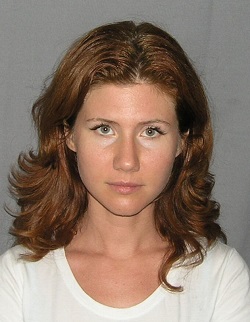
There are some similarities including the hair color, and some key differences — Chapman and Butina aren’t clones. Their behavior and achievements in the U.S. on behalf of Russia suggest a change in methodology over time.

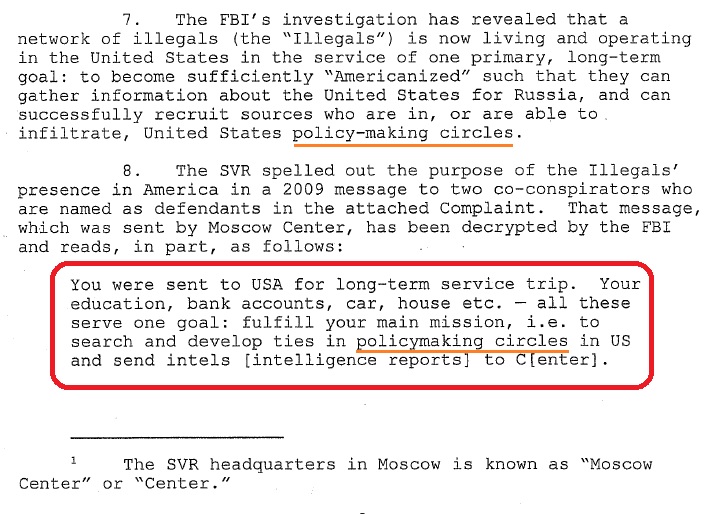
The indictment charging Chapman included her mission, decrypted from a 2009 message sent to Chapman and a co-conspirator:

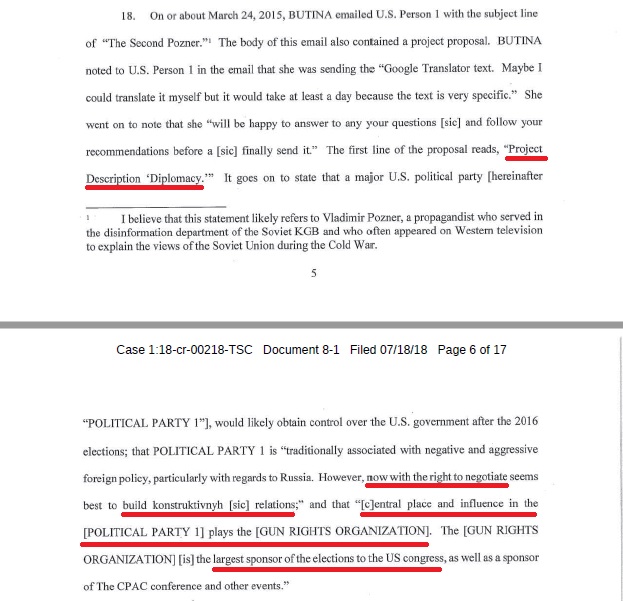
Butina’s mission appears to be similar, but there’s no decrypted message included in the Department of Justice’s Arrest Affidavit to compare with that in Chapman’s indictment. We must rely on Butina’s translation of another document she shared by email with ‘US Person-1,” believed to be Paul Erickson.

Both Chapman and Butina had missions or assignments; Butina’s appears to be worded more loosely but a full text of the email is not publicly available to make a more accurate assessment. Both women were expected to get close to and develop relationships with U.S. policy makers.

What may explain why Butina’s mission is worded a little differently: between the time Chapman receives her assignment and Butina shares her mission with U.S. Person-1, the policymakers have changed from Democrats to Republicans.

The Democrats were also much more difficult and distant; we can see in other interactions between Illegals Program spies including Chapman that targets weren’t as readily engaged as U.S Person-1. Though Americans who interacted with Illegals Program spies were amazingly credulous, the spies still didn’t get very close to their intended target, Hillary Clinton.

By the time Butina began her work in 2011, methods had changed. Instead of tradecraft seen in the Buryakov case circa 2013-2015 and the earlier Illegals Program circa 2010, Butina is initially accompanied by a Russian official – no need for Butina to implement additional traditional tradecraft to report intelligence when they are their own channel, subordinate spy to superior and minder. Once a relationship between Butina and US Person-1 had been well established, tradecraft was even more nominal – we don’t see in the Arrest Affidavit anything more complicated than a commercially available laptop computer and cellphone.

The descriptive name of the assignment on which Butina worked also indicated a shift — “Project Description ‘Diplomacy'” —  to building constructive (konstrucktivnyh) relations with an organization central to influence over the Republican Party, with an understanding that they (Russia in concert with Political Party 1 and Gun Rights Organization) had some ‘right to negotiate’. This is far more substantive than Chapman’s assignment to seek and develop ties with key contacts.

Spying operations changed along the arrest and deportation of the Illegals Program spies and in sync with a transition in U.S. Politics:

— The shift in Congress from Democratic Party to GOP with the 2010 election may have been a trigger for a new approach once the 112th Congress was sworn in;
— The transition happened in sync with the embrace of Torshin by the National Rifle Association (NRA);
— Change from Clinton to Kerry as Secretary of State likely played a role given the expectation Clinton would be the front runner for the Democratic Party’s presidential nomination.

But one key factor may have changed the tack Torshin and Butina took compared to Chapman and the Illegals: the Supreme Court decision in Citizens United, Appellant v. Federal Election Commission on January 21, 2010.

Now there was a means to funnel money to meet Torshin’s and Butina’s efforts without the level of difficulty other methods might have had before 2010. They could identify, meet, target, influence, and point to a candidate the NRA could fund using Russian money — in effect, developing and recruiting unwitting (or witting) agents.

They collected Republican members of Congress to exploit as useful idiots, in other words.

No wonder Butina had to hide behind a seemingly innocuous student status. Besides masking the reason why she was in the U.S., she needed to appear lower on the cultural status scale than the GOP’s easy marks on which she worked. In contrast, Chapman only needed the appearance of a real estate gig to enable her to poke around.

Note again in the excerpt from the DOJ’s Arrest Affidavit the ‘right to negotiate’ — does this suggest that Citizens United, combined with NRA’s welcome, that Russia felt it had an alternative (read: illegitimate) path to diplomacy, circumventing a Democratic White House between 2011 and 2017?

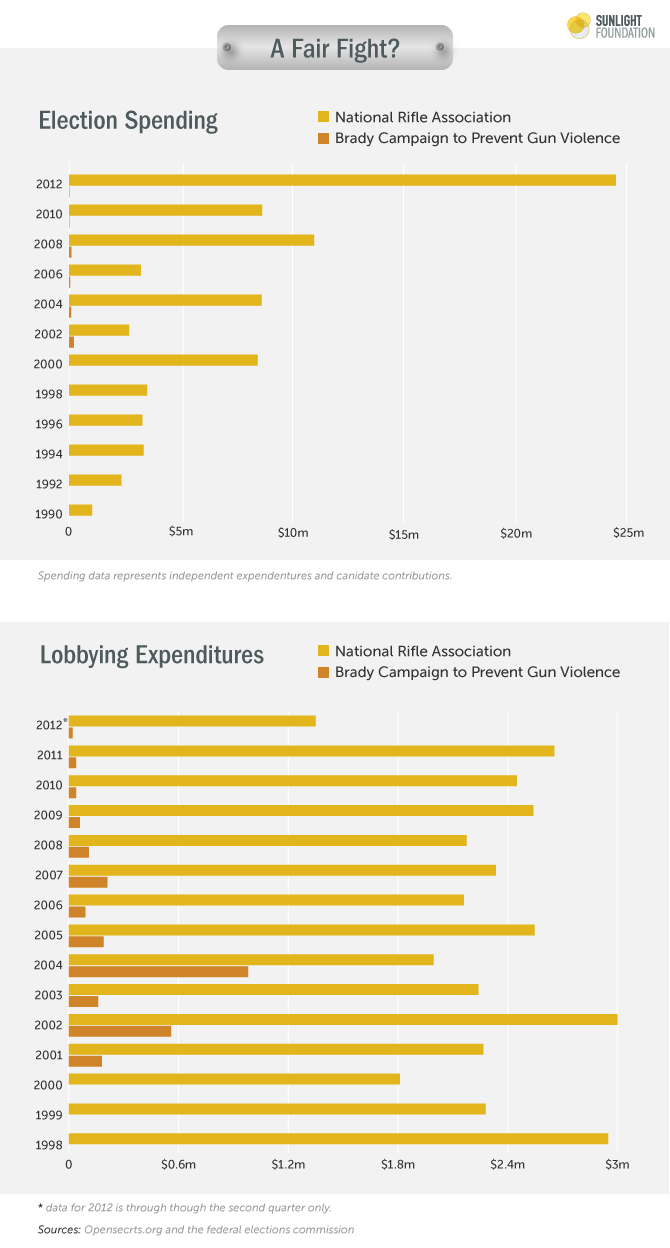
It’s clear something changed after 2010 at the NRA with regard to allocation of money between lobbying and campaigning.

Never mind that gun control advocacy group the Brady Foundation was outspent by an overwhelming amount. The NRA shifted its practice dramatically in 2012 from spending on lobbying instead to campaigning, just about the time Torshin had fully integrated Butina into a gun rights advocate as his “special assistant.”

In 2012 the NRA also transitioned away from relying as heavily on the  American Legislative Exchange Council (ALEC), doing more of its policy work and outreach directly through GOP candidates. ALEC executed a PR feint — backing away publicly from gun rights issues and the Stand Your Ground laws it helped promote — but in reality it was ceding to the NRA these efforts because ALEC was no longer needed after Citizens United as a legislative front. The NRA could handle their issues directly with candidates under the guise of campaign support.

The rest is history, with Butina taking selfies with NRA’s president David Keene and various GOP candidates to document her benchmarks along the way through Trump’s 2016 campaign.

(Conveniently, Trump trademarked his tagline, Make America Great Again, in November 2012.)

Butina’s legal team may argue against a charge of violating 18 USC 951 as a negotiating chip, claiming she didn’t spy. If either of these red-capped sparrows could have claimed they weren’t a spy, it wasn’t Butina. Her mission was successful in a way Anna Chapman could only have dreamed.

Share this entry

Big Dick Toilets and Sasquatch Dolls: Matt Whitaker’s Qualifications To Be Dog-Catcher

I’ve followed the burgeoning scandal that the guy Trump appointed to play hatchet man to Mueller’s investigation is totally unqualified to be Acting Attorney General. But I’ve already lost track of all the reasons why. So I’m going to try to keep a running list here.

This will be updated as new issues are identified.

Legal problems with the appointment

While Steve Vladeck says it’s legal, and Marty Lederman and Walter Dellinger find OLC’s analysis, concluding that Matt Whitaker’s appointment is legal, to be plausible, a number of commentators disagree. Those include:

These arguments include a mix of constitutional (Appointments Clause) and legal (Vacancies Reform Act and the purpose of DOJ).

Numerous people are already challenging his appointment, including the state of Maryland, three Democratic Senators, and a number of criminal defendants. Quinta Jurecic is collecting all the litigation documents for those challenges here.

Other legal problems

In addition to the Constitutional and legal problems he raises, Neal Katyal also argues that Whitaker cannot legally supervise Mueller’s investigation.

David Kris points out that because of the legal questions surrounding Whitaker’s appointment and the certainty that defendants will challenge it, his appointment will create a whole bunch of downstream problems for DOJ.

A company for which Whitaker served on the board is under investigation by the FBI and FTC. Though Whitaker was subpoenaed by the FTC, he blew off that subpoena. FOIAed records show that Whitaker kept pitching the company even after receiving complaints.

One report on Trump’s efforts to get DOJ to prosecute Hillary Clinton and Jim Comey describes Whitaker prepping discussions about what it was doing in response; he reportedly “did not seem to cross any line,” but it remains to be seen whether that’s true.

Whitaker got four donations amounting to $8,800 to his 2014 Senate run in 2018, after he had started as Sessions’ Chief of Staff, which may amount to a violation of the Hatch Act. Following a complaint from watchdog group American Oversight, the Office of Special Counsel (the DOJ office in charge of reviewing such violations, among other things) opened an investigation into this.

Bureaucratic problems

There may be problems with the way that Whitaker was appointed.

As numerous people have noted, Jeff Sessions did not date his resignation, raising questions about when his authority really passed to Whitaker. (OLC says Sessions resigned on November 7.) Democrats in the House are also suggesting they believe Sessions’ forced resignation counts as a firing, which changes the options Trump would have to replace him under the Vacancies Reform Act.

Chris Geidner has reported that the White House won’t say when Whitaker was formally appointed.

Because Mueller has sought an interview with John Kelly (indeed, he’s a leading candidate to be the Mystery Appellant challenging a subpoena or something else from Mueller), it may be problematic that he played a key role in firing Jeff Sessions.

Conflict problems

Whitaker has a potential conflict with regards to the Mueller investigation tied to his relationship with Sam Clovis, who was in charge of crafting Trump’s outreach to Russia. Whitaker served as Clovis’ campaign manager in 2014.

Then, in a series of appearances Whitaker used to draw Trump’s attention, he commented on the Mueller investigation or the underlying conflict.

In a USAT column on July 5, 2016 and then multiple appearances on July 6, Whitaker suggested Hillary should have been prosecuted, partly by criticizing Jim Comey for making the decision.

On September 30, 2016, Whitaker suggested that if Trump won, he should restart the investigation into Hillary.

On May 19, 2017, Whitaker dismissed the possibility that Trump had committed obstruction of justice by firing Comey.

In July 2017, Whitaker interviewed with Don McGahn to take on the role of legal attack dog discrediting the Mueller investigation.

On July 13, 2017, Whitaker defended Donald Trump Jr taking the June 9, 2016 Trump Tower meeting.

In a CNN interview on July 26, 2017, Whitaker described how you could defund the Special Counsel and thereby end his work.

I could see a scenario where Jeff Sessions is replaced, it would recess appointment and that attorney general doesn’t fire Bob Mueller but he just reduces his budget to so low that his investigations grinds to almost a halt.

On July 27, 2017, Whitaker said it would be a mistake to provide Mueller any further protection.

On August 4, 2017, Whitaker recommended an article that describes, “with a little planning he could install a true believer to a political position at DOJ—as a sleeper agent—and then (after easing out Sessions) elevate him or her to attorney general.”

On August 6, 2017, Whitaker used the Red Line comment Maggie and Mike teed up to describe Mueller pursuing Trump’s finances as improper.

On August 11, 2017, Whitaker suggested the investigation into Paul Manafort was outside the scope of Mueller’s appointment. In that same appearance, he suggested Mueller had engaged in prosecutorial misconduct.

On August 15, 2017, Whitaker said Mueller’s appointment was a little fishy.

On August 25, 2017, Whitaker suggested searching Manafort’s condo with a dozen agents was designed to intimidate him.

On August 30, 2017, Whitaker suggested Mueller’s investigation was politically motivated and was misusing resources that should be used elsewhere.

In spite of the fact that many of these would seem to pose conflicts that DOJ normally concludes would ethically prohibit Whitaker’s involvement in the Mueller investigation, both Trump and Whitaker appear to have known he would not recuse from the Mueller investigation even before he was appointed, though Trump has claimed (evidence to the contrary) that he didn’t talk to Whitaker about such things before he appointed him.

Financial problems

As noted by CREW when they released Whitaker’s financial disclosures, his disclosures got doctored (or “Kushnered,” as I’m now referring to serial attempts to belatedly fix glaring problems in official disclosures) four times after the time he was appointed AAG.

CREW has already filed a FOIA for those revisions.

What the records show is just as alarming.

The non-profit Whitaker worked at to, first, beat up Hillary Clinton and then audition to kill the Mueller investigation, Foundation for Accountability and Civic Trust, has obscure funding and genesis. It keeps changing its name. Whitaker’s salary, which went from $63,000 for part time work to $660,000 a year, made up most of its expenditures in the period before he became Sessions’ Chief of Staff. One of the guys listed as a director, James Crumley, claimed not to remember its existence. Another, Noah Wall, didn’t know he was listed as Director. While claiming to be non-partisan, it overwhelmingly attacked Democrats (and Hillary specifically), a possible violation of IRS regulations. As OpenSecrets notes, its funding comes from a black hole pass through, but the organization seems to have ties to other judiciary-related dark money groups.

The 14 companies in Iowa Whitaker worked for (reportedly, past tense) have never filed paperwork noting that, so on paper he still works for them.

In 2016, Whitaker abandoned a taxpayer-funded apartment rehabilitation project, defaulting on loans and hiding from creditors.

World Patent Marketing — the company the FBI is investigating — was totally fraudulent, pretending to help review patents without doing so. Among those the company defrauded are veterans. Among the things it marketed were Big Dick Toilets, Sasquatch dolls, and time travel.

Abuse as (or invoking past history as) US Attorney

Whitaker has already abused his position as a government prosecutor, both while serving and since.

In 2006, he prosecuted a Democratic politico, Matt McCoy and even paid an informant to incriminate him. The jury acquitted McCoy after deliberating for just 25 minutes.

Then, when serving on the advisory board for a World Patent Marketing, he threatened people who complained, including threatening them with legal retribution.

Temperament

Both on his legal views and his other beliefs, Whitaker has a temperament far outside the mainstream.

When running for Senate, Whitaker argued that judges should have a biblical view and said that Marbury v. Madison — the foundation of judicial review in this country — was among the worst Supreme Court decisions.

He was among the US Attorneys who imposed the harshest sentences in drug prosecutions.

Update: Since it has attracted a lot of attention, I owe this title in part to HowdyQuicksell, but the Dog Catcher accusation (which will probably ensure no DOJ spox will ever again return my calls) is my own.

Share this entry

The Psy-Group Presentation Suggests Online Trolls Swung Richard Burr’s State of North Carolina

The WSJ reports that Mueller’s team has obtained an analytical document from Psy-Group, the company of Joel Zamel, that was offering to help the Trump campaign both before and after the election.

Special counsel Robert Mueller’s investigators have obtained a presentation prepared by an Israel-based private intelligence firm that outlines ways in which Donald Trump’s 2016 election was helped by fake news and fake social-media accounts, according to people familiar with the presentation and documents reviewed by The Wall Street Journal.

[snip]

Psy-Group’s founder, Joel Zamel, is under scrutiny from U.S. investigators because of his close relationship with the government of the United Arab Emirates and his involvement in a meeting with Mr. Trump’s eldest son shortly before election day, the Journal has reported.

Mr. Zamel met with Donald Trump Jr. at Trump Tower in the weeks before the 2016 election along with George Nader, a top adviser to the crown prince of the United Arab Emirates, to discuss an offer to help boost the campaign, according to people familiar with the matter. Erik Prince, a U.S. defense contractor who specializes in the Middle East and had close ties to the campaign, attended the meeting, the Journal previously reported. People involved in the meeting say nothing came of it and the Psy-Group didn’t perform any work for the Trump campaign.

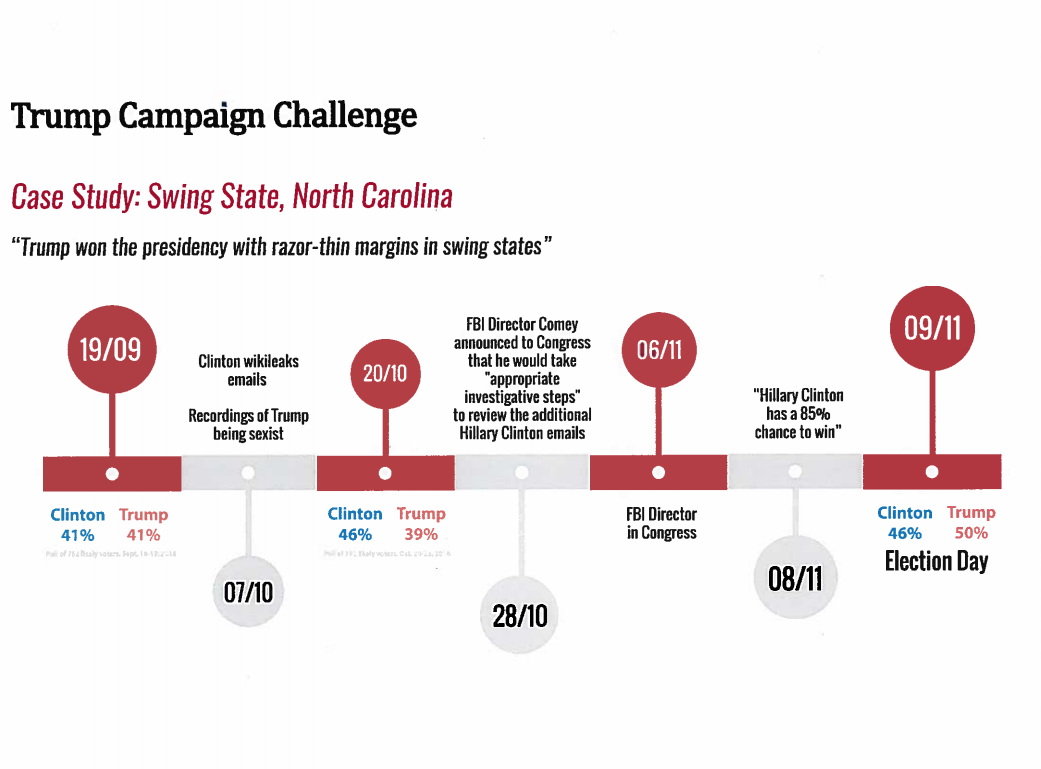
The presentation the Special Counsel is apparently scrutinizing is 9 pages; most pages describe generically how to seed bots to later swing opinion. But there’s one page that purports to show how this works in a swing state. That swing state in North Carolina.

While we can’t measure Psy-Group’s claims without a script, it seems that the group claims social media helped Trump turn a 7 point deficit in the wake of the Access Hollywood tape to a 4 point win on election day.

NC is an interesting choice because Trump also benefitted from the most aggressive voter suppression drive in the state. And because it’s the state for which Russian hacking — of VR Systems and, possibly, of poll books in disproportionately democratic precincts — may have actually affected the election.

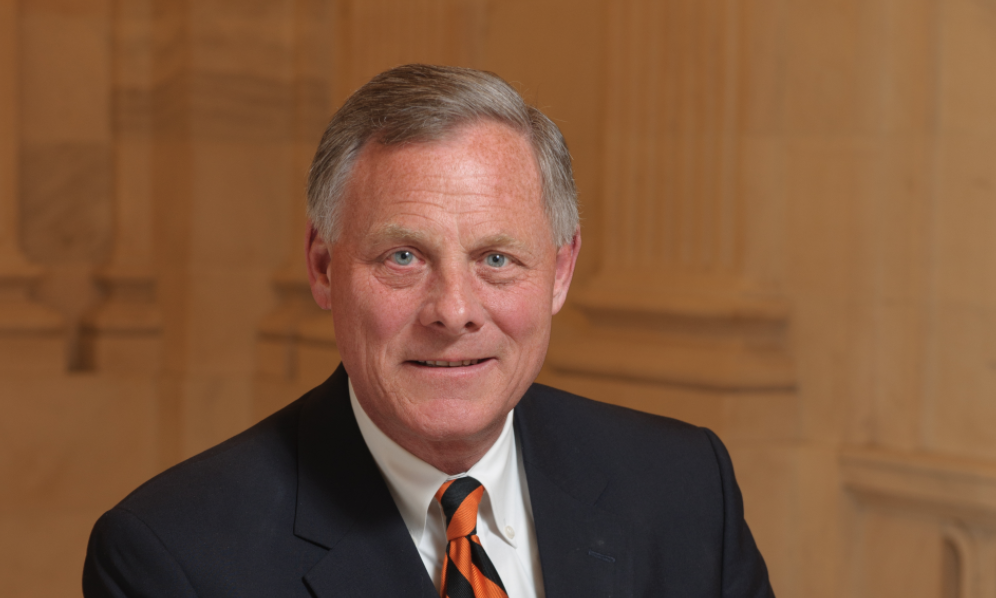
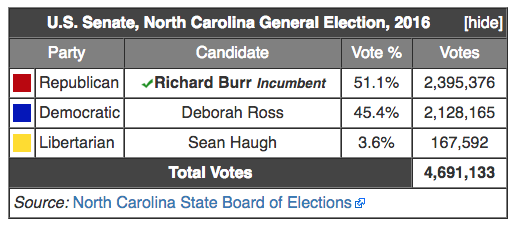
It’s interesting for one more reason: it’s the state of Senate Intelligence Committee Chair (and Trump NatSec advisor, during the election) Richard Burr. Burr won his race by more than Trump did, but still within the scope of the swing mapped out by Psy-Group.

As I noted, the election tampering report generated by Burr’s committee, largely failed to address the vulnerability and importance of vendors like VR Systems.

Obviously, if trolls made the difference in NC, they also made the difference in PA, MI, and WI.

But we might not find that out, because the guy in charge of the purportedly responsible investigation of such things has scoped the investigation in such a way that his own re-election could not be questioned.

Share this entry

Yet More Proof Facebook’s Surveillance Capitalism Is Good at Surveilling — Even Russian Hackers

I’ve long tracked Facebook’s serial admission to having SIGINT visibility that nearly rivals the NSA: knowing that Facebook had intelligence corroborating NSA’s judgment that GRU was behind the DNC hack was one reason I was ultimately convinced of the IC’s claims, in spite of initial questions.

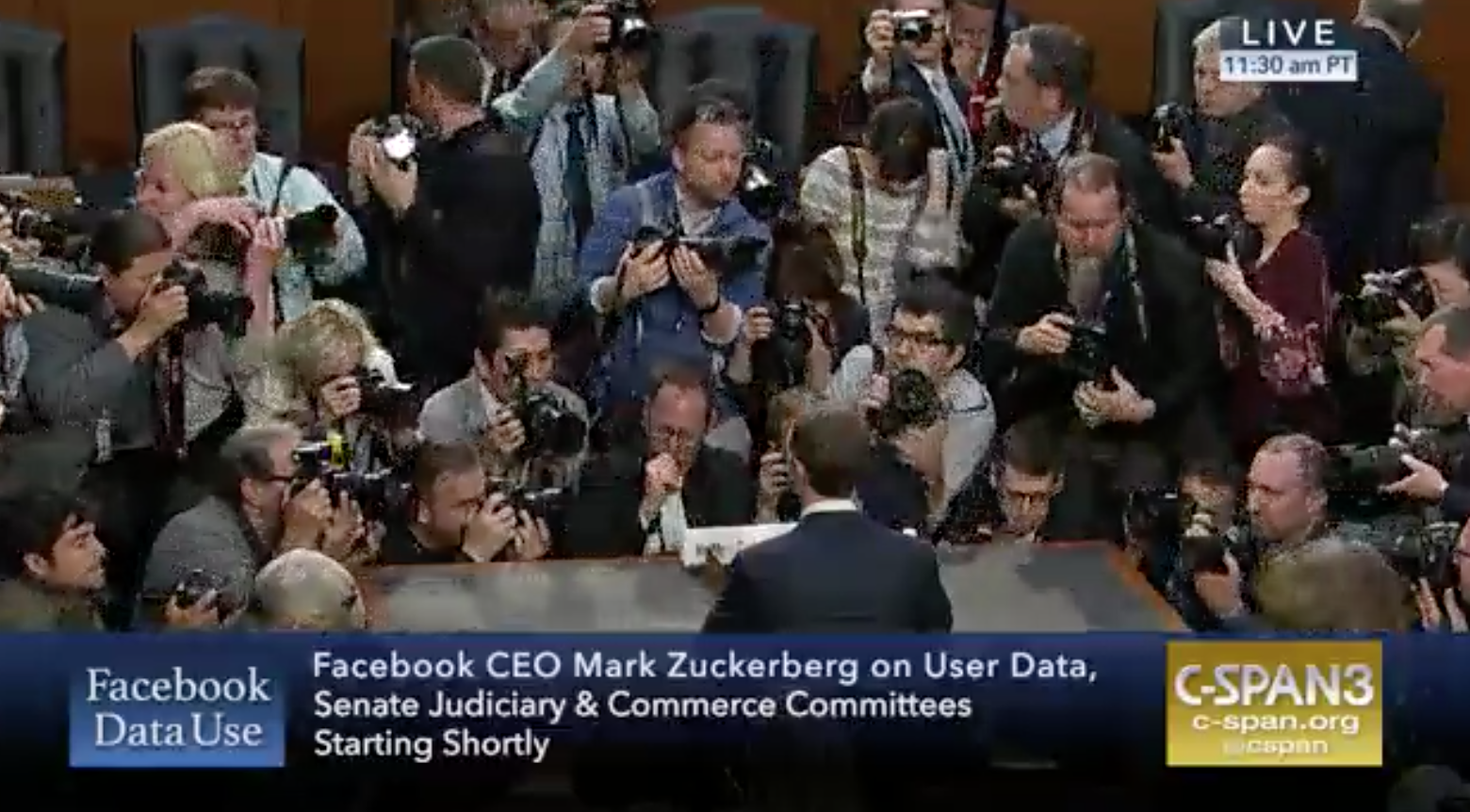
Among all his evasions and questionably correct answers in Senate testimony yesterday, Mark Zuckerberg provided another tidbit about the visibility Facebook had on the 2016 attacks.

One of my greatest regrets in running the company is that we were slow in identifying the Russian information operations in 2016. We expected them to do a number of more traditional cyberattacks, which we did identify, and notified the campaigns, that they were trying to hack into them. But we were slow to identifying [sic] the type of new information operations.

Not only did Facebook see GRU’s operations in real time, but they notified “the campaigns” about them.

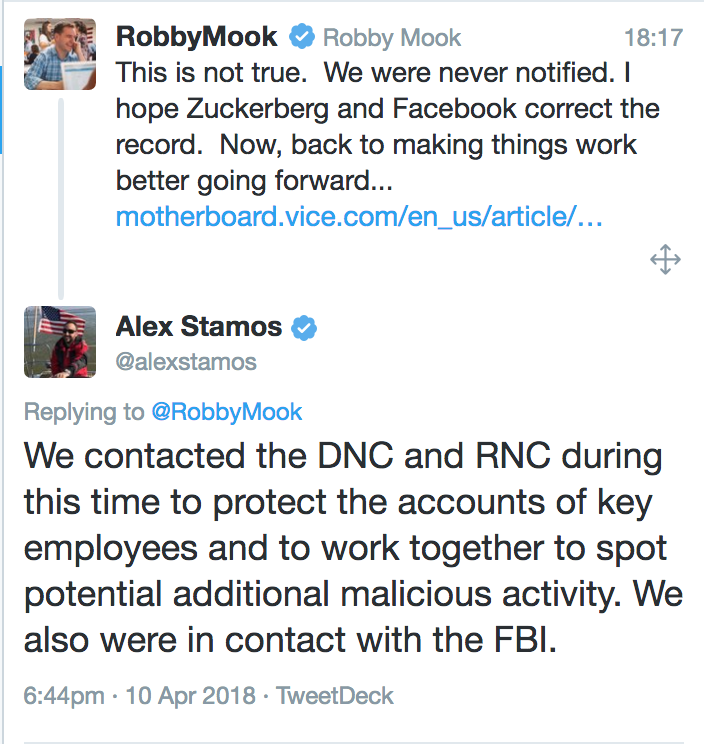
Note, Zuck didn’t describe the targets in any more detail than “campaigns.” That led Robby Mook to dispute Zuck, eliciting more details from Facebook CISO Alex Stamos.

Aside from illustrating how routinely those involved in and covering the 2016 hacks confuse the possible affected targets (resulting in some real misunderstanding of what happened), Stamos’ clarification provides important new details: these hacks affected both the DNC and RNC’s key employees, and Facebook alerted the FBI (something we’ve previously heard).

The DNC likes to claim they never got any warning they were being hacked. But apparently, in addition to the FBI’s serial attempts to lead them to discover Russia was hacking them, Facebook let them know too.

Elsewhere in his testimony, Zuck got coy about the degree to which Facebook remains involved in the Mueller investigation, a fact that should have been obvious to anyone who has read the Internet Research Agency indictment, but which numerous news outlets treated as news anyway.

Facebook has a lot to answer for (this David Dayen piece on yesterday’s testimony is superb).

But one thing that has continued to trickle out is that Facebook’s surveillance capitalism is good at what it’s designed for: surveillance, including of Russian hackers.

Share this entry

What Did Wikileaks Do with the DCCC Emails It Monopolized?

Yesterday Buzzfeed did a story that adds important details to this report from the New Yorker last year.

In mid-August, Guccifer 2.0 expressed interest in offering a trove of Democratic e-mails to Emma Best, a journalist and a specialist in archival research, who is known for acquiring and publishing millions of declassified government documents. Assange, I was told, urged Best to decline, intimating that he was in contact with the persona’s handlers, and that the material would have greater impact if he released it first.

First, Buzzfeed describes the emails clearly as the DCCC documents (though elsewhere this article remains unreliable on some facts about what documents were what).

As Best describes, she had reached out to Guccifer 2.0 when he had asked for assistance from journalists, and ultimately then reached out to Wikileaks.

Best told BuzzFeed News she first reached out to Guccifer 2.0 in August 2016 after it posted on its WordPress account a call for journalists who wanted its files. “I sent them a Direct Message and referred to that, asking what they had in mind,” Best told BuzzFeed News over Signal. Best has experience posting large data sets, and wondered if she could host the files on archive.org, a nonprofit digital library.

But Guccifer 2.0 had another idea. “[I] gonna send a large trove to wikileaks,” it said. Best, who had DMed with WikiLeaks before, relayed that message to WikiLeaks in a direct message on Twitter. Neither party conveyed to her whether they had interacted together before.

“I told them that Guccifer 2.0 was considering giving me at least part of the cache, which is when they asked me to be their ‘agent,’ which they said I would get ‘credit’ for,” Best said. She didn’t agree to act as Assange’s agent, she said, but stopped messaging with Guccifer 2.0.

Note, this exchange shortly follows the release by Best and Wikileaks of some Turkish emails under some interesting circumstances.

Best’s outreach led to the conversation with Wikileaks, the Wikileaks side of which Buzzfeed includes.

The following is the entirety of WikiLeaks’s messages to Best that night, according to the emails she provided. All times are ET. (Twitter does not send a user copies of their own messages, so the contents Best provided are one-sided.)

8:43 p.m.: please “leave” their conversation with them and us

8:43 p.m.: we would appreciate it if you did not dump the docs and obviously archive.org will delete them anyway

9:12 p.m.: Impact is very substantially reduced if the “news” of a release doesn’t co-incide with the ability to respond to the news by searching

9:13 p.m.: non-searchable dumps are just channeled into a few orgs with technical resources. then others won’t touch them because they perceive that the cherries have all been picked by techdirt or whatever.

9:14 p.m.: and these other media groups are very likely to take a stupid initial angle

9:15 p.m.: “We don’t know if its true. Possibly russians who knows blah blah blah” because they don’t properly verify prior to publication and are scared because they’re not us, contaminating the entire release

9:18 p.m.: in that regretable event, from our perspective, please just act as our agent we can ensure you get the right credit, cross promotion etc.

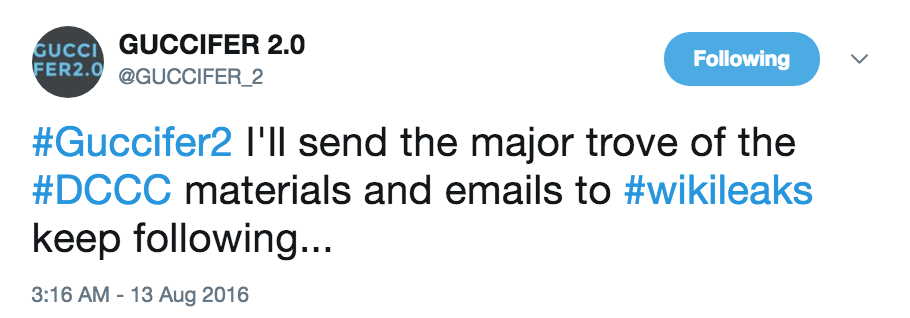
As Buzzfeed notes, at 10:16 PM ET that day, Guccifer 2.0 tweeted that he would give the documents to Wikileaks (though Buzzfeed incorrectly says Guccifer 2.0 said “it had handed those documents over” to Wikileaks; the tweet in fact describes doing so prospectively).

Buzzfeed emphasizes that this proves Wikileaks knew that it obtained documents from Guccifer 2.0, and not Seth Rich (though this is one reason why Buzzfeed’s conflation of the email sets is problematic, as the Rich conspiracy pertains necessarily to the DNC documents, not the DCCC ones). Showing Wikileaks in direct coordination with Guccifer 2.0 is important.

Equally important, however, is that Wikileaks never released the DCCC documents. Having laid out reasons why it, rather than Best, should release them (because they could make them searchable, because other media outlets would take a stupid initial angle, because other outlets would emphasize the Russian source), Wikileaks then sat on them, if indeed they ever obtained them.

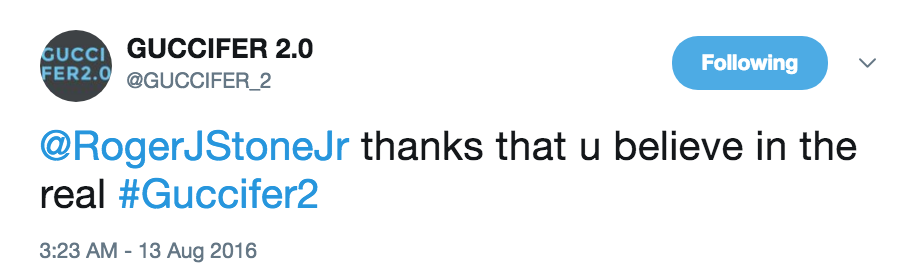
Meanwhile, five minutes after saying he’d dump the DCCC documents to Wikileaks, at 10:23 PM, Guccifer 2.0 sent the first tweet in what would become an exchange via DMs with Roger Stone.

Among the things Guccifer 2.0 did in that exchange was twice try to get Stone interested in the DCCC documents he was posting (though Stone did not respond).

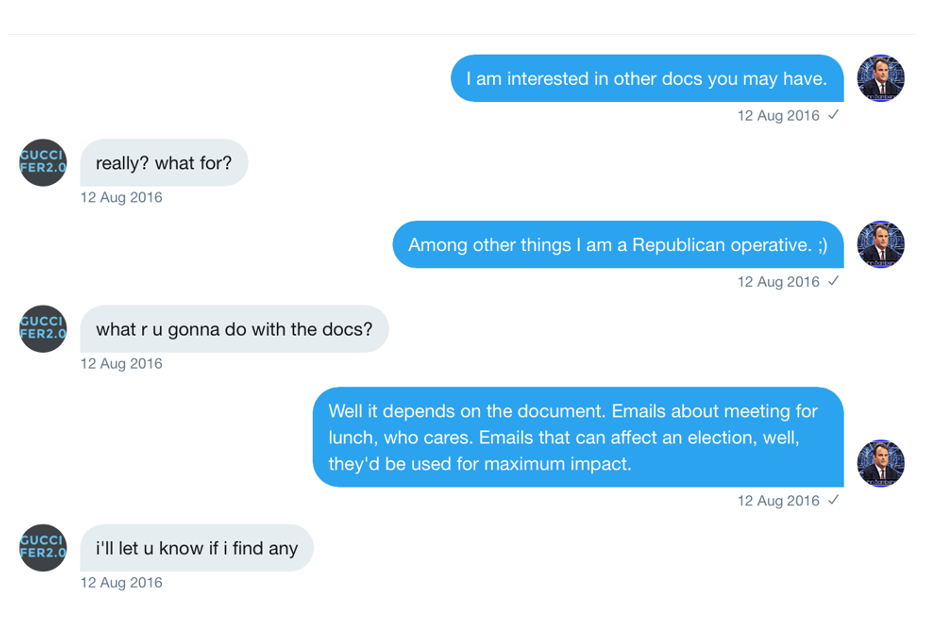
Similarly, also on August 12, Guccifer 2.0 started discussing sharing the emails with a Republican operative named James Bambanek who says, in a recently published report that probably misunderstands one goal of Guccifer 2.0’s actions, he was conducting infosec research.

Elsewhere, Bambanek says he turned over every message immediately to the FBI, but as he notes, they would have been monitoring all this in any case.

Every [direct message] I sent, every [one] I received was turned over to the FBI immediately. I assumed they would have been monitoring the account to begin with,” Bambenek said.

Publicly, we know that Guccifer was also sharing the DCCC documents with other Republican operatives around the country. While some of these documents were unexciting, others provided the Democrats’ oppo research for congressional races. Florida was one of the states where the documents might be said to have helped Republicans (which is not coincidentally where Mueller’s focus on the Internet Research Agency seems to be).

What seems to have happened, then, is that by getting Best to agree not to publish the emails, Guccifer 2.0 then offered them up to a series of Republicans who would (whatever value the actual documents did or didn’t have) then be implicated in obtaining campaign documents from a presumed Russian source.

Contrary to what Wikileaks said, there’d be no way Republican operatives would let actually useful documents go unused, regardless of how much work they had to do to search for them. But by convincing Best not to publish them in bulk (and by not publishing them themselves!), Wikileaks created the opportunity for Guccifer 2.0 to implicate at least a handful of Republican operatives around the country.

Yes, in Bambanek’s case that happened with the knowledge of the FBI. But how many other Republicans didn’t think to admit to the FBI what they were doing?

Update: When the New Yorker story came out last August, Best said she did not know what she was being offered. I’m assuming they were the DCCC docs from the context, timing, and related actions with state based Republicans, but that may not be the case.

Share this entry

The Embarrass Mitch McConnell Provision of the Intel Authorization

I’ve got a piece coming out on all the Russian-related provisions in the Intelligence Authorization bill for next year, which are for the most part really laudable policy proposals. But I wanted to look more closely at this one.

SEC. 606. REPORT ON CYBER ATTACKS BY FOREIGN GOVERNMENTS AGAINST UNITED STATES ELECTION INFRASTRUCTURE.
(a) Report Required.—Not later than 60 days after the date of the enactment of this Act, the Under Secretary of Homeland Security for Intelligence and Analysis shall submit to congressional leadership and the congressional intelligence committees a report on cyber attacks and attempted cyber attacks by foreign governments on United States election infrastructure in States and localities in connection with the 2016 presidential election in the United States and such cyber attacks or attempted cyber attacks as the Under Secretary anticipates against such infrastructure. Such report shall identify the States and localities affected and shall include cyber attacks and attempted cyber attacks against voter registration databases, voting machines, voting-related computer networks, and the networks of secretaries of State and other election officials.

(b) Form.—The report submitted under subsection (a) shall be submitted in unclassified form, but may include a classified annex.

(c) Definitions.—In this section:

(1) CONGRESSIONAL LEADERSHIP.—The term “congressional leadership” includes the following:

(A) The majority leader of the Senate.

(B) The minority leader of the Senate.

(C) The Speaker of the House of Representatives.

(D) The minority leader of the House of Representatives.

(2) STATE.—The term “State” means any State of the United States, the District of Columbia, the Commonwealth of Puerto Rico, and any territory or possession of the United States.

It requires the Department of Homeland Security to submit an unclassified report on all the hacking attempts on election infrastructure last year. It will involve declassifying information that Reality Winner is facing prison time for liberating, which seems like a concession that such information has public value. 

But I’m particularly interested in the emphasis on the distribution of this report: both to the intelligence committees and to Congressional leadership, spelled out by job title. Mitch McConnell, Chuck Schumer, Paul Ryan, and Nancy Pelosi.

That’s interesting because — as part of their investigation into last year’s hack — the Senate Intelligence Committee has already been briefed on this information. Indeed, the day after that testimony, Bloomberg reported — relying on three sources briefed on the investigation — that the hacks were much more severe than publicly known.

Russia’s cyberattack on the U.S. electoral system before Donald Trump’s election was far more widespread than has been publicly revealed, including incursions into voter databases and software systems in almost twice as many states as previously reported.

In Illinois, investigators found evidence that cyber intruders tried to delete or alter voter data. The hackers accessed software designed to be used by poll workers on Election Day, and in at least one state accessed a campaign finance database. Details of the wave of attacks, in the summer and fall of 2016, were provided by three people with direct knowledge of the U.S. investigation into the matter. In all, the Russian hackers hit systems in a total of 39 states, one of them said.

So ultimately, if this bill becomes law, it will require an unclassified report on stuff SSCI has been getting briefing on to be submitted to both SSCI and Congressional leadership.

The move comes in the wake of complaints from Democrats that Mitch McConnell refused to back a stronger statement about such attempted attacks in fall 2016. Now, I think some of the complaints about McConnell’s inaction last year are overblown, a demand that McConnell get ahead of where the Intelligence Community was willing to go publicly. And I think they largely obscure the more pressing question of what Trump advisors Devin Nunes and Richard Burr did. 

But I am cognizant of the fact that in a matter of months, we may get a better sense of the kinds of threats to our voting system that McConnell fought against publicizing.

Share this entry

McCain’s Brain Versus American Lives and Healthcare

There is no joy here in the Mudville that is Arizona. John McCain may have been somebody that natives like me disfavored from the start because of his hubristic usurpation of a true legend and son of Arizona, John Rhodes, but no one here wanted this.

Not now. Not ever.

So the “press” such as they may be, can run all their blathering hagiographies. Go run with that. It’s what you do, isn’t it?

But, for now, thankfully, McCain is alive and well. I am thankful for that.

And, I hope, at this critical juncture in life, John McCain finds it within himself to realize that the healthcare that has kept him alive, and diagnosed his problems, should NOT be limited to Congresspeople and those that married into money. We all deserve the benefit of what McCain has realized.

John McCain has an opportunity to stand up now for those that have none of his storied display of heroism, nor the benefit of his position. His story, because Mr. McCain was born into military care and then segued into other money and entitlement that does not transfer to most of us. For the common citizens he has always talked about, yet curiously abandoned, when it counted in close measures on the Senate floor, where has John McCain been? Absent, that is where.

The man who lived under the press moniker “Maverick” can ride into the famous sunset of his adopted state by helping real people instead of going out with the McConnell Republicans determined to screw the populous. Who will John McCain be?

Who will John McCain be? The elusive and etherial “Maverick” he has always painted himself as being? Or the reliable vote for craven Republican policies that devastate real citizens? Arizona, indeed America itself, deserves the McCain always portrayed and lionized in his numerous campaigns. Not the guy who always defaulted to the GOP sick and craven core.

Will John McCain have the guts and glory he is famous for, and go out fighting for the common American and their human rights to healthcare and financial and educational stability? The exact things McCain has fatuously blabbered about and never really supported in Congress? Or will he do better?

Who are you truly John McCain? A dying country, in the age of Trump, wants to know.

You have a chance to now be the man you always painted yourself to be. For the sake of this country, please be that man.

Share this entry

Penetrated: Today’s Senate Intelligence Committee Hearing on Russian Interference in the 2016 U.S. Elections

If you didn’t catch the Senate Intelligence Committee hearing on Russian influence on 2016 U.S. election on live stream, you should try to catch a replay online. I missed the first panel but caught the second when University of Michigan Prof. J. Alex Halderman began his testimony with his opening statement.

The same Halderman who questioned the 2016 election could have been hacked based on his expertise.

The same Halderman who hacked a voting machine to play Pac Man.

When asked if it was possible Russia could change votes, Halderman told the SIC that he and a team of students demonstrated they were able to hack DC’s voting system, change votes, and do so undetected in under 48 hours. Conveniently, Fox News interviewed Halderman last September; Halderman explained the DC hack demonstration at that time (see embedded video); the interview fit well with Trump’s months-long narrative that the election was ‘rigged’.

If you aren’t at least mildly panicked after watching the second panel’s testimony and reading Halderman’s statement, you’re asleep or dead, or you just plain don’t care about the U.S.’ democratic system.

Contrast and compare this Senate hearing to the House Intelligence Committee’s hearing with former DHS Secretary Jeh Johnson as a witness. Johnson sent out numerous messages last year expressing his concerns about election integrity, but after listening to the second Senate panel, Johnson should have been hair-on-fire (it’s figure of speech, go with it). But the Obama administration erred out of some twisted sense of heightened sensibility about appropriateness (which would have been better suited to its policies on drone use and domestic surveillance). The excess of caution feels more like foot dragging when viewed through the lens of time and Johnson’s testimony.

Early in the hearing, Johnson as well as DHS witnesses Jeanette Manfra and Samuel Liles said there was no evidence votes were changed. It’s important to note, though, that Johnson later clarifies in a round about way there was no way to be certain of hacking at that time (about 1:36:00-1:41:00 in hearing). I find it incredibly annoying Johnson didn’t simply defer to information security experts about the possibility there may never be evidence even if there were hacks; it’s simply not within in his skill set or experience then or now to say with absolute certainty based on forensic audit there was no evidence of votes changed. Gathering that evidence never happened because federal and state laws do not provide adequately for standardized full forensic audits before, during, or after an election.

Halderman’s SIC testimony today, in contrast, makes it clear our election system was highly vulnerable in many different ways last November.

Based on the additional testimony of a representative of National Association of State Election Directors, the President-Elect of National Association of Secretaries of State (NASS) & Secretary of State, Executive Director of Illinois State Board of Elections Illinois — whose combined testimony revealed lapses in communication between federal, state, and local government combined with gaps in information security education — the election system remains as vulnerable today as it was last autumn.

Nothing in either of these two hearings changed the fact we’ve been penetrated somewhere between 21 and 39 times. Was it good for you?

Share this entry