Where We Go from Here

At the beginning of 2026, I did a post piggybacking on what had succeed against Trump last year, laying out ways to use Trump’s own conspiracism and grievance against him. That post linked an assessment of our success in five ways fighting fascism, and also explained why I think we need to fight Trump using his own tools against him.

This page repeats the same categories from that post, and fleshes out developments that accord with my original framework.

Treat Epstein as the base layer

Remember that Marc Caputo column — it was published on December 23 — stating that the Epstein releases could last a whole ‘nother week? On the day that would mark that week, December 30, Devlin Barrett published a story saying that, “The document review” of what is now believed to be 5.2 million documents “is expected to take until at least Jan. 20, according to a person familiar with the matter.” Even if they could finish it by January 20 (they won’t), that’ll just be the first go-around. DOJ has not done what they need to do to document the redactions, so there’ll be demands from Congress for them to do that (with obvious areas — including DOJ names and some deliberative documents specifically included in the law, where they’re in violation), they’ll need to repeat the entire process over again, Congress will begin to bring more legal pressure, and all the while survivors will be pointing out things they missed.

A week, Marc Caputo reported, as if that were credible!

This will go on for some time. This will go on for a very long time.

Still, while the Epstein scandal has been absolutely instrumental in loosing Trump’s grip on things, people are naive in thinking that will be enough. “My friends will get hurt,” Trump predicted, but what does it really mean for Trump’s power that Les Wexner has been implicated in the Epstein scandal as a co-conspirator? What is the use of creating right wing cognitive dissonance about Les Wexner, when Wexner is not the oligarch currently helping Trump destroy the country?

In my opinion, the Epstein scandal is a tool. It undercuts Trump’s ability to grab and redirect attention. It can create moments of cognitive dissonance, as it did for MTG. It is a way to turn Trump’s conspiracism and populism against him and may make other related narrative lines more salient. And if there’s a surprise disclosure — perhaps about Melania’s origin story — all the better. But as you keep the focus on Epstein, remember that there needs to be a direction beyond Epstein as well, a direction which incorporates the oligarchs who are still key players in Trump’s network of power.

Focus on the Broligarchs and AI

The Broligarchs who’ve been a key part of Trump’s power are one way to do that (and that’s before we’ve really gotten into Steve Bannon and Peter Thiel’s ties to Epstein).

Tesla Takedown was one of the most successful campaigns of 2025. At a time when Tesla faced cheaper competitors worldwide, the protests incurred a cost on Musk for his DOGE depredations.

Elon was installed in the White House in significant part by fellow South African “alien invader” David Sacks, who is even more conspiratorial and even more pro-Russian than Musk. Sacks was installed in the White House as a Special Government Employee (who, Elizabeth Warren suggests, has overstayed his welcome) to force a bunch of policy decisions that suck for America but ensure that Broligarchs won’t pay any consequences for their rash business deals. When one or both of crypto and AI crash (this is a really good story on how and why AI will burst), he’ll be there to ensure the government bails them out, as he did after playing a role in the failure of Silicon Valley Bank.

And even as Trump sheds support based on his mockery of affordability, even as MTG split with Trump over that and his support for crypto, Sacks is trying to brand Democrats as being more populist than even Zohran Mamdani is.
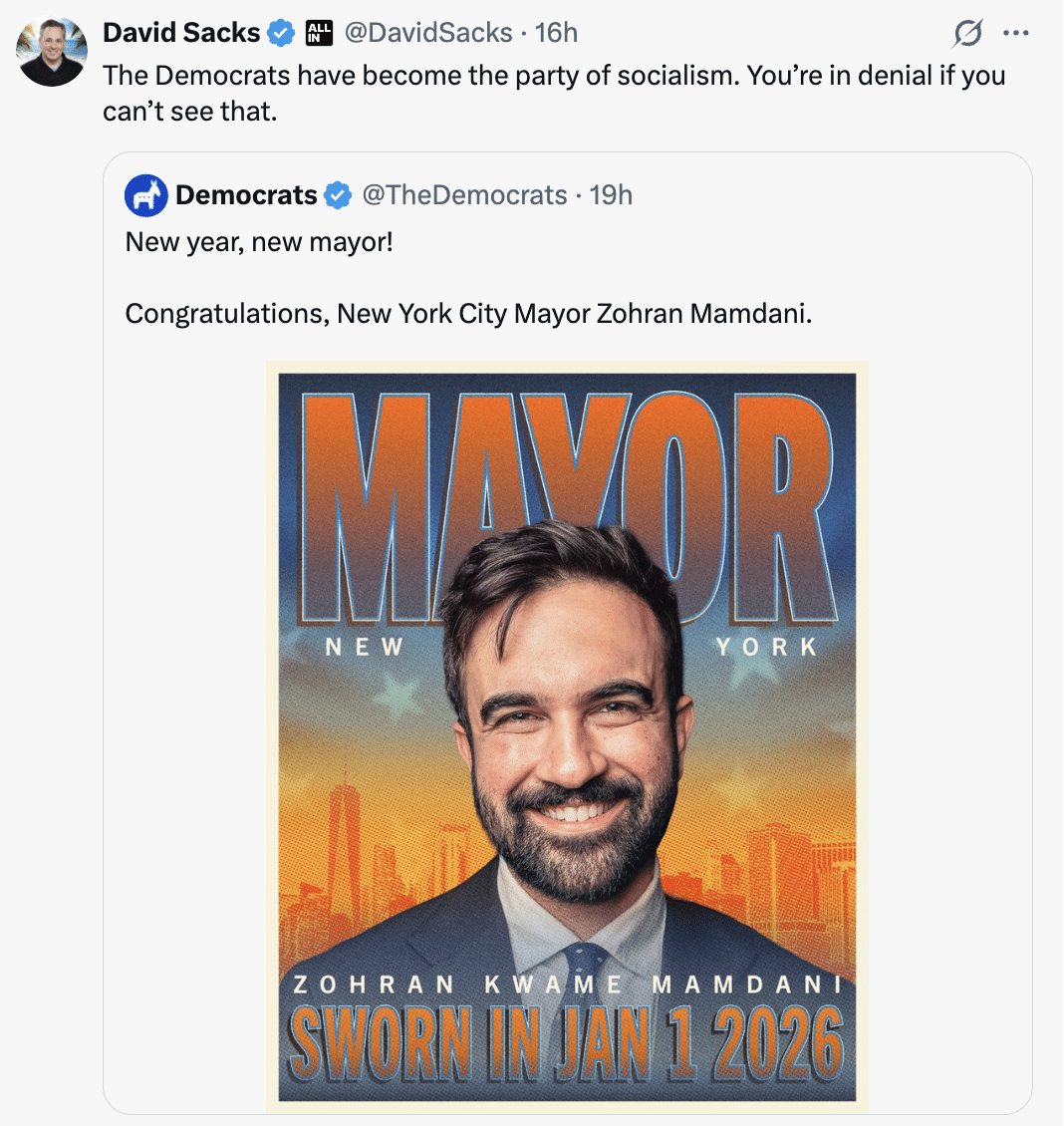
Fine. You want Democrats to be the party attending to the needs of working people? You’ve just made the GOP the party of “alien invader” billionaires who got tax cuts as millions lost their health care.

This happened even as AI has become a political liability. It has happened as local groups successfully stave off new data centers. It has happened as more instances of AI-inflamed suicide, murder, and pornincluding porn exploiting children — appear. And it happens before the aforementioned crash.

Sacks and the other Broligarchs are going to do something for which they’ll try to dodge accountability. Now is the time to make sure his name comes up as people look for culprits.

January 12, 2026: Trump seeks to quell data center rebellion (WaPo)

January 12, 2026: America’s Biggest Power Grid Operator Has an AI Problem—Too Many Data Centers (WaPo)

Emphasize Trump’s loser stench

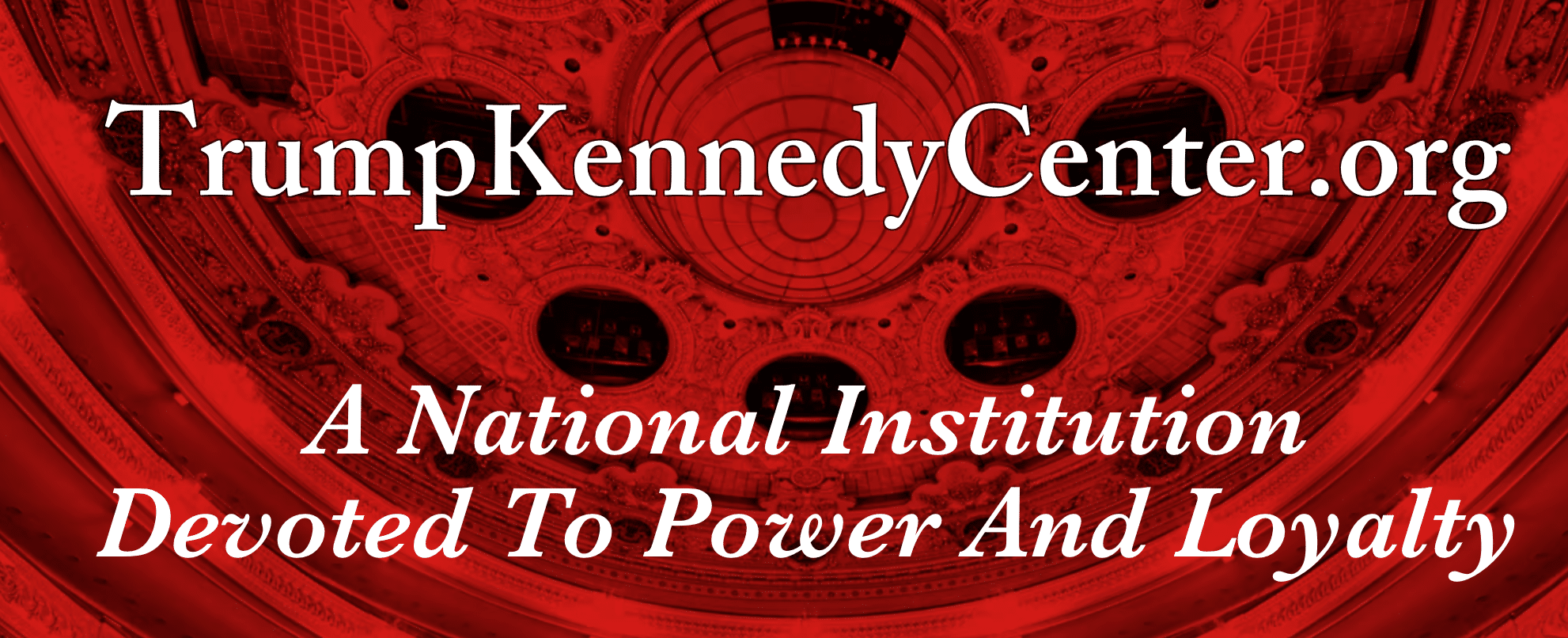
Another thing that will lead people to defect is to realize that Trump is a loser. He has done things — like the takeover of the Kennedy Center — that makes it easy to demonstrate he’s a loser in tangible fashion. Better still, every time Trump attaches his name to something, it provides an opportunity to hijack that brand, as comedian Toby Morton auspiciously managed to do by anticipating Trump’s most venal instincts and buying the domain.
The same is true of his businesses. Trump and his entire family is getting rich off the presidency 2.0. But his businesses are built as cons, sometimes Ponzi schemes. The idea is to leverage the loyalty of MAGAts to get them to invest in something, run up its value, only to collapse, leaving the most vulnerable screwed. In the past, at least, the cult effect was such that even MAGAts bilked by Trump associates, as with Steve Bannon’s Build the Wall graft, were reluctant to turn on the fraudsters; that may change. But at the very least, the volatile nature of Trump’s frauds makes it easy to show that as a businessman, he’s a loser.

Visualize Trump’s corruption

While there has been good reporting on Trump’s corruption — see, for example, NYT’s nifty visualization from New Year’s Eve — there has not been a systematic effort to take on his corruption.
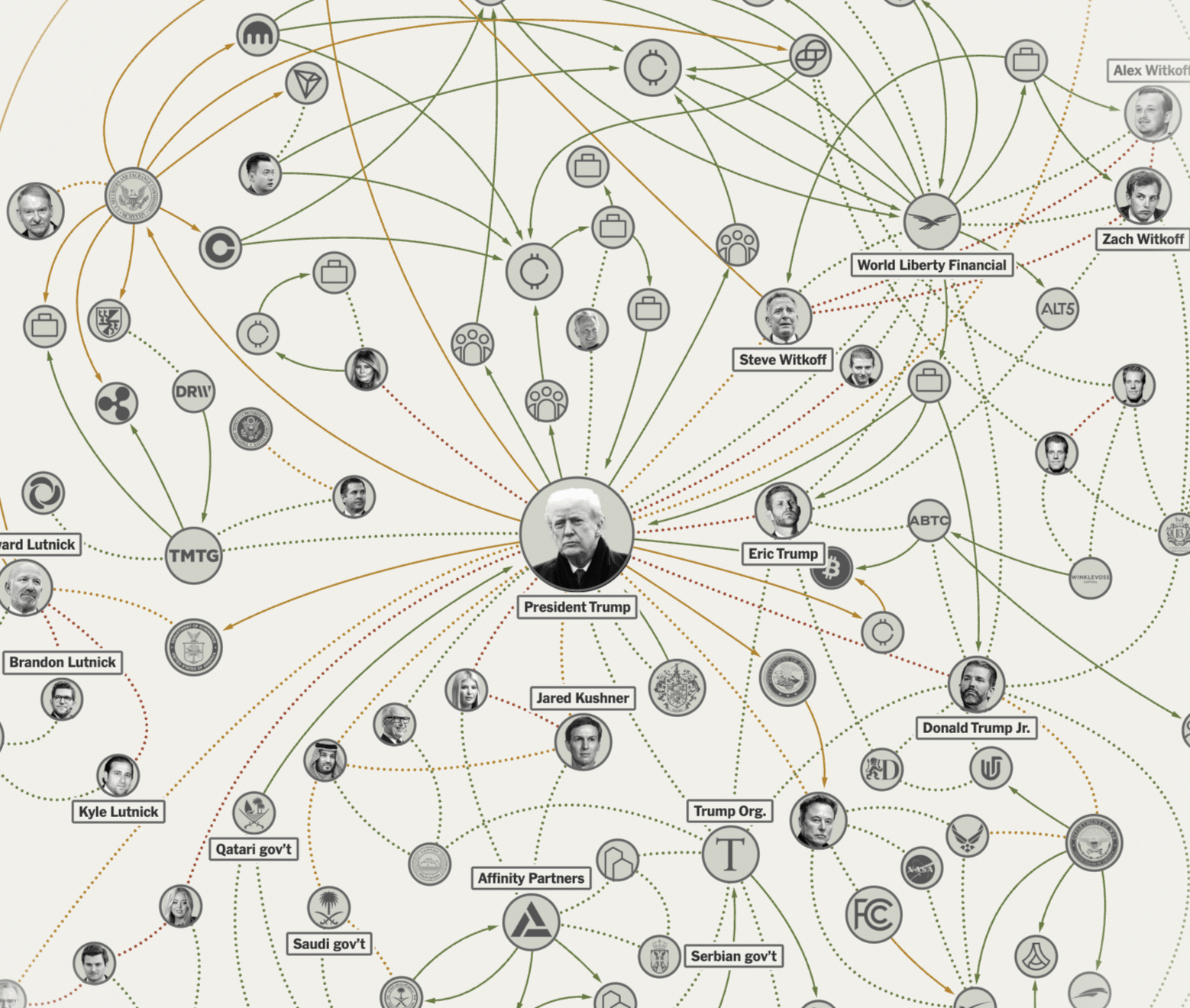
Nevertheless, possibly because of the Epstein scandal, a majority of the country does think Trump is corrupt.

That may actually not be in a bad place to be as we move into 2026. That’s because Democrats can make Republican inaction in the face of Trump’s corruption a campaign issue (and then, if it leads to a Democratic sweep in midterms, the electoral buy-in will be in place to do a lot of oversight and defunding of Trump’s corruption).

Trump’s pardons are similar. There’s actually a solid stream of reporting on how corrupt they are, without yet any political direction to it. Democrats running against Republican incumbents — especially in the Senate — should state as presumed that it is the job of Senators to respond to the kind of naked corruption Trump is engaged in.

Where activists can magnify the good reporting on both Trump’s corruption and his pardons is to focus on the victims. This is actually showing up in the reporting on both topics. WaPo focused on the victims of Trevor Milton who might have gotten restitution had Trump not pardoned him. LAT similarly focused on the victims fucked over by Trump’s pardon of David Gentile.

Rosenberg, a retired wholesale produce distributor living in Nevada, has supported Trump since he entered politics, but the president’s decision in November to commute the sentence of former private equity executive David Gentile has left him angry and confused.

“I just feel I’ve been betrayed,” Rosenberg, 68, said. “I don’t know why he would do this, unless there was some sort of gain somewhere, or some favor being called in. I am very disappointed. I kind of put him above this kind of thing.”

Trump’s decision to release Gentile from prison less than two weeks into his seven-year sentence has drawn scrutiny from securities attorneys and a U.S. senator — all of whom say the White House’s explanation for the act of clemency is not adding up. It’s also drawn the ire of his victims.

“I think it is disgusting,” said CarolAnn Tutera, 70, who invested more than $400,000 with Gentile’s company, GPB Capital. Gentile, she added, “basically pulled a Bernie Madoff and swindled people out of their money, and then he gets to go home to his wife and kids.”

This superb Bloomberg story on the extent to which the Juan Orlando Hernández pardon unraveled years of work starts with a murder arranged by the network.

Five minutes later, González was circling a roundabout when a gray van braked in front of him. At the same time, a green SUV crowded his rear bumper. A motorcycle carrying two men emerged on his left. A man on the back of the bike fired six shots through the driver-side window. González’s head slumped toward his shoulder, and he tilted forward, held upright by the seatbelt. He died instantly.

More than a dozen men streamed out of the two vehicles that had sandwiched his Nissan. They scrambled to collect the spent shell casings on the ground, then scattered other casings across the pavement—decoys to complicate ballistics tracing. They jumped back into their vehicles, circled the roundabout and took the same road Julián had just driven down.

When they approached the Slaughterhouse, the gates opened to let them in, then closed behind them.

Every one of these pardons has a victim — and that’s before you get into the people newly victimized by people who’ve been pardoned by Trump, which NYT covered in November and others are tracking as well.

A New Jersey fraudster who was pardoned by President Trump in 2021 was sentenced to 37 years in prison this month for running a $44 million Ponzi scheme, one of a growing number of people granted clemency by Mr. Trump only to be charged with new crimes.

The man, Eliyahu Weinstein, was pardoned by Mr. Trump in 2021 and was re-indicted by the U.S. attorney’s office in New Jersey three years later. He was accused of swindling investors who thought their money was being used to buy surgical masks, baby formula and first-aid kits bound for Ukraine, and a jury convicted him in April of several crimes, including conspiracy to commit securities and wire fraud.

[snip]
Some of those pardoned for their role in the Jan. 6, 2021, riot at the U.S. Capitol have quickly drawn new attention from law enforcement. The group Citizens for Responsibility and Ethics in Washington said in June that at least 10 of the more than 1,500 who were pardoned had been rearrested and charged, and the number has only grown since then.

Earlier this month, a man who was pardoned after having participated in the Jan. 6 attack was charged with sex crimes against two children. Another man whose original sentence Mr. Trump commuted in 2021 was recently sentenced to 27 months in prison after convictions on physical and sexual assault, among other crimes.

These stories provide an important way to explain the costs of Trump’s corruption.

Brand Trump as the criminal he is

And while we’re talking about telling these stories: We must never ever cede the ground of crime to Stephen Miller’s attempt to brand immigrants as criminals.

Trump — a felon who freed hundreds of cop assailants on his first day on the job — has an entire infrastructure devoted to trying to spin brown people as criminal. Every time that infrastructure goes into action, including with the effort to brand Somalis in Minnesota as inherently fraudulent when Trump himself is a serial fraudster, we need to repeat, relentlessly, that Trump is a serial criminal who coddles other criminals.

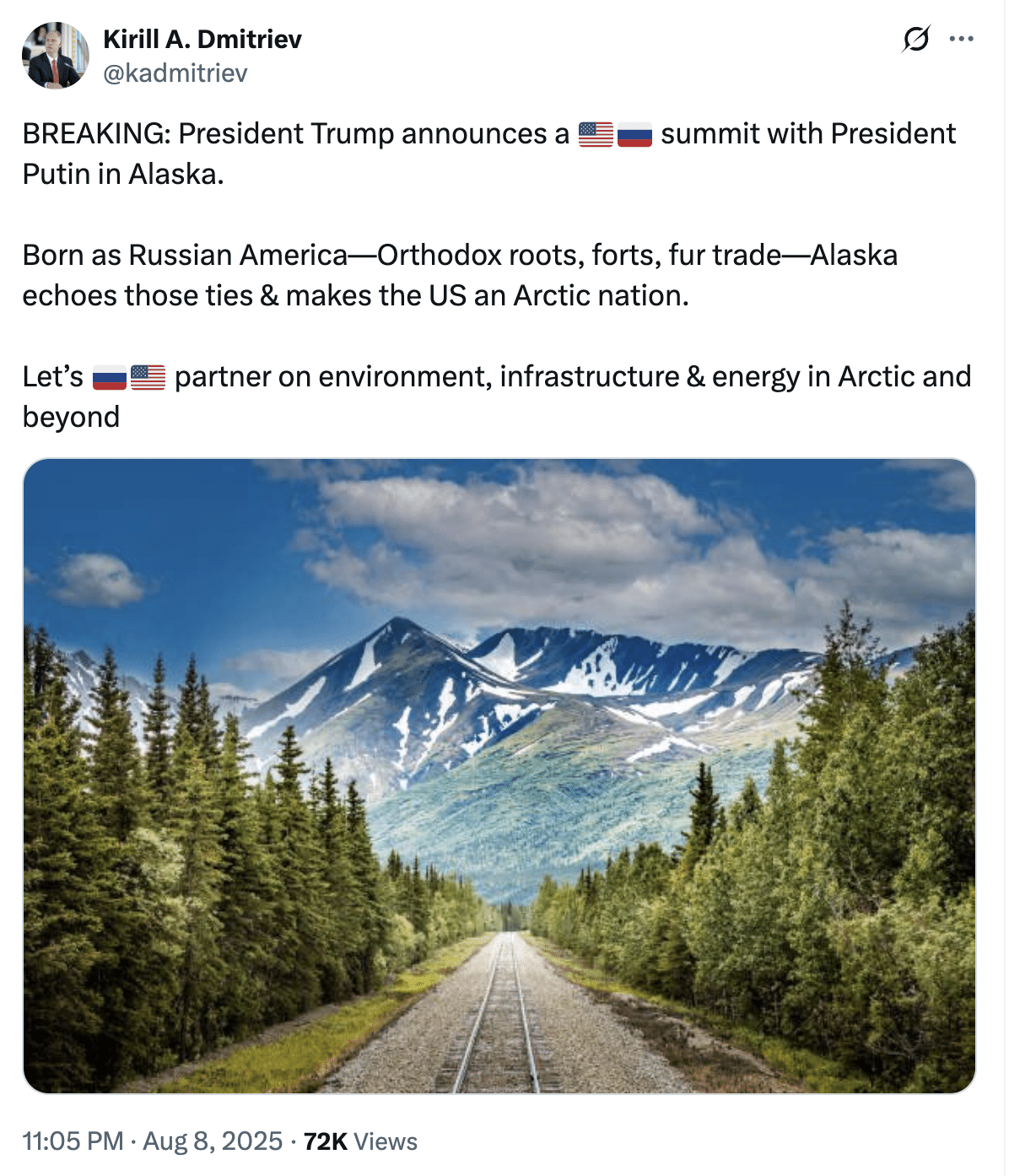
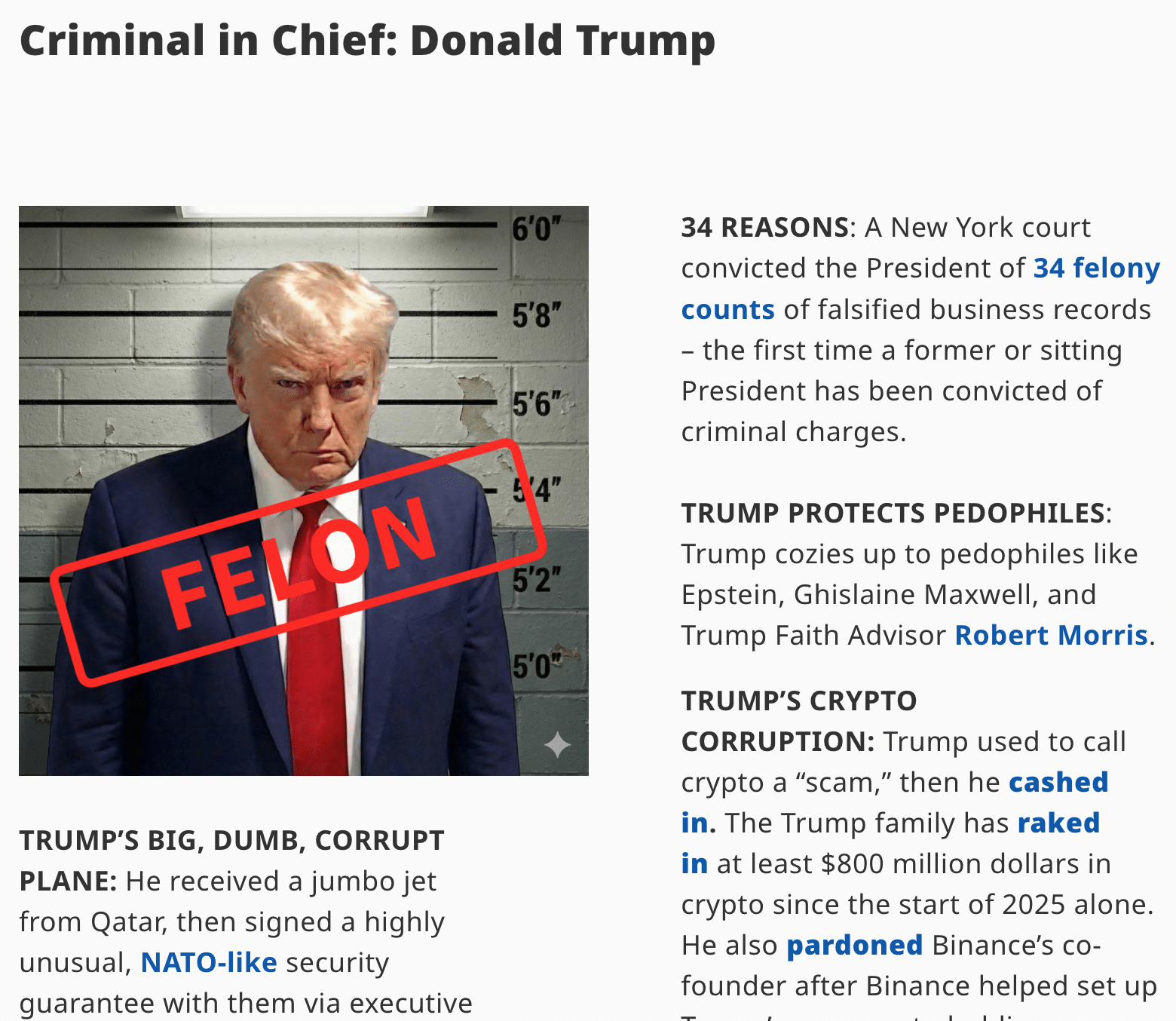
This is something Gavin Newsom just started doing, with an entire website devoted to cataloging Trump’s crime and that of his pardon recipients.

Do not let a conversation about crime go by without focusing on how much of it Trump does.

Crime, in Trump’s era, is a rich white man’s thing. And while it will take a lot of work to adjust a lot of racist priors, until people start seeing Trump as a criminal it will be far too easy for them to make excuses for him.

Hold Stephen Miller accountable for his failures

I focused on Stephen Miller — and the import of making his failures clear — last week.

The import of shifting how we speak of Miller’s considerable power is clear. That’s true because he frankly has done huge damage, even to Trump’s goals, and well more so to average Americans. He’s someone that people, including Republicans, can scapegoat for Trump’s failures (and they’ll be right). And if we don’t make sure that happens, then he’ll scapegoat brown people.

Again, are Somali day care workers or billionaires systematically defrauding average people the problem? One easy to way to drown out Miller’s case that it’s the former is to make it clear how much he personally has harmed average Americans.

Visualize how Stephen Miller took money for cancer research and veterans care to pay for a goon army snatching grandmothers

On January 12, AOC explained this shift better than anyone has.

Relatedly, particularly as the huge injection of funding Republicans approved last year starts landing at DHS, it will become increasingly necessary to tie the goon squads in the streets to the loss of benefits elsewhere.

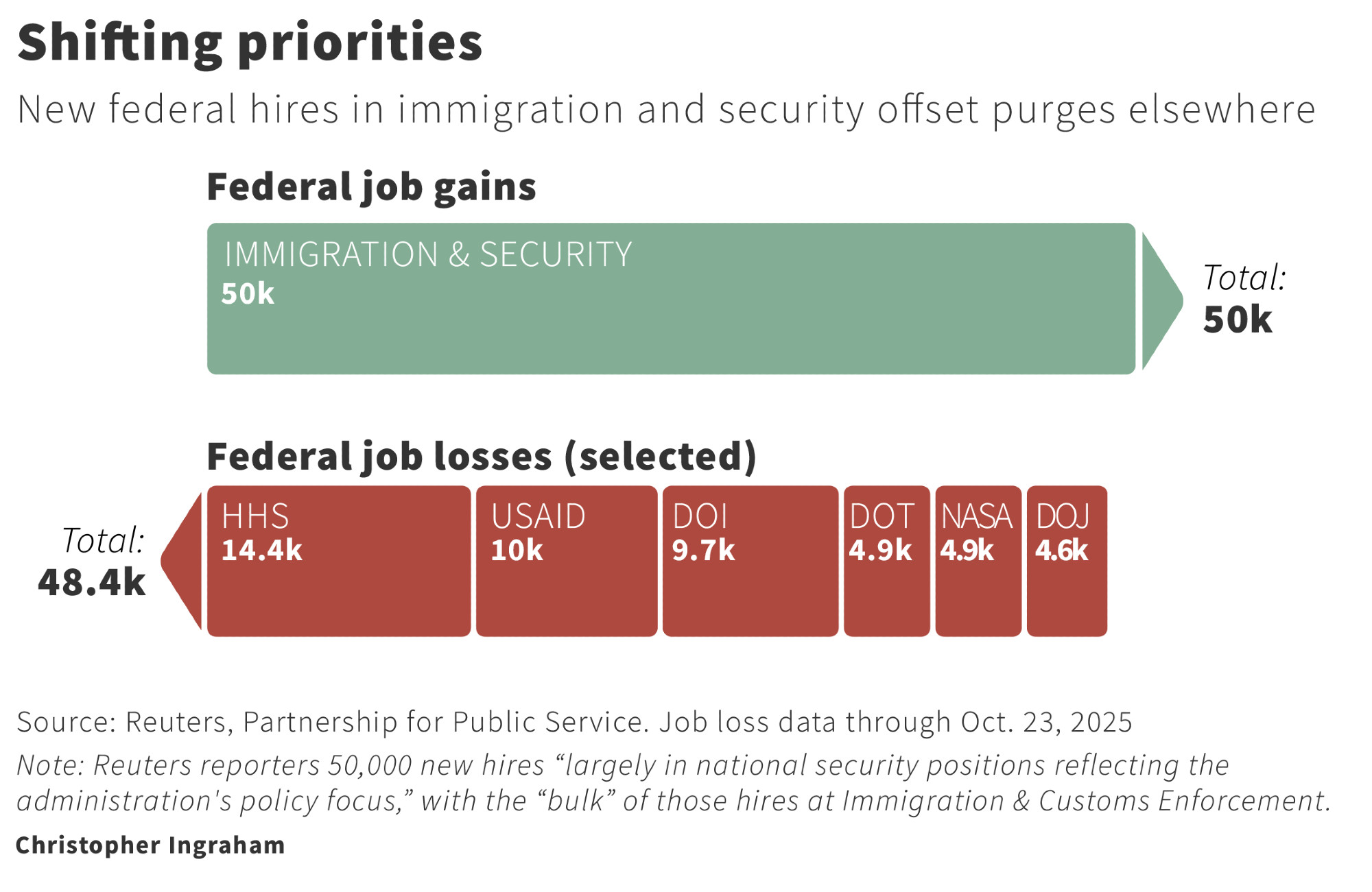
We need to make it clear that this is a direct trade. 50,000 ICE goons in, 300,000 other government employees out, including people who cure cancer, help learning disabled kids get through school, protect our National Parks, ensure your Social Security comes on time, and care for veterans.

Christopher Ingraham did a handy graphic to show the trade-off.
Stephen Miller’s dragnet is unpopular in the abstract and wildly unpopular in the lived sense, even — if meekly — among local Republican leaders.

But it still retains support of a big chunk of the population, probably because Trump officials routinely blame their own failures to address American problems on migrants, when as often as not, Trump’s response to immigration is the source of the problem.

America can’t have nice things, like cures for cancer and welcoming public schools, because Republicans in Congress took the money used to pay for those things and gave it to Stephen Miller to use to invade America’s neighborhoods.

Discredit Key Spokespeople

Right wingers like Jonah Goldberg and David French have expressed alarm by an old promo for a 60 Minutes piece (the piece itself was from October) that an influencer reposted yesterday, describing dozens of times when the government lied in court filings.
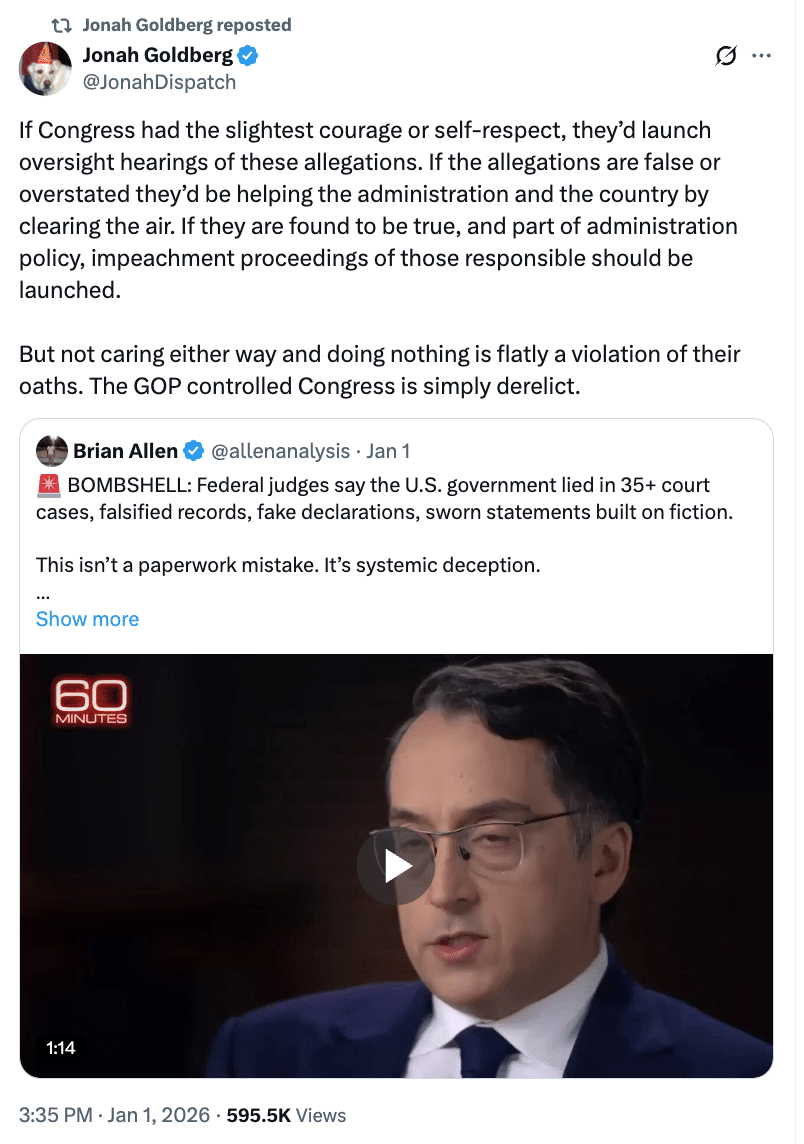
Judges have caught Trump’s DOJ in several major lies since then. In Chicago, Judge Sara Ellis wrote a 233-page opinion documenting the many lies DHS has told about their Chicago invasion.

And in December, judges in both Kilmar Abrego’s case caught the government obfuscating. In the criminal case, on December 30, Judge Waverly Crenshaw unsealed a December 3 opinion describing how Nashville’s US Attorney lied about how centrally involved Todd Blanche’s office was in demanding Abrego face trial.

The central question after Abrego established a prima facie case of vindictiveness is what information in the government’s control sheds light on its new decision to prosecute Abrego, after removing him from the United States without criminal charges. These documents show that McGuire did not act alone and to the extent McGuire had input on the decision to prosecute, he shared it with Singh and others. (Doc. No. 178-1). Specifically, the government’s documents may contradict its prior representations that the decision to prosecute was made locally and that there were no outside influences. For example, Singh contacted McGuire on April 27, 2025, to discuss Abrego’s case. (See Doc. No. 229 at Abrego-Garcia000001). On April 30, 2025, Singh asked McGuire what the potential charges against Abrego would be, whether the charging document would reference Abrego’s alleged MS-13 affiliation, and asked for a phone call before any charges were filed. (Id. at Abrego-Garcia000007–000008). In a separate email on April 30, 2025, Singh made clear that Abrego’s criminal prosecution was a “top priority” for the Deputy Attorney General’s office (Blanche). (Id. at Abrego-Garcia000037). He then told McGuire to “sketch out a draft complaint for the 1324 charge [making it unlawful to bring in and harbor certain aliens].” (Id.). On May 15th, McGuire emailed his staff that “DAG (Blanche) and PDAG would like Garcia charged sooner rather than later.” (Id. at Abrego-Garcia000060).

And as I’ve already noted, Judge Paula Xinis cataloged the many deliberately ignorant declarations DOJ filed about whether DHS had deportation plans for Abrego when she ruled that he must be released.

Respondents showcased Cantú’s ignorance about the content of his Declaration pertaining to Costa Rica. As the pointed questions of Respondents’ counsel made clear, Cantú’s lack of knowledge was planned and purposeful.

Counsel: So paragraph 4, final sentence [of the Cantú Declaration], do you see where it says the word—the words “certain understandings”?

Cantú: I found it. Yes, I do. I see it.

Counsel: What are the certain understandings referenced in the last sentence?

Cantú: I don’t know . . .

Counsel: What are the “contingencies” referenced in the last sentence?

Cantú: I do not know . . .

Counsel: What are the “interim developments” referenced in paragraph 5?

Cantú: I don’t know.

ECF No. 107 at 26:8–27:12 (counsel for Respondents, Jonathan Guynn (“Guynn”), questioning Cantú). See also id. at 53:8–9 (Guynn, at sidebar with Court, stating “I’ll just say I told you this was exactly what was going to happen,” regarding the witness’ ignorance on Costa Rica as a viable country of removal).

Ultimately, Respondents’ calculated effort to take Costa Rica “off the table” backfired. Within 24 hours, Costa Rica, through Minister Zamora Cordero, communicated to multiple news sources that its offer to grant Abrego Garcia residence and refugee status is, and always has been, firm, unwavering, and unconditional.

It’s a problem that, after huge scoldings like these, right wing critics of Trump don’t understand how much Trump’s people lie — not least because the Supreme Court still credits the most outlandish claims Trump makes, even after they’ve been thoroughly debunked by lower court judges.

Many of these lies are coming from the same people: Stephen Miller, Todd Blanche’s office, DHS spox Tricia McLaughlin, and Greg Bovino.

It is remarkable that so many of these people have been caught lying to courts (or publicly, about people before courts). But it needs to become common knowledge for everyone, so every time Tricia says something, they start from the assumption she’s lying, because she almost always is.

There comes a time when the credibility of systematic liars not named Trump collapse entirely such that every utterance they make discredits the claims they try to sell. Tricia McLaughlin, at least, is close those levels of propaganda, and Stephen Miller is not far behind.

Use Trump’s claimed opposition to antisemitism against him

Within days of his inauguration last year, Trump signed an EO — adding to one he signed in 2019 — claiming to oppose antisemitism. There has been some discussion about the bad faith of this EO and a DOJ lawyer implementing it, Michael Velchik, once wrote a paper from Hitler’s perspective. While it is explicitly targeted at universities (and has been a key tool to attempt to takeover universities), it nevertheless claimed to oppose antisemitism everywhere.

It shall be the policy of the United States to combat anti-Semitism vigorously, using all available and appropriate legal tools, to prosecute, remove, or otherwise hold to account the perpetrators of unlawful anti-Semitic harassment and violence.

This is the kind of statement of principle that can form the basis of political pressure — particularly as the MAGAt movement splinters around the overt antisemitism of people like Nick Fuentes and Candace Owen, and as political opportunists like Ted Cruz attempt to exploit that splinter.

We’re going to have to fight this battle in any case. As part of the revocation of everything Eric Adams did after he was indicted for bribery yesterday, Zohran Mamdani revoked an EO that gave Israel preferential treatment, which Israel is using to stoke division; yet Mamdani preserved the office Adams opened to combat antisemitism.

We need to call out the dripping antisemitism of Trump’s team, from top (at least JD Vance, who refuses to disavow Fuentes) to bottom.

There are two key Trump aides who should be targeted. Most notably, Paul Ingrassia, who had to withdraw his nomination to be Special Counsel after Politico exposed texts in which he confessed to a Nazi streak been installed at GSA instead. In addition, Kingsley Wilson became DOD spokesperson in spite of Neo-Nazi comments. NPR has done good work unpacking these ties.

Reclaim disinformation research

Republicans plan on exporting fascism via US tech platforms.

That’s not new. I’ve been talking about Elon’s plans to use Xitter as a machine for fascism for some time.

But since then, Trump’s minions worked it into the National Security Strategy.

And, in the wake of the EU’s sanctions against Elon Musk for — basically — lying about why I have a blue check, Marco Rubio stripped the visas of five people, including US Green Card holder Imran Ahmed, a long time adversary of Elon’s.

But there are several developments that suggest it is time to renew efforts to defend disinformation research, not least the White House’s absurd effort to attack real journalism, what is sure to be a snowballing failure on Bari Weiss’ part to make propaganda popular, and the meltdown the head of DOJ’s Civil Rights division, Harmeet Dhillon, had over the holidays about right wing “misinformation” targeting Pam Bondi.
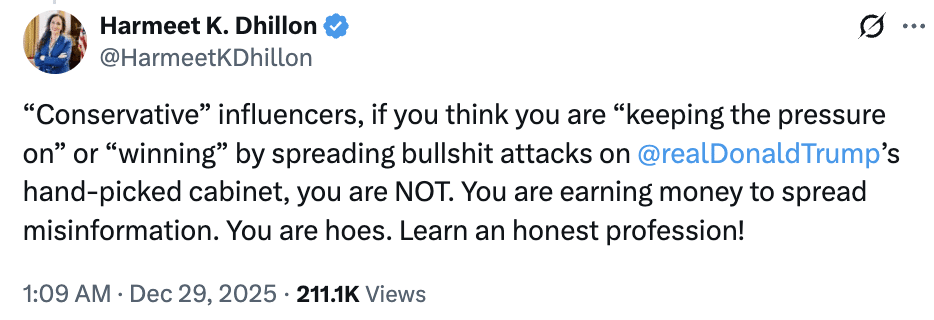
The right wingers are doing what they themselves established is unlawful. And that presents both political and legal opportunities to demonize their propaganda.

Which in turn cycles back to the increasing problem of AI propaganda, including Grok’s flagrant willingness to nudify children in recent days.

Some people write short resolutions. I guess I write 4,000-word To Do lists. Join me in my efforts!
Share this entry

On Same Day Robert McBride’s Firing Is Reported, Stan Woodward “Errs” His Grievances

A slew of outlets — starting with MS and including NYT but not including ABC, which usually gets the details right — have reported the firing of Robert McBride because, the MS headline claims, he “declined to pursue James Comey case.” All suggested that, even with the appeal of Lindsey Halligan’s firing before the Fourth Circuit (the Fourth just granted DOJ’s request to stall two weeks and keep the two appeals consolidated), McBride’s sins involved recharging the case in EDVA, even though DOJ abandoned its attempts to reindict Letitia James (on the mortgage fraud; now they’re pursuing hairdresser fraud) before it appealed.

No one mentioned news of the firing happened on the day the SDFL grand jury convenes, or the Comey-related role McBride has been willingly playing, as the single non-defense lawyer litigating Dan Richman’s efforts to get his files returned.

Associate Attorney General Stanley Woodward’s latest prank — an “erring” of grievances — may explain McBride’s firing.

When last we checked in on the Richman litigation before Christmas, after spending some time making sure that someone had ethical skin in her courtroom, Colleen Kollar-Kotelly attempted to juggle the genuinely complex issues before her, granting one after another notice of defiances masquerading as emergency motions for delay for the government, before — seemingly — issuing a final order on December 23, requiring the government to turn over all materials it had, but allowing it to delete the single no-longer classified file they used to obtain the materials back in 2017.

For the foregoing reasons, the Court shall GRANT IN PART the Government’s [22], [33] Emergency Motions to Clarify and Modify the Court’s Order and AMEND its [20] Order dated December 12, 2025, to make explicit that the Government may delete the purportedly classified document identified in 2017 from any material that it returns to Petitioner Richman. Because the Government has not shown that it has a lawful right to retain and use any of the materials at issue, the Court shall not otherwise alter its Order to relieve the Government from its obligation to return those materials to Petitioner Richman.

The next day, in a filing signed by Todd Blanche, Lindsey Halligan, and McBride, DOJ asked for an emergency extension. Again. Because of the holiday, they couldn’t technically remove that single classified file they supposedly removed back in 2017.

7. However, because of significant operational constraints caused by the imminent Christmas and New Year’s holidays (i.e., the lack of sufficient, technically qualified Government personnel in the Washington, DC area for the remainder of this week and the next), which make the current compliance deadline fall a mere one business day after the Court’s revised clarifying order, the Government anticipates that it will not be able to review all electronic storage devices containing classified information, delete that information, and return those devices to Richman’s counsel by December 29, 2025.

But on Christmas Eve, they were going to delete that file.

Days later Kollar-Kotelly granted that extension while reiterating that they only thing they were allowed to do was to delete that file.

Then Stan Woodward, the guy who defended all the people covering up Trump’s crimes across two criminal investigations, got involved. Without filing a notice of appearance — so Stan has no ethical skin in this game — On January 2, he effectively indicated that DOJ was going to defy Kollar-Kotelly’s order, because deleting that single classified file would destroy the forensic copy of this.

In the days since the Court last extended the foregoing deadline, the undersigned counsel has endeavored to negotiate in good faith with counsel for Petitioner-Movant the particulars of the parties’ understanding of what compliance with the Court’s Orders requires. For example, classified information cannot be deleted from the government’s forensic copy of electronic media without the destruction of the entire media. Thus, although the Court’s Orders, “permit the Government to permanently delete a single classified document from the material seized from Petitioner Richman’s personal computer hard drive . . . from any of these materials before returning them to Petitioner Richman,” ECF No. 41 at 2, such limited deletion of classified information from a forensic image is not technologically feasible.

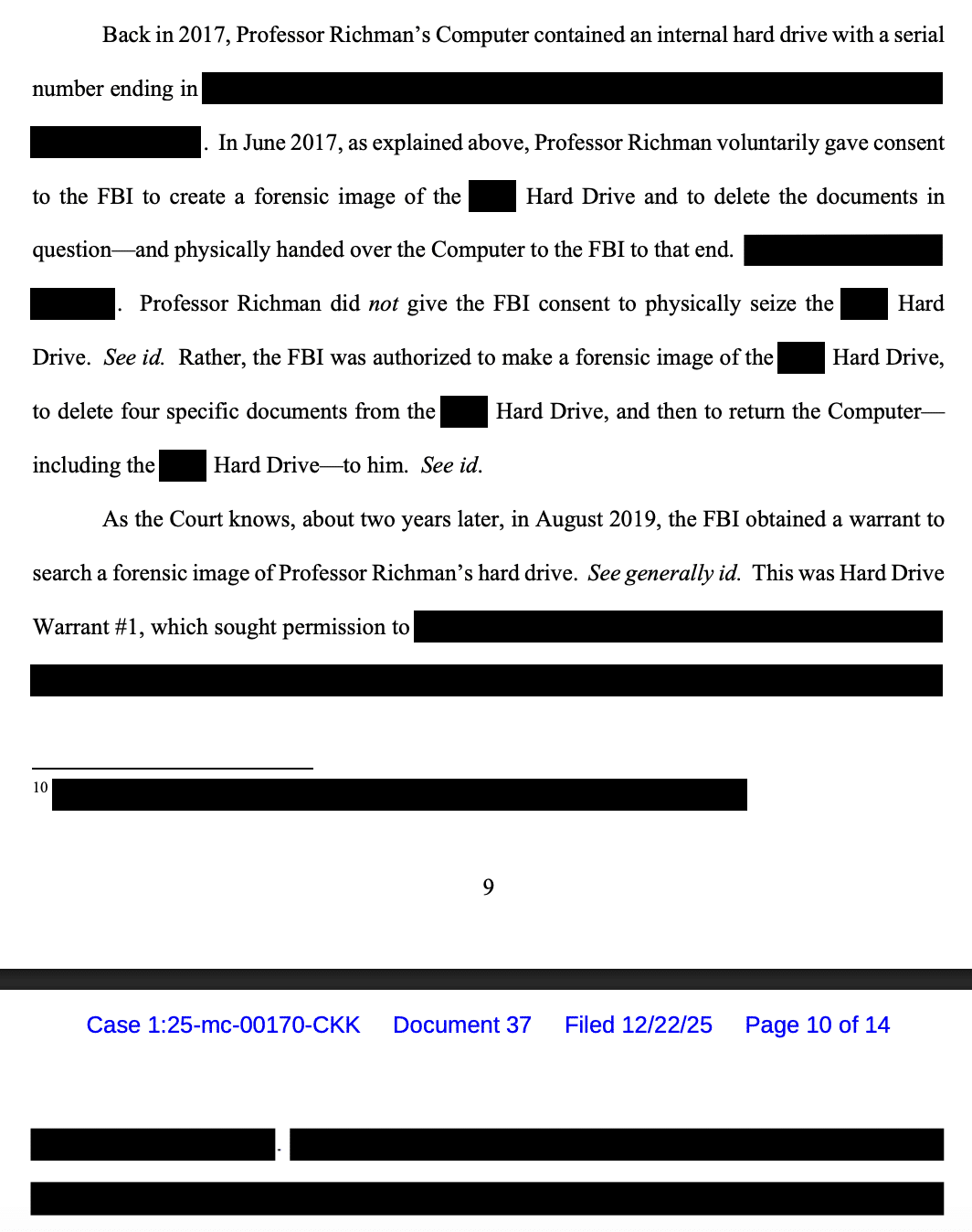
Now, this may be bullshit. Richman’s lawyers, at least, understand that DOJ still retains the actual hard drive, not a forensic copy. The reasons why they believe that are mostly redacted, but it appears the serial number on the subsequent search warrants matches the serial number of Richman’s original hard drive, meaning they kept the original and gave him a different hard drive.

Nicholas Lewin at least believes DOJ gave Richman a different hard drive back in 2017, effectively stealing his actual hard drive in defiance of the consent he gave.

If so, it’s not a forensic image.

And, anyway, someone should have started asking — I know I did — why the Associate Attorney General and the President’s third defense attorney involved in just this matter got involved in a seemingly minor issue that seemed to be settled at all.

Nevertheless, for reasons (probably professional comity) that I cannot fathom, Richman’s lawyers agreed to discuss how DOJ could get out of complying with Kollar-Kotelly’s order, so long as DOJ promised it wouldn’t do anything with his stuff. Kollar-Kotelly granted that extension too.

At that point, it was clear to me at least, DOJ had succeeded in dicking Kollar-Kotelly around long enough to facilitate a different grand jury — the one in SDFL and possibly convened before Aileen Cannon — to issue a warrant and therefore create competing orders from two District Courts.

Then, last night at 7:50PM, and so well after McBride was fired, Stan Woodward asked for another extension. With a flourish, the guy who badly struggled with basic technical issues during the stolen documents case elaborated on his blather about forensic copies (again, if it’s true that DOJ kept Richman’s original hard drive, then this is all bullshit).

The Parties dispute what the Court has authorized the United States to delete. However, when a device contains classified information the only way to properly remove that information is to destroy the device and all the information on that device. Put differently, the United States cannot delete just the documents containing classified material from the device. Further complicating matters is the fact that regardless of the presence of classified information, a single file cannot be deleted from a forensic copy of a device. Either the entire forensic copy is deleted or none of it is. Nevertheless, Petitioner-Movant has requested the United States not destroy any devices containing classified material absent further Order of the Court. The United States will honor this request and hopes the Parties can propose language for the Court’s consideration promptly.

But the bulk of Woodward’s filing consisted of, as he described it, “erring” his grievance that — around the time McBride may have disappeared –Richman’s lawyers did not immediately respond to Woodward’s attempts to keep a full set of Richman’s data on January 10.

To that end, the United States provided counsel for Petitioner-Movant a draft joint consent motion proposing modification to the Courts Orders on December 31, 2025, following a call to outline the contours of the same with Petitioner-Movant’s counsel the previous day. On January 5, 2025, Petitioner-Movant’s counsel wrote to question whether an agreement between the Parties was conceivable. The United States requested a call with counsel for Petitioner-Movant the next day, January 6, 2026, but counsel for Petitioner-Movant advised they were unavailable before January 8 for such a call. Given the desire for the United States to promptly resolve this matter, the United States implored counsel for Petitioner-Movant to provide a redline to the proposed consent motion, which counsel for Petitioner-Movant did after business hours on January 8. The United States provided further edits to the joint motion the next morning, on January 9. Since that time – and at the time of this filing – the United States has not received feedback on that draft despite representations that such feedback would be forthcoming on January 10.

Despite the undersigned representing to Petitioner-Movant’s counsel multiple times a desire to resolve this matter promptly, no agreement has been reached. The undersigned does not err this grievance lightly, but does so only out of respect for the Court’s deadline and out of regret for not seeking an extension earlier. [my emphasis]

It’s Richman’s fault, Woodward suggests by claiming grievance, not his own.

I have no idea whether Kollar-Kotelly saw the news that the only line prosecutor who filed a notice of appearance before her got fired in the middle of all this, but she seemed unimpressed that Woodward was erring grievances about delay when he filed his motion for an extension well after hours the day of his deadline.

The Court is in receipt of the Government’s Unopposed 45 Motion for Extension of Time. Given the late hour of this filing, which the Court received at 7:50 p.m. this evening, and with the understanding that the Government has complied with the Court’s 20 Order (as clarified and amended) in all respects except for the narrow unresolved issues identified in the 45 Motion, it is ORDERED that the deadline for the Attorney General or her designee to certify compliance with the Court’s Order is STAYED through January 13, 2026. The Court otherwise DEFERS RULING on the Government’s 45 Motion for Extension of Time. The Court shall resolve the 45 Motion by further order in due course.

She’s going to deal with it today.

But by firing McBride (who would have had cause to talk with EDVA judges about the supposedly intact copy DOJ stored in their SCIF, another of the crimes for which he was fired), there’s no longer anyone with real ethical skin in the game before Kollar-Kotelly, just Donald Trump’s defense attorneys, all of whom have chummy ties with Aileen Cannon.

Effectively, the promises not to access Dan Richman’s stuff have become virtually unenforceable.

Update: I missed that Stan Woodward did file a notice of appearance on January 2. It remains true that Trump’s defense attorneys likely aren’t that worried about bar complaints.

Update: Kollar-Kotelly has given DOJ a week from today.

MINUTE ORDER: Upon further consideration of the Government’s 45 Motion for Extension of Time, it is ORDERED that the Government’s 45 Motion is GRANTED to the following extent: It is ORDERED that the deadline for the Attorney General or her designee to certify to this Court, with specificity, that the Government has complied with this Court’s 20 Order dated December 12, 2025, as clarified and modified by any subsequent Order of this Court, including the provisions regarding both the return of certain materials to Petitioner Richman and the deposit of certain materials in the U.S. District Court for the Eastern District of Virginia, is EXTENDED to 5:00 p.m. ET on January 20, 2026.It is further ORDERED that the parties shall file a joint status report, no later than 9:00 a.m. ET on January 16, 2026, advising the Court of (1) the progress of the Government’s efforts to comply with the Court’s 20 Order, and (2) whether Petitioner Richman possesses a copy of any files or other materials that the Government proposes to delete or destroy on the basis that they are stored on a device or in an image that contains classified information.As previously ordered, the Government and its agents shall not access Petitioner Richman’s covered materials, except for the limited purpose of deleting the purportedly classified memorandum already identified in the record, or share, disseminate, disclose, or transfer those materials to any person, without first seeking and obtaining leave of this Court. Signed by Judge Colleen Kollar-Kotelly on 01/13/2026.

Share this entry

Annals of Sanewashing: NYT Labels Trump’s Confession of Psychological Unfitness as Leadership

Remember the term “sanewashing,” which Parker Malloy used to describe how the press minimizes Trump’s ramblings to describe them as something reasonable to people who don’t see them personally?

Four years ago, in an article for Media Matters for America, I warned that journalists were sanitizing Donald Trump’s incoherent ramblings to make them more palatable for the average voter. The general practice went like this: The press would take something Trump said or did—for instance, using a visit to the Centers for Disease Control to ask about Fox News’s ratings, insult then–Washington Governor Jay Inslee, rant about his attempt to extort Ukraine into digging up dirt on Joe Biden, and downplay the rising number of Covid-19 cases in the U.S.—and write them up as The New York Times did: “Trump Says ‘People Have to Remain Calm’ Amid Coronavirus Outbreak.” This had the effect of making it seem like Trump’s words and actions seemed cogent and sensible for the vast majority of Americans who didn’t happen to watch his rant live.

[snip]

This “sanewashing” of Trump’s statements isn’t just poor journalism; it’s a form of misinformation that poses a threat to democracy. By continually reframing Trump’s incoherent and often dangerous rhetoric as conventional political discourse, major news outlets are failing in their duty to inform the public and are instead providing cover for increasingly erratic behavior from a former—and potentially future—president.

The consequences of this journalistic malpractice extend far beyond misleading headlines. By laundering Trump’s words in this fashion, the media is actively participating in the erosion of our shared reality.

These three paragraphs about why Donald Trump wants to take over Greenland when the US already has a base there, the rights to establish more bases, the ability to mine its minerals really exist in NYT’s third milking of their interview with Donald Trump:

“Ownership is very important,” Mr. Trump said as he discussed, with a real estate mogul’s eye, the landmass of Greenland — three times the size of Texas but with a population of less than 60,000. He seemed to dismiss the value of having Greenland under the control of a close NATO ally.

When asked why he needed to possess the territory, he said: “Because that’s what I feel is psychologically needed for success. I think that ownership gives you a thing that you can’t do, whether you’re talking about a lease or a treaty. Ownership gives you things and elements that you can’t get from just signing a document.”

The conversation made clear that in Mr. Trump’s view, sovereignty and national borders are less important than the singular role the United States plays as the protector of the West.

First of all, NYT interjected that “real estate mogul’s” comment; I assure you, Trump is not going to start building hotels in Greenland.

But more … uh … insane still, after Trump describes contemplating blowing up the alliance that has been the centerpiece of American national security since World War II out of a psychological need to own other people and other countries, nothing more, the NYT describes it to be a comment about Trump’s imagination that he is “the protector of the West.”

You’re both fucking insane! Donald Trump, for contemplating making the US and Europe less safe because of his own psychological inadequacies that drive him to covet big empty spaces on a map, and the NYT for describing it as the exact opposite of what it is, not Donald Trump needing to tend to Donald Trump’s increasing fragile psyche, but instead as something that protects the West rather than destroys the very concept of it.

This is how access journalism works. You give an outlet that spent the entirety of the Biden Administration bitching that they didn’t get any sitdown interviews with the President two hours to watch the President ramble incoherently, and in return for that access — the latest of a series of stories screaming, look at us!! Donald Trump takes our calls and tells us nothing!! — you describe the most dangerous kind of malignant Narcissism as the opposite of what it is.

Update: The exchange is far worse in the transcript.

David E. Sanger

Why is ownership important here?

President Trump

Because that’s what I feel is psychologically needed for success. I think that ownership gives you a thing that you can’t do, whether you’re talking about a lease or a treaty. Ownership gives you things and elements that you can’t get from just signing a document, that you can have a base.

David E. Sanger

So you’re going to ask them to buy it?

Katie Rogers

Psychologically important to you or to the United States?

President Trump

Psychologically important for me. Now, maybe another president would feel differently, but so far I’ve been right about everything.

Share this entry

The Bankrupt Premise of Trump’s Venezuela Colony

The headline and opening paragraphs of a 1,400-word story basically reporting that Trump had sat for the interview Joe Biden had denied the NYT (okay, they didn’t mention the latter bit) focus on Trump’s plan to run Venezuela’s oil industry indefinitely.

Trump Says U.S. Oversight of Venezuela Could Last for Years

President Trump said on Wednesday evening that he expected the United States would be running Venezuela and extracting oil from its huge reserves for years, and insisted that the interim government of the country — all former loyalists to the now-imprisoned Nicolás Maduro — is “giving us everything that we feel is necessary.”

“Only time will tell,” he said, when asked how long the administration will demand direct oversight of the South American nation, with the hovering threat of American military action from an armada just off shore.

“We will rebuild it in a very profitable way,” Mr. Trump said during a nearly two-hour interview. “We’re going to be using oil, and we’re going to be taking oil. We’re getting oil prices down, and we’re going to be giving money to Venezuela, which they desperately need.”

[snip]

During the wide-ranging interview with The New York Times, Mr. Trump did not give a precise time range for how long the United States would remain Venezuela’s political overlord. Would it be three months? Six months? A year? Longer?

“I would say much longer,” the president replied.

That he said that is surely news. And while I assume David Sanger will do a follow-up story that might explain this, NYT did not here.

The headline gives Trump something he badly needs — false assurances to oil companies that have been disabusing Trump of his insane notions that oil will pay for a Venezuela invasion that the US would stick around to make investments worthwhile.

But it doesn’t get into all the problems with Trump’s rapidly moving attempt to turn this into a win: even with that much longer security guarantee, it’s not at all clear this will work.

It started 10 days before the invasion, when Trump told oil companies they had to invest now to get reimbursed for nationalizations in the past.

Administration officials have told oil executives in recent weeks that if they want compensation for their rigs, pipelines and other seized property, then they must be prepared to go back into Venezuela now and invest heavily in reviving its shattered petroleum industry, two people familiar with the administration’s outreach told POLITICO on Saturday. The outlook for Venezuela’s shattered oil infrastructure is one of the major questions following the U.S. military action that captured leader Nicolás Maduro.

But people in the industry said the administration’s message has left them still leery about the difficulty of rebuilding decayed oil fields in a country where it’s not even clear who will lead the country for the foreseeable future.

“They’re saying, ‘you gotta go in if you want to play and get reimbursed,’” said one industry official familiar with the conversations.

The offer has been on the table for the last 10 days, the person said. “But the infrastructure currently there is so dilapidated that no one at these companies can adequately assess what is needed to make it operable.”

Apparently, Trump didn’t heed these warnings, and in the aftermath of the invasion he has made grandiose promises that oil would pay for the invasion.

To be fair, his first announcement — that “the Interim Authorities in Venezuela” had agreed to give the United States (or perhaps Trump personally)  between 30 and 50 MILLION Barrels of High Quality, Sanctioned Oil” which would “be sold at its Market Price, and that money will be controlled by me, as President of the United States of America, to ensure it is used to benefit the people of Venezuela and the United States!” may well be an effort to pay for the costs of the invasion.

It’s not at all clear a $2 billion payment would even do that.

DOD has been conducting periodic murderboat strikes every several days, each of which surely costs millions of dollars.

One hellfire missile, for example, typically costs about $150,000, and reaper drones cost around $3,500 per hour to fly. An F-35 costs around $40,000 per hour to fly. The cost per flight hour of an AC-130J gunship is not public but its predecessor, the AC-130U, which was phased out in 2019, cost over $40,000 per hour to fly.

The Gerald Ford has been in the Caribbean since November 16, which works out to be about $424 million (though there were already ships there). One of the $50 million Chinooks used in the attack was badly damaged. Similarly, the Delta Force lead was seriously injured, so taxpayers are paying his recovery and possibly his retirement. There were 150 aircraft used in the attack.

It was a tremendously successful attack.

It wasn’t cheap.

But within days of promising that oil would pay for his new colony, outlets started reporting that taxpayers might have to subsidize that effort.

Donald Trump has suggested US taxpayers could reimburse energy companies for repairing Venezuelan infrastructure for extracting and shipping oil.

Trump acknowledged that “a lot of money” would need to be spent to increase oil production in Venezuela after US forces ousted its leader, Nicolás Maduro, but suggested his government could pay oil companies to do the work.

“A tremendous amount of money will have to be spent and the oil companies will spend it, and then they’ll get reimbursed by us or through revenue,” the president said.

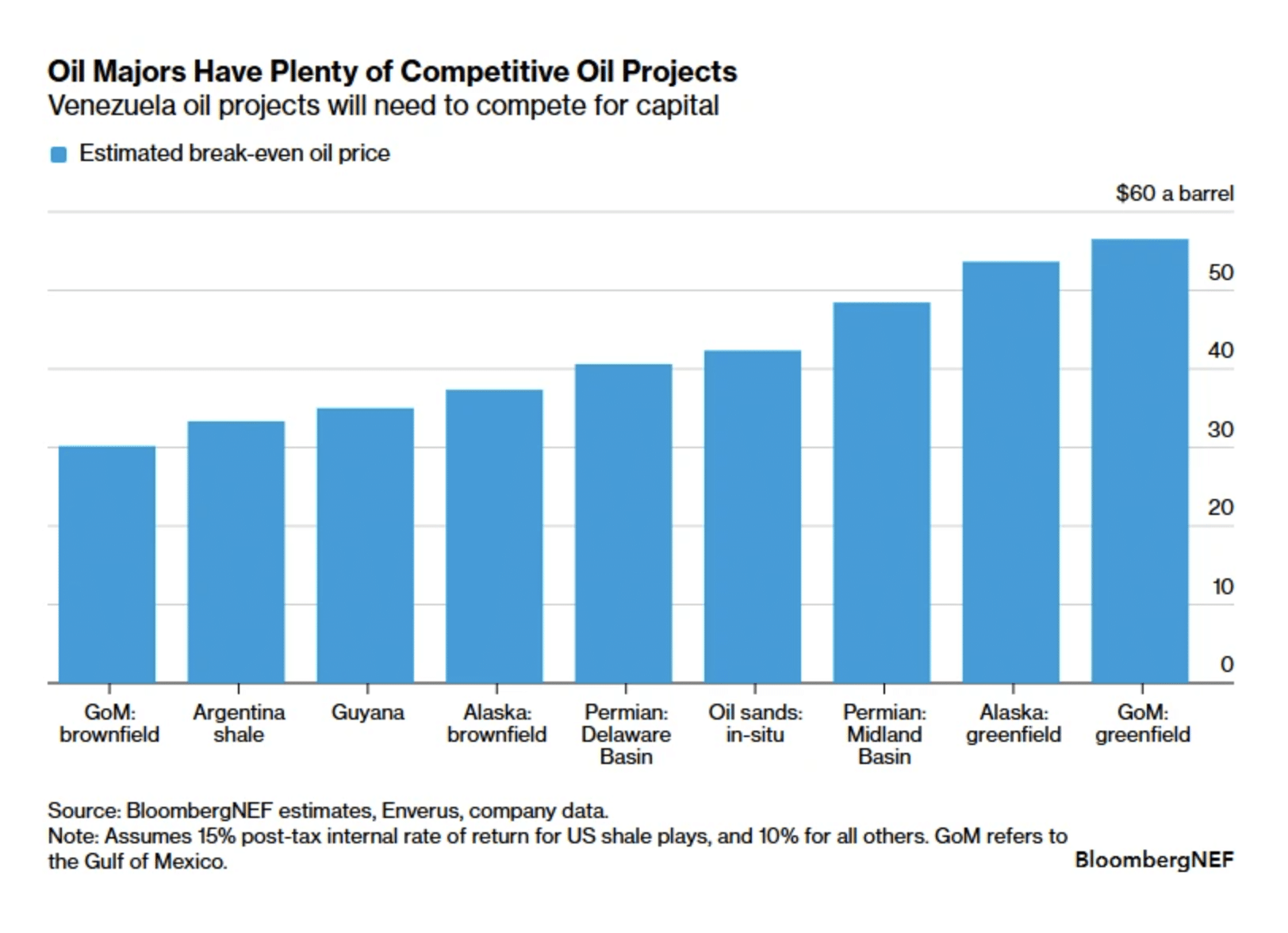
The reasons why are clear: even assuming Venezuela remains stable long enough to develop investments (the promise Trump is floating to the NYT), the cost of refining Venezuelan oil is just too high, particularly given current prices.

The energy-intensive upgrading process also increases the carbon footprint of these heavy grades, which could push up costs further if more governments start taxing emissions or raising existing levies.

Breakeven costs for key grades in the Orinoco belt already average more than $80 a barrel, according to estimates by consultancy Wood Mackenzie. That places Venezuelan oil at the higher end of the global cost scale for new production. By comparison, heavy oil produced in Canada has an average breakeven cost of around $55 a barrel.

Exxon’s breakeven target for its global oil production by 2030 is $30 a barrel, driven by low-cost fields in Guyana and the U.S. Permian shale basin. Chevron has a similar target, while Conoco has a long-term plan to generate free cash flow even if oil prices fall to $35 a barrel. Oil , currently trades at around $60.

While energy boards have increasingly supported greater exploration in recent years, they are insisting that this be done with spending discipline in mind in the face of rising global supplies and uncertainty over the energy transition.

Here’s a table from Bloomberg that shows that Venezuela, even ignoring the potential instability, is just not a competitive investment.

The rest of the article explains what better alternatives the majors are investing in.

Trump seems not to understand this math (or he’s engaged in another con job), because he keeps bragging about the price of oil coming down which … yeah, that’s the point. That’s precisely why imagining you’re going to have willful takers for your offer to invest in expensive-to-refine Venezuelan oil at today’s prices is a pipe dream.

Thus the bribes … er, subsidies, that American taxpayers will end up paying. On top of any deployment, taxpayers will bribe oil companies.

So it doesn’t make sense for the oil companies.

But it also doesn’t make sense for Venezuelans, because the first thing Trump’s backers will demand is that Venezuela pay off years of debt.

Analysts estimate Venezuela now owes $150-$170 billion and JP Morgan calculates that $102 billion of that is in the form of bonds, while bilateral debt to China totals $13-$15 billion.
Venezuela has not reported debt figures for around a decade and state oil company Petroleos de Venezuela (PDVSA) has in the meantime struck complex oil-backed debt deals with China.

Despite Washington’s ousting of Maduro, the main hurdles to a debt restructuring remain in place.

U.S. sanctions — including against Venezuela’s interim President Delcy Rodriguez – mean that even sitting down for creditor talks could breach U.S. Treasury Department curbs.

[snip]

“The U.S. administration has an interest in moving the restructuring forward, because without that restructuring, these oil companies will not be participating and will not be investing anything,” said Ed Al-Hussainy of Columbia Threadneedle Investments, which has Venezuelan bond exposure.

“The possibility of a U.S. government financial line of credit or a guarantee or a backstop of some sort is going to be music to the ears of investors,” the portfolio manager added.

Lee Robinson, founder of Altana Wealth which also holds Venezuelan bonds, said there was enough at stake for the U.S. itself to put a loan in place to kickstart Venezuela’s recovery.
JP Morgan said a recognition of Rodriguez’s new government by the Trump administration would open many questions.

“Should the Fund be bypassed in favour of a faster-track, oil-based bilateral program, we could be going down the road of a faster-track, less orthodox bond restructuring than what we have seen in the years since the pandemic and the advent of the Common Framework,” JP Morgan said.

Sounds like the taxpayers will be on the hook for the debt restructuring, just like the bailout to keep “libertarian” Javier Milei in office.

Moe Tkacik has written a bunch on the extraction involved here, as in this November story on Juan Guaidó’s role in it, during the last time Trump tried to milk Venezuela, making it easier for Paul Singer to acquire CITGO.

On January 23, 2019, when Guaidó proclaimed himself the “interim president” of an incredulous Venezuela, Secretary of State Mike Pompeo announced that the Trump administration would recognize Guaidó as the Bolivarian Republic’s genuine leader, and unveiled a suite of tough new sanctions on PDVSA, pitched as a bid to force Maduro to step down. The whole thing seemed like a joke, a throwback to the days when our foreign-policy establishment insisted a drug-trafficking warlord on an island of six million was the “real” leader of the world’s most populous country—though at least most Chinese knew who Chiang Kai-shek was when he fled to Taiwan in 1949 to preside over what the United Nations insisted on calling the “Republic of China.” Only the Miami Herald noted an unusual provision of the new arrangement, explained by then-Treasury Secretary Steve Mnuchin, who told the newspaper “that if Guaidó succeeds in forming a government, the money” from international sales of Venezuelan oil that he was freezing under the new sanctions regime “would go to him.” On Twitter, Guaidó promised this new arrangement would “prevent the looting from continuing.”

[snip]

Venezuela, PDVSA, and Citgo were legally separate entities. But in mid-February, Guaidó named entirely new slates of board members to PDVSA, its U.S. holding company, and Citgo, a move Rodríguez knew would strengthen Crystallex’s case. That same week, the glass manufacturer Owens-Illinois, which had been awarded a half-billion-dollar arbitration judgment over two Coke bottle factories Chávez had expropriated in 2010, sued Citgo on the basis that it was an “alter ego” of the state. Owens-Illinois had expert witness assistance from none other than José Ignacio Hernández, whom Guaidó had just named the attorney general of the shadow government.

That is, Trump proposes to fix the problem he, in significant part, caused in his first term.

Plus, until you fix Venezuela’s corruption problem — which Trump has pointedly declined to do in retaining Delcy Rodríguez, partly because he’s relying on Maduro’s suppression regime to offer stability to oil companies, partly because he affirmatively loves corruption — then the Venezuelan people aren’t going to see anything, even while Trump is attempting to oust China’s slightly more favorable float.

And all this is happening on a time frame — big investments and risks on the front end, very long timetable for returns to anyone — that I imagine China is taking some solace about being surprised, if it was surprised, by looking at how Trump’s obsession with becoming a petro-autocrat leaves it untouched to dominate renewables for the foreseeable future, renewables that will continue to put pressure on oil prices in a way that Trump seems not to understand.

And all that assumes Trump, or Dalcy Rodríguez, can ensure stability, something for which there’s no evidence. All that assumes that no one decides to make a target of the resources Trump has put in the middle of an increasingly volatile Caribbean.

Trump is literally making up Colonialism 2.0 on the fly. And the serially bankrupt businessman appears to be doing funny math at every turn.

So yeah, Trump is making expansive claims to the NYT. But they are part of an elaborate con job to prevent this Venezuela adventure from backfiring in a spectacular way.

Share this entry

How the Deep State Taught Stephen Miller to Love Socialism

Recent reporting suggests that the CIA — more than Trump’s other top intelligence advisors — continues to give the President unvarnished advice. And by yoking that advice to spectacular covert operative success (and probably a good deal of boasting to the press), the CIA seems to be building value with Trump and his stupider advisors (with the exception of the deliberately stupidest, Steve Witkoff).

Remain in Ukraine

Take Ukraine. A recent profile of how the US betrayed Ukraine describes the CIA has remained there fighting.

But there was a counternarrative, spooled out largely in secret. At its center was the C.I.A.

Where Mr. Hegseth had marginalized his Ukraine-supporting generals, the C.I.A. director, Mr. Ratcliffe, had consistently protected his own officers’ efforts for Ukraine. He kept the agency’s presence in the country at full strength; funding for its programs there even increased. When Mr. Trump ordered the March aid freeze, the U.S. military rushed to shut down all intelligence sharing. But when Mr. Ratcliffe explained the risk facing C.I.A. officers in Ukraine, the White House allowed the agency to keep sharing intelligence about Russian threats inside Ukraine.

CIA didn’t just remain in Ukraine collecting intelligence. They’ve played a role in Ukraine’s spectacular success in using drone attacks to degrade Russia’s security.

In June, beleaguered U.S. military officers met with their C.I.A. counterparts to help craft a more concerted Ukrainian campaign. It would focus exclusively on oil refineries and, instead of supply tanks, would target the refineries’ Achilles’ heel: A C.I.A. expert had identified a type of coupler that was so hard to replace or repair that a refinery would remain offline for weeks. (To avoid backlash, they would not supply weapons and other equipment that Mr. Vance’s allies wanted for other priorities.)

Russia no doubt understands the CIA remains intelligent (heh) and focused on its original adversary. When they recruited Witkoff to manage Trump’s capitulation, they specifically ordered him not to bring CIA.

Steve Witkoff, a billionaire real-estate developer and longtime golfing partner of Donald Trump, was just days into his job as the new president’s special envoy to the Middle East when he received a tantalizing message from the crown prince of Saudi Arabia.

Vladimir Putin was interested in meeting Witkoff—so interested that he might consider releasing an American prisoner to him. The invitation came from a Kremlin moneyman named Kirill Dmitriev, using the de facto Saudi ruler, Mohammed bin Salman, as an intermediary.

There was just one thing: Witkoff would be expected to come alone, without any CIA handlers, diplomats or even an interpreter, a person familiar with the outreach said.

And Witkoff, obedient to Putin’s demands, continues to refuse CIA briefings.

Witkoff has declined multiple offers from the CIA for a briefing on Russia.

[snip]

Ahead of his trip, the CIA offered to brief Witkoff; he declined. Nor was he accompanied by an interpreter: He had been told that Russia’s president wouldn’t allow him to bring another person into the meeting.

A White House official said he participated in multiple briefings before his first trip to Russia, including Trump’s intelligence briefing. The CIA regularly briefs him on other issues like Gaza—but not Russia.

Inform Trump that Ukraine did not strike Russia

The thing is, the ability to provide accurate intelligence and (I assume this was more important) really cool attacks that make the attacker look strong appears to be increasing the CIA’s value to Trump.

Not only did CIA conclude (unsurprisingly) that Putin was lying when he recently claimed that Ukraine had attempted to target his residence,

The CIA has assessed Ukraine was not targeting a residence used by Russian President Vladimir Putin in a recent drone attack in the north of his country, according to US officials, undercutting an assertion the Russian leader had made to President Donald Trump in a Monday phone call.

The CIA’s director John Ratcliffe briefed Trump on the assessment Wednesday, the officials said.

Russia had publicly raised allegations Ukraine attempted to hit Putin’s home Monday, and Trump told reporters Putin had told him of it over the phone. At the time, the president said he was troubled by the reported action, seeming to believe the Russian leader even as Ukraine strenuously denied it was behind any such attack.

“I don’t like it. It’s not good,” Trump said, describing himself as “very angry” upon hearing the claim.

But in the wake of Ratcliffe’s briefing, Trump has repeated that conclusion.

President Donald Trump on Sunday told reporters that U.S. officials have determined that Ukraine did not target a residence belonging to Russian President Vladimir Putin in a drone attack last week, disputing Kremlin claims that Trump had initially greeted with deep concern.

Russian Foreign Minister Sergey Lavrov last week said Ukraine launched a wave of drones at Putin’s state residence in the northwestern Novgorod region that the Russian defense systems were able to defeat. Lavrov also criticized Kyiv for launching the attack at a moment of intensive negotiations to end the war.

The allegation came just a day after Ukrainian President Volodymyr Zelenskyy had traveled to Florida for talks with Trump on the U.S. administration’s still-evolving 20-point plan aimed at ending the war. Zelenskyy quickly denied the Kremlin allegation.

Trump said that “something happened nearby” Putin’s residence but that Americans officials didn’t find the Russian president’s residence was targeted.

“I don’t believe that strike happened,” Trump told reporters as he traveled back to Washington on Sunday after spending two weeks at his home in Florida. “We don’t believe that happened, now that we’ve been able to check.”

Sure, this is just one instance, one single time when Trump believed his own spooks over Putin. But given that Trump first started to parrot obviously bullshit Russian claims eight years ago, in Helsinki, the fact that Trump would accept CIA’s judgment and in the process withstand an obvious attempt to pull Trump back towards capitulation, the instance feels momentous.

Venezuela central to success of operation

And given the CIA’s role in delivering one of the most sadistic thrills of this term, Trump may have no way back.

NYT dedicated an an entire story to describing how CIA (probably assisted by the $50 million reward the FBI offered) recruited someone within Maduro’s government who shared details of the dictators pattern of life.

The American spy agency, the people said, produced the intelligence that led to the capture of Mr. Maduro, monitoring his position and movements with a fleet of stealth drones that provided near constant monitoring over Venezuela, in addition to the information provided by its Venezuelan sources.

The C.I.A. had a group of officers on the ground in Venezuela working clandestinely beginning in August, according to a person familiar with the agency’s work. The officers gathered information about Mr. Maduro’s “pattern of life” and movements.

It is not clear how the C.I.A. recruited the Venezuelan source who informed the Americans of Mr. Maduro’s location. But former officials said the agency was clearly aided by the $50 million reward the U.S. government offered for information leading to Mr. Maduro’s capture.

Given how volatile things are in Venezuela, the CIA may not be able to sustain this person’s loyalty (or life, not least because Trump has made it a lot harder to support assets in various ways).

But for now, the CIA is taking credit for a key role in one of Trump’s only successes — and Trump is boasting of their work (again, in ways that may get assets in the field killed).

Advise Trump to keep regime members

Even before that success, though, CIA advised — and Trump heeded their advice — to stick with a Maduro loyalist to govern after his snatching. WSJ reports that senior Trump officials asked for this analysis weeks before the snatch.

Senior Trump administration officials commissioned the CIA to undertake the analytical assessment and debated it during discussions about day-after plans for Venezuela, the people said. The people familiar with the assessment said they were unsure of the precise date it was produced.

The report was briefed to Trump in recent weeks, according to two of the people.

The assessment didn’t describe how Maduro could lose power, or advocate for removing him, but attempted to gauge the domestic situation in Venezuela in the event that he did, people familiar with it said.

The intelligence report, the people said, cited Rodríguez and two other top Venezuelan regime figures as possible interim rulers who could keep order. The people familiar with the assessment didn’t identify the other two officials, but besides Rodríguez, the two most influential power brokers are Interior Minister Diosdado Cabello and Defense Minister Vladimir Padrino.

This advice may well backfire in the near term. It is undoubtedly the case that a Chavista will have far more ability to sustain order. But particularly given Trump’s belated realization that the oil won’t pay for itself — and the US government will have to subsidize oil development, it will very quickly sour at least some of the people most excited by this invasion, the Cuban-American community.

And ultimately, the Administration has gone all in with Chavistas who rule through brutal repression, as Stephen Miller said in that batshit interview with Jake Tapper where he also repeatedly said that Venezuela is an island.

For those who may be indicted, the best choice they can possibly make is to be part of a constructive decision-making process for the future of Venezuela. The best decision they can make is to cooperate fully and completely with the United States to be part of building this brighter future for Venezuela.

When Miller envisions cooperating with the other people who were indicted, he’s stating that he’s happy to cooperate with Diosdado Cabello, who has been far more involved in the day-to-day trafficking than Maduro, and who is very much an ideological Chavista.

Stephen Miller went on TV — around the same time as Trump said he was going to give welfare to oil companies so they could benefit Venezuela — and bragged about working with precisely the socialists he has defined his entire existence in opposition to.

John Ratcliffe’s CIA, the Deep State! after building Donald Trump’s trust over a year, convinced Stephen Miller to love socialists.

Ratcliffe bypassed the DNI gatekeeper

Meanwhile, Tulsi has remained silent since the snatch.

Leaving people to mock her past statements predicting precisely what is happening in Venezuela.

Tulsi almost lost her job in advance of the Iran strikes after posting a video warning of World War III.

It’s not necessarily a good thing that Tulsi’s skepticism is being supplanted with Ratcliffe’s willingness to go big on covert operations. Both of them suck. Neither can offer wise counsel to Trump (but both likely know Venezuela is not an island).

But at least some reality has begun to seep into Trump’s thinking.

Update, January 8: Sure enough, Bloomberg reports that Tulsi was systematically excluded from the planning for Venezuela.

The White House excluded Director of National Intelligence Tulsi Gabbard from months of planning to oust Nicolas Maduro because her previous opposition to military action in Venezuela cast doubt on her willingness to support the operation, people familiar with the matter said.

The move to cut Gabbard out of the meetings was so well-known that some White House aides joked that the acronym of her title, DNI, stood for “Do Not Invite,” according to three of the people. They asked not to be identified discussing private conversations. A White House official denied there was any such joke.

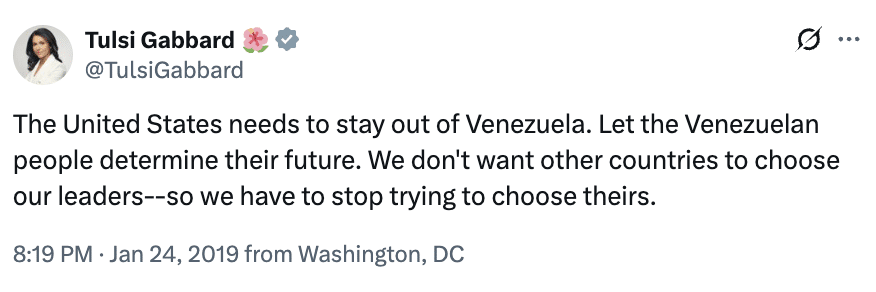
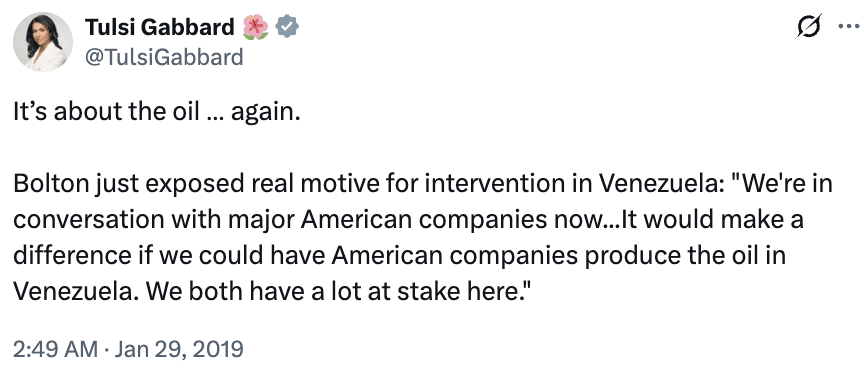
As a Democratic congresswoman in 2019, Gabbard said the US needs to “stay out” of Venezuela, and as recently as last month she railed against “warmongers” pushing the US into conflict.

The exclusion was the latest evidence of long-running tension over Gabbard’s role in the Donald Trump administration, and has underscored how the president’s decision to oust Maduro — despite campaigning against starting new wars — has widened fissures not only among his MAGA supporters but also within his team.

Tulsi’s people even pointed to that hilarious tweet to push back on this story.

A senior intelligence official pushed back against the characterization that Gabbard had been excluded, saying she provided intelligence that helped the overall mission, even if it was less operational and more analytical. An ODNI spokeswoman referred Bloomberg to a social media post Gabbard wrote Tuesday lauding servicemembers for the operation’s “flawless execution” of the move to capture Maduro.

“President Trump promised the American people he would secure our borders, confront narcoterrorism, dangerous drug cartels, and drug traffickers,” she wrote. The post broke a days-long silence after other top national security officials cheered the operation in press conferences, TV interviews and on social media.

Share this entry

Stephen Miller and Plans for Post-Decapitation

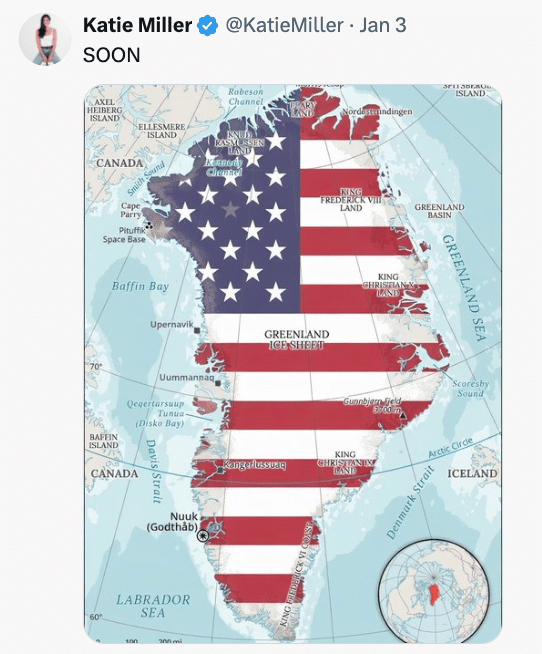
Stephen Miller’s breeding partner created a worldwide scandal by posting a picture of Greenland as an American flag.

The map from a far right podcaster, however well-connected, was actually less important than that the US President, the same day, told Michael Scherer, “we do need Greenland” because it was “surrounded by Russian and Chinese ships,” a sentiment Trump repeated on Air Force One yesterday.

During our call, Trump, who had just arrived at his golf club in West Palm Beach, was in evident good spirits, and reaffirmed to me that Venezuela may not be the last country subject to American intervention. “We do need Greenland, absolutely,” he said, describing the island—a part of Denmark, a NATO ally—as “surrounded by Russian and Chinese ships.”

Of course, since both Katie Miller and Donald Trump largely parrot what they’ve recently heard, both comments likely reflected the views of Stephen Miller.

Meanwhile, this passage of a story describing how Trump really hasn’t (yet) committed regime change, but instead decapitated the Venezuelan state only to leave Maduro’s cronies in place (for now), attracted a flood of confirmation bias.

Two people close to the White House said the president’s lack of interest in boosting Machado, despite her recent efforts to flatter Trump, stemmed from her decision to accept the Nobel Peace Prize, an award the president has openly coveted.

Although Machado ultimately said she was dedicating the award to Trump, her acceptance of the prize was an “ultimate sin,” said one of the people.

“If she had turned it down and said, ‘I can’t accept it because it’s Donald Trump’s,’ she’d be the president of Venezuela today,” this person said.

I have no doubt Trump was pissed María Corina Machado got the Nobel Prize and he did not. But a Miami Herald story published just six days after Machado’s recognition described that Delcy Rodriguez had been pitching a Madurismo without Maduro via back channels for months.

A group of senior Venezuelan government officials, led by Vice President Delcy Rodríguez and her brother Jorge, who is president of the National Assembly, have quietly promoted a series of initiatives in recent months aimed at presenting themselves to Washington as a “more acceptable” alternative to Nicolás Maduro’s regime, according to people with direct knowledge of the talks.

The proposals, funneled through intermediaries in Qatar, sought to persuade sectors of the U.S. government that a “Madurismo without Maduro” could enable a peaceful transition in Venezuela—preserving political stability without dismantling the ruling apparatus.

According to the sources, Qatari mediators presented to the U.S. two formal proposals this year, one in April and another in September. Both outlined potential governing mechanisms without Maduro in power. In those scenarios, Delcy Rodríguez would serve as the institutional continuity figure, while retired Gen. Miguel Rodríguez Torres, who is currently in exile and is not related to the Rodriguez siblings, would head a transitional government.

The central argument, the sources said, was that the Rodríguez siblings represent a “more palatable” version of so-called chavismo — the socialist ideology named for deceased leader Hugo Chávez — for Washington, since neither has been indicted on narcotrafficking charges by U.S. courts. However, former regime officials— whose accounts have been used by U.S. prosecutors in cases linked to the so-called Cartel of the Suns—have implicated both siblings in logistical support and money laundering operations.

Delcy Rodriguez is also the person who, according to the indictment charging Marco Rubio’s old roomie, former Congressman David Rivera, with acting as an unregistered agent of Venezuela (for which he is due to stand trial next month) who ordered CITGO to serve as a front for the contract. As part of the contract, Rivera lobbied Rubio in 2017 on a Maduro succession plan.

Delcy Rodriguez has been in the thick of such efforts from the moment Trump first became President.

So while the attribution of Trump’s sidelining of Venezuela’s democratic opposition — by a single person “close to the White House” — to the President’s narcissism surely has some truth, I’m more interested in that same story’s report that Stephen Miller may actually take on some of the duties of Viceroy that Trump initially assigned to the Miami-raised Spanish speaking Marco Rubio, not least because that may explain why Trump chose decapitation — retention of the oppressive Maduro regime — over regime change, replacement with a democratic one.

Having dismantled much of the U.S. foreign policy infrastructure since he came to power, Trump depends on a small number of trusted personnel and business associates to handle core issues such as his peace plan in Gaza, negotiations between Ukraine and Russia, and now Venezuela.

The National Security Council staff has been gutted and the administration has yet to nominate an assistant secretary of state to handle the Western Hemisphere.

The White House is weighing giving Stephen Miller, Trump’s deputy White House chief of staff and homeland security adviser, a more elevated role in overseeing post-Maduro operations in Venezuela, according to one person with knowledge of the conversations, who, like others, spoke on the condition of anonymity to discuss sensitive dealings.

Miller has been the architect of the administration’s anti-immigration and border policy, and took a central role in the effort to remove Maduro. He was among the handful of top administration officials flanking the president during the news conference Saturday at Trump’s Mar-a-Lago Club.

War on the Rocks argues that too many people are trying to read Trump’s decision to invade Venezuela as a statement of his ideology, rather than the result of the chaotic fight for influence within his White House.

Many observers of this administration underestimate the power struggle inside the administration and how it scrambles the output. Venezuela has been an interesting case of this. My hypothesis here is that Venezuela has been an outlet of sorts for the hawks, especially Secretary of State Marco Rubio but also others. There has been no sustained appetite for confrontation with Russia or China, and only limited room to maneuver on those fronts without significant escalation risks. Iran and Venezuela, by contrast, offered arenas for hawkish foreign policy.

[snip]

When it comes to predicting the president’s next move, too many politicians and analysts assume coherence where there is division, chaos when there is improvisation, and restraint where there is only selectivity. Trump’s foreign policy behavior emerges not from doctrine but from friction. Venezuela offered a target that felt weak, morally disreputable, geographically proximate, and manageable.

Under Trump, foreign policy outcomes are less the product of grand strategy than of episodic alignment. Observers should stop asking whether a given action is consistent with Trump’s supposed beliefs and start asking whether it is legible to him as fast, dominant, and containable. They should pay closer attention to intra-administration dynamics and to how ideas persist even when not immediately acted upon. Otherwise, the failure to predict Venezuela will not be an outlier.

Given the WaPo report (which came after Viceroy Rubio bombed on the Sunday shows) that Miller will be playing in a key role in America’s new colony, I want to situate the Venezuelan coup in Miller’s own history.

It is my belief — this is a hunch based entirely on observation, not any insider reporting — that Miller made himself indispensable when he helped Trump pull himself together after the Butler assassination attempt. Trump was completely dysfunctional after the near-death experience (I don’t blame him — everyone would be floored by that trauma). I would argue that Trump has never actually reclaimed his poise since then — throughout the campaign, he was already surpassing all decency on his political attacks, and he frequently got lost on the campaign trail, including his sundowning episode on the campaign trail. Everything people point to now as proof that he is unfit to be President was evident on the campaign trail. But Trump buried his collapse under ever grandiose fascist theater, much of it orchestrated by Miller, leading up to Trump’s fascist rally at Madison Square Garden, and shortly after, to election victory.

Whether or not that’s the case, it is clear that in the same period, Miller started laying the groundwork to use Venezuela as a propaganda foil for his assault on democracy, which I documented here.

  • 2023: Miller decides invoking the Alien Enemies Act will be a nifty way to deport people without due process.
  • September 2024: right wing propagandists stoke claim that Aurora, CO has been invaded by Tren de Aragua.
  • October 11, 2024: Miller stages a hate fest in Aurora.
  • October 18, 2024: After Tim Walz and others debunk Miller’s lies, he accuses them of defending gang members.
  • February 9, 2025: One of Miller’s earliest high profile raids targets Aurora but nets just a single TdA member.
  • February 26, 2025: The IC debunks Miller’s false claims about TdA.
  • March 14, 2025: Trump nevertheless relies on those lies while invoking the Alien Enemies Act.
  • March 16, 2025: DHS unloads planes of mostly innocent Venezuelan men in defiance of order from Judge James Boasberg.
  • March 21, 2025: Trump claims he’s not the one who signed the AEA invocation.
  • April 2025: WaPo reports that the NIE also debunked Miller’s false claims about TdA.
  • April 10, 2025: SCOTUS rules Trump has to make some effort to get Kilmar Abrego back.
  • April 14, 2025: Performance art with Nayib Bukele in Oval Office.
  • April 19, 2025: SCOTUS halts an AEA deportation order in process.

But then, on July 18, 2025, Trump swapped Venezuelans from CECOT for 10 Americans in Venezuela, seemingly dealing Stephen Miller a major defeat in his plan to rely on AEA.


I questioned why that happened here. And on the same day, NYT provided what is in retrospect even more critical background, a batshit insane story I glossed here. As the entire CECOT drama was proceeding, Trump was dicking around the Miami Hispanic community, which was clamoring to pressure Maduro, first halting then renewing Chevron’s Venezuela license.

  • January 31: Maduro makes a deal with Grenell.
  • February: Cuban-American Members of Congress (CAMC) pressure Trump to pull the Chevron license, which he does in late February (possibly between the time Rubio signs the deal with Bukele and the day 200 mostly-innocent men are loaded on planes?).
  • Chevron CEO Mike Wirth notes that if Chevron can’t export Venezuela’s oil, China will do so.
  • CAMC learn that Trump might reverse his decision, so threaten to vote against the Big Ugly Bill.
  • Stephen Miller pitches Trump on murderboats.
  • Trump lets Chevron license expire on May 27.
  • CAMC vote to pass Big Ugly.
  • Around the same time Trump considers a pardon for convicted drug kingpin Hernández, Marco Rubio sells Trump on a claim that Maduro is a drug kingpin.
  • July: Based in part on Wirth’s China argument, Trump reverses course, again, on Chevron license, Maduro accepts the CECOT prisoners and releases 10 Americans, including a triple murderer.

Trump’s flip-flopping over the Chevron license would lead up to Trump’s command, ten days before the actual invasion, that oil companies prepare to invest in Venezuela if they want compensation for equipment Maduro seized.

But we know that, after Miller first pitched Trump on drone strikes in Mexico, and then he and Rubio (Miller to support his fascist project including hopes to return to using the AEA declaration, Rubio to cater to Miami’s Cuban-American desires) pitched Trump to instead attack Venezuelan-related drug trafficking. On July 25 — a week after returning the hundreds of mostly innocent men to Venezuela — Trump signed an order to begin the murderboat campaign, with murderboat strikes beginning in September. That same day, Marco Rubio pretended this was all about the election Maduro stole last year. Another week later, Pam Bondi upped the reward to help capture Maduro — $50 million we don’t yet know whether has been claimed.

This would have been the period when CIA and Delta Force started practicing the snatch of Maduro.

According to a new WSJ story, it wasn’t yet a foregone conclusion that Trump would approve the attack. Maduro remained dancing in videos that reported inflamed Trump, and dancing in negotiations to leave peacefully (even as Delcy Rodriguez was working back channels to assume power in his wake).

  • October 7: CNN reveals Trump has a covert finding authorizing strikes on cartels.
  • October 10: Machado wins Nobel Prize.
  • October 15: Trump confirms he has signed a finding authorizing strikes on cartels.
  • October 16: Alvin Holsey announces his retirement.
  • November 16: Ford carrier group arrives in the Caribbean.
  • December 1: Trump pardons Juan Orlando Hernández, whose crimes include shipping drugs originating in and protected by Venezuela.
  • December 10: Trump starts seizing oil tankers; Machado arrives in Oslo just after the prize is awarded.
  • December 23: Maduro rejects offer to exile in Turkey.
  • Roughly December 25: Trump orders oil companies to prepare to invest in Venezuela.
  • December 29: CIA strikes a loading facility in Venezuela.
  • Unknown date: DOJ supersedes existing indictment against Maduro, shifting emphasis (without much substantiation) from Cartel de los Soles to Tren de Aragua, and including Maduro’s wife and son.
  • January 3: Trump snatches Maduro.

And immediately after Trump’s Administration imagined that they had proven their concept of decapitation without regime change, Trump started listing other places he would attack, including Cuba — high on Rubio’s list — but also Mexico (which Miller had had to defer earlier), Colombia, and Greenland.

If Marco Rubio had unilaterally won these battles, the chances would have been greater for genuine regime change; and his failure to deliver may soon sour his constituency on the snatch.

That this was, at least for the moment, decapitation, suggests Miller presided in the end.

After all, Trump also immediately likened the snatch operation to Miller’s domestic efforts to subjugate both civil society, including universities, law firms, and hospitals treating trans children, but also entire blue states, with paramilitary invasions launched in the name of deportation.

Miller’s goals are to demand subservience from everyone on threat of invasion, if not death, the stated means of keeping Delcy Rodriguez on track.

In the end, Stephen Miller is perfectly happy to get in bed with proud socialists, it turns out, so long as he can appropriate their authoritarian tools to his own ends.

Share this entry

Fridays with Nicole Sandler

Listen on Spotify (transcripts available)

Listen on Apple (transcripts available)


Share this entry

Where We Go from Here

Back before everyone checked out for the holidays, I did an inventory of the progress we’ve made in four ways to fight fascism (in comments ApacheTrout reminded I should have the courts in there too).

  1. The Erica Chenoweth rule, which says that if you can get 3.5% of a population in the streets, it often leads to regime change.
  2. Beginning to peel off four people in the Senate or eight or nine people in the House.
  3. Rescuing Republicans from a predictable catastrophe like Democrats did in 2008 and 2020.
  4. Waiting until 2026, winning at least one house of Congress, and beginning to rein in Trump that way.

I wrote it intending to kick off the new year with a post of things we can do, or do better. Here we are!

But first, let me explain where I’m coming from. Much of what follows builds on my belief that we’ve been fighting Donald Trump wrong.

Polarization is his superpower. It’s how he has gotten out of every single one of his political jams in the past: by turning his own scandal into a polarizing pivot, thereby turning his own failures and crimes into a matter of tribalism. Once he has done that, he invents some new bullshit story (usually stoking grievance), and getting right wingers to believe it because of that polarization.

This is why I’m such an asshole about the way people serve as data mules for Trump’s tweets: because those damn things are little polarization machines, which always serve to make him the center of attention around which society is re-polarized.

The way to combat someone whose superpower is polarization is not to exacerbate that polarization. It is to use his own tools — grievance and conspiracism — against him.

Back in May, before the Epstein files had created a full-blown crisis for the Trump Administration, Phil Bump and Mike Rothschild wrote about how conspiracism can undermine someone with power (which I added to here).

Think of how important conspiracism and grievance were to (at least per the Robert Draper profile) Marjorie Taylor Greene’s turn against Trump:

  • Realizing Trump never returns loyalty
  • Discovering Trump was the villain of the Epstein scandal in which she had an unshakeable belief
  • Opposing Gaza (probably for horrible Jewish space laser reasons) and crypto currency (for justifiable reasons inflamed by conspiratorial thinking)
  • Seeing Trump mock affordability
  • After all that (but while she still had her courage), being targeted by Trump mobs
  • Packaging that in a morality tale, Christianity, whence she derived moral value

Simplifying and ignoring her potential political ambitions, Trump became the thing everyone suspected was being hidden in the Epstein files, and that led to cognitive dissonance that led MTG to revisit a lot of her other differences with Trump.

So some of my logic, below, is simply to focus on the things that are likely to get Trump supporters or sympathizers to feel betrayed by him including by holding people close to him accountable for shitty things we are pretty sure are going to occur. It includes:

  • Treat Epstein as the base layer
  • Focus on the Broligarchs and AI
  • Emphasize Trump’s loser stench
  • Visualize Trump’s corruption
  • Brand Trump as the criminal he is
  • Hold Stephen Miller accountable for his failures
  • Visualize how Stephen Miller took money for cancer research and veterans care to pay for a goon army snatching grandmothers
  • Discredit Key Spokespeople
  • Use Trump’s claimed opposition to antisemitism against him
  • Reclaim disinformation research

One more point about this. This post is not a To Do list for the DNC (though some people on Bluesky will undoubtedly treat it as such). It’s a To Do list for myself, most of all, but one that others can borrow if they find it useful. Many of these things are attentional activities that are about repetition and focus as much as congressional oversight or electoral politics.

These are meant to be stories we can tell, regardless of what someone in Congress or some candidate in Iowa does.


Treat Epstein as the base layer

Remember that Marc Caputo column — it was published on December 23 — stating that the Epstein releases could last a whole ‘nother week? On the day that would mark that week, December 30, Devlin Barrett published a story saying that, “The document review” of what is now believed to be 5.2 million documents “is expected to take until at least Jan. 20, according to a person familiar with the matter.” Even if they could finish it by January 20 (they won’t), that’ll just be the first go-around. DOJ has not done what they need to do to document the redactions, so there’ll be demands from Congress for them to do that (with obvious areas — including DOJ names and some deliberative documents specifically included in the law, where they’re in violation), they’ll need to repeat the entire process over again, Congress will begin to bring more legal pressure, and all the while survivors will be pointing out things they missed.

A week, Marc Caputo reported, as if that were credible!

This will go on for some time. This will go on for a very long time.

Still, while the Epstein scandal has been absolutely instrumental in loosing Trump’s grip on things, people are naive in thinking that will be enough. “My friends will get hurt,” Trump predicted, but what does it really mean for Trump’s power that Les Wexner has been implicated in the Epstein scandal as a co-conspirator? What is the use of creating right wing cognitive dissonance about Les Wexner, when Wexner is not the oligarch currently helping Trump destroy the country?

In my opinion, the Epstein scandal is a tool. It undercuts Trump’s ability to grab and redirect attention. It can create moments of cognitive dissonance, as it did for MTG. It is a way to turn Trump’s conspiracism and populism against him and may make other related narrative lines more salient. And if there’s a surprise disclosure — perhaps about Melania’s origin story — all the better. But as you keep the focus on Epstein, remember that there needs to be a direction beyond Epstein as well, a direction which incorporates the oligarchs who are still key players in Trump’s network of power.

Focus on the Broligarchs and AI

The Broligarchs who’ve been a key part of Trump’s power are one way to do that (and that’s before we’ve really gotten into Steve Bannon and Peter Thiel’s ties to Epstein).

Tesla Takedown was one of the most successful campaigns of 2025. At a time when Tesla faced cheaper competitors worldwide, the protests incurred a cost on Musk for his DOGE depredations.

Elon was installed in the White House in significant part by fellow South African “alien invader” David Sacks, who is even more conspiratorial and even more pro-Russian than Musk. Sacks was installed in the White House as a Special Government Employee (who, Elizabeth Warren suggests, has overstayed his welcome) to force a bunch of policy decisions that suck for America but ensure that Broligarchs won’t pay any consequences for their rash business deals. When one or both of crypto and AI crash (this is a really good story on how and why AI will burst), he’ll be there to ensure the government bails them out, as he did after playing a role in the failure of Silicon Valley Bank.

And even as Trump sheds support based on his mockery of affordability, even as MTG split with Trump over that and his support for crypto, Sacks is trying to brand Democrats as being more populist than even Zohran Mamdani is.

Fine. You want Democrats to be the party attending to the needs of working people? You’ve just made the GOP the party of “alien invader” billionaires who got tax cuts as millions lost their health care.

This happened even as AI has become a political liability. It has happened as local groups successfully stave off new data centers. It has happened as more instances of AI-inflamed suicide, murder, and pornincluding porn exploiting children — appear. And it happens before the aforementioned crash.

Sacks and the other Broligarchs are going to do something for which they’ll try to dodge accountability. Now is the time to make sure his name comes up as people look for culprits.

Emphasize Trump’s loser stench

Another thing that will lead people to defect is to realize that Trump is a loser. He has done things — like the takeover of the Kennedy Center — that makes it easy to demonstrate he’s a loser in tangible fashion. Better still, every time Trump attaches his name to something, it provides an opportunity to hijack that brand, as comedian Toby Morton auspiciously managed to do by anticipating Trump’s most venal instincts and buying the domain.

The same is true of his businesses. Trump and his entire family is getting rich off the presidency 2.0. But his businesses are built as cons, sometimes Ponzi schemes. The idea is to leverage the loyalty of MAGAts to get them to invest in something, run up its value, only to collapse, leaving the most vulnerable screwed. In the past, at least, the cult effect was such that even MAGAts bilked by Trump associates, as with Steve Bannon’s Build the Wall graft, were reluctant to turn on the fraudsters; that may change. But at the very least, the volatile nature of Trump’s frauds makes it easy to show that as a businessman, he’s a loser.

Visualize Trump’s corruption

While there has been good reporting on Trump’s corruption — see, for example, NYT’s nifty visualization from New Year’s Eve — there has not been a systematic effort to take on his corruption.

Nevertheless, possibly because of the Epstein scandal, a majority of the country does think Trump is corrupt.

That may actually not be in a bad place to be as we move into 2026. That’s because Democrats can make Republican inaction in the face of Trump’s corruption a campaign issue (and then, if it leads to a Democratic sweep in midterms, the electoral buy-in will be in place to do a lot of oversight and defunding of Trump’s corruption).

Trump’s pardons are similar. There’s actually a solid stream of reporting on how corrupt they are, without yet any political direction to it. Democrats running against Republican incumbents — especially in the Senate — should state as presumed that it is the job of Senators to respond to the kind of naked corruption Trump is engaged in.

Where activists can magnify the good reporting on both Trump’s corruption and his pardons is to focus on the victims. This is actually showing up in the reporting on both topics. WaPo focused on the victims of Trevor Milton who might have gotten restitution had Trump not pardoned him. LAT similarly focused on the victims fucked over by Trump’s pardon of David Gentile.

Rosenberg, a retired wholesale produce distributor living in Nevada, has supported Trump since he entered politics, but the president’s decision in November to commute the sentence of former private equity executive David Gentile has left him angry and confused.

“I just feel I’ve been betrayed,” Rosenberg, 68, said. “I don’t know why he would do this, unless there was some sort of gain somewhere, or some favor being called in. I am very disappointed. I kind of put him above this kind of thing.”

Trump’s decision to release Gentile from prison less than two weeks into his seven-year sentence has drawn scrutiny from securities attorneys and a U.S. senator — all of whom say the White House’s explanation for the act of clemency is not adding up. It’s also drawn the ire of his victims.

“I think it is disgusting,” said CarolAnn Tutera, 70, who invested more than $400,000 with Gentile’s company, GPB Capital. Gentile, she added, “basically pulled a Bernie Madoff and swindled people out of their money, and then he gets to go home to his wife and kids.”

This superb Bloomberg story on the extent to which the Juan Orlando Hernández pardon unraveled years of work starts with a murder arranged by the network.

Five minutes later, González was circling a roundabout when a gray van braked in front of him. At the same time, a green SUV crowded his rear bumper. A motorcycle carrying two men emerged on his left. A man on the back of the bike fired six shots through the driver-side window. González’s head slumped toward his shoulder, and he tilted forward, held upright by the seatbelt. He died instantly.

More than a dozen men streamed out of the two vehicles that had sandwiched his Nissan. They scrambled to collect the spent shell casings on the ground, then scattered other casings across the pavement—decoys to complicate ballistics tracing. They jumped back into their vehicles, circled the roundabout and took the same road Julián had just driven down.

When they approached the Slaughterhouse, the gates opened to let them in, then closed behind them.

Every one of these pardons has a victim — and that’s before you get into the people newly victimized by people who’ve been pardoned by Trump, which NYT covered in November and others are tracking as well.

A New Jersey fraudster who was pardoned by President Trump in 2021 was sentenced to 37 years in prison this month for running a $44 million Ponzi scheme, one of a growing number of people granted clemency by Mr. Trump only to be charged with new crimes.

The man, Eliyahu Weinstein, was pardoned by Mr. Trump in 2021 and was re-indicted by the U.S. attorney’s office in New Jersey three years later. He was accused of swindling investors who thought their money was being used to buy surgical masks, baby formula and first-aid kits bound for Ukraine, and a jury convicted him in April of several crimes, including conspiracy to commit securities and wire fraud.

[snip]
Some of those pardoned for their role in the Jan. 6, 2021, riot at the U.S. Capitol have quickly drawn new attention from law enforcement. The group Citizens for Responsibility and Ethics in Washington said in June that at least 10 of the more than 1,500 who were pardoned had been rearrested and charged, and the number has only grown since then.

Earlier this month, a man who was pardoned after having participated in the Jan. 6 attack was charged with sex crimes against two children. Another man whose original sentence Mr. Trump commuted in 2021 was recently sentenced to 27 months in prison after convictions on physical and sexual assault, among other crimes.

These stories provide an important way to explain the costs of Trump’s corruption.

Brand Trump as the criminal he is

And while we’re talking about telling these stories: We must never ever cede the ground of crime to Stephen Miller’s attempt to brand immigrants as criminals.

Trump — a felon who freed hundreds of cop assailants on his first day on the job — has an entire infrastructure devoted to trying to spin brown people as criminal. Every time that infrastructure goes into action, including with the effort to brand Somalis in Minnesota as inherently fraudulent when Trump himself is a serial fraudster, we need to repeat, relentlessly, that Trump is a serial criminal who coddles other criminals.

This is something Gavin Newsom just started doing, with an entire website devoted to cataloging Trump’s crime and that of his pardon recipients.

Do not let a conversation about crime go by without focusing on how much of it Trump does.

Crime, in Trump’s era, is a rich white man’s thing. And while it will take a lot of work to adjust a lot of racist priors, until people start seeing Trump as a criminal it will be far too easy for them to make excuses for him.

Hold Stephen Miller accountable for his failures

I focused on Stephen Miller — and the import of making his failures clear — last week.

The import of shifting how we speak of Miller’s considerable power is clear. That’s true because he frankly has done huge damage, even to Trump’s goals, and well more so to average Americans. He’s someone that people, including Republicans, can scapegoat for Trump’s failures (and they’ll be right). And if we don’t make sure that happens, then he’ll scapegoat brown people.

Again, are Somali day care workers or billionaires systematically defrauding average people the problem? One easy to way to drown out Miller’s case that it’s the former is to make it clear how much he personally has harmed average Americans.

Visualize how Stephen Miller took money for cancer research and veterans care to pay for a goon army snatching grandmothers

Relatedly, particularly as the huge injection of funding Republicans approved last year starts landing at DHS, it will become increasingly necessary to tie the goon squads in the streets to the loss of benefits elsewhere.

We need to make it clear that this is a direct trade. 50,000 ICE goons in, 300,000 other government employees out, including people who cure cancer, help learning disabled kids get through school, protect our National Parks, ensure your Social Security comes on time, and care for veterans.

Christopher Ingraham did a handy graphic to show the trade-off.

Stephen Miller’s dragnet is unpopular in the abstract and wildly unpopular in the lived sense, even — if meekly — among local Republican leaders.

But it still retains support of a big chunk of the population, probably because Trump officials routinely blame their own failures to address American problems on migrants, when as often as not, Trump’s response to immigration is the source of the problem.

America can’t have nice things, like cures for cancer and welcoming public schools, because Republicans in Congress took the money used to pay for those things and gave it to Stephen Miller to use to invade America’s neighborhoods.

Discredit Key Spokespeople

Right wingers like Jonah Goldberg and David French have expressed alarm by an old promo for a 60 Minutes piece (the piece itself was from October) that an influencer reposted yesterday, describing dozens of times when the government lied in court filings.

Judges have caught Trump’s DOJ in several major lies since then. In Chicago, Judge Sara Ellis wrote a 233-page opinion documenting the many lies DHS has told about their Chicago invasion.

And in December, judges in both Kilmar Abrego’s case caught the government obfuscating. In the criminal case, on December 30, Judge Waverly Crenshaw unsealed a December 3 opinion describing how Nashville’s US Attorney lied about how centrally involved Todd Blanche’s office was in demanding Abrego face trial.

The central question after Abrego established a prima facie case of vindictiveness is what information in the government’s control sheds light on its new decision to prosecute Abrego, after removing him from the United States without criminal charges. These documents show that McGuire did not act alone and to the extent McGuire had input on the decision to prosecute, he shared it with Singh and others. (Doc. No. 178-1). Specifically, the government’s documents may contradict its prior representations that the decision to prosecute was made locally and that there were no outside influences. For example, Singh contacted McGuire on April 27, 2025, to discuss Abrego’s case. (See Doc. No. 229 at Abrego-Garcia000001). On April 30, 2025, Singh asked McGuire what the potential charges against Abrego would be, whether the charging document would reference Abrego’s alleged MS-13 affiliation, and asked for a phone call before any charges were filed. (Id. at Abrego-Garcia000007–000008). In a separate email on April 30, 2025, Singh made clear that Abrego’s criminal prosecution was a “top priority” for the Deputy Attorney General’s office (Blanche). (Id. at Abrego-Garcia000037). He then told McGuire to “sketch out a draft complaint for the 1324 charge [making it unlawful to bring in and harbor certain aliens].” (Id.). On May 15th, McGuire emailed his staff that “DAG (Blanche) and PDAG would like Garcia charged sooner rather than later.” (Id. at Abrego-Garcia000060).

And as I’ve already noted, Judge Paula Xinis cataloged the many deliberately ignorant declarations DOJ filed about whether DHS had deportation plans for Abrego when she ruled that he must be released.

Respondents showcased Cantú’s ignorance about the content of his Declaration pertaining to Costa Rica. As the pointed questions of Respondents’ counsel made clear, Cantú’s lack of knowledge was planned and purposeful.

Counsel: So paragraph 4, final sentence [of the Cantú Declaration], do you see where it says the word—the words “certain understandings”?

Cantú: I found it. Yes, I do. I see it.

Counsel: What are the certain understandings referenced in the last sentence?

Cantú: I don’t know . . .

Counsel: What are the “contingencies” referenced in the last sentence?

Cantú: I do not know . . .

Counsel: What are the “interim developments” referenced in paragraph 5?

Cantú: I don’t know.

ECF No. 107 at 26:8–27:12 (counsel for Respondents, Jonathan Guynn (“Guynn”), questioning Cantú). See also id. at 53:8–9 (Guynn, at sidebar with Court, stating “I’ll just say I told you this was exactly what was going to happen,” regarding the witness’ ignorance on Costa Rica as a viable country of removal).

Ultimately, Respondents’ calculated effort to take Costa Rica “off the table” backfired. Within 24 hours, Costa Rica, through Minister Zamora Cordero, communicated to multiple news sources that its offer to grant Abrego Garcia residence and refugee status is, and always has been, firm, unwavering, and unconditional.

It’s a problem that, after huge scoldings like these, right wing critics of Trump don’t understand how much Trump’s people lie — not least because the Supreme Court still credits the most outlandish claims Trump makes, even after they’ve been thoroughly debunked by lower court judges.

Many of these lies are coming from the same people: Stephen Miller, Todd Blanche’s office, DHS spox Tricia McLaughlin, and Greg Bovino.

It is remarkable that so many of these people have been caught lying to courts (or publicly, about people before courts). But it needs to become common knowledge for everyone, so every time Tricia says something, they start from the assumption she’s lying, because she almost always is.

There comes a time when the credibility of systematic liars not named Trump collapse entirely such that every utterance they make discredits the claims they try to sell. Tricia McLaughlin, at least, is close those levels of propaganda, and Stephen Miller is not far behind.

Use Trump’s claimed opposition to antisemitism against him

Within days of his inauguration last year, Trump signed an EO — adding to one he signed in 2019 — claiming to oppose antisemitism. There has been some discussion about the bad faith of this EO and a DOJ lawyer implementing it, Michael Velchik, once wrote a paper from Hitler’s perspective. While it is explicitly targeted at universities (and has been a key tool to attempt to takeover universities), it nevertheless claimed to oppose antisemitism everywhere.

It shall be the policy of the United States to combat anti-Semitism vigorously, using all available and appropriate legal tools, to prosecute, remove, or otherwise hold to account the perpetrators of unlawful anti-Semitic harassment and violence.

This is the kind of statement of principle that can form the basis of political pressure — particularly as the MAGAt movement splinters around the overt antisemitism of people like Nick Fuentes and Candace Owen, and as political opportunists like Ted Cruz attempt to exploit that splinter.

We’re going to have to fight this battle in any case. As part of the revocation of everything Eric Adams did after he was indicted for bribery yesterday, Zohran Mamdani revoked an EO that gave Israel preferential treatment, which Israel is using to stoke division; yet Mamdani preserved the office Adams opened to combat antisemitism.

We need to call out the dripping antisemitism of Trump’s team, from top (at least JD Vance, who refuses to disavow Fuentes) to bottom.

There are two key Trump aides who should be targeted. Most notably, Paul Ingrassia, who had to withdraw his nomination to be Special Counsel after Politico exposed texts in which he confessed to a Nazi streak been installed at GSA instead. In addition, Kingsley Wilson became DOD spokesperson in spite of Neo-Nazi comments. NPR has done good work unpacking these ties.

Reclaim disinformation research

Republicans plan on exporting fascism via US tech platforms.

That’s not new. I’ve been talking about Elon’s plans to use Xitter as a machine for fascism for some time.

But since then, Trump’s minions worked it into the National Security Strategy.

And, in the wake of the EU’s sanctions against Elon Musk for — basically — lying about why I have a blue check, Marco Rubio stripped the visas of five people, including US Green Card holder Imran Ahmed, a long time adversary of Elon’s.

But there are several developments that suggest it is time to renew efforts to defend disinformation research, not least the White House’s absurd effort to attack real journalism, what is sure to be a snowballing failure on Bari Weiss’ part to make propaganda popular, and the meltdown the head of DOJ’s Civil Rights division, Harmeet Dhillon, had over the holidays about right wing “misinformation” targeting Pam Bondi.

The right wingers are doing what they themselves established is unlawful. And that presents both political and legal opportunities to demonize their propaganda.

Which in turn cycles back to the increasing problem of AI propaganda, including Grok’s flagrant willingness to nudify children in recent days.

Some people write short resolutions. I guess I write 4,000-word To Do lists. Join me in my efforts!
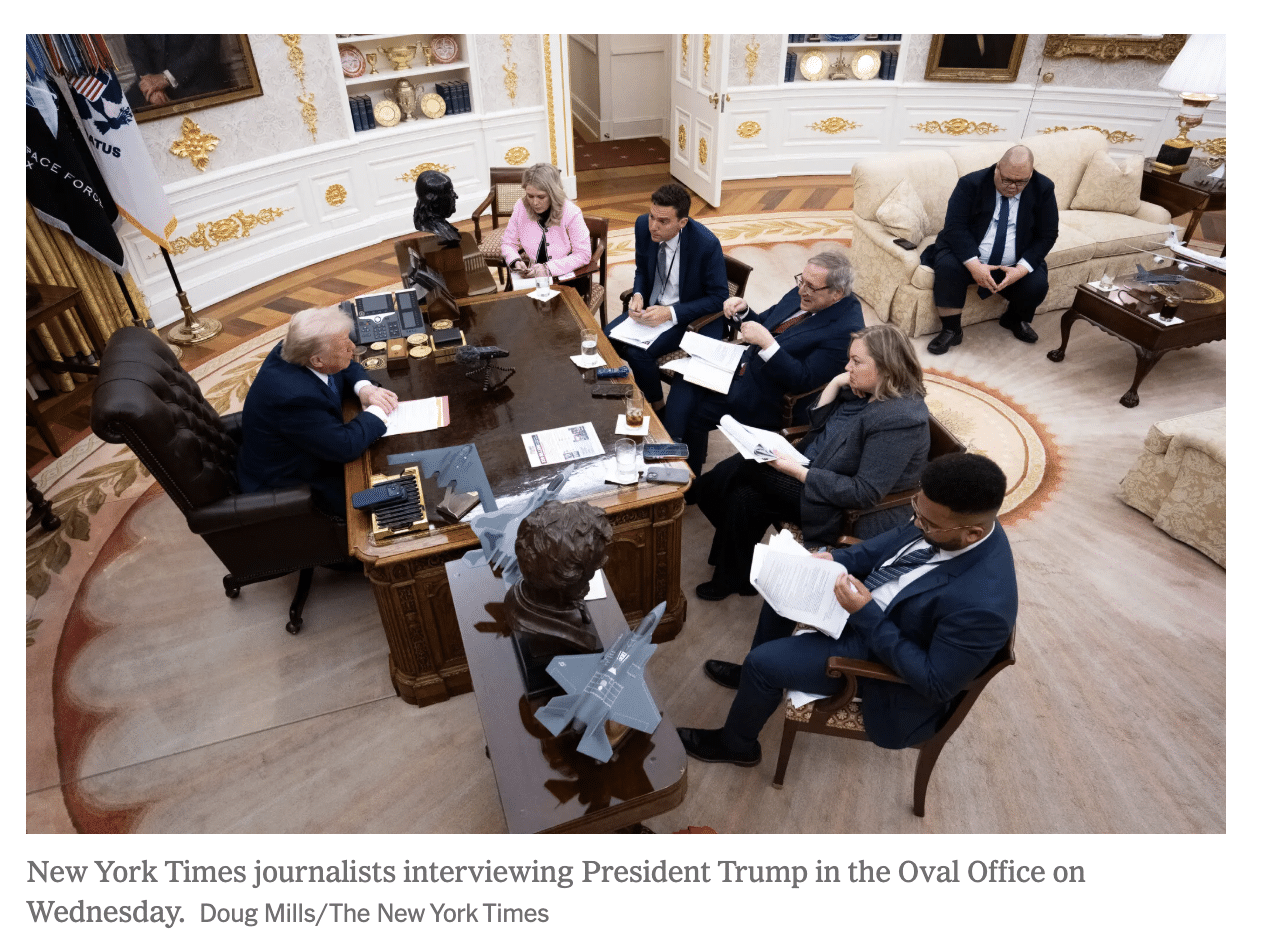
Share this entry

Jim Jordan Buries His Own Cowardice in a Cowardly Document Dump

Jim Jordan tried to bury the Jack Smith deposition in a News Years Eve document (and video) dump.

Perhaps that’s because the funniest answer Smith gave (after already explaining why he had obtained subpoenas for the phone records of members of Congress, which was, in part, because Boris Ephsteyn and Rudy Giuliani were using two phones that day) was that Jim Jordan’s toll records were important because Jordan called the White House on January 6 because he was scared.

Q The toll record subpoena for the chairman of the committee.

A Well, I can tell you that, for example, there were — there was contact on, for example, January 6. But, again, another example for you is Mark Meadows, when he interviewed, when we interviewed him, he referenced the fact that that afternoon Chairman Jordan had been in contact with the White House. And, like Congressman McCarthy’s contact with the White House, it was relevant because, again, Meadows stated this, that these were supporters. These were credible people that the President relied on.

And what I recall was Meadows stating that “I’ve never seen Jim Jordan scared of anything,” and the fact that we were in this different situation now where people were scared really made it clear that what was going on at the Capitol could not be mistaken for anything other than what it was.

And it goes back to that sort of information from someone who is a credible source to the President, proving that that actually happened and that there’s actually a record of that call and exactly when it happened and what actions happened after that or didn’t happen after that, extremely probative to our case.

Meanwhile, after Republicans complained about Smith’s gag order on Trump,

Q Did you- — you sought gag orders in both the Florida case and the D.C. case.

Is that correct?

A We sought an order in the D.C. case under a rule — I think it’s 57.2 — and we did that because Donald Trump was making statements that were endangering witnesses, intimidating witnesses, endangering members of my staff, endangering court staff.

As you might remember, in the — right around when the indictment was released, he issued a tweet saying: “If you come after me, I’ll come after you.” He called — in a tweet he called General Mark Milley a traitor and mentioned that what he’d done in olden times people would be put to death. As a result of the things he was saying, the judge in this case was put — received vile death threats.

And with respect to D.C., both the district court and the court of appeals, a panel of judges, found that his actions were, in fact, causing what we said they caused. They were causing witnesses to be intimidated and endangering people.

And I believe it was the court of appeals also found that in addition to intimidating or chilling witnesses who existed, it would chill witnesses who had not yet come forward because they were afraid that they would be next.

So, yes, we did file that and I make no apologies for that.

Q Which witnesses do you think he would have intimidated? I mean, are there any specific witnesses that you could identify for the court?

A We did a filing. I don’t recall the specifics in that filing right now. But as I said, one of the issues from my perspective was not only the witnesses who he had specifically called out and caused threats to be issued, this phenomena that was found by both courts, it was the result of that is that a rational witness who maybe had not come forward would be completely afraid to because they would see that they would be next.

And I think the courts — both courts agreed with that.

Here’s how Smith answered Jasmine Crockett’s question about threats to Smith specifically.

Ms. Crockett. And, just to kind of finish up on this point, you, yourself — I’m not sure if this was discussed by the majority, but have you, yourself, been intimidated as a result of the actions that you took in this case.

The Witness. I’m not going to be intimidated.

Ms. Crockett. Have you been threatened.

The Witness. Yes.

Much later, Smith declined to get into the threats against him because they would endanger his (and he did not specify, but implied, his family’s) safety.

Q Do you feel like you have a target on your back?

A I believe that President Trump wants to seek retribution against me because of  my role as special counsel.

Q Would you be surprised if President Trump directs the DOJ to indict you?

A No.

Q Are you concerned about the safety of people who associate with you, like your former colleagues and your attorneys here today?

A I would prefer, if it’s all right, not to talk about my safety, because I think doing so could, in fact, endanger my safety and those of people around me.

Q Understood.

Though Smith did later confirm that Trump tried to retaliate against Covington & Burling because they represented him.

Regarding Smith’s investigation, one of the more interesting insights was his explanation of why he did not try to interview Steve Bannon, Peter Navarro, or Roger Stone.

Ms. Lofgren. Can I ask — we attempted in the January 6th Committee to question Peter Navarro as well as Steve Bannon, and they were both prosecuted and spent time in jail. Roger Stone appeared but took the Fifth.

Were you able to provide — to get information from any of those three individuals and in the case of Mr. Stone provide use immunity so that he would have to testify?

The Witness. We did not.

Ms. Lofgren. Why not?

The Witness. We pursued the investigative routes that we thought were the most fruitful. We pursued those that we thought were necessary to get a complete understanding of the scope of the conspiracy. And given the highly uncooperative nature of the individuals you talked about, I didn’t think it would be fruitful to try to question them.

And the sort of information that they could provide us, in my view, wasn’t worth immunizing them for their possible conduct.

In addition to Ephsteyn, he also interviewed Rudy. Smith repeatedly said that prosecutors would have welcomed if Trump called any of his co-conspirators as witnesses.

Q Were you planning on calling John Eastman as a witness?

A I do not believe we would have, but we would have welcomed if the defense called him.

Q Okay. It gets tricky, though, for the defense to call him because the people like Eastman and Clark and, you know, Rudy Giuliani and Sidney Powell, I mean, you know, they were shrouded by the special counsel as, you know, co-conspirators one through six.

And so they all feared that they were going to be prosecuted if they said anything. Isn’t that fair?

A Well, they were co-conspirators. I can’t get into what was in their mind or not. can tell you some of the co-conspirators met with us in proffers and did interviews with us.

And so the idea that someone like Rudy Giuliani, who sat with a proffer with us, he was available as a witness, and we would have welcomed President Trump calling him as a witness.

Boris Epshteyn sat for an interview with us. We would have welcomed calling him as a witness.

Kenneth Chesebro. We would have welcomed it.

They probably had material lies all had made to either prosecutors or courts.

That comment led immediately to Republicans (who surely were trying to obtain evidence to support criminal charges against Smith) to ask why he hadn’t worked his way up through co-conspirators.

Q Why didn’t you charge any of those?

A I’m sorry?

Q Why didn’t you charge any of those, those co-conspirators?

A As we stated in the final report, we analyzed the evidence against different co-conspirators. We — my staff determined that we did have evidence to charge people at a certain point in time. I had not made final determinations about that at the time that President Trump won reelection, meaning that our office was going to be closed down.

Q Right. You’re a — you’ve had a 30-year career as a prosecutor. You prosecuted gang members, right?

A Yes.

Q You prosecuted organized crime members, right?

A Not as much.

Q But surely one of the fundamental principles of prosecutorial work is you work from the bottom up and you try to get as many fact witnesses to work with you. And a lot of times those fact witnesses have criminal liability.

And a lot of times those lower fact witnesses, the smaller fish, almost always they’re — they’re either prosecuted or they are given an immunity because they fear they’re going to be prosecuted. But here you didn’t — you know, you kept laser focused only on President Trump.

A Two points.

One, as I said, we were considering prosecutions of these people, and I think — I don’t want to say what the ultimate conclusion of that would have been, but that was something that was being considered.

The second thing I think to understand contextually is this was a case where the issue was how to present it in a concise way.

We had so many witnesses, again, so many witnesses who were allies of President Trump available to us to testify. This was not a case where we needed more witnesses, it was a case where we needed to be able to present the case in a streamlined way because there was so much evidence.

That led to Smith explaining why he focused on Trump: because none of the crime would have happened without him. It was all done for his benefit.

A All of that is false, and I’ll say a few things.

The first is the evidence here made clear that President Trump was by a large measure the most culpable and most responsible person in this conspiracy. These crimes were committed for his benefit.

The attack that happened at the Capitol, part of this case, does not happen without  him. The other co-conspirators were doing this for his benefit.

So in terms of why we would pursue a case against him, I entirely disagree with any  characterization that our work was in any way meant to hamper him in the Presidential election.

Aside from the two phones revelation or a detail about texts between Bannon and Ephsteyn in which Bannon told Ephsteyn that Trump was “still on fire,” there were almost no new disclosures.

Indeed, staffers from both parties were painfully unaware of all the public filings that could have supported some questioning there, including about Kash Patel’s testimony.

Meanwhile, staffers of both parties wanted to know why Trump stole the classified documents, which Smith declined to answer this way when responding to Democrats,

Q Okay. Can you draw any conclusions about his motive for refusing to return these documents?

A Unless you can point me to a filing, a public filing on that issue, I don’t want to run any risk of running afoul of the injunction. And so without a public filing on that issue, I don’t think I can answer that.

Q Just one last question. Did you come across in the course of your investigation any evidence about why President Trump took those documents in the first place?

A Again, I don’t think that’s in the indictment here, and unless you have a public filing, that given the current state of the injunction, I don’t think that’s a question I can answer.

And he responded this way when Republicans tried to offer up a stupid excuse for Trump.

Q Uh-huh. Do you know if he was intending to save those materials for his 12 Presidential library?

A You mean the classified documents?

Q The items in the boxes, all of them.

A Well, if he — if his defense were that he was intending to take classified documents that he had no authority to take and he did it intentionally because he wanted to start a Presidential library and keep these documents in the locations that we talked about today, that’s a crime.

Q No, but my question was, all the items in the boxes, the shirts and the, you know, mementos, were they being saved for a Presidential library, to the extent you were able to develop that in the course of your investigation?

A You know, I mean, there were newspaper clippings in there, there were, I think, you know, different sorts of things that I wouldn’t — wouldn’t, to me, seem like the sort of things that would be in a Presidential library. I — to be honest, I’ve never been to a Presidential library, so — but if I were starting one, I don’t think that’s the sort of things I would put in it.

Q Okay. But you didn’t develop any evidence during the course of your investigation that the materials were intended to be saved for a Presidential library?

A I don’t recall that.

Notably, Smith was uncertain whether the report discloses whether they got all the stolen documents back.

Q Do you think that the FBI was able to retrieve all the classified documents that 20 President Trump improperly retained after he lost the 2020 election?

A I’m struggling because I can’t recall if that is in the final report. And because I’m not sure of whether it’s in there, I don’t think I should answer that question.

In any case, Aileen Cannon is officially withholding information that both Democrats and Republicans want to know; perhaps that can be used to force her to release the report.

Share this entry

Adam Entous’ Coy Kirill Dmitriev Flirtations

Adam Entous has a curious 15,000-word story about, “the Unraveling U.S.-Ukraine Partnership.”

As he describes, the story is based on, “more than 300 interviews with national security officials, military and intelligence officers and diplomats in Washington, Kyiv and across Europe.” Unsurprisingly, then, it has new details of Trump’s failed attempt to capitulate to Russia in a way that the President might claim was victory, such as an anecdote of how Trump came to treat Volodymyr Zelenskyy differently after Ukraine’s president chatted up a former beauty pageant wife of a Trump friend.

But this would not be a replay of the Oval Office blowup of nearly six months before.

Mr. Trump would remark to aides that when he owned the Miss Universe pageant, the Ukrainian contestants were often the most beautiful. Now, he blurted out, “Ukrainian women are beautiful.”

“I know, I married one,” Mr. Zelensky responded.

Mr. Trump explained that an old friend, the Las Vegas mogul Phil Ruffin, had married a former Miss Ukraine, Oleksandra Nikolayenko; the president had met her through the Miss Universe pageant. Now, he called Mr. Ruffin, who put his wife on the phone. Mr. Trump did the same for Mr. Zelensky, and for the next 10 to 15 minutes, the room went on pause as the two spoke in Ukrainian.

Ms. Nikolayenko talked about her family, still in Odesa. “He was surprised they didn’t leave,” she recalled of Mr. Zelensky. “My father wouldn’t leave. He’s an old-school officer. And he believes that if he leaves, there will be nothing to come back to. He wants to be with his home, with his land, with his country.”

“You could feel the room change,” said an official who was there. “The temperature dropped. Everyone laughed. What it did was create a human connection. It was kind of a mind meld. It humanized Zelensky with Trump.”

A month later, in New York for the opening of the United Nations General Assembly, Mr. Trump called Mr. Zelensky “a great man” who was “putting up a hell of a fight.” Later, on Truth Social, he wrote that after coming to understand “the Ukraine/Russia Military and Economic situation,” he believed that “Ukraine, with the support of the European Union, is in a position to fight and WIN all of Ukraine back in its original form.”

Even most of the president’s top advisers were startled by what seemed like an abrupt about-face. But according to one adviser, he was trying to shock the Russians.

There are new details of how CIA sustained its ties to Ukraine even as Whiskey Pete Hegseth betrayed them.

But there are at least two enormous gaps which would be central to explaining why Trump is betraying the Western order to ally with Russia.

First, there’s no discussion of Trump’s venality, and barely any discussion of the goodies Russia has offered to get Trump to betray Ukraine.

Worse, Entous minimizes Russia’s serial electoral assistance to Trump. Entous briefly describes the Russian investigation — not contesting Trump’s use of the term “hoax” — when explaining why (Entous claimed) Trump’s aides were reluctant to begin negotiations with Russia during the transition without sanction from Joe Biden.

Mr. Trump’s aides knew he was eager to get started, but they were also aware of the shadow that outreach to Russia had cast over his first term. Then, several aides’ undisclosed contacts with the Russians before the inauguration had become part of the investigation of Russian interference in the 2016 election. Mr. Trump took to bitterly calling it “the Russia, Russia, Russia hoax.”

This time, his aides decided, they needed official cover.

“Look, we’ve been getting all kinds of outreach,” Mr. Trump’s pick for national security adviser, Michael Waltz, told his Biden administration counterpart, Jake Sullivan. “We’d like to go ahead and start testing some of these, because Trump wants to move quickly.”

And so Mr. Waltz made a request, never before reported, for a letter of permission from Mr. Biden. [my emphasis]

And he once again doesn’t probe Trump’s narrative when describing how Trump blamed Ukraine for Russia’s 2016 interference.

There would be much tortured back story to contend with. During his first term, Mr. Trump had come to blame Ukraine, not the Kremlin, for the 2016 election interference that spawned the Russia investigation. And it was his effort to have Ukraine investigate the Bidens that led to his first impeachment. In meetings, according to five aides, Mr. Trump would sometimes say of Mr. Zelensky, “He’s a motherfucker.”

If you want to explain why Trump continues to claim to believe Russia’s lies, you would need to unpack why he would have either the political or psychological incentive to tell such lies about 2016.

You might also want to explain that, in addition to their 2016 election interference on Trump’s behalf, Russia also provided Trump electoral help in 2020 (in the form of Andrei Derkach’s outreach to Rudy Giuliani) and 2024 (which included at least more Derkach interference and a propaganda campaign targeted Tim Walz).

Why is Trump switching sides? Well maybe we should consider that we still don’t know how much help Russia gave him last year? Maybe we should consider why Nikolay Patrushev insisted that Trump “will be obliged to fulfill” the obligations Trump incurred to “certain forces” that helped him win? Why is Trump switching sides? I can’t imagine.

With that in mind, consider how Entous introduces Kirill Dmitriev, the central player in massaging Trump (and Steve Witkoff’s) venality to get them to flip sides.

Dmitriev is first introduced 14¶¶ after the paragraph describing how, “several aides’ undisclosed contacts with the Russians before the inauguration had become part of the investigation of Russian interference in the 2016 election.” Kirill Dmitriev’s origin story in this 15,000-word story dates to the time, in 2021, when Amos Hochstein tried to stave off Russia’s invasion.

In secret, a close Biden adviser, Amos Hochstein, had also tried to forestall invasion through talks with the chief of Russia’s sovereign wealth fund, Kirill Dmitriev.

Is this some secret explanation for Trump’s nonsense claim that, had he been President in 2022, Russia wouldn’t have invaded Ukraine? Did Hochstein exhibit insufficient venality for Putin’s needs?

Whatever the case, when Entous returns to Dmitriev another 15¶¶ later — the chronology so far is: Mike Waltz tries to get Joe Biden’s blessing to negotiate during the transition, which is the context for the Hochstein mention, but fails, and meanwhile even though Trump’s aides said they wouldn’t negotiate during the transition because of what happened in 2016, lo-and-behold, Steve Witkoff is!!! — the only specific history he invokes is that brief “flirt[ation] with Hochstein, before describing that Dmitriev flirts with everyone, though without providing details.

Mr. Dmitriev hadn’t only flirted briefly with the Biden administration. He’d had repeated flirtations with Trumpworld and come to know the president’s son-in-law Jared Kushner.

A month into his job as Middle East envoy, Mr. Witkoff traveled to Riyadh to meet with the Saudi crown prince, Mohammed bin Salman, about the war in Gaza. The crown prince was aware of Mr. Trump’s campaign pledge to quickly negotiate an end to the war in Ukraine, and he proffered an introduction.

“You’re going to have a lot of people come to you claiming to have a line into President Putin,” the crown prince told Mr. Witkoff. And Mr. Dmitriev, he added, was “the right guy. We’ve done business with him.” Mr. Kushner vouched for him, too.

Maybe this is the work of deceitful editors, but the silences in this narrative are stunning.

Dmitriev “hadn’t only flirted briefly with the Biden administration; he’d had repeated flirtations with Trumpworld.” The substance of those flirtations is absolutely central to this story. He had flirted, first, with Jared’s hedgie buddy Rick Gerson, who knew enough that it would be awkward to carry out such discussions during the transition.

When Dmitriev and Gerson met, they principally discussed potential joint ventures between Gerson’s hedge fund and RDIF.1101 Dmitriev was interested in improved economic cooperation between the United States and Russia and asked Gerson who he should meet with in the incoming Administration who would be helpful towards this goal.1102 Gerson replied that he would try to figure out the best way to arrange appropriate introductions, but noted that confidentiality would be required because of the sensitivity of holding such meetings before the new Administration took power, and before Cabinet nominees had been confirmed by the Senate.1103 Gerson said he would ask Kushner and Michael Flynn who the “key person or people” were on the topics of reconciliation with Russia, joint security concerns, and economic matters.1104

Then, via child molester George Nader, Dmitriev met with Eric Prince in the Seychelles, about which meeting both Prince and Steve Bannon mysteriously lost their communications.

Working both channels, Dmitriev pitched a plan not dissimilar from the one he’s pursuing now. Via Gerson, he pitched it to Kushner.

Dmitriev told Gerson that he had been tasked by Putin to develop and execute a reconciliation plan between the United States and Russia. He noted in a text message to Gerson that if Russia was “approached with respect and willingness to understand our position, we can have Major Breakthroughs quickly.”1105 Gerson and Dmitriev exchanged ideas in December 2016 about what such a reconciliation plan would include.1106 Gerson told the Office that the Transition Team had not asked him to engage in these discussions with Dmitriev, and that he did so on his own initiative and as a private citizen.1107

On January 9, 2017, the same day he asked Nader whether meeting Prince would be worthwhile, Dmitriev sent his biography to Gerson and asked him if he could “share it with Jared (or somebody else very senior in the team) – so that they know that we are focused from our side on improving the relationship and my boss asked me to play a key role in that.”1108

[snip]

On January 16, 2017, Dmitriev consolidated the ideas for U.S.-Russia reconciliation that he and Gerson had been discussing into a two-page document that listed five main points: (1) jointly fighting terrorism; (2) jointly engaging in anti-weapons of mass destruction efforts; (3) developing “win-win” economic and investment initiatives; (4) maintaining an honest, open, and continual dialogue regarding issues of disagreement; and (5) ensuring proper communication and trust by “key people” from each country.1111 On January 18, 2017, Gerson gave a copy of the document to Kushner.1112 Kushner had not heard of Dmitriev at that time.1113 Gerson explained that Dmitriev was the head of RDIF, and Gerson may have alluded to Dmitriev’s being well connected.1114 Kushner placed the document in a file and said he would get it to the right people.1115 Kushner ultimately gave one copy of the document to Bannon and another to Rex Tillerson; according to Kushner, neither of them followed up with Kushner about it.1116

Entous started his chronology with the lingering sensitivities about, “several aides’ undisclosed contacts with the Russians before the inauguration [which] become part of the investigation of Russian interference in the 2016 election,” but never mentioned that Dmitriev is one of the key Russians in question (the only other main one being Sergey Kislyak). He never mentioned that back in 2017, Dmitriev was affirmatively asking to work via Kushner.

And then when he finally got to Witkoff’s first meetings with Dmitriev, during the transition in spite of every one else’s concerns about a repeat of 2016, … Kushner is already there, vouching for the guy who attempted to broker a very same kind of deal in 2017.

Dmitriev had “come to know the president’s son-in-law Jared Kushner,” Entous reveals, but doesn’t say how. He describes Mohammed bin Salman (whose welcome by the Trump camp was brokered by Tom Barrack, who is also one of the two guys who got Trump to “hire” Paul Manafort to work for free) offering up Dmitriev’s name to carry out a job that Witkoff does not yet have, brokering peace in Ukraine, because, “We’ve done business with him.”

Entous doesn’t describe who MbS means by “we” in this context.

He simply follows that immediately by describing that MbS’ agent Jared Kushner, “vouched for him, too.” (Read Judd Legum’s piece on how Jared’s lucrative ties to MbS make his involvement in these negotiations illegal.)

And the real story no doubt starts there, with Jared’s seeming ongoing interactions with the guy who first tried to cultivate him eight years ago.

By all means, read the story.

But as you do, keep an eye on the degree to which Entous’ silences really obscure the meat of the story.

Share this entry