DOJ Withheld Proof They Knew Their Assault of LaMonica McIver Was “Bad” before They Charged Her

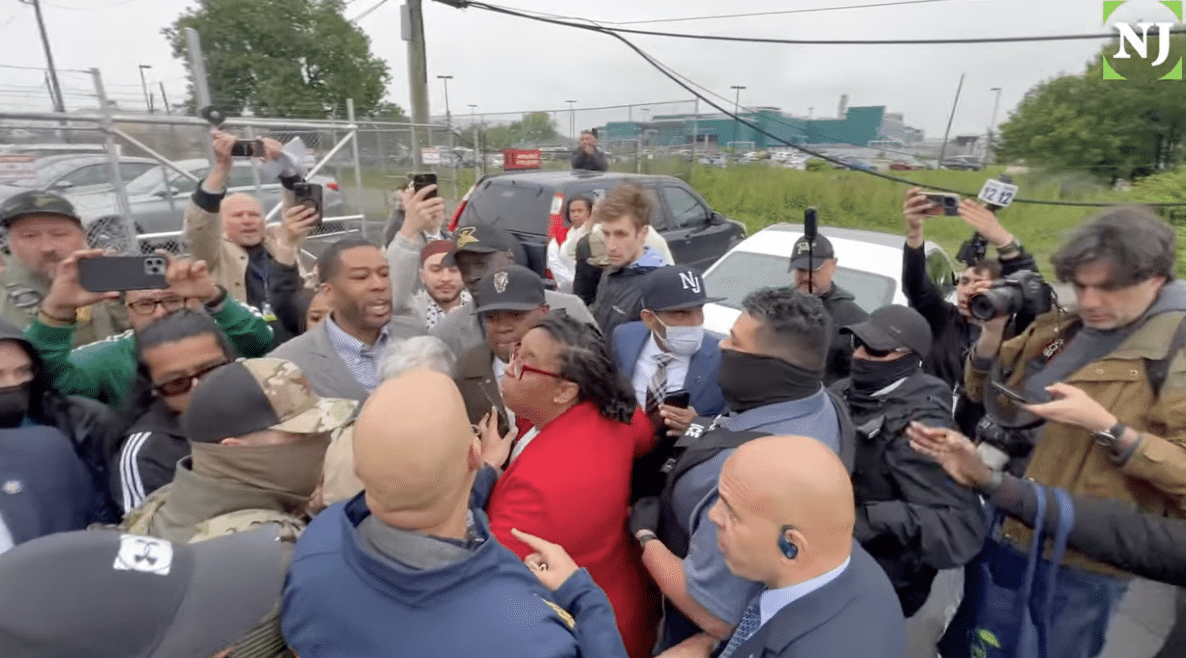
Today was a big day in New Jersey. It was the day that both Congresswoman LaMonica McIver and DOJ had to submit supplemental fillings in McIver’s case about whether the second of three charges against her fit entirely within her duties of oversight as a Congressperson.

It was also the day after Alina Habba finally gave up play-acting as US Attorney in the wake of the Third Circuit ruling that such play-acting was unlawful, something that sane-washing journalists inaccurately called a resignation.

Indeed, the most interesting thing about the government’s response was that it was signed by the guy, Phillip Lamparello, Pam Bondi installed to oversee criminal matters as part of her contemptuous refusal to permit a US Attorney be appointed in a legal manner (which may be why Todd Blanche remains on these filings, because this is still bullshit).

Otherwise, that motion complained that, “the Defendant had not included among her exhibits the video footage that most clearly depicted the events described in Count Two.” It argued that physical contact initiated by ICE was just a continuation of what happened outside the gate.

The Defendant’s actions as alleged in Count Two were simply the continuation of her actions in Count One, albeit with a different individual being subject to her ongoing efforts to interfere with the Mayor’s arrest.

And it argued that when ICE assaults members of Congress it still must be treated as an assault on ICE unprotected by Speech and Debate.

The Government respectfully asserts that any assault upon a federal officer should qualify as an act that is “clearly non-legislative” given that such an act is clearly an “illegitimate activity.” And it would be clearly non-legislative whether the arrest that triggered the assault took place outside the Security Gate or inside of Delaney Hall.

By contrast to the government’s terse 9-page response, McIver’s 19-page supplemental brief cites ten videos and two sealed Signal chats.

2. Exhibit X is a true and correct copy of a signal chat produced by the U.S. Attorney’s Office as part of a folder titled USA-000353, including participants from DHS and HSI. This exhibit will be filed under seal pursuant to a protective order signed by the parties and entered by the Court. See ECF No. 38.

3. Exhibit Y is a true and correct copy of a signal chat produced by the U.S. Attorney’s Office as part of a folder titled USA-000334, including participants from HSI. This exhibit will be filed under seal pursuant to a protective order signed by the parties and entered by the Court. See ECF No. 38.

Most of McIver’s filing conducts a second-by-second analysis of the video, showing that when she got back inside the gate she immediately headed towards the facility and not to where Mayor Baraka was being arrested without probable cause.

But a footnote describes one of the things in those Signal chats (another appears to have been notice that McIver and her colleagues said they were there to conduct oversight).

It wasn’t until November 26 — almost two weeks after Judge Jamel Semper ruled on McIver’s immunity bid —  that DOJ turned over texts copying this video, observing that it looked bad.

5 The Spotlight News video came to light during the course of supplemental briefing only because it was referenced in a May 9, 2025, text message that the government finally turned over on November 26, 2025. HSI special agents exchanged the video in that May 9 conversation, where the agents also acknowledged that the evidence in the video was “bad.” Ex. Y at 2-3. The prosecution team therefore clearly knew about the text messages (and thus the video) when disclosures were due in July.

McIver’s lawyer, Paul Fishman, says he will address this delayed discovery in a follow-up letter.

Inexplicable delays in the government’s discovery productions mean that the record continues to be developed.1

1 Congresswoman McIver will detail these shortcomings in a forthcoming letter to the Court.

But the implication of this is clear.

DOJ was never going to turn over these discussions — conducted on Signal — until Judge Semper ordered this supplemental briefing. They were sitting on evidence that shows that before DHS first started calling McIver’s actions an assault on May 10 (McIver had to ask to have these Tweets taken down, but the timeline is in her motion to do so), they had shared video noting that their own actions looked bad.

Over and over this year, DHS has assaulted opponents of ICE and then charged them for it. And these Signal texts sure seem to support that they knowingly did the same thing with Congresswoman McIver.

And then buried it in a discovery violation.

Update: At the status hearing pertaining to these filings, which was on November 17. McIver’s attorneys complained they were getting screen shots of Signal texts collected by Agents rather than texts with actual metadata from the posts.

Your Honor, I will just tee up that we have, you know, that there is certainly going to be an issue with respect to the government’s messages. We have received a partial production of the messages. I believe it is 54. And, you know, we are going to be, you know, we are preparing a letter to send to Your Honor. We have had some dialogue —

THE COURT: The text messages between the agents on the day in question?

MR. CORTES: That is correct, Your Honor. We have gotten 54 of them. They are a mish-mash of things of what appear to be Signal chats. Some of which seem like text messages. We have gotten a few emails.

But the broader issue I think, Your Honor, and just to preview it, obviously, I will put this in writing because I don’t — I want Your Honor to have the complete take, and, obviously, the government is going to have responses; but just as an overview, Judge, the messages that we have gotten, appear to be messages that the agents themselves searched for on their devices, applying search terms that the government tells us that they supplied to the agents, but they would not share with us the entirety of what those search terms were.

And then the agents took their devices and took photographs, screen shots of the messages that were responsive to the search terms that they applied. And then provided that to the government. And the government provided us a selection of those screen shots.

This led the AUSA to ask Judge Semper to provide clear guidelines of what they should be turning over, which led to this colloquy.

MR. CORTES: That I — One, the government, that the prosecutor, the A.U.S.A. should be the one conducting this search, applying the search term, applying, you know, conducting the review. Right? They should be the ones conducting the review.

THE COURT: Yes.

MR. CORTES: The other thing I would add is, if there is material before and after the visit that is dealing with how to deal with the members of the congress that are showing up or in the wake of the experience that is, that is, right, that is material, that deals with it, that deals with reactions, all of that as well.

THE COURT: Then I think we are in search term land.

MR. CORTES: Sure.

THE COURT: But for this period of time 12 and 5, Ijust think we are in, you know, what do the videos show, what do the text messages show land. And if there is something beyond that that you see, counsel, you are an officer of the court, I respect whatever representation you put before me.

You can do your search terms on the other areas outside of the block that I’ve mentioned. If there are things that relate to the congressional delegation and the visit, procedures that would occur, obviously, I’m very focused on 527, so anything that relates to that, would be fair game.

But for right now, let’s just do it quick and dirty; 12 to 5. And then anything that floats from that, that you think needs individualized assessment, come to me. I’m here

So one explanation for the late disclosure of these messages are that the Agents were withholding them in their own searches.
Share this entry

The False Claims Todd Blanche, Robert McBride, and Some Lady Impersonating a US Attorney Tell to Justify a Crime

Update: I realize that DOJ never complied with this part of Judge Kollar-Kotelly’s order.

The Attorney General of the United States or her designee is further ORDERED to certify that the United States is in compliance with this Order no later than 12:00 p.m. ET on Monday, December 8, 2025.

This court filing is a smokescreen.

DOJ — in the persons of Todd Blanche, some lady impersonating a US Attorney, and First AUSA Robert McBride — have responded to Dan Richman’s demand that they stop illegally rifling through his data.

It’s a remarkable filing for two reasons.

First, they cite a bunch of precedents claiming that one cannot use Rule 41 to thwart a prosecution. Best as I can tell, every single one of those precedents pertain to someone trying to withhold his own property to thwart his own prosecution. Michael Deaver trying to stop a Special Prosecutor investigation of himself. Paul Manafort trying to thwart a prosecution of himself. Justin Paul Gladding in a case where he was trying to get his own non-CSAM data back after a conviction. A grand jury case where the subject of the investigation tried to get his files back.

None of these apply here.

Effectively, Todd Blanche is saying Dan Richman has to lay back and enjoy digital compromise to allow the FBI to prosecute his friend and who cares if they’re breaking the law to do so.

But I’m also struck by the lies Blanche and the lady impersonating a US Attorney tell along the way. Consider this passage.

Richman served as a special government employee at the FBI between June 2015 and February 2017.1 Shortly after his departure from the FBI, the Government began investigating whether Richman had disclosed classified information to The New York Times concerning Comey’s decisionmaking process concerning the FBI’s investigation into former Secretary of State Hillary Clinton’s use of a private email server. See CM/ECF No. 1-1 at 3. The investigation demonstrated, among other things, that Comey had used Richman to provide information to the media concerning his—that is, Comey’s—decisionmaking process concerning the Clinton email investigation and that Richman had served as an anonymous source in doing so.

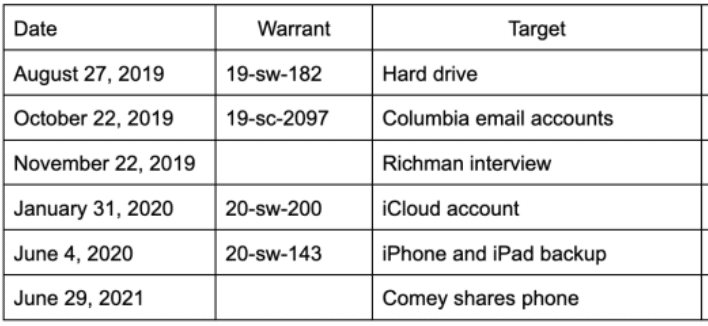
During the course of the investigation, the Government sought and obtained four search warrants in this district authorizing the Government to search for and seize evidence of violations of 18 U.S.C. §§ 641 and 793 from certain email accounts utilized by Richman, a hard drive containing a forensic image of his personal computer, and his iCloud account.2 See CM/ECF No. 1-1 at 3.

Comey provided relevant testimony to the Senate Judiciary Committee shortly before his employment as FBI Director was terminated, and again in September 2020. In May 2017, he testified in response to questioning from Senator Grassley that he had never authorized someone at the FBI to serve as an anonymous source regarding the Clinton email investigation. And in September 2020, he reaffirmed that testimony in response to questioning from Senator Cruz.

1 The government has provided the concise factual summary herein out of an abundance of caution as a result of the Court’s December 6, 2025 temporary restraining order (the “TRO”). See CM/ECF No. 9 at 4. Should the Court have meant the TRO to permit the government to use materials obtained via the relevant search warrants as part of this litigation, the government is prepared to provide a more detailed factual summary if necessary.

2 The investigators sought to obtain evidence of violations of 18 U.S.C. § 641 because it appeared that Richman and Comey were using private email accounts to correspond regarding official government business, i.e., that their correspondence were “record[s]” of the United States. See id.

First, the passage makes a confession, one that Lindsey the Insurance Lawyer Impersonating a US Attorney’s Loaner AUSAs never made: the use of May 2017 files involving attorney-client privilege had no basis in the prosecution, because they long post-dated the time Dan Richman left the FBI.

The filing misstates the genesis of Arctic Haze and the focus on Dan Richman. The investigation didn’t start by focusing on Richman. The focus on Richman appears to have started when John Durham discovered his communications while rifling through the image he shared with the Inspector General (a detail that seems quite sensitive, given the redactions).

The claim that the investigation demonstrated that Comey used Richman,

to provide information to the media concerning his—that is, Comey’s—decisionmaking process concerning the Clinton email investigation and that Richman had served as an anonymous source in doing so.

Is not backed by anything in the public record. Richman was not anonymous when doing this in fall 2016, and there’s no evidence that Comey asked Richman to do this in February 2017, where he was also an on-the-record source.

This filing obscures the fact that when Comey told Chuck Grassley he had not leaked anything anonymously, it preceded the time when Richman did share his memos anonymously, and he disclosed that publicly a month later, meaning it could not conceivably have been a lie on May 3, 2017 (before he shared the memo) or after June 8, 2017, in September 2020, because he had already disclosed it.

McBride claims he’s not using the unlawfully accessed materials in this filing, but he did disclose something new: that Richman and Comey were investigated under 18 USC 641 not because Comey shared a memo that the Inspector General would later rule was official FBI material, but because they were conducting official business on personal accounts (which is rich given that Lindsey the Insurance Lawyer masquerading as US Attorney used Signal for official business).

The lies are important for a reason beyond the cynicism: They obscure that if the FBI tried to get a warrant for these very same files, they would never be able to access the files they want.

And so they’re telling Dan Richman to just lay back and enjoy the Fourth Amendment violations.

Update: Richman’s response says exactly what I did (but in fancy lawyer-speak): The citations DOJ relied on all pertain to someone trying to get their own content back to prevent their own prosecution.

[I]n every single case cited by the government on this point, the movant was the target of an active investigation or the defendant in a charged criminal case. See In re Sealed Case, 716 F.3d at 604, 607 (observing that “the [DiBella] Court . . . found that each motion was tied to a criminal prosecution in esse because both movants had been arrested and indicted at the time of appeal” and that the movant in the case before it was “the subject of an ongoing grand jury investigation”) 6 ; Martino v. United States, 2024 WL 3963681, at *1 (3d Cir. Aug. 28, 2024) (movant was the “subject of an ongoing grand jury investigation” and brought a Rule 41(g) Motion tied to “his criminal prosecution”) (emphasis added); United States v. Nocito, 64 F.4th 76, 79 (3d Cir. 2023) (movant entities were owned by person charged with crime); In re Grand Jury, 635 F.3d 101, 105 (3d Cir. 2011) (finding DiBella’s second requirement met because “the property was seized in connection with an ongoing grand jury investigation of which the appellant is a target”) (emphasis added); In re Warrant Dated Dec. 14, 1990 & Recs. Seized From 3273 Hubbard Detroit, Mich. on Dec. 17, 1990, 961 F.2d 1241, 1242 (6th Cir. 1992) (involving “records . . . sought in connection with a criminal investigation of the appellants for tax evasion, filing of fraudulent tax returns, and conspiracy”).

Professor Richman is not a subject, target, or defendant. Though the government elides this fact, it bears repeating: because Professor Richman is not a prospective criminal defendant, he has no suppression remedy to address an ongoing violation of his constitutional rights. His property was seized five years ago, pursuant to warrants tied to a separate and since concluded investigation, and there is no indictment and no pending criminal case.

I actually think they might envision including him in a Grand Conspiracy indictment. But they’re pretending they’re not currently working on this and so got too cute for their own good — he notes that they twice dismissed his claims of irreparable harm because he was only at risk of being a witness at trial.

Share this entry

White Man’s Burden: Trump Is Failing Six of Ten Metrics on His Own Open Book Test

One reason I laid out what Stephen Miller and Trump’s other sad little advisors think they’re doing in their National Security Strategy is because once you do that, it makes it even more clear that their overestimation of their own competence is dooming the United States.

Fully seven pages of the short (33 pages as compared to Trump’s 68-page 2017 NSS and Sleepy Joe Biden’s 48-page 2022 one) document blather about what it is trying to accomplish: two pages announcing the adoption of utilitarianism over values, two laying out what the US should want, another laying out what Trump thinks the US wants from the world, and two more laying out what means the US has to get there.

This is the work of a bunch of men who imagine they are competent telling everyone who came before them that they were doing things wrong.

Yet by laying all that out — by writing down what they imagine competence would deliver — they make it clear how badly they’re screwing up.

Effectively, Donald Trump has already done significant, if not grave, damage to six of the ten things that Trump claims America wants:

  1. Continued survival of US sovereignty
  2. Protect the country from human trafficking, foreign influence, propaganda, and espionage
  3. “A resilient national infrastructure that can withstand natural disasters, resist and thwart foreign threat”
  4. The most dynamic economy
  5. A robust industrial base
  6. Unrivaled soft power that “believe[s] in our country’s inherent greatness and decency”)

Start with the obvious ones.

Donald Trump and Marco Rubio and Elon Musk spent the first six months of this Administration trashing America’s soft power. These boys seem to imagine they can replace it with something that “believe[s] in our country’s inherent greatness and decency.” Except no one else will believe in American decency after it suddenly withdrew funding that resulted in the deaths of 600,000 people, two thirds of them children. People won’t trust you after you renege on paying the bills.

Or consider that 2nd bullet, which reads this way:

We want to protect this country, its people, its territory, its economy, and its way of life from military attack and hostile foreign influence, whether espionage, predatory trade practices, drug and human trafficking, destructive propaganda and influence operations, cultural subversion, or any other threat to our nation.

Of course, Trump claims to combat drug trafficking with his murderboat killings, even while he lets increasingly major drug criminals out of prison.

As for the rest? On her first day in office, the Attorney General stopped policing foreign influence, destructive propaganda, and influence operations; then Kristi Noem piled on by shutting down other programs combatting foreign influence and propaganda.

And, as an endless stream of stories reveal, both Pam Bondi and Noem have reassigned those who would hunt spies and human traffickers to go hunt undocumented grannies and day laborers instead.

Worse, the priority on weaponization has resulted in the loss of those people. Just the firing of a bunch of people who took a knee during the George Floyd protests to deescalate resulted in the firing of a counterintelligence Deputy Assistant Director and a supervisor.

a. In late March 2025, Plaintiff Jane Doe 5 was informed that she was being removed at the direction of Defendant Patel from her position at FBI Headquarters as a Deputy Assistant Director for the FBI overseeing counterintelligence at the direction of Defendant Patel because she kneeled on June 4, 2020. Plaintiff Jane Doe 5 had been specifically identified in then-Representative Gaetz’s letter. Plaintiff Jane Doe 5 retained her SES status but was demoted to a Section Chief position.

b. In April 2025, Plaintiff Jane Doe 6 was serving as the Legal Attache for the FBI based overseas along with her family. In that capacity, Plaintiff Jane Doe 6 had previously provided briefings to Defendant Patel with which he said he was very impressed. Nevertheless, on April 3, 2025, an FBI senior leader informed her that she was being removed from her term position in the Senior Executive Service to a non-Senior Executive Service position, abruptly uprooting her entire family and resulting in a significant pay decrease. The FBI senior leader informed Plaintiff Jane Doe 6 that Defendant Patel had indicated that his mind was made up and could not be changed.

c. In April 2025, Plaintiff Jane Doe 9 was demoted from her position as a supervisor overseeing all FBI ransomware and malware investigations. An FBI senior leader informed her that the demotion came straight from top level FBI leadership.

d. In April 2025, Defendant Patel directed the removal of Plaintiff Jane Doe 8 from her position supervising a counterintelligence squad.

There were even greater losses in DHS’ purges.

That’s part of the problem with bullet 3: The NSS’ grand plan to make America’s infrastructure more resilient. Along with gutting those who protect against foreign influence, Noem has gutted those who protect against hacking and natural disasters.

As for bullets 4 and 5? Trump’s trade war has had the opposite effect than he claimed it would, with historic layoffs and struggling manufacturing and small businesses.

Again, Trump did affirmative damage rather than achieving his goals.

Then there’s the question of sovereignty.

For all its yapping about America First, the NSS doesn’t deal with the way that Trump has been trading away America’s advantages to any rich foreigner with millions in cryptocurrency. Just yesterday, for example, Trump approved the sale of one of Nvidia’s most complex chips to China on the same day Houston’s US Attorney rolled out showy prosecutions for Chinese men accused of illegally exporting those very same chips.

“The United States has long emphasized the importance of innovation and is responsible for an incredible amount of cutting-edge technology, such as the advanced computer chips that make modern AI possible,” said Assistant Attorney General for National Security John A. Eisenberg. “This advantage isn’t free but rather the result of our engineers’ and scientists’ hard work and sacrifice. The National Security Division, along with our partners, will vigorously enforce our export-control laws and protect this edge.”

Alan Hao Hsu aka Haochun Hsu, 43, Missouri City, and his company, Hao Global LLC, both pleaded guilty to smuggling and unlawful export activities Oct. 10.

According to now unsealed court documents, between October 2024 and May 2025, Hsu and others knowingly exported and attempted to export at least $160 million worth of export-controlled Nvidia H100 and H200 Tensor Core graphic processing units (GPUs).

Trump already authorized the export of even more complex chips to Saudi Arabia and Abu Dhabi, the same sovereigns backing Paramount’s hostile bid to take over a big chunk of the US entertainment industry (that’s after China’s Tencent was dropped).

And these are just the areas where Trump has most obviously failed his own standards.

He built in a gimme in those standards he actually accomplished by claiming to want nuclear deterrent but then stating, falsely, that the Golden Dome would deliver such a deterrent.

We want the world’s most robust, credible, and modern nuclear deterrent, plus next-generation missile defenses—including a Golden Dome for the American homeland—to protect the American people, American assets overseas, and American allies.

Mark Kelly explained how unrealistic this effort was months ago.

And as for the hope that the rest of the world will use American technology, one of the things Trump wants from the rest of the world?

We want to ensure that U.S. technology and U.S. standards—particularly in AI, biotech, and quantum computing—drive the world forward.

As for those chips Trump cleared for sale, China is limiting their use.

As for American biotech, the rest of the world is instead importing America’s scientists who’ve been defunded as part of Trump’s anti-intellectual purges.

There’s plenty else in this NSS (such as other references to America’s technical superiority) where the boys aspire to have skills they affirmatively destroyed.

As such, the NSS isn’t so much a strategy (a word they scare quote when they define it): it’s a confession that these self-declared competent people are failing to meet their own standards.

Share this entry

The National Security Strategy’s Structure and Presumptions

Last week, the Trump Administration released the National Security Strategy that was dated from the month before.

In an effort to highlight how the Administration — no doubt led by Stephen Miller and his fascist allies — claims to have adopted a utilitarian foreign policy stemming from things called principles and based on wildly imaginary assessment of America’s current strengths, this post will lay out what is in it. (Note, the titles are links.)

Follow-ups will say more.

Pages 2-3: My fellow Americans

This is a letter from Trump bragging about what he claims his accomplishments since Biden left are. They include:

  • Restoring borders (this does not explicitly talk about immigration)
  • Kicking qualified trans service members and other “DEI” hires out of the military
  • Making NATO allies pay 5% in defense costs
  • Getting Congress to pay $1 trillion for a Golden Dome that won’t work
  • Launching a trade war that has devastated soybean farmers, bankrupted many small businesses, and allowed China to acquire leverage by withholding rare earth products
  • Attacking Iran’s nuclear facility and claiming the attack did more damage than it did (this makes no mention of the inconclusive attack on the Houthis or the murderboat strikes)
  • Forcing Americans to prefer oil and gas over strategically smarter renewable energy
  • Ending eight wars (he claims)

Among the things this letter does not mention is destroying USAID and America’s soft power, and obviously it treats some of the grave damage Trump has done with his trade war and attacks on science and universities as strengths.

Page 4: Contents

Pages 5-6: Ends over Values

Two pages describing that the US has been doing everything wrong since the Cold War, chasing “platitudes” (also known as values) rather than desired ends.

Pages 7-8: What Should the US Want

These two pages describe a bunch of things it claims the US should, normatively, want.

Just half of these are things Trump has actually pursued (and even there, some of Trump’s policies have gone beyond what Trump says is ideal):

  • ¶3 Secure borders and controlled immigration
  • ¶5 A lethal military in which everyone is proud of their mission
  • ¶6 A Golden Dome
  • ¶10 A reinvigorated American culture (code for white nationalism)

More than half of these are things Trump has affirmatively destroyed:

  • ¶1 Continued survival of US sovereignty
  • ¶2 Protect the country from human trafficking, foreign influence, propaganda, and espionage
  • ¶4 “A resilient national infrastructure that can withstand natural disasters, resist and thwart foreign threat”
  • ¶7 The most dynamic economy
  • ¶8 A robust industrial base
  • ¶9 Unrivaled soft power that “believe[s] in our country’s inherent greatness and decency”)

Page 9: What do “we” want from the rest of the world?

  • A Trump corollary to the Monroe Doctrine
  • Halt damage an unnamed China has done while keeping stability in Indo-Pacific and keeping shipping lanes free and supply chains secure
  • Impose Stephen Miller’s idea of civilizational identity on Europe
  • “[P]revent an adversarial power from dominating the Middle East, its oil and gas supplies, and the chokepoints through which they pass while avoiding the ‘forever wars’ that bogged us down”
  • “[E]nsure that U.S. technology and U.S. standards—particularly in AI, biotech, and quantum computing—drive the world forward”

Note, this section parallels the discussion of regions, below, with the exception of laying out how the US will remain the standard-setter in the world by being an asshole and adopting crank conspiracies.

Pages 10-11: What are America’s means to get these ends?

This includes a list of things the US did have when Trump took over (I’ve italicized those which he has squandered, though there are others he is squandering):

  • A still nimble political system that can course correct;
  • The world’s single largest and most innovative economy, which both generates wealth we can invest in strategic interests and provides leverage over countries that want access to our markets;
  • The world’s leading financial system and capital markets, including the dollar’s global reserve currency status;
  • The world’s most advanced, most innovative, and most profitable technology sector, which undergirds our economy, provides a qualitative edge to our military, and strengthens our global influence;
  • The world’s most powerful and capable military;
  • A broad network of alliances, with treaty allies and partners in the world’s most strategically important regions;
  • An enviable geography with abundant natural resources, no competing powers physically dominant in our Hemisphere, borders at no risk of military invasion, and other great powers separated by vast oceans;
  • Unmatched “soft power” and cultural influence; and
  • The courage, willpower, and patriotism of the American people.

It also includes a list of things that Trump thinks are good, which I’ve restated to reflect reality:

  • “Instilling a culture of competence:” They’ve gotten rid of brown people and women who made them insecure
  • “Unleashing our enormous energy production capacity:” They’ve forced America to stop competing in renewable energy
  • “Reindustrializing our economy:” They’ve gutted the economy with tariffs
  • “Returning economic freedom to our citizens:” They’ve exploded the deficit with tax cuts to oligarchs huge tax cuts while cutting the health care that drives the economy
  • “Investing in emerging technologies and basic science:” They’ve destroyed America’s higher educational advantage and replaced it with state socialism

The strategy

Pages 12-15: Principles [sic]

This starts with a page of shite about Trump’s greatness. Then includes the following bullets:

  • Focused Definition of the National Interest (Trump will ignore key parts of the world)
  • Peace Through Strength (white nationalism)
  • Predisposition to Non-Intervention (with excuses permitted for invasions of choice)
  • Primacy of Nations (a nice way of saying they’ll gut international organizations)
  • Sovereignty and Respect (in which the NSS protects projecting “free speech” demands into other sovereign nations)
  • Balance of Power (China and Russia can extend their power so long as they allow America to do the same)
  • Pro-American Work (claims utterly inconsistent with Trump’s catering to oligarchs)
  • Fairness (code for making NATO, Japan, and South Korea pay more)
  • Competence and Merit (White men should not have to compete with brown people and women, and especially should not have to compete with H1B holders)

Pages 15-19: Priorities

  • The Era of Mass Migration Is Over: “Border security is the primary element of national security”
  • Protection of Core Rights and Liberties: This is defined as “the rights of free speech, freedom of religion and of conscience, and the right to choose and steer our common govern,” but apparently does not include due process or similar rights for Europeans or the Anglosphere
  • Burden-Sharing and Burden-Shifting: “The United States will stand ready to help— potentially through more favorable treatment on commercial matters, technology sharing, and defense procurement—those counties that willingly take more responsibility for security in their neighborhoods and align their export controls with ours.”
  • Realignment Through Peace: The President will intervene everywhere and claim to have fostered peace
  • Economic Security
    • Balanced Trade
    • Securing Access to Critical Supply Chains and Material
    • Reindustrialization
    • Reviving our Defense Industrial Base: We need to build drones in the US cheaply
    • Energy Dominance (in oil, gas, coal, and nuclear, explicitly)
    • Preserving and Growing America’s Financial Sector Dominance

Page 19: The Regions

A half page excusing largely ignoring key swaths of the world, as when you dedicate just a half page to Africa or mention Russia only in a section discussing Europe not as a place but a greatness to be imposed from outside.

Pages 19-23: Western Hemisphere: The Donroe Doctrine

  • Enlist: Treat a swath of countries as agents insofar as they can help stop the movement of people and drugs
  • Expand: Eight paragraphs on combatting “foreign influence” not named as Chinese, and three paragraphs imagining this can be driven by corporate investment

Pages 23-29: Asia: Win the Economic Future, Prevent Military Confrontation

  • Leading from a position of strength: Asia has gotten strong through manufacturing and we will combat that with false platitudes
  • Economics: the Ultimate Stakes: A claim that Trump’s disastrous trade policy will bring results the opposite of what have happened
  • Deterring Military Threats: A lot of talk about deterrence, some in passive voice

Pages 29-31: Promoting European Greatness

These are the two pages attracting the most attention, and I will return to it. Note that Europe is not described as a place, like the other regions are. The only mentions of Russia (ten) are in this section, and Russia is defined as not-Europe (and therefore not addressed as a region at all).

Pages 31-33: The Middle East: Shift Burdens, Build Peace

This section claims the Middle East is no longer as important because it is not longer the dominant energy producer, and then explains that major conflicts (including radicalism) are no big deal anymore.

Half of page 33: Africa

Africa will not get aid. It will get investment and Trump claims of peace deals.


Share this entry

Judge Colleen Kollar-Kotelly Asks DOJ for Signs of Life

Judge Colleen Kollar-Kotelly granted Dan Richman his request for a Temporary Restraining Order, preventing the government from snooping in his stuff, one that goes through Friday. And while I agree with Gerstein and Cheney (and Bower and Parloff) that it could have the effect of thwarting another indictment of Jim Comey — indeed, it may undercut an attempt to stonewall Richman — I find KK’s order interesting for other reasons.

Partly, it’s the way she’s demanding signs of life from DOJ.

Judge KK attempts to forestall a stonewall

As a reminder, Judge Cameron Currie threw out the indictment against Jim Comey on November 24, the Monday of Thanksgiving week. Two days later, the day before Thanksgiving, Richman cited that dismissal and the expired Statute of Limitations in his bid to get his data back. As far as I know, no one noticed it until Anna Bower pointed to it on Tuesday.

Notably, Richman attached the warrants used to obtain his records as sealed exhibits.

The same day Bower noted it (the day it was assigned), December 2, Judge KK issued an order, half of which dealt with Richman’s sealing request, which she provisionally granted. But she also told him that if he wants to keep the government out of his data, he needs to get a Temporary Restraining Order. Her order emphasized that that request must submit some sign of life from DOJ.

Finally, Petitioner Richman’s 1 Motion requests that this Court “issue a temporary restraining order enjoining the [G]overnment from using or relying on in any way” the materials at issue in his 1 Motion while this matter is pending. Consistent with Local Rule of Civil Procedure 65.1, it is ORDERED that Petitioner Richman shall file his application for a temporary restraining order by separate motion, accompanied by a certificate of counsel that either (1) states the Government has received actual notice of the application and “copies of all pleadings and papers filed in the action to date or to be presented to the Court” in connection with the application; or (2) identifies “the efforts made by the applicant to give such notice and furnish such copies.”

A Certificate of Service Richman filed later that day explains part of the reason KK made that order: For some reason, the motion was not docketed. So, Richman attorney Mark Hansen explained that he formally served Jocelyn Ballantine and DC USAO on December 1.

This Corrected Certificate of Service corrects the service date listed for the public redacted Motion for Return of Property and accompanying attachments, see ECF No. 1 at 3, and the sealed version of that Motion with accompanying attachments, see ECF No. 2, from November 26, 2025, to December 1, 2025. Although Petitioner filed those papers on November 26, 2025 and intended to serve them on that date, the filings were not docketed at that time. I promptly caused the filings to be served on counsel for respondent upon receiving notification from the Clerk’s Office, on December 1, 2025, that the filings had been accepted for submission and docketed.

But to comply with the other part of her order, Richman’s attorneys also included the emails they exchanged with Ballantine. And among the things those emails showed is that after agreeing to attorney Nick Lewin’s midafternoon December 3 request to respond by close of day on December 4,

Based on the government’s use of such property in connection with the Comey case (as described in Judge Fitzpatrick’s November 17, 2025 opinion), we are concerned that, absent a TRO, the government may continue to use the property in a manner that violates Professor Richman’s rights – particularly in light of recent news reports that the DOJ may seek a new indictment of Mr. Comey. However, if the government has no such intention and will agree to refrain from searching, using, or relying in any way upon Professor Richman’s property pending resolution of the Rule 41(g) motion, that would address our concerns and obviate the need for a TRO.

Please let us know the government’s position by COB tomorrow.

[snip]

Nick,

Thanks for your email. I will reach out to the appropriate people at DOJ with your request and will respond to you tomorrow by COB.

Jocelyn

Ballantine had not responded by 9PM on December 4.

Hi Jocelyn,

Did you get an answer? Please let us know.

Ballantine had a good excuse: she was busy prosecuting accused pipe bomber Brian Cole. Nevertheless, when she did respond at 9:12PM Thursday night, she said that her leadership — Jeanine Pirro — had already engaged with DOJ leadership (Bondi spent part of Thursday with Pirro bragging about the pipe bomber arrest), but she would not have an answer until “early next week.”

Thank you so much for the prompt. I met with my leadership today, and they have engaged Department of Justice leadership. I have also shared your pleadings and request with the prosecutors who handled the Comey prosecution out of EDVA.

I do not have an answer for you this evening, but I expect to have one early next week.

That’s what led Richman to file his motion for a TRO, maybe around 10PM Friday night. Judge KK responded just under a day later.

Her order specifically ruled that DOJ knows about Richman’s request.

Third, the Court finds that the Government has received actual notice of Petitioner Richman’s [9] Motion, ensuring that the Government is positioned to act promptly to seek any appropriate relief from this Order. Specifically, counsel for the Government may move to dissolve or modify this Order immediately upon entering an appearance, and the Court will resolve any such motion “as promptly as justice requires.” Fed. R. Civ. P. 65(b). Under the circumstances, the Court will allow and consider such a motion at any time upon contemporaneous notice to counsel for Petitioner Richman. See id. (providing that such a motion may be filed “[o]n 2 days’ notice to the party who obtained the order” or “on shorter notice set by the court”).

And barring the government requesting a different schedule, Judge KK’s order set up the following schedule:

  • Richman should “promptly” serve Judge KK’s order and everything filed in the docket to Pam Bondi (KK identifies Bondi by title specifically).
  • By noon on Monday, “the Attorney General of the United States or her designee” must confirm “the United States,” so everyone!, is in compliance with KK’s order not to “access … share, disseminate, or disclose” Richman’s data “to any person.”
  • By Tuesday at 9AM, DOJ must respond to both of Richman’s requests.
  • He must reply by 5PM that day.
  • The order will expire at 11:59PM on Friday night if Judge KK has not issued an order first.

If DOJ follows Judge KK’s order, then it will have the effect of:

  1. Slightly accelerating the response deadline for DOJ, which may have been due sometime on Tuesday anyway, while dramatically accelerating Richman’s reply, which is now due that same day.
  2. Flip the default status of Richman’s data, restricting DOJ from accessing it before Judge KK issues an order rather that allowing them to access it until any such order is in place.

In other words, the government can’t stall Richman’s effort in a bid to use the data in the interim. If DOJ follows the order, then it would prevent DOJ from using the data to get a new indictment before such time as Ballantine responds, “early next week.” Unless DOJ got an indictment on Friday with hopes of a big show arrest tomorrow morning, then KK would have thwarted any effort to stonewall Richman’s assertion of his rights.

If DOJ blows off the order, it’ll make it even easier for Comey to argue any indictment is malicious (unless, of course, he has to argue that to Aileen Cannon).

Did Judge KK smell a rat?

That’s the logistics of the order. The other parts of it are more interesting.

First, KK’s analysis on the TRO is cursory: just one paragraph stating that the government probably has violated Richman’s Fourth Amendment rights by searching his data without a warrant.

The Court concludes that Petitioner Richman is likely to succeed on the merits of his claim that the Government has violated his Fourth Amendment right against unreasonable searches and seizures by retaining a complete copy of all files on his personal computer (an “image” of the computer) and searching that image without a warrant. See United States v. Comey, No. 1:25-CR272-MSN-WEF, 2025 WL 3202693, at *4–7 (E.D. Va. Nov. 17, 2025). The Court further concludes that Petitioner Richman is also likely to succeed in showing that, because of those violations, he is entitled to the return of the image under Federal Rule of Criminal Procedure 41(g).

That’s on the third page of the four-page memo.

Before she gets there (and in addition to formally finding that DOJ has notice of Richman’s request), she focuses on the way DOJ is playing dumb. She notes she has spoken to unnamed people from DC USAO, who were helpful on administrative matters, thank you very much.

First, although the Court has been in communication with attorneys from the U.S. Attorney’s Office for the District of Columbia, 1 the U.S. Attorney’s Office for the District of Columbia has not yet entered an appearance to make representations on behalf of the Government, and counsel for the Government has not yet been identified. See Pet’r’s Ex. A, Dkt. No. 9-2.

1 These attorneys have helpfully facilitated communication on administrative matters. The Court appreciates counsel’s prompt assistance on these matters.

But no one, including Jocelyn Ballantine, wants to put their name on this docket.

And that’s a problem, Judge KK notes, because until someone files notice of appearance, there’s no formal way to start figuring out who has the data.

Second, the Government has not yet indicated who has custody of the material at issue, and neither the Petitioner nor the Court can determine the identity of the custodian until the Government appears in this case. Given that the custody and control of this material is the central issue in this matter, uncertainty about its whereabouts weighs in favor of acting promptly to preserve the status quo.

Maybe it’s something those helpful DC USAO personnel told her. Maybe it’s the way Ballantine deftly shared Richman’s motion with the Loaner AUSAs at EDVA, but not the DOJ leadership with whom Pirro had consulted by late day Thursday.

It’s like Colleen Kollar-Kotelly suspects DOJ is hiding the ball, and that’s why she ordered Richman to go right to the top with his request, to ensure Pam Bondi can’t pretend she’s ignorant of his request.

The perma-sealed Bill Barr dockets

There’s something else sketchy going on here.

As I noted, Richman attached the warrants used to seize his stuff. They’re still sealed and Judge KK has provisionally permitted them to remain that way.

But why are they still sealed?

Back on November 5, Magistrate Judge William Fitzpatrick ordered the Loaner AUSAs to get them unsealed or, if not, then to file a motion justifying the seal in DC.

ORDERED that the Government shall, on or before November 10, 2025, move in the issuing district to unseal the four 2019 and 2020 search warrants referenced in the Government’s Reply to Defendant’s Response to the Government’s Motion for Implementation of Filter Protocol (ECF 132), together with all attendant documents, or, in the alternative, file a motion in the issuing district setting forth good cause as to why the subject search warrants and all attendant documents should remain under seal, in whole or in part;

In that same order, he ordered that there’d be a discussion about unsealing all the references to the warrants in the Comey docket on November 21, which was before Judge Currie dismissed the indictment on November 24. The government was also going to have to defend keeping the filing explaining the notice given to Comey — and submitted as an exhibit to his first response to the effort to get a taint team — sealed that same day.

ORDERED that, if necessary, the Court shall hold a hearing on the pending motions to seal (ECFs 56, 72, 109, and 133) on November 21, 2025, at 10:00 a.m. in Courtroom 500, and the materials subject to those motions shall remain UNDER SEAL until further order of the Court; and it is further ORDERED that, to the extent the Government seeks to seal Exhibit A to Defendant’s Response to the Government’s Motion for Expedited Ruling (ECF No. 55-1), the Government shall file a supporting brief in accordance with Local Criminal Rule 49 on or before November 12, 2025; Defendant may file a response on or before November 19, 2025; and, if necessary, the Court shall hold a hearing on the Government’s sealing request on November 21, 2025, at 10:00 a.m. in Courtroom 500;

Best as I can tell, that never happened. For example, there are no gaps in the Comey docket hiding a sealed discussion about these sealed warrants.

And that’s interesting because when Fitzpatrick asked about all this back on November 5 — this is the hearing that led to the order to unseal the warrants — Rebekah Donaleski revealed that they asked Loaner AUSA Tyler Lemons about the warrants twice at that point, but had gotten no response.

Before we begin, what I’d like to do is — before we address the underlying issues, the government’s motion for a filter protocol, the defendant’s position, we have four outstanding sealing motions, and I do think those sealing motions will touch, at least in some way, on this motion; if not, motions that you-all are going to argue in the future. So what I’d like to do is see if we can nail down what the parties’ positions are and see if we can kind of resolve some of those sealing issues now, if possible.

As I understand it, there are four sealing motions that are outstanding. The defense has filed three; the government has filed one. All these sealing motions deal with either warrants that were issued in a sister district or one document that the government has provided to the defense in discovery.

MS. DONALESKI: Thank you, Your Honor. With respect to the one document provided in discovery, that’s our position, we have no objection. With respect to the underlying warrants which we attached to our motions, my understanding from Mr. Lemons is that he has moved to unseal those. We don’t know where — he hasn’t moved to unseal them — when. We’ve asked him twice for that information, and he hasn’t provided it. The defense’s view is that we should be entitled to proposed reasonable redactions for PII of those warrant affidavits and warrant materials. We have asked for an opportunity to do that and have not heard from the government. So our position is, the information in our motions, in the motion papers themselves, we have no objection to that being under seal — to that being publicly filed; but with respect to the warrants, which my understanding is those remain under seal by the District of D.C. court, we would ask that we be permitted an opportunity to propose redactions with the government.

[snip]

But with respect to the information that we’ve described in our motion papers, specifically referring to the offenses at issue in the Artic Haze warrants, the dates that the warrants authorize to search, the defense believes that those should be discussed publicly and those can be discussed publicly.

THE COURT: What about the affidavits in support of the warrants?

MS. DONALESKI: Those remain under seal. I don’t expect that we’ll need to get into what is in those affidavits in this hearing today, but if the government or the Court feels differently, we’d welcome that discussion.

And when Fitzpatrick asked Lemons about the warrants, the Loaner AUSA got a bit squirmy. Lemons had asked the AUSA to unseal the warrants. He had not filed a motion to unseal them, as if someone — maybe the AUSA in question, who may be Jocelyn Ballantine — advised him that was not a good idea.

THE COURT: Mr. Lemons, what’s the status of that?

MR. LEMONS: Thank you, Your Honor. Your Honor, we have made a request to the issuing district as to those search warrants, for them to be unsealed. My understanding, last speaking with an AUSA in that district, is that motion has not been filed at this time. They are preparing to provide notice to other potentially interested parties, per their practice and the rules they have to abide by in that district. So we requested it, and our understanding is at this time that the warrants all remain completely under seal. That is the only reason why the government designated these search warrants as protected material and filed them under seal and understands why the defense filed them under seal. If it was in my power and ability here today, those search warrants would be totally unsealed. [my emphasis]

“Preparing to provide notice to other potentially interested parties”? Who else would need notice? Richman and Comey were the ones suspected of leaking!

It has been a month but these dockets remain sealed.

One possible explanation for that is that the Loaner AUSAs (or perhaps Ballantine) filed a motion in DC on November 10 that is under seal, one that should not be sealed for Judge KK. So perhaps everyone is trying to hide the fact that after being ordered by Fitzpatrick not to access this data, Kash Patel just dealt it to someone else (possibly Jason Reding Quiñones). That might explain why Judge KK ordered the government they can only contest her order after giving “contemporaneous notice to counsel for Petitioner Richman:” because (hypothetically), having been ordered by MJ Fitzpatrick to stay out of Richman’s data, they instead dove deeper into it without telling him.

Or maybe the squirminess is about hiding how the underlying warrants were managed … by Jocelyn Ballantine.

Revealing those warrants, after all, should not thwart the effort to keep snuffling about Richman’s data, except insofar as it would raise questions not directly addressed in Judge KK’s order. Just as one example, even though Richman in his initial motion and TRO request relied heavily on Magistrate Judge William Fitzpatrick’s opinion effectively describing rampant Fourth Amendment violations, he does not mention that when the FBI seized his iCloud account in 2020, they took content through August 13, 2019, more than two years after the date of the warrant (basically, through the date of the Comey Memo IG Report release).

According to an April 29, 2020 letter from Mr. Richman’s then-attorney to the government–produced to the Court ex parte by the defense–the Department of Justice informed Mr. Richman that the data it obtained from his iCloud account extended to August 13, 2019, well outside the scope of the warrant and well past the date on which Mr. Richman was retained as Mr. Comey’s attorney. ECF 181-6 at 20. The same letter further states that the Department of Justice informed Mr. Richman that it had seized data from Mr. Richman’s hard drive that extended to June 10, 2017–again well into the period during which Mr. Richman represented Mr. Comey–despite the warrant (19-sw-182) imposing a temporal limit of April 30, 2017. Id.

Did Ballantine — in whom Pirro has invested the trust to limit the blowback of the pipe bomb prosecution — allow the FBI to obtain data outside the scope of a warrant? Are there secret John Durham warrants someone is hiding?

It’s not clear who all this squirminess is designed to protect. But I feel like, whether or not Judge KK’s order halts DOJ efforts to dive into this unlawfully collected data, it may lead to some interesting disclosures about why everyone is so squirmy.

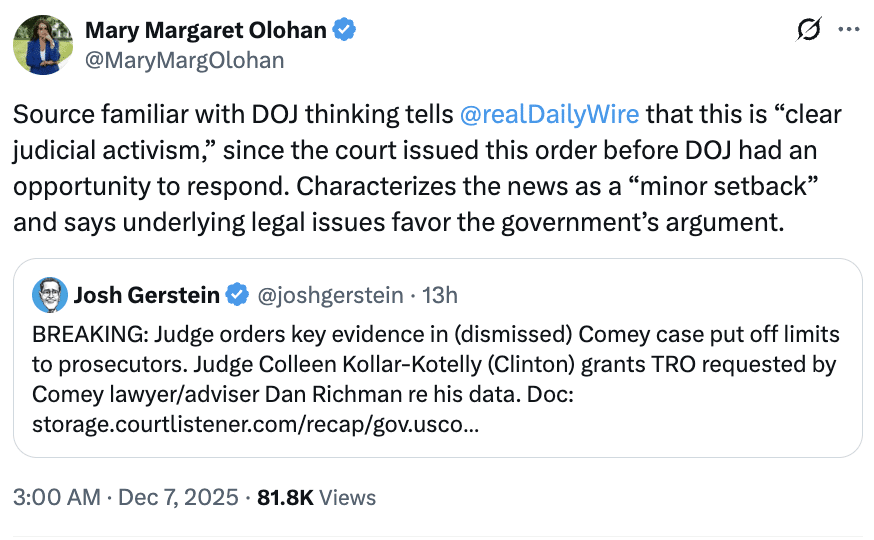
Update: Right wing propagandist (and daughter of a former whack job FBI agent) Mary Margaret Olohan gives the game away. One of her DOJ sources says this won’t be a setback … which sort of confirms that DOJ intends to continue to violate Richman’s Fourth Amendment.

Share this entry

SignalGate: “This Chat’s Kinda Dead”

DOD IG has released the unclassified version of the report confirming what was clear months ago: Whiskey Pete Hegseth has no business leading DOD.

He was wildly uncooperative with the investigation, refusing to be interviewed, refusing to let DOD inspect his phone, refusing to turn over other threads.

But Whiskey Pete may not look quite as stupid as JD Vance.

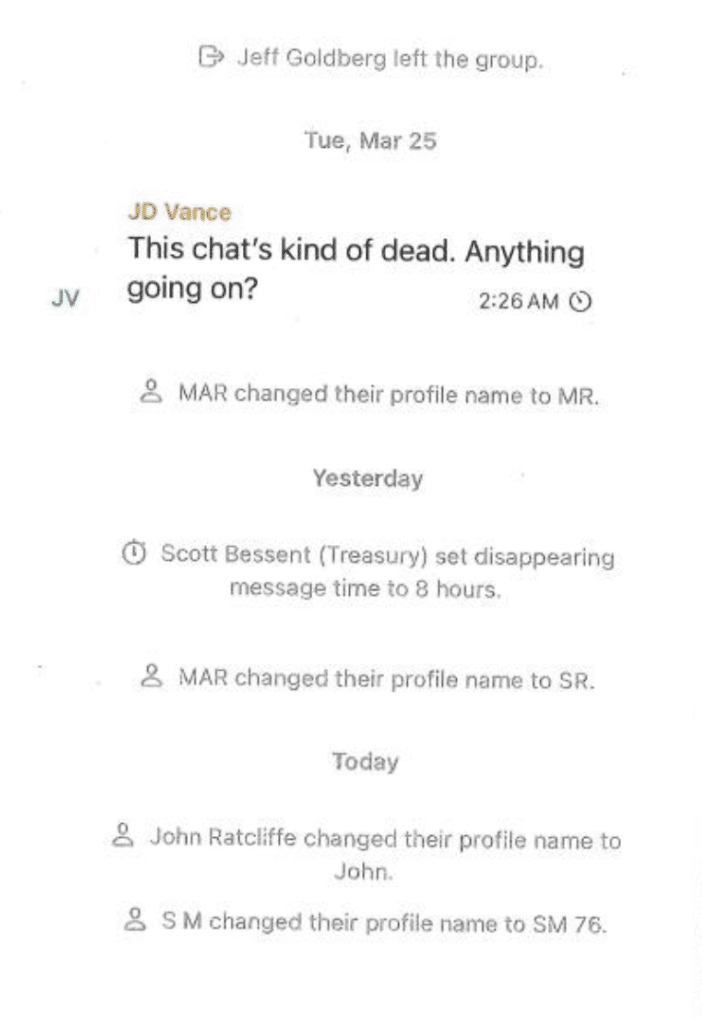
You see, Whiskey Pete turned over the Signal chat that was left on his phone after all the autodeleting these scofflaws had been doing. Most of the thread was gone. But there was a single text that post-dated Jeffrey Goldberg’s departure from the list, something the Deputy General Counsel used to suggest the Atlantic thread might not be reliable (a claim DOD IG refused to put in the body of the report because, some people still refuse bullshit).

After Jeff Goldberg left the group, JD Vance said, “This chat’s kind of dead. Anything going on?”

One after another participant on the thread changed their ID, perhaps in hopes … I don’t know what they fuck they were thinking.

These are dumb people.

No one more so, though, than JD.

Share this entry

The Hacking Hole Where John Bolton Should Be

Unless DOJ disguised him, the hack of John Bolton described in his indictment didn’t show up in the Iranian hack-and-leak indictment. It should have. After listing the 2022 attempt to assassinate Bolton (where he is described as “a former US National Security Advisor,” the indictment lists a slew of people that Iran IRGC attempted to hack (starting in 2020) and (starting in 2021) nine people it succeeded in hacking before it hacked Roger Stone and four other Trump flunkies.

Bolton should have, could have, been included along with those nine people.

As the (nifty color-coded) timeline below makes clear, Bolton told the FBI about the hack of him, on July 6, 2021, just as the Iranian hackers were setting up infrastructure to hack a set of people that include those, like Bolton, who played a role in the Qasem Soleimani assassination and Trump’s hardline first term approach with Iran.

To be sure, there are potentially good reasons why Bolton is not in there. There’s a sealed notice of related case in the Bolton docket (at docket entry 6), which could reflect charges against the people who hacked him, charges that might have been filed shortly after he alerted the FBI about the hack. Prosecutors could have left Bolton out to obscure that he told the FBI about the hack (and that therefore the FBI had been working backwards from that ever since, which is consistent with the timeline). Prosecutors could have left Bolton out because the criminal investigation into him remained open.

All plausible reasons to leave him out.

But when you put the hack and assassination targeting of Bolton on the same timeline as the hack-and-leak targeting first fellow Iran hawks and then the Trump campaign, as well as the second alleged assassination attempt by Asif Merchant, all presumed to be IRGC, it raises further questions.

First, one reason I was interested in Merchant’s disclosure yesterday that he was under surveillance from the moment he arrived in the US in April 2024 is because it suggests US spies were already well aware of the efforts to retaliate for the Soleimani killing. Indeed, the timeline explains how the FBI was magically able to get CHSes in both the Shahram Poursafi and the Asif Merchant attempt to hire hit squads to target Bolton and others: the FBI identified those people via those intercepts and flipped them early on in the plot.

It does raise questions about whether the FBI also knew of the hack-and-leak targeting Bolton in advance. The FBI would have been tracking the IRGC closely after their 2020 effort to attack Democrats under the guise of the Proud Boys (an earlier plot that makes the targeting of Proud Boy ally Roger Stone more interesting).

There is some separation between these two plots. While Poursafi eventually had access to non-public intelligence targeting Bolton, he didn’t even know Bolton’s home address at first, which he would have known if he had the emails stolen from Bolton available to him. But the hack-and-leak indictment, at least, lists as one of the goals of the hacking campaign, “to advance the IRGC’s malign activities, including ongoing efforts to avenge the death of Qasem Soleimani,” and the first hack included, of someone at State who led the Abraham Accords, implies that’s how they used, “travel, lodging and other information” from someone who was “a senior U.S. Department of State official at the time of Qasem Soleimani’s death and therefore of interest to the IRGC.” Near the tail end of the Poursafi complaint, so just weeks before the hack of that victim, Poursafi turned to another target.

But that’s the other reason this timeline is of such interest. The progression with Bolton went Hack > Extortion > Assassination Attempt. Bolton could simply have cooperated with the IRGC, but instead he went to the FBI (which has now led to his prosecution).

Trump, however did not.

It was over two months between the time hackers got into Roger Stone’s Hotmail account in May 2024 and the time the hack became public. In July, when they first became aware of the hack, the campaign affirmatively decided not to report it to the FBI.

Trump’s mistrust of federal agencies has complicated the investigation into Iran’s cyberattack on his campaign. When a technology firm first discovered the breach, campaign aides huddled to discuss what they should do. After hours of discussions in July, they decided they trusted the software experts to handle the matter and did not call the FBI. Co-campaign manager Susie Wiles, whose email account was targeted, was among those who questioned whether they could trust the Justice Department. The fears centered on giving federal officials access to campaign email servers and whether they would leak information out publicly.

As I noted at the time, Trump made that decision after relentlessly (and falsely) accusing the FBI of failing to get the server from the DNC hack. The decision was understandable (once you account for Trump’s venality and paranoia), because according to the initial reports, the hackers claim to have gotten information on Trump’s legal cases, not just his campaign.

The sender would not speak on the telephone with a Post reporter but indicated they had access to additional information, including internal campaign emails and documents related to Trump’s court cases.

And one reason that’s interesting is because — as Reuters disclosed only this summer — the lawyer targeted in the attack was Lindsey Halligan, who had no public role on the campaign but who did represent Trump on the stolen documents case.

In online chats with Reuters on Sunday and Monday, the hackers, who go by the pseudonym Robert, said they had roughly 100 gigabytes of emails from the accounts of White House Chief of Staff Susie Wiles, Trump lawyer Lindsey Halligan, Trump adviser Roger Stone and porn star-turned-Trump antagonist Stormy Daniels.

Which brings me back to Merchant, to the delay in turning over his own conversations until October 28.

Two public things might explain that delay (there are no doubt a bunch of secret things that could too): The conviction of Ryan Routh, who did have Iranian ties, though no Iranian role in his assassination attempt was publicly disclosed, and the indictment of Bolton, which disclosed that Bolton alerted the FBI to this hack back in 2021, just months before the FBI would preempt an assassination effort targeting Bolton as well.

The FBI took far greater efforts to rein in any publication of the materials stolen from Trump’s people than they ever have on another leak save WikiLeaks’ biggest document dumps. I can’t help but wonder whether there’s more about the Trump hack we weren’t told.

Timeline

December 19, 2018: Hackers establish account using Israeli politician’s name.

April 15, 2019: IRGC designated as FTO.

January 3, 2020: Trump kills Qasem Soleimani.

April 11, 2020: Hackers get an account in the name of a SCOTUS spouse.

October 22, 2020: Treasury sanctions IRGC for tampering in 2020 election.

June 16, 2021: Bolton and DOJ enter settlement on book.

July 6, 2021: Bolton representative tells FBI Iran has hacked Bolton.

July 7, 2021: Hackers register fake domain mailerdaemon.online.

July 25, 2021: Hacker threatens to release Bolton materials.

I do not think you would be interested in the FBI being aware of the leaked content of John’s email (some of which have been attached), especially after the recent acquittal. 

This could be the biggest scandal since Hillary’s emails were leaked, but this time on the GOP side!

Contact me before it’s too late…

July 28, 2021: Bolton representative tells FBI about threat.

July 29, 2021: Bolton rep tells FBI he would delete account.

August 5, 2021: Iran threatens Bolton again.

OK John … As you want (apparently), we’ll disseminate the expurgated sections of your book by reference to your leaked email…

October 22, 2021: Shahram Poursafi asks Individual A to photograph Bolton. Individual A suggests CHS.

November 9, 2021: Hackers register fake domain mailer-daemon.live. CHS contacts Poursafi; Poursafi asks if he could hire someone to “eliminate someone.”

November 14: Poursafi tells CHS he doesn’t need pictures anymore. After searching for it online, Poursafi provides Bolton’s DC office address with name of scheduling assistant.

November 18: Poursafi note with Bolton’s name, website, social media handle, and former title.

November 19: CHS asks for home address and asks how to do it.

November 21: Poursafi ups the payment to $300,000.

November 23: CHS tells Poursafi he traveled from Texas to DC; Poursafi still did not have home address, but that Bolton walked or was driven to work.

December 7, 2021: Poursafi says because of a recent failed operation, Iran did not approve payment.

December 10, 2021: Poursafi told the CHS that Bolton didn’t go outside often.

December 12, 2021: Hackers register tinyurl.ink.

December 14, 2021: Hackers create persona based on DC think tank employee and phish State employee (Victim 1). 

December 16, 2021: Poursafi asked CHS to refer to Bolton by name “Benham.”

December 20, 2021: With Bolton’s consent, CHS sent pictures of Bolton leaving his office.

December 22, 2021: Poursafi sends picture of cash he claims is for CHS.

January 3, 2022: Iranian President Ebrahim Raisi says Trump and other high ranking Trump officials need to face trial for Soleimani killing. Poursafi tells CHS the murder was not timed to coincide with anniversary of Soleimani death. Poursafi says he has a source who says Bolton is at home.

January 5, 2022: CHS tells Poursafi he would do the job on January 16 or 17.

January 7, 2022: IRGC head Esmail Ghani promises revenge.

January 10, 2022: CHS asks if Ghani’s speech was a reference to this job.

January 15, 2022: CHS claims to have three vans. Poursafi warns not to talk operational details on phone, instructs CHS to crush phone and/or change Poursafi contact to “Mark” in it.

January 18, 2022: CHS sent Poursafi public information stating that Bolton might be traveling; Poursafi said that Bolton was not. “The information does not appear to have been publicly available. POURSAFI did not specify whether his source was a person conducting surveillance, a cyber intrusion, or another type of source.”

January 20, 2022: Poursafi told CHS Bolton did not have a body guard, had not yet left town.

January 28, 2022: Poursafi instructs CHS to get surveillance cameras for Bolton’s home and office.

January 29, 2022: Poursafi instructs CHS to restore social media account.

February 1, 2022: Poursafi told CHS the area around Bolton’s home was clear.

April 13, 2022: Poursafi pushes CHS to do a second job.

April 28, 2022: Poursafi told CHS to finish the second job in six days.

April 30, 2022: Hackers create another persona, persona 3.

May 9, 2022: Jalili accesses persona 3 account, other hackers arrive in office, send test message to book author.

May 31, 2022: Hackers register mailer-daemon.me.

June 18, 2022: Hackers create persona 4, phish victim 1.

August 2, 2022: Hackers create spoof of think tank, with two more personas.

August 5, 2022: Shahram Poursafi complaint.

August 6, 2022: Hackers start stealing from victim 1, including his passport.

Early August 2022: Hackers create persona based on DC journalist/think tanker (victim 4).

August 23, 2022: Victim 4 responds to phish.

August 29, 2022 through October 5, 2022: Hackers hack former Homeland Security Advisor (Victim 5).

October 4, 2022: Hackers pose as assistant to Victim 1 to contact peace organization employee (Victim 2), using stolen passport and get Victim 2 to buy business class ticket for Victim 1.

October 26, 2022: Hackers used Victim 1 passport to query about UAE conference.

November 23, 2022: Hackers create persona based on UAE embassy employee in DC, then use account to invite Victim 1, a former senior CIA person (Victim 6), a former US Ambassador to Israel (Victim 7), and a former Deputy CIA Director (Victim 8) as well as other targeted persons to a party at UAE embassy.

December 20, 2022 to January 23, 2022: Hackers compromise Victim 6’s personal email.

January 16, 2023: Hackers create encrypted app account in the name of DC think tank employee and phish Iranian Human Rights worker (Victim 9).

April 2024: Hackers try to phish Victim 5.

April 13, 2024: Merchant arrives in Houston.

April 22, 2024: Merchant pitches CHS on business.

May 23, 2024: Hackers attempt to log into Roger Stone’s account.

May 24 ,2024: Hackers use recovery code to access Stone’s account.

June 3-4, 2024: Merchant presents plan.

June 10, 2024: Merchant and CHS meet fake hitmen.

June 12, 2024: Hackers access Stone’s account and access campaign official (Victim 11).

June 13, 2024: Merchant establishes code.

June 15, 2024: Hackers use Stone’s account to attempt to phish Victim 13 (Susie Wiles?).

June 18, 2024: Merchant arranges payment with US-based associate.

June 20, 2024: Hackers hack a second Stone account.

June 21, 2024: Via WhatsApp Merchant’s cousin arranges payment.

June 27, 2024: Hackers send Trump debate prep to two people on Biden’s campaign; neither responded.

July 3, 2024: Hackers send Trump info to another Biden associate; that person did not respond.

July 12, 2024: Merchant arrest.

July 20, 2024: Hackers use 2FA hack to access Trump lawyer [Lindsey Halligan?], Victim 12.

July 22, 2024: Hackers started pitching content to journalists, including by pitching one journalist on things campaign official said to Susie Wiles about that journalist’s reporting.

August 9, 2024: Microsoft report on Iran hack.

August 10, 2024: Politico reports hack; WaPo follows.

August 13, 2024: Hackers ousted from Victim 11 account and Victim 12 account.

August 14, 2024: Google report on Iran hack.

August 31, 2024: Hackers pitch more journalists (including me).

September 24, 2024: Iran hack-and-leak indictment.

October 2, 2024: FISA notice in Merchant prosecution.

December 20, 2024: Initial CIPA request in Merchant prosecution.

July 1, 2025: Hackers attempt to sell Susie Wiles, Lindsey Halligan, Stone, and Stormy Daniel emails.

July 11, 2025: CIPA filing in Merchant prosecution.

August 11, 2025: CIPA meeting in Merchant prosecution.

September 23, 2025: Ryan Routh guilty verdict.

October 18, 2025: Bolton indicted.

October 28, 2025: Delayed discovery provided in Merchant prosecution.

November 12, 2025: Ex parte communication in Merchant prosecution.


Purple: Shahram Poursafi complaint

Blue: Iran hack-and-leak indictment

Pink: Asif Merchant complaint

Green: Bolton prosecution


Share this entry

Asif Merchant Says EDNY Screwed Up Its Intercepts

Asif Merchant wants EDNY to provide all the spying the FBI did targeting him — or at least the spying that they say matches the calls he made while they were surveilling him.

As you’ll recall, Merchant is the Pakistani guy that EDNY arrested in July 2024 for allegedly soliciting someone to kill political targets, possibly including Donald Trump. Since then, Merchant has been sitting in prison, under communication restrictions, awaiting trial, which is currently scheduled for February 23, 2026. On October 2, 2024, DOJ informed Merchant they used FISA to find him. Just over a year ago, on December 20, 2024, DOJ kicked off the Classified Information Procedures Act (CIPA) process. It filed a CIPA Section 4 motion (where the government asks to withhold certain materials that aren’t relevant or helpful to the defense) on July 11, and met with Judge Eric Komitee about it on August 11, after which point Komitee ordered the government to provide the materials they had discussed with the Court Information Security Officer.

In a letter asking the judge to intervene in a discovery dispute, Merchant’s lawyers reveal that the initial story DOJ told — that the guy Merchant asked to help him find a hit squad simply went to the FBI which is where the FBI first learned of the plot — is inaccurate. In fact, Merchant was under FISA surveillance even before he arrived in the United States in April 2024 and he was closely surveilled the entire time he was in the US.

Discovery has revealed that Asif was under investigation before he arrived in the United States, and he was under surveillance from the moment he arrived in this country. In addition, Asif was the subject of electronic surveillance under the Foreign Intelligence Surveillance Act (“FISA”). (See Notice of Intent to Use ForeignIntelligence Surveillance Act, Docket Entry No. 20). As a result, the government is in possession of his communications which it obtained through this electronic surveillance. In addition, Asif was also under surveillance by teams of agents. The government produced reports from these surveillance teams, which indicate that Asif was constantly speaking on his phone. In addition, Asif was also under surveillance by teams of agents. The government produced reports from these surveillance teams, which indicate that Asif was constantly speaking on his phone. The government also set-up a hidden camera in a hotel room where he stayed for a number of days, which also indicates that Asif made a number of calls on his cellphone (though the calls can be difficult to hear). Both the surveillance reports and the hidden camera cover only a portion of the time between Asif’s entry into the United States and his arrest. 

On November 8, 2024, the government produced five recordings of Asif’s intercepted telephone calls. On October 28, 2025,1 Defendant received sixty-four additional audio-recordings of Asif’s telephone calls from the government. These sixty-nine recordings, however, do not match up with the phone calls noted in the surveillance reports. Moreover, given the frequency with which Asif used his phone while under surveillance and while his phone was subject to monitoring (as can be observed on the surveillance videos produced by the government, for example), the government is likely in possession of many additional recordings that have not been produced. In addition to the sixty-four recordings, the October 21, 2025, production included a number of FBI reports that were redacted.

1 The government’s cover-letter is dated October 21, 2025. (See Docket Entry No.60).

Among the many concerns Merchant’s lawyers raised was why they didn’t get this discovery until October 28 (with a letter dated October 21).

During the November 25, 2025, meet and confer, the Defense (1) expressed concerns about the timing of the October 28, 2025, production and asked why the government had not produced the recordings at an earlier date, since they appear to have been in the government’s possession throughout the pendency of this case;

But his attorneys are also asking for all the intercepts of Merchant, particularly those that match with the surveillance of him.

Both the surveillance reports and the camera recording indicate that he used his cellphone constantly. The recordings produced by the government, however, do not match the communications which occurred during the surveillance. In other words, many more recordings of Asif should exist that correspond to telephone calls noted in the reports or indicated by the footage. Second, the additional recordings are material. Asif is accused of coordinating anti-American activity and assassinations on behalf of a foreign government over the course of the approximately three months he was in the United States. The content of the recordings is relevant to show his actual activity during that time period, and the government’s refusal to produce the recordings implies that these communications do not constitute evidence of the alleged plot. On the other hand, the additional recordings would show him engaging in activity and discussing matters unrelated to the allegations in this case.

Probably, these problems simply reflect a delayed CIPA decision that they had to share the intercepts and incompetence, possibly arising from the competence drain under Trump.

But the revelation that the FBI was watching Merchant when he arrive in April 2024 is interesting for a slew of reasons, which I’ll return to.

Share this entry

Alina Habba: A Parking Garage Lawyer with $1 Million in Sanction Penalties

In the first appellate court decision on Donald Trump’s persistent effort to put Insurance Lawyers, Election Deniers, and other sundry actors play-acting as US Attorneys, the Third Circuit has unanimously ruled that Alina Habba really is nothing more than a Parking Garage lawyer.

Habba is not the Acting U.S. Attorney for the District of New Jersey by virtue of her appointment as First Assistant U.S. Attorney because only the first assistant in place at the time the vacancy arises automatically assumes the functions and duties of the office under the FVRA. Additionally, because Habba was nominated for the vacant U.S. Attorney position, the FVRA’s nomination bar prevents her from assuming the role of Acting U.S. Attorney. Finally, the Attorney General’s delegation of all the powers of a U.S. Attorney to Habba is prohibited by the FVRA’s exclusivity provision. Therefore, we will affirm the District Court’s disqualification order.

This ruling, if applied elsewhere, would cause problems for Lindsey the Insurance Lawyer, Sigal the Election Denying Laywer, and Bill the Chapman Nut, as well — including Essayli, whom a judge ruled could act as First AUSA.

Abbe Lowell, who represents Letitia James in EDVA, argued this case before the court.

The Third Circuit ruling comes even as the Eleventh Circuit ruled that Alina the Parking Garage lawyer is not only just a Parking Garage lawyer, but a frivolous one at that, sustaining the $1 million in fees on her and her liege Donald Trump.

Share this entry

Trump Fired the People Who Could Dispute His False Claims about Ukraine Aid

Trump is having a tantrum because Volodymyr Zelenskyy called out Trump for parroting Russia disinformation.

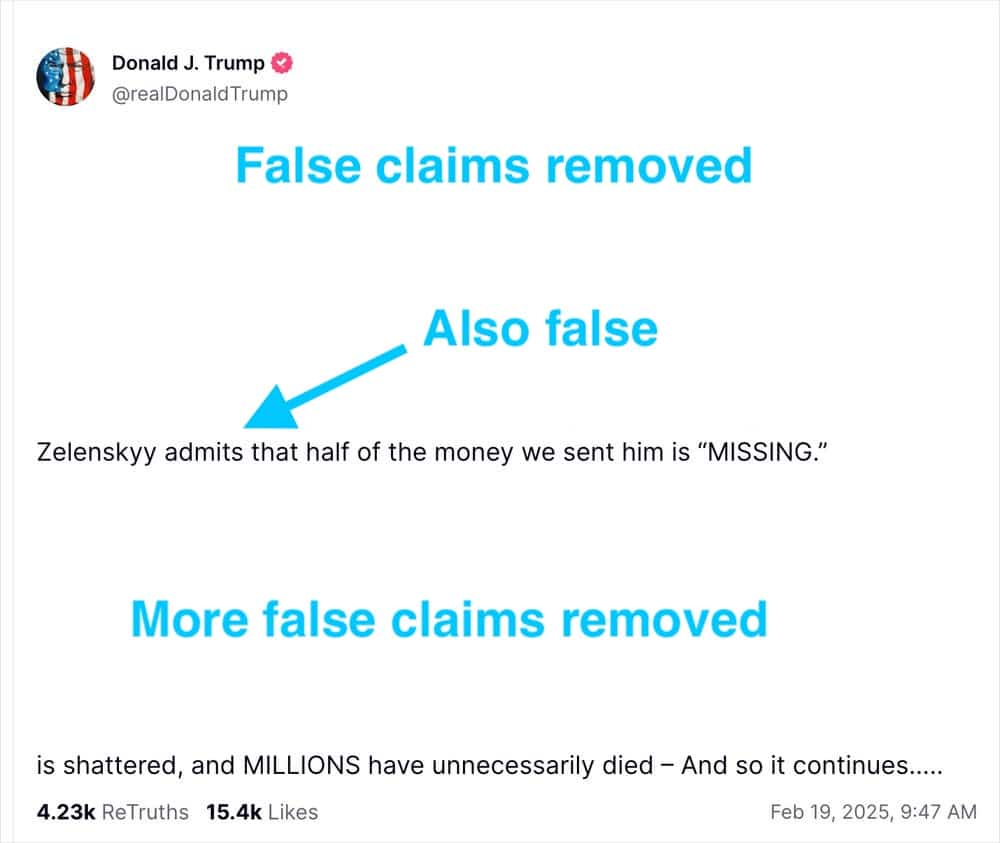
The President sent out a post riddled with false claims, including that Zelenskyy has admitted to losing half the money the US has given.

Politifact debunked that claim earlier this month (while catching Elon Musk in — gasp!! — a lie about it).

“One-hundred billion (dollars) of these 177, or 200, some people even say, we have never received,” Zelenskyy said, according to the translation of the clip. “We are talking about specific things, because we got it not with money but with weapons. We got $70 something billion worth of it. There is training, there is additional transport. There are not only prices for weapons, there were humanitarian programs, social et cetera.”

It was not clear what exactly Zelenskyy was including in his accounting of the military support Ukraine has received, but his comments align with the public data on how Ukraine aid is being spent.

The money is not missing or laundered, as some posts claimed. It’s being spent as Congress intended: on U.S. weapons manufacturing, nonmilitary support in Ukraine and support elsewhere in the region.

I’m particularly interested in the disinformation that Trump and Elon are spreading about the money Ukraine has received (though this is not new — it’s one way Trump undercut support for funding last year).

As you know, I’ve been pretty obsessed (one, two, three) by the way that Trump and DOGE have repeatedly pointed to fraud identified by some of the Inspectors General that Trump fired to substantiate their claim there are hundreds of billions of dollars of fraud to find.

Effectively, DOGE is using Trump’s own mismanagement of COVID to justify their assault on the federal government.

But that’s not the only subgroup of Inspectors General Trump targeted on his fourth day on the job. By terminating State Department Inspector General Cardell Richardson and DOD Inspector General Robert Storch, followed weeks later by Paul Martin after he released a report showing the impact of cuts on USAID, Trump has fired the main people responsible for oversight of aid to Ukraine.

Indeed, both Richardson and Storch talked about how their firing will disrupt the work of tracking the aid to Ukraine.

In his declaration submitted with their wrongful termination lawsuit, Richardson emphasized that by firing him, Trump has prevented him from continuing to supervise that oversight work.

4. The work of the OIG advances U.S. foreign policy objectives and the nation’s national security. For instance, my office was responsible for overseeing programs that provided funding to support Ukraine in its war against Russia. Overseeing programs that fund initiatives in other countries makes OIG’s work uniquely challenging.

5. This crucial work is ongoing, and my unlawful termination has prevented me from continuing to supervise it during my lawful term of office.

And Storch tied his role in supervising Ukraine funding to key national security interests. He specifically described the import of tracking “the most sensitive equipment and technology provided to Ukraine.”

3. The work of DoD’s Office of the Inspector General (“OIG”) helps to safeguard U.S. national security. For example, as Inspector General, I was the Lead Inspector General, and then the congressionally-designated Special Inspector General for Operation Atlantic Resolve (“SIG OAR”), which operation includes U.S. assistance to Ukraine. I worked closely with colleagues from the Offices of Inspector General for the State Department, the U.S. Agency for International Development, and others from across the oversight community on this and the other two ongoing overseas contingency operations, which relate to countering ISIS and assisting local partners in Iraq and Syria (Operation Inherent Resolve) and to furthering U.S. policy goals in Afghanistan (Operation Enduring Sentinel).

4. As SIG OAR, I was responsible for all oversight related to U.S. security assistance to Ukraine, and for coordinating and reporting on oversight of all aspects of U.S. assistance. One of many areas where my office’s programmatic oversight has been particularly consequential is evaluating DoD’s efforts to ensure the accountability of the most sensitive equipment and technology provided to Ukraine. As has been publicly reported, assistance to Ukraine became a highly partisan issue, and it was only because of the non-partisan nature of the OIG that we were able to do this impactful oversight and to do it authoritatively and credibly. All told, as of January 2025, during my tenure as Inspector General, my office had (1) issued approximately four dozen programmatic oversight reports covering all aspects of U.S. security assistance, and (2) coordinated with our oversight colleagues on dozens more, all as transparently reported on the public website whose development I led, www.UkraineOversight.gov.

Given Trump’s abject capitulation to Putin and his overt efforts to replace Zelenskyy, I can’t help but wonder whether blinding this oversight was part of the plan. As Storch alludes, the US sent a whole bunch of sophisticated tools to Ukraine, and I’m sure there are people who’d like to put them to uses other than helping Ukraine repel Russia’s attack.

Whatever the case, when reporters push back on Trump’s false claims about Zelenskyy, they might include a question about why, if he cared about oversight of the money spent with Ukraine, one of his first acts in office amounted to gutting it.

Update: Daniel Dale has a fact check of all the lies Trump is telling about Zelenskyy.

Share this entry