Future Forecast: Roundup of Scattered Probabilities

[The Crystal Ball by John William Waterhouse, c. 1902]

While thinking about forecasting the future, I collected a few short-term predictions for the year ahead worth kicking around a bit. After gazing deeply into my crystal ball, I added a few predictions of my own.

The National Weather Service’s Climate Prediction Center at NOAA forecasts below-average precipitation in the Pacific Northwest along with higher than average temperatures in the Southwest through Summer 2013. Looks like rainfall across areas stricken by drought in 2012 might be normal, but this will not overcome the soil moisture deficit.

My prediction: Beef, pork, and milk prices will remain high or increase — and that’s before any weirdness in pricing due to changes in federal regulations after the so-called “fiscal cliff.” And the U.S. government, both White House and Congress, will continue to do even less than the public expects when it comes to climate change.

The European Commission predicted the UK will lead economic recovery in the EU with a meager 0.9% growth rate anticipated in 2013. The southern portion of the EU is expected to continue to struggle while the rest of the EU stagnates.

My prediction: More mumbling about breaking up the EU, with just enough growth to keep at bay any action to that effect. Silvio Berlusconi will continue to provide both embarrassment and comedic relief to Italy and the EU. (What are they putting in that old freak’s pasta? Or are they doping his hair color?)

In September, the Federal Reserve Bank forecast slowish growth in the U.S. through 2013. Did they take into account the lame duck status of an already lethargic and incompetent Congress in this prediction? Did the Fed Reserve base this forecast on a Romney or an Obama win? This forecast seems oddly optimistic before November’s election.

My prediction: All bets are off now, since the over-long backbiting and quibbling over the so-called fiscal cliff has eroded public sentiment. Given the likelihood of increased food prices due to the 2012 global drought, the public will feel more pain in their wallet no matter the outcome of fiscal cliff negotiations, negatively affecting consumer sentiment. The only saving grace has been stable to lower gasoline prices due to lower heating oil demand–the only positive outcome of a rather warm winter to date.

An analyst forecast Apple sales of iPads will equate nearly 60 percent of the total tablet market in 2013. As an owner of AAPL stock, I rather liked this. Unfortunately, that prediction was made in October, before the release of the iPad Mini. The stock market had something entirely different to say about the forecast–more like a bitchslap to the tune of nearly $200 decline per share between October and year-end. *Ouch!* Not all of that was based on the market’s rejection of the forecast on iPad Mini sales, though; much of that fall was related to the gross failure of Apple’s map application launched alongside the iPhone 5.

My prediction: I will continue to bemoan the failure to sell some AAPL stock in September 2012, while many of you will continue to buy Apple products. I thank you buyers in advance for trying so hard to boost my spirits and bolster my kids’ college fund in the coming year. Oh, and Google Maps will continue to eat at market share; it’s going to be a while before Apple recovers from its epic map failures. Conveniently, there’s GOOG stock in the kids’ college fund, too.

What about you? Are any of these predictions worth the pixels with which they’re presented?  What do you predict for the year ahead? Do tell.
Share this entry

US Intelligence Community: Still Not Getting It on Climate Change

I’m going to have more to say about the Global Trends 2030 document in a few days. But for the moment I want to just point to what it says about climate change.

It considers climate change both a significant factor in one of its mega trends–“food, water, energy nexus” (“in combination with climate change,” the report adds to this category in the body of the text but not the executive summary) and a potential Black Swan that could cause disruptive impact.

But (as previous National Intelligence Council documents also have done) it treats climate change as something that will primarily affect the world by “aggravating” existing food and water scarcity, not by causing it (and not how cagey the language is, here avoiding naming climate change directly).

The increasing nexus among food, water, and energy— in combination with climate change—will have far-reaching effects on global development over the next 15-20 years. In a tectonic shift, demand for these resources will grow substantially owing to an increase in the global population from 7.1 billion today to 8.3 billion by 2030. As we have discussed, an expanding middle class and swelling urban populations will increase pressures on critical resources—particularly food and water—but new technologies—such as “vertical” farming in high-rise structures which also reduce transportation costs —could help expand needed resources. Food and water security is being aggravated by changing weather conditions outside of expected norms.

We are not necessarily headed into a world of scarcities, but policymakers and their private sector partners will need to be proactive to avoid scarcities in the future.

[snip]

Climate change impacts on food and water availability will vary widely by region and probably will be more limited in the period out to 2030 than in the decade after that. In the medium-term, atmospheric carbon rise is expected to boost carbon fertilization and thereby crop yields; however, the impact of climate change on extreme weather events (see box on page 32) probably will offset the positive effect on farming. Moreover, climate change analysis suggests that average precipitation patterns will change such that wet areas will become wetter while dry, arid areas will become more so. Much of the decline in precipitation will occur in the Middle East and northern Africa, as well as western Central Asia, southern Europe,southern Africa and the US Southwest. [my emphasis]

This, written in a the richest country in the world, which produces more than any other country, yet in which a sixth of the population already faces food scarcity. And written in a country in which 60% of the country–including much of its less arid land–is facing a historic drought. It seems inconceivable after the last few years to see climate change affecting agriculture only in arid places.

And the focus seems to be exclusively on climate change’s impact on agriculture, not society-disruptive events themselves. Consider the way it discusses rivers as sources for agriculture.

Recent scientific work shows that temperature anomalies during growing seasons and persistent droughts have lessened agricultural productivity. degraded agricultural productivity, when coupled with more protectionist national policies tightening global supply, undercuts food security, especially in impoverished regions.

Flows in the Nile, Tigris-Euphrates, Niger, Amazon, and Mekong river basins have been diminished by droughts that have persisted during the past decade. Although weather patterns in these regions are dominated by natural variability, these persistent droughts are consistent with the expected effects of warming from increased greenhouse gas concentrations in the atmosphere.

Flows have also been affected–through flood last year and drought this year–in the Mississippi. And the Great Lakes. And these flows have not just affected agriculture, but even more so, shipping. Yet, there’s little attention to how climate change is literally reshaping the globe, which will have impacts beyond hunger.

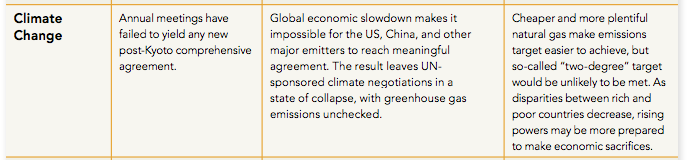
And while it discusses how governance and climate change interact, with the “best case” (right column) being that rising powers (AKA China) may be be prepared to make economic sacrifices, but it’s “worst case” (central column) focuses only on the issue itself, not what happens when climate negotiations collapse, as the continue to do.

Moreover, it doesn’t seem to factor in how climate change itself, rather than food scarcity or some weather events (it includes Tsunamis but not floods), will challenge governance going forward. Bangladesh–one of the countries that faces the most daunting challenges because of climate–even does better  than previously (though still quite badly) on the list of countries that might face collapse.

Then there’s the Black Swan events. Some of the others include pandemic, collapsed EU or China, “reformed” Iran–all a collection of totally foreseeable events that demonstrate that these are not Black Swans at all, but predictable and possibly even likely events (and the fact it includes Iran on this list shows a bias towards the maintenance of current US hegemony, even while saying that won’t sustain).

Here’s what it says about climate change as a Black Swan.

Much More Rapid Climate Change: dramatic and unforeseen changes already are occurring at a faster rate than expected. Most scientists are not confident of being able to predict such events. rapid changes in precipitation patterns—such as monsoons in India and the rest of Asia—could sharply disrupt that region’s ability to feed its population.But it seems unaware of the many ways climate change will affect the issues it treats.

It admits that climate change is already happening faster than expected, its best case scenario doesn’t see us stalling warming at 2 degrees–after which the climatologists see real catastrophe. And yet it considers this a Black Swan, not the central event that will guide events 18 years out. Again, the threat is seen primarily in terms of food scarcity and not the disruption caused by losing entire cities.

As I said, I’ll return to this later in the week (and those with the time should read how the report discusses fracking and other energy sources, which is the counterpart to this weird approach on climate). But for the moment, understand that the climate change exacerbated weather that still has people in NYC left without power and still has shipping on the Mississippi facing daunting challenges doesn’t really factor in our Intelligence Community’s understanding of what life will be like in 18 years, to say nothing of today.

Share this entry

US Climate Inaction: Blame Dick Cheney

In one of my earliest blog posts ever–one I’ve lost somewhere–I grappled with why the Bush Administration would choose their Iraq adventure in the face of Peak Oil and climate change.

Why, at the time the US enjoyed its greatest relative power, after Dick Cheney had fought his earliest battles to dodge congressional oversight with his energy task force to study declining readily explotable oil and its alternatives, would the Bush Administration expend America’s hegemonic power in an illegal invasion of Iraq?

This post, asking whether the US refuses to do anything about climate change because it will affect the US relatively less than it will affect other countries, reminded me of that post I wrote years ago.

What if the leaders of the United States — and by leaders I mean the generals in the Pentagon, the corporate executives of the country’s largest enterprises, and the top officials in government — have secretly concluded that while world-wide climate change is indeed going to be catastrophic, the US, or more broadly speaking, North America, is fortuitously situated to come out on top in the resulting global struggle for survival?

[snip]

What prompted me to this dark speculation about an American conspiracy of inaction was the seemingly incomprehensible failure of the US — in the face of overwhelming evidence that the Earth is heating up at an accelerating rate, and that we are in danger of soon reaching a point of no return where the process feeds itself — to do anything to reduce either this country’s annual production of more atmospheric CO2, or to promote some broader international agreement to slow the production of greenhouse gases.

The conclusion to that 8 year old post–one I still think is valid–is that in the face of both Peak Oil and climate change, Cheney committed the US to doubling down on the source of its hegemonic power in the belief that by retaining hegemonic power for this period of transition out of oil and into alternatives, it would retain hegemonic power thereafter.

Rather than invest the trillion dollars squandered on Iraq (or even the hundreds of billion they had to know it would cost) to make the US energy self-sufficient and lead the world in climate response, Cheney instead chose to seize the largest source of readily exploitable oil, in the process providing an alternative swing producer to the Saudis, whose citizens and funds attacked us on 9/11 (and remember, Iran was teed up to be overthrown next). By choosing the oil route, I figured, Cheney also chose the route that supported relative unilateralism rather than the cooperation that a real climate change response would and ultimately will require.

So I don’t so much think the US has decided it will ride out climate change better than other nations as I think it is intent on retaining its hegemonic position of power, which has been built since 1945 on cheap oil. Sure, the US also seems to have grown comfortable with Neo-Feudalism in the last decade, meaning the elite will happily live in their compounds protected from the instability that climate change will and already has unleashed. And the Global War on Terror will morph unnoticeably into a global counter-insurgency to protect those Neo-Feudal bastions.

But ultimately, I think, this country’s elites have decided they must retain their grasp on power no matter what. And that power rests on oil.

And don’t get me wrong. While I think Cheney fully understood the alternatives presented by this choice and made it for the rest of us, I’m not saying Democrats generally or Obama specifically are innocent. Consider Obama’s unwavering focus on energy independence, which he often cloaks in a false concern for climate change. US power is currently built off a death embrace with the Saudis. But as news reports increasingly–if prematurely–tout, we’re headed for Saudi-level targets of production. That will free us from the troubling demands the Saudis make, shore up our currency, but also keep us precisely where we are, relying on cheap oil to drive our economy and power. That is the goal of Obama’s energy choices, not replacing coal with less-polluting gas. And that explains why Obama just started selling off the rest of the Gulf for exploitation.

It’s crazy, I know. But I sincerely believe there are top secret discussions that insist if we just keep hold of power during what will undoubtedly be a chaotic fifty years, then we can fix whatever mess we’ve caused in the interim. If we can just get the oil while the getting is good, I think they believe, we can adjust to what comes later. Even if the Chinese and Koreans and Europeans will have been eating our lunch in developing new technologies, I guess they believe, we’ll be able to seize them back when the time comes.

The alternative, of course, one Dick Cheney surely recognized during his energy task force, would be to invest instead in a Manhattan project of alternative energy and to dissolve our power into the cooperative structures that will be needed in the face of climate change. That was not, and remains not, a viable option for a top American national security figure.

And so we–and the rest of the world–will melt as a result.

Share this entry

While You Were Munching

North Kenya: “This is the last of my food…”  (photo: Giro555 via Flickr)

You’ve given thanks for today’s grub, and now you’re dopey from the soporific effects of holiday gluttony. You’ve scraped the plates into the garbage disposal and kvetched about fitting all the leftovers in the fridge, or moaned about loosening your belt.

Shopped, cooked, eaten, stowed. Check, check, check, check.

Now add another item to your check list: a much-needed guilt trip.

•  Climate change may have contributed to instability in these strife-filled locations: Libya, Mali and the Sahel, the Horn of Africa, Syria.

•  Climate change has been and is killing people in Kenya, Ethiopia, and Somalia, even as I type this due to starvation rising from persistent drought and resulting famine.

•  Climate change caused the two-day black out for 670 million Indians — that’s 1.5 times the population of the U.S., Canada, and Mexico combined without power for two days. Mind-fricking-boggling.

•  Climate change effects from 2012 will result in increased food insecurity [PDF] for hundreds of millions of people for the next year and longer. If India didn’t have enough water for its crops, where will it buy food for its population? From the U.S. and Canada, which suffered huge crop losses? Even fisheries are negatively impacted.

There, guilt trip. Check.

On Monday after the turkey has worn off and the leftovers are gone, perhaps you’ll contact your Congress critter and demand immediate, proactive, and effective policy on climate change right after the turkey doldrums wear off.

Wish you and yours much to give thanks about this holiday.

Share this entry

Redirecting the Redirected: Returning Attention to Climate Change Policy and Planning

Corporate interests with strong ties to conservative politics have undermined American’s awareness and understanding about climate change. Record profits from fossil fuel businesses have been threatened by talk of reducing consumption. Rather than change their business model, these entities went on the offensive against knowledge; facts were stretched until barely recognizable, bolstered with easy untruths, and fed to the public alongside infotainment through co-opted media.

The same fossil fuel interests bought politicians who are easily led by cash infusions or manipulated through electoral scaremongering by increasingly ignorant, easily acquired political factions (hello, Tea Party).

Presto: Americans are the least likely to believe in anthropomorphic climate change, and they’re likely to vote for candidates who mirror their own tractability.

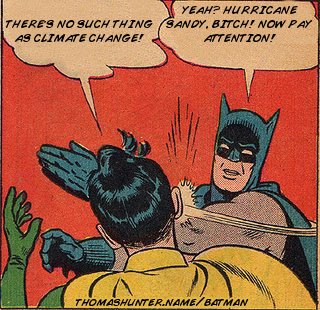
But the truth has a nasty way of bitchslapping consumers and voters until their attention is returned to the facts. Hurricane Sandy, following this past summer’s wretched Dust Bowl-like drought, delivered a one-two punch to the public’s consciousness. Americans are ripe right-the-hell NOW for corrective action in the form of education and effective policy.

Therein lies the problem: there is no ongoing nationwide sustained discussion on climate change reaching a critical mass of the American public, and they in turn are not demanding better, effective, and immediate policy. There’s lots of hand-wringing over the damages caused by the drought and hurricane. There’s discussion about improvements to emergency response (tactical), and chatter about building dikes a la Netherlands to protect New York City from future hurricanes (tactical).

Yet there’s only tactical discussion–no society-wide dialog about strategic approaches to climate change.

The challenge to the educated and aware is to change this scenario and fast. The longer it takes for the tractable to become engaged and aware, the more time fossil fuel interests have to re-poison the minds of the public before the next truth-borne bitchslapping. Read more

Share this entry

David Petraeus’ Response to Climate Change: MOAR DRONZ!

When I saw DHS is acquiring more drones this morning, I joked that the policy response of government agencies when they fail at their core function is to ask for more drones.

Pretty sure there’s direct correlation bet size of NatSec departments [sic] failures at core job–HUMINT, safety–& desire for drones–CIA, DHS.

CIA has another massive HUMINT failure. Response? Moar dronz! DHS fusion centers proven to be huge wastes. Response? Moar dronz!

After @kade_ellis got into the fun, I pushed the idea, suggesting our country would respond to bank looting and climate change with a demand for more drones, too.

Banks looting the country? MOAR DRONZ! Impending climate catastrophe? MOAR DRONZ!

I swear, when I made that joke, I had not yet read how the CIA closed its climate change center because David Petraeus thought it more important to hunt terrorists with drones.

The center was designed as a small unit of senior specialists focused on the impact that environmental changes could have on political, economic and social factors in countries of concern to the United States. The analysts probed questions such as, under what scenarios might a massive drought cause large-scale migration, and when might a government’s failure to respond to a devastating flood open the door for terrorist groups to win over the local populace?

Analysts at the center worked to develop warning software that combined regional climate projections with political and demographic information, and held climate war games looking at what might happen in extreme scenarios, such as if rapid glacial melt caused the ocean’s major currents to shut down.

The center didn’t focus on the science behind climate change but instead relied on data from other government agencies as well as recommendations — including ones in a report released just over a week ago — from the National Academy of Sciences (Greenwire, Nov. 9).

But congressional Republicans skeptical of the science behind climate change sought to block the center’s funding shortly after it was launched. Those efforts failed, but sources say the center received little internal support after Panetta left the CIA in 2011 to take the top job at the Defense Department. Under his successor, David Petraeus, the agency was highly focused on terrorism, specifically targeted killings using armed drones. [my emphasis]

The diddling Director, it seems, thought taking out an American teenager with a drone was more important than responding to a crisis that is already leading to migration and increased credibility for terrorist groups.

But it’s not just the diddling Director. The CIA’s statement on the closure says instead of focusing on climate change, the CIA is focusing on energy.

CIA spokesman Todd Ebitz confirmed the change.

“The CIA for several years has studied the national security implications of climate change,” Ebitz said in a statement to Greenwire. “This work is now performed by a dedicated team in an office that looks at a variety of economic and energy security issues affecting the United States.”

This parallels, as it happens, Obama’s changing emphasis on gas production for energy security reasons, and only secondarily for climate change ones.

It seems our national security establishment–from the man who would turn back the oceans to the diddling Director–are more interested in replacing the Saudis as the petro-state than really preventing climate disaster in the not-too-distant future.

And if that emphasis should continue to destabilize the increasingly climate-wracked world?

MOAR DRONZ!

Share this entry

Sandy’s Teachable Moment on Infrastructure

In a remarkable development, the devastation from Sandy now is finally moving a least a portion of the national conversation onto the very important topic of infrastructure and how we need to renew our degrading infrastructure in addition to hardening it against new waves of damage due to weather extremes brought on by climate change. Consider this bit of truth-telling from Connecticut Governor Dannel Malloy on Rachel Maddow’s show last night:

But it’s not just Malloy who sees the need to have the future in mind during the recovery from Sandy. Today’s New York Times carries an article in which New York Governor Andrew Cuomo discusses how preventive steps need to be taken in the near future:

On Tuesday, as New Yorkers woke up to submerged neighborhoods and water-soaked electrical equipment, officials took their first tentative steps toward considering major infrastructure changes that could protect the city’s fragile shores and eight million residents from repeated disastrous damage.

Gov. Andrew M. Cuomo said the state should consider a levee system or storm surge barriers and face up to the inadequacy of the existing protections.

“The construction of this city did not anticipate these kinds of situations. We are only a few feet above sea level,” Mr. Cuomo said during a radio interview. “As soon as you breach the sides of Manhattan, you now have a whole infrastructure under the city that fills — the subway system, the foundations for buildings,” and the World Trade Center site.

The Cuomo administration plans talks with city and federal officials about how to proceed. The task could be daunting, given fiscal realities: storm surge barriers, the huge sea gates that some scientists say would be the best protection against floods, could cost as much as $10 billion.

It is sad that such a level of devastation is needed before there is talk of action. As recently as last month, the Times carried yet another warning that exactly this type of damage was becoming increasingly likely:

But even as city officials earn high marks for environmental awareness, critics say New York is moving too slowly to address the potential for flooding that could paralyze transportation, cripple the low-lying financial district and temporarily drive hundreds of thousands of people from their homes.

Only a year ago, they point out, the city shut down the subway system and ordered the evacuation of 370,000 people as Hurricane Irene barreled up the Atlantic coast. Ultimately, the hurricane weakened to a tropical storm and spared the city, but it exposed how New York is years away from — and billions of dollars short of — armoring itself.

“They lack a sense of urgency about this,” said Douglas Hill, an engineer with the Storm Surge Research Group at Stony Brook University, on Long Island.

Instead of “planning to be flooded,” as he put it, city, state and federal agencies should be investing in protection like sea gates that could close during a storm and block a surge from Long Island Sound and the Atlantic Ocean into the East River and New York Harbor.

And it was exactly that storm “surge from Long Island Sound and the Atlantic Ocean into the East River and New York Harbor” that flooded lower Manhattan and the New York subway system. Considering that estimates yesterday on the financial impact of Sandy were already going as high as $25 billion (and I expect that number to go up by a lot as more damage is discovered), an investment of $10 billion for a surge barrier, coupled with a massive push for revitalizing and hardening the electrical and transportation systems behind the barrier, looks like a very wise investment. Sadly, though, as Malloy points out, half the country doesn’t believe in infrastructure investment. At least, that was the case before Sandy. Will infrastructure scrooges who were directly impacted by the storm finally see the importance of being proactive, or will yet another teachable moment be lost?

Share this entry

Sandy Makes Turn, Landfall in Mid-Atlantic Expected by Monday Night

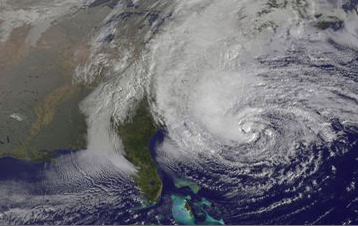
In the 8 am update from the National Hurricane Center, NOAA has announced that Hurricane Sandy is now moving to the north-northwest. In the previous update, Sandy was headed due north, so this means that the turn toward the coast of the US has begun and the expected track leading to landfall along the Delaware or New Jersey shoreline remains in place. There are many dire predictions that have been made for this storm, so I will not repeat all of them here, but I do want to emphasize some of the most important pieces of information from the latest update.

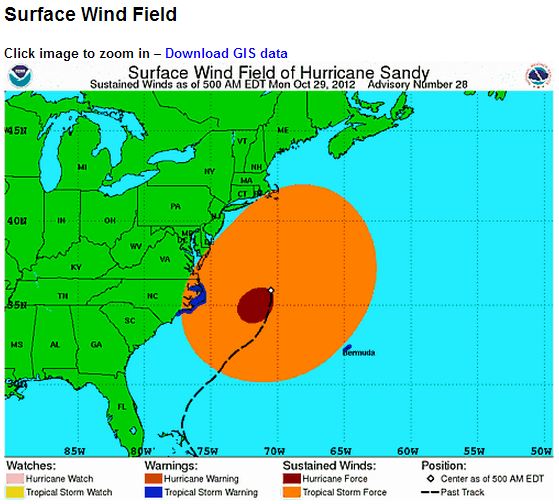
The graphic above, which is from the 5 am update, shows the sheer size of the storm very effectively. The current wind field has tropical storm force winds already along the coastline from North Carolina through Massachusetts. In the Public Advisory portion of the 8 am update, we learn more about the storm’s size:

HURRICANE-FORCE WINDS EXTEND OUTWARD UP TO 175 MILES…280 KM…FROM THE CENTER…AND TROPICAL-STORM-FORCE WINDS EXTEND OUTWARD UP TO 485 MILES…780 KM.

That means that the red oval of hurricane force winds in the graphic has a diameter of 350 miles. In other words, a 350 mile stretch of coastline is due to receive hurricane force winds. Similarly, the orange oval of tropical storm force winds has a diameter of 570 miles, an almost unheard of size for a storm anywhere on the US East Coast.

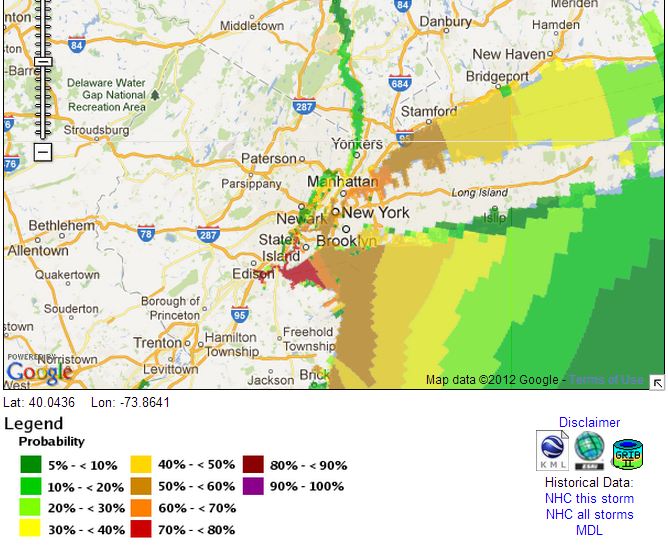
Besides the expected wind damage, though, this storm is likely to produce very significant storm surge flooding. At this link, NOAA allows the user to plug in a selected storm surge height and then see the probability of the surge exceeding that value. I plugged in a five foot storm surge and got the following map:

The five foot storm surge is important, because that would be the level at which it is possible that water could begin to flood the New York subway system, which would be estimated to cause billions of dollars in damage. From Jeff Masters at Weather Underground (emphasis in the original):

Sandy is now forecast to bring a near-record storm surge of 6 – 11 feet to Northern New Jersey and Long Island Sound, including the New York City Harbor. This storm surge has the potential to cause many billions of dollars in damage if it hits near high tide at 9 pm EDT on Monday. The full moon is on Monday, which means astronomical high tide will be about 5% higher than the average high tide for the month. This will add another 2 – 3″ to water levels. Fortunately, Sandy is now predicted to make a fairly rapid approach to the coast, meaning that the peak storm surge will not affect the coast for multiple high tide cycles. Sandy’s storm surge will be capable of overtopping the flood walls in Manhattan, which are only five feet above mean sea level. On August 28, 2011, Tropical Storm Irene brought a storm surge of 4.13′ and a storm tide of 9.5′ above MLLW to Battery Park on the south side of Manhattan. The waters poured over the flood walls into Lower Manhattan, but came 8 – 12″ shy of being able to flood the New York City subway system. According to the latest storm surge forecast for NYC from NHC, Sandy’s storm surge is expected to be at least a foot higher than Irene’s. If the peak surge arrives near Monday evening’s high tide at 9 pm EDT, a portion of New York City’s subway system could flood, resulting in billions of dollars in damage. I give a 50% chance that Sandy’s storm surge will end up flooding a portion of the New York City subway system.

Unfortunately, the 8 am NHC advisory contradicts Masters on the point of only one tide cycle being affected by the storm surge:

ELEVATED WATER LEVELS COULD SPAN MULTIPLE TIDE CYCLES RESULTING IN REPEATED AND EXTENDED PERIODS OF COASTAL AND BAYSIDE FLOODING.

One last bit of bad news from NOAA is that Sandy could still strengthen somewhat:

REPORTS FROM AN AIR FORCE HURRICANE HUNTER AIRCRAFT INDICATE THAT THE MAXIMUM SUSTAINED WINDS REMAIN NEAR 85 MPH…140 KM/H…WITH HIGHER GUSTS. SANDY IS EXPECTED TO TRANSITION INTO A FRONTAL OR WINTERTIME LOW PRESSURE SYSTEM PRIOR TO LANDFALL. HOWEVER…THIS TRANSITION WILL NOT BE ACCOMPANIED BY A WEAKENING OF THE SYSTEM… AND IN FACT…A LITTLE STRENGTHENING IS POSSIBLE DURING THIS PROCESS. SANDY IS EXPECTED TO WEAKEN AFTER MOVING INLAND.

The next several days will be trying for the Mid-Atlantic area. I urge everyone in the region to listen carefully to local emergency managers and to follow their guidance.

Share this entry

If Hillary Named Fat Al Gore a Foreign Terrorist Organization…

I’ve been thinking about how things would be different if Hillary Clinton named Fat Al Gore–my metaphorical name for climate change–a Foreign Terrorist Organization.

The FTO designation, you’ll recall, is the official designation that signals the US considers an entity a dangerous terrorist organization. The criteria are:

  • The organization must be foreign based.
  • The organization engages in terrorist activity or terrorism, or retains the capability and intent to engage in terrorist activity or terrorism.
  • The terrorist activity or terrorism of the organization threatens the security of United States nationals or national security of the United States.

As I see it, the “foreign based” is the only stretch here. While American carbon use is one big contributor to Fat Al Gore (in the same way American foreign policy has been one contributor to Islamic terrorism), we can ultimately claim Fat Al Gore lives in the atmosphere. That’s foreign, right?

As for terrorism? Fat Al Gore’s latest incarnation has shut down the entire Eastern Seaboard. Pictures of Sandy have inspired awe and fear even among experienced Fat Al Gore watchers. Sandy will do billions in damage, and has already killed 51 people. This is a spectacular, horrifying disaster, just as terrorist attacks are.

Perhaps you could argue Fat Al Gore is not a terrorist because it has no political goals. But I think Mother Nature probably does have some policies she’d like us to implement. Hell, we’re going to change our policies in response to Fat Al Gore one way or another, the question is when.

And clearly Fat Al Gore threatens the US–more than any other terrorist right now (and that would be true even without Frankenstorm bearing down on the East Coast).

If Hillary named Fat Al Gore an FTO, the first effect would be to criminalize financial support of Fat Al Gore. Chevron’s $2.5 million donation to defeat Democrats? Material support of terrorism. Continued subsidies to the fossil fuel industry? Material support of terrorism. We could even start arresting people pursuing policies that support Fat Al Gore and throw them away for long prison terms.

The other thing that naming Fat Al Gore an FTO would do is change our response. No longer would it be enough to respond competently (or incompetently) when Fat Al Gore attacks our country. No longer would a reactive response be enough. The goal would change, immediately and at great political cost, to–as much as possible–preventing Fat Al Gore from striking the country.

Now, if Hillary did name Fat Al Gore an FTO, you can be sure all the politicians who’ve been in the back pocket of Fat Al Gore would complain. They’d argue the designations were political.

But as I see it, that complaint was neutralized when State removed MEK from the FTO. Tom Ridge was quite happy when State used designations politically with MEK. How can he complain when designations work the other way, by holding him responsible for supporting Fat Al Gore.

One thing’s clear: our primary security apparatus–that fighting terrorism–does not now address our primary security threat–Fat Al Gore. Maybe it’s time to change that.

Share this entry

Wherein DC Sir Lancelots Turn Their Tail And Flee Like Candyass Sir Robins

Attention Americans:

Those brave elected and appointed representatives who represent YOU in the Federal Government are fleeing! Well, granted, I guess that doesn’t really account for the elected members of Congress who have been diddling and twiddling their thumbs, among other things, for a while now in order to suck at the tit of corporate cash, while doing nothing for you on the record at their elected jobs (no, Darrell Issa’s dog and pony show doesn’t count) and throw it around to perpetuate a fraud on you.

But, as they say in movies, that is something completely different.

No, here is the notice I take just a little umbrage with:

Non-emergency employees (including employees on pre-approved paid leave) will be granted excused absence (administrative leave) for the number of hours they were scheduled to work unless they are:

required to telework,

on official travel outside of the Washington, DC, area,

on leave without pay, or

on an alternative work schedule (AWS) day off.

Telework-Ready Employees who are scheduled to perform telework on the day of the announcement or who are required to perform unscheduled telework on a day when Federal offices are closed to the public must telework the entire workday or request leave, or a combination of both, in accordance with their agencies’ policies and procedures, subject to any applicable collective bargaining requirements.

Emergency Employees are expected to report to their worksites unless otherwise directed by their agencies.

As friend of the blog, Timothy Shorrock, noted:

No government Monday. A state of anarchy will reign!

I’m with Tim, we are all SO SCREWED!

Okay, and I’m going to take a flyer that Mr. Shorrock agrees, the nation may not only survive, but actually prosper without the usual cabal of corrupt con men and bloodsuckers that generally run things in Washington DC on a “normal” day. Call me crazy, but I am going out on that limb.

Here is my issue: They are all bozos on that bus. Pretty much all of the NOAA, CNN and other data intensive models have been prediting this likely Sand path for days.

Our Men in Havana, er, I mean men and women in DC, are just figuring this out now??? Perhaps the usual rhesus monkey brains were otherwise occupied still figuring out the Administration’s housing policy.

And, look at the directive. What does it really say? That the poohbahs suggest common workers, just being notified a couple of hours before they go to sleep, do what they were already doing, or already had the option to do, and work from home. For any others unable to do so, the suggestion is they take leave.

In short, the real backbone of the federal government, the regular workers, are being treated in a tardy and tawdry manner.

By the 1% MOTUs. Shocking, no?

So, while the politicians who are not already cravenly out of town on your dime are absent, even the remaining Knights of The Pinhead Table run like crazed Sir Robins.

Ain’t that America?

Uh, yeah, so tomorrow will be different from exactly what other day you federal jackasses??

Because, Congress, the DOJ, the SEC, the FEC, the NLRB, and all the rest, BEFORE SANDY, were sooooooo totally responsive to the needs and desires of their constituents.

On a serious note, this hurricane is pretty clearly a grave matter for human safety. Care SHOULD be taken. The projected damage had the DC/Eastern Virginia/Maryland area in the cone of danger in nearly every projection.

The federal government waited until now to tell regular workers, the real backbone of our functioning government to, paraphrasing “stay at home if you have that already available, or otherwise work as best you can.

That is loathsome from a leadership of cowardly and craven Sir Robins. And, on the remote chance you do not understand what a “Sir Robin” is, watch the video.

Share this entry