
“The Yemeni situation and … the Iranian cyber situation”

As MadDog noted yesterday, Dianne Feinstein seemed to answer a question I’ve written about here and here regarding the scope of the leak investigations.

She said the U.S. attorneys would not face political pressures from the Obama administration and would “call the shots as they see them.”

“We can move ahead much more rapidly,” Feinstein said. “Instead of one special prosecutor, you essentially have two here, one is the Yemeni situation and the other is the Iranian cyber situation. I think you’re going to get there much quicker.”

I’m not sure I agree with MD, though, that “the UndieBomb 2.0 and the Stuxnet leaks are the ones being investigated,” meaning implicitly that just those two “leaks” are being investigated.

DiFi’s quote seems to confirm that there is a distinct investigation into the source of the detail (one of the only new parts of David Sanger’s StuxNet reporting) that Israel let StuxNet free, possibly deliberately. Since Eric Holder suggested there was a jurisdictional component to his choice of US Attorneys on these investigations, we can assume that Rod Rosenstein, US Attorney for the National Security Agency, will investigate that alleged leak.

But what does DiFi include when she says, “the Yemeni situation”? Does it include only the leaks about UndieBomb 2.0? And if so, why isn’t it being investigated out of Eastern District of VA, the CIA’s US Attorney district, which purportedly had a lead on that operation in the US?

Further, MD suggested (though did not say explicitly) this means they’re not investigating the drone targeting leaks.

Now, as I’ve noted, one possible reason they wouldn’t investigate the drone targeting “leaks” would be if the stories reported falsehoods or–more charitably–a drone targeting process that was no longer in place, as the AP has reported to be the case and the White House, in their response to the AP story, seemed to confirm. That is, one possible reason why they wouldn’t investigate the “leaks” about drone targeting would be because those stories did not report accurate classified information (and I’ll remind here that the Klaidman story differs in some notable ways from the Joby Warrick story, which we now know came in part from Rahm Emanuel’s effort to publicize Baitullah Mehsud’s killing).

But there’s another possibility. I’m struck by DiFi’s description of “the Yemeni situation” rather than–as most people refer to it–the “thwarted” bomb “plot.” It’s possible that in DiFi’s mind–the mind of a Gang of Four member who has presumably been briefed on our ongoing operations in Yemen–that the leak of the bomb sting, the leak of the Saudi role in it, and the stories that made it clear that John Brennan is running a secret war against Yemeni insurgents using signature strikes out of the NSC largely at the behest of the Saudis all constitute for her “the Yemeni situation.” UndieBomb 2.0 is a part of that secret war–perhaps the legal justification for US involvement in it (and also a useful way to remove an asset and a key handler before the drones start wreaking havoc). But if this speculation is right, it may well be the other details–the report that this war is being run out of NSC, the details that make it clear we’re targeting insurgents, not just AQAP, the fact that we’re clearly in an undeclared war–that DiFi worries about most.

Mind you, this is all supposition. It may be that DiFi was just using shorthand for the UndieBomb 2.0 plot. But to a great degree, all the stories about drone targeting were efforts to expose–and then cover up–the war we’re engaging in Yemen. And that does seem like a secret the Administration is trying to prevent the American public from learning about.
Share this entry

The Baitullah Mehsud Propaganda

I have twice before noted some curious details about Joby Warrick’s telling of the events leading up to Baitullah Mehsud’s death. I noted that it is another example–like the Iraq War–of an attack justified by nukes in which the nukes were ultimately never found. And I noted there are some significant differences between the NYT’s version of the story and Joby Warrick’s. Daniel Klaidman apparently tells his own version in his book, which I hope to read next week.

Mind you, I’m not saying that any of these journalists is telling the complete story or even that any one journalist presents a story that is entirely true, I’m just noting that different Administration sources are feeding different stories.

Last week Ben Wittes transcribed the complete passage from Klaidman’s book that describes how Rahm Emanuel decided to publicize Baitullah’s killing for political benefit.

When they finally took Mehsud out in August 2009, [White House Chief of Staff Rahm] Emanuel celebrated. He had a hawkish side to him, having volunteered with the Israeli Defense Forces as a civilian during the 1991 Gulf War. But above all, Emanuel recognized that the muscular attacks could have a huge political upside for Obama, insulating him against charges that he was weak on terror. “Rahm was transactional about these operational issues,” recalled a senior Pentagon official. “He always wanted to know ‘how’s this going to help my guy,’ the president.”

Though the program was covert, Emanuel pushed the CIA to publicize its covert successes.  When Mehsud was killed, agency public affairs officers anonymously trumpeted their triumph, leaking colorful tidbits to trusted reporters on the intelligence beat. Newspapers described the hit in cinematic detail, including the fact that Mehsud was blown up on the roof of his father-in-law’s compound while his wife was massaging his legs. [italics Wittes’, bold mine]

Here’s how Warrick describes the killing in his book.

It was now 1:00 A.M. in the Paksitani village. Baitullah Mehsud, leader of the Pakistani Taliban and chief protector of the Jordanian physician Humam al-Balawi, now lay on his back, resting as the IV machine dripped fluid into his veins. At his feet, a pair of young hands, belonging not to a doctor, as the CIA supposed, but to his new wife, were massaging his swollen legs. Barely aware of the buzzing distance drone, oblivious of the faint hissing of the missile as it cleaved the night air, he took a deep breath and looked up at the stars.

The rocket struck Mehsud where he lay, penetrating just below the chest and cutting him in two. A small charge of high explosives detonated, hurling his wife backward and gouging a small crater in the bricks and plaster at the spot where she had knelt. The small blast reverberated against the nearby hills, and then silence.

Overhead, the drones continued to hover for several minutes, camera still whirring. A report was hastily prepared and relayed to Panetta at the White House.

Two confirmed dead, no other deaths or serious injuries. Building still stands. [italics original, bold mine]

That is, while Klaidman is too polite to say it, this account is the one that derives from Rahm’s decision to publicize Mehsud’s killing. (Warrick sources these details to “three U.S. intelligence officials involved in the planning or oversight of the operation.”)

Now, the NYT reveals that some sources say there were other civilian casualties.

Mr. Obama, through Mr. Brennan, told the C.I.A. to take the shot, and Mr. Mehsud was killed, along with his wife and, by some reports, other family members as well, said a senior intelligence official.

This doesn’t mean Warrick’s version of the drones originally reporting there were no other casualties is incorrect on that front–after all, drones don’t provide perfect intelligence, contrary to what their boosters say, and it’s possible that reports of other casualties came later from HUMINT. But if there were other casualties, it probably means many of these cinematic details about the pinpoint nature of the strike–Meshud being cut in two and his wife being blown back but the strike leaving only a small crater–are not entirely true.

Again, I’m not saying any of these journalists are fully capturing the truth; what they’re telling is what Administration sources have told them, and I doubt NYT and Klaidman’s sources have any less of an agenda than Warrick’s did. And note all the details about Mehsud’s death distract from the way we tried to get to him by first killing one of his clan-members, then targeting that man’s funeral, which Warrick does include; Warrick was reporting on our funeral targeting tactic before TBIJ did, to great controversy.

But I am noting that this cinematic picture of very controlled killing (even the killing of a young woman who was probably pushed into this marriage as a teenager) comes from a decision from Rahm to push such picture for political advantage.

One more thing. The killing of Mehsud’s commander and then Mehsud and his young wife and maybe her family, reportedly justified by intelligence on nukes that never materialized? Mehsud claimed direct credit for Faisal Shahzad’s attempted attack on Times Square, and al-Balawi killed 7 CIA officers at Khost in direct revenge for the killing of Mehsud. These are some of the most serious attacks on us or attempts in recent years, both stemming from this attack on someone whose aspirations to attack us may never have been real beforehand.

Share this entry

The Whack-a-Moles Leave Women Unaroused

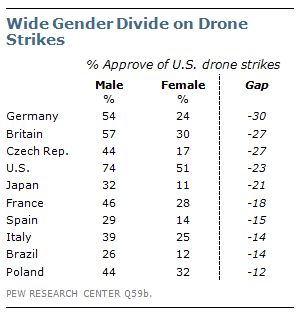
Pew Research has started polling whether people around the world approve of America’s use of drones against terror leaders.

Do you approve or disapprove of the United States
conducting missile strikes from pilotless aircraft called
drones to target extremists in countries such as Pakistan,
Yemen and Somalia?

The quick answer is, no one aside from Americans themselves (who love them) likes our use of drones. Only in the UK and Poland does the result come close to 50/50. Mind you, none of the countries where we’re using drones were asked in this questionnaire (Pew promises numbers from Pakistan soon). India, which is in the neighborhood and fights some of the same terrorist groups being hit, split 32 approving, 21 disapproving, and the rest not answering.

But I’m even more interested in the gender split. As shown above, the gender gap in drone approval levels is in the same neighborhood as Mitt Romney’s gender gap.

This is something I’ve been thinking of when I encounter men who defend our use of drones with almost visceral enthusiasm. Sure, Americans like explosions and displays of sheer power in all forms. But I can’t help but think about how drones have been sold as the ultimate porn thrill: sitting in a dark room in Nevada, watching over minute creatures whose humanity has been stripped, caressing a joy-stick to wield the ultimate power over life and death. La petite mort.

Never mind that a lot of the targeters are actually women, never mind that we keep whacking these moles without winning any war.

They make Americans feel powerful, and I guess that’s worth 34 net approval points.

Update: It turns out Americans aren’t all that fond of drones themselves, for uses where they might be surveilled.

Share this entry

Can Hillary Turn on Electricity in Yemen Better than AQAP?

Due to the vagaries of smart phone RSS feeds, I re-read this story over the weekend. In addition to describing Secretary of State Clinton’s speech before the Special Operations Forces Industry Conference–in which she described how special ops fit into her idea of really smart power–it also aired JSOC complaints about Hillary’s proposed closer ties between diplomacy and special ops.

But rumor has it Clinton’s vision has its detractors — and that its implementation in hotspots such as Yemen and Congo has made some Special Operations Forces officers very unhappy. In Yemen, in particular, some commando officers look upon the State Department’s expanding shadow-war powers as a bureaucratic intrusion on what should be military territory. A source tells Danger Room that in Yemen State has effectively hijacked all U.S. counter-terrorism funding, requiring a labyrinthine approval process for even small expenditures. According to detractors, the funding control is a way of cementing State’s expansion into the Special Operations Forces traditional remit.

McRaven does not share the officers’ objections. The admiral has enthusiastically widened and deepened his command’s alliances with commando forces from allied nations — all in a bid to build what he calls the “global SOF partnership.” The Army 10th Special Forces Group’s ongoing deployment to Afghanistan is a perfect example: 10th Group’s Afghanistan task force includes commandos from Poland, Romania and several other countries. In a sense, McRaven is becoming more of a diplomat as Clinton becomes more of a warrior. Meeting in the middle, they’ve apparently chosen to be allies instead of rivals.

In that context, Clinton’s appearance at an otherwise minor military trade show is an important signal. McRaven is showing his officers that if he and America’s top diplomat can get along, then they can get along with their own State Department counterparts, as well. An evolving vision of American warfare is counting on it.

This story came out on May 24, just a few days after this largely unnoticed AP story described John Brennan seizing control over targeting. One reason for Brennan to do so, it seemed, was to give State more direct influence over targeting.

The move concentrates power over the use of lethal U.S. force outside war zones at the White House.

The process, which is about a month old, means Brennan’s staff consults the Pentagon, the State Department and other agencies as to who should go on the list, making a previous military-run review process in place since 2009 less relevant, according to two current and three former U.S. officials aware of the evolution in how the government targets terrorists.

[snip]

But some of the officials carrying out the policy are equally leery of “how easy it has become to kill someone,” one said. The U.S. is targeting al-Qaida operatives for reasons such as being heard in an intercepted conversation plotting to attack a U.S. ambassador overseas, the official said.[my emphasis]

That is, it seems like this process–which the AP dates to sometime in mid-April–allowed State to bypass DOD’s vetting process by submitting targeting suggestions directly to Brennan. And the AP story appeared to arise out of the same disgruntlement within JSOC as Wired’s story.

Now, I actually support Hillary’s efforts to strengthen State’s soft power efforts; we won the Cold War as much with soft power and oil price manipulation as we did by bankrupting Russia with an arms race. But we’ve sucked at it ever since. Read more

Share this entry

$356 Million in Drone Failure

I guess we should be grateful the Customs and Border Patrol simply mismanages its fleet of 9–soon to be 10–drones, each costing $18M apiece. (h/t Kevin Gosztola, who tweeted a report of this) After all, the massive drone that went down in a marsh in Maryland yesterday cost $176M, and it’s surely still burning up.

But I couldn’t help but think that that money could have been spent on around 3,500 teachers, for a far greater benefit to this country.

The Department of Homeland Security Inspector General says the problem with CPB’s drone program is mismanagement. But that’s mostly because the drones aren’t used as much as the bean counters think they should be–just 29% of the flight hours planned.

CBP has not achieved its scheduled nor desired levels of flight hours of its unmanned aircraft. The Office of Inspector General (OIG) estimates that, based on the contract performance specifications, seven UASs should support 10,662 flight hours per year to meet the mission availability threshold (minimum capability) and 13,328 flight hours to meet the mission availability objective (desired capability). However, resource shortfalls of qualified staff and equipment coupled with restrictions imposed by the Federal Aviation Administration, weather, host airfields, and others have resulted in CBP scheduling just 7,336 flight hours for its seven unmanned aircraft and limited actual flight hours to 3,909 hours. This usage represents 37 percent of the unmanned aircraft’s mission availability threshold and 29 percent of its mission availability objective. Despite the current underutilization of unmanned aircraft, CBP received two additional aircraft in late 2011 and was awaiting delivery of a tenth aircraft in 2012.

Sadly, DHS IG sees this as a management problem, rather than a budgeting and planning problem on the part of DHS management and Congress. And CPB’s response to the IG–basically saying “we’ve got our plan and we’re going to stick to it”–sure sounds like it intends to take delivery of more drones it has neither the equipment, staff, or operational need to use.

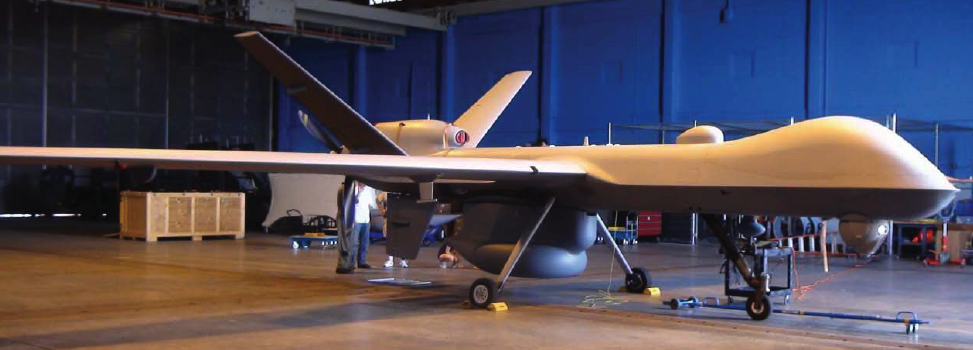
As for the massive 44 feet long, 116-foot wingspan, 25,600 pound RQ-4A Global Hawk that went down in Maryland, the most amusing part of the coverage is the number of outlets that report a line from the Navy statements on it, “Crashes are highly unusual, Navy officials said.” The Navy just lost one-fifth of their fleet of this particular drone. Read more

Share this entry

Is Administration Admitting It Is Lying about Drones?

I’ll have far, far more on the leak investigations tomorrow or Monday. But for the moment I want to lay out certain implications suggested by this Jack Goldsmith post.

Goldsmith asks what the scope of the leak investigation is and cites reports that the investigation is only investigating the UndieBomb 2.0 and StuxNet leaks.

However, the Wall Street Journal reports that the two relevant FBI leak investigations concern (1) “leaks about the cyberattack program” and (2) “leaks about a double agent who infiltrated al Qaeda’s Yemen affiliate.”  If the WSJ is right, it would appear that the investigations do not concern leaks about drone attacks and related matters that, like leaks about the Iranian cyber-operation and the AQAP infiltration, have been the subject of recent congressional complaint.

And he cites DOJ saying they can’t tell us the scope of the investigation because it would confirm whether or not reports were correct.

According to the New York Times, DOJ was silent on the subject matter of the investigations because revealing their subject matter “would implicitly confirm that certain reports contained accurate classified information.”

Put these two details together. If DOJ will only investigate leaks of accurate classified information, and if DOJ is really investigating the UndieBomb 2.0 leaks and StuxNet leaks but not the drone stories, one possible explanation (though not the only one) is that the UndieBomb 2.0 and StuxNet stories were accurate, but not the drone stories.

I have suggested the NYT and Klaidman stories came out when they did and in the form they did to distract from earlier reporting on signature strikes run from the NSC. Is the Administration admitting–with the scope of their leak investigations–that those leaks were not the truth?

Share this entry

UndieBomb 2.0: Defying the Trend

In his story describing the lowered standards for drone strikes the other day, Greg Miller described multiple officials admitting that we’re increasing the number of drone strikes in Yemen even though there’s no evidence more people are “migrat[ing]” to join AQAP.

U.S. officials said the pace has accelerated [in the last five months] even though there has not been a proliferation in the number of plots, or evidence of a significantly expanded migration of militants to join AQAP.

That may conflict with John Brennan’s claims that AQAP has tripled in size since the UndieBomber 1.0. It may suggest that that growth all took place before the last year. Or it may suggest–particularly given the use of the word “migration”–that these officials are distinguishing between non-Yemenis and local insurgents allying with AQAP.

Whichever it is, the NCTC just reported, last year attacks from AQAP didn’t go up either–in fact, they went down slightly.

Attacks by AQ and its affiliates increased by 8 percent from 2010 to 2011. A significant increase in attacks by al-Shabaab, from 401 in 2010 to 544 in 2011, offset a sharp decline in attacks by al-Qa‘ida in Iraq (AQI) and a smaller decline in attacks by al-Qa‘ida in the Arabian Peninsula (AQAP) and al-Qa‘ida in the Islamic Maghreb (AQIM).

Everyone but John Brennan–who has a history of lying about drone strikes–seems to be saying that the risk from terrorism, while still real, is going down in Yemen, not up.

UndieBomb Plot 2.0, to the limited degree that it was a general plan of Ibrahim al-Asiri and not a plot from Mohammed bin Nayef, appears to defy the trend.

Which brings me to something that’s been gnawing at me about the public claims about UndieBomb 2.0.

Imagine you’re Ibrahim al-Asiri. A Saudi-Brit shows up, trains, impresses the trainers. He offers to do a suicide mission and–while you don’t meet with him personally–the trainers decide to send him off on UndieBomb Plot 2.0. He leaves and you wait, and wait, and wait. And … nothing. That is, according to all the people complaining that the AP reported the government had thwarted a plot, what the government had intended.

If you’re AQAP, wouldn’t it be more suspicious hearing nothing about the guy who just walked off with your UndieBomb than hearing John Brennan boasting that he had thwarted the UndieBomb. Not bragging that the Saudis had infiltrated AQAP, which is what Brennan ended up bragging about. Just a big dog-and-pony about thwarting an attack, as the Administration did when it intercepted the toner cartridge plot.

Probably, the AP’s version of the story is correct and the Administration planned a dog-and-pony show, which would have left Asiri with the impression that the Saudi-Brit was what he appeared to be, an aspiring suicide bomber that got caught.

One alternative is that UndieBomber 2.0 actually absconded with an UndieBomb, but intended to go back into AQAP and continue to collect information. I wonder, though: Giving the increasing number of targets in Yemen, you’d think it’d be at least as important to collect information about AQAP plans in Yemen as to obtain the latest UndieBomb in the guise of an attack on the US.

But I’m puzzled by the claim that the Administration wasn’t going to announce they had thwarted the plot. That doesn’t make sense.

Share this entry

Will al-Libi Killing Be Used to Justify Drone Strikes on Mourners, First Responders?

Back in early February, a report from Chris Woods and Christina Lamb at The Bureau of Investigative Journalism delivered the shocking news that CIA targeting practices for drone attacks include the intentional targeting of mourners at funerals and first responders to initial attacks:

The CIA’s drone campaign in Pakistan has killed dozens of  civilians who had gone to help rescue victims or were attending funerals, an investigation by the Bureau for the Sunday Times has revealed.

/snip/

But research by the Bureau has found that since Obama took office three years ago, between 282 and 535 civilians have been credibly reported as killed including more than 60 children.  A three month investigation including eye witness reports has found evidence that at least 50 civilians were killed in follow-up strikes when they had gone to help victims. More than 20 civilians have also been attacked in deliberate strikes on funerals and mourners. The tactics have been condemned by leading legal experts.

As Woods and Lamb point out, targeting mourners and first responders is a practice that is both heinous and likely to include civilian deaths along with those who are military targets. However, it now appears that the strikes that took out Abu Yahya al-Libi included both a strike on mourners and possibly a strike on first responders, so it seems likely now that there will be a push from Obama administration figures to provide a patina of glory derived from taking out al-Qaeda’s number two in command to a practice that Woods and Lamb pointed out amounts to “little more than extra-judicial executions”.

Before it was known that al-Libi had likely been killed, Glenn Greenwald pointed out yesterday that Monday’s strikes had been aimed at mourners and I pointed out that locals in the vicinity feared a follow-on strike hitting first responders. Greenwald cited and quoted from a Guardian article pointing out the mourner aspect of the strike. More details come from this article in Pakistan Today:

A US drone targeted a compound believed to be used by militant commanders Mullah Nazir and Commander Malang in the Wocha Dana Beermal area of South Waziristan.

While officials in various intelligence agencies have confirmed al-Libi’s death, officials in the United States endorsed that al-Libi was the target of Monday’s drone strike. There has not been any confirmation or rejection of the report by al Qaeda yet. According to reports, the militants had gathered in the compound to condole the death of Malang’s brother who was killed the previous day in a drone attack in the same area.

Multiple reports indicate that two missiles were used in the attack that killed al-Libi. Read more

Share this entry

SCOTUS Reviews the “Military Age Male” Standard on Thursday

One of the most consistent statements of outrage I’ve seen from people just coming to the horrors of the drone program is the military aged male criterion: the Administration’s assumption that all military age males killed in a drone strike must be combatants.

Mr. Obama embraced a disputed method for counting civilian casualties that did little to box him in. It in effect counts all military-age males in a strike zone as combatants, according to several administration officials, unless there is explicit intelligence posthumously proving them innocent.

Justin Elliott even got the Administration to reiterate the claim, albeit anonymously.

I gave the White House a chance to respond, and it declined to comment on the record. But speaking on condition of anonymity, an administration official acknowledged that the administration does not always know the names or identities of everyone in a location marked for a drone strike.

“As a general matter, it [the Times report] is not wrong that if a group of fighting age males are in a home where we know they are constructing explosives or plotting an attack, it’s assumed that all of them are in on that effort,” the official said. “We’re talking about some of the most remote places in the world, and some of the most paranoid organizations on the planet. If you’re there with them, they know you, they trust you, there’s a reason [you’re] there.” [brackets original]

What no one seems to get, however, is that between them, the Bush and Obama Administrations have been using that standard to detain people for over a decade. Indeed, there are probably over 30 men (I suspect the number is closer to 50) still at Gitmo being held on that standard, most of them for over a decade.

More importantly, SCOTUS will decide whether to uphold that standard on Thursday (or whenever they get around to accepting or denying cert on the 7 Gitmo cases they’ve been agonizing over for weeks).

The case is question is Uthman Abdul Rahim Mohammed Uthman’s habeas petition. Here’s how his cert petition describes the issues presented by his case.

Whether the Authorization of Use of Military Force, Pub. L. No. 107-40, 115 Stat. 224 (2001) (‘‘AUMF”), authorizes the President to detain, indefinitely and possibly for the rest of his life, an individual who was not shown to have fought for al Qaeda, trained to fight for al Qaeda, or received or executed orders from al Qaeda, and was not claimed to have provided material support to al Qaeda.

The government has always yoked its detention authority closely to its targeted killing authority (see, for example, the reported justification for the Awlaki killing). And here you can replace “detain, indefinitely and possibly for the rest of his life” with “kill with a drone strike” and you’ve got precisely the authority that Obama (and Bush before him) claims to kill all men in the vicinity of suspected al Qaeda figures, even absent any claim they were al Qaeda fighters.

Read more

Share this entry

BREAKING! EXCLUSIVE! NYT’s Ambiguous Reporting Leads to Logical Conclusions

I guess John Brennan has figured out that the effort to roll out the Steely Decider campaign has backfired.

How else to explain the almost unheard of tactic from the NYT of accusing those who drew very logical conclusions from its own article of engaging in gossip?

For example, the NYT complains that people read these passages:

This was the enemy, served up in the latest chart from the intelligence agencies: 15 Qaeda suspects in Yemen with Western ties. The mug shots and brief biographies resembled a high school yearbook layout. Several were Americans. Two were teenagers, including a girl who looked even younger than her 17 years.

[snip]

“How old are these people?” he asked, according to two officials present. “If they are starting to use children,” he said of Al Qaeda, “we are moving into a whole different phase.”

It was not a theoretical question: Mr. Obama has placed himself at the helm of a top secret “nominations” process to designate terrorists for kill or capture, of which the capture part has become largely theoretical. He had vowed to align the fight against Al Qaeda with American values; the chart, introducing people whose deaths he might soon be asked to order, underscored just what a moral and legal conundrum this could be.

And concluded that, “President Obama really add[ed] a 17-year-old girl to the counterterrorism “kill list.”

The NYT complains that people read this passage:

David Axelrod, the president’s closest political adviser, began showing up at the “Terror Tuesday” meetings, his unspeaking presence a visible reminder of what everyone understood: a successful attack would overwhelm the president’s other aspirations and achievements.

And concluded that “his political adviser, David Axelrod, really participate[d] in discussions of which terrorist suspects should be targeted in drone strikes.”

In its effort to suggest readers have drawn unfair conclusions from what I assume was NYT’s deliberately vague reporting, it clings to that very ambiguity (ambiguity, I’ll add, which made the article far more dramatic and therefore more widely read).

The article said that Mr. Obama knew he might be asked to add such terrorism suspects to the kill list — but it did not say he had been asked to do it in this case. Nor did it say that he had done so.

Ah, but the article also didn’t say he hadn’t done so, either, did it? So whose fault is it that readers drew precisely the conclusions that the narrative and emphasis of the article created?

The NYT is so intent on impugning those who drew very logical conclusions from its vague reporting that it made this laughably inaccurate claim:

On the left, too, there were thousands of posts with inaccurate claims about what The Times had reported. Many picked up what a blogger for the conspiracy-minded PrisonPlanet.com wrote on the day the article appeared: that The Times had said Mr. Obama had placed several Americans and a 17-year-old girl, all with alleged links to the branch of Al Qaeda in Yemen, on the kill list.

I’m not sure what is most offensive about this. That a newspaper complaining that readers drew inaccurate conclusions from its vague reporting made an inaccurate claim that a libertarian is a lefty? That, in an effort to impugn Alex Jones the NYT decided to label him as a lefty?

Or that neither here nor in the larger article did the NYT breathe one word of that American 16-year old who was killed in a drone strike, Abdulrahman al-Awlaki. Even if this particular 17-year old girl weren’t ever put on the kill list (though she may well have been–the NYT effectively commits a journalistic Glomar by neither confirming nor denying it here), an American teenager was, one whose death goes unmentioned.

I refrained from noting the following when I first wrote about this article, but this odd attempt to ensure the Steely Decider campaign doesn’t backfire makes it pertinent.

First, remember what Scott Shane said when he got called on letting a senior Administration official hide behind anonymity to insinuate those doing independent reporting on drone strikes were al Qaeda sympathizers?

Shane, in written responses to a number of questions that Nieman Watchdog posed to him about the two articles, said he believes this particular quote was not necessarily directed at BIJ, calling it “ambiguous, and I wish I had been able to clarify it.” He added: “Based on all my reporting over the last couple of years, I believe U.S. government officials have in mind not BIJ or other journalists as sympathizers of Al Qaeda but militants and perhaps ISI officers who supply what they consider disinformation on strikes to journalists.”

Apparently, he was helpless in the face of the ambiguity that allowed sources–probably the same one demanding he go back and counter the blowback from this article–to insinuate independent journalism amounted to helping terrorism. But now, he sees fit not to clear up his own ambiguities, but rather to attack those who drew fair conclusions from those ambiguities.

The story must always mean what is most convenient for John Brennan.

Then there’s this. The Administration is currently prosecuting John Kiriakou for leaking information about the torture program John Brennan once championed. The very core of their case–not to mention any pretense that the government didn’t use National Security Letters to get journalists’ sources to identify leads in this case–is a Scott Shane story for which, he said, he had two dozen sources. One of the very first things Kiriakou’s lawyer is going to do, I’d wager, is demand to know who the other 23 sources for the story are so he can prove that some of those people–people like Buzzy Krongard–knew that Deuce Martinez was involved in the torture and interrogation program.

Now, as a threshold matter, the fact that Shane might have been–and may well be–under DOJ surveillance for a leak investigation suggests that every source who spoke to him for the drone story would have heightened awareness of the risk of speaking out of turn. That sucks. It goes to the core of the problem of Obama’s war on leakers, not to mention their claimed authority to use NSLs to get journalist contact information in national security investigations. But because of this Administration’s decision to prosecute a guy who allegedly identified torturers, Scott Shane’s sources–at least those that say things the Administration doesn’t want out there, mind you–may be in a precarious position. Yet people spoke to Shane for this blockbuster article nevertheless.

Furthermore, Shane undoubtedly knows that the Kiriakou prosecution–particularly those 23 sources sitting between John Kiriakou and a fair trial–could get him in a bigger pickle than James Risen is currently in. This makes Shane’s awkward position even worse. DOJ may well get to decide whether to let Kiriakou go free or risk a judge allowing Kiriakou’s lawyer to demand a list of Shane’s sources from 2008.

Now, I’m not blaming Shane on this front. I’m just pointing out what kind of ancillary power the Administration gets from its leak investigations. It may well be that that’s not playing a part here at all. But I do think it worth noting that Shane–and the NYT generally–may be in a position where the same people hiding behind all this ambiguity will have some say over what kind of headaches Shane will face for once using Kiriakou as a source.

Share this entry