The Administration’s Lame Plan on the Economy? It Gets Worse

You know that article portraying the White House paralysis in the face of 9.1% unemployment? Should they do nothing and run on the promise of more deficit and entitlement cuts in a second term? Or should they do almost nothing, like renaming the Department of Commerce “The Department of Confidence Fairies”?

It gets still worse:

There’s an article in today’s NYT on the economic debate within the White House.  The print version—not the online one—contains this quote from an admin official:

It would be political folly to make the argument that government spending equals jobs.”

Really?  I mean, I get the reluctance, and certainly the “spending=jobs” frame, while essentially correct, may not be the right way to frame it.

But in fact, the best way to get people back to work right now, with consumers weakened and investment on the sidelines is through more government spending…it should be targeted and temporary, but jeez, the President himself has been making this point, and correctly pointing out that R’s are blocking him on it. [my emphasis]

The President did an event on Thursday in a shiny new factory that owes its existence to government spending. The jobs at that factory are some of the best jobs created in the last decade, because they’re innovative, they include high end jobs in a new segment, and (if the President doesn’t send them all away with trade deals) they make us competitive internationally.

But rather than actually claim credit for those jobs–which Obama was willing to do a year ago–he now says “freedom” created those jobs, not government spending.

Share this entry

Still More Deficit Reduction and “Department of Competitiveness”?!?!?

Calculated Risk says most of what needs to be said about this article describing the debate within the White House over whether or not to “pivot to jobs” after all.

Tax incentives are the “bigger idea“? It sounds like the debate is between doing nothing and doing very little.

But it’s worth looking at two parts of this argument that appear to be new.

The article reports the Administration is considering proposing great economic policies that it would deliver in a second term. And those ideas? More neoliberal policies that won’t actually create jobs.

The issue is being framed by the 2012 election. Administration officials, frustrated by the intransigence of House Republicans, have increasingly concluded that the best thing Mr. Obama can do for the economy may be winning a second term, with a mandate to advance his ideas on deficit reduction, entitlement changes, housing policy and other issues.

So the side currently winning this debate is not only arguing against a pivot to jobs right now, but arguing it should continue its obsessive focus on the deficit and “entitlement” cuts through a second term.

And housing policy?!?!? This Administration wants to run on a promise to implement more housing policy, an area in which it has thus far achieved unmitigated failure?

But way at the end of the article, there is what I believe is a completely new policy, one which betrays just how misguided this Administration’s economic policy has become. The new big idea? Renaming the Department of Commerce.

The administration may also merge the Department of Commerce, the Office of the United States Trade Representative and some economic divisions at the State Department into a new agency, administration officials said. Possible names include the Department of Jobs or the Department of Competitiveness.

As bad as the suggestion that simply rearranging the Titanic’s deck chairs might be a great new idea is, the underlying implications of this proposed policy change are worse. Someone on Obama’s team thinks that by merging the entity that negotiates deals to send our jobs overseas with the Department of Commerce and those parts of the State Department that serve the interests of Monsanto rather than the American people, you’ll end up with more Jobs or better Competitiveness.

Atrios is right. We’re doomed.

Share this entry

The Village Discovers the “Jihadists” among Them

Steve Pearlstein is one of those pundits who reliably spouts the Village narrative, often to the point of wankery. Which is why I find his use of the language of terrorism to describe the TeaParty and the corporatists that empower it more significant than Joe Nocera’s use of the same language a few weeks ago.

Want to know who is to blame, Mr. Big Shot Chief Executive? Just look in the mirror because the culprit is staring you in the face.

J’accuse, dude. J’accuse.

You helped create the monsters that are rampaging through the political and economic countryside, wreaking havoc and sucking the lifeblood out of the global economy.

[snip]

My own bill of particulars begins right here in Washington, where over the past decade you financed and supported the growth of a radical right-wing cabal that has now taken over the Republican Party and repeatedly made a hostage of the U.S. government.

When it started out all you really wanted was to push back against a few meddlesome regulators or shave a point or two off your tax rate, but you were concerned it would look like special-interest rent-seeking. So when the Washington lobbyists came up with the clever idea of launching a campaign against over-regulation and over-taxation, you threw in some money, backed some candidates and financed a few lawsuits.

[snip]

What started as a reasonable attempt at political rebalancing turned into a jihad against all regulation, all taxes and all government, waged by right-wing zealots who want to privatize the public schools that educate your workers, cut back on the basic research on which your products are based, shut down the regulatory agencies that protect you from unscrupulous competitors and privatize the public infrastructure that transports your supplies and your finished goods. For them, this isn’t just a tactic to brush back government. It’s a holy war to destroy it — and one that is now out of your control. [my emphasis]

But what’s even more … amusing is the agency described here. Pearlstein suggests the few Big Shot Chief Executives he accuses here have, through organizations like the Chamber of Commerce and some front organizations, provided key funding and sanction for the radical right-wing cabal conducting this Holy War.

The more successful it was, however, the more you put in — hundreds of millions of the shareholders’ dollars, laundered through once-respected organizations such as the Chamber of Commerce and the National Association of Manufacturers, phoney front organizations with innocent-sounding names such as Americans for a Sound Economy, and a burgeoning network of Republican PACs and financing vehicles. And thanks to your clever lawyers and a Supreme Court majority that is intent on removing all checks to corporate power, it’s perfectly legal.

[snip]

It’s not just that you have remained silent as the financial sector has sucked away much of the profit generated by the private sector, stolen away much of the nation’s best talent and transformed the process of capital allocation and formation into a casino. Even worse, through organizations such as the Chamber and the Business Roundtable you reflexively provided them with crucial political support that allowed them to beat back regulators who tried to restrict their growth, curb their risk-taking or put a stop to the kind of fraudulent activity that nearly sank the recovery, and from which it will take years to recover. Given your role in society and in the economy, your silence amounts to complicity.

That is precisely the kind of action Pearlstein denied exists back during the last hostage-crisis–on the Bush tax cuts.

I know there are many Democrats and independents who believe that Republicans get up in the morning determined to do whatever is necessary to help their rich friends and campaign contributors. While that may explain some Republicans’ behavior some of the time, I strongly doubt it’s the primary motivation.

For starters, there is no American Association of Rich Persons out there with a huge political action committee and a formidable grass-roots lobbying effort. Yes, there are cabals of very rich people who fund conservative think tanks and political advertising. But American democracy is not so corrupt or dysfunctional that a tiny portion of the population, driven purely by selfish greed, can capture so many elected officials and bamboozle so many voters.

It seems Pearlstein has changed his estimation of the damage this association of rich people have done and the power they wield.

That’s important because something else has empowered these “Jihadists” over the last several years: Village pundits like Pearlstein, who dismissed the concerns of those of us who raised early warnings about them.

Mind you, Pearlstein seems to have little awareness of his own complicity here.

But if the Village wants to finally get around to shaming those who have looted our economy, I guess that’s progress.

Share this entry

Even as the Costs Become Apparent, Big Business Pushes to Legalize Bribery

Last night, Jefferson County, AL delayed their decision for a month whether to declare bankruptcy or accept a settlement with their creditors and the state. At issue is $3.2 billion in debt, much of it for a sewer upgrade, that got dragged into the financial crash. The current deal would have creditors forgo a third of the debt in exchange for rate increases and the creation of an independent authotiry to run the sewer. County commissioners balked, though, arguing the deal relied on too many contingencies from the state–none of which are guaranteed–and took away any control at the county level. In short, it’s a mess, one that is costing the people of Jefferson County in increased rates and diminished services as the county struggled to find funding mechanisms to pay for the debt.

Yesterday, Reuters did a report summarizing all the bribery that went into the original sewer deal–and noting that JP Morgan hasn’t paid any reputational damage or loss of business for it, largely because it has blamed the deal on corrupt local officials.

JPMorgan Chase & Co. (JPM)’s Charles LeCroy said the key to landing bond deals in Jefferson County, Alabama, was finding out whom to pay off. In one example, that meant a $2.6 million payment to Bill Blount, a local banker and longtime friend of County Commissioner Larry Langford.

“It’s a lot of money, but in the end it’s worth it on a billion-dollar deal,” LeCroy told a colleague in 2003, according to a complaint filed by the Securities and Exchange Commission.

[snip]

Just 21 months ago, JPMorgan agreed to a $722 million SEC settlement to end a case over secret payments to friends of Jefferson County commissioners. The financings arranged by JPMorgan, a package of floating-rate debt and derivatives, exposed taxpayers to the 2008 credit crisis and dealt a blow that may lead the county to approve the biggest U.S. municipal bankruptcy as soon as today.

Read more

Share this entry

Under Austerity, We Can’t Have Nice Things Like State Fairs Anymore

Just about every political horserace journalist is at the Iowa State Fair today, covering the Ames straw poll, and eating a seemingly endless supply of fried butter, porkchop on a stick, and meat sundaes. GOP (and a few Democratic) politicians are there too, allowing themselves to be photographed stuffing their mouths with phallic objects in an apparent attempt to appear authentic or folksy. It’s DC’s opportunity, it seems, to experience what (they imagine) life is like in quaint flyover country.

Only, life’s not like that anymore–at least not in two flyover (swing) states. In this day and age, you see, some states can’t afford nice things like state fairs anymore.

Last year, MI shut down its 160-year old fair (it was the second oldest fair in the country). And this year, NV shut down its fair for the first time in 136 years.

Now, I won’t kid you and pretend I was a long-time MI fair-goer. I went for the first time in 2009 (the last one), 14 years after I moved to the state (though my decision to go had as much to do with having a 2 year old friend I knew would love to see the “Cow-Pigs” as it being the last fair). And I think the MI State Fair’s location, in the northwest corner of Detroit, suffered from being far from the agricultural heart of the state (though of course its location made it easily accessible to the bulk of the population). If I had my way they’d reopen the fair in Lansing, still accessible to SE MI’s population base, but much closer to more of the farming in this state.

Nor do I think losing the state fair was the most tragic budget cut of the last several years. I’d support funding education and human services before we reopen the fair. But, particularly given the important role of agriculture in this state, I would like to see them reopen the fair.

State fairs are, to some extent, all about fantasy: games and dreams and shiny lights (and, in IA’s case, fantasies about flyover country). But there’s a reality behind them. And the increasing reality out here in flyover country is that we’re shutting down such fantasies because years of  tax cuts and the generalized decline of the US economy mean we can’t support them anymore.

(Image by Dave Hogg, used under Creative Commons)

Share this entry

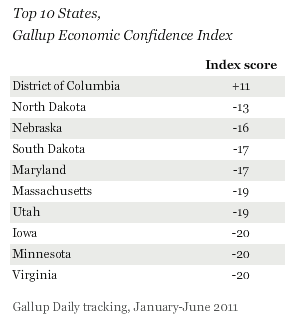
David Plouffe, Still Believe People Are Feeling Better about Economy?

David Plouffe was at yesterday’s disappointing “Freedom Rally” at Johnson Controls. Aside from being amazed (as I often am when I see politicos in person) at how short he is, seeing him also made me newly cranky about Plouffe’s comments last month about people feeling better about their own economic situations.

The average American does not view the economy through the prism of GDP or unemployment rates or even monthly jobs numbers.

In fact, those terms very rarely pass their lips. So it’s a very one-dimensional view. They view the economy through their own personal prism. You see, people’s — people’s attitude towards their own personal financial situation has actually improved over time. You know, they’re still concerned about the long-term economic future of the country, but it’s things like “My sister was unemployed for six months and was living in my basement and now she has a job.”

There’s a — a “help wanted” sign. You know, the local diner was a little busier this week. Home Depot was a little busier. These are the ways people talk about the economy. [my emphasis]

As I pointed out then, people actually weren’t feeling better about the economy, which seemed like a point you ought to be cognizant of if you’re trying to get a President re-elected based on improving consumer confidence.

Particularly when consumer confidence is at Jimmy Carter levels of malaise.

Confidence among U.S. consumers plunged in August to the lowest level since May 1980, adding to concern that weak employment gains and volatility in the stock market will prompt households to retrench.

The Thomson Reuters/University of Michigan preliminary index of consumer sentiment slumped to 54.9 from 63.7 the prior month. The gauge was projected to decline to 62, according to the median forecast in a Bloomberg News survey.

The biggest one-week slump in stocks since 2008 and the threat of default on the nation’s debt may have exacerbated consumers’ concerns as unemployment hovers above 9 percent and companies are hesitant to hire. Rising pessimism poses a risk household spending will cool further, hindering a recovery that Federal Reserve policy makers said this week was already advancing “considerably slower” than projected.

“The mood is very depressed,” said Chris Christopher, an economist at IHS Global Insight Inc. in Lexington, Massachusetts. “Consumers are very fatigued and very uncertain. In the short term, people are going to pull back on spending.”

Of course, when the President’s team decides that, rather than go and point out that the government can and has done something about jobs (and proposes to do more), it should blame Congress and pretend that freedom creates jobs all by itself, it doesn’t really inspire confidence.

As Paul Krugman says, what we need is someone to go out and staunch the bleeding, not someone to lecture more about getting the deficit in order (as Obama also did yesterday).

For the fact is that right now the economy desperately needs a short-run fix. When you’re bleeding profusely from an open wound, you want a doctor who binds that wound up, not a doctor who lectures you on the importance of maintaining a healthy lifestyle as you get older. When millions of willing and able workers are unemployed, and economic potential is going to waste to the tune of almost $1 trillion a year, you want policy makers who work on a fast recovery, not people who lecture you on the need for long-run fiscal sustainability.

[snip]

What would a real response to our problems involve? First of all, it would involve more, not less, government spending for the time being — with mass unemployment and incredibly low borrowing costs, we should be rebuilding our schools, our roads, our water systems and more. It would involve aggressive moves to reduce household debt via mortgage forgiveness and refinancing. And it would involve an all-out effort by the Federal Reserve to get the economy moving, with the deliberate goal of generating higher inflation to help alleviate debt problems.

Mind you, just from watching last night’s debate via Twitter, I recognize that most of the alternatives would be far, far worse. But to prevent one of those yahoos from having a change, the Obama Administration really ought to be looking at what works–investing in factories like JCI–rather than lecturing more about deficits and freedom.

Share this entry

Made in China: Ensuring Everyone Gets Paid Less

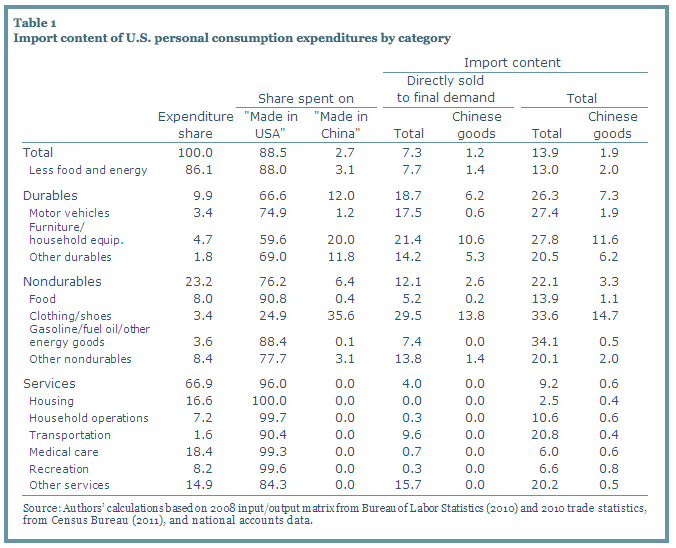
The San Francisco Federal Reserve has a report showing that we don’t really import all that much from China (this, in spite of yesterday’s report that our trade deficit rose again last month). It manages to make the claim by tracking not the volume of all the stuff we use, but the percentage of the ultimate amount of money we spend on that stuff. That calculation shows that just 2.7% of what we spend goes to China.

Here’s how that works:

Obviously, if a pair of sneakers made in China costs $70 in the United States, not all of that retail price goes to the Chinese manufacturer. In fact, the bulk of the retail price pays for transportation of the sneakers in the United States, rent for the store where they are sold, profits for shareholders of the U.S. retailer, and the cost of marketing the sneakers. These costs include the salaries, wages, and benefits paid to the U.S. workers and managers who staff these operations.

Table 1 shows that, of the 11.5% of U.S. consumer spending that goes for goods and services produced abroad, 7.3% reflects the cost of imports. The remaining 4.2% goes for U.S. transportation, wholesale, and retail activities. Thus, 36% of the price U.S. consumers pay for imported goods actually goes to U.S. companies and workers.

This U.S. fraction is much higher for imports from China. Whereas goods labeled “Made in China” make up 2.7% of U.S. consumer spending, only 1.2% actually reflects the cost of the imported goods. Thus, on average, of every dollar spent on an item labeled “Made in China,” 55 cents go for services produced in the United States. In other words, the U.S. content of “Made in China” is about 55%. The fact that the U.S. content of Chinese goods is much higher than for imports as a whole is mainly due to higher retail and wholesale margins on consumer electronics and clothing than on most other goods and services.

Now, the whole calculation relies on the fact that most of what we spend money on–the 66.9% of our spending that goes to housing (16.6% of our spending), health care (18.4%), recreation (8.2%), and other services (14.9%)–can’t be outsourced very easily (though some of this money presumably pays for call centers in India). Add in the 8% of our spending that goes to food–most of which is still grown in America (more on that below)–and this calculation doesn’t the include three-quarters of our spending that either can’t be or won’t be outsourced very easily.

There’s another way of thinking of this, though: it basically means we don’t pay the Chinese teenagers who make our sneakers very much.

We knew that–that’s the whole point of producing stuff in China!

That allows the companies importing goods from China to spend money, instead, on marketing and shipping and sales. So rather than make sneakers at a US plant, a working class American is left with a job in a big box store selling sneakers made for pennies by someone in China.

Mind you, that still means this whole process leaves room for jobs for those who design the products Made in China, people like engineers, and for B-School grads who manage the logistics of all this. But much of the jobs left for the unskilled workers are low wage.

Now, the process by which increasing amounts of money are spent on marketing and transportation is not just happening in the areas where we do import from China: clothing, cars, and furniture.

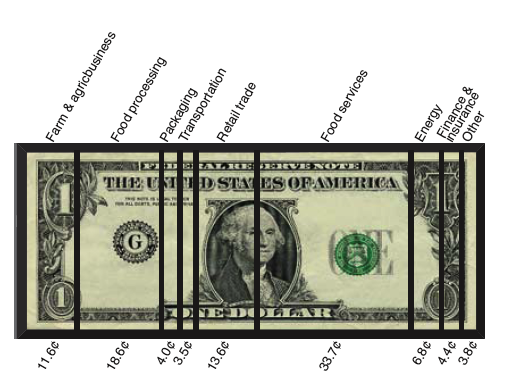
The same process is happening in the one area where we still largely produce for ourselves: food. The USDA recently recalculated how much of our food dollar goes where. And while the results aren’t as stark as the Chinese example–American farmers are still making a bigger chunk of what you spend on food than Chinese workers make from your $70 sneakers–the numbers are still pretty striking.

Farmers make less than $.12 of every dollar Americans spend on food. The bulk of the money go to food processing (more very low wage jobs) and food service (low wage restaurant jobs).

Interestingly, one thing seems to be fairly consistent across these measures. 6.6% of our spending on imported goods go to imported oil.

Imported oil, which makes up a large part of the production costs of the “gasoline, fuel oil, and other energy goods” and “transportation” categories, is the main contributor to this 6.6 percentage point difference.

And 6.8% of the American food dollar goes to energy.

This series indicates that payments from each food dollar going to the energy industry group approached 7 cents in 2008, an increase of 75 percent since 1998.

I compare the food dollar to our “China dollar” not just because it illustrates how much of our spending supports relatively non-productive roles. But also because it provides a way to understand the alternative.

Mr. EW and I spend a lot on eating out (though we frequent restaurants that locally source food). But of what I spend on food directly, the bulk of it goes right to a farmer that lives within 30 miles of me–these women, this family and this family, for example. Of course, that means I have to actually cook to make dinner. But it also means my money stays in my community rather than paying Saudis for oil.

There are some goods it makes sense to outsource. And I don’t begrudge Chinese workers for the pennies they’re making off manufacturing consumer goods for Americans. But at some level the logic of spending all that money on marketing and oil rather than on actually making things defies reason.

Share this entry

Apparently, “Freedom” Is the New Euphemism for “Government Investment”

There’s something really disturbing about Obama’s speech at Johnson Controls today: he barely claimed credit for the government’s involvement in it.

Understand, I think the opening of factories like Johnson Controls the single biggest piece of good news in our economy today. It’s good news because we’re investing in new manufacturing jobs. It’s good news because it helps us move away from our dependence on fossil fuels. And it’s good news because the technologies will help us do something about climate change. Obama’s investment in energy technology jobs may well be the single best thing he has done as President.

So I’ve been waiting for Obama to come claim credit for the factories in Holland since they were built. Since then, Rick Snyder and Crazy Pete Hoekstra have hailed these new factories, all the while pretending that capitalists did the work all by themselves, with nothing more than a tax cut from the government. I’ve been waiting for Obama to correct the record and explain how important government investment can be–particularly at a time when no one else is investing.

But it took him 1095 words–over a third of the speech–before he offered the following vague explanation for what made the factory possible.

But what also made this possible are the actions that we took together, as a nation, through our government –- the fact that we were willing to invest in the research and the technology that holds so much promise for jobs and growth; the fact that we helped create together the conditions where businesses like this can prosper.

No mention of precisely what the government did or how it invested. No mention of how many jobs that investment created (JCI’s CEO made some of that case).

And Obama’s weak claim of credit came long after Obama’s first explanation (coming 210 words in) for what created these jobs,

The reason a plant like this exists is because we are a country of unmatched freedom, where groundbreaking ideas flourish.

And it came in the paragraph after Obama’s second explanation for what created these jobs,

So let’s think about it — what made this possible?  The most important part is you:  your drive, your work ethic, your ingenuity, your management.  The grit and optimism that says, “We’ve got an idea for a new battery technology or a new manufacturing process, and we’re going to take that leap and we’re going to make an investment.  And we’re going to hire some folks and we’re going to see it through.”  That’s what made it possible.

It seems that Obama would rather push a Milton Friedmanesque notion of capitalism–arguing freedom creates jobs–than take clear, proud credit for the government’s role in creating them.

Obama had no problem claiming credit for the government’s role in creating jobs when he broke ground on a different battery factory (the LG Chem one) in Holland a year ago. After first invoking the auto bailout (and admitting it was an unpopular decision), Obama described clearly that the factory relied, in part, on a government grant for funding.

And through small business loans, a focus on research and development and investments in high-tech, fast-growing sectors like clean energy, we’ve aimed to grow our economy by harnessing the innovative spirit of the American people.

Because we did, shovels will soon be moving earth and trucks will soon be pouring concrete where we are standing.  Because of a grant to this company, a grant that’s leveraging more than 150 million private dollars, as many as 300 people will be put to work doing construction and another 300 will eventually be hired to operate this plant when it’s fully up and running.  And this is going to lead to growth at local businesses like parts suppliers and restaurants.  It will be a boost to the economy of the entire region. [my enphasis]

And he went on to boast about all the additional benefits of the investment in related jobs and increasing efficiency. That language–the language Obama used last year–is the kind of language we need to hear now that people owe their employment to such government support. It’s the kind of language that would not only support his own re-election (his approval levels in MI are barely where they need to be to win the state, particularly if Romney’s on the ballot), but it’d also help downticket Dems (Granholm had a big role in this investment), and correct the false claims made by Snyder and others.

Obama’s failure to boast loudly about the government’s role in this plant is all the more troubling given the rest of the speech.

The larger speech, after all, was about what we can do now to stimulate the economy.

Now, there are more steps that we can take to help this economy growing faster.  There are things we can do right now that will put more money in your pockets; will help businesses sell more products around the world; will put people to work in Michigan and across the country.

He went on to rehearse a bunch of ideas that really won’t stimulate the economy all that much: the payroll tax cut, the trade deals, new patent law, and a veteran jobs program. And (second in the list of things we could do), as part of his call for a highway construction bill, he admitted “we’re slipping behind because we’re not investing.”

America used to have the best stuff — best roads, best airports, best seaports.  We’re slipping behind because we’re not investing in it, because of politics and gridlock.  Do you want to put people to work right now rebuilding America?  You’ve got to send that message to Congress.

But if it’s true (and it is) that America’s falling behind because the government is not investing, if Obama’s going to try to mobilize voters to pressure Congress to do something about jobs, if what made this factory and these jobs possible was government investment, why not make a broader call for more of it?

The evidence was all there today in the form of the shiny new battery factory and the engineers running around in blue lab coats that government investment can be critically important to creating jobs. But rather than make that argument, Obama pretended that grit and freedom are all it takes to create jobs

Share this entry

Obama Tries to Sell Free Trade in Holland, MI

I’ll have more to say about Obama’s speech at Johnson Controls later today when I get back to reliable Toobz.

But here are my first impressions.

First, here’s the order of emphasis in his speech:

  1. Freedom
  2. Debt and compromise
  3. The kinds of investments that make this factory possible

That’s a problem. Republicans like Crazy Pete Hoekstra and Rick Snyder have already come to these factories to claim credit for the jobs. And they’re not going to talk about how these jobs depended on government investment.

I was unsure whether Obama was going to just ignore his pitch for trade. He didn’t. But not only did it come later in his pitch of late (after payroll tax deductions), but he changed the delivery. He claimed that if we pass these trade deals, people around the world will be driving Fords and Chevys.

Of course, people around the world already are driving Fords and Chevys. Made in places like Brazil and Mexico and China. Trade deals won’t change where the American-branded cars sold in Colombia and Panama and Korea are made.

The one exception, of course, is the most dangerous. Korea will import electric Volts and Ford Transits–they even adopted a change in KORUS to allow for them. But how long do you think the real leader in battery technology–Korea–will stand for the importation of batteries from MI? I have long believed–and still do–that KORUS may kill just this kind of factory, because once GM starts building Volts in Korea, they’ll export those higher-margin Volts to other markets.

In any case, the applause when Obama talked about trade was much quieter than the other applause lines.

One more thing about this event. It was, I believe without exception, the whitest Democratic event I have ever attended in MI. Now, Holland is whiter than much of MI (though it has a growing Latino population). But Grand Rapids, which is just  a half hour away, is racially balanced. Moreover, I know an auto supply plant about 10 miles from here that has more Latinos working at it than were in this room.

That’s probably more a testament to who the VIPs were that got invited to this event (and that the employees who have been hired here thus far tend to be white collar workers). But still, I found it striking.

Share this entry

A Jobs SuperCongress

It’s rather pathetic that this idea seems so remarkable.

Rep. John Larson (Conn.), chairman of the Democratic Caucus, wants to amend the recently passed debt-limit package to establish a joint select committee on job creation to operate alongside the already mandated Joint Select Committee on Deficit Reduction.

In a “Dear Colleague” letter sent to House members earlier in the week, Larson argued that the nation’s jobs crisis is only exacerbating its long-term fiscal problems and therefore demands Congress’s immediate attention.
“This high unemployment poses a very real short-term fiscal crisis, because it drains the federal coffers through increased government spending and reduced tax revenues,” Larson wrote in the Aug. 8 letter.
“Families are being forced out of their homes, children are being forced to forgo higher education, the elderly are being forced to retire early without nearly enough saved to cover their long-term costs,” he said. “If not addressed, I believe the social costs of unemployment will dramatically damage the United States’ status in the world and prevent us from emerging from this recession.”

And in the Senate, a portion of Democrats are making a similar argument.

Dear Leader McConnell:

Given that the single best deficit reduction strategy is economic growth, we urge you to ensure that your appointments to the new joint select committee (“JSC”) created by the debt limit bill are committed to a policy of job creation.

The recent spate of discouraging economic news underscores the need to make employment the top priority of our government.  For families across the country, the biggest economic problem is high unemployment.  As you know, the lack of jobs and anemic growth rate of the economy are not only enormous problems in their own right, causing great pain for millions of Americans, they are a major component of our deficit.  Indeed, the loss of revenue resulting from the recession accounts for nearly $4 trillion of the projected deficits over the next 10 years.

At the same time, jobless workers put additional strain on our critical social safety net programs.  As more and more Americans rely on unemployment benefits, food stamps and Medicaid, our deficits go up.  Getting those individuals back to work not only allows them to be self-sufficient, it reduces federal government spending.

It is therefore appropriate and important that the JSC explicitly embrace job creation as a part of its mission.  Targeted investments in economic growth and job creation can complement and even enhance long-term deficit reduction efforts and should be a priority that the JSC embraces.  Indeed, failure to make such investments could have a serious negative impact on our fiscal situation.

But, as Bob Brigham observes, only 23 Senators signed this letter. How have we gotten to the point where not even a majority of Senate Democrats understand that the one of the best ways to fix the deficit it to fix the jobs crisis (of course, the absolutely best way to fix the deficit is to enact single payer health care, and that’s not going to happen either).

Share this entry