
In Wake of Revelations about Corruption and Coercion, OCC Wails about Bank Cybersecurity

Over 3 months ago, the Guardian revealed that the President reserved the right to declare “inherent right of self defense” to access private networks deemed part of our critical infrastructure in the name of cybersecurity.

2 weeks ago, the Guardian, ProPublica, and NYT reported that, to make it easier to spy on others, the NSA had “deliberately weakened the international encryption standards adopted by developers.”

Also 2 weeks ago, FP reported that “many corporate participants” in an NSA initiative to protect US critical infrastructure “say Alexander’s primary motive” in that initiative “has not been to share what the NSA knows about hackers. It’s to get intelligence from the companies.”

And just this week, Spiegel provided details of how NSA conducts Man-in-the-Middle attacks — hacks — on financial giants like VISA and SWIFT.

Yet none of those revelations prevented Comptroller of the Currency Thomas Curry to give a fairly breathtaking speech yesterday about financial cybersecurity.

In it, a member of the Executive Branch that has made everyone less security by corrupting encryption said,

The growing sophistication and frequency of cyberattacks is a cause for concern, not only because of the potential for disruption, but also because of the potential for destruction of the systems and information that support our banks. These risks, if unchecked, could threaten the reputation of our financial institutions as well as public confidence in the system.

A member of a regime that is routinely hacking financial entities said,

The global nature of the Internet means they can conduct their activity from almost anywhere, including in countries with regimes that, at worst, sponsor attacks and, at a minimum, act as criminal havens by turning a blind eye toward criminal behavior.

And a member of the government that has hacked key third party providers like SWIFT and cooperated with third party telecoms to just steal data said,

Banks not only operate their own networks, they also rely on third parties to support their systems and business activities. Some of these third parties have connections to other institutions and servicers. Each new relationship and connection provides potential access points to all of the connected networks and introduces different weaknesses into the system.

I recognize the cybersecurity threat to banks is real. I’d like to be protected against criminals trying to steal my money online and I endorse OCC including IT security among things bank inspectors review. I grant that Curry may well be operating in good faith when he says all these things. But when he talks about partnerships like this, he simply loses credibility.

Clearly, much of the responsibility for assessing cyber threats is housed in other agencies, from the Department of Homeland Security to the FBI to the National Security Agency. They are on the front lines, and they are the ones that are doing the most within government to identify, evaluate, and respond to threats in this area. However, we – the OCC, the FFIEC, and the other regulatory agencies individually – are working closely with them to strengthen the coordination and overall effectiveness of government’s approach to cybersecurity of critical infrastructure.

[snip]

But this is not a problem that can be addressed by one agency alone or by any one institution acting on its own. It is a threat that we can deal with only if we work together in a collegial and collaborative way for the good of our country.

The banks’ regulators may believe he is in a position to lecture about collegiality in the face of threats. But since the government is one of the biggest of those threats, it doesn’t strike me as all that convincing.
Share this entry

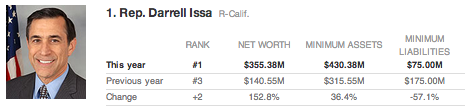
Darrell Issa’s Net Worth Goes Up 152% in One Year

Screen shot 2013-09-17 at 1.23.12 PM

It is wealth inequality day, in which, on the same day, the Census Bureau releases information on poverty and CQ releases the list of richest members of Congress.

As for poverty: things didn’t get statistically worse, but things didn’t get better at all, not even with decreasing unemployment (which, admittedly, is largely about labor market participation). (In good news, President Obama today extended minimum wage and overtime protections to home healthcare workers, though he bizarrely delayed implementation of the rule until 2015.)

As for wealth, 50 members of Congress are worth $6.67 million or more.

No wonder they seem so distant from the worries of their constituents.

But the truly mind-blowing detail from CQ’s wealthiest list is the remarkable luck Darrell Issa had in the last year. In just the last year, his net worth has increased from $140.55 million to $355.38 million — or a net worth increase of 152.8%. (He also became the richest member, but would have anyway on account of John Kerry’s retirement.)

No wonder he gins up factually problematic attacks on the IRS.

Here’s how CQ describes Issa managed such a feat:

The longtime denizen of the 50 Richest list finally reached the No. 1 spot after making about $135 million in 2012, mostly from investments that swelled in a bull market.

[snip]

Issa appears to make his money in the stock market. He ended 2012 with at least $390 million in bonds and stocks. His true worth, however, could be far greater. Members of Congress aren’t obligated to disclose exact figures, only ranges, and Issa has seven accounts with a minimum of $50 million, which is the highest category available on standard disclosure forms.

Issa also has about $75 million in outstanding loans, owing at least $50 million to Merrill Lynch and $25 million to Union Bank. Whether he truly is the richest member of Congress actually depends on precisely how much money he owes to Merrill Lynch.

So in the last year in which insider trading was legal for members Congress, Darrell Issa managed to make at least $100 million.

And yet he believes Benghazi is the most urgent matter facing this country.

Share this entry

Double Dipping at SWIFT

Spiegel today reveals more details about NSA’s “Follow the Money” program, in which it collects credit card information from select geographical regions. In addition, as TV Globo also revealed last week, they are conducting Tailored Access Operations against SWIFT, the international financial transfer messaging system.

The NSA’s Tracfin data bank also contained data from the Brussels-based Society for Worldwide Interbank Financial Telecommunication (SWIFT), a network used by thousands of banks to send transaction information securely. SWIFT was named as a “target,” according to the documents, which also show that the NSA spied on the organization on several levels, involving, among others, the agency’s “tailored access operations” division. One of the ways the agency accessed the data included reading “SWIFT printer traffic from numerous banks,” the documents show.

Now, some caution about this claim is in order. Spiegel reports that NSA’s financial records database has 180 million records, of which 84% are credit card transactions.

The collected information then flows into the NSA’s own financial databank, called “Tracfin,” which in 2011 contained 180 million records. Some 84 percent of the data is from credit card transactions.

Even assuming the balance of the records in the database come from SWIFT, that’s less than 29 million records (in 2011, so assume the number is larger now). In 2011, SWIFT was sending 17.5 million records a day. So whatever makes it into the actual database is just a small fraction of international traffic.

But that almost certainly doesn’t account for the bulk of the SWIFT information collected by the US government. Remember: in addition to stealing the data, Treasury also gets it via a now-public agreement. The former CEO of SWIFT Leonard Schrank and former Homeland Security Czar, Juan Zarate actually boasted in July, in response to the earliest Edward Snowden revelations, about how laudable Treasury’s consensual access to the data was.

The use of the data was legal, limited, targeted, overseen and audited. The program set a gold standard for how to protect the confidential data provided to the government. Treasury legally gained access to large amounts of Swift’s financial-messaging data (which is the banking equivalent of telephone metadata) and eventually explained it to the public at home and abroad.

It could remain a model for how to limit the government’s use of mass amounts of data in a world where access to information is necessary to ensure our security while also protecting privacy and civil liberties.

Never mind that by the time they wrote this, an EU audit had showed the protections were illusory, in part because the details of actual queries were oral (and therefore the queries weren’t auditable), in part because Treasury was getting bulk data. But there was a legitimate way to get data pertaining to the claimed primary threat at hand, terrorism. And now we know NSA also stole data.

Note, too, the timing. While Spiegel doesn’t provide enough details about the exploitation of SWIFT for us to date it, the dates it does provide about this financial spying are 2010 and 2011. That was the period when the EU was trying to put sensible limits to Treasury’s access of SWIFT.

Back when the intelligence community first decided to go after SWIFT data, their first plan was to just steal it.

Intelligence officials were so eager to use the Swift data that they discussed having the C.I.A. covertly gain access to the system, several officials involved in the talks said. But Treasury officials resisted, the officials said, and favored going to Swift directly.

12 years later, they apparently are stealing at least some of it. That probably means they wanted data for transactions that have nothing to do with the counterterrorism application first SWIFT and then the EU bought off on. So there’s the legal access to counterterrorism data via Treasury, and the illegal access to (presumably) some other kind of data via NSA.

Read more

Share this entry

Google’s Payoff from DOD: 20 Cheap Fuel Flights to Tortola

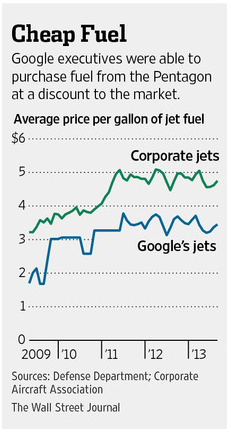
Screen shot 2013-09-13 at 1.47.45 PMGiven that I’m very interested in the carrots and sticks the government uses to get tech companies to help spy on us, I find it rather interesting that from 2007 until August 31, DOD was allowing Google to pay for jet fuel at Moffett Field near Google’s HQ in Mountain View at DOD’s substantially discounted rate.

Granted, this arose because Google provided a light airplane to perform scientific flights for Ames Research Center.

NASA officials have pointed to a related agreement by the Google executives to perform scientific flights and other NASA-related transport. That mostly has involved flights by an Alpha jet, a small trainer bought by the Google executives and used by NASA to measure atmospheric greenhouse gases and ozone.

[snip]

[T]he contract between H211 and the Pentagon stated that the fuel was supposed to be used only “for performance of a U.S. government contract, charter or other approved use,” and said violations could trigger civil or criminal penalties. There is no indication of any such investigation.

Flight records from the Federal Aviation Administration suggest that the vast bulk of the flights by the Google executives’ fleet have been for non-NASA purposes.

The main jets in the fleet—a Boeing 767, Boeing 757 and four Gulfstream V’s—have departed from Moffett a total of 710 times since 2007, FAA records show. The most frequent destinations were Los Angeles and New York, but the planes also flew 20 times to the Caribbean island of Tortola; 17 to Hawaii; 16 to Nantucket, Mass.; and 15 to Tahiti.

This agreement went into place before Google joined PRISM, for example (though I’m sure Google was already helping NSA on its storage challenges before that). Though I really look forward to Google defending these fuel purchases because so much of what they do is “for performance of a U.S. government contract.”

This is peanuts to a company as rich as Google; access to the airport is probably worth more to Google execs than the cheap gas.

Still, it’s a perk. The kind of perk that might explain why Eric Schmidt believes all this spying is just the nature of society. (h/t Kevin Gosztola)

There’s been spying for years, there’s been surveillance for years, and so forth, I’m not going to pass judgment on that, it’s the nature of our society.

Spying is the nature of society in the same way as special perks for those who help in it, after all.

Share this entry

James Clapper’s Financial War on the World

I’m fundraising this week. Please support me if you can. 

Yesterday, TV Globo published details of NSA spying on Brazil’s oil company, Petrobras, SWIFT, and financial organizations. Besides revealing that man-in-the-middle attacks are sometimes used, the report didn’t offer details of what the NSA was actually collecting. Its sources suggest NSA might be seeking Brazil’s leading deep sea drilling technology or geological information that would be useful in drilling auctions, but it is also conceivable the NSA is just trying to anticipate what the oil market will look like in upcoming years (this is one area where we probably even spy on our allies the Saudis, since they have been accused of lying about their reserves).

To some degree, then, I await more details about precisely what we’re collecting and why.

But what I am interested in is James Clapper’s response. He released this statement on the I Con site.

It is not a secret that the Intelligence Community collects information about economic and financial matters, and terrorist financing.

We collect this information for many important reasons: for one, it could provide the United States and our allies early warning of international financial crises which could negatively impact the global economy. It also could provide insight into other countries’ economic policy or behavior which could affect global markets.

Our collection of information regarding terrorist financing saves lives. Since 9/11, the Intelligence Community has found success in disrupting terror networks by following their money as it moves around the globe. International criminal organizations, proliferators of weapons of mass destruction, illicit arms dealers, or nations that attempt to avoid international sanctions can also be targeted in an effort to aid America’s and our allies’ interests.

What we do not do, as we have said many times, is use our foreign intelligence capabilities to steal the trade secrets of foreign companies on behalf of – or give intelligence we collect to – US companies to enhance their international competitiveness or increase their bottom line.

As we have said previously, the United States collects foreign intelligence – just as many other governments do – to enhance the security of our citizens and protect our interests and those of our allies around the world. The intelligence Community’s efforts to understand economic systems and policies and monitor anomalous economic activities is critical to providing policy makers with the information they need to make informed decisions that are in the best interest of our national security.

Let me take this extraordinary statement in reverse order.

In the fourth paragraph, Clapper reiterates the final defense that NSA defenders use: that we’re better than, say, China and France, because we don’t engage in industrial espionage, stealing technology with our spying. That may be true, but I suspect at the end of the day the economic spying we do might be more appalling.

In the third paragraph, he retreats to the terror terror terror strategy the Administration has used throughout this crisis. And sure, no one really complains that the government is using financial tracking to break up terrorist networks (though the government is awfully selective about whom it prosecutes, and it almost certainly has used a broad definition of “terrorism” to spy on the financial transactions of individuals for geopolitical reasons). But note, while the Globo report provided no details, it did seem to describe that NSA spies on SWIFT.

That would presumably be in addition to whatever access Treasury gets directly from SWIFT, through agreements that have become public.

That is, the Globo piece at least seems to suggest that we’re getting information from SWIFT via two means, via the now public access through the consortium, but also via NSA spying. That would seem to suggest we’re using it for things that go beyond the terrorist purpose the consortium has granted us access for. Past reporting on SWIFT has made it clear we threatened to do just that. The Globo report may support that we have in fact done that.

Now the second paragraph. James Clapper, too cute by half, asserts, spying on financial information,

could provide the United States and our allies early warning of international financial crises which could negatively impact the global economy

Hahahahahaha! Oh my word! Hahahaha. I mean, sure, the US needs to know of pending financial crises, in the same way it wants to know what the actual versus claimed petroleum reserves in the world are (and those are, of course, closely related issues). But with this claim, Clapper suggests the US would actually recognize a financial crisis and do something about it.

Hahahahaha. Didn’t — still doesn’t — work out that way.

Read more

Share this entry

Bandar’s Hot and Cold Running Jihadis

As a reminder, it is fundraising week Chez Emptywheel. Please help support our work if you can.

In my questioning of the Administration’s case on Syria, I have focused on holes within their own story — inconsistent numbers, claims about chain-of-command even while boasting of a hundred defections, false assurances about the reliability of the rebels. Note, too, Jim’s catch about the timing of a rebel advance.

All the while I’ve been reading the several strands of stories alleging that rebel-tied people, not Assad, caused the attack. There’s the story that hacked emails show a recently retired American Colonel assuring his wife that the dead Syrian kids were just for show. There’s a new letter from Veteran Intelligence Professionals for Sanity (who warned about the Iraq WMD) warning that Syria is a trap.

I’m not confident yet I buy these stories — and besides, there’s plenty of evidence that Vladimir Putin is waging as heavy a propaganda battle as the US government, so it could well be Russian propaganda.

But given all this, there’s one more item that deserves far more attention. Back in early August, I noted a Reuters report of a meeting between Bandar bin Sultan and Putin, in which Bandar offered Putin a lot of things he couldn’t deliver so long as Putin would give up on supporting Bashar al-Assad.

The day of the CW attack, what is clearly Putin’s version of the story got published. In addition to it depicting Bandar basically concluding (at the end of July) that “there is no escape from the military option” in Syria, it also alleged that Bandar claimed he could shut down jihadist influence in Syria and suggested he could prevent Chechen terrorists from attacking the Sochi Olympics. Or not, depending on whether Putin cooperated.

Bandar told Putin, “There are many common values ​​and goals that bring us together, most notably the fight against terrorism and extremism all over the world. Russia, the US, the EU and the Saudis agree on promoting and consolidating international peace and security. The terrorist threat is growing in light of the phenomena spawned by the Arab Spring. We have lost some regimes. And what we got in return were terrorist experiences, as evidenced by the experience of the Muslim Brotherhood in Egypt and the extremist groups in Libya. … As an example, I can give you a guarantee to protect the Winter Olympics in the city of Sochi on the Black Sea next year. The Chechen groups that threaten the security of the games are controlled by us, and they will not move in the Syrian territory’s direction without coordinating with us. These groups do not scare us. We use them in the face of the Syrian regime but they will have no role or influence in Syria’s political future.

Putin thanked King Abdullah for his greetings and Bandar for his exposition, but then he said to Bandar, “We know that you have supported the Chechen terrorist groups for a decade. And that support, which you have frankly talked about just now, is completely incompatible with the common objectives of fighting global terrorism that you mentioned. We are interested in developing friendly relations according to clear and strong principles.”

Again, this is clearly Putin’s version of the meeting. We should assume it is at least partly propaganda.

However, the allegation that Bandar either implicitly or explicitly threatened the Olympics does very closely resemble a threat Bandar is documented to have made in the past.

Back in 2004, the British Serious Fraud Office started to investigate the Al-Yamamah arms deal under Maggie Thatcher, in which BAE would bribe members of the Saudi royal family to sell arms (as a special side deal, the bribes became a slush fund to run covert ops). In 2005, BAE started pressuring SFO to drop the investigation in the public interest, at first citing the business BAE would lose if SFO continued the investigation. Then in December 2006, Bandar flew to Britain and threatened Tony Blair that the Saudis would stop counterterrorism cooperation unless SFO dropped the investigation. Within weeks, SFO dropped the investigation.

Read more

Share this entry

Is This Why Banksters Don’t Go to Jail for Laundering Terrorist Finances?

I’m in the middle of a deep dive in the Section 215 White Paper — expect plenty of analysis on it in coming attractions!

But I want to make a discrete point about this passage, which describes what happen to query results.

Results of authorized queries are stored and are available only to those analysts trained in the restrictions on the handling and dissemination of the metadata. Query results can be further analyzed only for valid foreign intelligence purposes. Based on this analysis of the data, the NSA then provides leads to the FBI or others in the Intelligence Community. For U.S. persons, these leads are limited to counterterrorism investigations.

The Primary Order released several weeks back calls these stored query results “the corporate store.” As ACLU laid out, the government can do pretty much whatever it wants with this corporate store — and their analysis of it is not audited.

All of this information, the primary order says, is dumped into something called the “corporate store.” Incredibly, the FISC imposes norestrictions on what analysts may subsequently do with the information. The FISC’s primary order contains a crucially revealing footnote stating that “the Court understands that NSA may apply the full range of SIGINT analytic tradecraft to the result of intelligence analysis queries of the collected [telephone] metadata.” In short, once a calling record is added to the corporate store, anything goes.

More troubling, if the government is combining the results of all its queries in this “corporate store,” as seems likely, then it has a massive pool of telephone data that it can analyze in any way it chooses, unmoored from the specific investigations that gave rise to the initial queries. To put it in individual terms: If, for some reason, your phone number happens to be within three hops of an NSA target, all of your calling records may be in the corporate store, and thus available for any NSA analyst to search at will.

But it’s even worse than that. The primary order prominently states that whenever the government accesses the wholesale telephone-metadata database, “an auditable record of the activity shall be generated.” It might feel fairly comforting to know that, if the government abuses its access to all Americans’ call data, it might eventually be called to account—until you read footnote 6 of the primary order, which exempts entirely the government’s use of the “corporate store” from the audit-trail requirement.

The passage from the White Paper seems to suggest there are limits (though it doesn’t explain where they come from, because they clearly don’t come from FISC).

This analysis must have a valid foreign intelligence purpose — which can include political information, economic information, espionage information, military information, drug information, and the like. Anything other countries do, basically.

But if the data in the corporate store pertains to US persons, the FBI can only get a lead “for counterterrorism purposes.”

At one level, this is (small) comfort, because it provides a level of protection on the dragnet use.

But it also may explain why HSBC’s US subsidiary didn’t get caught laundering al Qaeda’s money, or why JP Morgan always gets to self-disclose its support for Iranian “terrorism.” So long as the government chooses not to treat banks laundering money for terrorists as material support for terror, then they can consider these links (which surely they’ve come across in their “corporate store!) evidence of a financial crime, not a terrorist one, and just bury it.

I would be curious, though, whether the government has ever used the “corporate store” to police Iran sanctions. Does that count as a counterterrorism purpose? And if so, is that why Treasury “finds” evidence of international bank violations so much more often than it does American bank violations?

Share this entry

Candidate Obama’s Tribute to “Courage and Patriotism” of Whistleblowers Disappears 2 Days after First Snowden Revelations

Sunlight Foundation discovers the Obama Administration has removed access to his 2008 campaign promises from the White House website. It suggests one of the promises Obama may want to hide has to do with his support for whistleblowers.

While front splash page for for Change.gov has linked to the main White House website for years, until recently, you could still continue on to see the materials and agenda laid out by the administration. This was a particularly helpful resource for those looking to compare Obama’s performance in office against his vision for reform, laid out in detail on Change.gov.

According to the Internet Archive, the last time that content (beyond the splash page) was available was June 8th — last month.

Why the change?

Here’s one possibility, from the administration’s ethics agenda:

Protect Whistleblowers: Often the best source of information about waste, fraud, and abuse in government is an existing government employee committed to public integrity and willing to speak out. Such acts of courage and patriotism, which can sometimes save lives and often save taxpayer dollars, should be encouraged rather than stifled. We need to empower federal employees as watchdogs of wrongdoing and partners in performance. Barack Obama will strengthen whistleblower laws to protect federal workers who expose waste, fraud, and abuse of authority in government. Obama will ensure that federal agencies expedite the process for reviewing whistleblower claims and whistleblowers have full access to courts and due process.

It may be that Obama’s description of the importance of whistleblowers went from being an artifact of his campaign to a political liability.

To be fair, Obama did extend whistleblower protection beyond that of the law last year — though he did it largely in secret.

Of course, that came at the same time as Obama rolled out an Insider Threat Detection system that seems designed to discourage anyone from speaking out … about anything.

And then there’s the issue of all the whistleblower prosecutions.

But if Obama did hide his campaign promises specifically to hide this tribute to the “courage and patriotism” of whistleblowers, then I find the timing particularly interesting. June 8 was just two days after the first Edward Snowden release (at a time, moreover, when the Guardian had reported only issues that went to lies James Clapper and Keith Alexander had told, making Snowden’s claim to be unable to go through regular channels quite credible).

Mind you, Obama could be hiding other promises. I still think promises about mortgages and homes are his biggest failure.

Share this entry

Carl Levin’s Double Standard for Banksters and Spooks

Carl Levin is one of the few people in DC who has tried to hold banks accountable — in his case, via investigations conducted at the Permanent Subcommittee on Investigations. Never mind that DOJ has serially taken his investigations and, seemingly, wiped their ass with them for all the banksters who have been held accountable as a result.

One particularly noteworthy ass-wiping came after Levin referred Goldman Sachs CEO Lloyd Blankfein to DOJ for lying to his customers and, more importantly, to Congress. To him.

The chairman of the U.S. Senate’s investigative subcommittee said he believes Goldman Sachs officials made misleading statements about their trading during the financial crisis and should be investigated criminally.

Sen. Carl Levin (D-Mich.) said on Wednesday that he plans to refer Goldman officials, and potentially officials from other organizations, to the Justice Department for possible prosecution and to the Securities and Exchange Commission for possible civil proceedings.

“In my judgment, Goldman clearly misled their clients and they misled the Congress,” said Levin, the chairman of the Senate Permanent Subcommittee on Investigations.

[snip]

“We will be referring this matter to the Justice Department and the SEC,” Levin said.

DOJ did what it does — which apparently includes chatting up CEOs — while it is pretending to investigate when it is actually wiping its ass. Then after a year it decided it wasn’t going to prosecute Blankfein.

Still. Just over 2 years ago, Carl Levin believed that when people, even very powerful people, lie to Congress, DOJ should at least consider prosecuting them.

How times change.

Levin also said he was still “troubled” by Director of National Intelligence James Clapper’s testimony to the Senate Intelligence Committee that the NSA did not collect data on millions of Americans.

“I’m troubled by that testimony, obviously. I don’t know how he’s tried to wiggle out from it, but I’m troubled by it,” Levin said. “How you hold him accountable, I guess the only way to do that would be for the president to somehow or other fire him.”

But, Levin added, “I think he’s made it clear that he regrets saying what he said, and I don’t want to call on the president to fire him although I am troubled by it.”

Golly! Clapper regrets what he said (or rather, that he got caught saying it?). So rather than suggesting we hold Clapper accountable the way Levin tried to do with Blankfein, he instead thinks maybe if the President feels like it on his own because Levin himself isn’t going to call on him to do this, Obama should “somehow or other fire” Clapper.

Share this entry

Five Additional Questions for Jim Comey

Colleen Rowley has a great list of questions Jim Comey should be asked today in his confirmation hearing (I’ll be live-tweeting it, so follow the twitter feed over there. >>>>>>

Here are five questions I would add:

  1. The May 10, 2005 torture authorization you signed off (as well as the Combined of the same date one you objected to) on was retrospective. What were the circumstances of the treatment of this detainee? Was that detainee water-boarded, in spite of CIA claims only Abu Zubaydah, Ibn Rahim al-Nashiri, and Khalid Sheikh Mohammed were?
  2. Do you believe the High Value Interrogation Group (HIG) should be authorized to use “separation,” including modified sleep deprivation, to coerce confessions?
  3. Do you believe it legal or advisable to delay presentment for detainees interrogated by HIG so as to set up up to two weeks of unsupervised interrogation?
  4. FBI has used the Section 215 authorization — the same law used to collect every American’s phone data — to collect lists of common products that on very rare occasions have been used as precursors to explosives. They could and may well have used the same authority with pressure cookers. Is collecting such a broad sweep of innocent activity in pursuit of terrorists the best way to identify them? What do you believe the appropriate use of Section 215 authority is?
  5. Through the entire financial crisis, it appears the FBI did not use all the investigative tools available, including (with two or three notable exceptions) wiretaps and phone and Internet tracking, when investigating large financial institutions. This appears to be true even when, as with your former employer HSBC, the institution had clear ties to terrorists and Transnational Criminal Organizations. What tools do you believe appropriate to investigate large financial institutions and do you plan to change the approach to investigating financial crime?
Share this entry