
How Does the CIA-on-the-Hudson Program Interact with Secure Communities?
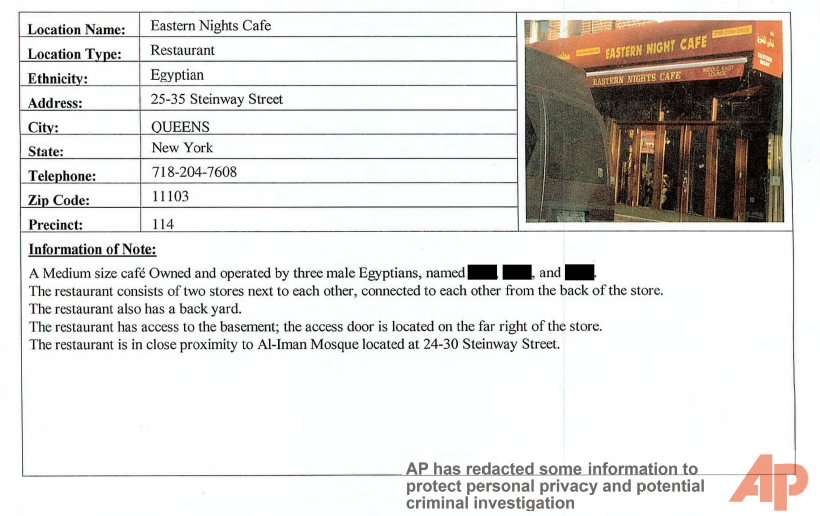
The AP has another installment of their series on the NYPD intelligence department’s mapping of ethnic neighborhoods in New York. As always, you should read the whole thing, as well as the documents showing the spooks’ data collection on innocent Moroccans and Moroccan-Americans.

One question I came away with, though, was how this program interacted with Department of Homeland Security’s Secure Communities program.

Secure Communities, recall, involves information sharing from local law enforcement to the FBI to DHS.

When state and local law enforcement arrest and book someone into a jail for a violation of a state criminal offense, they generally fingerprint the person. After fingerprints are taken at the jail, the state and local authorities electronically submit the fingerprints to the Federal Bureau of Investigation (FBI). This data is then stored in the FBI’s criminal databases. After running the fingerprints against those databases, the FBI sends the state and local authorities a record of the person’s criminal history.

With the Secure Communities program, once the FBI checks the fingerprints, the FBI automatically sends them to DHS, so that U.S. Immigration and Customs Enforcement (ICE) can determine if that person is also subject to removal (deportation). This change, whereby the fingerprints are sent to DHS in addition to the FBI, fulfills a 2002 Congressional mandate for the FBI to share information with ICE, and is consistent with a 2008 federal law that instructs ICE to identify criminal aliens for removal. Secure Communities does not require any changes in the procedures of local law enforcement agencies or jails.

By that process, DHS identifies people it can deport so as to meet the quota set for them by Congress.

As DDay has written repeatedly, this process has led to the deportation of low-level undocumented people, not the hardened felons the program was designed for. And this, in turn, makes local law enforcement less effective, because it makes immigrant communities less willing to cooperate with the cops because doing so might get them deported.

As the documents made available by AP make clear, when the NYPD’s spooks case out businesses, they note whether they are owned by citizens of ethnic (even Italian!) descent, or (as with the Eastern Nights Cafe profile, above) non-citizens. This effectively means NYPD’s spooks are, among other things, creating a database of the statuses of key members of ethnic communities throughout the city. Also, since the NYPD had a set of questions to ask anyone arrested or on parole from the Moroccan community, it also means the normal law enforcement process was being used to collect a database of information on immigration statuses and habits.

The AP story seems to suggest that NYPD keeps this information in a database separate from their other database system.

The information was recorded in NYPD computers, officials said, so that if police ever received a specific tip about a Moroccan terrorist, officers looking for him would have details about the entire community at their fingertips.

[snip]

Current and former officials said the information collected by the Demographics Unit was kept on a computer inside the squad’s offices at the Brooklyn Army Terminal. It was not connected to the department’s central intelligence database, they said.

The first installment of this series reported that the NYPD had shredded some of its documents to keep aspects of the program–including the fact that they were “building dossiers on innocent people, as these latest documents show they were–secret.

Some in the department, including lawyers, have privately expressed concerns about the raking program and how police use the information, current and former officials said. Part of the concern was that it might appear that police were building dossiers on innocent people, officials said. Another concern was that, if a case went to court, the department could be forced to reveal details about the program, putting the entire operation in jeopardy.

That’s why, former officials said, police regularly shredded documents discussing rakers.

But they did pass some of the information to the CIA via back channels.

Intelligence gathered by the NYPD, with CIA officer Sanchez overseeing collection, was often passed to the CIA in informal conversations and through unofficial channels, a former official involved in that process said.

Mind you, that doesn’t mean this information was shared with DHS’ Immigration and Customs Enforcement, leading to deportations.

But given information sharing laws included within the PATRIOT Act, this intelligence might well be legally available to the Federal government (but possibly illegal for them to keep, given that it is potentially illegal domestic intelligence).

All of which leads me to wonder: has the CIA-on-the-Hudson make NYC less safe, because it has turned the local cops into officers combining law enforcement, intelligence, and immigration mapping?

Share this entry

Once Again, US Ratchets Up Rhetoric Against Pakistan

The pattern by now is all too familiar.  Once again, the US is ratcheting up its rhetoric against Pakistan.  Earlier instances included the “crisis” when the US killed three Pakistani soldiers and Pakistan responded by closing strategic border crossings.  This was followed by the Raymond Davis fiasco. Then came exchanges of bluster over the US unilateral action that took out Osama bin Laden.  Now, the target of US ire is the cozy relationship between the Haqqani network and Pakistan’s intelligence agency, the ISI.

Reporting for Reuters, Mark Hosenball and Susan Cornwell tell us this morning that some in the US intelligence community are now assigning a direct role for ISI in the Haqqani network attack on the US embassy in Kabul:

Some U.S. intelligence reporting alleges that Pakistan’s Inter Services Intelligence directorate (ISI) specifically directed, or urged, the Haqqani network to carry out an attack last week on the U.S. Embassy and a NATO headquarters in Kabul, according to two U.S. officials and a source familiar with recent U.S.-Pakistan official contacts.

The article informs us that the Senate Appropriations Committee has added to the pressure on Pakistan:

The Senate committee approved $1 billion in aid to support counter-insurgency operations by Pakistan’s military, but voted to make this and any economic aid conditional on Islamabad cooperating with Washington against militant groups including the Haqqanis.

A series of high-level meetings between US and Pakistani officials also has taken place over the last week to hammer home these allegations against Pakistan, despite this warning in the Reuters article:

However, U.S. officials cautioned that the information that Pakistan’s spy agency was encouraging the militants was uncorroborated.

A series of articles on the website for Pakistan’s Dawn news agency provides some perspective on the coverage of the issue in Pakistan.  One article provides a forum for Interior Minister Rehman Malik after his meeting with FBI Director Robert Mueller yesterday: Read more

Share this entry

The Cost of $100 Million Prison Expansions and Other “Civilian-Led” Blowback

In addition to green-lighting debt collection calls to cell phones, another of the deficit plans Obama rolled out today is basically claiming credit for military withdrawals.

The plan also realizes more than $1 trillion in savings over the next 10 years from our drawdowns in Afghanistan and Iraq.

As DDay notes, these “cuts” are scheduled to happen anyway. It’s just funny accounting, particularly since the foreverwar hawks will fight some of these changes in any case.

But there’s another reason I think this is funny accounting. We’re not withdrawing, we’re switching to “civilian-led” efforts in these places. And Obama is not measuring the costs of these civilian-led efforts.

Such as the $100 million expansion we’re making to habeas-free Parwan prison in Afghanistan.

The U.S. Army Corps of Engineer (USACE) Middle East District intends to solicit names of construction firms or joint ventures experienced in working in the Middle East region who are interested in submitting a firm-fixed price offer for this project. To be considered a construction firm, the firm must perform construction as a significant portion of its business. This announcement is for the construction of Detention Facility in Parwan (DFIP), Bagram, Afghanistan. The contractor shall comply with all base security requirements. Defense Base Act Insurance and Construction surety will be required. The estimated cost of the project is between $25,000,000 to $100,000,000.

PROJECT SCOPE: The scope of the Project includes construct detainee housing capability for approximately 2000 detainees. [my emphasis]

Glenn Greenwald hits much of what needs to be said about this expansion:

Budgetary madness to the side, this is going to be yet another addition to what Human Rights First recently documented is the oppressive, due-process-free prison regime the U.S. continues to maintain around the world:

Ten years after the September 11 attacks, few Americans realize that the United States is still imprisoning more than 2800 men outside the United States without charge or trial. Sprawling U.S. military prisons have become part of the post-9/11 landscape, and the concept of “indefinite detention” — previously foreign to our system of government — has meant that such prisons, and their captives, could remain a legacy of the 9/11 attacks and the “war on terror” for the indefinite future. . . . .

The secrecy surrounding the U.S. prison in Afghanistan makes it impossible for the public to judge whether those imprisoned there deserve to be there. What’s more, because much of the military’s evidence against them is classified, the detainees themselves have no right to see it. So although detainees at Bagram are now entitled to hearings at the prison every six months, they’re often not allowed to confront the evidence against them. As a result, they have no real opportunity to contest it.

In one of the first moves signalling just how closely the Obama administration intended to track its predecessor in these areas, it won the right to hold Bagram prisoners without any habeas corpus rights, successfully arguing that the Supreme Court’s Boumediene decision — which candidate Obama cheered because it guaranteed habeas rights to Guantanamo detainees — was inapplicable to Bagram.  Numerous groups doing field work in Afghanistan have documented that the maintenance of these prisons is a leading recruitment tool for the Taliban and a prime source of anti-American hatred.  Despite that fact — or, more accurately (as usual), because of it — the U.S. is now going to build a brand new, enormous prison there.

And then there’s the expansion we’re doing to the “Embassy” in Baghdad. Dan Froomkin lays this out.

U.S. diplomats, military advisers and other officials are planning to fall back to the gargantuan embassy in Baghdad — a heavily fortified, self-contained compound the size of Vatican City.

The embassy compound is by far the largest the world has ever seen, at one and a half square miles, big enough for 94 football fields. It cost three quarters of a billion dollars to build (coming in about $150 million over budget). Inside its high walls, guard towers and machine-gun emplacements lie not just the embassy itself, but more than 20 other buildings, including residential quarters, a gym and swimming pool, commercial facilities, a power station and a water-treatment plant.

[snip]

The number of personnel under the authority of the U.S. ambassador to Iraq will swell from 8,000 to about 16,000 as the troop presence is drawn down, a State Department official told The Huffington Post. “About 10 percent would be core programmatic staff, 10 percent management and aviation, 30 percent life support contractors — and 50 percent security,” he said.

[snip]

As the Department of Defense pulls out and its spending drops, the State Department is expecting its costs to skyrocket. State asked Congress for $2.7 billion for its Iraqi operations in fiscal year 2011, and got $2.1 billion. It wants $6.2 billion for next year. The Senate Foreign Relations Committee estimates that State’s plans will cost $25 to $30 billion over the next five years.

I use scarequotes for the word “Embassy” because I think it’s time we set aside the fiction that this is a State Department operation. Froomkin notes, for example, that the $6 billion a year State will be spending on this “Embassy” adds to the only $14 billion State spends, in total, right now.

It’s not just the actual spending I’m objecting to–the $100 million here, the $30 billion there–though Glenn’s point, that we refuse to spend a fraction of $100 million to fix CA’s prison overcrowding, is an important one.

It’s that in one of our colonies we’re doubling the size of our replacement Gitmo, right there in plain view of the people it will antagonize (though the expansion does raise questions about whether we’ll fill the prison with detainees from other countries, too).

And in another of our colonies we’re expanding our giant concrete intelligence bunker (I am open to suggestions for better names for this monstrosity), replete with numbers equal to the numbers of troops Nuri al-Maliki can’t publicly approve. Will the fact that intelligence and contractor personnel are watching over our colony be any less incendiary to the Moqtada al-Sadrs of Iraq than men and women we explicitly called troops? Isn’t this stupid fiction–with the legal fiction it exploits–be in a number of ways worse?

Call it a crazy suspicion. But our non-withdrawal withdrawals from our colonies seems ripe for blowback in a very very big (and expensive) way.

Of course that’s precisely the kind of cost even the deficit hawks refuse to count, so we’ll never see it accounted for in any budget.

Share this entry

The CIA Hates Us for Our Freedom

As I’ve noted a couple of times, there’s the suggestion that the CIA likes the NYPD’s CIA-on-the-Hudson because the NYPD, unlike the CIA, is diverse enough to have people with the linguistic and cultural background to infiltrate Muslim communities.

So how stupid is this?

Three weeks ago, The Arab American News published a story written by The Associated Press about the CIA and the NYPD cooperating in a massive spying operation on the entire Muslim community in the New York/New Jersey area.

The following week, we published an article detailing the CIA’s denial of that activity.

As we went to press last week, Thursday, September 8, 2011, we received an email from the advertising agency which handles the CIA’s account. “The government agency for the CIA has just contacted us and wants us to remove the banners from your website for undisclosed reasons,” the agency said in its email. A representative from the advertising agency haunted our advertising director all afternoon, repeatedly asking to immediately remove the four ads that the agency just orderedeight days ago. Another email three hours later from the same agency: “Sorry to keep bothering you but the client is giving me a headache.” The CIA has canceled all advertising in The Arab American News.

Not only was this outlet a place the CIA advertised to the Arab community (presumably including recruitment ads), but the paper, as it describes, served as an entree into the community.

This newspaper was instrumental in inviting the CIA into the community, introducing its employees to community leaders and helping to forge good relations between the force and local organizations. The CIA has sponsored many events in the community and generally been welcomed with open arms.

So now the newspaper is drawing one of the most obvious conclusions: that the CIA hates us–rather, a newspaper serving the Arab American community–for our freedoms.

But the evidence shows that perhaps that was a mistake. We treated the CIA like an American institution that believes in American values, like freedom of speech, freedom of worship and the freedom to peaceably assemble. At least in America.

However, if displeasure with one story the newspaper publishes causes a government agency to pull all its ads in retribution, then we assume everyone should be afraid of the CIA — and maybe the whole government — because it’s obviously “my way or the highway” with them. For us they can pull advertising and satisfy their thirst for revenge.

There is, though, one other (not mutually exclusive) possibility. Presumably the CIA wants Arab-Americans it recruits to imagine that they will be targeting actual terrorists if they go to work for the CIA. But the AP series shows that, in the CIA-assisted NYPD program, Arab-Americans will be spying on the innocent activities of their own community. Arab-Americans who read the AP series in this newspaper, then, might be less pliable recruits for the CIA.

So, instead, they’ll just have to rely even more on the NYPD to infiltrate these communities, I guess, having pissed off key figures in the community it needs to reach out to to do its job.

Share this entry

John Brennan, the Intelligence Community’s One Man Justice Department

Matt Apuzzo has a story describing three different responses to growing concerns about the CIA-on-the-Hudson.

There’s Rush Holt, who unfortunately is no longer on the House Intelligence Committee and therefore has limited ability to look into this:

“I believe that these serious and significant allegations warrant an immediate investigation,” Holt wrote.

[snip]

Holt, who previously served on the House Intelligence Committee, said he never remembers being told about the CIA partnership or the programs the NYPD was running.

[snip]

Holt asked for a special prosecutor because he wanted both the civil rights issues and the NYPD-CIA collaboration to be investigated, his office said.

So Holt, who suggests he should have been informed of the NYPD spook program but wasn’t, suggests one means of oversight never happened.

There’s Mike Bloomberg, who has been Mayor for almost the entire post-9/11 period and therefore ought to have exercised some oversight over this program:

In New York, Mayor Michael Bloomberg was asked Thursday about the CIA’s investigation and whether he thought the partnership violated any laws.

“How would I know?” Bloomberg replied. “They’re doing an investigation. That’s what — if I knew, I’d be happy to tell them. But my guess is no.”

Surprisingly, Bloomberg hasn’t thought of consulting one of NY’s own lawyers, or one of the thousands of lawyers inhabiting NY, to find out whether the partnership was legal. A smart guy like Mayor Mike and he claims not to even know how he might find out if the program were legal. Rather than finding out, though, he’s just gonna guess.

And then, finally, there’s John Brennan, the guy who apparently did the targeting for Cheney’s illegal wiretap program and also was personally involved in one of the whistleblower cases the Obama Justice Department is prosecuting, who cites his intimate knowledge of the program as his basis for being sure there’s no problem.

President Barack Obama’s homeland security adviser, John Brennan, who was the deputy executive director the CIA when the NYPD intelligence programs began, said he was intimately familiar with the CIA-NYPD partnership. He said that agency knew what the rules were and did not cross any lines.

Call me crazy. But I think there’s a third reason to support Holt’s call for an independent prosecutor. Not only is Obama’s DOJ personally involved, but his top Homeland Security advisor was involved in this mess, too. Given the White House’s past involvement in shutting down DOJ investigations pertaining to the Brennan-era CIA, I’d say we need someone free of that chain of authority.

Share this entry

Another Secret Self-Investigation of Counter-Terrorism Abuses

At a hearing on the 9/11 anniversary yesterday, David Petraeus revealed that the CIA’s Inspector General had launched an investigation into its role in the NYPD’s spy program.

During his first Congressional testimony as the C.I.A. director, David H. Petraeus said Tuesday that the agency’s inspector general had begun to investigate its work with the Police Department “to make sure we are doing the right thing.” Mr. Petraeus said the inquiry began last month, but gave few details about its scope.

There are several things of note here.

First, the wrong agency appears to be doing the investigation. The NYPD program is, by all appearances, a massive ethnic profiling operation that hasn’t been all that effective at finding potential terrorists. DOJ ought to be conducting this investigation as a potential civil rights violation.

But instead, CIA will conduct the investigation, meaning the chances the public will know the result are slimmer even than if DOJ conducted it.

Consider, too, the timing. Petraeus says this investigation started last month. The initial AP story was published on August 24th, with a follow-up on August 31. That basically means the story came out and the CIA launched an investigation within days–pretty impressive turnaround.

So is CIA particularly worried? Both James Clapper and the CIA flack appear to be narrowly parsing the potential problem: whether or not there are CIA officers on the streets of NY, whether they are investigating domestically as opposed to overseas (remember, the NYPD is sticking its nose into overseas investigations, too).

James R. Clapper, the director of national intelligence, said during the same Congressional hearing on Tuesday that while there were no C.I.A. officers out on the streets of New York collecting intelligence, he thought it was “not a good optic to have C.I.A. involved in any city-level police department.”

[snip]

Marie E. Harf, a spokeswoman for the agency, said that its cooperation with American police forces in the past decade “should not be a surprise to anyone,” and that its work with the department in New York “is exactly what the American people deserve and have come to expect following 9/11.”

The agency’s operational focus, however, is overseas and none of the support we have provided to N.Y.P.D. can be rightly characterized as ‘domestic spying’ by the C.I.A.,” Ms. Harf said. [my emphasis]

(Note, given that the CIA has its own office in NYC, I find Clapper’s construction particularly amusing.)

Which is why it might be worth looking more closely at what the AP described the CIA’s role to be.

There was the way retired CIA officer, David Cohen, set up the organization and perhaps more notably, the way he and Tenet dual-hatted Larry Sanchez to set up the organization.

Among Cohen’s earliest moves at the NYPD was making a request of his old colleagues at CIA headquarters in Langley, Va. He needed someone to help build this new operation, someone with experience and clout and, most important, someone who had access to the latest intelligence so the NYPD wouldn’t have to rely on the FBI to dole out information.

CIA Director George Tenet responded by tapping Larry Sanchez, a respected veteran who had served as a CIA official inside the United Nations. Often, when the CIA places someone on temporary assignment, the other agency picks up the tab. In this case, three former intelligence officials said, Tenet kept Sanchez on the CIA payroll.

When he arrived in New York in March 2002, Sanchez had offices at both the NYPD and the CIA’s station in New York, one former official said. Sanchez interviewed police officers for newly defined intelligence jobs. He guided and mentored officers, schooling them in the art of gathering information. He also directed their efforts, another said.

There had never been an arrangement like it, and some senior CIA officials soon began questioning whether Tenet was allowing Sanchez to operate on both sides of the wall that’s supposed to keep the CIA out of the domestic intelligence business.

Then there was the reverse move–a NYPD detective, Steve Pinkall, going through CIA training at the Farm–though given the mention of Robert Mueller making a stink, I presume this was high on everyone’s radar at the time.

The CIA just sent another, high level dual hat to the NYPD, but again, that seems to have gotten enough attention that it would not surprise anyone.

And perhaps most damning is the report that NYPD and CIA were sharing information collected by the former using unofficial channels.

Intelligence gathered by the NYPD, with CIA officer Sanchez overseeing collection, was often passed to the CIA in informal conversations and through unofficial channels, a former official involved in that process said.

Notably, the FBI has refused to share some of the information NYPD has been collecting (this reminds me of FBI refusing to participate in CIA’s torture sessions).

“If you’re sending an informant into a mosque when there is no evidence of wrongdoing, that’s a very high-risk thing to do,” Caproni said. “You’re running right up against core constitutional rights. You’re talking about freedom of religion.”

That’s why senior FBI officials in New York ordered their own agents not to accept any reports from the NYPD’s mosque crawlers, two retired agents said.

As I noted in my first post on this, one of the most interesting characteristics of the program is that its officers have diversity the CIA lacks.

Particularly given the persistent dual-hatting and the back channel exchange of information that even the FBI refuses to accept, it is conceivable that the CIA has been so cooperative with the NYPD because it gives it back door access–both culturally and bureaucratically–into the NYC community.

I’m just interested whether CIA’s Inspector General will find that dual-hatting so as to better share information collected in ways the FBI, much less the CIA, wouldn’t be able to use does, in fact, amount to domestic spying.


Share this entry

The Narratology of Leaks, Part Two: Schooling William Welch

Let me just say I do not relish seeing William Welch making precisely the point I have made in one of his filings. When you read this,

That Mr. Feldstein’s opinions are unreliable and based on no method at all is underscored by their internal inconsistency. He opines that “all statements in Chapter Nine that seem to indicate the potential identity of sources must not be taken at face value,” Attachment A at 3. Yet at the same time, he also concludes that “taken at face value, Mr. Risen had multiple sources” for Chapter Nine, including multiple human sources and documentary sources. Id. Moreover, because such testimony has a substantial likelihood of confusing the jury, it is also inadmissible under Rule 403.

You’d almost think Welch had read this,

The filing goes on to suggest that because Risen used this same technique he succeeded in hiding his sources.

Chapter 9 of State of War attributes thoughts and motivations hoth the “the Russian scientist” and to “the CIA case offcer.” It is not possible to infer from this attribution whether Mr. Risen spoke directly to both of these individuals, one of them or neither of them, in gathering the information contained in Chapter 9, much less what information, if any, either individual provided Mr. Risen.

Now, in the literary world, scholars are cautious about making definitive statements about the intentionality of the author (particularly as with books like this, which have clearly been edited to make the book a good read). But I’ll grant that a good investigative journalist might be (though might not be) a lot more cautious about the legal implications of the narrative voice used than a fiction writer.

But there’s another problem. The filing later suggests a reader can draw conclusions from the narrative presentation of evidence.

Taken at face value, Mr. llsen had multiple sources for the portion of Chapter 9 of State of War that discusses a CIA operation to provide flawed information to Iran’s nuclear program. These sources include multiple human sources as well as documentary sources, which may have been  provided to Mr. Risen by persons who also gave oral information to Mr. Risen or by others in addition to those who gave him oral information. Mr. Feldstein bases this opinion, in part, on the following examples: 1) page 197 of the book attributes information to a “secret CIA report”; 2) the material quoted at pages 204-05 of the book appears to have been quoted from a documentary source; 3) page 208 attributes views to unnamed “offcials”: 4) page 211 cites “several former CIA offcials”; and 5) page 211 indicates that the Senate Selcct Committee on Intellgence received information about the program from the “CIA case offcer,” but states the Committee took no action.

Sterling’s team is trying to have it both ways, drawing on Feldstein’s amateurish identification of narrative voice to suggest one cannot draw conclusions about sources, then showing Feldstein doing just that based on the clear indications given in the narrative.

Say, Bill Welch? In case you’re reading this post, you made almost as stupid an error in your request to preclude the defense’s use of narratology at the Jeffrey Sterling trial as the defense did in trying to have it both ways. You try to argue that the typical juror would understand this stuff already. Trust me, I’ve taught this subject to literature majors and honors students at a good state university, and it is not commonly understood, even among uncommonly smart people.

But even funnier is the way you make this argument.

In addition to inadmissible speculation regarding sources, the defendant also intends to call this expert to testify regarding the fact that State of War is written in the “third-person omniscient narrative style.” Attachment A at 1-2. The concept of a narrative voice, including the “third-person omniscient” narrative voice, does not require expert explanation. It is a common feature of high school reading curricula. See, e.g., English Standards of Learning in Virginia Public Schools 2 (2010), available at http://www.doe.virginia.gov/testing/sol/standards_docs/english/ 2010/stds_english9.pdf; English Standards of Learning Curriculum Framework 2010: Grade Nine 12 (2010), available at http://www.doe.virginia.gov/testing/sol/standards_docs/english /review.shtml. Because the concept of “point-of-view” is within the common knowledge and education of the average juror, it is inadmissible and properly excluded.

First, here are the correct links, in case Judge Brinkema wants to see the original references and gets lost by the 404 errors the URLs in the filing pull up.

But what the curriculum document you’ve linked to–and you yourself–are referring to is “point of view,” not “third person omniscient” narrative.

The student will read, comprehend, and analyze a variety of literary texts including narratives, narrative nonfiction, poetry, and drama.

e) Explain the relationships between and among elements of literature: characters, plot, setting, tone, point of view, and theme.

i) Explain the influence of historical context on the form, style, and point of view of a written work.

Neither the word, “omniscient,” nor the phrase “third person” appears in that curriculum document.

As even Wikipedia will tell you, “point of view” and “narrative voice” are different things. Both a first person and a third person narrative can use the same point(s) of view. The points of view (actually, focalization) James Risen used in the chapter in question is generally that of the Russian scientist and the case officer. We don’t, for example, get access to the feelings of the “senior CIA officer,” who might have been thinking that the “case officer” was being a big wuss about the doctored nuclear blueprints and should just suck it up and go on with the operation; we only get that person’s statements. And in spite of the fact that Risen uses some fairly interesting narrative techniques to convey the thoughts of the Russian (as I noted in my last post), this is not told in a first person narrative in the voices of the two: we (generally) get not only the narrator’s description of who said and thought what, but also a great deal of background about things like the IAEA, Russian nukes, and Nunn-Lugar that Risen is pretty damn knowledgeable about all by himself.

In other words, in the passage of the filing claiming that this stuff is known to VA’s high school freshmen, Welch makes an error, incorrectly conflating two aspects of narrative (and frankly, the two that would need to be distinguished for anyone, government or defense, to make an argument at trial about what the style of Risen’s text means about his sources).

Apparently, your average VA juror can be expected to know this stuff, but not a fancy government lawyer with degrees from Princeton and Northwestern.

Now, as I’ve said, I think this use of narratology in the court room is inappropriate, regardless of whether the defense or the prosecution attempts to use it (and both are trying to do so). I hope the defense responds to this filing by counter-filing that if their expert is precluded, the government should also be prevented from presenting their claims about what Risen’s narrative techniques mean, since the lawyers involved are obviously incompetent to do so.

But I will say I’m having a bit of fun watching the debate about it.

Share this entry

Nine Years after Aluminum Tube Fear-Mongering, Judy Miller Is Back at It

Murdoch’s empire has a funny approach to its own mantra, “never forget.” On what is effectively the ninth anniversary of Judy Miller’s aluminum tube extravaganza, she’s back at work fear-mongering in the WSJ.

This time, she’s serving as NYPD Commissioner Ray Kelly’s stenographer. It appears Kelly decided to use the occasion that other anniversary, 9/11, to sow propaganda to counter the work the AP has done exposing Kelly’s CIA-on-the-Hudson.

A specter has haunted the New York Police Department during this week’s torrent of 10th anniversary commemorations of 9/11—the 13 terrorist plots against the city in the past decade that have failed or been thwarted thanks partly to NYPD counterterrorism efforts.

Police Commissioner Raymond W. Kelly and his 50,000-strong department know that the 9/11 gatherings are an occasion not only to reflect on that terrible day. They’re also a prime target for al Qaeda and other Islamist extremists who long to convince the world, and perhaps themselves, that they’re still capable of killing in the name of their perverse interpretation of Islam.

Commissioner Kelly allocates some $330 million of his $4.6 billion annual budget and 1,200 of his staff to counterterrorism. He and his staff, not surprisingly, spent the week bolstering security at the remembrance gatherings throughout the city. On Wednesday, he came to the Manhattan Institute to tout the NYPD’s counterterrorism record and defend his department against press allegations that his intelligence division has been spying illegally on Muslims and infringing on their privacy and civil rights. [my emphasis]

As is typical for Judy, she parrots the crafty misdirection of her sources.

The police have to factor terrorism into “everything we do,” Mr. Kelly said. If that means following leads that take NYPD undercover detectives into mosques, Islamic bookstores, Muslim student associations, cafes and nightclubs, so be it.

A journalist, after all, would have pointed out that the NYPD’s spooks aren’t simply following leads. as Kelly suggested. Rather they have sought to map out entire communities, based solely on ethnic and racial profiling.

The Demographics Unit, a squad of 16 officers fluent in a total of at least five languages, was told to map ethnic communities in New York, New Jersey and Connecticut and identify where people socialize, shop and pray.

Once that analysis was complete, according to documents obtained by the AP, the NYPD would “deploy officers in civilian clothes throughout the ethnic communities.”

Nor does Judy show any more critical assessment when listing 7 of those 13 plots against NYC that Kelly mentioned, leaving the incorrect impression that Judy’s description that these were “thwarted thanks partly to NYPD counterterrorism efforts” applies to all these plots.

You can check out the real story of those 7 cases below. As I’ve pointed out, the NYPD failed to discover the two most developed plots. At least from what is publicly known, the NYPD was only involved in 4 of the 7 cases and the ones it led have been criticized as entrapment or mere aspirational plots. And there’s a bit of leakiness from the NYPD that on at least one (and possibly two) occasions has hurt ongoing investigations.

So here’s what New Yorkers have gotten for Ray Kelly’s $3.3 billion investment (assuming the $330 million cited by Judy has remained constant) in his very own spy department.

1) It was an undercover officer in an Islamic bookstore who helped stop Shahawar Matin Siraj, a homegrown Muslim extremist and self-professed al Qaeda admirer, from bombing the Herald Square subway station during the 2004 Republican convention, Mr. Kelly said.

The NYPD “undercover officer” in this case, Osama Eldawoody, had infiltrated Siraj’s Bay Ridge Islamic community, getting paid almost $100,000 for his three year effort setting up the plot. He incited Siraj and his young, schizophrenic friend, James Elshafay, in part by showing pictures from the Abu Ghraib torture scandal. Siraj never had any explosives–Eldawoody was supposed to provide those–and in fact tried to back out of the plot days before he was arrested.

2) Another undercover officer prevented homegrown terrorists Ahmed Ferhani, 26, and Mohamed Mamdouh, 20, from bombing a Manhattan synagogue and trying to “take out the entire building.”

As with the Siraj case, the NYPD had long cultivated Ferhani (according to his lawyers, like Elshafay, he is mentally ill) and Mamdouh; the cops provided the arms used as an excuse to arrest them. The NYPD tripped the sting just days after the killing of Osama bin Laden. The Feds declined to take the case, questioning whether the gun deal was really a terrorism case and whether the case would hold up in court. And the grand jury rejected the most serious charges against the men.

3) Yes, he declared, if that was what was needed to keep tabs on the likes of Carlos Almonte and Mohammed Alessa—al Qaeda sympathizers arrested en route to Somalia at JFK Airport in 2010 “who were determined to receive terrorist training abroad only to return home to kill us here.”

Almonte and Alessa were first identified in 2006 via the FBI tip line. They traveled to Jordan (Jordan?! Who goes to Jordan to join a terrorist group?) allegedly to try join terrorists, but failed to do so. It’s unclear when the NYPD first assigned an undercover officer to the two (or why the NYPD did so instead of the FBI), but the first mention of that officer came shortly after the Nidal Hasan attack, so it’s possible the NYPD decided to more aggressively pursue people who had read or listened to Anwar al-Awlaki’s and other English-language jihadist propaganda after that attack. The men definitely did intend to try to join a terrorist group in Somalia (though there are reasons to suspect the undercover officer suggested it; and the evidence suggests they wanted to engaged in jihad there, not in the US) and they did listen to jihadist propaganda. But the bulk of the evidence simply consists of the number of times they trained using gyms or video games and accounts of the number of Camelbak water systems they bought.

4) Sigint was key in disrupting at least two of the most serious al Qaeda plots targeting New York since 9/11: the 2006 “Liquid Bomb Plot,” or “Operation Overt,” in which 25 British citizens of Pakistani descent targeted some seven transatlantic commercial flights from London to North America;

This was, by all appearances, a real, serious plot. While I’m sure the NYPD was alerted to the plot, there’s no reason to believe the NYPD was ever central to the investigation. And Dick Cheney’s sabotage of the British investigation into it would later lead to Najibullah Zazi’s attempted plot.

5) Operation Highrise, an attempt to use suicide bombers to blow up New York City subways in 2009. The homegrown Islamist in that plot was Najibullah Zazi, an Afghan immigrant with al Qaeda ties who grew up in New York City and staged his operation from there and Colorado.

Not only did the NSA and FBI discover this plot, and not only did the NYPD not discover it in spite of using Zazi’s imam as an informant, but they damaged the investigation by tipping Zazi off through that imam.

6) Another serious plot that was disrupted thanks to Internet intercepts was a 2006 scheme by Assem Hammoud, a 31-year-old Lebanese al Qaeda member, and several other still unnamed Islamists—all overseas—to flood Lower Manhattan by setting off explosives in the PATH railway tunnels under the Hudson River.

This plot was apparently discovered via chat room surveillance, with FBI leading the investigation (though Peter King was quoted as saying the NYPD was involved in the investigation). FBI sources described the plot as aspirational, not the “serious plot” Judy describes. Not only hadn’t suspects traveled to the US, they hadn’t yet done the Pakistani training they hoped would prepare them for the attack. Of particular interest, international cooperation was disrupted on this investigation because someone leaked news of it to the NY Daily News. Given that after that leak NYC’s leaders used it to call for more counter-terrorism funding, and given that some reports insisted the Feds would continue to share information with local authorities, it seems likely that someone in NY leaked it.

7) Faisal Shazad, a middle-class Pakistani–American resident of Connecticut, failed last year to detonate a bomb in Times Square only because he received too little training in Pakistan.

And Faisal Shahzad. Judy doesn’t mention that the NYPD’s investigations outside of NYC didn’t include Shahzad’s community in CT nor the hawala he used in Long Island to obtain funding from Pakistan. But at least she included it in her list, implicitly admitting that the CIA-on-the-Hudson she was celebrating didn’t find this plot.

So the story Kelly wanted Judy to tell was that the 1,200 people spying on New Yorkers have done something. And, an obedient stenographer as always, that’s what she uncritically wrote. But even a cursory look behind the claims she makes shows Kelly’s spooks have largely been entrapping dull-witted young Muslim men and hurting FBI investigations with leaks.

Be afraid, Judy says. But it’s clear she’s mistaken about what we need to fear.

Share this entry

Obama Rejects Senate Advice and Consent Over the Guy Who Data Mines Our Communications

The Administration has released a veto threat of the Intelligence Authorization that I’m going to deal with in reverse order.

The last objection argues that we can’t require the head of the NSA–the agency that gets to collect and data mine virtually all of America’s telecom metadata, as well as a lot of the actual content–face Senate confirmation because that person might not be confirmed.

Confirmation of Appointment of the Director of the National Security Agency:  The Administration strongly objects to section 421, which would add a requirement that the person nominated for the position of Director of the National Security Agency be confirmed by the Senate.  The Administration believes that if this provision were to become law, a critical national security position would likely remain unfilled for a significant period of time, adversely impacting the management and function of the National Security Agency.

Admittedly, Obama has had problems getting his nominees through Congress, partly because of Republican intransigence, partly because he hung out his most progressive nominees to dry, and partly because he hasn’t gotten nominees in place.

But the solution for that is not to give up! The solution is turn Republican intransigence into a political liability. And there’s no easier area to do that with than National Security. Indeed, the only National Security nominees I’m aware of who got held up (aside from Eric Holder until he promised not to prosecute torture) were TSA nominees who supported TSA workers’ right to organize; with them, Obama made no effort to accuse Republicans for exposing the country to danger over a political spat. And even James Clapper–about whom a number of Senators had concerns–got confirmed unanimously.

Then there’s the Administration’s objection to the requirement for records of diplomatic negotiations about detainees.

Submission of Information on Detainees Held at United States Naval Station, Guantanamo Bay, Cuba: The Administration strongly objects to sections 307 and 309, which would state that the DNI must provide the Intelligence Committees with each Department of State cable, memorandum, or report containing certain information relating to Guantanamo Bay detainees, as well as government-to-government assurances related to the transfer of those detainees. The Administration believes that such disclosure will have a significant adverse impact on the willingness of foreign partners, who often expressly request this information not be disseminated, to communicate frankly on these matters.

The cables and other documents at issue – originated and controlled by the Department of State, not the ODNI – contain deliberative commentary and sensitive diplomatic discussions and negotiations, including commitments made by foreign governments relating to the handling of transferred detainees. The Department of State has accordingly declined to produce these documents to Congress or to U.S. federal courts because of the need to protect diplomatic communications in conducing effective foreign relations. The Administration is concerned that these provisions may conflict with the Executive Branch’s constitutional authority to control the disclosure of information when necessary to preserve the Executive’s ability to perform its constitutional responsibilities.

There’s a deep, deep irony here. If this were Dick Cheney’s Administration, he would have added a “besides, Congress leaks so much we can’t let these sensitive materials circulate.” Except the Executive Branch is here refusing to share with the legislative branch the kinds of cables that were leaked to WikiLeaks, largely because of the incompetence of the Executive Branch.

You see, the Executive Branch may have “constitutional authority to control the disclosure of information,” but not, apparently, the basic competence to do so.

And so Congress can’t know whether the US is letting detainees of certain nationalities–like, say, Saudi Arabia–be released because of diplomatic sensitivities. Congress can’t know whether we release someone like David Hicks to help a political ally win an election. And Congress also can’t know what is probably the greater sensitivity, whether and how the Executive Branch, and allies like the Saudis, believe they’re flipping detainees to work as spies (often mistakenly).

I can see why such a requirement would elicit a veto threat.

But I think the real veto threat comes from stuff we’re not allowed to know about.

The Administration looks forward to reviewing the updated classified annex accompanying H.R. 1892.  In a letter from the Director of National Intelligence dated August 30, 2011, the Administration identified specific provisions in the Senate classified annex that also raised serious concerns.  If H.R. 1892 is presented to the President and includes the issues of concern described below and includes, but does not adequately address, the specific provisions of the Senate classified annex, the President’s senior advisors would recommend a veto.

The fact that much of this veto threat pertains to stuff that is substantive and sensitive enough to appear in the classified annex suggests it might be a real issue (and note that the items to which the Administration objects are in the Senate annex, not the House one, so they’re not something Michele Bachmann dreamt up to be cute). It is very rare that Administrations differ with Congress on such substantive issues (as opposed to, say, GAO review). Which suggests this may well be the really interesting source of the veto threat.

Share this entry

William Welch & DOJ’s Dishonest Intelligence Witness Against Jeff Sterling

In a comment to Marcy’s The Narratology of Leaking: Risen and Sterling post yesterday, MadDog related this nugget regarding the Sterling case from a Steve Aftergood article in Privacy News:

I know EW’s post’s focus was on Sterling’s defense team’s strategy, but I’d be remiss in not commenting on this tidbit from Steven Aftergood’s post:

“…In addition, a former intelligence official now tells prosecutors that portions of his testimony before a grand jury concerning certain conversations with Mr. Risen about Mr. Sterling were “a mistake on his part.” As a result, prosecutors said (8 page PDF), Mr. Risen himself is “the only source for the information the government seeks to present to the jury.”…”

I wondered just what this paragraph meant. Did it mean, as I assumed, that one of the prosecution’s key witnesses, a former intelligence official, had in fact recanted the former intelligence official’s grand jury testimony?

Here is just what the prosecution blithely said on the matter from page 5 of their supplement (8 page PDF):

“…Fifth, the testimony of the “former intelligence official” referenced in the Court’s Opinion has changed. The former official will now only say that on one occasion, Mr. Risen spoke with him about the defendant and stated that the defendant had complained about not being sufficiently recognized for his role in Classified Program No. 1 and in his recruitment of a human asset relating to Classified Program No. 1, and that on a separate occasion, Mr. Risen asked him generic questions about whether the CIA would engage in general activity similar to Classified Program No. 1. This former official, however, cannot say that Mr. Risen linked the second conversation with the defendant, although both conversations occurred within several months of each other. The former official termed his grand jury testimony, which linked the two conversations together, as a mistake on his part. In addition, the former official further modified his testimony to say that although Mr. Risen had acknowledged visiting the defendant in his hometown, Mr. Risen’s trip to see the defendant was not the main purpose of his travel, but rather a side trip.

The testimony of this former official had been cited by the Court as providing “exactly what the government seeks to obtain from its subpoena [to Mr. Risen]: an admission that Sterling was Risen’s source for the classified information in Chapter Nine.” Memorandum Opinion (Dkt No.148) at 24. The former official’s testimony will not now provide such a direct admission, further underscoring the government’s contention that for the reasons discuss in its Motion, Mr. Risen is the only source for the information the government seeks to present to the jury…”

So, that got me thinking, what is the status of the “former intelligence officer” in question? Is he still on the witness list? Who is it, and why is he “former”? Has he been charged with false statements to a government officer under 18 USC 1001? Has he been charged with perjury under 18 USC 1623? Is there a criminal investigation regarding the duplicity underway? What is being done?

Because, giving the government’s prosecutors the benefit of the doubt that they did not misrepresent or puff the “former intelligence officer’s” statements and testimony to start with, which is a pretty sizable grant for a William Welch run show, then it seems pretty clear that the “former intelligence official” is now saying that he either testified to things he did not, in fact know at the time, or he embellished/lied to the grand jury and the attending prosecutors.

The problem with the above is, the “former intelligence official is not entitled to any protection or benefit of the doubt for a “recantation” under 18 USC 1963(d). Here is the relevant portion on Read more

Share this entry