Colleen Kollar-Kotelly’s Baby-Splitting with Dan Richman’s Devices

Judge Colleen Kollar-Kotelly issued an order that — if DOJ abides by it — should have the effect of forcing DOJ to do what they should have done in the first place before charging Jim Comey: Obtain a warrant for materials it claims supports their imagined crime.

At first, this looks like a tidy solution — and (as Politico notes) it may well present unbridgeable barriers to a renewed indictment of Jim Comey in EDVA, to say nothing of the Grand Conspiracy in SDFL. It’s also a solution that may prove resilient to appeal and because of that, avoid further scrutiny of its apparent tidiness.

But I’m not sure it is a just solution.

Start with the end result: DOJ has to destroy all copies of Dan Richman’s data in its possession, but first, Kollar-Kotelly ordered, they must give a copy of it all under seal to EDVA.

[T]he Court shall further ORDER that, before returning the covered materials to Petitioner Richman, the Government may create one complete electronic copy of those materials and deposit that copy, under seal, with the U.S. District Court for the Eastern District of Virginia, which shall have supervisory authority over access to this material, for future access pursuant to a lawful search warrant and judicial order. The U.S. District Court for the Eastern District of Virginia may then exercise its discretion to decide whether to allow Petitioner Richman an opportunity to move to quash any such warrant before it is executed.

Kollar-Kotelly describes this as a balancing solution, protecting Richman but preserving the government’s ability to use this data against Comey.

Allowing the Government to retain a copy in its own possession therefore would not provide adequate redress to Petitioner Richman. Meanwhile, requiring the Government to return all copies of the files to Petitioner Richman could unduly impede the Government’s interests in pursuing future investigations and prosecutions if—as the Government strongly suggests in its briefing—it intends to pursue further prosecution of Mr. Comey. See supra Section III.C. The appropriate way to balance these interests, and to provide redress to Petitioner Richman without transforming his motion into a “collateral (and premature) motion to suppress evidence in another criminal proceeding,” see Gov’t’s Opp’n & Mot. at 7, is to allow a copy of the files to be retained for

As noted, this solution may well pose grave problems for the government, at least its hopes of reindicting in EDVA.

When Magistrate Judge William Fitzpatrick first laid out the Fourth Amendment violations involved in the searches targeting Jim Comey, he speculated that the reason DOJ did not get a warrant to access the material is because they were rushing to beat the statute of limitations.

That may be part of it, but there’s another reason. The theory of crime behind the indictment is that Jim Comey lied in September 2020 when he said that he had never authorized anyone at the FBI to leak anonymously. But as Comey laid out as part of his bid for a Bill of Particulars, none of the exhibits presented to the grand jury match that theory: they either involve stuff Richman did publicly or stuff he did after he left the FBI.

Here, the government has repeatedly failed to provide a coherent factual basis for its theory that Mr. Comey authorized Mr. Richman to be an “anonymous source” in news reports regarding the Midyear Exam investigation while Mr. Richman was “at the FBI.” Of the communications following Mr. Comey’s October 28, 2016 letter that the government cites in both briefs, none reflect Mr. Comey authorizing Mr. Richman to be an anonymous source. For instance, the communications show Mr. Richman discussed materials that were already public, like Mr. Comey’s letter to Congress. See, e.g., Opp. at 3 (“Wittes and I are spending a lot of time saying your letter means exactly, and only what it says.” (emphasis added)); id. at 3-4 (quoting the defendant as telling Mr. Richman that Richman’s contributing to a New York Times Opinion piece “would [be] shouting into the wind,” and “that they would ‘figure it out’” without Richman’s contributions). And even where the government alleges that Mr. Comey encouraged Mr. Richman to speak to the press in late October and early November 2016, there is no indication that Mr. Richman did so anonymously; to the contrary, one of the exhibits the government cites references Mr. Richman’s televised interview with Anderson Cooper. Opp. at 4 (citing ECF No. 138-6, 138- 7). The remaining communications cited by the government in its Opposition to Defendant’s Motion to Dismiss Indictment Based on Vindictive and Selective Prosecution suffer from numerous defects, but most critically, all occurred after February 7, 2017, when Mr. Richman left the FBI. This alone makes the government’s theory that Mr. Richman was “at the FBI” when these communications occurred incomprehensible. [Emphasis original]

To get a warrant — at least for the theory of the case presented in the EDVA indictment — DOJ would have to lay out what it failed to here, that there’s probable cause that Comey intentionally had Richman leak stuff anonymously while still at the FBI. Worse, in a warrant affidavit, unlike in a grand jury, the FBI would have to be honest about all the exculpatory evidence, such as the date Richman left. And even assuming DOJ could get that warrant, they would have to adhere to the terms of it; the warrant likely would not permit them to access materials that post-date Richman’s FBI departure, for example, which is the stuff they want the most.

Putting the materials at EDVA — where DOJ claims, unpersuasively, any and all ongoing investigation is — would ensure that prosecutors from WDVA or SDFL have to go there to obtain this information for other investigations. Even if Aileen Cannon approved an outrageous warrant for the Grand Conspiracy investigation, EDVA would have some visibility on it, most notably on any claim that there’s something criminal about releasing a memo showing Trump’s corruption when John Durham couldn’t find a crime in that after four years of looking.

And putting the material at EDVA would ensure that prosecutors do what they tried to avoid with their bid for a filter protocol: ignoring Fourth Circuit precedent by excluding courts from any privilege determination. They will not get a warrant in EDVA that does not provide Comey an opportunity to assert his own privilege claims.

Where I have some discomfort with Kollar-Kotelly’s opinion, though, is in limiting her holding to how badly DOJ fucked Richman’s Fourth Amendment rights.

As she laid out, Richman described three ways DOJ violated his Fourth Amendment rights: (1) by seizing data outside the temporal limits of the warrants, (2) by failing to scope the data specific to the crimes under investigation and sealing or destroying the rest, and then (3) by searching the raw data without a warrant five years later.

To obtain the return of his property under Rule 41(g), Petitioner Richman must show that “the property’s seizure was illegal.” United States v. Wright, 49 F.4th 1221, 1225 (9th Cir. 2022) (citation modified). Petitioner Richman contends that the Government’s seizure of his property violated his Fourth Amendment rights “in at least three ways.” Pet’r’s T.R.O. Mem., Dkt. No. 9- 1 at 17. First, he argues that the Government “exceeded the scope” of the prior warrants it obtained in 2019 and 2020 to search his property by “seizing both responsive and non-responsive materials.” Id. at 17–20. Second, he argues that the Government has continued to retain his materials for an “unreasonable” period of time. Id. at 17, 20–22. Third, he argues that the Government executed an unreasonable warrantless search of the retained property in 2025. Id., at 17, 22–23.

William Fitzpatrick, in ruling these were likely Fourth Amendment violations, put the fault on the original Arctic Haze investigators more than on the current Jim Comey team.

There is nothing in the record to suggest the government made any attempt to identify what documents, communications or other materials seized from Mr. Richman constituted evidence of violations of 18 U.S.C. § 641 and § 793. To be clear, ensuring that agents and prosecutors seize only those things which a court has authorized is a critical early step in the execution of any warrant and an elemental responsibility of all government agents.

But having laid those out as three problems, Kollar-Kotelly then flattens item one and two into one issue: the initial seizure. Her initial discussion discusses only whether or not the government scoped the material it seized within the two crimes at question; it ignores the question of the temporal overseizure, which (unless there are warrants DOJ is hiding) should be clearcut.

Petitioner Richman’s motion concerns the Government’s seizure of his property pursuant to four different search warrants executed in 2019 and 2020. Petitioner Richman claims that the Government’s execution of these warrants violated his Fourth Amendment rights because the Government seized more material than the warrants authorized. Pet’r’s Mem., Dkt. No. 2-1 at 13. Petitioner Richman neither contests the validity of the four search warrants nor disputes the fact that the warrants permitted the Government to search his property “broadly.” Id. Petitioner Richman, however, claims that the warrants only authorized the Government to seize information that constituted “evidence and/or instrumentalities of” a violation of either 18 U.S.C. § 641 (theft and conversion of government property) or 18 U.S.C. § 793 (unlawful gathering or transmission of national defense information).

But then she just waves her hands and says she doesn’t have enough information to hold that that is a Fourth Amendment violation.

In light of Magistrate Judge Fitzpatrick’s findings, the Court concludes that Petitioner Richman has established a reasonable basis for his claim that the Government exceeded the scope of the 2019 and 2020 “Arctic Haze” warrants when seizing his property. On the present record, however, the Court shall not determine whether Petitioner Richman has conclusively established a violation of his Fourth Amendment rights based on his claim that the 2019 and 2020 “Arctic Haze” seizures at issue were overbroad. Magistrate Judge Fitzpatrick’s findings raise a substantial question as to whether Petitioner Richman’s Fourth Amendment rights were violated when the Government executed the 2019 and 2020 warrants at issue. However, the parties have not provided the Court with additional information in the record that would enable the Court to make a conclusive determination of Petitioner Richman’s Fourth Amendment claim about over-seizure as to the 2019 and 2020 “Arctic Haze” warrants.

So Kollar-Kotelly bases her baby-splitting ruling exclusively on DOJ’s search in 2025 without a warrant.

The Court will address each of Richman’s arguments in turn. In doing so, the Court concludes that, although the Government’s initial seizure of Richman’s property and its continued retention of that property did not violate Richman’s Fourth Amendment rights, the Government’s warrantless search of his property in 2025—approximately five years after it initially seized that property—did violate those rights. The Court further concludes that the Government’s mishandling of Petitioner Richman’s property renders its continued retention of that property an unreasonable Fourth Amendment seizure.

My guess is Kollar-Kotelly did this because she didn’t need to pursue the question further to achieve her Solomonic outcome. Simply finding a clear Fourth Amendment violation — here, in searching Richman’s data without a warrant — proved enough to find him aggrieved and injured.

There are several problems with this.

Having dispensed with the mystery overseizure by date and the failure to seize the data pertinent to two suspected crimes and seal the rest, Kollar-Kotelly then applies four different decisions to this data:

  • United States v. Jacobsen: A 1984 case about the test of white powder after having seized it.
  • Asinor v. DC: An effort to get a bunch of physical cell phones (one belonging to an independent journalist) back years after DC’s Metropolitan Police Department seized them at an August 13, 2020 George Floyd protest. Last year, Greg Katsas ruled for the protesters.
  • In the Matter of the Search of 26 Digital Devices: A set of opinions in which first Magistrate Judge Michael Harvey and subsequently then-Chief Judge Beryl Howell considered a warrant to access a bunch of devices. Harvey first held that the government could not go back into data retractions after closing an investigation. Howell reversed that.

Here’s how Kollar-Kotelly incorporated these decisions.

Judge Howell noted two critical procedural requirements for searches of stored extracts of digital device data from prior investigations, both of which had been satisfied in the case before her. First, and most fundamentally, “in order for the [G]overnment to search a cell phone’s digital data[,] the [G]overnment must get a probable cause warrant.” Digital Devices II, 2022 WL 998896, at *15 (citing Riley v. California, 573 U.S. 373 (2014)). Second, “[o]nce the government’s investigation unearths the likelihood that evidence of offenses not covered by the initial warrant exists, the government must set forth adequate probable cause and particularity to secure a warrant expanding the scope of its search of previously seized evidence.” Id.

Although nearly all of Judge Howell’s reasoning remains powerfully persuasive, one aspect of her analysis appears to have been altered by the D.C. Circuit’s intervening decision in Asinor v. District of Columbia, 111 F.4th at 1262. Judge Howell’s decision that the closure of the prior investigation did not preclude the Government from obtaining a warrant to search the stored extracts for a later proceeding rested in part on a conclusion that “[t]he Fourth Amendment does not operate as an arbiter of law enforcement retention policies for lawfully seized evidence.” Digital Devices II, 2022 WL 998896, at *1. Although Judge Howell’s conclusion on this point is consistent with the law of many circuits, the D.C. Circuit recently held in Asinor that the Fourth Amendment does regulate the Government’s retention of evidence by requiring “continuing retention of seized property to be reasonable.” 111 F.4th at 1261. The court reasoned that although it is not clear from the text of the Fourth Amendment’s protection of the right to be “secure” against “unreasonable . . . seizures” whether the provision regulates retention after an initial lawful seizure, history and common-law tradition from the Founding era support the conclusion that the reasonableness requirement governs not only the “taking possession” but also the “continued retention” of property. Id. at 1254–55.

[snip]

Applying each of these principles, the Court concludes that it was reasonable for the Government to retain Petitioner Richman’s files after it closed the “Arctic Haze” investigation, but only so long as the Government adequately protected those files by refraining from accessing or searching them without a warrant.

But let’s go back and look at the problems. The most direct precedent, the 26 Digital Devices, involves warrants served the same year (2021) as the phones were originally seized. There’s a difference between retention for a matter of months and for years.

And all of these rulings assume the initial seizure was legal; by hand-waving over the two claimed overseizures in 2020 (one based on temporal overseizure, another based on failure to scope and seal), Kollar-Kotelly has applied potentially inapt precedents to this case, and in so doing simply said that the government needed a warrant and the government needs a warrant.

And then she sent the data to EDVA in the Fourth Circuit, where a different set of precedents apply which … now that part of the decision looks especially reckless.

From there, Kollar-Kotelly goes further, refusing to adopt Richman’s application of taint to the data the government already unlawfully seized (Kollar-Kotelly dodges all discussion of DOJ’s attorney-client violations in this opinion as well).

Finally, Petitioner Richman requests an order barring the Government from “using or relying on in any way” the information derived from the image of his laptop. See Pet’r’s Rule 41(g) Mem. at 26; see also id. at 19 (arguing that the Government should be “barred from using evidence obtained from” the image in its case against Mr. Comey). This remedy would be broader than an order for return of property to which Petitioner Richman is entitled. It would not only deprive the Government of the opportunity to use Petitioner Richman’s materials as evidence, but it would also presumably bar the Government from presenting testimony or Finally, Petitioner Richman requests an order barring the Government from “using or relying on in any way” the information derived from the image of his laptop. See Pet’r’s Rule 41(g) Mem. at 26; see also id. at 19 (arguing that the Government should be “barred from using evidence obtained from” the image in its case against Mr. Comey). This remedy would be broader than an order for return of property to which Petitioner Richman is entitled. It would not only deprive the Government of the opportunity to use Petitioner Richman’s materials as evidence, but it would also presumably bar the Government from presenting testimony or pursuing investigative leads based on what Government agents learned by reviewing those materials before returning them. Such a broad order might also bar the Government from seeking to obtain the materials again in the future by obtaining a valid search warrant from a judicial officer

Here, too, Kollar-Kotelly’s initial scope — accepting just one of Richman’s three claimed injuries — allows her a baby-splitting solution. The searches that got into Jim Comey’s privileged communication would have been illegal on the scope issue, but Kollar-Kotelly is making it available the government (pending a warrant and privilege review) in a way in which Comey would not have Fourth Amendment injury.

As I said, perhaps Kollar-Kotelly adopted this solution because she just wants an answer that is far easier than the data provides. Perhaps she adopted the solution because something that the unnamed AUSA with whom she was in communication (who might be Jocelyn Ballantine) explained — at least — the temporal overcollection but did so in such a way that renders the AUSA’s testimony unavailable to Richman.

First, although the Court has been in communication with attorneys from the U.S. Attorney’s Office for the District of Columbia, 1 the U.S. Attorney’s Office for the District of Columbia has not yet entered an appearance to make representations on behalf of the Government, and counsel for the Government has not yet been identified. See Pet’r’s Ex. A, Dkt. No. 9-2.

1 These attorneys have helpfully facilitated communication on administrative matters. The Court appreciates counsel’s prompt assistance on these matters.

And maybe it’ll work? Maybe this will result in Richman’s entire digital life collecting dust in EDVA, where his standing to challenge it is much less clear.

Or maybe DOJ will give the data to Richman (as opposed to simply destroying it) and he’ll have basis to prove the two underlying Fourth Amendment injuries and be able to (and willing to) ask for more.

But while it is an interesting ruling for the Comey case, it is a highly unsatisfying ruling from a Fourth Amendment.

Update: The government is requesting a week, during which period they claim they won’t access the data. But in a footnote they ask for reconsideration because Kollar-Kotelly found a Fourth Amendment violation with a search, not a seizure.

5 The Government maintains its position that the Government did not engage in an impermissible search in the 2025 investigation, nor did the Government engage in an unreasonable seizure by continuing to hold the documents obtained by the Government through a lawful search warrant in 2019. Petitioner Richman voluntarily provided these documents pursuant to consent, and while the consent agreement with Petitioner Richman includes limitations on searches, it does not provide, in the event of a prohibited search, for return of property or render continued possession of the property an unlawful seizure. Accordingly, this Court erred in treating any impermissible search as authorizing this Court’s order under Rule 41(g)—which addresses unlawful or harmful seizures—and the Court should grant reconsideration on that basis.
Share this entry

Donald Trump Will Piss Away the Western Order Investing in Jared Kushner’s Imagined Business Savvy

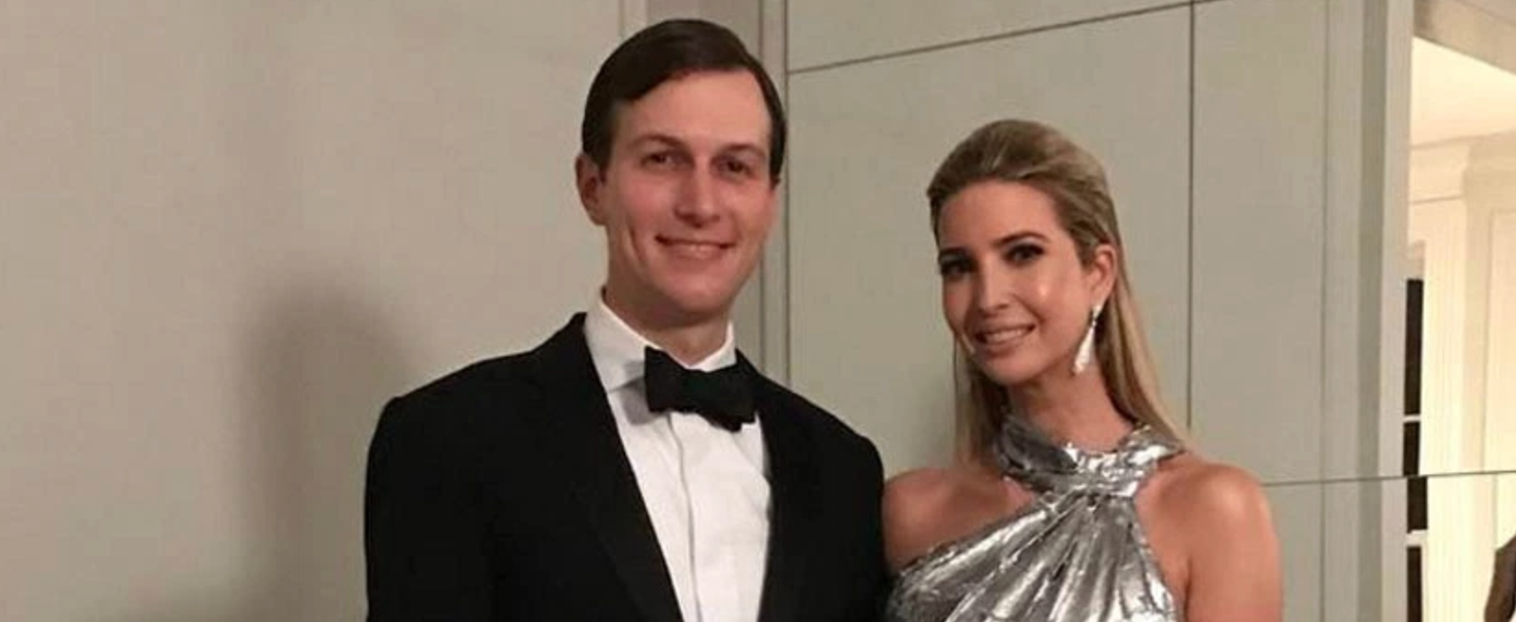
It is just over nine years to the day since Jared Kushner naively asked Russian Ambassador Sergei Kislyak to use Russian secure facilities to communicate in such a way that US spies wouldn’t find them.

Kushner went forward with the meeting that Kislyak had requested on November 16. It took place at Trump Tower on November 30, 2016.1139 At Kushner’s invitation, Flynn also attended; Bannon was invited but did not attend.1140 During the meeting, which lasted approximately 30 minutes, Kushner expressed a desire on the part of the incoming Administration to start afresh with U.S.-Russian relations.1141 Kushner also asked Kislyak to identify the best person (whether Kislyak or someone else) with whom to direct future discussions—someone who had contact with Putin and the ability to speak for him.1142

The three men also discussed U.S. policy toward Syria, and Kislyak floated the idea of having Russian generals brief the Transition Team on the topic using a secure communications line.1143 After Flynn explained that there was no secure line in the Transition Team offices, Kushner asked Kislyak if they could communicate using secure facilities at the Russian Embassy.1144 Kislyak quickly rejected that idea.1145

Shortly after Kushner indicated his enthusiasm for back-channel discussions that US spies couldn’t find, Sergei Kislyak threw Sergey Gorkov at him — someone who would dangle financial goodies that would require overturning sanctions to collect, someone functionally analogous to Kirill Dmitriev.

The accounts from Kushner and Gorkov differ as to whether the meeting was diplomatic or business in nature. Kushner told the Office that the meeting was diplomatic, with Gorkov expressing disappointment with U.S.-Russia relations under President Obama and hopes for improved relations with the incoming Administration.1157 According to Kushner, although Gorkov told Kushner a little bit about his bank and made some statements about the Russian economy, the two did not discuss Kushner’s companies or private business dealings of any kind.1158 (At the time of the meeting, Kushner Companies had a debt obligation coming due on the building it owned at 666 Fifth Avenue, and there had been public reporting both about efforts to secure lending on the property and possible conflicts of interest for Kushner arising out of his company’s borrowing from foreign lenders.1159)

In contrast, in a 2017 public statement, VEB suggested Gorkov met with Kushner in Kushner’s capacity as CEO of Kushner Companies for the purpose of discussing business, rather than as part of a diplomatic effort. In particular, VEB characterized Gorkov’s meeting with Kushner as part of a series of “roadshow meetings” with “representatives of major US banks and business circles,” which included “negotiations” and discussion of the “most promising business lines and sectors.”1160

It’s all there in the Mueller Report, plain as day: From the very start Jared Kushner planned to use his role in Trump’s White House for his own benefit. It was in the background of his dealings with Mohammed bin Salman, who has domesticated him since. It was the plan for Russia, too, until Mike Flynn’s shitty OpSec scuttled the plan.

Even in the first iteration of this fraud, Jared was hiding what he was doing from the Secretary of State — at that point Rex Tillerson.

And then Kirill Dmitriev picked right up where he left off eight years earlier, finding the weak venal levers for Trump and, ultimately, Jared. The plan didn’t succeed in February. It came closer but didn’t succeed in August. In November, once Dmitriev finally got Kushner on board, it seems to be succeeding.

It’s all worth revisiting again given this important (but nauseating) report from WSJ– one they themselves suggest is the follow-up to their report, Make Money Not War: Trump’s Real Plan for Peace in Ukraine.

The way the Russians succeeded in getting Trump to sell out Ukraine and the West (and I promise you, Trump has no fucking clue the ramifications of this and probably doesn’t give a fuck anyway) was by taking the $300 billion seized by Europe as punishment for their invasion of Ukraine — money Europeans were hoping to use to arm Ukraine — and instead used it to bribe Trump, effectively.

The Trump administration in recent weeks has handed its European counterparts a series of documents, each a single page, laying out its vision for the reconstruction of Ukraine and the return of Russia to the global economy.

The proposals have sparked an intense battle at the negotiating table between America and its traditional allies in Europe. The outcome stands to profoundly alter the economic map of the continent.

The U.S. blueprint has been spelled out in appendices to current peace proposals that aren’t public but were described to The Wall Street Journal by U.S. and European officials. The documents detail plans for U.S. financial firms and other businesses to tap roughly $200 billion of frozen Russian assets for projects in Ukraine—including a massive new data center to be powered by a nuclear plant currently occupied by Russian troops.

Another appendix offers America’s broad-strokes vision for bringing Russia’s economy in from the cold, with U.S. companies investing in strategic sectors from rare-earth extraction to drilling for oil in the Arctic, and helping to restore Russian energy flows to Western Europe and the rest of the world.

[snip]

If the U.S. vision prevails, it would override Europe’s own plans to shore up Ukraine’s wartime government and further cement Russia’s economic isolation. The result is what several officials described as a frenzied race to move ahead before the U.S. imposes its own arrangements.

U.S. officials involved in the negotiations say Europe’s approach would quickly deplete the frozen funds. Washington, on the other hand, would tap Wall Street executives and private-equity billionaires to invest the money and expand the amount available to invest. One official involved in the talks said the pot could grow to $800 billion under American management. “Our sensibility is that we really understand financial growth,” the official said.

On Wednesday, Ukrainian President Volodymyr Zelensky said he had held productive conversations with the investment firm BlackRock’s chief executive, Larry Fink.

The U.S. negotiating team sees shared economic activity and energy interdependence as the cornerstone of its business-for-peace philosophy: Ukrainian data centers would draw power from the currently Russian-occupied Zaporizhzhia nuclear plant, Europe’s largest, for example.

Some European officials who have seen the documents said they weren’t sure whether to take some of the U.S. proposals seriously. One official compared them to President Trump’s vision of building a Riviera-style development in Gaza. Another, referring to the proposed U.S.-Russia energy deals, said it was an economic version of the 1945 conference where World War II victors divvied up Europe. “It’s like Yalta,” he said.

Just as pitching Trump on a Riviera where millions of Gazans once lived, Bibi Netanyahu solicited Trump’s assistance in genocide, so has Dmitriev convinced Trump to sell out the Western order by turning the nuclear plant they stole into fuel for a data center.

As Judd Legum lays out, this is all happening via a guy, Jared, effectively serving as an agent of the Saudis.

Kushner is engaged in activities that can only be conducted by government officials. The Logan Act bars private citizens from engaging in negotiations with foreign governments without authorization. Kushner is acting in an authorized capacity, under Trump’s direction, and that creates a host of legal issues.

As a de facto SGE with substantial authority, the Foreign Emoluments Clause of the Constitution prohibits Kushner from accepting “any present, Emolument, Office, or Title, of any kind whatever, from any King, Prince, or foreign State.”

Since leaving the White House in 2021, Kushner has raised at least $4.8 billion for Affinity Partners, his private equity firm. Nearly 99% of Affinity Partners’ funding comes from foreign sources. The largest investment, $2 billion, came from the Public Investment Fund of Saudi Arabia (PIF).

The Saudi government pays Kushner 1.25% of its investment, or $25 million annually. Other investors, including the governments of Qatar and the United Arab Emirates (UAE), pay annual fees of up to 2%. As of September 2024, Affinity Partners had collected $157 million in fees, mainly from Middle Eastern governments.

Kushner is continuing to collect these fees as he serves in a top foreign policy role for the Trump administration. This is precisely the kind of behavior the Foreign Emoluments Clause was designed to prevent.

See also Legum’s assessment of Jared’s role in Paramount’s effort to buy Warner using foreign (and Jared’s) money.

Horse trading away a half century alliance is bad enough.

But remember: These people are horrible businessmen. There’s no sign that Jared has any competence to judge these deals on the merits. He’s not a competent businessman, he’s a captured one.

And Trump was vastly more successful as a businessman when reality TV show producers controlled the plot than he every was IRL.

Throw enough goodies at my son-in-law and I will betray Europe, Donald Trump seems to be saying.

And that’s all it took.

Share this entry

Judge Colleen Kollar-Kotelly Asks DOJ for Signs of Life

Judge Colleen Kollar-Kotelly granted Dan Richman his request for a Temporary Restraining Order, preventing the government from snooping in his stuff, one that goes through Friday. And while I agree with Gerstein and Cheney (and Bower and Parloff) that it could have the effect of thwarting another indictment of Jim Comey — indeed, it may undercut an attempt to stonewall Richman — I find KK’s order interesting for other reasons.

Partly, it’s the way she’s demanding signs of life from DOJ.

Judge KK attempts to forestall a stonewall

As a reminder, Judge Cameron Currie threw out the indictment against Jim Comey on November 24, the Monday of Thanksgiving week. Two days later, the day before Thanksgiving, Richman cited that dismissal and the expired Statute of Limitations in his bid to get his data back. As far as I know, no one noticed it until Anna Bower pointed to it on Tuesday.

Notably, Richman attached the warrants used to obtain his records as sealed exhibits.

The same day Bower noted it (the day it was assigned), December 2, Judge KK issued an order, half of which dealt with Richman’s sealing request, which she provisionally granted. But she also told him that if he wants to keep the government out of his data, he needs to get a Temporary Restraining Order. Her order emphasized that that request must submit some sign of life from DOJ.

Finally, Petitioner Richman’s 1 Motion requests that this Court “issue a temporary restraining order enjoining the [G]overnment from using or relying on in any way” the materials at issue in his 1 Motion while this matter is pending. Consistent with Local Rule of Civil Procedure 65.1, it is ORDERED that Petitioner Richman shall file his application for a temporary restraining order by separate motion, accompanied by a certificate of counsel that either (1) states the Government has received actual notice of the application and “copies of all pleadings and papers filed in the action to date or to be presented to the Court” in connection with the application; or (2) identifies “the efforts made by the applicant to give such notice and furnish such copies.”

A Certificate of Service Richman filed later that day explains part of the reason KK made that order: For some reason, the motion was not docketed. So, Richman attorney Mark Hansen explained that he formally served Jocelyn Ballantine and DC USAO on December 1.

This Corrected Certificate of Service corrects the service date listed for the public redacted Motion for Return of Property and accompanying attachments, see ECF No. 1 at 3, and the sealed version of that Motion with accompanying attachments, see ECF No. 2, from November 26, 2025, to December 1, 2025. Although Petitioner filed those papers on November 26, 2025 and intended to serve them on that date, the filings were not docketed at that time. I promptly caused the filings to be served on counsel for respondent upon receiving notification from the Clerk’s Office, on December 1, 2025, that the filings had been accepted for submission and docketed.

But to comply with the other part of her order, Richman’s attorneys also included the emails they exchanged with Ballantine. And among the things those emails showed is that after agreeing to attorney Nick Lewin’s midafternoon December 3 request to respond by close of day on December 4,

Based on the government’s use of such property in connection with the Comey case (as described in Judge Fitzpatrick’s November 17, 2025 opinion), we are concerned that, absent a TRO, the government may continue to use the property in a manner that violates Professor Richman’s rights – particularly in light of recent news reports that the DOJ may seek a new indictment of Mr. Comey. However, if the government has no such intention and will agree to refrain from searching, using, or relying in any way upon Professor Richman’s property pending resolution of the Rule 41(g) motion, that would address our concerns and obviate the need for a TRO.

Please let us know the government’s position by COB tomorrow.

[snip]

Nick,

Thanks for your email. I will reach out to the appropriate people at DOJ with your request and will respond to you tomorrow by COB.

Jocelyn

Ballantine had not responded by 9PM on December 4.

Hi Jocelyn,

Did you get an answer? Please let us know.

Ballantine had a good excuse: she was busy prosecuting accused pipe bomber Brian Cole. Nevertheless, when she did respond at 9:12PM Thursday night, she said that her leadership — Jeanine Pirro — had already engaged with DOJ leadership (Bondi spent part of Thursday with Pirro bragging about the pipe bomber arrest), but she would not have an answer until “early next week.”

Thank you so much for the prompt. I met with my leadership today, and they have engaged Department of Justice leadership. I have also shared your pleadings and request with the prosecutors who handled the Comey prosecution out of EDVA.

I do not have an answer for you this evening, but I expect to have one early next week.

That’s what led Richman to file his motion for a TRO, maybe around 10PM Friday night. Judge KK responded just under a day later.

Her order specifically ruled that DOJ knows about Richman’s request.

Third, the Court finds that the Government has received actual notice of Petitioner Richman’s [9] Motion, ensuring that the Government is positioned to act promptly to seek any appropriate relief from this Order. Specifically, counsel for the Government may move to dissolve or modify this Order immediately upon entering an appearance, and the Court will resolve any such motion “as promptly as justice requires.” Fed. R. Civ. P. 65(b). Under the circumstances, the Court will allow and consider such a motion at any time upon contemporaneous notice to counsel for Petitioner Richman. See id. (providing that such a motion may be filed “[o]n 2 days’ notice to the party who obtained the order” or “on shorter notice set by the court”).

And barring the government requesting a different schedule, Judge KK’s order set up the following schedule:

  • Richman should “promptly” serve Judge KK’s order and everything filed in the docket to Pam Bondi (KK identifies Bondi by title specifically).
  • By noon on Monday, “the Attorney General of the United States or her designee” must confirm “the United States,” so everyone!, is in compliance with KK’s order not to “access … share, disseminate, or disclose” Richman’s data “to any person.”
  • By Tuesday at 9AM, DOJ must respond to both of Richman’s requests.
  • He must reply by 5PM that day.
  • The order will expire at 11:59PM on Friday night if Judge KK has not issued an order first.

If DOJ follows Judge KK’s order, then it will have the effect of:

  1. Slightly accelerating the response deadline for DOJ, which may have been due sometime on Tuesday anyway, while dramatically accelerating Richman’s reply, which is now due that same day.
  2. Flip the default status of Richman’s data, restricting DOJ from accessing it before Judge KK issues an order rather that allowing them to access it until any such order is in place.

In other words, the government can’t stall Richman’s effort in a bid to use the data in the interim. If DOJ follows the order, then it would prevent DOJ from using the data to get a new indictment before such time as Ballantine responds, “early next week.” Unless DOJ got an indictment on Friday with hopes of a big show arrest tomorrow morning, then KK would have thwarted any effort to stonewall Richman’s assertion of his rights.

If DOJ blows off the order, it’ll make it even easier for Comey to argue any indictment is malicious (unless, of course, he has to argue that to Aileen Cannon).

Did Judge KK smell a rat?

That’s the logistics of the order. The other parts of it are more interesting.

First, KK’s analysis on the TRO is cursory: just one paragraph stating that the government probably has violated Richman’s Fourth Amendment rights by searching his data without a warrant.

The Court concludes that Petitioner Richman is likely to succeed on the merits of his claim that the Government has violated his Fourth Amendment right against unreasonable searches and seizures by retaining a complete copy of all files on his personal computer (an “image” of the computer) and searching that image without a warrant. See United States v. Comey, No. 1:25-CR272-MSN-WEF, 2025 WL 3202693, at *4–7 (E.D. Va. Nov. 17, 2025). The Court further concludes that Petitioner Richman is also likely to succeed in showing that, because of those violations, he is entitled to the return of the image under Federal Rule of Criminal Procedure 41(g).

That’s on the third page of the four-page memo.

Before she gets there (and in addition to formally finding that DOJ has notice of Richman’s request), she focuses on the way DOJ is playing dumb. She notes she has spoken to unnamed people from DC USAO, who were helpful on administrative matters, thank you very much.

First, although the Court has been in communication with attorneys from the U.S. Attorney’s Office for the District of Columbia, 1 the U.S. Attorney’s Office for the District of Columbia has not yet entered an appearance to make representations on behalf of the Government, and counsel for the Government has not yet been identified. See Pet’r’s Ex. A, Dkt. No. 9-2.

1 These attorneys have helpfully facilitated communication on administrative matters. The Court appreciates counsel’s prompt assistance on these matters.

But no one, including Jocelyn Ballantine, wants to put their name on this docket.

And that’s a problem, Judge KK notes, because until someone files notice of appearance, there’s no formal way to start figuring out who has the data.

Second, the Government has not yet indicated who has custody of the material at issue, and neither the Petitioner nor the Court can determine the identity of the custodian until the Government appears in this case. Given that the custody and control of this material is the central issue in this matter, uncertainty about its whereabouts weighs in favor of acting promptly to preserve the status quo.

Maybe it’s something those helpful DC USAO personnel told her. Maybe it’s the way Ballantine deftly shared Richman’s motion with the Loaner AUSAs at EDVA, but not the DOJ leadership with whom Pirro had consulted by late day Thursday.

It’s like Colleen Kollar-Kotelly suspects DOJ is hiding the ball, and that’s why she ordered Richman to go right to the top with his request, to ensure Pam Bondi can’t pretend she’s ignorant of his request.

The perma-sealed Bill Barr dockets

There’s something else sketchy going on here.

As I noted, Richman attached the warrants used to seize his stuff. They’re still sealed and Judge KK has provisionally permitted them to remain that way.

But why are they still sealed?

Back on November 5, Magistrate Judge William Fitzpatrick ordered the Loaner AUSAs to get them unsealed or, if not, then to file a motion justifying the seal in DC.

ORDERED that the Government shall, on or before November 10, 2025, move in the issuing district to unseal the four 2019 and 2020 search warrants referenced in the Government’s Reply to Defendant’s Response to the Government’s Motion for Implementation of Filter Protocol (ECF 132), together with all attendant documents, or, in the alternative, file a motion in the issuing district setting forth good cause as to why the subject search warrants and all attendant documents should remain under seal, in whole or in part;

In that same order, he ordered that there’d be a discussion about unsealing all the references to the warrants in the Comey docket on November 21, which was before Judge Currie dismissed the indictment on November 24. The government was also going to have to defend keeping the filing explaining the notice given to Comey — and submitted as an exhibit to his first response to the effort to get a taint team — sealed that same day.

ORDERED that, if necessary, the Court shall hold a hearing on the pending motions to seal (ECFs 56, 72, 109, and 133) on November 21, 2025, at 10:00 a.m. in Courtroom 500, and the materials subject to those motions shall remain UNDER SEAL until further order of the Court; and it is further ORDERED that, to the extent the Government seeks to seal Exhibit A to Defendant’s Response to the Government’s Motion for Expedited Ruling (ECF No. 55-1), the Government shall file a supporting brief in accordance with Local Criminal Rule 49 on or before November 12, 2025; Defendant may file a response on or before November 19, 2025; and, if necessary, the Court shall hold a hearing on the Government’s sealing request on November 21, 2025, at 10:00 a.m. in Courtroom 500;

Best as I can tell, that never happened. For example, there are no gaps in the Comey docket hiding a sealed discussion about these sealed warrants.

And that’s interesting because when Fitzpatrick asked about all this back on November 5 — this is the hearing that led to the order to unseal the warrants — Rebekah Donaleski revealed that they asked Loaner AUSA Tyler Lemons about the warrants twice at that point, but had gotten no response.

Before we begin, what I’d like to do is — before we address the underlying issues, the government’s motion for a filter protocol, the defendant’s position, we have four outstanding sealing motions, and I do think those sealing motions will touch, at least in some way, on this motion; if not, motions that you-all are going to argue in the future. So what I’d like to do is see if we can nail down what the parties’ positions are and see if we can kind of resolve some of those sealing issues now, if possible.

As I understand it, there are four sealing motions that are outstanding. The defense has filed three; the government has filed one. All these sealing motions deal with either warrants that were issued in a sister district or one document that the government has provided to the defense in discovery.

MS. DONALESKI: Thank you, Your Honor. With respect to the one document provided in discovery, that’s our position, we have no objection. With respect to the underlying warrants which we attached to our motions, my understanding from Mr. Lemons is that he has moved to unseal those. We don’t know where — he hasn’t moved to unseal them — when. We’ve asked him twice for that information, and he hasn’t provided it. The defense’s view is that we should be entitled to proposed reasonable redactions for PII of those warrant affidavits and warrant materials. We have asked for an opportunity to do that and have not heard from the government. So our position is, the information in our motions, in the motion papers themselves, we have no objection to that being under seal — to that being publicly filed; but with respect to the warrants, which my understanding is those remain under seal by the District of D.C. court, we would ask that we be permitted an opportunity to propose redactions with the government.

[snip]

But with respect to the information that we’ve described in our motion papers, specifically referring to the offenses at issue in the Artic Haze warrants, the dates that the warrants authorize to search, the defense believes that those should be discussed publicly and those can be discussed publicly.

THE COURT: What about the affidavits in support of the warrants?

MS. DONALESKI: Those remain under seal. I don’t expect that we’ll need to get into what is in those affidavits in this hearing today, but if the government or the Court feels differently, we’d welcome that discussion.

And when Fitzpatrick asked Lemons about the warrants, the Loaner AUSA got a bit squirmy. Lemons had asked the AUSA to unseal the warrants. He had not filed a motion to unseal them, as if someone — maybe the AUSA in question, who may be Jocelyn Ballantine — advised him that was not a good idea.

THE COURT: Mr. Lemons, what’s the status of that?

MR. LEMONS: Thank you, Your Honor. Your Honor, we have made a request to the issuing district as to those search warrants, for them to be unsealed. My understanding, last speaking with an AUSA in that district, is that motion has not been filed at this time. They are preparing to provide notice to other potentially interested parties, per their practice and the rules they have to abide by in that district. So we requested it, and our understanding is at this time that the warrants all remain completely under seal. That is the only reason why the government designated these search warrants as protected material and filed them under seal and understands why the defense filed them under seal. If it was in my power and ability here today, those search warrants would be totally unsealed. [my emphasis]

“Preparing to provide notice to other potentially interested parties”? Who else would need notice? Richman and Comey were the ones suspected of leaking!

It has been a month but these dockets remain sealed.

One possible explanation for that is that the Loaner AUSAs (or perhaps Ballantine) filed a motion in DC on November 10 that is under seal, one that should not be sealed for Judge KK. So perhaps everyone is trying to hide the fact that after being ordered by Fitzpatrick not to access this data, Kash Patel just dealt it to someone else (possibly Jason Reding Quiñones). That might explain why Judge KK ordered the government they can only contest her order after giving “contemporaneous notice to counsel for Petitioner Richman:” because (hypothetically), having been ordered by MJ Fitzpatrick to stay out of Richman’s data, they instead dove deeper into it without telling him.

Or maybe the squirminess is about hiding how the underlying warrants were managed … by Jocelyn Ballantine.

Revealing those warrants, after all, should not thwart the effort to keep snuffling about Richman’s data, except insofar as it would raise questions not directly addressed in Judge KK’s order. Just as one example, even though Richman in his initial motion and TRO request relied heavily on Magistrate Judge William Fitzpatrick’s opinion effectively describing rampant Fourth Amendment violations, he does not mention that when the FBI seized his iCloud account in 2020, they took content through August 13, 2019, more than two years after the date of the warrant (basically, through the date of the Comey Memo IG Report release).

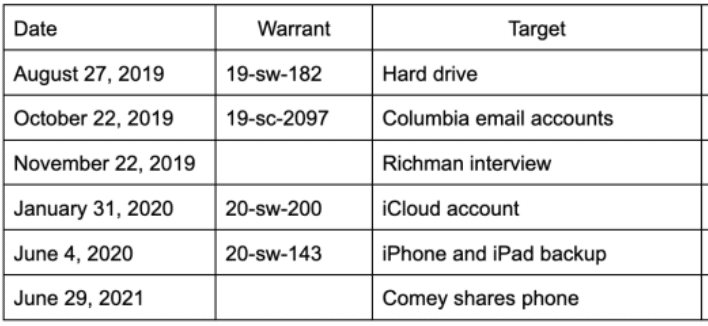
According to an April 29, 2020 letter from Mr. Richman’s then-attorney to the government–produced to the Court ex parte by the defense–the Department of Justice informed Mr. Richman that the data it obtained from his iCloud account extended to August 13, 2019, well outside the scope of the warrant and well past the date on which Mr. Richman was retained as Mr. Comey’s attorney. ECF 181-6 at 20. The same letter further states that the Department of Justice informed Mr. Richman that it had seized data from Mr. Richman’s hard drive that extended to June 10, 2017–again well into the period during which Mr. Richman represented Mr. Comey–despite the warrant (19-sw-182) imposing a temporal limit of April 30, 2017. Id.

Did Ballantine — in whom Pirro has invested the trust to limit the blowback of the pipe bomb prosecution — allow the FBI to obtain data outside the scope of a warrant? Are there secret John Durham warrants someone is hiding?

It’s not clear who all this squirminess is designed to protect. But I feel like, whether or not Judge KK’s order halts DOJ efforts to dive into this unlawfully collected data, it may lead to some interesting disclosures about why everyone is so squirmy.

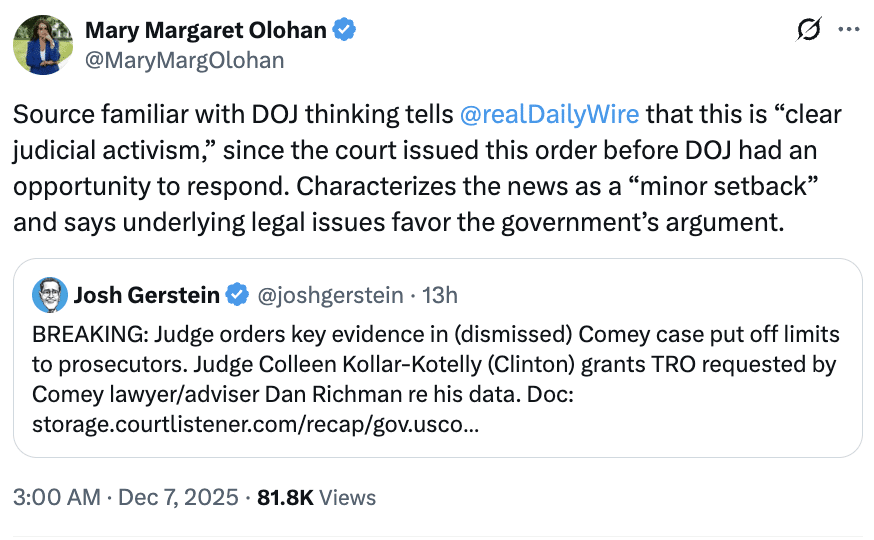
Update: Right wing propagandist (and daughter of a former whack job FBI agent) Mary Margaret Olohan gives the game away. One of her DOJ sources says this won’t be a setback … which sort of confirms that DOJ intends to continue to violate Richman’s Fourth Amendment.

Share this entry

The Dim Philby Leaks

Bloomberg obtained and posted the content of two phone calls showing Steve Witkoff — whom Michael Weiss has dubbed “Dim Philby” — working for Russia’s interests, not US interests. Bloomberg published two transcripts:

  • A 5-minute October 14 call between Witkoff and Yuri Ushakov, Putin’s top foreign policy advisor, in which Witkoff tells Ushakov how to pitch Trump on capitulation
  • A short October 29 call between Ushakov and Kirill Dmitriev, in which Dmitriev described “informally pass[ing …] along [Russia’s maximal “piece” plan], making it clear that it’s all informal. And let them do like their own

The transcripts show that Witkoff is a sycophant serving Putin’s interest and that the transcript that Americans have been claiming was their own plan was, as everyone smart insisted, in fact Russia’s plan.

The fall-out of this is yet to be seen. Thus far, Marco Rubio’s efforts to salvage things seems to have bought time.

When Bloomberg posted the transcripts they said they had reached out for comment from the White House. That reference is gone, but now Trump and his flunkies claim these transcripts make Witkoff look strong, rather than culpable. So maybe Trump will just try to barrel through the transcript release and still capitulate to Russia.

I want to consider the logistics of this leak, which could arise from wiretapping (or simply recording) what happened on Ushakov’s phone, which is common to both transcripts. It could have come from any of three entities:

  • The Russians, who would have ready access to Ushakov’s phone and no concern about preserving that access
  • Some European intelligence service, which would be endangering a tremendously valuable compromise by releasing this, but might stave off diplomatic catastrophe
  • American leakers, possibly at the CIA (which, like Marco Rubio, was excluded from these negotiations)

Bloomberg’s story has no byline, which would make it harder for the FBI or anyone else to determine who leaked these materials.

Now consider the effect of the leak. The transcripts make it clear the claims sold to Axios and WSJ — that Jared Kushner wrote this plan — were false. Dmitriev succeeded, as he told Ushakov he would do, in getting the White House to pass off the Russian plan as their own.

If the US forces through this deal, the leak of this transcript makes Russia’s complete dominance evident.

Or, if the deal fails because Rubio succeeded in making the deal more acceptable to Ukraine and Europe, this leak may undercut Dmitriev’s role in the entire process (indeed, the leak could be an attempt to scapegoat him for a failed plan to get maximal capitulation).

But unless the US understands where the transcripts came from, it makes Witkoff vulnerable. The only obviously targeted phone is Ushakov’s. But if they got both sides of this conversation, what else did they got?

We don’t know the answers but it’s worth remembering something about 2016 to 2017.

Like Witkoff, Mike Flynn used absolutely abysmal operational security when working a back channel to undermine sanctions on Russia. Ultimately, US spies discovered what he had done, after trying to figure out why Putin did nothing in response to US sanctions. But the Russian Embassy pretty clearly knew the phone lines Flynn was calling into were wiretapped. Russia knew that would be exposed, and likely knew that one of several things would happen: they’d have blackmail on Trump because he dealt with Russia before becoming President or, the discovery of Flynn’s actions could destabilize the Trump administration as the investigation into his Russia ties in fact did do.

The same could be said for these transcripts.

Share this entry

The Graymail Cometh

I’ve written extensively about how Kash Patel and John Durham chased a particular intelligence report — one we now know to have been based on Russian fabrications — for four years.

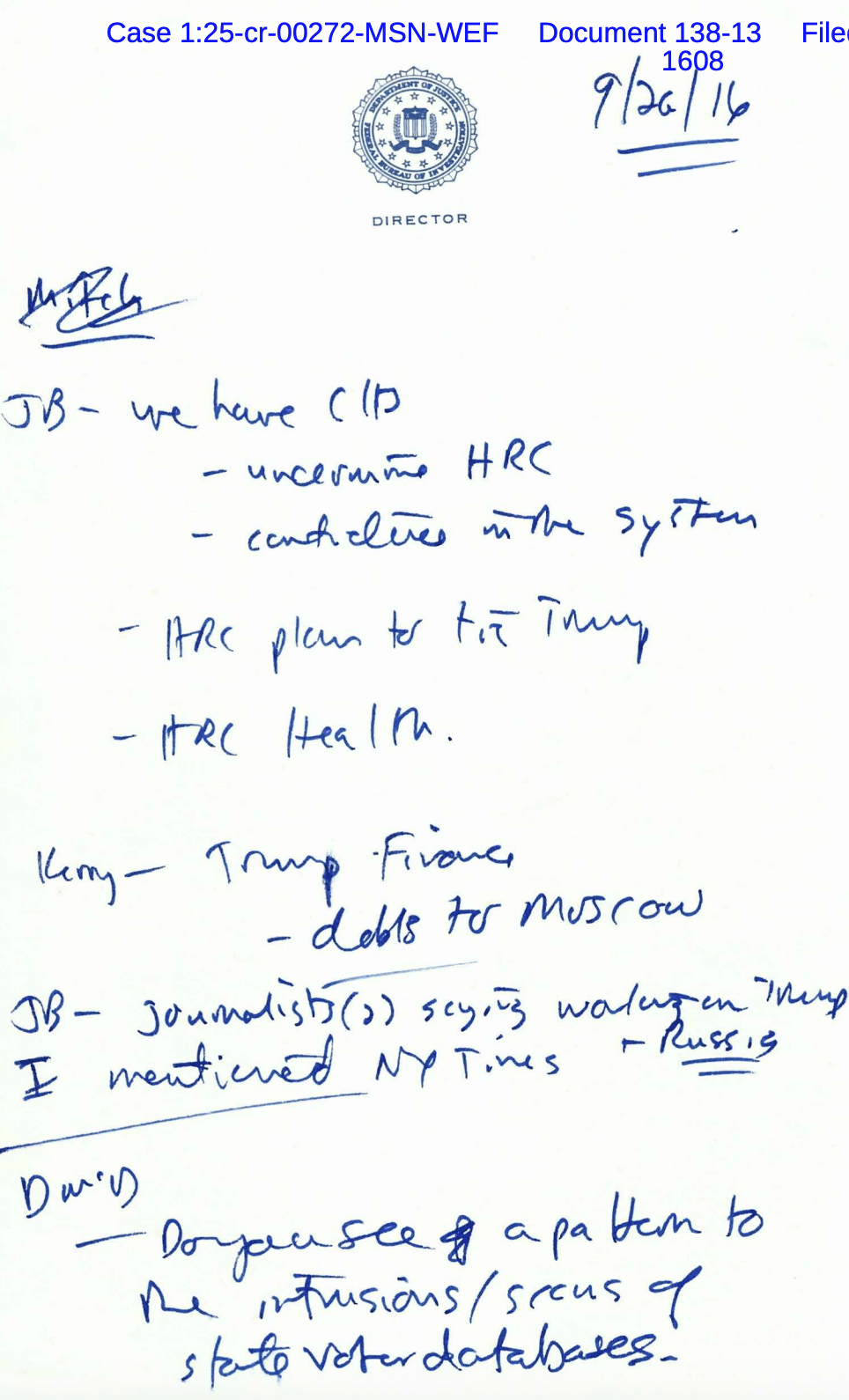
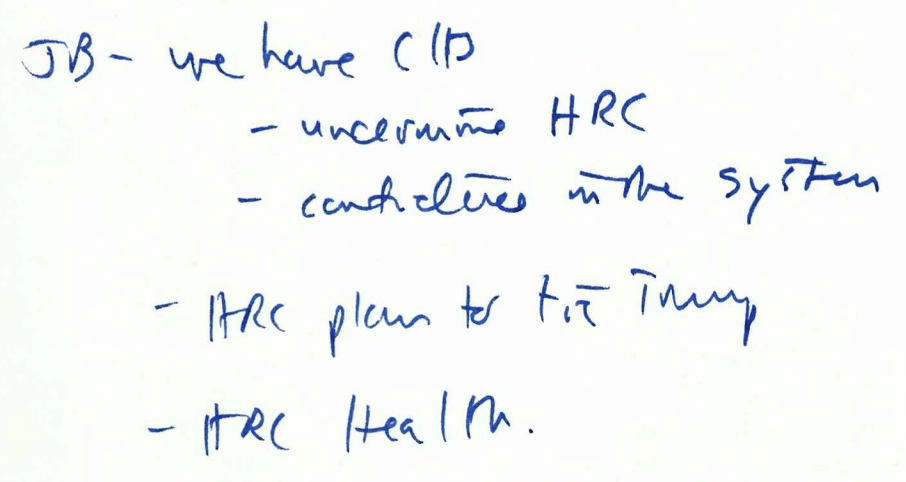
Kash, John Ratcliffe, Durham, his lead investigator Jack Eckenrode (who leads this investigation), Bill Barr — all of them! — believed that because the FBI received a single intelligence report repeating a Russian claim that Hillary planned to hold Trump accountable for his ties to Russia, it was proof that Hillary had intentionally fabricated the Steele dossier (disinformation into which was probably injected by Paul Manafort buddy Oleg Deripaska) and the Alfa Bank anomalies.

The case against Jim Comey renews that goose chase, perhaps (because Durham concluded it was likely fabricated) criminally so.

In his bid to obtain the grand jury transcripts submitted yesterday, Comey laid out how important it was for him to see how Lindsey Halligan instructed the jury on this matter, especially given that the grand jury rejected the charge specifically pertaining to that intelligence, but Loaner AUSAs plan to use it to prove Count Two of the existing indictment. As part of that discussion, he lays out how obscene it was to even charge him for not remembering something simply because Kash and Ratcliffe had developed an obsession over it.

Note, I have generally referred to that intelligence report as the “Clinton Plan,” which is how Durham referred to it, though without the scare quotes making clear that Durham himself fabricated parts of this theory. Comey, in his filings, uses the FBI term for all such referrals, CIOL (Counterintelligence Operational Lead).

Comey’s description starts with a detail I should have known, but did not: When Comey was asked, three times during the September 30, 2020 hearing, about the “Clinton Plan” CIOL, he had not been shown it.

On September 30, 2020, Mr. Comey testified before the Senate Judiciary Committee about the Crossfire Hurricane counterintelligence investigation into alleged links between President Trump’s 2016 campaign and the Russian government. See Oversight of the Crossfire Hurricane Investigation: Day 3, Hearing Before the U.S. Senate Committee on the Judiciary, 116th Cong. (Sept. 30, 2020), http://bit.ly/4o2ekHb. The night before, he was sent a copy of the Ratcliffe Letter, described above, which purported to summarize the September 7, 2016 CIOL in one sentence. Mr. Comey was not provided an opportunity to review the September 7, 2016 CIOL at issue prior to his testimony.

Ratcliffe had sent Lindsey Graham a misleading letter about it the night before the hearing, but he didn’t release the memo itself (which was itself redacted in a misleading way, and then shared with the Federalist) for another week. I first posted about it on October 11 of that year.

Nevertheless, Lindsey Graham highlighted it in the hearing and then Josh Hawley followed up. The focus on the referral was an ambush, probably intended to support the Durham investigation. And that’s what Kash is trying to criminalize, because doing so sustains his batshit insane theory that Hillary was treated better than Trump in the 2016 election when two criminal investigations into her dominated and the investigation into Trump’s aides remained secret.

To make things worse, Trump is trying to criminalize something which there’s no evidence Comey ever saw (Comey lays this out without even mentioning that Durham couldn’t find any proof that anyone else had seen it, either).

There is no evidence whatsoever that Mr. Comey received the CIOL at issue, much less that he reviewed it. The materials in discovery make clear that every day, numerous CIOLs come to the FBI addressed to the Director—from a variety of federal agencies in a variety of formats—and are routed to employees other than the Director. Because the Midyear Exam investigation had been closed for more than two months, there is no reason to believe that any CIOL related to Ms. Clinton would have been sent to Mr. Comey (and the government has produced no proof that it was). There is no electronic trail showing that Mr. Comey received the CIOL at issue. There is no paper trail showing that he received it. And there is no witness who says that Mr. Comey either received it or discussed it with him. Full stop.

This total lack of evidence is extremely troubling in light of credible press reporting that not only does a declination memorandum exist in this case,11 but it made clear that with respect to the CIOL in particular, a prior investigation found that Mr. Comey’s statement could not support a false-statement charge because there was insufficient evidence Mr. Comey had ever seen the CIOL.12 Ms. Halligan was also reported to have been advised by career prosecutors in that declination memorandum that “seeking the charges would violate DOJ policy, raise serious ethics issues, and risk being rejected by the grand jury.” Id. 13

11 The government’s refusal to answer basic questions about the existence of this declination memorandum and decision to hide behind a flimsy claim of privilege to stonewall the Court’s inquiries, see ECF No. 207, should be taken as confirmation that such a memorandum exists. See ECF No. 174 at 21.

12Katherine Faulders, et al., Ex-special counsel John Durham undercut case against James Comey in interview with prosecutors: Sources, ABC News (Oct. 6, 2025), https://perma.cc/M2JC-CQGQ.

13 Katherine Faulders, et al., Prosecutors’ memo to new US attorney found no probable cause to charge James Comey: Sources (Sept. 25, 2025), https://perma.cc/8KT5-LHAG.

As noted, this was a key part of Comey’s bid to get the grand jury transcripts, something that goes to the heart of the problem with simply cut-and-pasting the two true billed charges into a new indictment.

But as part of his (far less interesting) reply motion for a Bill of Particulars, he also includes all the discovery requests he has submitted (October 2, October 29, November 12, November 19). They hint at another way this prosecution might go away (and Comey’s post-exoneration retaliation might flourish), on top of the 14 ways we’ve already talked about: with discovery requests with which prosecutors will really not want to comply, or cannot, either because of bulk, classification, or destruction.

In the latter category, for example, Comey reveals an October 12 FBI 302 describing that DC USAO destroyed records relating to journalists when the Arctic Haze investigation was closed.

An FBI 302 Report, dated October 12, 2025, reports that “the District of Columbia United States Attorneys Office [was] ‘freaking out’ when the [Arctic Haze] case was declined for prosecution and in the process of being closed, with an Assistant United States Attorney telling [the lead agent in the Arctic Haze investigation] to ensure that any grand jury materials relating to members of the media were destroyed.” See FD-302 Report Serial 110 at -26505.

Lindsey’s Loaner AUSAs say that’s not true.

In an email on November 20, 2025 at 10:29 AM ET, the government represented that the 302 was inaccurate and the records had not, in fact, been destroyed. Mr. Comey reserves his rights with respect to the government’s potential spoliation of exculpatory evidence and will further investigate the government’s claim.

Comey also, just Wednesday, asked for the complete case file for the Arctic Haze, Durham, and this investigation (why he doesn’t have the latter two months after indictment I don’t know).

The Arctic Haze case file will lay out not just how Bill Barr focused exclusively on Comey (which I noted here) as opposed to others who might have been trying to damage him, but would name the Republican(s) who would have been the focus if he had not done so.

The Durham case file would explain why Andrew DeFilippis left DOJ quickly and quietly in the middle of the investigation. It would show that Durham lied in his report about how many FBI sources he had asked about the “Clinton Plan” CIOL, partly in an attempt to hide how clear it was that no one had seen this. It might show which Ukrainian Russian agents Durham and Barr and Jack Eckenrode consulted during the investigation and whether they also consulted Oleg Deripaska. It would either reveal the nature of the tip about Trump corruption that Italy gave to Durham or make clear that Durham hadn’t actually chased it down.

Importantly, it would also include all the evidence that shows Durham and Durham’s lead investigator turned Kash’s senior advisor, Jack Eckenrode, saw confirming that he had been chasing Russian disinformation for years, even while failing to establish any proof that FBI had actually received it. That evidence would be important to lay out how the continued pursuit of this by Kash and Eckenrode is a crime, at least according to Durham’s logic.

Holy hell I’d love to see the full Durham case file.

But the request that might really sink this prosecution, if 14 other things don’t first, is Jim Comey’s request for (1) all the CIOLs he received between January 1, 2016 (when the first SVR reports pertinent to the Clinton email investigation came in) and September 30, 2016, (2) all the intelligence he received pertaining to the Clinton email investigation or Crossfire Hurricane in that same period, and (3) all communications he received for a narrower period, July 1, 2016 to September 30, 2016.

If the government intends to present evidence as part of its case in chief at trial regarding the CIOL dated September 7, 2016 that Mr. Comey was questioned about in the September 30, 2020 Senate Judiciary Committee hearing, Mr. Comey is entitled to any and all documents that would rebut the inference that this CIOL was memorable to him as of September 30, 2020. Therefore, to the extent Count Two (or any other aspect of the government’s case in chief) is premised on the September 7, 2016 CIOL, in addition to the standard Rule 16 discovery that we are entitled to receive promptly, we are entitled to receive the following categories of documents pursuant to Rule 16 and Brady and its progeny, all of which are material to Mr. Comey’s ability to defend this case in pretrial motion practice and/or at trial:

(1) Any and all documents reflecting Mr. Comey’s receipt or review of CIOLs concerning the Midyear Exam investigation, Hillary Clinton, or the Crossfire Hurricane investigation between January 1, 2016 and September 30, 2016, including but not limited to:

(a) The CIOLs themselves; and

(b) Documentation reflecting Mr. Comey’s receipt or review thereof;

(2) Any and all documents reflecting Mr. Comey’s receipt or review of classified information concerning the Midyear Exam investigation, Hillary Clinton, or the Crossfire Hurricane investigation between January 1, 2016 and September 30, 2016;

(3) Any and all documents reflecting discussion involving Mr. Comey of CIOLs concerning the Midyear Exam investigation, Hillary Clinton, or the Crossfire Hurricane investigation between January 1, 2016 and September 30, 2016;

(4) Any and all documents reflecting discussion involving Mr. Comey of classified information concerning the Midyear Exam investigation, Hillary Clinton, or the Crossfire Hurricane investigation between January 1, 2016 and September 30, 2016; and

(5) Any and all communications or documents received by Mr. Comey in his capacity as Director of the FBI between July 1, 2016 and September 30, 2016. “Communications” as used in this subrequest five includes, but is not limited to:

(a) Emails;

(b) Phone calls;

(c) Text messages;

(d) Records of oral communications;

(e) Meeting invitations and calendar entries; and

(f) Hard copies of written communications delivered to Mr. Comey or his staff.

This is, on one hand, totally justifiable, because it would show just how unremarkable the CIOL that the current FBI Director has obsessed about for six years is as compared to everything else that Comey saw in that period. It would show why it made sense that, in 2020, when sandbagged by a misleading letter, it was unsurprising that the “Clinton Plan” CIOL would not ring a bell, as Comey responded in the hearing.

On the other hand, it is classic graymail, the very defense strategy used by Scooter Libby a hundred (well, just twenty) years ago: a request for documents so sensitive and so voluminous that prosecutors would have an exceedingly difficult time complying.

Libby’s request was more frivolous than this one. He asked for PDBs, among the most sensitive intelligence documents out there, covering the period when he was targeting Valerie Plame through the period when he lied to Patrick Fitzgerald about doing so. Fitzgerald managed not just to get the discovery to Libby, but to get substitutions approved so Libby’s team could walk through how insignificant exposing a CIA officer was to him, given the issues he was dealing with at the time.

By comparison, Comey’s is totally reasonable, given what prosecutors are preparing to argue, that he should have remembered, in September 2020, either the CIOL he didn’t receive or a briefing, possibly from John Brennan, that mentioned it in passing weeks later.

But Comey’s request will be just as difficult to comply with (and will also flip the logic of the dumb burn bag investigation back onto investigators). Plus, Kash Patel won’t want to comply with this, because it would involve giving Jim Comey a ton of information about how real and pressing the Russian attack was in 2016, the one Kash’s entire career is built on diminishing.

It seems that Lindsey’s Loaner AUSAs are already trying to dodge this request. The most recent discovery letter, sent Tuesday, reveals that prosecutors are struggling to come with even the number of CIOLs Comey saw.

With respect to defense Category Twelve, which we understand from our November 12, 2025 meet and confer that you are working to provide relevant numbers with respect to, we seek to review the underlying CIOLs for 2016 in their entirety, and reserve our right to seek declassification of those CIOLs.

Tough shit, this letter says. We not only want the number, we want to see them, all of them, and we may demand you declassify them.

In October, ABC reported that one of the things in the declination memo — one of the reasons why career prosecutors said they could not charge this — was the difficulty in even identifying the number of things they’d have to show Comey.

Prosecutors further expressed concerns about the department’s ability to take the case to trial quickly due to problems identifying all the relevant materials that would need to be handed over to Comey’s lawyers, sources said.

This is what that concern looks like in real life.

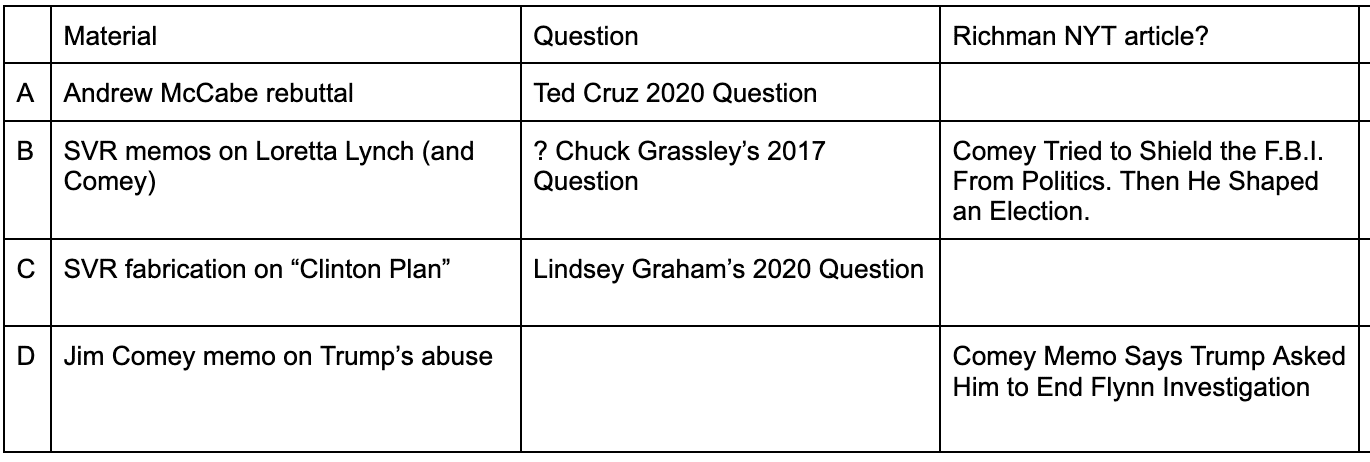
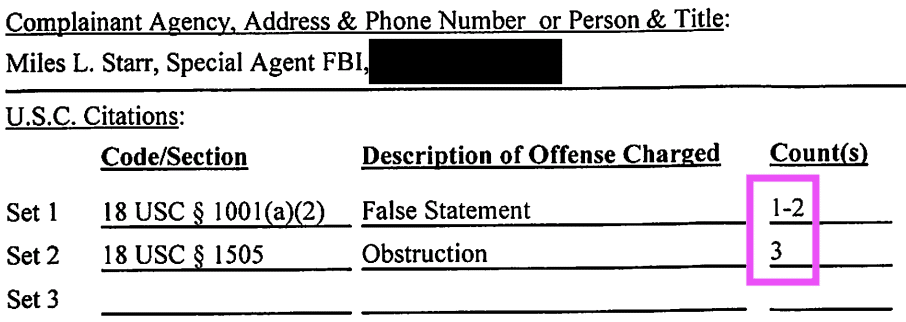
And if Lindsey’s unlawful appointment or Trump’s clear malice or Lindsey’s suspected misconduct in the grand jury or her failure to actually get an indictment or Miles Starr’s breach of Comey’s privilege or their unwarranted searches or Ted Cruz’ prevarications and stupid questions or the destruction of exculpatory evidence or something else doesn’t make this prosecution go away beforehand, Lindsey’s Loaner AUSAs may one day give up.

Update: In a new filing, Comey asks for a delay of his deadline for identifying what classified information he’ll need to defend himself. Among the problems is DOJ has still not declassified the CIOL John Ratcliffe partly declassified 5 years ago.

First, the government must produce the classified discovery at issue. On October 29, 2025, and November 19, 2025, the defense made discovery and Brady requests to the government that called for the production of additional classified information and the declassification of certain materials. See ECF No. 204-2 (Requests Eleven and Twelve) and 204-4 (Request Fourteen). With respect to the defense’s requests, the government reported today, November 21, 2025, that they had requested authorization for the defense to have access to certain counterintelligence operational leads (“CIOLs”), but that they were held at high classification levels. Needless to say, to the extent Count Two relates to a CIOL, and Mr. Comey’s purported memory of a CIOL, it is necessary for the defense to review the CIOL and any other relevant CIOLs. That has not happened.

Discovery requests

Category One: Lindsey Halligan’s unlawful appointment (expanded to include WDVA)

Category Two: Lack of probable cause (expanded to include more prosecutors)

Category Three: Presentation to grand jury

Category Four: Vindictive prosecution (expanded to include comparators)

Category Five: Trump’s hostility to Jim Comey

Category Six: Prejudicial statements from Trump

Category Seven: Prior inconsistent statements from Andy McCabe

Category Eight: Other Rule 16 and Brady

[There’s no identifiable Category Nine]

Category Ten: Potential sources identified in leak investigations

Category Eleven: Privilege taint

Category Twelve: All CIOLs and communications

Category Thirteen: All evidence destroyed in Arctic Haze investigation

Category Fourteen: Full case files for Arctic Haze, Durham investigation, Jim Comey


Share this entry

Tyler Lemons Caught Jack Eckenrode Committing a Capstone Crime

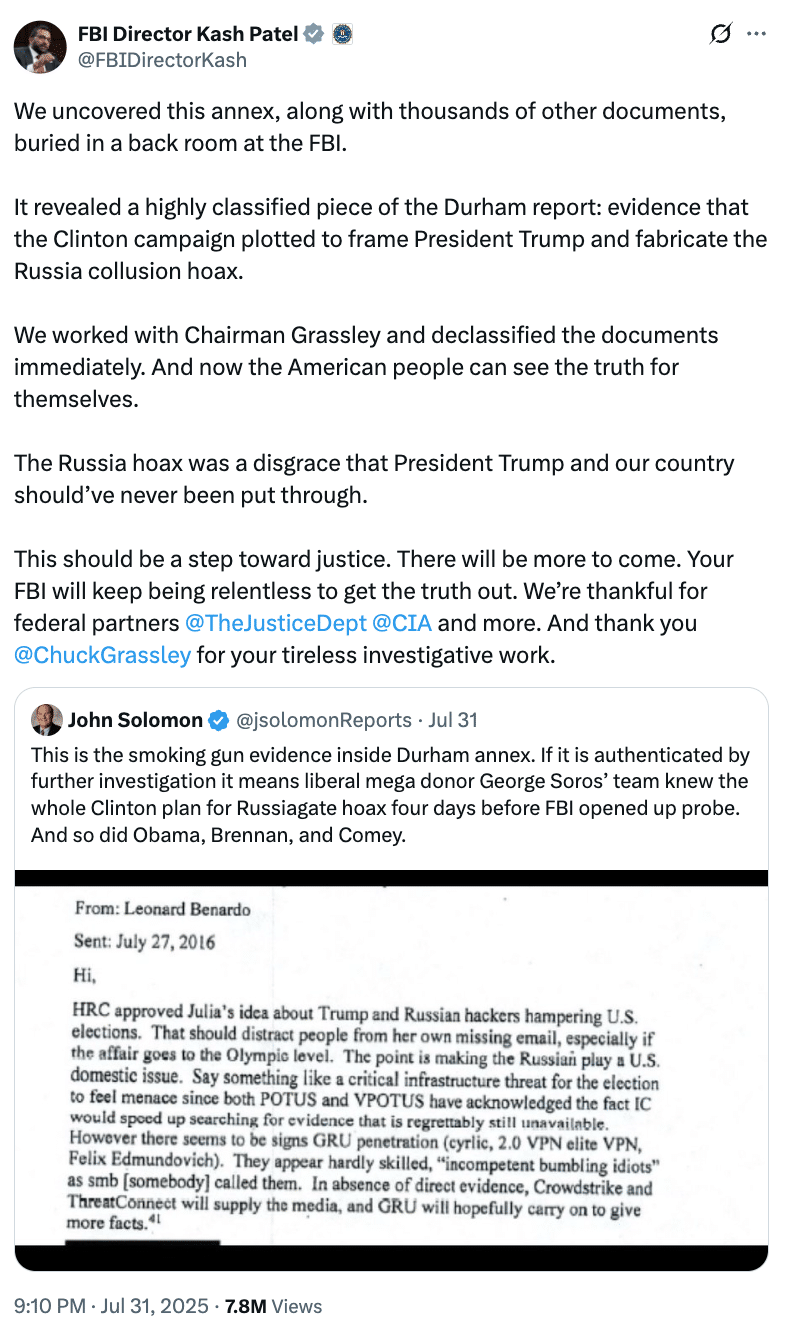
Back in July, in the wake of Trump’s struggles to distract from his own Epstein cover-up and as if in response to Tulsi Gabbard’s wild rants about the Intelligence Community Assessment, the FBI Director posted this tweet, RTing an inflammatory tweet from a propagandist who has been central to Kash’s disinformation about the Russian investigation.

Buried in a back room at the FBI, Kash claimed, was what John Solomon called “the smoking gun evidence … [i]f it is authenticated.”

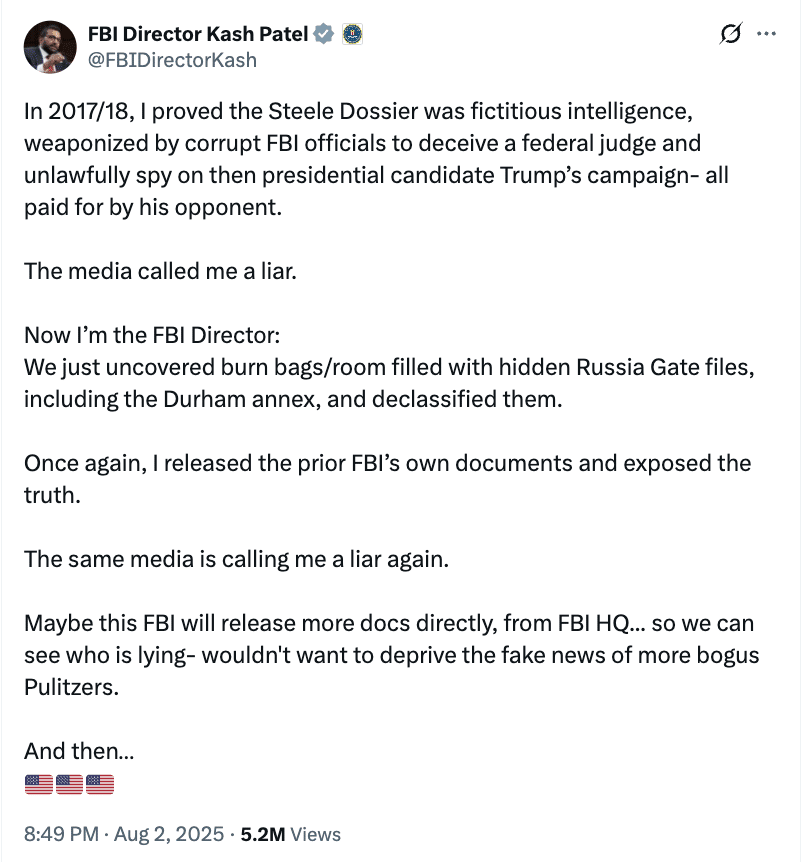
Days later, Kash referenced these files again, explicitly tying his campaign to supplant the Steele dossier for the actual Russian investigation with his role, as FBI Director, now focusing on “uncovered burn bags/room filled with hidden Russia Gate files, including the Durham annex.”

It took just a matter of days for me and Charlie Savage to figure out that four years earlier, John Durham had not just not authenticated John Solomon’s “smoking gun,” but he had in fact concluded that the very email Solomon called a smoking gun was instead, “a composite of several emails.”

That is — a fabrication.

After the release of the Durham annex revealed that Kash — and John Durham and John Durham’s lead investigator Jack Eckenrode, along with John Ratcliffe — had been chasing Russian disinformation, Kash got even more desperate, clinging to Sean Davis propaganda in an attempt to rebut a plain reading of the Durham annex.

The FBI Director just endorsed the ignorant ravings of a long-discredited propagandist, Sean Davis, attempting to debunk the NYT’s factual reporting that the letters on which the entire conspiracy the frothy right has been chasing for years “were probably manufactured.”

Kash needs Davis to be right, because if he’s not, it exposes Kash as someone too stupid to understand he has been chasing Russian disinformation for years. Kash needs Davis to be right, because Kash just declassified this annex thinking it would help his boss distract from the Epstein scandal that him himself stoked, when in fact it shows that Russian spies have been laughing their ass off at everyone involved for nine years (which I’ll come back to).

The truth is, Kash has been chasing documents as self-evidently problematic as the Steele dossier all that time.

He has proven an easy mark.

That’s what we saw in real time. We also saw in the classified annex both that Durham, along with his chief investigator, Jack Eckenrode, tried to hide the evidence that they had been chasing Russian disinformation for years — indeed, continued to chase Russian disinformation for two years after obtaining confirmation they were doing that. Then Tulsi Gabbard and Chuck Grassley tried to hide that Durham had tried to hide that.

It became clear that John Durham and his lead investigator Jack Eckenrode had committed the very crime that Durham claimed he was investigating when he chased Russian disinformation for four years, which he described this way:

(i) knew the Clinton campaign intended to falsely accuse its opponent with specific information or allegations, (ii) intentionally disregarded a particular civil right of a particular person (such as the right to be free of unreasonable searches or seizures), and (iii) then intentionally aided that effort by taking investigative steps based on those allegations while knowing that they were false.

From the moment John Durham and his lead investigator Jack Eckenrode persisted in falsely accusing Hillary of framing Donald Trump and used that false accusation to take investigative steps like obtaining warrants, they were (in their model) conspiring against rights under 18 USC 241.

18 USC 241 happens to be the crime that the frothers claim they are pursuing against Comey and everyone else right now.

About a month after Kash first rejoiced about the opportunity to commit the crime Durham had chased, we learned that Jack Eckenrode — shockingly!! — had been invited back to commit the same crime some more. NYT since updated on how, little more than a month after Todd Gilbert was confirmed as US Attorney in WDVA and asked to oversee this investigation, he left under pressure.

That’s background to these two exhibits that prosecutors included in the government’s response to Comey’s vindictive prosecution motion.

Start with the opening memo for an investigation into whether someone deliberately put a bunch of documents in burn bags but … didn’t burn them, the precipitating event that Kash boasted about on July 31. In fact, those burn bags were discovered in April, and they were discovered in FBI Headquarters, not WDVA, where Kash and Bondi stashed the investigation. And the likely explanation for the documents is that senior FBI people were clearing out their offices to make way for … Kash Patel.

On or about April 15, 2025, the Director’s Advisory Team was informed of the unusual discovery of highly classified and sensitive documents found inside five “burn bags” located in Room 9582, a certified Sensitive Compartmented Information Facility (SCIF) at the FBI Headquarters building in Washington, DC.

A cursory inventory of the 9582 SCIF revealed the existence of classified documents, including documents believed to be official records, inside “burn bags” which appeared to have been placed in the SCIF around the timeframe of the 2025 presidential inauguration – Friday, January 17, 2025 through Wednesday, January 22, 2025. A brief review of the contents of the “burn bags” revealed that some of the documents left behind may have come from a collection of records held by certain unidentified senior government officials at FBI Headquarters.

What really set Kash off, it seems clear, is that — seemingly amid a bunch of files relating to the Special Counsel investigations that happened during the Biden Administration — was the document at the heart of Durham’s criminal investigation building on Russian disinformation, a document potentially referring to the fabrications Russian spies made.

Among the records found were many related to the FBI’s Mar-a-Lago search, the January 06 capitol breach, the Crossfire Hurricane investigation, as well as a copy of the Classified Appendix to the John Durham Special Counsel investigation. Moreover, an additional record discovered as part of this management review process was an original referral by the Central Intelligence Agency (CIA) to former FBI Director James Comey, known as a Counterintelligence Operational Lead (CIOL). This CIOL, believed to have been missing for several years, was dated September 07, 2016 and contained certain intelligence related to the 2016 U.S. presidential election campaign. The CIOL was found in a storage closet adjacent to the Director’s office and was subsequently transported to the 9582 SCIF. Former Director Comey previously testified before the Senate Judiciary Committee that he was unfamiliar with this CIOL as well as its related intelligence. [my emphasis]

Now, there are already several flashing lights here. 🚨🚨🚨 [Sorry Rayne!]

You cannot have Jack Eckenrode anywhere near the criminal investigation into a document he chased for years. He has more incentive to hide the Durham annex showing that he committed the very crime he was investigating than Comey (or anyone close to him) has to hide the CIOL. In any case, this still seems to fall well short of proof that the FBI actually received it. This opening memo describes that the people who are supposed to catalog such things did not, and if they found it after the fact, it would raise real questions if Eckenrode planted it.

Worse still, the opening memo for this investigation misrepresents Comey’s testimony from the hearing.

Lindsey: Do you recall getting an inquiry from the CI, excuse me, the intelligence community in September, 2016, about a concern that the Clinton campaign was going to create a scandal regarding Trump and Russia? Mr. Comey: I do not.

Senator Graham: You don’t remember getting a investigatory lead from the intelligence community, hang on a second … Let me find my document here.

Speaker 3: There it is.

Senator Graham: September the Seventh, 2016, the US intelligence officials forwarded an investigative referral to FBI Director James Comey and Assistant Director of Counterintelligence Peter Strzok regarding US presidential candidate Hillary Clinton’s approval of a plan concerning US presidential candidate Donald Trump and Russian hackers hampering US elections as a means of distracting the public from her use of a private email server. You don’t remember getting that or being talk, that doesn’t …

Mr. Comey: That doesn’t ring any bells with me.

[snip]

Senator Graham: Did you have a duty to look at any allegations regarding Clinton in Russia?

Mr. Comey: I don’t know what you mean. Senator Graham: Well, you say you had a duty to look at allegations about the Trump campaign being involved with the Russians. You’ve got a letter now from Radcliffe saying that there was a, they intercepted information about an effort in July where Hillary Clinton approved an effort to link Trump to Russia or the mob. Did you have an investigation look and see if whether that was true?

Mr. Comey: I can’t answer that. I’ve read Mr. Radcliffe’s letter, which frankly I have trouble understanding.

That’s true, in part, because Graham misrepresented what the CIOL was. As it explains, the memo only served to provide the kinds of information that the CIA was finding in SVR documents obtained from the Dutch. It was not a request for the FBI to conduct an investigation, but right wingers have treated it as such for years.

The redaction in the pertinent paragraph, which seems to be a reference to Guccifer 2.0, likely obscures the entire meaning of the paragraph, to say nothing of the redaction of the other paragraphs. More importantly, there was no discussion at the hearing of what Comey would have understood this to belong to: the larger set of SVR documents that the FBI had deemed objectively false much earlier in the year.

In other words, that reference in the opening document shows that this entire investigation was predicated on a false claim about Comey — it represents Eckenrode’s false belief about Comey, not the actual transcript (remember, Loaner AUSA Tyler Lemons hid this transcript as an exhibit in his response to Comey’s selective prosecution bid).

And the Jim Comey notes that Lemons insinuates undercut Comey’s claims about receiving the CIOL on September 7, 2016 only serve to underscore this point.

The discovery of the handwritten notes is relevant considering the defendant’s prior testimony on September 30, 2020. Of note, during that hearing, the defendant was questioned by Senator Graham of South Carolina and Senator Hawley of Missouri. See Gov. Ex. 14. The questions focused on whether the defendant remembered “being taught” of “U.S. presidential candidate Hillary Clinton’s approval of a plan concerning U.S. presidential candidate Donald Trump and Russian hackers hampering U.S. elections as a means of distracting the public from her use of a private email server.” See id. The defendant responded by stating that “it doesn’t ring any bells with me” and “I don’t know what that refers to” and “I don’t remember receiving anything that is described in that letter.” See id. at 1 and 5. Despite this testimony, the defendant’s handwritten notes dated September 26, 2016, read: “HRC plan to tie Trump.” See Gov. Ex. 13 (Defendant’s handwritten notes).

These notes are more consistent with the SVR files being disinformation, rather than the truth right wingers have adopted it as.

More importantly, there’s no reason for Comey to be briefed (possibly by John Brennan) on a topic on September 26 if he received information about it 19 days earlier.

That is, these notes appear to be Comey writing down the reference, understanding it to be part of an attack on Hillary, weeks after Republicans want to catch him receiving a memo.

The part about prosecutors and FBI agents reading these notes in the least sensical way possible is not a crime.

What is a crime, though, is using Russian disinformation you know to be Russian disinformation (and Comey appears to have believed was disinformation) to obtain a criminal indictment.

And it appears that Lindsey Halligan tried to do that — but got no-billed.

Further, according to the transcript from the hearing on Wednesday, Comey’s team read Tyler Lemons’ response to Comey’s vindictive prosecution claim the same way I did:

As for the 18 USC 1505 charge, prosecutors will need to prove that Comey told lies that were intentional that impeded that investigation. Because of the scope of the hearing (and therefore the investigation), they can’t argue the two Hillary stories are material. Comey was aware of the scope of the hearing and Hillary wasn’t part of it.

There’s no way they can argue that Comey should have admitted asking Richman to serve as an anonymous source for the May 2017 story impeded the Senate investigation, because he had admitted that years earlier!!

That leaves just the Lindsey Graham question, which was specifically about whether Comey remembered the CIA referral, dated September 7, that Kash Patel had recently released in redacted — and therefore likely hopelessly misleading — form. As the transcript Lemons buries in an exhibit makes clear, the question — the one the grand jury no-billed — was not whether Comey was briefed; it was whether he recalls getting the document itself (Lindsey misstates what this document even was).

On Wednesday, Pat Fitzgerald expressed serious concern that “the government is expanding its case, we believe, to include the conduct that was no true billed in Count One as part of its proof of Count Two.”

And on top of that, Your Honor, I think there’s another motion coming from us, in light of some disclosures that were made Monday, where we think that the government is expanding its case, we believe, to include the conduct that was no true billed in Count One as part of its proof of Count Two, which raises serious issues for us. So we’ll do everything we can, but to do all that while getting Mr. Comey access to materials…

As I’ve said, this is the founding document of their conspiracy theories.

On Wednesday, Lemons didn’t raise an objection when Magistrate Judge William Fitzpatrick first said he was going to order DOJ to turn over grand jury transcripts, suggesting Lemons may have no fear Miles Starr presented privileged information to the jury.

By the end of day yesterday, he did have an objection. Michael Nachmanoff has bumped the whole grand jury question back to Fitzpatrick, so I expect Patrick Fitz (sorry, bad joke!) will get to test this theory shortly.

But that — relying on a no-billed charge for the obstruction charge — is not the only problem with chasing the Clinton Plan disinformation that John Durham debunked.

The far graver problem is it means Miles Starr is a witness to, if not a co-conspirator to, Jack Eckenrode (and FBI Director Kash Patel) committing a crime, precisely the crime they’re chasing.

Four years ago, Jack Eckenrode concluded this stuff was a Russian fabrication, the very thing they claim about the Steele dossier.

And then, Jack Eckenrode got an indictment for it anyway.

Share this entry

Jim Comey and the Crown Jewels of the Fevered Conspiracy against Rights Conspiracy

For a number of reasons, I’m not as convinced as others that right wing blowhard Mike Davis’ insinuation that a grand jury scheduled to be seated in Fort Pierce, FL, in January would serve the purpose of stitching together all his feverish conspiracy theories into a conspiracy against Trump’s rights case.

What if Mike Davis is telling the truth, for once?

But this post assumes that his comments do reflect inside knowledge.

That is, this post considers the likelihood that someone — Jack Eckenrode would be part of that team, possibly Deputy FBI Director Andrew Bailey, who was installed in September but has been unseen aside from comments on public corruption a few days ago — has a plan to pull together the investigative work done in various places, to present it to a grand jury in Trump’s current residence, under a theory that some group of meanies have been conspiring against Trump for a decade.

For example, the 302 reports of interviews tied to a WDVA investigation, conducted in attorneys’ offices, might be presented in January to the SDFL grand jury.

[A] host of former F.B.I. officials voluntarily sat for interviews, according to people familiar with the matter.

Witnesses in the case were questioned by a combination of civil lawyers — not criminal prosecutors — from the Western District of Virginia, as well as criminal prosecutors from the neighboring Eastern District of Virginia and F.B.I. agents. To reassure witnesses that they were not targets of the investigation, witnesses were allowed to be interviewed at their lawyers’ offices, rather than at government buildings.

The specious referral of John Brennan for lying? Sent to Florida as part of a claim it was a conspiracy to harm poor Donald Trump. Tulsi Gabbard’s inability to distinguish the DNC server from voting machines? Off to Florida, as if it were credible.

And, importantly, whatever material prosecutors obtained by using the frivolous EDVA Jim Comey prosecution as a pretext? Sent to Florida to be presented to a different grand jury in January to support a conspiracy indictment.

The attorney-client breach hints that the risk goes beyond this indictment

The need to assume that something like that is happening (wherever it might be located) is, I think, a better explanation for some of the motions Jim Comey filed than Ben Wittes’ theory that Comey is just stacking up ways to get this indictment dismissed.

It’s certainly possible that when Lindsey Halligan first rolled out one failed and one successful indictment, Comey and Patrick Fitzgerald thought this would be easy to defeat. This particular indictment, obtained by someone playacting as US Attorney, should be.

But almost immediately, the loaner AUSAs started trying to dick around, first trying to buy an extra week on discovery because Comey planned to submit two rounds of pretrial motions, then demanding that Comey have sharply limited access to the discovery.

More alarming still, on October 10, before handing over any discovery, prosecutors started pressuring Comey to adopt a filter protocol so they could access content seized from Dan Richman in 2020. When they submitted a request for such a filter team on October 13, they did not disclose — not publicly, at least — that the primary investigators on the team had already peeked at the privileged material. When they tried to accelerate that request for a filter team on October 19, they falsely claimed that Comey’s decision to share a memo about Donald Trump’s misconduct in 2017 implicated Fitzgerald in leaking classified information: “the defendant used current lead defense counsel to improperly disclose classified information.”

It’s not clear when prosecutors first told Comey that investigators had accessed his attorney-client privileged content, but the first time Comey’s team mentioned it (in redacted form) was in their response to that bid to accelerate the process of a filter team on October 20, almost a month after the indictment. Judge Nachmanoff’s order denying the government’s request to accelerate the process revealed some of what Comey had described under seal (making at least the first Comey filing a judicial record under Fourth Circuit law that someone could petition to liberate).

He also states that the underlying warrants were “obtained by prosecutors in a different district more than five years ago[,] in an investigation that closed without criminal charges[,] and [] authorized the seizure of evidence related to separate offenses that are not charged here.” Id. at 2. And, there is “reason to believe that the two principal FBI investigators may already have been tainted by exposure” to privileged information. Id. at 3.

When prosecutors filed that bid to accelerate getting access to Comey’s privileged communications, when they claimed that Fitzgerald committed a crime by receiving unclassified CYA memos documenting Trump’s misconduct from Comey (hinting that they want to access Comey’s privileged material by invoking a crime-fraud exception), it became clear this prosecution was just one prong of the larger witch hunt. And whenever it was that prosecutors first alerted Comey that they had snooped in his privileged communications, the claim that sharing unclassified memos documenting Trump’s misconduct was criminal was also the first hint that this “spill” was not an accident.

Indeed, the repeated invocation by the loaner prosecutors of Fed. R. Evid. 502(d) to suggest that a waiver of privilege here, in the EDVA case, would not waive privilege somewhere else (which is the opposite of how they’re treating material seized from Dan Richman — they’re treating his successful invocation of privilege five years ago as waiver here)…

Fed. R. Evid. 502(d) (providing that a court may “order that [a] privilege or protection is not waived by disclosure connected with the litigation pending before the court — in which event the disclosure is also not a waiver in any other federal or state proceeding.”)

…. May be a confession in the opposite world of Trump’s DOJ that they’ve already gotten access via a claim of crime-fraud exception somewhere else and need a waiver here to introduce it at trial.

Someone helped themselves to this content (possibly with the assistance of a Trump-installed judge), and that someone seems to imagine it was a crime for Jim Comey to reveal Trump’s misconduct in 2017, an act that is not directly implicated in either the existing charges or the no-billed one but would be foundational to the fever dreams of a conspiracy against rights case.

The intersecting investigations

This is probably a good time to review all the investigations Republicans are drawing on here, which I’ve summarized in this table (I’m just including DOJ and DOJ IG investigations; there are also some Congressional investigations that generally were riddled with logical and evidentiary problems).

There are three Senate exchanges with Comey at issue in his prosecution.

First, there’s the questions Chuck Grassley asked on May 3, 2017 that Ted Cruz invoked when he asked the questions at issue in the indictment.

SEN. GRASSLEY: Director Comey, have you ever been an anonymous source in news reports about matters relating to the Trump investigation or the Clinton investigation?

MR. COMEY: Never.

SEN. GRASSLEY: Question two on [sic] relatively related, have you ever authorized someone else at the FBI to be an anonymous source in news reports about the Trump investigation or the Clinton investigation?

MR. COMEY: No.

By context, this was a general question (and as such it could include Item B in the table). Grassley probably imagined it included questions like, Did Comey (or anyone he authorized) leak details of his briefing to Trump about the Steele dossier? Did Comey (or anyone he authorized) leak details on the intercepts capturing Mike Flynn undermining sanctions? Did Comey (or anyone he authorized) leak details about the Clinton investigation, possibly including the Russian disinformation that led him to make the prosecutorial decision on it.

One thing Chuck Grassley’s question could not have referred to were the memos documenting Trump’s misconduct, Item D, because Comey only shared them with Dan Richman after Trump fired Comey on May 9, six days later. Even if Comey did authorize Richman to share them (he did, but the terms on which he did so are likely contested), he had not shared them yet, when he answered this question. Per the IG Report on this topic, Comey shared the memos first with Fitzgerald on May 14, 11 days after Grassley’s question, then shared just one memo with Richman on May 16, two days later, the NYT story on the memo came out that day, May 16.

Then there’s Andrew McCabe’s rebuttal of details about the Clinton Foundation, which was the explicit topic of Ted Cruz’ questions on September 30, 2020 and the alleged lie charged (but miscited) in the indictment.

SEN. CRUZ: On May 3, 2017 in this committee, Chairman Grassley asked you point blank “have you ever been an anonymous source in news reports about matters relating to the Trump investigation or the Clinton investigation?” You responded under oath “never.” He then asked you “have you ever authorized someone else at the FBI to be an anonymous source in news reports about the Trump investigation or the Clinton administration.” You responded again under oath, “no.” Now, as you know, Mr. McCabe, who works for you, has publicly and repeatedly stated that he leaked information to The Wall Street Journal and that you were directly aware of it and that you directly authorized it. Now, what Mr. McCabe is saying and what you testified to this committee cannot both be true; one or the other is false. Who’s telling the truth?

MR. COMEY: I can only speak to my testimony. I stand by what, the testimony you summarized that I gave in May of 2017.

SEN. CRUZ: So, your testimony is you’ve never authorized anyone to leak. And Mr. McCabe when if he says contrary is not telling the truth, is that correct?

MR. COMEY: Again, I’m not going to characterize Andy’s testimony, but mine is the same today. [my emphasis]

A footnote in Comey’s literal truth motion describes the agreed-upon scope of the September 30, 2020 hearing, which included neither the Clinton email nor the Clinton Foundation investigation, so Cruz’ question, to the extent it pertained to McCabe, was fundamentally out of scope for the hearing and therefore could not be claimed to be addressing material to the topics of the hearing.

1 Before the hearing, the committee agreed that it would be limited to four specific topics: (i) “Crossfire Hurricane,” (ii) the December 2019 Department of Justice Inspector General report’s “Review of Four FISA Applications and Other Aspects of the FBI’s Crossfire Hurricane Investigation,” (iii) the Carter Page FISA applications, and (iv) Christopher Steele’s source network and primary sub-source.

If this ever gets to trial there will be about fifty ways to prove that Comey’s answer to this question could not be material to what the Senate imagined it was doing.

But to use Cruz’ poorly worded questions to charge Comey, Halligan applied it to the Dan Richman stuff.

Since Halligan claims this about Hillary (which, again, was not material to the hearing), she must be applying it to Item B, the only one of these items known to include both Richman and Hillary, the SVR memos claiming that Loretta Lynch was helping Democrats deal with the Hillary investigation (and also claiming that Jim Comey was going to make the Hillary investigation right up until election day, which he in fact did).

Even then, there’s a problem for both known stories attributed to Richman. For the earlier one — the one that could be included in the scope of Grassley’s question and which is the most obvious story addressed in the indictment — Richman was not anonymous. Mike Schmidt quoted him three times in that story.

“Jim sees his role as apolitical and independent,” said Daniel C. Richman, a longtime confidant and friend of Mr. Comey’s. “The F.B.I. director, even as he reports to the attorney general, often has to stand apart from his boss.”

[snip]

Confidants like Mr. Richman say he was constrained by circumstance while “navigating waters in which every move has political consequences.”

[snip]

Mr. Richman sees no conflict, but rather “a consistent pattern of someone trying to act with independence and integrity, but within established channels.”

“His approach to the Russia investigation fits this pattern,” he added.

Richman was anonymous in the Comey memo story, but he was also no longer at the FBI when he shared it.

Finally, there’s the question Lindsey Graham asked on September 30, 2020, which was the subject of the failed charge in the no-billed indictment, Item C.

Lindsey: Do you recall getting an inquiry from the CI, excuse me, the intelligence community in September, 2016, about a concern that the Clinton campaign was going to create a scandal regarding Trump and Russia? Mr. Comey: I do not.

Senator Graham: You don’t remember getting a investigatory lead from the intelligence community, hang on a second … Let me find my document here.

Speaker 3: There it is.

Senator Graham: September the Seventh, 2016, the US intelligence officials forwarded an investigative referral to FBI Director James Comey and Assistant Director of Counterintelligence Peter Strzok regarding US presidential candidate Hillary Clinton’s approval of a plan concerning US presidential candidate Donald Trump and Russian hackers hampering US elections as a means of distracting the public from her use of a private email server. You don’t remember getting that or being talk, that doesn’t …

Mr. Comey: That doesn’t ring any bells with me.

[snip]

Senator Graham: Did you have a duty to look at any allegations regarding Clinton in Russia?

Mr. Comey: I don’t know what you mean. Senator Graham: Well, you say you had a duty to look at allegations about the Trump campaign being involved with the Russians. You’ve got a letter now from Radcliffe saying that there was a, they intercepted information about an effort in July where Hillary Clinton approved an effort to link Trump to Russia or the mob. Did you have an investigation look and see if whether that was true?

Mr. Comey: I can’t answer that. I’ve read Mr. Radcliffe’s letter, which frankly I have trouble understanding.

This question was based off the redacted version of a CIA memo addressed to, but not provably sent to the FBI, in 2016. The redaction almost certainly hides critical details about the memo to say nothing of details that should have led everyone to realize they were based on an SVR fabrication. As such, Graham’s question asked Comey not about the memo as it would have been perceived if it actually were received by FBI in 2016 (something John Durham was never able to prove), but a memo that Kash Patel retconned after the fact. Even if FBI did receive the memo, Comey would not recognize it as Graham described it.

This, along with Comey’s decision to share his CYA memos, which led to the appointment of Robert Mueller as Special Counsel, are the crown jewels of the fevered conspiracy against rights conspiracy theory.

Right wingers claim to believe that the FBI had reason to know that Hillary wanted to frame Donald Trump in 2016, and so when “she” shared information with the FBI — the Steele dossier and the Alfa Bank anomalies, though Hillary didn’t share the Steele dossier and affirmatively did not authorize sharing the Alfa Bank anomalies — the FBI should not have investigated them (which, in the case of Alfa Bank, they barely did, because they assumed Hillary was trying to frame Trump!). Right wingers claim to believe that the Steele dossier was central to the investigation of Donald Trump and the claim that Russia wanted to help Trump get elected. And they claim to believe Comey broke the law by sharing his own CYA memo of Trump. None of that is true. But that’s now become an object of faith in the cult of Donald Trump. And that’s why this investigation into Comey is critical to any investigation going on somewhere else.

Lindsey Halligan did not, overtly, charge either one of those things — the inaccurately redacted reference to an SVR fabricated memo alleging a Clinton Plan or Richman’s anonymous sharing of the Comey memos with Mike Schmidt. But that is why the vague language in Count Two of the existing indictment — and the loaner AUSAs’ claim that sharing the memo was a crime — is such a problem.

On or about September 30,2020, in the Eastern District ofVirginia, the defendant, JAMES B. COMEY JR. did corruptly endeavor to influence, obstruct and impede the due and proper exercise of the power of inquiry under which an investigation was being had before the Senate Judiciary Committee by making false and misleading statements before that committee.

Halligan couldn’t get the jury to indict Comey for the Lindsey Graham question. But the Lindsey Graham question was material to the topic of the hearing, and central to the fever dream. So it’s possible she used the charged alleged lie about Andy McCabe that Halligan is already overtly applying to Dan Richman as a way to get the grand jury to approve an obstruction case that would feed the fever dream.

That is, referring back to my table above, it’s likely Halligan used an out-of-scope question about Item A to charge Item B so as to create a prosecution for Items C and D.

Comey’s motions are necessary to this case, but also serve to stave off more

All that makes clear why two of the motions Comey filed Thursday are necessary. One — a motion to dismiss based on literal truth — arises from the shoddiness of the questions Ted Cruz asked; it was the only one that Fitzgerald mentioned at the arraignment.

The two others — one asking to obtain grand jury transcripts and another asking for a Bill of Particulars — are necessary to pin down whether the charged lie (which by description should be Item B on the table, even though Richman was not anonymous in the story in question) are actually what she got a grand jury to indict, whether that is the basis for the obstruction charge, and whether what Halligan said in the grand jury matches what the loaner AUSAs (who took several days before they’d even tell Comey who the people referred to in the indictment were) imagine they’ll present to a jury at trial.

Here’s how Comey describes the possibility of head fakes at trial in the Bill of Particulars motion.

Count Two charges Mr. Comey with “making false and misleading statements” at a four-hour hearing in which he was questioned on topics ranging from the FBI’s Crossfire Hurricane investigation, to the investigation into Hillary Clinton’s alleged mishandling of classified information, to white supremacist activities in the United States. Under the indictment as written, the government could wait until trial to specifically allege that any one, or several, of Mr. Comey’s statements over a four-hour hearing forms the basis for its prosecution. The government could also wait until trial to select any topic of investigation covered at the hearing as the one Mr. Comey allegedly endeavored to obstruct, and unfairly surprise Mr. Comey.

And here’s how he raised it in his bid to get grand jury transcripts.

Disclosure of the grand jury materials is also required to ensure that the government does not seek to try Mr. Comey for alleged false or misleading statements that differ from those on which the grand jury was asked to indict. See Russell v. United States, 369 U.S. 749, 765 (1962).

But there’s also the possibility that to pull off this trick — using an out-of-scope question about Item A to charge Item B — Halligan relied on privileged content.

When DOJ investigated Richman from 2019 to 2021 as the source for Mike Schmidt, they never found proof that Comey authorized him to share that information, details of the SVR content making false claims about the investigation into Hillary Clinton. But when DOJ IG investigated Comey in 2019 about his memos, he told them that he authorized Richman to share the memo about Trump.

May 14, 2017

Comey sends scanned copies of Memos 2, 4, 6, and 7 from his personal email account to the personal email account of one of his attorneys, Patrick Fitzgerald. Before sending, Comey redacts the second paragraph from Memo 7 involving foreign affairs because Comey deems it irrelevant. On May 17 Fitzgerald forwards these four Memos to Comey’s other attorneys, David Kelley and Richman.

May 16, 2017

Comey sends a digital photograph of Memo 4 (describing the meeting in which Comey wrote that President Trump made the statement about “letting Flynn go”) to Richman via text message from Comey’s personal phone. Comey asks Richman to share the contents, but not the Memo itself, with a specific reporter for The New York Times. Comey’s stated purpose is to cause the appointment of a Special Counsel to ensure that any tape recordings that may exist of his conversations with President Trump are not destroyed. Richman conveys the substance of Memo 4 to the reporter. The New York Times publishes an article entitled “Comey Memo Says Trump Asked Him to End Flynn Investigation.”

So there are communications between Comey and Richman (and possibly Fitzgerald) from May 2017 authorizing him to share information with Mike Schmidt. They’re almost certainly in the batch of stuff Richman said was privileged in 2020.

And that’s the kind of thing that might lead a grand jury to believe that Comey authorized Richman’s earlier conversations with Schmidt. Neither would match the details of Cruz’ question. Richman was still at the FBI when he was the source for Item B, but not anonymous. Richman was anonymous when he was the source for Item D, but he was no longer at the FBI (in any case, Comey notes in his literal truth motion that Richman “was a Special Government Employee living fulltime in New York”). But you could see how grand jurors might get that confused. Or, you could see how someone already breaking every rule of legal ethics would wildly conflate all of that.

And that’s part of what Comey is pursuing with his bid to obtain the grand jury transcripts: he suggests that Special Agent Miles Starr may have accessed attorney-client information before presenting to the grand jury.

[T]he agent who served as a witness in the proceedings may have been exposed to Mr. Comey’s privileged communications with his attorneys and thus may have conveyed that information to the grand jury.

Redacted passages describe that that same day he likely presented to the grand jury, FBI Agent Miles Starr, “alerted the FBI Office of the General Counsel” something redacted “involving Mr. Comey and his attorneys,” which suggests — Comey argues — that Starr was apparently aware “of his potential exposure to privileged material” when serving “as a witness presenting evidence to the grand jury in this case.”  Which, in turn, supports Comey’s hypothesis that Starr used privileged information to get the indictment.

Third, the record suggests that an FBI agent who testified before the grand jury was potentially tainted by privileged communications between Mr. Comey and his attorneys, one of whom was likely Mr. Richman, yet the agent still proceeded to testify in front of the grand jury. There is thus a serious concern that the grand jury may have improperly relied on privileged information.

[snip]

That information apparently related to certain attorneys for Mr. Comey, including Mr. Richman. See id. Nevertheless, the agent testified before the grand jury that same day, and given the content of the resulting indictment, it is clear that his testimony must have referenced Mr. Comey’s interactions and communications with Mr. Richman. This created a high risk that privileged information was presented to the grand jury by a tainted case agent.

If that were true — if Starr relied on information obtained without a warrant specific to the crimes under investigation — then Comey would have a Fourth Amendment challenge to the entire thing.

Fighting a battle in December to win a fight in October

Comey has a clear need for more clarity about whether they’re going to pull a headfake. But one reason I suspect this is not the only reason to seek that clarity has to do with timing.

Consider this comment in his request for grand jury materials, which argues he needs the grand jury materials to adjudicate his vindictive prosecution motion (just a page and a half of which asks for discovery).

For similar reasons, disclosure of the grand jury materials is reasonably calculated to provide additional support for Mr. Comey’s argument that he would not have been prosecuted but for President Trump’s animus toward Mr. Comey, including because of his protected speech. See generally Mot. to Dismiss Indictment Based on Vindictive & Selective Prosecution, ECF No. 59. Objective evidence establishes that the President harbors such animus—he has spent the last eight years publicly attacking Mr. Comey’s speech and character and calling for Mr. Comey to be prosecuted. See id. at 4-8. The record also shows that President Trump “prevailed upon [Ms. Halligan] to bring the charges . . . such that [she] could be considered a ‘stalking horse.’” See id. at 21-22 (citing United States v. Sanders, 211 F.3d 711, 717 (2d Cir. 2000)). In turn, the government’s manipulation of the prosecutorial process, including its repudiation of the views of every career prosecutor who assessed the case, makes clear that Mr. Comey would not have been prosecuted but for President Trump’s animus. Id. at 22-26.

Although dismissal of the indictment is warranted on the record as it stands, disclosure of the grand jury materials would bolster Mr. Comey’s arguments. Having served as his personal attorney and as a White House Official, Ms. Halligan has a close, longstanding relationship with President Trump. Id. at 11-12. And even though Ms. Halligan lacks prosecutorial experience, President Trump appointed her for the specific purpose of bringing this prosecution against Mr. Comey and other perceived political opponents. Id. at 23-24. Accordingly, there is a substantial risk that during her presentation to the grand jury, Ms. Halligan made statements that would support Mr. Comey’s motion to dismiss. Such “irregularities in the grand jury proceedings” would “create a basis for dismissal of the indictment” and thus warrant disclosure of the grand jury materials. Nguyen, 314 F. Supp. at 616 (citations omitted).

According to the current schedule, the hearing on this motion will be November 19. The request for grand jury transcripts won’t be fully briefed until one day later, and the hearing for it will take place after a Thankgiving break, on December 9.

This case could be — is likely to be, at least based on a disqualification of Lindsey Halligan — over by December 9.

Similarly, Comey asks for a Bill of Particulars to help wade through both the discovery he got and the stuff he did not get.

The discovery produced to date does not “fairly apprise [Mr. Comey] of the charges against him so that he may adequately prepare a defense and avoid surprise at trial.” Sampson, 448 F. Supp. 2d at 696 (cleaned up). The government produced voluminous discovery that includes some, but not all, documents from multiple different FBI investigations involving multiple districts.

[snip]

A bill of particulars can also be necessary to allow the defendant to request materials under, and the court to monitor the government’s compliance with, Brady v. Maryland, 373 U.S. 83 (1963), and its progeny. See United States v. Trie, 21 F. Supp. 2d 7, 25 (D.D.C. 1998) (noting that the scope of the government’s Brady obligations could be determined “once it has provided the bill of particulars”).

[snip]

Accordingly, without knowing whether, and how, Mr. Richman allegedly acted as an anonymous source, Mr. Comey cannot ascertain whether the government has fulfilled its obligations under Brady. See Trie, 21 F. Supp. 2d at 26. For example, if the government contends that Mr. Richman acted as an anonymous source in the articles that were the subject of the “Arctic Haze” investigation, the defense would request that entire investigative file (which has not been produced), as well as information about all other individuals the government identified as possible sources of information (which has also not been produced). 5 Such materials would enable the defense to demonstrate—as government investigators previously found, see Mot. to Dismiss Indictment Based on Vindictive & Selective Prosecution, ECF No. 59 at 9-10—that there was insufficient evidence to believe that Mr. Richman was the source of that information. By contrast, if instead the government contends that Mr. Richman was authorized to act as a source in a different article, the defense could tailor both its Brady requests and trial defense accordingly. The defense should not be required to dig through tens of thousands of pages of incomplete discovery to guess at what it is defending against—only to be sandbagged by the government at trial.

Comey’s point about the Arctic Haze investigation is of particular note, given that DOJ chose only to pursue potential sources who would protect Comey, not those who would not, and Richman claimed that Mike Schmidt, who wrote that article with several other journalists, already knew a bunch about the SVR documents before asking him about it.

After discussing the status of investigative leads and resources available with the U.S. Attorney’s Office and Department of Justice’s National Security Division (DOJ NSD), the FBI investigative team was directed to interview only those officials who might have had a motive to protect Comey. Therefore, the FBI only interviewed eight of these officials who consisted mainly of former FBI officials.

Given a delay in Fitzgerald getting clearance, a Bill of Particulars might help him make the case to unseal classified information he won’t delay until that time. But any Brady violations discovered after getting one, if this motion succeeds, would also come after this case might be over.

But what these filings may do — especially the grand jury one — is affect several things going on, starting this week.

As noted, Judge Cameron McGowen Currie has ordered the government to give her the transcripts from both grand juries by tomorrow.

The undersigned has been appointed to hear this motion and finds it necessary to determine the extent of the indictment signer’s involvement in the gra.nd jury proceedings. Accordingly, the Government is directed to submit, no later than Monday, November 3, 2025, at 5:00 pm, for in camera review, all documents relating to the indictment signer’s participation in the grand jury proceedings, along with complete grand jury transcripts.

It’s genuinely unclear why she needs them, but it’s possible that by laying out Comey’s concern about privileged material in the grand jury, that will affect Judge Currie’s review.

Comey noted that Currie had already asked for these transcripts (which Nachmanoff surely noticed, since she did so in his docket).

Indeed, Judge Currie has already ordered the government to produce for in camera review “all documents relating to the indictment signer’s participation in the grand jury proceedings, along with complete grand jury transcripts.” ECF No. 95. Mr. Comey has argued that if Ms. Halligan alone secured and signed the indictment, dismissal would be required because she was unlawfully appointed.

Comey will not prevail on his motion for the grand jury transcripts until after the vindictive prosecution motion is briefed. But there’s nothing to stop Nachmanoff from making the same request that Currie did, to receive the transcripts for in chambers review. Similarly, there’s nothing to prevent William Fitzpatrick, the Magistrate Judge who’ll hold a hearing on the privilege question this Wednesday, to do the same.

But there’s one other way to think about this. If this prosecution continues as scheduled (as noted, Comey just asked for a delay in the CIPA schedule until Fitzgerald is cleared, which makes that a very big if), then the trial would happen — to much media attention — one week before this grand jury is seated in January.

Prosecutors are currently trying to preserve asymmetry in knowledge, withholding parts of these investigative files and remaining coy about how they snuck a peek in his privileged communications.

But on top of the necessary information these motions would give him to prepare for trial, they also erode that asymmetry, in ways that may help defeat not just this prosecution, but the larger fever dream one.

Relevant links

DOJ IG Investigation into McCabe

DOJ IG Investigation into Hillary’s email and Classified Annex

DOJ IG Investigation into Comey’s Memos

Durham Report and Classified Annex

Redacted memo about “Clinton Plan”

Arctic Haze Investigation Documents

NYT, April 22, 2017: Comey Tried to Shield the F.B.I. From Politics. Then He Shaped an Election.

NYT, May 2016: Comey Memo Says Trump Asked Him to End Flynn Investigation

Timeline

September 25: Indictment

September 29: Guidance from FBI OGC regarding those exposed to tainted information

October 8: Arraignment; Comey signs but government does not return discovery order

October 13: Government moves for a filter protocol

October 15: Government first informs Comey the false statements charge is about Dan Richman and Hillary Clinton

October 19: Request to accelerate privilege review

October 20:

October 27:

October 28: Judge Cameron McGowan Currie orders prosecutors to submit: “all documents relating to the indictment signer’s participation in the grand jury proceedings, along with complete grand jury transcripts”

October 29:

  • Judge Nachmanoff orders Magistrate Judge William Fitzpatrick to preside over filter review questions
  • Classified material delivered to SCIF; Fitzgerald can access just one-third of material

October 30:

November 2: Reply to motion for filter protocol

November 3:

  • Responses to first motions due
  • Grand jury transcripts due to Judge Currie

November 5: Filter review hearing before Magistrate Judge Fitzpatrick

November 10: Reply to first motions due

November 13:

  • Responses to second motions due
  • Motion hearing on motion to disqualify

November 19: Motions hearing for first motions

November 20: Reply to second motions due

December 4: Fitzgerald to be fully cleared, permitting his first full review of classified evidence

December 9: Motion hearing for second motions

December 18: Proposed new CIPA deadline

January 5: Jury trial

January 12: Fort Pierce grand jury convenes

Share this entry

Donald Trump’s [Miles] Starr Chamber

When the government first asked, on October 13, to use a filter review to access content seized from Dan Richman five years ago, it described that Jim Comey, “prefers to challenge the underlying search warrant first before any review takes place.”

But in his response yesterday, Comey didn’t do that.

Rather, after a heavily-redacted discussion of the problems with DOJ’s past and prospective access to the content, he proposed that Judge Michael Nachmanoff should deny the government’s filter request without prejudice, allowing DOJ to reconsider its bid for a filter protocol after they’ve first answered a set of questions.

For the foregoing reasons, the Court should deny the government’s motion to implement its proposed filter protocol without prejudice, and direct the government to disclose the following information to allow both the Court and the defense to assess the appropriateness of the protocol:

1. The legal authority for the contemplated review.

2. Whether any quarantined materials have been accessed by, shared with, or provided to the case team (and, if so, which materials were reviewed by which personnel on which day), and whether any such materials have been produced in discovery.

3. The protocol used during the prior filter review, including search parameters, segregation measures, privilege determinations, and associated logs or correspondence.

4. Whether the government intends to search raw returns or only the set already filtered in the prior review. See In re Search Warrant Issued June 13, 2019, 942 F.3d 159, 181 (4th Cir. 2019), as amended (Oct. 31, 2019) (holding that “the magistrate judge erred” by approving a filter protocol “without first ascertaining” the materials to be reviewed).

5. Whether non-lawyers will conduct any portion of the Filter Review. See ECF No. 38-1 ¶ 2 n.2 (“The Filter Team is comprised of Two Assistant United States Attorneys, and their support staff”) (emphasis added); see In re Search Warrant Issued June 13, 2019, 942 F.3d at 177 (criticizing the use of non-lawyers to designate documents as nonprivileged).

One might explain the reason why he’s doing this in one or two ways.

The first is a procedural reason. The warrants and original filter protocol themselves were probably reasonably sound for the purpose to which they were put: investigating whether Richman leaked classified information. The heavily redacted bit describes four different warrants and the loaner AUSAs’ original filing described content seized from “an image of a computer hard drive, an iCloud download, the backup of an iPhone, and the backup of an iPad.” There are five sealed exhibits to the filing (none cited in unredacted form), of which four are presumably the warrants and one may pertain to the original protocol, though there is something identified in footnote 4 that “was not produced,” not even after Comey’s team asked about it on October 23. While the seized material included a great deal of material, including material pertaining to Richman’s clients other than Comey and “sensitive and private materials belonging to his students,” the original filter protocol withheld, “private materials related to his students, as well as privileged materials, [from] the case team.”

But, contrary to the approach used with (for example) Michael Cohen as well as what we’ve been able to publicly review of warrants implicating Rudy Giuliani, in which prosecutors obtained new warrants every time the scope or target of an investigation changed, the government appears not to have obtained new warrants to search this material for a different crime, the alleged lie Comey told in 2020.

[I]t appears that the government has not obtained any search warrants in connection with the instant matter, including any warrant authorizing a search of the Arctic Haze materials for evidence of the two offenses with which Mr. Comey is charged.

Comey cites several precedents, one in the Fourth Circuit, that would require a new warrant.

He points to other reasons, too, why the government would need to obtain new warrants: because these warrants are not only stale, but they predate the alleged crime here, testimony from October 2020.

The government now proposes to use those warrants to search for evidence of different crimes that arose from a proceeding that occurred after USAO-DDC obtained the Arctic Haze warrants.

Comey also objects because some part of this was sealed by another court, which by date and location would probably have been an order from Beryl Howell when she was Chief Judge in DC.

The government has no lawful basis to review materials obtained more than five years ago, in a closed investigation that ended without any charges, pursuant to stale warrants for separate offenses, including materials that remain under seal by another court. [my emphasis]

Comey maintains that he can challenge the use of these warrants here.

The Fourth Amendment plainly prohibits the government from doing exactly what it seeks to do here: the Arctic Haze warrants were obtained more than five years ago in a separate and now-closed criminal investigation and authorized the seizure of evidence of separate offenses. Yet the government seeks to turn those warrants into general warrants to continue to rummage through materials belonging to Mr. Comey’s lawyer in an effort to seize evidence of separate alleged crimes. The Court should not authorize the government to conduct an unlawful review.

[snip]

Mr. Comey reserves his right to move to suppress these warrants, to the extent the government continues to use them in this manner. See, e.g., United States v. Place, 462 U.S. 696, 709–10 (1983) (a seizure lawful at its inception can nevertheless violate the Fourth Amendment based on agents’ subsequent conduct); DeMassa v. Nunez, 770 F.2d 1505, 1508 (9th Cir. 1985) (“an attorney’s clients have a legitimate expectation of privacy in their client files”). Until the government answers the questions the defense has previously raised about these warrants, which to date have remained unanswered and which are detailed at the end of this submission, the defense will not be in a position to file an appropriately targeted suppression motion.

But even the language here notes at one problem: Normally you challenge a Fourth Amendment violation by suppressing evidence for use at trial. Here, Comey is trying to do more. He’s trying to prevent investigators from even accessing it. And so, instead, he’s asking the judge to force prosecutors to answer some basic questions in the guise of allowing him to suppress the warrants.

Until the government answers the questions the defense has previously raised about these warrants, which to date have remained unanswered and which are detailed at the end of this submission, the defense will not be in a position to file an appropriately targeted suppression motion.

Which brings us to the second possible reason for responding this way: question 2. Who already accessed privileged material, when did they do so, and has the government turned over that material in discovery? The answer to that question, especially, would force investigators to confess if they’ve already snuck a peek into what is in the privileged communication.

The “spill” that Comey suspects happened may have happened recently: on the day Lindsey Halligan obtained the indictment.

That footnote, marked in pink, cites the Criminal Case Cover Sheet, which, in spite of being labeled as “REDACTED,” is not, and so among other things, reveals the name of one of two FBI agents on the case, Miles Starr (the other being Jack Eckenrode, who investigated Scooter Libby but then left the team, and who joined John Durham in chasing Russian disinformation for four years).

I’ve redacted Starr’s phone number. You’re welcome, Miles.

But the Sheet also includes an error: it lists three counts, including the one, pertaining to Comey’s answer to Lindsey Graham’s question about a CIA referral (one that FBI may never have received) that Kash Patel and John Ratcliffe ret-conned into a “Clinton Plan” on which to hang the Durham investigation. That’s the one the grand jury no-billed.

While none of that explains when and how Starr and Eckenrode snuck a peek of privileged information, it might explain why.

Kash and Eckenrode are still chasing the theory behind the dropped charge, that Jim Comey purportedly knew Hillary Clinton had a plan (one fabricated by Russia and then embellished by Eckenrode and Durham to claim Hillary wanted to frame Trump) to emphasize Donald Trump’s ties with Russia. That’s the logic of the larger conspiracy theory that Eckenrode has been hired to chase. It was and remains Russian disinformation, but that didn’t stop Eckenrode the last time he tried this.

Indeed, because DC USAO obtained warrants in 2019 and 2020, there may be communications between Comey and his attorneys about the John Durham investigation, about Eckenrode’s past witch hunt, which would explain why Comey is so interested in the scope of proposed review, which the loaner AUSAs still haven’t told Comey.

Because Kash and Eckenrode are chasing that conspiracy theory, this is a much bigger issue than just the case before Nachmanoff. As I laid out in my post predicting that John Durham’s investigation was a preview of coming attractions (even before I knew that Kash had brought Eckenrode back!), Durham already played games to access attorney-client privileged material.

In response, Sussmann accused Durham of abusing the same grand jury process he abused with Benardo (abuse, ironically, that debunked Durham’s conspiracy theory).

First, the Special Counsel’s Motion is untimely. Despite knowing for months, and in some cases for at least a year, that the non-parties were withholding material as privileged, he chose to file this Motion barely a month before trial—long after the grand jury returned an Indictment and after Court-ordered discovery deadlines had come and gone.

Second, the Special Counsel’s Motion should have been brought before the Chief Judge of the District Court during the pendency of the grand jury investigation, as the rules of this District and precedent make clear.

Third, the Special Counsel has seemingly abused the grand jury in order to obtain the documents redacted for privilege that he now challenges. He has admitted to using grand jury subpoenas to obtain these documents for use at Mr. Sussmann’s trial, even though Mr. Sussmann had been indicted at the time he issued the grand jury subpoenas and even though the law flatly forbids prosecutors from using grand jury subpoenas to obtain trial discovery. The proper remedy for such abuse of the grand jury is suppression of the documents.

Fourth, the Special Counsel seeks documents that are irrelevant on their face. Such documents do not bear on the narrow charge in this case, and vitiating privilege for the purpose of admitting these irrelevant documents would materially impair Mr. Sussmann’s ability to prepare for his trial.

He also revealed that some of those privilege claims went back to August — that is, the weeks after Durham should have closed up shop.

Email from Andrew DeFilippis, Dep’t of Just., to Patrick Stokes, Gibson, Dunn & Crutcher LLP, et al. (Aug. 9, 2021) (requesting a call to discuss privilege issues with a hope “to avoid filing motions with the Court”); Email from Andrew DeFilippis, Dep’t of Just., to Patrick Stokes, Gibson, Dunn & Crutcher LLP, et al. (Aug. 14, 2021) (stating that the Special Counsel “wanted to give all parties involved the opportunity to weigh in before we . . . pursue particular legal process, or seek relief from the Court”). And since January— before the deadline to produce unclassified discovery had passed—the Special Counsel suggested that such a filing was imminent, telling the DNC, for example, that he was “contemplating a public court filing in the near term.” Email from Andrew DeFilippis, Dep’t of Just., to Shawn Crowley, Kaplan Hecker & Fink LLP (Jan. 17, 2022). [my emphasis]

In a hearing on May 4, right before trial, Joffe’s lawyer revealed they had demanded Durham press a legal claim much earlier, in May 2021.

MR. TYRRELL: So if they wanted to challenge our assertion of privilege as to this limited universe of documents — again, which is separate from the other larger piece with regard to HFA — they should have done so months ago. I don’t know why they waited until now, Your Honor, but I want to be clear. I want to say without hesitation that it’s not because there was ever any discussion with us about resolving this issue without court intervention.

THE COURT: That was my question. Were you adamant a year ago?

MR. TYRRELL: Pardon me?

THE COURT: Were you adamant a year ago that —

MR. TYRRELL: Yes. We’ve been throughout. We were not willing to entertain resolution of this without court intervention.

THE COURT: Very well.

Ultimately, Cooper did bow to Durham’s demand, but prohibited them from using those documents at trial.

That didn’t prevent DeFilippis from attempting to use the privileged documents to perjury trap his one Fusion witness, the kind of perjury trap that might have provided a way to continue the madness indefinitely.

There must have been nothing interesting there: most of the Fusion documents were utterly irrelevant to the Sussmann charges, but could implicate the Danchenko ones, but Durham didn’t use them there, nor did he explain their content in his final report.

That effort involved, among other things, abusing the prosecutorial process to bypass rulings (such as the sealing order mentioned above) that Beryl Howell had already made, and using one criminal case, against Michael Sussmann, to obtain attorney-client privileged materials that would only be relevant in another criminal case, the Igor Danchenko case (or a larger conspiracy).

Particularly given the reticence of the loaner AUSAs to tell Comey what happened, whether they have warrants, who read what, this feels like an attempt to retroactively bless access that investigators already got. And the stakes are bigger than this one case. As Durham (and Eckenrode) did in 2022, this likely would primarily serve to feed their bigger conspiracy theory.

Plus, if Eckenrode is sneaking peeks at Comey’s privileged communications still in FBI custody, there’s nothing that would prevent him from doing the same with all the other people whose privileged communications have been seized during this years-long witch hunt.

And that’s why you ask these questions.

Share this entry

A Summary of Kash Patel’s Disqualifications to Lead FBI

I expect Kash Patel will be confirmed; I even expect that Democrats on the Senate Judiciary Committee will be utterly feckless in Kash’s confirmation hearing tomorrow.

Nevertheless I wanted to summarize his disqualifications.

Kash got where he is by substituting the Steele dossier for the real Russian investigation, which was instrumental in Trump’s success at minimizing the damage of one after another Trump associate lying about what really happened in 2016.

Kash gets a lot of credit for the Nunes Memo, with many right wingers claiming that the Horowitz Report vindicated it.

It didn’t. As I showed, both the Nunes Memo and the Schiff Memo got things right and got things wrong; mostly they just spoke past each other, which was fundamentally based on that substitution of the Steele dossier for the real Russian investigation.

Nevertheless, one of Kash’s lasting gripes (against Robert Hur) has to do with efforts to limit how much Kash was releasing at the time.

Kash did more than that as a House staffer, though. He continued to chase his conspiracy theories as Congress turned to criminalizing Hillary Clinton. He’s actually the staffer who asked the question that set up Michael Sussmann for a failed prosecution years later. He set up what would later become the Durham investigation — a four year effort to criminalize being victimized by a hostile nation-state.

And then, after Durham filed a wildly misleading court filing misrepresenting the discovery by some Georgia Tech researchers that someone was using a YotaPhone inside the Executive Office of the Presidency during the Obama term, Kash sent out a letter outright lying about the claims.

The whole thing is riddled with lies, but ultimately it amounts to a conflation of the Obama-era discovery with the discovery of the ties between a marketing server, Alfa Bank, and a Spectrum Health server. Kash’s letter was the final step before Trump jumped on the lies and called for Sussmann’s execution. Kash is a key cog in the way Trump has elicited threats against others.

Kash also paid a lot of former FBI agents who were disgruntled about having to investigate Trump supporters.

And when news of the discovery that boxes of documents that Trump had returned had classified documents in them, Kash invented a claim that Trump had declassified all those documents.

At least one Jack Smith witness — someone with the potty mouth of Eric Herschmann — disputes any claim there was a standing order to declassify documents. That witness described someone “unhinged” and “crazy” who first got access to the White House through the Member of Congress he worked for, who started the “declassified everything” claim when it first started appearing in the media, which is when Kash Patel made the claim.

Jack Smith described what happened next. When investigators subpoenaed Kash to test his claims that Trump had this standing order, Kash tried to delay compliance indefinitely by hiring a lawyer already busy defending a January 6 seditionist. When the aspiring FBI Director did first testify, Kash pled the Fifth repeatedly.

On Monday, September 19, 2022, the FBI personally served witness Kashyap “Kash” Patel with a grand jury subpoena, commanding him to appear on September 29, 2022. Prior to engaging with counsel, Patel contacted government counsel on Friday, September 23, 2022, to request a two-week extension. The government agreed to that extension and set his appearance for October 13, 2022. Thereafter, [Stan] Woodward contacted government counsel on September 27, 2022, explaining that he had just begun a lengthy jury trial–United States v. Rhodes et a., No. 22-cr-15 (D.D.C.)–but that Patel had retained him. On September 30, 2022, Woodward request an addition indefinite extension of Patel’s grand jury appearance until some point after the Rhodes trial concluded. (Ultimately, the verdict in the trial was not returned until November 29, 2022, approximately six weeks after Patel’s already-postponed appearance date of October 13, 2022.) The government was unwilling to consent to the indefinite extension that Woodward sought. Woodward, for his part, declined various alternatives offered by the government, including scheduling Patel’s grand jury appearance for Friday afternoons, when the Rhodes trial was not sitting, and a voluntary interview by prosecutors and agents over a weekend.

On October 7, 2022, Patel (through Woodward) filed a motion to quash his grand jury appearance, arguing that requiring Patel to appeal pursuant to the grand jury’s subpoena would violate his constitutional rights by depriving him of his counsel of choice, i.e., Woodward, who was occupied with a jury trial elsewhere in the courthouse. The Court denied the motion to quash on October 11, 2022, see In re Grand Jury No. 22-03 Subpoena 63-13, No. 22-gj-41, Minute Order (Oct. 11, 2022), and required Patel to appear as scheduled on October 13. See id. (“Mr Patel requests a delay of some unspecified time period in his testimony because his counsel, Stanley Woodward, will be engaged in the United States v. Rhodes trial, Case No. 22-cr-15, scheduled to last several weeks, with no promises as to when his counsel will still have time available. Mr. Patel retained Mr. Woodward on the attorney’s first day of jury selection in Rhodes when such circumstance made fully apparent that counsel would be unavailable during Mr. Patel’s scheduled grand jury testimony. In addition, the government has already demonstrated flexibility in meeting Patel’s scheduling needs . . . . Testifying before a grand jury is not a game of find-or-seek-a-better-time or catch-me-if-you-can, and a witness cannot indefinitely delay a proceeding based on his counsel’s convenience. . . .”).

Patel appeared before the grand jury on October 13, 2022, where he repeatedly declined to answer questions on the basis of the rights afforded to him by the Fifth Amendment. Thereafter, the government moved to compel Patel’s testimony. The Court granted the government’s motion to compel, contingent on the government offering statutory immunity. [my emphasis]

Aileen Cannon has buried any description of what Kash said when compelled to testify. This nomination should be held until any discussion of Patel in the Jack Smith report is released (but thus far Dick Durbin has shown no interest in doing so; DOJ just dropped their appeal).

But it should never be passed, because Kash is a menace. In his repeated efforts to falsely claim that January 6 defendants were treated any worse than any other mostly-violent pretrial detainees during the COVID period, he suggested that the people detained for assaulting cops were being mistreated.

As I have shown (and Bulwark did before me) Kash’s cheerleading for January 6 defendants amounts to arguing that someone accused of assaulting cops who grabs a gun when his probation officers show up should not then be jailed, nor should someone who directly threatened members of Congress, called on a mob to grab their weapons, and then assaulted cops.

Kash Patel will do and say anything to protect Trump and his flunkies — up to and including risking the safety of members of Congress.

Such a person would not serve as Director of FBI. He would serve as a means to turn government against Trump’s adversaries.

Share this entry

Gravity and Trump’s Conspiracy Cabinet

This paragraph, describing the role that aspiring FBI Director Kash Patel played in Trump’s video collaboration with a bunch of mostly-violent Jan6ers, appears about two thirds of the way through a very good NYT review of how Trump has rewritten the history of January 6.

Mr. Trump recorded his contribution at his Mar-a-Lago residence in Florida, while the choir was recorded with a phone in the Washington jail. The song — a fund-raising effort that the Trump loyalist Kash Patel, now the president-elect’s nominee to head the F.B.I., helped produce — concludes with a defiant echo of the “U.S.A.!” chants that resounded during the Jan. 6 attack.

Kash Patel has been central to the success of Trump’s repackaging of his own crimes as grievance from the start.

And I’ve been trying to figure out how that’ll work as I contemplate what I think of as Trump’s Conspiracy Cabinet.

I’ve been thinking of his nominations as a combination of a highly competent Christian nationalist core (led by Stephen Miller and Russ Vought), largely filled out with people who’ll be in the business of graft and other kinds of corruption — whether for their own benefit or Trump’s. But the most unpredictable element is how Trump plans to fill government with embodiments of the conspiracies that have become central to his movement.

That’s most evident in virtually of Trump’s health-related appointments, starting with Bobby Kennedy (who might yet lose his confirmation battle). I don’t, for a second, believe the claim from someone adjacent to Roger Stone that Trump picked RFK and Tulsi Gabbard as a way to tap into a realignment of Democrats. Rather, Trump had to appoint them to keep the likes of Matthew Livelsberger , who invoked RFK in his manifesto, engaged, no matter the cost. And so after having presided over a heroic rush to develop a COVID vaccine in his first term, Trump will hand over America’s scientific crown jewels to people who don’t believe in science.

What will happen when these conspiracists confront the immutable laws of science? What will happen when gravity hits?

And how many children will die as a result?

The damage that Tulsi will be able to do (again, her confirmation is not assured) at National Intelligence is more measurable. US intelligence has been politicized for years. Forever. Such politicization as often as not cause self-perpetuating scandal cycles. And if not, Bad Things will likely result that will harm the US and lead to avoidable catastrophes that Trump should own.

It’s the damage posed by Kash’s likely installation at FBI — he has a better shot at confirmation than either RFK or Tulsi — that I can’t fully grok.

Back in the halcyon days of the Durham investigation, I came to believe that gravity would defeat these grievance myths, would defeat the kinds of conspiracies Kash sows, too. Even with Durham, Kash helped facilitate the false claims Durham spun out of theories of conspiracy hung on two false statements indictments. A key prong of the Sussmann prosecution — into what he said to the CIA in January 2017 — arose out of a question Kash somehow knew to ask on December 18, 2017. Then, after Durham deliberately misrepresented legitimate intelligence that Georgia Tech discovered dating to the Obama Administration to insinuate that Trump had been spied on, Kash made a number of unhinged claims to expand on Durham’s already false claim.

But the oddest statement came from “Former Chief Investigator for Russia Gate [sic]” and current key witness to an attempted coup, Kash Patel, sent out by the fake Think Tank that hosts some of the former Trumpsters most instrumental in covering up for Trump corruption.

Taken literally (which one should not do because it is riddled with false claims), the statement is a confession by Kash that he knew of what others are calling “spying” on Trump and did nothing to protect the President.

Let’s start, though, by cataloguing the false claims made by a man who played a key role in US national security for the entirety of the Trump Administration.

First, he claims that the Hillary Campaign, “ordered … lawyers at Perkins Coie to orchestrate a criminal enterprise to fabricate a connection between President Trump and Russia.” Thus far, Durham has made no claims about any orders coming from the Hillary Campaign (and the claim that there were such orders conflicts with testimony that Kash himself elicited as a Congressional staffer). The filing in question even suggests Perkins Coie may be upset about what Sussmann is alleged to have done.

Latham – through its prior representation of Law Firm-1 – likely possesses confidential knowledge about Law Firm-1’s role in, and views concerning, the defendant’s past activities.

In fact, in one of the first of a series of embarrassing confessions in this prosecution, Durham had to admit that Sussmann wasn’t coordinating directly with the Campaign, as alleged in the indictment.

Kash then claims that “Durham states that Sussmann and Marc Elias (Perkins Coie) … hired .. Rodney Joffe … to establish an ‘inference and narrative’ tying President Trump to Russia.” That’s false. The indictment says the opposite: Joffe was paying Perkins Coie, not the other way around. Indeed, Durham emphasized that Joffe’s company was paying Perkins Coie a lot of money.  And in fact, Durham shows that the information-sharing also went the other way. Joffe put it together and brought it to Perkins Coie. Joffe paid Perkins Coie and Joffe brought this information to them.

Kash then claims that “Durham writes that he has evidence showing Joffe and his company were able to infiltrate White House servers.” Kash accuses the Hillary Campaign of “mastermind[ing] the most intricate and coordinated conspiracy against Trump when he was both a candidate and later President.” This betrays either real deceit, or ignorance about the most basic building blocks of the Internet, because nowhere does Durham claim that Joffe “infiltrated” any servers. Durham, who himself made some embarrassing technical errors in his filing, emphasizes that this is about DNS traffic. And while he does reveal that Joffe “maintain[ed] servers for the EOP,” that’s not infiltrating. These claims amount to a former AUSA (albeit one famously berated by a judge for his “ineptitude” and “spying”) accusing a conspiracy where none has been charged, at least not yet. Plus, if Joffe did what Kash claims starting in July 2016, as Kash claims, then Barack Obama would be the one with a complaint, not Trump.

Finally, Kash outright claims as fact that Joffe “exploited proprietary data, to hack Trump Tower and the Eisenhower Executive Office Building.” This claim is not substantiated by anything Durham has said and smacks of the same kind of conspiracy theorizing Louise Mensch once engaged in. Only, in this case, Kash is accusing someone who has not been charged with any crime — indeed, a five year statute of limitation on this stuff would have expired this week — of committing a crime. Again: a former AUSA, however inept, should know the legal risk of doing that.

Curiously, Kash specifies that the White House addresses involved were in the Eisenhower Executive Office Building. That could well be true, but Durham only claims they were associated with EOP, and as someone who worked there, Kash should know that one is a physical structure and the other is a bureaucratic designation. But to the extent Kash (who has flubbed basic Internet details already) believes this amounted to hacking the EOP, it is based off non-public data.

So, like I said, the piece is riddled with false claims, but with two claims that go beyond anything Durham has said.

This one-two punch — first Durham misrepresenting evidentiary claims and then Kash spinning Durham’s misrepresentations free of all mooring — resulted in Trump making death threats targeting Sussmann and an entire campaign targeting Rodney Joffe.

But in the end, even though Durham’s lawyers repeatedly defied Judge Christopher Cooper’s orders, they ultimately mostly failed to present the theory of conspiracy they had about Sussmann’s alleged false statement. Sussmann, after paying superb lawyers a bunch of money, having his career disrupted, and facing death threats ginned up by the former President, was acquitted.

The process worked, but not before a great many people’s lives were upended, irrevocably.

So even though only NYT joined me, in exposing the degree to which a theory of conspiracy, and not any real evidence, lay behind Durham’s insinuations of guilt, even though the legacy media chased Durham’s theory of conspiracy hook line and sinker, I at least believed that the system would work.

The Hunter Biden prosecution has disabused me of that faith. Between the fact that Hunter really did evade taxes — the presence of a crime that could substitute for all the unsubstantiated claims about him — and the way a multi-year revenge porn campaign solidified the legacy media belief he was too icky for due process, prosecutors continue to make outlandish claims with little pushback, much less curiosity about why a witness to a crime is overseeing the investigation into it.

As FBI Director Kash will have the ability to do what he did in advance of the Sussmann hearing, find some nugget, tangential to any topic at hand, on which to hand a larger conspiracy theory.

Amid all the focus on Trump naming his defense team to run DOJ, there has been little focus on the fact that Emil Bove, whom he named to PADAG (even though the position doesn’t require confirmation and once confirmed as DAG, Todd Blanche could presumably put anyone he wants in the position), presided over a serious discovery violation scandal at SDNY, which forced him out of DOJ. If judges continue to hold DOJ to already weak discovery requirements, due process might survive. But if DOJ institutionally permits prosecutors to ignore their ethical guidelines, it will become far, far easier to frame defendants.

And the press has simply stopped reporting on due process, choosing instead to chase whatever dick pics propagandists unpack in front of them.

Kash Patel earned his nomination to be FBI Director by being the self-described wizard of Trump’s grievance myth. He has done such a tremendous job spinning that myth that even some good faith Republican Senators believe that myth as true.

And while I’m sure that gravity will eventually catch up to RFK Jr, as it did in Samoa, while I have every expectation to continue doing what I do, if only to witness further assaults on due process, I’m far less sanguine about gravity’s effect on a Kash-run Bureau.

Share this entry