Richard Burr Pretends He Has a Basis to Claim SSCI Has [Searched for and] Not Found Any Evidence of “Collusion”

Richard Burr is teeing up Tweet-bait again by going on Fox News and suggesting his committee has not found “hard evidence of collusion.”

In the interview, Burr uses some of the same squishy language he used last month with the AP, which the Fox dude raised to explain why he was asking him about the investigation when Burr’s Fox appearance was designed to boast about how well prepared the Trump Administration was for Hurricane Florence.

Fox: Sir, can you say today that there has been no evidence — no factual evidence — of collusion between the Trump campaign and any elements of the Russian government during the election of 2016?

Burr: I can say, as it relates to the Senate Intelligence Committee investigation, that we have no hard evidence of collusion. Now, we’re not over, and that leaves the opportunity that we might find something that we don’t have today. But the fact is if this is all about collusion — and our investigation encompasses more than collusion — that issue has not been finalized at all.

Fox: If that is your answer today, what is next, or how does this end, perhaps that’s the better way to ask that question.

Burr: Well, Bill, if you’d have asked me when we started this 19 months ago, if it would be over today, I would have said yes, but we found a lot of things that we didn’t anticipate that we would find, we’ve had to chase a lot of threads that needed to be chased. I hope to complete this at some point before the end of the year. It will take probably three to six months to write the final report. But we’ve got, we’ve been charged with making a determination as to what happened, and conveying that with facts to the American people, to let them make their mind up.

Fox: Okay, can you give us an idea of what the conclusion could be then Sir, if it’s not collusion? What is it?

Burr: I can’t really tell you, and maybe we find something in the next several interviews that are evidence of collusion, I don’t think so, with what we’ve seen, but clearly we were asked to look at Russian meddling. Today, once again, this Administration said we’re not going to let Russia meddle in our elections, we’re going to sanction people, they gave 45 days until after the election to report to DHS any interference, and DHS would seek sanctions against them. So the United States government, the whole of government’s taking a very tough stand on Russia. [my emphasis]

As I noted regarding the AP story last month, this statement also stops well short of claiming the Senate Intelligence Committee has looked for and not found evidence of Trump’s campaign conspiring with Russia.

It’s a squishy statement that seems designed — particularly given Burr’s newfound lassitude about ending the inquiry and his stated worries of being accused of missing something in the future — to permit him to sustain a claim he hasn’t seen any conspiracy, at least through the election, without aggressively investigating for one.

Burr is careful to make clear that he is speaking only about his committee, and the question, which seems coached, asked only about Trump’s campaign “colluding” with “elements of the Russian government.” Heck, Don Jr and Aras Agalarov employee Ike Kaveladze could have signed a pact in blood on June 10, 2016, the day after their Trump Tower meeting, and Burr’s statement would still be true, because Agalarov and his employees are not Russian officials. And both last month and today, Burr specifies that he’s talking about “factual” or “hard” evidence.

As it is, the public record of what SSCI has been focused on (and the witnesses whose dodgy comments it hasn’t tried to nail down) makes it clear it’s not looking all that aggressively for evidence of a conspiracy with Russia.

But Burr might feel comfortable making this repeated claim even if his investigators had, in the privacy of their SCIF, been told that a witness had provided Mueller evidence of a conspiracy, so long as those investigators made no effort to actually obtain the evidence. They could even have been told by a witness that she was specifically withholding inflammatory pieces of hard evidence potentially implicating Trump’s campaign, on the basis that she was waiting to see if FBI corroborated the most likely explanation for that evidence. If they never asked for that evidence, then Burr would be perfectly able to go on Fox News and claim his committee hadn’t received any evidence. No one is asking Burr whether he has sought out all the evidence of “collusion” his investigators have been informed about.

Such a scenario might also explain why, in both appearances, Burr laid the ground work to “discover” evidence in two months or so that did corroborate a conspiracy. He’s just going to make sure he doesn’t actually ask for such evidence before then.

As I disclosed in July, I provided information to the FBI on issues related to the Mueller investigation, so I’m going to include disclosure statements on Mueller investigation posts from here on out. I will include the disclosure whether or not the stuff I shared with the FBI pertains to the subject of the post. 

Share this entry

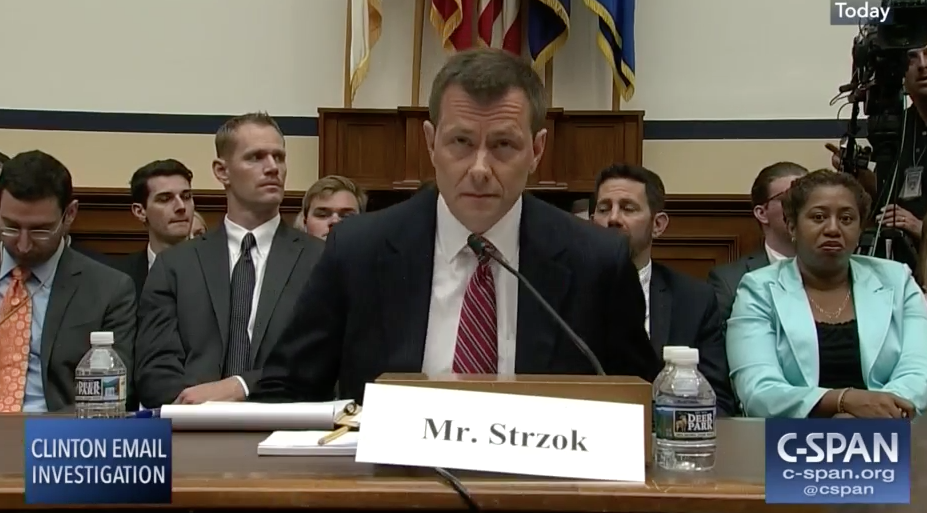
The Frothy Right Is Furious that Peter Strzok Pursued the Guy Leaking about Carter Page

Close to midnight on June 3, 2017, Lisa Page texted Peter Strzok to let him know that Reality Winner was in custody. Page used the same shorthand she and Strzok (and presumably, those around them) consistently use to describe leak investigations, ML, media leaks.

They used the term elsewhere, as when Strzok said “media leaks and what I do for a living” when responding to the first reports that Mueller was investigating Trump (and hypothesizing about who the WaPo’s likely sources were).

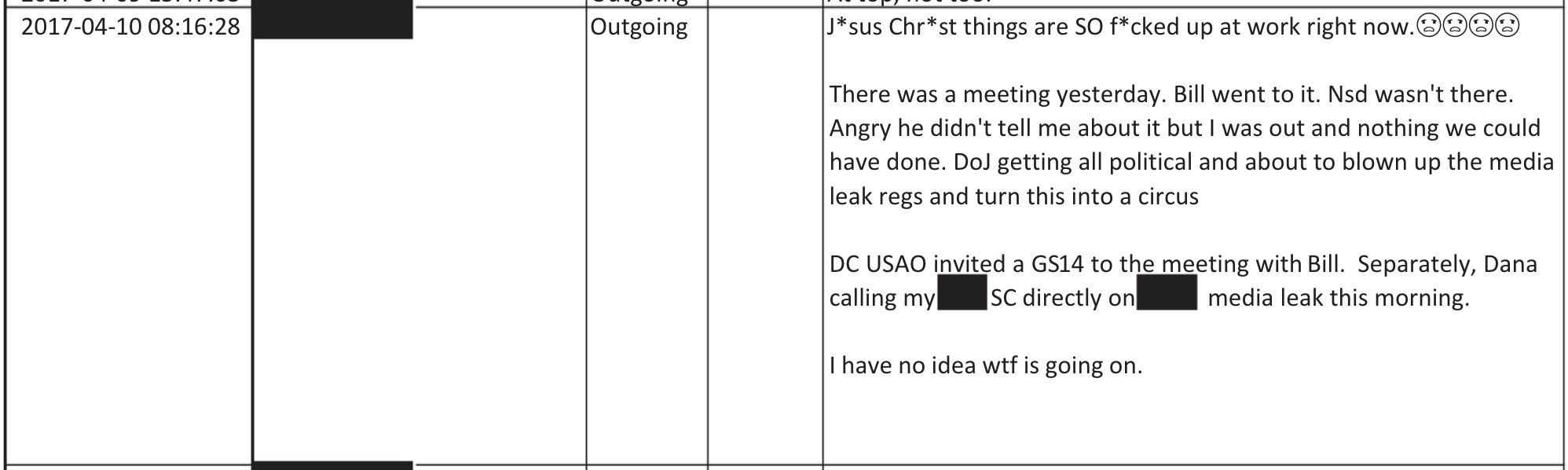
Significantly, they used the term on April 10, 2017, when trying to figure out how to respond to DOJ’s effort to increasingly politicize leak investigations.
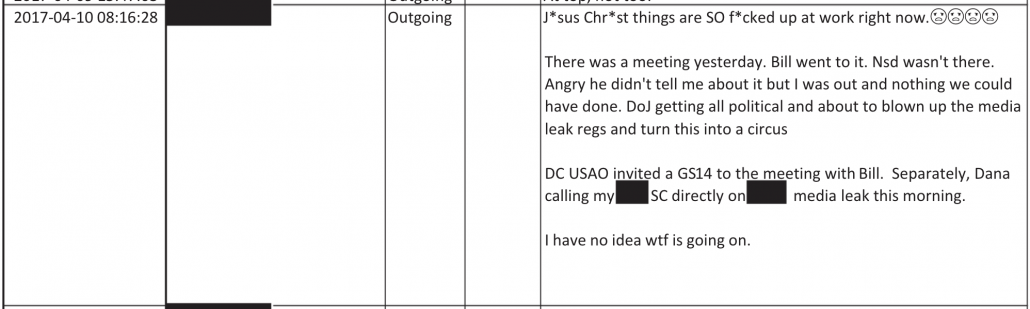
Indeed, Strzok’s lawyer has issued a statement confirming this is how Strzok and Page used the term.

The term ‘media leak strategy’ in Mr. Strzok’s text refers to a Department-wide initiative to detect and stop leaks to the media. The President and his enablers are once again peddling unfounded conspiracy theories to mislead the American People.

In spite of all that context, Mark Meadows has the entire frothy right, from Sara Carter to Fox News to Don Jr to his dad, worked up about two newly produced texts, based on this letter to Rod Rosenstein, which gets just about every thing wrong.
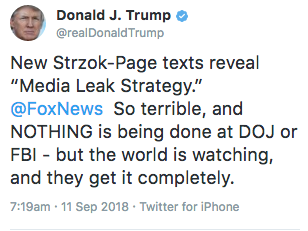
Before I explain how wrong Mark Meadows’ letter is, let me point out two things.

Michael Horowitz has already investigated a media leak text and found no misconduct

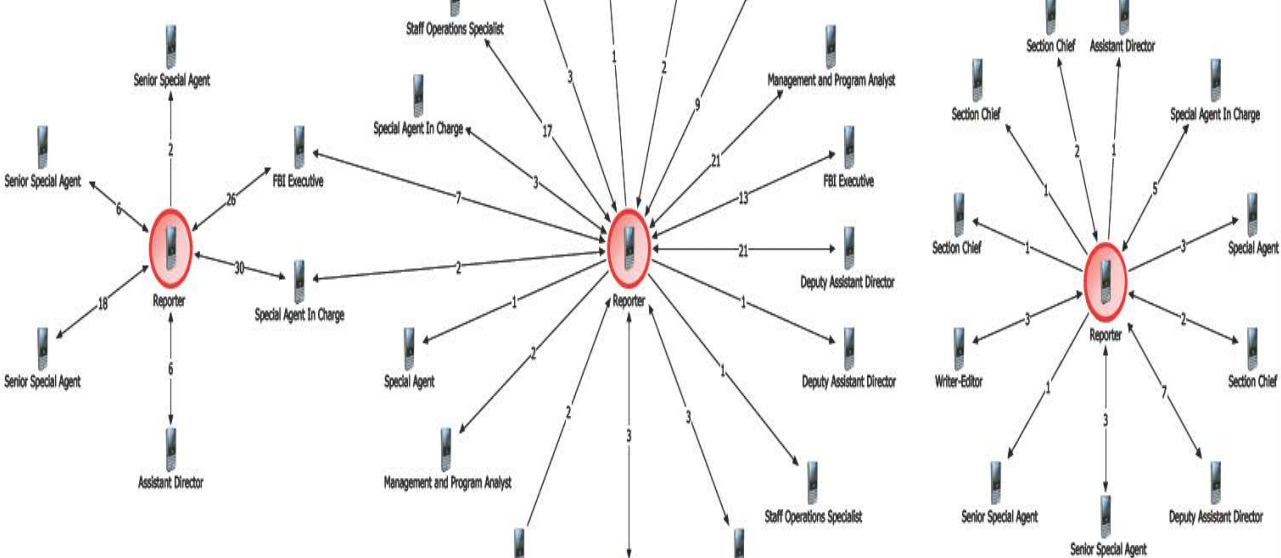
First, Michael Horowitz is (with the possible exception of DOD’s Glenn Fine) the best Inspector General in government. His office spent over a year investigating the work of Peter Strzok and Lisa Page; he wrote a 500-page report on it. And when he found evidence that even looked like impropriety, acted on it immediately and then formally, leading to Strzok’s firing. He has also spent a year investigating whatever calls went between FBI lines and reporters covering Hillary or Trump. He even drew pretty pictures showing each one of concern.
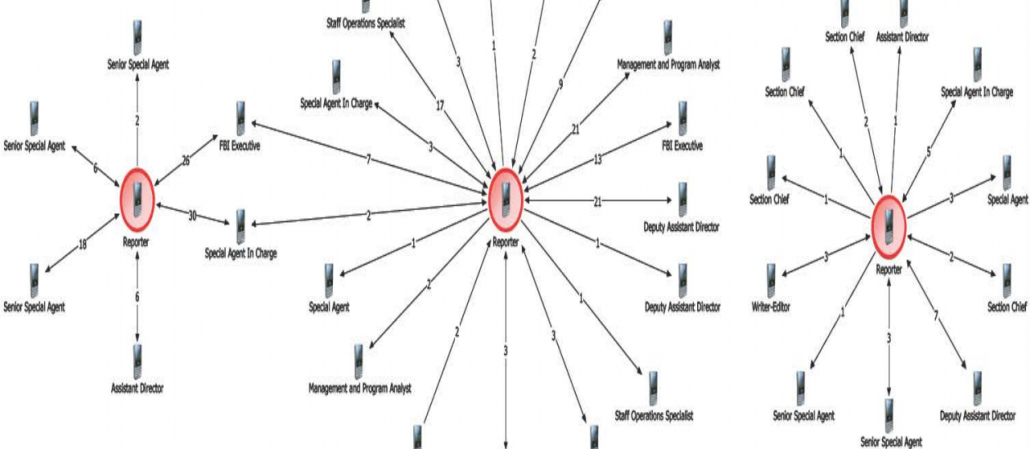
As part of both investigations, he examined a text in the series Meadows is concerned about (the April 10 one, above). And in spite of examining Page and Strzok, including a relevant text, at such length, Horowitz found no impropriety with the discussions about how to investigate leaks to the media.

We know the likely culprit for the leak the frothy right is blaming on Page and Strzok

The punchline of Meadows’ letter — as fed via the always-wrong Sara Carter — is a claim that Strzok and Page were the source for the WaPo story revealing that FBI obtained a FISA order on Carter Page.

The review of the documents suggests that the FBI and DOJ coordinated efforts to get information to the press that would potentially be “harmful to President Trump’s administration.” Those leaks pertained to information regarding the Foreign Intelligence Surveillance Court warrant used to spy on short-term campaign volunteer Carter Page.

Aside from how fucking stupid you’d have to be to believe that Strzok would go to great lengths to get a FISA order on Page and then tell the entire world about it, there’s another reason that the frothy right should know this is wrong: because we know the likely culprit for it.

As I noted in my first post on the James Wolfe indictment, that investigation appears to have started to (and focused on) finding the source for the WaPo story the frothy right now blames on Strzok and Page.

The government lays out clear proof Wolfe lied about conversations with three reporters. With Watkins and another, they point to stories about Carter Page to do so. The Watkins story is this one, confirming he is the person identified in the Evgeny Buryakov indictment. Another must be one of two stories revealing Page was subpoenaed for testimony by the Senate Intelligence Committee — either this one or this one.

I’m most interested, however, in this reference to a story the FBI raised with Wolfe in its interview, a story for which (unlike the others) the indictment never confirms whether Wolfe is the source.

During the interview, FBI agents showed WOLFE a copy of a news article authored by three reporters, including REPORTER #1, about an individual (referred to herein as “MALE-l), that contained classified information that had been provided to the SSCI by the Executive Branch for official purposes

The story suggests they don’t have content for the communications between Wolfe and Reporter #1, and the call records they’re interested in ended last June (meaning the story must precede it).

For example, between in or around December 2015 and in or around June 2017, WOLFE and REPORTER #1 communicated at least five times using his SSCI email account.

For that reason, I suspect this is the story they asked about — whether Wolfe is a source for the original credible story on Carter Page’s FISA order. The focus on Page generally in the indictment suggests this investigation started as an investigation into who leaked the fact that Page had been targeted under FISA, and continued to look at the stories that revealed classified details about the investigative focus on him (stories which he rightly complained to SSCI about).

The government didn’t charge Wolfe for that story — they just (appear to have) included his lies about whether he knew the reporters behind it among the lies they charged him for. But that’s a common strategy for FBI when dealing with a leak investigation the direct prosecution of which would require declassifying information, particularly with someone like Wolfe who could easily graymail the government. Moreover, the docket in his case has the look of one where the defense is considering a plea to avoid more serious charges.

Now consider how they got Wolfe. Not only did the government go after a trusted employee, not only did they very publicly access his Signal and WhatsApp texts, not only did they get Congress to waive speech and debate (which very rarely happens), but they also obtained years of Ali Watkins’ call records, both directly and via Temple University.

In other words, the prosecution of James Wolfe pushed prior protocols on leak investigations on a number of fronts: going after favored insiders, going after encrypted comms, going after employees of Congress, and going far more aggressively after a journalist and a college student than would seem necessary. That’s precisely the kind of thing that FBI and DOJ would debate as part of revising their strategy to more aggressively pursue media leaks.

So the James Wolfe case not only provides a likely culprit for the leak, but probably even evidence that shifts in the media leak strategy did happen, shifts resulting in far more aggressive pursuit of leaks than happened at the end of the Obama Administration.

Mark Meadows dangerously wrong

Which brings us, finally, to the many errors of Mark Meadows’ letter to Rosenstein. Once again, the premise of the letter is that two next texts (one of which obviously relates the one I posted above) create grave new concerns.

As you may know, we recently received a new production of documents from the Department providing greater insight into FBI and DOJ activity during the 2016 election and the early stages of the Trump administration. Our review of these new documents raises grave concerns regarding an apparent systemic culture of media leaking by high-ranking officials at the FBI and DOJ related to ongoing investigations.

Review of these new documents suggests a coordinated effort on the part of the FBI and DOJ to release information in the public domain potentially harmful to President Donald Trump’s administration. For example, the following text exchange should lead a reasonable person to question whether there was a since desire to investigate wrongdoing or to place derogatory information in the media to justify a continued probe.

April 10, 2017: Peter Strozk [sic] contacts Lisa Page to discuss a “media leak strategy.” Specifically, the text says: “I had literally just gone to find this phone to tell you I want to talk to you about media leak strategy with DOJ before you go.”

April 12, 2017: Peter Strozk [sic] congratulates Lisa Page on a job well done while referring to two derogatory articles about Carter Page. In the text, Strzok warns Page two articles are coming out, one which his “worse” than the other about Lisa’s “namesake.” [see update below] Strzok added: “Well done, Page.”

Meadows goes on to cite the WaPo story revealing Page’s FISA order and Andrew Weissman’s meeting with the AP (in which, per court testimony from the Manafort trial, the AP provided information useful to the investigation into Manafort, but which — significantly — led to the warrant on Manafort’s condo which may have led to the discovery of information that implicates Trump).

Meadows is just wrong. Both texts he already has and the Wolfe case “should lead a reasonable person” to understand that the same people who had long pursued leak investigations still were doing so, doing so in an increasingly politicized environment, but doing so with results that would employ more aggressive techniques and would find the likely culprit behind the WaPo story in question (not to mention send Reality Winner to prison for five years).

But all that’s just a premise to claim that because he imagines, fancifully, that Page and Strzok were leaking about ongoing investigations to the press (when in fact they were investigating such leaks), he should be able to get the FBI to talk about ongoing investigations.

During our interviews with Peter Strozk [sic] and Lisa Page, FBI attorneys consistently suggested witnesses could not answer questions due to the US Attorneys’ Manual’s policy for ongoing investigations. However, documents strongly suggest that these same witnesses discussed the ongoing investigations multiple times with individuals outside of the investigative team on a regular basis.

Not only is Meadows almost certainly wrong in his accusations against Strzok and Page, but he’s also ignoring that there are two ongoing investigations being protected here — both the general Russian investigation, but also the prosecution of Wolfe for behavior that likely includes the story he’s bitching about.

Meadows then uses what he even seems to admit are authorized media contacts as a transition paragraph.

Our task force continues to receive troubling evidence that the practice of coordinated media interactions continues to exist within the DOJ and FBI. While this activity may be authorized and not part of the inappropriate behavior highlighted above, it fails to advance the private march to justice, and as such, warrants your attention to end this practice.

The transition paragraph — which I’ll return to — leads to the whole point of the letter, Meadows’ demand that, because he has trumped up a false accusation against Strzok and Page, he should be able to interview FBI agents he believes will undermine the investigation into Donald Trump.

In light of the new information, our task force is requesting to review text messages, emails, and written communication from FBI and DOJ officials Stu Evans, Mike Kortan, and Joe Pientka between June 2016 to June 2017. To be clear, we are not suggesting wrongdoing on the part of Evans, Kortan, and Pientka–and, in fact, previously reviewed documents suggest that some of these individuals may share the committees’ same concerns. However, these additional documents, with an emphasis on communications between the aforementioned individuals and Peter Strozk [sic], Andrew McCabe, Lisa Page, Bruce Ohr and Andrew Weissman, would provide critical insight into the backdrop of the Russian investigation.

Meadows is looking, among other things, testimony that says Pientka didn’t believe Mike Flynn lied when he interviewed Trump’s National Security Advisor with Strzok. But he’s doing so specifically for a time period that ends before the evidence showing that Flynn did lie came into FBI (in part, when Mueller obtained Transition emails showing Trump closely directed Flynn’s conversations with Sergei Kislyak.

Now back to authorized media interactions. I happen to know something about how they work. I had a conversation with the FBI that pertained, in part, to whether there was a tie between Russian criminals and the President, one that also pertained to my perception of possible threats. Apparently Meadows thinks that such a conversation “fails to advance the private march to justice,” though it’s not clear what he means by that.  I mean, thus far, I have been very circumspect about the content of such conversations; is Meadows really asking me to air details before the midterms? I have thus far hesitated to share suspicions I had, believing it would be inappropriate for anyone besides Mueller and the FBI to air such things publicly, until they had corroborated my suspicions. But Meadows apparently believes it important to air investigative details before the election.

The better option — one that would put the rule of law and the security of the nation ahead of partisan obstruction — would be for Meadows to stop inciting hoaxes among the frothy right. Or maybe, at least, the frothy right can recognize that Meadows has serially embarrassed them as they credulously repeat whatever hoax he floats?

Update: After Jerrold Nadler and Elijah Cummings released a response noting some of Meadows’ errors, he fixed just one of the errors in his letter, admitting that the “well done, Page” language was actually from an April 22, 2017 text that reads, “article is out! Well done, Page,” and which obviously refers to this story on Jim Comey.

As I disclosed July, I provided information to the FBI on issues related to the Mueller investigation, so I’m going to include disclosure statements on Mueller investigation posts from here on out. I will include the disclosure whether or not the stuff I shared with the FBI pertains to the subject of the post. 

Share this entry

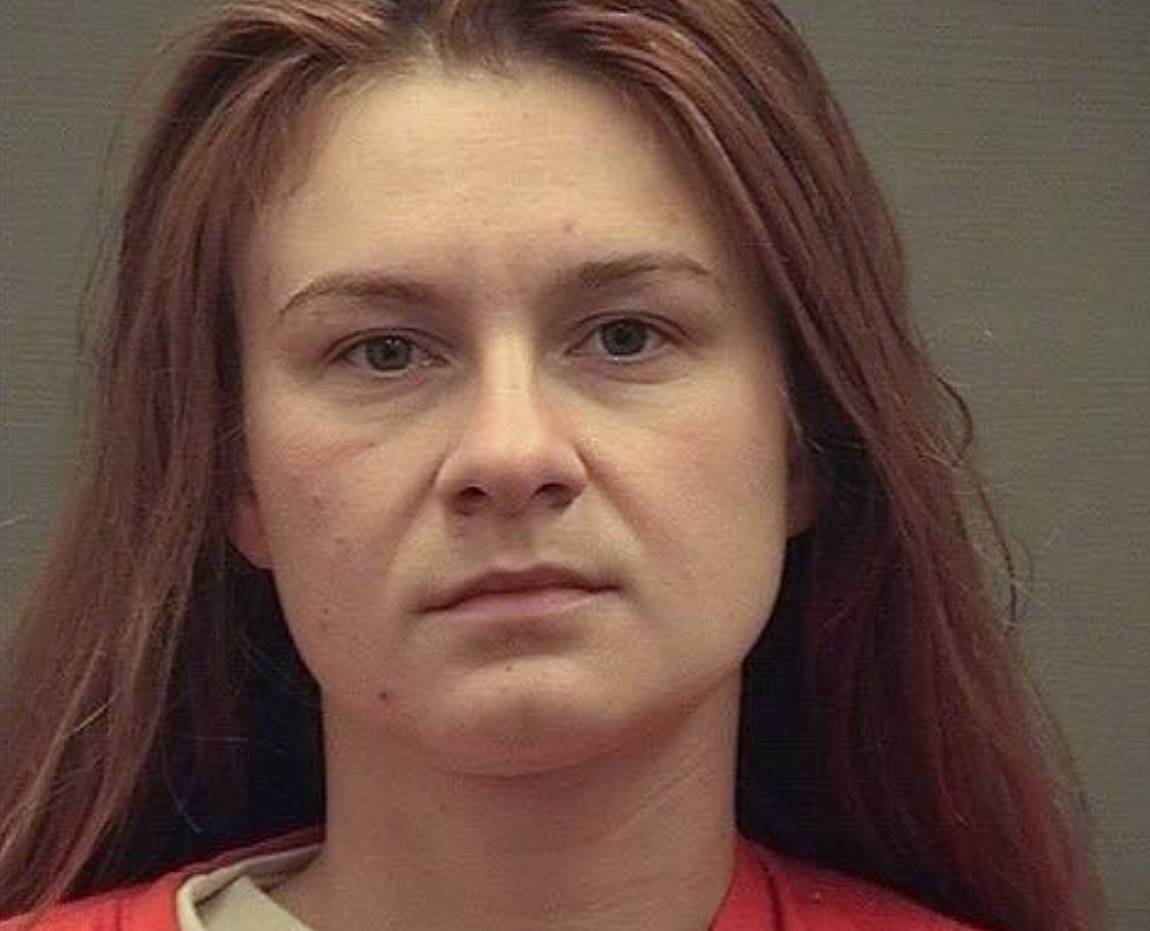
Is a Tie with Vladimir Putin What Makes Mariia Butina More of a Spy than Paul Manafort?

Given my continued obsession with the border between the spying charge (18 USC 951) with which Mariia Butina got charged and the FARA charge (22 USC 611 et seq.) with which Paul Manafort got charged, I find this footnote from the government’s opposition to Butina’s request for bail of particular interest.

14 The defendant also attempts to rely on the government’s search warrant seeking “evidence of a potential violation under FARA.” ECF No. 23-1 at 7. As the defendant later acknowledges, id. at 15, the search warrants the government obtained for the defendant’s residence authorized it to search for potential violations of 18 U.S.C. §§ 371 and 951, as well as 22 U.S.C. § 611 et seq.

It reveals that at the time they searched Butina’s residence on April 25, 2018, the FBI had not determined whether they considered her just a sleazy foreign influence peddler or a spy. The government had explained that, in that or a subsequent search they found several pieces of evidence she had ties to the FSB, including a note reflecting a job offer. The search also included access to her devices, which revealed a slew of “taskings” from Aleksandr Torshin, which the government will use (if this ever goes to trial) to prove Butina worked as an agent for the Russian government.

So that may be one of the things that led them to charge her as a spy, rather than just a sleazy influence peddler.

The opposition filing provides more details, however, that may explain the charge.

Pre-meditation: the operation started in 2015

I had noted, here, that one difference between Butina and Manafort likely stemmed from her necessity to lie to get a visa, something the government repeats here.

In 2016, the defendant applied for and was granted an F1 student visa to study at American University in Washington, D.C. On her application, she identified her current employer as “Antares LLC” and described the Russian Official as a previous employer. Nonetheless, once resident in the United States, the defendant continued her efforts at the direction of the Russian Official to establish connections with U.S. Political Party 1 and other U.S. officials and political operatives.

They also defend a claim they made about her current visa, which she obtained to ensure she’d be able to travel back and forth from Russia, another detail the defense had spun to great effect.

The defense asserts, ECF No. 23-1 at 13 n.12 & ECF No. 23-8, that the government made a misrepresentation regarding the type of visa for which the defendant recently applied and implies that it did so intentionally. The government acknowledges the error in its Memorandum in Support of Detention regarding the label it applied to the visa. ECF No. 8 at 8. But the substance of the government’s contention—that the defendant could travel to and from the United States per her new visa’s terms, but not per the terms of her F-1 visa after her graduation—is true of the Optional and Practical Training visa extension for which the defendant applied. In other words, the “B1/B2” label the government used to describe the visa was incorrect, but its underlying its argument was correct.

But this filing also adds further details of how pre-meditated Butina’s plan was, describing a plan she wrote up in March 2015.

Beginning as early as 2015, the defendant wrote a proposal intended for Russian officials laying out her plan to serve as an unofficial agent or representative to promote the political interests of the Russian Federation vis-à-vis the United States.

[snip]

In 2015, the defendant created a document entitled “Description of the Diplomacy Project,” in March 2015, which included a proposal to cultivate political contacts in the United States.

Interestingly, amid a list of Russian officials the FBI has evidence she had contact with, is a phone call she had with Sergey Kislyak in May 2015, when this operation was still in the planning stages.

At the detention hearing on July 18, 2018, defense counsel argued, “There’s no evidence [the defendant has] been in a diplomatic car. There’s no evidence that she’s been to the embassy. There’s no evidence that she’s been in contact with the consulate. ECF No. 12 at 55:21-25. But after the government proffered that it had seen photos of the defendant with the former Russian ambassador to the United States, ECF No. 12 at 58:8-18, counsel admitted that he was aware of at least one photograph of the defendant with the former Ambassador at “a movie screening hosted by a Russian cultural group in Washington.” Id. at 59:19-21. The government now proffers that it possesses additional photographs of the defendant and the Russian Official with the former Russian ambassador to the United States; that the defendant’s calendar shows a call with the former ambassador in May 2015; and that the defendant’s journal reflects her plan to meet with the current Russian ambassador to the United States upon his arrival to the United States. The government also possesses a photograph of the defendant with the Russian ambassador dated October 2017. [my emphasis]

Putin’s personal involvement

Finally, as noted here, this filing provides more evidence of Putin’s involvement (even though one premise of the operation is to suggest some in Russia are planning for a post-Putin future). The filing describes Erickson calling Torshin “Putin’s emissary.”

The government has developed other evidence over the course of the conspiracy that establishes taskings by the Russian Official (whom U.S. Person 1 has referred to as “Putin’s emissary”) and actions within the United States in response to those taskings by the defendant

It describes Erickson pitching Putin’s involvement when arranging for the Russian delegation to the National Prayer Breakfast.

Reaction to the delegation’s presence in America will be relayed DIRECTLY to President Putin and Foreign Minister Sergey Lavrov (who both had to personally approve the delegation’s travel to this event).

And that Putin involvement came at the last minute — the weekend of January 20-21, 2017.

[Erickson] noted, “I was ahead of this in December, but last weekend Putin decided to up his official delegation – if we can accommodate them, we can empower rational insiders that have been cultivated for three years.”

Diplomatic attention even beyond propaganda-making

All of which may explain why the Russians have made such an effort to pressure for Butina’s release.

Since the detention hearing in this case, the actions of the Russian Federation and its officials toward the defendant have confirmed her relationship with, and value to, her own government. To date, the Russian government has conducted six consular visits with the defendant. It also has passed four diplomatic notes to the U.S. Department of State.2 According to the Russian Ministry of Foreign Affairs, Russian Foreign Minister Sergey Lavrov has spoken to the U.S. Secretary of State twice to complain about this prosecution.3 The official Kremlin Twitter account changed its avatar to the defendant’s face and started a #FreeMariaButina hashtag. RT, a Russian television network funded by the Russian government, has published numerous articles on its website criticizing this prosecution and the defendant’s detention.4 Russia has issued more diplomatic notes on the defendant’s behalf in the past month than for any other Russian citizen imprisoned in the United States in the past year. Put simply, the Russian government has given this case much more attention than other cases.

2 Diplomatic notes are used for official correspondence between the U.S. Government and a foreign government. The Department of State serves as the official channel for diplomatic communications between the U.S. government and a foreign government.

3 Press release on Foreign Minister Sergey Lavrov’s telephone conversation with US Secretary of State Mike Pompeo, July 21, 2018 available at http://www.mid.ru/en/web/guest/foreign_policy/news/-/asset_publisher/cKNonkJE02Bw/ content/id/3302434 (last accessed Sept. 7, 2018); Press Release on Foreign Minister Sergey Lavrov’s telephone conversation with US Secretary of State Mike Pompeo, August 23, 2018, available at http://www.mid.ru/en/web/guest/foreign_policy/news/-/asset_publisher/ cKNonkJE02Bw/content/id/3323966 (last accessed September 7, 2018).

4 See, e.g., “Accused ‘Russian Agent’ Butina moved to another jail, now in ‘borderline torture’ conditions,” RT, August 19, 2018, available at https://www.rt.com/usa/436301-butinamoved-torture-prison/ (last accessed Sept. 2, 2018); “‘A real witch hunt’: Moscow says student Butina is being held as ‘political prisoner’ by US,” RT, July 26, 2018, available

Though, of course, some of this is the simple counterpart to what Butina’s attorneys complain DOJ is doing: because she’s a pretty woman, she makes for good propaganda that Russia can use to accuse the US of abuse. Still — Butina has gotten more reported attention than even Yevgeniy Nikulin, another case the Russian government has shown exceptional interest in.

Spying doesn’t require tradecraft

Her lawyers’ opposition to a government bid for a gag order repeats, in more dramatic fashion, a claim they had made in their bid for bail: that the government has presented no evidence of traditional tradecraft.

Maria Butina is in a cell, pretrial, 22 hours a day for crimes she did not commit and for government falsehoods and never-tested theories of culpability that have not (and will never) pan out. For all of the government insinuation and media coverage of Hollywood style, spy-novel allegations, in reality this case is bereft of any tradecraft or covert activity whatsoever. There are no dead drops, no brush passes, no secret communication devices, no bags of cash or payoffs, no bribes, no confidential secret information gathering, no espionage type activity, and no agency or agreement to commit crime.

Ultimately, though, the government relies on the elements of the offense, and confirm what I had suggested here — “he mis-states what the materials say about exempting political activity, not least because, per other materials, section 611 can be a subset of a section 951 violation.”

The elements of a violation of 18 U.S.C. § 951 are that (1) the defendant acted in the United States as an agent of a foreign government; (2) that the defendant failed to notify the Attorney General of the United States that she would be acting in the United States as an agent of a foreign government prior to so acting; and (3) that the defendant acted knowingly, and knew that she had not notified the attorney general.

But neither the USAM nor the Criminal Resource Manual contain any provisions that “specifically exempt[] section 951 from applying to ‘foreign agents engaged in political activities.’” ECF No. 23-1 at 7. Setting aside whether the defendant’s alleged activities are “purely political”—which the government does not concede—the sections of the USAM and Criminal Resource Manual cited by the defendant do not specifically exempt political activity undertaken at the behest of a foreign government or foreign government official from prosecution under 18 U.S.C. § 951. Further, the Inspector General’s Report cited by the defendant, id. at 6, n.4, quotes National Security Division officials as stating, “unlike FARA . . . Section 951 can be aimed at political or non-political activities of agents under the control of foreign governments.” U.S. DOJ, Office of the Inspector General, Audit of the National Security Division’s Enforcement and Administration of the Foreign Agents Registration Act, at ii (Sep. 2016), available at https://oig.justice.gov/reports/2016/a1624.pdf (last visited Aug. 26, 2018). More importantly, the USAM “is not intended to, does not, and may not be relied upon to create any rights, substantive or procedural, enforceable at law by any party in any matter civil or criminal.” United States v. Goodwin, 57 F.3d 815, 818 (9th Cir. 1995) (quoting USAM § 1-1.100); cf. United States v. Caceras, 440 U.S. 741, 754 (1979) (IRS manual does not confer any substantive rights on taxpayers but is instead only an internal statement of penalty policy and philosophy). 14

One final thing: this opposition motion makes it clear how pissed Butina and Torshin were when news of the DNC hack broke, knowing it would focus more attention to their own operation.

In July 2016, in a series of revealing communications, the defendant, U.S. Person 1, and the Russian Official expressed concern about how their operation might be affected by news reports that Russia had hacked the emails of the Political Party 2 National Committee. U.S. Person 1 worried that “it complicates the hell out of nearly a year of quiet back-channel diplomacy in establishing links between reformers inside the Kremlin and a putative [Political Party 1] administration (regardless of nominee or president). . . . What a colossal waste of lead time.” The defendant told the Russian Official, “Right now I’m sitting here very quietly after the scandal about our FSB hacking into [Political Party 2’s] emails. My all too blunt attempts to befriend politicians right now will probably be misinterpreted, as you yourself can understand.” The Russian Official responded by telling the defendant, she was “doing the right thing.”

Parallel processing: Not just about Trump

And it describes Butina first latching on to Scott Walker before picking up with Trump.

At some point, she identified a particular candidate (“Political Candidate 1”), whom she believed to have the best chance of becoming Political Party 1’s nominee for President. On July 14, 2015, the Russian Official requested that the defendant send him a report about Political Candidate 1’s announcement of his candidacy for the Presidency. She did so the next morning. After recounting Political Candidate 1’s speech, the defendant reported that she had a “short personal contact” with Political Candidate 1, with whom she had had previous personal contact, as well as one of his three advisors in matters of international politics. The day prior, the defendant had written to the Russian Official, “Judging from American polls – our bet on [Political Candidate 1] is correct.”

It describes the arc of the operation as an attempt to be well-positioned after the 2016 election.

[Butina] was working as an undeclared agent on behalf of the Russian Federation to position herself and that official to exert Russian influence over U.S. policies towards Russia after the 2016 Presidential election.

All that leads me to believe that the government is beginning to view the Torshin operation as a parallel effort to the election hack one, an effort that had Putin’s direct involvement in.

So it’s not just that the government has decided she has real ties to Russia’s spooks. It’s that the scope of her effort, and the involvement of Putin, raises the stakes for her custody, but also for any attempt to learn how these operations fit together.

Share this entry

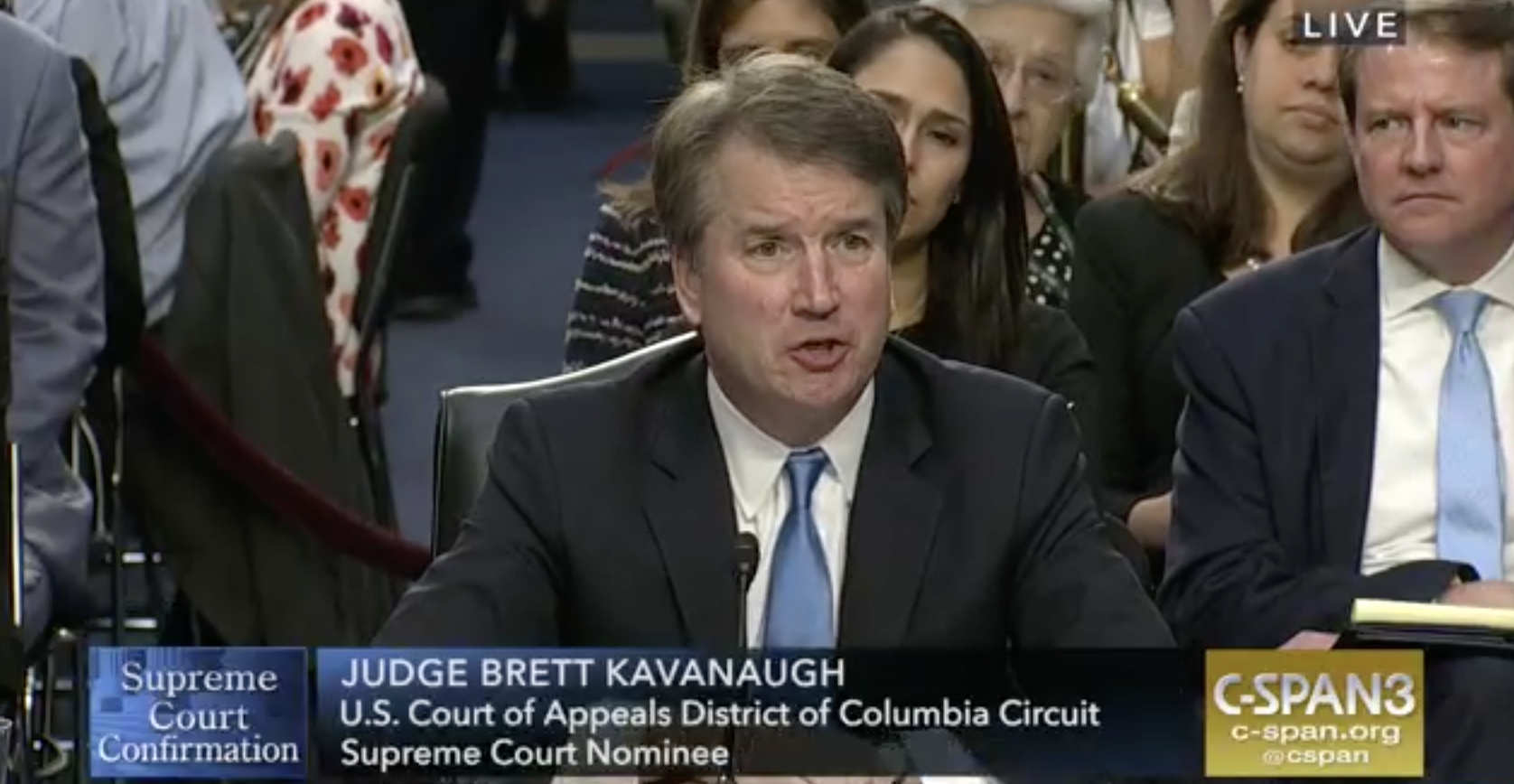
Brett Kavanaugh Thinks Using Stolen Emails Is Acceptable Behavior

There’s something that is missing from the debates back and forth about whether Brett Kavanaugh lied during any or all of the three Senate confirmation processes he has undergone. I’m of the opinion Kavanaugh lied skillfully, but because he’s a lawyer he managed to do so without committing perjury.

But on one issue — Kavanaugh’s use of emails stolen from Democrats — we don’t need to determine whether he lied or not, because he irrefutably did something that should make him unacceptable to be confirmed.

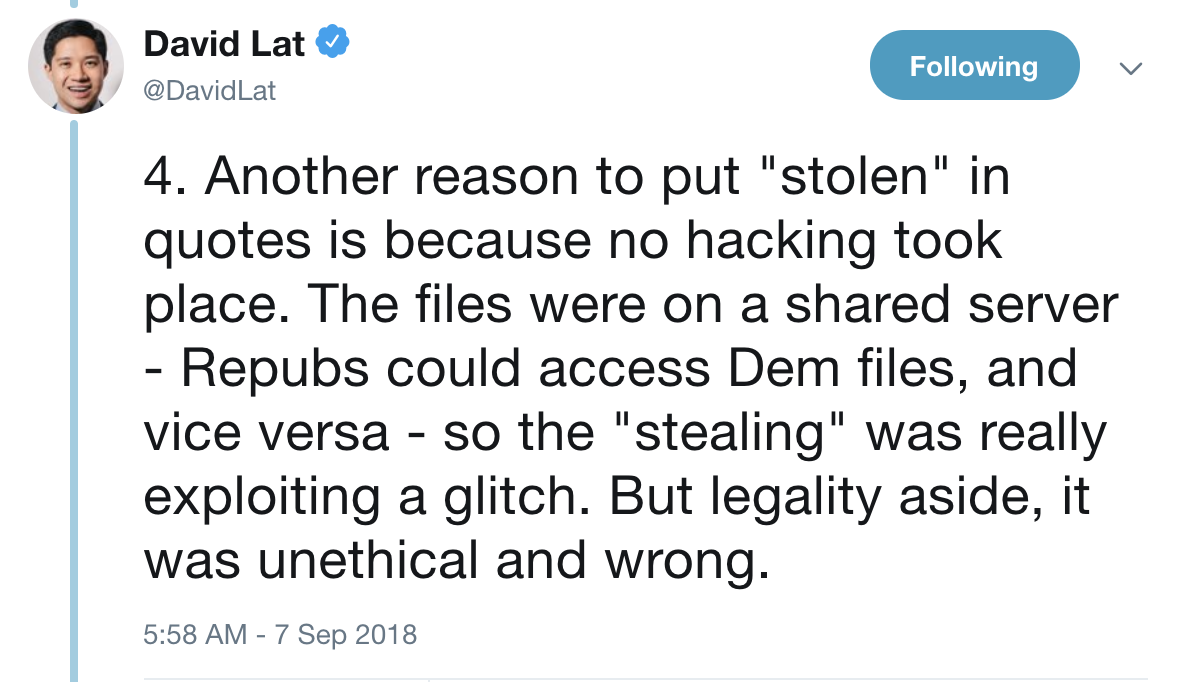
Even those that argue Kavanaugh didn’t lie and those that argue that, because Manny Miranda wasn’t prosecuted (during a GOP Administration and benefitting from speech and debate protection) or because it wasn’t a technical hack but rather a permissions violation, these emails weren’t “stolen,” do agree that using them was wrong. Here’s David Lat, for example, who wrote most of a book’s worth of Twitter threads defending Kavanaugh this week, admitting that using the emails was “unethical and wrong.”

And whatever you believe about whether Kavanaugh lied in any of these confirmation processes, what is irrefutable is that last week he was told, from the people involved, that he had, in fact, received and used stolen emails. For example, Patrick Leahy told him, repeatedly, that a document of his that got forwarded in draft form, that the document was not public at the time Kavanaugh received it.

Given such a circumstance, there is one natural, decent response. You apologize. Upon learning, allegedly for the first time, that you had indeed used stolen emails, you apologize to the people they were stolen from. “Gosh, I’m sorry. I had no idea. I’m sorry.” That’s what you say when you discover you used emails stolen from someone.

Brett Kavanaugh didn’t do that. He sat in front of his entire Catholic school girl’s basketball team, and instead of apologizing, he defended himself.

So no matter whether he was lying, one thing is crystal clear: he doesn’t think it was wrong to use stolen emails. He had no moral or ethical regret upon learning, definitively, that he had used stolen emails.

There may be several reasons that explain his lack of remorse for using stolen emails.

Obviously, he’s trying very hard not to offend the guy who appointed him before he’s confirmed, and pointing out that it is unethical to use stolen emails might be a sore subject for Donald Trump, who got elected by exploiting stolen emails.

Perhaps, too, he’s just an unethical person, the kind of guy whose Catholicism serves as a sanctimonious self-justification to engage in really unholy behavior.

But the biggest reason why Brett Kavanaugh might be reluctant to apologize for a clear ethical injury, even if he claims it was unwitting, is that it would taint his actions confirming judges. That is, it would make it clear he cheated — even if unwittingly — to push lifetime appointments through Congress. Those judges were confirmed illegitimately. And Kavanaugh, bidding for the third of three lifetime appointments, doesn’t want to do anything to highlight that illegitimately confirmed judges are, themselves, tainted.

Share this entry

Just before Mike Flynn Was Interviewed by the FBI, Putin Increased His Participation in the National Prayer Breakfast

There are twin filings (gag, bail) in the Mariia Butina case that I will write up separately. For the moment, I wanted to point to this passage of the government’s motion opposing Butina being released.

On January 26, 2017, [Paul Erickson] asked an acquaintance for National Prayer Breakfast tickets, noting that tickets could “advance the cause of US/Russian reset (on our terms).” [Erickson] later noted, “I was ahead of this in December, but last weekend Putin decided to up his official delegation – if we can accommodate them, we can empower rational insiders that have been cultivated for three years.”

I note it solely for the timing: it shows that the weekend of January 21-22, 2017, Putin decided to increase the seniority of his representatives attending the National Prayer Breakfast, which took place on February 2, and that decision filtered down to Erickson and Butina.

At the time, Trump had plans to meet with Aleksandr Torshin, plans which were scrapped at the last minute.

The event had been planned as a meet and greet with President Trump and Alexander Torshin, the deputy governor of the Bank of Russia and a close ally of President Vladimir Putin, in a waiting room at the Washington Hilton before the National Prayer Breakfast on Feb. 2. Torshin, a top official in his country’s central bank, headed a Russian delegation to the annual event and was among a small number of guests who had been invited by Prayer Breakfast leaders to meet with Trump before it began.

But while reviewing the list of guests, a White House national security aide responsible for European affairs noticed Torshin’s name and flagged him as a figure who had “baggage,” a reference to his suspected ties to organized crime, an administration official told Yahoo News. Around the same time, a former campaign adviser alerted the White House that the meeting could exacerbate the political controversy over contacts between Trump associates and the Kremlin, another source familiar with the matter said.

It’s remarkable how many events relevant to the Mueller inquiry happened during those few weeks (and remember — Butina’s prosecution is being handled separately).

Update: This seems to suggest Butina believed there was a letter behind the earliest 2017 coverage of her (probably this Tim Mak story).

In early 2017, in response to the Russian Official’s comment to her that a reporter had contacted him about his relationship to the defendant, President Putin, and U.S. Person 1, among others, the defendant told the Russian Official that she had received inquiries from the same reporter. She told the Russian Official, “under no circumstances should you contact him. You didn’t even see the letter at all.”

Share this entry

The Government and Manafort Continue to Argue about the Agency of Being an Agent

In this post, I briefly described that Paul Manafort, in a challenge to the way the government charged his sleazy influence peddling, tried to distinguish his influence peddling from that of spies, both with respect to whether hiding the proceeds of sleazy influence peddling might merit forfeiture and whether lying about sleazy influence peddling was a separate crime from lying in his FARA filing. Manafort lost on the former point, Amy Berman Jackson punted the latter point until after trial. But in ruling on the former, she emphasized that the FARA crime was about acting as an undisclosed sleazy influence peddler, not just hiding it.

But the reference to section 951 does not support defendant’s position, since defendant acknowledges that section 951 plainly governs acting as an agent of a foreign government, and the language of the two provisions is quite similar. See Def.’s Mot. at 4–5; compare 18 U.S.C. § 951(a) (“Whoever . . . acts in the United States as an agent of a foreign government without prior notification to the Attorney General . . . shall be fined under this title or imprisoned . . . .”) with 22 U.S.C. § 612(a) (“No person shall act as an agent of a foreign principal unless he has filed with the Attorney General a true and complete registration statement . . . .”) and id. § 618(a) (imposing criminal penalties on any person who “willfully violates any provision of this subchapter or any regulation thereunder” or “willfully makes a false statement of a material fact or willfully omits any material fact” in a FARA statement). These laws are not just about paperwork; their object is to ensure that no person acts to advance the interests of a foreign government or principal within the United States unless the public has been properly notified of his or her allegiance. So both statutes expressly prohibit “acting” as a representative of a foreign entity without submitting the required notification to the Attorney General. For these reasons, the alleged international banking transactions could “promote,” and Manafort could realize “proceeds” from, a FARA violation.

With that ruling, ABJ judged that FARA is like spying, just not quite as serious.

Manafort is still fighting the issue, however (probably, in part, in preparation for an appeal, but maybe also to save the industry of sleazy influence peddling for all his fellow sleazy influence peddlers).

In both the joint pretrial statement and his proposed jury instructions, Every time the government emphasized that the crime is about acting as an unregistered sleazy influence peddler, Manafort objected and rewrote the government’s language to focus on registration. Here’s one example:

Defendant also objects to the following language under the section entitled Elements of the Conspiracy’s Objects:

In Count One, the government has alleged that one object of the conspiracy was to act as an unregistered agent of a foreign principal. For Count One, the government does not have to prove that the defendant committed this crime; only that this was an object of the conspiracy. In considering whether this was an object of the conspiracy, the following legal principles and definitions apply. A person willfully violates the FARA requirements if:

(1) The defendant acted in the United States as an agent of a foreign principal;

(2) The defendant acted without registering with the Attorney General; and

(3) The defendant acted willfully.

Defendant proposes the following replacement:

In Count One, the government has alleged that one object of the conspiracy was to fail to register as an agent of a foreign principal in violation of FARA. For Count One, the government does not have to prove that the defendant committed this crime; only that this was an object of the conspiracy. In considering whether this was an object of the conspiracy, the following legal principles and definitions apply. A person willfully violates the FARA requirements if:

(1) The defendant was required by law to register as an agent of a foreign principal;

(2) The defendant failed to register with the Attorney General; and

(3) In failing to register, the defendant acted willfully.

Manafort may be doing this just to try to avoid forfeiture.

But, in part because this is a rare case going to trial that will serve as precedent for other people, the debate is an interesting one, one Manafort may appeal no matter what happens (because the decision is worth millions to him).

Mueller is arguing that being a sleazy influence peddler without being honest about who you’re working for is like being a spy. Given how much damage sleazy influence peddlers have done to our country, that’s probably right. But (I think to save his ill-gotten gains), Manafort thinks selling out his country’s politics to the highest bidder is just a matter of paperwork.

As I disclosed July, I provided information to the FBI on issues related to the Mueller investigation, so I’m going to include disclosure statements on Mueller investigation posts from here on out. I will include the disclosure whether or not the stuff I shared with the FBI pertains to the subject of the post. 
Share this entry

Roger Stone’s Excuse for His “Podesta Time in a Barrel” Comment Is Even Stupider Given the Paul Manafort Prosecution

In addition to Randy Credico, Jerome Corsi will testify before the Mueller grand jury on Friday. That means that the grand jury will hear testimony from two people who can address the truth of two claims Roger Stone made before the House Intelligence Committee on September 26, 2017.

First, there’s Stone’s claim he learned about WikiLeaks’ plans to release the John Podesta emails in October via Credico.

Now, let me address the charge that I had advance knowledge of the timing, content and source of the WikiLeaks disclosures from the DNC. On June 12, 2016, WikiLeaks’ publisher Julian Assange, announced that he was in possession of Clinton DNC emails. I learned this by reading it on Twitter. I asked a journalist who I knew had interviewed Assange to independently confirm this report, and he subsequently did. This journalist assured me that WikiLeaks would release this information in October and continued to assure me of this throughout the balance of August and all of September. This information proved to be correct. I have referred publicly to this journalist as an, “intermediary”, “go-between” and “mutual friend.” All of these monikers are equally true.

Credico has not only said this is not true, but that Stone threatened him to prevent him from testifying as much.

Then, there’s Stone’s claim (first made publicly by Corsi the previous March) that his tweet predicting John Podesta would soon catch political heat pertained to a project he and Corsi were working on at the time.

My Tweet of August 21, 2016, in which I said, “Trust me, it will soon be the Podesta’s time in the barrel. #CrookedHillary” Must be examined in context. I posted this at a time that my boyhood friend and colleague, Paul Manafort, had just resigned from the Trump campaign over allegations regarding his business activities in Ukraine. I thought it manifestly unfair that John Podesta not be held to the same standard. Note, that my Tweet of August 21, 2016, makes no mention, whatsoever, of Mr. Podesta’s email, but does accurately predict that the Podesta brothers’ business activities in Russia with the oligarchs around Putin, their uranium deal, their bank deal, and their Gazprom deal, would come under public scrutiny. Podesta’s activities were later reported by media outlets as diverse as the Wall Street Journal and Bloomberg. My extensive knowledge of the Podesta brothers’ business dealings in Russia was based on The Panama Papers, which were released in early 2016, which revealed that the Podesta brothers had extensive business dealings in Russia. The Tweet is also based on a comprehensive, early August opposition research briefing provided to me by investigative journalist, Dr. Jerome Corsi, which I then asked him to memorialize in a memo that he sent me on August 31st , all of which was culled from public records. There was no need to have John Podesta’s email to learn that he and his presidential candidate were in bed with the clique around Putin.

I noted at the time that that Corsi’s explanation didn’t make any sense, because while the July 31 report did pertain to John Podesta, his August 31 report focused exclusively on Tony (the Corsi materials start at page 39 of Stone’s HPSCI testimony; note the conflation of Tony for John got repeated in Craig Murray’s explanations for the WikiLeaks’ go-between he met in September).

But the explanation is even less credible given what has happened since: Paul Manafort, whose plight the Corsi report was (per Stone) explicitly a response to, got indicted in part because he told Tony Podesta to hide his ties to Russian-backed Ukrainian politicians. Indeed, in classic Corsi style, he describes Podesta’s role in Manafort’s crime, without disclosing that Podesta was in legal trouble because of Manafort’s effort to hide his own crimes; Corsi presented them as equal partners in this crime.

CNN further reported on Aug. 19 the Podesta Group had issued a statement affirming the firm has retained the boutique Washington-based law http://www.capdale.com firm Caplin & Drysdale “to determine if we were mislead by the Centre for a Modern Ukraine or any other individuals with potential ties to foreign governments or political parties.” The Podesta Group statement issued to CNN continued: “When the Centre became a client, it certified in writing that ‘none of the activities of the Centre are directly or indirectly supervised, directed, controlled, financed or subsidized in whole or in part by a government of a foreign country or a foreign political party.’ We relied on that certification and advice from counsel in registering and reporting under the Lobbying Disclosure Act rather than the Foreign Agents Registration Act.”

The CNN statement concluded with the statement, “We will take whatever measures are necessary to address this situation based on Caplin & Drysdale’s review, including possible legal action against the Centre.” In breaking the story that the Podesta Group had hired Caplin & Drysdale, Buzz Feed https://www.buzzfeed.com/rosiegray/top-lobbying-firm-hiresoutside-counsel-in-ukraine-manafort?utm term=.duLexkeKBx#.rj4gn3gmln reported on Aug. 19, that both the Podesta Group and Manafort’s D.C. political firm were working under contract with the same group advising Yanukovych and his Ukrainian Party of Regions – namely the non-profit European Centre for a Modern Ukraine based in Brussels. On Dec. 20, 2013, Reuters reported http://www.reuters.com/article/us-usaukraine-lobbying-idUSBRE9BJ1B220131220#6oTXxKZp25obYxzF.99 the European Centre for a Modern Ukraine paid $900,000 to the Podesta Group for a two-year contract aimed at improving the image of the Yanukovych government in the United States that the Podesta Group told Reuters they were implementing through contacts with key congressional Democrats.

That detail is important of a number of reasons. First, because it makes it entirely unlikely that Stone (who was meeting with Rick Gates during this period, if not his “boyhood friend” Manafort himself) learned of Podesta’s ties via Panama Papers and not from Manafort himself. But it also provides a reason why Corsi and Stone would be focusing on Tony at the time — to draw attention away from Manafort, and with it, the corruption that Manafort implicated the Trump Administration in. Indeed, the Manafort EDVA court record shows that Gates and Manafort were using a range of financial and political means of doing the same at precisely that time.

It’s clear, given what we’ve learned as part of the Manafort prosecutions, that the effort to impugn Tony Podesta had everything (as Stone partly tells truthfully)to do with the plight of Manafort at the time.

Which is to say, it didn’t have anything to do with John, and so can’t be used to explain that tweet.

On top of everything else. Mueller appears to be finishing up false statements charges against Stone.

Share this entry

Mueller Ready to Get Trump on the Record on His Involvement in the Russian Conspiracy

EUREKA!!!

The NYT finally has a story that admits Trump is at risk under conspiracy charges!

It reports that Mueller told Trump’s lawyers last Friday that he’d be willing to start with written answers about his involvement in the election conspiracy, while bracketing obstruction questions as privileged.

The special counsel, Robert S. Mueller III, will accept written answers from President Trump on questions about whether his campaign conspired with Russia’s election interference, Mr. Mueller’s office told Mr. Trump’s lawyers in a letter, two people briefed on it said on Tuesday.

But on another significant aspect of the investigation — whether the president tried to obstruct the inquiry itself — Mr. Mueller and his investigators understood that issues of executive privilege could complicate their pursuit of a presidential interview and did not ask for written responses on that matter, according to the letter, which was sent on Friday.

Mr. Mueller did not say that he was giving up on an interview altogether, including on questions of obstruction of justice. But the tone of the letter and the fact that the special counsel did not ask for written responses on obstruction prompted some Trump allies to conclude that if an interview takes place, its scope will be more limited than Mr. Trump’s legal team initially believed, the people said.

For the moment, I’m not going to say what I think this means (I’ve got some ideas, but will hold those for now).

Instead, consider what questions will be included in Trump’s take-home test, from the list the NYT first published (though it has presumably grown since March when Jay Sekulow wrote it up). I’m going to group them, here, under things we know Mueller has been up to in recent months.

November 30, 2017: Mike Flynn pleads guilty as part of a cooperation deal

Last year, Mike Flynn pled guilty as part of a cooperation deal; he has a status hearing — scheduled on a 24 day interval — on September 17. Flynn has spent the last nine months answering these questions:

  • What discussions did you have during the campaign regarding Russian sanctions?
  • During the campaign, what did you know about Russian hacking, use of social media or other acts aimed at the campaign?
  • What did you know during the transition about an attempt to establish back-channel communication to Russia, and Jared Kushner’s efforts?
  • What do you know about a 2017 meeting in Seychelles involving Erik Prince?
  • What do you know about a Ukrainian peace proposal provided to Mr. Cohen in 2017?

February 23: Rick Gates pleads guilty as part of a cooperation deal

On February 23, Rick Gates pled guilty as part of a big cooperation agreement. Two weeks later, Mueller obtained search warrants for 5 AT&T phones (and probably an equivalent number of Verizon phones), at least one of which is Paul Manafort’s and one of which may be Roger Stone’s. Gates can surely help answer the following questions:

  • What discussions did you have during the campaign regarding any meeting with Mr. Putin? Did you discuss it with others?
  • What discussions did you have during the campaign regarding Russian sanctions?
  • What involvement did you have concerning platform changes regarding arming Ukraine?
  • During the campaign, what did you know about Russian hacking, use of social media or other acts aimed at the campaign?
  • What knowledge did you have of any outreach by your campaign, including by Paul Manafort, to Russia about potential assistance to the campaign?

April: Jared testifies for seven hours

Sometime in April, Jared testified for seven hours. Jared is likely to be able to provide some answers about the following questions:

  • What did you know during the transition about an attempt to establish back-channel communication to Russia, and Jared Kushner’s efforts?
  • What do you know about a 2017 meeting in Seychelles involving Erik Prince?
  • When did you become aware of the Trump Tower meeting?
  • What involvement did you have in the communication strategy, including the release of Donald Trump Jr.’s emails?
  • During the campaign, what did you know about Russian hacking, use of social media or other acts aimed at the campaign?

May 22: Sam Patten makes his first proffer for a cooperation deal

On August 31, Sam Patten pled guilty to FARA violations in the context of a cooperation agreement for which he made his first proffer back on May 22. Patten may know some of the answers to these questions:

  • What do you know about a Ukrainian peace proposal provided to Mr. Cohen in 2017?
  • What discussions did you have during the campaign regarding Russian sanctions?
  • What involvement did you have concerning platform changes regarding arming Ukraine?

August 17: Paul Manafort seeks a plea deal

During jury watch in his first trial, Manafort and Mueller’s lawyers had aborted discussions about a plea deal, at least to resolve his second trial. Manafort’s lawyers are only belatedly preparing for the second trial, jury selection for which begins on September 17.

Manafort would be able to answer the following questions:

  • During the campaign, what did you know about Russian hacking, use of social media or other acts aimed at the campaign?
  • What discussions did you have during the campaign regarding any meeting with Mr. Putin? Did you discuss it with others?
  • What discussions did you have during the campaign regarding Russian sanctions?
  • What involvement did you have concerning platform changes regarding arming Ukraine?
  • During the campaign, what did you know about Russian hacking, use of social media or other acts aimed at the campaign?
  • What knowledge did you have of any outreach by your campaign, including by Paul Manafort, to Russia about potential assistance to the campaign?

August 21: “They’re squeezing Don Jr. right now”

On August 21, Vanity Fair reported that Mueller has been making document follow-up requests pertaining to Jr.

Another theory for what’s motivating Trump’s increasingly unhinged tweets is that Mueller may be closing in on his son Don Jr. “A lot of what Trump is doing is based on the fact [that] Mueller is going after Don Jr.,” a person close to the Trump family told me. “They’re squeezing Don Jr. right now.”

Don Jr.’s lawyer said, “I’m not going to comment.” Another person briefed on the investigation disputed the term “squeeze,” but said the Mueller team continues to ask for documents.

These questions would directly pertain to Don Jr and the documents he has been turning over:

  • During a 2013 trip to Russia, what communication and relationships did you have with the Agalarovs and Russian government officials?
  • When did you become aware of the Trump Tower meeting?
  • What involvement did you have in the communication strategy, including the release of Donald Trump Jr.’s emails?
  • What discussions did you have during the campaign regarding any meeting with Mr. Putin? Did you discuss it with others?
  • What discussions did you have during the campaign regarding Russian sanctions?
  • During the campaign, what did you know about Russian hacking, use of social media or other acts aimed at the campaign?

August 21: Michael Cohen pleads guilty to eight charges while begging to cooperate

On August 21, Michael Cohen pled guilty to eight charges; both before and after he has desperately shopped a plea deal (though he has gone quiet in recent days). Cohen’s cooperation might help answer these questions:

  • During a 2013 trip to Russia, what communication and relationships did you have with the Agalarovs and Russian government officials?
  • What communication did you have with Michael D. Cohen, Felix Sater and others, including foreign nationals, about Russian real estate developments during the campaign?
  • What do you know about a Ukrainian peace proposal provided to Mr. Cohen in 2017?

September 7: The second-to-last known witness against Roger Stone testifies before the grand jury

On Friday, Randy Credico will bring his dog to visit the grand jury and describe how Roger Stone tried to convince him to claim he was Stone’s back channel to Assange (he has already interviewed with Mueller’s team, so they know what he’s going to say). Mueller has been questioning witnesses about Stone since February, and just one — Andrew Miller — remains to testify (assuming the sealed order Beryl Howell signed on August 13) didn’t immunize him for part of his testimony).

That long line of witnesses likely provided information relevant to these questions:

  • During the campaign, what did you know about Russian hacking, use of social media or other acts aimed at the campaign?
  • What did you know about communication between Roger Stone, his associates, Julian Assange or WikiLeaks?

In short, while the NYT has been reporting incessantly about the obstruction charges against Trump, Mueller has accumulated a good deal of evidence to answer the questions about the Russian conspiracy that Trump’s lawyers have in the past said they’d be willing to answer.

I’d say Mueller’s ready to get Trump’s answers — which will not be truthful — on the record. You don’t need obstruction charges involving Jim Comey when you’re guaranteed the President will lie on the record about conspiracy.

Update: In their version of this story, WaPo notes they’ll return to obstruction discussions later.

On potential obstruction-of-justice issues, “he said he’d assess it down the road,” said one person familiar with Mueller’s letter who requested anonymity to discuss private communications. “They’re essentially saying, ‘We’ll deal with this at a later date.’”

That makes sense. There’s bound to be more obstruction to discuss later down the road, whether it’s lies in response to these questions or attempted pardons.

Update: One other thing this does. This letter, inviting Trump to answer questions in writing, came a day after the first detailed story on Rudy’s counter-report came out. Rudy’s blabbing about how they’re going to release a report that purportedly addresses all of Mueller’s concerns will make it hard (but never impossible) to refuse to comply. And it will also give Rudy a hobby that will distract from inventing conspiracy theories about Mueller conflict.

As I disclosed in July, I provided information to the FBI on issues related to the Mueller investigation, so I’m going to include disclosure statements on Mueller investigation posts from here on out. I will include the disclosure whether or not the stuff I shared with the FBI pertains to the subject of the post. 
Share this entry

Would Rod Rosenstein Object to a Mueller Action before Brett Kavanaugh Is Confirmed?

There’s a lot of discussion about whether or not DOJ’s traditional prohibition on major prosecutorial actions limits Robert Mueller. As I have explained, I personally think the terms of it don’t apply, with the possible exception of Dana Rohrabacher, because no other conceivable subject of Mueller’s investigation is conceivably on the ballot. Quinta Jurecic has a good piece explaining that it is a general practice, not a rule.

Justice Department Inspector General Michael Horowitz spelled out exactly why it’s wrong in three short pages of his recent report on the FBI’s conduct in the Clinton email investigation.

Two years ago, Jane Chong dove deep into the supposed 60-day rule in a Lawfare post on FBI Director James Comey’s October 2016 letter on new developments in the Clinton investigation. As she wrote then, there is no formal rule barring Justice Department action in the days immediately before an election. Rather, the “rule” is more of a soft norm based on what former Attorney General Eric Holder himself described as “long-standing Justice Department policies and tradition.” In a guidanceHolder issued in 2012, the attorney general wrote that, “Law enforcement officers and prosecutors may never select the timing of investigative steps or criminal charges for the purpose of affecting any election, or for the purpose of giving an advantage or disadvantage to any candidate or political party”—which, Chong noted, leaves a wide loophole for actions taken near an election without the purpose of affecting that election. In 2016, Attorney General Loretta Lynch issued a similar memorandum with the same language, as the inspector general report lays out.

Chong’s post was, in fact, cited by the inspector general report in the office’s own analysis of whether Comey had violated the supposed 60-day rule. “The 60-Day Rule is not written or described in any Department policy or regulation,” the report says. Investigators canvassed a range of “high-ranking [Justice] Department and FBI officials” on their own understandings of the guideline, which the report describes as “a general practice that informs Department decisions.”

This short section of the 500-plus-page report shows broad agreement among the current and former Justice Department officials interviewed that there is some kind of principle against taking action in such a way as to potentially influence an election, though the interviewees do not precisely agree on the contours of that principle. Former U.S. Attorney for the Southern District of New York Preet Bharara stated, investigators write, that “there is generalized, unwritten guidance that prosecutors do not indict political candidates or use overt investigative methods in the weeks before an election.” Former Deputy Attorney General Sally Yates located the cutoff more precisely at the 90-day instead of the 60-day mark.

The inspector general’s office also interviewed Ray Hulser, the former deputy assistant attorney general for the Public Integrity Section of the Justice Department, who was involved in the drafting of Lynch’s 2016 election integrity. Interestingly, Hulser told investigators that the Public Integrity Section had actually considered codifying the 60-day rule in the Lynch memo, but had decided not to because such a policy would be “unworkable.”

Yet, even though I don’t believe the 60-day “rule” does apply, my expectation is that Rod Rosenstein — who after is the one who will make any decisions about major Mueller actions — would nevertheless abide by it.

Still, that leaves three more days of this week, before the actual 60-day cut-off.

Which leaves me with another question: Would Rosenstein balk at a major action this week, before Brett Kavanaugh is confirmed to the Supreme Court?

After all, Rosenstein is close to Kavanaugh from when both served on a real witch hunt, the Ken Starr investigation into Bill Clinton’s blowjob (indeed, Kavanaugh seemed to have gotten off on the most scandalous details about that blowjob). Rosenstein has gone to great lengths to make DOJ resources available in support of his confirmation. Rosenstein showed up for the start of today’s hearing.

For Rosenstein, Kavanaugh’s confirmation is personal.

Would he do anything this week to stave off new Mueller revelations, to ensure the Kavanaugh bullet train races forward?

Share this entry

Spy versus Spy: The Two Alleged Agents of Foreign Powers Sitting in the Alexandria Jail, Part Two (Mariia)

In this post, I laid out the difference between two laws criminalizing foreign agents of influence, 22 USC 611 et seq. (FARA) and 18 USC 951. Paul Manafort is charged with the former; Rick Gates, Mike Flynn, and Sam Patten have also all pled guilty to FARA related crimes; Mariia Butina is accused of the latter.

I think, particularly as Mueller’s investigation begins to put real teeth in FARA (and as nation-state spying hides under new kinds of cover and funding arrangements), the border between the two crimes will become increasingly tenuous. A comparison of Butina and Manafort shows some of the ways that’s clear.

Butina’s lawyer pitches her actions as lobbying

In response to her charges, her attorney Robert Driscoll has repeatedly denied she’s an agent of Russia, not by denying she did what Aleksandr Torshin instructed her to, but by claiming that hers is just a regulatory filing case.

“This is not an espionage case, this is not a spy case, this is a regulatory filing case,” in which Butina didn’t file the correct paperwork with the Justice Department, Driscoll told Robnson in arguing why she should be freed pending trial.

“She’s not an agent of the Russian Federation,” Driscoll told reporters after the hearing.

In a bid to overturn Magistrate Deborah Robinson’s decision to deny Butina bail, Driscoll minimizes the Russian’s activities as “going to dinners among intellectuals and foreign policy wonks to discuss U.S.-Russia relations, attending two National Prayer Breakfasts, and booking hotel rooms at the Washington Hilton, if true, is anything but an ‘obvious’ danger to the public.” He argues, “the allegations do not involve spying, tradecraft, classified information, or any other hallmarks of an espionage case.” To rebut any claim of covert operation, Driscoll points to the fact that one of the actions in her indictment — a dinner hosted by her unindicted co-conspirator, George O’Neill, just after the National Prayer Breakfast — was hosted by O’Neill and written up in the press (one of two stories he cited was written by O’Neill).

She is accused of arranging dinners to promote better relations between Russia and the United States although the very dinner that is listed as a predicate act for her alleged crimes was written about in Time Magazine and the American Conservative—hardly covert activity—and, in actuality, was initiated, organized, and directed by an American citizen, not the Russian government.3

He argues that the government charged Butina with section 951 as a tactical move, to make it easier to prosecute political activity (I’m not a lawyer, but I’m virtually certain he mis-states what the materials say about exempting political activity, not least because, per other materials, section 611 can be a subset of a section 951 violation).

To distract from the frailty of its charges, the government reprises that Ms. Butina is charged under section 951 and not FARA. However, that charging decision alone contradicts the Justice Department’s own policies, and perhaps was made as an attempt to aggrandize her conduct and mischaracterize her innocent political interest as nefarious.

That is, the Department of Justice (“DOJ”) Criminal Resource Manual makes a distinction between section 951 and a FARA violation. It describes FARA under section 611 et seq. as requiring an agent of a foreign principal engaged in political activities to register. See U.S. Dep’t of Justice, United States Attorneys’ Manual 9-90.700 and 9-90.701; and see Criminal Resource Manual at 2062. It also discusses other federal statutes like section 951, which is “aimed at persons loosely called foreign agents” but specifically exempts section 951 from applying to “foreign agents engaged in political activities.” Id. In plain English, DOJ further notes among frequently asked questions that section 951 is only “aimed at foreign government controlled agents engaged in non-political activities.”5

The government’s April, 2018 search warrant sought evidence of a potential violation under FARA.

[snip]

[A]lthough such allegations are unfounded and untrue, and although the government’s searches revealed no hidden transmitters, wads of cash, counterfeit passports, and plane tickets back to Moscow, the government still decided to paper a case against Ms. Butina under section 951. This decision shows that the government desired to overcharge and inflate her conduct for tactical advantages versus act with restraint or, at a minimum, be consistent with the DOJ and National Security Division’s own publicized understanding of appropriate charges.

And Driscoll doesn’t even concede she violated FARA.

[F]or reasons only it is aware, the government has charged Ms. Butina under 18 U.S.C. § 951 rather than the Foreign Agent Registration Act (“FARA”), 22 U.S.C. § 611 et seq., which generally carries civil penalties and much less severe criminal penalties (for circumstances far more egregious than the facts alleged here). Much like a FARA case, the government does not allege that Ms. Butina undertook any independently illegal activities in the United States. The only thing that made her alleged conduct illegal, if true, is that she did not notify the Attorney General prior to undertaking it.

[snip]

At bottom, the government’s case appears to be a novel attempt to stretch 18 U.S.C. § 951 to cover the activities of a foreign national student under the theory that her communications (about non-classified public source material) with contacts in her home country made her an “agent” of that country. The serious charges against her should be viewed in that context, which makes this case distinctly different from a typical section 951, “espionage-like or clandestine behavior” case.4

The lobbying included in Butina’s alleged crimes

To some extent, Driscoll is right: the government’s description of the allegations against Butina does focus closely on activity that might fall under FARA’s political activities (though, as noted, he cites a DOJ statement that suggests sections 611 and 951 are mutually exclusive, when by my understanding sections 611 can be a part of 951).

Many of the activities Butina is alleged to have done involve things that might be classified as lobbying. In her arrest affidavit, DOJ describes how Butina, with help from Paul Erickson, identified a network of influential Americans, including the NRA, to whom she could pitch closer relations with Russia. George O’Neill helped Butina set up a series of “friendship and dialogue” dinners. A number of her activities, such a publishing an article in The National Interest, are precisely the kinds of things FARA attempts to provide transparency on. This is where Driscoll gets his claim that Butina only “arrang[ed] dinners to promote better relations between Russia and the United States.”

Butina was directed by Aleksandr Torshin

A number of the allegations would support either a FARA or 951 violation.

The affidavit makes it clear she was following the directions of Aleksandr Torshin, the Deputy Governor of Russia’s Central Bank and as such an official representative of the government.

On the night of the election, for example, she asked for orders from Torshin, “I’m going to sleep. It’s 3 am here. I am ready for further orders.” The two moved to WhatsApp out of Torshin’s concern “all our phones are being listened to.” It’s clear, too, she and Torshin were hiding the role of the Russian government behind her actions. When she sent a report on a conference to establish a dialogue with US politicians, she said it “must be presented as a private initiative, not a government undertaking.”

The government even presented proof that Butina’s actions were approved by people close to Putin himself.

On March 14, 2016, Butina wrote O’Neill that what DOJ calls a  “representative of the Russian Presidential administration” had expressed approval “for building this communication channel,” suggesting she and Torshin had direct approval from Putin. “All we needed is <<yes>> from Putin’s side,” Butina explained to O’Neill.

With one exception, Driscoll largely offers bullshit in response to the government’s evidence she operated as a Russian government agent (indeed, his recognition that Butin advertised being Torshin’s special assistant on one of her business cards confirms that she continued to work for Torshin). He includes a letter of grad school recommendation for Butina for Columbia as proof of … it’s not clear what, particularly since Torshin includes his government affiliation on the letter.

Still: Paul Manafort was operating on behalf of a foreign government while Viktor Yanukovych remained in power, yet DOJ charged him with FARA, not section 951. The bar to meet foreignness under FARA is broader than it is under section 951, but lobbying for a foreign government can be sufficient to it. Yet Butina got charged under section 951, not FARA.

Paid by an oligarch

The exception to my claim that Driscoll offers little to rebut (in court filings — his statements to the press are another issue) that Butina was directed by the Russian government is the issue of her funding, which the government notes comes from an oligarch that Butina identified to the Senate Intelligence Committee as Konstantin Nikolaev.

Her Twitter messages, chat logs, and emails refer to a known Russian businessman with deep ties to the Russian Presidential Administration. This person often travels to the United States and has also been referred to as her “funder” throughout her correspondence; he was listed in Forbes as having a real-time net worth of $1.2 billion as of 2018. Immediately prior to her first trip to the United States in late 2014, Butina engaged in a series of text messages with a different wealthy Russian businessman regarding budgets for her trip to the United States and meetings with the aforementioned “funder.”

Driscoll points to this to disclaim a tie between her and the Russian state.

[T]he Russian Federation did not pay for her travel to the United States, her tuition, her living expenses, or make any payments to her at all.

This is actually an interesting point, because while FARA requires only that a person be working as an agent of a foreign principal (which might include, for example, an oligarch), section 951 requires that the agent be working on behalf of a foreign government. Butina no doubt still qualifies, given her tie to Torshin.

But particularly when comparing Manafort and Butina, both of whom worked at the border between laundered oligarch cash and government officials, the detail is of particular interest. If Russia outsources its intelligence operations to oligarchs (the Internet Research Agency’s Yevgeniy Prigozhin is another example), will that intelligence still qualify as spying under section 951?

In any case, thus far, the allegations against Butina and Manafort are fairly similar: both were hiding the fact that their political activities were backed by, and done in the interest of, Russian or Russian-backed entities.

The evidence for covert action

One area where Butina may go further than Manafort (at least for his pre-election work) is in the means by which she was trying to hide her work.

In spite of the great deal of publicity Butina made of her own actions — with all the pictures of her and powerful Republican men — the government affidavit also described Butina trying to set up (in her words) a “back channel” of communication with influential Americans.  On October 4, 2016, Erickson emailed a friend admitting he had “been involved in security a VERY private line of communication between the Kremlin and key [Republican] leaders through, of all conduits, the [NRA]. The affidavit describes Butina telling Torshin that her Russia-USA friendship society” is “currently ‘underground’ both here and there.” When discussing the list of delegates to the 2017 National Prayer Breakfast with Erickson in late November, she said the attendees were seeking to establish a “back channel of communication.”

Manafort was trying to hide that the lobbying he paid for was done for Yanukovych’s benefit, but there’s no allegation his pre-election work aimed to set up a secret channel of communication between Yanukovych and Congress.

Of particular interest, given the parallel efforts on voter suppression from Roger Stone and the Russians, Butina floated serving as an election observer. Torshin argued that “the risk of provocation is too high and the ‘media hype’ which comes after it.” But Butina argued she’d only do it incognito.

The honey pot claim

Then there’s the specific government insinuation that Butina was engaged in a honey pot operation. It substantiates this two ways — first, by suggesting she’s not that into Erickson.

Further, in papers seized by the FBI, Butina complained about living with U.S. Person 1 and expressed disdain for continuing to cohabitate with U.S. Person 1.

It also alleges she offered sex for favors.

For example, on at least one occasion, Butina offered an individual other than U.S. Person 1 sex in exchange for a position within a special interest organization.

Driscoll pretty convincingly argues the government misinterpreted this last bit.

The only evidence the government relied on for its explosive claim was an excerpt from an innocuous three-year-old text exchange (attached as Exhibit 3) sent in Russia between Ms. Butina and DK, her longtime friend, assistant, and public relations man for The Right to Bear Arms gun rights group that she founded.

DK, who often drove Ms. Butina’s car and thus was listed on the insurance, took the car for its annual government-required inspection and insurance renewal, and upon completion, texted (according to government translators), “I don’t know what you owe me for this insurance they put me through the wringer.” Ms. Butina jokingly replied, “Sex. Thank you so much. I have nothing else at all. Not a nickel to my name.” DK responded: “Ugh . . . ( ”—that is, with a sad face emoticon.

Aside from the fact that Maria is friends with DK’s wife and child and treats DK like a brother, the reference to sex is clearly a joke.

We still haven’t seen the government response to this, but what Driscoll presents does support his claim this is a “sexist smear.”

But Driscoll’s dismissal of the other claim — that Butina disdained living with Erickson — is far less convincing.

[I]n response to her girlfriend’s own complaints about her boyfriend’s failure to call in three weeks (accompanied by an angry face emoji) that Maria responds that her own boyfriend (Mr. Erickson) has been “bugging the sh*t out of me with his mom” and that she has “a feeling that I am residing in a nursing home.” “Send a link to the dating app[,]”

Driscoll spins this as an attack on Erickson’s now late mother, but doesn’t address the central allegation that she likened living with her much older boyfriend to living in a nursing home. Nor that she started the exchange by saying “let’s go have some fun with guys!!!” because she was “Bored. So there.” Furthermore, Butina seemed concerned that her use of Tinder would become public because she logged in using Facebook.

Though he has been sharing schmaltzy videos of Butina and Erickson with ABC, Driscoll also doesn’t address the fact that as early as May, Butina was proffering to flip on Erickson in fraud charges in South Dakota, which would have the effect of putting her in a position to negotiate permanent visa status independent of him, while limiting her own legal exposure.

A student visa or tourist one?

One key distinction between Manafort and Butina stems from the fact that she’s not a citizen.

The government’s detention motion also notes that Butina “use[d] deceit in a visa application.” They describe her attendance at American University as her cover, one she chose after rejecting carrying out the operation on tourist visas.

Butina chose a student visa from a range of options for her ultimate application, but not before a lengthy discussion of the risks associated with traveling to the United States repeatedly on a tourist visa. The FBI has discovered text messages and emails between U.S. Person 1 and Butina in which Butina would routinely ask U.S. Person 1 to help complete her academic assignments, by editing papers and answering exam questions. In other words, although she attended classes and completed coursework with outside help, attending American University was Butina’s cover while she continued to work on behalf of the Russian Official.

The government also notes that Butina claimed she was no longer employed by Torshin on her visa application. It points to her visa fraud as additional support that she did not intend to register as required by the law.

Butina entered the United States with the express purpose of working as part of a covert Russian influence campaign and did not disclose that fact—not on her visa application and not to the Attorney General.

Driscoll offers a narrow (and to my mind, unconvincing) defense, arguing the government hasn’t shown proof she lied on her form, when the claim is, instead, that intercepts show she applied for a student visa over a tourist visa because of the immigration advantages it offers.

[T]he government has also failed to provide any evidence to support its claim that Maria affirmatively lied on her application for a student visa should give this Court pause.

To be clear: this doesn’t mean Americans can’t be charged under section 951. In June, for example, DOJ charged Ron Rockwell Hansen under section 951 for spying for China.

But because Butina had to find a way to get and stay in the US, she had to game out the best way to do so, and that adds to the evidence that her entire purpose for being in the US is to push Russian policies. That is, it may be easier to charge a foreigner under section 951 because it often involves lying on visa forms.

Ongoing ties with Russian intelligence

Finally, there are ties with spooks.

The government alleges that Butina had ongoing ties with the Russian intelligence agencies, including a private meal with a suspected Russian intelligence operator, Oleg Zhiganov (whom Driscoll identified, to the government’s displeasure, to Politico).

FBI surveillance observed Butina in the company of a Russian diplomat in the weeks leading up to that official’s departure from the United States in March 2018. That Russian diplomat, with whom Butina was sharing a private meal, was suspected by the United States Government of being a Russian intelligence officer.

The government also cites from pointed to a conversation where Torshin likened Butina to Anna Chapman (see below) and argued that showed that Torshin treated her a covert spy. The government further points to a document suggesting she considered a job with FSB (though remains murky about other evidence that supports the claim).

Another document uncovered during the execution of a search warrant contained a hand-written note, entitled “Maria’s ‘Russian Patriots In-Waiting’ Organization,” and asking “How to respond to FSB offer of employment?” Based on this and other evidence, the FBI believes that the defendant was likely in contact with the FSB throughout her stay in the United States.

That said, the government also alleges that Manafort has had ongoing ties with Russian intelligence, in the form of Konstantin Kiliminik. So it’s not like ties to intelligence officers by itself merits a section 951 charge.

Recruiting assets

I suspect a key feature that may distinguish Butina from Manafort is that she had two Americans, Erickson and O’Neill, working with her. There’s even the allegation that she was seeking out time with JD Gordon in the lead-up to the election, suggesting she may have been recruiting assets within the new administration, an action akin to a formal spook. That is, she seems to have been recruiting agents.

That’s different from Manafort, employing a bunch of lobbyists (even while hiding some aspects of those engagements), because Manafort was hiring established professionals (or former European government officials).

I guess one question I have is whether the awareness of the recruitment targets is different.

Flight risk

While it matters little for the distinction between FARA and section 951, Driscoll suggests the fact that Butina hasn’t fled yet — notably did not in response to a report on her work — is proof she’s not an agent.

First, in February, 2017, the Daily Beast published an article about Maria, her connection to Aleksandr Torshin, her love of guns, and her activities in the United States, essentially alleging that her purpose in the United States might be to “infiltrate” American conservative political groups.13 If the government’s fanciful theory were correct, almost 18 month ago, Maria Butina was exposed, her handler identified, and her purpose in the United States published on the internet. She did not flee, visit the Russian Embassy, or make any effort to change her status as a student.

Curiously, he doesn’t address an intercept excerpted in the government’s detention motion, suggesting that in March 2017 there was an order against arresting her.

Specifically, in March 2017, after a series of media articles were published about Butina, the following conversation ensued:

Russian Official: Good morning! How are you faring there in the rays of the new fame?[] Are your admirers asking for your autographs yet? You have upstaged Anna Chapman. She poses with toy pistols, while you are being published with real ones. There are a hell of a lot of rumors circulating here about me too! Very funny!

[snip]

Butina: It’s the other thing that is important: evidently, there is an Order not to touch us. I believe it is a good sign.

Russian Official: For now – yes, but should things shift, then we are guaranteed a spot on the list of ‘agents of influence.” . . .

But as I noted, Butina’s flight risk would remain the same regardless of whether she had been charged with FARA or section 951.

Why Maria and not Manafort (yet)?

All of which raises a series of questions about what might distinguish Butina from Manafort:

  • How important is citizenship in this? And would dual citizenship — dual Russian Federation and US — change that? The government’s reliance on Butina’s alleged visa fraud would (and in other 951 cases has) have important repercussions for any subjects of the investigation who lied but have since obtained US citizenship.
  • Does who is paying for a person’s defense matter? Driscoll won’t say who is paying his bills, but neither do we know who is funding Manafort’s (thus far) much more expensive defense. In similar cases (such as Evgeny Buryakov, one of the spies who recruited Carter Page), the government filed for a Curcio hearing to make sure a person’s lawyer wasn’t representing the interests of the people paying his bills rather than the defendant, but in so doing proved that Buryakov was not a government agent. If a close Putin ally is paying for Manafort’s defense, does that change the calculus of who he’s working for?
  • At what point would obtaining useful information on political process in the US count as collecting intelligence? Manafort knows US politics better than almost anyone — he doesn’t need to recruit a source to learn that. Butina did. Does recruiting Erickson to learn about US politics amount to collecting intelligence?
  • Is beefed up FARA enforcement the proper tool to combat foreign influence operations, or is section 951, absent more covert operations, the way to go after foreign nationals engaging in influence operations?
  • Given how these two crimes might bleed into each other, are prosecutors threatening charges under section 951 to get pleas under FARA?
  • All this analysis is based off stuff Manafort did years ago, going back over a decade. It doesn’t address the stuff he is suspected of doing in during the 2016. For example, if Manafort was reporting back on an active Presidential campaign to Oleg Deripaska via suspected Russian intelligence agent Konstantin Kilimnik, is that a FARA violation, or a section 951 one? He got charged under FARA for his historic work. But I’m not sure his election-related work doesn’t pass the bar for a section 951 charge.

As I disclosed July, I provided information to the FBI on issues related to the Mueller investigation, so I’m going to include disclosure statements on Mueller investigation posts from here on out. I will include the disclosure whether or not the stuff I shared with the FBI pertains to the subject of the post. 
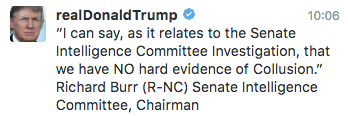
Share this entry