With Matt Gaetz, Donald Trump’s Myth Cannot Fail — It Can Only Be Failed

Folks, I know this is bad timing, but in about 20 minutes, I’m going to temporarily shut down comments here, as we’re going to do some planned maintenance. Hopefully it won’t take too long.

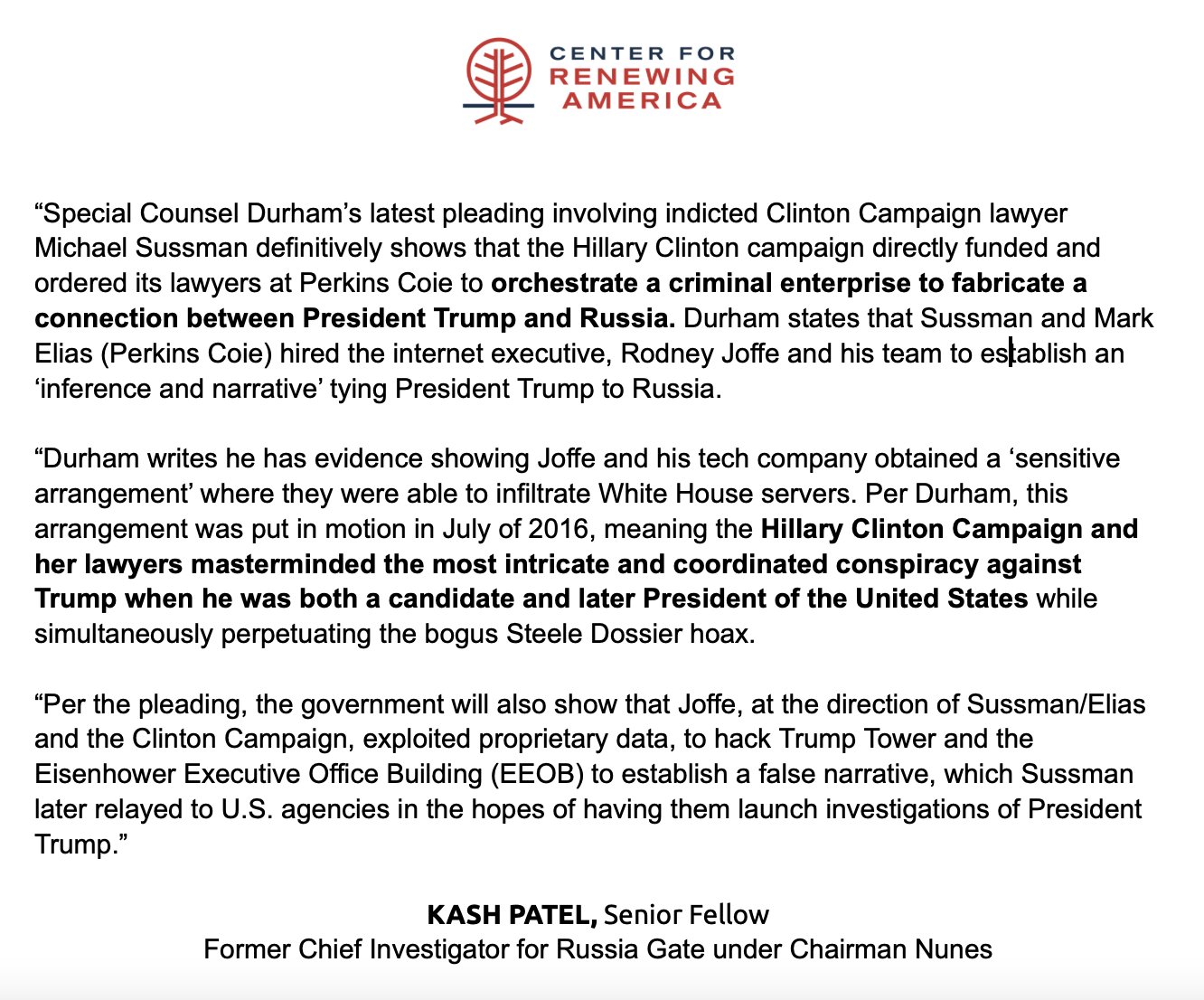
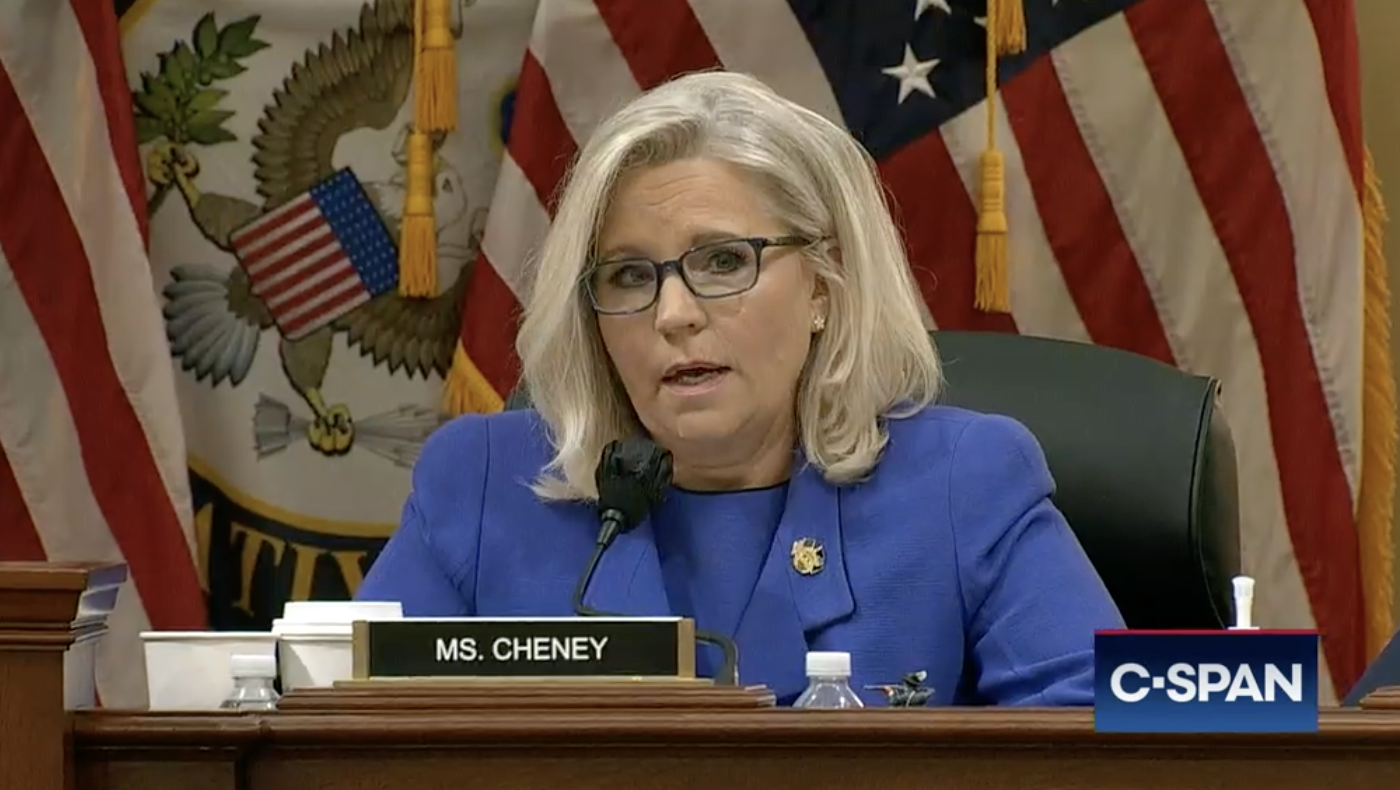
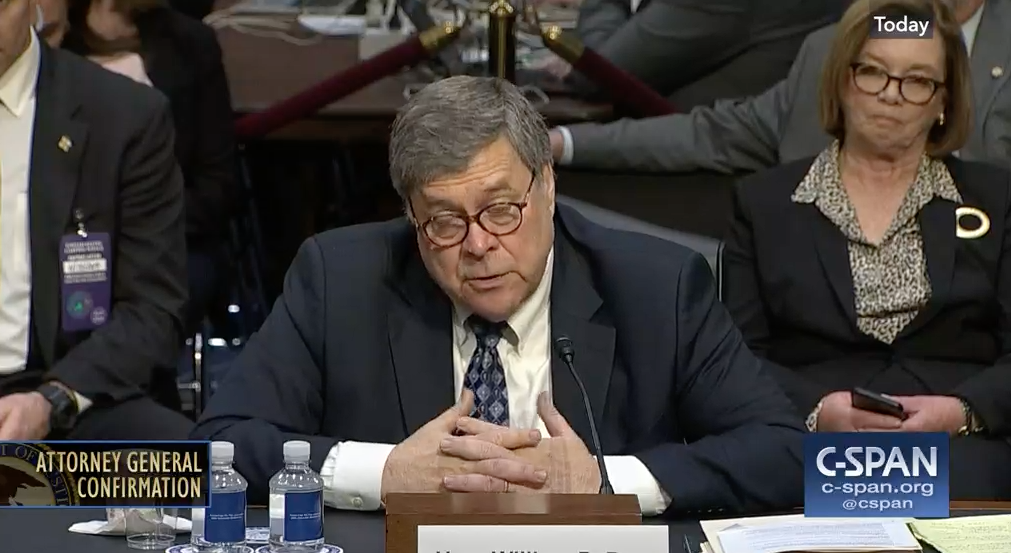
I keep thinking back to this June 2023 exchange between Matt Gaetz and John Durham.

It came at the end of Durham’s testimony after delivering his report, in which Durham said a lot of inflammatory things, but ultimately concluded that the allegations of Russian interference should have been investigated, but should have been opened at a lower level of investigation.

After four years, Durham blamed Hillary Clinton for things Russians (like those suspected of filling the Christopher Steele dossier with disinformation) had done. But he hadn’t done the one thing Republicans needed him to do: assert that the Russian investigation was a hoax.

At the end of it, Jim Jordan adopted a tactic he has come to use in his hearings. He took a break for votes, giving staffers a half hour to prepare a rebuttal. And then three Republican members took turns, including Matt Gaetz for his second turn, unrebutted by any Democratic member.

He came prepared.

Gaetz cued up video from Robert Mueller’s July 2019 testimony, showing Jim Jordan grilling Mueller about Joseph Mifsud. Jordan asserted that Bill Barr and John Durham were trying to find out what Mifsud was doing. After Durham responded that they did try to pursue that angle, Gaetz asserted that Durham’s investigation was “an op.”

You had years to find out the answer to what Mr. Jordan said was the seminal question, and you don’t have it. It just begs the question whether or not you were really trying to find that out. Because it’s one thing to criticize the FBI for their FISA violations, to write a report. They’ve been criticized in plenty of reports. Some have referred to your work as just a repackaging and regurgitation of what the Inspector General already told us. So if you weren’t going to do what Mr. Jordan said you were going to do in that video, and give us the basis for all of it, what’s this all been about?

Now, in point of fact, who Mifsud really was was never the seminal question. Or rather, he only ever became a question via conspiracy theories Jordan and Mark Meadows laundered through a sham Congressional appearance from George Papadopoulos. Under their direction, the Coffee Boy provided no primary documentation with which staffers could hold him to account. Instead, Papadopoulos laundered conspiracy theories first posted in right wing propaganda outlets.

Q Okay. So, and Mifsud, he presented himself as what? Who did he tell you he was?

A So looking back in my memory of this person, this is a mid-50’s person, describes himself as a former diplomat who is connected to the world, essentially. I remember he was even telling me that, you know, the Vietnamese prime minister is a good friend of mine. I mean, you have to understand this is the type of personality he was portraying himself as.

And, you know, I guess I took the bait because, you know, usually somebody who — at least in Washington, when somebody portrays themselves in a specific way and has credentials to back it, you believe them. But that’s how he portrayed himself. And then I can’t remember exactly the next thing that happened until he decided to introduce me to Putin’s fake niece in London, which we later found out is some sort of student. But I could get into those details of how that all started.

Q And what’s your — just to kind of jump way ahead, what’s your current understanding of who Mifsud is?

A My current understanding?

Q Yeah. A You know, I don’t want to espouse conspiracy theories because, you know, it’s horrifying to really think that they might be true, but just yesterday, there was a report in the Daily Caller from his own lawyer that he was working with the FBI when he approached me. And when he was working me, I guess — I don’t know if that’s a fact, and I’m not saying it’s a fact — I’m just relaying what the Daily Caller reported yesterday, with Chuck Ross, and it stated in a categorical fashion that Stephan Roh, who is Joseph Mifsud’s, I believe his President’s counsel, or PR person, said that Mifsud was never a Russian agent.

In fact, he’s a tremendous friend of western intelligence, which makes sense considering I met him at a western spying school in Rome. And all his interactions — this is just me trying to repeat the report, these are not my words — and when he met with me, he was working as some sort of asset of the FBI. I don’t know if that’s true or not. I’m just reporting what my current understanding is of this individual based on reports from journalists.

[snip]

Q And then at what point did you learn that, you know, he’s not who he said he was?

A Like I said, I don’t have the concrete proof of who this person is. I’m just going with reports. And all I can say is that I believe the day I was, my name was publicly released and Papadopoulos became this person that everyone now knows, Mifsud gave an interview to an Italian newspaper. And in this newspaper, he basically said, I’m not a Russian agent. I’m a Clinton supporter. I’m a Clinton Foundation donor, and that — something along those lines. I mean, don’t quote me exactly, you could look up the article yourself. It is in La Republica. And then all of a sudden, after that, he disappears off the face of the planet, which I always found as odd.

[snip]

I guess the overwhelming evidence, from what I’ve read, just in reports, nothing classified, of course, because I’m not privy to anything like that, and considering his own lawyer is saying it, Stephan Roh, that Mifsud is a western intelligence source. And, I guess, according to reports yesterday, he was working with the FBI. [my emphasis]

And that’s what led Barr and Durham to jump on a plane together and chase Papadopoulos’ conspiracy theories — without ever interviewing Papadopoulos directly. Mifsud’s own lawyer — the one who couldn’t help Durham figure out how to subpoena him — who started the conspiracy theory that Mifsud worked for Western, not Russian, spies.

Durham and Barr did more than just chase Papadopoulos’ conspiracy theories together. Durham fabricated a key part of the theory of his case. He ignored key events — most notably, Trump’s invitation for Russia to hack his opponent — that made all the actions of Hillary’s people make sense. He relied on a Twitter account as the foundation of his indictment against Igor Danchenko, then whined when such communications were deemed inadmissible without a witness to introduce them.

Yet ultimately, the rules of criminal procedure and some very very good defense attorneys (no doubt paid with life savings) managed to thwart Durham’s efforts to spin from his own fevered imaginations a conspiracy implicating Hillary Clinton.

For that, Matt Gaetz accused Durham of “inoculating” the FBI.

Your report seems to be less an indictment of the FBI and more of an inoculation — lower case I, of course. And like many inoculations, it may have worse consequences down the road. It’s just hard to pretend as though this was a sincere effort. When you don’t get to the fundamental thing that started the whole deal.

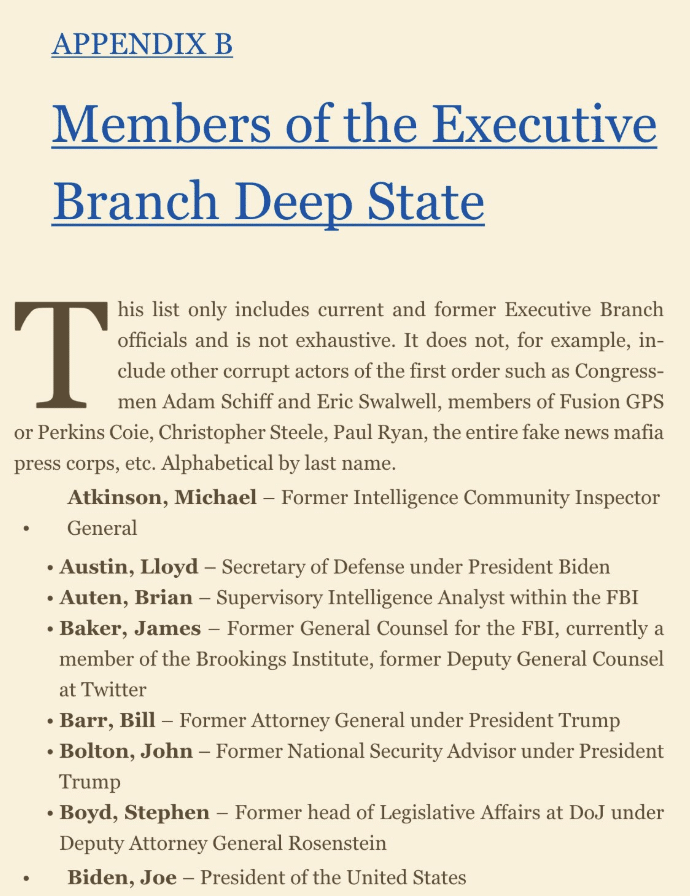
Because reality ultimately debunked Durham’s conspiracy theories, Gaetz deemed him to be part of the Deep State.

I get that Matt Gaetz’ nomination is one of the most likely to be rejected by the Senate. I get that there’s still a chance this guy — the guy who proclaims even a fellow conspiracist part of the Deep State if he permits himself to discover that reality doesn’t back his fever dreams — won’t be Attorney General.

But this is what it means that Trump wants to take a hammer to DOJ and FBI: not just that they’ll avoid any investigations implicating Trump or his allies, but they will find a way to meld reality to their own myth.

As it was, Bill Barr’s DOJ added post-it notes to evidence in ways that happened to feed Trump’s myth of grievance. They claimed travel records of the informant with something akin to a Let’s go Brandon cap matched his claims about Joe Biden accepting a bribe when, purportedly, the opposite is true.

Bill Barr’s DOJ already made shit up to feed Trump’s myth.

Since then, a Trump judge admitted a laptop full of evidence at a criminal trial with little more validation than an access to an iCloud account to which multiple outsiders had access, and an email sent to a publicly available email address.

But whoever Trump installs atop DOJ will take all this one step further. No longer will it be a select crony US Attorneys who forget to remove post-it notes with erroneous but convenient dates or claim travel records say the opposite of what they actually say. It will be the litmus test from the top: Donald Trump’s myths cannot fail, they can only be failed.

Update: Gaetz has withdrawn from consideration.

Share this entry

Russia Attempts to Collect Its Winnings

Russia has been engaged in a good deal of dick-wagging with Trump since the election.

After Trump won, Russia did not call to congratulate — at least as far as we know (though Viktor Orbán seems to be Trump’s handler and he did).

Putin did, on Thursday, butter up Trump, calling his response to being shot courageous and claiming interest in a deal.  Putin did what he always does with Trump: he played to his narcissism.

On Friday, though, one of the most popular TV shows in Russia used a different approach (as made available by Julia Davis’ Russian Media Monitor) — airing Melania’s nude photos in the guise of noting that she was years ago photographed with a US seal, as if someone knew she would be First Lady.


Monday morning, WaPo published an exclusive claiming that in his first call with Putin, Trump warned Putin not to escalate in Ukraine.

During the call, which Trump took from his resort in Florida, he advised the Russian president not to escalate the war in Ukraine and reminded him of Washington’s sizable military presence in Europe, said a person familiar with the call, who, like others interviewed for this story, spoke on the condition of anonymity to discuss a sensitive matter.

The two men discussed the goal of peace on the European continent and Trump expressed an interest in follow-up conversations to discuss “the resolution of Ukraine’s war soon,” one of the people said.

In the aftermath of the claimed call, Russia escalated strikes.

Russia has also deployed 50,000 troops, including some from North Korea, to attempt to expel Ukraine from Kursk.

Ukrainian President Volodymyr Zelensky said Monday Russia has deployed nearly 50,000 troops to Kursk, the southern Russian region where Kyiv launched its surprise counteroffensive in the summer.

Ukrainian troops “continue to hold back” the “nearly 50,000-strong enemy group” in Kursk, Zelensky said in a post on Telegram after receiving a briefing from General Oleksandr Syrskyi, the Commander-in-Chief of Ukraine’s Armed Forces.

Kyiv launched its incursion into Russia’s Kursk region in August, taking by surprise not just Moscow, but also its allies. It said at the time, that the operation was necessary, because Russia had been planning to launch a new attack on Ukraine from the region. It said it was aiming to create a “buffer zone” to prevent future cross-border attacks.

The Kursk offensive, the first ground invasion of Russia by a foreign power since World War II, caught Moscow completely unprepared.

Meanwhile, Russia denied WaPo’s report. There was no call, Putin’s spox said. Putin has no plan to call.

“It is completely untrue. It is pure fiction; it is simply false information,” the Kremlin spokesperson, Dmitry Peskov, said when asked about the call. “There was no conversation.

“This is the most obvious example of the quality of the information that is being published now, sometimes even in fairly reputable publications.”

Peskov added that Putin had no specific plans to speak to Trump.

Peskov is probably lying. But the US can’t debunk him because (according to WaPo) Trump is, once again, going it alone.

Trump’s initial calls with world leaders are not being conducted with the support of the State Department and U.S. government interpreters. The Trump transition team has yet to sign an agreement with the General Services Administration, a standard procedure for presidential transitions. Trump and his aides are distrustful of career government officials following the leaked transcripts of presidential calls during his first term. “They are just calling [Trump] directly,” one of the people familiar with the calls said.

Later in the day, Nicholay Patrushev implied that Trump had made commitments to get elected — commitments he was obliged to keep.

In his future policies, including those on the Russian track US President-elect Donald Trump will rely on the commitments to the forces that brought him to power, rather than on election pledges, Russian presidential aide Nikolay Patrushev told the daily Kommersant in an interview.

“The election campaign is over,” Patrushev noted. “To achieve success in the election, Donald Trump relied on certain forces to which he has corresponding obligations. As a responsible person, he will be obliged to fulfill them.”

He agreed that Trump, when he was still a candidate, “made many statements critical of the destructive foreign and domestic policies pursued by the current administration.”

“But very often election pledges in the United States can [d]iverge from subsequent actions,” he recalled.

Republican Donald Trump outperformed the candidate from the ruling Democratic Party, Vice President Kamala Harris, in the US elections held on November 5. Trump will take office on January 20, 2025. During the election campaign Trump mentioned his peace-oriented, pragmatic intentions, including in relations with Russia.

Trump is going to be a tool of Russia. In one of his first personnel moves, he humiliatingly killed Mike Pompeo’s bid to be Defense Secretary; Pompeo, like Nikki Haley, supports Ukraine. Reportedly Trump made that decision with the counsel of Don Jr — Trump’s soft-underbelly — and Tucker Carlson.

My guess is their primary concern is when he will do that.

He promised to deliver peace on Day One. Seven days later, he hasn’t delivered, nor said he would. The shape of the capitulation Trump is discussing — basically a freeze of the status quo and a withdrawal of funding for Ukraine — is far less ambitious than what Russia intends, which is to conquer all of Ukraine.

While Trump has appointed white nationalists — Tom Homan and Stephen Miller — to run his mass deportation program, his national security appointments, thus far, were once normal people before they capitulated to Trump: Elise Stefanik at UN Ambassador, Mike Waltz at National Security Adviser, Marco Rubio at Secretary of State, and Kristi Noem at Homeland Security (it’s unclear who thinks will manage the House as it awaits special elections to replace two newly elected members; the GOP will win the majority but with a thinner margin than they had).

But Patrushev is correct: Russia did, overtly, help Trump win, and there may have been far more useful covert assistance we don’t know. Early in the year, they set up yet another attack on Hunter Biden as a way to attack his father. They released a series of videos targeting Harris and manufacturing claims about migrants voting. Those videos likely involved John Mark Dougan, a former Palm Beach sheriff who fled to Russia in 2016. While it’s not yet clear whether bomb threats to Springfield, OH and on voting locations were from Russia, they were routed via a Russian email domain.

A far bigger question is whether the decision by a bunch of tech oligarchs, most notably Elon Musk, to support Trump came with the involvement of someone either formally working for or just actin as an epic useful idiot of Russia. Did Trump install JD Vance as part of a deal for support from Elon? And what should we take from all the Russophile nutjobs that Trump plans to install in his administration?

To a great degree, Trump will be opening up his Administration to Russia, and doing so via wildly ignorant or crazy people. Russia will get what it wants under a Trump Administration. It just might take awhile.

So why the dick-wagging?

Probably, Russia is engaging in this game for two reasons. First, while the infusion of North Korean soldiers has helped its cause and it is making advances in Ukraine, it is doing so at great cost. And Ukraine still manages some attacks deeper in Russia.

An average of around 1,500 Russian soldiers were killed or injured per day in October — Russia’s worst month for casualties since the beginning of the invasion, according to Britain’s Chief of the Defense Staff Tony Radakin.

“Russia is about to suffer 700,000 people killed or wounded — the enormous pain and suffering that the Russian nation is having to bear because of [President Vladimir] Putin’s ambition,” Radakin told the BBC on November 10.

Moscow does not reveal the number of its war casualties.

Radakin claimed Moscow was spending more than 40 percent of public expenditure on defense and security, putting “an enormous strain” on the country.

Meanwhile, the Russian Defense Ministry claimed on November 10 that its forces had captured the town of Voltchenka in Ukraine’s eastern Donetsk region, where Russian forces have been making advances in recent weeks.

Ukraine launched dozens of drones targeting Moscow, forcing the temporary closure of three of the capital’s airports, Russian officials said on November 10.

With Trump’s victory, Russia is in a strong position, but it faces immediate challenges. So it would prefer, I’m sure, immediate action.

More importantly, Russia has a history with Trump, where he deferred action until he was inaugurated, and then failed to deliver.

Robert Mueller never charged Trump with entering into a quid pro quo in 2016. It may have happened, but would have required the cooperation of people Trump later pardoned to prove it. But Russia had every reason to expect that Trump might end sanctions and recognize Crimea after he was elected with their help the first time. During that transition, Russia did reach out to Trump, first with a congratulatory Putin call, and then with discussions via Mike Flynn.

On December 29, 2016, Flynn reached out to Sergey Kislyak and asked Russia to do no more than match Barack Obama’s sanction, so as not to set off an escalation. At that point, Russia undoubtedly had every expectation they’d see sanctions removed. Instead, over the course of the Administration, more were imposed, with Biden adding an entire new sanctions regime in the wake of the Ukraine invasion.

That is, Trump has a history of making commitments to Russia he didn’t deliver, couldn’t deliver after installing grown-ups in his Administration.

So Russia appears to be doing what every other entity that helped Trump get elected is doing, as they try to collect on their support: exerting what levers of pressure they have to get their objectives.

It turns out they likely have more levers of pressure — some of which are more powerful now, before Trump’s win is certified — and larger demands than most of the people who helped Trump get elected.

Trump proved unreliable in 2016. Russia has good reason to want to demand better this time around.

Share this entry

Trump Sold Grievance and America Liked What He Was Selling

Once Trump got everyone hooked on his grievance drug, Merrick Garland was never going to make a difference.

I have tried, over and over, to explain how the investigation into Trump and his co-conspirators proceeded. More recently, I’ve explained how you couldn’t have charged Trump with insurrection — the only thing that would have disqualified him from running — until after May 2023, and had Jack Smith done so, it would have ended up exactly where we are here, with John Roberts delaying everything until after the election.

No effort to explain the process — the two years of exploiting phones, the months of January 6 Committee delay, the ten months of privilege fights, the month Elon Musk stole, or the eight months John Roberts bought Trump — none of that has mattered, of course. People needed an explanation for their own helplessness and Merrick Garland was the sparkle pony they hoped would save them.

But nothing Merrick Garland would have done would have mattered anyway.

That’s because since January 2017, since Trump learned that Mike Flynn had been caught undermining sanctions on the phone with Sergey Kislyak, Trump has used every effort to hold him accountable as a vehicle to sell grievance.

This is the core premise of the Ball of Thread podcast I’ve been doing with LOLGOP.

Rather than being grateful when learning that FBI was investigating four of his close campaign advisors had monetized their access to him — rather than imagining himself as the victim of the men who snuck off and met with Russian spies — Trump made himself the victim of the FBI. He invented a claim he was wiretapped, and then kept inventing more and more such false claims. And then he (possibly on the advice of Paul Manafort, whose associate Oleg Deripaska funded HUMINT before the Democrats did) used the dossier as stand-in for the real Russian investigation. It wasn’t the Coffee Boy yapping him mouth that led to the investigation into those trying to monetize access, this false story tells, it was the dossier Russia filled with disinformation, a guaranteed way to discredit the investigation. Once you convince people of the lie that the FBI really did investigate a candidate based off such a flimsy dossier, it becomes easy to target all those involved, along the way gutting the Russian expertise at FBI.

Then Bill Barr came in and used the authority of the Attorney General to lie about what the investigation found; almost no media outlets have revisited the findings once it became clear that Barr didn’t even bother learning what the report said. While trying to kill Zombie Mueller — the parts of the investigation that remained after Mueller finished — Barr’s DOJ literally altered documents in an attempt to put Joe Biden at the genesis of the investigation into Donald Trump, yet another attempt to replace the actual investigation, the Coffee Boy and campaign manager and National Security Advisor and personal lawyer and rat-fucker who were found to have lied to cover up the 2016 Russian operation, with a storytale in which Democrats are the villains.

John Durham never bothered to learn what the report actually said either. Had he done so, it would have been far harder to criminalize Hillary Clinton for being a victim of a hack-and-leak operation, along the way taking out still more expertise on Russia.

And while Barr was criminalizing people, he followed Rudy’s chase for dick pics in an effort to criminalize Hunter Biden and his father.

Do you see the genius of this con, Donald Trump’s most successful reality TV show ever?

Vast swaths of America, including at least half the Supreme Court, and millions of working class voters, really believe that he — the guy who asked Russia to hack his opponent some more — was the victim.

And that’s how a billionaire grifter earns the trust of the working guy.

For the most part, the press just played along, repeating Trump’s claims of victimhood as if they were true.

It’s also the problem in thinking that if only Trump faces legal consequences, he’ll go away, he’ll be neutralized.

We saw this every time he faced justice. The first impeachment. The second one. The New York trials. Each time, his grievance became a loyalty oath. Each time, he sucked more and more Republicans into the con. Each time he made them complicit.

The hatred of and for Trump by Rule of Law is what made him strong, because he used it to — ridiculously!! — place himself into the role of the little guy, the target of those mean elites.

We’ll have decades, maybe, to understand why Trump resoundingly won yesterday. Some of it is inflation (and the unrebutted claims it is bigger than it is), which makes working people angry at the elites, people they might imagine are the same people persecuting Trump.

For many, though, it’s the appeal of vengeance.

Trump has spent nine years spinning a tale that he has reason to wreak vengeance on Rule of Law. The greatest con he ever pulled.

So even if DOJ had charged Trump, two months before Merrick Garland was confirmed (though all three of the charges people imagine would be easy — incitement, the call to Brad Raffensperger, and the fake electors plot — have been unsuccessful in other legal venues), even if DOJ had convicted Trump along with the earliest crime scene defendant in March 2022, even if Trump hadn’t used the very same means of delay he used successfully, which would have still stalled the case past yesterday’s election, it still wouldn’t have disqualified him from running.

It still would be the centerpiece of his manufactured tale of grievance.

It still would be one of the elements he uses to make working people think he’s just like them.

You will only defeat Trumpism by destroying that facade of victimhood. And you will not achieve meaningful legal victories until you do that first.

I know we all need an easy way to explain this — an easy culprit for why this happened.

But it’s not Merrick Garland, because years before he came on the scene, Trump had already convinced everyone that any attempt to hold him accountable was just another attempt by corrupt powers to take him down.

Trump sold the country on grievance and victimhood. And in the process he made half the country hate Rule of Law.

Update: This is a good summary of how Trump lures in people attracted to grievance.

The Republican Party has been the party of the Low-Trust voter for a very long time. It’s the party that wants to get rid of institutions, of any of the bonds that connect us all together. The Democratic Party is the party of institutions, the party of Good Governance. It’s the party of trusting other Americans to make good choices for you. There is very little that the Democrats can do to appeal to the Low-Trust voter, and you saw what that means for the future of our politics last night. I would go so far as to say that we’re seeing the effects of a realignment of what partisanship is. The GOP is the party of the perpetual outsider and the Low-Trust voter, the people calling for things to be torn down. The Democrats are the insiders, the institutionalists. That’s why you saw realignment of people like Liz Cheney and Vermont Governor Phil Scott, people who still think the government matters even if they disagree on how it should be doing things.

I don’t know what you can do to win back the Low-Trust voters.

[snip]

I don’t know how you build back trust in the government. Things like FEMA in disasters are supposed to be able to do that, but the post-hurricane situation in North Carolina, where outside agitators went in to try to destroy that trust, and people on the Internet went out of their way to spread lies about how the Federal government had abandoned Asheville, are just examples of how everything can be used to pop out more Low-Trust voters.

Share this entry

Ball of Thread: Zombie Mueller

In this episode of Ball of Thread, we showed how Bill Barr’s efforts to kill the parts of the Mueller investigation that continued after he misrepresented the report itself led directly to January 6. In his effort to lower the sentencing recommendation for Roger Stone, for example, Barr treated threats from Stone and the Proud Boys against a Federal judge a “technicality.” And after Barr’s efforts to reverse the prosecution of Mike Flynn failed, Trump pardoned his former National Security Adviser just as Flynn and Sidney Powell were creating the Big Lie.

Share this entry

Ball of Thread: Barr’s Butchery

In this week’s installment of Ball of Thread, LOLGOP and I talk about how Barr deliberately set out to kill the Mueller investigation. Here’s the Patreon for the series.

You can also subscribe on:
Apple Podcasts

Spotify 
YouTube
 
Audible

RSS
Podcast Addict

Share this entry

Putin Has Convinced Trump He’s Keeping Trump’s Weakness Secret

“He gets played by them, because he thinks that they’re his friends and they are manipulating him full time … with flattery.” Kamala Harris

Here’s how WSJ described the Bob Woodward scoop that Donald Trump sent COVID testing equipment to Vladimir Putin rather than to Americans in need.

Woodward reports that one former intelligence analyst specializing in Russian affairs believed that Trump idolized Putin, making him open to manipulation. During the outbreak of Covid-19 in Russia, Trump secretly sent Putin some Abbott Point of Care Covid test machines for Putin’s personal use.

Putin then asked Trump never to mention it to anyone else, Woodward reports. “I don’t care,” Trump replied. “Fine.”

“No, no,” Putin said. “I don’t want you to tell anybody because people will get mad at you, not me. They don’t care about me.”

In this telling, there’s an intelligence analyst involved, someone who could be Woodward’s source.

It’s not just that Trump secretly sent Putin medical equipment that Americans needed. It’s that, presumably knowing full well the Intelligence Community would learn of that gift, Putin told Trump to keep it secret. “I don’t care,” Trump claimed. But he kept his KGB handler’s secret anyway.

He’s still trying to keep it secret.

You don’t need an intelligence analyst to tell the story of how easy it is for Vladimir Putin to manipulate Donald Trump. After all, HR McMaster documented Trump’s subjugation to Putin at length.

I was the principal voice telling him that Putin was using him and other politicians in both parties in an effort to shake Americans’ confidence in our democratic principles, institutions and processes. Putin was not and would never be Trump’s friend. I felt it was my duty to point this out.

[snip]

Trump wanted to call Putin to congratulate him on being elected to a fourth term as president of Russia. I explained that Putin’s victory had been rigged, thanks to the Kremlin’s control over the media, its quelling of the opposition, the disqualification of popular opposition candidates such as Alexei Navalny, and restrictions on election monitors.

A call was arranged anyway. The day before it, I told Trump I knew he was going to congratulate Putin, but that he should know that “the Kremlin will use the call in three ways: to say that America endorsed his rigged election victory, to deflect growing pressure over the Salisbury nerve agent attack and to perpetuate the narrative that you are somehow compromised.” I then asked Trump the following: “As Russia tries to delegitimize our legitimate elections, why would you help him legitimize his illegitimate election?”

But at this stage in our relationship, my advice on Putin and Russia had become pro forma. I knew that Trump would congratulate Putin and go soft on Salisbury. Trump took the early morning call from the residence. Because I had briefed him the day before, I listened in from my office. As expected, he congratulated Putin up front. After the call, Trump asked me, as he had before, to invite Putin to the White House.

On Face the Nation, McMaster described that he included all this in his book to try to demonstrate to Trump (or at least his hypothetical handlers in a second term) how successfully Putin was manipulating him.

MARGARET BRENNAN: When you got home, you said to your wife, “After [over] a year in this job, I cannot understand Putin’s hold on Trump.” How do you explain that now?

LT. GENERAL H.R. MCMASTER: Well, I explained it in the book. I try to place the president’s belief that he could have a good deal with Vladimir Putin in context of the two previous presidents who thought that they could have a good deal with- with Putin. But also, you know, President Trump, and people know this, he- he likes big splashy deals. He liked- he was pursuing that with Putin. He was pursuing that with Xi Jinping. And of course, Putin is the best liar in the world. And so I struggled, Margaret, should I write about how Putin tried to manipulate President Trump, or not? And I thought, well, Putin knows how he was trying to do it. So maybe in writing about how Putin was trying to press Donald Trump’s buttons, that will make a future President Trump, if he’s elected, less susceptible to those kind of tactics.

There’s been a lot of discussion about whether the intelligence community knows what a simp for Putin Trump is, knows about his ongoing calls with Putin.

The mention of the analyst at least suggests that the IC learned about the COVID testing equipment in real time, which is not surprising given that the equipment would have to be shipped somehow. Importantly, Trump’s KGB handler Vladimir Putin surely knew that it would be discovered. I’m sure the COVID testing kits were nice for Putin to have. The fact that Putin got Trump to prioritize Putin’s health over Americans, the fact that by keeping this secret, Putin ratcheted up the hold he had on Trump were probably far bigger gifts.

And that’s why I think Putin’s instructions to keep this secret are as important as the fact that Trump made efforts to care for Putin’s health as he neglected hundreds of thousands of Americans. It’s the control over all this information that Trump keeps ceding to Putin. As Asha Rangappa noted, Trump just keeps handing Putin ways to control him, willingly.

And now Putin is picking and choosing which of the secrets he has with Donald Trump he’ll make public. Oh sure, he sent me medical equipment at a time when Americans were struggling, Putin is effectively saying. But phone calls?!?! The seven phone calls that are bloody obvious from his claims about speaking to me about my dreams? Nyet! No phone calls, they didn’t happen!!

These tailored denials, hilariously, come from Dmitry Peskov, the guy whose call Trump and Michael Cohen criminally conspired to hide, the likely source for the false claim that appeared in the Steele dossier that the call to the Kremlin Cohen and Trump were hiding was not about real estate in January 2016, but was instead about cheating in an election in October 2016.

That is, I’ve long argued, one of the ways Putin has been wildly successful: not just getting Trump to simper to him like a teenager with a crush, but also to use Trump’s paranoia to heighten conflict in the United States over Trump’s ties to Russia.

Indeed, while Trump would have been preferable for Russia based on policy stances alone, Russia would prefer a weak Trump they could manipulate over a strong Trump any day. By the time of the 2016 operation, Vladimir Putin had already exhibited a willingness to take huge risks to pursue Russian resurgence. Given that audacity, Trump was more useful to Putin not as an equal partner with whom he could negotiate, but as a venal incompetent who could be pushed to dismantle the American security apparatus by playing on his sense of victimhood. Putin likely believed Russia benefitted whether a President Trump voluntarily agreed to Russia’s policy goals or whether Putin took them by immobilizing the US with chaos, and the dossier protected parts of the ongoing Russian operation while making Trump easier to manipulate.

Just as one example, Vladimir Putin knew the FBI was getting recordings of Sergey Kislyak’s calls with Mike Flynn — there’s even a moment when Kislyak’s assistant performs for the wiretap back on December 29, 2016. Putin knew that when he didn’t respond to Obama’s sanctions, the spooks would find those calls, leading to all manner of disruption for the US.

And that created a cascade of ongoing benefits for Putin, as Trump keeps denying Russia Russia Russia that he needed Russia’s help to win, and so keeps doubling and tripling down on his denials, even as he makes his capitulation to Putin readily apparent.

Russia’s 2016 intelligence operation and its aftermath may be the most successful intelligence operation in recent history, because Vladimir Putin has gotten Trump to believe that his KGB handler is hiding the proof he’s got of how weak Trump is, and Trump is desperate, to the core of his being, to pretend that his weakness is not obvious to all.

Update: Going to reup what I wrote just weeks after Helsinki.

Trump and the Russians were engaged in a call-and-response, a call-and-response that appears in the Papadopoulos plea and (as Lawfare notes) the GRU indictment, one that ultimately did deal dirt and got at least efforts to undermine US sanctions (to say nothing of the Syria effort that Trump was implementing less than 14 hours after polls closed, an effort that has been a key part of both Jared Kushner and Mike Flynn’s claims about the Russian interactions).

At each stage of this romance with Russia, Russia got a Trump flunkie (first, Papadopoulos) or Trump himself to publicly engage in the call-and-response. All of that led up to the point where, on July 16, 2018, after Rod Rosenstein loaded Trump up with a carefully crafted indictment showing Putin that Mueller knew certain things that Trump wouldn’t fully understand, Trump came out of a meeting with Putin looking like he had been thoroughly owned and stood before the entire world and spoke from Putin’s script in defiance of what the US intelligence community has said.

People are looking in the entirely wrong place for the kompromat that Putin has on Trump, and missing all the evidence of it right in front of their faces.

Vladimir Putin obtained receipts at each stage of this romance of Trump’s willing engagement in a conspiracy with Russians for help getting elected. Putin knows what each of those receipts mean.

Share this entry

Bill Barr Didn’t Hear When Trump Asked, “Russia Are You Listening?”

One of the most surprising details in the book by former Mueller prosecutors, including Aaron Zebley, is that they added a contentious half paragraph the morning they finished the report.

For volume I, we discussed one last time whether the report was sufficiently clear about “coordination” with Russia. One of the sticking points: on July 27, 2016, Trump had made his “Russia, if you’re listening” speech urging Russia to find Clinton’s “missing” emails. Five hours later, the Russian GRU launched attacks into the Clinton team’s personal email accounts. This appeared to be Russia’s response to Trump’s speech.

Bob had tied our work to established criminal standards. We did not view this “call and response”—Trump’s publicly asking for an action and then Russia taking one—as sufficient for a criminal agreement or conspiracy. But without more explanation, we were concerned a reader might not understand why these July 27 events did not constitute “coordination.” That morning, we added a paragraph to the introduction to volume I to make our reasoning clearer (emphasis added):

“Coordination” does not have a settled definition in federal criminal law. We understood coordination to require an agreement—tacit or express—between the Trump Campaign and the Russian government on election interference. That requires more than the two parties taking actions that were informed by or responsive to the other’s actions or interest. We applied the term coordination in that sense when stating that the investigation did not establish that Trump campaign coordinated with the Russian government in its election-interference activities.

There’s more to this paragraph: it starts by explaining why prosecutors didn’t assess Trump’s actions in terms of “collusion,” another term that’s not a crime. Unlike “collusion,” though, “coordination” was included in Rod Rosenstein’s appointment order. As a prosecution and declination report, Mueller had to (and did) assess conduct in terms of law, not buzzwords or Rosenstein’s ill-considered measures.

Rather than providing clarity, this paragraph made things worse, because those who had spent years talking about “collusion,” incorrectly claimed the report had addressed it. No collusion!!! All the headlines blared. No collusion!!! Bill Barr keeps claiming.

In fact, as the book describes it, prosecutors added the coordination language, at least, not to expand the scope of the report (to include terms people used to describe it), but to address how they approached what the book calls “call-and-response:” when Russia and Trump’s campaign worked in concert without formally agreeing to do so.

Of late, I’ve come to understand this “call-and-response” structure as Russia’s effort to lock Trump in, ensuring a benefit to itself, in his compromise and America’s polarization, whether or not he took the actions Russia would prefer.

There’s a sad irony here. Prosecutors thought that the “are you listening” comment was so outrageous, they needed to explain why it was nevertheless not a crime, because of course must appear outrageous to everyone else.

But in reality, it didn’t appear to their bosses at all. Both Rod Rosenstein and Bill Barr, for example, repeatedly excised a key part of Mueller’s findings: that Russia was seeking to help Trump and Trump was happy to accept the help from a hostile foreign country.

Rod Rosenstein did so when announcing the Internet Research Agency troll indictment; Rosenstein even ad-libbed a claim that the indictment did not allege the information operation changed the outcome of the election.

One thing we noticed about Rosenstein’s remarks was that he never stated that the defendants’ actions were designed to help Trump and disparage Clinton, even though that was one of the core allegations of the indictment. And at the end of his remarks, he added something that wasn’t in the indictment: “There is no allegation,” he said, “that the charged conduct altered the outcome of the 2016 election.”

Bill Barr didn’t say Russia was trying to help Trump when he informed Congress of his spin of the results.

It omitted or misstated our analysis. In its discussion of volume I, the letter accurately stated our core charging decisions, but left out any reference to the intent of the Russian social media campaign to aid Trump in his bid for the White House, nor did it describe that same objective driving the hack-and-dump operation run by Russian military intelligence. There was no mention of the contacts between members of the Trump campaign and Russian officials and proxies. The letter also left out a core conclusion of volume I: that the “Russian government perceived it would benefit from a Trump presidency and worked to secure the outcome, and that the [Trump] Campaign expected it would benefit electorally from information stolen and released through [Russian military] efforts.

And Barr did it again — refused to say Russia was trying to help Trump — when he gave a press conference with the release of the Report.

[A]s he had in his March 24 letter, he omitted any mention of Russian support for Trump’s election bid. He then described the Russian military intelligence operation to steal and dump Clinton campaign emails, but again omitted the Russian government’s purpose of harming Clinton’s election bid in order to aid Trump. Barr also did not mention our finding that the Trump campaign expected it would benefit electorally from information stolen and released through Russian military intelligence efforts.

He then described the Russian military intelligence operation to steal and dump Clinton campaign emails, but again omitted the Russian government’s purpose of harming Clinton’s election bid in order to aid Trump. Barr also did not mention our finding that the Trump campaign expected it would benefit electorally from information stolen and released through Russian military intelligence efforts.

To be sure, the prosecutors’ larger gripe was always how Barr dealt with volume II. Mueller’s team had decided they would not to make a prosecutorial decision, but Barr spun it as a choice that they could not make such a decision. (My instincts that they deliberately left this for Congress are confirmed by the book.)

But the book tracks how the people overseeing the investigation refused to admit something central to it: Russia wanted to help Trump, and Trump invited that help.

“If it’s what you say I love it especially later in the summer.”

It’s an important observation given what came next. The entire Durham investigation was premised on ignoring Trump’s request for help. Two years later, for example, Barr insisted that the Russian investigation started from the Steele dossier (and astonishingly, Barr dismissed the possibility that Russia would want something in exchange for electing Trump).

Bill Barr and John Durham deliberately kept themselves ignorant of all that. Three years later, Barr continued to insist the investigation arose from the Steele dossier (and, insanely, said that since Russia didn’t need help doing a hack-and-leak, there was no reason to investigate Trump). Durham repeatedly tried to prevent those he charged from describing how Trump’s public comments (and their likely knowledge that another hacking attempted followed the comments) drove their concerns about Trump’s ties to Russia, even though as Marc Elias described, that was the reason they all started to focus on Russia.

Even at the end of his four year investigation, Durham claimed to have no idea that in response to Trump’s comments, Russia attempted to hack a new target.

Of course, Barr and Durham had to ignore Trump’s solicitation of a hack. If they hadn’t, they would never have had an excuse to launch the Durham probe, to pretend that investigating why Trump’s campaign got advance warning of the operation and then goaded it on made total sense. Barr and Durham had to pretend that none of this posed a risk to the country.

For a report for Bill Barr, Mueller added language trying to explain why they didn’t treat Trump’s successful solicitation of an attempted hack against his opponent as a crime.

But Barr, both before, in real time, and for years after, never even considered that a problem. Or couldn’t, because if he did, he couldn’t criminalize Hillary Clinton’s victimization at the hand of Russia.

Share this entry

Iranian Hackers Compromised Roger Stone’s Email Eight Years After Russian Hackers Exfiltrated DNC Emails

DOJ unsealed the indictment against three Iranian hackers it accuses of targeting Donald Trump’s campaign (as well as a bunch of other victims, including one of his top State Department officials).

Perhaps the most remarkable detail is this.

On May 25, 2016, Russian hackers started exfiltrating the emails from the DNC that Trump and his rat-fucker would exploit to beat Hillary Clinton.

On May 23, 2024 — two days short of eight years, to the day — Iranian hackers first compromised one of two Roger Stone email accounts they hacked.

As noted, Trump waited to call the FBI, in part because Susie Wiles was worried the FBI would make them hand over their email server (as Hillary had done during the campaign where Trump beat her). As a result, Iranian hackers remained in the account of Victim 11 — from whom they stole the JD Vance vetting materials, among other things — for two months.

According to the indictment, Iranian hackers were in Roger Stone’s account (what must be his Hotmail account) for almost a month, from May 24 to June 20.


On June 15, the hackers used Roger’s account to try to hack another Trump account (probably Susie Wiles), though that failed, which may have led Microsoft to cop on, leading to the expulsion of hackers from the Hotmail account.

After they were kicked out of that account they got into his Gmail account, apparently for a day.

Now, I might allow myself to feel a touch of schadenfreude that Roger Stone has been victimized in the same kind of influence operation he exploited against Hillary.

Except for this: As I keep saying, one of the reasons this is worse — more dangerous — than what happened to Hillary is that these people are also trying to exact revenge for the killing of Qasem Soleimani. The indictment says that almost verbatim: One of the goals of this operation was to “steal information relating to current and former U.S. officials that could be used to advance the IRGC’s malign activities, including ongoing efforts to avenge the death of Qasem Soleimani.” The indictment describes that the hackers successfully targeted someone who played a key role in the Abraham Accords in Trump’s State Department, then started making travel reservations for the person using their stolen passport.

They’re not just using this information to affect the election. They’re using it to track people.

It turns out it was never fun and games.

Share this entry

Bill Barr, “So Far as We Knew”

As I described, the book written by Aaron Zebley and two of Robert Mueller’s other former prosecutors breaks most new ground in its description of discussions between Mueller’s team, Trump’s lawyers, and those supervising the investigation at DOJ.

As it describes, for months, the investigation was working towards a January 27, 2018 interview of Trump, to be held at Camp David. But shortly after Mike Flynn pled guilty, Trump attorney John Dowd (whose call to Rob Kelner floating a pardon made it into the report but not the book), started getting cold feet. On January 30, Dowd told Jim Quarles, “I can’t let this guy testify. I will resign before he does.” On March 1, Dowd and Jay Sekulow first pitched the idea of written questions. Four days later, Mueller first raised the possibility of a subpoena; Dowd said that would be war. Trump would plead the Fifth before he’d respond to a subpoena.

Three weeks later, Dowd resigned.

On April 18, Sekulow told Quarles that Trump was close to bringing on new lawyers. Of Jane and Marty Raskin, Sekulow spoke of their high stature.

“We are talking to people with high stature to take over the representation,” Sekulow said. “Just finalizing everything now.”

“Good,” Jim said.

“You know them, actually. I think you’ve worked with them in the past. They are like-minded people who share our desire to get to the goal line.”

Of Rudy Giuliani (who was officially disbarred in DC yesterday), Sekulow said he hoped he wouldn’t join the team.

Sekulow continued, “There’s a third person too, but I’m hopeful he won’t join.” He did not divulge this person’s identity.

[snip]

Sekulow then said, “And the third person is, well, America’s Mayor.”

Jim thought for a brief moment. “Rudy?”

“That’s correct,” Sekulow said. “Rudy Giuliani is coming on too.”

Rudy almost immediately ran afoul of the Mueller team.

At a meeting on April 24, there was a discussion about whether Trump even could be charged. Bob told Rudy that “we plan to follow the [OLC] regulations” prohibiting the indictment of a sitting President, though in a way that left wiggle room in case (as the book describes) the team found “evidence proving Trump truly was a Manchurian candidate.” Rudy asked whether Trump was a witness, a subject, or a target; Mueller answered he was a subject.

Giuliani asked, “Is he a subject regardless of the OLC opinion?” In other words, were we not labeling Trump a “target” simply because he couldn’t be indicted? Or was he a subject because there was not enough evidence to make him a target?

Bob said that we had deliberately withheld making a judgment about the president’s conduct, but we would get back to them if we could say more.

In spite of repeated assurances the meeting was confidential, Rudy promptly ran to the press and (per the book, at least) misrepresented what Mueller said. As the book describes, Rudy told journalists that if Trump couldn’t be indicted, he couldn’t be subpoenaed.

That’s all background to the discussion of whether Trump could be charged with obstruction. As the book describes, Trump’s request that Don McGahn make a false statement disclaiming Trump’s effort to replace Mueller involved the creation of a false record in an attempt to obstruct the investigation; it clearly involved creating a false evidentiary record, and so would qualify no matter how you interpret 18 USC 1512(c)(2). But the other obstruction incidents did not (this issue has now been decided by Fischer to require evidentiary impairment, meaning the only obstruction incident that could be charged against Trump, ignoring the immunity opinion, is the McGahn one). So there was an extended dispute, starting in May 2018, which a long chapter discusses at length.

But then, unbeknownst to Mueller, Bill Barr weighed in, writing Rod Rosenstein and OLC head Steven Engel that Mueller’s views on obstruction were wrong.

As the book describes, Barr’s allegedly unsolicited memo was “remarkably timely,” because, from that point forward, Rosenstein’s team seemed to adopt precisely the analysis Barr offered.

We didn’t know it at the time, but just as we were starting our subpoena discussion with the DOJ, another person weighed in with the department on these very issues.

On June 8, 2018, the once-and-future attorney general, William Barr, submitted a nineteen-page memo to Rosenstein and Assistant Attorney General Steven Engel, who was then head of the DOJ’s Office of Legal Counsel. In his memo, Barr argued that section 1512 did not apply to President Trump in the manner Barr imagined we might be seeking to apply it. We say “imagined” because Barr had no actual insight into our work, so far as we knew.

Given that Barr was a private citizen at that time, his memo was remarkably timely. It posited (fairly accurately) that we were then “demanding that the President submit to interrogation about [obstruction] incidents, using the threat of subpoenas to coerce his submission.” Barr’s bottom line was that a prosecutor, even a special counsel, should not be allowed to require an examination of the president regarding these incidents, end of story. According to Barr, section 1512 prohibited only corrupt acts that impaired the integrity or availability of evidence, for instance, an act that destroyed a document or induced a witness to change his testimony. Barr’s memo stated that a president’s conduct can “obviously” be considered obstruction of justice in the “classic sense of sabotaging a proceeding’s truth-finding function. Thus, for example, if a President knowingly… induces a witness to change testimony… then he, like anyone else, commits the act of obstruction.”

But Barr maintained that the obstruction statute did not apply to what he termed the president’s “facially-lawful” actions—such as firing an FBI director or ending a federal criminal prosecution—even if such an action were done with corrupt intent and impacted a grand jury proceeding. In other words, even if Trump fired Comey for a corrupt purpose, that could not be a crime, in Barr’s view.

We wouldn’t become aware of Barr’s memo until December 2018, the day before his Senate confirmation hearing for attorney general. Nevertheless, his memo seemed to capture the fundamental issues Rosenstein and the department would raise throughout that summer when it came to subpoenaing the president. Barr may have previewed the department’s position when he wrote: “It is inconceivable to me that the Department could accept Mueller’s interpretation of 1512(c)(2). It is untenable as a matter of law and cannot provide a legitimate basis for interrogating the President.” [my emphasis]

A couple of points about this.

First, the Zebley book doesn’t address any documents that have subsequently been released. Most notably, while the book discusses the events immediately following the conclusion of the report at length, it doesn’t address Bill Barr’s memo declining prosecution on obstruction (the chapter on Barr’s letter to Congress is called “The Barr Report”), even though Barr egregiously avoided comment on the pardons that Trump was using to silence Mike Flynn, Paul Manafort, and Roger Stone.

Similarly, it doesn’t address the communications with OLC that were liberated via FOIA. Those show that starting on July 12 — the day before the GRU indictment incorporating reference to Roger Stone — Ed O’Callaghan shared everything that went between Mueller and Trump’s lawyers with Engel who, like Rosenstein, got the Barr obstruction memo, and along with O’Callaghan would “advise” Barr to release his letter to Congress. Starting on July 26, National Security Division head John Demers got added. Those things, taken together, strongly suggest that OLC was involved from the start to find a way to find that Trump couldn’t be charged (remember that Engel did similar cover-up work during impeachment).

All that is not that suspicious if, indeed, “Barr had no actual insight into our work.”

“So far as we knew.”

But it would be if Barr did have actual insight into what Mueller was doing.

LOLGOP and I are hard at work on our Ball of Thread episode on precisely how Bill Barr killed the Mueller investigation. And in that context, I’ve returned to something I’ve puzzled over for years: Barr’s description, in his book, of his decision to return to government with the intent of killing the Mueller investigation and starting an investigation without a crime, the Durham investigation.

I would soon make the difficult decision to go back into government in large part because I saw the way the President’s adversaries had enmeshed the Department of Justice in this phony scandal and were using it to hobble his administration. Once in office, it occupied much of my time for the first six months of my tenure. It was at the heart of my most controversial decisions. Even after dealing with the Mueller report, I still had to launch US Attorney John Durham’s investigation into the genesis of this bogus scandal. At the end of my first year in office, the President was impeached over a harebrained effort, involving Rudy Giuliani, to push back on the Russia collusion canard by digging up an alleged counter-scandal in Ukraine implicating the Clinton campaign or Vice President Biden and his son Hunter.

The fallout from Russiagate continued during my last year in office. My relationship with the President frayed as he became frustrated by my failure to bring charges against those who had ginned up Russiagate and the failure of Durham’s investigation to produce more rapid results.

I’ve always believed — even already taped for the podcast my belief — that you need no more than Barr’s reactionary views (which happen to match those of several SCOTUS justices), his past work obstructing Iran-Contra, and years of submersion in Fox News propaganda to explain his actions. Just like you need no more than Trump’s narcissism to explain his actions, you need no more than those three characteristics of Barr to explain his willingness to chase Russian disinformation in his effort to kill concerns about Trump’s ties to  Russia.

You need no more to explain their actions, but I can never shake the possibility there’s more.

All the more so given Lev Parnas’ claim, in interviews after the release of From Russia with Lev, that Victoria Toensing got Barr hired.

Now, Parnas’ reference — and his visibility on interactions between Toensing, Rudy, and Barr — post-dates Barr’s June 2018 memo. He’s talking about Toensing’s assurances to Trump, after he fired Jeff Sessions, that Barr would make the Mueller investigation go away (though if Toensing made that assurance, the Ukraine stuff looks far different, as does Barr’s treatment of it as a mere “counter-scandal”).

But Toensing was involved in the effort to make the Mueller investigation go away far earlier.

She represented Sam Clovis (who was interviewed, without an attorney, in two parts on October 3, 2017, and interviewed, including before a grand jury, with Toensing, on October 26, 2017). George Papadopoulos probably told Clovis that Russia had Hillary’s emails and Clovis was involved in Papadopoulos’ apparent discussions about setting up a September 2016 meeting with Russia, but Clovis testified that he had no memory of either of those things. And she represented Erik Prince (who was interviewed on April 4 and May 3, 2018) — who, like Steve Bannon, deleted their texts to each other from during the period when Prince was meeting with Kirill Dmitriev in the Seychelles, but has no memory of doing so.

Indeed, Toensing’s spouse, Joe DiGenova, even briefly said he was representing Trump, during that transition where Rudy got added. During his Ukraine caper a year later, Rudy repeatedly proposed that he do the work while Toensing billed for it. So if you got Rudy, you got Toensing.

And if Toensing later was involved in getting Barr hired, it would be unsurprising if she was a contact with him before that.

Incidentally, Barr never once mentions Toensing in his book. He mentions Rudy, who is a central focus of his book, around 44 times. He exercised his right to remain silent about Toensing.

In a follow-up, I’m going to talk (again) about the blind spot that connects the Mueller investigation and the Durham investigation — the blind spot at the core of Bill Barr’s effort to cover up Trump’s ties to Russia.

For now, though, consider the possibility that Barr had a great deal more insight into the Mueller investigation when he wrote that memo than he let on.

Share this entry

Scott Schools Got the [Trump Subpoena] Memo — Then Left DOJ

As noted, while the book by Aaron Zebley et al does not reveal a single new detail from the Russian investigation, it provided a bunch of new details on discussions between Mueller’s team, Trump’s lawyers, and DOJ. Two chapters focus almost entirely on discussions about an interview and, after Trump’s new legal team in May 2018, reversed earlier assurances Trump would sit for an interview, discussions about a subpoena.

The book describes how, after getting nowhere with requests for a voluntary interview, Zebley approached Scott Schools (then the senior non-political appointment at DOJ) about subpoenaing Trump. Schools asked for a memo making the case.

Three days after Mueller delivered it, Schools left DOJ.

Bob’s May 16 letter about the importance of an interview did not get an immediate response from Trump’s lawyers. Instead, after a series of emails, calls, and meetings during the ensuing weeks, the Raskins told us that they would agree to an interview on preelection Russia-related topics only. There could be no questions on obstruction. Bob rejected this proposal.

By the end of June, it was becoming clear that a subpoena might be the only way to secure the president’s testimony on obstruction. Aaron called Schools at the DOJ and relayed the president’s latest position. Aaron explained that “evidence from the president is likely to be of significant value to our evaluation of the issues.”

Schools did not immediately respond, so Aaron continued: “If we can’t negotiate a resolution, we’d like to point to a subpoena as our next step.” Aaron told Schools we wanted the department to agree to enforce a subpoena in the courts, including the Supreme Court if it came to that. “We have written materials that go through the evidence and our analysis” as to why a subpoena was necessary and appropriate, Aaron said.

Schools responded in his muted southern drawl, “Think we’ll want to see those.”

Four days later, on July 3, we delivered to Schools and O’Callaghan a memo, “Preliminary Assessment of Obstruction Evidence,” with a set of supporting documents. The takeaway was on page 1: the president had refused an interview; we had gathered significant evidence on obstruction and had determined that the law enabled us to compel the president’s testimony; and, finally, “we have concluded that the issuance of a subpoena is justified.” There was no immediate response from the department. (On July 6, 2018, after a decades-long career at the Department of Justice, Schools left to take a job in the private sector.)

There’s no evidence, here, that the memo was the reason Schools left, apparently with no notice to Mueller’s team.

But eight months later, in advance of the first meeting between Mueller and Barr, Ed O’Callaghan probed what would appear in the report on obstruction.

He specifically referred to the memo justifying the subpoena as “aggressive.”

We knew that one of the main issues for our March 5 meeting with Barr would be obstruction of justice. In the days leading up to the meeting, O’Callaghan had asked Aaron how we planned to handle our obstruction findings. “Will your report be as aggressive as your legal analysis from last summer?” he asked, referring to the memo we submitted in July 2018 about a subpoena for the president’s testimony. “That is a topic we want to discuss.”

As it happens, almost immediately after Mueller gave DOJ the memo in June 2018, according to files released under FOIA, they pulled in Office of Legal Counsel and (at least for a few meetings), National Security Division. It’s not entirely clear Mueller’s team realized Rod Rosenstein’s people were doing that.

Share this entry