
The Perils of “Strategic Messaging”

”We’re an empire now, and when we act, we create our own reality.” Senior Bush aide, quoted by Ron Suskind

The WSJ has a fascinating account of how President Obama’s efforts to extend our will without military intervention failed in Syria.

Early in the article, it describes that, as the Administration was debating intervening directly last summer, senior officials “misjudged” the situation because rebels “appeared” to be getting close to killing Bashar al-Assad.

Just as pressure to intervene grew last summer, White House officials were buoyed by a series of attacks where rebels appeared to be getting close to killing Mr. Assad. Several senior officials now acknowledge the U.S. misjudged how long Mr. Assad could hold on.

Many paragraphs later, the article elaborates on what caused this “misjudgment” about Assad’s resilience. It describes how in this period last summer, the Obama Administration was focused on post-Assad planning, rather than on getting rid of Assad, because the intelligence had “created a sense” that Assad would be ousted by the rebels acting alone.

The administration committee charged with Syria policy was kept on a tight leash by Mr. McDonough, then the deputy national security adviser and a close confidante to Mr. Obama, participants say. They said Mr. McDonough made clear that Mr. Obama wasn’t interested in proposals that could lead the U.S. down a slippery slope to military intervention; instead, he had the committee focus mostly on post-Assad planning.

“It was clear to all participants that this was what the White House wanted, as opposed to really focusing on key questions of how do you get to the post-Assad period,” one participant said.

Administration officials said one of the reasons the committee was told to focus on post-Assad planning was because intelligence at the time created “a sense” in the White House that Mr. Assad could be killed by rebels or his own people, eliminating the need for riskier measures to support the rebel campaign.

“Appeared to be getting close” … “created a sense.”

The article doesn’t say it explicitly, but either the intelligence the White House was getting about Syria was faulty, or the White House was reading into the intelligence what it wanted to hear (perhaps in their hopes that the “Obama Doctrine” would work better than Donald Rumsfeld’s fetish for a light footprint).

That passage on how problematic intelligence led the Administration to assume Assad’s downfall is almost immediately followed by the airing of a dispute about whether or not the Administration was also focused on “strategic messaging.”

Likewise, high-level White House national security meetings on Syria focused on what participants called “strategic messaging,” how administration policy should be presented to the public, according to current and former officials who took part in the meetings.

Another administration official disputed that account, saying there were multiple cabinet-level meetings “with extensive and rigorous analysis presented” and that he didn’t recall strategic messaging ever being a “central topic of discussion at senior levels.” [my emphasis]

I find it telling that WSJ so closely follows a description of some kind of problem with intelligence with the (disputed) suggestion that even as the Administration was acting on faulty intelligence, it was focusing on its own “strategic messaging.”

Go skim Moon of Alabama’s archive from last July. It’s a very good read not only of the abundant open source evidence Assad might not be ousted so easily (and if he was, the problems that would create), but also of how much western propaganda was spinning what was going on in Syria.

That’s the thing: much of what was being reported — in public western reports, at least — was propaganda. Perhaps Israeli, perhaps rebel, perhaps Turkish, perhaps American. But obviously propaganda.

Now, the article presents a different chronology: the Administration got faulty intelligence (or misread what it got), and in response moved onto spinning what they were doing in Syria.

But I can’t help but wonder whether the Administration fell for its own propaganda about what it was doing in Syria?
Share this entry

Yemeni Government Intensifies Harassment of Journalist Who Presented Counter-Evidence to US Case against Awlaki

Ever since I wrote this post, I’ve been thinking about the fate of Yemeni journalist Abdulelah Haider Shaye. As Jeremy Scahill reported last year, President Obama personally intervened in February 2011 to make sure that Shaye would remain in prison, for terrorism charges presented at a kangaroo court, for at least five years.

In the course of pointing out the holes in the NYT piece on Anwar al-Awlaki, I revisited the discrepancy between what, according to DOJ, Umar Farouk Abdulmutallab confessed to immediately after he was arrested on December 25, 2009 and what, according to DOJ, he said in interrogations conducted a month and more later. I’m now convinced, at a minimum, that the discrepancies are much more problematic than I thought when I first reported the discrepancy, and I also think (though I’m still working on this) that the original confession may be more reliable given other known facts. If that’s true, it significantly undermines the government’s case against Awlaki, as Abdulmutallab is the key known witness attesting to Awlaki’s operational role which — at least publicly — is the key criteria that must be met before Awlaki’s killing was legal (though at precisely the moment Abdulmutallab started cooperating, Dennis Blair described the standard to be something different).

Which brings me to this article, which reports on an interview Shaye conducted with Awlaki some time after the UndieBomb attack, presumably at least several days before it was published and therefore before Abdulmutallab started cooperating. The story originally took Awlaki’s acknowledgment he had “communications” with Abdulmutallab to support its claim that Awlaki “met” with the UndieBomber.

Anwar al-Awlaki, the fugitive American-born cleric accused of terrorist ties, acknowledged for the first time that he met with the Nigerian suspect in the Dec. 25 airliner bomb plot, though he denied any role in the attack, according to a Yemeni journalist who said he met with him.

Mr. Awlaki said he had met and spoken with the Nigerian suspect, Umar Farouk Abdulmutallab, in Yemen last fall, according to the journalist, Abdulelah Hider Sha’ea, who played a digital recording of the cleric’s comments for this reporter.

[snip]

“Umar Farouk is one of my students; I had communications with him,” Mr. Awlaki can be heard saying on the recording. “And I support what he did, as America supports Israel’s killing of Palestinians, and its killing of civilians in Afghanistan and Iraq.”

[snip]

Mr. Awlaki, 38, said on the recording that he had no part in the planning or execution of the bomb plot. He did not say whether he had advance knowledge of it. “I did not tell him to do this operation, but I support it,” Mr. Awlaki said on the tape, adding that he was proud of Mr. Abdulmutallab. [my emphasis]

Nine days later it added this correction, and took the word “met” out of the second though not lead paragraph of the article.

An article last Monday about possible connections between Anwar al-Awlaki, a fugitive American-born cleric accused of terrorist ties, and Umar Farouk Abdulmutallab, the Nigerian suspect in the Christmas Day plot against an American passenger jet, paraphrased incorrectly from comments by a Yemeni journalist about the relationship between the two men. The journalist, Abdulelah Hider Sha’ea, said that Mr. Awlaki told him he had “communications” with Mr. Abdulmutallab last fall, not that the two men had met in person. [my emphasis]

To be sure, the correction (which presumably came from Shaye and not Awlaki) doesn’t rule out Awlaki meeting with Abdulmutallab; it just clarifies that’s not what Awlaki said (or even, to take the most cynical view, that Shaye shifted the emphasis after reports of Abdulmutallab’s cooperation were made public).

Read more

Share this entry

A Partial Defense of Bill Keller’s Column on Manning

Late Sunday, former New York Times Executive Editor Bill Keller put up an op-ed column at the NYT website on the state of Bradley Manning’s case, his perception of Manning’s motivations and what may have been different had Manning actually gotten his treasure trove of classified information to the Times instead of WikiLeaks. The column is well worth a read, irrespective of your ideological starting point on Mr. Manning.

Bradley Manning has ardent supporters and, predictably, they came out firing at Keller. Greg Mitchell immediately penned a blog post castigating Keller for not sufficiently understanding and/or analyzing the Manning/Lamo chat logs. Kevin Gosztola at Firedoglake also had sharp words for Keller, although, to be fair, Kevin did acknowledge this much:

It is an interesting exercise for Keller. Most of what he said is rational and, knowing Keller’s history, he could have been more venerating in his description of how the Times would have handled Manning.

Frankly, many of the points Mitchell and Gosztola made, which were pretty much representative of a lot of the chatter about Keller’s op-ed on Twitter, were fair criticism even if strident. And part of it seems to simply boil down to a difference in perspective and view with Keller, as evidenced in Keller’s response to inquiry by Nathan Fuller, where he indicates he simply views some things differently.

This is all healthy give and take, difference in view and sober discussion by the referenced Read more

Share this entry

Forbes’ Flawed Report on NPR and Sourcing by Gender

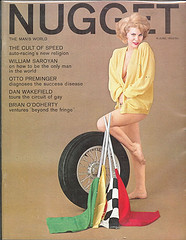
Back when bias in media was naked

Cover, Nugget magazine c. 1963 via Flickr — back when media bias was naked

Today saw a bumper crop of weak content masquerading as journalism. I’m really perturbed about one article in particular.

Forbes—the business magazine led by zillionaire libertarian CEO and editor-in-chief Steve Forbespublished an article noting that NPR’s reporting had a gender bias in its sourcing. The report was written by contributor Michael Howe, whose bio at Forbes characterizes him as the “lead shepherd of the 4th Estate Project.” The 4th Estate Project released several interesting studies, including one last June detailing the media’s overall gender bias in using women as news sources for election coverage. It was a laudable effort in concept to encourage awareness of diversity in media.

The 4th Estate Project continued to follow NPR’s coverage through the election season to watch for gender bias. In a nutshell, the bias noted across other commercial outlets in frequency of quoting males over females also appears in NPR’s coverage. Not a good thing, on the face of it.

But there are problems with this particular report in Forbes and 4th Estate Project:

1)  The magazine has an inherent gender bias of its own, not spelled out clearly by contributor Howe. With the overwhelming majority of medium-to-large corporations in this country lacking female board members and even fewer CEOs, Forbes’ own sourcing for business news is automatically biased by the current structure of this country’s businesses.

[Which begs the question: Is it at all possible that reporting on elections is similarly biased, because there are too few women in government or in politics? 4th Estate Project may have screened out statements by candidates, but did they screen out statements from past office holders, or prospective candidates who were assisting then-prospective candidates?]

2)  Forbes’ editor-in-chief has a known bias as a libertarian conservative (though he once ran for president under the GOP); his ideological bent against taxes may manifest in a bias against NPR as a publicly-funded news outlet. Howe’s piece does not disclose Forbes’ ideology or the possibility that the magazine has a similar bias; he doesn’t appear to question why Forbes magazine would be so interested in coverage of this single outlet’s continued performance up through the November election after the 4th Estate Project’s June 2012 report.

3) NPR is a competitor to Forbes; they may not operate in exactly the same market niche, but they both do reporting on business and politics. In this particular piece by Howe, Forbes questions the diversity of a single competitor, yet we can only assume that Howe and Forbes both believe their readers fully understand this relationship. Read more

Share this entry

The Traditional Press’ Blind Spot in Aiding the Enemy

This post by Kevin Gosztola lays out many of the implications of the news — revealed in Bradley Manning’s statement to the court yesterday — that he tried to publish the Iraq and Afghan cables with WaPo, NYT, and Politico before he turned to WikiLeaks. He describes, as Michael Calderone has laid out at length, how NYT and WaPo claim to have no memory of Manning’s pitch.

He wonders what the NYT and WaPo would have done had they actually gotten exclusive dibs on Manning’s trove of information.

Had the Times or Post obtained the logs and begun to examine them for publication, what would the organizations have done? Would they have published? Would they have notified the government they now possessed the documents? The Timescommunicated with the government when preparing to publish State Department cables:

Because of the range of the material and the very nature of diplomacy, the embassy cables were bound to be more explosive than the War Logs. Dean Baquet, our Washington bureau chief, gave the White House an early warning on Nov. 19. The following Tuesday, two days before Thanksgiving, Baquet and two colleagues were invited to a windowless room at the State Department, where they encountered an unsmiling crowd. Representatives from the White House, the State Department, the Office of the Director of National Intelligence, the C.I.A., the Defense Intelligence Agency, the FBI and the Pentagon gathered around a conference table. Others, who never identified themselves, lined the walls. A solitary note-taker tapped away on a computer.

What would have happened to Manning? Would they have been able to protect the identity of the lower-level soldier who had passed on information because he believed they were “some of the most significant documents of our time, removing the fog of war and revealing the true nature of 21st Century asymmetric warfare.”

The example of Jeffrey Sterling, where NYT’s apparent consultation with the government on whether to publish Risen’s story about Merlin appears to have launched the investigation into Sterling, heightens this concern.

And I would also ask whether the papers would sit on the information, using it as their exclusive data, rather than releasing it to be crowd sourced and accessed by people with more expertise on particular areas. A WikiLeaks trove would have made (and to some extent has in any case) the NYT brand for some time. Would the paper have put more stock in that than in sharing the information.

After raising questions about whether NYT would expose its source in such a case, Gosztola concludes, shows the value of organizations like WikiLeaks.

This is why leaks organizations like WikiLeaks are needed. Not only do they have the power to reveal what governments are doing in secret, they also are uniquely positioned—if constructed appropriately—to protect the identity of sources in a such way that makes it near impossible for governments to pursue those blowing the whistle. It creates the possibility that employees in militaries or national security agencies can reveal what they are seeing, be conscientious citizens and at the same time keep their job and, perhaps, not risk their livelihood.

I’d add two points to that.

NYT’s normally excellent ombud, Margaret Sullivan, suggested that the paper could continue the “time-tested way” of sourcing leaks directly to reporters. Dan Froomkin argues this news proves the need for a whistleblower drop box.

Both are ignoring a very dangerous new reality of the war on leakers. Read more

Share this entry

John Brennan, Unplugged

As a special service to emptywheel readers, I am going to provide an abridged version of John Brennan’s answers to Additional Prehearing Questions in advance of his confirmation hearing on Thursday.

Q1 Bullet 3: 7 CIA officers died in Khost in a suicide bombing that was direct retaliation for our drone attack on a funeral, and then another drone attack on a thuggish enemy of Pakistan and his young wife. Let’s discuss this event as a counterintelligence event, shall we?

A: I have been impressed with CIA’s counterintelligence briefings.

Q6 Bullet 1: What principles should determine whether we conduct covert action under Title 50, where they’re legally supposed to be, or Title 10, where we’ve been hiding them?

A: Whatever works. But tell Congress!

Q6 Bullet 3: Should we reevaluate this?

A: Only if the President decides he wants to stop this shell game.

Q7: Should CIA be a paramilitary agency?

A: See answer to question 6.1.

Q9: We missed the Arab Spring. Shouldn’t we expect better?

A: The liaison relationships with Egypt, Israel, and Saudi Arabia that failed us before won’t fail us again.

Q10: Rather than asking whether you set up the CIA-on-the-Hudson, can you just answer whether you knew about this attempt to bypass restrictions on CIA operating in the US?

A: Yes, I did. CIA likes providing “key support” to local entities under the guise of Joint Terrorism Task Forces.

Q12: How would you manage CIA?

A: Moral rectitude.

Q13: You have lied about things like the Osama bin Laden raid to boost President Obama’s political fortunes. How will you ensure independence from the White House?

A: I will provide him with objective intelligence but I won’t necessarily provide such objective intelligence to anyone else.

Q15: How will you work with your buddies in the Saudi and similar intelligence agencies?

A: I will be the gatekeeper to all US intelligence community elements, but I promise to keep the Chief of Mission informed. At least about what the US side of that relationship is doing.

Q16: How will you staff the agency?

A: Moral rectitude.

Q17: How will you ensure accountability?

A: As CIA did when it was torturing, we’ll refer allegations of criminal wrongdoing to DOJ.

Read more

Share this entry

The Administration’s Drafty Secrecy Claims

As I’ve noted a couple of times, both Jason Leopold and Scott Shane FOIAed the white paper someone strategically leaked to Mike Isikoff this week.

Leopold requested the white paper in August, shortly after Pat Leahy discussed it in a hearing. Just weeks later, DOJ granted him expedited processing. But then his request dropped off the face of the earth — I guess the Administration treated this “expedited” request with the same temporal measure as the Administration treats “imminence.”

Scott Shane requested the white paper in December. In January DOJ rejected his request, citing deliberative process (basically claiming the white paper was a draft).

The disparate treatment of the two requests — and the leaking of it to Isikoff after two different people had been denied it already — is troubling enough.

But I think there’s another problem with the claim they made to Shane, that it was a draft.

The letter that Ron Wyden and 10 other Senators sent to President Obama the other day suggests that the reason they’re being given for not receiving the OLC memos is because they are drafts.

Specifically, we ask that you direct the Justice Department to provide Congress, specifically the Judiciary and Intelligence Committees, with any and all legal opinions that lay out the executive branch’s official understanding of the President’s authority to deliberately kill American citizens. We are not asking for any pre-decisional legal advice and do not believe that providing this information would violate and Constitutional privilege. However, if there is any concern that providing this information to Congress might implicate some sort of privilege, we would encourage you to simply waive whatever privilege might apply, if you would like to make it clear that you are not setting a precedent that applies to other categories of documents.

At one level, this language suggests a consistency from the Administration. Every single document they have on drone strikes, it would seem, is a draft.

Except that the Senators’ helpful suggestion — that if these so-called drafts really are drafts, then Obama could just waive the privilege this time around without implicating other drafts it wants to keep secret — suggests (I’m going to see if I can confirm it) that what the Committees have (remember, 9 of the 11 Senators are on either the Intelligence or Judiciary Committee, and so have officially received the white paper) was not considered a draft when it was given to them. If they already received a draft, after all, it would not be novel for them to get more drafts.

It’s just that when a reporter who has an active FOIA on precisely this kind of document asks for it, it suddenly reverts to draft status, until such time as someone finds it convenient for Mike Isikoff to have it.

Ah well, John Brennan has made it clear the terrorists will win if the Administration doesn’t presumptively turn over documents under FOIA. So I’m sure the Administration will sort this all out in “expedited” fashion.

Update: Thanks to Charlie Savage for linking to the letter off of which Scott Shane FOIAed the document. It reads:

On June 22, 2012, the Department provided us with a copy of a Department of Justice White Paper titled “Lawfulness of a Lethal Operation Directed Against a U.S. Citizen Who Is A Senior Operational Leader of Al-Qa’ida or An Associated Force.” That document, which is marked as “Draft November 8, 2011,” sets forth the legal framework for considering the circumstances in which a particular, identifiable United States Citizen may be targeted. In transmitting that document to us, the Department acknowledged that this white paper is not classified, but took the position that it is not intended for public dissemination.

So DOJ did represent to HJC, at least, that it was a draft.

Two more interesting details, though. The memo was finalized 5 days after the date — November 3, 2011 — when DOJ’s Office of Information Policy arbitrarily enacted as the end date for their FOIA.

And the memo was handed to HJC, at least, the day after DOJ responded to the NYT and ACLU FOIA.

Man, according to John Brennan’s own rules, the terrorists are winning.

Share this entry

Will NYT’s Ombud Encourage a NYT Pre-Sentencing Memo for Bradley Manning, Too?

When I first read Scott Shane’s long profile of John Kiriakou, I thought, “how interesting that the NYT is doing a piece that exposes the government’s double standards just in time for the sentencing of Kiriakou, one of their sources.”

That’s not to say I’m not glad to see the piece: the profile did more to raise the scandal of Kiriakou’s prosecution than just about anything short of a 60 Minutes piece might.

And I’m much less interested in Shane’s references to his own role in Kiriakou’s indictment

Mr. Kiriakou first stumbled into the public limelight by speaking out about waterboarding on television in 2007, quickly becoming a source for national security journalists, including this reporter, who turned up in Mr. Kiriakou’s indictment last year as Journalist B.

[snip]

After Mr. Kiriakou first appeared on ABC, talking with Brian Ross in some detail about waterboarding, many Washington reporters sought him out. I was among them. He was the first C.I.A. officer to speak about the procedure, considered a notorious torture method since the Inquisition but declared legal by the Justice Department in secret opinions that were later withdrawn.

Then I am by this passage.

In 2008, when I began working on an article about the interrogation of Khalid Shaikh Mohammed, I asked him about an interrogator whose name I had heard: Deuce Martinez. He said that they had worked together to catch Abu Zubaydah, and that he would be a great source on Mr. Mohammed, the architect of the Sept. 11 attacks.

He was able to dig up the business card Mr. Martinez had given him with contact information at Mitchell Jessen and Associates, the C.I.A. contractor that helped devise the interrogation program and Mr. Martinez’s new employer.

Mr. Martinez, an analyst by training, was retired and had never served under cover; that is, he had never posed as a diplomat or a businessman while overseas. He had placed his home address, his personal e-mail address, his job as an intelligence officer and other personal details on a public Web site for the use of students at his alma mater. Abu Zubaydah had been captured six years earlier, Mr. Mohammed five years earlier; their stories were far from secret. [my emphasis]

As I have mapped out before, the indictment strongly suggests that Kiriakou was Shane’s source for Martinez’ phone number, and with that suggestion, implies that Shane got Martinez’ identity from Kiriakou rather than one of the 23 other sources he had for the article.

With this passage, Shane rebuts what would have been a key point at trial (and may help Kiriakou in his sentencing). At least according to Shane, he not only learned of Martinez’ identity before he asked Kiriakou about it, but was able to find Martinez’ home address and email on an alumni network site. (Note, Shane doesn’t address whether Kiriakou was the source for the “magic box” technology discussed in the article, about which Kiriakou was also alleged to have lied to CIA’s Publication Review Board.)

In short, the whole article serves as a narrative pre-sentencing memo, offering a range of reasons why Kiriakou should get less than the 30 months his plea deal currently recommends.

Read more

Share this entry

The Official John Brennan Story


The NYT has chosen to have someone who presented an outdated picture of drone targeting that covered up changes implemented under John Brennan report on John Brennan’s nomination to be CIA Director. The story is predictably imbalanced.

Take this claim, for example:

It is uncertain whether the torture issue will now cause any problems for Mr. Brennan. But he is a far more well-known figure than in 2009, having made many public appearances in the wake of terrorist plots and to explain the legal and policy arguments behind drone strikes.

It’s fair, as far as it goes. I do doubt that Obama will care that his CIA Director has protected the CIA’s torturers. I do think Brennan has seduced enough beltway journalists so as to withstand criticism for his views.

But Scott Shane suggests Brennan’s many public statements on drones were 1) accurate and 2) consisted of actual explanations for drone strikes.

This, coming from a guy who has noted Brennan getting caught lying about there being no civilian casualties from drones in the past.

And from a guy who knows well that Brennan’s drone targeting speech fails to explain signature strikes (which Brennan approved in Yemen).

Sadly, Shane didn’t note those past lies.

Then there’s this claim.

He has spoken out repeatedly about the need for strong oversight and review of counterterrorism actions.

It would be useful for Shane to note that Brennan’s plans to establish rules for drones faltered after Mitt Romney lost the election. It would also be useful to note that his idea of “strong oversight” consists of him–John Brennan–centralizing all decision making under himself, then operating within the oversight free National Security Council. All at the same time the Administration refuses to exercise real transparency (and doesn’t even share the “kill list” with the Gang of Four).

That is, it would be nice if Shane had distinguished the myth he has helped to create from the reality.

But it seems the real role of Shane’s article is to point this out.

During Mr. Brennan’s tenure as Mr. Obama’s top adviser on counterterrorism, Al Qaeda’s leadership has been devastated and Mr. Bin Laden been killed.

That, I suppose, is the plan to get Brennan confirmed: paper over the serial lies and instead repeat Osama bin Laden over and over again.

Well done, Scott Shane!

Share this entry

Grand Rapids Press: A Pox on All Their Houses, But Not Our Own

The local rag posted an editorial “reflect[ing] the views of The Grand Rapids Press editorial board,” blaming almost everyone involved in the so-called “right to work” fight for the ugly way things went down Tuesday.

Right-to-work laws may or may not end up helping Michigan, but no one should be pleased with what happened in Lansing this week.

The whole process that led to the bills prohibiting workers from having to pay dues or fees to unions as a condition of employment has a patina of ick that unnecessarily divides and casts the state and its lawmakers in the national spotlight for all the wrong reasons.

[snip]

We’re disappointed in the whole lot.

The issue deserved the sunlight of the traditional legislative process, not moved through a lame duck session at breakneck speed amid threats and raucous protests, all played out in the national spotlight.

That’s not the Pure Michigan image we’re hoping to project as we rebuild the state’s economy and attract new businesses.

We all deserved better.

It blames Rick Snyder for betraying his “relentlessly positive” promises and flipflopping on an issue he had said wasn’t on his agenda.

It blames union leaders for all the violent images (some–perhaps most–not the unions’ fault), including the disputed tent collapse, the riot gear clad cops, and Jimmy Hoffa’s promise of a “civil war.”

It blames legislative leaders, calling out Doug Geiss and Dave Agema for their violent language and Lisa Posthumus Lyon for her hypocritical attempt to exempt her husband’s profession from the law.

Yet oddly (or maybe not so oddly), the Grand Rapids Press placed no blame on the man who, perhaps more than anyone else, bears responsibility both that this went down, and for the nasty way it was jammed through.

As (the umbrella that owns the Press) MLive’s own senior political columnist Tim Skubick explained, this went down in the way it did in significant part because of Grand Rapids’ most prominent citizen, Dick DeVos.

Surely you remember the GOP candidate for governor and former CEO of Amway. Well he’s back on the political field and he worked tirelessly behind Gov. Rick Snyder’s back to push Right to Work.

[snip]

Having performed the 180, Mr. DeVos ramped it up. He told senators that if they don’t vote for this thing, he would launch a petition drive to place this before the voters.

Recall that Mr. DeVos spent $35 million of his own money to beat Gov. Jennifer Granholm, (money wasted). Legislators on the other end of his phone calls knew he has the deep pockets to not only gather the required signatures, but also to find a way to sell it to the voters.

Other press outlets (and presumably Senate Majority Leader Randy Richardville) were less polite, calling what DeVos and his anti-labor friends did “threats” and “arm-twisting.”

Precisely the kind of implicit violence the Press found so distasteful when union leaders or legislators did it.

It’s all very nice for the Press to blame people on the other side of the state for the ugliness in Lansing on Tuesday. But they’re utterly irresponsible if they don’t also blame the ugliness here at home.

They’re right: We all deserved better. And the place to start demanding better is from Dick DeVos.

Share this entry