Posts

Five Years Ago Today, Hunter Biden Bought a Gun

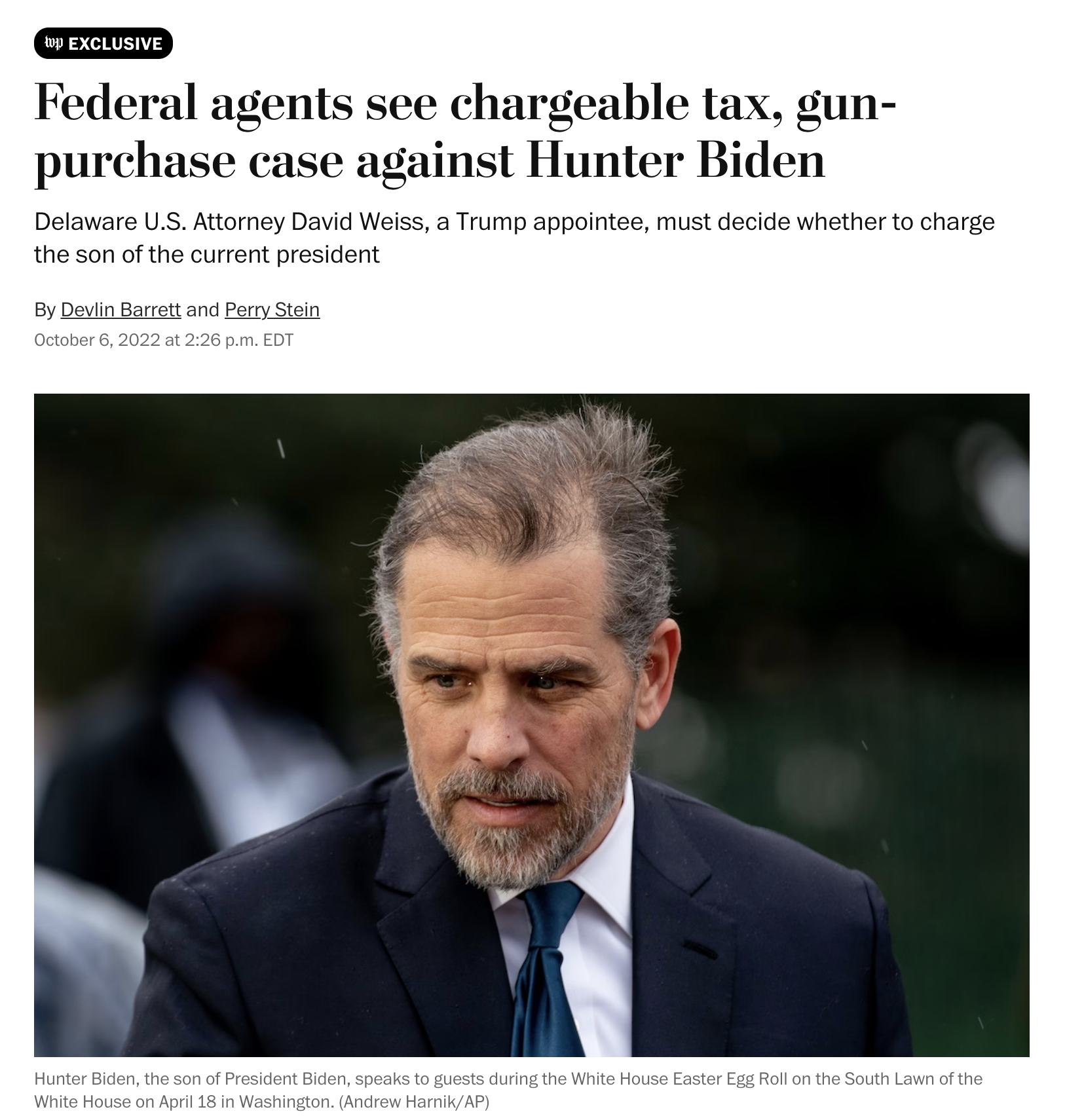
Yesterday, Judge Maryanne Noreika dismissed the gun-related Information against Hunter Biden, signed by Baltimore AUSA Leo Wise, that was filed on June 20, an Information tied to a diversion agreement that Leo Wise also signed.

At the arraignment on Hunter’s new charges — three charges replaced one — Magistrate Judge Christopher Burke reminded the Special Counsel’s team (Derek Hines had the speaking role at the arraignment, not Leo Wise) about the Information still on the docket.

Mr. Hines, one question on my end. The Indictment now obviously has been filed on the docket and that still has the prior felony information that was filed with regard to the prior gun charge back at the point where it was thought that there might be a plea. Did the Government intend to dismiss that charge?

MR. HINES: Yes, consistent with local practice, we intend to file a written motion within the next day.

THE COURT: Okay. And that will go to Judge Noreika and she will review that.

It took Leo Wise two tries — he forgot to sign the first motion to dismiss — but Weiss’ team did indeed move to dismiss the Information, and the docket identified the motion to dismiss that Noreika granted as the amended one, the one Leo Wise actually signed.

And so it was that on the last day off the fifth year after Hunter Biden purchased a gun, Judge Noreika dismissed one charge against him for doing so. Weiss’ team moved to dismiss the Information without prejudice to refiling it. But as of today, the statutes of limitation begin to expire on both that Information — charged under 18 USC 922(g)(3) and 18 USC 924(a)(2) — and the charges in the Indictment — which added charges under 18 USC 924(a)(1)(A) and 18 USC 922(a)(6) and 18 USC 924(a)(2), something Leo Wise noted at the failed plea hearing in July. Any charge tied to unlawful possession of that gun, as opposed to unlawful statements made during the purchase of the gun, will expire on October 23.

So, 9 days into the 30-day period during which Judge Burke gave Hunter’s team to file motions, things may begin to get interesting,

Since the failed plea, the two sides have been involved in a dance regarding whether the diversion agreement — which, as noted, Leo Wise signed on July 26 — remains binding on the government. Over and over, the government, with its evolving titles, has claimed it does not remain binding. Over and over, Hunter’s team preserves the record, insisting it does.

For example, when the government moved to vacate Judge Noreika’s briefing order with an August 11 filing — a motion signed by Leo Wise — claiming that, “there is no longer a plea agreement or diversion agreement,” Hunter’s lawyers responded two days later countering, “the parties have a valid and binding bilateral Diversion Agreement.” On August 15, DOJ filed a reply — signed by newly promoted Assistant Special Counsel Leo Wise — disputing Hunter’s claims, focusing not on whether Wise signed the diversion, but whether Judge Noreika approved the plea or Probation signed the diversion.

On September 6, in response to an order from Judge Noreika, DOJ filed a status update — once again signed by Leo Wise — stating (among other things) that the diversion had not been executed because, while it had been signed by Leo Wise, it had not been signed by Probation. Lowell responded — again, protecting the record — that the court had been provided an executed copy of the diversion agreement, the one signed by Leo Wise.

I don’t know who will win this dispute. I know that DOJ — in filings signed by Leo Wise — keeps saying that where the diversion agreement says “approval” in ¶¶ 1 and 2, it means approval by Probation, not the parties mentioned in ¶¶1 and 2. But from the moment DOJ first opened this docket — with a letter signed by Leo Wise — they referred to executed agreements that were signed that day.

I also know that DOJ keeps speaking of a plea agreement as it existed on July 26, not the agreement that DOJ entered into on some unspecified date in June before that, between which time and July 26, Leo Wise took over from Lesley Wolf and the scope of the immunity agreement started shrinking, one of two things that led the plea to fail on July 26.

At the arraignment last week, Lowell warned that several things were going to happen by or before November 3, when motions are due.

MR. LOWELL: Yes, a couple of things, Judge. First, I understand that Judge Noreika did advise the Government of their Brady obligations. I would want to talk to the Government about the overall discovery issues, especially with the thirty-day motions schedule. We would like to get discovery in the case obviously before we file the motions. We will talk to them. I don’t know that we’ll have any problems that we will need to bring for the Court’s attention, but we will see.

And second of all on those motions, I appreciate the date, I think we can conform to that based on the discovery perhaps, but I think there will be a number of motions which won’t be a surprise to Your Honor or to Judge Noreika, including motions to dismiss which we discussed during the last proceeding which would focus on our view that there was an agreement in effect which would prevent this charge from being filed as well as questioning the constitutionality of the statutes that have been cited and others depending on what happens. So that thirty days seems right, but we’ll talk to the Government.

[snip]

MR. LOWELL: The only other thing that would maybe not change the schedule but would add to the schedule, is that at least one of those motions, I think given what we all know about this case, we will be making a request for an evidentiary hearing. [my emphasis]

Lowell said he:

  1. Wanted Brady and other discovery before he filed motions
  2. Would make a request for an evidentiary hearing
  3. Would file motions (plural) to dismiss, arguing:
    • The diversion agreement prohibits these charges
    • The gun charges are unconstitutional
    • “others depending on what happens”

As a threshold mattter, Lowell seems to believe he had not, by last Tuesday, received all the Brady discovery, even though Chris Clark agreed he had received it back in July. That is, Lowell believes the government has evidence that either exculpates Hunter (which is unlikely) or impeaches the investigation or prosecution that DOJ has not yet turned over.

It’s not a mystery what some of this is. In an August 13 appearance on CBS, Lowell described that if Weiss decided to file charges other than what got filed in June, something must have “infected” the process.

LOWELL: But you asked me whether or not that has been part of the investigation and after five years and what we know happened in the grand jury, of course that had to be part of what the prosecutor has already looked at, as well as every other false allegation made by the right wing media and others, whether it’s corruption or FARA, or money laundering. That was part of what this prosecutor’s office had to have been looking over for five years. I can assure you that five years concluded that the only two charges that made sense were two misdemeanors for failing to file like millions of Americans do, and a diverted gun charge for the 11 days that Hunter possessed a gun. Everything else had been thoroughly looked at. So is that possible that they’re going to revisit it? Let me answer it one way. If the now Special Counsel decides not to go by the deal, then it will mean that he or they decided that something other than the facts and the law are coming into play.

[snip]

LOWELL: –Because I know we were a little rushed. So to answer your question squarely. People should keep in mind that while Mr. Weiss’ title changed last week, he’s the same person he’s been for the last five years. He’s a Republican U.S. attorney appointed by a Republican president and attorney general, who had career prosecutors working this case for five years, looking at every transaction that Hunter was involved in. So whether it was tax or the gun, or possible any other charge, if anything changes from his conclusion, which was two tax misdemeanors, and a diverted gun charge. The question should be asked: what infected the process that was not the facts and the law?

MARGARET BRENNAN: Or new evidence? I mean, are you confident your client won’t face new criminal charges?

LOWELL: I’m confident that if this prosecutor does what has been done for the last five years, look at the facts, the evidence and the law, then the only conclusion can be what the conclusion was on July 26. It’s new evidence, there’s no new evidence to be found. Some of these transactions are years old. They’ve had people in the Grand Jury, they’ve had data that was provided to them. I don’t know the possibility exists after this kind of painstaking investigation for them to be “oh, my gosh, there’s a new piece of evidence which changes.” The only thing that will change is the scrutiny on some of the charges, for example, the gun charge.

More spectacularly, in a September 14 appearance on CNN, after the gun charges were filed, Lowell casually mentioned that prosecutors, “don’t share their emails with me, at least as of yet.”

LOWELL: And that the only thing that changed, Erin, was not the facts and not the law, which has only gotten worse for law enforcement but the application of politics. If it turns out that they continue to escalate the charges, then that is an issue that should be explored.

BURNETT: Okay. So but you are saying that they would be doing that because they are under political pressure from Republicans, MAGA Republicans as you referred to them, in Congress.

LOWELL: Well, they don’t talk to me about their motives.

BURNETT: Yeah.

LOWELL: They don’t share their emails with me, at least as of yet. All can I do, as you as a good reporter does, is make connections. So, if they thought after five years this was appropriate and then the political pressure came and now they think this is appropriate and if it’s no change in the facts and no change in the law, then let me ask you as a journalist would ask, what changed? And I’m telling you, the only thing that’s changed is the politics.

That is, Lowell insinuated that he would demand emails from the prosecution team to understand what led them to (to use the phrase used in the first Hunter filing signed by Lowell) renege on a plea deal.

I have said repeatedly when covering this case and I’ll repeat again, defense attorneys make the kinds of claims that Lowell is making — raising selective prosecution claims and insisting they haven’t gotten Brady discovery, for example — all the time. Such claims usually don’t work. Mind you, you would always need to take those claims more seriously when dealing with someone like Lowell; he’s a formidable lawyer. But even still, selective prosecution claims almost never reach the bar required to get an evidentiary hearing and DOJ has a great deal of flexibility in how they fulfill their discovery obligations. Lowell is making incredibly aggressive claims here, especially the casual suggestion he might get prosecutors’ emails.

The Hunter Biden case is different though. It’s different because Gary Shapley and Joseph Ziegler have spent months making easily debunked claims about politicization in favor of Hunter Biden, even while disclosing the existence of evidence showing the opposite, improper political influence to investigate Hunter. And it’s different because James Comer and Jim Jordan and Jason Smith and the chief investigative counsel they all keep swapping between committees like a cheap date, Steve Castor, keep forcing one after another investigative witness to go on the record about this investigation.

Take just one example: the emails that Gary Shapley belatedly claimed he was a whistleblower to try to explain away because David Weiss’ team demanded them in discovery. Michael Batdorf — the Director of IRS-CI Field Operations who described that Shapley uniquely escalated things to him because he has, “a tendency to go to level like grade 7 five-alarm fire on everything,” also described that Shapley wasn’t a mere supervisor on this team, he was playing an investigative role.

He was taking investigative steps with the special agents. I mean, he was one of the team.

So it wasn’t just an agent involvement. It was the supervisor involvement. He was, again, taking those actions as if he was a working case agent. (97)

Batdorf provided this description to explain why it was reasonable to remove the entire IRS investigative team (which Batdorf also repeatedly said was not retaliation, undercutting yet more of Shapley’s claims). But it would also serve to explain why it was totally reasonable for Weiss to demand Shapley’s emails in discovery, first in March 2022 and then, after Shapley refused to turn them over, again in October 2022. Batdorf also revealed that Weiss had to and did go over his head to get Shapley’s emails. If it was reasonable to obtain Shapley’s emails for discovery — and Batdorf has explained why it was — then it would be reasonable for Hunter Biden to expect to get them.

Republicans’ frenzied dick pic sniffing has also provided clear evidence, both in the form of testimony about whether Shapley’s notes accurately reflect what happened on October 7, which multiple witnesses say they do not, and in notes that clearly conflict with what he typed up and sent in emails, to demand Shapley’s hand-written notes, in addition to his more formal memorializations.

Normally, evidence that Shapley has been biased or dishonest would only matter for any tax case Weiss attempts to charge down the road. Weiss has time yet under the statute of limitations for tax charges, allowing him to see how this gun charge will go down, and possibly allowing him to delay responding to precisely this kind of discovery request until after the gun charges are resolved.

Except that thanks to frothy Republicans, there is already evidence showing that Shapley’s media tour “infected” Weiss’ prosecutorial team before they made the decision to “renege” on a plea agreement and add additional felony gun charges against Hunter.

When asked by Steve Castor in an interview on September 7 how Shapley’s media tour was affecting the ongoing investigation (which Thomas Sobocinski continues to oversee), the FBI Special Agent in Charge of the Baltimore office described that the media tour, “is affecting my employees,” so much so that the children of retired FBI agents “are being followed.”

Castor later asked a question I’m sure Abbe Lowell would love to know the answer to: Why Lesley Wolf was taken off court filings. Sobocinski balked at answering, even questioning whether Castor’s premise was “factually correct.” But Democratic staffers followed up to ask whether Wolf has faced threats. Sobocinski responded that “my office and the FBI have done things and initiated things to ensure that she remains safe.”

In other words, Shapley made himself relevant to not just the tax charges but also to all charges from David Weiss’ office by setting off a media frenzy that led to credible threats that — Hunter’s attorneys can and undoubtedly will argue — may have led prosecutors to ratchet up the charges against Hunter.

It turns out, though, that it wasn’t just the threats Shapley elicited that affected Lesley Wolf’s involvement in the case. Just five days after Sobocinski’s interview, Batdorf was willing to answer that question.

Q And looking at the individuals who were working on the case outside of IRS, so looking at the AUSA, for instance, to your knowledge, was there any change in the personnel of the AUSA from when it started in 2018 to now? Has there been a change, or has it been generally the same career people working the case the entire time?

A It’s my understanding that there had been a change in the AUSA, the prosecution team.

Q And when was the change made? Do you know?

A I believe that it was made in roughly — I think it was May or June of this year when we decided to move forward with the investigation. (99)

According to Politico, Wolf remained involved in the plea negotiations at least as late as June 7. According to Batdorf, Weiss did ultimately remove her.

The process by which Weiss removed his own AUSAs from the prosecution team appears to have taken two steps. First, between June 7 and June 20, Leo Wise started signing things, including things that Lesley Wolf negotiated. While Wolf was never on the Hunter Biden docket, Delaware AUSA Benjamin Wallace was on early filings (and has not withdrawn from it). According to reports from the day, a number of Weiss’ prosecutors attended the scotched plea deal as well.

But since Weiss was named Special Counsel, just Wise and Hines have appeared on filings, using their new title, Assistant Special Counsel. In other words, it seems that Weiss may have belatedly — very, very belatedly — tried to create a prosecutorial clean team that might sustain charges against the President’s son.

Along the way, Wise made preposterous claims — such as that he was not aware of any leaked grand jury information — that suggest that on top of removing Wolf from the process, Weiss is serially attempting to sheep-dip the prosecution, to create a team unaffected by the bullshit that has gone on for five years, so as to create the illusion of apolitical, neutral prosecutorial decisions.

On a July 31, 2023, call, Assistant United States Atiomey Wise stated he was “not aware” of any leak of grand jury information by the Government during the courseof the Government’s investigation of our client. Such a statement was surprising given that Mr. Biden’s counsel have discussed such leaks with the Government on multiple occasions over the past two years and addressed these leaks in at least four prior letters and countless telephone calls with your Office.1 We incorporate by reference counsels’ prior correspondence on these issues, enclosed herewith as Exhibits A – D.

Not only does that ignore the press blitz Republicans have created, to which both Wise and jurors would have been exposed.

But at least in June, Leo Wise signed things negotiated by Lesley Wolf. You can’t claim that Wise represents a team isolated from the original investigative team if he was signing documents negotiated by Wolf.

That transition, from Wolf to Wise, is a central factual issue that would determine whether DOJ reneged on the terms of the plea agreement, as Hunter’s team insists DOJ did. That transition, from Wolf to Wise, will significantly determine whether that diversion agreement really does remain binding — meaning the indictment already charged would need to be dismissed, with statutes of limitation expired even for an Information to backstop any diversion agreement that remained in place.

Again, normally defendants would never get access to such details. Normally defendants would never contemplate, as Lowell did publicly, getting prosecutors’ emails.

But Jim Jordan and James Comer and Steve Castor have been jumping through hoops providing Lowell cause to do just that.

And so, on the fifth anniversary of the day when Hunter Biden purchased a gun, things may start to get interesting.

Update: Hunter’s attorneys have filed a consent motion to extend deadlines, with Hunter’s initial motions deadline extended to December 11 (provided Judge Noreika approves).

The parties in the above-captioned case have conferred, and respectfully submit the following proposed modified briefing schedule for all pretrial motions: (a) the defendant’s pretrial motions to be filed by December 11, 2023; (b) the government’s oppositions/responses to be filed by January 16, 2024; and (c) the defendant’s replies to be filed by January 30, 2024. The parties will be prepared to argue the motions, if the Court so directs, following completion of all briefing. This proposed schedule excludes deadlines for motions regarding jury selection, discovery, and motions in limine (which can be scheduled at a later time once a trial date is determined).
Share this entry

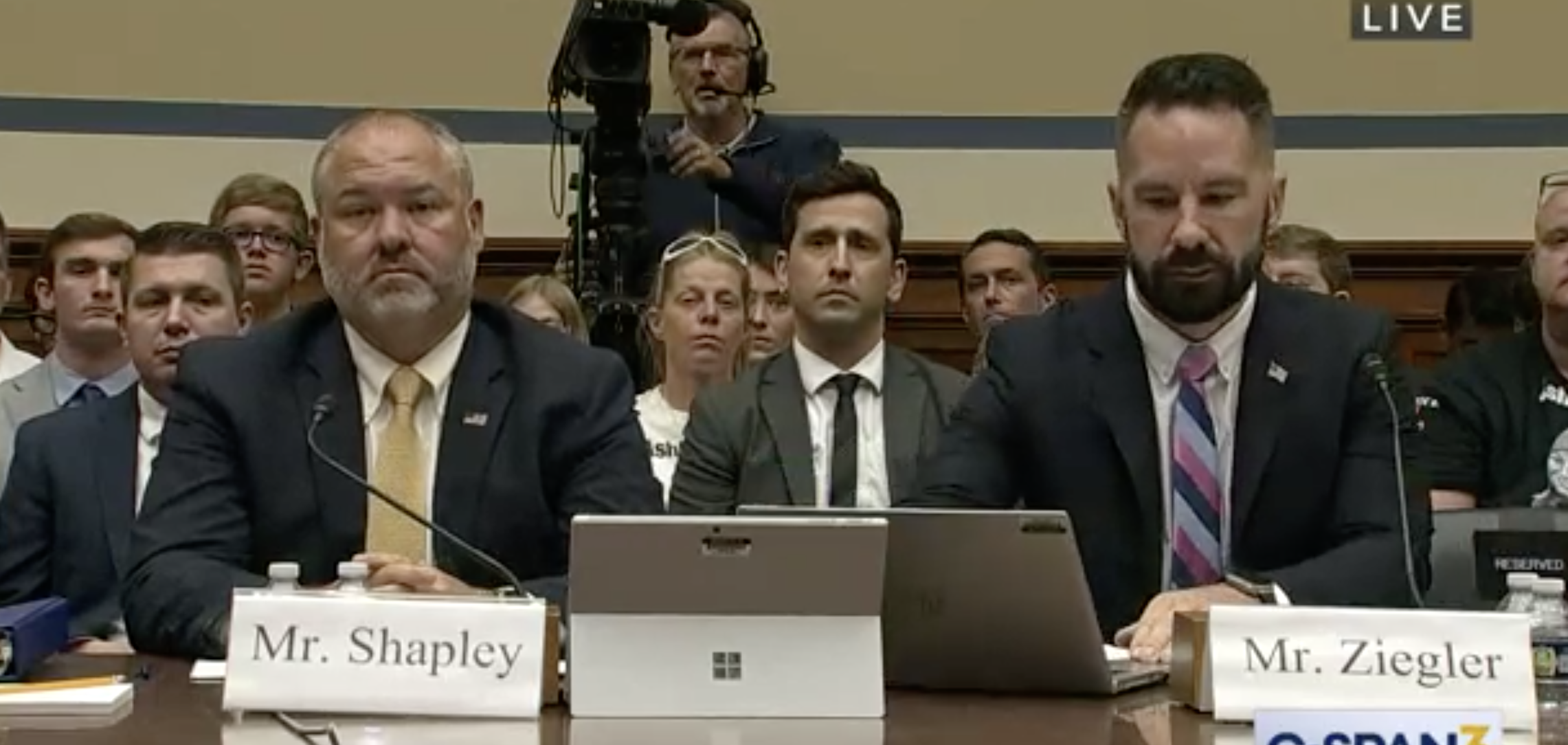
Gary Shapley Didn’t Tell Congress about Election Meddling Concerns

I’m reading my way through the documents from Gary Shapley and Joseph Ziegler that the House Ways and Means Committee released the other day.

While I have yet to read the tax-related documents closely, the others don’t help the evidence-free impeachment much, undoubtedly complicate David Weiss’ hopes of charging Hunter Biden on tax crimes, and probably give Abbe Lowell a stash of documents he would otherwise not have gotten, some of which show investigative sloppiness and potential evidentiary problems for any case Weiss does charge (again, some of which Lowell would otherwise never have gotten).

Plus, some of the documents undermine the Agents’ claims to be whistleblowers. The documents show they had advance notice of both Delaware’s decision to decline prosecution of the 2104 and 2015 tax years and of the timing of any prosecution. They show Shapley walked into a key October 7, 2022 meeting with a chip on his shoulder and an agenda entirely at odds with his knowledge of declination and timing. From that point forward, phantoms of Shapley’s paranoia, not facts, appear to have driven his actions.

For now, though, I want to point to two details that utterly destroy Shapley’s complaints about delays in 2020. It has always been the case that most of Shapley’s complaints about politicization (besides his own) pertained to events that happened under the Trump Administration. Indeed, that’s something that Jason Smith struggled to address at his own presser the other day: how events from 2020 could support the impeachment of Joe Biden.

But details in two documents Shapley sent in late 2020 reveal that during his entire media tour, Shapley has been withholding a key detail that make these complaints all the more ridiculous.

The first is what must be a draft (since it is not dated and includes editorial questions) one page summary of the investigation written for the IRS Deputy Commissioner around November 9, 2020. It explained (as other documents the IRS agents did too) that after the IRS got a Suspicious Activity Report regarding a UK porn site that wasn’t reporting income to US-based contractors, one of whom Hunter Biden had also paid as an escort, the IRS used that to start pulling Hunter’s tax returns, an initial predication that is going to be comedy gold in any opening arguments Abbe Lowell ever gives at a Hunter Biden trial. It also revealed (again, this gets mentioned in other documents) that there was a FARA investigation out of New York regarding Hunter’s ties to CEFC. Finally, the document attributed any pre-election guidance not just to David Weiss’ office, but also to DOJ Tax and the Deputy Attorney General’s office.

To date no proactive interviews have occurred as a result of guidance provided to the investigative team by the USAO in Delaware, DOJ Tax PDAG and the Deputy Attorney General’s office.

We’ve known of the Deputy Attorney General’s involvement since Shapley’s transcript was first released, which described that the guidance involved Richard Donoghue. Shapley has nevertheless blamed Weiss’ office for these delays ordered by Bill Barr’s top deputies, and Smith even blamed Lesley Wolf personally.

But the centrality of the DAG’s office in such delays is important background to a report filed on December 10, 2020 — which shows that its author (it’s not entirely clear who wrote this, but Shapley provided it) was upset that investigators weren’t improperly sharing information with Congress even then — attributes any delays in the investigation to concerns about election interference.

This investigation has been hampered and artificially slowed by various claims of potential election meddling. Even after the election, our day of action to go overt was delayed more than two weeks.

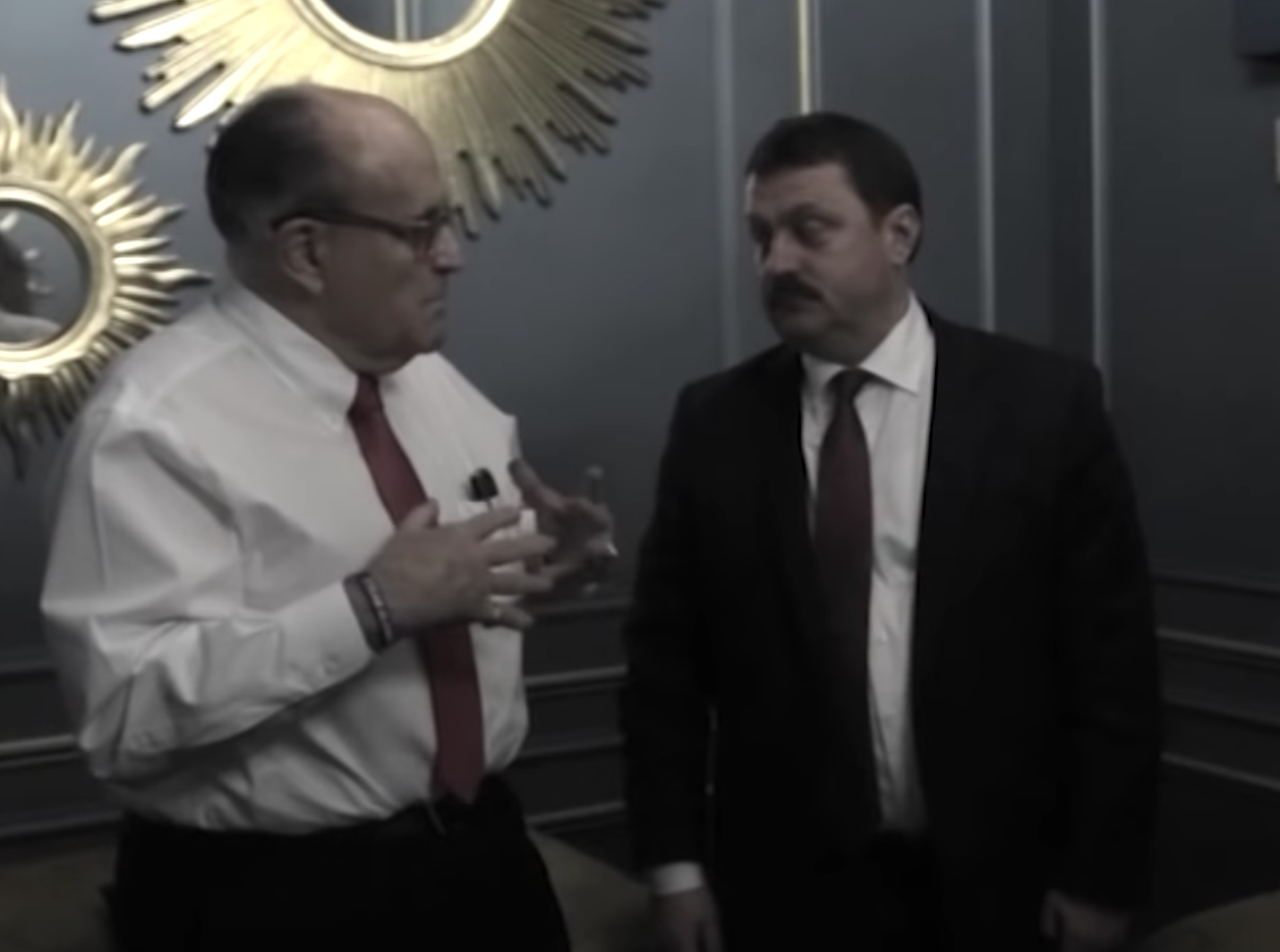
The memo clearly dismisses those claims, which suggests whoever wrote it thinks they know better than FBI counterintelligence investigators. But it also ignores someone else who knows better about known efforts by Russia to use Hunter Biden as a campaign prop: Donoghue. In February 2020, when he was US Attorney for EDNY, Bill Barr ordered him to serve as a gatekeeper for any investigation implicating Ukraine. This was a specific effort to prevent the SDNY investigation into Rudy Giuliani to pursue Rudy’s efforts to fetch dirt, including a laptop!!, from Andrii Derkach in December 2019.

But starting in July, Donoghue swapped places with Seth DuCharme, becoming the Principal Assistant Deputy Attorney General, where he proceeded to issue guidance to delay any overt investigative steps in the Hunter Biden investigation. In other words, the orders to delay overt steps until after the election would have involved someone who knew as well as anyone in government that the effort to exploit Hunter Biden’s relationship with Burisma involved a plot coordinated with known Russian agents.

But over the course of a four month media blitz, Gary Shapley — represented by people close to Chuck Grassley, who of late has been pushing this Russian information operation himself — suppressed the fact that DOJ had concerns, concerns that manifested in multiple Treasury sanctions afterwards, that the effort to focus attention on Burisma was orchestrated by Russia, Ukranian agents of Russia, and Donald Trump’s own efforts to solicit dirt whereever he could.

Twice yesterday, Republicans refused to vote on Democratic requests that James Comer subpoena Rudy (the first request included a request to subpoena Lev Parnas as well). Yet this detail from Shapley — and his suppression of it for four months — makes a Rudy subpoena all the more important.

Share this entry

“They Were Trying to Boot the Machine:” John Paul Mac Isaac Claims the FBI Really WERE That Incompetent

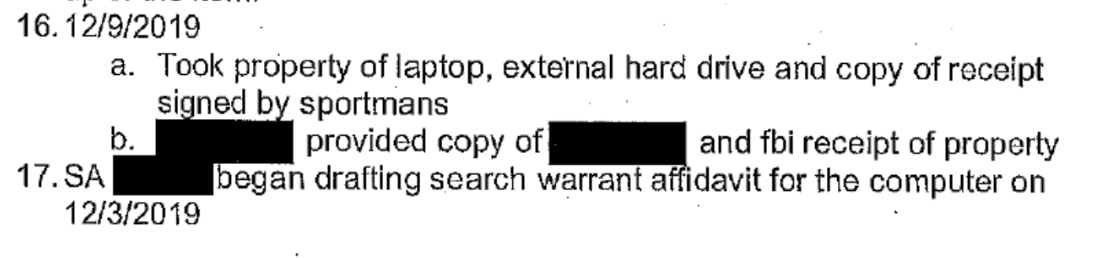
If you can believe John Paul Mac Isaac, the FBI did some incredibly bone-headed things after they obtained Hunter Biden’s laptop in December 2019. As he describes it in his book (which I read recently while stuck in a hospital awaiting foot surgery), on the very same day the FBI collected the laptop purported to belong to Hunter Biden, on December 9, 2019, someone named “Matt” told Mac Isaac they had tried to boot it up.

“Hi, my name is Matt,” said a voice I didn’t recognize. “I work with Agent DeMeo and Agent Wilson. Do you have a second? I have some questions about accessing the laptop.”

Confused, I responded, “Sure, what’s going on?”

“Did the laptop come with any cables or a charger? How can I connect the drive to a PC? When I plug it in, it wants to format the drive,” Matt said.

“PCs can’t natively read Mac-formatted disks. You will only be able to access the drive from another Mac.”

This is fairly common knowledge among most computer users, and I was surprised that any kind of tech person wouldn’t know it.

“Sadly, Hunter never left the charger or any other cables,” I went on. “I have a charger and everything you need back at the shop. You guys are welcome to it.”

I was feeling really uncomfortable. This Matt guy definitely didn’t seem to have the training or resources to be performing a forensic evaluation of the laptop. Hadn’t the whole reason for taking the laptop been to get it to a lab for proper evaluation and dissemination?

“Tell him we’re OK and we won’t need to go back to his shop,” Agent DeMeo said in the background. “We’ll call you back if we need to,” Matt said before hanging up.

[snip]

“Hi, it’s Matt again. So, we have a power supply and a USB-C cable, but when we boot up, I can’t get the mouse or keyboard to work.”

I couldn’t believe it—they were trying to boot the machine!

“The keyboard and trackpad were disconnected due to liquid damage. If you have a USB-C–to–USB-A adaptor, you should be able to use any USB keyboard or mouse,” I said. He related this to Agent DeMeo and quickly hung up.

Matt called yet again about an hour later.

“So this thing won’t stay on when it’s unplugged. Does the battery work?”

I explained that he needed to plug in the laptop and that once it turned on, the battery would start charging. I could sense his stress and his embarrassment at having to call repeatedly for help. [my emphasis]

To be sure, you can’t believe Mac Isaac.

His own story is riddled with questionable details and important discrepancies.

The most important discrepancy is his description of the laptop he turned over to the FBI, which he describes as a 2016 Mac, not the 2018 Mac identified by serial number.

I moved on to the last Mac, a thirteen-inch 2016 MacBook Pro. The drive was soldered onto the logic board. This one powered on but then would shut down. I suspected that there was a short in the keyboard or trackpad, and if I took it apart, I could at least get it to boot and possibly recover the data.

As I understand it, Mac Isaac’s claims that the hard drive was soldered onto the logic board is also inconsistent with the known details of the laptop shared with the FBI.

But there are important other discrepancies between the story Mac Isaac tells and the one the government tells. In his timeline of his interactions with the FBI, Mac Isaac gets the date for the actual handoff, December 9, correct, but other dates he uses differ from those that show up in Gary Shapley’s timeline. For example:

  • Mac Isaac says that Agent Josh Wilson (who is mentioned in Shapley’s notes) reached out to his father on November 1; Shapley’s notes say that happened on November 3
  • Mac Isaac says that Wilson called him on November 4; Shapley’s notes say that happened on November 6
  • Mac Isaac says that Wilson came to his home on November 19; Shapley’s notes say that happened on November 7

These discrepancies aren’t all that important, legally. But Mac Isaac’s dates seem tailored to the impeachment proceedings going on in the same period, and so to laying a foundation for sharing the laptop with Rudy Giuliani.

A far more important set of discrepancies pertain to Mac Isaac’s description of what happened on December 9, 2019.

The blind computer repairman first describes that the second agent, Agent Mike DeMeo, called him to ask for the device identifiers that morning, before coming to the shop to pick up the device.

Agent DeMeo called around 9:30 a.m. It caught me a little off guard. The only other time we had communicated was shortly after our meeting almost three weeks earlier. He had asked me then to text him the timeline of my interaction with Hunter. I figured that he wanted something in writing showing the chain of custody—or it was an effort to trap me into writing something that could be twisted into a charge of lying to the FBI.

This time, he asked me to text him the model and serial number of the external drive and laptop. I explained that I hadn’t made it to the shop yet. “I need this information before we head over,” he insisted. “It’s important.”

“Give me thirty-five minutes,” I responded, then hung up. I finished getting ready and headed to the shop. After texting the numbers to Agent DeMeo, I waited in the shop with the blinds closed and the lights out, so as not to announce that the store was open. [my emphasis]

Shapley described that the FBI obtained and confirmed the device identifier before they ever met Mac Isaac, on November 6 (though perhaps Mac Isaac only referred to other identifiers needed for the subpoena).

Nevertheless, this discrepancy is important for a number of reasons, not least that if the FBI looked at all closely at the returns on a subscriber subpoena to Apple, it should have raised significant alarm that someone was trying to hack Hunter Biden. But if they didn’t obtain this information until the day they obtained the laptop, then they couldn’t have reviewed the subscriber data very closely in advance. That negligence might, in turn, amount to negligence in missing clear signs that the then former VP’s son was being hacked.

As Mac Isaac describes it, it was not until Agents arrived at his shop that they told him they were going to seize the laptop with a subpoena rather than imaging the laptop there at the shop.

Both agents arrived at my door about a half hour late. “Where’s the tech?” I asked, holding the door open.

“We have a change of plans,” Agent Wilson responded. “Can we go in the back?”

I led the agents to the back, and Agent Wilson placed his bag on the workbench. “

I have a subpoena here to collect the laptop, the drive, and all paperwork associated with the equipment,” he said, pulling out a collection of very formal and important-looking paperwork. “I’ll need you to sign it.”

When Mac Issac asked why they had changed their plan, he claims, lead Agent Josh Wilson deferred to Agent Mike DeMeo, who told him that they were taking the laptop back to a lab to image.

“You guys scared the shit out of me!” I exclaimed. “So why the change of plans? Don’t get me wrong; I’m grateful that you’re taking this stuff out of my shop.”

Agent Wilson looked over at Agent DeMeo, who was buried in his clipboard. “Ah, Mike?” he said. Agent DeMeo paused his writing and said, “We have a lab that takes these things and is better equipped than our field tech.”

Mac Isaac also claims that at that same meeting, DeMeo told him only to contact him, not Wilson.

“Tell them you keep abandoned equipment offsite, like a warehouse location,” Agent DeMeo answered, taking over. “Tell them it will take a day for you to check and they should call back the next day. Then immediately text me at my cell number. From now on, only communicate through my cell number. Not Agent Wilson, just me. We need to avoid communicating through, ah, normal channels. I’m sure you can understand. Text me and we will get the equipment back to you and deal with the situation.”

This communication works the opposite of the way you’d expect. Often, second agents are asked to take the stand, so you’d want them to have a clean digital trail. Here, the lead agent, Agent Wilson, was protecting his communications, whereas the second agent was not.

And then, as Mac Isaac tells it, that very same day, someone else, “Matt,” called using DeMeo’s phone, asking really embarrassing questions about how to access the laptop.

The claim that someone at the FBI was trying to boot up the laptop is alarming enough — though as I noted in July, there is some corroboration for the claim in Gary Shapley’s notes.

FBI determined in order to do a full forensic review a replacement laptop had to be purchased so the hard drive could be installed, booted and imaged.

[snip]

Josh Wilson stated that (while laughing) so whoever [people wanting to review the laptop] are they are going to have to buy a laptop to put the hard drive so they can read it.

Where Mac Isaac’s claims are totally inconsistent with the FBI claims, in a way that would cause grave legal problems for the FBI, is the date: Mac Isaac claims that the FBI was trying to boot up the laptop that same day, on December 9.

According to Gary Shapley’s notes, the FBI didn’t have approval to even get a warrant on December 9, much less have a signed warrant itself.

The FBI didn’t have a warrant to access the “Hunter Biden” “laptop” until December 13.

And yet, if you can believe Mac Isaac, the FBI was already trying to boot it up, perhaps irreparably altering its contents, three days before they got a warrant.

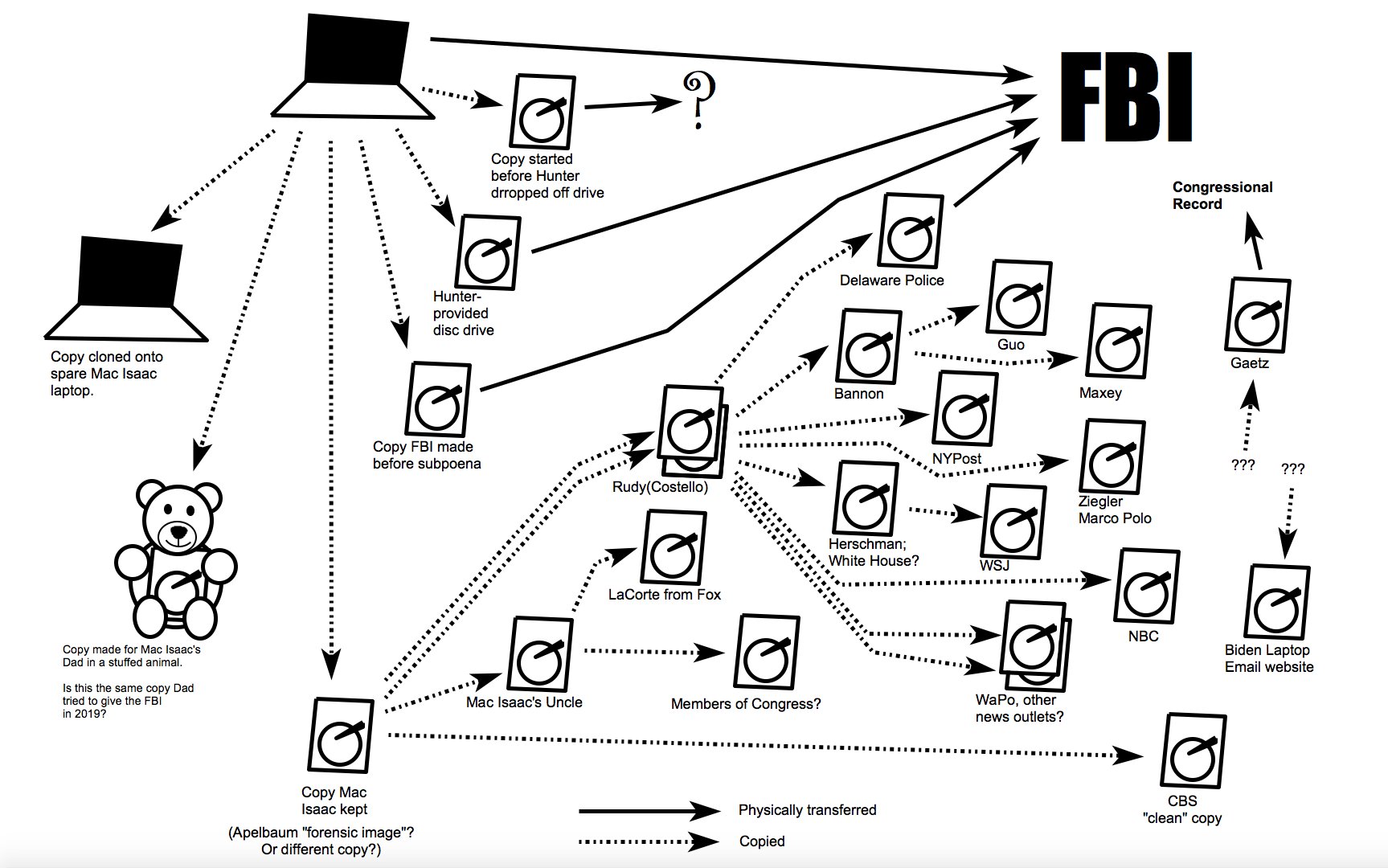
Featured image showing known dissemination of the “Hunter Biden” “laptop” by Thomas Fine.

Share this entry

Hunter Biden Threatens to Make Robert Costello’s Dalliance with Rudy Giuliani Even More Costly

Last week, Robert Costello’s law firm sued Rudy Giuliani — as they earlier successfully sued Steve Bannon for a far smaller amount earlier this year — for stiffing them on payments amounting to almost $1.4 million.

In a statement provided by a spokesman, Mr. Giuliani lashed out at Mr. Costello and the lawsuit, portraying it as an overly aggressive attempt to collect.

“I can’t express how personally hurt I am by what Bob Costello has done,” Mr. Giuliani said. “It’s a real shame when lawyers do things like this, and all I will say is that their bill is way in excess to anything approaching legitimate fees.”

Reached by phone, Mr. Costello initially declined to comment but fired back after hearing Mr. Giuliani’s statement, asking, “How can he take a personal affront when he owes my firm nearly $1.4 million?”

Mr. Costello also disputed the claim that the bills were excessive, saying that he billed his regular hourly rate and that Mr. Giuliani never complained about the cost until Davidoff Hutcher & Citron warned that it had planned to sue.

“He’s a little late to that party,” Mr. Costello said, adding, “it’s too late for that frivolous claim as he will find out in court.”

Mr. Giuliani, he said, “took the low road here because he is feeling desperate.”

In all, Mr. Costello’s firm has billed Mr. Giuliani $1,574,196, according to the lawsuit. Of that, Mr. Giuliani has paid only $214,000, the lawsuit said, most recently handing over $10,000 last week.

Rudy doesn’t have the money to pay Costello. This lawsuit can only serve to pressure Rudy to get Trump to pay up, something he has thus far refused to do.

In any case, Costello’s costs for enabling Rudy’s shenanigans may well grow, now that Hunter Biden has sued both of them for hacking his personal data.

The lawsuit largely parallels the lawsuit filed earlier against Garrett Ziegler — though the evidence that first Costello and then Rudy hacked the data is based on a different access claim. Hunter alleges (with merit) that Ziegler unlawfully accessed encrypted data that had been saved to Hunter’s iTunes account.

In this suit, the hacking claim appears to be two-fold: first, Costello’s demonstration to Olivia Nuzzi of how he accessed Hunter’s email account using Hunter’s own credentials.

24. Plaintiff has discovered (and is continuing to discover) facts concerning Defendants’ hacking activities and the damages being caused by those activities through Defendants’ public statements in 2022 and 2023. During one interview, which was published on or about September 12, 2022, Defendant Costello demonstrated for a reporter precisely how Defendants had gone about illegally accessing, tampering with, manipulating and altering Plaintiff’s data:

“Sitting at a desk in the living room of his home in Manhasset, [Defendant Costello], who was dressed for golf, booted up his computer. ‘How do I do this again?’ he asked himself, as a login window popped up with [Plaintiff’s] username . . .”3

By booting up and logging into an “external drive” containing Plaintiff’s data and using Plaintiff’s username to gain access Plaintiff’s data, Defendant Costello unlawfully accessed, tampered with and manipulated Plaintiff’s data in violation of federal and state law. Plaintiff is informed and believes and thereon alleges that Defendants used similar means to unlawfully access Plaintiff’s data many times over many months and that their illegal hacking activities are continuing to this day.

3 Andrew Rice & Olivia Nuzzi, The Sordid Saga of Hunter Biden’s Laptop, N.Y. MAG. (Sept. 12, 2022), https://nymag.com/intelligencer/article/hunter-biden-laptop- investigation.html.

I’ve been told that because of the way the data was stored, booting the hard drive up would update emails onto the hard drive, including any emails altered during the November 2019 Burisma hack. But using Hunter’s credentials — if that’s what Costello did — would be a CFAA violation unto itself.

Additionally, the complaint notes that both Costello and Rudy boasted about accessing Hunter’s camera roll.

26. For example, Defendant Costello has stated publicly that, after initially accessing the data, he “scrolled through the laptop’s [i.e., hard drive’s] email inbox” containing Plaintiff’s data reflecting thousands of emails, bank statements and other financial documents. Defendant Costello also has admitted publicly that he accessed and reviewed Plaintiff’s data reflecting what he claimed to be “the laptop’s photo roll,” including personal photos that, according to Defendant Costello himself, “made [him] feel like a voyeur” when he accessed and reviewed them.

[snip]

31. By way of further example, in an episode of the podcast “Louder with Crowder” in late 2022, Defendant Giuliani held up a laptop computer on air and announced: “This is the hard drive they’re on,” referring to data (e.g., photographs) he apparently carries around with him on a daily basis, presumably so that he can continuously access, tamper with and manipulate the data whenever and wherever he desires.

Hunter’s team may know that these photos would not have been available without a password.

Note, the complaint makes some interesting allegations about John Paul Mac Isaac’s own actions; I would be unsurprised if Hunter sues him next.

23. Following these communications, Mac Isaac apparently sent via FedEx a copy of the data he claimed to have obtained from Plaintiff to Defendant Costello’s personal residence in New York on an “external drive.” Once the data was received by Defendants, Defendants repeatedly “booted up” the drive; they repeatedly accessed Plaintiff’s account to gain access to the drive; and they proceeded to tamper with, manipulate, alter, damage and create “bootable copies” of Plaintiff’s data over a period of many months, if not years.

2. Plaintiff’s investigation indicates that the data Defendant Costello initially received from Mac Isaac was incomplete, was not forensically preserved, and that it had been altered and tampered with before Mac Issac delivered it to Defendant Costello; Defendant Costello then engaged in forensically unsound hacking activities of his own that caused further alterations and additional damage to the data he had received. Discovery is needed to determine exactly what data of Plaintiff Defendants received, when they received it, and the extent to which it was altered, manipulated and damaged both before and after receipt.

Mac Isaac admits in his book that the copy he made of the laptop he received was not a forensic copy.

As with Costello’s suit, the lawsuit against Rudy is drilling a dry hole. Rudy is broke, and even if Hunter prevailed, he’d be at the back of a long line of creditors at some time Rudy declares bankruptcy.

But the discovery is something else.

So, too, is Costello’s role in all that, which he may or may not be claiming is part of attorney-client privileged activities, a claim that would he impossible to sustain in light of the Nuzzi profile.

And, in the shorter term, these lawsuits provide basis to claim that DE USAO is pursuing Hunter for misdemeanor tax charges, while ignoring the way the President’s son was and continues to be serially hacked by his father’s opponents.

Update: Politico includes this quote in their report on the lawsuit.

Giuliani and his allies have long argued that the purported laptop was fair game because it was allegedly abandoned. But at the heart of the lawsuit is the argument that regardless of where any piece of computer hardware was located, Hunter Biden’s data still belongs to him alone. A member of his legal team, granted anonymity to discuss his newly aggressive legal strategy, put it this way: “If you take your coat to the dry cleaner and leave your wallet in it, and you forget to pick it up, it doesn’t mean the dry cleaner gets the wallet and all your money. It’s just common sense.”

The member of his legal team hinted that more litigation could follow.

“Everyone involved in stealing and manipulating Hunter’s data should be hearing footsteps right about now,” that person said.

I don’t think people yet have considered the full scope of people this might include.

Share this entry

Hunter Biden Sues the IRS

I can’t help but wonder whether the lawsuits Abbe Lowell is filing on behalf of Hunter Biden are preparation for an assault on the criminal charges against the President’s son.

Last week, for example, Lowell alleged that Garrett Ziegler had criminally hacked an iPhone encrypted on “the laptop” and had altered information on it. Whatever else the lawsuit will do, it will establish that DOJ chose to charge a non-violent recovering addict for owning a gun for 11 days in 2018, but has yet to do anything about the people who’ve serially compromised the digital life of the President’s son.

Lowell already has a bunch of other information to substantiate a selective prosecution case. But if he can demonstrate that DOJ ignored more serious felonies while still pursuing Hunter, it would only add to the evidence.

Today, Lowell sued the IRS for the media tour that Gary Shapley and Joseph Ziegler have conducted since April, enumerated as follows (note, this only includes live appearances; Tristan Leavitt has made obviously problematic claims to print journalists as well):

Attorney A’s public statements in a letter to the Committee on Ways and Means on April 19, 2023.

Attorney A’s public statements to Mr. Solomon of John Solomon Reports on April 19, 2023.

Attorney A’s public statements to Mr. Axelrod of CBS News on April 19, 2023.

Attorney A’s public statements to Mr. Baier of Fox News on April 20, 2023.

Mr. Shapley’s public statements to Mr. Axelrod of CBS News on May 24, 2023.

Mr. Shapley’s public statements to Mr. Baier of Fox News on June 28, 2023.

Mr. Shapley’s public statements to Mr. Axelrod of CBS News on June 28, 2023.

Mr. Shapley’s public statements to Mr. Solomon of John Solomon Reports on June 29, 2023.

Mr. Ziegler’s public statements to Jake Tapper of CNN on July 20, 2023.

Mr. Shapley and Mr. Ziegler’s public statements to Megyn Kelly of the Megyn Kelly Show on July 20, 2023.

Attorney B’s public statements to Mr. Solomon of John Solomon Reports on July 21, 2023.

Mr. Ziegler’s public statements to John Solomon of John Solomon Reports on July 24, 2023.

Attorney A’s public statements to Martha MacCallum of Fox News on July 26, 2023.

Attorney A’s public statements on Fox News on July 31, 2023.

Mr. Shapley’s public statements to Kaitlan Collins of CNN on August 11, 2023.

While statute permits and Hunter Biden did ask for punitive damages, ultimately he only asked for attorneys fees and $1,000 per disclosure — just $15,000 for this listed disclosures, as well as a program to ensure that IRS uphold the Privacy Act.

He’s not going to get rich with this lawsuit.

But Lowell also asked for all information in the IRS’ possession relating to these disclosures.

Ordering Defendant to produce to Mr. Biden all documents in its possession, custody, or control regarding the inspection, transmittal, and/or disclosure of Mr. Biden’s confidential tax return information;

If successful, this request would generate a good deal of information about the IRS tracking of these leaks (and any earlier ones). It might provide proof, in the form of metadata, showing when the IRS agents accessed this information and under what circumstances, including Ziegler’s overt promise to go back and find more data in response to demands from members of Congress. It might obtain information on the IRS’ own investigation of this leaking.

If DOJ is going to charge Hunter with tax charges, they’re going to need to present the investigation as conducted by Shapley and Ziegler — a point Abbe Lowell made in a letter to David Weiss last month.

Among other ways, these agents, sill employed by the Government, would likely be witnesses should any tax charge you file ever be tried. It is unprecedented for Government officials who are the investigators or prosecutors in the case and would be witnesses and rial counsel to conduct themselves in this manner which seks to try the issues in the court of public opinion rather than properly in a court of law. That conduct itself (in addition to the various other infirmities with the Government attempting to bring charges against Mr. Biden26) would support dismissal of any charges you have fled or would try to so file in the future.27

26 To be clear, we do not believe the Government could validly bring charges against our client concerning these issues given the express language of he agreed-upon Diversion Agreement.

27 Courts recognize that the crime of leaking or disclosing such information by Government agents sworn to uphold the law is often more egregious than the crimes those agents are charged with investigating. See, e.g., United States v. Walters, No. 17. 2373 (2d Cir. Dec. 4, 2018) Jacobs, J. concurring) ([Tlhe leak of grand jury tesimony in some respects more egregious than anything [Defendant] did (insider wading) — the FB supervisor took an oath to uphold the law and was acting in a supervisory capacity to discharge an important public function.” (emphasis ddd).

Again, on top of all the other things Lowell could point to to substantiate a claim that Hunter was being selectively prosecuted, Lowell might ask why Hunter is being prosecuted but not Shapley and Ziegler.

For five years, the government has (apparently) chosen to relentlessly pursue pickayune charges against Hunter Biden while ignoring the crimes committed to try to set up those charges.

And Abbe Lowell may be preparing to make that case in the case of any trial.

Share this entry

After Threats Elicited by Gary Shapley’s Misleading Testimony, Hunter Biden Prosecutors Reneged on the Plea Deal

In the wake of two news reports on the communications leading up to the aborted Hunter Biden plea, Jim Jordan et al demanded the documents shared with the Politico and NYT from Hunter’s lawyers. In response, Lowell sent the following documents, which Betsy Woodruff Swan published here:

While the letters include a familiar catalog of the Shapley and Ziegler media tour, there are a few details worth noting.

First, the August 14 letter goes to great lengths to distinguish the topic of Gary Shapley and Joseph Ziegler’s purported whistleblowing — prosecutorial misconduct — from the materials released, which focus on investigative material implicating Hunter Biden. That distinction ought be a way for DOJ to rein in the two purported whistleblowers, as Merrick Garland quickly did in the case of Michael Sherwin.

The letter claims, as Abbe Lowell has in the past, that some of the statements Shapley and Ziegler have made are false.

[T]he “facts” disclosed and conclusions reached are either false, legally incorrect, or were otherwise addressed during the various meetings between defense counsel and your Office.

If that’s true, Lowell should ask for a criminal investigation for their false statements before Congress.

It also reveals something that should be obvious but I hadn’t realized: The iCloud warrant which produced a bunch of WhatsApp texts, which Shapley discussed at length in his original testimony, has never been disclosed to Hunter himself, so must be sealed.

On several occasions during their testimony, Mr. Shapley and Mr. Ziegler discussed a sealed search warrant, and showed and discussed with the Committee certain fruits of that sealed search warrant. Because we have never been notified of any such “electronic search warrant for iCloud backup”— nor of any other warrant to search for and seize any property of our client 13—we must presume that Mr. Shapley and Mr. Ziegler were discussing, in violation of a sealing order, a search warrant that has been sealed. Nevertheless, Mr. Shapley purportedly produced WhatsApp messages that are the: fruit of these warrants, and they have now been published.” Moreover, Mr. Ziegler offered to produce to the House Oversight and Accountability Committee additional and more fulsome grand jury materials concerning these messages, with the intent of making such materials public.

So it’s not just that Shapley was violating grand jury secrecy (he was authorized by Ways and Means Chief Counsel to share tax information, but not grand jury information), he was also almost certainly violating a sealing order that remained in effect almost two months after Hunter Biden received a summons in conjunction with the tax charges (conveniently so for the purported whistleblowers, because the warrant affidavit may rely on poisoned fruit from their mistreatment of “the laptop”). Whatever judge authorized that warrant and gag — presumably DE’s Chief Judge, Colm Connolly — might be interested that investigative agents are just blowing off the gag they themselves presumably asked for.

The most alarming thing in the August 14 letter, though, is a claim that Leo Wise — who has taken the lead role in the prosecution — claimed in a July 31 call to be unaware of any grand jury leaks in the investigation, at all!

On a July 31, 2023, call, Assistant United States Attorney Wise stated he was “not aware” of any leak of grand jury information by the Government during the course of the Government’s investigation of our client. Such a statement was surprising given that Mr. Biden’s counsel have discussed such leaks with the Goverment on multiple occasions over the past two years and addressed these leaks in at least four prior letters and countless telephone calls with your Office.

[snip]

Yet, given your Office’s inaction in the face of a torrent of illegal leaks about your investigation of Mr. Biden, and now your reinvented denial that leaks ever happened at all—your Offices assurances are being rendered false.

It’s as if the guy Weiss brought in to salvage the case believes he has to simply deny what everyone watching can plainly see, that Shapely and Ziegler have set off a torrent of prejudicial information that could make it impossible for Hunter to get a fair trial, much less be exonerated if not charged.

In both the August 14 letter and the one from yesterday, Lowell claims that the political pressure Jordan et al have put on Weiss led the newly minted Special Counsel to ratchet up his charges.

The change to a rare misdemeanor failure to file/pay and a felony diversion for possession of a firearm (and now the actual filing of those firearm charges) occurred only after a chain of events starting with the improper disclosures arranged by you and your Committees of the so-called “whistleblowers” claims of prosecutorial misconduct and your, and the right-wing media with whom you coordinate, taking up those claims.

But there’s something that Lowell didn’t mention.

It’s not just political pressure that this media blitz has created.

It’s credible threats of violence.

As Ken Dilanian first reported, after Shapley started representing Lesley Wolf’s adherence to DOJ and FBI guidelines as political interference, she was targeted with credible threats. Thomas Sobicinski told the House Judiciary Committee how Shapley’s testimony had led to the harassment of employees, employees whose parents got calls and children got followed. He specifically agreed that Wolf “has concerns for her own safety.”

It’s not just that Shapley’s testimony has led to political pressure. It has led directly to credible threats of violence against the prosecutor who crafted the original plea deal.

And in the wake of those credible threats of violence, David Weiss decided to ratchet up the charges against the President’s son.

The threats of violence may not have caused Weiss’ subsequent decision to renege on the plea deal (though that is one thing that is likely to be the topic of litigation going forward).  But the public record, at least, makes clear that those threats of violence correlate with a decision to seek more punitive treatment of the President’s son.

And that’s a very chilling prospect: that MAGA right wingers could bully prosecutors into taking punitive action against Hunter Biden.

Share this entry

Hunter Biden Sues Garrett Ziegler for Hacking His iPhone

Back in July, as part of an effort to understand whence the IRS obtained WhatsApp texts that weren’t on the “Hunter Biden” “laptop” made available by Rudy Giuliani, I noted that those WhatsApp texts appear to have come from an iPhone backed up to a different iCloud account than the one the laptop was synched to.

On the laptop itself, the iPhone content was encrypted.

That meant anyone without a warrant accessing that content was likely violating the Computer Fraud and Abuse Act.

In part four of Dimitrelos’ report, he describes that there were, indeed, WhatsApp messages on the iPhone, registered to that entirely different iCloud account, seemingly backed up to iTunes on the [email protected] account.

I can’t be sure about this, because I’m not a forensics expert, both Shapley and Dimitrelos are deliberately unreliable narrators, and even they don’t have all the data to understand what went on here. But it appears that the reason why there were no WhatsApp texts on the laptop itself, which had all the content in the [email protected] iCloud account, is that they weren’t used by a device registered to the [email protected] iCloud account. They were used by a device registered to the [email protected] account, which was (as Shapley’s notes reflect) stored in encrypted fashion on the laptop.

There’s one more very important point about this.

The government had a warrant. If they really did find a business card (one not described anywhere I’ve seen in Dimitrelos’ report) with a password, they were able to get the encrypted content (though oftentimes prosecutors will recommend you go back and get a second warrant for that). From there, it seems, the IRS got another warrant for the other iCloud account, the [email protected] one. That’s how they got a legally sound copy of the WhatsApp texts in August 2020.

But for people like Rudy Giuliani or Garrett Ziegler or John Paul Mac Isaac, taking a laptop they purport to have been abandoned, and then using a password found on that laptop to access an encrypted container — especially one of a different iCloud account — is legally another level of conduct.

Hunter Biden’s newly aggressive legal team appears to agree. They’ve just sued Garrett Ziegler. One of the key claims is that he hacked the “laptop” to access encrypted data.

28. Plaintiff further is informed and believes and thereon alleges that at least some of the data that Defendants have accessed, tampered with, manipulated, damaged and copied without Plaintiff’s authorization or consent originally was stored on Plaintiff’s iPhone and backed-up to Plaintiff’s iCloud storage. On information and belief, Defendants gained their unlawful access to Plaintiff’s iPhone data by circumventing technical or code-based barriers that were specifically designed and intended to prevent such access.

29. In an interview that occurred in or around December 2022, Defendant Ziegler bragged that Defendants had hacked their way into data purportedly stored on or originating from Plaintiff’s iPhone: “And we actually got into [Plaintiff’s] iPhone backup, we were the first group to do it in June of 2022, we cracked the encrypted code that was stored on his laptop.” After “cracking the encrypted code that was stored on [Plaintiff’s] laptop,” Defendants illegally accessed the data from the iPhone backup, and then uploaded Plaintiff’s encrypted iPhone data to their website, where it remains accessible to this day. It appears that data that Defendants have uploaded to their website from Plaintiff’s encrypted “iPhone backup,” like data that Defendants have uploaded from their copy of the hard drive of the “Biden laptop,” has been manipulated, tampered with, altered and/or damaged by Defendants. The precise nature and extent of Defendants’ manipulation, tampering, alteration, damage and copying of Plaintiff’s data, either from their copy of the hard drive of the claimed “Biden laptop” or from Plaintiff’s encrypted “iPhone backup” (or from some other source), is unknown to Plaintiff due to Defendants’ continuing refusal to return the data to Plaintiff so that it can be analyzed or inspected.

Of course, this means that DOJ should have been investigating Ziegler for hacking the President’s son rather than spending five years pursuing misdemeanor tax charges.

Perhaps that will become more clear going forward.

Update: These kinds of videos will be of interest to Hunter’s team.

Share this entry

David Weiss May Have More Bluster than Tactical Leverage

There’s something missing from coverage of the claim, made in the second-to-last sentence of a Speedy Trial filing submitted Wednesday, that David Weiss will indict Hunter Biden before September 29, when — according to calculations laid out by prosecutor Leo Wise in the filing — the Speedy Trial Act mandates an indictment.

None of the coverage has considered why David Weiss hasn’t already charged the President’s son.

The filing was submitted in response to an August 31 order from Judge Maryellen Noreika; its very last sentence politely asked her to butt out: “[T]he Government does not believe any action by the Court is necessary at this time.” Given the unusual nature of this legal proceeding, there may at least be question about Wise’s Speedy Trial calculations. One way or another, though, the Speedy Trial clock and the statute of limitations (which Wise said in July would expire on October 12) are ticking.

It would take probably half an hour to present the evidence for the weapons charge — which would consist of the form Hunter signed to purchase a gun, passages from Hunter’s book, a presumed grand jury transcript from Hallie Biden, and testimony from an FBI agent — to a grand jury. It would take maybe another ten minutes if Weiss wanted to add a false statements charge on top of the weapons charge. There certainly would be no need for a special grand jury.

Any tax charges would be more complicated, sure, but they would be in one or another district (probably Los Angeles), ostensibly severed from the weapons charge to which the misdemeanors planned as part of an aborted plea deal were linked.

So why wait? Why not simply indict and avoid any possible challenge to Speedy Trial calculations?

The answer may lie in something included in a long NYT story citing liberally from an anonymous senior law enforcement official who knew at least one thing that only David Weiss could know. That story explains that Weiss sought Special Counsel status, in part, to get, “added leverage in a revamped deal with Mr. Biden.”

If Weiss indeed sought Special Counsel status to get leverage for a deal, then at least last month when he asked for it, he wasn’t really planning on indicting Hunter Biden. He was hoping to get more tactical leverage to convince Hunter Biden to enter into a plea agreement that would better satisfy GOP bloodlust than the plea that failed in July.

Now he has used the opportunity presented by Noreika’s order to claim he really really is going to indict Hunter, a claim that set off predictably titillated reporting about the prospect of a Hunter Biden trial during the presidential election.

Again, if you’re going to charge Hunter Biden with a simple weapons charge, possibly a false statements charge, why not do it already, rather than threatening to do it publicly? Why not charge him in the week after Noreika entered that order, mooting all Speedy Trial concerns?

Abbe Lowell appears unimpressed with Weiss’ promised indictment. He repeated in both a separate filing and a statement to the press that Weiss can’t charge Hunter because he already entered into a diversion agreement pertaining to the charge.

We believe the signed and filed diversion agreement remains valid and prevents any additional charges from being filed against Mr. Biden, who has been abiding by the conditions of release under that agreement for the last several weeks, including regular visits by the probation office. We expect a fair resolution of the sprawling, five-year investigation into Mr. Biden that was based on the evidence and the law, not outside political pressure, and we’ll do what is necessary on behalf of Mr. Biden to achieve that.

I think few stories on this have accounted for the possibility that that statement — “we’ll do what is necessary … to achieve” a fair resolution of the case — is as pregnant a threat as DOJ’s promise to indict in the next several weeks. That’s because everything leading up to David Weiss obtaining Special Counsel status actually squandered much of any leverage that Weiss had, and that’s before you consider the swap of Chris Clark as Hunter’s lead attorney for the more confrontational Lowell, making Clark available as a witness against Weiss.

As Politico (but not NYT, working off what are presumably the same materials) laid out, Hunter’s legal team has long been arguing that this investigation was plagued by improper political influence.

But even before the plea deal was first docketed on June 20, the GOP House started interfering in ways that will not only help Abbe Lowell prove there was improper influence, but may well give him unusual ability to go seek for more proof of it.

It appears to have started between the time the deal was struck on June 8 and when it was docketed on June 20. AUSA Lesley Wolf, who had negotiated the deal, was replaced by Leo Wise and others. When Weiss claimed, with the announcement of the deal, that the investigation was ongoing and he was even pursuing dodgy leads obtained from a likely Russian influence operation, it became clear that the two sides’ understanding of the deal had begun to rupture. This is the basis of Lowell’s claim that Weiss reneged on the deal: that Weiss approved an agreement negotiated by Wolf but then brought in Wise to abrogate that deal.

Whatever the merit of Lowell’s claim that the diversion agreement remains in place — the plea deal was such a stinker that both sides have some basis to defend their side of that argument — by charging Hunter, Weiss will give Lowell an opportunity to litigate the claim that Weiss reneged on the diversion agreement, and will do so on what may be the easier of the two parts of the plea agreements to make a claim that Weiss reneged on a deal, with Judge Noreika already issuing orders to find out why this stinker is still on her docket. I’m not sure how Lowell would litigate it — possibly a double jeopardy challenge — but his promise to do what’s necessary likely guarantees that he will litigate it. He’ll presumably do the same if and when Weiss files tax charges in California. It’s not necessarily that these arguments about reneging on a deal will, themselves, work, but litigating the issue will provide opportunity to introduce plenty more problems with the case.

That’s part of what was missed in coverage of this development this week. Weiss promised to indict. Lowell responded, effectively, by challenging the newly-minted Special Counsel to bring it on, because it will give Lowell opportunity to substantiate his claim that Weiss reneged on a deal because of political influence.

And those IRS agents claiming to be whistleblowers have only offered gift after gift to Lowell to destroy their own case. In their own testimony they revealed:

  • From the start, a supervisor documented concerns about improper influence and Sixth Amendment problems with this investigation
  • Joseph Ziegler, the IRS agent who improbably claims to be a Democrat, treated such concerns as liberal bias, evincing political bias on his own part
  • DOJ didn’t do the most basic due diligence on the laptop and may have used it in warrants, creating poisonous fruit problems
  • Ziegler treated key WhatsApp messages obtained with a later warrant with shocking sloppiness, and may even have misidentified the interlocutors involved
  • Ziegler didn’t shield himself from the taint of publicly released laptop materials (and Shapley was further tainted by viewing exhibits during his deposition)
  • Gary Shapley is hiding … something … in his emails

These two self-proclaimed whistleblowers have made evidence from this case public — all of which would never have seen the light of day if Weiss had honored the plea agreement — without the filter of a prosecutor to clean it up in advance.

All that’s before you consider the rampant leaking.

In both their depositions and their giddy public testimony before the House both Shapely and Ziegler did plenty of things that will provide basis to impeach them, not just as witnesses, but even as investigators, as did their anonymous FBI agent colleague’s laughable claim in his deposition that this was not an investigation riddled with leaks. James Comer seems intent on inviting all the other investigators who have complained they weren’t able to bulldoze rules designed to protect sensitive investigations to be deposed in an adversarial setting, which will provide still more surface area that Lowell can attack.

The gun charge is simple. But what investigative witnesses would present any tax case against Hunter Biden and would their testimony be impressive enough to sustain a case after Lowell serially destroyed Ziegler as the key investigator? And because Weiss has left Lowell with a viable claim that the diversion remains valid, he may be able to introduce the taint of the tax case into any gun prosecution.

Some of this shit goes on in any case, though not usually this much with politically exposed people like the President’s son. But prosecutors have a great number of tools to prevent defendants from learning about it or at least keeping it off the stand. Many of the IRS agents’ complaints were really complaints about Lesley Wolf’s efforts to preserve the integrity of the case. By bitching non-stop about her efforts, the IRS agents have ensured that Hunter Biden will get access to everything that Wolf tried hard to stave off from the investigation.

And there’s something more. Ziegler provided the name of his initial supervisor, who documented concerns that this case was politicized from the start. Both IRS agents identified for Lowell a slew of irregularities he can use to undermine any case. Republicans in Congress have bent over backwards to expose witnesses against Hunter to adversarial questioning (and both IRS agents got downright reckless in their public testimony). The way in which this plea collapsed provides Lowell reason to challenge any indictment from the start.

But the collapse also provided something else, as described in the NYT story: a David Weiss associate told the NYT that Weiss told them that any other American would not be prosecuted on the evidence against Hunter.

Mr. Weiss told an associate that he preferred not to bring any charges, even misdemeanors, against Mr. Biden because the average American would not be prosecuted for similar offenses. (A senior law enforcement official forcefully denied the account.)

If this witness makes themselves available to Lowell, it provides him something that is virtually unheard of in any prosecution: Evidence to substantiate a claim of selective prosecution, the argument that Weiss believes that similarly situated people would not have been prosecuted and the only reason Hunter was being prosecuted was because of non-stop GOP bloodlust that originated with Donald Trump. It is darn near impossible for a defense attorney to get discovery to support a selective prosecution claim. Weiss may have given Lowell, one of the most formidable lawyers in the country, a way to get that discovery.

And all that’s before Lowell unveils whatever evidence he has that Joseph Ziegler watched and did nothing as Hunter Biden’s digital life was hijacked, possibly by people associated with the same Republicans driving the political bloodlust, possibly by the very same sex workers on which the case was initially predicated. That’s before Lowell unveils evidence that Ziegler witnessed what should have been clear alarms that Hunter Biden was a crime victim but Ziegler chose instead to trump up a weak criminal case against the crime victim. I suspect that Weiss doesn’t know what Lowell knows about this, either, adding still more uncertainty to any case he charges.

Over four weeks ago, Leo Wise asked Noreika to dismiss the misdemeanor tax charges against Hunter so they could charge them in another venue.

In light of that requirement, and the important constitutional rights it embodies, the Government moves the Court to dismiss the information without prejudice so that it may bring tax charges in a district where venue lies.

Now he and Weiss have made promises of another upcoming indictment, without yet charging it. At the very least, that suggests that there are a number of challenges to overcome before they can charge Hunter.

They likely still have time on any 2019 tax charges — the ones where, reportedly, both sides agree that Hunter overstated his income, which will make a tax case hard to prove. I’m not saying that Weiss won’t charge Hunter. Indeed, he has backed himself into a corner where he likely has to. But with each step forward, Lowell has obtained leverage to make Weiss’ own conduct a central issue in this prosecution (and even Wise may have made himself a witness given the centrality of his statements during the plea colloquy to Lowell’s claim that the diversion remains valid).

The Speedy Trial filings seem to have hinted at an intense game of chicken between Weiss and Lowell. And thus far at least, Weiss seems more afraid of a Hunter Biden indictment than Lowell is.

Share this entry

Right Wing Operatives Say Hunter Biden Shouldn’t Get Same Treatment as Dmitry Firtash

In the wake of the Politico and NYT reports on the collapse of the Hunter Biden plea deal (which I wrote up here), right wing operatives have a remarkable complaint: That the President’s son got worse treatment from DOJ than mobbed up Ukrainian oligarch Dmitry Firtash.

The complaint started with Federalist Faceplant Margot Cleveland (who called the good Politico piece and the problematic NYT piece “virtually identical”).

Margot complains that Hunter Biden’s lawyer Chris Clark attempted to reach out to high level DOJ personnel to raise concerns about the degree to which the investigation into his client had been politicized from the start.

Clark’s efforts to meet with Attorney General Merrick Garland and Deputy Attorney General Lisa Monaco failed.

Ultimately, though, he did get a meeting with Associate Deputy Attorney General Bradley Weinsheimer, who oversees ethical violations at DOJ. As Faceplant Margot helpfully lays out, the meeting happened in the wake of yet another attempt by agents involved in the case — after repeated leaks to the press — to  force Weiss’ hand.

According to Politico, from the fall of 2022 through the spring of 2023, Clark, on behalf of Hunter, sought meetings with high-level Justice Department officials, including the head of the Criminal Division, the head of the Tax Division, the Office of Legal Counsel, the Office of the Solicitor General, Deputy Attorney General Lisa Monaco, and the attorney general himself. Clark finally succeeded in his efforts to meet with a higher-up at Main Justice, when on April 26, 2023, Clark met with Associate Deputy Attorney General Bradley Weinsheimer and Delaware U.S. Attorney Weiss.

Just one week earlier, Mark Lytle, a partner at the law firm Nixon Peabody, had penned a letter to key House and Senate committees informing them that his client, a career IRS criminal supervisory special agent, sought to make “protected whistleblower disclosures to Congress,” concerning an investigation into a politically connected individual. Those whistleblower disclosures, the letter explained, would “contradict sworn testimony to Congress by a senior political appointee,” would show the “failure to mitigate clear conflicts of interests,” and would provide “examples of preferential treatment” and improper political influence. While the whistleblowers did not identify the politically connected taxpayer, Just The News confirmed the allegations concerned Hunter Biden.

So that means that after Hunter’s lawyer spent some six months trying to swing a meeting with top DOJ officials, a meeting materialized a week after news broke of the whistleblowers’ claims that political favoritism prevented them from properly investigating Hunter Biden.

Soon after Weiss, Hunter’s attorney Clark, and Associate Deputy Attorney General Bradley Weinsheimer met in late April 2023 to discuss the Hunter Biden investigation, the House Ways and Means Committee met on May 5, 2023, and received a “proffer” from the whistleblowers’ attorney concerning the testimony their client would provide Congress about the political interference into the Hunter Biden investigation.

Less than a week later, on May 11, 2023, Weinsheimer “thanked Clark for the meeting and told him Weiss would handle the next steps.” Then, on May 15, 2023, “at the request of the Department of Justice,” the two whistleblowers and their entire elite team of IRS investigators were removed from the Hunter Biden investigation. It was the same day, according to the Times’ weekend reporting, that Wolf proposed resolving the investigation into Hunter Biden with only a deferred prosecution agreement.

Margot leaves out a few details about what led up to the removal of the IRS investigators from the case. According to his own testimony, Gary Shapley had been sidelined months earlier, as he continued to resist requests from DOJ that he provide his emails pertaining to the case. According to Ziegler’s testimony, his related cases had already been put on hold.

Margot seeks to blame a meeting in April for things that IRS agents’ own behavior had triggered months (and in Shapley’s case, over a year) earlier.

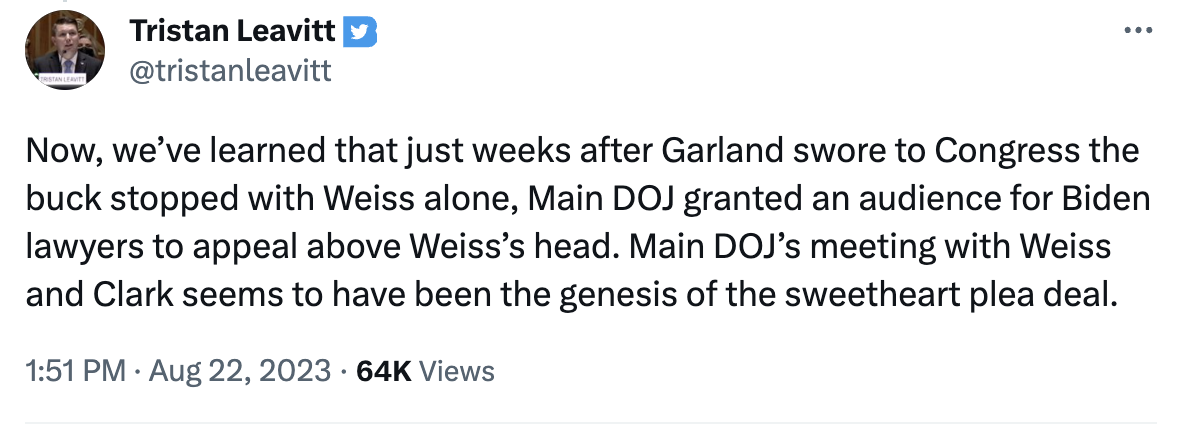
After Faceplant Margot’s piece, one of Gary Shapley’s attorneys, Tristan Leavitt, got into it.

The thing is, Main DOJ grants audiences to the lawyers of high profile suspects fairly routinely. It’s one of the things you get when you hire a a lawyer of a certain stature.

On behalf of “Hunter Biden” “laptop” disseminator Steve Bannon, for example, “Hunter Biden” “laptop” disseminator Robert Costello met with JP Cooney and two other AUSAs twice in November 2022.

And in fact, as I pointed out in the beginning of an amusing exchange with Leavitt, someone directly tied to the politicized allegations against Hunter Biden availed himself of just that kind of access: Dmitry Firtash.

Unlike Hunter Biden, when Dmitry Firtash leveraged that kind of access, his attorneys — Victoria Toensing and Joe DiGenova  — were granted a meeting with the Attorney General, with Bill Barr, who may or may not have had a role in putting the investigation into Hunter Biden in Delaware in the first place.

In July, the tycoon changed legal teams, replacing longtime Democratic lawyer Lanny Davis with the husband-and-wife team of Victoria Toensing and Joseph diGenova, who appear frequently on Fox News to defend Trump and have served as informal advisers to Trump’s legal team, including Giuliani.

After taking on Firtash’s case, Toensing and diGenova secured a rare face-to-face meeting with Attorney General William P. Barr and other Justice Department officials to argue against the charges, three people familiar with the meeting said.

Barr declined to intercede, the people said.

A Justice Department spokeswoman said that the case “has the support of the department leadership,” adding: “We continue to work closely with the Austrian Ministry of Justice to extradite Mr. Firtash.”

Mind you, Toensing and DiGenova did not succeed in getting DOJ to drop the case against the mobbed up Ukrainian oligarch — though neither did Chris Clark’s meeting with Associate Deputy Attorney General Bradley Weinsheimer succeed in getting David Weiss to drop the case against Hunter Biden.

After Firtash’s success at getting an audience with the Attorney General was disclosed, only Mitt Romney, of all the Republicans in Congress, voiced any problem with the larger corruption aired during Trump’s first impeachment, which included the means and purpose for which Toensing got that meeting. But Republicans now feign outrage that the American citizen targeted in that earlier access campaign might seek a similar meeting.

At least according to Lev Parnas, the Firtash meeting had a direct role in a campaign against Hunter Biden, a campaign that developed in parallel to the criminal investigation and which — at least since Leavitt’s client has gone public — has provably merged.

Rudy first reached out to Parnas in November 2018. Joseph Ziegler first attempted to open the investigation, based on payments to a sex worker network, in November 2018.

In January 2019, per Ziegler’s testimony, Delaware’s US Attorney’s Office first started looking into Hunter Biden. That same month, Rudy and Parnas met with Yuri Lutsenko in New York, where Rudy — who connected Trump in on the phone in the way Republicans falsely alleged Hunter connected his father in to weigh in on the substance of business deals — tried to trade access to Bill Barr in exchange for dirt on Hunter and $200K.

Giuliani continued to receive conspiracy theories from different sources, and remained insistent that there must be some data on the Bidens’ corruption. In late January 2019, my business partner Igor Fruman got word that Yuri Lutsenko, Shokin’s replacement as Ukraine’s Prosecutor General, was in New York and wanted to meet with Giuliani to discuss some legal matters. We set up the meeting in Giuliani’s office on Park Avenue. There, Lutsenko explained he’d requested the meeting because he wanted to sit down with Bill Barr and, Attorney General to Attorney General, discuss the overall problem of Ukrainian and American corruption, including the funneling of Ukrainian money into American institutions. Giuliani stopped Lutsenko and said he wasn’t interested in that, only in information concerning Joe and Hunter Biden. He then added statements to the effect that if Lutsenko wanted a conversation with Barr, he would need to offer a give and take, and Giuliani was interested in details about the Bidens.

[snip]

During the meeting, Giuliani stopped to call President Trump for about 3-5 minutes to update him on how the meeting was going with Lutsenko, and told Lutsenko that Trump was very happy with the help he was giving. He gave Lutsenko the thumbs-up. Lutsenko then promised that if we went to Ukraine, he would help us meet President Poroshenko and other officials who were dealing directly with the Burisma investigation. After the first meeting, Lutsenko kept pressuring Giuliani that he needed to meet Bill Barr. However, Giuliani eventually told Lutsenko he hadn’t provided enough information, and that the only way he could meet Bill Barr was if he retained Giuliani for $200,000. He then gave Lutsenko a “contract”. (It should be noted that Lutsenko refused to pay and to this day has never met Bill Barr.)

A few days later, Giuliani told me that he had decided that it might not be a good look for him to represent Ukrainian officials while representing Donald Trump, and introduced me to attorneys Victoria Toensing and Joseph DiGenova, who he said would represent Lutsenko instead. Later on, Giuliani told me that Toensing and DiGenova had agreed to split the $200,000 retainer fee in some part with him.

In April 2019, Ziegler’s investigation and DE USAO’s investigations were consolidated.

The next month, Rudy’s efforts started to incorporate Firtash, with Toensing and DiGenova again serving as the public face of the effort, but with Rudy allegedly sharing in the spoils.

Near the end of our trip to Paris, we were introduced to one of Igor Fruman’s associates, a friend who happened to be an employee of a Ukrainian oligarch named Dmitry Firtash, who had many political and business connections, including with the head of Burisma, Zlochevsky. When we returned to the U.S., we met with the BLT Team and John Solomon said Firtash’s help would be key because of his relationship with Zlochevsky.

The problem was that Firtash would prove nearly impossible to contact. He was also facing a serious extradition case to the U.S. for a number of bribery, racketeering and other charges since 2014. Solomon and Giuliani put together a package of documents regarding confidential information in Firtash’s case, and had me travel to Vienna in June 2019 to meet with Firtash, letting him know that Giuliani and our whole team were serious and that we could help him if he helped us. From June until the time of my arrest in October 2019, we had ongoing communications with Firtash.

In October 2019 — per notes taken by Leavitt’s client — FBI received the first official outreach from John Paul Mac Isaac about a laptop that appears to have been packaged up, during a period when Hunter Biden’s digital life shows signs of being compromised, after Ziegler had opened the investigation. That happened just days after Rudy, Parnas, and John Solomon had planned to go to Vienna to obtain a different instance of the “Hunter Biden” “laptop,” a trip that was forestalled by Parnas’ arrest and Barr’s warnings to (at least) Fox News.

In the early part of October 2019, I got a call telling me to go to Vienna with Giuliani, where the former Chief Financial Officer of Burisma, Alexander Gorbunenko, would meet Giuliani and give us Hunter Biden’s hard drive and answer any questions we had. My Ukrainian contacts also told me they would have Viktor Shokin in Vienna to give an interview to Sean Hannity of FOX News, because Shokin was supposed to appear in a Viennese court on behalf of Dmitry Firtash, giving sworn testimony in court that would basically be saying what Giuliani wanted him to say – that he was fired because of Joe Biden. (As mentioned earlier, Biden did make statements that he had helped to get Shokin fired, but Ukrainian investigations into the matter some years later concluded that Shokin had been terminated because of multiple cases of corruption while in office.)

I have text messages confirming all these plans, and all are among the materials I submitted to Congress during the first impeachment inquiry. These include messages from Hannity setting up the interview, and messages coordinating that Giuliani, Toensing, and I would go to Vienna to meet Burisma’s ex-CFO Gorbunenko. Just before we were to fly to Austria, there was a meeting at FOX News in Washington, because Solomon was appearing that night on Hannity’s show and Giuliani was appearing on Laura Ingraham’s. The BLT Team got together in a FOX conference room and discussed how we would blow up the story once we got Hunter Biden’s hard drive in Vienna.

Right in the middle of these seeming lockstep parallel investigations of Hunter Biden — by Bill Barr’s DOJ and by the then President’s lawyer all over Europe, and before offers of two laptops — both with ties to Rudy Giuliani — were made, two things happened.

On July 25, 2019, then President Donald Trump got on the phone with Volodymyr Zelenskyy and — after making a quid pro quo tying aid to the announcement of an investigation into Burisma — told Ukraine’s president that both Rudy and Barr would reach out.

I will have Mr. Giuliani give you a call and I am also going to have Attorney General Barr call and we will get to the bottom of it.

[snip]

I will tell Rudy and Attorney General Barr to call.

The next month, in August, Victoria Toensing and Joe DiGenova succeeded in scoring the meeting Firtash wanted with the Attorney General. The Rudy investigation and the Barr investigation met first at Trump’s hotel and then at DOJ. And the day after IRS got a warrant to access the Hunter Biden laptop seemingly packaged up after Joseph Ziegler was already investigating, DOJ told Barr they were sending him a laptop.

Whether or not that Dmitry Firtash meeting was an explicit meeting of the Rudy and the DOJ investigations, whether or not that laptop Barr obtained was the same one Rudy had a role in packaging up, we do know the investigations have since merged.

After the first press blitz about Gary Shapley — arranged in significant part by Tristan Leavitt — Bill Barr raised attention to an FD-1023 obtained via a channel he set up to ensure that Rudy could share information obtained from known Russian spies without being prosecuted for soliciting known Russian spies. In response, Shapley and Ziegler both complained that they hadn’t had access to an informant report the sole operative detail of which involved a 2019 call set up with Mykola Zlochevsky during impeachment, in which he used those politicized discussions to reverse his earlier admissions in order to claim to have made a bribe to Joe Biden. Remarkably, Shapley — lawyered by people with close ties to Chuck Grassley, who released the FD-1023 — claims to have known about the tainted Pittsburgh evidence in real time.

That is, even three years later (or perhaps, especially three years later) the IRS agents who should have seen Hunter Biden’s digital life get attacked if not packaged up for their own consumption are complaining they’re not able to pursue leads obtained via a channel catering to Russian spies.

It’s not surprising that you could look at this timeline and still have right wingers claim that Hunter Biden is the one who got favorable treatment. Those people don’t care if they reveal their cynical hypocrisy in pursuit of attacks on democracy.

What is surprising is that people claiming to be journalists wouldn’t immediately lay out how absurd that is. The “democracy dies in darkness” guys sitting on their own evidence about this stuff have assigned upwards six journalists to cover this story, but few have shown any curiosity about how the known political hit job on Hunter Biden ties to the wails of the sources whose own stories they don’t bother to test.

It is the collective stance of the entire Republican party, save Mitt Romney, that it’s fine for Dmitry Firtash to score a meeting with the Attorney General as part of an alleged quid pro quo to get an investigation into Hunter Biden, but it’s a sign of corruption for Hunter’s lawyers to point out that happened to DOJ.

The Republican party claims it is a sign of corruption to call out their own corruption.

And virtually every Hill journalist is playing along.

Share this entry

“Ebb and Flow:” How David Weiss Volunteered for a Subpoena, or Worse

Politico and NYT have stories — relying on what Politico describes as, “more than 300 pages of previously unreported emails and documents exchanged between Hunter Biden’s legal team and prosecutors,” — chronicling the legal negotiations leading up to the failed Hunter Biden plea deal.

Politico’s, written by Betsy Woodruff Swan, is good.

NYT’s is not, in part because it dedicates a long passage to repeating Gary Shapley’s claims without noting the many things in his own testimony that discredit those claims, even while relying on props from Shapley’s testimony that have since been challenged. Luke Broadwater knows where his beat gets sweetened, and it is in treating James Comer like a credible person, not in exhibiting the critical thinking of a journalist.

When first published, the NYT couldn’t even get the date of the failed plea hearing, July 26, correct.

But hey — at least that error is less catastrophic than the one in a WaPo story on the same topic the other day, in which three reporters (at least two of whom never bother to hide their right wing allegiances, particularly when it pertains to chasing Hunter Biden dick pics) claimed that Joe Biden was now a “former” President.

For its errors and other problems, however, the NYT story is useful for the way in which it puts David Weiss at risk for his own subpoena.

Hunter Biden lays the groundwork for holding the government to their signed agreements

To understand why, a review of the current state of the (known) legal case is in order.

On August 11, as Merrick Garland was announcing that he had given David Weiss Special Counsel status, Weiss’ prosecutors filed a motion to dismiss the charges against Hunter Biden. After describing that, “When the parties were proceeding to a negotiated resolution in this matter, a plea in this District was agreed upon,” the filing said that because Hunter did not plead guilty, it may have to file charges in the district where venue lies. At the same time, Weiss also moved to vacate the briefing schedule in the gun diversion.

Judge Maryellen Noreika gave Hunter a day to respond to the motion to vacate. That response, signed by Chris Clark but including Abbe Lowell on the signature line, explained that Hunter planned to fulfill the terms of the gun diversion agreement, which the government had stated was a contract between the two parties.

[T]he Defendant intends to abide by the terms of the Diversion Agreement that was executed at the July 26 hearing by the Defendant, his counsel, and the United States, and concurs with the statements the Government made during the July 26 hearing,1

The Government stated in open court that the Diversion Agreement was a “bilateral agreement between the parties” that “stand[s] alone” from the Plea Agreement, and that it was “in effect” and “binding.”

But, “in light of the United States’ decision on Friday to renege on the previously agreed-upon Plea Agreement, we agree that those issues are moot at this point.” Effectively, Hunter’s team was saying they considered the gun diversion as still valid, recognized everything else was moot, and described that it was moot because the government had reneged on the terms of the deal.

Then Abbe Lowell entered his appearance in the case. And Clark moved to withdraw from the case because — given that the plea and diversion would be contested — he might have to serve as a witness.

Mr. Clark’s withdrawal is necessitated by recent developments in the matter. Pursuant to Delaware Rule of Professional Conduct 3.7(a), “a lawyer shall not act as advocate at a trial in which the lawyer is likely to be a necessary witness unless… disqualification of the lawyer would work substantial hardship on the client.” Based on recent developments, it appears that the negotiation and drafting of the plea agreement and diversion agreement will be contested, and Mr. Clark is a percipient witness to those issues. Under the “witness-advocate” rule, it is inadvisable for Mr. Clark to continue as counsel in this case.

Noreika never actually approved Clark’s withdrawal, but the defense team filed notice that Hunter consented to the withdrawal while the docket remained active.

Meanwhile, Noreika ordered the government to reply to Hunter’s response on the briefing, and ordered Hunter to respond to the thing she failed to ask about in the first place, whether he objected to the dismissal of the charges.

Hunter’s team agreed that the charges must be dismissed, but reiterated that the court had no oversight over the diversion agreement (which had been Noreika’s complaint from the start).

Without adopting the Government’s reasoning, as venue for the existing information does not lie in this District, the information must be dismissed.

Further, the Defendant’s position is that the enforceability of the Diversion Agreement (D.I. 24-1 in No. 23-cr-00061-MN) has no bearing on the United States’ Motion to Dismiss for Lack of Venue (D.I. 31 in No. 23-mj-00274-MN), and any disputes regarding the effect of the Diversion Agreement are therefore not before the Court at this time.

The government, meanwhile, filed a seven page reply attempting to claim that the government did not renege on the plea that had been negotiated in advance of its filing in June, by describing how after Hunter refused to plead guilty because Leo Wise, an AUSA who had not been involved in the original deal, claimed its scope was far narrower than Hunter understood, the parties did not subsequently agree on one to replace the signed deal Hunter entered into.

First, the Government did not “renege” on the “previously agreed-upon Plea Agreement,” as the Defendant inaccurately asserts in the first substantive sentence of his response. ECF 33, Def. Resp. at 1. The Defendant chose to plead not guilty at the hearing on July 26, 2023, and U.S. Probation declined to approve the proposed diversion agreement at that hearing.

Then Noreika dismissed the charges.

David Weiss may have plenty of time to argue with Lowell, relying on Chris Clark’s testimony, that he should not be held to the terms of signed agreements he entered into in June.

But the two important takeaways from all this are, first, that Hunter Biden is stating that before the plea hearing, Weiss attempted to change the terms of the signed plea deal, and second, that Chris Clark is no longer bound by any terms of confidentiality that will allow him to prove that’s true.

A senior law enforcement official speaks, illegally

These twin stories are a warning shot to Weiss — before Hunter even gets more discovery on all the other problems with this investigation — what that is going to look like.

Which brings me to the things for which the NYT is really useful: giving David Weiss or someone in his immediate vicinity an opportunity to cause David Weiss more problems.

Three times in the story, NYT provides anonymity to a “senior law enforcement official” to push back on the representation of the deal, including as laid out by documentary evidence. In one such instance, NYT helpfully notes that if Weiss commented, he would be violating DOJ policies and possibly the law (though the leaks in this story don’t appear to violate grand jury secrecy).

A spokesman for Mr. Weiss had no comment. He is legally barred from discussing an open investigation, and a senior law enforcement official with knowledge of the situation pushed back on the idea that Mr. Weiss had been influenced by outside pressures, and ascribed any shifts to the typical ebb and flow of negotiations.

In a second instance, this anonymous “senior law enforcement official” denies something — that David Weiss told an associate that “the average American would not be prosecuted for similar offenses,” the kind of assertion that might provide basis for an exceedingly rare successful claim of selective prosecution — that only David Weiss would know.

Mr. Weiss told an associate that he preferred not to bring any charges, even misdemeanors, against Mr. Biden because the average American would not be prosecuted for similar offenses. (A senior law enforcement official forcefully denied the account.)

This chatty senior law enforcement official similarly denies something else that could bollox any further charges against Hunter Biden — that the only reason he “reneged” on the original terms of the plea deal are because IRS agents got journalists like the NYT’s to report claims of bias that their own testimony did not substantiate.

Now, the I.R.S. agents and their Republican allies say they believe the evidence they brought forward, at the precise time they did, played a role in influencing the outcome, a claim senior law enforcement officials dispute.

Now, normally, misconduct by a prosecutor like Weiss would be reviewed by the feckless Office of Professional Responsibility. But that’s less likely with a Special Counsel, because of the reporting structure for an SCO. And that’s particularly true here given the involvement of Associate Deputy Attorney General Bradley Weinsheimer in earlier discussions about the plea. Weinsheimer oversees OPR, and so any review by OPR presents a conflict. Indeed, Weiss may have asked to be made SCO precisely so he could escape the purview of OPR.

But to some degree that may not matter.

That’s because there are already parallel investigations — at TIGTA and at DOJ IG — into the leaking that occurred during this investigation. David Weiss was already going to be a witness in them, because Gary Shapley made claims about what Weiss said personally at a meeting on October 7, 2022, a meeting that was called first and foremost to discuss leaks.

So if Michael Horowitz wanted to subpoena Weiss to find out whether he was the senior law enforcement official denying things only he could deny, to find out whether days after being made a Special Counsel, Weiss decided to violate DOJ guidelines to which he still must adhere, the only way Weiss could dodge that subpoena might be to resign from both his US Attorney and his Special Counsel appointment.

And if Weiss and DOJ IG didn’t already have enough to talk about, there’s this passage from the NYT, with its truly epic use of the passive voice: “Mr. Weiss was quietly assigned,” by whom, NYT didn’t choose to explain.

NYT corrected their earlier error on the date of the failed plea hearing, but the date here is probably another: Both IRS agents and the FBI agent have testified that this occurred in 2019, not 2018. Indeed, Joseph Ziegler testified, then thought the better of it, in a period when Bill Barr was making public comments about all this, that Barr himself was involved, which would date it to February 2019 or later, in a period when Barr was engaged in wholesale politiciziation of the department. Who assigned Weiss to investigate Joe Biden’s son as Trump demanded it would already be a question for any inquiry into improper influence, but it’s nice for NYT to make it more of one, in a story otherwise repeatedly sourced to “a senior law enforcement official” who might know.

I don’t know whether Hunter Biden’s lawyers deliberately intended to bait Weiss into responding in the NYT. But under DOJ guidelines, he is only permitted to respond to these claims in legal filings, after Abbe Lowell makes it an issue after Weiss files an indictment somewhere, thereby confirming precisely the concerns raised in these stories and creating another avenue of recourse to address these issues.

But whether that was the intention or not, that appears to be what happened.

And that’s on top of the things that Gary Shapley and Ziegler have made issues by blabbing to Congress: describing documentation in the case file of 6th Amendment problems and political influence, the documentation showing that no one had validated the laptop ten months after starting to use it in the investigation, Lowell’s claims that after the IRS got a warrant for an iCloud account that probably relied on the tainted laptop, they did shoddy summaries of WhatsApp texts obtained as a result and mislabeled the interlocutors, and Shapley’s own testimony showing that he was hiding something in his own emails.

That’s on top of anything that Denver Riggleman’s work with the “Hunter Biden” “laptop,” the one Weiss’ office never bothered to validate before using, has produced.

Don’t get me wrong: if and when Weiss decides to charge Hunter Biden with felonies — and I assume he will (indeed, given that the Bidens are all together in Tahoe this weekend, he may have already alerted Biden to that fact) — it’s going to be hell for everyone, for the entire country. But the IRS agents demanding this happen will have made things far harder for Weiss going forward with their disclosures of details of misconduct conducted under Weiss’ watch.

Hunter’s lawyers have already documented the political influence behind this case

Swan’s story, but not the Shapley-parroting NYT one likely based on the same documents, describes that Hunter’s lawyers repeatedly raised the improper political influence on this case, starting with an April 2022 Powerpoint presentation on why DOJ would be stupid to charge Hunter.

In light of Trump’s ceaseless demands for an investigation of the first son, charging the younger Biden with tax crimes would be “devastating to the reputation” of the Justice Department, his lawyers asserted. It would look like the department had acquiesced to Trump’s political pressure campaign.

They noted that Trump had laid into Biden in his speech to the rowdy crowd right before the Jan. 6, 2021, attack on the Capitol. “What happened to Hunter?” the president said. “Where’s Hunter? Where’s Hunter?”

Biden’s lawyers argued that the political pressure was itself a compelling reason not to bring any charges. A move seen as caving to the pressure, they contended, would discredit the department in the public eye, especially if the Justice Department was only going to charge him with paying his taxes late.

Clark wrote Weiss directly in October 2022, in the wake of the October 6 leak, noting that the only reason an unusual (and potentially unconstitutional) gun charge had been added in the interim was pressure from Republicans.

On Oct. 31, 2022, he wrote directly to David Weiss, the U.S. attorney for Delaware who was overseeing the probe. Weiss had been appointed by Trump and had been allowed to stay on during Joe Biden’s administration to continue the investigation — and Attorney General Merrick Garland had pledged to give Weiss full independence.

But Clark argued in his letter to Weiss that charging Hunter Biden with a gun crime would torpedo public trust in the Justice Department.

Biden, Clark continued, didn’t use the allegedly purchased gun to commit a crime, didn’t buy another one and didn’t have any prior criminal record. No drug user had ever been charged with a felony in Delaware for buying a gun under those same circumstances, he wrote. Prosecutors, he alleged, were weighing gun charges for one reason: “the relentless political pressure from the opponents of the current President of the United States.”

After all, Clark noted, federal law enforcement officials had known about Biden’s gun episode since 2018. Only politics explained why years later they were considering charges, he argued.

In January, Clark did another presentation — the first one threatening to put Joe Biden on the stand to talk about how this case was targeted at him, not Hunter.

He said Joe Biden would undoubtedly be a witness at trial because of leaks about the probe. He wrote that just a few weeks before sending his letter, there had been two back-to-back leaks related to Hunter Biden and the gun issue. First, someone told The Washington Post that investigators thought Biden deserved tax and gun charges. Then a few days later, The Daily Mail reported on a voicemail Joe Biden left for his son in the window of time when he allegedly owned the gun. Surely the back-to-back leaks were part of a coordinated campaign to push the Justice Department to charge his client with crimes. And, Clark said, the leaks prompted the president to address his son’s legal woes the next day on CNN.

“There can be no doubt that these leaks have inserted President Biden into this case,” he said.

On April 26, Associate Deputy Attorney General Bradley Weinsheimer met with Hunter’s lawyers, which immediately preceded the efforts to reach a plea deal.

On May 11, Weinsheimer thanked Clark for the meeting and told him Weiss would handle the next steps. The prosecutors appeared to be nearing the end of their investigation, and they were ready to make a deal. This type of process is not unusual in high-profile white collar investigations where the targets of the probes have engaged with the government and signaled openness to pretrial resolution.

On May 18, another lawyer for Biden sent two Delaware prosecutors — including Lesley Wolf, a senior prosecutor in the Delaware U.S. Attorney’s Office — the first draft of a proposed deal, structured so it wouldn’t need a judge’s sign-off and wouldn’t require a guilty plea from Biden.

As noted, Weiss may have used Weinsheimer’s intervention to justify his request to be appointed Special Counsel, but if he did it may backfire.

At each stage, after another wave of pressure from Republicans, the ask from prosecutors got bigger and bigger, first to include the gun, then to include a guilty plea with diversion.

That’s what the anonymous senior law enforcement official claims was just “ebb and flow.”

On June 7, the immunity agreement was written as follows.

The United States agrees not to criminally prosecute Biden, outside of the terms of this Agreement, for any federal crimes encompassed by the attached Statement of Facts (Attachment A) and the Statement of Facts attached as Exhibit 1 to the Memorandum of Plea Agreement filed this same day. This Agreement does not provide any protection against prosecution for any future conduct by Biden or by any of his affiliated businesses.

In the wake of the failed plea, prosecutors demanded that all immunity language be stripped, a truly insane ask.

No wonder Hunter’s lawyers are furious.

No wonder Clark dropped off the case, to be replaced by a far more confrontational Abbe Lowell, so he could lay all this out.

NYT describes that David Weiss thought that being provided Special Counsel status, “could provide him with added leverage in a revamped deal with Mr. Biden,” which is not something included in the Special Counsel regulations. Those regulations especially don’t envision getting that status for the purpose of reneging on already signed deals.

Abbe Lowell (who is not named in either of these stories) has something else entirely in mind.

Gary Shapley used notes that utterly contradict his public claims to dupe credulous reporters like Broadwater to build pressure on Weiss. Hunter’s team laid out that long before that, they had made the case that this prosecution was designed to target Joe Biden. Since then, they’ve identified at least one witness who could testify that Weiss is pursuing charges he knows other Americans wouldn’t face and learned of another — Ziegler’s first supervisor — who documented improper political influence from the start.

That’s before getting discovery that may show how Ziegler sat and watched as Hunter Biden’s digital identity got stolen and rather than doing anything to halt that attack in process, instead responded by deciding to charge Biden, not those tampering with his identity.

Sure. Weiss can charge the President’s son now — and he may well have already refiled tax charges in California.

But like his bid to renege on the original terms of the plea deal, that may not work out the way he thinks.

Share this entry