Posts

Does the Fusion Ledger Explain Why They’ve Pled the Fifth?

When the first two Fusion employees, Peter Fritsch and Thomas Catán, testified before the House Intelligence Committee on October 18, they pled the Fifth. I’ve been wondering since then what basis they had to do so — as have the House Intelligence Committee lawyers fighting with them to obtain bank records related to their Russian related activities last year and this. Indeed, HPSCI suggests the invocation of the Fifth suggests there may be relevant and important materials still to hand over.

It logically follows either that Plaintiff’s principals may have been perjuring themselves when they testified to a purportedly good-faith belief that their answers would tend to incriminate them, and/or that they are in possession of incriminating information of relevance to the Committee’s investigation that they have not yet disclosed.

In my last post, I noted that the House Intelligence Committee believes Fusion GPS, the intelligence firm behind the dossier, paid three or four journalists (actually, two or three journalists, plus someone who has served as a source for such information), and is trying to get records pertaining to other law firms and two businesses as well.

Looking at the exhibits Fusion submitted, however, at least suggests what they might be trying to hide.

The interesting exhibits are:

Here’s what, taken together, we learn about the 112 transactions HPSCI is trying to access but Fusion is trying to hide. The HPSCI filing describes them this way:
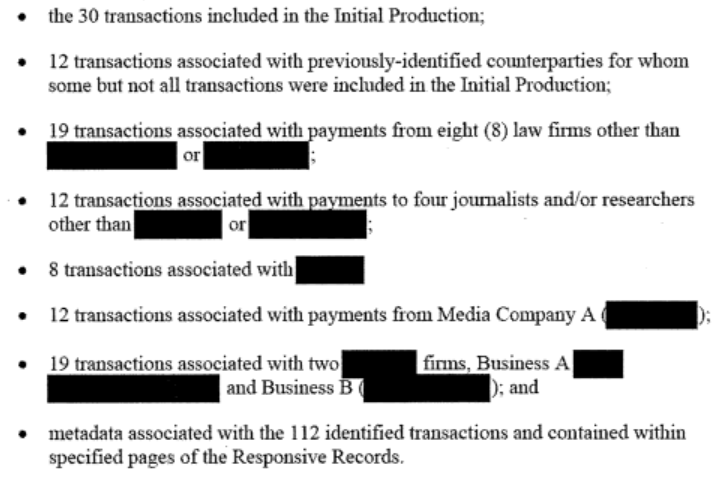
30 + 12 transactions associated with those who worked on the Steele or Prevezon projects

The filings make clear Fusion originally turned over 30 transactions. They are bolded in the ledger, which include:

  1. Transactions 5-11 (7 total) totaling $523,650.62 dated March 7, March 18, August 18, September 6, October 27, October 31, and October 31 (again) 2016 which are Baker Hostetler payments associated with Prevezon
  2. Transactions 46 (dated June 28), 48 (dated September 8), and 51 (dated November 2) paid to someone whose redacted name is of a length that it might be Rinat Ahkmetshin (3 total transactions)
  3. Transactions 77-81 (5 total) dated July 13, August 2, September 1, October 5, November 1 paid to a Russian expert with a short name [see the HPSCI justification page 5]; this may be Steele
  4. Transactions 83-88 (5 total) which are payments to someone else dated August 16, October 5, November 1, November 2, January 5, 2017
  5. Transactions 89-95 (7 total) which are payments from Perkins Coie dated May 24, July 15, July 29, August 31, September 30, October 28, and December 28
  6. Transactions 96-98 (3 total) which are payments to someone with a relatively short name dated August 11, September 2, and October 5

There are also 12 other transactions associated with people involved in those original transactions. They include:

  • A credit (Transaction 40) totaling $20,000 paid to Baker Hostetler on December 13, 2016
  • 7 payments associated with the redacted name person in 2, above, dated March 11, March 22, August 23, October 4, November 1 (which is listed as the same Bates stamp as one disclosed already), December 27, 2016 and January 5, 2017
  • 3 payments paid to the Russian researcher with the short name in 3, above, dated March 22, April 6, and May 25
  • A credit dated May 11, 2016 from the redacted name in 4, above

Comments:

There are four items of particular interest, here (before you get into coincidental dates).

First, the Russian expert with the short name is probably Steele (unless bullet 4 is him). If so, Fusion turned over payment information tied to the DNC work, but not payment information for something else (three payments in March through May) before the DNC came in. That may be stuff associated with Beacon’s funding of the earlier Trump dossier. Or it may be something else.

Second, Perkins Coie’s payments seem to track when the Trump reports come out. Except there is one payment for $58,669.00 (a curiously even number) in late December, after the last and most inflammatory Russian related report comes out on December 13. Admittedly, by report number, there are 31 reports between the October 19 and December 13 report publicly released, but the October 28 Perkins Coie payment of $365,275.33, by far the largest, would seem to pay for that. This suggests it is likely that Perkins Coie continued to pay for the dossier even after Trump won, contrary to what these entities have said in sworn declarations elsewhere. Given reports of John Podesta meeting with Christopher Steele after the election, I think that quite possible that Democrats paid for that last report.

Third, there is no payment even remotely associated with Baker Hostetler around the time of the Trump Tower meeting. There’s a March 18 payment and an August 18 one. This, in spite of the fact that Fox reported that Natalia Veselnitskaya met with Fusion both before and after the June 9, 2016 Trump Tower meeting.

But there is a payment — which Fusion says is not related to Prevezon or DNC — to the person with the name of the length of Rinat Akmetshin, on June 28. I asked in September who paid Akhmetshin to be at that Trump Tower meeting. Is that the June 28 payment? If so, who paid for him to be at that meeting?

19 transactions pertaining to 8 law firms

Then there are the payments pertaining to 8 law firms. The HPSCI justification says those are:

  1. Transactions 1-3 (3 total), dated March 11, March 23, and August 17
  2. Transaction 17, dated February 12
  3. Transaction 65, dated June 6
  4. Transaction 67, dated March 30
  5. Transaction 70-73 (4 total), dated June 10, July 6, September 28, 2016, and February 17, 2017
  6. Transaction 88, dated May 10
  7. Transactions 99-105 (7 total), dated June 10, July 29, August 31, October 13, November 29, December 15, January 11
  8. Transaction 106, dated September 13

We have no idea what these are, and Fusion may well be correct saying this is just investigative work for real cases. Mind you, HPSCI has said it has classified information to justify some of these requests (not necessarily limited to the law firms). So I think it is worth noting.

8 transactions probably associated with Beacon

The HPSCI filing (paragraph 26) makes it clear they’re trying to get the payment information associated with Beacon, which reportedly paid for the Republican side of the dossier. The only otherwise unaccounted for 8 Transactions are 54-61, which suggest those are the Beacon transactions. The HPSCI justification backs this, as it says the committee seeks to investigate a public claim (as they note, Beacon has confirmed its role in paying for the dossier). Except that produces some really weird dates: March 31, June 7, July 12, September 30, October 17, November 30, 2016, and January 4, February 15, 2017.

Those dates don’t make sense at all (because we were led to believe the Republican sponsored research started earlier than February), and they go well beyond the time the Republicans were said to have stopped paying.

12 credits probably associated with a media outlet, possibly  Yahoo

As noted, the HPSCI filing suggests there are payments from (not to) a media company, which might be Yahoo.

As Mr. Steele has acknowledged in other dossier-related litigation, in addition to sharing memos comprising the dossier with Mother Jones, in fall 2016 he met with at least five major media outlets at Fusion GPS’ direction. Those outlets included Yahoo News, which on September 23, 2016, reported purported meetings between Trump campaign advisor Carter Page and specified high-ranking Russian officials, attributed to a single “well-placed Western intelligence service.” Substantively similar allegations were contained in the dossier. Given Fusion GPS’ demonstrated patter of dossier-related engagement with media outlets, the Requested Records include records from [line and a half redacted].

Those appear to be transactions 32-43, dated pretty much monthly: February 17, March 21, April 19, May 18, June 15, July 20, August 17, September 19, October 19, November 16, December 14, 2016 and January 8, 2017, though they clearly track the election and transition time frame.

Business A transactions

Then there are two businesses. Those appear to be Transactions 12-16, which are payments on June 9, June 23, October 16, November 14, 2016 and January 26, 2017, and Transactions 18-31, which are mostly monthly payments from February 2016 to February 2017, though with some odd bunching during summer 2016. Both Business A and B are likely lobbying firms — see the redaction in the filing:
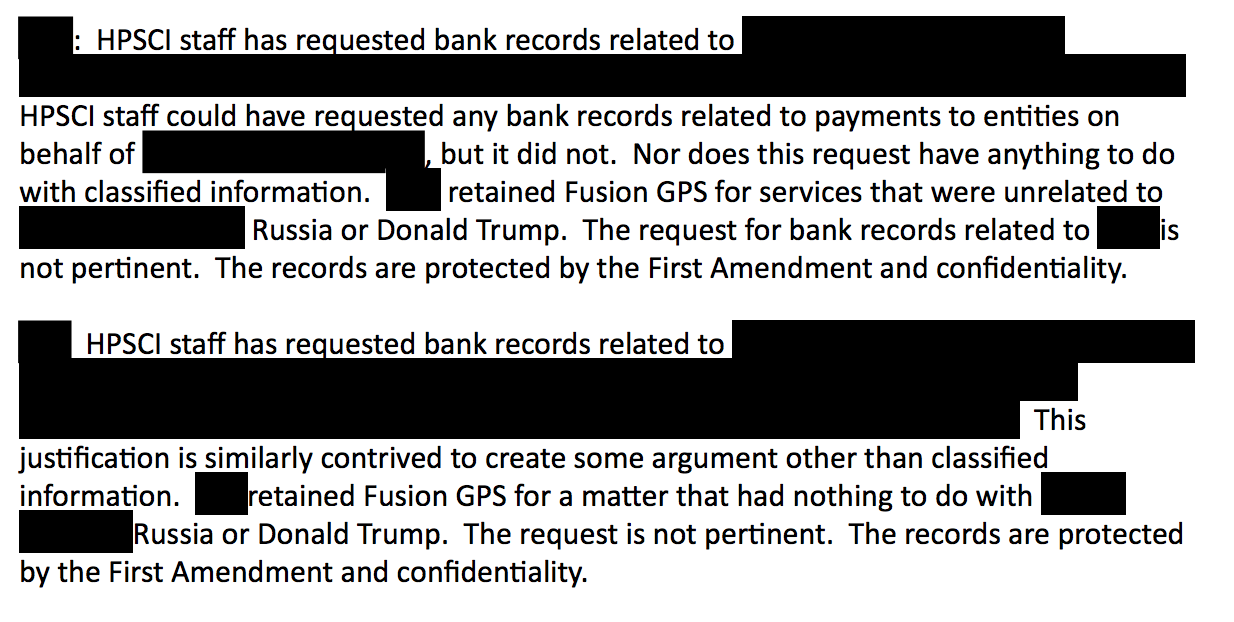
Business A appears to work on Ukrainian issues, as a footnote justifying its inclusion describes Trump’s shift on Ukranian policy.

The hacked documents would be in exchange for a Trump Administration policy that de-emphasizes Russia’s invasion of Ukraine and instead focuses on criticizing NATO countries for not paying their fare share – policies which, even as recently as the President’s meeting last week with Angela Merkel, have now presciently come to pass.”).

But that’s recent representation — “since January 2017.”

Business B transactions

Business B represents a variety of interests, but one of them is the kind of business that got mentioned in the Steele dossier as potentially colluding with Trump.

The “Steele Dossier” directly implicates [redacted] in potential collusion between the Trump campaign and Russia;

Both these businesses appear to have names that can be referred to as a short acronym.
Journalist (and other) transactions

There are three journalist transactions (besides those tied to Yahoo and Beacon):

  • Transactions 62-64, payments dated May 16, June 9, and September 6
  • Transactions 68-69, payments dated June 15 and August 26
  • Transactions 107-112, payments dated September 1, October 25, November 14, December 2, January 9, February 2

Then there is this:

  • Transaction 66, a payment dated December 12

This is not a payment to a journalist, per se, but to “individuals on [sic] have contributed to press stories on Russian issues relevant to its investigation.” This last payment, generally treated in the “journalist” category, appears to be tied to someone being quoted in the press, not writing their own work.

It’s interesting because this payment happens in the time period when the last, allegedly free report was being prepared.

Update, 12/12/17: The researcher with the short name may be Nellie Ohr, the wife of a DOJ official who was in the loop on the dossier.
Share this entry

In Defense of Subpoena for Fusion Bank Records, HPSCI Alleges Fusion Paid Journalists

The House Intelligence Committee continues to fight with Fusion GPS over records and testimony. Most specifically, they continue to fight over how many of Fusion’s bank records it should have to turn over. Yesterday, HPSCI submitted a filing that suggests a number of fairly inflammatory things about Fusion’s work, most notably that they may have paid up to four journalists and/or researchers besides Steele in conjunction in relation to topics relating to Russia, if not the dossier.

HPSCI is currently asking for:

The context in the declaration from Scott Glabe suggests the following about these requests.

The 30 initial transactions would relate to Perkins Coie and BakerHostetler, as well as the payments to Steele’s firm, though a redaction elsewhere suggests there are 6 counterparties total that Fusion has already provided records on.

HPSCI is interested in the law firms because of the way Fusion’s true clients (the Democrats and Prevezon, for example) have had law firms pay Fusion to hide their role in the project. It wants to know if those 8 law firms served as cut-outs for other Russian related work.

It is interested in Business A because it might pertain in some way to “links between Russia and individuals associated with political campaigns or any other U.S. person,” particularly some policy matter at issue in the inquiry/reflected in the dossier. HPSCI is interested in Business B because it may pertain to collusion between Russia and the Trump campaign.

With regard to journalists or researchers, Fusion has apparently already provided records related to one journalist or researcher. HPSCI is seeking records pertaining to three more. Given the reference, below, which seems to suggest an earlier redacted reference to Mother Jones, I don’t rule out the earlier one being David Corn or someone else from Mother Jones, and MoJo has a specific effort associated with Russia coverage. The 8 transactions mentioned must pertain to payments from Beacon, which funded the early work on the dossier.

The 12 transactions appear to involve payments from Yahoo to Fusion, based on the following passage:

As Mr. Steele has acknowledged in other dossier-related litigation, in addition to sharing memos comprising the dossier with Mother Jones, in fall 2016 he met with at least five major media outlets at Fusion GPS’ direction. Those outlets included Yahoo News, which on September 23, 2016, reported purported meetings between Trump campaign advisor Carter Page and specified high-ranking Russian officials, attributed to a single “well-placed Western intelligence service.” Substantively similar allegations were contained in the dossier. Given Fusion GPS’ demonstrated patter of dossier-related engagement with media outlets, the Requested Records include records from [line and a half redacted].

Mind you, I don’t understand why Yahoo would be paying Fusion if they were at the same time publishing its dirt. But the allegation is of particular interest given the way Michael Isikoff’s September story has been a central self-referential piece of “proof” dossier boosters always rely on to prove its value.

First, note that Sipher relies on “renowned investigative journalist” Michael Isikoff to validate some of these claims.

Renowned investigative journalist Michael Isikoff reported in September 2016 that U.S. intelligence sources confirmed that Page met with both Sechin and Divyekin during his July trip to Russia.

[snip]

A June 2017 Yahoo News article by Michael Isikoff described the Administration’s efforts to engage the State Department about lifting sanctions “almost as soon as they took office.”

Among the six journalists Steele admits he briefed on his dossier is someone from Yahoo.

The journalists initially briefed at the end of September 2016 by [Steele] and Fusion at Fusion’s instruction were from the New York Times, the Washington Post, Yahoo News, the New Yorker and CNN. [Steele] subsequently participated in further meetings at Fusion’s instruction with Fusion and the New York Times, the Washington Post and Yahoo News, which took place in mid-October 2016.

That the Yahoo journalist is Isikoff would be a cinch to guess. But we don’t have to guess, because Isikoff made it clear it was him in his first report after the dossier got leaked.

Another of Steele’s reports, first reported by Yahoo News last September, involved alleged meetings last July between then-Trump foreign policy adviser Carter Page and two high-level Russian operatives, including Igor Sechin — a longtime associate of Russian President Vladimir Putin who became the chief executive of Rosneft, the Russian energy giant.

In other words, Sipher is engaging in navel-gazing here, citing a report based on the Steele dossier, to say it confirms what was in the Steele dossier.

Fusion is claiming a First Amendment interest in keeping this all hidden. Me, I’m actually a bit interested in which journalists and researchers were getting and giving Fusion money.

Share this entry

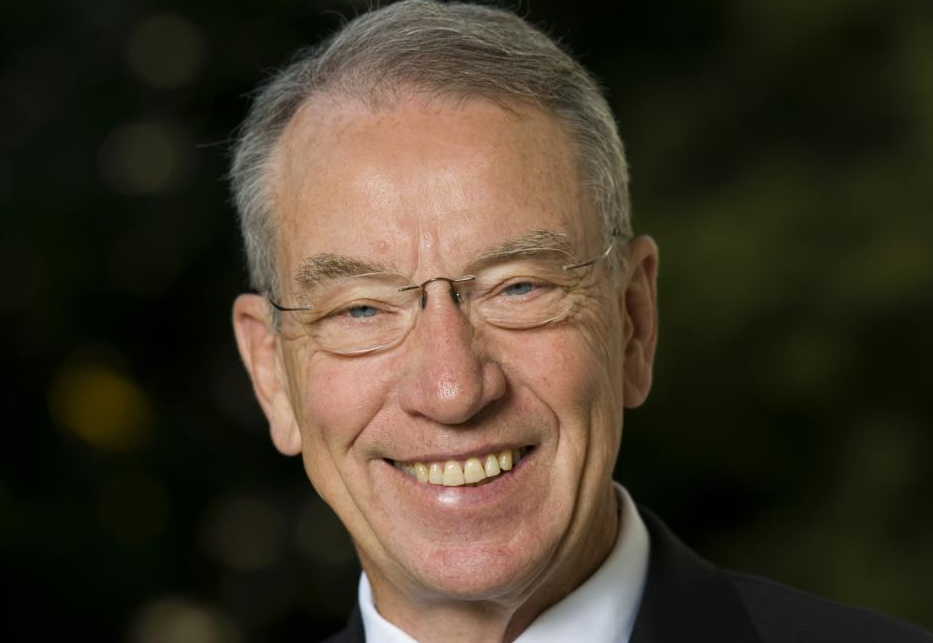
Senate Judiciary Committee Chair Chuck Grassley Has Spent the Week Cowering from His Party’s Legal Problems

In response to Monday’s server hiccups and in anticipation that Mueller is nowhere near done, we expanded our server capacity overnight. If you think you’ll rely on emptywheel reporting on the Mueller probe, please consider a donation to support the site

Of all the Republicans responding their President’s increasing legal woes, Chuck Grassley — the Chair of the Judiciary Committee — has had the most appalling week.

On Monday (even before news of the George Papadopoulos plea broke), when reporters started asking about Paul Manafort’s indictment, Grassley used some American flags as cover to hide his escape.

On Wednesday, after it became clear that Papadopoulos told the FBI Grassley’s fellow Iowan, Sam Clovis, had prioritized chumming up to Russia on the campaign generally, and encouraged Papadopoulos to set up meetings with the Russians as late as August 2016 (two months after it was public they had hacked the DNC), the Senate Judiciary Committee Chair said the allegations would not be an issue in Clovis’ confirmation to US Department of Agriculture.

Grassley said he has reviewed emails provided by the Trump campaign that include a fuller account of Clovis’ interactions with Papadopoulos. According to those 80-some emails, Grassley said, Clovis does not appear to encourage any travel to meet with Russian officials.

“There’s an entirely different context than what was reported about Clovis and his relationship to this George P.,” Grassley told reporters.

The emails he reviewed cannot be released publicly, Grassley said, although some of them have been referenced in published newspaper accounts and are referred to in the court document from the Papadopoulos case.

When asked if he believes Clovis could face legal consequences over his role in the campaign, Grassley answered that it was “too early for me to say that.”

“But,” he went on, “reading these emails … that’s not an issue.”

Grassley was still prepared to introduce Clovis at his then planned confirmation hearing, even after the allegations.

Even the White House seems to disagree with Grassley’s assessment that these allegations are “not an issue” though, because Clovis has since withdrawn from consideration.

And then later on Wednesday, several days after I first showed that the Papadopoulos plea showed that Jeff Sessions had perjured himself yet again in Senate testimony, Chuck Grassley was still unsure whether he’d even call on the Attorney General to explain his serial lies before his committee.

Senate Judiciary Chairman Chuck Grassley said Thursday he was still learning all the details about the Papadopoulos matter.
Asked if Sessions should amend his testimony before his committee, Grassley told CNN: “I’m looking into it.”

I’ve long defended Grassley’s legitimate questions about the investigation — most notably questions about the Steele dossier. But all week the senior Republican overseer of the Justice Department has been cowering from the clear implications of this scandal. Perhaps it’s because Grassley has a duty, here, to ensure the integrity of a department led by a serial perjurer, he has instead been hiding and dodging.

Share this entry

The Cost of the Lawfare Surrounding the Steele Dossier Will Vastly Outstrip Its Original Cost

In response to Monday’s server hiccups and in anticipation that Mueller is nowhere near done, we expanded our server capacity overnight. If you think you’ll rely on emptywheel reporting on the Mueller probe, please consider a donation to support the site

Yesterday, Reuters reported that Fusion GPS has told Congress (presumably as part of the settlement on a bank subpoena reached last week) how much it got paid for the dossier on Donald Trump, and how much of that it paid Christopher Steele for his part in the dossier. Fusion got $1.02 million from Perkins Coie, of which Steele got $168K.

Fusion GPS’ statement said it had told Congress about how $168,000 was paid last year to Orbis Business Intelligence, Steele’s company.

The money paid to Orbis was taken from $1.02 million it received in fees and expenses from the Perkins Coie law firm, the statement said.

There’s some confusion about this number, however, with some claiming that Fusion had a huge markup on Steele’s labor. But that’s not right. We’ve now confirmed what we’ve seen is just part of the total dossier Fusion did on Trump. If the numbering in the dossier is any indication, there were at least 166 reports done, with 79 done between the time  started on the dossier in April and when Steele got involved in June. Of the total, we’ve seen just 17 released reports from Steele, or about 10% of the total (assuming none of his Russian-related reports were withheld). That would put his payment — over 16% of what Fusion got paid — to be a reasonable fraction (of course much of the rest of the dossier is likely domestic and less reliant on paid sources built up over decades).

In any case, as Reuters points out, it’s far less than the $12 million Trump has alleged.

But it’s also far less than what the dossier will cost in the long run. As I’ve been tracking, there are a number of strands of “lawfare” surrounding the dossier — Russian and Republican attempts to use lawsuits to make the dossier toxic. They include:

  • Alexej Gubarev’s lawsuit against Steele and his company in the UK
  • Alexej Gubarev’s lawsuit against BuzzFeed in FL (with related subpoena challenges being litigated in DC)
  • The lawsuit by Alfa Bank executives against BuzzFeed in DC (filed after consulting with top GOP lawyers Viet Dinh and Brian Benczkowski and their firm)
  • Fusion’s efforts to fight testimony and bank subpoenas in DC
  • Carter Page’s lawsuit against HuffPo and Yahoo

In addition, I would be shocked if Marc Elias doesn’t get slapped with a lawsuit or two, now that his role in funding the dossier has become known. With the exception of Page’s suit, each of those involves at least two sets of well paid lawyers to fight things out.

Which is to say that the lawfare surrounding the dossier may well end up costing $12 million, even assuming no one ever has to pay any penalties. Which seems to offer a lesson for sleazy politicos: If you’re going to pay to develop dirt on your opponent, make sure that the blowback from it doesn’t cost more in terms of dollars and damage than the actual dossier itself.

Share this entry

Did Manafort Prep Trump for the Dossier Lawfare

In the wake of the report that Marc Elias paid for the Steele dossier on behalf of the Democratic party, Ken Vogel linked back to an old story of his, reporting that the day after the Steele dossier came out, Manafort had a conversation with Reince Priebus about it.

It was about a week before Trump’s inauguration, and Manafort wanted to brief Trump’s team on alleged inaccuracies in a recently released dossier of memos written by a former British spy for Trump’s opponents that alleged compromising ties among Russia, Trump and Trump’s associates, including Manafort.

“On the day that the dossier came out in the press, Paul called Reince, as a responsible ally of the president would do, and said this story about me is garbage, and a bunch of the other stuff in there seems implausible,” said a personclose to Manafort.

[snip]

According to a GOP operative familiar with Manafort’s conversation with Priebus, Manafort suggested the errors in the dossier discredited it, as well as the FBI investigation, since the bureau had reached a tentative (but later aborted) agreement to pay the former British spy to continue his research and had briefed both Trump and then-President Barack Obama on the dossier.

Manafort told Priebus that the dossier was tainted by inaccuracies and by the motivations of the people who initiated it, whom he alleged were Democratic activists and donors working in cahoots with Ukrainian government officials, according to the operative.

I think Vogel retweeted it because the story laid out much of what came next.

But I’m interested in it for several other reasons. First, where did Manafort learn of this? Did he learn of it from the Russians tied to the death, just a few weeks earlier, of one of the suspected sources of the dossier? If so, does Mueller have transcripts of those conversations?

And how broadly were Manafort’s comments shared in the White House? Did Brian Benczkowski, then running the transition team at DOJ, but not long later, advising Alfa Bank to sue BuzzFeed over it, learn of Manafort’s comments?

I’ve never been surprised that both Russians and Republicans were engaging in lawfare to expose the underlying circumstances of the dossier’s existence. I’ve just been amazed at how well coordinated that lawfare was. I mean, sure, it didn’t take much to understand that’s where this was going. But did Manafort serve as a go-between here, to make the lawfare more effective?

And if so, did Priebus tell Mueller about it in his interview?

Share this entry

Reasons Why Dems Have Been Fucking Stupid on the Steele Dossier: a Long Essay

Let me start this post by reposting in full my explanation of why Trump opponents are idiots for clinging to the Steele dossier, so I can add to that with an explanation of why the disclosure that Marc Elias paid for the dossier on behalf of Hillary and the DNC makes it far, far worse.

I have zero doubt that the Russians attempted to influence the election. I think it likely Robert Mueller will eventually show evidence that senior people in Trump’s camp attempted to and may have coordinated with people working for Russia, and people more tangential to the campaign sought out Russians for help. I think if the full story of the Russian involvement in the election comes out, it will be worse than what people currently imagine.

I also think Trump opponents have made a really grave error in investing so much in the Steele dossier. That’s true because, from the start, there were some real provenance questions about it, as leaked. Those questions have only grown, as I’ll explain below. The dossier was always way behind ongoing reporting on the hack-and-leak, meaning it is utterly useless for one of the most important parts of last year’s tampering. The dossier provides Trump officials a really easy way to rebut claims of involvement, even when (such as with Michael Cohen) there is ample other evidence to suggest inappropriate ties with Russia. Most importantly, the dossier is not needed for the most common reason people cling to it, to provide a framework to understand Trump’s compromise by Russia. By late January, WaPo’s reporting did a far better job of that, with the advantage that it generally proceeded from events with more public demonstrable proof. And (again, given the abundance of other evidence) there’s no reason to believe the Mueller investigation depends on it.

But because Trump opponents have clung to the damn dossier for months, like a baby’s blanket, hoping for a pee tape, it allows Trump, Republicans, and Russians to engage in lawfare and other means to discredit the dossier as if discrediting the dossier will make the pile of other incriminating evidence disappear.

So let’s see how the Marc Elias disclosure makes this far, far worse.

The WaPo reports that Elias’ firm, Perkins Coie, acting on behalf of both Hillary and the DNC, paid Fusion GPS. And they did so much earlier than previously reported, starting in April.

Marc E. Elias, a lawyer representing the Clinton campaign and the DNC, retained Fusion GPS, a Washington firm, to conduct the research.

After that, Fusion GPS hired dossier author Christopher Steele, a former British intelligence officer with ties to the FBI and the U.S. intelligence community, according to those people, who spoke on the condition of anonymity.

Elias and his law firm, Perkins Coie, retained the company in April 2016 on behalf of the Clinton campaign and the DNC. Before that agreement, Fusion GPS’s research into Trump was funded by an unknown Republican client during the GOP primary.

Given the numbering of the dossier, the April date makes far better sense than the June date. In fact, on January 13, I said, “It must have started sometime in April.” Yay me — that’s the one piece of prescience I’ll write about here I’m happy about.

The news comes as Fusion has been digging itself deeper and deeper into a perjury hole in an effort to protect Elias and the Democrats, just as they would have had to release financial documents showing Perkins Coie’s involvement in any case (I’ll do a follow-up to show that Fusion seems to have been using a cute definition of “client” in its sworn legal declarations about the dossier).

Some of the details are included in a Tuesday letter sent by Perkins Coie to a lawyer representing Fusion GPS, telling the research firm that it was released from a ­client-confidentiality obligation. The letter was prompted by a legal fight over a subpoena for Fusion GPS’s bank records.

As the WaPo and an army of Dem flacks have noted since this story broke, it is totally normal to pay oppo research firms for dirt on opponents.

It is!!

Which ought to raise really big questions why Elias didn’t come forward before now to simply admit that Hillary and the Dems — rather than some unnamed big donor as has always been intimated — were doing what every campaign normally does.

And there are several likely reasons for that.

First, consider what position this puts the FBI in. Steele started sharing his information with the FBI during the summer, possibly before the FBI opened an investigation into Trump’s Russian ties (though the CIA claims to have had a report in June about such ties, so the investigation doesn’t derive exclusively from the dossier). It’s still unclear — not even given Steele’s legal statements on this fact — whether Steele shared the information on his own, or whether Fusion permitted him to share. It’s also not clear whether Steele disclosed to FBI who was paying for his work (or even if he actually knew). But it is qualitatively different for the FBI to accept and respond to information from a political party than it is to respond to information paid for by — say — a rich private person like George Soros. That is, admittedly, how the Whitewater investigation got started (so I can appreciate the irony), but it was wrong then and it’s wrong now.

Note, this detail also provides a much better explanation for why the FBI backed out of its planned relationship with Steele in October, one that matches my supposition. As soon as it became clear Elias was leaking the dossier all over as oppo research, the FBI realized how inappropriate it was to use the information themselves, no matter how credible Steele is. This also likely explains why FBI seeded a story with NYT, one Democrats have complained about incessantly since, reporting “none of the investigations so far have found any conclusive or direct link between Mr. Trump and the Russian government.” Ham-handed? Sure. But in the wake of Harry Reid and David Corn’s attempts to force FBI to reveal what Democratic oppo research had handed to FBI, the FBI needed to distance themselves from the oppo research, and make sure they didn’t become part of it. Particularly if Steele was not fully forthcoming about who was paying him, the FBI was fucked.

And consider what Hillary and the DNC did. Back when the June 9 Trump Tower meeting first broke, I warned Democrats who were screaming that this was proof of collusion to be very careful of how they defined it.

[T]hus far, it is not evidence of collusion, contrary to what a lot of people are saying.

That’s true, most obviously, because we only have the implicit offer of a quid pro quo: dirt on Hillary — the source of which is unknown — in exchange for sanctions relief. We don’t (yet) have evidence that Don Jr and his co-conspirators acted on that quid pro quo.

But it’s also true because if that’s the standard for collusion, then Hillary’s campaign is in trouble for doing the same.

Remember: A supporter of Hillary Clinton paid an opposition research firm, Fusion GPS, to hire a British spy who in turn paid money to Russians — including people even closer to the Kremlin than Veselnitskaya — for Russia-related dirt on Don Jr’s dad.

Yes, the Clinton campaign was full of adults, and so kept their Russian-paying oppo research far better removed from the key players on the campaign than Trump’s campaign, which was run by incompetents. But if obtaining dirt from Russians — even paying Russians to obtain dirt — is collusion, then a whole bunch of people colluded with Russians (and a bunch of other foreign entities, I’m sure), including whatever Republican originally paid Fusion for dirt on Trump.

Breaking: Our political process is sleazy as fuck (but then, so are most of our politicians).

I assumed at the time that Democrats were adults and provided Hillary some plausible deniability and distance from the payments to ex-spooks who in turn paid Russian spies.

Serves me right for underestimating, yet again, Hillary’s ability to score own goals, because Nope! They’re not that adult! And so while it pains me greatly to have to say this, the Dems who screamed “COLLUSION!!!!!!!!” after evidence of a meeting but not payment have earned this attack from Ari Fleischer, accusing them of colluding, because that’s the standard they adopted at the time.

Finally, there’s the most interesting thing implicated by the disclosure that Perkins Coie partner Marc Elias paid for the dossier.

As noted, the WaPo explains Elias started to do so in April, which makes far more sense given the numbering of the dossier. But Steele, we know, was brought in in June; his first report, about whether Russia had kompromat on Hillary, was June 20. That means Steele’s involvement, paid for by Perkins Coie, postdates the involvement of Perkins Coie partner (and former DOJ prosecutor who should have known better than to do this) Michael Sussman in the DNC’s response to learning they were hacked by Russia, starting around April 29.

“Not sure it is related to what the F.B.I. has been noticing,” said one internal D.N.C. email sent on April 29. “The D.N.C. may have been hacked in a serious way this week, with password theft, etc.”

No one knew just how bad the breach was — but it was clear that a lot more than a single filing cabinet worth of materials might have been taken. A secret committee was immediately created, including Ms. Dacey, Ms. Wasserman Schultz, Mr. Brown and Michael Sussmann, a former cybercrimes prosecutor at the Department of Justice who now works at Perkins Coie, the Washington law firm that handles D.N.C. political matters.

“Three most important questions,” Mr. Sussmann wrote to his clients the night the break-in was confirmed. “1) What data was accessed? 2) How was it done? 3) How do we stop it?”

It also means that Steele’s involvement — paid for by Perkins Coie — roughly coincides with the time Democrats and Perkins Coie partner Michael Sussman first sat down with the FBI and pushed the FBI to “tell the American public that” Russia had attacked the Democrats.

The D.N.C. executives and their lawyer had their first formal meeting with senior F.B.I. officials in mid-June, nine months after the bureau’s first call to the tech-support contractor. Among the early requests at that meeting, according to participants: that the federal government make a quick “attribution” formally blaming actors with ties to Russian government for the attack to make clear that it was not routine hacking but foreign espionage.

“You have a presidential election underway here and you know that the Russians have hacked into the D.N.C.,” Mr. Sussmann said, recalling the message to the F.B.I. “We need to tell the American public that. And soon.”

Shortly thereafter, Steele, paid for by Perkins Coie, started sharing reports with the FBI, with as yet unknown disclosure to them about who was paying his bills. Do you see why this is a problem yet?

Note, too, the irony. The DNC was unwilling to share their server directly with the FBI. But they were willing to launder their intelligence to it.

Not cool, Democrats. Also, not smart.

Now, add to this massive own goal the Democrats have scored on themselves. The second report in the released dossier, is dated July 26, released four days after WikiLeaks started releasing the DNC emails, making it clear the Democrats had a far bigger hack-and-leak problem on their hands than they had let on in a June 14 story to the WaPo. It is an incredibly back-assward report on Russian hacking that proved unaware of the most basic publicly known details about Russia’s hacking (the Democrats would have been better served reading this report that had been released ten months before, which is almost certainly what FBI was trying to point them to when they first warned of the hack in September). That is, in the wake of the DNC hack, the Democrats’ lawyer paid for private intelligence about Russian involvement with Trump, and they ended up paying someone whose sources (because Steele is a follow-the-money guy, not a follow-the-packets guy) consistently were months and months behind the public knowledge on the hack.

Yikes.

Finally, one more point. It has been clear for some time that Steele’s reports had some kind of feedback loop, responding to information the Democrats got. That was most obvious with respect to the September 14 Alfa Bank report, which was obviously written after first news of the Alfa Bank/Trump Tower story, which was pushed by Democratic partisans. Particularly given that we know the released report is a selective release of just some reports from the dossier, the inclusion of Alfa Bank in that release makes no sense. Even if reports about old corrupt ties between Alfa and Putin are true (as if Democratic politicians and corrupt American banks never have old ties), the inclusion of the Alfa report in the dossier on Trump made zero sense.

Which is why Alfa Bank decided — after consulting with big Republican lawyers like Viet Dinh and soon-to-be DOJ Criminal Division Chief Brian Benczkowski — to sue for defamation. Now I understand why (particularly given that Republicans seem to have known who paid for the dossier for some time). I’m not sure Alfa Bank executives pass the bar for defamation here (though the publication of a report that misspelled Alfa’s name is pretty damning), but the fact that Elias paid for this dossier on behalf of the Democrats is going to make that defamation case far more explosive (and I’ll be surprised if Elias doesn’t get added into the mix).

As I said when I began this: I have no doubt Russia tampered with the election, and if the full truth comes out I think it will be more damning than people now imagine.

But the Democrats have really really really fucked things up with their failures to maintain better ethical distance between the candidate and the dossier, and between the party and the FBI sharing. They’ve made things worse by waiting so long to reveal this, rather that pitching it as normal sleazy political oppo research a year ago.

The case of Russian preference for Trump is solid. The evidence his top aides were happy to serve as Russian agents is strong.

But rather than let FBI make the case for that, Democrats instead tried to make their own case, and they did in such a way as to make the very solid case against Trump dependent on their defense of the dosser, rather than on better backed claims released since then.

Boy it seems sadly familiar, Democrats committing own goals like this. And all that’s before where the lawfare on this dossier is going to go.

Update, 12/6/17: This, from April, is a really interesting claim by claim debunking of the dossier.

Share this entry

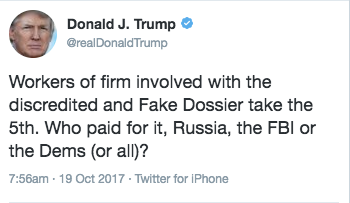
In Defense of Trump’s Steele Dossier Tweet

I can’t believe what I’m about to do.

I’m going to defend this tweet from Donald Trump as reasonable.

Before I do, let me say two things.

First, I have zero doubt that the Russians attempted to influence the election. I think it likely Robert Mueller will eventually show evidence that senior people in Trump’s camp attempted to and may have coordinated with people working for Russia, and people more tangential to the campaign sought out Russians for help. I think if the full story of the Russian involvement in the election comes out, it will be worse than what people currently imagine.

I also think Trump opponents have made a really grave error in investing so much in the Steele dossier. That’s true because, from the start, there were some real provenance questions about it, as leaked. Those questions have only grown, as I’ll explain below. The dossier was always way behind ongoing reporting on the hack-and-leak, meaning it is utterly useless for one of the most important parts of last year’s tampering. The dossier provides Trump officials a really easy way to rebut claims of involvement, even when (such as with Michael Cohen) there is ample other evidence to suggest inappropriate ties with Russia. Most importantly, the dossier is not needed for the most common reason people cling to it, to provide a framework to understand Trump’s compromise by Russia. By late January, WaPo’s reporting did a far better job of that, with the advantage that it generally proceeded from events with more public demonstrable proof. And (again, given the abundance of other evidence) there’s no reason to believe the Mueller investigation depends on it.

But because Trump opponents have clung to the damn dossier for months, like a baby’s blanket, hoping for a pee tape, it allows Trump, Republicans, and Russians to engage in lawfare and other means to discredit the dossier as if discrediting the dossier will make the pile of other incriminating evidence disappear.

I believe the Trump opponents’ investment in the Steele dossier will ultimately lead to a bad own goal.

All that said, I think Trump’s tweet today, while as typically douchey as all his tweets, is somewhat defensible (and the fact that it is defensible should serve as a warning to those still clinging to the Steele dossier).

Workers of firm … take the 5th

Trump is referring to the fact that two Fusion employees refused to testify before the House Intelligence Committee under a subpoena issued unilaterally by Devin Nunes. There is significant confusion, spread in part by their attorney, as to why they would not testify. Beforehand, their attorney said the First Amendment permitted them to blow off the committee (which wouldn’t even be true for a journalist, much less an oppo research firm pretending for convenience to be a journalistic enterprise). Since it happened, several credible journalists have said Fusion’s lawyer said they pled the Fifth (which would work, but would also mean they felt they had criminal exposure).

So the point it at least contested.

My guess is they’re just stalling, with the knowledge that if Nunes has to find a way to enforce his subpoena, the rest of the committee will get to weigh in and will refuse to back his effort.

Discredited and Fake

It is true that anonymous sources say that the FBI has corroborated some things in the dossier (and Andy McCarthy makes an uncharacteristically worthwhile argument for what the tea leaves say). It is also true that Dianne Feinstein confirmed during the summer that we only have part (and given the numbering, probably a very small part) of the dossier. So we can’t be sure whether the bits FBI has corroborated are public at all.

There are things, as I’ve noted, that totally discredit parts of the dossier, such as the fact that it reported Russia hadn’t succeeded in hacking top targets almost a year after it was widely reported FSB already had (in general, the dossier is awful on the hack, as I lay out in this post; Steele’s speciality is in following the money and it shows).

Then there’s the fact that the unnecessary report on Alfa bank misspells their name: it’s a minor point but one those engaging in lawfare always point out.

The one thing that most people focus on — a Prague meeting between Cohen and the Russians — is not backed by the US passport he showed BuzzFeed.

A number of people have claimed that the dossier reported, 11 days after it occurred, the June 9 Trump Tower meeting. But as I lay out in this post, the dossier says the kompromat in question is older stuff based off wiretaps of Hillary, and it actually claims that Russia had not yet shared the intelligence in question, meaning the dossier did not confirm the June 9 meeting.

That doesn’t mean it’s discredited. But it doesn’t mean we know what parts of it have been corroborated, and some parts are not true (as we should expect from raw intelligence).

Who paid for it: Russia

The most problematic thing Trump said is that Russia may have paid for the dossier. It’s true we don’t know who paid for the dossier (indeed, that is the chief reason why Fusion doesn’t want to testify, to hide who did pay for it). Rumors say that a Jeb Bush supporter paid for it up until June 2016 (meaning, for a bunch of reports that aren’t public at all), and a Hillary supporter paid for it until November. Steele has claimed in court filings that the reports that came after that, including the December 13 report that has the most incendiary claims (including that Trump paid hackers involved in the operation), that he worked for free after November and that his sources — who normally would be paid — also just dumped the intelligence that happened to be the most inflammatory parts into his lap.

The Defendants continued to receive unsolicited intelligence on the matters covered by the pre-election memoranda after the US Presidential election and the conclusion of the assignment for Fusion.

After receiving some such intelligence [Steele] prepared the confidential December memorandum, … on his own initiative on or around 13 December 2016.

That last claim — that Steele worked for free — is pretty sketchy, especially when you consider that (given the numbering in the dossier and Feinstein’s confirmation we’ve got just part of the dossier) there were likely 31 reports filed between October 19 and December 13.

Regardless of who really paid for the work, the fact that Steele claims he (and his sources) were working for free, the fact that the Russians would have known about the dossier at least by October 31, when David Corn wrote about it, and possibly by mid-September, when Steele started briefing journalists on it, the fact that Aleksej Gubarev quickly sued, the fact that a suspected dossier source died in mysterious circumstances in December, and the fact that the last report tied everything up in a neat little bow, suggests the Russians may have been feeding Steele disinformation by that last report.

Does that mean the Russians paid Steele? Absolutely not. It’s an outrageous insinuation. Does that mean that any disinformation in the dossier was ultimately paid for by Russia and that it is not crazy to imagine the later reports included at least some disinformation? Yup.

Then there’s another detail that makes the Russian accusation at least reasonable: the fact that Rinat Ahkmetshin had a relationship with Fusion (to work on anti-Magnitsky stuff) at precisely the same time as Fusion was working on the Trump dossier. Not only does that fact make it more likely Russians eventually learned of the dossier and fed Steele disinformation, but it also means Fusion was getting paid by Russians at the same time as or not long before it was producing free Steele dossier work.

Who paid for it: FBI

People seem most offended by Trump’s claim that FBI may have paid for the dossier. The reporting on this point conflicts, but note that CNN has said that Steele got paid by the FBI for expenses.

CNN:

The FBI reimbursed some expenses of the former British intelligence operative who produced a dossier containing allegations of President Donald Trump’s ties to Russia, people familiar with the matter said.

WaPo:

The former British spy who authored a controversial dossier on behalf of Donald Trump’s political opponents alleging ties between Trump and Russia reached an agreement with the FBI a few weeks before the election for the bureau to pay him to continue his work, according to several people familiar with the arrangement.

The agreement to compensate former MI6 agent Christopher Steele came as U.S. intelligence agencies reached a consensus that the Russians had interfered in the presidential election by orchestrating hacks of Democratic Party email accounts.

[snip]

Ultimately, the FBI did not pay Steele. Communications between the bureau and the former spy were interrupted as Steele’s now-famous dossier became the subject of news stories, congressional inquiries and presidential denials, according to the people familiar with the arrangement, who spoke on the condition of anonymity because they were not authorized to discuss the matter.

NBC:

The FBI reached a deal in October to pay a former British spy who had compiled a dossier on Donald Trump’s alleged ties with Russia, an indication of how seriously the bureau was taking the allegations, according to a person familiar with the matter.

The deal for the former operative, Christopher Steele, to continue his work on behalf of the FBI fell apart when Steele pulled out, said the source, who has direct knowledge of the situation.

Given what Chuck Grassley has asked and said in response, my suspicion is the reality is that FBI paid Steele’s expenses for trips to explain sourcing and other details of the dossier to them, meaning their funds didn’t pay his sources or for his time, but did pay for him to meet with the FBI.

Who paid for it: Dems

This claim is a no-brainer. According to the public story, a Hillary supporter — who has always been presumed to be a Democrat though there’s no reason that has to be true (indeed, it is utterly conceivable that the same person paid for the work first in Jeb’s name and then in Hillary’s) — paid for all the reports we have, save the December 13 one.

(or all)?

Finally, people are especially offended that Trump, with his “or all,” insinuated that the FBI and Russians were colluding against Trump.

It’s certainly possible that’s what he intended. But the public record at least claims that three different entities paid for the dossier over time; that same record makes a reasonable claim that both the Dems and FBI paid some money to support the dossier.

All of which is to say the serial payment for the dossier does not require that “or all” to be a malicious insinuation of collusion (heh) between FBI and Russia.

I know this will be an unbelievably unpopular post. But the dossier simply isn’t as pristine as those clinging to it want it to be. Which is a good reason for Trump opponents to spend more time highlighting the great reporting of the WaPo or NYT, which often as not has been confirmed and is backed by public information.

Update: Made some tweaks in my argument that Trump opponents should stop clinging to the Steele dossier.

Share this entry

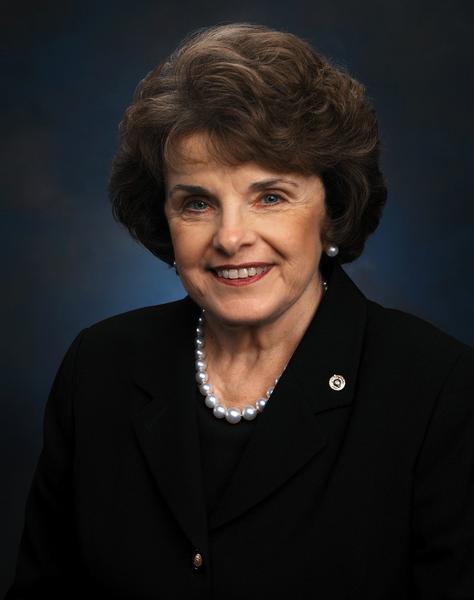
Senator Feinstein Confirms the Public Steele Dossier Is Not the Whole Thing

For something else, I’m rewatching the confirmation hearing for Brian Benczkowski to be Assistant Attorney General of the Criminal Division. (at 1:55)

Feinstein: Before you go on, do you have the whole dossier?

Benczkowski: I read the dossier online as it was published on BuzzFeed [raises two fingers]

Feinstein: The whole dossier is not online.

Benczkowski: The only thing that I have done, Senator, in that regard, was read the two pages as to Alfa Bank.

Feinstein: You have not seen the whole dossier?

Benczkowski: I have not.

The Senate Judiciary Committee had, by this point, been investigating the Steele Dossier for months (though this question preceded the Glenn Simpson testimony by a month). This is the classic Feinstein hearing disclosure, and past history suggests it would be accurate.

Which is to say what we’re seeing is just a fraction of the dossier — which is a point I’ve been making from the start (it also means the balance of the dossier may be more sensitive). It also means that someone made cherry picked the reports to first brief and then ultimately to leak to the press, which itself should be an issue for inquiry.


Share this entry

Chuck Grassley Finally Shows Concern about Parallel Construction — Affecting Trump

As I’ve said repeatedly, I think Chuck Grassley’s concerns about the Steele dossier — and FBI’s refusal to answer questions about it — generally have merit. That continues with his latest letter to FBI.

Effectively, he’s worried that because Steele shared the dossier with MI6, the FBI might effectively be parallel constructing intelligence that ultimately came from Steele, and so from a oppo research dossier.

There is another concern about Mr. Steele’s and Fusion GPS’s work that the FBI needs to address.  Public reports indicate that the FBI received the dossier and has used it in the Russia investigation.  However, it appears that the FBI, the media, and various Congressional offices were not the only recipients of the dossier prior to its publication.  In court filings by Mr. Steele’s attorneys in London, he admitted that he had passed at least some contents of the dossier to at least one foreign government – the United Kingdom.[1]

Media reports have also claimed that foreign governments passed along information to the United States about purported contacts between Trump associates and Russians.  Given that Mr. Steele also distributed the dossier’s contents to at least one foreign government, it is possible that this political dossier’s collusion allegations, or related allegations originating via Mr. Steele, may have also been surreptitiously funneled into U.S. intelligence streams through foreign intelligence sharing.  If so, that foreign information would likely have ended up within the FBI’s investigation of allegations of collusion between Trump associates and Russia.  However, given that foreign intelligence agencies carefully guard their sources and methods, it may not have been clear to the FBI that the foreign reporting was actually based on the work of Mr. Steele and Fusion GPS.

If this in fact happened, it would be alarming.  Mr. Steele’s dossier allegations might appear to be “confirmed” by foreign intelligence, rather than just an echo of the same “research” that Fusion bought from Steele and that the FBI reportedly also attempted to buy from Steele.  It is even more alarming in light of what we are learning about the allegedly unregistered Russian foreign agents who Fusion GPS and Glenn Simpson were working with to undermine the Magnitsky Act and who met with Trump family and campaign officials last summer.

The Committee must understand what steps the FBI has taken to ensure that any foreign information it received and used in the Russia investigation, beyond the dossier itself, was not ultimately sourced to Mr. Steele, his associates such as Fusion GPS, or his sub-sources.

It’s a fair point — as mentioned, he’s effectively describing parallel construction, which the FBI uses all the time to hide the ultimate source for its evidence on defendants (though usually, that process involves obtaining subpoenas to hide what kind of foreign intelligence it relies on).

So I’m grateful the Chair of the Senate Judiciary Committee has finally decided to turn his focus on a process that is badly abused, to the detriment of due process in this country.

I just wish he expressed the same concern for less famous targets, rather than just the President.

Share this entry

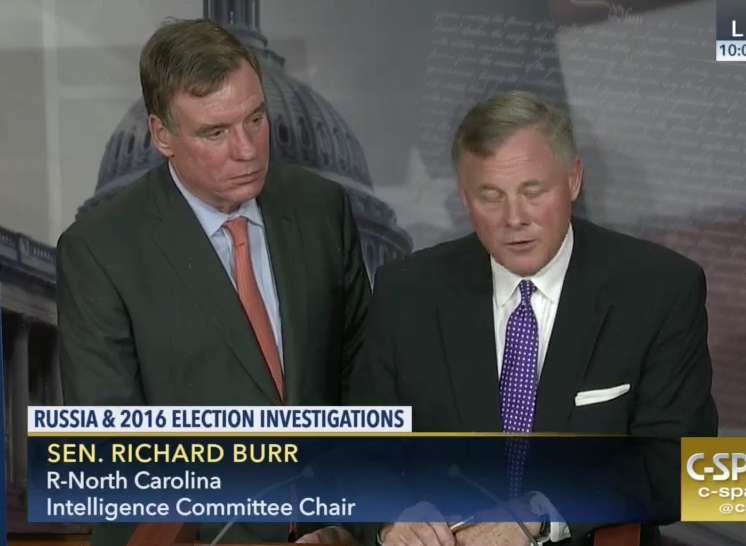
Richard Burr’s Tacit Warning to Christopher Steele

I’m just now catching up to Richard Burr and Mark Warner’s press conference on the Russia investigation yesterday. I saw some folks questioning why they did the presser, which surprises me. The answer seems obvious. They did the presser to release and apply pressure from specific areas of the investigation. For example, Burr exonerated those involved in the Mayflower Hotel meetings on April 2016 and further argued that the GOP platform was not changed to let Russia off the hook for Ukraine (I think the latter conclusion, in any case, is correct; I’m less persuaded about the first). Warner used the presser to push for Facebook to release the ads sold to Russia.

A particularly instance of this — one that I believe has been misunderstood by those who’ve reported it thus far — pertains to the Steele dossier. Here’s what Burr said about it, working off of prepared remarks (meaning issuing this tacit warning was one purpose of the presser; after 16:00):

As it relates to the Steele dossier: unfortunately the committee has hit a wall. We have on several occasions made attempts to contact Mr. Steele, to meet with Mr. Steele, to include, personally, the Vice Chairman and myself as two individuals, of making that connection. Those offers have gone unaccepted. The committee cannot really decide the credibility of the dossier without understanding things like who paid for it? who are your sources and sub-sources? We’re investigating a very expansive Russian network of interference in US elections. And though we have been incredibly enlightened at our ability to rebuild backwards, the Steele dossier up to a certain date, getting past that point has been somewhat impossible. And I say this because I don’t think we’re going to find any intelligence products that unlock that key to pre-June of ’16. My hope is that Mr. Steele will make a decision to meet with either Mark and I or the committee or both, so that we can hear his side of it, versus for us to depict in our findings what his intent or what his actions were. And I say that to you but I also say that to Chris Steele.

People seem to interpret this to mean SSCI hasn’t been able to corroborate the dossier — a point on which Burr is ambiguous. He references intelligence products that might unlock secrets of the dossier, which might suggest the committee has found intelligence products from later in the process that either confirms or doesn’t the events as the dossier as produced.

More important, however, is his reference to June 2016. While it seems like Burr might be suggesting the committee has found no evidence on collusion dating to before that date, that would seem to be inconsistent with the committee having received information on Michael Cohen’s discussions of financial dealings from before June (though given Burr’s exoneration of the Mayflower attendees, he may deem the earlier activities to be inconclusive).

So it seems more likely Burr raised the June 2016, along with his question about how paid for the report, to suggest he has real questions about whether its findings served as a partisan effort to taint Trump, paid for by a still undisclosed Hillary backer.

If Christopher Steele won’t talk about what intelligence he had on Trump before the time when, in June 2016, he reported on Russia providing kompromat (though not, at that point, hacked emails) on Hillary to Trump’s team, Burr seems to be saying, then it will be far easier to question his motivations and the conclusions of the report. And frankly, given some of the details on the Steele dossier — especially Steele’s briefings to journalists and his claim that the customers for the brief never read it — Burr is right to question that.

In other words, one point of the presser, it seems to me, was for Burr to warn Steele that his dossier will not be treated as a credible piece of work unless and until the committee gets more details about the background to it.

Update: Apparently, Steele responded to Burr’s comments by informing the committee he is willing to meet with Burr and Warner.

Share this entry