Posts

The Silent Cast of Characters in the Very Noisy Recent Mueller Moves

A fuck-ton has happened in the Mueller investigation already this month. Amid the noisy pleas and indictments, we’ve seen indications of hidden cooperation from a range of people, cooperation that may point to where Mueller’s next steps are.

Here, arranged by the date of the development, are hints at who either was or soon is likely to be talking to Mueller’s team.

February 1: In a proffer to Mueller’s team, Rick Gates lied about a March 19, 2013 meeting with Paul Manafort, Vin Weber, and Dana Rohrabacher.

Rohrabacher’s statement in response to the guilty plea is inconsistent with the version laid out in the plea, suggesting he’s not the means by which Mueller’s team learned it was a lie.

After the guilty plea on Friday, a spokesman for Rohrabacher, who has sought better relations with Russia, said: “As the congressman has acknowledged before, the meeting was a dinner with two longtime acquaintances –- Manafort and Weber –- from back in his White House and early congressional days.”

“The three reminisced and talked mostly about politics,” the spokesman said. “The subject of Ukraine came up in passing. It is no secret that Manafort represented Viktor Yanukovych’s interests, but as chairman of the relevant European subcommittee, the congressman has listened to all points of view on Ukraine.”

This suggests someone else provided the version of the meeting the government included in the plea. While it’s possible the other version came from Gates’ former lawyers, it’s more likely the version came from someone else. Vin Weber is the most likely source of that information.

Back in August 2016, as news of the secret ledger was breaking,Weber suggested he may have been misled by Manafort, both as to the purpose of his lobbying and regarding the need to register as a foreign agent for Ukraine. If he felt that way in August 2016, I imagine he came to feel that even more strongly as Manafort’s legal woes intensified.

February 9: Returning a call from John Kelly but speaking to Don McGahn, Rod Rosenstein spoke of “important new information” about Jared Kushner that will delay his clearance.

Given all the evidence that suggests Jared faces very significant exposure in this investigation, this new information could be any number of things. But two possibilities are likely. First, it might reflect Jared’s January 3 disclosure of additional business interests in yet another update to his SF-86, or his family’s increasing debt over the last year.

More likely, it reflects things the government has learned from Mike Flynn (who has an incentive to burn Jared, given that the President’s son-in-law was asked for and didn’t provide exonerating information tied to Flynn’s own lies to the FBI). Indeed, that seems to be one theory of those who reported on this phone call.

Kushner’s actions during the transition have been referenced in the guilty plea of former Trump national security adviser Michael Flynn, who admitted he lied to the FBI about contacts with then-Russian Ambassador Sergey Kislyak. Prosecutors said Flynn was acting in consultation with a senior Trump transition official, whom people familiar with the matter have identified as Kushner.

All that said, there are two more possibilities. Given that she appears to have lied to the Senate Foreign Relations Committee in her confirmation process, KT McFarland would be an obvious follow-up interview after the Mike Flynn plea; she asked Trump to withdraw her nomination to be Ambassador to Singapore on February 3. And February 9 might be (though probably isn’t, quite) late enough to catch the first sessions of Steve Bannon’s 20 hours of interviews with Mueller, and Bannon has long had it in for Jared.

February 14: Alex Van der Zwaan got caught and pled guilty to lying about communications he had with Rick Gates, Konstantin Kilimnik, and Greg Craig in September 2016. On top of whatever he had to say to prosecutors between his second interview on December 1 and his plea on February 14, both Craig and Skadden Arps have surely provided a great deal of cooperation before and since September 2016. (As I was finishing this, NYT posted this story that details some, but not all, of that cooperation.)

February 16: As I noted in my post on the Internet Research Agency indictment, Rod Rosenstein was quite clear: “There is no allegation in the indictment that any American was a knowing participant in the alleged unlawful activity.” That said, there are three (presumed) Americans who, both the indictment and subsequent reporting make clear, are treated differently in the indictment than all the other Americans cited as innocent people duped by Russians: Campaign Official 1, Campaign Official 2, and Campaign Official 3. We know, from CNN’s coverage of Harry Miller’s role in building a cage to be used in a fake “jailed Hillary” stunt, that at least some other people described in the indictment were interviewed — in his case, for six hours! — by the FBI. But no one else is named using the convention to indicate those not indicted but perhaps more involved in the operation. Furthermore, the indictment doesn’t actually describe what action (if any) these three Trump campaign officials took after being contacted by trolls emailing under false names.

On approximately the same day, Defendants and their co-conspirators used the email address of a false U.S. persona, [email protected], to send an email to Campaign Official 1 at that donaldtrump.com email account, which read in part:

Hello [Campaign Official 1], [w]e are organizing a state-wide event in Florida on August, 20 to support Mr. Trump. Let us introduce ourselves first. “Being Patriotic” is a grassroots conservative online movement trying to unite people offline. . . . [W]e gained a huge lot of followers and decided to somehow help Mr. Trump get elected. You know, simple yelling on the Internet is not enough. There should be real action. We organized rallies in New York before. Now we’re focusing on purple states such as Florida.

The email also identified thirteen “confirmed locations” in Florida for the rallies and requested the campaign provide “assistance in each location.”

[snip]

Defendants and their co-conspirators used the false U.S. persona [email protected] account to send an email to Campaign Official 2 at that donaldtrump.com email account.

[snip]

On or about August 20, 2016, Defendants and their co-conspirators used the “Matt Skiber” Facebook account to contact Campaign Official 3.

Again, the DOJ convention of naming makes it clear these people have not been charged with anything. But we know from other Mueller indictments that those specifically named (which include the slew of Trump campaign officials named in the George Papadopoulos plea, KT McFarland and Jared Kushner in the Flynn plea, Kilimnik in the Van der Zwaan plea, and the various companies and foreign leaders that did Manafort’s bidding, including the Podesta Group and Mercury Public Affairs in his indictment) may be the next step in the investigation. As a reminder: Florida Republicans are those who most tangibly can be shown to have benefitted from Russia’s hack-and-leak, given that Guccifer 2.0 leaked a slew of Democratic targeting data for the state. (In perhaps related news, this week Tom Rooney became the third Florida Republican member of Congress to announce his retirement this cycle, which is all the more interesting given that he’s been involved in the HPSCI investigation into Russian tampering.)

February 23: Manafort’s superseding indictment (a version of which was originally filed February 16) added the description of the Hapsburg Group for former European officials who lobbied at the direction (to some degree via cut-outs) of Manafort.

MANAFORT explained in an “EYES ONLY” memorandum created in or about June 2012 that the purpose of the “SUPER VIP” effort would be to “assemble a small group of high-level European highly influencial [sic] champions and politically credible friends who can act informally and without any visible relationship with the Government of Ukraine.” The group was managed by a former European Chancellor, Foreign Politician A, in coordination with MANAFORT.

It may be that the government only recently obtained this document (meaning it was not among the 590,000 pages of documents obtained and turned over to Manafort in discovery thus far). But it’s likely this also reflects further testimony. Former Austrian Chancellor Alfred Gusenbauer denied he is Foreign Politician A to BBC, though that may be a non-denial denial tied to his claim he wasn’t directed by Manafort and only met him a few times (this Austrian story suggests only he doesn’t remember what American or English firm paid him). NYT reported that Gusenbauer’s lobbying during the relevant time period was registered under Mercury Public Affairs. This is another piece of evidence suggesting the group — and Vin Weber personally — has been cooperating since the original indictment.

Note, I assume that Mercury/Weber’s cooperation has been mirrored by Tony Podesta’s.

Share this entry

Jared’s Clearance and the Foreign Policy Version of Conspiracy to Defraud America


I confess there is no multi-day Trump story I’ve looked forward to more than the problem with Jared Kushner’s clearance. And it is officially here. Last night, the NYT described how Jared is butting heads with John Kelly over whether he’ll lose clearance under Kelly’s post-Rob Porter mandate that people who can’t be cleared won’t be kept around anymore.

Kushner, frustrated about the security clearance issue and concerned that Mr. Kelly has targeted him personally with the directive, has told colleagues at the White House that he is reluctant to give up his high-level access, the officials said. In the talks, the officials say, Mr. Kushner has insisted that he maintain his current level of access, including the ability to review the daily intelligence briefing when he sees fit.

Today CNN and WaPo weigh in, with CNN nodding towards the conflict this will present Trump.

Though a source familiar with the situation said Kushner has not yet appealed to the President directly about his access to highly classified information, those close to Trump believe he would be inclined to grant his son-in-law access if asked. This source pointed to the fact that Kushner is part of the President’s family and has outlasted all of his rivals in Trump’s inner circle, including former chief of staff Reince Priebus, former chief strategist Steve Bannon, former campaign manager Corey Lewandowski and former deputy campaign manager David Bossie.

Trump, however, has given Kelly his full support in efforts to reform the White House’s system of security clearances, and has told his chief of staff that changes need to be made to bring the system into order, according to a person who has spoken to him about the matter. Kelly has interpreted that as a wide-ranging mandate that would include Kushner, a person familiar with the matter said. The person said Trump and Kelly would likely discuss the matter this week, if they haven’t already, before Kelly’s self-imposed Friday deadline.

WaPo brings the appropriate level of skepticism over whether Kushner can really do his Fake Peace Plan job without clearance.

It is not clear how Kushner could perform his job without a high-level security clearance.

He holds a broad range of responsibilities, from overseeing peace efforts in the Middle East to improving the efficiency of the federal government. And he is the administration’s interlocutor with key allies, including China and Saudi Arabia, where he has developed a personal relationship with the young crown prince, Mohammed bin Salman.

[snip]

And apart from staff on the National Security Council, he issues more requests for information to the intelligence community than any White House employee, according to a person with knowledge of the situation, who spoke on the condition of anonymity to describe private discussions.

More importantly, WaPo includes a series of false bravado quotes from Jared’s defense attorney, Abbe Lowell, who bizarrely offered up his judgement that Jared is speaking with foreign officials “properly.”

“My inquiries to those involved again have confirmed that there are a dozen or more people at Mr. Kushner’s level whose process is delayed, that it is not uncommon for this process to take this long in a new administration, that the current backlogs are being addressed, and no concerns were raised about Mr. Kushner’s application,” he said in a statement.

[snip]

Lowell said Kushner’s job is “to talk with foreign officials, which he has done and continues to do properly.”

I’ve come to think of Kushner’s clearance process in similar terms to the way I’ve thought of the bail process Mueller has used with Paul Manafort and Rick Gates: While Gates ultimately did make bail, Manafort is still (!) almost four months after his arrest, struggling to show enough liquidity free of taint from his money laundering to alter his release conditions. The process of making bail (and having to serially beg to attend his kids’ soccer events) seems to have been one of the factors that brought Gates to the point of flipping, but along the way, he probably gave Mueller’s team far more leverage in plea negotiations, because they know how little Gates actually has to pay a defense attorney to oversee the flip (indeed, that may lie behind the confusion over Gates’ current legal representation).

Kushner’s liquidity problems are literally an order of magnitude greater than these men. But unlike them, he made the idiotic decision to work in the White House, and thereby to undergo the scrutiny of sworn statements laying out all the financial vulnerabilities and foreign entanglements that might make him susceptible to blackmail.

Which brings me back to my description of how Mueller is leveraging “conspiracy to defraud the United States” (what I will henceforward refer to as ConFraudUS*) charges to prosecute political influence peddling for which our regulatory system has completely collapsed. With the Internet Research Agency indictment, Mueller charged ConFraudUS because the trolls bypassed a campaign finance system that no longer works. With Manafort and Gates, Mueller charged ConFraudUS because they bypassed Foreign Agents Registration Act requirements that have never been enforced.

In the old days, to pursue the kind of quid pro quo we see outlines of, in which Trump officials (from George Papadopoulos’ proposed business with Sergei Millian to the possibility Kushner might get bailed out by the Russian Direct Investment Fund, which is itself a cut-out for the sanctioned Vnesheconombank, whose head, Sergey Gorkov, Kushner met in December 2016), you’d pursue bribery. But post-Bob McDonnell, bribery is a far tougher charge to make stick, as Mueller prosecutor Andrew Goldstein, who worked on the Sheldon Silver prosecution team, knows well.

What if, however, you could charge people whose meetings seamlessly tie the foreign policy decisions of the United States with discussions of their own financial interests, with ConFraudUS? That might make it easier to charge someone whose foreign policy decisions don’t serve the US interest but might enrich them for the quid pro quo entailed.

Which is why I’m interested in the report that Mueller has shown increased interest (almost certainly tied to Steven Bannon’s public pronouncements that, “It goes through Deutsche Bank and all the Kushner shit”) in Jared’s foreign financial dealings, how he has mixed his business interests and US foreign policy.

One line of questioning from Mueller’s team involves discussions Kushner had with Chinese investors during the transition, according to the sources familiar with the inquiry.
A week after Trump’s election, Kushner met with the chairman and other executives of Anbang Insurance, the Chinese conglomerate that also owns the Waldorf Astoria hotel in New York, according to The New York Times.

At the time, Kushner and Anbang’s chairman, Wu Xiaohui, were close to finishing a deal for the Chinese insurer to invest in the flagship Kushner Companies property, 666 Fifth Avenue. Talks between the two companies collapsed in March, according to the Times.

Mueller’s team has also asked about Kushner’s dealings with a Qatari investor regarding the same property, according to one of the sources. Kushner and his company were negotiating for financing from a prominent Qatari investor, former prime minister Hamad bin Jassim Al Thani, according to The Intercept. But as with Anbang, these efforts stalled.

Lowell’s false bravado in this report is even more ridiculous than that in the clearance stories.

A representative for Kushner declined to comment prior to the publication of this story. After publication, Kushner attorney Abbe Lowell told CNN in a statement, “Another anonymous source with questionable motives now contradicts the facts — in all of Mr. Kushner’s extensive cooperation with all inquiries, there has not been a single question asked nor document sought on the 666 building or Kushner Co. deals. Nor would there be any reason to question these regular business transactions.”

Lowell may not have turned over any documents relating to 666 Fifth Avenue. But Deutsche Bank got subpoenas even before Bannon started running his mouth (albeit in a separate EDNY probe). Moreover, the key detail under my imagined ConFraudUS charge would be whether Kushner did things — like try to get Chinese investors visas — that didn’t serve or indeed violated the interests of the United States. Admittedly, the President gets largely unfettered control over the foreign policy of the United States (though Trump has defied Congress in areas where they do have some control). But to the extent Jared pursued his own business interests during the transition, he wouldn’t be able to claim to rely on presidential prerogative.

Which brings me back to Jared’s long struggle to get a security clearance.

Abbe Lowell may not have turned over the financial documents on 666 Fifth Avenue that would show how susceptible Jared’s debt woes make him to foreign influence. But he has serially provided that evidence in support of Jared’s almost certainly futile attempt to convince the FBI he should get a permanent TS/SCI security clearance.

I laid this out yesterday at the very end of my Democracy Now appearance:

I think—the reason why Kushner’s business deals are important, we’ve talked—and in the intro, this wasn’t the only example of—there’s the Don Jr. We’ve talked about how poorly Trump’s people have separated his business interests from the interests of the country. The same is even more true for Jared Kushner, whose family business is basically bankrupt. And over and over again, he’s been shown to be in negotiations with entities, including Russians, but also Chinese and Middle Eastern. So, you know, he’ll go in and say, “OK, we’ll talk about this grand peace plan,” which is not about peace at all, “but, oh, by the way, can you bail out our 666 Park Avenue building, which is badly underwater?” And I think Mueller could make the same argument he’s made with the IRA indictment and the Manafort indictment, and say that Jared Kushner is pretending to be serving America’s foreign policy interests, but in fact he is just doing his own bidding. He’s just trying to bail out his own company. So I wouldn’t be surprised if he’s moving towards a very similar indictment on conspiracy to defraud the United States, having to do with his conflicts of interest.

AMY GOODMAN: And, of course, interesting that Kushner also hasn’t managed to get top security clearance, when he’s a senior adviser to President Trump, as Porter didn’t because he beat his wives, etc. And then you’ve got Donald Jr. now in India promoting Trump businesses, as, of course, Donald Trump is the president of the United States. And he’s standing with the prime minister of India as he does this, promoting the Trump brand, Marcy.

MARCY WHEELER: Exactly. I mean, if Trump and his son and his son-in-law are pretending to be doing the business of the United States but are instead just trying to enrich themselves, again, I don’t think it’s a—you know, we’ve talked about the Emoluments Clause and how you go after the Trump campaign—the Trump officials for their egregious conflicts of interest. And, frankly, it extends into his Cabinet. But what Mueller seems to be doing, with some very good appellate lawyers, by the way, is to be laying out this framework that if you are pretending to be doing something in the interest of the United States but are actually doing something else, serving somebody else’s bidding, whether it’s Russia, pro-Russian Ukrainian political party, or whether it’s your own family business, then they’re going to go after you for a conspiracy charge. And I wouldn’t be surprised if these conspiracy charges all kind of link up at the end, in this kind of grand moment of—I think that’s where he’s headed.

Remember, Trump and his spawn never really thought they’d win the election. Instead, they seemed interested in, among other things, a Trump Tower in Moscow and refinancing 666 Fifth Avenue. But if they made deals with Russians in hopes such personal financial benefits would result, a ConFraudUS charge might be a way to prosecute them for it.

*I originally shortened this “CTDTUS,” but following Peter Crowley’s suggestion, I’m instead using “ConFraudUS.”


[Note: At the top of this post there is an embedded video of Marcy’s interview with Democracy Now. It isn’t rendering properly on all browsers and operating systems and may appear as a blank space. You can watch the video or listen to audio at this link. /~R]

Share this entry

New Right Hook: Mike Flynn Lied When He Admitted to a Judge He Lied to the FBI

Apparently, the latest Grassley-Graham effort to spin a very understandable reaction to the discovery that the incoming National Security Advisor might be compromised by Russia — to have a meeting about whether that requires a change in the government’s investigative approach and then memorialize the meeting — as a Christopher Steele plots is not an isolated event. To accompany the Grassley-Graham effort to obscure, the right wing is now seeing a conspiracy, best captured in this Byron York piece with follow-ups elsewhere, in Mike Flynn’s guilty plea.

At issue is leaked March 2017 testimony from Jim Comey (in a piece complaining about the leak of Flynn’s FISA intercepts) that the FBI agents who interviewed Flynn on January 24, 2017 believed any inaccuracies in Flynn’s interview with the FBI were unintentional.

In March 2017, then-FBI Director James Comey briefed a number of Capitol Hill lawmakers on the Trump-Russia investigation.

[snip]

According to two sources familiar with the meetings, Comey told lawmakers that the FBI agents who interviewed Flynn did not believe that Flynn had lied to them, or that any inaccuracies in his answers were intentional. As a result, some of those in attendance came away with the impression that Flynn would not be charged with a crime pertaining to the Jan. 24 interview.

From that, York spins out a slew of laughable claims: Mike Flynn would have no reason to address the FBI amid swirling coverage of lies about Russian ties! The Deputy Attorney General “sends” FBI agents to conduct interviews! DOJ “effectively gave” Jim Comey authority to decide Hillary’s fate but then fired him for usurping that authority! They lead up to York’s theory that DOJ may have overridden the FBI agents in forcing Flynn to sign a plea admitting he made false statements.

It could be that the FBI agents who did the questioning were overruled by Justice Department officials who came up with theories like Flynn’s alleged violation of the Logan Act or his alleged vulnerability to blackmail.

[snip]

To some Republicans, it appears the Justice Department used a never-enforced law and a convoluted theory as a pretext to question Flynn — and then, when FBI questioners came away believing Flynn had not lied to them, forged ahead with a false-statements prosecution anyway. The Flynn matter is at the very heart of the Trump-Russia affair, and there is still a lot to learn about it.

Along the way, York feigns apparent ignorance of everything he knows about how criminal investigations work.

For example, York pretends to be unaware of all the pieces of evidence that have surfaced since that time that have changed the context of Flynn’s January 24 interview. There’s the weird dinner Trump invited Comey to on January 27, a day after Sally Yates first raised concerns about the interview with White House Counsel Don McGahn, where Trump told Comey “I need loyalty, I expect loyalty.” There’s the more troubling meeting on February 14, where (after asserting that Flynn had indeed lied to Mike Pence) Trump asked Comey to drop the Flynn investigation.

He repeated that Flynn hadn’t done anything wrong on his calls with the Russians, but had misled the Vice President. He then said, “I hope you can see your way clear to letting this go, to letting Flynn go. He is a good guy. I hope you can let this go.”

There’s the March 30 phone call in which the President complained about the “cloud” of the Russian investigation. There’s the April 11 phone call where the President complained about that “cloud” again, and asked for public exoneration. There’s the newly reported Don McGahn call following that conversation, to Dana Boente asking for public exoneration. There’s Comey’s May 9 firing, just in time for Trump to tell Russians on May 10 that firing that “nut job” relieved pressure on him. There’s the letter Trump drafted with Stephen Miller’s help that made it clear Comey was being fired because of the Russian investigation.

Already by the time of Comey’s firing, the White House claim that Mike Flynn got fired because he lied about his conversations to Sergey Kislyak to Mike Pence, was falling apart.

Then, in August, the Mueller team obtained the transition emails that transition lawyers had withheld from congressional requests (and therefore from Mueller), including those of Flynn himself, Jared Kushner, and KT McFarland. The transition would go on to squawk that these emails, which didn’t include Trump and dated to before Trump became President, were subject to executive privilege, alerting Mueller that the emails would have been withheld because the emails (some sent from Mar-A-Lago) reflected the involvement of Trump. Not to mention that the emails tied conversations about Russia to the “thrown election.”

Then there’s Jared Kushner’s interview with Mueller’s team in the weeks before Mike Flynn decided to plead guilty. At it, prosecutors asked Jared if he had any information that might exculpate Flynn.

One source said the nature of this conversation was principally to make sure Kushner doesn’t have information that exonerates Flynn.

There were reports that Flynn felt like he had been sold out just before he flipped, and I would bet this is part of the reason why. In addition to instructions regarding the sanction calls with Kislyak, which were directed by KT McFarland, Flynn’s statement of offense describes someone we know to be Kushner directing Flynn to call countries, including Russia, to try to persuade them to avoid a vote on Israeli West Bank settlements.

On or about December 22, 2016, a very senior member of the Presidential Transition Team directed FLYNN to contact officials from foreign governments, including Russia, to learn where each government stood on the resolution and to influence those governments to delay the vote or defeat the resolution.

Granted, Mueller’s team didn’t make the point of the lies as obvious as they did with the George Papadopoulos plea, where they made clear Papadopoulos lied to hide that he learned of the “dirt” on Hillary in the form of emails after he started on the campaign and whether he told the campaign about those emails (not to mention that he had contacts with Ivan Timofeev).

Mueller’s not telling us why Flynn’s lies came to have more significance as Mueller collected more and more evidence.

But what they make clear is that the significance of Flynn’s lies was not, as it first appeared, that he was trying to hide the subject of the calls from Mike Pence. I mean, maybe he did lie to Pence about those calls. But discussions about how to work with the Russians were not secret; they included at least Kushner, McFarland, Tom Bossert, Reince Priebus, Steve Bannon, and Sean Spicer. Some of those conversations happened with McFarland emailing while at Mar-A-Lago with the President-Elect.

So given the weight of the evidence collected since, Flynn’s lies now appear neither an effort to avoid incriminating himself on Logan Act charges, nor an effort to cover up a lie he told others in the White House, but the opposite. His lies appear to have hidden how broadly held the Russian discussions were within the transition team, not to mention that he was ordered to make the requests he did, possibly by people relaying orders from Trump, rather than doing them on his own.

That, by itself, doesn’t make the Flynn conversations (as distinct from the lies) illegal. But it means Trump went to great lengths to try to prevent Flynn from suffering any consequences for lying to hide the degree to which negotiations with Russia during the transition period were the official policy of the Trump team. And when Trump (or rather, his son-in-law) stopped protecting Flynn on that point, Flynn decided to admit to a judge that he had been knowingly lying.

It doesn’t take a conspiracy to realize that the FBI Agents who interviewed Flynn in January had none of the evidence since made available largely because Trump tried so hard to protect Flynn that he fired his FBI Director over it. It takes looking at the evidence, which makes it clear why those false statements looked very different as it became clear Flynn, after acting on Trump transition team instructions, got sold out as other senior Trump officials started trying to protect themselves.

Share this entry

How the White House’s Tolerance for Wife-Beaters Exposed That It Was Harboring Counterintelligence Threats

There are a lot of important lessons about the White House’s protection and promotion of Rob Porter even after the FBI informed the White House about his serial wife beating: about White House’s tolerance for conflicts, about John Kelly’s overblown competence. If you haven’t read Dahlia Lithwick’s piece on what it says about society’s response to domestic abuse more generally, absolutely do.

There are also multiple theories about how this all came to light, whether the recent girlfriend who learned of the abuse after talking to the ex-wives about Porter’s philandering made it happen, or whether the FBI did so in the wake of White House involvement in the Devin Nunes saga.

Whatever the answers to those issues, it’s now clear what just or is about to happen.

Last night, the WaPo answered a question that should have been answered at yesterday’s presser. There are dozens of people working in the White House who, like Porter, have not yet received clearance. Starting with the son-in-law that has been remapping the world while under active counterintelligence investigation for shaping policy in a way that may stave off familial bankruptcy.

Dozens of White House employees are awaiting permanent security clearances and have been working for months with temporary approvals to handle sensitive information while the FBI continues to probe their backgrounds, according to U.S. officials.

People familiar with the security-clearance process said one of those White House officials with an interim approval is Jared Kushner — the president’s son-in-law and one of his most influential advisers.

Then Politico provided the other, even more critical piece of this puzzle: FBI already told the White House that Porter and others would not get security clearance. And there are witnesses that Kelly knew about these multiple White House aides and thought they should be fired.

White House chief of staff John Kelly was told several weeks ago that the FBI would deny full security clearances to multiple White House aides who had been working in the West Wing on interim security clearances.

Those aides, according to a senior administration official, included former White House staff secretary Rob Porter, who left the White House on Thursday after reports that he physically and verbally abused his two ex-wives.

The White House chief-of-staff told confidants in recent weeks that he had decided to fire anyone who had been denied a clearance — but had yet to act on that plan before the Porter allegations were first reported this week.

I figure around about noon we’ll learn Jared was one of the others.

Remember: according to Supreme Court precedent, the President has final authority on matters of clearance. So if Trump wants to override the FBI’s determination, he can. Which he might get away with so long as it remained secret, so long as the press didn’t know that a bunch of people were working with the country’s most sensitive information even though the FBI had told the White House it was a very bad idea to let them. And know which ones they were.

But whether through the coincidental timing of a bunch of women refusing to let a serial abuser go on with his life or through orchestration by the Bureau or both, any effort to keep secret that the White House was delaying the obvious counterintelligence choice or even perhaps planning to defy the FBI about it is in the process of being exposed.

Trump is reportedly consulting now with two of the most likely counterintelligence problems, Jared and (on her own right, because of her own dodgy business deals) Ivanka, on a staff shake-up to try to make this problem go away.

Share this entry

Are There Other Emails about the June 9 Meeting?

Something has been bugging me about this NYT story from last week reporting that, in a conference call with Mark Corallo on July 9, 2017 (see the timeline of events below), Hope Hicks told him emails on the June 9, 2016 Trump Tower meeting between Don Jr, Paul Manafort, and Jared Kushner and Natalia Veselnitskaya, Rinat Akhmetshin, Ike Kaveladze, and Rob Goldstone would never come out.

Corallo is planning to tell Mr. Mueller about a previously undisclosed conference call with Mr. Trump and Hope Hicks, the White House communications director, according to the three people. Mr. Corallo planned to tell investigators that Ms. Hicks said during the call that emails written by Donald Trump Jr. before the Trump Tower meeting — in which the younger Mr. Trump said he was eager to receive political dirt about Mrs. Clinton from the Russians — “will never get out.” That left Mr. Corallo with concerns that Ms. Hicks could be contemplating obstructing justice, the people said.

[snip]

In Mr. Corallo’s account — which he provided contemporaneously to three colleagues who later gave it to The Times — he told both Mr. Trump and Ms. Hicks that the statement drafted aboard Air Force One would backfire because documents would eventually surface showing that the meeting had been set up for the Trump campaign to get political dirt about Mrs. Clinton from the Russians.

According to his account, Ms. Hicks responded that the emails “will never get out” because only a few people had access to them.

As the story describes, the emails in question were already prepped (by the lawyers with whom Corallo worked on a day to day basis) to send to Congress, which would have made it really hard for anyone to withhold the emails.

Congress had requested records from Paul Manafort, Mr. Trump’s campaign chairman; Mr. Kushner; and other Trump campaign officials about meetings with Russians. And lawyers had already copied and stamped the emails for delivery to Capitol Hill.

But elsewhere in the story, the NYT admits that even as (or shortly after) that meeting transpired it already had the emails Don Jr released that day and was going to publish them itself.

The younger Mr. Trump ultimately released the emails after being told The Times was about to publish them.

The original story (as well as the second one) described that the meeting was discovered when Kushner disclosed it on one of his many revisions to his security clearance application and in a response from Paul Manafort to congressional inquiries.

The Trump Tower meeting was not disclosed to government officials until recently, when Mr. Kushner, who is also a senior White House aide, filed a revised version of a form required to obtain a security clearance.

[snip]

Manafort, the former campaign chairman, also recently disclosed the meeting, and Donald Trump Jr.’s role in organizing it, to congressional investigators who had questions about his foreign contacts, according to people familiar with the events.

But nothing in that description would mean Congress would have gotten the emails yet, which is where investigative materials normally get leaked to the press (though it’s possible Manafort had already turned them over).

Michael Wolff’s book reports the Bannon suspicion that a Jared aide (presumably Josh Raffel), who was in the initial meeting where Trump forced everyone else to say the June 9 meeting dealt primarily with adoptions, leaked the emails to the NYT.

Indeed, the best guess by many in the West Wing was that the details of the meeting had been leaked by the Kushner side, thus sacrificing Don Jr. in an attempt to deflect responsibility away from themselves.

[snip]

The lawyers, and spokesperson Mark Corallo, had been working to manage this news. But while in Hamburg, the president’s staff learned that the Times was developing a story that had far more details about the meeting—quite possibly supplied by the Kushner side—which it would publish on Saturday, July 8.

But it describes the Jared team as leaking details, not the emails themselves. Plus, it’s hard to see how the emails don’t also implicate Jared, unless he’s going to bank on having left the meeting as his means to defend himself even in light of all the other damning evidence he was willing to chat up Russians later in the year.

Furthermore, given that Jared was an active player in that first meeting, it’s hard to understand how Hicks wouldn’t have known that Jared would have to disclose any emails that involved him personally.

There’s one other detail of note. The NYT makes it clear that the lawyers (and Corallo) in DC were kept out of the loop on the panic on Air Force One and that they didn’t know the NYT was working on a story. Though it’s unclear where the Circa story that those lawyers (and Corallo) did contribute to came from, then, as it feels like an effort to pre-empt the NYT with a friendly outlet.

Significantly, the Circa story is the source of the claim that Trump didn’t know about the meeting that I noted here (which the lawyers are said to have believed, which is why the Trump and his family weren’t consulting with the lawyers).

President Trump was not aware of the meeting and did not attend it, according to the lawyers.

It’s also significant, though, because it adopts the line Paul Manafort seems to have convinced Reince Priebus to adopt, pointing to problems with the dossier and Fusion GPS as a way to discredit the entire investigation.

“We have learned from both our own investigation and public reports that the participants in the meeting misrepresented who they were and who they worked for,” said Mark Corallo, a spokesman for President Trump’s legal team. “Specifically, we have learned that the person who sought the meeting is associated with Fusion GPS, a firm which according to public reports, was retained by Democratic operatives to develop opposition research on the President and which commissioned the phony Steele dossier. ”

“These developments raise serious issues as to exactly who authorized and participated in any effort by Russian nationals to influence our election in any manner,” Corallo said.

I raise all this to highlight two possibilities: that the emails are all that exist, but that they were leaked by someone — Manafort? Bannon? Corallo? — to punish the White House for its first misleading lies about the meeting. Perhaps Gorelick leaked them, which might explain why she stopped representing Jared days later?

But there’s another possibility: that more emails exist, between Don Jr and Rob Goldstone (indeed, we know Goldstone sent follow-up emails involving Vkontakte). Or that there are communications between other players. In which case the release of the current emails might serve to distract from a fuller set that Hicks did succeed in burying.

In any case, not only is Corallo prepping his meeting with Mueller’s team, but Steve Bannon seems intent on meeting with Mueller before HPSCI has an opportunity to run interference with him.

A source familiar with the matter added that Bannon would instead answer all of special counsel Robert Mueller’s questions as part of his investigation.

So whatever particular complaints the Corallo/Kasowitz/Bannon/Priebus crowd has about the way things went down may soon be shared with Mueller.


Early July 7: NYT approaches WH officials and lawyers; WH schedules a conference call w/NYT for next morning.

July 7: Trump chats up Putin at dinner. (Note, whenever Melania decides it’s time to get revenge on Trump for treating her like shit, she can go tell Mueller what she overheard of this conversation.)

July 8, morning: Conference call doesn’t happen. NYT submits 14 questions about the meeting to the WH and lawyers of Trump campaign aides who attended the meeting (do these aides include all of Don Jr, Kushner, and Manafort?); Trump and his aides develop a response on Air Force One, with Hicks coordinating with Don Jr and his lawyer Alan Garten, who were both in NY, via text message.

July 8, afternoon: Jamie Gorelick provides a statement describing his revisions to his security clearance forms.

He has since submitted this information, including that during the campaign and transition, he had over 100 calls or meetings with representatives of more than 20 countries, most of which were during transition. Mr. Kushner has submitted additional updates and included, out of an abundance of caution, this meeting with a Russian person, which he briefly attended at the request of his brother-in-law Donald Trump Jr. As Mr. Kushner has consistently stated, he is eager to cooperate and share what he knows.

July 8, evening: Garten issues a statement in Don Jr’s name stating,

It was a short introductory meeting. I asked Jared and Paul to stop by. We primarily discussed a program about the adoption of Russian children that was active and popular with American families years ago and was since ended by the Russian government, but it was not a campaign issue at that time and there was no follow up. I was asked to attend the meeting by an acquaintance, but was not told the name of the person I would be meeting with beforehand.

July 8, 5PM: NYT publishes story.

July 8, slightly later: Circa publishes different story based on Mark Corallo’s statement, admitting Magnitsky Act discussion.

July 9, morning: Hope Hicks calls Corallo, with Trump in the room, accusing him of trafficking in conspiracy theories. It is this call, according to the NYT, where Hicks said the emails would never come out.

July 9: Don Jr issues a new statement.

After pleasantries were exchanged, the woman stated that she had information that individuals connected to Russia were funding the Democratic National Committee and supporting Mrs. Clinton. Her statements were vague, ambiguous and made no sense. No details or supporting information was provided or even offered. It quickly became clear that she had no meaningful information.

July 14: Jamie Gorelick quits representing Kushner on Russian issues.

July 20: Mark Corallo quits.

July 21: Marc Kasowitz quits.


Some lawyers and witnesses who have sat in or been briefed on the interviews have puzzled over Mr. Mueller’s interest in the episode. Lying to federal investigators is a crime; lying to the news media is not. For that reason, some of Mr. Trump’s advisers argue that Mr. Mueller has no grounds to ask the president about the statement and say he should refuse to discuss it.

Share this entry

Feinstein’s Homework Assignments

While Devin Nunes has been getting all the headlines for trying to muck up the Mueller investigation, Chuck Grassley and Dianne Feinstein are increasingly at odds, as well. First there was the Grassley-Lindsey Graham bogus referral of Christopher Steele (I say it’s bogus not because I doubt his sworn statements have been inconsistent — they have been — but because FBI doesn’t need a referral for statements made to FBI itself). Then Feinstein released, and then apologized for, releasing the Glenn Simpson transcript. Grassley used that to invent the story that Jared Kushner was spooked and so wouldn’t sit for an interview with the Senate Judiciary Committee (we know that’s bullshit because Kushner released his own statement before giving it to the Senate Intelligence Committee, which “spooked” Richard Burr). Still, in response to a Sheldon Whitehouse and Richard Blumenthal request that Don Jr’s transcript be shared with FBI (because he likely lied in it), Grassley suggested he’d release the transcripts of all the interviews pertaining to the June 9 meeting.

So now both are continuing to collect evidence on their own, at least in part to generate headlines rather than investigative leads. But the most recent requests, both sent out yesterday, provide some insight into what they believe might have happened and what they know (or still don’t know).

In this post, I’ll look at whom Feinstein is requesting information from. In a follow-up I’ll comment on Grassley’s latest request.

Who Feinstein wants to talk to and who represents them

Some of Feinstein’s requests are immediately understandable, including the following people (thoughout this post, I’ve noted the lawyer’s name if the letter was sent to one):

As for the others, the explanation for why the Committee is seeking information explains any connection understood to the investigation. Most of this is open source information to footnoted reporting (click through to see those sources). Where that’s not the case, I’ve bolded it, as that presumably reflects still classified information the Committee received.

Michael Caputo (Dennis Vacco):

You joined the presidential campaign of Donald Trump as a communications advisor upon the recommendation of Paul Manafort, and it has been reported you have close ties to campaign advisor Roger Stone. It also has been reported that you have deep ties to Russia, including having worked for the Kremlin and Russian energy conglomerate Gazprom.

Paul Erickson (sent to him directly):

In May 2016, you were involved in efforts to broker a meeting between Alexander Torshin — someone you described as “President Putin’s emissary” — and top officials for the Trump campaign. In your communications with the Trump campaign about this meeting, you said that you had been “cultivating a back-channel to President Putin’s Kremlin” and that the “Kremlin believes htat the only possibility of a true reset in this relationship would be with a new Republican White House.”

Robert Foresman (sent to him directly):

As a long-time investment banker in Russia, you have developed relationships with senior Kremlin officials and have expressed your passion for private diplomacy to help foster improved U.S.-Russia relations. The Committee has reason to believe you sought to engage the Trump campaign in discussions concerning outreach from senior Kremlin officials.

Rhona Graff (Alan Futerfas, who is also representing Don Jr):

As a senior vice president in the Trump Organization and longtime assistant to Donald Trump, you are likely familiar with the President’s communications and schedule, particularly during the 2016 presidential campaign. For example, Roger Stone and Paul Manafort, [sic] have said they contact you to get access to President Trump. And when Rob Goldstone emailed Donald Trump Jr. about setting up the June 9, 2016 meeting between the Trump campaign and a Russian lawyer, he noted, “I can also send this info to your father via Rhona, but it is ultra sensitive so wanted to send to you first.”

Philip Griffin (sent directly to his email):

You have been a longstanding associate of former Trump campaign manager Paul Manafort and served, reportedly at his request, as an advisor to the Trump campaign during the Republican National Convention in Cleveland in July 2016.

[snip]

You have been a longtime of [sic] associate of Manafort, and you hired Konstantin Kiliminik [sic] to work with you and Manafort in Ukraine. In 2014, you were named in a lawsuit filed by Russian oligarch Oleg Deripaska as a “ley” partner, along with Manafort, Gates, and Kilimnik, in an investment fund that Deripaska contends stole nearly $19 million from him. In 2016, while Manafort was serving as the Trump campaign manager, Kilimnik reportedly emailed Manafort about reporting on Manafort’s role in the campaign with Deripaska, which Manafort suggested might be used to “get whole.”

David Keene (sent directly to him):

In spring 2016, Russian banker Alexander Torshin and Russian national Maria Butina were reportedly involved in efforts to arrange a meeting between Mr. Torshin and then-candidate Donald Trump or his campaign. Mr. Torshin is a “senior Russian official who claimed to be acting at the behest of President Vladimir V. Putin of Russia.” Ms. Butina is the founder of the Russian group known as the Right to Bear Arms and has described herself as a “representative of the Russian Federation” and a “connection between Team Trump and Russia.” You reportedly were introduced to Mr. Torshin in 2011, and were invited by Mr. Torshin and Ms. Butina to speak at the 2013 annual meeting in Moscow for the Right to Bear Arms. Ms. Butina was your guest at the NRA’s 2014 annual meeting, and you traveled along with Trump campaign surrogate Sheriff David Clarke to Moscow in December 2015 for another meeting with Ms. Butina’s organization.

Joseph Keith Kellogg, Jr. (sent directly to him):

As a member of the Trump campaign’s foreign policy team, you worked alongside George Papadopoulos and Carter Page, both of whom had multiple contacts with Russian officials (or their surrogates) that they reported back to the campaign. You also worked on the Trump transition team before joining the National Security Council and served as Chief of Staff under Lt. General Michael Flynn until his removal.

[snip]

You served as Chief of Staff on the National Security Council during the period when General Flynn lied to administration officials about his Russian contacts. It has been reported that, once the White House learned of those lies from Acting Attorney General Sally Yates, you started participating in the President’s daily security briefings, and — once General Flynn was removed — you served as the President’s interim national security advisor.

John Mashburn (sent to him at the White House):

As the Trump campaign policy director, you worked alongside members of the foreign policy team who had multiple contacts with Russian officials (or their surrogates). For example, Rick Dearborn, another senior policy aide, who reportedly shared a May 2016 request from Alexander Torshin, a senior Russian official with close ties to Vladimir Putin, to meet then-candidate Trump or other top campaign officials at the National Rifle Association’s 2016 annual convention. It also has been reported that JD Gordon informed you about pro-Russian changes to the Republican party platform that were championed by the Trump campaign. You role as senior advisor on the transition team, and now White House Deputy Cabinet Secretary, also has given you a firsthand look at other significant events affecting the Trump administration, including the removals of National Security Advisor Michael Flynn and FBI Director James Comey.

Frank Mermoud (sent via email directly to him):

You served as an advisor to the Trump campaign during the Republican National Convention in Cleveland in July 2016, running the program for ambassadors and foreign delegations — a post that you reportedly held at the recommendation of former Trump campaign manager Paul Manafort. Because of your role at the convention, longstanding relationship with Mr. Manafort, and deep business ties to Ukraine,

Amanda Miller (Alan Futerfas, who also represents Don Jr):

As a vice president for marketing at the Trump Organization, you are likely intimately familiar with President Donald Trump and the inner workings of the Trump Organization. For example, you have made public statements on behalf of the Trump Organization regarding the Trump Organization’s efforts to build a Trump Tower in Moscow. In addition, the Committee has reason to believe that you may have information on other Trump business ties to Russia.

Feinstein wants to know who lied to David Ignatius

In general, the items requested are not the surprising. I am, however, interested that Kellogg, Miller, and Spicer were asked about,

All communications concerning the story written by David Ignatius that appeared in the Washington Post on January 12, 2017, titled, “Why did Obama dawdle on Russia’s hacking?

Note, before the story, the transition team did not comment, but after it revealed that Flynn had phoned Sergei Kislyak several times on December 29, two aides called Ignatius and told what we now know are lies.

The Trump transition team did not respond Thursday night to a request for comment. But two team members called with information Friday morning. A first Trump official confirmed that Flynn had spoken with Kislyak by phone, but said the calls were before sanctions were announced and didn’t cover that topic. This official later added that Flynn’s initial call was to express condolences to Kislyak after the terrorist killing of the Russian ambassador to Ankara Dec. 19, and that Flynn made a second call Dec. 28 to express condolences for the shoot-down of a Russian plane carrying a choir to Syria. In that second call, Flynn also discussed plans for a Trump-Putin conversation sometime after the inauguration. In addition, a second Trump official said the Dec. 28 call included an invitation from Kislyak for a Trump administration official to visit Kazakhstan for a conference in late January.

Burck’s clients get different treatment

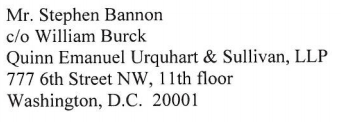
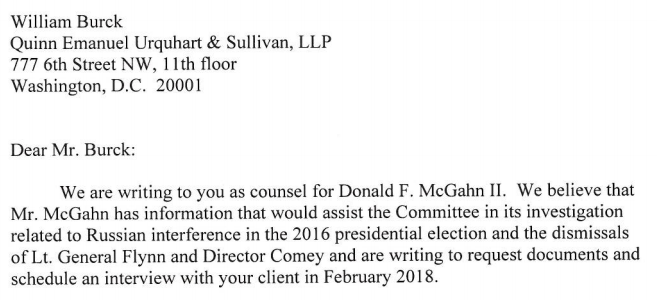
Also as I noted above, Feinstein staff treated the letter to the two William Burck clients differently. Bannon’s was sent to him, but care of Burck.

But McGahn’s was addressed to Burck.

Unless I missed it, McGahn’s is the only letter treated this way. Which is one reason I suspect the blizzard of stories about what a hero McGahn was in June after he had done clearly obstructive things in May and earlier may have more to do with McGahn’s legal jeopardy than Trump’s.

Update: This Politico piece (h/t PINC) says that McGahn hired Burck last May, right after he had done some really stupid things with respect to the Jim Comey firing.

McGahn came calling in May amid the fallout from Trump’s decision to fire Comey from his post as FBI director — an explosive move that prompted Mueller’s appointment.

Share this entry

The June 9 Trump Tower Limited Hangout

I did two podcasts this week where I elaborated on my theory that the current story we have about the June 9, 2016 Trump Tower meeting is just a limited hangout, a partial story that I suspect serves to hide a later, more damning part of the meeting:

I first started suspecting that the current story — that Natalia Veselnitskaya pitched a request for Magnitsky sanctions relief in exchange for … almost no dirt on Hillary — was a limited hangout as I tracked Scott Balber’s repeated heavy-handed attempts to craft a story that could explain the known emails and documents.

I want to lay out my evolving, more developed theory here.

For weeks, Russians had been offering emails in exchange for meetings

The Trump campaign first learned about “dirt” on Hillary in the form of thousands of emails on April 26. The day after learning of those emails, George Papadopoulos sent two emails to Trump campaign staffers, that may have reflected a discussion of an early quid pro quo: some meetings — meant to lead to one between Trump and Putin — in exchange for emails.

To Stephen Miller, Papadopoulos wrote, “Have some interesting messages coming in from Moscow about a trip when the time is right.” To Corey Lewandowski, it appears he asked for a phone call “to discuss Russia’s interest in hosting Mr. Trump. Have been receiving a lot of calls over the last month about Putin wanting to host him and the  team  when the time is right.”

That same day, he sent his Russian handler, Ivan Timofeev, an email saying that the first major Trump foreign policy speech he helped author was a “signal to meet.” The speech spoke, in part, about making a great deal with Russia.

I believe an easing of tensions, and improved relations with Russia from a position of strength only is possible, absolutely possible. Common sense says this cycle, this horrible cycle of hostility must end and ideally will end soon. Good for both countries.

Some say the Russians won’t be reasonable. I intend to find out. If we can’t make a deal under my administration, a deal that’s great — not good, great — for America, but also good for Russia, then we will quickly walk from the table. It’s as simple as that. We’re going to find out.

Over the course of the next month, Papadopoulos sent a Timofeev invitation for a meeting  to move towards setting up a Putin-Trump meeting via email to Lewandowski (on May 4), to Sam Clovis (on May 5, after which they spoke by phone), and to Paul Manafort (on May 21), with additional back and forth in between.

Who is the Crown Prosecutor?

Around that time in late May, Natalia Veselnitskaya met with long-time Trump associate Aras Agalarov and mentioned her efforts to help Denis Katsyv in his legal fight with Bill Browder (note, elsewhere Veselnitskaya claimed she normally keeps her clients’ business compartmented, but claims not to have done so in this case) and to lobby against the Magnitsky sanctions. That’s where, according to Veselnitskaya, the idea of connecting her with Don Jr first came about, though she doesn’t remember who came up with the idea.

Around the end of May 2016, during a conversation with a good acquaintance of mine, being my client, Aras Agalarov on a topic that was not related to the United States, I shared the story faced when defending another client, Denis Katsyv, about how terribly misled the US Congress had been by the tax defrauder William Browder, convicted in Russia, who, through his lobbyists and his close-minded rank-and-file Congress staffers, succeeded in adopting the Act in the name of a person whom Browder practically hardly ever knew.

I considered it my duty to inform the Congress people about it and asked Mr. Agalarov if there was any possibility of helping me or my colleagues to do this. I do not remember who of us was struck by the idea that maybe his son could talk about this with Donald Trump, Jr., who, although a businessman, was sure to have some acquaintances among Congress people. After my conversation with Mr. Agalarov, I prepared a reference in case it would be necessary to hand over the request – to support the hearings in the Subcommittee in the US House Committee on Foreign Affairs as to the Magnitsky’s and Browder’s story, scheduled for mid-June.

The timing of this meeting is important. We know that the date on the document alleged to be the “dirt” handed to Don Jr — one that she claims she prepared “in case it would be necessary to hand over” is May 31. Either this meeting happened before May 31 (which is when Veselnitskaya described it to have taken place), or the document was instead drawn up exclusively for lobbying purposes (which would be unsurprising, but would be inconsistent with the testimony that uses the talking points to prove the meeting was only about Magnitsky sanctions). Elsewhere she gets sketchy about the date of the document, and produced as it was by Agalarov lawyer Scott Balber, we can’t be sure about the forensics of the document.

The reason the date is important, however, is that, in pitching the Trump Tower meeting on June 3, Rob Goldstone told Don Jr that Emin Agalarov’s father met with “the Crown Prosecutor” that morning.

Emin just called and asked me to contact you with something very interesting.

The Crown prosecutor of Russia met with his father Aras this morning and in their meeting offered to provide the Trump campaign with some official documents and information that would incriminate Hillary and her dealings with Russia and would be very useful to your father.

This is obviously very high level and sensitive information but is part of Russia and its government’s support for Mr. Trump – helped along by Aras and Emin. [my emphasis]

Admittedly, any discrepancy on dates might be due to the game of telephone going on — Aras to Emin to Goldstone. But if the meeting in question really did happen on June 3, then it significantly increases the likelihood that “Crown Prosecutor” is not at all a reference to Veselnitskaya (who claims to have met with Agalarov earlier), as has been claimed, but is to someone else, dealing a different kind of dirt.

Spoiler alert: I suspect it is not a reference to her.

In his version of this story, Goldstone says he only played this broker role reluctantly.

“I remember specifically saying to Emin, you know, we probably shouldn’t get involved in this. It’s politics, it’s Hillary Clinton and Donald Trump. Neither of us have any experience in this world. It’s not our forte. I deal with music. You’re a singer and a businessman.”

Don Jr seems to have shown no such reluctance. He emailed back 17 minutes later saying, “if it’s what you say I love it especially later in the summer.” He says that, in spite of the claim he made in his testimony that, “I had no additional information to validate what Rob was saying, I did not quite know what to make of his email.” Whatever Don Jr expected it to include on June 3, he may have gotten a clearer sense of what it was on June 6, when he spoke to Emin in a phone call set up in about an hour’s time, just as Emin got off the stage.

In fact, Don Jr had three “very short” phone calls in this period, but he’s getting forgetful in his old age and so doesn’t remember what transpired on them.

My phone records show three very short phone calls between Emin and me between June 6th and 7th. I do not recall speaking to Emin. It is possible that we left each other voice mail messages. I simply do not remember.

Veselnitskaya did not get her visa to come to the US until June 6. That’s the day when Goldstone, referencing Don Jr’s earlier instructions on timing, followed-up about a meeting.

Let me know when you are free to talk with Emin by phone about this Hillary info.

Ike Kaveladze’s still unexplained late inclusion in the meeting

Goldstone was still finalizing the meeting time on June 8 at 10:34 AM. But sometime, presumably after the time on June 7 at 6:14PM, when Don Jr told Goldstone that Paul Manafort and Jared Kushner would also attend, fellow Agalarov employee Ike Kaveladze got invited, though without Veselnitskaya ever learning why. At some unidentified time, Kaveladze called an associate of Goldstone’s and learned that the meeting would be about discussing “dirt” on Hillary Clinton — the same word Papadopoulos’ handlers had used.

Scott Balber, Kaveladze’s attorney, told The Daily Beast that before Kaveladze headed from Los Angeles to New York for the meeting, he saw an email noting that Kushner, Manafort, and Trump Jr. would all be involved. He thought it would be odd for them to attend the meeting, so he called Beniaminov before heading to New York. Both Beniaminov and Kaveladze have worked with the Agalarov’s real estate development company, the Crocus Group.

Balber said that Beniaminov told Kaveladze that he heard Rob Goldstone— Emin Agalarov’s music manager—discuss “dirt” on Hillary Clinton. It’s never become completely clear what kind of “dirt” the Russians were talking about.

Having learned of a meeting dealing dirt that included Don Jr, Kushner, and Manafort, Kaveladze got on a plane and flew to NYC.

According to Veselnitskaya’s very sketchy account, she got an email finalizing the meeting when she arrived in NYC on June 8 — an email that was also CC’ed to Kaveladze. She and Kaveladze spoke by phone sometime that day, and met sometime before the meeting.

With those present at the meeting, Samochernov, Kaveladze, and Akhmetshin, I spoke about the meeting on the day it was to be held, possibly, I mentioned it the day I arrived in New York when speaking with Kaveladze by phone, but I do not have exact information about it.

[snip]

We got acquainted first by phone when I was in Moscow. I met him personally first on June 9 shortly before the meeting.

[snip]

We had a phone call and met at a café, I do not remember where and at what café. I told him briefly what I knew about the Browder case, about the Ziffs and their possible support when lobbying his interests in the United States.

Like Don Jr’s memory of his phone calls with Emin, Veselnitskaya claims to have forgotten what got said in that phone call with Kaveladze.

Competing versions of the meeting

Which brings us to June 9.

We don’t know what Kaveladze’s schedule was. We do know that on the morning of June 9 — before lunch, which is when Veselnitskaya said Akhmetshin first got involved — Veselnitskaya asked Goldstone if she could bring Akhmetshin, whom she claimed had just “arrived that day in New York for an evening performance of Russian theatre stars.” Goldstone responded a half hour later, “Please bring them with you and meet Ike for your meeting at 4PM today.” (The copy of the email publicly released does not include the CC to Kaveladze that Veselnitskaya said was included.)

As I laid out in this post, Veselnitskaya says she arrived at the meeting with her translator, Kaveladze, and Akhmetshin, was met by Goldstone there, and brought to a board room where Don Jr and Manafort were already present.

I came to the meeting with Anatoly Samochornov, a translator, Irakly Kaveladze, a lawyer of my client who helped to arrange for the meeting, Rinat Akhmetshin, my colleague who was working with me on the Prevezon case. We were met by a big, stout man who introduced himself as Rob and escorted us on the elevator to the boardroom. I saw two men in the boardroom – one of them introduced himself as Donald Trump Jr., while the other did not introduce himself. Another young man entered the boardroom a little later and left it shortly afterwards. I found out much later that the two unidentified gentlemen were P. Manafort and J. Kushner.

According to Veselnitskaya, Kaveladze was introduced — to the extent he was — as “Ike.” Remember that he attended the 2013 dinner celebrating the Agalarov-brokered deal to bring Miss Universe to Moscow, meaning at least some in the Trump camp should know him.

Veselnitskaya’s account seems to line up with Jared Kushner’s, which basically has him arriving late, staying for about 10 minutes of Veselnitskaya’s discussion of adoptions (though he seems to be claiming not to be present for any discussion of Magnitsky sanctions), then asked his assistant to give him an excuse to leave.

I arrived at the meeting a little late. When I got there, the person who has since been identified as a Russian attorney was talking about the issue of a ban on U.S. adoptions of Russian children. I had no idea why that topic was being raised and quickly determined that my time was not well-spent at this meeting. Reviewing emails recently confirmed my memory that the meeting was a waste of our time and that, in looking for a polite way to leave and get back to my work, I actually emailed an assistant from the meeting after I had been there for ten or so minutes and wrote “Can u pls call me on my cell? Need excuse to get out of meeting.” I had not met the attorney before the meeting nor spoken with her since. I thought nothing more of this short meeting until it came to my attention recently. I did not read or recall this email exchange before it was shown to me by my lawyers when reviewing documents for submission to the committees. No part of the meeting I attended included anything about the campaign, there was no follow up to the meeting that I am aware of, I do not recall how many people were there (or their names), and I have no knowledge of any documents being offered or accepted.

Jared claims not to know who was at the meeting, which is somewhat credible given that he arrived after introductions.

For some reason, Goldstone holds out the claim this meeting started by talking about Democratic campaign donations then moved to sanctions.

Goldstone tells me that he only half-listened to the presentation from Natalia Veselnitskaya, the Russian lawyer, as he checked emails on his phone. But he insists, as Trump Jr has done, that the meeting ended awkwardly after she switched tack from discussing Democratic funding to US sanctions legislation and Moscow’s retaliatory policy that restricts Americans from adopting Russian children. “It was vague, generic nonsense,” Goldstone says.

[snip]

“Within minutes of starting, Jared said to her, ‘Could you just get to the point? I’m not sure I’m following what you’re saying,’ ” Goldstone says.

It was then that she started talking in detail about the provisions of the Magnitsky legislation and adoptions, he says. “I believe that she practised a classic bait-and-switch. She got in there on one pretext and really wanted to discuss something else.”

Don Jr’s memory of the meeting is somewhat different. Not only doesn’t he remember Akhmetshin’s presence at all, but he remembers Manafort arriving after the visitors were already in the conference room (mind you, I don’t consider this a significant discrepancy). And he definitely remembers adoptions being discussed at the same time as the sanctions.

As I recall, at or around 4 pm, Rob Goldstone came up to our offices and entered our conference room with a lawyer who I now know to be Natalia Veselnitskaya. Joining them was a translator and a man who was introduced to me as Irakli Kaveladze. After a few minutes, Jared and Paul joined. While numerous press outlets have reported that there were a total of eight people present at the meeting, I only recall seven. Because Rob was able to bring the entire group up by only giving his name to the security guard in the lobby, I had no advance warning regarding who or how many people would be attending. There is no attendance log to refer back to and I did not take notes.

After perfunctory greetings, the lawyer began telling the group very generally something about individuals connected to Russia supporting or funding Democratic Presidential Candidate Hillary Clinton or the Democratic National Committee. It was quite difficult for me to understand what she was saying or why. Given our busy schedules, we politely asked if she could be more specific and provide more clarity about her objective for the meeting. At that point, Ms. Veselnitskaya pivoted and began talking about the adoption of Russian children by U.S. citizens and something called the Magnitsky Act.

Until that day, I had never heard of the Magnitsky Act and had no familiarity with this issue. It was clear to me that her real purpose in asking for the meeting all along was to discuss Russian adoptions and the Magnitsky Act. At this point, Jared excused himself from the meeting to take a phone call.

Despite some minor differences in choreography, thus far the differences in the stories are not that substantial.

That changes, though, in the descriptions of how the meeting ended.

Don Jr claims he said that Trump was a private citizen so could do nothing to help.

I proceeded to quickly and politely end the meeting by telling Ms. Veselnitskaya that because my father was a private citizen there did not seem to be any point to having this discussion.

Goldstone claims something similar — that Don Jr told Veselnitskaya she should talk to Obama’s Administration, not the future Trump one.

“Don Jr ended it by telling her that she should be addressing her concerns to the Obama administration, because they were the ones in power.”

But in an an interview with Bloomberg that Veselnitskaya disavowed in her statement to SJC, she said that Don Jr suggested he would reconsider the sanctions “if we came to power.”

“Looking ahead, if we come to power, we can return to this issue and think what to do about it,’’ Trump Jr. said of the 2012 law, she recalled. “I understand our side may have messed up, but it’ll take a long time to get to the bottom of it,” he added, according to her.

The extra details in the contemporaneous record as interpreted by Glenn Simpson

As far as we know, there’s only one contemporaneous record of this meeting: the notes that Manafort — whom Veselnitskaya claimed “closed his eyes and fell asleep” during the 20 minute meeting — took on his phone. Glenn Simpson was asked to comment on Manafort’s notes in his Senate testimony. Some of what he describes confirms these public accounts: the early reference to Browder, the other reference to Juliana Glover, the reference to adoptions.

MR. DAVIS: These are the meeting notes from 3 the June 9th meeting at Trump Tower. These are Mr. Manafort’s notes or they’re contemporaneous.

BY THE WITNESS:

A. I could tell — obviously you know who Bill Browder is. Cyprus Offshore, Bill Browder’s structure, you know, investment — Hermitage Capital, his hedge fund, set up numerous companies in Cyprus to engage in inward investment into Russia, which is a common structure, both partially for tax reasons but also to have entities outside of Russia, you know, managing specific investments. I can only tell you I assume that’s what that references. I don’t know what the 133 million —

[snip]

A. I can skip down a couple. So “Value in Cyprus as inter,” I don’t know what that means. “Illici,” I don’t know what that means. “Active sponsors of RNC,” I don’t know what that means. “Browder hired Joanna Glover” is a mistaken reference to Juliana Glover, who was Dick Cheney’s press secretary during the Iraq war and associated with another foreign policy controversy. “Russian adoptions by American families” I assume is a reference to the adoption issue.

While Simpson doesn’t recognize the reference, in addition to the passing reference to Cyprus shell companies, the notes allegedly used for the meeting explain the 133 million reference.

In the period of late 1999 to 2004, two companies – Speedwagon Investments 1 and 2, registered in New York, and owned by the said U.S. investors, acting through three Cypriot companies, Giggs Enterprises Limited, Zhoda Limited, Peninsular Heights Limited illegally acquired more than 133 million Gazprom shares in the amount exceeding $80 million in the name of the Russian companies Kameya, Lor, Excalibur, Sterling Investments.

But there seems to be more extensive reference to Cyprus (the laundering of money through which, of course, Manafort is himself an expert; it features centrally in his indictment).

And none of the accounts of the meeting seem to explain Manafort’s half-written “illicit,” nor does “Active sponsors of RNC” appear anywhere.

So there appear to be two things in Manafort’s notes that aren’t explained by the several accounts of the meeting: RNC support (elsewhere attributed to the reference to Ziff brothers’ political donations, something which Manafort might independently know) and, most intriguingly, “illicit” (as well, as perhaps, the more central focus on Cyprus than reflected in the talking points).

Who left the conference room when?

This brings me to the question of who left the conference room when.

According to the LAT, Mueller’s team seems newly interested in an exchange between Ivanka, Veselnitskaya, and Akhmetshin, which attests to Ivanka’s awareness — whatever her spouse’s and brother’s ignorance — of Akhmetshin’s presence.

Investigators also are exploring the involvement of the president’s daughter, Ivanka Trump, who did not attend the half-hour sit-down on June 9, 2016, but briefly spoke with two of the participants, a Russian lawyer and a Russian-born Washington lobbyist. Details of the encounter were not previously known.

It occurred at the Trump Tower elevator as the Russian lawyer, Natalia Veselnitskaya, and the lobbyist, Rinat Akhmetshin, were leaving the building and consisted of pleasantries, a person familiar with the episode said. But Mueller’s investigators want to know every contact the two visitors had with Trump’s family members and inner circle.

But it also may suggest that, after arriving with the two Russians, Ike Kaveladze may have stayed on for a bit afterwards.

Which may be backed by another detail in the various accounts of the meeting. Both Don Jr …

She thanked us for our time and everyone left the conference room. As we walked out, I recall Rob coming over to me to apologize.

And Goldstone claim that the music promoter apologized for the meeting at the end.

As he emerged from the meeting, Goldstone says that he told Trump Jr he was “deeply embarrassed” that it had been an apparent waste of time.

If Goldstone “apologized” for the meeting, as he and Don Jr claim, it suggests Goldstone, at least, stayed behind long enough to say something that would otherwise be rude to say in front of Veselnitskaya. Don Jr’s claim of an apology might provide convenient excuse.

Perhaps most curious among the first-hand accounts is Goldstone’s claim that he thought the 20-30 minute meeting was “dragging on.”

He had not even planned to attend, but was encouraged to stay by Trump Jr. His biggest concern, he says, was that if the meeting dragged on, he would be caught in the notorious Lincoln Tunnel traffic on his journey home.

But her emails

At 4:40 PM, 40 minutes after the meeting started, Trump tweeted what would become one of the most famous exchanges of the campaign, his retort to Hillary Clinton’s taunt that he should delete his Twitter account with this response,
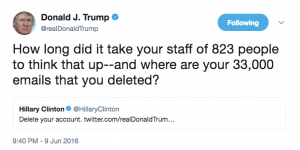
Did you say “dirt” in the form of Hillary emails?

Six days after that meeting, Guccifer 2.0 released the first of the documents stolen by hacking Democratic targets (though note, none of these are known to have come from the DNC, which is the only hack the WaPo reported on the day before; while some have been traced to Podesta’s emails, the others remain unaccounted for).

While I have argued that the specific content in that dump can be explained, in significant part, as an effort to respond to and rebut the claims CrowdStrike and the Democrats made to the WaPo, some of the documents would be particularly valuable in selling the Trump team on the value of any “dirt” on offer. That includes the oppo research on Trump himself (though that was definitely also a response to the WaPo), but also what purports to be a secret policy document stolen from Hillary’s Secretary of State computer, and a document on Hillary’s election plans. Significantly, all three of these documents were among the ones with the altered metadata, in part bearing the signature of Felix Edmundovich Dzerzhinsky.
In short, that first post from Guccifer 2.0 would not only refute the confident claims the Democrats made to the WaPo, but it would provide the Trump camp with a sense of the scope of documents on offer. Within that first week, Guccifer 2.0 would even offer what claimed to be a (heh) “dossier” on Hillary Clinton. (Given my concerns that Russians learned of the Steele dossier and filled it with disinformation, I find it rather interesting that Guccifer 2.0 first advertised this dossier on the same day, June 20, that Steele submitted the first report in his dossier.)

Eerie

If, in fact, there was a second part of this meeting, it seems to be the high level meeting that George Papadopoulos had been working on setting up for weeks, meetings discussed in the context of offering dirt in the form of emails. The Russians laid out a quo — relief of the Magnitsky sanctions — and a week later, provided the first installments of the quid — oppo research from Hillary Clinton.

That would more readily explain why, on June 14, Goldstone would forward this account of the DNC hack to Emin and Ike (but not the other attendees) declaring the DNC hack to be eerie in the wake of what transpired at the meeting.

In one email dated June 14, 2016, Goldstone forwarded a CNN story on Russia’s hacking of DNC emails to his client, Russian pop star Emin Agalarov, and Ike Kaveladze, a Russian who attended the meeting along with Trump Jr., Trump’s son-in-law Jared Kushner and Manafort, describing the news as “eerily weird” given what they had discussed at Trump Tower five days earlier.

And that, I suspect, is the real story that Scott Balber has been working so hard to obscure.

Share this entry

Stephen Miller Claims that Trump’s Russian Investigation Line Was a Disclaimer

In this post, I noted that Trump (in his interview with the WSJ) appears to believe asking for and getting a letter from Rod Rosenstein justifying Jim Comey’s firing is proof that his firing of Comey wasn’t obstruction of justice. I suggested that that argument may have been planned from the start — and noted the proximity of that argument to the claim, which we know Jared Kushner provided, that Democrats would be thrilled by Comey’s firing.

Having suggested that there was more of a plan behind the orchestrated firing of Comey than we might imagine, I want to return to the Jake Tapper interview with Stephen Miller on Sunday.

Tapper asked Miller about his role in writing the initial draft of the letter that fired Comey, which NYT reported on this way:

Mr. McGahn successfully blocked the president from sending the letter — which Mr. Trump had composed with Stephen Miller, one of the president’s top political advisers — to Mr. Comey. But a copy was given to the deputy attorney general, Rod J. Rosenstein, who then drafted his own letter. Mr. Rosenstein’s letter was ultimately used as the Trump administration’s public rationale for Mr. Comey’s firing, which was that Mr. Comey had mishandled the investigation into Hillary Clinton’s private email server.

Mr. Rosenstein is overseeing Mr. Mueller’s investigation into Russian efforts to disrupt last year’s presidential election, as well as whether Mr. Trump obstructed justice.

Mr. McGahn’s concerns about Mr. Trump’s letter show how much he realized that the president’s rationale for firing Mr. Comey might not hold up to scrutiny, and how he and other administration officials sought to build a more defensible public case for his ouster.

[snip]

Mr. Trump ordered Mr. Miller to draft a letter, and dictated his unfettered thoughts. Several people who saw Mr. Miller’s multi-page draft described it as a “screed.”

Mr. Trump was back in Washington on Monday, May 8, when copies of the letter were handed out in the Oval Office to senior officials, including Mr. McGahn and Vice President Mike Pence. Mr. Trump announced that he had decided to fire Mr. Comey, and read aloud from Mr. Miller’s memo.

Some present at the meeting, including Mr. McGahn, were alarmed that the president had decided to fire the F.B.I. director after consulting only Ms. Trump, Mr. Kushner and Mr. Miller. Mr. McGahn began an effort to stop the letter or at least pare it back.

[snip]

Rosenstein was given a copy of the original letter and agreed to write a separate memo for Mr. Trump about why Mr. Comey should be fired.

In the interview with Tapper, Miller claimed that the key claim the NYT said got removed — about Comey thrice telling Trump he wasn’t personally under investigation — was actually in the final letter.

Tapper: According to the New York Times, Special Counsel Robert Mueller has, in his possession, an early draft of a letter that you helped write, in May 2017, detailing reasons to fire FBI Director James Comey. According to the newspaper, the first line of the letter mentions the Russia investigation. Did you write a letter outlining the reasons to fire Comey and list the Russia investigation. Is that true?

Miller: Here’s the problem with what you’re saying: the final draft of the letter the one that was made —

Tapper: I’m not talking about that one, I’m talking about the one that Comey [sic] has that mentions Russia —

Miller: If you want to have an answer to your question and not to get hysterical, then I’ll answer it. The final draft of the letter has the same line about the fact that there is a Trump-Russia investigation that this has nothing to do with.

Tapper: So it was just moved from the top to the bottom.

Miller: No. No! Look at the letter. It’s at the beginning. The investigation is referenced at the beginning of the final letter that was released to point out about the fact that notwithstanding, having been informed that there’s no investigation, that the um, the move that is happening is completely unrelated to that. So it was a disclaimer. It appeared in the final version of the letter that was made public.

Here’s the letter Trump sent to fire Comey. The passage Miller must be talking about reads,

While I greatly appreciate you informing me, on three separate occasions, that I am not under investigation, I nevertheless concur with the judgment of the Department of Justice that you are not able to effectively lead the Bureau.

That’s the passage that was so confounding when we all read that in real time.

And while I’m not prepared to believe Miller that that is the totality of the reference to Russia in the original letter — after all, this doesn’t even mention Russia — what I do think Miller provided proof for on national TV is that the connotation of that sentence changed from first to second draft, and in a way that he, Kushner, and Don McGahn all surely recognize.

In the first letter, according to McGahn and others, the “screed” listed the Russia investigation as a reason to fire Comey. Here, according to the guy who drafted it, it is meant to serve as a disclaimer, a denial that this firing was about the Russia investigation.

And that’s what Miller surely told Mueller’s investigators.

No wonder he kept ranting and had to be escorted off Tapper’s set. He just revealed, for everyone, how this second letter was designed to be misleading.

In the last week, Miller and Trump have told CNN and WSJ, respectively, about their cover-up.

Update: I forgot to reference this language from the NYT’s latest. The line originally said that the investigation was“fabricated and politically motivated.” If that reporting is correct then they also changed the wording of the reference to the investigation.

Share this entry

Trump’s Obstruction Defense: Rod Rosenstein Wrote a Letter

The WSJ has posted a transcript of their interview with Trump.

I think it shows how he plans (and may have planned, from the start) to defend against obstruction charges: by noting that Rod Rosenstein, in his letter supporting Comey’s firing, said stronger things against Comey than Trump did.

He returned to this idea three times in the interview. First, after WSJ first noted that Mueller may be looking at obstruction charges.

TRUMP: There has never been, in the history — in the history of an administration anybody that was more open than we were. You understand that?

WSJ: Yes.

TRUMP: We gave them everything. We didn’t go to court and say, “You can’t have this document, you can’t have” — and what we gave them showed — I never got a phone call from Russia. I didn’t have a tweet. I didn’t have a — I had nothing. I didn’t have an email. I didn’t have a meeting. I didn’t have — did I have one meeting with — about Russia? And…

WSJ: Well, Mueller’s also looking at some other areas, right? Like obstruction of justice…

TRUMP: Well allow — let me — (inaudible). So, they make up a crime, and the crime doesn’t exist. And then they say obstruction. And how could there be obstruction on firing Comey? When the man who’s in charge of it wrote a letter that was far stronger than anything I would have written. He was in charge — Deputy Rosenstein. He wrote a letter that’s far stronger than even what I say.

Again, after ranting a bit about how badly the Democrats once wanted Comey fired.

All you have to do is take a look, seriously – take a look at all these people, they all wanted him fired. And the FBI was a mess. When he announced the Hillary Clinton fiasco where she was guilty, guilty, guilty, guilty and then where they did the interview with no tape recorder, with no swearing in, with no this, with no that – you know the story.

But take a look at all of these people that became critics of my firing (ph), they all wanted him fired. And they wanted him fired until I said, “he’s fired.” But the deputy, Rosenstein, who is in charge, he wrote a letter that was possibly or probably stronger than anything I would have written or did write.

Then he returns to it just as WSJ tries to get him to shift to talking about infrastructure.

WSJ: (Inaudible) infrastructure (inaudible).

TRUMP: But just so you understand…

WSJ: Oh, sorry.

TRUMP: …The Deputy Attorney General, who’s in charge of the case, wanted – all you have to do is read his letter. So that’s – there’s no obstruction there.

But Rosenstein!!! He seems to be saying.

I’m interested in this, in general. But I’m also interested in how closely tied the notion that Democrats would celebrate a Comey firing is with the claim that because Rosenstein said meaner things about Comey, there couldn’t be obstruction.

I wonder whether this was the plan all along. And I wonder whether these two whackjob ideas came from the same person: Jared.

Share this entry

Why Did Ivanka Run into Just Veselnitskaya and Akhmetshin at the Trump Tower Elevator?

In this post, I argued that Natalia Veselnitskaya’s story about her June 9 Trump Tower meeting with Don Jr, Paul Manafort, and Jared Kushner seemed designed (with help from one time Trump and current Agalarov lawyer Scott Balber) to downplay the role of Agalarov employee Ike Kaveladze.

It’s that even with all of Scott Balber’s efforts, there’s still no explanation for why Kaveladze attended this meeting. Given Balber’s significant efforts to minimize Agalarov’s role in the meeting — and his denials that Agalarov might have ties directly to Putin — I find the failure to explain that notable.

The LAT story convinces me I’m right. The basic story is that Mueller has called at least one of the attendees at that meeting back for a second interview; for a number of reasons, it is highly likely that person is Rinat Akhmetshin. The self-interested defense lawyers who are the source of the story suggest that this must be because Mueller is pursuing an obstruction case, not a collusion case.

Special counsel Robert S. Mueller III has recalled for questioning at least one participant in a controversial meeting with a Kremlin-connected Russian lawyer at Trump Tower in June 2016, and is looking into President Trump’s misleading claim that the discussion focused on adoption, rather than an offer to provide damaging information about Hillary Clinton.

Some defense lawyers involved in the case view Mueller’s latest push as a sign that investigators are focusing on possible obstruction of justice by Trump and several of his closest advisors for their statements about the politically sensitive meeting, rather than for collusion with the Russians.

But the far more interesting part of the story is that Mueller wants details about Ivanka’s actions that day, because, the story explains, she ran into Veselnitskaya and Akhmetshin by the Trump Tower elevator.

Investigators also are exploring the involvement of the president’s daughter, Ivanka Trump, who did not attend the half-hour sit-down on June 9, 2016, but briefly spoke with two of the participants, a Russian lawyer and a Russian-born Washington lobbyist. Details of the encounter were not previously known.

From that, Twitter conspiracists and Newsweek (which lately has been close to the same thing) are suggesting that Ivanka might be in trouble.

That’s not the point of this line of questioning, in my opinion.

LAT makes it clear (presumably based on Akhmetshin’s story) that the Ivanka exchange happened on their way out of the meeting with Jr and the others.

It occurred at the Trump Tower elevator as the Russian lawyer, Natalia Veselnitskaya, and the lobbyist, Rinat Akhmetshin, were leaving the building and consisted of pleasantries, a person familiar with the episode said.

According to Veselnitskaya, she arrived with Akhmetshin, Kaveladze, and her translator; Jr and Manafort were in the board room when she arrived.

I came to the meeting with Anatoly Samochornov, a translator, Irakly Kaveladze, a lawyer of my client who helped to arrange for the meeting, Rinat Akhmetshin, my colleague who was working with me on the Prevezon case. We were met by a big, stout man who introduced himself as Rob and escorted us on the elevator to the boardroom. I saw two men in the boardroom – one of them introduced himself as Donald Trump Jr., while the other did not introduce himself.

She says she met with Kaveladze before the meeting.

I met him personally first on June 9 shortly before the meeting.

We had a phone call and met at a café, I do not remember where and at what café.

Though, admittedly, every single thing she says about Kaveladze is sketchy.

Finally, Veselnitskaya denies that she met with Glenn Simpson before and after the meeting, a story Fox News reported that “a confidential source” told it.

Last week Fox News 38 referring to a confidential source reported that I met with Glenn Simpson before and after the meeting with Trump’s son, and that “but hours before the Trump Tower meeting on June 9, 2016, Fusion co-founder and ex-Wall Street Journal reporter Glenn Simpson was with Veselnitskaya in a Manhattan federal courtroom, in a hearing on the DOJ’s claim against Prevezon Holdings, a Cyprus company owned by a Russian businessman Denis Katsyv.” This statement does not reflect the reality.

Nowhere in Veselnitskaya’s story addresses how or in whose company she left the meeting.

But the LAT report suggests she left with Akhmetshin. The report mentions nothing about the presence of Goldstone or Kaveladze, waiting at the elevator, chatting up Ivanka.

So did the two Agalarov employees stay later, which would leave them in a room alone with Don Jr and Paul Manafort?

Update: I’ve corrected this to reflect that Veselnitskaya said she did arrive with Kaveladze.

Share this entry