emptywheel
  • Home
  • About
  • Posts
      • Posts by Categories
  • Timeline Collection
      • Hillary Clinton Investigation
      • Internet Dragnet
      • Disappearing White House Emails
      • Exigent Letters
      • Anthrax Investigation
      • Targeted Killing
      • Phone Dragnet Orders
      • Jeffrey Sterling Materials
      • Iran NIE
      • Warrantless Wiretap Memos
      • Torture Tape
      • Torture Document Dump
      • The Ghorbanifar Meetings
  • Support
  • Click to open the search input field Click to open the search input field Search
  • Menu Menu

Tag Archive for: John Durham

Posts

The Blind Spots of CJR’s “Russiagate” [sic] Narrative

February 7, 2023/45 Comments/in 2016 Presidential Election, Press and Media /by emptywheel

Jeff Gerth began his series on the press’ Russia investigation failures by noting that trust in the traditional media collapsed after the 2016 election (a claim based on a statistical error), with a sharp rise in concern about “fake news” and, according to Rasmussen, half of those surveyed thinking the press was the enemy of the people.

Before the 2016 election, most Americans trusted the traditional media and the trend was positive, according to the Edelman Trust Barometer. The phrase “fake news” was limited to a few reporters and a newly organized social media watchdog. The idea that the media were “enemies of the American people” was voiced only once, just before the election on an obscure podcast, and not by Trump, according to a Nexis search.

Today, the US media has the lowest credibility—26 percent—among forty-six nations, according to a 2022 study by the Reuters Institute for the Study of Journalism. In 2021, 83 percent of Americans saw “fake news” as a “problem,” and 56 percent—mostly Republicans and independents—agreed that the media were “truly the enemy of the American people,” according to Rasmussen Reports.

Gerth believes part of the problem stems from an erosion of journalistic norms, which he listed at length in an afterward, starting with the press’ unwillingness to report facts that run counter to the prevailing narrative.

My main conclusion is that journalism’s primary missions, informing the public and holding powerful interests accountable, have been undermined by the erosion of journalistic norms and the media’s own lack of transparency about its work. This combination adds to people’s distrust about the media and exacerbates frayed political and social differences.

One traditional journalistic standard that wasn’t always followed in the Trump-Russia coverage is the need to report facts that run counter to the prevailing narrative.

And in spite of his citation of WaPo’s tracking of the vast number of lies Donald Trump told during his term early in the series, Gerth put great stock in what Donald Trump told him in two interviews, adopting Trump’s attribution of the coverage of Russia for the reality TV star’s decision to start labeling the media, “fake news.”

He made clear that in the early weeks of 2017, after initially hoping to “get along” with the press, he found himself inundated by a wave of Russia-related stories. He then realized that surviving, if not combating, the media was an integral part of his job.

“I realized early on I had two jobs,” he said. “The first was to run the country, and the second was survival. I had to survive: the stories were unbelievably fake.”

This is a critical point: Gerth appears to believe Trump that called the media “fake news” not as part of an effort to manipulate the media or to damage one of the institutions of accountability that might check his power, but instead as part of a good faith response to coverage of him.

From that premise, CJR decided the way to understand the collapse in trust of the media was to focus largely on NYT and WaPo’s performance in their coverage of Russia. 

CJR editor Kyle Pope told me,

What we wanted to do with this piece was focus entirely on the media coverage, without the usual notes about Trump’s failings. Specifically, we wanted to focus largely on the New York Times and the Washington Post, as important leaders of the coverage. This was not intended as a 360-degree roundup of everything written about Trump and Russia.

There are obviously enormous problems with the conception of this project, particularly with media polarization in the US that looks like this (a source Gerth relied on to assess the problem).

Others engaged in the “Russiagate” project correctly recognize the import of cable news in the equation (though most, like Glenn Greenwald, ignore the power of the self-contained bubble around Fox, which doesn’t even attempt to hold itself to standards of truth). In 23,000 words, for example, Gerth never considers whether Fox’s scandalous Seth Rich coverage fostered distrust of the media.

In his series, Gerth spent a great deal of time questioning claims about the impact of Russia’s social media operation in 2016 (which, like many “Russiagate” analysts, he treats as the only possible means by which Russia influenced the election). But he didn’t consider the impact of social media, generally, on this decline in trust, not even in the vast reaches of America where there is no more local news, where news consumers increasingly rely on information fed by algorithms that reward the most inflammatory information, from whatever source.

So even on its own terms, it’s a project designed to fail, because it ignores centrally important parts of the equation.

Worse still, Gerth didn’t even carry out what he claimed to set out to do.

That’s actually one of the reasons I’ve spent so much time dissecting his effort: because the ways in which he claimed to limit his scope, and his deviation from that scope, is itself very telling.

Gerth shows how little WaPo and NYT chased the dossier

Start with his focus on the Steele dossier. The dossier is mentioned or discussed in paragraphs making up over 5,000 words out of Gerth’s 23,000-word series. That’s consistent with the “Russiagate” project, which often treats the dossier as stand-in for the entire Russian investigation (or, here, the coverage of it).

Even regarding the Steele dossier, Gerth’s own summary of their coverage  makes it clear that the NYT and WaPo aren’t the villains of the dossier story. The villains in his account are Michael Isikoff, David Corn, CNN, BuzzFeed, McClatchy, and Jane Mayer.

Gerth struggled to implicate NYT and WaPo in his dossier complaint. He noted that NYT mentioned it, including FBI’s efforts to reach out to its sources, in a February 14, 2017 article he spends  almost 1,000 words attacking.

In the article’s discussion of the dossier, it described Steele as having “a credible track record” and noted the FBI had recently contacted “some” of Steele’s “sources.” Actually, the FBI had recently interviewed Steele’s “primary” source, a Russian working at a Washington think tank, who told them Steele’s reporting was “misstated or exaggerated” and the Russian’s own information was based on “rumor and speculation,” according to notes of the interview released later. The day the Times piece appeared in print, Strzok emailed colleagues and reported that Steele “may not be in a position to judge the reliability” of his network of sources, according to Justice Department documents released in 2020.

But as I note below, the dossier is in no way Gerth’s primary complaint with this article and others in a series of similar reports from NYT.

Gerth also included the dossier in a critique of NYT’s reporting on the Nunes Memo.

At the Times, the coverage of the GOP memo was skeptical while a dueling memo, a few weeks later from the ranking Democrat on the committee, was portrayed more favorably.

The Times, at the start of the piece about the Republican memo, called it “politically charged”; noted, in the next sentence, how it “outraged Democrats”; and did not quote the memo’s allegation of the dossier’s “essential” role in the surveillance. The same day, in a separate piece, the Times again called the GOP memo “politically charged” and quoted the “scathing” criticism by Democrats.

Later that month, the Democrats released their own memo. It said the surveillance warrant “made only narrow use of information from Steele’s sources.” The Times story called it a “forceful rebuttal” to Trump’s complaints about the FBI’s inquiry. In the end, the allegations of abuse by Nunes were confirmed in 2019 when the Inspector General released a report that was a “scathing critique” of the FBI, as the Times told readers at the time.

In a statement to CJR, the Times said: “We stand behind the publication of this story,” referring to its reporting on the Nunes memo.

In doing so, he overstates the extent to which the DOJ IG Report on Carter Page, “confirmed” Nunes’ claims. As I noted in a claim-by-claim assessment after the release of the report, both memos got things wrong and both got things right, and Democrats were right that the dossier was not part of the predication of the Russian investigation. Mostly, though, they were just talking past each other, a problem exacerbated by the secrecy behind which both sides could hide their arguments.

Gerth found a little more to work with in the WaPo.

He made much of the fact that one journalist on a long (and accurate) piece about Trump’s ties to Russia was friends with Glenn Simpson, one of the founders of Fusion GPS, via which the Democrats paid for the Steele dossier.

The lead author of the story, Tom Hamburger, was a former Wall Street Journal reporter who had worked with Simpson; the two were friends, according to Simpson’s book. By 2022, emails between the two from the summer of 2016 surfaced in court records, showing their frequent interactions on Trump-related matters. Hamburger, who recently retired from the Post, declined to comment. The Post also declined to comment on Hamburger’s ties to Fusion.

Here was a tie, Gerth insinuated, that proved journalism collapsed in the face of Hillary’s attempts to push oppo research.

But 1,500 words later in Gerth’s series, he showed that Hamburger pushed back on Fusion tips like the Carter Page one when he couldn’t substantiate them.

[S]ome reporters, aware of the dossier’s Page allegations, had pursued them, but no one had published the details. Hamburger, of the Washington Post, told Simpson the Page allegations were found to be “bullshit” and “impossible” by the paper’s Moscow correspondent, according to court records.

That’s important background to Gerth’s coverage of WaPo’s 2017 story on Sergei Millian. 

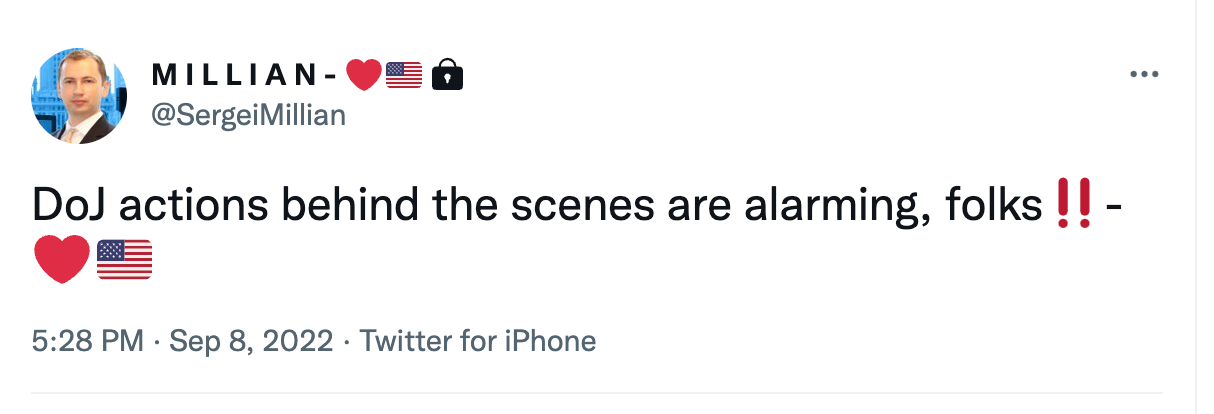
The Post landed a long story about Sergei Millian, a Belarusian-American businessman, on March 29. The top of the piece identified Millian as the source behind the dossier’s most serious allegation, a “well-developed conspiracy” between the Trump campaign and the Kremlin, the same ground covered by the Wall Street Journal and ABC in January. The claim that Millian was a key informant whose information was “central to the dossier” was stated without any attribution or sourcing. In 2021 the Post retracted the parts of the story describing Millian as a dossier source after John Durham, a special counsel looking into the origins of the Trump-Russia investigations, indicted Steele’s main source for lying to the FBI. Durham alleged the fact of Millian being a source had been “fabricated.” The Post editor’s note explained that Durham’s indictment “contradicted” information in the March story, and additional reporting in 2021 further “undermined” the account. The Post also deleted parts of a few other stories that repeated the allegation that Millian was a dossier source.

WaPo retracted much of the story after the Danchenko indictment, with this editor’s note:

The original version of this article published on March 29, 2017, said that Sergei Millian was a source for parts of a dossier of unverified allegations against Donald Trump. That account has been contradicted by allegations contained in a federal indictment filed in November 2021 and undermined by further reporting by The Washington Post. As a result, portions of the story and an accompanying video have been removed and the headline has been changed.

The original account was based on two people who spoke on the condition of anonymity to provide sensitive information. One of those people now says the new information “puts in grave doubt that Millian” was a source for parts of the dossier. The other declined to comment.

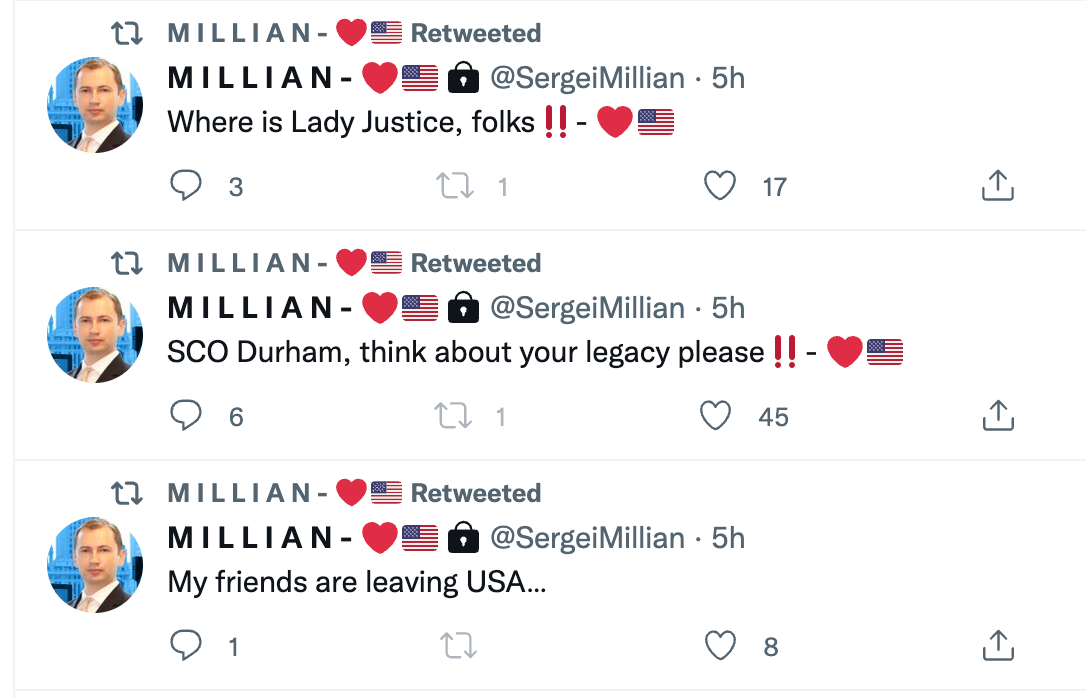
WaPo’s retraction (like the CNN “reckoning” which Gerth cites approvingly) were themselves problematic, because (as I noted about the CNN piece) they took John Durham’s false statements indictment against Steele’s primary subsource, Igor Danchenko, insinuating — but falling far short of charging — a conspiracy as a source of fact. Worse still, the indictment was obviously problematic. In it, Durham relied on Millian’s claims, made on social media but not to a grand jury, for a key part of his case. After Millian refused to testify at trial, Durham admitted he had little but hearsay to prove his case. 

And as Danchenko attorney Stuart Sears noted at trial, several of Millian’s communications, in which Millian boasted about his ties to Trump, were consistent with Danchenko’s claims about the call he attributed to Millian.

It’s entirely possible it wasn’t Sergei Millian, but even if it was, the caller only said there was coordination between the campaign and Russia and that there was nothing bad about it. Agent Helson told you that. That’s not anti-Trump, and we do know from the government’s own evidence that Millian was at least telling people he was going to meet with Trump campaign people the week before the phone call, the anonymous phone call. 

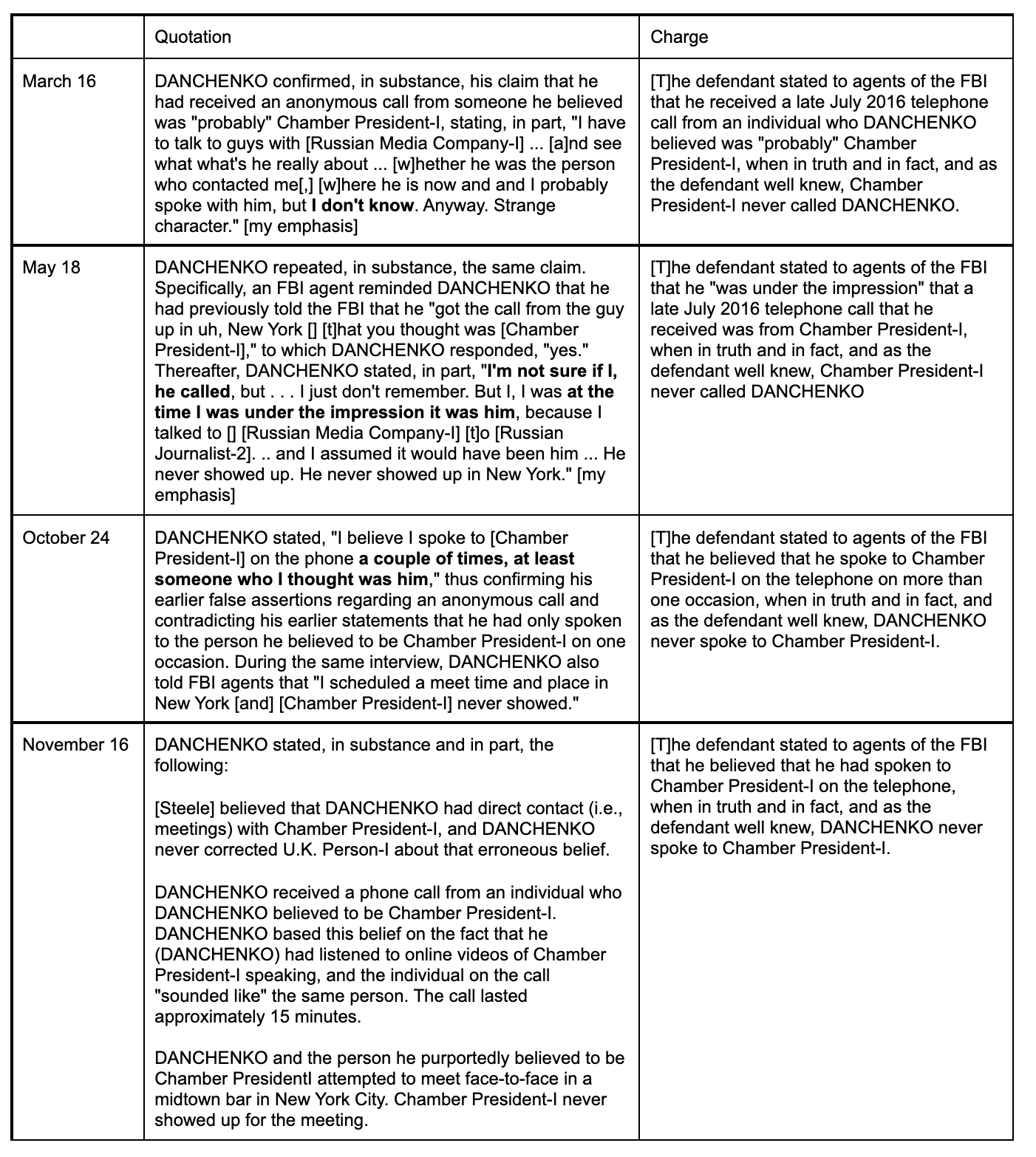
Gerth cheered retractions based off an indictment alone over three months after a jury acquitted Danchenko of lying about this call, which he told the FBI he believed, but was not certain, came from Millian. 

And Gerth, who complains about transparency, buried that fact: while Gerth emphasized the WaPo and CNN retractions in Part Two of his series, he didn’t get around to informing readers that Igor Danchenko had been acquitted until Part Four, over 9,000 words and two clicks later.

Gerth elsewhere noted that Mueller’s indictments against Yevgeniy Prigozhin and the GRU hackers haven’t been tried, yet when it served his narrative, he applauded these retractions based on an indictment alone.

Meanwhile, Gerth credited WaPo with breaking the news that the Democrats had funded the dossier, which is ample proof that the WaPo wasn’t shielding the project.

Amazingly, Gerth complained that the NYT didn’t retract anything in the wake of the Danchenko indictment, even though he found so little to complain about in the NYT coverage of the dossier and even though, as he describes, WaPo’s Erik Wemple (who might consider whether his own campaign for dossier accountability went too far, in light of the Danchenko acquittal) called out NYT’s Adam Goldman as one of those who approached the dossier responsibly. Gerth even noted that the NYT acknowledged the flimsiness of the dossier’s allegations in real time.

The Times has offered no such retraction, though the paper and other news organizations were quick to highlight the lack of firsthand evidence for many of the dossier’s substantive allegations;

It’s genuinely not clear what Gerth thinks the NYT should retract, a question I posed to Pope that he declined to answer.

And Gerth makes this complaint even though his series was published four days after NYT’s bombshell report of how corrupt the Durham investigation was. Somehow CJR didn’t find time to remove or amend Gerth’s complaints about NYT’s critical reporting on the Durham investigation, including his complaint that Goldman suggested a junket Barr and Durham took to Italy might be chasing a “conspiracy theory,” when the recent NYT report has revealed it was far worse. 

There are other grave problems with Gerth’s treatment of the dossier, all consistent with the ”Russiagate” project more generally. The DOJ IG Report Gerth relies on so heavily laid out abundant reason to suspect that Russia larded the dossier with disinformation, probably with the participation of Manafort associate Oleg Deripaska.

That’s important given the fragments of truth that appear in the dossier. As Durham briefly acknowledged at trial and as I noted in an interview hosted by CJR, the reason Danchenko’s ties to Clinton ally Chuck Dolan were so significant, and led Durham to charge Danchenko for making a “literally true” statement about Dolan to the FBI, was that Dolan established ties between Olga Galkina — the source of the most problematic claims in the dossier, alleging Michael Cohen spoke directly with the Kremlin about election interference — and Dmitri Peskov. The link raises the possibility that someone who knew about Michael Cohen’s January 2016 call to the Kremlin, to Peskov’s office, a call both Cohen and Trump lied to conceal, was behind the dossier allegation that falsely claimed Cohen had other contacts with the Kremlin. Peskov knew that Cohen and Trump were lying to hide that earlier contact, which made the later false allegation more powerful.

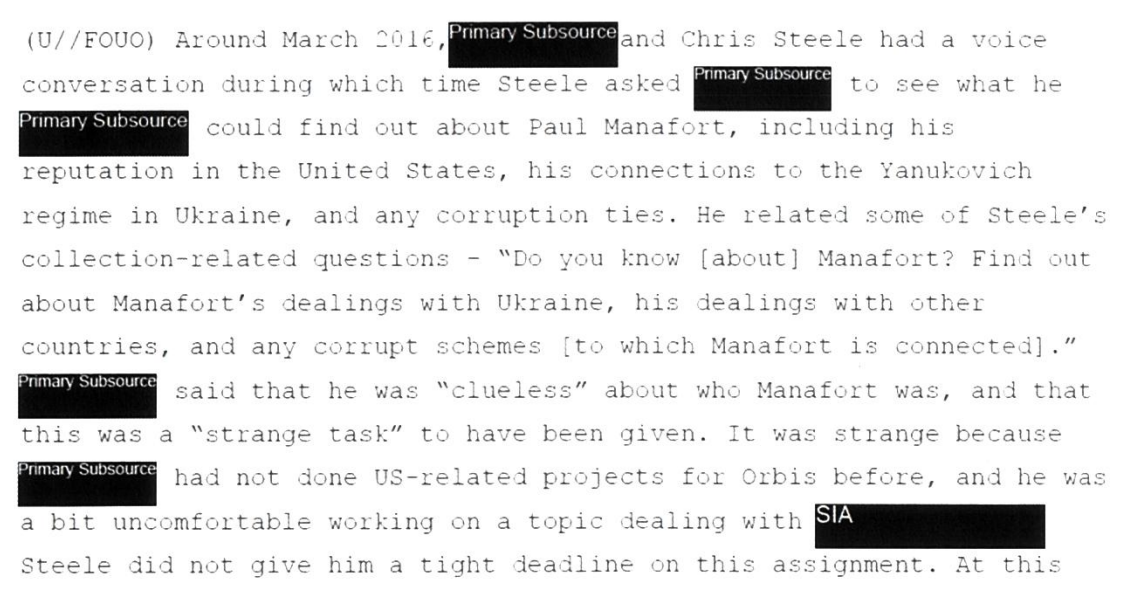
Other records show that Russia likely used Steele for a functional role in their operation. In spring 2016, Deripaska is believed to have been the client who hired Steele for intelligence collection targeting Paul Manafort. Then Deripaska used Steele as part of a brutal double game with Manafort. Essentially, Deripaska used the former British spy’s association with the FBI to increase Manafort’s legal vulnerability while he had Kilimnik exploit Manafort’s financial vulnerability, all of which made it easier to obtain inside information on the Trump campaign at the August 2 meeting. 

And, in a story about the dossier that Gerth doesn’t mention, Manafort came back from what we now know to be a meeting with a Deripaska associate and told Reince Priebus to focus on the dossier’s inaccuracies as pushback on the Russian investigation. That is, the focus on the dossier as a substitute for Trump’s real Russian ties seems to have become part of Russia’s plan, if it wasn’t from the start. If the dossier was deliberate disinformation — and the Republican members of Congress who investigated that document insist it was — then it must be considered part of Russia’s attack on US democracy –  in which Gerth and other “Russiagate” participants are enthusiastic participants.

Polarization and trust in the media lie at the center of Gerth’s project. Yet he failed to consider how the dossier, not the coverage of it, might be a key driving factor in polarization. That makes his project part of the problem.

Gerth’s selective coverage of NYT and WaPo’s Pulitzer-winning journalism

Even while Gerth failed to significantly implicate NYT and WaPo in what he portrays as the gravest journalistic crime in Russian coverage, hyping the Steele dossier, he also ignored key parts of their coverage.

For example, he didn’t acknowledge that WaPo reported on Carter Page’s inflammatory comments in Moscow weeks before Steele did. Much of the focus on Page subsequent to WaPo’s report was based on this public source, not the dossier. It’s one of many events that the press covered for its real news value that Gerth, in his own narrative, suggests could only have happened with Hillary’s intervention.

Gerth also ignored large swaths of NYT and WaPo’s award-winning journalism on Russia, although he covered Trump’s attack on that reporting in the third installment of his series. 

NYT won a Pulitzer in 2017 for ten Russia-related articles and NYT and WaPo shared a prize for a combined 20 stories on the Russian investigation in 2018. Trump has sued the Pulitzer Board for defamation relating to the 2018 award. In his coverage, Gerth suggests that Trump’s lawsuit against the Pulitzer Board  for those awards has merit.

Best as I’ve been able to reconstruct, this page lists the newspaper coverage mentioned in Gerth’s series (in numerous ways, CJR’s decision not to link the media Gerth claimed to discuss made it very difficult to assess his claims, and I made one error in my questions to CJR as a result). The page also lists, at the end, some key stories that Gerth did not address. Those with asterisks — both in the stuff he covered and the stuff he did not — were part of the Pulitzer packages for which NYT and WaPo won prizes.

Gerth included just one of the stories for which NYT won a Pulitzer in 2017, the Manafort secret ledger story (the same story,  as Fusion GPS revealed after Barry Meier attacked them in a book, for which Fusion provided research).

But he ignored the rest. 

That had the effect of hiding the general background on Russia’s international assault on its opponents that NYT, as an institution, would have brought into its coverage of Trump’s suspected ties to the Kremlin in 2017: stories about Russia hunting down its enemies in other countries, Russia’s use of disinformation, the elite hackers Russia was recruiting, and Russia’s cultivation of the far right.

Gerth also ignored two stories that were specifically on point to his project: A September 2016 story revealing how often Julian Assange’s Wikileaks releases served Russia’s political  interests (I raised some concerns about the piece here), and a December 2016 epic that described the Russian hack-and-leak from the DNC perspective (I pointed out the DNC’s changing story about being warned by the FBI here). The DNC story should be particularly important to Gerth’s project because it explicitly made the comparison with the Watergate burglary in 1972 that Gerth complains about in his series. It also provided a great deal of information, much publicly available, backing the hack-and-leak attribution to Russia – an attribution that Gerth claims remains “far from definitive.”

I asked Pope why the Assange and the DNC hack stories weren’t included in the series. He pointed to coverage of other NYT stories as proof CJR wasn’t ignoring the (2017, not 2018) Pulitzer stories.

Do you think it fair to ignore all the stories for which WaPo and NYT did get Pulitzers, including the 2017 ones on WikiLeaks and the DNC hack?

We didn’t ignore them. From the piece: “For the Times, Trump’s mess was a pot of gold: two of the Times stories about the meeting and the emails were part of its winning Pulitzer Prize package.

And … “But before that omission, the Times exposed another piece of the FBI’s Russia puzzle. The paper landed a major story at the end of the year, in time to be included in its Pulitzer package that ultimately shared the prize for national reporting.”

But there were a bunch of Pulitzer winners Gerth left out whose omission is still more problematic, particularly given his suggestion that the entirety of the press’ early 2017 focus on Russia in Trump’s administration stemmed from the publication of the dossier.

For example, Gerth barely mentions the coverage of Mike Flynn’s lies and resignation and its central role, starting even before the publication of the dossier, in press coverage in early 2017. He slips discussion of a key David Ignatius column, the first to report on Mike Flynn’s calls with Russian ambassador to the US, Sergei Kislyak, in between his references to the dossier.

The WSJ and the Times stories were not well received by Fusion. At first, they feared for Steele’s safety. Then they felt the Times’ behavior was “improper,” because it had “unilaterally” published material “it had learned off the record,” the founders wrote in their book.

Hours after the Times story ran, the Post upped the temperature on Russia even more. Columnist David Ignatius disclosed that incoming national security adviser Michael Flynn had phoned Russia’s US ambassador “several times” at the end of the year, according to “a senior US government official.” Ignatius noted the talks had come on the day the Obama administration had expelled Russian diplomats in retaliation for the country’s hacking activities, so he questioned whether Flynn had “violated” the spirit of an “unenforced” law barring US citizens from trying to resolve “disputes.”

Ignatius went on to write that it might be a “good thing” if Trump’s team was trying to de-escalate the situation. But Ignatius didn’t know the substance of the conversations. Hours before his story went online, Ignatius appeared on MSNBC and, while not disclosing his upcoming Flynn exclusive, said “it was hard to argue” against the need to “improve relations with Russia.”

The existence of Flynn’s talks with the ambassador was known by Adam Entous, a reporter then at the Post, but he held off writing anything because the mere fact of a contact wasn’t enough to justify a story. “It could have been something innocent,” Entous, now with the Times, said in an interview, “something he would be praised for.”

On the heels of the Ignatius column, the FBI’s “investigative tempo increased,” according to FBI records, and the Senate intelligence panel announced an inquiry into Russia’s election activities. (The House Intelligence Committee announced a similar effort later that month.)

Two days after the Senate announcement, Bob Woodward, appearing on Fox News, called the dossier a “garbage document” that “never should have” been part of an intelligence briefing.

But he doesn’t reveal why the FBI’s investigative tempo increased in the wake of Ignatius’ column. 

Stories that the WaPo published that he ignored did. A Pulitzer-winning WaPo report published the same day revealed that Flynn was denying he had discussed sanctions with the Russian Ambassador, the first of many compromising lies Trump’s associates told in the early days of his Administration. Flynn’s lies (as Mueller confirmed in his congressional testimony) created the risk that he could be blackmailed, which led the FBI and DOJ to respond more aggressively than they otherwise might have. Another Pulitzer-winning WaPo story explained all that on the day Flynn resigned. 

Later in the spring, a Pulitzer-winning NYT report revealed that Trump knew Flynn was under investigation for his secret relationship with Türkiye even before the president appointed him to be National Security Adviser. Gerth’s silence about all these stories is particularly damning, given that he later gets a key detail about Flynn’s prosecution wrong, which I’ll return to.

Other award-winning stories revealed still more Russian ties that Trump and his associates were trying to hide. A March story from WaPo — yet another Pulitzer winner — revealed that Jeff Sessions had failed to disclose some interactions with Sergey Kislyak, the same ambassador  with whom Flynn was undermining Obama foreign policy during the transition. An April Pulitzer-winning story from the NYT revealed that Jared Kushner had omitted transition period meetings with Russians — not just Kislyak, but also the head of a sanctioned bank — in his security clearance paperwork.

While Gerth may have mentioned a May article for which NYT won a Pulitzer, if he did, he did so only as part of his complaint that the NYT repeatedly referred to the line from Trump’s interview with Lester Holt in which he referred to “the Russian thing” in his explanation for firing Comey.

A tweet from the show on May 11 set the narrative for the Holt interview: “Trump on firing Comey: ‘I said, you know, this Russia thing with Trump and Russia is a made-up story.’” Those few words, by suggesting Comey’s firing was aimed at getting the FBI inquiry off his back, provided fresh ammunition to anti-Trumpers.

The full interview, which was available online, presented a more nuanced story, and appeared to reflect what his advisers told him: firing Comey could prolong, not end, the investigation. Trump told Holt, soon after the controversial words, that the firing “might even lengthen out the investigation” and he expected the FBI “to continue the investigation,” to do it “properly,” and “to get to the bottom.”

The media focused on the “Russia thing” quote; the New York Times did five stories over the next week citing the “Russia thing” remarks but leaving out the fuller context.

But Gerth’s account elided the entire reason Trump’s NBC quote was used in that particular NYT article: because Trump told Kislyak and Sergey Lavrov roughly the same thing, privately, on the same day.

President Trump told Russian officials in the Oval Office this month that firing the F.B.I. director, James B. Comey, had relieved “great pressure” on him, according to a document summarizing the meeting.

“I just fired the head of the F.B.I. He was crazy, a real nut job,” Mr. Trump said, according to the document, which was read to The New York Times by an American official. “I faced great pressure because of Russia. That’s taken off.”

Mr. Trump added, “I’m not under investigation.”

Gerth doesn’t address the real concerns presented by Trump privately bragging about firing the FBI director – in charge of counterintelligence – to his Russian visitors.

Indeed, given Gerth’s focus on Trump’s use of “fake news,” he might have at least mentioned the last lines of the NYT story:

At one point, Mr. Trump jokingly asked whether there were reporters in the room.

“No,” Mr. Lavrov said. “No fake media.”

Whether you think that Trump’s adoption of the term “fake news” was merited or not, the answer to Trump’s question, “Russia, if you’re listening,” was yes, they were.

Gerth also appears to have paid no attention to a Pulitzer-winner from WaPo written in the same time frame, revealing that Trump shared highly classified Israeli intelligence with his Russian visitors in the same meeting, another cause for concern that Gerth simply makes disappear. 

Those aren’t the only damning stories Gerth ignored. As Pope emphasized to me, Gerth credited NYT for two of three Pulitzer-winning stories on the June 9 meeting that Don Jr took with a Russian lawyer in hopes of acquiring dirt on Hillary– the July 10 one revealing that Don Jr took a meeting with Russians offering dirt, and the July 11 one revealing Don Jr’s enthusiastic response. But I don’t believe he credited the WaPo for their July 31 Pulitzer-winning story revealing that Trump drafted Don Jr’s misleading statement, claiming a meeting about dirt on Hillary and sanctions relief was about adoption.

The omission is really telling given Gerth’s take on a July 19 story from the NYT (which did not win a prize). In an interview with three NYT reporters, Trump successfully got the NYT to participate in his efforts to obstruct the investigation by airing his threats to fire Jeff Sessions (he had asked Corey Lewandowski to fire Jeff Sessions on the same day). In the interview, Trump also confirmed that he and Putin spoke about the topic of his misleading statement before drafting it, meaning adoptions. But Gerth deemed that interview important primarily because Mike Schmidt asked Trump about the dossier.

A week after the Trump Tower story, the president conducted a serendipitous interview with three Times reporters, including Schmidt, who asked if Comey’s sharing of the dossier with Trump before his inauguration was “leverage.” Trump replied, “Yeah, I think so, in retrospect.”

After the Oval Office sit-down, an aide, worried about the possibility of repercussions from an impromptu interview, sought Trump’s reaction.

“I loved that,” the aide, who requested anonymity, recalled him saying. “It was better than therapy. I’ve never done therapy, but this was better.”

This is a fairly astounding view on the relative newsworthiness of the interview — I’ve pointed out the importance, to Trump’s obstructive purpose, of NYT’s decision to bury the Putin tie rather than dedicate an entire story to it. It’s also a prime example of how the unrelenting focus on the dossier by “Russiagate” adherents diverts attention from far more damning events, both creating in that unrelenting focus the narrative they claim to combat, and in the process burying the real events that “Russiagate” adherents claim could only come as part of a manufactured narrative.

I asked CJR, “Why do you believe a comment on the dossier was more important than a scoop substantiating Trump’s problematic ties to Putin?” but it was another of the questions the magazine’s editor declined to answer.

There are more Pulitzer winners that Gerth left out, including a WaPo story describing both Trump’s refusal to take steps to protect American democracy from Russian interference…

Nearly a year into his presidency, Trump continues to reject the evidence that Russia waged an assault on a pillar of American democracy and supported his run for the White House.

The result is without obvious parallel in U.S. history, a situation in which the personal insecurities of the president — and his refusal to accept what even many in his administration regard as objective reality — have impaired the government’s response to a national security threat. The repercussions radiate across the government.

Rather than search for ways to deter Kremlin attacks or safeguard U.S. elections, Trump has waged his own campaign to discredit the case that Russia poses any threat and he has resisted or attempted to roll back efforts to hold Moscow to account.

… As well as Russia’s assessment of the “staggering return”  achieved by their interference operation.

U.S. officials said that a stream of intelligence from sources inside the Russian government indicates that Putin and his lieutenants regard the 2016 “active measures” campaign — as the Russians describe such covert propaganda operations — as a resounding, if incomplete, success.

Moscow has not achieved some its most narrow and immediate goals. The annexation of Crimea from Ukraine has not been recognized. Sanctions imposed for Russian intervention in Ukraine remain in place. Additional penalties have been mandated by Congress. And a wave of diplomatic retaliation has cost Russia access to additional diplomatic facilities, including its San Francisco consulate.

But overall, U.S. officials said, the Kremlin believes it got a staggering return on an operation that by some estimates cost less than $500,000 to execute and was organized around two main objectives — destabilizing U.S. democracy and preventing Hillary Clinton, who is despised by Putin, from reaching the White House.

The bottom line for Putin, said one U.S. official briefed on the stream of post-election intelligence, is that the operation was “more than worth the effort.”

But the stories from the first half of 2017 that Gerth left out are key. They not only reveal the real reason that the FBI investigation picked up in early 2017, they also show that a great deal of important journalism provided abundant reason to be concerned about all the secrets about Russia that Trump and his aides were keeping, independent of the dossier.

The contacts with Russian spies that were later confirmed

That focus – the ties with Russia that Trump, his National Security Adviser, his Attorney General, and his son-in-law failed to disclose – makes Gerth’s chief complaint about the NYT coverage look very different.

He appears especially peeved over a series of NYT stories in this same time period that described the sheer number of contacts that investigators were discovering with various Russians described by the paper as intelligence officers.

  • January 19, 2017
  • February 14, 2017
  • March 1, 2017
  • March 3, 2017 (including comment from Konstantin Kilimnik)

Gerth’s critique relies heavily on a Peter Strzok annotation of the February 14 story that Strzok shared with top FBI officials (parts of which, detailing how few call records the investigation had yet obtained, explain why early reports Gerth points to to make claims about the investigation, including one from James Clapper, are meaningless). It is absolutely true that Strzok found no basis for the NYT to claim that the Russians with whom Trump and his aides were in contact were Russian spies. 

Gerth also reviews how Comey disavowed such reports in his public testimony to Congress, with support from Devin Nunes.

That section of the series, covering all four stories, is over 2,500 words long.

As Gerth described it, when NYT has been challenged on these stories, they’ve stood by them. I share Gerth’s curiosity regarding NYT’s sources for the stories, but like Gerth himself, the NYT is not about to share their sources. 

It’s worth noting, though, that Gerth seems to believe that the US-based three letter agencies (or the Congressional personnel who’ve been briefed by those agencies) referenced in Strzok’s memo are the only possible sources for these stories. We know that at least five other intelligence services — the UK, the Dutch (from whom the US got a great deal of intelligence on the operation), the Spanish, the Ukrainians, and the Israelis — would have had their own views about which foreign interlocutors with Trump aides were spies. We know of a number of witnesses, not in government at all, who told Mueller they believed one or another interlocutor was a spy. We also know of a number of overt spies (such as Emirati ones) who had a role in the international effort to influence Trump. And we know of contacts – like that between Stone and Guccifer 2.0 – that were legitimately viewed as a spy contact when they started to become known around this time.

The clearest error in the NYT series pertains to the claim that an investigation into Stone had already been opened, but that’s an error SSCI seems to have shared, because on March 16,  Senator Richard Burr told Don McGahn the FBI was investigating Paul Manafort, Roger Stone, Carter Page, and “Greek Guy.”

In the years since, however, the US government has come to believe more of the people known to have been interacting directly with Trump’s aides were Russian spies.

Konstantin Kilimnik — who along with at least two other Deripaska allies have been described as Russian agents in official US documents — is a particularly important one, given Gerth’s complaints that the NYT didn’t call Kilimnik for comment when the record shows they did (including in the March 3 one).

Gerth’s claims about the evidence that Kilimnik was a spy were nothing short of fanciful, including a perennial “Russiagate” favorite — which he credits to John Solomon’s scoop, from a period when Solomon was part of Rudy Giuliani’s outreach to people like Dmitry Firtash – that Kilimnik had been a source for the State Department.

As for Kilimnik possibly being a Russian spy, the only known official inquiry, by Ukraine in 2016, didn’t result in charges. More recent claims that he worked for the Russians, by the Senate intelligence panel in 2020 and the Treasury Department in 2021, offered no evidence. Conversely, there are FBI and State Department documents showing Kilimnik was a “sensitive source” for the latter. (The documents were disclosed a few years ago by John Solomon, founder of the Just the News website. Kilimnik, in an email to me, confirmed his ties with State.)

One primary objective of most spies, of course, is to infiltrate the agencies of other governments.

I asked CJR why Gerth claimed SSCI had no evidence against Kilimnik when their section substantiating their assessment about Kilimnik includes 16 bullet points, over half redacted, and they also included a separate 5-page, largely redacted section showing more fragmentary evidence that Kilimnik had a role in the hack-and-leak. I also asked why Gerth thought the FBI, under Trump, would have issued a $250,000 reward for Kilimnik’s arrest.

Those questions also went unanswered.

So the NYT may well have been ahead of the FBI’s assessment in spring 2017 (and their report that Stone was already part of the investigation has been shown to be wrong). But those reports really aren’t ahead of what the US intelligence community says they have since corroborated. Moreover, many of the Pulitzer stories that Gerth doesn’t mention show that Trump and his associates were aggressively lying to hide their ties to Russians or their interlocutors, and criminally so, in the case of Flynn and George Papadopoulos (and, ultimately, Michael Cohen and Roger Stone, too). That background — the lies that Flynn and Sessions and Kushner were telling about their Russian ties — is important background to these stories Gerth hates, yet he makes no mention of them.

Gerth’s main remaining gripe about the WaPo is even more remarkable. He spent six paragraphs on the WaPo’s scoop reporting the FISA order targeting Carter Page.

In early April, the Post story on Page landed, calling the surveillance “the clearest evidence so far that the FBI had reason to believe during the 2016 presidential campaign that a Trump campaign adviser was in touch with Russian agents. Such contacts are now at the center of an investigation into whether the campaign coordinated with the Russian government to swing the election in Trump’s favor.” It noted Page’s “effusive praise” for Putin and mentioned Schiff’s congressional recitation of the Page allegations in the dossier. Relying on anonymous sources, it gave a vague update on the dossier’s credibility: “some of the information in the dossier had been verified by US intelligence agencies, and some of it hasn’t.”

At the Times, the newsroom was irked about getting beaten by the Post. “Times is angry with us about the WP scoop,” Strzok texted to an FBI colleague, a few days later.

But the Post scoop was incomplete. Its anonymous sources mirrored the FBI’s suspicions but left out the bureau’s missteps and exculpatory evidence, as subsequent investigations revealed. It turns out that the secret surveillance of Page was an effort to bring in heavier artillery to an FBI inquiry that, in the fall of 2016, wasn’t finding any nefarious links, as the Times reported back then. Agents were able to review “emails between Page and members of the Donald J. Trump for President Campaign concerning campaign related matters,” according to an inquiry in 2019 by the Justice Department Inspector General. FBI documents show the surveillance of Page targeted four facilities, two email, one cell, and one Skype.

Still, even with the added surveillance capability, the investigation had not turned up evidence for any possible charges by the date of the Post piece, which came four days after the secret surveillance, called FISA, for the Foreign Intelligence Surveillance Act, was renewed for the second time. (Page was never charged.)

The IG review also found that the FISA warrant process was deeply flawed. It relied heavily on the dossier, including the fabricated Millian allegation of a conspiracy, the IG found. Furthermore, the report said the warrants contained seventeen “significant errors and omissions,” such as leaving out exculpatory information about Page, including his previous work for the CIA and comments he made to an undercover FBI informant. And by the time of the Post piece, the dossier’s credibility was collapsing; the FBI knew the CIA called it “internet rumor,” and on its own the FBI “did not find corroboration for Steele’s election reporting,” according to the IG report.

The Post spokesperson, who would only speak on background, said the article on Page was “fair and accurate” and meant to reflect “how deeply the FBI’s suspicions were about Page.” They acknowledged the story was incomplete, noting that “at that time there was a lot that was not publicly known.” [my emphasis]

This passage commits several errors. The FBI targeted Page not because they were looking for heavier artillery. They did so because Page was about to travel internationally and they wanted coverage of that trip. (The FBI consistently described the FISA targeting of Page as “productive” or “fruitful.”) And Bill Barr’s DOJ didn’t withdraw the probable cause claim for Page’s first two FISA orders. The applications against him, which were based in part on his voluntary sharing of non-public information with known Russian intelligence officers, alleged he knowingly aided and abetted foreign spies.

Over time, there would be more than those four facilities, and in fact one main reason FBI submitted the especially problematic June 2017 application was because the FBI wanted to access financial information and two encrypted messaging apps, the latter out of suspicion that Page had destroyed a phone once he discovered he was under investigation.

The FBI also had concerns about Page’s initial denial in a March 16, 2017 interview that he had sought out some Russian official to identify himself as the Male-1 in court filings for one of the Russians trying to recruit him some years earlier.

There was evidence for possible charges; there was evidence when the FBI first opened an investigation into him in April 2016. Just not enough to charge him.

Errors aside, though, Gerth here adopts a fairly remarkable stance. He complains that the WaPo story confirming the FISA targeting did not include all the problems with the FISA applications that wouldn’t be discovered until much later. I spoke with a Congressional Republican who was privy to the applications targeting Page in summer 2018, for example, and even at that point, the person believed there was abundant other evidence against Page, even without any information from Steele. Crazier still, in April 2017 when the WaPo published that scoop, the worst abuse of all identified in the Page applications – the alteration of an email – hadn’t happened yet.

The WaPo would have needed a time machine to meet Gerth’s strictures.

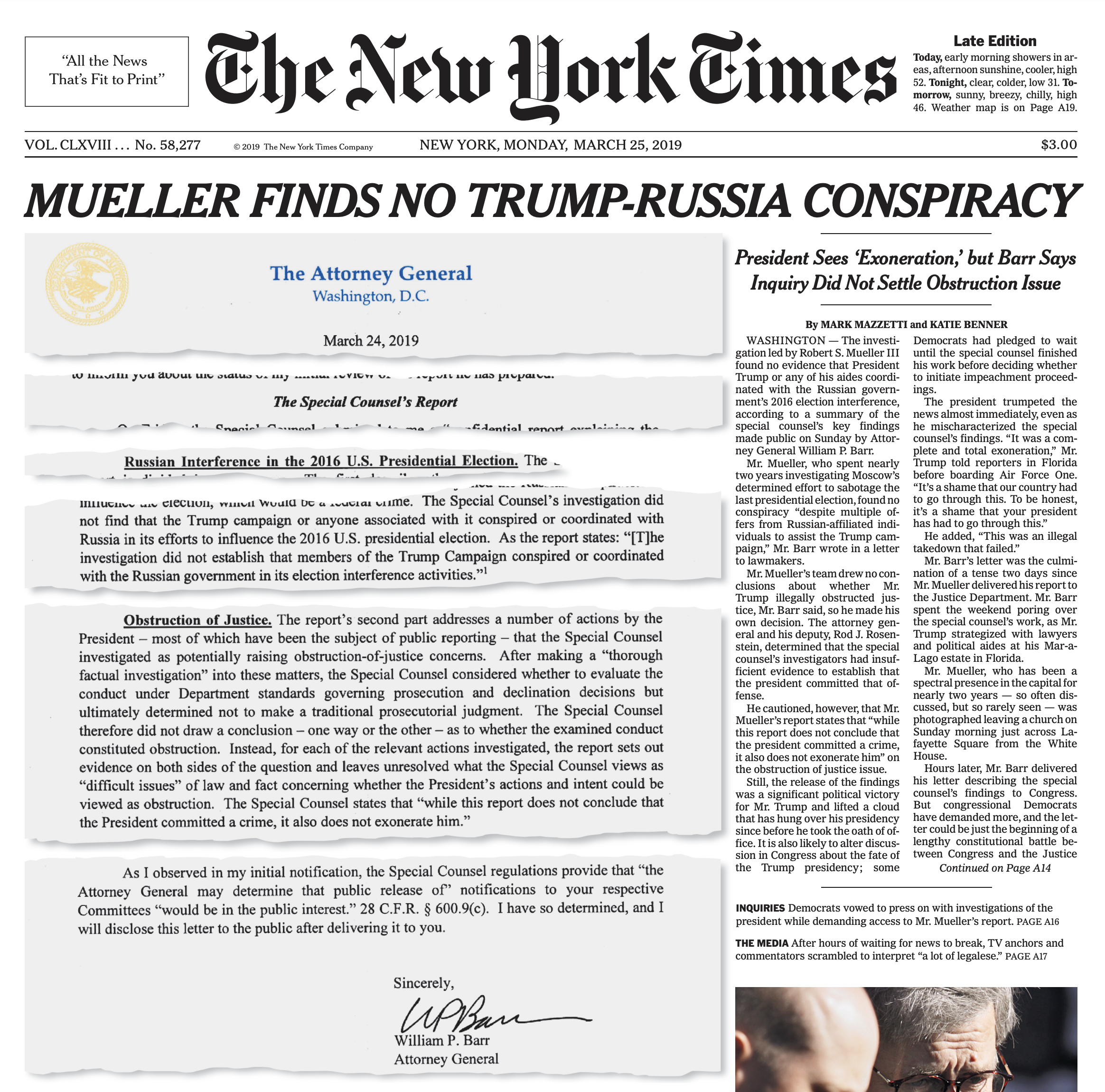
Gerth’s claims that the NYT and WaPo’s reporting was particularly problematic are, with a few exceptions, extraordinarily weak, and that’s before you consider all the Pulitzer articles he simply ignored. But he also ignores some of the more problematic NYT stories, like the NYT decision to bury Trump’s discussion of adoptions with Putin immediately before he wrote a misleading note claiming the June 9 meeting addressed adoptions. Similarly, Gerth had no problem that the NYT not only parroted Bill Barr’s misleading March 24, 2019 letter about the Mueller Report, but ran entire blocks of his letter on the front page. I asked CJR if they had any problem with this article, which misrepresented court filings in the Manafort case to suggest that his sharing of polling data with Konstantin Kilimnik happened in the spring, not during the general election, and involved only Ukrainian oligarchs, not Deripaska; to this day, the article feeds misunderstanding about that allegation. 

That was another question to which I got no answer.

Gerth has plenty of complaints about the NYT — just not about the stories where they erred on the side of downplaying the discoveries of the Russian investigation.

But as I’ll show in my next post, Gerth’s poor framing of his complaints about the NYT coverage doesn’t end there.

Links

CJR’s Error at Word 18

The Blind Spots of CJR’s “Russiagate” [sic] Narrative

Jeff Gerth’s Undisclosed Dissemination of Russian Intelligence Product

Jeff Gerth Declares No There, Where He Never Checked

“Wink:” Where Jeff Gerth’s “No There, There” in the Russian Investigation Went

My own disclosure statement

An attempted reconstruction of the articles Gerth includes in his inquiry
A list of the questions I sent to CJR

Share this entry
https://www.emptywheel.net/wp-content/uploads/2023/02/Screen-Shot-2023-02-03-at-6.12.56-PM-1.png 2300 2328 emptywheel https://www.emptywheel.net/wp-content/uploads/2016/07/Logo-Web.png emptywheel2023-02-07 17:49:422023-02-25 08:53:17The Blind Spots of CJR’s “Russiagate” [sic] Narrative

Billy B and Johnny D Drank Whiskey before the Special Counsel Appointment

January 27, 2023/191 Comments/in 2020 Presidential Election, Mueller Probe /by emptywheel

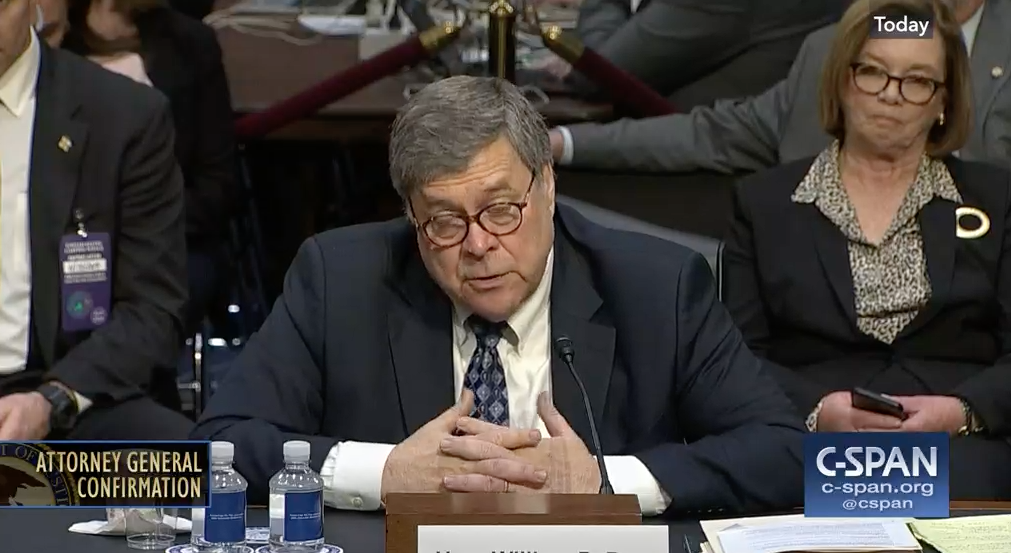
I’ll have more to say about the NYT piece on the corrupt Durham investigation, though probably not till next week. But many people are commenting about how close Billy Barr was to Durham, as depicted by the way they sipped whiskey together.

While attorneys general overseeing politically sensitive inquiries tend to keep their distance from the investigators, Mr. Durham visited Mr. Barr in his office for at times weekly updates and consultations about his day-to-day work. They also sometimes dined and sipped Scotch together, people familiar with their work said.

In some ways, they were an odd match. Taciturn and media-averse, the goateed Mr. Durham had spent more than three decades as a prosecutor before Mr. Trump appointed him the U.S. attorney for Connecticut. Administrations of both parties had assigned him to investigate potential official wrongdoing, like allegations of corrupt ties between mafia informants and F.B.I. agents, and the C.I.A.’s torture of terrorism detainees and destruction of evidence.

By contrast, the vocal and domineering Mr. Barr has never prosecuted a case and is known for using his law enforcement platform to opine on culture-war issues and politics. He had effectively auditioned to be Mr. Trump’s attorney general by asserting to a New York Times reporter that there was more basis to investigate Mrs. Clinton than Mr. Trump’s “so-called ‘collusion’” with Russia, and by writing a memo suggesting a way to shield Mr. Trump from scrutiny for obstruction of justice.

But the two shared a worldview: They are both Catholic conservatives and Republicans, born two months apart in 1950. As a career federal prosecutor, Mr. Durham already revered the office of the attorney general, people who know him say. And as he was drawn into Mr. Barr’s personal orbit, Mr. Durham came to embrace that particular attorney general’s intense feelings about the Russia investigation.

It is true that Special Counsels, under the regulations, are supposed to have more independence from the Attorney General than this.

But keep in mind that 17 months of whiskey sipping happened before Barr made Durham Special Counsel.

And Barr intervened this closely in many of the other investigations he orchestrated. I wouldn’t be surprised if he sipped whiskey with Scott Brady and Jeffrey Jensen, when they were conducting corrupt projects (accepting Russian-tied dirt on Joe Biden and undermining the Mike Flynn case, respectively) for him, as well.

The timing is significant in another way.

As NYT describes, when Billy and Johnny went to Italy chasing George Papadopoulos’ conspiracy theories, the Italians instead shared alarming information about suspected financial crimes with the two men. Rather than providing the tip to a normal investigator, Barr instead had Durham chase it down.

On one of Mr. Barr and Mr. Durham’s trips to Europe, according to people familiar with the matter, Italian officials — while denying any role in setting off the Russia investigation — unexpectedly offered a potentially explosive tip linking Mr. Trump to certain suspected financial crimes.

Mr. Barr and Mr. Durham decided that the tip was too serious and credible to ignore. But rather than assign it to another prosecutor, Mr. Barr had Mr. Durham investigate the matter himself — giving him criminal prosecution powers for the first time — even though the possible wrongdoing by Mr. Trump did not fall squarely within Mr. Durham’s assignment to scrutinize the origins of the Russia inquiry, the people said.

Mr. Durham never filed charges, and it remains unclear what level of an investigation it was, what steps he took, what he learned and whether anyone at the White House ever found out. The extraordinary fact that Mr. Durham opened a criminal investigation that included scrutinizing Mr. Trump has remained secret.

But in October 2019, a garbled echo became public. The Times reported that Mr. Durham’s administrative review of the Russia inquiry had evolved to include a criminal investigation, while saying it was not clear what the suspected crime was. Citing their own sources, many other news outlets confirmed the development.

The news reports, however, were all framed around the erroneous assumption that the criminal investigation must mean Mr. Durham had found evidence of potential crimes by officials involved in the Russia inquiry. Mr. Barr, who weighed in publicly about the Durham inquiry at regular intervals in ways that advanced a pro-Trump narrative, chose in this instance not to clarify what was really happening.

By description, this tip too appears to precede the time when Durham was appointed Special Counsel. That’s important because, with every other investigation into Trump, Barr attempted to ensure it was shut down during the summer of 2020. If Barr succeeded here, too, then it would mean that it would not fall into the scope of Durham’s Special Counsel activities.

That’s important, because Durham is, by regulation, required to write a report about his prosecution and declination decisions. If Durham wants to see his report made public, we should fairly expect to see this criminal tip on Trump included.

There are a lot of questions about why Durham remains at DOJ. But one potential reasons is that Lisa Monaco believes his report could be a worthwhile thing: basically a long list of conspiracy theories that Barr had Durham chase that turned out to be conspiracy theories.

And this story may put some pressure on DOJ to make sure that happens.

Share this entry
https://www.emptywheel.net/wp-content/uploads/2019/03/Screen-Shot-2019-03-26-at-2.35.58-PM.png 553 1011 emptywheel https://www.emptywheel.net/wp-content/uploads/2016/07/Logo-Web.png emptywheel2023-01-27 02:56:502023-01-27 02:59:45Billy B and Johnny D Drank Whiskey before the Special Counsel Appointment

Judge Sanctions Alina Habba for Misrepresenting Igor Danchenko Indictment

November 11, 2022/55 Comments/in 2016 Presidential Election, Mueller Probe /by emptywheel

There are a number of reasons why Judge Donald Middlebrook sanctioned Alina Habba and Peter Ticktin for the frivolous claims they made against Chuck Dolan in the omnibus lawsuit against Hillary Clinton and a bunch of other people.

In reverse order, Middlebrook found that the lawsuit was filed for improper purpose: to advance a political grievance.

Every claim was frivolous, most barred by settled, well-established existing law. These were political grievances masquerading as legal claims. This cannot be attributed to incompetent lawyering. It was a deliberate use of the judicial system to pursue a political agenda.

[snip]

The rule of law is undermined by the toxic combination of political fundraising with legal fees paid by political action committees, reckless and factually untrue statements by lawyers at rallies and in the media, and efforts to advance a political narrative through lawsuits without factual basis or any cognizable legal theory.

He ruled that it’s not RICO, it’s never RICO (or any of the other conspiracies Habba alleged, either).

In the RICO count of the Amended Complaint, Plaintiff realleged the previous 619 paragraphs, and it was a mystery who he intended to sue. In the caption to Count II, he named 22 defendants but in the prayer for relief for that count 28 were named. Added were HF ACC, Inc., the DNC Services Corporations, James Comey, Peter Strzok, Lisa Page, and Andrew McCabe. (Am. Compl. ¶ 633). Whoever he intended to sue, Plaintiff alleged that each of them “knew about and agreed to facilitate the Enterprise’s scheme to harm the Plaintiff’s political career, tarnish his electability, and undermine his ability to effectively govern as the President of the United States . . . . ” (Am. Compl. ¶ 627).

The RICO conspiracy claims were entirely conclusory. Moreover, there is no standing to bring a RICO conspiracy claim unless injury resulted from violation of a substantive provision of RICO.

Of greatest interest to me, however, to substantiate a finding that the lawsuit’s allegations against Chuck Dolan lacked any reasonable factual basis, Judge Middlebrook laid out how Habba misrepresented the Igor Danchenko indictment to include Dolan in her conspiracy theories. Middlebrook focused closely on Habba’s claims that the pee tape allegation in the Steele dossier “was derived from Dolan.” He rejected Habba’s defense of the allegations against Dolan by pointing to stuff she left out.

Mr. Trump’s lawyers claim “nearly all” of the allegations against Mr. Dolan were sourced directly from the Indictment brought against Igor Danchenko by special counsel John Durham. (DE 270-2 at 6). But this is simply not so. As was the practice throughout the Amended Complaint, Plaintiff cherry-picked portions which supported his narrative while ignoring those that undermined or contradicted it.1 Mr. Trump’s lawyers persisted in this misrepresentation after being warned by the sanctions motion, and they doubled down on this falsehood in their response to the motion.

[snip]

Even more telling are the portions of the Indictment ignored by Plaintiff. The Indictment alleges that Mr. Dolan and others were planning a business conference to be held in Moscow on behalf of businessmen seeking to explore investments in Russia. (DE 270-2 ¶ 21). Mr. Danchenko was introduced to Mr. Dolan in connection with business activities. (Id. ¶ 18).

Significantly the Indictment alleges two other facts relevant to and, if true, fatal to Plaintiff’s claim of conspiracy.

According to [Mr. Dolan], individuals affiliated with the Clinton Campaign did not direct, and were not aware of, the aforementioned meetings and activities with Danchenko and other Russian nationals.

***

According to [Mr. Dolan], he [Mr. Dolan] was not aware at the time of the specifics of Danchenko’s ‘project against Trump,’ or that Danchenko’s reporting would be provided to the FBI.

And with regard to the allegation about sexual activity, the Indictment alleges that Mr. Dolan and another individual were given a tour of a Moscow hotel in June 2016, told that Mr. Trump had previously stayed in the Presidential suite, and according to both Mr. Dolan and the other individual, the staff member who gave the tour did not mention any sexual or salacious activity. (Id. ¶¶ 60-61). The Indictment does not allege that the information concerning sexual activity was provided by Mr. Dolan.

The May 31, 2022 warning letter told the Trump lawyers that Mr. Dolan had been questioned by the FBI on multiple occasions, that the Danchenko Indictment detailed his contacts with Mr. Danchenko but did not indicate he “discussed any sexual rumors with Mr. Danchenko — because he did not.” (DE 268-1 at 2). The Indictment confirms that Mr. Dolan spoke to the FBI, and not only was he not charged with any falsehood, but his statements are included within the Indictment. The Indictment contradicts rather than supports Plaintiff’s allegations against Mr. Dolan. Far from being “sourced directly” and cited “word-for-word,” (DE 270 at 5), Plaintiff’s use of the Indictment is nothing short of a deliberate disregard of the truth or falsity of their claims. This is a textbook example of sanctionable conduct under Rule 11.

Rather than express any regret, Plaintiff doubled down on his claims: “Plaintiff’s allegation that Defendant was the source of the salacious sexual activity rumor has a legitimate factual basis and is based upon a well-reasoned theory that may well be proven correct during the [Office of Special Counsel’s] upcoming trial of Danchenko.” (DE 270 at 10).

It was never to be. In the Danchenko trial, Mr. Dolan was called as a witness by the government about matters unrelated to the Ritz Carlton rumors. The government never alleged that Mr. Dolan was a source for the Ritz Carlton story. See Order, United States v. Igor Y. Danchenko, Case No. 21-cr-00245-AJT at 5 (Oct. 4, 2022). And Mr. Danchenko was ultimately acquitted by the jury.

1 The “sourced directly” claim is untrue. For example, the Indictment says: “In or about April 2016, Danchenko and [Mr. Dolan] engaged in discussions regarding potential business collaboration between PR Firm-1 and UK Investigative Firm-1 on issues related to Russia.” (DE 270-2 ¶ 23). The Amended Complaint, however, states: “In late April 2016 Danchenko began having discussions with Dolan about a potential business collaboration between Orbis Ltd. and Kglobal to create a ‘dossier’ to smear Donald J. Trump and to disseminate the false accusations to the media.” (Am. Compl. ¶ 96(c)).

The order as a whole generated a lot of attention on the failed birdsite. But there was no self-awareness that the exercise that Habba engaged in with respect to Dolan and the Danchenko prosecution was similar to what a number of journalists (and a great number of right wingers and other frothers) themselves did, when the Danchenko indictment was rolled out last year.

For example, here’s what the WaPo claimed in a still-uncorrected report last year:

Durham says Danchenko [1] made up a conversation [2] he claimed was the source of one of the dossier’s most salacious claims, that Trump paid prostitutes at a Moscow hotel room to urinate on a bed in which President Barack Obama had once slept. The dossier also suggested Russian intelligence agencies had secretly recorded that event as potential blackmail material. Trump has denied any such encounter.

The indictment [3] suggests that story came from Dolan, who in June 2016 toured a suite at a hotel in Moscow that was once occupied by Trump. According to the indictment, Danchenko [4] falsely told Steele and the FBI that the information came from the president of the U.S. Russian-American Chamber of Commerce at the time.

All four of the above claims are not supported by the indictment, much less Danchenko’s published interviews with the FBI, which attributed the pee tape claim to someone else — though it is definitely the case that Durham encouraged such unsupported inferences.

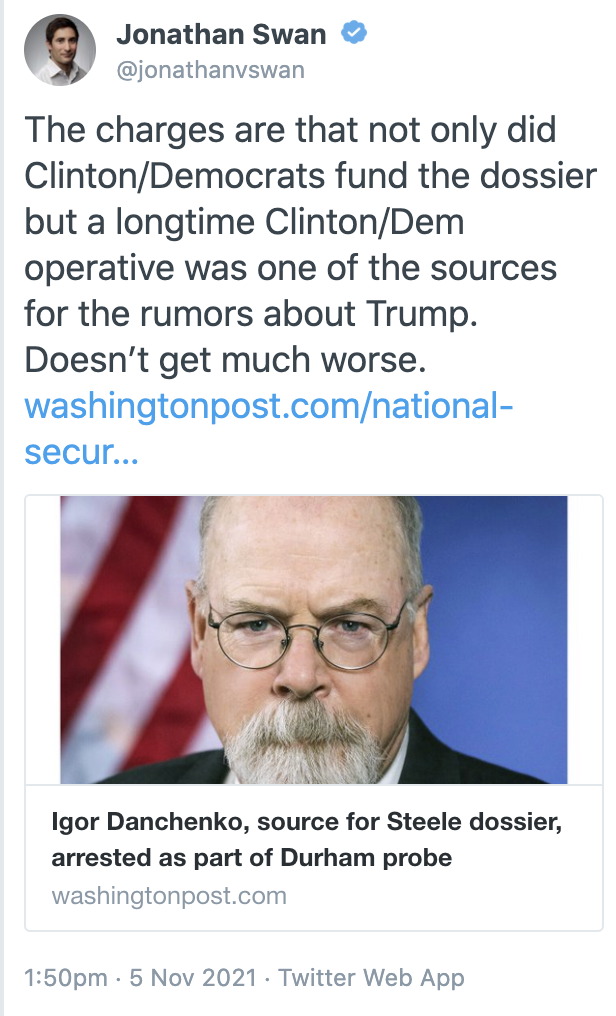
Jonathan Swan condensed the same kinds of claims that Habba just got sanctioned for in one tweet.

Just one “rumor” was attributed to Dolan in the Danchenko indictment, the most provably true one (because it came from media coverage), and one about which — as the trial established — the FBI never once asked Danchenko, in significant part because it had nothing to do with Russia.

And while Middlebrook notes that Danchenko was acquitted, he doesn’t note that Judge Anthony Trenga dismissed the single Dolan count because the allegedly false statement Danchenko made about Dolan was “literally true.” That should not have been a surprising judgment. I noted problems with that charge exactly a year ago, when I catalogued all the sloppy reporting on the Danchenko indictment.

Middlebrook’s order makes for great reading. It’s fun to laugh at Habba getting called out.

But it should bring some reflection from the journalists who made the same kind of logical jumps that Habba did, but who cannot be sanctioned for professional failures.

Middlebrook may not be done. The other defendants have asked for sanctions, as well (though without doing the same preparation in advance to ask for Rule 11 sanctions). So Donald Trump’s lawyers may yet have the privilege of paying Peter Strzok and Hillary Clinton for the privilege of having sued them.

Update: Corrected Middlebrook’s name.

Share this entry
https://www.emptywheel.net/wp-content/uploads/2021/11/Screen-Shot-2021-11-05-at-7.14.13-PM.png 1016 616 emptywheel https://www.emptywheel.net/wp-content/uploads/2016/07/Logo-Web.png emptywheel2022-11-11 07:10:552022-11-11 08:49:59Judge Sanctions Alina Habba for Misrepresenting Igor Danchenko Indictment

Bill Barr Complains that His Special Counsel Was Unable to Match Robert Mueller’s Record of Success

October 21, 2022/64 Comments/in 2016 Presidential Election, 2020 Presidential Election, emptywheel, Mueller Probe /by emptywheel

Even before the Igor Danchenko trial, Billy Barr declared victory in defeat — arguing that if John Durham could just “fill in a lot of the blanks as to what was really happening,” the inevitable acquittal would still give Durham an opportunity to spin fairy tales about what Durham imagines happened.

“What these cases show is that these are difficult cases to win,” Barr said. “There’s a reason it takes so long, and you have to build up the evidence because at the end of the day, you’re going before these juries that aren’t going to be disposed to side with the people they view as supporting Trump.”

Danchenko is slated to go on trial next month on charges of lying to the FBI about the Steele dossier, for which he was the main source. The dossier claimed that Trump and members of his campaign and company had established extensive ties to the Russian government and had colluded during the 2016 election.

The trial is widely expected to be the final criminal prosecution from Durham’s investigation before he submits a report of his findings to Attorney General Merrick Garland.

But despite Durham’s limited success in the courtroom, Barr defended the investigation he ordered, saying the courtroom was allowing Durham to establish a record of what had occurred with the so-called Russiagate investigation.

“I think Durham got out a lot of important facts that fill in a lot of the blanks as to what was really happening,” Barr said. “My expectation is … the Danchenko trial will also allow for a lot of this story to be told, whether or not he’s ultimately convicted. I hope he’s convicted, but if he isn’t, I still think it provides an avenue to tell the story of what happened.”

Like an obedient puppy, Durham did use the trial as an opportunity to get extraneous details into the public record. On top of the $1 million dollar offer that Brian Auten said, vaguely, Christopher Steele might have gotten if he had corroborated the dosser — which has been treated like an FBI attempt to bribe a source for dirt on Trump and as the most exonerating possible detail, rather than an effort to investigate a real threat to the country — Durham went out of his way to give the full names of people at various meetings so Carter Page and Donald Trump can add them to lawsuits.

Mind you, along the way, the trial also revealed the FBI’s own assessment of Danchenko’s cooperation, which contributed to 25 investigations and which Barr burned to a crisp by exposing him, with Lindsey Graham’s help, as a source in 2020.

Q. And you were concerned, in July of 2020, when you became aware that Attorney General Barr was going to release a redacted version of Mr. Danchenko’s interview in January of 2017?

A. Yes.

Q. You were upset about that?

A. I was.

Q. You found out about that during a telephone conference, right?

A. I did.

Q. And you disagreed with that decision?

A. I did.

Q. The OIG had already completed a report on that investigation, correct?

A. Yes.

Q. And you thought that the release of that document was dangerous?

A. Yes.

Q. You even wrote up a memo of that phone call you were on in July of 2020 where you learned that they were going to publish a redacted version of his interview, correct?

A. I did.

[snip]

Q. And within an hour of Mr. Danchenko’s January interview being released to the senate judiciary committee, the senate judiciary committee, I won’t say who, released it to the public?

A. They did.

[snip]

Q. So, Agent Helson, you wrote in October of 2020 that from 2017 until present day, Mr. Danchenko had provided information on at least 25 FBI investigations assigned to at least six field offices?

A. Correct.

Q. In addition, he aided the United States Government by introducing the United States Government to a sub-source who had provided additional information separate to his report, correct?

A. Correct.

[snip]

Q. And it’s noted that he — his reporting contributed to at least 25 active FBI investigations.

[snip]

Q. In July of 2020 his identity became public after the release of the redacted version of his interview in January of 2017. Since that public disclosure, he has received threatening messages via social media and email. It’s resulted in significant damage to his reputation from false and baseless claims aimed to undermine his credibility. Those are your words, correct?

A. Correct.

Q. The Washington Field Office had assessed that this will have negative ramifications with respect to his ability to provide for his family via personal income for the foreseeable future, correct?

A. Correct.

Q. And while the FBI cannot promise complete anonymity to anyone who provides information, his identity became public only after the decision was made to release the redacted version of his interview, correct?

A. Correct.

Q. As a result of that act, his ability to continue to provide information viable to the FBI is diminished as is his ability to provide financial support to his family.

After the trial, Barr has been spending time on Fox News declaring — as much of the frothy right has — that this record, of how he deliberately harmed national security for revenge, exposed the corruption of what Barr calls “Russiagate,” the moniker frothers use to distract from the real substance of the Russian investigation.

I was disappointed, obviously. I think they did a good job prosecuting the case. Their ability to put evidence on, in a very difficult case, was limited by some rulings, and they weren’t able to get access to some witnesses overseas. So it was a tough — it was a tough case, so this should show people that it’s hard to win these cases, and sometimes it takes time to … to achieve justice. But as people say — I think Andy McCarthy said — the real public interest being served here was exposing the full extent of the corruption that was involved in Russiagate [sic] and the abuse by the FBI in that whole episode. And I think Durham is going to get a report out that’s gonna lay out all the facts.

Barr and everyone else are pointing to the exposures they and Durham made to justify their actions because they didn’t have evidence to support their claims.

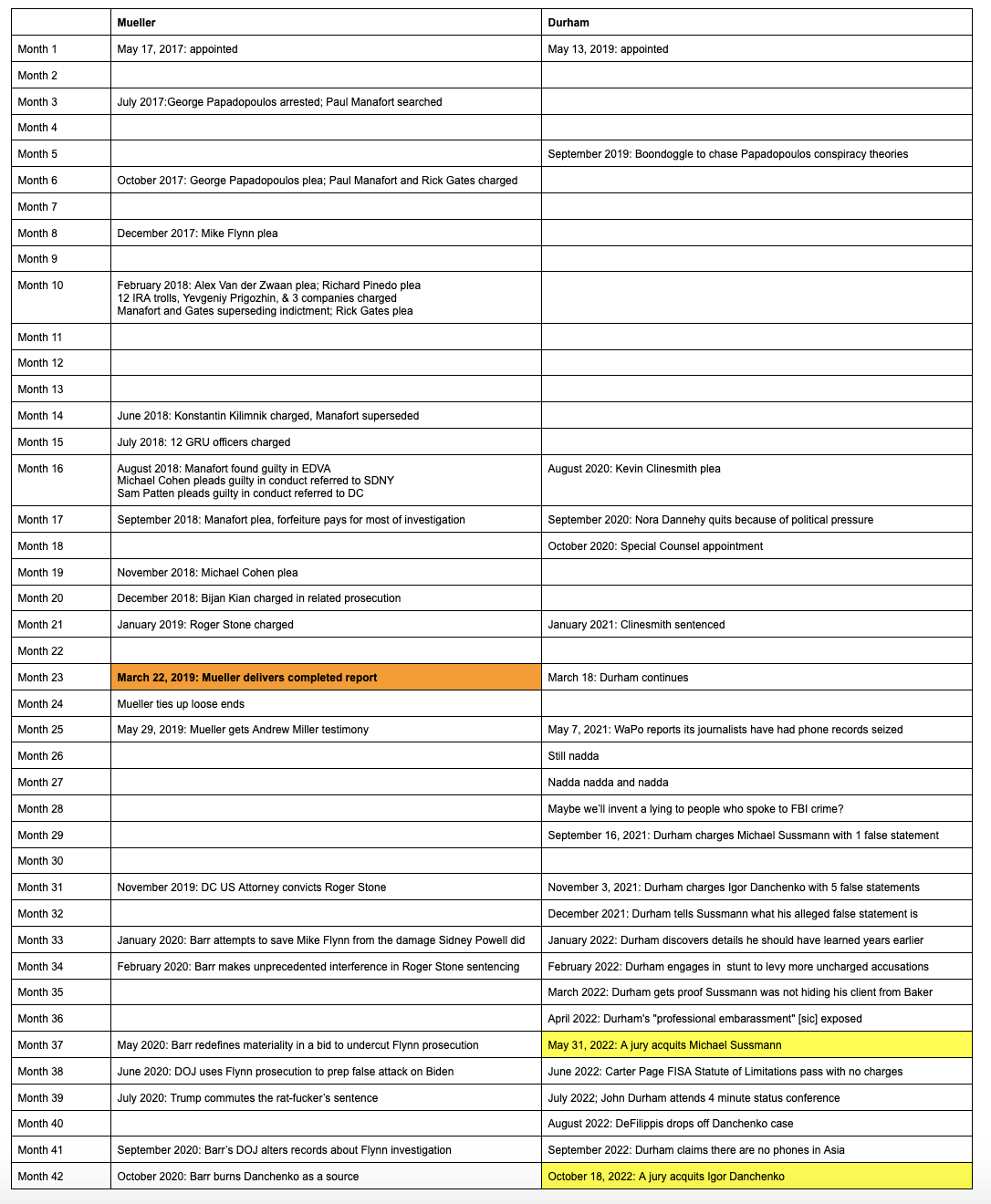
Barr is whining that getting false statements convictions is hard. But Robert Mueller was able to prove that:

  • Alex Van der Zwaan lied to cover up his efforts, in conjunction with Konstantin Kilimnik and Rick Gates, to cover up Manafort’s effort to spin Ukraine’s politicized Yulia Tymoshenko prosecution during the 2016 election
  • George Papadopoulos lied to cover up his advance knowledge of the Russian effort to help Trump
  • Mike Flynn lied to cover up his back channel calls with Sergei Kislyak to undermine Obama Administration policy (and also that he was a paid agent of Turkey during the campaign)
  • Michael Cohen lied to hide the secret negotiations he had directly with the Kremlin about an impossibly lucrative real estate deal
  • Paul Manafort conspired to cover up a front organization he set up with Konstantin Kilimnik and (at a preponderance of the evidence standard) lied to cover up his August 2016 meeting with Kilimnik
  • Roger Stone lied and intimidated Randy Credico to cover up his real back channel to the Russian operation

I mean, Robert Mueller had no problem getting convictions, whether from guilty pleas, jury verdicts, or (in the case of Manafort’s lies about the August 2, 2016 meeting) a judge’s ruling.

One reason he had no problem was that these defendants were generally guilty of a lot more than just lying. It’s a lot easier to get Flynn to admit he lied about his back channel discussions with the Russian Ambassador, after all, when he was also on the hook for secretly being an agent of Turkey. It’s lot easier to get Papadopoulos to admit he lied about his advance warning of the Russian operation when he’s trying to stave off foreign agent charges tied to Israel. It’s a lot easier to get a jury verdict against Stone when he spent months plotting out his lies with multiple people on emails.

Mueller wasn’t able to get false statement verdicts from everyone, mind you. For example, because Steve Bannon and Erik Prince deleted their texts from early January 2017, Mueller did not charge them for false statements made to cover up meetings to set up a back channel with UAE and Russia. That’s one lesson that Durham should have taken to heart: Absent the mobile app records from Sergei Millian and Igor Danchenko, he had no way of knowing whether Millian called Danchenko on July 26, 2016.

That’s not the only evidentiary complaint Barr makes here. He’s complaining that Durham was unable to get hearsay admitted against Danchenko. He’s angry that Durham was not permitted to introduce Millian’s wild Twitter boasts as evidence without requiring Millian to show up and make those claims under oath. And he’s complaining that Durham wasn’t able to introduce his pee tape conspiracies without charging it.

But the most alarming of the former Attorney General’s statements — before and after the trial — embrace the notion that it is a proper goal of failed prosecutions to expose information that does not rise to the level of criminality.

As I’ll show in a follow-up, the Durham fiasco is part of a piece of Barr’s larger actions, both his other failed prosecutions — most notably, that of Greg Craig — but also his efforts to undo the convictions for which there was no reasonable doubt of guilt.

It’s not enough to talk about Durham’s unprecedented failure … it’s not enough to note that Durham and his prosecutors repeatedly failed to take basic investigative steps before embracing and charging conspiracy theories that juries didn’t buy … it’s not enough to note how, in an attempt to prove those conspiracy theories, Durham and his prosecutors and abused the prosecutorial system.

Durham’s entire project is a continuation of Barr’s unprecedented politicization of DOJ, one that not only places Republicans attempting to secretly work for hostile nations above the law, but that has made the country far less safe in many other ways.

It’s not just Durham prosecuted two men without any real hope of winning conviction, all to expose things that aren’t crimes. It’s that Billy Barr hired him to do just that.

Share this entry
https://www.emptywheel.net/wp-content/uploads/2020/07/Screen-Shot-2020-07-28-at-4.35.21-PM.png 1178 2014 emptywheel https://www.emptywheel.net/wp-content/uploads/2016/07/Logo-Web.png emptywheel2022-10-21 11:38:502022-10-21 16:25:46Bill Barr Complains that His Special Counsel Was Unable to Match Robert Mueller’s Record of Success

John Durham Avenged Warrants Targeting Carter Page by Getting a Warrant Targeting Sergei Millian

October 19, 2022/9 Comments/in 2016 Presidential Election, Mueller Probe /by emptywheel

In both his opening and closing statements, John Durham prosecutor Michael Keilty described the materiality of the alleged lies Igor Danchenko told the FBI about Sergei Millian by pointing to the role the Steele report on Millian played in getting FISA warrants targeting Carter Page.

The evidence in this trial will show that the Steele dossier would cause the FBI to engage in troubling conduct that would ultimately result in the extended surveillance of the United States citizens. And the defendant’s lies played a role in that surveillance.

[snip]

So let’s now talk about why the defendant’s lies matter. The defendant’s lies about Sergei Millian mattered because the information he allegedly received from Millian ended up in a FISA warrant against a U.S. citizen, one of the most intrusive tools the FBI has at its disposal. The FBI gets to listen to your calls and read your emails. It’s a really significant thing.

You heard Brian Auten testify that that Millian information — alleged Millian information was contained in every single FISA application on four different occasions. The FBI surveilled a U.S. citizen for nearly a year based on those lies.

Even accepting the problems of the FISA warrants, the claim never made any sense.

According to the trial record, Danchenko’s information didn’t end up in FISA applications. Language Christopher Steele wrote based on Danchenko’s information did. Danchenko claimed that Steele had exaggerated it, and even after interviewing Steele twice, the FBI believed Danchenko.

Keilty was accusing Danchenko of doing something that — no one has contested — that Steele did, not Danchenko.

Plus, two of the alleged lies took place after the FBI had ceased surveilling Page, in October and November 2017. Even if Danchenko did lie, it would defy the laws of physics to blame those alleged lies for surveillance that ended in September.

Crazier still, one reason why DOJ retroactively withdrew the probable cause claims for the last two FISA orders on Page, obtained in April and June 2017, is because FBI didn’t integrate the warnings Danchenko gave them about the report in the applications. Danchenko is the last person you should blame for the FISA surveillance of Page. He claims he didn’t even know the reports were being shared with the FBI!

The obvious problems with this claim have not stopped stupid propagandists like Margot Cleveland from repeating the nonsensical claim.

It all the weirder, though, when you consider that John Durham was himself responsible for obtaining senseless search warrants against two American citizens.

First, there are the warrants Durham served to obtain Chuck Dolan’s communication, as Stuart Sears had Dolan explain on cross examination.

Q You’re aware, Mr. Dolan, aren’t you, that the government was investigating you at some point?

A Yes.

Q You’re aware that they issued search warrants and subpoenas for your email communications?

A Yes.

Q You’re aware that they issued subpoenas for your phone records?

A Yes.

Q Your work email records?

A Yes.

Q Your Facebook records?

A Yes.

As Sears had Dolan explain, those warrants yielded nothing to refute his claim never to have “talked” to Danchenko about anything that appeared in the dossier.

Q And I think you have already testified to this, but even knowing everything that the government has done to look into you, it’s still your testimony today that you’ve never talked to Mr. Danchenko about anything that ended up in the dossier, correct?

A Correct.

Last Friday, in dismissing the single count pertaining to Dolan, Judge Trenga ruled that any evidence these warrants targeting Dolan yielded did not prove a crime.

And Durham also obtained warrants targeting Sergei Millian — one of his purported victims! — who at least in 2016 had dual citizenship. Durham had his case agent, Ryan James, describe all the surveillance Durham did of Millian.

Q With respect to those documents, tell the ladies and gentlemen of the jury whether you personally have been involved in sorting through those records.

A Yes, I have.

Q Travel records, the travel records relating to Sergei Millian was brought to the jury’s attention. Who obtained those records?

A Our team did.

[snip]

Q The jury has heard testimony relating to a number of telephone numbers involved with a fellow by the name of Sergei Millian. Would you tell the jury, sir, whether or not you have any knowledge about records and information being retrieved concerning Sergei Millian.

A Our team requested legal process on some of his numbers that we’ve identified that belong to him.

Q When you say legal process, just so the jurors have an understanding of that, what kind of legal process would typically be involved in getting those records?

A In this particular case, subpoenas.

Q All right. And in addition to subpoenas, do you know if Facebook records and the like were retrieved using the leal process?

A Yes.

Q And what kind of legal process was used to obtain those records?

A Those would be via search warrants.

Even more than the Facebook warrant, Durham’s collection of Millian’s travel records — all the way through current day! — are probably more intrusive on Millian’s privacy.

Q Now, let me start, if I might then. With regard to the records in this matter, you’ve told the jurors that among those records that you obtained were travel records for Sergei Millian, correct?

A Yes.

Q And with respect to Millian’s travel records, how would you describe them? Were they plentiful or there was one or two? What’s your best recollection as to Millian’s travel records?

A I would say he frequently comes in and out of this country.

Q Based on your review of all the travel records, has he been in the country anytime recently?

A No.

It’s too early to say whether any of these records included evidence of a crime. After all, DOJ’s KleptoCapture complaint against Elena Branson shows that one of Millian’s colleagues at the Russian-American Chamber of Commerce viewed the requirement to register under FARA as a “problem” way back in 2013.

But according to an EDVA jury, any evidence the warrants and subpoenas targeting Millian obtained did not prove Danchenko committed a crime.

Durham unpacked the digital lives of two American citizens, plus Danchenko, partly through search warrants that he attacked Mueller’s investigators for not obtaining.

And unless the evidence obtained ends up being used to show that Millian was an illegal foreign agent of Russia, that evidence did not provide that anyone committed a crime.

The right wing is defending John Durham today because he avenged an American who was unfairly targeted by a warrant. And along the way, they seem to have missed that Durham himself obtained a bunch of apparently pointless search warrants targeting American citizens, including Trump fan Sergei Millian.

Share this entry
https://www.emptywheel.net/wp-content/uploads/2022/09/Sergei-2.png 482 1208 emptywheel https://www.emptywheel.net/wp-content/uploads/2016/07/Logo-Web.png emptywheel2022-10-19 11:57:262022-10-19 13:07:36John Durham Avenged Warrants Targeting Carter Page by Getting a Warrant Targeting Sergei Millian

Igor Danchenko Acquitted on All Remaining Charges

October 18, 2022/131 Comments/in 2016 Presidential Election, Mueller Probe /by emptywheel

NYT, Politico, and HuffPo are all reporting that the jury has acquitted Igor Danchenko on all four remaining charges against them.

Shortly before they did so, the jury had asked for a report that had been used to refresh Danchenko handling agent’s memory about why Danchenko had not corrected Christopher Steele’s incorrect memories about their conflicting Millian stories in 2017. There was an extended exchange before Danchenko’s lawyers noted — having won a fight to exclude Christopher Steele’s testimony pre-trial — that this was hearsay.

Q. If you take a look at Government’s Exhibit 103 and see if that refresh your recollection as to whether or not there was yet another occasion that you raised or asked questions of Mr. Danchenko relating to these matters?

A. Yes.

Q. And when was it that you met with Mr. Danchenko and Millian came up again?

A. I’m looking at the wrong —

Do you have Government’s Exhibit 103 there?

A. I have one — oh, here we go, yes.

Q. Okay.

A. So it’s November the 2nd.

Q. Okay. So why don’t you just take a moment and look at that and see if that refreshes your recollection as to the date which you met with Mr. Danchenko and the Millian matter came up yet again?

A. Yes.

Q. And what was the date?

A. November the 2nd, 2017.

Q. All right. And on November 2nd, 2017, was that some kind of telephone connection or was that a face-to-face meeting?

A. That was a face-to-face.

Q. So you are with him? He’s not like — no interference in the phone or anything, right?

A. Correct.

Q. Do you recall, sir, why it was that you had occasion to go back to, yet again, ask about this Millian piece in November of 2017?

A. There had been — this, I think, goes to the fact that Brian was still saying there was inconsistency in what Mr. Danchenko was saying as opposed to what Mr. Steele was saying with respect to Millian’s — his connection or his contact with Millian.

Q. And so tell the ladies and gentlemen of the jury on November 2nd now, of 2017 — on October 24th, he now says that there were a couple of calls. Now, on November 2nd, you’re confronting him now about what he told Steele regarding him actually meeting with Millian, correct?

A. Correct.

Q. And with respect to what you were asking Mr. Danchenko on November 2nd, what is it that Mr. Danchenko told you regarding Steele and what he had told Steele or not told Steele about meeting with Millian?

A. He said that Steele had the idea — that Steele believes that Mr. Danchenko had met in person and he never corrected Mr. Steele’s thought in that, is that he was pretty much tired of talking about it. He — Steele was pressuring him to answer questions that Steele — that Millian could potentially answer. So the pressure was get with Millian, get a report, and Igor was — I let him have what I — I told him what I know and he still believed that I was in — it was an in-person meeting and I never corrected him because I was tired of talking about it.

MR. SEARS: Your Honor, I apologize to interrupt, but to the extent Mr. Steele’s comments are coming in, my understanding is that they would not be for the truth of the matter asserted —

THE COURT: Correct.

MR. SEARS: — just because the agent heard —

THE COURT: Right.

MR. SEARS: It might be appropriate to inform the jury.

And then minutes later they came back with an acquittal on all charges.

Here’s a comparison about Durham’s work compared to Mueller’s:

WaPo has this from a juror:

The jury in Danchenko’s case deliberated for about nine hours over two days. Juror Joel Greene said in an interview that there were no holdouts in the deliberations and that the decision was “pretty unanimous.”

“We looked at everything really closely,” said Greene, who declined to comment on the politics of the case. “The conclusion we reached was the conclusion we all were able to reach.”

And from Danchenko:

After the verdict was announced, Danchenko choked up and embraced his defense attorneys, Stuart A. Sears and Danny C. Onorato. Danchenko declined to comment, but Sears said outside the courthouse “we’ve known all along that Mr. Danchenko is innocent.”

“We’re happy now that the American public knows that as well,” he said.

Politico’s Kyle Cheney caught Durham making the same canned comment after this face-planting loss as he did after the Sussmann acquittal.

emptywheel coverage of the Danchenko case

John Durham’s Last Word: An Outright Lie about the Mueller Conclusions

John Durham’s Missing Signals (and FaceTime and WhatsApp and iPad)

John Durham Created a False Pee Tape Panic Based Off a “Literally True” Alleged Lie

As John Durham Preps for his Closing Report, His Own Withholdings become Key

“It Certainly Sounds Creepy:” John Durham Adopts the “Coffee Boy” Defense

John Durham Twice Misread Steele Dossier Sourcing to Invent a Partisan Claim

John Durham’s Re-Virgined Birth of the Carter Page and Sergei Millian Investigations

Igor Danchenko Would Have Been a Crucial Witness to Understanding the Disinformation in the Dossier

Anthony Trenga Smothers the Frothers’ Hopes for a Pee Tape Trial … But Not the Damage Done by Credulous Press

FBI Approved Igor Danchenko as a Source before It Stopped Doing Back-Door FISA Searches to Vet Informants

John Durham Wants to Lecture EDVA Jurors about Being Played by Foreign Spies

On the Belated Education of John Durham

Durham Admits He Has No Real Evidence on Four Millian Counts against Igor Danchenko

“Desperate at Best:” Igor Danchenko Starts Dismantling John Durham’s Case against Him

John Durham’s Igor Danchenko Case May Be More Problematic than His Michael Sussmann Case

The Disinformation that Got Told: Michael Cohen Was, in Fact, Hiding Secret Communications with the Kremlin

On CIPA and Sequestration: Durham’s Discovery Deadends

In Story Purporting to “Reckon” with Steele’s Baseless Insinuations, CNN Spreads Durham’s Unsubstantiated Insinuations

Aleksej Gubarev Drops Lawsuit after DOJ Confirms Steele Dossier Report Naming Gubarev’s Company Came from His Employee

John Durham’s Cut-and-Paste Failures — and Other Indices of Unreliability

John Durham: Destroying the Purported Victims to Save Them

Source 6A: John Durham’s Twitter Charges

Daisy-Chain: The FBI Appears to Have Asked Danchenko Whether Dolan Was a Source for Steele, Not Danchenko

“Yes and No:” John Durham Confuses Networking with Intelligence Collection

John Durham May Have Made Igor Danchenko “Aggrieved” Under FISA


Share this entry
https://www.emptywheel.net/wp-content/uploads/2022/10/Screen-Shot-2022-10-18-at-9.31.36-PM.png 1320 1086 emptywheel https://www.emptywheel.net/wp-content/uploads/2016/07/Logo-Web.png emptywheel2022-10-18 16:33:112022-10-18 18:50:13Igor Danchenko Acquitted on All Remaining Charges

John Durham’s Last Word: An Outright Lie about the Mueller Conclusions

October 18, 2022/36 Comments/in 2016 Presidential Election, Mueller Probe /by emptywheel

There were aspects of Igor Danchenko attorney Stuart Sears’ closing argument yesterday that could have been stronger.

He could have more strongly emphasized that Danchenko had nothing to do with the words that appear in the dossier, and so when John Durham claims that the words in the dossier — alleging a conspiracy between Trump and Russia — are what Danchenko told the FBI he told Steele, he’s lying. Or maybe too stupid to understand that? That said, Sears did emphasize that Danchenko told the FBI the anonymous caller had said there was nothing bad about the ties between Russia and Trump.

It’s entirely possible it wasn’t Sergei Millian, but even if it was, the caller only said there was coordination between the campaign and Russia and that there was nothing bad about it. Agent Helson told you that. That’s not anti-Trump, and we do know from the government’s own evidence that Millian was at least telling people he was going to meet with Trump campaign people the week before the phone call, the anonymous phone call.

Still, this case is about reported speech, and Durham is prosecuting Danchenko for what the record shows is Christopher Steele’s speech, not for what the record shows is Danchenko’s speech.

Sears’ materiality argument could have been more forceful (though he correctly noted, jurors should never even have to get that far). Durham claims the alleged lies about Millian were material because they caused the surveillance against Carter Page; that is literally impossible for two of the alleged lies (which were told after surveillance stopped), including the October 24 alleged lie that, for the reasons I’ve laid out here, the jury may have more reason to believe Danchenko lied. And whether Danchenko told the FBI what Durham believes to be the truth — that no call with Millian happened — or Danchenko told them what he did — that the call that happened was so sketchy it shouldn’t have been relied on, and it did not include any claim of conspiracy — the decision the FBI should have taken would have been the same, to stop relying on that allegation in the FISA application. Importantly, Danchenko raised questions about the reliability of the call with no knowledge of the FISA application or the import of the conspiracy of cooperation language to the FISA application, but nevertheless told FBI everything they would need to remove the allegation from the FISA application.

And I think Sears could have hit the significance of the mobile apps harder. He did remind jurors about how Durham attempted to elicit false testimony about whether Danchenko had said this could be a mobile app.

The government set out to prove — Mr. Keilty told you in his opening statement he was going to prove Mr. Danchenko never received an anonymous call. Now, this is where — if you recall during the trial, special counsel got a little tricky here. Remember, they asked Agent Auten to refresh his recollection by reviewing a document, a report he had written, that Mr. Danchenko claimed to have received a cellular call from an anonymous caller. That was all they had him review. Just read that part, and what does it say? A cellular call, a cellular phone.

Then Mr. Onorato got up on cross-examination and literally said: Review the same report but read the rest of the sentence onto the next page.

And the full sentence that Agent Auten actually read out loud read: The call was either a cellular phone, or it was a communication through a phone app.

It was a good try, but it didn’t work. And it was a try because they know they have no evidence at all from which you could conclude there was not a call through a messaging app. They don’t have it. It’s their burden. They don’t have it. He doesn’t have to prove he received a call on a messaging app. They have to prove he didn’t.

Sears had more evidence here, though. There was the evidence that Millian was communicating via mobile apps using his iPad in the period he was in South Korea (though Durham worked hard to withhold it from the jury), and because he was overseas, Millian would be far more likely to use mobile apps than telephony. It might have been useful to explain why Ryan James’ effort to rule out a mobile app call by looking at only telephony calls didn’t even attempt steps that could have clarified the issue. The steps Durham’s hand-picked FBI agent failed to take prove, definitively, that Durham never attempted to fill what Sears called “a giant hole” in Durham’s case.

And if they have not convinced you beyond a reasonable doubt that he did not receive an anonymous call through a phone app, that’s the end of the case. They had to prove that.

They told you they would, but did they? Are you convinced beyond a reasonable doubt, as you sit here today, that Millian or perhaps someone else didn’t reach out to him anonymously over a messaging app in July 2016? What evidence do you have to make that conclusion? What evidence do you have to make that conclusion beyond a reasonable doubt? There’s none. It’s a giant hole in the case, and they can’t fill it with conjecture, speculation, and argument. Where is the evidence?

All that said, Sears laid out all the other compelling proof against Durham: that Durham’s own witnesses, Brian Auten and Kevin Helson, said Danchenko didn’t lie, and that all the details that Durham collected believing they would disprove Danchenko’s story in fact corroborated the claims Danchenko had made about the call and aftermath.

We’ll learn soon enough what the jury thinks about it. They deliberated for about three and a half hours yesterday and will resume deliberations at 9:30 this morning.

I’d like to address the underlying dynamic about the closing arguments, though.

Michael Keilty, the least corrupt member of the Durham team, had the initial close, which often is the longer of prosecutors’ two presentations, the one in which prosecutors explain to the jury which the most important pieces of evidence are and where to find them. At least by transcript pages, that wasn’t the case here: Keilty’s close spanned 21 pages, whereas Durham’s rebuttal spanned 22. Still, that’s totally within the norm, and how the prosecution splits their time is their own decision.

But that time differential is not what Judge Anthony Trenga expected. Even before Durham started, he remarked on how short Keilty’s close was and asked Durham in a bench conference how long he expected to take.

THE COURT: I thought the government’s closing was going to be a lot longer than it was. How long were you intending for rebuttal?

MR. DURHAM: I would say half an hour, 40 minutes.

THE COURT: Well, I’ll give you half an hour. All right.

MR. DURHAM: Yes, Your Honor.

I think Trenga suspected — as did I after Keilty’s close — that the entire plan from the start was to sandbag Danchenko’s team, effectively present the bulk of the close after Sears could no longer respond (this is what Durham did with Special Agent Kevin Helson’s testimony, raising the most damning testimony of the trial for the first time in a second redirect).

Sears anticipated that would happen. Based on all the times Durham pointed to evidence he didn’t have because he himself didn’t bother to try to collect it, Sears warned the jury about the Special Prosecutor’s efforts to shift the burden on Danchenko, repeatedly demanding that Danchenko affirmatively prove his claims, rather than just disprove Durham’s.

So now is the part where I have to sit down in a minute, and it’s the hardest part of the case for a defense attorney because they get the last word. And so we just have to sit there and listen and think about the things we meant to say when we were up here and forgot or the things that we think they’re getting wrong and that we feel like we can correct, like I was just able to do now, and we can’t.

And it’s particularly concerning in this case and difficult in this case because the burden shifting I heard in the government’s closing about where is the evidence that Mr. Danchenko did this or did that. He didn’t have any burden. You’re not going to see an instruction back there that says he has a burden to do anything. It’s the government’s burden to prove their case. It’s not his burden to disprove it.

The special counsel at times through its questions and arguments, they’ve not given you the full picture. They haven’t told you the whole story. Just like when they were showing the agents and had the agents testifying, well, if you knew this or if you knew that, what would you think? Oh, yeah, that would affect my views of that, or I would think that was important. They only showed them the stuff that they think helped their case.

[snip]

So I’m worried more so than usual when I go back to sit down about what you’re going to hear now and what I can’t respond to. And while I can’t do that, you can. You can pay attention to what’s said now, and you can discover those inaccuracies or misstatements, if there are any, when you go back to deliberate and consider the actual evidence in this case.

Before he did this, though, Sears talked about how Bill Barr started this investigation, burned Danchenko as a source, and how as part of the investigation Barr set up, Durham has not investigated what happened, but instead set out to prove guilt.

Agent Helson also told you that Mr. Danchenko’s information was vital to national security and led to the opening of more than two dozen active influence cases. He became a trusted source of information for our government that even led to the creation of a new team at the FBI as a result of the information he provided, the guy they are saying is a liar.

But as you’ve also heard at trial, the political winds in this country changed once then-President Trump appointed a new attorney general, William Barr. Barr not only essentially revealed Mr. Danchenko’s identity by releasing a redacted version of his January 2017 interview to the Senate Judiciary Committee, but that committee released that report within an hour of receiving it to the public.

Attorney General Barr also ordered an investigation into the investigation of the Trump campaign and its connections to Russia. So a new special counsel was appointed, this special counsel, to lead that investigation.

I submit to you that if this trial has proven anything, it’s that the special counsel’s investigation was focused on proving crimes at any cost as opposed to investigating whether any occurred.

I submit to you that a fair and reasonable look at the evidence in this case shows that the special counsel — they started out with the presumption of guilt, that Mr. Danchenko had lied, and they read guilt into every piece of evidence they came across and at every detail they saw. They ignored — and we’re going to show you. They ignored how their own evidence showed he was not guilty, that he was innocent.

This narrative is all true. Even within the trial, there was abundant evidence presented that Durham sought out to find someone to charge, not to find out what happened (neither of which is an appropriate use of prosecutorial resources, absent evidence of a crime).

For any critique I have about things Sears could have done tactically, the strategic decision to make Durham defend his own investigation clearly had an effect. I think Sear’s comments got to Durham, and made him defensive.

In his close, in the middle of spending much of his close focusing on a single 2020 LinkedIn message in which Danchenko admitted he was the source for 80% of the raw intelligence in the dossier, John Durham took the time to rebut the accusation about Bill Barr deliberately exposing Danchenko by blaming Danchenko for speaking to the press.

But what do you also know about that? And don’t forget what the evidence is. Mr. Sears wants to put this on Bill Barr. He wants to put it on politicians or whatever. You heard testimony from Mr. Helson that Mr. Danchenko himself, when he was interviewed by the press — all right. I think it was couched in the terms of your recollection controls, of course, but I think it’s couched in terms of, well, he had to do what he had to do to protect himself. He went and talked to the press.

And then later in his close, he returned to it again, not presenting the proof that Sears said was absent, but instead defending Bill Barr.

That’s when Durham decided to explain to the jury what he believes the results of the Mueller investigation were.

Now, I think that counsel’s suggestion is, oh, it’s Bill Barr. Bill Barr did this for political reasons. But reflect on how this came about. The Mueller report had come out, and there’s no collusion that was established. It’s not an illogical question to ask, well, then how did this all get started? Now, you can call that political. You can suggest, I guess, inferentially that somehow people who have spent a considerable period of time away from their families and whatnot did this for political reasons or what have you. If that’s your mind-set, I suppose that’s your mind-set.

But to look into the question of how did this all happen — Director Mueller, a patriotic American, the former director of the FBI, concludes there’s no evidence of collusion here or conspiracy. Is it the wrong question to ask, well, then how did this get started? Respectfully, that’s not the case. [my emphasis]

That’s the first time when Judge Trenga interrupted and told Durham to wrap it up.

THE COURT: You should finish up, Mr. Durham.

MR. DURHAM: Yes, Your Honor.

Only after Trenga told him to stop and only after defending Billy Barr twice did Durham turn to the crucial issue before him, attempting to disprove a mobile app call.

You know that the defendant didn’t receive an anonymous call here on an app from Millian or anyone else for at least three reasons:

First, there’s absolutely no evidence in the record of such a call, none.

Second, the statements the defendant made to the FBI are not in any way consistent with how someone would describe an anonymous call. They’re consistent with how somebody would describe a call that they made up.

Even though Danchenko was a trained business intelligence analyst whose entire task from orders from Christopher Steele was to find evidence of collusion between Trump and the Russians — if he had received an anonymous call, whether he thought it was Millian or it was somebody else, that would be the very evidence of collusion that he was looking for so eagerly. As a trained researcher, he clearly would have noted every detail possible: What’s the incoming call number? What’s the area code number? What other details are there? What do you know about the person’s speech pattern? None of that information is recorded or provided. It’s simply an anonymous caller.

He would have known to remember the cell phone application if it was a cell phone application that was involved. Look, that’s what a good research analyst does, looks into the details, records those details, and reports on those details. Mr. Danchenko did none of that. He didn’t provide any of that information to Steele, and he didn’t provide any of that information to the FBI.

Third, the most conclusive evidence that such a call never occurred, if you look at Government’s Exhibit 207T, the defendant’s August 18 email to Mr. Millian where the defendant states in his own words — I mean, he can’t get away from his own words. His words state that he wrote to Millian several weeks earlier and that they were contacts on LinkedIn but says nothing about the call that he told the FBI he thought was probably Millian. What possible reason could explain why the defendant wouldn’t at least ask Millian if he had called?

Because he had spent his time doing other things, including defending Bill Barr twice, in the middle of walking the jury through what Durham believes is his smoking gun evidence, he made a bid for more time.

I want you to look at Government’s Exhibit 115T, the August 24 email — Can I have five more minutes, Your Honor?

THE COURT: One minute.

MR. DURHAM: One minute.

The point being, I think (and Trenga may have thought) that Durham attempted to sandbag Danchenko, delaying the entirety of his substantive close until after Sears had finished.

And indeed, Durham’s presentation of what they believe is their smoking gun evidence didn’t come until Durham’s own close, not Keilty’s.

An attempted sandbag.

Though it only came after Durham spent his time trying to defend Barr’s actions, not just in exposing an FBI source, but in launching this investigation in the first place.

Which is why it matters that Durham lied about the conclusion of the Mueller investigation when he claimed, “Director Mueller, a patriotic American, the former director of the FBI, concludes there’s no evidence of collusion here or conspiracy.”

Mueller didn’t charge conspiracy and it is true that he said the available evidence did not prove it (in at least two cases, notably, because people had destroyed mobile app communications). But even ignoring the then-ongoing investigation into whether Roger Stone conspired to hack with Russia, Mueller explicitly stated that, “A statement that the investigation did not establish particular facts” — such as the finding that, “the investigation did not establish that members of the Trump Campaign conspired or coordinated with the Russian government in its election interference activities” — “does not mean there was no evidence of those facts.”

Mueller pointedly said his statement explaining that he didn’t charge conspiracy doesn’t mean there is no evidence of conspiracy, but John Durham got up before a jury and asserted that anyway. To defend his actions spending almost twice as long hunting for guilt as Mueller did investigating Trump aides for their potential role in a crime, Durham affirmatively claimed what Mueller said one could not claim.

All the more so given that (as Onorato had already established), three of the first four subjects of the investigation were convicted, and five of those convicted — Mike Flynn, George Papadopoulos, Michael Cohen, Paul Manafort, and Roger Stone — were either convicted or (in the case of Manafort) found by a judge to have lied to cover up their interactions with agents of Russia in 2016.

Indeed, Brittain Shaw even explicitly used the standard on which the FBI first opened the investigation — to figure out whether claims like the ones George Papadopoulos made to Australia were true or not — in her attempt to prove the materiality of the literally true alleged lie Durham prosecuted Danchenko for.

With respect to knowing whether someone passed false information that contained allegations — not the Lewandowski part but somebody made up that they were an insider or had inside information, in the course of looking at Russian interference, as you did in the Special Counsel’s investigation, would that have been important to you?

In their bid to win this case, Durham and his prosecutors have argued not only that one can investigate whether someone is telling the truth when he claims to have inside access to Trump (as evidence in this trial showed Millian was doing), much less to Russia, as Papadopoulos was doing. Indeed, in his attacks on the FBI, Durham claimed one would be negligent not to investigate such things. Durham even argued that Mueller didn’t investigate Sergei Millian thoroughly enough.

And yet, when it came time to prove his own case, to explain why he hadn’t taken basic steps to disprove a mobile app call, Durham instead squandered his time inventing false claims about the results of the Mueller investigation.

We’ll see what the jury has to say about Durham’s defense of his prosecution. But there is no more fitting way for Durham to end this fiasco than to lie about how and why it all got started in the first place.

Update: Changed how long the jury has deliberated to include their lunch.

Share this entry
https://www.emptywheel.net/wp-content/uploads/2018/02/RobertMueller_PeteSouza_2012_Wikimedia.jpg 1054 1500 emptywheel https://www.emptywheel.net/wp-content/uploads/2016/07/Logo-Web.png emptywheel2022-10-18 03:45:322022-10-18 08:58:36John Durham’s Last Word: An Outright Lie about the Mueller Conclusions

John Durham’s Missing Signals (and FaceTime and WhatsApp and iPad)

October 16, 2022/38 Comments/in 2016 Presidential Election, emptywheel, Mueller Probe /by emptywheel

As is common, the case agent for the Durham investigation against Igor Danchenko, Ryan James, was the last witness on Friday. Case agents are often used to summarize the case against a defendant and introduce boring communications records that the prosecution will rely on in the closing arguments.

As Durham cued James to describe, he spent the first nine years of his career as an FBI employee in New Haven, where Durham was, first an AUSA and then US Attorney.

Q When you finished up at the Quantico Training Academy, you would then be a first office agent as it’s sometimes referred to?

A Yes.

Q And what’s a first office agent?

A So that’s the term that you get when you graduate the academy, and it’s the first office you’re assigned to.

Q And where were you first assigned?

A New Haven, Connecticut.

Q And how long were you in New Haven, Connecticut?

A So I was there from late ’09 to September of 2018.

By description, he’s the single current or former FBI employee of five who testified at the trial (the others being Brian Auten, Kevin Helson, Amy Anderson, and Brittany Hertzog) who described no expertise in Russian counterintelligence.

James’ job was to introduce a bunch of travel and communications records that — Durham will claim on Monday — rule out the possibility that Igor Danchenko got a call from an anonymous caller, probably around July 24 or 25, 2016, someone Danchenko claimed to believe was Sergei Millian. This is the burden Durham chose to take on when he charged Danchenko with four counts — the four remaining after Judge Anthony Trenga dismissed the fifth on Friday — about whether Danchenko was lying on four different occasions in 2017 when he described what he had believed in July 2016.

Here are those four counts as quoted in transcripts or interview reports from the indictment, and how Durham charged the alleged lie.

Durham is not proving that Danchenko lied that the person on the call was Millian. He has to prove that Danchenko lied about what he believed in about the call in 2016, five years after the interviews in question and six after the call.

At times, even Durham seems not to have understood what he got himself into by charging that Danchenko lied when he said he believed in 2016 that he thought that a call he described to the FBI came from Millian. Durham can’t just prove that Millian didn’t call Danchenko (though he has presented insufficient evidence to prove that). To rule out the possibility that Danchenko really believed a call even he described as weird came from Millian, Durham is stuck — with one exception I’ll lay out below — attempting to prove that Danchenko received no call from anyone, whether Millian or anyone else.

In an attempt to do that on Friday, Durham had James walk through how his team obtained all the records possible for the phone numbers they identified for Millian at the time (at least one, a Russian one, seems not to have been included, though exhibits aren’t available remotely).

Q And as to telephone records, would you indicate to the ladies and gentlemen of the jury what telephone records — specific telephone records that you obtained relating to Mr. Millian.

A We obtained all the records possible for the phone numbers that we had identified for Mr. Millian.

Durham had Ryan describe what sounds like a time-consuming effort to track down every single telephony call that called Danchenko’s known line in that time period in late July early August 2016.

Q Now, you told the jurors that among other things that were subpoenaed were three telephone lines that were active in 2016 for Millian, correct?

A Yes.

Q But I think you also told them that you had looked for any other number that may have been in FBI databases that would tie in some fashion to Millian, correct?

A Yes.

Q And did you compare all of those numbers to any calls going into Mr. Danchenko’s telephone number?

A Yes.

Q And the jury saw a particular record that will be in evidence reflecting the fact that Millian was providing his new Moscow number. Do you remember that? It was a plus-45 telephone number?

A Yes.

Q Did you also check that number against any incoming calls to Mr. Danchenko’s telephone line?

A Yes.

Q And what can you tell the jurors about that?

A We didn’t identify any known numbers for Sergei Millian making an incoming call to Mr. Danchenko.

They made a great show of bragging about getting records from Sergei Millian and Danchenko that (they suggested) the NY Field Office and Mueller team before them had not.

Q To your knowledge, had anybody gotten those before?

A No.

[snip]

Q Do you know if prior to you and your colleagues retrieving that information, if anybody had gone and retrieved it? Do you know?

A I do know. No, they didn’t.

But in the entire performance, neither Durham nor James described the records that would be most probative to determine if Millian called Danchenko in late July 2016: Details of LinkedIn contacts between Danchenko and Millian (probably as early as May or June) and what Danchenko’s LinkedIn page looked like when that happened. That presumed LinkedIn contact was not mentioned at all during James’ testimony.

Durham’s entire premise — that a review of incoming telephony calls to Danchenko could serve to rule out a call from Millian — is based off a claim that Millian would have no way of contacting Danchenko on anything but his telephony line, because that’s all the information Danchenko included in the signature block of the email he sent on July 21, asking to meet. Mind you, even on direct examination, when Durham had Brian Auten agree there was no mention of mobile apps in the signature block, Auten noted there was a mention of a mobile app in the body of the message: to LinkedIn.

Q And then there’s a signature block, correct?

A Correct.

[snip]

Q Is there anything anywhere in this document, Government’s Exhibit 204T, Mr. Danchenko’s initial outreach to Millian, that says anything about the use of apps?

A In the signature block, no. And the only app I believe that’s mentioned is LinkedIn, which is the last line of 204T in the letter.

Q And LinkedIn isn’t communication — verbal communication, correct?

A Not to my knowledge, no.

Q Right. So nothing in here about contact me using an app or anything of that sort?

A According to the block, no.

Durham wasn’t interested because LinkedIn, itself, does not support voice calls.

Danny Onorato emphasized the reference to LinkedIn at more length with Auten on cross.

Q. Okay. And that would be the email that Mr. Durham showed you July 21st, and that, kind of, starts off with the strange phone call, right? So the timeline is late May, right, where there’s an introduction?

A. Right.

Q. Which is Mr. Danchenko told you?

A. Yes.

Q. And then, he said in, kind of, late June or late July he reached out to Millian, right?

A. Correct.

Q. Okay. And so this is reach out, right?

A. This is — this is a July 21st —

Q. Yep.

A. — 2016, Igor Danchenko to [email protected].

Q. Okay. And what I want you to focus on, right, is that he said [As read:] “It would be interesting if it were possible to chat with you by phone or meet for coffee/beer in Washington or New York where I’ll be next week.” Right?

A. Right.

Q. “I am, myself, in Washington.” So he’s giving him alternatives as to where the meeting could take place, right?

A. Correct.

Q. Okay. I want you to focus on the last line of the email, please.

A. Yes.

Q. He said [As read:] “I sent you a request to LinkedIn. There my work is clearer.” Right?

A. Correct.

The reason Danchenko’s referral to his LinkedIn is important (aside from the prior communication that never got introduced as evidence) is because people often list all modes of communication at LinkedIn, including their mobile apps. Danchenko’s current LinkedIn bio has a link to his Telegram account.

At the time , before he started being stalked by frothers, Danchenko used at least four more mobile apps: in addition to the Telegram he still uses, WhatsApp, Viber, FaceTime, and Wickr.

Q. Okay. Thank you. Are you aware that when Mr. Danchenko spoke to the FBI he told them that he used, in this timeframe, WhatsApp, Viper, [sic] FaceTime, Wickr, and Telegram?

A. I think it would depend on what time frame you are talking about talking to the FBI.

Q. Sure. But between, let’s say, January, when you met with him, and call it July, after he’s meeting with Mr. Helson.

A. I don’t know if I would be able to rattle off all of those different things.

Q. Sure. Some of them?

A. Some of them.

Q. Okay. And, again, those apps — whether it’s one, two, three, four, or five of them — do not leave records on my Verizon cell phone bill, right?

A. I do not believe so.

If Danchenko had those apps listed on his LinkedIn in 2016, as he has Telegram listed on his LinkedIn today, then it would be readily apparent how Millian could have figured out how to call Danchenko in late July 2016: on the LinkedIn profile that Danchenko explicitly pointed him to.

The explanation from Ryan James — an FBI agent who likely worked closely with Durham since the start of his FBI career, but who claims no expertise at all in counterintelligence — about how he ruled out a call to Danchenko from Millian (much less anyone else) in 2016 did nothing to exclude mobile app calls, at all.

Short of having the cell phone Danchenko was using all the time and the devices used with the at-least four SIM cards Millian was using at the time, Durham couldn’t even begin to rule out such a call. That’s how mobile apps work, and that’s why people making spooky anonymous phone calls prefer to use apps.

Absent having the devices themselves, the FBI routinely uses Apple and Google store records to show what apps someone has downloaded onto their various phones. That’s how I know precisely when Roger Stone added ProtonMail, Signal, and WhatsApp to his phone in August, October, and (on the new phone he got after the election) November 2016: from app store records used in FBI affidavits. To make a show of figuring out what apps, besides LinkedIn, Danchenko and Millian used in common, James could have obtained records from the app stores. He didn’t describe doing that either.

But the details of the LinkedIn communications between Danchenko and Millian might have either explained or ruled out the most obvious explanation for how Millian would have known to call Danchenko on a mobile app: That Millian referred to Danchenko’s LinkedIn account, which we know he used because he used it himself to approach Papadoploulos.

When Danchenko’s lawyers lay all this out Monday, Durham will point to the single Danchenko LinkedIn communication he did introduce — a 2020 LinkedIn message confirming that he was the source for 80% of the raw intelligence in the Steele dossier.

BY MR. DURHAM: Q. Sir, with respect, then, to the Government’s Exhibit 1502, that’s a LinkedIn message, correct?

A. Correct.

Q. Now, the date of the Government’s Exhibit 1502, you indicated was, again, what?

A. It was October 11, 2020.

It’s unclear to me whether the LinkedIn messages that Durham obtained include the one(s) Danchenko sent Millian in 2016. He said he had deleted a bunch of records, including those pertaining to Millian, before first meeting with the FBI in 2017.

During cross-examination, Kevin Helson revealed that FBI themselves twice advised Danchenko to purge his phone to protect against compromise, including once after Bill Barr released his January 2017 interview materials.

Q. Okay. And, in fact, Agent Helson, once Mr. Danchenko became a confidential human source, and for good reason, you told him that he should scrub his phone, correct?

A. Yeah, at the beginning, there were two times that we had discussed that action was at the beginning to kind of mask and obfuscate his connection to Steele and any connection to us. And then after the three-day interview became public, we readdressed that as well as we assumed he would be most likely targeted from — by cyber means by the Russians.

Q. So to the extent it’s possible there were any communications that were left on his phone from the period when he was doing the reporting that later ended up being the dossier, they were likely erased?

A. Yeah, depending on how he did it.

When Danchenko submitted his objections to Durham’s exhibits on September 15, Durham had not yet identified that he planned to pull out only that October 2020 one.

The government has not identified which LinkedIn messages it seeks to introduce and Mr. Danchenko objects to admission of any messages not sent by Mr. Danchenko and objects to the inclusion of any messages not specifically admitted as evidence.

That would have been the period Durham was working on his strategy in the wake of Sergei Millian’s refusal to show up to testify under oath to any of this, the strategy preformed Friday to deny a call of any kind by reviewing only telephony calls,

The transcript reflects that only Exhibit 1502 — the October 2020 LinkedIn message — was introduced as evidence. But the stipulation mentions Exhibit 1500.

MR. DURHAM: Okay. This is in the matter of United States versus Igor Y. Danchenko, Criminal No. 1:21-cr-245, parenthesis, (AJT), close parenthesis. [As read]: It is hereby stipulated and agreed by and between the undersigned parties that, if called to testify, a records custodian from LinkedIn would testify as follows: Paragraph No. 1, Government’s Exhibits 1500 and 1502 are true and accurate copies of the contents of the LinkedIn account “Igor Danchenko” controlled by Igor Danchenko. Paragraph No. 2, Government’s Exhibits 1500 and 1502 are true and accurate copies of authentic business records of LinkedIn that were made at or near the time of the acts and events recorded in them by a person with knowledge and were prepared and kept in the course of LinkedIn’s regularly conducted business activity. And it was the regular practice of LinkedIn to make such business records, and the source of the information or the method and the circumstances of preparation are trustworthy. The parties stipulate to the authenticity of Government’s Exhibits 1500 and 1502.

All of Danchenko’s LinkedIn records that still existed in 2020 could have been available at trial, but just the October 2020 one was introduced.

There was, however, one LinkedIn message from 2016 introduced. In cross-examination of Auten, Onorato introduced the LinkedIn request that Millian sent to George Papadopoulos just days before Danchenko initially reached out to Millian on July 21.

Q. First of all, does it appear to be a LinkedIn message between George Papadopoulos and Mr. Millian?

A. Yes, it does.

Q. And the date of that is July 15th of 2016, right?

A. Correct.

Q. Okay. And just — it appears to be an email that LinkedIn is sending to Mr. Millian, correct?

A. Yes.

Q. Okay. And I’m just going to direct your attention to a specific portion of the second page. Okay?

A. Yes.

MR. ONORATO: And, Your Honor, I’m not going to talk about the —

THE COURT: All right.

BY MR. ONORATO: Q. Okay. Millian writes to George — do you see where it says, “To George”?

A. Yes.

Q. Okay. So that’s Millian sending a comment to Mr. Papadopoulos, right?

A. Correct.

Q. Okay. And I want to direct your attention to the bottom of the highlighted portion where it says, “Please do not hesitate to contact me at (212) 844-9455.”

A. I see that, yes.

Q. Okay. And do you see in the last line it says, “Sent from LinkedIn for iPad”? Okay?

A. Yes, I see that.

Q. Okay. And so in this timeframe Mr. Millian is saying on the 15th that Mr. Papadopoulos can call him at that phone number that we discussed, right?

A. Correct.

Q. Okay. And so do you know that the 212 area code is from New York?

A. Yes.

Q. Okay. And that’s where Mr. Millian lived, right?

A. Correct.

Q. Okay. And you also sent an iPad — a message from an iPad, right?

A. Correct.

Q. And, again, that’s a device that you can FaceTime people from that we all know, right?

A. Yes.

Q. And the one that doesn’t leave a record or footprint on a device, right? A. In terms of a record on a device.

Q. I mean a — with a cell phone carrier, like Verizon or Sprint or AT&T. A. Correct.

[snip]

Q. And so remember before when I introduced an email from Mr. Papadopoulos to Mr. Millian?

A. Yes.

Q. That came in the form of an email, didn’t it?

A. Yes, it did.

Q. And so this is, you know, him saying that I sent you a previous email, the LinkedIn email. And then I’m sending you an email on July 21st, correct?

A. I think it’s sending a request on LinkedIn.

Q. Right.

A. So I think that might be a little different than an actual email, but it’s a request.

Q. But when you get a request, it comes via email, right?

A. Yes, that does.

Millian was already in South Korea on July 15. Onorato made much of the fact, with Auten, that Durham hadn’t introduced these records. While Durham will point to the voicemail reference (which doesn’t help him as much as he thinks it does), the LinkedIn request will show that Millian wasn’t using the phone that Durham made a big deal out of being turned off. He was using an iPad.

And that detail will make the inadequacy of James’ search evident. When Durham got James to explain that he had pulled the records that would show up in a toll records report from the 917 phone number tied to Millian’s iPad. Durham almost seemed to concede you would get no phone records for telephony calls tied to an iPad.

Q You said there was a 917 area code, correct?

A Correct.

Q What were you able to determine as to that telephone number?

A It appeared that that number was assigned to an iPad.

Q Okay. And did you look at whatever records were available by way of subpoena or search warrant there?

A Yes.

James’ summary of Millian’s contacts is not online. But the LinkedIn contact with Papadopoulos would not show up on the call records Durham pulled. Its absence on James’ exhibit will serve as proof that Millian was communicating during the period for which James conducted a review in ways that would never show up in telephony records.

Danchenko’s team may have more to disprove Durham’s telephony distraction. Onorato seemed to want to say more about all this. After Durham finished questioning James on direct, Danny Onorato responded to Judge Trenga’s question about how long cross would take by hinting that he wanted to ask James questions, but he would have to convince Stuart Sears to do so first over lunch.

THE COURT: How long do you think you’ll be, Mr. Onorato?

MR. ONORATO: So Mr. Sears is going to —

THE COURT: Mr. Sears, how long do you think you’ll be? (Reporter clarification.)

MR. ONORATO: There may be no questions unless I talk him into questions.

When I read this in the transcript, I was thinking of all the questions I would want asked: about the coercion of witness testimony by threatening them with indictment, about James’ insinuation that having telephony records is more comprehensive than having actual devices — which is what Mueller’s team used to understand some of Millian’s contacts at the time. I would have asked James to describe how Durham never bothered to interview George Papadopoulos, either before Durham and Bill Barr went on a junket to Europe based off Papadopoulos’ claims, or in the wake of learning that Sergei Millian had handed him his ass.

I would have asked how he could competently claim to have ruled out a call with Danchenko without at least reviewing those LinkedIn exchanges.

But Sears convinced Onorato to holster whatever surprises they have. After lunch, Stuart Sears revealed that Onorato hadn’t talked him into questions of James at all.

THE COURT: Please be seated. Mr. Sears, any cross?

MR. SEARS: It’s a little anti-climatic, Your Honor, but I have no questions for this witness.

Rather than point out the gaping problems with James’ claimed proof that Millian didn’t call Danchenko, rather than giving Durham a chance to add to the record, they let it rest.

Damnit!

But particularly given their sustained effort to show that Durham has been withholding comms far more than Danchenko has, I expect James’ silence about LinkedIn records to be central.

So will Durham’s effort to get Auten to testify inaccurately to suggest that Danchenko had said the call from someone he believed to be Millian could only have been a telephony call.

Q. Okay. But I do want to try to correct something about what you testified about this morning. Okay?

A. Okay.

Q. And you prepared to testify with Mr. Durham and his team, right?

A. Yes.

Q. Okay. And I think he asked you to look at Government Exhibit 100.

A. Yes.

Q. Okay. And when he asked you to look at Government one- — Exhibit 100, I think you may have answered that he did not mention a call app on Page 20, right, in response to his questions?

A. Yes.

Q. Okay. Well, do me a favor. Look at Page 20 and then 21, And see if that refreshes your memory the first day about what Mr. Danchenko told you.

A. I apologize. Yes, it basically says — would you like me to read it?

Q. Yeah.

A. Okay. I’ll start at the middle of — middle of the last paragraph of Page 20. [As read:] “The two of them talked for a bit and the two of them tentatively agreed to meet in person in New York City at the end of July. At the end of July, Danchenko traveled with his daughter to New York but the meeting never took place and no one ever called Danchenko back. Altogether, he had only a single phone call with an individual he thought to be Millian. The call was either a cellular call or it was a communication through a phone app.”

Q. I’m sorry, what did you just say?

A. “Or it was a communication through a phone app.”

Q. Okay. So remember when Mr. Durham asked you questions this morning, right?

A. Yes.

Q. Did he omit — ask you to look at page 21 to see what Mr. Danchenko told you that day?

A. I don’t think he was omitting. I think I —

Q. Okay. And did you intentionally omit, intentionally tell the jury something wrong, right?

A. No.

Q. But the import of the testimony was that, no, he never mentioned in that first meeting it could have been a phone app, right?

A. Correct.

Q. And now we all know that that’s false, right?

A. Correct.

Q. So he did mention a mobile app?

A. That is correct.

Onorato then introduced Auten’s notes from the interview where he underlined “app.”

Q. Okay. And just for the record, again, we’re at — they’re not page-numbered, but it’s Defense Exhibit 497, and it’s Bates-stamped SCO350067270. Okay? And those appear to be — but I don’t want you to just agree with me — the interview notes from your first conversation with Mr. Danchenko. So that’s on July 24th — or January 24th. I keep saying July.

A. Yeah.

Q. Okay. I want you to look at the middle of the page.

A. Yes.

Q. And he said to you, which you wrote down at the same time and it looks like you underlined it, “Either cell phone or an app,” with an underscore, right?

A. That is correct.

Q. Those are your handwritings, right?

A. That is my handwriting, yes.

Q. And when he wrote “app,” the instant is that it’s probably an app because you’re emphasizing “app,” right?

A. I don’t necessarily know if I was emphasizing, but I did draw a line under it, yes.

Q. And you would agree that when you draw a line under something that’s generally — one of the reasons you do it is you want to emphasize —

A. It can be one of the reasons, yes.

Onorato repeated the point: Durham had introduced affirmatively false testimony about whether that call, hypothetically from Millian, may have been on a phone app.

Q. All right. And just to show the jury what you were looking at, right? A. Right. Q. So, again, despite the testimony this morning, that Mr. Danchenko did not mention a phone app, just to highlight it for you, right?

A. Correct.

Q. And so that’s the correct testimony, right?

A. Yes.

Q. And whether it was Mr. Durham’s question or whether it was your misunderstanding, you did not intentionally leave the jury with the impression, right?

A. Correct.

Q. That he didn’t say that on the first day, right?

A. Correct.

Q. But you would think as lawyers in the case that we should know the general state of the evidence?

A. Correct.

Q. And could correct that for you, right?

A. Correct.

Q. And Mr. Durham didn’t take any steps to correct your wrong answer, did he?

A. I don’t recall him correcting that.

Q. Okay. But now, I’m correcting it, right?

A. You are correcting it.

To be fair to Durham, for Onorato’s complaints here that Durham misrepresented the evidence, on several occasions, Danchenko’s lawyers have suggested that Danchenko said the call was on a mobile app, rather than it could have been. But unlike Durham and his team, Danchenko’s lawyers didn’t repeatedly elicit false testimony about what transcripts said.

None of that will be the most central part of Danchenko’s closing argument tomorrow. What will come before debunking Durham’s claim that such a call could not have taken place and showing how Durham tried to exclude records corroborating that such a call did take place is the testimony from both men who interviewed Danchenko, saying they believe him.

With Brian Auten there was some equivocation (during which Danny Onorato raised the fact that Durham had made him a subject of the investigation during the period any doubts creeped in), but ultimately he said he still does not doubt that Danchenko believed the call came from Millian, the only thing at issue in the remaining four counts.

Q. And so when you made that statement under oath before the Senate, you didn’t think he was lying to you that he had contact with Mr. Millian, right, or believed — not that he did, that he believed? A. I — I have no reason to doubt that he believed he was talking to Mr. Millian based upon what he told us in the interview. Q. Okay. I’m sorry. Once more, can you please repeat that to the jury? A. I don’t have any basis to — at the time to believe that —

[snip]

Q. So do you remember being — do you remember giving the following answer: [As read:] “On the whole, you did not see any reason to doubt the information the primary sub-source provided about who he received information from, which was the supervisory intel’s analyst focus.” Right?

A. Yes. That is from my — that’s from my OIG testimony.

Q. Right. But you said it under oath, subject to penalty of perjury?

A. Correct.

Q. And it’s true?

A. Correct.

Q. And it’s true today?

A. Correct.

Stuart Sears walked Helson first through his general opinion that Danchenko never lied to him.

Q. Agent Helson, it was no — it was no secret, during the course of your relationship with Mr. Danchenko, that there was a discrepancy between how Mr. Steele described how Mr. Danchenko represented his interactions with Mr. Millian and how Mr. Danchenko told you he actually explained his interactions?

A. Yes.

Q. Okay. It was no — it was no secret. Everyone knew all along that there was a disconnect there?

A. Correct.

Q. And at no point during your entire time of meeting with Mr. Danchenko over those three years, did you ever walk away thinking that he was lying to you about anything; is that fair?

A. That’s fair.

Q. In fact, for years after your conversations with Mr. Danchenko about his anonymous phone call with the person he believed to be Mr. Millian, you would submit reports indicating that he was a reliable source?

A. Correct.

Q. And some of those reports would even mention the Millian discrepancy and you would write that you believed that Mr. Danchenko had accurately reported the information as best you could recall?

Sears then had Helson describe how, in reports in 2019 and 2020, he had dismissed the import of any inconsistencies in the Millian reporting.

Q. And this report even addresses the inconsistency regarding the Millian issue?

A. Correct.

Q. Correct? And this report that you generated says that Mr. Danchenko’s position or story on the Millian situation never changed while the motivation of others came into question, right?

A. Correct.

Q. And that’s Chris Steele?

A. That is true.

The most important testimony from Helson, though, addresses the one exception I noted above. As I noted in this post and this table above, Danchenko’s story about the Millian call, in the four charged conversations and the one with Auten, deviated from form on one occasion: on October 24, 2017.

That October 24 conversation came during the period when Auten was trying to address the discrepancies between Steele’s claims of the Millian conversations and Danchenko’s (though the FBI didn’t tell Danchenko they were interviewing Steele — they were basically playing the men off each other).

I fully expect that Durham, in an attempt to salvage at least one guilty verdict, will focus on the October 24 case and claim that the deviation from prior testimony — at a time when Danchneko was trying to fix immigration issues — was the tell that he lied.

Who knows? It might work! If he can convince the jury that the October 24 deviation was a tell that he was lying, maybe he can convince the jury that Danchenko invented the lie that he believed he had actually talked to Millian to cover up inventing a story for Durham.

That’s what he’s left with.

Which is why Helson’s note, on the back of his interview notes from that conversation, will be critically important. Explaining that he pushed Danchenko really hard on this point (this is one of the interviews for which there’s no recording and less reliable documentation), he wrote that he believed Danchenko’s response — including the inconsistent reference to two calls — was what you’d expect from particularly confrontational questioning.

Q. Okay. And you wrote — and you can close that now. And you wrote — going back to Government Exhibit 102, which was your memorandum of the interview of Mr. Danchenko — you wrote in addition to that he didn’t inquire about the nature of the questions regarding Mr. Millian, quote, “Mr. Danchenko’s responses were consistent with what would be expected during this type of questioning.”

A. Correct.

Q. And that meant that his reaction to the line of questioning did not lead you to believe he was lying to you, correct?

A. Correct.

Whether you find Danchenko’s stories credible or not, the fact of the matter is that Durham charged Danchenko with lying in these conversations in spite of the fact that his primary witnesses both attested, sometimes under oath, that they believed him.

There’s no telling what the jury will do. Durham will use testimony from a validation review to suggest that at least one person at the FBI, someone who didn’t have a personal investment in Danchenko’s success, suspected he was a GRU spy. Durham will likely argue that Auten and Helson only believe Danchenko because they’re incompetent.

Which is why, ultimately, Durham’s own evasions and failures will be central.

Share this entry
https://www.emptywheel.net/wp-content/uploads/2022/09/Sergei-3.png 698 1086 emptywheel https://www.emptywheel.net/wp-content/uploads/2016/07/Logo-Web.png emptywheel2022-10-16 12:57:082022-10-16 16:06:11John Durham’s Missing Signals (and FaceTime and WhatsApp and iPad)

John Durham Created a False Pee Tape Panic Based Off a “Literally True” Alleged Lie

October 15, 2022/61 Comments/in 2016 Presidential Election, Mueller Probe /by emptywheel

Here’s how Judge Anthony Trenga explained his decision to dismiss the false statement charge against Igor Danchenko tied to Chuck Dolan, a charge alleging that Danchenko lied to his handling agent Kevin Helson when he responded to a question about whether he, “talked to Chuck Dolan about anything that showed up in the dossier,” with, “No. We talked about, you know, related issues, perhaps, but no, no, no, nothing specific.”

[A] prosecution for a false statement under Section 1001 cannot be based on a literally true statement even if that response is nonresponsive or misleading.

[snip]

The government presented two witnesses that provided direct evidence concerning Count 1: Charles Dolan and FBI Special Agent Kevin Helson. Dolan identified to one occasion when he spoke on the phone with Mr. Danchenko about the dossier, specifically on January 11, 2017, the day after it was published by BuzzFeed. Dolan testified, however, that there was no discussion about anything in the dossier, precisely what Danchenko told Helson, although the dossier was mentioned.

[snip]

Special Agent Helson confirmed in his testimony that he never explained to the defendant what he meant by “talked,” nor did he follow up with the defendant about what the defendant meant by his answer that he had talked about related issues with Dolan.

[snip]

The standard definition of “talk” means communication through the spoken word.

Applying that definition, the evidence in this case establishes that Mr. Danchenko’s answer was literally true.

[snip]

Helson asked an unambiguous question, defined otherwise would allow the government to impose the serious consequences of criminal liability under Section 1001 by divorcing words from the commonly understood meaning.

[snip]

Agent Helson testified that if what Dolan said was true, Mr. Danchenko’s answer was literally true; and in light of that testimony, Agent Helson understood the question the same way that Mr. Danchenko did, as asking for verbal communications.

Trenga’s decision came after the prosecution rested Friday, and Danchenko opted not to mount a defense (he was never going to do so; he never provided a witness list). On Monday, the two sides will present their closing arguments, and the jury will move to deliberating over the four remaining charges, which allege that Danchenko lied when he told the FBI, over and over, that he believed that an anonymous caller he claimed to have spoken to in late July 2016 was Sergei Millian. I hope to do a follow-up post explaining the evidence presented on those four charges.

Judge Trenga dismissed this charge because John Durham had accused Igor Danchenko of lying when all the evidence, including the affirmative testimony of two of Durham’s own witnesses, shows his statement was “literally true.”

Trenga judged that Durham had accused Danchenko of lying when in fact he was telling the truth after Durham, the frothers, and far too many members of the legacy press spent almost a year spinning conspiracy theories based on it, most notably by claiming that Chuck Dolan (whose ties to Democrats Durham and the press also wildly overstated) was the source for the pee tape allegation, even though Danchenko had named one of his Russian associates as the source and even though (we now know) Dolan claims he doesn’t remember meeting Danchenko at the Moscow Ritz, much less talking about pee tapes.

Trenga dismissed the charge after Durham spent much of the four day trial trying to bolster the materiality claims behind this charge.

For example, Durham prosecutor Michael Keilty had former FBI analyst Brittany Herzogg testify about how, months after the literally true alleged lie (Herzogg first joined the Mueller team the month after the literally true alleged lie), she tried but was not permitted to get the Mueller team to take further steps to investigate Dolan. Similarly, prosecutor Brittain Shaw had Special Agent Amy Anderson describe how at least three and possibly as many as six months after Danchenko told the literally true alleged lie, her supervisor on the Mueller team (which had to have new predications approved by Rod Rosenstein) did not let her open an investigation into Dolan.

On at least two occasions, these efforts to bolster the materiality of this literally true alleged lie extended to attempting to introduce false or misleading testimony to the jury.

On cross, Danny Onorato caught Shaw eliciting a false claim from Anderson — that Danchenko had not revealed Dolan’s ties to Dmitry Peskov — when in fact he had revealed that during the interview where he told the literally true alleged lie.

Q Okay. And are you aware that Mr. Danchenko in June, despite what Ms. Shaw asked you and despite what you told her, actually described that Mr. Dolan knew the press secretary of Vladimir Putin? Right?

A According to this document, yes.

Q Yeah. And it came from Mr. Danchenko, right?

A Yes.

Q Okay. And so you said that if you knew there was a connection back in June of Mr. Peskov and Mr. Dolan, that would be significant, right?

A Yes.

Q And you knew it in June, right?

A Yes.

Q And when you testified, you weren’t trying to lie; were you?

A I was absolutely not trying to lie.

Earlier that morning, Danchenko attorney Stuart Sears caught Durham himself trying to make further misrepresentations on this topic. In an attempt to suggest that Sears had coached Danchenko handler Kevin Helson to claim (falsely, Durham wanted to prove) that Danchenko had never been asked about the report at issue in this charge, Steele Report 105, Durham asked Helson to refer back to the original Danchenko interviews where — Durham falsely claimed — Helson would find Supervisory Analyst Brian Auten asking Danchenko about Report 105.

Q Now, counsel also asked you some questions on cross-examination yesterday that you — the question was asked and you kind of adopted it. The question was essentially — and Mr. Auten never asked Mr. Danchenko about the report number, which was 2016/105. It was the Manafort report.

A Okay.

Q He asked you if Auten asked him about that, and you said no or you adopted the question no. Do you recall, sir, whether or not — in the three-day interview in January of 2017 whether or not Mr. Danchenko was, in fact, asked questions and there was reporting in the report about the Manafort part of the dossier?

A I didn’t recall that, no.

Q All right. Do you recall it now? Well, let me withdraw that. I’d ask you to take a look at Government’s Exhibit 100. It’s just for identification in the record now. You are free, of course, to look at the entirety of it, but I would direct your attention most particularly to pages 11 and 12 to see if that refreshes your recollection as to whether or not Mr. Danchenko is, in fact, asked questions relating to Paul Manafort and the like in January 2017.

[snip]

A Is there a particular page?

Q Pages 11 and 12, but look through it as you want. Does that refresh your recollection, sir, as to whether, in fact, Mr. Danchenko had been asked about the Manafort matters back in January of 2017?

Here’s the passage of Danchenko’s January 2017 interviews where, Durham falsely claimed, Helson would find memorialization of Auten asking Danchenko about Report 105 — the report describing that Corey Lewandowski hated Manafort.

Not only does this passage relate to entirely different details about Manafort — his ties to Viktor Yanukovych rather than his animosity with Corey Lewandowski, not only does it address events that transpired even before Manafort started replacing Lewandowski as Trump’s Campaign Manager, not only do these events precede the report in question by five months, but this is not even a reference to what is known as the Steele dossier, paid for by Perkins Coie.

It’s a reference to the reporting on Manafort specifically that Oleg Deripaska paid for.

As Sears explained in a sidebar, Durham was deliberately conflating broader Manafort reporting (nobody pointed out what I have, that this specific reference wasn’t even to what is known as the Steele dossier) with the single report he charged.

MR. SEARS: Your Honor, Mr. Durham’s question has created the impression, I think, that the Manafort discussion, as referenced in that report, was about Report 105. My question was very specific about whether he had ever been shown that specific report. It is true that Paul Manafort came up during discussions.

THE COURT: In January?

MR. SEARS: In January. But just about his relationship with Ukraine, not about his resignation from the campaign or any of those issues. I’m concerned about the impression he’s giving to the jury because of the way the questions were asked. It is redirect.

THE COURT: On cross, he said that he wasn’t aware of —

MR. SEARS: Whether or not he had ever been shown that report.

THE COURT: So the report itself?

MR. SEARS: The report itself.

John Durham, in his attempt to prove that Danchenko lied about something that actually mattered in that literally true alleged lie, misrepresented the record, falsely claiming that Helson had misspoken.

I know! It’s dizzying even for me! And I knew this was a misrepresentation as soon as frothers falsely claimed Durham had caught Sears in a lie.

By yesterday’s testimony, Danchenko’s lawyers summarized what the Dolan charge was really about as opposed to what Durham had spun it into by mocking the idea you’d open an espionage investigation into someone because they repeated the publicly known fact that Corey Lewandowski hates Paul Manafort.

Q Okay. And I just want to ask one final question because I think you talked about Russian misinformation. Correct?

A Correct.

Q Do you think it could be Russian misinformation that Corey Lewandowski hated Paul Manafort back in July of 2016?

A I honestly don’t remember that specific allegation. Anything could be Russian misinformation.

Q Sure.

A It’s possible.

Q But I’m asking you. If you heard from me, “Corey Lewandowski hates Paul Manafort,” would you then run and open up an espionage investigation based on that fact?

A No.

The pushback from Durham’s prosecutors, discussing the the dossier in terms of “Russian interference,” “Russian-related,” and “related to Russia,” is actually a fair enough point.

Q And in terms of — he asked you about Mr. Manafort and Lewandowski. With respect to knowing whether someone passed false information that contained allegations — not the Lewandowski part but somebody made up that they were an insider or had inside information, in the course of looking at Russian interference, as you did in the Special Counsel’s investigation, would that have been important to you?

[snip]

Would it be relevant to you if that information actually had come from somebody the dossier claimed to be a Trump insider and the dossier was a Russian related — related to Russia and Donald Trump’s connections to Russia? Correct?

A Correct.

Q So would it have been relevant to know in that dossier that that information came from a Trump insider?

A Yes.

But that was an argument to investigate Dolan, not to prosecute Danchenko for his literally true statements about Dolan.

Taken on its face, too, it’s a vindication of opening an investigation to find out which of Trump’s Coffee Boys were lying about their role in a Russian influence operation. If this is your standard — and it is the standard Durham has finally adopted — then every investigation Crossfire Hurricane opened up was justified.

As I’ll show, Durham went further still yesterday, arguing that Mueller’s investigators hadn’t investigated Sergei Millian aggressively enough in 2017.

In any case, thus far, the only people who have been demonstrably lying are Durham’s own witnesses and, arguably, his own prosecution team. As Durham has been sustaining this claim that Danchenko lied even though what he said was literally true, Durham has burned two reportedly valuable FBI sources, damaged US cybersecurity efforts, partnered with a now-sanctioned Russian bank, and forced the declassification of details of multiple FBI counterintelligence investigations.

That is the damage Durham has wrought while he has been spinning tales of pee tapes to sustain his investigation.

At least with regards to Chuck Dolan, Judge Trenga has ruled, Igor Danchenko was literally telling the truth. Durham made of that literally true statement a bogus pee tape panic that has done breathtaking amounts of damage.

Update: Added more context per Frank Probst’s comment.

Share this entry
https://www.emptywheel.net/wp-content/uploads/2021/10/John_H._Durham_magazine-1500pxw.jpg 997 1494 emptywheel https://www.emptywheel.net/wp-content/uploads/2016/07/Logo-Web.png emptywheel2022-10-15 09:31:582022-10-15 10:40:24John Durham Created a False Pee Tape Panic Based Off a “Literally True” Alleged Lie

As John Durham Preps for his Closing Report, His Own Withholdings become Key

October 14, 2022/21 Comments/in 2016 Presidential Election, Mueller Probe /by emptywheel

Update: Judge Trenga has dismissed the Chuck Dolan charge because it was based entirely on the definition of “talk.”

It’s sometimes helpful to think of all the witnesses at a trial as just tactical preparation for a closing argument. Their credibility is important, sure, but they also serve to get evidence admissible, which the two sides then use in their closing arguments to direct how the jury will assess it.

In the Igor Danchenko case, however, John Durham appears to be prepping not for his closing argument in this trial, but for the report he will write after it’s clear who will run which houses in Congress next year.

At the end of the day yesterday, as part of a second redirect of Danchenko’s handling agent Kevin Helson, Durham introduced evidence I suspect he’ll use to argue that Danchenko — and not, say, Oleg Deripaska — was the prime mover of disinformation in the dossier. After duping poor Christopher Steele for years, Durham may argue in his report (but not necessarily to the EDVA jury), Danchenko succeeded in duping poor Kevin Helson and through him the poor FBI for years, and as a result led the FBI to believe a whole bunch of false information about Russian influence operations. Again, that’s not what the record shows, but I suspect Durham is laying foundation to make that argument.

Based on what Durham pulled yesterday, if Republicans win at least one house of Congress, I expect there will be a concerted effort to force the Biden Administration to deport Danchenko, whether or not he’s acquitted (and thus far, both Durham’s initial witnesses have testified that Danchenko didn’t lie, so acquittal is a good possibility).

None of this makes any sense. But it only has to make sense for people like Jim Jordan and (if they’re reelected) Ron Johnson and Chuck Grassley. They’ve never cared about the damage they do to national security by trying to criminalize being a Democrat (nevermind that testimony yesterday from Danchenko’s handling agent said he’s not one).

I’ll return to this — as well as the damage that Grassley is alleged to have already done — tomorrow, after I get a chance to read the transcript for what will be Durham’s continued questioning of Helson this morning.

But the likelihood that Durham is only trying to prep material for his own report, not for this jury, raises the stakes on Durham’s own withholdings.

Key to Durham’s materiality argument is that if Danchenko had told the truth about things Durham claims Danchenko lied about, there would have been a much closer immediate focus on Chuck Dolan and the access Danchenko facilitated between Dolan and his childhood friend, Olga Galkina. In Durham’s mind, that would have allowed Crossfire Hurricane to ask questions of Dolan that Durham’s own questions and an FBI investigation of Dolan didn’t surface when they did investigate Dolan, starting in late 2017, some details of which Danchenko attorney Stuart Sears introduced during cross-examination of Dolan yesterday.

Q You’re aware, Mr. Dolan, aren’t you, that the government was investigating you at some point?

A Yes.

Q You’re aware that they issued search warrants and subpoenas for your email communications?

A Yes.

Q You’re aware that they issued subpoenas for your phone records?

A Yes.

Q Your work email records?

A Yes.

Q Your Facebook records?

A Yes.

Q And I think you have already testified to this, but even knowing everything that the government has done to look into you, it’s still your testimony today that you’ve never talked to Mr. Danchenko about anything that ended up in the dossier, correct?

A Correct.

Durham imagines that if Danchenko had told the truth about a report no one much cared about and he was never asked about, the FBI would have proven that Chuck Dolan was behind the pee tape, even though neither a prior FBI investigation nor Durham’s own have developed evidence he is (though that didn’t stop Durham from falsely implying he had in the Danchenko indictment).

If Danchenko had told the truth about things Durham claims he lied about — again, I’m just thinking with Durham-brain here, the evidence thus far is that Danchenko didn’t lie — then the FBI would have realized from the start that Danchenko lied to Christopher Steele about ever speaking to Millian. Such a claim is utterly useless to materiality of the Mueller investigation, both because Mueller didn’t use the dossier and the FBI didn’t integrate Danchenko’s own warnings about the limits of his conversation with Millian into the FISA applications against Carter Page. But it would be useful if Durham wants to spin an even bigger conspiracy theory, that Danchenko duped first Steele and then the FBI.

I mean, there are other reasons it wouldn’t make sense (not least that Steele, not Danchenko, drove the focus on Millian). But it only needs to make sense for Jim Jordan and Chuck Grassley to have an effect.

And so, Durham wants the jury to believe that Danchenko was covering something up because he didn’t hand over key communications — including:

  • August 2016 emails with Dolan that might have sourced the arguably most accurate Steele report, one that –as Brian Auten testified the other day — “has absolutely nothing to do about collusion in Russia, which is the whole point that Crossfire Hurricane was opened”
  • Any evidence of a mobile app phone call made by Millian (or anyone else) to Danchenko in late July 2016
  • An August 2016 email with Millian (and/or possibly August 2016 emails with the RIA Novosti journalists who facilitated Danchenko’s introduction to Millian)

FBI would have obtained the Dolan emails in question — including his much more extensive communications with Olga Galkina — both from FISA 702 collection on Galkina by June 2017 as well as from the investigative steps Sears laid out, above, and even still, the FBI was simply not interested in the report that Durham has made the centerpiece of this case.

As for the communications with or about Millian, after saying in his first interview that the call with Millian could have been on a phone app, Danchenko said from the third day of his first interview in January 2017 that he had deleted some communications.

[Danchenko] said that he had gone back to check for electronic communications records, but he said that he had deleted most of the election-related communications “months ago.” He also has a different phone from the one he used previously. He didn’t delete communication involving [Dmitry Zlodorev], and he had reported that communication to Christopher Steele.

Whether that’s true or not will likely be a key detail the lawyers will confirm or debunk in days ahead. It’s also true, however, that from the start Danchenko described both his emails to Millian and his exchanges with the RIA Novosti journalists, and email with whom Danchenko did turn over, and his original descriptions were consistent with what Durham eventually obtained.

And that’s why it’s interesting that Durham himself withheld things, and attempted to withhold critical evidence from the jury (and in the process, avoid having it made public to debunk his own eventual report).

Critically, Durham (who charged Danchenko without first getting a commitment that Millian wouldn’t hand him his ass, as he eventually did), attempted to withhold from they jury and did withhold from Brian Auten and Helson documents that show a phone call with Millian in late July was possible as well as documents that show Danchenko acted as if he believed he would meet someone he believed to be Millian.

Perhaps the most important exchange came when Durham led Auten through questions in which — possibly by cutting his review of a document one page short — he got Auten to say that Danchenko said Millian called him on a telephony call.

Q You have a version of it. What you have in front of you is the portion relating to Report 95, correct?

A 100, sorry.

Q The excerpt you have relates to — on page 19 — starting on page 19 going to 20?

A Yes, correct.

Q And will you take a look at that and see if it refreshes any recollections on either the 24th or the 25th, which then appears at 37 as to what kind of device he purportedly received a phone call?

A On page 20 — this would have been the 24th — it says “phone call.”

Again, you can see that the reference in question carries over to page 21, but Durham asked Auten to review just pages 19 to 20.

Danny Onorato later went back and — in exchange that not only caught Durham in his deceit, but showed the hazards of claiming others were withholding material information — had Auten correct his testimony.

Q. Okay. And, again, I’m not giving you a hard time because you didn’t ask a lot of probing questions on that day because you were just trying to break the ice with him to see if you can get him to work with you. Somma said you’d have more time to work with him, right?

A. Correct.

Q. Okay. But I do want to try to correct something about what you testified about this morning. Okay?

A. Okay.

Q. And you prepared to testify with Mr. Durham and his team, right?

A. Yes.

Q. Okay. And I think he asked you to look at Government Exhibit 100.

A. Yes.

Q. Okay. And when he asked you to look at Government one- — Exhibit 100, I think you may have answered that he did not mention a call app on Page 20, right, in response to his questions?

A. Yes.

Q. Okay. Well, do me a favor. Look at Page 20 and then 21, And see if that refreshes your memory the first day about what Mr. Danchenko told you.

A. I apologize. Yes, it basically says — would you like me to read it?

Q. Yeah.

A. Okay. I’ll start at the middle of — middle of the last paragraph of Page 20. [As read:] “The two of them talked for a bit and the two of them tentatively agreed to meet in person in New York City at the end of July. At the end of July, Danchenko traveled with his daughter to New York but the meeting never took place and no one ever called Danchenko back. Altogether, he had only a single phone call with an individual he thought to be Millian. The call was either a cellular call or it was a communication through a phone app.”

Q. I’m sorry, what did you just say?

A. “Or it was a communication through a phone app.”

Q. Okay. So remember when Mr. Durham asked you questions this morning, right?

A. Yes.

Q. Did he omit — ask you to look at page 21 to see what Mr. Danchenko told you that day?

A. I don’t think he was omitting. I think I —

Q. Okay. And did you intentionally omit, intentionally tell the jury something wrong, right?

A. No.

Q. But the import of the testimony was that, no, he never mentioned in that first meeting it could have been a phone app, right?

A. Correct.

Q. And now we all know that that’s false, right?

A. Correct.

Q. So he did mention a mobile app?

A. That is correct. [my emphasis]

I expect that Danchenko’s team has a follow-up or two for days ahead on this issue. Note that in this case, unlike the Michael Sussmann case, Durham intends to put his case agent on the stand.

The point, however, is that Onorato caught Durham eliciting knowingly false testimony about a central issue in the case: whether Millian could have called Danchenko using a phone app, leading Danchenko to honestly believe they might meet face to face in NYC on July 28, 2016.

But, for all Durham’s claims that withholding emails are evidence of guilt, Danchenko’s team caught him doing that too. Here’s how Onorato walked Auten through an email Millian sent bragging about his ties to Trump in July 2016.

Q And, again, I don’t want to discuss whether the information in this email is truthful, okay. But it purports to be an email from Sergei Millian, right?

A 481, yes.

Q Okay. And it purports to be sent on July 15 of 2016?

A Correct.

Q And it purports to be to someone named bridgeusa —

A @aol.com, yes.

Q And the subject matter is Trump?

A Trump, yes.

Q Okay. And do you remember when Mr. Durham asked you questions about if you had certain facts, would they have been material or helpful to you? Right?

A Yes. Yes.

Q Okay. So in July 15 of 2016, again, the same time frame that Mr. Danchenko allegedly received this anonymous phone call, right?

A Yes.

Q If you had known that Mr. Millian was telling people that he would be meeting with Trump and his people, would that be significant to you?

A Yes.

Q Okay. So I’m going to ask you to look at 4 — and that’s what that email purports to say, that Mr. Millian was going to be meeting with Trump and his people?

[snip]

Q Okay. So that would have been material and important when evaluating whether the anonymous caller could have been Mr. Millian? A Yes, this would have been helpful.

Q Correct. Did anybody from Mr. Durham’s team ever show you that document?

A This is the first time I’ve seen this document.

Similarly, Onorato walked Auten through an email — of uncertain content — between Millian and Dmitry Zlodorev, the RIA Novosti journalist who gave Danchenko Millian’s contact information.

Q Okay. So let’s go to the next document. That’s 482, again, the translated page. It’s also dated the same day. So it’s July 15, 2016, but this time it’s from Millian to a person named Zlodorev, right?

A Correct.

Q And Zlodorev is someone that Mr. Danchenko discussed with you in your January meetings, correct?

A That is correct.

Q In fact, he told you that Zlodorev was actually the individual that put him in touch with Millian, right?

A That is my recollection, yes.

Q Okay. And it’s fair to say, again, not whether a meeting happened or it was truthful, but that Millian was saying at the beginning of August, “I’m meeting with Trump and his people. I assume we will discuss Russia.” Right?

A Yes.

Q And, again, that fact would be important for you as an analyst, right?

A Yes.

Q And that’s a document that Mr. Danchenko, of course, was not copied on, right?

A Correct.

Q But did the special counsel show you that document before today?

A I have not seen this document.

Yesterday, Stuart Sears walked Helson through the fact that neither the Mueller team nor Durham ever told him that Danchenko had turned over emails relating to Millian.

Q. And I think you already testified to this, but were you aware that Mr. Danchenko had told Mr. Auten about that email in January 2017?

A. No.

Q. Okay. Were you also aware that he had provided them with an email during the January interviews between him and Mr. Zlodorev, which is the person he got Mr. Millian’s contact information from in August?

A. No.

Q. He actually gave him a screenshot of the email?

A. No.

Q. You were not aware of that?

A. No.

The most important of these is a Facebook message Danchenko sent, apparently to his spouse, on July 28, 2016, referencing that he had one more meeting that day. Outside the presence of the jury, Durham fought hard against admitting the communication, arguing it was hearsay, even though he had planned on introducing the exhibit himself until just days ago.

The government has evidence in its possession that is, frankly, Brady or exculpatory. And what they’re telling this Court is — and this was co-marked as Government Exhibit 607 until Friday night, so we relied on this to be used by them. And, again, I don’t want to say that it’s truthful that there was a meeting, just a statement of intent, because there was no meeting. He told them there was no meeting, and this supports that notion. And there’s going to be evidence that he left New York City later that night in a window where that meeting could have taken place.

MR. DURHAM: The issue is that it is not admissible under the rules of evidence. And the defense —

THE COURT: Well, I’m not sure — I’m not sure that’s dispositive, though, as far as what importance he would have attached to it, had he known of it. I understand your point.

MR. DURHAM: But the point is — Your Honor had observed earlier — you don’t know what’s even being talked about here. You don’t know whether it’s a meeting that Mr. Danchenko is supposed to intend, that he was invited to, if it relates to the L messages. You just don’t — you don’t know if it is a meeting involving other people that he’ll get information on down the road. It just — it is unclear and it just invites speculation on the part of the jury. So to incorporate that same information in a question would be, respectfully, inappropriate.

MR. ONORATO: And, Your Honor, I just have one more point to make. It’s almost as if Mr. Danchenko would be omniscient, right? I mean, to have his state of mind where I have a meeting tonight and then he leaves New York, you know, five or six hours later, and knowing that he’s going to be sitting in this courtroom and, my god, he’s so lucky this email exists and they want to suppress the fact — not that it happened, but that was part of the intent from the agent who they said — you believe he’s now lying because we showed you a couple of emails you haven’t seen.

THE COURT: This was previously a proposed Government Exhibit?

MR. ONORATO: Yes. Government’s Exhibit 607.

What didn’t get mentioned in this colloquy is that what appears to be the same communication was included in the Danchenko indictment.

c. Also on or about July 28, 2016, DANCHENKO messaged an acquaintance the following: “Another meeting tonight. Thanks to my reporting in the past 36 hours, [U .K. Person1] and [U.K. Investigative Firm Employee] are flying in tomorrow [i.e., July 29, 2016] for a few days so I might be busy-don’t know when but in Downtown D.C.”

Here’s how Onorato walked Auten through the Facebook message Danchenko sent during the afternoon of July 28 expressing a belief that he had another meeting that day.

Q. But somewhere in that ballpark between 2:23 and 4:23, Mr. Danchenko makes a post. And I want to focus on the third line of that post. Can you highlight that? Okay. What does that say?

A. [As read:] “Another meeting tonight.”

Q. Okay. And Mr. Danchenko was posting at some point in the afternoon from New York City that he had another meeting tonight between 2:23 and 4:23 p.m., depending on how you interpret UTC time, right?

A. Correct.

Q. Okay. And I think — and he told you that he went to New York City for the purpose of having a meeting, right?

A. Correct.

Q. Okay. And the special counsel never showed you this exhibit, I take it?

A. I have not seen this.

Q. And so you’ve never been aware before today that Mr. Danchenko professed in the evening hours on the 28th that he believed he had a meeting at the time?

A. No. This is the first I am seeing this.

Q. Okay. And would you say that’s material to your consideration as to whether there’s a probability that would support the fact of his belief that it could have been Millian, that he had a meeting, first of all —

A. Right.

Q. It’s corroborative that he thought he had a meeting, right?

A. Correct.

Q. Okay. And that it would also corroborate that it could be Millian because you saw Millian’s travel records, right?

A. It is the possibility that it could be Millian.

Here’s how Stuart Sears walked Helson through the same material.

Q. Did they share with you evidence they had uncovered that Mr. Danchenko had sent a Facebook message to his wife from the Bronx Zoo in New York where he wrote, among other things, another meeting tonight on July 28th of 2016?

A. No.

Q. Did they share with you when they were sharing you the evidence they had uncovered in their investigation, that Mr. Millian had been reaching out to George Papadopoulos who was a foreign policy advisor to President Trump at the time, during the same time frame or very close to it, that Mr. Danchenko believed he spoke to Mr. Millian?

A. No.

Q. Would you agree with me, Agent Helson, that those additional facts that were uncovered by the Durham team tend to offer some support for Mr. Danchenko’s belief that the caller may have been Sergei Millian?

A. It could, yes.

Durham had in his possession abundant communications that showed not only that it was possible that Millian called Danchenko, but that Danchenko took action that suggested he believed someone, whether Millian or someone else, had set up that meeting.

But he tried to keep it away from the jury — even a detail he himself included in the indictment, that on the afternoon of July 28, Danchenko still believed he had one more meeting in New York.

John Durham is arguing that when someone withholds communications that are material to an investigation, it is proof he’s lying.

Thus far, the trial has shown he did far more of that than Igor Danchenko.

Share this entry
https://www.emptywheel.net/wp-content/uploads/2022/09/Sergei-1.png 414 1214 emptywheel https://www.emptywheel.net/wp-content/uploads/2016/07/Logo-Web.png emptywheel2022-10-14 10:19:112022-10-14 15:52:19As John Durham Preps for his Closing Report, His Own Withholdings become Key
Page 6 of 27«‹45678›»

PRINT FRIENDLY VERSION

image_print

Resize your Font

(keep clicking for changes)

  • A A A

Support Emptywheel

This site's work is possible through readers' support. Choose a support option at the link below.

Donate

Recent Posts

  • Cowardice Like Michael Glasheen’s Is How January 6 Happened
  • Lindsey Halligan Can’t Tell the Difference between a Man, a Woman, and a Ham Sandwich
  • Donald Trump Will Piss Away the Western Order Investing in Jared Kushner’s Imagined Business Savvy
  • Judge Colleen Kollar-Kotelly Demands Someone at DOJ Put Ethical Skin in the Game

Recent Comments

  • Peterr on Cowardice Like Michael Glasheen’s Is How January 6 Happened
  • BRUCE F COLE on Cowardice Like Michael Glasheen’s Is How January 6 Happened
  • Rugger_9 on Lindsey Halligan Can’t Tell the Difference between a Man, a Woman, and a Ham Sandwich
  • JVOJVOJVO on Lindsey Halligan Can’t Tell the Difference between a Man, a Woman, and a Ham Sandwich

Interesting links

Here are some interesting links for you! Enjoy your stay :)

Pages

  • Community Guidelines
  • Get Notified
  • January 6 Phone Call Log
  • Log In
  • Log Out
  • Lost Password
  • Mastodon Verification
  • Register
  • Reset Password
  • Trump and U.S.-Afghanistan, U.S.-Iran Policy Timeline
  • Home
  • About
  • Posts
  • Posts by Categories
  • Timeline Collection
  • Contact
  • Support
  • Comment Policy
  • Privacy Policy
  • About
  • Contact
  • Support
  • Privacy Policy
Copyright © 2025 emptywheel. All rights reserved. Developed by CurlyHost.
Scroll to top