Posts

Adam Entous’ Coy Kirill Dmitriev Flirtations

Adam Entous has a curious 15,000-word story about, “the Unraveling U.S.-Ukraine Partnership.”

As he describes, the story is based on, “more than 300 interviews with national security officials, military and intelligence officers and diplomats in Washington, Kyiv and across Europe.” Unsurprisingly, then, it has new details of Trump’s failed attempt to capitulate to Russia in a way that the President might claim was victory, such as an anecdote of how Trump came to treat Volodymyr Zelenskyy differently after Ukraine’s president chatted up a former beauty pageant wife of a Trump friend.

But this would not be a replay of the Oval Office blowup of nearly six months before.

Mr. Trump would remark to aides that when he owned the Miss Universe pageant, the Ukrainian contestants were often the most beautiful. Now, he blurted out, “Ukrainian women are beautiful.”

“I know, I married one,” Mr. Zelensky responded.

Mr. Trump explained that an old friend, the Las Vegas mogul Phil Ruffin, had married a former Miss Ukraine, Oleksandra Nikolayenko; the president had met her through the Miss Universe pageant. Now, he called Mr. Ruffin, who put his wife on the phone. Mr. Trump did the same for Mr. Zelensky, and for the next 10 to 15 minutes, the room went on pause as the two spoke in Ukrainian.

Ms. Nikolayenko talked about her family, still in Odesa. “He was surprised they didn’t leave,” she recalled of Mr. Zelensky. “My father wouldn’t leave. He’s an old-school officer. And he believes that if he leaves, there will be nothing to come back to. He wants to be with his home, with his land, with his country.”

“You could feel the room change,” said an official who was there. “The temperature dropped. Everyone laughed. What it did was create a human connection. It was kind of a mind meld. It humanized Zelensky with Trump.”

A month later, in New York for the opening of the United Nations General Assembly, Mr. Trump called Mr. Zelensky “a great man” who was “putting up a hell of a fight.” Later, on Truth Social, he wrote that after coming to understand “the Ukraine/Russia Military and Economic situation,” he believed that “Ukraine, with the support of the European Union, is in a position to fight and WIN all of Ukraine back in its original form.”

Even most of the president’s top advisers were startled by what seemed like an abrupt about-face. But according to one adviser, he was trying to shock the Russians.

There are new details of how CIA sustained its ties to Ukraine even as Whiskey Pete Hegseth betrayed them.

But there are at least two enormous gaps which would be central to explaining why Trump is betraying the Western order to ally with Russia.

First, there’s no discussion of Trump’s venality, and barely any discussion of the goodies Russia has offered to get Trump to betray Ukraine.

Worse, Entous minimizes Russia’s serial electoral assistance to Trump. Entous briefly describes the Russian investigation — not contesting Trump’s use of the term “hoax” — when explaining why (Entous claimed) Trump’s aides were reluctant to begin negotiations with Russia during the transition without sanction from Joe Biden.

Mr. Trump’s aides knew he was eager to get started, but they were also aware of the shadow that outreach to Russia had cast over his first term. Then, several aides’ undisclosed contacts with the Russians before the inauguration had become part of the investigation of Russian interference in the 2016 election. Mr. Trump took to bitterly calling it “the Russia, Russia, Russia hoax.”

This time, his aides decided, they needed official cover.

“Look, we’ve been getting all kinds of outreach,” Mr. Trump’s pick for national security adviser, Michael Waltz, told his Biden administration counterpart, Jake Sullivan. “We’d like to go ahead and start testing some of these, because Trump wants to move quickly.”

And so Mr. Waltz made a request, never before reported, for a letter of permission from Mr. Biden. [my emphasis]

And he once again doesn’t probe Trump’s narrative when describing how Trump blamed Ukraine for Russia’s 2016 interference.

There would be much tortured back story to contend with. During his first term, Mr. Trump had come to blame Ukraine, not the Kremlin, for the 2016 election interference that spawned the Russia investigation. And it was his effort to have Ukraine investigate the Bidens that led to his first impeachment. In meetings, according to five aides, Mr. Trump would sometimes say of Mr. Zelensky, “He’s a motherfucker.”

If you want to explain why Trump continues to claim to believe Russia’s lies, you would need to unpack why he would have either the political or psychological incentive to tell such lies about 2016.

You might also want to explain that, in addition to their 2016 election interference on Trump’s behalf, Russia also provided Trump electoral help in 2020 (in the form of Andrei Derkach’s outreach to Rudy Giuliani) and 2024 (which included at least more Derkach interference and a propaganda campaign targeted Tim Walz).

Why is Trump switching sides? Well maybe we should consider that we still don’t know how much help Russia gave him last year? Maybe we should consider why Nikolay Patrushev insisted that Trump “will be obliged to fulfill” the obligations Trump incurred to “certain forces” that helped him win? Why is Trump switching sides? I can’t imagine.

With that in mind, consider how Entous introduces Kirill Dmitriev, the central player in massaging Trump (and Steve Witkoff’s) venality to get them to flip sides.

Dmitriev is first introduced 14¶¶ after the paragraph describing how, “several aides’ undisclosed contacts with the Russians before the inauguration had become part of the investigation of Russian interference in the 2016 election.” Kirill Dmitriev’s origin story in this 15,000-word story dates to the time, in 2021, when Amos Hochstein tried to stave off Russia’s invasion.

In secret, a close Biden adviser, Amos Hochstein, had also tried to forestall invasion through talks with the chief of Russia’s sovereign wealth fund, Kirill Dmitriev.

Is this some secret explanation for Trump’s nonsense claim that, had he been President in 2022, Russia wouldn’t have invaded Ukraine? Did Hochstein exhibit insufficient venality for Putin’s needs?

Whatever the case, when Entous returns to Dmitriev another 15¶¶ later — the chronology so far is: Mike Waltz tries to get Joe Biden’s blessing to negotiate during the transition, which is the context for the Hochstein mention, but fails, and meanwhile even though Trump’s aides said they wouldn’t negotiate during the transition because of what happened in 2016, lo-and-behold, Steve Witkoff is!!! — the only specific history he invokes is that brief “flirt[ation] with Hochstein, before describing that Dmitriev flirts with everyone, though without providing details.

Mr. Dmitriev hadn’t only flirted briefly with the Biden administration. He’d had repeated flirtations with Trumpworld and come to know the president’s son-in-law Jared Kushner.

A month into his job as Middle East envoy, Mr. Witkoff traveled to Riyadh to meet with the Saudi crown prince, Mohammed bin Salman, about the war in Gaza. The crown prince was aware of Mr. Trump’s campaign pledge to quickly negotiate an end to the war in Ukraine, and he proffered an introduction.

“You’re going to have a lot of people come to you claiming to have a line into President Putin,” the crown prince told Mr. Witkoff. And Mr. Dmitriev, he added, was “the right guy. We’ve done business with him.” Mr. Kushner vouched for him, too.

Maybe this is the work of deceitful editors, but the silences in this narrative are stunning.

Dmitriev “hadn’t only flirted briefly with the Biden administration; he’d had repeated flirtations with Trumpworld.” The substance of those flirtations is absolutely central to this story. He had flirted, first, with Jared’s hedgie buddy Rick Gerson, who knew enough that it would be awkward to carry out such discussions during the transition.

When Dmitriev and Gerson met, they principally discussed potential joint ventures between Gerson’s hedge fund and RDIF.1101 Dmitriev was interested in improved economic cooperation between the United States and Russia and asked Gerson who he should meet with in the incoming Administration who would be helpful towards this goal.1102 Gerson replied that he would try to figure out the best way to arrange appropriate introductions, but noted that confidentiality would be required because of the sensitivity of holding such meetings before the new Administration took power, and before Cabinet nominees had been confirmed by the Senate.1103 Gerson said he would ask Kushner and Michael Flynn who the “key person or people” were on the topics of reconciliation with Russia, joint security concerns, and economic matters.1104

Then, via child molester George Nader, Dmitriev met with Eric Prince in the Seychelles, about which meeting both Prince and Steve Bannon mysteriously lost their communications.

Working both channels, Dmitriev pitched a plan not dissimilar from the one he’s pursuing now. Via Gerson, he pitched it to Kushner.

Dmitriev told Gerson that he had been tasked by Putin to develop and execute a reconciliation plan between the United States and Russia. He noted in a text message to Gerson that if Russia was “approached with respect and willingness to understand our position, we can have Major Breakthroughs quickly.”1105 Gerson and Dmitriev exchanged ideas in December 2016 about what such a reconciliation plan would include.1106 Gerson told the Office that the Transition Team had not asked him to engage in these discussions with Dmitriev, and that he did so on his own initiative and as a private citizen.1107

On January 9, 2017, the same day he asked Nader whether meeting Prince would be worthwhile, Dmitriev sent his biography to Gerson and asked him if he could “share it with Jared (or somebody else very senior in the team) – so that they know that we are focused from our side on improving the relationship and my boss asked me to play a key role in that.”1108

[snip]

On January 16, 2017, Dmitriev consolidated the ideas for U.S.-Russia reconciliation that he and Gerson had been discussing into a two-page document that listed five main points: (1) jointly fighting terrorism; (2) jointly engaging in anti-weapons of mass destruction efforts; (3) developing “win-win” economic and investment initiatives; (4) maintaining an honest, open, and continual dialogue regarding issues of disagreement; and (5) ensuring proper communication and trust by “key people” from each country.1111 On January 18, 2017, Gerson gave a copy of the document to Kushner.1112 Kushner had not heard of Dmitriev at that time.1113 Gerson explained that Dmitriev was the head of RDIF, and Gerson may have alluded to Dmitriev’s being well connected.1114 Kushner placed the document in a file and said he would get it to the right people.1115 Kushner ultimately gave one copy of the document to Bannon and another to Rex Tillerson; according to Kushner, neither of them followed up with Kushner about it.1116

Entous started his chronology with the lingering sensitivities about, “several aides’ undisclosed contacts with the Russians before the inauguration [which] become part of the investigation of Russian interference in the 2016 election,” but never mentioned that Dmitriev is one of the key Russians in question (the only other main one being Sergey Kislyak). He never mentioned that back in 2017, Dmitriev was affirmatively asking to work via Kushner.

And then when he finally got to Witkoff’s first meetings with Dmitriev, during the transition in spite of every one else’s concerns about a repeat of 2016, … Kushner is already there, vouching for the guy who attempted to broker a very same kind of deal in 2017.

Dmitriev had “come to know the president’s son-in-law Jared Kushner,” Entous reveals, but doesn’t say how. He describes Mohammed bin Salman (whose welcome by the Trump camp was brokered by Tom Barrack, who is also one of the two guys who got Trump to “hire” Paul Manafort to work for free) offering up Dmitriev’s name to carry out a job that Witkoff does not yet have, brokering peace in Ukraine, because, “We’ve done business with him.”

Entous doesn’t describe who MbS means by “we” in this context.

He simply follows that immediately by describing that MbS’ agent Jared Kushner, “vouched for him, too.” (Read Judd Legum’s piece on how Jared’s lucrative ties to MbS make his involvement in these negotiations illegal.)

And the real story no doubt starts there, with Jared’s seeming ongoing interactions with the guy who first tried to cultivate him eight years ago.

By all means, read the story.

But as you do, keep an eye on the degree to which Entous’ silences really obscure the meat of the story.
Share this entry

Things the Legacy Media Found Less Important than Joe Biden’s Apostrophe

If Kamala Harris loses today, America’s media ecosystem will bear a great deal of the blame.

As I’ve said before, part of that is the hermetically sealed Trump propaganda industry, starting with Fox News. About 35% to 40% of American voters live in that world and believe Trump’s false claims of grievance. With Pete Buttigieg leading the way and a bunch of ad buys, Harris cracked that world just enough to elicit squeals about betrayal from Trump.

Part of that is the disinformation industry, led by Elon Musk. As more of America becomes a news desert, voters’ window on the world is often mediated by the algorithms of people, like Musk, who have a stake in debasing reason.

But a big part of it is the legacy media, which has gotten so addicted to horse race that it has lost interest in the reality of politics’ effects on ordinary people’s lives.

In an interview with Margaret Sullivan, Jay Rosen describes how reporters chose to chase Joe Biden’s alleged attack on Trump supporters rather than things that mattered to voters.

“But the horse race is too easy, too available — it has all these advantages,” he said.

How does this play out? This is my example, not Jay’s, but consider how the New York Times and the Washington Post, along with others in national media, gave such huge emphasis last week to the story about Biden’s verbal gaffe in which he used the word “garbage.” (He says he was describing the demonization of Puerto Rican people that was depicted at Trump’s appalling Madison Square Garden rally; others — especially on the right — heard Biden’s words as a description of Trump’s followers.)

If coverage is based around the horse race, this is a big story because it remind people of how Hillary Clinton’s 2016 campaign was damaged after she described some Trump fans as a “basket of deplorables.” And indeed, that’s how they played it — both major newspapers led their home pages with that story, framing it as how Kamala Harris was being forced to distance herself from Biden and how it was giving “grist” to her opponents. Both papers also put the story above the fold on their Thursday front pages.

Huge, in other words. As Greg Sargent of the New Republic put it in a smart X thread: “The news hook is literally that it provided ‘grist’ to Republicans,” and this in effect “outsources the judgment about the newsworthiness of the event to bad-faith actors.” He’s right. It’s also classic false equivalence — as Trump devolves into simulating oral sex with a microphone, there must be something bad to say about Harris’s campaign, right?

If media coverage had been centered around the potential loss of American democracy, or really, anything other than horse race coverage, this Biden screwup wouldn’t have mattered much. Biden’s not the candidate, after all. There’s no actual consequence to this story.

But if your organizing principle is the horse race — neck and neck going into the home stretch! — Harris’s response is a much bigger deal. So the emphasis tells us a lot.

In a piece reminding that Rick Perlstein this childish practice of chasing bogus scandals has a long history — did you know that the press shamed John McCain for fighting back against Karl Rove’s black baby smear? — he also notes that sometimes voters just won’t play along.

Breaking en masse for Kamala Harris, Puerto Ricans just might be the ones who end up confounding that elite media’s desperation to end this race in a photo finish. If they do, they will have proved once and for all that the most malodorous garbage during this campaign was the stuff those elite journalists kept trying to shovel in our face.

Indeed, as Daniel Marans described, some Puerto Rican voters took renewed offense from Trump’s stunt of renting a garbage truck.

Nilsa Vega and Neidel Pacheco of Hellertown, a borough south of Bethlehem, both said they had never voted before, but Hinchcliffe’s remarks were the reason they planned to vote for Harris on Tuesday.

“That hit the spot right there,” Vega said. “They keep saying, ‘Oh, he’s only a comedian.’ It still hurts.”

Pacheco saw Trump’s decision to pose in a garbage truck at a campaign stop in Wisconsin the following day as an additional insult. “If he didn’t have nothing to do with it, what’s he doing in the garbage truck?” Pacheco asked.

Meanwhile, here’s a story about the Syracuse student who got one of the most impactful stories in a key swing district: whether Republicans will cut off job-creating funding from the CHIPS Act.

Back on July 17 — four days before Biden dropped out — I made a list of stories that the press was ignoring by instead focusing on Joe Biden Old. They were:

  • Is Trump a Saudi Foreign Agent?
  • What deals has Trump made with Putin and/or Orbán?
  • What happened to the missing classified documents?

I’d add a few more:

  • What is the state of Trump’s health and is he suffering ongoing symptoms from the shooting attempt?
  • Who are the other business partners and backers behind the various means Trump has established, like Truth Social, to launder payments?

We are hours away from polls closing, and Eric Lipton is one of the few journalists (along with Forbes, which reported on a new loan Trump got in 2016 today) who has shown much curiosity about who actually owns Trump.

We literally don’t know the precise nature of the business relationship between the Saudis and Emiratis — to say nothing of Russia or Egypt — and the Republican candidate for President.

Instead, we know that Republicans were able to bait the press into chasing an apostrophe for several of the last days of this campaign.

Share this entry

The Saudi Payments to Trump Are More Important than the Suspected Egyptian One

As you know, I was calling on the press to focus on the suspected $10 million payment Egypt made to Trump before it was cool — since even before the WaPo significantly advanced the story over a month later.

In the aftermath of Trump’s shitshow presser last week, a slew of people have started calling on the handpicked set of journalists who’ll attend today’s presser to focus on the Egyptian payment.

It is important that Trump face questions about it.

But, in my opinion, that’s not the most important financial windfall to question. The ongoing Saudi funding of Trump is.

There are four payments of interest:

  • The $2 billion investment in Jared Kushner’s investment fund after Mohammed bin Salman overrode the recommendations of advisors who pointed out he’s unqualified and was charging too much.
  • The LIV golf tournaments hosted at Trump properties; while Forbes has estimated the tournaments were a minimal part of Trump Organization revenue, they put Trump at the center of a Saudi influence-peddling racket that was too toxic for even Vivek Ramaswamy.
  • The freebie branding deal for a development in Oman, for which Trump has already pocketed $5 million.
  • The more recent deal — with the same government-connected construction firm as the Oman deal — for a Trump Tower in Jeddah.

There are a bunch of reasons why the Saudi payments are more important.

First, while the Egyptian payment does seem to have coincided with increased coziness on Trump’s part for Abdel Fattah El-Sisi, the Saudi/Gulf influence-peddling was orchestrated even earlier by Tom Barrack (and assisted by Paul Manafort). There’s good reason to suspect the autocrats of the world are at least chatting openly about efforts to reinstall Trump, because he will undermine democracy and human rights.

The Jared investment, especially, looks like a quid pro quo for America’s help downplaying the Jamal Khashoggi assassination. That is, that payment, at least, looks like a specific payoff, a payoff for letting Mohammed bin Salman chop up a US resident journalist with a bone saw.

As noted, Trump’s involvement in LIV really legitimized a clear Saudi influence-peddling racket.

The branding deals in Oman and Jeddah parallel the free money Moscow Trump Tower deal that was fairly clearly an attempt to purchase Trump (and put Trump back in the business of selling money laundering vehicles to corrupt people again).

The branding deals are especially troubling given the closer involvement of Eric and Don Jr in Trump’s campaign this time. Will Trump do what he did the last time, and install his children in the White House and give them access to classified records they would otherwise never be cleared to access?

And finally, there are the missing stolen documents. According to the indictment, Trump took boxes of documents with him to Bedminster after he hid them from Evan Corcoran (and he had the classified Iran document with him the previous summer in Bedminster). As ABC reported last month, Trump snuck back to Mar-a-Lago, a trip witnesses described was an effort to check on his stolen documents. Then, weeks later, the Saudis arrived for their golf tournament. By all accounts, there must be documents outstanding, and one possible explanation for their disappearance is they left the country.

Finally, and most simply, Trump has not (as far as I’ve seen) even remotely addressed what he will do with his existing Saudi deals if he is elected in November. Even if he agreed to shelter himself from the business (assuming, of course, that he doesn’t give either Don Jr or Eric a job in the White House), we would have to assume he was lying, just like he lied the last time.

We literally do not know whether Trump would enter the White House as a business partner, an employee, or an unregistered foreign agent of the Saudis.

The Saudi financial tie is ongoing and prospective. That makes it a far more urgent issue than a payment that may have been made over seven years ago.

Update: Amicus12 adds another reason to worry about the Saudi deals: Trump’s past efforts to strike a nuclear deal with the Saudis, which could be used to get nukes.

Share this entry

Brazil Charges Coup-Plotter Bolsonaro for Saudi Gifts as Trump Org Unveils New Saudi High Rise

Brazilian authorities will charge Jair Bolsonaro with money laundering for keeping $3.2 million in diamonds given to him and his spouse by the Saudi government.

Brazilian federal police on Thursday formally accused former President Jair Bolsonaro of embezzlement for allegedly misappropriating jewelry he received while head of state, including luxury items given by the Saudi Arabian government, two police sources said.

This is the second time police have formally accused Bolsonaro of a crime. He was charged in March with forging his COVID-19 vaccine records.

The jewelry, some of it made by Chopard of Switzerland, was valued at $3.2 million and included a diamond necklace, ring, watch and earrings given to Bolsonaro and former first lady Michelle Bolsonaro by the Saudi government.

Some of the jewelry was seized by customs officials at Sao Paulo’s international airport in October 2021 when it was found in the backpack of a government aide returning from Riyadh.

The police accused Bolsonaro of money laundering, criminal association and embezzlement, according to one of the sources, who spoke to Reuters on the condition of anonymity.

Meanwhile, buried on page A7 of the NYT on Monday, behind mountains of stories about Old Man Joe Biden, NYT’s Eric Lipton reported that Trump Organization unveiled in new project in Saudi Arabia.

The Trump Organization has signed a new deal with a Saudi real estate company to build a residential high-rise tower in the city of Jeddah, extending the family’s close ties with the kingdom.

Saudi Arabia has become one of the few reliable sources of growth for the Trump family’s business operations, as new real estate deals in the United States have slowed or stopped since the Jan. 6, 2021, assault on the Capitol and since former President Donald J. Trump left the White House.

This new deal is like other international projects the Trump family has signed over the past decade. It offers the family’s name and brand to a well-financed developer that will build the project and sell luxury resident units, it hopes at a premium, based on the marketability of the former president’s perceived star power. Other projects include a resort complex in Oman and Saudi-backed golf tournaments at Trump courses in recent years.

This seems to be structured like the Moscow Trump Tower deal would have been: basically, free money to the Trump Organization for the use of a coup-plotter’s brand.

The Saudis allegedly supported one coup-plotter with piddling gifts of mere millions. Meanwhile, it has been funneling far more to the Trump family, all in plain sight (albeit buried beneath a bunch of breathless coverage of Joe Biden’s age).

Isn’t it time voters learned whether the Republican candidate for President is a mere house boy for the Saudi royal family?

Share this entry

In March, DOJ Asked Trump for the Iran Document; In April, DOJ Asked for His Saudi Business Records

Remember how I responded to CNN’s scoop that DOJ had recordings of Trump bragging about a document describing a plan to attack Iran that he acknowledged remained classified?

I suggested that if DOJ knew he had the document in July 2021, but didn’t find it in the documents returned in January 2022 or June 2022 or August 2022, then we’d have problems.

If it is, then it would be a document that Trump transported back and forth from Florida — something that would make it easier for DOJ to charge this in DC instead of SDFL.

If it’s something DOJ didn’t obtain in the search, but also didn’t obtain among the documents Trump returned in either January or June 2022, then … then we have problems. If this is among the documents that DOJ thinks Trump didn’t return, then we have problems, especially given Jack Smith’s focus on Trump’s LIV golf deal, because this is the kind of document that the Saudis would pay billions of dollars for.

CNN has a follow-up, revealing that after Margo Martin was asked about the recording in her March grand jury appearance, DOJ subpoenaed Trump for the document.

His lawyers couldn’t find it.

Attorneys for Donald Trump turned over material in mid-March in response to a federal subpoena related to a classified US military document described by the former president on tape in 2021 but were unable to find the document itself, two sources tell CNN.

[snip]

Prosecutors sought “any and all” documents and materials related to Mark Milley, Trump’s chairman of the Joint Chiefs of Staff, and Iran, including maps or invasion plans, the sources say. A similar subpoena was sent to at least one other attendee of the meeting, another source tells CNN.

The sources say prosecutors made clear to Trump’s attorneys after issuing the subpoena that they specifically wanted the Iran document he talked about on tape as well as any material referencing classified information – like meeting notes, audio recordings or copies of the document – that may still be Trump’s possession.

That was in March.

In April, DOJ asked Trump for records on — among other things — his business ties to the Saudis.

The Trump Organization swore off any foreign deals while he was in the White House, and the only such deal Mr. Trump is known to have made since then was with a Saudi-based real estate company to license its name to a housing, hotel and golf complex that will be built in Oman. He struck that deal last fall just before announcing his third presidential campaign.

The push by Mr. Smith’s prosecutors to gain insight into the former president’s foreign business was part of a subpoena — previously reported by The New York Times — that was sent to the Trump Organization and sought records related to Mr. Trump’s dealings with a Saudi-backed golf venture known as LIV Golf, which is holding tournaments at some of his golf clubs. (Mr. Trump’s arrangement with LIV Golf was reached well after he removed documents from the White House.)

Collectively, the subpoena’s demand for records related to the golf venture and other foreign ventures since 2017 suggests that Mr. Smith is exploring whether there is any connection between Mr. Trump’s deal-making abroad and the classified documents he took with him when he left office.

In March, DOJ asked for this Iran document Trump boasted on tape of having at Bedminster in July 2021, but his lawyers couldn’t find it.

In April, DOJ asked for records describing how and when he made a deal to host Saudi golf tournaments, and for how much.

In May, DOJ got Trump’s Chief Operating Officer to explain what he knew about gaps in the five months of surveillance footage Trump Organization turned over.

Share this entry

Devlin Barrett’s “People Familiar with the Matter”

As Devlin Barrett’s sources would have it, a man whose business ties to the Saudis include a $2 billion investment in his son-in-law, a golf partnership of undisclosed value, and a new hotel development in Oman would have no business interest in stealing highly sensitive documents describing Iran’s missile systems.

I’ll let you decide whether the claim, made in Barrett’s latest report on the stolen documents case, means the FBI is considering the issue very narrowly or Barrett’s sources are bullshitting him.

That review has not found any apparent business advantage to the types of classified information in Trump’s possession, these people said. FBI interviews with witnesses so far, they said, also do not point to any nefarious effort by Trump to leverage, sell or use the government secrets. Instead, the former president seemed motivated by a more basic desire not to give up what he believed was his property, these people said.

Barrett has a history of credulously repeating what right wing FBI agents feed him for their own political goals, which means it’s unclear how seriously to take this report. Particularly given several critical details Barrett’s story does not mention:

  • Trump’s efforts, orchestrated in part by investigation witness Kash Patel, to release documents about the Russian investigation specifically to serve a political objective
  • The report, from multiple outlets, that Jay Bratt told Trump’s lawyers that DOJ believes Trump still has classified documents
  • Details about classified documents interspersed with a Roger Stone grant of clemency and messages — dated after Trump left the White House — from a pollster, a book author, and a religious leader; both sets of interspersed classified documents were found in Trump’s office
  • The way Trump’s legal exposure would expand if people like Boris Epshteyn conspired to help him hoard the documents or others like Molly Michael accessed the classified records

To be sure: I think a good many of the documents Trump stole — including the most sensitive ones — were stolen as trophies. We know that’s why Trump stole his love letters with Kim Jong Un. And the visible contents of the FBI’s search photograph show that the most highly classified documents were stored along with Time Magazine covers.

But this report, from sources described as “people familiar with the matter,” bespeaks a partial view of the investigation, one Barrett hasn’t bothered to supplement (or challenge) with public records.

That description, “people familiar with the matter,” is the same one Barrett uses to remind readers that he got the scoop on the Iranian missile documents that his sources don’t think the Saudis would have any interest in, and his scoop that Trump stole documents about some country’s defense system (which, if the country is Iran, Saudi Arabia, or Israel, would be of acute interest to Trump’s golf partners, too).

The Washington Post has previously reported that among the most sensitive classified documents recovered by the FBI from Mar-a-Lago were documents about Iran and China, according to people familiar with the matter.

At least one of the documents seized by the FBI at Mar-a-Lago on Aug. 8 describes Iran’s missile program, according to these people, who spoke on the condition of anonymity to describe an ongoing investigation. Other documents described highly sensitive intelligence work aimed at China, they said. The Post has also reported that some of the material focuses on the defense systems of a foreign country, including its nuclear capabilities.

There’s no guarantee that these “people familiar with the matter” are the same sources for both the information about the most sensitive documents Trump stole and the current understanding about Trump’s motive. It could be that Barrett is using the same vague description to protect his source(s).

But they could be the same sources. Indeed, the blind spots in Barrett’s reporting may stem from having sources familiar with the national security review of the documents, but not necessarily the ongoing investigation into it. Some of the WaPo’s past reporting on this story seems to come from people who’ve seen the unredacted affidavit, but not necessarily the investigative files.

And that’s interesting, among other reasons, because the leak to Barrett about the most sensitive documents has formed the primary harm claimed by Trump’s lawyers in filing after filing after filing, starting literally the day after Judge Aileen Cannon cited leaks in her original order enjoining the criminal investigation.

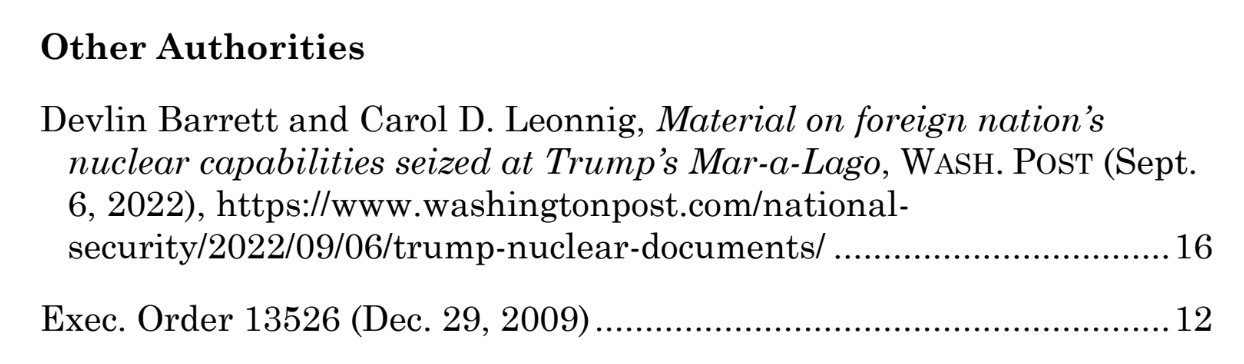
The Government is apparently not concerned with unauthorized leaks regarding the contents of the purported “classified records,” see, e.g., Devlin Barrett and Carol D. Leonnig, Material on foreign nation’s nuclear capabilities seized at Trump’s Mara-Lago, WASH. POST (Sept. 6, 2022), https://www.washingtonpost.com/nationalsecurity/2022/09/06/trump-nuclear-documents/, and would presumably be prepared to share all such records publicly in any future jury trial. However, the Government advances the untenable position in its Motion that the secure review by a Court appointed and supervised special master under controlled access conditions is somehow problematic and poses a risk to national security.

Trump cites Barrett’s work right alongside EO 13526 as “Other Authorities” central to Trump’s argument:

In any case, given the precedent of Nghia Pho (which may still be the only 18 USC 793 case cited by DOJ in this proceeding), it may not matter if Trump stole all or only some of these documents because he’s a narcissist. Trump brought a stack of classified documents to a foreign intelligence target and left them unprotected as multiple suspect foreigners infiltrated his resort. He continued to hoard such documents even after it was publicly reported that he had brought classified documents home.

During Trump’s Administration two men were sent to prison because, by bringing highly classified documents home for motives that had nothing to do with leaking, they made the documents accessible to Russian-linked sources, actions that ultimately led to a devastating compromise of US intelligence resources. Under Donald Trump’s DOJ, Pho and Hal Martin were not given a pass because they were serving their own ego.

So there’s no reason Trump’s narcissism, alone, should be a basis not to charge him.

Share this entry

The Intelligence Gaps Where the Saudis Hid Their October Surprise

NYT has a story on Joe Biden’s serial surprise as he discovered the Saudis were reneging on what the President thought was a deal to keep pumping oil.

Here’s the timeline:

May: Amos Hochstein and Brett McGurk believe they make a deal for a two-part increase of production

June 2: OPEC announces the first part of production increases and Biden announces his Saudi trip

June 3: Trump travels from Mar-a-Lago to Bedminster for Saudi golf tournament

June 7: Adam Schiff and others send Biden a letter warning about Saudi Arabia

Prior to July 15: Briefings for Intelligence Committees on secret plan

July 15: Biden meets with Mohammed bin Salman

August 3: Saudis announce half of production increase promised (“the first public warning”)

September 5: OPEC announced production cuts

Late September: US officials begin hearing of deep production cuts on October 5

September 24: MbS says there will be no production cuts

September 27: Abdulaziz argues cuts would impede diversification plans

September 28: Saudis inform the US they will announce production cuts

October 26: Jared Kushner speaks at Saudi investment summit

NYT emphasizes the Saudi expression of self interest and hints at influence from Russia.

American officials say they believe that Prince Mohammed was particularly influenced by a high-level Sept. 27 meeting in which Prince Abdulaziz, the energy minister, argued that oil production cuts were needed to keep prices from plummeting to as low as $50 per barrel. The U.S. officials said they learned Prince Abdulaziz asserted that, under such as scenario, the Saudi government would lack the resources to fund economic diversification projects at the heart of Prince Mohammed’s domestic agenda.

Some U.S. officials believe that the Russians influenced the Saudi about-face, pointing to Prince Abdulaziz’s strong working ties with top Russian officials close to Mr. Putin, particularly Alexander Novak, the deputy prime minister who oversees energy policy.

[snip]

On Tuesday, speaking on stage at the annual investment forum in Riyadh, Prince Abdulaziz said that the kingdom would do what was in its best interests.

“I keep listening to, ‘Are you with us or against us?’ Is there any room for, ‘We are for Saudi Arabia and the people of Saudi Arabia’?” he said. “We will have to deliver our ambitions.”

But the story focuses more on how the Americans repeatedly got caught by surprise.

The Americans came away from the summit with the belief that the agreement was on track and that Prince Mohammed was satisfied. But in Riyadh, top Saudi officials were privately telling others that they had no plans for further meaningful oil production increases.

Indeed, the first public warning of this came on Aug. 3, when OPEC Plus announced a paltry bump in production for September of 100,000 barrels a day — half of what U.S. officials believed the Saudis had promised them.

American officials said they did not understand why that decision was made. Then OPEC Plus announced on Sept. 5 it would cut production by 100,000 barrels per day — retracting the increase it had announced a month earlier. After that, U.S. officials were increasingly confused and concerned about the kingdom’s direction.

In late September, American officials began hearing that Saudi Arabia could get OPEC Plus to announce a deep cut to oil production at a meeting scheduled for Oct. 5. [my emphasis]

There’s no comment about Trump’s ongoing meetings with the Saudis as this transpired, not even the one the day after Biden announced his visit, the same day (as it happens) that Trump refused to give back all the classified documents he stole. There’s no comment about MbS’s repeated, publicly stated preference for Trump over Biden.

The story describes Biden’s surprise as the result of wishful thinking. And the US wasn’t totally surprised. They got advance warning of the October cuts with enough time to send Janet Yellen to attempt to reverse the cuts.

But as depicted, the Saudis were saying, from the start, that they intended to renege on the deal with Biden, and the US went on believing the deal would hold for months.

There is no way the US should be taken by that much surprise: not by the Saudis, not by the Israelis, not even by the Brits. If they genuinely were this badly surprised, it would suggest significant intelligence gaps on the part of the US. The US spends billions to avoid such surprises.

One of the last times the IC had a surprise this big came when Vladimir Putin decided, after secret phone calls with Mike Flynn, not to respond to Obama’s 2016 sanctions. (They quickly found an explanation for the surprising turn of events, which intelligence collection Trump’s Director of National Intelligence burned years later.)

Perhaps it’s the paranoia fostered by a man who repeatedly intervenes in US foreign policy to obtain personal benefit, but I can’t help but notice these intelligence failures followed Trump’s meeting with the Saudis in Bedminster.

Share this entry

The Legal and Political Significance of Nuclear Document[s] Trump Is Suspected to Have Stolen

After Merrick Garland called Trump’s bluff yesterday, multiple outlets reported that DOJ was looking for documents relating to nuclear weapons.

Classified documents relating to nuclear weapons were among the items FBI agents sought in a search of former president Donald Trump’s Florida residence on Monday, according to people familiar with the investigation.

[snip]

Material about nuclear weapons is especially sensitive and usually restricted to a small number of government officials, experts said. Publicizing details about U.S. weapons could provide an intelligence road map to adversaries seeking to build ways of countering those systems. And other countries might view exposing their nuclear secrets as a threat, experts said.

It’s unclear whether this information is coming from investigators trying to demonstrate what a no-brainer this search was, people who’ve otherwise seen the Attachment listing items to seize, or from Trump’s camp in an effort to pre-empt damage from when this will be released. With few exceptions, most details made public about the search thus far have come from Trump’s side.

But the report that FBI showed probable cause to believe Trump was hoarding a document or documents pertaining to nukes has several significant legal and political implications.

First, it makes it far more likely that Trump has violated, and can be proven to have violated, part of the Espionage Act, 18 USC 793.

In my post describing the likely content of an affidavit justifying a search of the former President, I noted that somewhere in there, the FBI would have had to anticipate and rule out the possibility that Trump simply declassified these documents which, if Trump could prove it, would render the documents simply stolen documents covered by the Presidential Records Act.

  • Some explanation of why DOJ believes that these documents weren’t actually declassified by Trump before he stole them

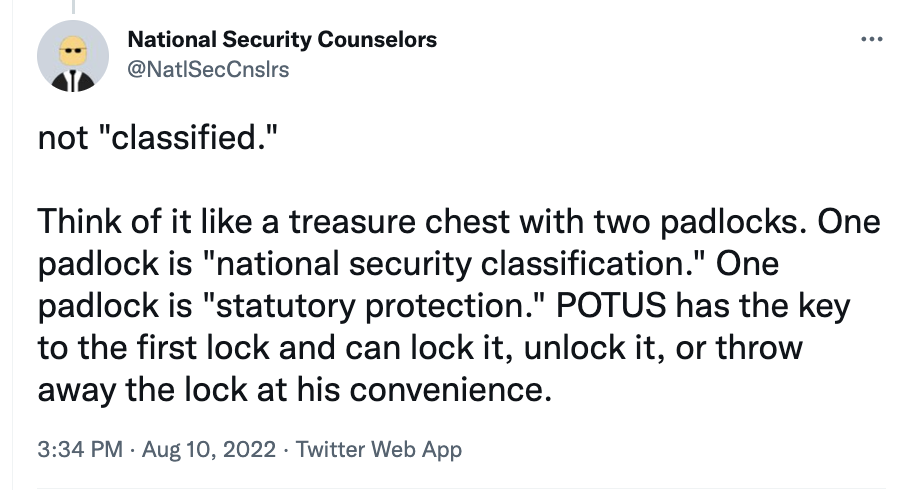
But the fact that these are nuclear documents, under the Atomic Energy Act, Trump cannot declassify them by himself. They’re “restricted documents,” the one kind of document that’s true of. Here are threads by Kel McClanahan and Cheryl Rofer explaining the distinctions — even Chelsea Manning weighed in! As McClanahan likened it, nuclear documents are protected by two padlocks, and Trump only had the legal key to one of those padlocks.

So by showing probable cause that Trump had stolen at least one document pertaining to nuclear weapons, FBI would accomplish that task: Trump could not claim to have declassified any such documents, because he cannot have declassified them by himself.

Now consider how it impacts Trump’s exposure under the Espionage Act. As I laid out here, to prove someone violated the Espionage Act, you don’t actually prove they were refusing to return classified information; you prove they had what is called “National Defense Information.” Even if Trump claimed to have declassified the documents, if the Agency in question (here, likely DOD or DOE) still believed the information to be classified and still treated as such, it could still qualify as NDI. But ultimately, a jury gets to decide whether something is NDI or not. One key difference between the first and second Joshua Schulte trials, for example, is that DOJ relied not on expert testimony to prove that he leaked or was trying to leak NDI, but rather on the logic of why the government would want to keep information about its assets secret. I thought it was one of the areas where the second prosecution was vastly more effective than the first.

There are few easier concepts to explain to a juror than that you need to keep information about nuclear weapons safe, and that doing so pertains to the national defense.

Then there’s the backstory. Early in the Trump Administration, there were reports that Trump had a scheme (one that involved all Trump’s sketchiest flunkies, including Mike Flynn) to transfer sensitive nuclear reactor technology to Saudi Arabia. The Oversight Committee conducted an investigation, the results of which, with the hindsight of Mohammed bin Salman’s $2 billion investment in a paper-thin Jared Kushner finance scheme and the Foreign Agent charges against Tom Barrack, look all the more suspect.

In 2017, President Trump’s son-in-law, Jared Kushner, orchestrated a visit to Saudi Arabia as the President’s first overseas trip. Mr. Kushner also met on his own with then-Deputy Crown Prince Mohammed bin Salman, who subsequently ousted his cousin, Mohammed bin Nayef, launched a crackdown against dozens of Saudi royal family members, and reportedly bragged that Mr. Kushner was “in his pocket.”

In October 2018, the brutal murder of Washington Post columnist Jamal Khashoggi was met with equivocation by President Trump and other top Administration officials. This month, the White House ignored a 120-day deadline for a report on Mr. Khashoggi’s killing requested on a bipartisan basis by the Senate Committee on Foreign Relations.

Within the United States, strong private commercial interests have been pressing aggressively for the transfer of highly sensitive nuclear technology to Saudi Arabia—a potential risk to U.S. national security absent adequate safeguards. These commercial entities stand to reap billions of dollars through contracts associated with constructing and operating nuclear facilities in Saudi Arabia—and apparently have been in close and repeated contact with President Trump and his Administration to the present day.

However, experts worry that transferring sensitive U.S. nuclear technology could allow Saudi Arabia to produce nuclear weapons that contribute to the proliferation of nuclear arms throughout an already unstable Middle East. Saudi Crown Prince Mohammed bin Salman conceded this point in 2018, proclaiming: “Without a doubt, if Iran developed a nuclear bomb, we will follow suit as soon as possible.”

When Congress passed the Atomic Energy Act, it imposed stringent controls on the export of U.S. technology to a foreign country that could be used to create nuclear weapons. Under Section 123 of the Act, the U.S. may not transfer nuclear technology to a foreign country without the approval of Congress, in order to ensure that the agreement reached with the foreign government meets nine specific nonproliferation requirements.

[snip]

[W]histleblowers provided new information about IP3 International, a private company that has assembled a consortium of U.S. companies to build nuclear plants in Saudi Arabia. According to media reports, IP3’s only project to date is the Saudi nuclear plan. A key proponent of this nuclear effort was General Michael Flynn, who described himself in filings as an “advisor” to a subsidiary of IP3, IronBridge Group Inc., from June 2016 to December 2016—at the same time he was serving as Donald Trump’s national security advisor during the presidential campaign and the presidential transition. According to the whistleblowers, General Flynn continued to advocate for the adoption of the IP3 plan not only during the transition, but even after he joined the White House as President Trump’s National Security Advisor.

[snip]

Another key proponent of this effort was Thomas Barrack, President Trump’s personal friend of several decades and the Chairman of his Inaugural Committee.

The nuclear energy scheme (which did not involve nuclear weapons, but implicated concerns that the Saudis would develop them) overlaps closely with the scope of the Foreign Agent charges against Barrack (and I don’t rule out that FBI’s focus on such document(s) stems, in part, from Barrack’s upcoming trial). One of the overt acts charged against Barrack, for example, is that he “forced” the Trump White House to elevate the treatment of MbS on a visit to the US in March 2017 beyond that accorded by his rank at the time.

To be sure: There’s not a hint of evidence that the government has reason to believe Trump tried to sell or otherwise share the documents he stole with foreign entities. If the government suspected Trump might do so with Restricted Documents covered by the Atomic Energy Act, it would implicate a different crime, 40 USC 2274, with which Jonathan Toebbe was charged last year for trying to deal such technology to Brazil. Trump has succeeded in obscuring the crimes listed on his warrant (though not all crimes need to be listed on the overt warrant), but if the Atomic Energy Act were implicated, that would be really hard to do (unless this leaked detail is an effort on Trump’s part to prepare for the mention of the Atomic Energy Act on the warrant, though I doubt that’s the case).

So for now, Trump’s past history of attempting to share nuclear technology with the Saudis for the profit of his closest advisors is just background noise: something that makes it all the more concerning he is suspected of stealing such documents. But if the FBI did not find nuclear documents they have reason to believe Trump stole, then that could change quickly.

Finally, there’s a political angle. The press has been absolutely remiss in calling out Republicans for their hypocrisy about classified information — or their irresponsibility in parroting Trump’s complaints about a serious breach investigation. Instead, the press treated the nation’s security as a he-said, she-said fight between political parties.

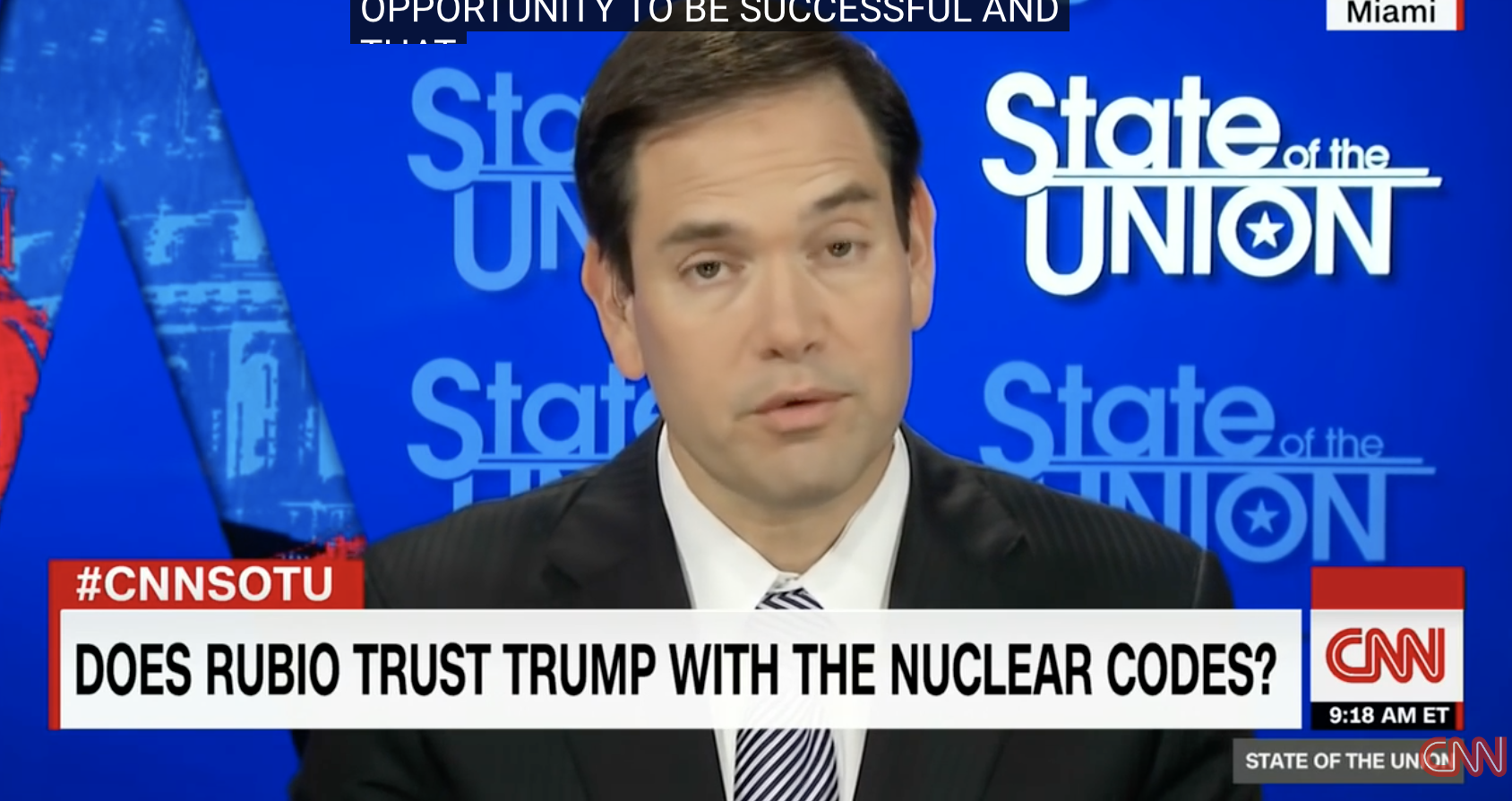
But the report that the FBI has reason to believe that Trump stole documents about nuclear weapons provides just the kind of horse race angle that seems to be the only thing that vast swaths of journalists can understand anymore. That’s because in 2016, Marco Rubio argued that Trump was “unfit for the Presidency” because we could not give the “nuclear codes of the United States to an erratic individual.”

Indeed, Val Demings, who is in a close fight against Rubio in November’s Senate elections, just made it an issue yesterday, before the nuclear angle became clear.

2016 Marco Rubio scoffed at the notion that someone like Trump should be given access to the nuclear codes. 2022 Marco Rubio — largely because he wants to win Trump’s favor in the election against Demings — doesn’t even want the FBI to investigate whether Trump stole the nuclear codes when he left office.

Perhaps with a horserace angle, the press might finally hold Republicans accountable for their irresponsibility of their efforts to protect Trump here.

Share this entry

Tom Barrack Appears to Claim Trump Knew Barrack Was Catering US Foreign Policy to the Emirates

In this post, I described the import of the false statement and obstruction charges against Tom Barrack. While Barrack may have been honest about his ties to the Emirates in a 2017 interview with Robert Mueller’s prosecutors, he is accused of lying about those ties in 2019, which — if DOJ has the goods on those later lies — will make it clear he was affirmatively hiding his role at that point.

[A]ssuming the FBI didn’t charge a billionaire with false statements without having him dead to rights on the charges, by June 2019, the FBI foreclosed several of the defenses that Barrack might offer going forward: that he was doing all this as a legal commercial transaction (which is exempt from the foreign agent charges) or that he wasn’t really working for UAE, he just thought the alliance really served US interests and indulged the Emiratis by referring to MbZ as “boss.” By denying very basic things that the FBI appears to have records for, then, Barrack made it a lot harder to argue — in 2021 — that’s there’s an innocent explanation for all this.

[snip]

This case will sink or swim on the strength of the false statements charges, because if Barrack’s alleged lies in June 2019 were clearcut, when he presumably believed he would be protected by Barr and Trump, then it makes several likely defenses a lot harder to pull off now.

The government made the same argument in a filing last month responding to Barrack’s motion to dismiss: If Barrack did not know his back channel with the Emirates was a problem, why did he (allegedly) lie about it?

Although not dispositive to Barrack’s vagueness challenge, if Barrack actually believed that he had done nothing wrong, it is unclear why he allegedly lied to FBI special agents during his voluntary June 20, 2019 interview as set forth in Counts Three through Seven of the Indictment.

It’s now clear that Barrack’s alleged false statements are even more important than that.

That’s because Barrack is now arguing that, because the Trump Administration approved of how Barrack was peddling US policy to the Emirates, Barrack could not have been a secret foreign agent under 18 USC 951.

That revelation has slowly become clear over the course of a dispute over discovery (motion, response, reply) pertaining to Barrack’s demand, among other things, for, “all communications between Mr. Barrack and the Trump Campaign and Administration regarding the Middle East.”

In the government’s response, they note that 18 USC 951 requires notice to the Attorney General, not to members of a private political campaign.

The defendants argue that evidence of Barrack’s disclosure of his UAE connections to members of the Trump Campaign are exculpatory. But Section 951 requires notice to the Attorney General, not to private citizens affiliated with the Trump Campaign. See 18 U.S.C. § 951(a). This makes sense, since the Attorney General is the official charged with enforcing the law and the senior official in charge of the FBI, the agency responsible for investigating and responding to unlawful foreign government activity inside the United States. By contrast, members of the Trump Campaign have no such responsibilities with respect to the internal national security of the United States and had no authority to sanction or bless the defendants’ illegal conduct. They are not government officials, and even if they were, they are not the Attorney General or a representative thereof.

According to the indictment, Paul Manafort not only knew that Barrack was working for the Emirates, but was cooperating with Barrack’s efforts.

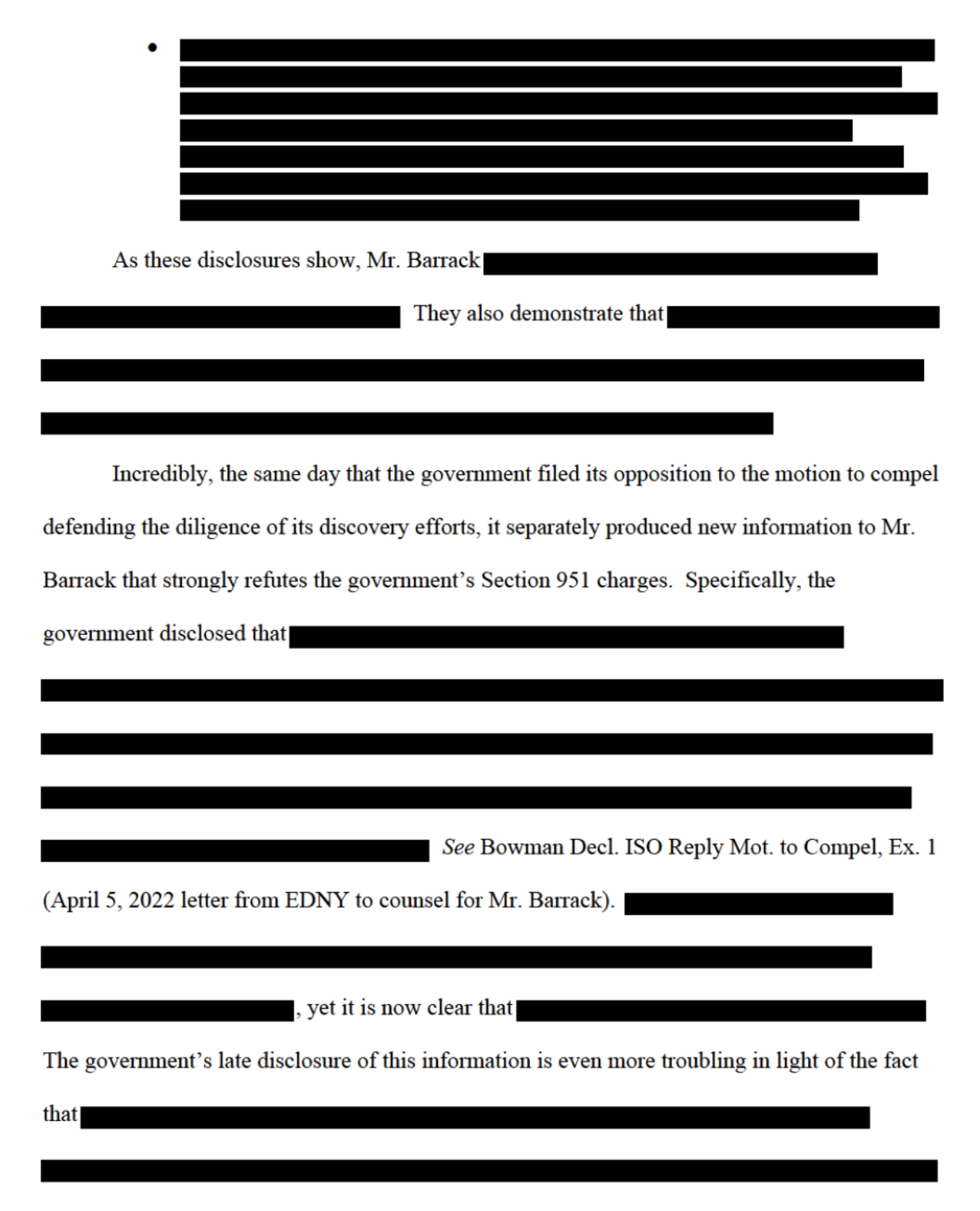
In Barrack’s reply, after a heavily redacted passage, he complains about DOJ’s claim — made in the press conference announcing his arrest — that he had deceived Trump about what he was doing.

The government’s position is particularly astonishing in light of its public claim at the time of Mr. Barrack’s arrest that he had deceived Mr. Trump and the administration. Specifically, the then-Acting Assistant Attorney General for the National Security Division announced that the “conduct alleged in the indictment is nothing short of a betrayal of those officials in the United States, including the former President,” and that this indictment was needed to deter such “undisclosed foreign influence.” [citation removed] In that same press release, the Assistant Director in Charge of the FBI NY Field Office asserted that the indictment was about “secret attempts to influence our highest officials.” Id. When Mr. Barrack raised concerns with the government about these false statements in the press release, the government responded that these statements were a fair representation of the conduct alleged in the indictment. [citation removed] Thus, in one breath the government claims that Mr. Barrack deceived Mr. Trump and the administration and that such evidence is part of its case, but in the next breath contends that contrary evidence is neither relevant nor exculpatory and apparently withheld such discovery on that basis.

Barrack’s lawyers include the 2021 comments about whether Trump knew of all this as exhibits, but more recent correspondence about it remains sealed.

In other words, Barrack seems to be arguing, he didn’t betray Trump; Trump wanted him to cater American foreign policy to rich Gulf Arab nations.

Barrack spends four pages of his reply making the same kinds of complaints about the documentation of his 2019 FBI interview that Mike Flynn made in 2020, even complaining that the fact that the AUSAs prosecuting the case were in the room makes them conflicted on the case. It’s clear why he did so: because if Barrack did lie to an FBI run by Trump’s appointed FBI Director and ultimately overseen by Bill Barr in 2019, then he was continuing to hide his influence-peddling from the one person that mattered under the law, Bill Barr (though given what we know of Barr’s interference in Ukraine investigations, I would be unsurprised if Barr knew that Trump knew of Barrack’s ties to the Emirates, which would explain why he swapped out US Attorneys in EDNY at the time).

Remember: Barrack is alleged to have been pursuing policies pushed by Mohammed bin Zayed. But among the things he is accused of doing for the Emirates was to “force” the White House to elevate Saudi Crown Prince Mohammed bin Salman (then just the Deputy Crown Prince) during a visit to DC in March 2017. At the time the FBI interviewed Barrack in June 2019, Trump was under significant pressure for his possible complicity in the Jamal Khashoggi assassination.

And now — at a time when EDNY is talking about indicting Barrack’s not-yet indicted co-conspirators — we learn that MbS invested $2 billion dollars in Jared Kushner’s brand new firm even in spite of all the reasons not to.

Six months after leaving the White House, Jared Kushner secured a $2 billion investment from a fund led by the Saudi crown prince, a close ally during the Trump administration, despite objections from the fund’s advisers about the merits of the deal.

A panel that screens investments for the main Saudi sovereign wealth fund cited concerns about the proposed deal with Mr. Kushner’s newly formed private equity firm, Affinity Partners, previously undisclosed documents show.

Those objections included: “the inexperience of the Affinity Fund management”;the possibility that the kingdom would be responsible for “the bulk of the investment and risk”; due diligence on the fledgling firm’s operations that found them “unsatisfactory in all aspects”; a proposed asset management fee that “seems excessive”; and “public relations risks” from Mr. Kushner’s prior role as a senior adviser to his father-in-law, former President Donald J. Trump, according to minutes of the panel’s meeting last June 30.

But days later the full board of the $620 billion Public Investment Fund — led by Crown Prince Mohammed bin Salman, Saudi Arabia’s de facto ruler and a beneficiary of Mr. Kushner’s support when he worked as a White House adviser — overruled the panel.

Barrack’s apparent claim that Trump knew exactly what he was doing does nothing to change his legal posture before Trump became President, and DOJ indicted this before the statute of limitation expired on that conduct.

But the apparent claim that Trump knew about this — and the possibility that Barr did too, at least after the fact — would change the kind of crime that happened in 2017, after Trump became President. And, possibly, the culprit.

Share this entry

What If the US Had Fought the Saudis Instead of the Taliban?

Poof.

Our twenty year occupation of Afghanistan is ending in humiliating fashion. Jim and I are thinking about re-running every one of his posts cataloging the failures of training Afghans who would — and now have — changed sides when necessary or convenient.

While I’ve got burning questions about how Trump and his hand-picked Acting Secretary of Defense, Christopher Miller, made this defeat more certain, I’m going to hold off on recriminations for a bit. After all, we have two decades of accountability to demand.

I am, however, interested in how the way in which we’re fleeing Afghanistan will influence how President Biden responds to a demand from the families of the 9/11 victims to declassify more intelligence from the investigation. They have said Biden is not welcome at the memorial if he does not respond to their demand.

Families of 9/11 victims say an FBI offer to release some documents from its investigation into the attack has not gone far enough, and are demanding a comprehensive declassification review of all relevant material, particularly on Saudi Arabia’s role.

The FBI offer on Monday followed a call by some victims’ families and first responders for Joe Biden to stay away from ceremonies marking the 20th anniversary of the attack next month, if the president failed to honour a campaign pledge to lift the secrecy surrounding the multi-agency investigations.

The families want information on who financed and supported the attacks, and are currently suing the Saudi Arabian government in a federal court in New York. As part of that case, three former Saudi officials were questioned in June by the plaintiffs’ lawyers about their links with two of the 9/11 hijackers, Khalid al-Mihdhar and Nawaf al-Hazmi, who spent several months in southern California before the attack. Their testimony cannot be shared with the families under secrecy rules.

Of course, if Biden does respond fully, it will demonstrate that, rather than occupying Afghanistan for two decades, we should have been fighting the Saudis.

And yet, we remained allies with the Saudis, continuing to let Saudis like Ahmed Mohammed al-Shamrani enter the US without adequate vetting, allowing yet another Saudi-linked terrorist attack on US soil.

We have hidden the role that our “allies” the Saudis had in 9/11 for two decades because if we actually held them accountable, rather than inflicting our need for revenge on the Taliban, their oil could no longer be a cornerstone to our  empire.

We could not hold the Saudis accountable because if we did, we would have had to stop burning oil.

We would have had to replace Saudi oil with renewables, a more modest way of life, and some humility.

We would have, out of necessity, done something about climate change.

We have plenty of time for recriminations about our failures in Afghanistan. But we have no time left to make up for the twenty years we might have spent addressing climate change instead.

Share this entry