US Deports Ibragim Todashev’s Girlfriend

The Guardian and Boston Magazine report that Tatiana Gruzdeva, the woman whom FBI had apparently detained to pressure Ibragim Todashev to cooperate, is now back in Moldova after being deported to Russia. Gruzdeva had claimed she was deported for granting an interview to Boston Magazine, and that outlet quotes a lawyer explaining how that might be the case.

[I]mmigration lawyers Susan Church and Jeremiah Freedman told me Gruzdeva was most likely given something called an order of supervision—and yes, they said, under an order of supervision, the feds can deport her for speaking to the media.

Church says this proviso matches Gruzdeva’s account that she was given a one-year extension to stay in America and that she was allowed to file for work papers. Orders of supervision are usually given under another legal provision called deferred action. Church says it’s common for people to file for work under these circumstances.

According to Freedman, orders of supervision can include certain requirements like not speaking to the press. “If you violate the conditions of your order of supervision,” he said, “they pick you up and put you in jail again.” And Church says these requirements don’t have to be explicit. “A person who has an overstay really doesn’t have any legal rights,” said Church. “They could be picked up at any time.”

“That is really a privilege that is not extended to many people,” said Church,

I’m as interested in this account for what it says about Gruzdeva’s likely status — deferred action — as the explanation for how speaking to Boston Magazine could get her deported. Because, from what I’ve seen, such an extension along with work privileges is virtually unheard of in the immigration context, even for people who are far more cooperative with law enforcement than we at least understand Gruzdeva to have been.

So Gruzdeva gets that privilege, and while released spends a lot of time with Todashev’s father, Abdulbaki, who is a government official in Grozny. When her roommate, Ashurmamad Miraliev. who had been close friends with Todashev and also spent time with Abdulbaki, was arrested, she went public, which led not only to accusations the FBI was recruiting members of this community as informants, but also ultimately to Gruzdeva’s loss of that privilege and her deportation. While in the US, Abdulbaki was interviewed by the FBI and other law enforcement. And according to the Guardian, Gruzdeva was debriefed in Moscow before she traveled onto Moldova.

So what is the FBI (and another unnamed federal agency, on whose request Miraliev is being detained) really after here?

Share this entry

US Grabs Pakistan Taliban Representative From Afghan Authorities, Preventing Peace Talks

Afghan President Hamid Karzai recently lashed out at the United States, stating that US insistence on being able to conduct autonomous counterterrorism actions within Afghanistan was a major obstacle to signing a new Status of Forces Agreement (okay, they call it the Bilateral Security Agreement now, but SOFA just has a much better ring to it). A report from the Washington Post yesterday evening provides a perfect example of how the hypocrisy of US forces in Afghanistan is killing any chance of an agreement being signed, as the US consistently brags about Afghans being “in the lead” on virtually all actions and yet when the US wants, it takes arbitrary and brutal action with complete disregard for the Afghan chain of command.

The hubris of this latest insult to Afghanistan is staggering. After months of carefully recruiting a senior figure from inside Pakistan’s Taliban, Afghan intelligence officials were in the process of bringing him into Afghanistan where he was to begin discussions with the security service that could lead to peace talks. It appears that the US stopped the convoy transporting him, grabbed him, and took him to the portion of the prison at Bagram that the US still refuses to turn over to Afghan control:

The United States recently seized a senior Pakistani Taliban commander in eastern Afghanistan, snatching him from the custody of Afghan intelligence operatives who had spent months trying to recruit him as an interlocutor for peace talks, Afghan government officials charged Thursday.

Latif Mehsud, an influential commander in the Pakistani Taliban, was taken into custody by U.S. personnel, who intercepted an Afghan government convoy in Logar province, Afghan officials said.

As might be expected, Karzai is furious. Karzai’s spokesman talked to the Post:

Afghan officials described their contact with Mehsud, thought to be about 30, as one of the most significant operations conducted by their country’s security forces. After months of conversations, the Taliban leader had agreed to meet with operatives of Afghanistan’s main spy agency, the National Directorate of Security, said Aimal Faizi, a spokesman for Karzai, who declined to identify Mehsud by name, referring to him only as a top Taliban commander.

/snip/

“The Americans forcibly removed him and took him to Bagram,” said the spokesman, referring to the military base that includes a detention facility where the United States continues to hold more than 60 non-
Afghan combatants.

There is simply no way that the US could have thought that Mehsud was in Afghanistan to carry out a terrorist attack. He was in a convoy of NDS personnel and word has been spreading that the Pakistan Taliban is interested in peace talks with Pakistan, so the concept of peace talks with Afghanistan also would make a lot of sense.

Keep in mind as well that, even though the drone strike on Wali Ur Rehman was seen by most as revenge for his role in the Khost bombing, Rehman was seen as one of the more moderate voices within the Pakistani Taliban who would have favored peace talks. The Taliban quickly called off the prospect of peace talks after Rehman’s death. Recall that his death came just as Nawaz Sharif, who had campaigned on a platform including peace negotiations with the Taliban, was preparing to take office.

It goes without saying that Pakistan’s Taliban is one of the most violent and disgusting organizations in existence. Continued attacks on polio vaccine workers and threats to attack Malala Yousufzai again if she returns to Pakistan and continues her activism for young girls to have equal access to educational opportunities show them to be the worst kind of terrorists. And yet, somehow, the US has seen fit twice now to intervene and remove from the playing field the voices within this group who seemed in the best position to help lead it out of its most extreme actions and closer to a peaceful position within society.

Somehow, US actions in Pakistan and Afghanistan seem to indicate that the US does not feel that peace talks in the region are in its best interests. What harm would come to the US from peace talks?

Share this entry

What Kind of Intelligence Does the HIG Expect to Get from Anas al-Libi?

There has been all manner of commentary about the rendition and detention on a poorly functioning ship of Abu Anas al Libi. There are credulous claims about the humanity of the High Value Interrogation Group’s tactics that nevertheless remain officially classified. There’s the growing awareness that al-Libi’s case differs from Ahmed Warsame’s in several key ways. And then there’s John Bellinger, trolling the Obama Administration for violating rules the Bush Administration did not in superb fashion.

These are important questions. But they distract from another important question.

What kind of intelligence do they really expect to get from al-Libi?

The explanation for his capture has focused on his alleged role in the 1998 Embassy Bombings. While there are no statutes of limitation for murder, that’s nevertheless an event that took place over 15 years ago. Even some of the analysts we often rely on — not to mention his family — suggest he hasn’t had an active role in al Qaeda for over a decade, or at least since he returned home to Libya 2 years ago. Lisa Monaco offered weak claims about the importance of al-Libi.

During an appearance on PBS Newshour, Deputy National Security Adviser Lisa Monaco repeatedly referred to Abu Anas Al-Libi as a “member” of Al Qaeda. However, she stopped short of calling the Libyan-born Al-Libi a “senior operational leader”—a phrase which seemed to have special significance when the Justice Department evaluated the legality of lethal force against U.S. citizens and is also believed to apply to targeting of foreign nationals outside combat zones.

Newshour reporter Jeffrey Brown asked Monaco about whether Al-Libi posed an “imminent” threat to Americans, but Monaco wouldn’t say that and also seemed to avoid declaring that he was an Al-Qaeda operative or even a leader of the group.

“Al-Libi did pose a threat to the United States as a senior al-Qaida member and somebody who is also charged in an indictment for his role as part of the Al Qaeda worldwide conspiracy,” Monaco declared.

This is, at the least, a significant difference from Ahmed Ghailani (who was seized with an active cell in Pakistan and interrogated for years about that active cell before being tried for his role in the Embassy Bombings) and Ahmed Warsame (who was seized for his active role in working with AQAP and al-Shabaab), though it perhaps resembles Suleiman Abu Ghaith.

I’m not saying al-Libi had no active role in terrorism. The timing — the raid took place at the same time as the strike on Abdulkadir Mohamed Abdulkadir, who allegedly helped plan attacks in Kenya — might suggest al-Libi played some role in the Westgate Mall attack and other operations in Africa.

Perhaps the most complete explanation for why al-Libi is a current threat is this description.

An unclassified report published in August 2012 highlighted al Qaeda’s strategy for building a fully operational network in Libya. The report (“Al Qaeda in Libya: A Profile”) was prepared by the federal research division of the Library of Congress (LOC) under an agreement with the Defense Department’s Combating Terrorism Technical Support Office (CTTSO). [See LWJ report, Al Qaeda’s plan for Libya highlighted in congressional report.]

Abu Anas al Libi has played a key role in al Qaeda’s plan for Libya, according to the report’s authors. He was described as the “builder of al Qaeda’s network in Libya.”

Al Qaeda’s senior leadership (AQSL) has “issued strategic guidance to followers in Libya and elsewhere to take advantage of the Libyan rebellion,” the report reads. AQSL ordered its followers to “gather weapons,” “establish training camps,” “build a network in secret,” “establish an Islamic state,” and “institute sharia” law in Libya.

Abu Anas al Libi was identified as the key liaison between AQSL and others inside Libya who were working for al Qaeda. “Reporting indicates that intense communications from AQSL are conducted through Abu Anas al Libi, who is believed to be an intermediary between [Ayman al] Zawahiri and jihadists in Libya,” the report notes.

Al Libi is “most likely involved in al Qaeda strategic planning and coordination between AQSL and Libyan Islamist militias who adhere to al Qaeda’s ideology,” the report continues.

Al Libi and his fellow al Qaeda operatives “have been conducting consultations with AQSL in Afghanistan and Pakistan about announcing the presence of a branch of the organization that will be led by returnees from Iraq, Yemen, and Afghanistan, and by leading figures from the former LIFG.” The LIFG refers to the Libyan Islamic Fighting Group, an al Qaeda-linked jihadist group formed in Libya in the 1990s.

The suggestion that al-Libi might be the liaison between Ayman al-Zawahiri and extremists in Libya (extremists we helped to overthrow Qaddafi) is more interesting, particularly given Libya’s public objections to al-Libi’s rendition. Perhaps the ultimate plan is to hold al-Libi responsible for Benghazi (though interrogating him in a floating prison might endanger any charges if he was involved, which would be a big problem given the need for some finality on Benghazi). But it might raise interesting questions about whether the extremists we helped in Libya really constitute al Qaeda, or instead constitute a legitimate force within that country.

As of now, however, the US public story is that we captured this guy who has been living in the open for two years for a crime he committed 15 years ago. And that instead of whisking him immediately to NY to stand trial for that crime, we are instead pissing off the Libyan government and nudging up against a slew of domestic and international laws by conducting a floating interrogation from which we might learn only decades old facts. If that’s the story (and again, I suspect the government at least claims there is more), it makes all the legal and ethical issues surrounding his detention all the more problematic.

Share this entry

The FBI’s Official “CAIR Has Cooties Guidance Directive [Redacted]”

I had just about come to the conclusion that Michael Horowitz, DOJ’s Inspector General who took over after Glenn Fine retired in 2010, was a worthy successor. In recent weeks, Horowitz has released reports critical of DOJ’s handling of classified information, its refusal to account for drones’ unique risks to privacy, and the Bureau of Alcohol, Tobacco, and Firearms’ use of “churning” (money-making) operations.

But then I read this report — on the FBI’s Interactions with the Council on American-Islamic Relations — and I got literally sick to my stomach.

The report purports to determine whether the FBI complies with Agency guidance — the title and issuing authority for which are redacted in the report, which is why I am referring to it as the “Cooties Guidance Directive [Redacted]” throughout, even where it is redacted in direct quotes — that FBI personnel are not to engage in any community outreach with people from CAIR. For results, it shows that in three of five cases where FBI personnel did engage (or almost engage!) with people from CAIR, the personnel either didn’t consult with the FBI entity the IG deems to be in charge of this policy (which is probably the Counterterrorism Division, but the IG Report redacts that too), or consulted instead with the Office of Public Affairs, which is in charge of community outreach.

In response to these shocking (!!) results, Congressman Frank Wolf has already called for heads to roll.

But what the report actually shows is, first of all, how in response to two non-criminal pieces of evidence — a meeting between men who would go on to found CAIR and Hamas, which was not yet a designated a terrorist organization, and CAIR’s designation as an unindicted co-conspirator in the Holy Land Foundation case (the publication of which was subsequently deemed a violation of the group’s Fifth Amendment rights) — the FBI formulated a formal policy to treat that organization as if it has cooties.

And yet, even the language the IG repeats about this policy makes it clear that the FBI was operating on a policy of “guilty until proven innocent.”

The guidance specifically stated that, until the FBI could determine whether there continued to be a connection between CAIR or its executives and Hamas, “the FBI does not view CAIR as an appropriate liaison partner” for non-investigative activities.

That is, for the entire 5 year period versions of this policy have been in place, FBI has maintained that so long as it doesn’t develop evidence that CAIR has no ties to Hamas, then FBI will treat the organization and its officials as if they do have such ties by refusing to let them on FBI property or attend any CAIR-affiliated events. And we’re supposed to believe, I guess, that the FBI has used not a single one of their intrusive investigative methods to try to prove or disprove this allegation in the interim 5 years, and so it just will never know whether the allegation is correct or not, and so must operate on the playground Cooties standard.

Heck, in one of the “incidents” the report investigates, the local FBI office actually vetted an event participant to make sure his service on CAIR’s local board didn’t taint all his other community ties so badly that he should not participate in the event.

Yet whether or not a particular CAIR representative [redacted] is irrelevant to the Cooties Guidance Directive  [Redacted] to deny the organization access to the FBI in such non-investigative community-outreach activities.

And the IG Report — Michael Horowitz’ report — judges that vetting that found this gentleman to be innocent was not sufficient reason to ignore the Cooties Guidance Directive [Redacted]. The Report seems to endorse the view that vetting notwithstanding, this guy had a formal role in CAIR that made all his other roles in the Muslim community suspect and that’s the way things work in America.

Then there’s the underlying logic. The entire policy is premised on a bizarre belief that it is exploitative for a Muslim organization to advertise its willingness to work with the FBI.

The June 2011 EC also reiterated that CAIR was not prohibited from “maintaining a relationship with the FBI regarding civil rights or criminal violations; however, civil rights and criminal squads should be cognizant CAIR has exploited these relationships in the past.”

[snip]

The end result of this incident- CAIR posting on its website of a photograph showing the SAC speaking at the event and a description of CAIR’s Civil Rights Director moderating his speech is the sort of exploitation of contact with the FBI that the Cooties Guidance
Directive [Redacted] was intended to avoid.

I don’t get it. If CAIR really were a terrorist sleeper cell, wouldn’t advertising their willingness to associate with the FBI completely ruin all their terrorist Cred, and therefore neutralize whatever threat they presented?

In any case, on the one hand, the report chronicles how the federal agency in charge of investigating civil rights abuses basically treated an entire constitutionally protected civil rights organization as guilty without charging it with any crime.

But then there’s the fact that, after responding to a request to fear-mongers in Congress, this report saw the light of day in the fashion it appears.

As noted above, the IG Report seems to accept this premise of guilty until proven innocent without noting the problem underlying it. Like, you know, the Constitution. In places, the language of the report even echos that of a presumption of guilt, as in this passage where it berates OPA for actually treating an individual with multiple formal ties to the Muslim community as such, rather than as someone branded solely by his affiliation with CAIR.

It appears that OPA provided guidance that effectively reversed the presumption against CAIR participation in non-investigatory FBI activities in this instance. OPA indicated that it wanted to ensure that there was sufficient justification for excluding the CAIR participant apart from his role in CAIR.

Then there’s the way in which this was released. While the actual Cooties Guidance  Directive [Redacted] is classified, nothing else in the report seems like it should be (though the FBI has removed the classification marks from the paragraphs to hide the basis for their claims that this is classified). In particular, FBI or DOJ or OIG has chosen to redact anything that would make it clear whether this is an actual policy, or just guidance on which CTD and OPA disagree (in their complaint about the report, the ACLU notes that it doesn’t appear to have gone through the formal policy-making process). And yet, having hidden that information, the IG presents it as if the failure to implement the Cooties Guidance Directive [Redacted] is a graver problem than the upending of presumption of innocence.

Finally, there are a few tonal issues. For example, the report presents this view — from a Chicago SAC who twice blew off the Cootie Guidance Directive [Redacted] — as if his basic civility presents a problem.

He stated that if DHS considered CAIR officials to be part of the community and invited them to the Roundtable, the FBI was not going to deny them entry at the door.

In another instance, it quotes another violating SAC as using the term “Islamophobia” (PDF 22), but presents the term in scare quotes. This is borderline McCarthyist shit, treating the language of people fighting terrorists by treating Muslims as human beings as some kind of brand against them.

Finally, there’s the timing of this. The fear-mongers requested this report in March 2012 — over 20 months after after the Section 215 IG Report that we’ve been waiting for for 1,224 days got started. Three of four of what are probably interviews with those deemed in violation of this guidance took place over the course of 8 days in August and September of 2012 (the last took place in July, which makes me wonder whether that was added to beef up an otherwise thin report.)

But then the report didn’t get released until a second state CAIR affiliate starts challenging the FBI’s killing of a Muslim person. And the IG Report got released on the very same day that CAIR released a major report on Islamophobia (or, as the IG appears to treat it, “Islamophobia.”)

The whole thing seems designed not to make the FBI a more orderly place (if that were the purpose, then it might be better to focus on how the Cooties Guidance Directive
[Redacted] became formal policy — if it did — without going through formal policy channels). Rather, it seems designed to foment a kind of McCarthyism within FBI targeted at those counterterrorism investigators who believe the best way to fight Islamic extremists is to treat Muslims as partners in rooting out violence.

Share this entry

US Embarrasses Self Again on Symbolism of Newest Floating Prison

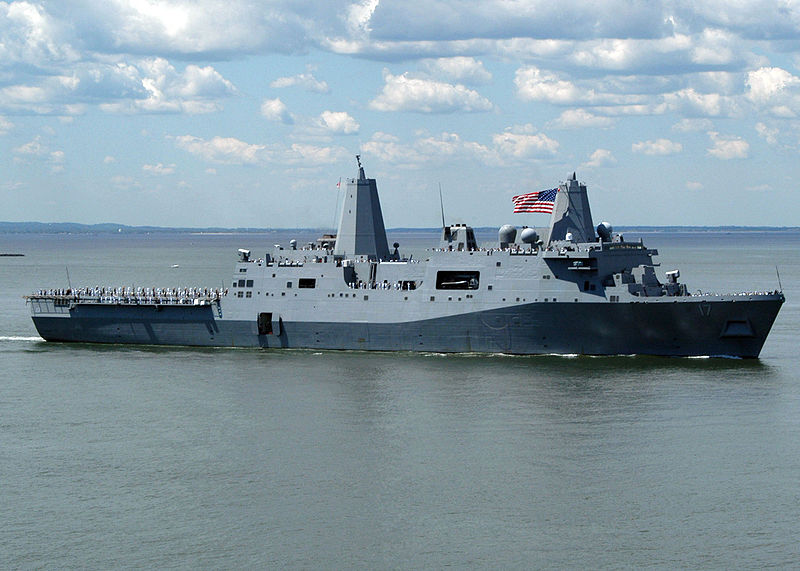
The USS San Antonio entering New York Harbor during Fleet Week, 2006. When I first saw this photo, I thought that the image created the illusion that the ship was holding the Statue of Liberty, but it turns out that is part of the ship's structure and not Liberty's torch that we see. I still can't quite shake that metaphor, however.

The USS San Antonio entering New York Harbor during Fleet Week, 2006. When I first saw this photo, I thought that the image created the illusion that the ship was holding the Statue of Liberty, but it turns out that is part of the ship’s structure and not Liberty’s torch that we see. I still can’t quite shake that metaphor, however.

I fought what seemed to be a one-person battle over what appeared to me to be efforts by the United States to rehabilitate the image of the USS Bataan. In 2010, I pointed out the depravity of using a ship that once was a floating torture chamber as a hospital ship during Katrina and then after the earthquake in Haiti. And then I completely went ballistic when the Bataan Rehabilitation March came even closer to home with the disgusting spectacle of the torture ship being used to stage a college basketball game. At least Mother Nature won that particular round, as the game had to be cancelled at halftime when the surface of the court became unplayable due to moisture as the ship cooled in evening air.

The whole concept of the floating “interrogation” ship is being used again by the US and the naturally arising question is that if no less than Charlie Savage is being used on the preemptive “nothing to see here, move along” gov-splaining of the use of the ship is needed, is the US reverting to the torture practices that were carried out on the Bataan? But this time, instead of the USS Bataan, the interrogation of Abu Anas al-Libi is being carried out on the USS San Antonio. The San Antonio can be considered the poster child for all that is wrong with military procurement systems today:

Five years ago, the USS San Antonio (the first LPD 17 class ship) entered service. Or at least tried to. The builders had done a very shoddy job, and it took the better part of a year to get the ship in shape.

/snip/

Although the San Antonio did get into service, it was then brought in for more inspections and sea trials, and failed miserably. It cost $36 million and three months to get everything fixed. The workmanship and quality control was so poor that it’s believed that the San Antonio will always be a flawed ship and will end up being retired early.

Just as the San Antonio was “commissioned” and then towed back for repairs because it couldn’t move on its own, the “interrogation” that is currently underway for al-Libi is a false start and a “clean team” will have to be brought in for any interrogations that will be used should al-Libi ever be brought to trial. From the gov-splanation: Read more

Share this entry

The Other Things the Government Is Hiding from Dzhokhar’s Lawyers

As Josh Gerstein reported earlier today, Dzhokhar Tsarnaev repeatedly asked for a lawyer during his interrogation — and the government has not turned over details about the extent of his requests to his lawyers.

That’s interesting enough — does the government really expect it will be able to suppress these details?

But there are other details from Dzhokhar’s lawyers’ discovery request that I find equally of interest. The government also withheld:

  • The immigration files of requested individuals. The government has refused to share the files from anyone but Dzhokhar’s nuclear family (presumably meaning even the file of his spooked up uncle will be withheld, along with that of — say — Ibragim Todashev).
  • The interview reports from certain people in Russia.
  • Information about the surveillance and interviews of Tamerlan and the brothers’ mother prior to the Boston bombing.
  • Information on tips from the Russians.
  • Transcripts of Dzhokhar’s calls from the detention center. This would include a call to his mother the government cited in imposing SAPs on him.
  • “All documents and information concerning or comprising intercepted communications (e.g., U.S. mail, voice (telephone/skype/etc.) calls, text messages, e-mail messages, we search history/browser requests) of the defendant and his family members.” The filing doesn’t describe what, if any, response the government gave to this request.
  • Documents pertaining to the investigation of the 2011 Waltham murders, including any investigation of Tamerlan, Ibragim Todashev, or Dzhokhar. The government cited investigative privilege in withholding these documents.

Some of this may well come out later. But it seems the government is withholding anything that might touch Russian intelligence. Which is why I find this footnote so interesting.

With respect to the second summary disclosure, government counsel cryptically wrote: “We apologize for providing this information in a supplement but our own review of the information was unavoidably delayed.”

The Fifth and Sixth Amendment issues here might well endanger the government’s death penalty case, if not worse. But you get the feeling the government may be willing to risk their legal case (at least the death penalty) to protect these intelligence details.

Too bad for them so many of them have been leaked to the press or disclosed in the aftermath of killing Todashev.

Share this entry

Is Carmen Ortiz Subjecting Dzhokhar Tsarnaev to Solitary To Prevent Him from Learning about Developments in Florida?

On August 27, Attorney General Eric Holder imposed Special Administrative Measures on Dzhokhar Tsarnaev at the request of US Attorney Carmen Ortiz. Yesterday, Dzhokhar’s lawyers challenged the SAMs.

Josh Gerstein provides a good overview of the SAMs, but they basically amount to inching Dzhokhar closer to full solitary confinement, as well as reviewing even legal materials his lawyers bring into the prison and prohibiting lawyers and other defense staff from passing on messages from third parties.

The big question is why they’re doing this. The government’s excuses — that Dzhokhar employed “tradecraft” by (in part) throwing away a detonator in the trashcan outside of Gerry’s Italian Kitchen, to which Dzhokhar and his brother had interesting ties; that Dzhokhar’s mother released a recording of a call they had back on May 24 “to generate sympathy;” and that Dzhokhar has received 1,000 pieces of mail — are all absurd. I find it non credible that DOJ considers it “tradecraft” to throw criminal evidence away in a place that should offer up more clues. The call with Dzhokhar’s mother was 3 months before the imposition of the SAMs — and she has obeyed instructions not to repeat it. And, as Dzhokhar’s defense points out, he has not responded to any of that mail, and while some of it consists of people telling him they believe him to be innocent, none of it is “jihadist,” and some even consists of people imploring him to convert to Christianity.

The stated explanations are all ridiculous.

So why did Carmen Ortiz (and not, Dzhokhar’s lawyers point out, prison officials) impose these SAMs over 4 months after Dzhokhar got arrested?

It may be the government just wants to subject Dzhokhar to solitary to make him less defiant in case of any public appearances — to “break” him, just as the US government has used other torture methods for. (Still, if that was the purpose, why not impose them back in April and May, before his arraignment?)

But I’m particularly interested in the way this happened as things have heated up in Florida in the aftermath of FBI’s killing of Ibragim Todashev.

I’ve put the relevant dates below. And while they don’t match exactly, during the same time as Dzhokhar has been subjected to these new measures, the FBI, local authorities, and other federal agencies have been trying to investigate Florida’s Russian immigrant community that had ties to Todashev. While I have no idea why the government would want to prevent Dzhokhar from learning of any of that (nor am I aware of any evidence he knew Todashev or any of the others, though he may have known Todashev from when he lived in MA), I do find the parallel developments to be of interest.

Some of the emphasis, thus far, in how the SAMs have been applied is also of interest. The government won’t let the Defense show Dzhokhar pictures of his family (remember, he has a spooked up uncle). The government will decide what kinds of extremist literature it deems discovery relevant to Dzhokhar’s defense and therefore admissible as legal material.

The latter detail, especially, suggests another possible explanation (and it is just a theory, not one I’m ready to fully support): the government doesn’t want the Defense team to be able to substantiate any other motive for the Boston attack besides the Islamic extremism they’ve publicly claimed and highlight even in the SAM memo.

But I would love to know the real reason they are doing this.

Read more

Share this entry

Massive Obama Administration Leaks on Covert CIA Program Training Syrian Rebels

Last night, Remi Brulin pointed out on Twitter that Greg Miller’s article in the Washington Post contains a lot of leaks describing a program that is supposed to be covert:


Miller even notes the covert nature of the program:

The descriptions of the CIA training program provide the most detailed account to date of the limited dimensions and daunting objectives of a CIA operation that President Obama secretly authorized in a covert action finding he signed this year.

And yet, despite the fact that even the authorization of this operation was supposed to be covert, Miller seems to have no trouble getting folks to talk to him about it. I’ve attempted to list here all the times he mentions things someone told him. I’ve only copied the references here when they relate to the covert training program, not to other information being conveyed to Miller:

U.S. officials said

officials said

officials said

officials said

The officials, who spoke on the condition of anonymity to discuss intelligence matters, said

The CIA effort was described

said a U.S. official familiar with operations in Syria

The descriptions of the CIA training program

U.S. officials said the classified program

a former senior U.S. intelligence official said

Officials said

the former U.S. intelligence official said

Officials said

officials said

officials said

officials said

what some officials have described

senior CIA officials have raised the concern

said a former senior U.S. intelligence official

the former official said

All of those are the anonymous quotes that Miller included. When it came time to get anyone to go on the record: Read more

Share this entry

SOFA Unlikely Due to Karzai’s Objection to Death Squads

The US has set the end of this month as its artificial deadline for signing a Status of Forces Agreement (SOFA, also Bilateral Security Agreement, or BSA) with Afghanistan to govern the presence of US troops inside Afghanistan after the scheduled end of NATO operations at the end of 2014. The driving force behind this push to have the SOFA in place so far ahead of the end of next year was to prevent a repeat of the embarrassment that the US suffered when it was unable to get the terms it wanted–specifically, full criminal immunity for US troops–in Iraq and wound up withdrawing all troops instead of leaving a force behind after the stated end of military operations.

The news today out of Afghanistan does not bode well for the US to meet its deadline. Although the issue of criminal immunity still seems likely to me to be just as big a barrier in Afghanistan as it was in Iraq, Afghan President Hamid Karzai has raised a different concern that the US seems quite unlikely to address in the way he wants. From Reuters:

But two issues have emerged as potential “deal breakers”, President Hamid Karzai’s spokesman, Aimal Faizi, told reporters late on Tuesday.

One is a U.S. desire to run independent counter-terrorism missions in Afghanistan after 2014, Faizi said. The other was a U.S. refusal to agree to a wide-reaching promise to protect Afghanistan from foreign aggression.

Karzai has long opposed operations in Afghanistan by U.S. special operations forces and the CIA, particularly when they run the risk of causing civilian casualties.

“These things are strongly related to our sovereignty,” Faizi said. “We find it to be something that will definitely undermine our sovereignty, if we allow the U.S. forces to have the right to conduct unilateral military operations.”

Recall that back in February of this year, Karzai grew frustrated with the death squad activities in Wardak province and called for the expulsion of US special forces there. As usual, the reference to “special operations forces and the CIA” means the death squads that the US organizes in Afghanistan (sometimes under the guise of Afghan Local Police) that carry out brutal night raids described as “counter-terrorism” operations.

Faizi is quoted on this issue further in an AFP piece picked up by Dawn:

“The US wants the freedom to conduct military operations, night raids and house searches,” Faizi told reporters late Tuesday.

“According to them, there are 75 Al Qaeda operatives in Afghanistan, which is very strange as this agreement will be for 10 years to have the right to conduct military operations anywhere in the country.

“Unilaterally having the right to conduct military operations is in no way acceptable for Afghans.”

It appears that negotiations on this issue are now being carried out in direct phone conversations between Karzai and Obama. It’s hard to imagine that either will give up any portion of their position, so look for an announcement near the end of this month that the “deadline” has been extended. There already is discussion that the new Afghan president taking office after the April elections will be tasked with finalizing the agreement since Karzai and Obama seem unable to come to agreement.

The second sticking point is also fairly interesting. It appears that in this case, the US is actually showing restraint of a sort, since they don’t want to give Afghanistan wide latitude in determining what constitutes an attack on Afghanistan that would trigger the US responding in defense of Afghanistan. From the Dawn article:

Faizi also said the two sides could not agree on how the bilateral security agreement (BSA) should define an attack on Afghanistan that would trigger US protection.

“We believe that when terrorists are sent to commit suicide attacks here, that is also aggression,” Faizi said.

“We are a strategic partner of the US and we must be protected against foreign aggression. For us and for the US, that’s the conflicting point. We are not of the same opinion and we need clarity from the US side,” he said.

Cross-border skirmishes between various factions in Afghanistan in Pakistan are an ongoing process. In fact, there was a suicide bombing today at the Chaman border crossing that killed at least eight people. Today’s attacker appeared to have come from the Afghan side of the border, but it appears that the US wishes to avoid being forced to carry out attacks inside Pakistan under the guise of the SOFA when a suicide attack originates from inside Pakistan.

Of course, even a government shutdown hasn’t stopped the US carrying out drone strikes inside Pakistan, but that is a different issue entirely and seems to relate more to who has pissed off John Brennan lately rather than who organized a suicide attack.

Share this entry

Syrian Moderate Coalition Fractures — Is al Nusra the Next MEK?

The US grand strategy of arming moderate groups within Syria’s opposition in the ongoing civil war (remember, we only arm folks so moderate that they eat enemies’ hearts) took a huge blow yesterday, as several groups previously aligned with the moderates threw their support into a group including the Islamist group Jabhat al Nusra, which has affiliations with al Qaeda. With the moderate coalition in disarray, it occurred to me to wonder whether al Nusra will now undergo a reputation-scrubbing and a lobbying campaign similar to that applied to MEK, which has been removed from the official list of terrorist organizations and continues to support US politicians who are willing to sell their services to any group with enough funding. There is hope for the future, though, as a UN treaty that would take significant steps toward stemming the flow of conventional weapons is gathering steam and has now been signed by more than half of the members of the UN.

The Washington Post brings us the news of the fractured moderate coalition:

American hopes of winning more influence over Syria’s fractious rebel movement faded Wednesday after 11 of the biggest armed factions repudiated the Western-backed opposition coalition and announced the formation of a new alliance dedicated to creating an Islamic state.

The al-Qaeda-affiliated Jabhat al-Nusra, designated a terrorist organization by the United States, is the lead signatory of the new group, which will further complicate fledgling U.S. efforts to provide lethal aid to “moderate” rebels fighting to topple Syrian President Bashar al-Assad.

The defecting groups are blaming the US for failing to come through with promised arms and for not bombing Assad after the August 21 chemical weapons attack:

Abu Hassan, a spokesman for the Tawheed Brigade in Aleppo, echoed those sentiments, citing rebel disappointment with the Obama administration’s failure to go ahead with threatened airstrikes to punish Assad for using chemical weapons in the suburbs of Damascus last month, as well as its decision to strike a deal with Russia over ways to negotiate a solution.

“Jabhat al-Nusra is a Syrian military formation that fought the regime and played an active role in liberating many locations,” he said. “So we don’t care about the stand of those who don’t care about our interests.”

Toward the end of the New York Times story on this development, we see the al Nusra group being described as less radical than the new kid on the block, the Islamic State in Iraq and Syria (ISIS): Read more

Share this entry