Did Chuck Hagel Cut Off Poor Bandar?

I’m working on a longer post on how Saudi King Abdullah took all his toys and went home because we wouldn’t start an illegal war at his behest.

But for the moment, I want to look at a passage from this article reporting a Bandar bin Sultan tantrum.

Diplomats and officials familiar with events recounted two previously undisclosed episodes during the buildup to the aborted Western strike on Syria that allegedly further unsettled the Saudi-U.S. relationship.

In the run-up to the expected U.S. strikes, Saudi leaders asked for detailed U.S. plans for posting Navy ships to guard the Saudi oil center, the Eastern Province, during any strike on Syria, an official familiar with that discussion said. The Saudis were surprised when the Americans told them U.S. ships wouldn’t be able to fully protect the oil region, the official said.

Disappointed, the Saudis told the U.S. that they were open to alternatives to their long-standing defense partnership, emphasizing that they would look for good weapons at good prices, whatever the source, the official said.

In the second episode, one Western diplomat described Saudi Arabia as eager to be a military partner in what was to have been the U.S.-led military strikes on Syria. As part of that, the Saudis asked to be given the list of military targets for the proposed strikes. The Saudis indicated they never got the information, the diplomat said. The Pentagon declined to comment.

“The Saudis are very upset. They don’t know where the Americans want to go,” said a senior European diplomat not in Riyadh.

So, in the second anecdote, we have a European diplomat revealing that “the Pentagon” refused to share targeting information about our planned strikes in Syria. It’s a smart decision, mind you, but I wonder whether something specific precipitated that, particularly given the allegations Bandar was engaging in disinformation and worse. Withholding such information from him, for example, would have prevented him from ensuring a few bombing runs led to further involvement.

Then there’s the first incident, in which the Saudis were shocked that the US hadn’t included protecting its Eastern Province in any war plan for Syria. Again, it’s a lot easier to sow a full-blown war in Syria if you know you’re protected from Syria’s sponsors at home.

But I do think Saudi Arabia’s oil industry would have been the most logical countarattack for Syria and its allies, though probably using hacks rather than bombs.

Moreover, this gets to the expectations of the Technical Cooperation Agreement, in which the Saudis keep funneling us dollars and we protect its most vulnerable parts. Certainly, the Saudi threat to bring its weapons dollars elsewhere sure seems like a threat to discontinue it.

Still, this, too, was partly about sharing intelligence.

Has someone decided that the Saudis have been misusing the intelligence we’ve shared with them?

Share this entry

Pitiful “Moral Victory” for ANSF: “Mostly Survived” and “Didn’t Give Back All Gains”

Maybe ISAF can borrow this tag for vehicles in Afghanistan. (Photo courtesy of myoldpostcards via Creative Commons License on flickr)

Maybe ISAF can borrow this tag for vehicles in Afghanistan. (Photo courtesy of myoldpostcards via Creative Commons License on flickr)

I’ve noted before how the “fighting season” in Afghanistan is viewed by the Pentagon in terms that are eerily parallel to baseball season, but the end of season reviews this year have sunk to a pitifully low level as military leaders cast about for anything that can be viewed as a positive sign to take away from the season that is winding down. In today’s New York Times, the season review has sunk lower than any diehard Cubs fan’s version of “wait until next year”:

Some American and Afghan commanders characterized a kind of moral victory for the Afghan forces: they mostly survived, and they did not completely give back gains from past Western offensives.

True to form, the article opened by presenting the “fighting season” framing:

When the Taliban announced the beginning of their spring offensive, they saw few limits to their ambitions: to kill top Afghan officials across every major ministry, to plot even more infiltration attacks against Americans and to bloody, break and drive off the Afghan security forces who were newly in charge across the country.

Now, Afghan and American officials are cautiously celebrating a deflation of the Taliban’s propaganda bubble, the militants’ goals largely unmet.

With this year’s fighting season nearly over, the officials say the good news is that the Afghan forces mostly held their own, responding to attacks well and cutting down on assassinations. But at the same time, the Afghans were unable to make significant gains and, worse, suffered such heavy casualties that some officials called the rate unsustainable.

So, in other words, the Taliban team was really cocky coming out of spring training and felt like they could win it all. Their arch-rivals ANSF instead played them to a standstill, with neither team making the playoffs yet again. And the ANSF team is in dire danger of being seriously depleted next spring.

The review coming from manager Joseph Dunford at the ISAF team website is no better:

While the ANSF are making real progress in security, the challenges faced by Afghans and the international community are primarily psychological and political. There is still widespread uncertainty amongst the Afghan people and in the region concerning the post-2014 environment. This uncertainty causes unhelpful hedging behavior. The overall perception of security is affected by the Taliban’s high profile attacks (HPAs), which is nothing more than a campaign of fear, murder and intimidation. ISAF’s current focus is to enable the ANSF to emerge from this fighting season confident and credible in the eyes of the Afghan people; this will create the perception of security that will support the political process and lead to successful elections in 2014.

If only that damned commissioner’s office would quit screwing around with league alignment, we’d win it all! Honest!

But all jokes aside, when military sources providing quotes to the Times can only speak of “moral victories” and when the commander of US forces has as his goal “the perception of security”, the battle is already lost.

Share this entry

Clearest Indication Yet That Some Chemical Weapon Sites in Syria Are Under Rebel Control

One of the underlying assumptions for folks who joined the rush to claim that the UN report on the August 21 chemical weapons attack in the suburbs of Damascus proved the attack was carried out by Syrian government forces was that only government forces had access to the refined versions of chemical weapons that the Assad regime had amassed. That aspect of the story began to crumble quickly once the accidental diplomacy kicked in and it became clear that chemical weapons inspectors would need cooperation from both the Syrian government and rebel forces to gain access to all sites where chemical weapons are present. Today’s New York Times presents the clearest indication yet that it isn’t just access routes to chemical weapons sites that the rebels control, but that the rebels control some of the sites themselves:

A Western diplomat in the Arab world said that though the Syrian government was legally responsible for dismantling its chemical weapons under an international agreement, its opponents should also cooperate in the process, because several chemical weapons sites were close to confrontation lines or within rebel-held territory.

Somehow, though, the Times only discusses this very important piece of information in light of the need for rebels to grant access to the sites to the OPCW without noting that the rebels had direct access to chemical weapons (or their immediate precursors) previously belonging to the Syrian government. This admission by a “Western diplomat” completely invalidates the assumption that rebels had access only to crude, “home-made” versions of chemical weapons.

Today’s news fully underscores the need for a true ceasefire (as I have been shrilly pointing out for some time now):

“The international community also expects full cooperation from the opposition,” the diplomat said, speaking on the condition of anonymity to discuss a delicate issue. “However divided the opposition might be, it would look very bad if the government was seen to be cooperating fully, while inspections were held up because of problems with the opposition.”

The inspection team from the Organization for the Prohibition of Chemical Weapons, the watchdog group in charge of implementing the agreement along with the United Nations, has not publicly cited any specific instance of opposition fighters’ impeding access to chemical weapons sites. As with agencies that deliver relief aid, the inspectors face a complicated and uncertain process that requires cease-fires with multiple parties among fluid lines of combat.

Clearly, a general ceasefire by all parties would be much better than the current, piecemeal arrangement where it appears that localized agreements are put into place for individual excursions by the inspectors.

Finally, it should also be noted that however the Obama administration got to the diplomatic route involving the OPCW, we got new details over the weekend on how the Bush administration orchestrated the removal of the previous head of OPCW because he wanted to send inspectors into Iraq in 2001-2002 to verify that Iraqi chemical weapons had been destroyed in the 1990’s:

More than a decade before the international agency that monitors chemical weapons won the Nobel Peace Prize, John R. Bolton marched into the office of its boss to inform him that he would be fired.

“He told me I had 24 hours to resign,” said José Bustani, who was director general of the agency, the Organization for the Prohibition of Chemical Weapons in The Hague. “And if I didn’t I would have to face the consequences.”

/snip/

But Mr. Bustani and some senior officials, both in Brazil and the United States, say Washington acted because it believed that the organization under Mr. Bustani threatened to become an obstacle to the administration’s plans to invade Iraq. As justification, Washington was claiming that Saddam Hussein, the Iraqi leader, possessed chemical weapons, but Mr. Bustani said his own experts had told him that those weapons were destroyed in the 1990s, after the Persian Gulf war.

“Everybody knew there weren’t any,” he said. “An inspection would make it obvious there were no weapons to destroy. This would completely nullify the decision to invade.”

What a different place the world would be today if Bolton and his neocon buddies hadn’t held such sway during the George W. Bush presidency.

Share this entry

US Grabs Pakistan Taliban Representative From Afghan Authorities, Preventing Peace Talks

Afghan President Hamid Karzai recently lashed out at the United States, stating that US insistence on being able to conduct autonomous counterterrorism actions within Afghanistan was a major obstacle to signing a new Status of Forces Agreement (okay, they call it the Bilateral Security Agreement now, but SOFA just has a much better ring to it). A report from the Washington Post yesterday evening provides a perfect example of how the hypocrisy of US forces in Afghanistan is killing any chance of an agreement being signed, as the US consistently brags about Afghans being “in the lead” on virtually all actions and yet when the US wants, it takes arbitrary and brutal action with complete disregard for the Afghan chain of command.

The hubris of this latest insult to Afghanistan is staggering. After months of carefully recruiting a senior figure from inside Pakistan’s Taliban, Afghan intelligence officials were in the process of bringing him into Afghanistan where he was to begin discussions with the security service that could lead to peace talks. It appears that the US stopped the convoy transporting him, grabbed him, and took him to the portion of the prison at Bagram that the US still refuses to turn over to Afghan control:

The United States recently seized a senior Pakistani Taliban commander in eastern Afghanistan, snatching him from the custody of Afghan intelligence operatives who had spent months trying to recruit him as an interlocutor for peace talks, Afghan government officials charged Thursday.

Latif Mehsud, an influential commander in the Pakistani Taliban, was taken into custody by U.S. personnel, who intercepted an Afghan government convoy in Logar province, Afghan officials said.

As might be expected, Karzai is furious. Karzai’s spokesman talked to the Post:

Afghan officials described their contact with Mehsud, thought to be about 30, as one of the most significant operations conducted by their country’s security forces. After months of conversations, the Taliban leader had agreed to meet with operatives of Afghanistan’s main spy agency, the National Directorate of Security, said Aimal Faizi, a spokesman for Karzai, who declined to identify Mehsud by name, referring to him only as a top Taliban commander.

/snip/

“The Americans forcibly removed him and took him to Bagram,” said the spokesman, referring to the military base that includes a detention facility where the United States continues to hold more than 60 non-
Afghan combatants.

There is simply no way that the US could have thought that Mehsud was in Afghanistan to carry out a terrorist attack. He was in a convoy of NDS personnel and word has been spreading that the Pakistan Taliban is interested in peace talks with Pakistan, so the concept of peace talks with Afghanistan also would make a lot of sense.

Keep in mind as well that, even though the drone strike on Wali Ur Rehman was seen by most as revenge for his role in the Khost bombing, Rehman was seen as one of the more moderate voices within the Pakistani Taliban who would have favored peace talks. The Taliban quickly called off the prospect of peace talks after Rehman’s death. Recall that his death came just as Nawaz Sharif, who had campaigned on a platform including peace negotiations with the Taliban, was preparing to take office.

It goes without saying that Pakistan’s Taliban is one of the most violent and disgusting organizations in existence. Continued attacks on polio vaccine workers and threats to attack Malala Yousufzai again if she returns to Pakistan and continues her activism for young girls to have equal access to educational opportunities show them to be the worst kind of terrorists. And yet, somehow, the US has seen fit twice now to intervene and remove from the playing field the voices within this group who seemed in the best position to help lead it out of its most extreme actions and closer to a peaceful position within society.

Somehow, US actions in Pakistan and Afghanistan seem to indicate that the US does not feel that peace talks in the region are in its best interests. What harm would come to the US from peace talks?

Share this entry

MEK Makes Desperate New Iran Nuclear Accusation, Reuters Yawns

With the world anticipating real progress at the next round of P5+1 talks set to start next week in Geneva, the MEK is getting desperate. Because they appear to only want a violent regime change in Iran, talk of actual diplomacy is their worst nightmare. Today, Reuters reports on the latest wild accusation tossed out by the MEK using the “umbrella” organization of the National Council of Resistance of Iran:

An exiled Iranian opposition group said on Thursday it had information about what it said was a center for nuclear weaponisation research in Tehran that the government was moving to avoid detection ahead of negotiations with world powers.

Reuters clearly was unmoved by the accusation, as they immediately pointed out that NCRI is biased and politically motivated. However, even in pointing out the bias of NCRI, Reuters perpetuates a myth that has been disproven:

The dissident National Council of Resistance of Iran (NCRI) exposed Iran’s uranium enrichment facility at Natanz and a heavy water facility at Arak in 2002. But analysts say it has a chequered track record and a clear political agenda.

Uhm, yes. Having your major group spend decades on the list of terrorist organizations (before eventually buying their way off the list and registering as a lobbying group) would indeed qualify as “a chequered track record”. But Reuters insists on repeating the falsehood that the NCRI and MEK were responsible for exposing the underground enrichment site at Natanz. That myth has been thoroughly debunked by Jeffrey Lewis:

The debate about whether Iran has constructed a clandestine centrifuge program drives me nuts.

You mean other than the one we already found?

And by we, I mean the United States—or at least its intelligence community. As I understand the sequence of events, the United States—knowing full well that Iran had a clandestine centrifuge program—watched Iran dig two MASSIVE HOLES near Natanz (see the big picture), then ratted the Iranians out to the IAEA. About the same time, someone leaked that information to an Iranian dissident group, the National Council of Resistance of Iran (NCRI), which then released the second-hand dope in a press conference where they got the details wrong.

Lewis goes on to cite multiple independent sources to confirm that the intelligence community, not the NCRI, was responsible for discovering the Natanz facility. [It is also instructive to note the role ISIS played in the charade of promoting NCRI responsibility.]

Aside from that major error on attribution of the discovery of Natanz, Reuters was so unmoved by the newest ploy from NCRI that they didn’t even rewrite today’s article very much from the last wild NCRI accusation in July (the link here is to CBC carrying the Reuters story):

But analysts say it has a mixed track record and a clear political agenda.

But in that July story, Reuters went further in linking that accusation to a desire to derail diplomacy:

The latest allegation comes less than a month after the election of a relative moderate, Hassan Rouhani, as Iran’s new president raised hopes for a resolution of the nuclear dispute with the West, and might be timed to discredit such optimism.

Yes, the MEK clearly sees diplomacy as the real enemy. That article also rehashed the abject failure of an accusation NCRI and MEK made in 2010:

In 2010, when the group said it had evidence of another new nuclear facility, west of the capital Tehran, U.S. officials said they had known about the site for years and had no reason to believe it was nuclear.

It would appear that NCRI and MEK need to step up their acts. They have reached a level of incompetence that is barely worthy of rewriting the standard dismissal that Reuters keeps on file.

Share this entry

Karzai: NATO Caused Lot of Suffering and Death, Yet Afghanistan Is Not Secure

[youtuber youtube=’http://www.youtube.com/watch?v=-_zHbMa0iJU’]

Last week, we learned that Hamid Karzai’s strong objection to the US continuing to control death squads inside Afghanistan after the NATO mission officially concludes at the end of 2014 seemed likely to scuttle the US and Afghanistan finalizing the bilateral security agreement that is under negotiation. In a further sign that the agreement now appears to be dead, Karzai unleashed some of his strongest criticism of NATO and the US to date in an interview with BBC:

“On the security front the entire Nato exercise was one that caused Afghanistan a lot of suffering, a lot of loss of life, and no gains because the country is not secure,” he said.

He said Nato had incorrectly focused the fight on Afghan villages rather than Taliban safe havens in Pakistan.

/snip/

“I am not happy to say that there is partial security. That’s not what we are seeking. What we wanted was absolute security and a clear-cut war against terrorism,” Mr Karzai said of the Nato campaign.

Unsurprisingly, I have already started seeing grumblings about how ungrateful Karzai is. But really, how could anyone honestly expect him to be grateful for “a lot of suffering, a lot of loss of life”, when these losses have not achieved the stated mission of security?

Because of these bluntly honest remarks, Karzai also will be attacked by US apologists for his corruption. But his response to the widespread corruption in his government also is sobering and in need of consideration by the chattering classes inside the Beltway:

“Our government is weak and ineffective in comparison to other governments, we’ve just begun,” Mr Karzai said. “But the big corruption, the hundreds of millions of dollars of corruption, it was not Afghan. Now everybody knows that. It was foreign.

“The contracts, the subcontracts, the blind contracts given to people, money thrown around to buy loyalties, money thrown around to buy submissiveness of Afghan government officials, to policies and designs that the Afghans would not agree to. That was the major part of corruption,” he said.

“Goodness”, the chattering class will claim, “we never could have anticipated that all those investments in Afghan security could have turned into opportunities for looting”. Yeah, nobody (and that makes John Sopko and his crew into definite nobodies) could have expected all that money to find its way out of the country and into bank accounts controlled by Afghan bigwigs.

Coverage in the New York Times of Karzai’s remarks has this to say about Karzai’s observation that if an agreement cannot be reached, NATO forces “can leave”: Read more

Share this entry

Massive Obama Administration Leaks on Covert CIA Program Training Syrian Rebels

Last night, Remi Brulin pointed out on Twitter that Greg Miller’s article in the Washington Post contains a lot of leaks describing a program that is supposed to be covert:


Miller even notes the covert nature of the program:

The descriptions of the CIA training program provide the most detailed account to date of the limited dimensions and daunting objectives of a CIA operation that President Obama secretly authorized in a covert action finding he signed this year.

And yet, despite the fact that even the authorization of this operation was supposed to be covert, Miller seems to have no trouble getting folks to talk to him about it. I’ve attempted to list here all the times he mentions things someone told him. I’ve only copied the references here when they relate to the covert training program, not to other information being conveyed to Miller:

U.S. officials said

officials said

officials said

officials said

The officials, who spoke on the condition of anonymity to discuss intelligence matters, said

The CIA effort was described

said a U.S. official familiar with operations in Syria

The descriptions of the CIA training program

U.S. officials said the classified program

a former senior U.S. intelligence official said

Officials said

the former U.S. intelligence official said

Officials said

officials said

officials said

officials said

what some officials have described

senior CIA officials have raised the concern

said a former senior U.S. intelligence official

the former official said

All of those are the anonymous quotes that Miller included. When it came time to get anyone to go on the record: Read more

Share this entry

SOFA Unlikely Due to Karzai’s Objection to Death Squads

The US has set the end of this month as its artificial deadline for signing a Status of Forces Agreement (SOFA, also Bilateral Security Agreement, or BSA) with Afghanistan to govern the presence of US troops inside Afghanistan after the scheduled end of NATO operations at the end of 2014. The driving force behind this push to have the SOFA in place so far ahead of the end of next year was to prevent a repeat of the embarrassment that the US suffered when it was unable to get the terms it wanted–specifically, full criminal immunity for US troops–in Iraq and wound up withdrawing all troops instead of leaving a force behind after the stated end of military operations.

The news today out of Afghanistan does not bode well for the US to meet its deadline. Although the issue of criminal immunity still seems likely to me to be just as big a barrier in Afghanistan as it was in Iraq, Afghan President Hamid Karzai has raised a different concern that the US seems quite unlikely to address in the way he wants. From Reuters:

But two issues have emerged as potential “deal breakers”, President Hamid Karzai’s spokesman, Aimal Faizi, told reporters late on Tuesday.

One is a U.S. desire to run independent counter-terrorism missions in Afghanistan after 2014, Faizi said. The other was a U.S. refusal to agree to a wide-reaching promise to protect Afghanistan from foreign aggression.

Karzai has long opposed operations in Afghanistan by U.S. special operations forces and the CIA, particularly when they run the risk of causing civilian casualties.

“These things are strongly related to our sovereignty,” Faizi said. “We find it to be something that will definitely undermine our sovereignty, if we allow the U.S. forces to have the right to conduct unilateral military operations.”

Recall that back in February of this year, Karzai grew frustrated with the death squad activities in Wardak province and called for the expulsion of US special forces there. As usual, the reference to “special operations forces and the CIA” means the death squads that the US organizes in Afghanistan (sometimes under the guise of Afghan Local Police) that carry out brutal night raids described as “counter-terrorism” operations.

Faizi is quoted on this issue further in an AFP piece picked up by Dawn:

“The US wants the freedom to conduct military operations, night raids and house searches,” Faizi told reporters late Tuesday.

“According to them, there are 75 Al Qaeda operatives in Afghanistan, which is very strange as this agreement will be for 10 years to have the right to conduct military operations anywhere in the country.

“Unilaterally having the right to conduct military operations is in no way acceptable for Afghans.”

It appears that negotiations on this issue are now being carried out in direct phone conversations between Karzai and Obama. It’s hard to imagine that either will give up any portion of their position, so look for an announcement near the end of this month that the “deadline” has been extended. There already is discussion that the new Afghan president taking office after the April elections will be tasked with finalizing the agreement since Karzai and Obama seem unable to come to agreement.

The second sticking point is also fairly interesting. It appears that in this case, the US is actually showing restraint of a sort, since they don’t want to give Afghanistan wide latitude in determining what constitutes an attack on Afghanistan that would trigger the US responding in defense of Afghanistan. From the Dawn article:

Faizi also said the two sides could not agree on how the bilateral security agreement (BSA) should define an attack on Afghanistan that would trigger US protection.

“We believe that when terrorists are sent to commit suicide attacks here, that is also aggression,” Faizi said.

“We are a strategic partner of the US and we must be protected against foreign aggression. For us and for the US, that’s the conflicting point. We are not of the same opinion and we need clarity from the US side,” he said.

Cross-border skirmishes between various factions in Afghanistan in Pakistan are an ongoing process. In fact, there was a suicide bombing today at the Chaman border crossing that killed at least eight people. Today’s attacker appeared to have come from the Afghan side of the border, but it appears that the US wishes to avoid being forced to carry out attacks inside Pakistan under the guise of the SOFA when a suicide attack originates from inside Pakistan.

Of course, even a government shutdown hasn’t stopped the US carrying out drone strikes inside Pakistan, but that is a different issue entirely and seems to relate more to who has pissed off John Brennan lately rather than who organized a suicide attack.

Share this entry

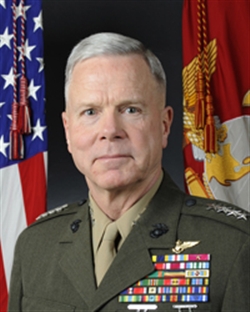
Failed Marine Corps Commandant Amos Calls for Consequences for Failed Leadership (for Others)

Marine Corps Commandant James Amos has rediscovered the concept of consequences for failed leadership. Will he also face consequences?

Marine Corps Commandant James Amos has rediscovered the concept of consequences for failed leadership. Will he also face consequences?

I have long maintained that part of the reason why Afghanistan has been such a doomed mission is that high ranking military figures have faced zero consequences for their failed leadership. As just one example, John Allen faced no punishment when he offered the insane excuse that the rash of green on blue killings in August of 2012 was due to Ramadan fasting, even when it was widely known that clashing cultural values and the mere presence of Americans were the driving forces of the attacks.  Allen did wind up retiring in disgrace, but only because he got caught up in the periphery of the panty sniffing surrounding the David Petraeus-Paula Broadwell affair. Until that point, Allen was scheduled to fail upward to NATO Commander.

That background makes last night’s announcement that two Marine Corps generals will be forced into retirement over their failures that led to the devastating attack on Camp Bastion last September a huge surprise. From the New York Times:

Maj. Gen. Charles M. Gurganus, formerly NATO’s regional commander in southwestern Afghanistan, was faulted for failing to properly assess risks posed by the insurgency operating outside the vast military base in Helmand Province that included camps Bastion, Leatherneck and Shorabak.

General Gurganus had been nominated for his third star and a senior leadership role at the Marine Corps headquarters at the Pentagon, but will retire instead.

Maj. Gen. Gregg A. Sturdevant, the former commander of the Third Marine Aircraft Wing forces assigned to Afghanistan, was faulted for not having established an integrated system of security at Bastion airfield, and will also take early retirement.

Of course, a cynic might note that such severe consequences don’t seem to have been leveled due major loss of life, but was more likely tied to the loss of $200 million worth of aircraft and major damage to facilities at the base as well. There was also a huge chance for even bigger embarrassment from the attack, as McClatchy reminds us that the attack may have been aimed at Prince Harry, who was at the base at the time of the attack which hit just about two hours before his birthday.

Returning to the Times, we have this from Amos:

Gen. James F. Amos, the Marine Corps commandant, announced the disciplinary action on Monday. He said the punishments were unprecedented in modern Marine Corps history and were an effort “to remain true to the timeless axioms relating to command responsibility and accountability.”

Hmm. Amos is telling us about “command responsibility and accountability”. I wonder if he feels that those concepts apply to him, as well? Amos has been at the center of not one, but two scandals in which he has been accused of applying undue command influence regarding criminal proceedings inside the military.

First, there are his comments on the prosecution of sexual assault cases. While it is laudable that Amos wants to see sexual assaults prosecuted fully, the way he has gone about it has actually made such prosecutions harder to carry out.  From McClatchy:

The Marine Corps commandant wanted to snuff out rape in the ranks. However, his well-meaning but overly blunt talk instead complicated Marine sexual-assault cases worldwide and raised troubling questions about whether accused Marines will get a fair shake.

This week, for the second time in recent months, a Marine Corps trial judge found that Gen. James F. Amos’ forceful remarks on sexual assault earlier this year presented the appearance of unlawful command influence.

And just what did Amos say to cause the problems? Try this: Read more

Share this entry

Syrian Government Off to Good Start With OPCW, But Why Is Peace Conference Six Weeks Away?

The Washington Post reports this morning that the Syrian government has been “businesslike and efficient” in its dealings with the OPCW and that things are on track for representatives from the OPCW to be inside Syria tomorrow to start working on the details of destroying Syria’s chemical weapon stockpile. Considering how rapidly the UN Security Council resolution passed unanimously on Friday evening was put together, though, it remains a mystery to me why the UN is waiting until mid-November for a peace conference to begin in Geneva.

The good news from OPCW:

Inspectors from the Hague-based Organization for the Prohibition of Chemical Weapons said they would arrive in Damascus midday Tuesday and spend a week in the city before starting visits to chemical weapons facilities declared by the Syrian government. The OPCW officials said the details of the Syrian declaration appeared to line up with external intelligence assessments of what the government possesses, giving them optimism that the regime was being cooperative.

“It’s been good business so far,” said an OPCW official, speaking at a briefing for reporters under the condition of anonymity. “So far, our interactions with the Syrians have been very businesslike and efficient.”

The difficulties that the inspectors will face underline why I have been stating all along that a ceasefire is an important component of destroying the chemical weapons:

Another OPCW official said inspection teams may not even be able to reach every declared chemical weapons site because of security concerns. The inspectors will be working with unarmed U.N. security guards and under the protection of Syrian government forces, but significant portions of Syrian territory are not under the full control of Assad’s military.

“It may be that we are not in a position to go to some of these locations,” the official said. “We are not a military unit.”

It is difficult to tell from the phrasing here whether some of the sites where the inspection teams will work are under rebel control or whether the teams merely need to pass through rebel-held territory in order to reach sites still under government control. In either case, a ceasefire would make the work much more likely to be successful.

Even though it appears that the teams intend to destroy the equipment that Syria could use to do the final mixing of the two chemical precursors composing the bulk of Syria’s chemical weapons by November 1, much work will still be needed to destroy the chemicals themselves. Waiting until mid-November to start the peace conference seems a poor choice to me:

The United Nations Secretary-General Ban Ki-moon on Saturday urged the National Coalition for the Syrian opposition forces to reach out to other groups and forge an agreement on a united delegation for an upcoming peace conference in Geneva. Reports suggest that the peace conference will be held in mid-November. Hectic parleys are on in New York, to firm up the exact date, which is expected to be finalised this week. Meanwhile, it was known that Iran may also participate in the peace talks.

In his meeting with Ahmad al-Jarba, president of the National Coalition for Syrian Revolutionary and Opposition Forces, in New York on Saturday, the Secretary-General welcomed the opposition’s commitment to send a delegation to the upcoming peace conference.

Ban “urged the National Coalition to reach out to other opposition groups and agree on a representative and united delegation,” states the readout issued by the Secretary-General’s spokesperson.

If we break through all the noise about chemical weapons, the humanitarian crisis of the Syrian war is huge:

Since March 2011, the Syrian civil war has claimed over 100,000 lives. The civil war has displaced over 4 million people within Syria and sent more that 2 million people fleeing for safety to neighbouring countries.

Let’s hope that this peace conference is more successful than the last one:

A first Syria peace conference was held in Geneva in June 2012. The 2012 conference agreed that there should be a transitional government in Syria with full executive powers and called for a new conference to decide how to implement the accord.

The fact that Iran, a strong ally of the Assad government, is likely to take in part in this conference seems to bode well for it to make real progress on bringing hostilities to an end. I just wish the timing were more in concert with the planned actions on rounding up and disposing of the chemical weapon precursors.

Share this entry