Time to Start Rethinking How We Define “Insurgent”

I was struck by this passage in the WSJ’s description of the three green on blue killings yesterday.

Since the year began, more coalition service members have been gunned down by Afghan troops than by insurgents. A total of 16 members of the U.S.-led coalition were killed this year in nine such “green on blue” incidents, representing nearly one-third of the 50 coalition fatalities caused by hostile action.

After all, at the point when the biggest danger to ISAF troops Afghan security forces, can we so easily define who is and who is not an insurgent? If Afghan security forces are increasingly using their proximity to attack coalition forces, how do we distinguish them from insurgents except in who buys their guns?

Particularly given this news, from Murdoch’s less respectable rag.

Afghan intelligence officials arrested 16 people after an apparent mass suicide bombing attack was foiled in Kabul, according to reports out Tuesday.

Some 11 suicide bombing vests were also seized from inside Afghanistan’s defense ministry, according to security officials, cited by news website Khaama Press.

A number of the suspects were members of the Afghan National Army, the security sources added.

It is believed the suspects planned to detonate the bombing vests on buses transporting more than 1,000 staff from one compound to the next, Sky News said.

Whether these recent attacks are simply a response to a series of US insults–like pissing on corpses, burning Qurans, and killing women and children. Or whether a significant number of Afghan security forces have decided it’s only a matter of time until the Taliban return and it’s better to prove fealty now, while there’s still time, it seems we may have passed the point where even the myths about training will be successful anymore.

Several weeks ago, TomDispatch published Ann Jones’s explanation why she’s always opposed training a big Afghan army. The whole thing is worth reading, but particularly what she says about how the history of Afghan security forces switching sides.

Second, take just a moment to do something Washington has long been adverse to — review a little basic Afghan history as it applies to Plan A.  Start with the simplest of all facts: in the country’s modern history, no Afghan national army has ever saved a government, or even tried.  More often, such an army has either sat on its hands during a coup d’état or actually helped to overthrow the incumbent ruler.

[snip]

In short, for their own safety and advancement, Afghans back a winner, and if he goes into decline, they ditch him for a rising star.  To spot that winner is the mark of the intelligent survivor.  To stick loyally to a losing cause, as any patriotic American would do, seems to an Afghan downright stupid.

Now, apply this to the ANA as American and NATO troops draw down in 2014.  Any army intended to defend a nation must be loyal to the political leaders governing the country.  Estimates among Afghan experts of how long the ANA would be loyal to Afghan President Hamid Karzai start at two weeks, and remember, 2014 is a presidential election year, with Karzai barred by the constitution from seeking another term.  In other words, Obama’s Plan A calls for urgently building up a national army to defend a government that will not exist before our own combat troops leave the country.

Now the plot to use suicide bombers to attack thousands may well be a matter of Taliban infiltration. But it appears increasingly likely that we’ve passed the time where Afghans have recalculated the long-time winners of this war, and have started to act accordingly. Hell, I bet even Hamid Karzai is doing the same.

And across the border, Pakistanis are demanding a return to the Reagan rules of engagement.

Pakistan’s military wants to go back to the “Reagan rules — the way the CIA operated with the ISI against the Soviets” inside Afghanistan, says former CIA officer Bruce Riedel, of the Brookings Institute. “We give them a big check, and they make every decision about how that is spent. Minimal American footprint in country, or involvement in actual fighting the bad guys.”

“We cannot trust the ISI to fight this war for us,” after finding bin Laden in a Pakistani military town, “showing the ISI was either clueless or complicit,” Riedel said.

This is, of course, how we built a bunch of mujahadeen who came back to haunt us.

Are we so sure we’re not already doing that ourselves in Afghanistan?
Share this entry

Obama, Gilani Meet in Seoul While Allen Undermines Talks

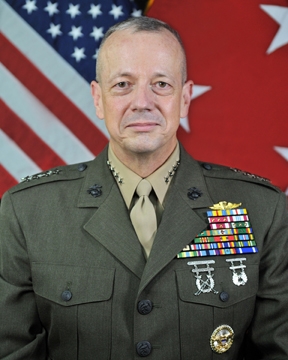
ISAF Commander John Allen

In Seoul today for an international nuclear security summit, President Obama met with Pakistan’s Prime Minister Yousaf Raza Gilani. The meeting was viewed by many as an opportunity to bring the two nations closer together while the parliament in Pakistan reviews how to move forward in re-establishing cooperation between the two countries in counterterrorism efforts. Remarkably, ISAF Commander General John Allen appears to be doing his best to undermine these talks, appearing at the Brookings Institution yesterday to reprise divisive remarks delivered by Admiral Michael Mullen just before he retired as Chair of the Joint Chiefs last September.

As a reminder, here is the remark from Mullen that set off a firestorm in Pakistan last year:

In a scathing and unprecedented public condemnation of Pakistan, Admiral Mike Mullen said the country’s main intelligence agency ISI was actively supporting Haqqani network militants blamed for an assault on the US embassy in Kabul last week.

The Haqqani network is probably the most dangerous faction in the Afghan Taliban and founded by a CIA asset turned al Qaeda ally. During the 1980s, the CIA funneled arms and cash to the Haqqanis to counter Soviet forces.

“The Haqqani Network, for one, acts as a veritable arm of Pakistan’s Inter-Services Intelligence agency,” Mullen told the US Senate Armed Services Committee.

That comment dominated US-Pakistan relations until the US attack that killed 24 Pakistani troops at a border station in November overshadowed it and relations between the two countries reached a new low. Now, as the countries work toward re-establishing better relations, Allen ham-handedly re-runs Mullen’s remark by claiming he won’t mention it:

“In this forum I can’t really speculate on why the ISI does anything with respect to the Haqqanis. I don’t think we should be surprised that they have a relationship, that relationship with the ISI and a number of these organisations goes back a very long time,” he said.

But he added that the fact these relationships exist are not of particular surprise. “We shouldn’t be surprised that they have a relationship, I would not speculate on what specific operational support they have or whether they are an actual arm. Read more

Share this entry

NYT: “Impartial” … “Impartial” but Anti-Iran

Jill Abramson repeats the word “impartial” several times in this interview on the NYT’s Israel-Iran coverage, almost explicitly invoking what Jay Rosen calls the View from Nowhere.

Q: Do you think there have been articles the Times has published that could be considered pro-attack or anti-attack, or has all of the coverage been impartial?

ABRAMSON: I think all of the coverage has been impartial. I think we have had pieces that have looked very skeptically at the intelligence itself as a predicate for any kind of action against Iran. I really do think our coverage has been impartial. When we are reporting about the debate about this, we are conscious to reach out and report on both sides. But at the end of the day, our job in terms of fairness, accuracy, and depth is to report widely enough that we can try to help readers work their way through where the weight of the evidence seems to be at any given time. That’s very difficult right now, because some of the intelligence is contradictory. Getting the nuances right on this is very important. [my emphasis]

But check out how she guarantees that the NYT isn’t getting dragged into justifying another war again.

Q: What are the concerns and considerations you take into account when covering the tensions between Israel and Iran, especially in light of some to the Times’s failures in the build-up to Iraq?

ABRAMSON: The key issue for us is, there’s murky intelligence on the current state of Iran’s nuclear program. There’s no dispute that they have one, the dispute is Iran saying that it’s for civilian use, and other intelligence saying that it could be for military use.

The debate, at least in Washington, is a little more limited than in 2003, because we’re talking about something that — either on the Israeli end or more broadly — would be a targeted military strike. It’s not the kind of debate we had in 2003 about a full-blown boots on the ground invasion.

In 2003, the Times had flawed coverage on the intelligence concerning WMD. I think a big factual difference is that at least the administration as it shapes its policy is not  actively promoting a policy to strike Iran. That’s a huge, fundamental difference. [my emphasis]

Now, to the NYT’s credit, it is the newspaper that (under Abramson’s guidance) reported that an Israeli strike would set off a regional war including the US. But given that, how does Abramson conclude that this would be nothing more than a targeted strike?

And particularly given that reporting (that a targeted strike really amounts to starting a regional war), note the problem with Abramson’s reassurance that because the Administration is not “actively promoting” a policy to strike Iran, it ensures the NYT’s coverage cannot be flawed.

To strike or not to strike is not necessarily the correct pole here, even if issues like this were as simple as Abramson’s two-sided debate. Even before you get to that question, you need to unpack the “to undermine Iran’s bid for hegemony in the Middle East to reinforce the Sunni-Israeli hegemonic position” presumption. Or even the “in spite of all our problems with Pakistan, Iran is the biggest nuke threat” presumption.

Abramson doesn’t seem to be remotely aware that, even aside from her embrace of false balance over accuracy, she’s unquestioningly embraced the stance the Administration is, for the most part, aggressively pushing, that suggesting that Iran is the biggest problem we face in the Middle East and one that must be solved.

Ah well. That’s not–by any shade–the funniest part of this interview. The funniest part is where Abramson says the NYT needs sources to report on AIPAC’s meeting and general influence.

Share this entry

Latest “Isolated Incident” Raises Death Toll to 15 NATO Troops Killed by Afghan Troops This Year

Reacting to the killing of two senior NATO officers inside the previously secure Interior Ministry building in Kabul, Presidential Press Secretary Jay Carney on February 27 continued to insist that the ongoing killing of NATO troops by Afghan troops is just a series of “isolated incidents”. This stance is necessary in order for Obama administration and Pentagon officials to continue their attempts to hide the retroactively classified report “A Crisis of Trust and Cultural Incompatibility” (pdf) which clearly describes the cultural barriers which contribute to the disturbing trend of green on blue killings. Sadly, today marks another “isolated incident”, with the killing of two more NATO soldiers by a man “in an Afghan army uniform”:

A man wearing an Afghan army uniform killed two NATO troops in southern Afghanistan on Monday, military officials said, the latest in a string of shootings that have undermined trust between allies.

The gunman was killed by NATO troops shortly after he opened fire on a group of foreign troops, the military said in a statement. A military spokesman said officials were investigating whether the man was an Afghan soldier or an infiltrator wearing the uniform. No other details were released.

So-called “green on blue” shootings have become a rising threat this year, following a series of incidents that have created distrust between Afghan forces and their international coalition partners. The most significant was last month’s burning of Korans by U.S. troops. The episode sparked violent riots and prompted the Taliban to call on Afghan security forces to open fire on foreign troops.

From Reuters, we get an update on the fratricide statistics, along with an observation on the importance of this trend:

Before Monday’s attack, 13 members of the NATO-led force had been killed this year in what appeared to be attacks by members of Afghan forces, the commander of U.S. and NATO forces, General John Allen, told a U.S. senate committee last week.

About 70 members of the NATO force have been killed in 42 insider attacks from May 2007 to January this year.

The shootings raise new concern about the reliability of Afghan forces and their ability to take over security responsibilities by the end of 2014, when most Western combat forces leave.

So far, there has been no indication from the Obama administration that the clearly increasing trend of fratricide or other catastrophic events like the Panjwai Massacre will prompt a review of strategy in Afghanistan until after the November election. However, there is a hint that the Pentagon realizes they now stand on the precipice, as the blood money paid to the survivors in Panjwai is significantly higher than what was paid in previous incidents in Iraq and Afghanistan: Read more

Share this entry

Was Mohammed Wazir’s 2-Year Old, Palwasha, the Victim of a Revenge Killing?

The Wall Street Journal has the story on the Panjwai killing that should have been written on Monday, not Friday. It tells the story of the massacre from the perspectives of Mohammed Wazir, Mullah Baran, and Syed Jaan, Afghan men who lost family members in the attack.

Wazir, for example, describes what it’s like to lose his 12 and 13-year old sons, and what it’s like to find the fabric his wife planned to use to make outfits for Eid.

Mr. Wazir says he is haunted by guilt. “It hurts me a lot when I remember occasions when I shouted at my sons because I asked them to do something and they ignored it,” he says. “I feel so very sorry now.”

At least, he says, he can take solace in knowing he had bought his two sons two new bicycles, which they had so badly wanted, before they died.

Mr. Wazir says his family had rolls of freshly bought cloth that his wife and mother intended to use to sew new outfits for his children for the Eid al Fitr Islamic festival—still five months away. “It is still there—and there is no one to wear them,” he sighed.

He also suggests his youngest child–2 year old Palwasha–may have been burned alive.

Mr. Wazir says the corpse of his 2-year-old daughter Palwasha was amid the charred bodies. He believes she was burned alive. “I checked her body, and there were no bullet marks.”

Wazir also mentioned a story reported elsewhere today–that the Americans had recently conducted night raids in retaliation for an IED they blamed on the village; the frequent night raids meant no one reacted when the intruders came.

As the Australian elaborates on that part of the story, the IED went off on March 7 or 8 (the attack was March 11). In response, Americans lined the male villagers up and said they’d get revenge.

Ghulam Rasool, a tribal elder from Panjwai district, gave an account of the bombing at a March 16 meeting in Kabul with Mr Karzai in the wake of the shootings.

“After the incident, they took the wreckage of their destroyed tank and their wounded people from the area,” Mr Rasool said. “After that, they came back to the village nearby the explosion site.

“The soldiers called all the people to come out of their houses and from the mosque,” he said.

“The Americans told the villagers ‘A bomb exploded on our vehicle. … We will get revenge for this incident by killing at least 20 of your people,”‘ Mr Rasool said. “These are the reasons why we say they took their revenge by killing women and children in the villages.”

Now, we’re still unable to discern which of the many competing narratives lies closer to the truth (aside from Wazir and the other family members’ descriptions of their grief).

But it does seem that if these threats of revenge took place in the week before the massacre–particularly if the IED attack caused Sergeant Robert Bales’ buddy to lose his leg–the US loses credibility by not admitting as much.

That may not affect the story about whether or not Bales operated alone, but it is part of the story.

Share this entry

McCain, Lieberman and Graham Attempt to Revive Mass Delusion on Afghan “Success”

Where is this "success" which McCain, Lieberman and Graham tout?

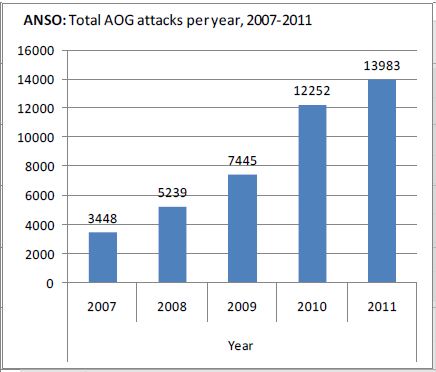
In yesterday’s post, I pointed out the craven political decision to delay a strategic reassessment of the war strategy in Afghanistan until after the election in November. Just in case that was not enough stupidity already emanating out of Washington regarding Afghanistan, today we have the collected wisdom of John McCain, Joe Lieberman and Lindsey Graham informing us that not only is there success in the war effort in Afghanistan, but the US must listen closely to them in order to sustain that success. In preparation for reading the recommendations from our trio of uninvited experts, it is useful to look once again at the accompanying chart, where we see the steady increase in violent events in Afghanistan. The surge of troops in early 2010 did not reverse the trend of increasing violence. In fact, violence jumped by an even larger amount in the first year of the surge than in previous years. No benefit of the surge accrued in 2011, either, as the number of violent events continued to increase.

But McCain, Lieberman and Graham would have us believe that there is “success”:

Significant military progress has been made in Afghanistan — progress that we have personally witnessed over repeated visits. Four years ago, southern Afghanistan was overrun by the Taliban, and our coalition lacked the resources and the strategy necessary to break their momentum. Today, that situation has been reversed, thanks to the president’s surge of forces, the leadership of talented military commanders, and the courage and perseverance of our troops.

Similarly, our effort to build the Afghan National Security Forces — which was under-resourced and disorganized four years ago — has been overhauled. Growing numbers of Afghan units are increasingly capable of leading the fight.

Of course, given the current clusterfuck that is reality in Afghanistan, our mentors of mendacity were forced to open their piece with a nod to the growing desire by most Americans to get out sooner rather than later:

A series of tragic events in Afghanistan has increased the desire of a war-weary public to end our mission there. As heart-wrenching as these events have been, they do not change the vital U.S. national security interests at stake in Afghanistan, nor do they mean that the war is lost. It is not. There is still a realistic path to success if the right decisions are made in the coming months.

And just what is the “realistic path to success” that is being offered for our consideration? Read more

Share this entry

Despite Afghanistan Spiraling Out of Control, Allen Wants No Drawdown Acceleration Until After Election

There can be no doubt that American troops in Afghanistan have become nothing more than political pawns for the Obama administration. Appearing before the House Armed Services Committee yesterday, General John R. Allen, who commands US forces in Afghanistan, made it clear that there will be no increase in the rate of troop drawdown from Afghanistan before the end of the year — a move that even the New York Times identifies as likely being more political than strategic:

The top allied commander in Afghanistan told Congress on Tuesday that he would not be recommending further American troop reductions until late this year, after the departure of the current “surge” forces and the end of the summer fighting season.

That timetable would defer one of the thorniest military decisions facing President Obama — the pace at which the United States removes its forces from Afghanistan by the end of 2014 — until after the November elections.

If strategic reviews were based on changes in operating conditions (remember the old catchphrase “conditions on the ground”?), then the current situation would rightly call for immediate action. However, since the Obama administration senses that any adjustments in the strategy for Afghanistan now would be a tacit admission that the current strategy has flaws, the craven decision is to delay the review until after the November elections have taken place. It appears that the lives of our troops are a lower priority than winning the election.

That no real progress is being made in terms of reducing violence in Afghanistan was made crystal clear by the valiant truth-telling from Lt. Col. Daniel Davis. In addition, despite attempts to retroactively classify a key report on the ongoing cultural clash between US and Afghan forces, fratricide appears to be on a path of increasing frequency, as well.

In a Defense Department release coinciding with Allen’s testimony, we have more denial of the cultural clash:

Recent incidents have been deplorable, but they will not stand in the way of accomplishing goals in Afghanistan, the International Security Assistance Force commander said here.

Marine Corps Gen. John R. Allen also said the incidents do not represent the actions of the vast majority of U.S. military personnel who have served in Afghanistan.

Three incidents have been lumped together, the general said: desecration of corpses, the accidental burning of Qurans and the murder of 16 Afghans in Kandahar province. “It’s important to understand that while tragic, these few incidents do not represent who we are,” Allen said during an interview. “The Afghan people know that, the Afghan government knows that, and more importantly, the Afghan national security forces know who we are.”

Allen emphasized that U.S. and Afghan forces have been working together for years, and many Afghans and Americans have close working relationships. Read more

Share this entry

Chain of Command: Some Violations of Military Discipline Are More Equal Than Others

The other day, Teddy Partridge noted a second instance of someone in the military–the previous one being the Commander-in-Chief–weighing in on Bradley Manning’s guilt.

Echoing his commander in chief in issuing statements that provide improper command influence in the trial of Bradley Manning, the Chairman of the Joint Chiefs of Staff, Gen. Martin Dempsey, stated unequivocally that Manning broke the law.

To review, here’s what Barack Obama said when asked about Bradley Manning in April 2011:

And if you’re in the military… And I have to abide by certain rules of classified information. If I were to release material I weren’t allowed to, I’d be breaking the law.

We’re a nation of laws! We don’t let individuals make their own decisions about how the laws operate. He broke the law.

It appears that President Obama’s highest military officer agrees with him:

The Joint Chiefs chairman also was asked about Manning, the alleged WikiLeaks contributor, and whether Dempsey thought Manning should be viewed as a political prisoner, whistle-blower or traitor.

“We’re a nation of laws. He did violate the law,” Dempsey said.

Meanwhile, Staff Sergeant Robert Bales has not even been charged yet–his lawyer, John Henry Browne, says the military has neither forensics nor a confession incriminating him!–but Generals are sending Browne messages wishing him the best in his defense of Bales.

Browne added that he has received hundreds of emails, including from some generals and other military figures, who wished him luck in the case.

Don’t get me wrong. I hope Browne does his best to give Bales a robust defense. And as I’ve noted repeatedly, I’m not at all convinced that the killings occurred as the military currently claims they did; if so I hope Browne proves that, too.

But I would be shocked if any generals wrote David Coombs, Bradley Manning’s lawyer, to wish him luck in defending a tough, unpopular client. Yet both men–Manning and Bales–are alleged to have violated military discipline in ways that hurt our efforts.

Update: Fixed my misspelling of Bales’ name.

Share this entry

As Fraud History Emerges for Bales, US Pushes FISA Court as Ideal for Afghan Night Raid Approval

The background for Staff Sergeant Robert Bales, the suspect in the mass killing of civilians in Afghanistan last week, became much murkier with the revelation that his career as an investment manager ended in a judgment of $1.4 million against him for fraud. He was accused of “churning” a client’s retirement account, selling off holdings in safer investments to purchase more volatile penny stocks. In the meantime, the fallout from the attack continues, as the US continues its effort to reach a SOFA agreement with Afghanistan ahead of the NATO summit in Chicago scheduled for May. The latest offering appears to be establishment of a system in which Afghan judges would be put into position to approve “warrants” before night raids take place. Deputy National Security Adviser Denis McDonough took to the airwaves on NPR this morning to hold up the US FISA court as the shining example on which the Afghan system should be modeled.

In this morning’s Washington Post, we get quite a few details on the fraud case against Bales. The former client, Gary Liebschner, had employed the firm Bales worked for to manage his retirement account:

That is not the man that Liebschner said he dealt with when Bales was much younger and listed as the “investment executive” on his retirement account. The fund held stock that Liebschner had inherited and earned during his AT&T days, as well as other investments.

/snip/

A severe reaction to medication left Liebschner hospitalized and in a rehabilitation center from November 1998 until June 1999. At the time, his wife, Janet, who took time off from her nursing job, was pressed for money to cover car and mortgage payments, as well as the cost of renovations to their home to make it wheelchair-accessible, she said.

She hadn’t previously been in charge of the couple’s finances, she said, but after she began to examine account statements, she realized that the fund had been severely depleted.

Her husband’s retirement account had nearly $700,000 in 1998, his statements show. By early 2000, the fund had about $30,000 in it.

That is an appallingly bad job of investment management, and it is easy to see how a finding of fraud was found against Bales and the firm for which he worked. A big caveat here, though, is whether Janet Liebschner withdrew funds to cover the home renovation and other expenses listed, and if so, how much was withdrawn. We don’t have the exact dates of when the account sat at about $700,000 or when it was found to be depleted, but the period of 1998 through 2000 was fairly robust for investments. Below is a chart of the Dow Jones Industrial Average from the beginning of 1998 through the end of 2000. There was a dip in mid-1998 that gave up the gains from earlier that year, but then from the fall of 1998 through the end of 2000, the market advanced by roughly 33%, from about 7500 to about 10,000: Read more

Share this entry

Start a 8 Year Regional War and Set Iran’s Nukes Back 3 Years

The headline and lead of the story everyone’s buzzing about reads,

Pentagon Finds Perils for U.S. if Israel Were to Strike Iran

A classified war simulation exercise held this month to assess the American military’s capabilities to respond to an Israeli attack on Iran forecast that the strike would lead to a wider regional war, which could draw in the United States and leave hundreds of Americans dead, according to American officials.

That claim that just “hundreds” of Americans would die in a war started next door to where we’ve got 90,000 Americans deployed makes me want to see the full results and the resumés of those who did the war game.

But the headline misses one critical result of the war game.

The initial Israeli attack was assessed to have set back the Iranian nuclear program by roughly a year, and the subsequent American strikes did not slow the Iranian nuclear program by more than an additional two years. However, other Pentagon planners have said that America’s arsenal of long-range bombers, refueling aircraft and precision missiles could do far more damage to the Iranian nuclear program — if President Obama were to decide on a full-scale retaliation.

This regional war Israel might start? A war, presumably, akin to the Iraq war, which started 9 years ago today and only “ended” in December?

All it would do is set Iran’s nuclear program back 3 years.

No word on what this 8 year war to set Iran back 3 years would cost. But don’t worry. I’m sure it’d be as great a value as the war itself.

Share this entry