Zardari in Dubai Hospital; Coup Rumors Quelled for Now
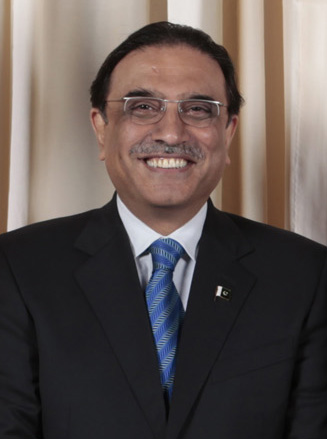
Pakistan's President Asif Ali Zardari (Wikimedia Commons)

Late Tuesday afternoon, Twitter was awash in a flurry of rumors on the status of Pakistan’s President Asif Ali Zardari. One tweet that was repeated over and over stated that Zardari had been sedated, flown to Abu Dhabi, and would leave as soon as possible for London due to a medical condition. Then Josh Rogin put up a story at Foreign Policy stating that Zardari was in Dubai after complaining of chest pains and that there was a possibility that he would resign before returning to Pakistan. After first stating that Zardari was in Dubai only for medical tests relating to a known previous heart condition, the Pakistani government later stated that Zardari had suffered a minor heart attack and was in Dubai for treatment, which many have described as angioplasty.  Zardari is expected to return to Pakistan soon.

The tweet that set things off appears to have come from Najam Sethi, whose twitter profile lists him as “Editor, The Friday Times, & Group Advisor GEO TV; Senior Fellow New America Foundation, Washington DC; Eric Lane Fellow Clare College Cambridge University UK”. Although the tweet doesn’t seem to be in his timeline now, retweets put it as: “Prez Zardari sedated and taken to hosp in AbuDhabi. He will go to London asap. Faranaz Ispahani with him but not HH!” Tweets that are still in his timeline state that he meant to say Dubai, but he had just returned from Abu Dhabi and typed that instead. There is an additional tweet stating that he still expects Zardari to go to London.

Faranaz Isphahani is Zardari’s spokeswoman, “HH” is presumed to refer to former US Ambassador Husain Haqqani, who resigned in the memo scandal and has been placed on the Exit Control List, preventing his exit from Pakistan.

An even higher level of Twitter activity ensued after Josh Rogin Tweeted a link to his story at Foreign Policy.  The key aspect to Rogin’s story was information received from “a former US government official”:

A former U.S. government official told The Cable today that when President Barack Obama spoke with Zardari over the weekend regarding NATO’s killing of the 24 Pakistani soldiers, Zardari was “incoherent.” The Pakistani president had been feeling increased pressure over the Memogate scandal. “The noose was getting tighter — it was only a matter of time,” the former official said, expressing the growing expectation inside the U.S. government that Zardari may be on the way out.

The former U.S. official said that parts of the U.S. government were informed that Zardari had a “minor heart attack” on Monday night and flew to Dubai via air ambulance today. He may have angioplasty on Wednesday and may also resign on account of “ill health.”

Rogin then went on to quote another source on a potential coup: Read more

Share this entry

Pakistan Withdraws Cooperation From Key Border Posts, McCain and Graham Stir Pot

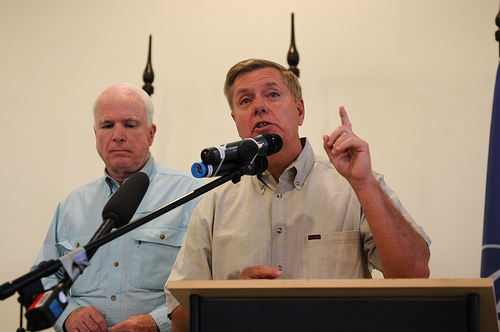
Pointy heads John ("Get Off My Lawn!") McCain and Lindsey ("Holy Hell!") Graham grab some microphone time in Kabul on July 5, 2010. (ISAFMedia photo)

Although it is now a week and a half since the November 26 NATO attack on two border posts that killed 24 Pakistani soldiers, it appears that the barrage of official statements and official actions is not yet slowing. Despite a Sunday phone call from President Obama to President Zardari that was meant to emphasize cooperation, Pakistan withdrew its representatives today from two of three key border posts that coordinate communications between troops on both sides of the border region. And, as if things weren’t already bad enough with Pakistan boycotting the Bonn conference on the future of Afghanistan, Senators John McCain and Lindsey Graham decided that they should issue their own set of demands for Pakistan.

On Sunday, President Obama made a phone call to Pakistan’s President Zardari.  Here is the statement on the call released by the White House:

Earlier today the President placed a phone call to Pakistani President Asif Ali Zardari to personally express his condolences on the tragic loss of twenty-four Pakistani soldiers this past week along the border of Afghanistan and Pakistan.  The President made clear that this regrettable incident was not a deliberate attack on Pakistan and reiterated the United States’ strong commitment to a full investigation.  The two Presidents reaffirmed their commitment to the U.S.-Pakistan bilateral relationship, which is critical to the security of both nations, and they agreed to stay in close touch.

Even though this statement ends by claiming both presidents “reaffirmed their commitment to the US-Pakistani bilateral relationship”, Pakistan followed that reaffirmation up by withdrawing its cooperation from key border posts that provide coordination and communication:

Pakistan is pulling out troops from two of the three border coordination units at the Pak-Afghan border set-up for communication between Nato and Pakistani troops in retaliation to the Nato November 26 attack, said a report by the The Associated Press. Read more

Share this entry

Pakistan’s “Temoporary Campsite” at Center of NATO Border Post Attack Controversy

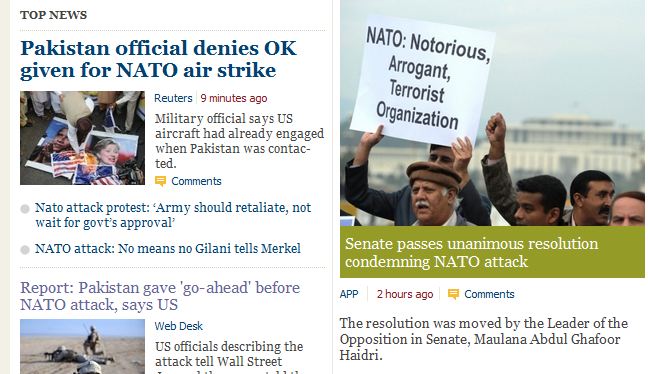
A partial screen-cap of the Express Tribune website on Friday, showing protesters and dominance of the news by the NATO attack.

The barrage of claims and counter-claims on what took place early Saturday morning just inside the Pakistani side of the Afghanistan-Pakistan border continues at a rapid pace. On Thursday, the Wall Street Journal published an article in which the US military claimed that Pakistan had given clearance for the attack. Despite the Journal claiming they were unable to get a response from Islamabad for the article, responses from Pakistan did not take long, and Pakistan claims that NATO did not contact Pakistan until after the raid was in progress and that incorrect location information was given in the first contact.

Citing only “US officials” and not giving any names, the Journal describes the joint US-Afghan commando operation that night as hunting Taliban militants in the border area when they came under fire:

The commandos thought they were being fired upon by militants. But the assailants turned out to be Pakistani military personnel who had established a temporary campsite, U.S. officials said.

According to the initial U.S. account from the field, the commandos requested airstrikes against the encampment, prompting the team to contact a joint border-control center to determine whether Pakistani forces were in the area, a U.S. official said.

The border-control center is manned by U.S., Afghan and Pakistani representatives who are supposed to share information and head off conflicts. But the U.S. and Afghan forces conducting the Nov. 26 commando operation hadn’t notified the center in advance that they planned to strike Taliban insurgents near that part of the border, the official said.

When called, the Pakistani representatives at the center said there were no Pakistani military forces in the area identified by the commandos, clearing the way for the Americans to conduct the airstrikes, the U.S. officials said.

Despite the Journal claiming that they could not get a response from Islamabad on this information, the Express-Tribune carries this response in a Reuters story: Read more

Share this entry

Border Post Attack Fallout Continues: No Obama Apology; Pakistan Threatens WOT Role

[youtube]http://www.youtube.com/watch?v=-BSoEeLgnm0[/youtube]

Pakistan and the US continue to provide widely differing accounts of the NATO attack on two border posts just inside the Pakistan border that killed 24 Pakistani troops early Saturday morning. Although both sides have adjusted their stories somewhat in the intervening time, the US still claims that NATO forces were under fire from across the border and Pakistan insists the attack was unprovoked.

Pakistan’s Inter Services Public Relations released a video of the aftermath of the attack. More description of the video is provided by Dawn, but the presence of the large, established buildings at the peak of the mountain ridge fits with this description quoted in my post from Wednesday:

“This was a visible, well-made post, on top of ridges, made of concrete. Militants don’t operate from mountaintops, from concrete structures.”

Meanwhile, as MadDog pointed out, the New York Times reports that the Obama administration has decided not to have the President issue a formal apology:

On Monday, Cameron Munter, the United States ambassador to Pakistan, told a group of White House officials that a formal video statement from Mr. Obama was needed to help prevent the rapidly deteriorating relations between Islamabad and Washington from cratering, administration officials said. The ambassador, speaking by videoconference from Islamabad, said that anger in Pakistan had reached a fever pitch, and that the United States needed to move to defuse it as quickly as possible, the officials recounted.

Defense Department officials balked. While they did not deny some American culpability in the episode, they said expressions of remorse offered by senior department officials and Secretary of State Hillary Rodham Clinton were enough, at least until the completion of a United States military investigation establishing what went wrong. Read more

Share this entry

Give Them a Damn Ticker Tape Parade Already

“Who will be the last senator to not want to end a mistake? Me.” – John Kerry

That’s the way MightyOCD interpreted John Kerry’s vote–along with 66 of his colleagues–not to repeal the Iraq war that is ending whether they like it or not next month.

The vote was on a Rand Paul amendment to repeal the 2002 Iraq War AUMF.

Along with Paul, DeMint, Heller, and Snowe, a bunch of liberals and Blue Dogs like Bad Nelson and Manchin voted to end the Iraq mistake.

Yet liberals like Levin, Stabenow, Reed, and Whitehouse voted to continue the war that is ending.

By my count, something like 25 men and women who weren’t around to vote for the AUMF when it first passed in 2002 voted in favor of continuing this infernal war–and that’s not counting people like Levin and Stabenow who voted against it the first time.

So we’re going to have all these AUMFs lying around on the books. authorizing secret powers we’re not allowed to know, rather than simply and cleanly declaring a war over. Done.

In the good old days, you’d declare victory and give the men and women who served a big parade. How I’d love a parade about now.

Share this entry

British Embassy in Tehran Stormed by Protesting Students

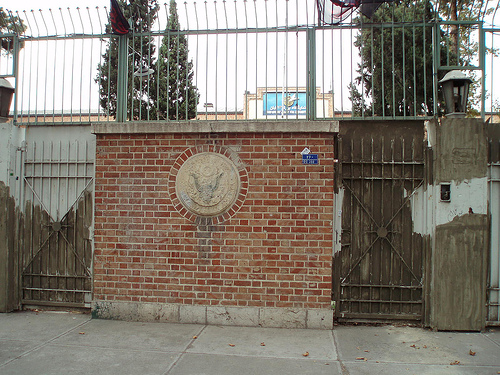
The gates at the old US embassy site in Tehran. (David Holt photo on Flickr with Creative Commons license)

While gathering materials for yesterday’s post on the reports of an explosion near the uranium processing facility near Isfahan in Iran, I almost mentioned this story on the Mehr News website, where we got confirmation that Iran was reducing its diplomatic relations with the UK, expelling the Ambassador:

The Guardian Council has endorsed the parliamentary ratification on reducing ties with Britain, the council spokesman Abbas Ali Kadkhodaii announced on Monday.

Lawmakers approved on Sunday a proposal calling for a reduction in the level of diplomatic and trade ties with Britain to a minimum level.

Now the Foreign Ministry is obligated to reduce its relationship with London to the level of charge d’affaires within two weeks.

This action by Iran has now escalated, with multiple reports surfacing that student protesters have entered the grounds of the British embassy in Tehran.  From CNN:

Iranian students stormed the UK Embassy in Tehran Tuesday, breaking down the door, throwing papers and replacing the British flag with an Iranian one, a CNN crew witnessed.

The protesting students also threw stones at the embassy’s windows.

There is more from Reuters:

Iranian protesters stormed the British Embassy compound in Tehran on Tuesday, smashing windows and burning the British flag during a rally to protest against sanctions imposed by Britain, live Iranian television showed.

/snip/

The incident followed Britain’s imposition of new sanctions on the Islamic state last week over its nuclear program.

London banned all British financial institutions from doing business with their Iranian counterparts, including the Central Bank of Iran, as part of a new wave of sanctions by Western countries.

And the Reuters article shows that the protesters had “encouragement” from the government: Read more

Share this entry

Mark Udall’s Unsatisfactory Solution to the Detainee Provisions

As I have repeatedly described, I have very mixed feelings about the debate over Detainee Provisions set to pass the Senate tonight or tomorrow. I view it as a fight between advocates of martial law and advocates of relatively unchecked Presidential power. And as I’ve pointed out, the SASC compromise language actually limits Presidential power as it has been interpreted in a series of secret OLC opinions.

Which is why I’m no happier with Mark Udall’s amendment than I am with any of the other options here.

On its face, Udall’s amendment looks like a reset: A request that the Executive Branch describe precisely how it sees the military should be used in detention.

SEC. 1031. REVIEW OF AUTHORITY OF THE ARMED FORCES OF THE UNITED STATES TO DETAIN COVERED PERSONS PURSUANT TO THE AUTHORIZATION FOR USE OF MILITARY FORCE.

(a) In General.–Not later than 90 days after the date of the enactment of this Act, the Secretary of Defense shall, in consultation with appropriate officials in the Executive Office of the President, the Director of National Intelligence, the Secretary of State, the Secretary of Homeland Security, and the Attorney General, submit to the appropriate committees of Congress a report setting forth the following:

(1) A statement of the position of the Executive Branch on the appropriate role for the Armed Forces of the United States in the detention and prosecution of covered persons (as defined in subsection (b)).

(2) A statement and assessment of the legal authority asserted by the Executive Branch for such detention and prosecution.

(3) A statement of any existing deficiencies or anticipated deficiencies in the legal authority for such detention and prosecution.

On one hand, this seems like a fair compromise. The Republicans want something in writing, Carl Levin claims SASC met just about every demand the Administration made in its attempt to codify the authority, but in response the President still issued a veto threat. So why not ask the President to provide language codifying the authority himself?

Read more

Share this entry

Explosion Reported Near Iranian Uranium Processing Facility

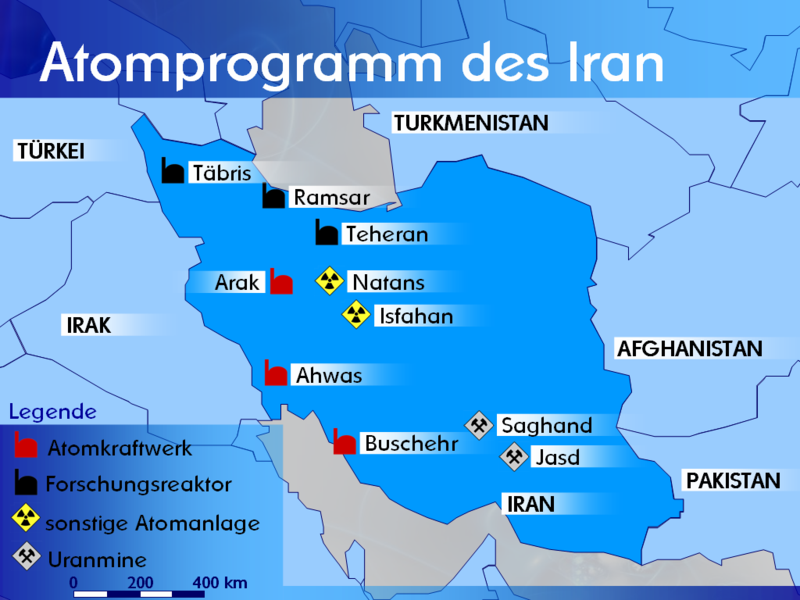
Iranian nuclear facilities (Wkimedia Commons map)

According to Haaertz, the Iranian Fars News Agency is reporting (although I don’t see a story yet at their website or at Mehr News) an explosion in Isfahan, where an Iranian uranium processing facility is located:

A explosion rocked the western Iranian city of Isfahan on Monday, the semi-official Fars news agency reported, adding that the blast was heard in several parts of the city.

/snip/

It should be noted that Iran operates a uranium conversion plant near Isfahan, one with an important function in the chain of Iran’s nuclear program.

It first went into operation in 2004, taking uranium from mines and producing uranium fluoride gas, which then feeds the centrifuges that enrich the uranium.

The underground centrifuge facility at nearby Natanz was previously attacked by the Stuxnet virus and is seen as perhaps the most important Iranian enrichment facility.

When today’s explosion and the recent death of Hassan Moqaddam, the head of Iran’s missile program, in an explosion of dubious origin while hawks nattered on about the IAEA Iran report, are coupled with the Stuxnet attack, it appears that the Iranian nuclear program is being attacked simultaneously at all points along the path that could lead to a weapon on a missile.

Was today’s explosion an escalation of that battle?

Share this entry

Fallout From NATO Attack on Pakistani Border Posts Continues: Afghanistan At Center of Conflict

[youtube]http://www.youtube.com/watch?v=fXKtehgB-Cw[/youtube]

While a great deal of the attention on the effects of Saturday’s NATO attack on two (or three) Pakistani border posts that killed at least 24 Pakistani soldiers centers on US-Pakistan relations, the importance of these developments on relations between Pakistan and Afghanistan should not be overlooked. Most reports on the incident suggest that Afghan soldiers in the border region were responsible for calling in the air attack.  While NATO and Afghan accounts claim that the Afghan forces were under fire from the Pakistani border outposts, the Pakistani military insists that the attacks were unprovoked. It should be noted that an Afghan group of investigators had arrived in Islamabad on Thursday before the incident on Saturday. This group was in Pakistan to investigate Pakistani ties to the militant group that killed former Afghan President Burhanuddin Rabbani on September 20 when he was starting peace talks with the Taliban.

The Attack

The Washington Post account of the attack has this key passage on the background situation:

The poorly patrolled and ill-marked border is the central sore point in Pakistan’s relations with both the United States and Afghanistan. American military officials say al-Qaeda and Afghan Taliban fighters live on the Pakistani side and cross the border to attack U.S. troops — with the knowledge of and help from Pakistani intelligence. Pakistan says the homegrown militants its army is fighting in the restive tribal areas can easily find refuge ineastern Afghanistan, which borders Mohmand, and that CIA drone strikes in the region inspire militants.

The Saturday airstrike came one day after [Commander of US forces General John] Allen met with [Pakistan’s Army head General Ashfaq] Kayani to discuss border security.

That Friday meeting between Allen and Kayani certainly makes the subsequent events on Saturday hard to understand. Only one day after discussing border security at the highest levels, we see a massive communications breakdown at a critical moment:

Maj. Gen. Athar Abbas, a Pakistani military spokesman, stopped short of that characterization [describing the attack as a US offensive action], but he said the strike was “inexplicable.” In an interview, he said the two border posts are clearly marked and their locations are known to Afghan and coalition forces. No militant or military firing preceded the NATO assault, nor did coalition troops inform Pakistan that they were receiving fire from the Pakistani side, as is procedure, Abbas said.

Once the strike began, Abbas said, soldiers notified their commanders in the nearby city of Peshawar, who told officials at military headquarters in Rawalpindi, who then informed two trilateral border coordination centers located at the Torkham pass and the border of Pakistan’s North Waziristan region.

“But somehow it continued,” Abbas said of the firing. “Our side believes there is no possibility of confusion. The post location is not where a Taliban would take position.”

The Express Tribune carries more of Abbas’ remarks: Read more

Share this entry

NATO Helicopter Attack Kills Up to 28 at Pakistani Border Post, Supply Crossings Closed

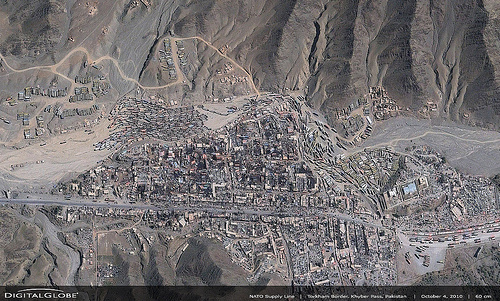
Backlog of supply trucks at Torkham crossing after closure in September, 2010. (DIgital Globe photo on Flickr)

In September of 2010, the US and Pakistan faced a crisis in relations after the killing of two Pakistani soldiers at a border outpost.  Pakistan closed the Torkham supply crossing through the Khyber Pass as a result of the incident. Today, Pakistan has closed both the Torkham and the Chaman crossings, indicating a very strong response to an incident in which up to 28 have been killed at a Pakistani border post.

The Washington Post describes the situation in this way:

The Pakistani army on Saturday accused NATO helicopters of firing on two Pakistani border checkposts and killing 24 soldiers, and officials quickly closed a key border crossing used by convoys carrying supplies to Afghanistan.

The attack, which took place early Saturday in the Mohmand region of Pakistan’s tribal belt along the Afghan border, seemed certain to mark a new downturn in the ever-rocky U.S.-Pakistan alliance. NATO troops battling militants in Afghanistan coordinate border operations with the Pakistani military, but Pakistan does not allow coalition forces to enter or fire inside its territory without permission. Various Islamist militant factions are based in Pakistan’s remote tribal areas, from where they can easily slip across the border to attack inside Afghanistan.

Pakistani officials issued swift condemnations. The powerful army chief, Gen. Ashfaq Parvez Kayani, said in a statement that the firing was an unprovoked act of “aggression” that prompted Pakistani troops to fire in self-defense. Prime Minister Yousuf Raza Gilani said the matter would be “taken up by the foreign ministry, in the strongest terms, with NATO and the U.S.”

We learn from the Express Tribune that the order to close at least the Torkham crossing was not a local decision:

Official sources confirmed the suspension of supplies, adding that all containers were stopped at the Takhta Baig check post in Jamrud tehsil of Khyber Agency.

“We have suspended the supply and will not let even a single container move ahead,” the official added.

“We have stopped NATO supplies after receiving orders from the federal government,” Mutahir Hussain, a senior administration official in Khyber tribal region, on the Afghan border, told AFP. ”Supply trucks are being sent back to Peshawar.”

The Reuters description of the incident tells us the Chaman crossing also is closed: Read more

Share this entry