The Mueller Subpoena Starts at the Moment a Real Estate Deal in Moscow Might Get Trump Elected

Axios got a copy of a subpoena someone got from Robert Mueller last month. It asks for all communications (including handwritten notes) “this witness sent and received regarding the following people.” The list of people includes a lot of people you’d expect, but it’s missing a few:

  1. Carter Page
  2. Corey Lewandowski
  3. Donald J. Trump
  4. Hope Hicks
  5. Keith Schiller
  6. Michael Cohen
  7. Paul Manafort
  8. Rick Gates
  9. Roger Stone
  10. Steve Bannon

Cooperating witnesses George Papadopoulos and Mike Flynn aren’t on this list, but cooperating witness Rick Gates is (which may date the subpoena to before Gates flipped on February 23). The order is of particular interest (or, maybe they’re just alpha order by first name): Page, the long term suspected Russian asset, followed immediately by Lewandowski, who was in the loop on the stolen email offer, followed by the President and those closest to him, followed by Manafort and his closest aide. Then Stone and then — in the same month he gave 20 hours of testimony — Bannon.

Neither Don Jr nor Kushner is on this list. Given the emphasis on communications “regarding” the listed people, and given the way that Abbe Lowell purposely avoided giving “about”communications to Congress (and possibly to Mueller), and also given that Jonathan Swan is Axios’ key White House scoopster, I actually don’t rule out the witness being Jared. Or, as I joked on Twitter, like Flynn and Papadopoulos, maybe he has already flipped and so isn’t on this list.

Whoever it is, the absences on the list are probably a function of who is legitimately in this person’s circle.

Perhaps most telling, however, is the timing: November 1, 2015, to the present. Recall that on November 3, sometime FBI informant Felix Sater sent Michael Cohen (on the list) an email promising that a real estate deal in Moscow might lead to Trump becoming President. (Here’s the original WaPo scoop on the story.)

On November 3, 2015, two months before the GOP primary started in earnest and barely over a year before the presidential election, mobbed up real estate broker and sometime FBI informant Felix Sater emailed Trump Organization Executive Vice President and Special Counsel to Trump, Michael Cohen. According to the fragment we read, Sater boasts of his access to Putin going back to 2006 (when the Ivanka incident reportedly happened), and said “we can engineer” “our boy” becoming “President of the USA.”

[snip]

Mr. Sater, a Russian immigrant, said he had lined up financing for the Trump Tower deal with VTB Bank, a Russian bank that was under American sanctions for involvement in Moscow’s efforts to undermine democracy in Ukraine. In another email, Mr. Sater envisioned a ribbon-cutting ceremony in Moscow.

“I will get Putin on this program and we will get Donald elected,” Mr. Sater wrote.

That’s the start date Mueller uses for potential communications among people including Trump’s closest aides, including Cohen (but not including Sater) in the Russian investigation.

Update: Adding, we know that on October 21, 2016, the FBI had investigations into Manafort, Page, Stone, and possibly Gates. Is it possible this list is the sum of all those against whom sub-investigations have been opened (or were at the time this subpoena was issued)?

Share this entry

Reality Winner Seeks to Use Trump’s Denials of Russian Hacking in Her Defense

Last week, Reality Winner had a hearing on her bid to get her interview with the FBI thrown out because they didn’t issue her a Miranda warning (Kevin Gosztola covered and discussed it on Democracy Now). Given the precedents on Miranda, I think that bid is unlikely to succeed.

But there is a tack her defense is taking that, as far as I’ve seen, has gotten no notice, one that is far more interesting. Winner is seeking to use Trump’s comments denying that the Russians hacked the election to argue the document she is accused of leaking to The Intercept isn’t actually National Defense Information, the standard the government has to prove to secure an Espionage conviction.

In her discovery requests, Winner asked for three (entirely redacted) categories of documents “reflecting statements made by high-ranking governmental officials regarding information contained in the document,” all of which were denied (see PDF 87).

A discovery appeal submitted in January (but only released on February 13) makes clear that Winner’s defense attorneys are going to argue that the intelligence in the report she is accused of leaking cannot be National Defense Information because the President’s statements would be taken to suggest the intelligence is not true.

However, high-ranking government officials, including the President of the United States, have made statements undermining and/or contradicting that contention. 44 That, is of great import because, if the information in the Document is inaccurate (as the President and other high-ranking officials have said), it cannot be NDI. While the defense may seek to capture some of this information in the public domain, 45 it cannot capture statements made privately by these high-ranking officials.

Bill Leonard, the former head of the federal classification authority, ISOO, who has served as expert witness on two other cases involving Espionage charges, laid out the logic of the argument this way (PDF 102-3)

[T]here are governmental actors, including high-level governmental actors (such as the President of the United States), that have made conflicting and/or contradicting statements in comparison to the Government’s position here. In other words, these high-level governmental officials have made statements undermining the veracity of the information contained in the Document, which would impact whether the Document actually contains “national defense information” because, if inaccurate, the Government’s contention that its disclosure could harm the national security of the United States would be severely undermined. Indeed, the President is the highest level of authority in our classification system and has virtually unrestricted access to information in our intelligence system. He is, therefore, in the best position to know the particulars of any piece of intelligence, including its sensitivity and its veracity. Consequently, records reflecting statements made by high-ranking governmental officials, including and in particular, the President of the United States, relating to the information contained in the Document (including statements contradicting the truth or veracity of the information at issue) are highly relevant and are critical to the determination of whether or not it is closely held and/or whether or not its disclosure would potentially damage the national security.

There are a number of other challenges the government is facing with this case (not least that — as I’ve pointed out — similar information has been leaked to the press without any apparent prosecution arising from it).

But Trump’s self-interested denials are the most interesting. After all, he cannot admit that Russia affected the election, because he has staked so much on the claim that that will lessen his legitimacy (not to mention any risk such an admission exposes him to in the Mueller investigation). As Leonard notes, the entire classification system is built on presidential authority, and if he says something isn’t true, it will seriously undermine any claim a prosecutor can make at trial that Winner leaked true National Defense Information.

Effectively, some prosecutor will be in a position of having to point out what we all know, that the President is a liar. Given Trump’s propensity towards rage-induced firings, I imagine the government would like to avoid this pickle.

Share this entry

The Competing Hope Hicks White Lies Stories


Since the NYT reported Hope Hicks admitting to telling white lies for Donald Trump in her House Intelligence Committee testimony Tuesday, the press has provided at least four different versions of the story. The competing versions make the exchange worthy of a public release of her transcript, though I doubt we’ll ever see that. So, particularly given that this exchange seems to have led Trump to bawl out Hicks, leading to her resignation, I wanted to lay out the competing versions here.

The first version, from the NYT and obviously telling the Democratic perspective, emphasizes Hicks’ consultation with her lawyers.

Hope Hicks, the White House communications director, told House investigators on Tuesday that her work for President Trump, who has a reputation for exaggerations and outright falsehoods, had occasionally required her to tell white lies.

But after extended consultation with her lawyers, she insisted that she had not lied about matters material to the investigations into Russia’s interference in the 2016 presidential election and possible links to Trump associates, according to three people familiar with her testimony.

The exchange came during more than eight hours of private testimony before the House Intelligence Committee. Ms. Hicks declined to answer similar questions about other figures from the Trump campaign or the White House.

CNN provides Chris Stewart’s version, which describes the Republicans providing her a way to answer a very narrow non-denial denial pertaining to “the Russian investigation” but not necessarily “Russia.”

“It truly was just a setup of this witness, who was trying to be forthright and honest,” Utah Rep. Chris Stewart told CNN’s Wolf Blitzer on Friday. “The question was so broad. It was, ‘In any circumstances, regardless of what it might be, have you ever felt any pressure to be deceitful or to be dishonest regarding any subject?’ And she answered it honestly. And that is, anyone in that circumstance, there is none of us in our lives that can say we have always been 100% honest.”

Stewart said upon hearing the question, his Republican colleagues intervened: “We realized that this was, frankly, just a setup and that it was designed to make a headline, so we asked her specifically — we interjected — we are talking about this investigation with Russia, regarding collusion or conspiracy, regarding the hacking of the DNC.”

After they narrowed the question to those areas, Hicks was “adamant,” he said, recalling that she answered: “‘No, absolutely not.'”

The WaPo, which provides the version of Eric Swalwell, who posed the question (as well as Peter King, but that’s far less interesting), describes that Hicks admitted to lying for Mike Flynn but stayed silent about every other Trump official.

The one exception she made, according to Rep. Eric Swalwell (D-Calif.), was acknowledging that former Trump national security adviser Michael Flynn had asked her during the transition period to dissemble about questions he was getting regarding his conversations with the Russian ambassador, Sergey Kislyak.

She claimed that she did not know she was being asked to lie but that she felt Flynn was being “dishonest,” Swalwell said.

Swalwell said Hicks did not answer when he asked why she would refuse to say whether other aides had asked her to lie when she was willing to speak about Flynn, or whether she had ever witnessed Trump asking others to lie for him.

And CBS provides the versions of Tom Rooney and another Swalwell version, which puts the question in immediate context of a Swalwell question about whether she was “loyal” to Trump (something asked of all close Trump aides in the wake of the Comey firing) and shows that Hicks’ lawyer offered up the “no with respect to the Russian investigations” line, one which Rooney then repeated.

Swalwell said — and Rooney acknowledged — that Rooney was not in the room for the very beginning of the questioning, which began with Swalwell asking Hicks about her relationship with Mr. Trump. He said he asked whether Hicks and Mr. Trump had a “typical” employer-employee relationship.

“She said, ‘Nothing is typical about it,'” given the number of hours she spends with the president and the nature of his role, Swalwell said.

He said he then asked if Hicks was “loyal” to the president, and she asked what he meant by the term.

“I think loyalty is being committed to somebody,” Swalwell said, and asked, in turn, if she was “committed” to the president.

“She said, ‘Yes, fully,'” Swalwell said.

It was then that he asked whether the president had ever asked Hicks to lie for him. Hicks and her counsel then conferred for “five to ten minutes,” and she responded, according to Swalwell, by saying, “I have never been asked to lie with respect to the Russia investigation.”

Rooney said he objected at the time to the breadth of Swalwell’s question and engaged in a “back and forth” with Swalwell and House Intelligence Committee Ranking Member Adam Schiff, D-California. Rooney asked aloud whether the question meant if Mr. Trump had ever asked Hicks to tell someone he was busy, or on the phone, or not around, or to answer, ‘Does this suit make me fat?’

An appropriate question, and one which would fit within the parameters of what the committee was investigating, Rooney said, would have been specific to its Russia investigation.

“So I asked her specifically with regard to the substance of our investigation,” whether she had been asked to lie, and she said ‘No,'” Rooney said.

The exchange comes in the wake of the report that Mueller’s team has been asking about Hicks’ comment, just after the election, that no one from the campaign had met with Russian officials. If Trump (or any of the other people listed by Swalwell) had asked her to lie then, it would not count as a lie about the investigation, though it would be a lie about Russia. Unless she, in turn, lied about the lie to Mueller’s people.

Presumably, Trump got so angry just because Hicks made him look like a liar, and not because he has thought through the implications of what Swalwell presumably has (and probably a few of the Republicans making excuses now).

But Hicks has now committed to a story that suggests the lie about the Sergey Kislyak conversation came from Flynn and not someone else, someone like Kushner or Trump himself, even while she has dodged answering about whether any of those other people asked her to lie about that or similar issues.

Share this entry

Thug, Mob, Rogue: Trump Organization’s Own Description of Its Panama Hotel

While Trump and his son-in-law (and a number of his cabinet members) have clearly been profiting personally from Trump’s presidency (see my NYT op-ed on Jared’s woes), thus far their pursuit of self-interest hasn’t caused any international incidents (moving the US embassy to Jerusalem has come closest).

The scuffle between the Trump organization and the majority owner of the Panama City Trump hotel might just change that.

The problems go back aways (I’ll lay out some of the timeline below). But the short version is that the majority owner of the property, Orestes Fintiklis, got the other owners to vote to fire the Trump Organization in October, claiming the diminished brand and (importantly) a bad sales strategy is part of why the property is at less than 30% occupancy. The Trump Organization (screaming RICO) tried to force the matter into arbitration in December. And Fintiklis has now sued in SDNY to prevent that.

Things started getting crazy a week ago Thursday, when Fintiklis tried to fire the Trump employees, then cut off power, and then got the Panamanian government to side with him and arrest a Trump employed security guard. Significantly, the two sides are fighting over the control room and Fintiklis alleges that Trump employees are shredding documents.

Two people familiar with Fintiklis’s account said that, after his arrival, hotel employees barricaded office doors with furniture, and they added that documents were shredded. The two people said Trump Organization employees — including an executive who flew down from New York City — also blocked access to a control room that houses servers and surveillance-camera monitors.

This room, the two people said, is shared by the hotel operation and the managers of the residential side of the building, which is no longer operated by the Trump Organization.

I find that interesting given the Reuters report, from last November, describing how Ivanka put a Brazilian money launderer with ties to Russian organized crime, Alexandre Ventura Nogueira, in charge of many of the advanced sales in the project.

A Reuters investigation into the financing of the Trump Ocean Club, in conjunction with the American broadcaster NBC News, found Nogueira was responsible for between one-third and one-half of advance sales for the project. It also found he did business with a Colombian who was later convicted of money laundering and is now in detention in the United States; a Russian investor in the Trump project who was jailed in Israel in the 1990s for kidnap and threats to kill; and a Ukrainian investor who was arrested for alleged people-smuggling while working with Nogueira and later convicted by a Kiev court.

Three years after getting involved in the Trump Ocean Club, Nogueira was arrested by Panamanian authorities on charges of fraud and forgery, unrelated to the Trump project. Released on $1.4 million bail, he later fled the country.

He left behind a trail of people who claim he cheated them, including over apartments in the Trump project, resulting in at least four criminal cases that eight years later have still to be judged.

[snip]

When first approached by Reuters, Nogueira declined to answer questions. Writing on October 4, he said in an email: “Anything I would say could also damage a lot of important and powerful people. I am not sure I should do that.”

Later, Nogueira agreed to meet. In a lengthy interview, he described his contacts with the Trump family and his role in the Ocean Club project. He said he only learned after the Ocean Club project was almost complete that some of his partners and investors in the Trump project were criminals, including some with what he described as connections to the “Russian mafia.” He said he had not knowingly laundered any illicit money through the Trump project, although he did say he had laundered cash later in other schemes for corrupt Panamanian officials.

The role Nogueira played is similar to the one Sergey Millian played for a Trump property in LA, which basically amounts to artificially inflating the sales so as to be able to get the loans for the underlying property.

Two Democrats on the House Foreign Affairs Committee, Ranking Member Eliot Engel and Norma Torres, have decided to take this opportunity to ask the Trump Organization if it knew the Panama facility was being used as a money laundering vehicle.

With the possibility that Fintiklis will gain control of the facility before any records of money laundering get shredded, I want to look at the timeline the Trump Organization lays out in their statement on the fracas.

Just before the 2016 election, Fintiklis, who is Cypriot though has a residence in Florida, bought into a majority share in the hotel from the original owners. The Trump Organization could have blocked that sale but, no, they could not, because otherwise the hotel would go under.

In October 2016, the original developer of the Hotel, Newland International Properties Corp., notified Trump Hotels that it was actively negotiating a bulk sale of its remaining 202 units to a company controlled by Mr. Fintiklis. Because the Co-Ownership Regulations for the Hotel preclude any one person from owning more than ten units without Trump Hotels’ consent, Trump Hotels could have blocked the sale as a matter of right. Concerned, however, about the future of the Hotel and the fate of the Hotel’s highly dedicated and loyal staff, Trump Hotels agreed to allow the sale to proceed on one condition: that Mr. Fintiklis agree that he would not in any way attempt to interfere with Trump’s management of the Hotel or take any other steps to terminate its management agreement.

So weeks after Trump became President, Fintiklis agreed to the terms of the sale and eventually finalized the purchase in August.

In February 2017, Mr. Fintiklis agreed, in writing, to these terms and, in August 2017, closed on the purchase of the units, becoming the owner of 202 of the 369 hotel units.

At that time, last August, Fintiklis spoke in rosy terms of the deal, including the hotel operator (that is, Trump).

We are excited to welcome such an iconic property to our investment portfolio and we look forward towards working with the local team, the hotel operator and the Panama community, to establish the Property as the premier hotel in the country and the entire region.

The Trump Organization accuses Fintiklis of orchestrating a conspiracy to remove Trump Hotels from the property.

Unfortunately, within weeks of the closing, it became apparent to Trump Hotels that Mr. Fintiklis had other motives. Rather than abide by the clear terms of the agreement he had signed, Mr. Fintiklis had been conspiring with others to remove Trump Hotels as manager and fire most, if not all, of its loyal and dedicated employees. Looking back, it is now apparent that Mr. Fintiklis, in flagrant violation of the commitments he had made, never had any intention of keeping his word and had been plotting a takeover and termination of Trump Hotels all along.

On October 14, 2017, Mr. Fintiklis furthered his fraudulent scheme, calling a meeting of the hotel condominium under the false pretense of a “meet and greet” and used that moment to hold unlawful votes and declare Trump Hotels in default of the management agreement. Within minutes of the meeting concluding Mr. Fintiklis sent Trump Hotels a default notice and filed for arbitration to terminate the management agreement. Clearly, Mr. Fintiklis had been concocting and planning this scheme for months.

The Trump folks, too, emphasize that part of this fight is over the facility’s computer system.

Together, Mr. Fintiklis and Mr. Lundgren, over the past several days, have resorted to thug-like, mob style tactics, repeatedly attempting to force their way into Trump Hotels’ offices, infiltrate and disrupt its computer systems and threatening and intimidating any employee of the Hotel that resisted.

Now, the Trump Organization made less than a million dollars off management fees for this facility in the last year or so.

In his most recent personal financial disclosure, Trump said his company had received $810,000 in management fees over the preceding 15 ½ months.

They are not getting rich off this facility, certainly not rich enough to sustain the legal fight already brewing over retaining the contract.

These people are all douchebags and the brawling side show is fairly amusing. But it does seem that Fintiklis bought into something far more than a mostly empty hotel, and he’s now using it as leverage against the Trump family business.

The fight over the Trump Panama hotel seems to be as much about the fight over records that may show whether Ivanka knew she was involved in money laundering with Russian mobsters and Colombia narcotics traffickers as it is over who gets to run the mostly empty hotel.

Which is a reminder that it’s not just Robert Mueller who has Trump by the nuts.

Share this entry

NBC’s Broken Story about Mueller Charging the DNC Hackers

NBC has a BROKEN story reporting that Robert Mueller is contemplating charges against the people who carried out the hack of the DNC (and other targets) in 2016.

Special Counsel Robert Mueller is assembling a case for criminal charges against Russians who carried out the hacking and leaking of private information designed to hurt Democrats in the 2016 election, multiple current and former government officials familiar with the matter tell NBC News.

Much like the indictment Mueller filed last month charging a different group of Russians in a social media trolling and illegal-ad-buying scheme, the possible new charges are expected to rely heavily on secret intelligence gathered by the CIA, the FBI, the National Security Agency (NSA) and the Department of Homeland Security (DHS), several of the officials say.

Mueller’s consideration of charges accusing Russians in the hacking case has not been reported previously. Sources say he has long had sufficient evidence to make a case, but strategic issues could dictate the timing. Potential charges include violations of statutes on conspiracy, election law as well as the Computer Fraud and Abuse Act. One U.S. official briefed on the matter said the charges are not imminent, but other knowledgeable sources said they are expected in the next few weeks or months. It’s also possible Mueller opts not to move forward because of concerns about exposing intelligence or other reasons — or that he files the indictment under seal, so the public doesn’t see it initially.

As they have frequently of late, they misunderstand the story they’re telling. They misunderstand this sentence, entirely.

Mueller’s consideration of charges accusing Russians in the hacking case has not been reported previously.

It’s not news, at all, that DOJ was considering charges against those who carried out the hack. Nor is it news that DOJ had enough evidence to charge people in it.

Here’s what WSJ reported on those two topics in November, almost exactly four months ago.

The Justice Department has identified more than six members of the Russian government involved in hacking the Democratic National Committee’s computers and swiping sensitive information that became public during the 2016 presidential election, according to people familiar with the investigation.

Prosecutors and agents have assembled evidence to charge the Russian officials and could bring a case next year, these people said. Discussions about the case are in the early stages, they said.

[snip]

The pinpointing of particular Russian military and intelligence hackers highlights the exhaustive nature of the government’s probe. It also suggests the eagerness of some federal prosecutors and Federal Bureau of Investigation agents to file charges against those responsible, even if the result is naming the alleged perpetrators publicly and making it difficult for them to travel, rather than incarcerating them. Arresting Russian operatives is highly unlikely, people familiar with the probe said.

So: not news that DOJ had pinpointed Russians responsible, not news they were planning on charges “next year” last year, which would mean, “this year” this year.

What is news is that this reporting from the WSJ report is no longer operative.

Federal prosecutors and federal agents working in Washington, Pittsburgh, San Francisco and Philadelphia have been collaborating on the DNC investigation. The inquiry is being conducted separately from Special Counsel Robert Mueller’s investigation of alleged Russian meddling in the 2016 election and any possible collusion by President Donald Trump’s associates.

[snip]

The Justice Department and FBI investigation into the DNC hack had been under way for nearly a year, by prosecutors and agents with cyber expertise, before Mr. Mueller was appointed in May. Rather than take over the relatively technical cyber investigation, Mr. Mueller and the Justice Department agreed that it would be better for the original prosecutors and agents to retain that aspect of the case, the people familiar with the Justice Department-FBI probe said. [my emphasis]

Mind you, we’ve since learned that Ryan Dickey got added to Mueller’s team … oh, in November. And contrary to what NBC says about the heavy reliance, in the Internet Research Agency indictment, “on secret intelligence gathered by the CIA, the FBI, the National Security Agency (NSA) and the Department of Homeland Security (DHS),” it really wasn’t all that sophisticated from a cybersecurity standpoint. Especially not once you consider the interesting forensics on it (aside from IDing the IRA’s VPNs) would have come from Facebook and Twitter.

You don’t need Dickey’s talents for the IRA indictment. You need him for something that is technical.

I’ll leave it for you to consider what it means that Mueller subsumed this part of the investigation even as WSJ was reporting he wasn’t going to do that. I’ll leave you to consider, too, what it means that they brought in a prosecutor with the ability to try these things.

But understand that the news here is not that DOJ is contemplating indicting the people behind the DNC hack. WSJ already scooped that story. It’s that Mueller, not prosecutors in Pittsburgh, San Francisco and Philadelphia, are going to charge it.

Share this entry

Mueller Wants to Know How Far the Game of Email Telephone Got within the Trump Campaign

NBC has a story that has gotten a lot of people excited, reporting that Mueller’s team has been asking:

  • Policy towards Russia: Why Trump took policy positions that were friendly toward Russia and spoke positively about Russian President Vladimir Putin
  • Roger Stone: Whether Stone was aware of information the group had before it became public and when it might be released
  • Trump’s knowledge: Whether Donald Trump was aware that Democratic emails had been stolen before that was publicly known, and whether he was involved in their strategic release

I think this story is both less and more than people are making it out to be.

It’s being overhyped for its facial value. Of course Mueller is going to ask about what the president knew and when he knew it. Of course he’s going to chase down whether Roger Stone’s repeated claims to know what was coming were bluster or not.

But on at least two counts, I think there’s more to this story than meets the eye.

First, as I noted when George Papadopoulos’ plea came out, the FBI charged the former foreign policy advisor for lying about whether he had been told of dirt on Hillary in the form of emails (which we now know they said they might anonymously leak to help Trump) before or after he joined the campaign. That they believed this important enough to charge suggests that, after two full months of cooperation, they got the answer they expected.

FBI found those lies to be significant enough to arrest him over because they obscured whether he had told anyone on the campaign that the Russians had dirt in the form of Hillary emails.

To be sure, nothing in any of the documents released so far answer the questions that Papadopoulos surely spent two months explaining to the FBI: whether he told the campaign (almost certainly yes, or he wouldn’t have lied in the first place) and when (with the big import being on whether that information trickled up to Paul Manafort and Jared Kushner before they attended a meeting on June 9, 2016 in hopes of obtaining such dirt).

I’m sure that’s intentional. You gotta keep everyone else guessing about what Mueller knows.

But we can be pretty sure what the answers are.

There’s no way Papadopoulos’ plea would have been rolled out in the way it was except to get everyone he had told about the emails (as well as those who were instructing him on how to negotiate a meeting with Putin) on the record first.

So Mueller has a good idea of who learned first hand from Papadopoulos about the emails. What he may not know (or may be trying to lock in with further testimony) is how far that game of telephone extended; did it include Trump, and if so via what interlocutors. (Rick Gates may be, or may already have, enlightened Mueller on this point.)

These questions are also interesting against the background of something else suggested by the Papadopoulos plea (and subsequent NYT reporting), which I laid out here. Papadopoulos appeared to be signaling Ivan Timofeev, and those signals were closely tied to email releases.

In this post I did a timeline of all the known George Papadopoulos communications. The timeline made something clear: on two occasions, Papadopoulos alerted Ivan Timofeev to something in a Trump speech. On each occasion, something happened with emails.

[snip]

I’m not saying that the timing of these email releases were dictated by the speeches. Of course they weren’t. They were timed to do maximal damage to the Hillary campaign (not incidentally, in a way that coincided with the “later in the summer” timing Don Jr asked for in his communications with Rob Goldstone).

Rather, I’m saying that Papadopoulos seems to have been signaling Timofeev, and those signals closely mapped to email releases.

And those signals are among the things he tried to destroy.

Importantly, that signaling pertained to public statements on policies of Russian interest. I laid out three apparent incidences in that post, incidences mentioned in the plea.

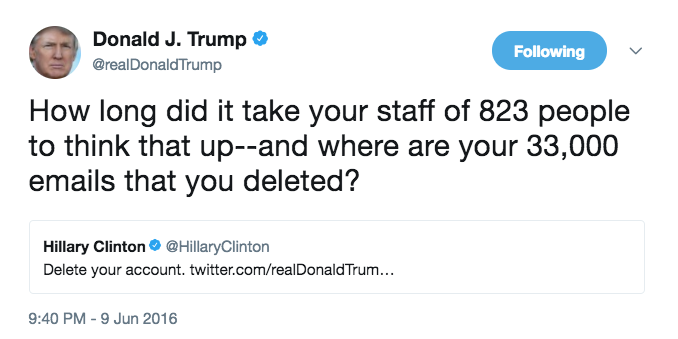
In this post, I suggested what might be a fourth: when Trump’s twitter account tweeted about Hillary’s emails just 40 minutes after the June 9 Trump Tower meeting started and incorporated a potentially accurate number for how many staffers Hillary had.

I want to return to a detail many others have already noted, Donald Trump’s tweet, just 40 minutes after the Trump Tower meeting started, referencing Hillary emails (albeit the ones she deleted off her server, not the still secret stolen ones).

Given that George Papadopoulos seemed to treat other public statements from the campaign (most notably Trump’s April 27 foreign policy speech) as signals to the Russians the campaign was prepared to take the next step, could this tweet be the same? A response, seemingly from the candidate himself, accepting a deal presented in the meeting?

[snip]

I’m at least as interested in why Trump (or rather, Scavino or Parscale or Don Jr) used the number “823” in the tweet. In the aftermath of the John Sipher interview Jeremy Scahill did, Sipher suggested to me might be some kind of signal, a code; he’s the pro–maybe he’s right.

But I was wondering whether it might, instead, reflect real-time knowledge of the Hillary campaign’s finances and resources. That is, I wondered whether that number might have, itself, reflected the sharing of some kind of data that could verify the Russians had compromised Hillary’s campaign (or at least researched it substantively enough to know more than the Trump camp did). The public use of the number, then, might serve as a signal that that message, and the inside data, had been received.

While the specific number is difficult to check, I’ve been told the 823 number would have been at least “in the ball park” of the real number of Hillary’s campaign staffers on June 9, 2016.

If this (or, specifically mentioned in the NBC story, Trump’s July call for Russia to release Hillary’s emails) were part of the signaling, then Trump either could have been in the loop, or one of the flunkies who ran his iPhone account before he switched to iPhone himself could have been.

Which leads me to one more question reported by NBC today, almost as an afterthought. At least one witness was asked about the boundaries of Dan Scavino’s job.

At least one witness has been asked about Trump aide Dan Scavino, specifically about any involvement he may have had in the campaign’s data operation. Scavino currently runs the White House’s social media operations and is one of Trump’s closest aides.

I’m particularly interested in this given the report that Scavino was involved in negotiations through Rob Goldstone for promotions on Russian social media platform VKontakte, and the odds that he might have been the one tweeting any signaling tweets using Trump’s campaign.

So while these questions are, on the one hand, bloody obvious, they also may suggest a far more advanced understanding of how this operation might have worked.

Share this entry

Kushner Floats! Was Trump’s Witch Hunt Outburst about Jared Losing Clearance?

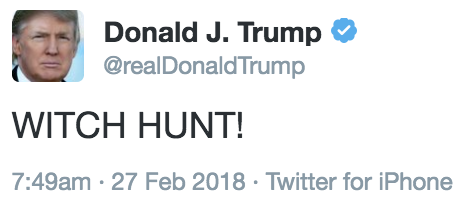
President Trump had one of his regular tweetbursts this morning about the Mueller investigation, culminating in an all caps tweet WITCH HUNT!

These outbursts are admittedly routine. But there was something unusual about this one. As MMFA’s Lis Starr noted, the three tweets leading up to this, citing Judge Napolitano, Johnathan Turley, and Ken Starr, were all reruns of Fox coverage from the last several days.

In other words, Trump resorted to the DVR to be able to justify his rant this morning. Clearly, he’s even more obsessed today than normal.

That, plus one more detail, makes me wonder whether Trump was reacting to new approaches put in place after Jared (and probably Ivanka) had his clearance downgraded to Secret on Friday.

A memo sent Friday downgraded the presidential son-in-law and adviser and other White House aides who had been working on interim clearances.

Presidential son-in-law and adviser Jared Kushner has had his security clearance downgraded — a move that will prevent him from viewing many of the sensitive documents to which he once had unfettered access.

Kushner is not alone. All White House aides working on the highest-level interim clearances — at the Top Secret/SCI-level — were informed in a memo sent Friday that their clearances would be downgraded to the Secret level, according to three people with knowledge of the situation.

The SCI acronym stands for sensitive compartmentalized information, a category of information that comes from sensitive intelligence sources and must be walled off.

The memo was not signed by chief of staff John Kelly, but it comes as the retired Marine general and other top White House aides are grappling with the fallout of a scandal involving former White House staff secretary Rob Porter, which revealed that dozens of White House aides had yet to receive permanent clearances but nonetheless had access to some of the country’s deepest secrets.

There are several interesting tidbits about the Politico story reporting that Jared has finally been stripped of his TS/SCI interim clearance. First, John Kelly didn’t sign the memo, even though that’s who Trump put in charge of over-riding typical clearance process to protect his spawn. If Don McGahn signed it, it might mean Friday’s memo came after a follow-up to Robert Mueller’s boss, Rod Rosenstein, informing him, back on February 9, of significant new information that required review before he could be cleared.

Also, Politico cites a statement from Abbe Lowell, Jared’s defense attorney.

Kushner’s attorney Abbe Lowell said in a statement that Kushner “has done more than what is expected of him in this process.”

Lowell added that the changes would “not affect Mr. Kushner’s ability to continue to do the very important work he has been assigned by the president.”

But the statement is just the same one he used back on February 16, when news of Jared’s impending clearance problems first came out. Lowell still has yet to issue any new bravado since he went silent in the face of last week’s more serious reports.

Meanwhile, Jared is not staying out of trouble. The Trump 2020 campaign announced that Brad Parscale — one of the people most suspect for coordinating data analysis with the Russians — would run his 2020 re-election campaign. The announcement included this quote from Kushner.

Jared Kushner, Senior Advisor and Assistant to the President, and President Trump’s son-in-law, said, “Brady was essential in bringing a disciplined technology and data-driven approach to how the 2016 campaign was run. His leadership and expertise will be help [sic] build a best-in-class campaign.”

Even aside from the typo, this is a no-no, as it ties Kushner’s official White House role to a campaign document.

I almost wonder whether all their fundraising is about paying lawyers at this point. On Friday, CNBC reported that when RNC stopped paying the legal defense of people like Don Jr, it started paying rent at Trump Tower. And the legal defense to pay Trump aides’ legal fees also just went active. Increasingly, it seems, the Trump “campaign” is all about staying out of prison.

Meanwhile, the Kushner family’s partner on the underwater 666 Fifth Avenue is negotiating to get out.

Kushner Cos. says it’s negotiating to buy the 49.5 percent of a debt-laden office tower on Manhattan’s Fifth Avenue that it doesn’t already own from partner Vornado Realty Trust.

Christine Taylor, a spokeswoman for Kushner Cos., declined to elaborate on terms for either the purchase or a restructuring of the building’s debt. A Vornado representative didn’t immediately respond to a request for comment. The talks were first reported Tuesday by the Wall Street Journal.

Earlier this month, Vornado recategorized how it accounts for the property, 666 Fifth Ave., because “we do not intend to hold this asset on a long-term basis,” it said in an annual report. That language typically means the company plans to unload an asset within a year, a person familiar with Vornado’s thinking said at the time.

That’s going to shine a lot more light on Kushner’s finances, and his efforts to abuse his position as his father-in-law’s “peace” negotiator to get bailed out by any number of slimy foreign oligarchs.

Jared’s in real trouble. It’s a wonder he can stay afloat amid this witch hunt.

Update: Bingo.

Officials in at least four countries have privately discussed ways they can manipulate Jared Kushner, the president’s son-in-law and senior adviser, by taking advantage of his complex business arrangements, financial difficulties and lack of foreign policy experience, according to current and former U.S. officials familiar with intelligence reports on the matter.

Among those nations discussing ways to influence Kushner to their advantage were the United Arab Emirates, China, Israel and Mexico, the current and former officials said.

It is unclear if any of those countries acted on the discussions, but Kushner’s contacts with certain foreign government officials have raised concerns inside the White House and are a reason he has been unable to obtain a permanent security clearance, the officials said.

[snip]

White House officials said [National Security Advisor HR] McMaster was taken aback by some of Kushner’s foreign contacts.

“When he learned about it, it surprised him,” one official said. “He thought that was weird…It was an unusual thing. I don’t know that any White House has done it this way before.”

Meanwhile, the normally loquacious Abbe Lowell is outsourcing the no-commenting to a spokesperson.

“We will not respond substantively to unnamed sources peddling second-hand hearsay with rank speculation that continue to leak inaccurate information,” said Peter Mirijanian, a spokesman for Kushner’s lawyer.

Update: Let’s look more closely at something loquacious Abbe Lowell had to say the last time he wanted to go on the record about his client, on February 16.

Lowell said Kushner’s job is “to talk with foreign officials, which he has done and continues to do properly.”

He was denying, 11 days ago, something only now being aired: that Kushner wasn’t properly alerting the NSC of his contacts with foreign leaders. But now we know, he wasn’t properly alerting the National Security Advisor — the one that replaced the one who lied to the FBI about his contacts with foreigners, I mean.

No wonder Lowell has gone silent.

Share this entry

Andy Finds an Acorn: The Searches of Carter Page’s Devices

I’ve long argued that Trump opponents should include Andrew McCarthy among the right wing Trump defenders they read. That’s true, in part, because he at least feigns to be considering the public evidence (though I think he has long since gotten swept up in tribalism). Moreover, as a former prosecutor who worked on some high visibility national security cases, he knows how these things worked fifteen years ago.

His piece on the Adam Schiff memo is typical of his current work. Virtually every single point is easily refuted; most are laughable, such as when he claims the FBI’s use of his 2013 interview to prosecute some spies means his March 2016 interview was truthful.

The memo does note that “the FBI also interviewed Page multiple times about his Russian intelligence contacts.” Apparently, these interviews stretch back to 2013. The memo also lets slip that there was at least one more interview with Page in March 2016, before the counterintelligence investigation began. We must assume that Page was a truthful informant since his information was used in a prosecution against Russian spies and Page himself has never been accused of lying to the FBI.

McCarthy also adheres to the GOP propaganda line that “Democrats conveniently omit is that … the Russian spies explicitly regarded him as an ‘idiot’ (and they had not even seen him on cable TV),” which I mocked in this piece at Vice.

The Republican response to the evidence that the Trump campaign named Page a foreign policy advisor around the same time the FBI interviewed him over suspected ties with Russian spies is perhaps the most pathetic thing in here. Among other things, it complains that the Schiff memo doesn’t mention that “a Russian intelligence officer called Page ‘an idiot.’”

So the latest Memoghazi arguments might best be summarized this way: After Democrats convincingly argued Trump made a suspected Russian asset a key foreign policy advisor, Republicans insisted that doesn’t matter because the suspected Russian asset was a moron.

On one point (a point I’ve been making), however, McCarthy is right.

The Schiff memo reveals, for the first time, that DOJ obtained a FISA order covering both electronic surveillance and “physical search.” Not many people understand this, but DOJ uses physical search orders not just to authorize FBI agents to search through a person’s home, but also to search through that person’s electronic devices (and cloud providers’ cloud storage). As I explained in my post on FISA and the Space-Time Continuum, using a physical search order allows the government to search far back in time.

Domestically, there are two kinds of collection: 1805, which is the collection of data in motion — an old fashioned wiretap, and 1824, which is called a “physical search” order. The government likes to hide the fact that the collection of data at rest is accomplished with an 1824 physical search order, not 1805. So an 1824 order might be used to search a closet, or it might be used to image someone’s hard drive. Most often, 1805 and 1824 get combined, but not always (the FISC released a breakdown for these last year).

Of course (as the Gartenlaub case will show), if you image someone’s hard drive, you’re going to get data from well before the time they’ve been under a FISA order, quite possibly even from before you’ve owned your computer.

In Keith Gartenlaub’s case, a physical search order was used to conduct a black bag search of his home, during which the FBI imaged and subsequently searched the saved hard drives from the last three computers Gartenlaub had used, going back a decade, which is how FBI found child porn that hadn’t been accessed in a decade.

And, as McCarthy notes (though without explaining the electronic/physical distinction), in the case of Carter Page, depending on what minimization procedures the FISC imposed, a physical search order approved on October 21, 2016 might allow FBI to search his devices for communications he had between March and September 2016, when he was a member of the Trump campaign.

What Democrats fail to mention is that the surveillance enabled the FBI to intercept not only his forward-going communications but also any stored emails and texts he might have had. Clearly, they were hoping to find a motherlode of campaign communications. Remember, Page was merely the vehicle for surveillance; the objective was to probe Trump ties to Russia.

I’ve explained that the near-certainty that NSA obtained a 705(b) order on Page for when he traveled to Moscow, London, and the Emirates in December and January would make such backwards looking surveillance even more likely.

I’m not sure that amounts to using Page as a vehicle to surveil the Trump campaign. Depending on how you count it, FISC modified somewhere between 112 and 310 applications in 2016, easily more than they ever had before (my guess is the big spike in numbers has to do with their consideration of the Riley SCOTUS precedent as they approve more orders accessing iPhones). Modifications are how minimization procedures show up in FISA counts, and imposing limits on what the government might access from Page’s devices is the kind of thing I’d expect to see out of the FISC.

Still, McCarthy doesn’t know that FBI used Page as a vehicle; the FBI could easily argue they were trying to protect Trump from the suspected spy the campaign’s non-existent vetting had invited into its midst. And he couldn’t know whether targeting Page allowed FBI to access campaign-related communications without knowing what kind of minimization procedures were imposed, if any.

A real oversight committee would make answering such a question a priority, because it’s the kind of question that goes to the core of the impact of the Page order on Trump’s campaign, but also because the question of how FISC orders permit FBI to access decades of information is a fairly important legal issue, not least in the Ninth Circuit in the Gartenlaub case.

Alas, HPSCI is not that real oversight committee, and so no one appears to be asking that question.

Share this entry

The Significance of the January 12 Reauthorization of Carter Page’s FISA Order

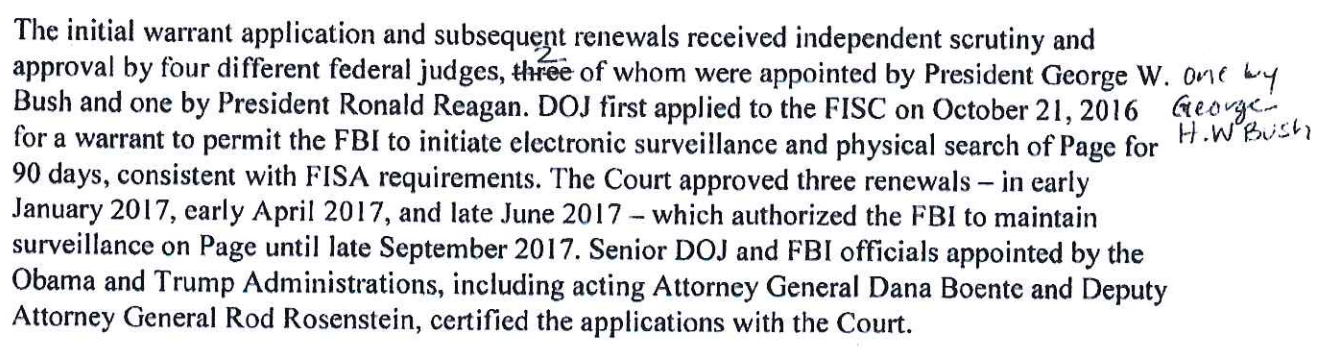
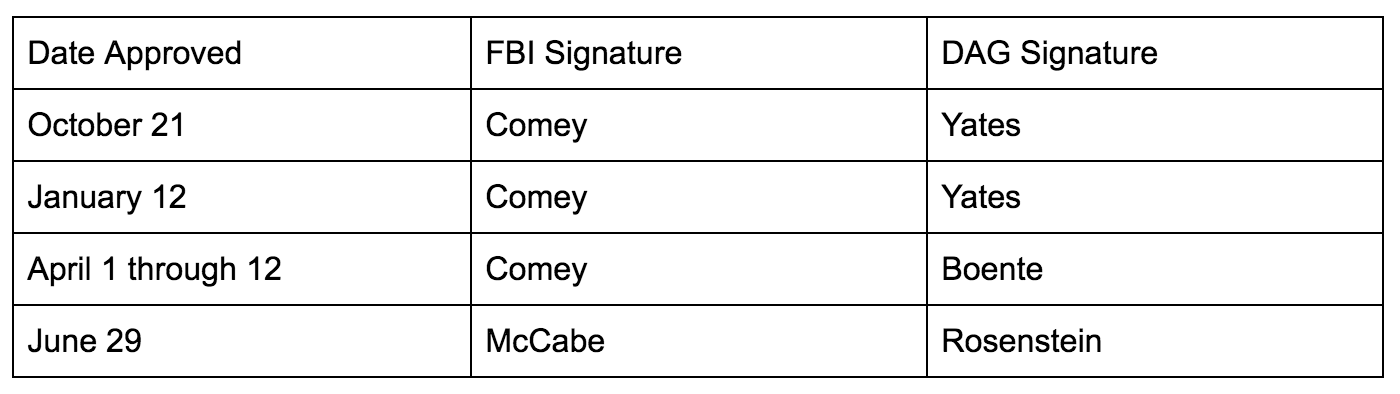
I’d like to riff on a small but significant detail revealed in the Schiff memo. This paragraph adds detail to the same general timeframe for the orders obtained against Page laid out in the Nunes memo: the first application approved on October 21, with reauthorizations in early January, early April, and late June.

Republican judges approved the Carter Page FISA orders

The passage also narrows down the judges who approved the orders, necessarily including FISC’s sole Reagan appointee Raymond Dearie and FISC’s sole Poppy appointee Anne Conway, plus two of the following W appointees:


  • Rosemary Collyer (worst FISC judge ever)
  • Claire Eagan (OK, she may be worse than Collyer)
  • Robert Kugler
  • Michael Mosman (a good one)
  • Dennis Saylor (also good)

I won’t dwell on this here, but it means the conspiracy theory that Obama appointee Rudolph Contreras approved the order, and because of that recused in the Flynn case, is false.

The first reapplication came days after the dossier and a second Isikoff article came out

Back to the timing. The footnotes provide the dates for two of the other applications: June 29 (in footnotes 12, 14, 15, 16) and January 12 (footnote 31), meaning the third must date between April 1 and 12 (the latter date being 90 days after the second application).

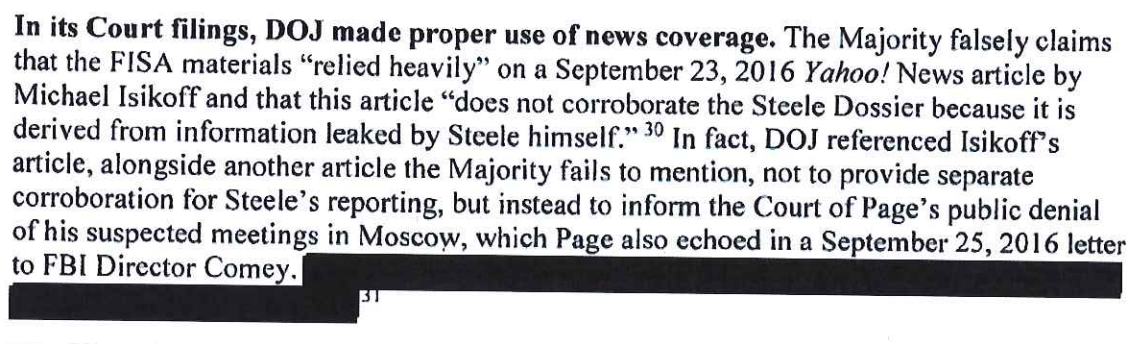
As I laid out here, the timing of that second application is critical to the dispute about whether FBI handled Michael Isikoff’s September 23 article appropriately, because it places the reapplication either before or after two key events: the publication of the Steele dossier on January 10 and Isikoff’s publication of this story on January 11. Isikoff’s January article included a link back to his earlier piece, making it fairly clear that Steele had been his source for the earlier article. The publication of that second Isikoff piece should have tipped off the FBI that the earlier article had been based on Steele (not least because the second Isikoff piece IDs Steele as an “FBI asset,” which surely got the Bureau’s attention).

FBI didn’t respond to Isikoff in time for the second application

Now, you could say that FBI should have immediately reacted to the Isikoff piece by alerting the FISC, but that’s suggesting bureaucracies work far faster than they do. Moreover, the application would not have been drafted on January 12. Except in emergency, the FISC requires a week notice on applications. That says the original application would have been submitted on or before January 5, before the dossier and second Isikoff piece.

FBI appears to have dealt with the Isikoff article interestingly. The body of the Schiff memo explains that Isikoff’s article, along with another that might be either Josh Rogin’s or Julia Ioffe’s articles from the time period, both of which cite Isikoff (Rogin’s is the only one of the three that gets denials from Page directly), were mentioned to show that Page was denying his Moscow meetings were significant.

That redacted sentence must refer to the January 12 application, because that footnote is the only footnote citing that application and nothing else in the paragraph discusses it.

An earlier passage describes the first notice to FISC, in that same January 12 application, “that Steele told the FBI that he made his unauthorized media disclosure because of his frustration at Director Comey’s public announcement shortly before the election that the FBI reopened its investigation into candidate Clinton’s email use.”

It’s possible that redacted sentence distinguishes what Grassley and Graham did in their referral of Steele. The first application stated that, “The FBI does not believe that [Steele] directly provided this information to the press.” Whereas the January reapplication stated in a footnote that the FBI, “did not believe that Steele gave information to Yahoo News that ‘published the September 23 News Article.” Within a day or so, the FBI should have realized that was not the case.

So it’s true FBI was denying that the September Isikoff article was based off Steele reporting after the time they should have known it was, but that can probably best be explained by the application timelines and the lassitude of bureaucracy.

The submission of the preliminary second application likely coincides with the Obama briefing on the Russian threat

As noted above, the second application would have been submitted a full week earlier than it otherwise would have had to have been given the 90-day term on FISA orders targeting Americans. That means the preliminary application was probably submitted by January 5. Not only would that have been too early to incorporate the response to the dossier, most notably the second Isikoff piece, but it even preceded Trump’s briefing on the Russian tampering, which took place January 6.

It’s also interesting timing for another reason: it means FBI may have submitted its reapplication targeting Page on the same day that Jim Comey and Sally Yates briefed Obama, Susan Rice, and Joe Biden, in part, on the fact that Putin’s mild response to the election hack sanctions rolled out in late December arose in response to requests from Mike Flynn to Sergey Kislyak. As I addressed here, that briefing has become a subject of controversy again, as Chuck Grassley and Lindsey Graham tried to suggest that the Steele dossier may have contributed to the investigation of Flynn.

But contrary to what the Republican Senators claimed in their letter to Rice on the subject, Rice claims the Steele dossier and the counterintelligence investigation never came up.

The memorandum to file drafted by Ambassador Rice memorialized an important national security discussion between President Obama and the FBI Director and the Deputy Attorney General. President Obama and his national security team were justifiably concerned about potential risks to the Nation’s security from sharing highly classified information about Russia with certain members of the Trump transition team, particularly Lt. Gen. Michael Flynn. In light of concerning communications between members of the Trump team and Russian officials, before and after the election, President Obama, on behalf of his national security team, appropriately sought the FBI and the Department of Justice’s guidance on this subject. In the conversation Ambassador Rice documented, there was no discussion of Christopher Steele or the Steele dossier, contrary to the suggestion in your letter.

Given the importance and sensitivity of the subject matter, and upon the advice of the White House Counsel’s Office, Ambassador Rice created a permanent record of the discussion. Ambassador Rice memorialized the discussion on January 20, because that was the first opportunity she had to do so, given the particularly intense responsibilities of the National Security Advisor during the remaining days of the Administration and transition. Ambassador Rice memorialized the discussion in an email sent to herself during the morning of January 20, 2017. The time stamp reflected on the email is not accurate, as Ambassador Rice departed the White House shortly before noon on January 20. While serving as National Security Advisor, Ambassador Rice was not briefed on the existence of any FBI investigation into allegations of collusion between Mr. Trump’s associates and Russia, and she later learned of the fact of this investigation from Director Comey’s subsequent public testimony. Ambassador Rice was not informed of any FISA applications sought by the FBI in its investigation, and she only learned of them from press reports after leaving office.

Grassley and Graham appear to have confused the IC investigation with the counterintelligence investigation, only the latter of which incorporated the Steele dossier.

In any case, one reason the apparent coincidence between the January 5 briefing and the reapplication process is important is it suggests it was also pushed through a week early to provide room for error with the inauguration. If a FISA order on January 19 goes awry, it might not get approved under President Trump. But if anything happened to that application submitted around January 5, it’d be approved with plenty of time before the new Administration took over.

Intelligence from Page’s FISA collection helped support the government’s high confidence that Russia attempted to influence the election

Here’s one of the most interesting details in the Schiff memo, however. This passage describes that the wiretap on Page obtained important intelligence, though it won’t tell us what it is.

That redacted footnote, number 14, describes that the redacted intelligence is part of what gave the Intelligence Community “high confidence”

Admittedly, this footnote, with its citation to the October and June applications, is uncertain on this point. But for the wiretap on Page to have supported the December ICA assessment of the Russian tampering, then it would have had to have involved collection from that first period.

If that’s right, then it suggests the reason the Obama Administration may have applied for the order renewal early, the same day Comey and Yates briefed Obama on the ICA and Flynn, is because something from that order (possibly targeting Page’s December trip to Moscow) added to the IC’s certainty that the Russians had pulled off an election operation.

Share this entry

Abbe Lowell’s Unusual Silence in the Face of Jared Kushner’s Clearance Woes

Abbe Lowell’s a very good defense attorney. He’s also of the ilk that works the press.

As one example, note Lowell’s false bravado quotes from one of the first stories to contemplate how John Kelly’s new rules about long term clearance problems would (not) affect Jared’s work.

Abbe Lowell, an attorney for Kushner, said Kelly’s directive “will not affect Mr. Kushner’s ability to continue to do the very important work he has been assigned by the president.” White House officials declined to comment on how the new policies would specifically affect Kushner.

[snip]

Lowell, Kushner’s attorney, said Kushner had disclosed more information on his security forms than was required out of an abundance of caution.

“My inquiries to those involved again have confirmed that there are a dozen or more people at Mr. Kushner’s level whose process is delayed, that it is not uncommon for this process to take this long in a new administration, that the current backlogs are being addressed, and no concerns were raised about Mr. Kushner’s application,” he said in a statement.

[snip]

Lowell said Kushner’s job is “to talk with foreign officials, which he has done and continues to do properly.”

Which is, in my opinion, why the following detail, in three different stories about the “important new information” DOJ obtained that would delay Jared’s clearance, is so significant. Lowell declined to comment to the original story in WaPo.

Kushner’s lawyer, Abbe Lowell, declined to comment.

Then there was this NYT story which seems to reflect White House officials and Jared’s lawyers realizing (for the first time?!?!?!) that he’s not just a witness in this investigation.

The White House was not told what the issues were involving Mr. Kushner, President Trump’s son-in-law and senior adviser. But the notification led White House lawyers and aides to believe that they were more problematic than the complexity of his finances and his initial failure to disclose contacts with foreign leaders.

[snip]

The interview led Mr. Kushner’s lawyers to believe that he was considered a witness, not a target, in the special counsel investigation.

For that story, too, Lowell went silent.

[A] lawyer for Mr. Kushner, Abbe D. Lowell, declined to comment.

With Axios, Lowell appears to have just blown off the request for comment.

Kushner’s lawer, Abbe Lowell, did not immediately respond to Axios’ request for comment.

I don’t mean to make light of this. It’s no laughing matter. But Lowell’s silence appears to indicate either that he is sussing out second-hand — or he has since the February 16 story learned directly — that his client is in deeper shit than he realized.

Share this entry