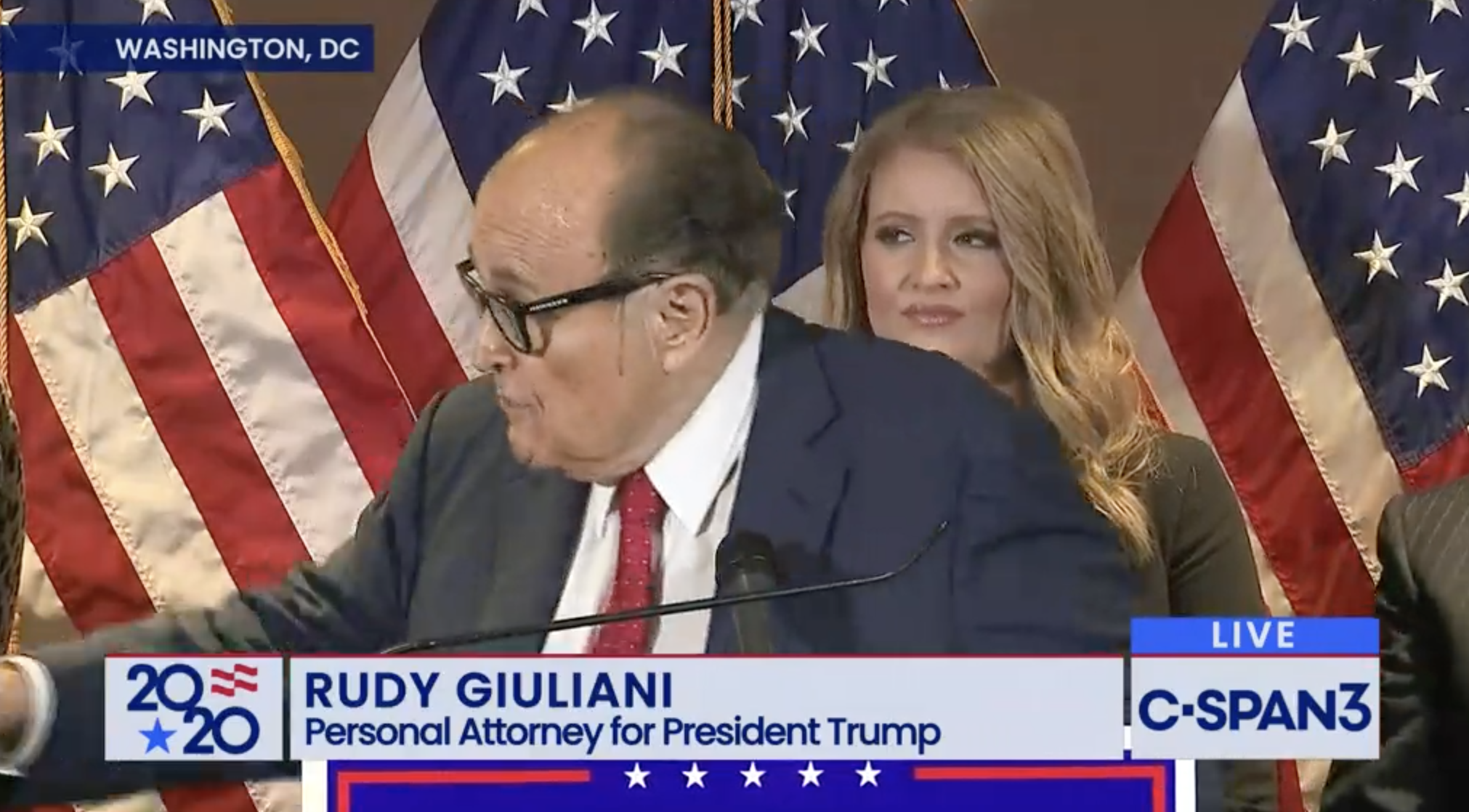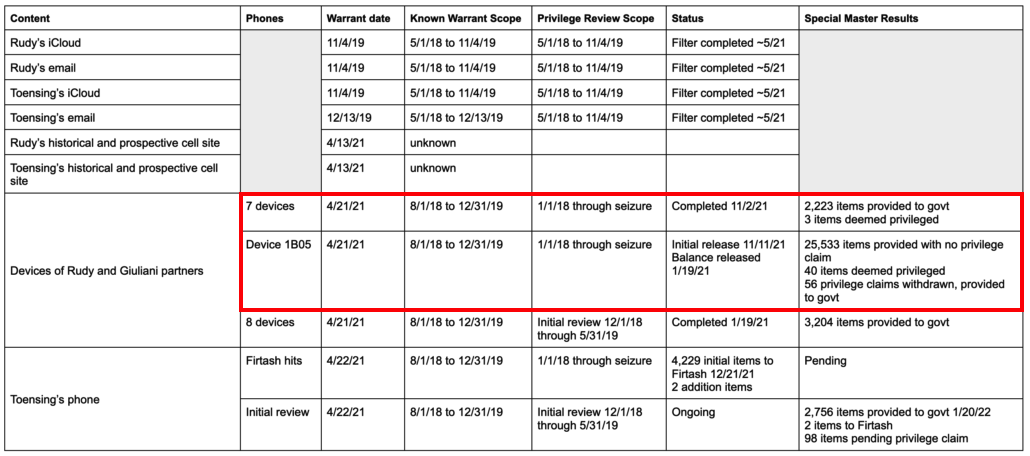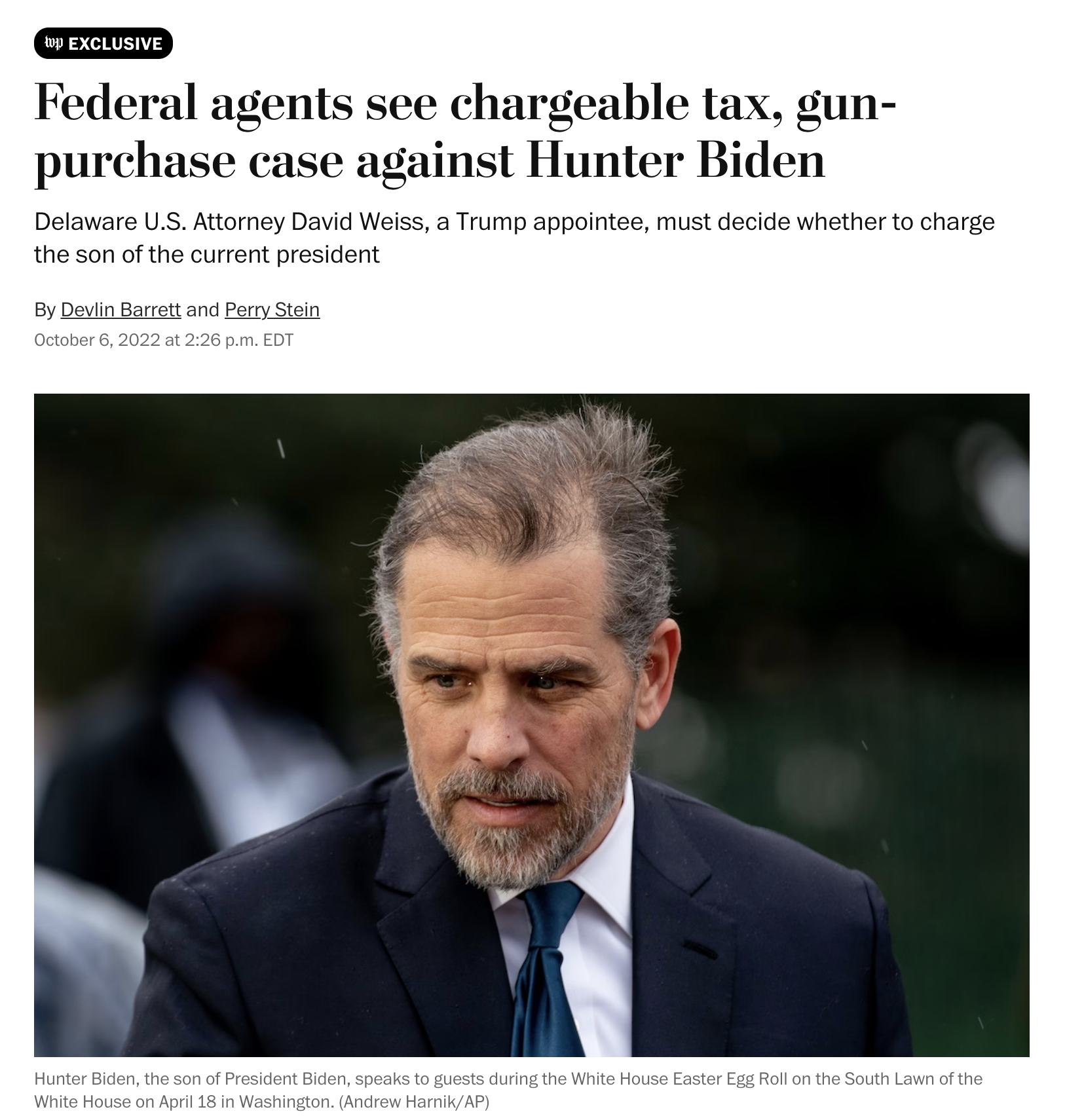
On Bill Barr and Sex Workers: Whistleblower X Raised Hunter Biden’s Baby Momma in Response to a Prostitute Question

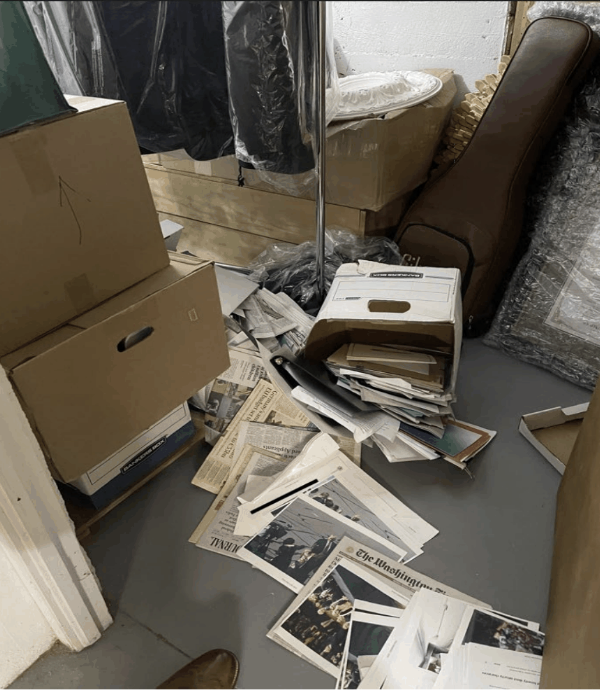
As a number of people have noted, the second so-called IRS whistleblower on the Hunter Biden case pointed to the official release of the documents Trump stole as an example of another high profile case where (he claimed, incorrectly), like the Hunter Biden one, there were leaks.

Q What’s an example of another high-profile case that we’re comparing that to?

A So some of the information that was released — or some of the information that was leaked related to the Trump classified documents. So that case. So there were actual pictures that were leaked from inside the search warrant. And this is what my memory of seeing things in the media. So that’s something that I remember. But, I mean — yeah.

It’s a testament to the way he has internalized Trump propaganda. It is one indicator of his unreliability.

There are more.

Far more.

The man should not be treated as credible.

All Whistleblower X’s International Tax Experience Has Been Milking Hunter Biden

Start with his own description of his work experience.

While he has been with the IRS for 13 years, it’s actually not clear how experienced he is in this kind of investigation. As he described, until just before he personally predicated the Hunter Biden investigation in 2018, he was a Public Information Officer, seemingly in both a public-facing role and working investigations.

Literally his first investigation on IRS’ International Tax and Financial Crimes group was into Hunter Biden.

And that’s important because he seems to struggle with due process. Throughout his presentation, for example, he seems to have little understanding of FBI guidelines, including least intrusive means and required approvals for Sensitive Investigative Matters. Many of his complaints amount to a complaint that he wasn’t permitted to violate rules that FBI has re-emphasized in the wake of the Carter Page IG Report.

So in a sense, Republicans are wailing because FBI wouldn’t violate rules the FBI didn’t even violate with Carter Page, such as doing physical surveillance of a candidate’s son 14 days before the election.

Q Why did you have to get approval for that?

A Because we were in a posture at that point that we couldn’t do anything that appeared — any investigative activities pretty much whatsoever.

Q But you weren’t wearing an IRS windbreaker, and you weren’t driving a car marked with IRS letters on it. So how would anyone possibly know? It’s a free country. You’re allowed to drive by any house you want.

A Yeah, I didn’t want it — because I think at that time we were trying to do surveillance of pretty much everyone we were going to potentially interview. So he was just another one of the people that we wanted to do that for. I guess I don’t know —

[snip]

Q What is that email in reference to?

A This is in reference — this is October 20th, 2020, walk-by of possible residence. And Mark Daly says: Tax does not approve. This will be on hold until further notice.

He also seems to have assumed that decisions were made to protect Hunter when many of his complaints seem to pertain to efforts to protect the investigation (for example, in addition to the above complaint that he wasn’t able to physically surveil Hunter Biden solely to make sure he was living where they believed him to live; another objected to making a data request without using his name, something that would prevent leaks).

But particularly given his own description of his career track, it’s not clear how many successful investigations he has had.

Over the course of his testimony, he described two other cases he worked about which there were substantive disagreements. The first was one he apparently worked while also an Public Information Officer. There, after the AUSA cycled off of the case, a new one declined to prosecute.

Prior to joining the case, DOJ Tax had approved tax charges for the case and the case was in the process of progressing towards indictment. Our assigned Assistant United States Attorney was promoted to judge, and DOJ Tax had made the decision to reinvestigate the case.

After working thousands of hours on that captive case, poring over evidence, interviewing witnesses all over the U.S., the decision was made by DOJ Tax to change the approval to a declination and not charge the case.

I was devastated when I found that out, but at the end of the day I understood.

We did everything we could to try to work through the issues and get the captive case ready for indictment. I fought hard, having meetings with the leaders of my agency and DOJ Tax to try and get it charged. But at the end of the day it was a difference in opinion, and DOJ Tax didn’t want to set precedence.

I’m bringing this up to show you an example of difference in opinion between the investigators and prosecutors when it came to charging. The captive case and the steps taken were significantly different than what happened with the Hunter Biden investigation, and hopefully I can show you that with my testimony here today.

Without distinguishing the difference, Whistleblower X claimed he wasn’t much bothered by the declination in that case.

Much later in his interview, he was asked why he didn’t approach IRS Director of Field Operations Michael Batdorf after he was removed from the Hunter Biden case, when in 2021 Batdorf had invited him to do.

Whistleblower X described that in mid-October 2022, shortly after the big pre-election leak about the case to Devlin Barrett, Batdorf put a hold on another of his cases.

Q So you mentioned Michael Batdorf and that he had told you previously that you could go directly to him. Is that right?

A Yes.

Q Did you do that at the stage where you learned that you were removed?

A I did not.

Q Okay. Did you feel like you could talk to him about this issue?

A No, because I’ve been having other issues with him on another case I’m working that is — I felt like that chain of — that that relationship was broken.

Q When did that relationship start to break down?

A Probably since mid-October, maybe, would be my guess. I mean, it’s — yeah. It’s definitely —

Q Mid-October 2022?

A Yes.

Q And you mentioned issues you were having with him on another case. It’s totally fine if you don’t want to get into the specifics of that particular case, but can you generally describe the issues that you’re referring to?

A Yeah. I need to stay very, very high level on this. I had received approval with a strategy related to this case. And they backtracked that approval a couple weeks later and said to me that we need to put this on pause and that we’ll get back to you on what strategy we’re going to do moving forward. And we’re still on a pause right now.

[snip]

Q We were talking about the approval on the strategy for this other case. And just to clarify, this is a totally unrelated matter?

A Unrelated matter, yes.

Q Okay. And can you describe more about what happened to that strategy?

A It felt like it was — all along, we had been — for the past probably year, we had been communicating a strategy on this case that is tackling a big problem and trying to tackle it efficiently, okay? And it’s a compliance issue in this area. So we were briefing our [IRS] leaders and constantly having meetings about what we’re planning on doing, and they were on all [of] these phone calls, and we were sending emails of our strategy. And very recently, one of those strategies was moving forward on this compliance issue, and we were a go on it. And a few weeks later, I receive[d] a phone call that basically says, you’re being paused, and we’re having to relook at what you were doing, and we will make a determination moving forward.

So now, to all my peers and the different people, I was the one pushing the strategy, and it got halted in place, and now I have to go back to [these] people and explain to them why — it was just a mess. It was an absolute mess.

Q When did you get that phone call saying that you were being paused?

A It was in February of 2023. It was either a phone call or an email. [Inline brackets original]

Perhaps this was a response to the investigation into the leak, but Whistleblower X suggested that on a second case, he had had serious disagreements with management.

And yet, per a later answer, Hunter Biden and its offshoots were his only case.

Q Okay. I want to get some sense generally of your caseload and what you work. How many cases do you currently have? How many cases did you have back in 2018 when this case was assigned to you?

A I was new to the group. So this was one of two cases that I was working at the time. And then moving forward to right now, I have one large case. But it includes probably 80 tangential cases — or 80 sort of spinoff cases that I’m trying to manage and work, as well.

That’s abnormal. Normally for an IRS special agent, normally it’s one or two cases that they’re working a year because of how much work goes into them.

Q You mentioned that one of your other cases is paused. How many cases do you have that are paused? I don’t know how you count the one large one with the 80 tangentials. But how many of those are paused?

A Probably 20-ish. Let me rephrase that. I would say 10 to 15.

Mr. Zerbe. Why are they paused? You might expand on that.

BY MINORITY COUNSEL 1: Q I was going ask that question. So, yeah, go ahead.

A They are second-guessing the strategy that we’re putting forward on those.

[snip]

Q In your cases that you’ve had, first starting back since November of 2018, coming forward, have you had disagreements in other cases that you’ve been working?

A Yeah, yes.

Q How did that play out? How do your disagreements play out generally?

A I can give you an example of in another situation I was working, we also had a person who had failed to file returns and they earned a significant amount of money and they went out into — I need to be — so they had that situation at hand. I went to the prosecutors on the case. And I said, hey, this person has these unfiled returns. I’m thinking that specifically with what has happened — and specifically with what has happened in news reporting related to them, I think we need to go talk to them

Not only don’t these answers make sense, but even if they’re true, Whistleblower X has had problems with every major case he has worked for the last five years.

That wasn’t the only way Whistleblower X damaged his credibility.

On the Third Try He Admits He Listened into a Meeting Uninvited

Take his belated admission to listening in on a phone conversation involving his chain of command covertly.

Whistleblower X provided three different accounts of how he learned he had been removed from the Hunter Biden investigation.

His first description of how he learned he had been removed came as he was reading from an email he sent to much of the IRS chain of command. Either in that email or an aside he made as he read (note the quotation marks; this transcript was reviewed and revised by Whistleblower X and his attorney, who has very close ties to Chuck Grassley), he claimed he never got a phone call informing he had been removed.

It says, “My respective IRS leadership, first off, I apologize for breaking the managerial chain of command, but the reason I am doing this is because I don’t think my concerns and/or words are being relayed to your respective offices. I am requesting that you consider some of the issues at hand. I’m sure you are aware I was removed this week from a highly sensitive case out of the Delaware U.S. Attorney’s Office after nearly 5 years of work. I was not afforded the opportunity of a phone call directly from my special agent in charge or assistant special agent in charge, even though this had been my investigation since the start.”

And outside, I still have not received a phone call from my assistant special agent in charge or anyone in my IRS CI leadership other than my supervisor.

Later Chairman Jason Smith asked him how he found out. Whistleblower X implied that Gary Shapley told him.

Chairman Smith. Who informed you that you were being removed from the investigation?

Mr. X. I learned through my supervisor, Gary Shapley.

Chairman Smith. How were you informed that you were being removed from this investigation?

Mr. X. He told me — Gary Shapley told me that he was removed and I was removed.

Chairman Smith. So it was by phone call?

Mr. X. Yes.

The implication from this exchange was that after he learned of it, Gary Shapley picked up the phone and called Whistleblower X to tell them the entire team had been removed from the case.

Shortly after that exchange, Whistleblower X and his attorney went off the record, after which he offered a third version: He sat in, uninvited, on a call that Shapley was asked to attend.

Mr. X. So I want to be clear with this. Can I explain what happened?

The assistant special agent in charge, Lola Watson, sent Gary an email — not me, Gary Shapley — my supervisor an email saying that they want to have a call regarding Sportsman. So a Sportsman update call. Gary, not feeling comfortable with our leadership, asked me to be on that call as a witness. I was not invited on that call, but I participated via phone on that phone call.

And it was during that call that — I overheard it, and they said that essentially the ITFC — so our group was removed from the investigation, and they were going to replace us with some other agents within the D.C. Field Office that they didn’t know the names of yet. There was no mention of, we need you to tell X. No mention of me whatsoever. It was just that we were removed from the case.

So, after telling two entirely different stories, Whistleblower X admitted he had basically listened in, uninvited, to an official government call.

And Republicans on the committee were not much bothered by that.

When Prostitutes Turn Girlfriends Turn Baby Mommas

Whistleblower X described starting the investigation into Hunter Biden off a sex worker site.

I started this investigation in November of 2018 after reviewing bank reports related to another case I was working on a social media company. Those bank reports identified Hunter Biden as paying prostitutes related to a potential prostitution ring.

I genuinely wonder whether this entire investigation is Elliott Spitzer 2.0, a highly politicized case out of someone arranging for sex work, especially given later references to the Mann Act.

And then there were — and I know that my counsel brought this up earlier. There were some flying people across State lines, paying for their travel, paying for their hotels. They were what we call Mann Act violations.

Even by Whistleblower X’s description, this investigation started off almost nothing.

Mr. X. My initiation packet, so sending the case forward to get — we call it subject case. It’s an SCI. It’s elevating the case to actually working the investigation. My first one showed the unfiled returns and the taxes owed for 2015 and that was it on my first package. So that was the wrongdoing that we were alleging.

And my supervisor goes: You don’t have enough. You need to find more.

All the more so given Whistleblower X’s problems with sex workers.

He talked about women he claimed to be prostitutes a lot.

At one point he bragged about how, in spite colleagues’ dismissals of the import of sex workers, he hunted down every sex worker with a tie to Hunter Biden and wowed his colleagues about them.

There was a lot of different investigative steps that we took, that even going and talking to the prostitutes, we found multiple people that he called his employees that were also prostitutes, and that he would have them clean his hotel room or — there were a lot of these interviews that we ended up going and doing and talking to people that were so worth it, even though someone might — we were always being told by the prosecutors, you guys are wasting your time going and doing that. It’s not worth it. And literally, I would surprise them every time and find everyone.

Later, Whistleblower X turned to the woman whose child support payments Hunter Biden just settled, Lunden Roberts, and claimed she didn’t work for Hunter Biden (Abbe Lowell complained when Shapley made this same claim).

So in addition to some of this stuff that we’ve been talking about, he also had members of his family, including Lunden Roberts, on his payroll. We know that during the time period she was paid, she did not work for him. So he was deducting things for salary for employees that were his family members. A lot of those witnesses are people we would go and talk to.

Still later, one of the majority counsels tried to get Whistleblower X to confirm he caught Hunter Biden paying health insurance for his sex workers, only to have him raise Roberts, the mother of the child he fathered.

Q During our discussion of the 2018 tax year, you mentioned that Hunter Biden was making business expenses for prostitutes?

A Yes, in some circumstances.

Q Could you give us a little bit more information on that? What was the nature of the — was he paying for — were they on the payroll? Was he paying for travel?

A In some situations, they were on payroll, and that was to get them health insurance in certain situations. There was —

Q So he’s paying for health insurance for his prostitutes?

A Not necessarily for — so let me go back and — so one of his girlfriends was on the payroll and — Mr. . Off the record, please, for a second. [Discussion off the record.]

MAJORITY COUNSEL 2. Back on the record.

Mr. X. So Lunden Roberts, she was on his payroll. She was not working. She was actually living in Arkansas pregnant with his child, and she was on his payroll.

There were expenditures for one of — he called it his West Coast assistant, but we knew her to also be in the prostitution world or believed to be in the prostitution world. And he deducted expenses related to her. She relates to the sex club issue.

Particularly given how much of this case relied on leads obtained from and tax returns updated in response to the paternity suit here, it is fairly remarkable that Whistleblower X raises Roberts in response to a question about prostitutes (though he quickly promoted her to being a girlfriend), particularly given corroboration for the claim that she was a personal assistant.

To be clear: I’m not saying she was anything but a personal assistant. Whistleblower X, however, raised her as an example in response to a question about prostitutes, and only later called her a girlfriend.

According to the NYT, Roberts’ father hunts with Don Jr, and Whistleblower X raised her in response to a question about sex workers.

But maybe Whistleblower X’s treatment of all these women as sex workers is not an accident.

Steve Bannon has been involved in this operation for years. I’ve heard a propagandist close to Bannon has been a source of leads for the investigation.

What if any ties to sex work among his personal assistants was not Hunter’s doing?

Whistleblower X Retreats from Hearsay … But Only His Bill Barr Hearsay

Whistleblower X’s presentation was riddled with hearsay (so much so, it raises real questions about his integrity as an investigator — in congressional testimony he proved unable to distinguish between rumor and fact). He repeatedly made claims about things that transpired with the investigation about which he has no firsthand knowledge.

That includes a claim he made about Bill Barr: Throughout Whistleblower X’s presentation, he claimed Bill Barr made the decision to send this tax investigation to Delaware.

So in [or] around March or April of 2019, the case went up to DOJ Tax. And at that time we were told that William Barr made the decision to join two investigations together. So at that point in time I had found out that Delaware had opened up an investigation related to the bank reports and that that occurred in January of 2019, so 2 months after I started mine.

He didn’t change his story on follow-up from Minority Counsel.

Q Shortly after that, you talked about in March and April of 2018 that Attorney General Barr had made a decision to join the cases. And then you said that Delaware had opened the case. You said January of — is that 2019 or 2018 or 2020? I didn’t get the year.

A It was January of 2019 —

Q Okay.

A — that Delaware, U.S. Attorney’s Office, and FBI had opened up the investigation. They wouldn’t have been able to see in our IRS system that we had a case open.

Or another follow-up from Minority Counsel.

Q Okay. I wanted to go back to something that you mentioned earlier. You said that in March/April — and I think you meant 2018, but I’m not sure — that Bill Barr made the decision to join these cases together.

A So that would have been 2019.

Q 2019. And then you said that the case in Delaware was opened January of 2019? Is that correct?

A Yep.

Q Okay. And then this case was opened May of 2019?

A So the cases were joined May of 2019.

Q How was it communicated to you that Bill Barr joined these cases together?

A I believe it was my manager that told me. My manager would have been Matt Kutz.

Q How would he have known? Would that have come from Justice somewhere or where does that come from —

A From his leadership, most likely, when we were told — we were essentially told that we had go up to Delaware to meet them. And the decision was made at his direction, from what I recall.

Q “His” being Bill Barr?

A Yes.

Q Okay. Was there any other discussion of Bill Barr taking interest in this case that you heard of beyond it being joined?

A Not at all.

Q Was there any reporting up the chain that you know of to Bill Barr?

A No, not that I know of.

As noted, Whistleblower X attributed this claim to his then-supervisor Matt Kutz.

Curiously, Republican Chairs chose not to demand testimony from Kutz — who might explain why he understood the decision to consolidate the cases in Delaware came from the Attorney General — among the 12 from whom they’re demanding impossible testimony.

  • Lesley Wolf, DOJ
  • Jack Morgan, DOJ
  • Mark Daly, DOJ
  • Matthew Graves, DOJ
  • Martin Estrada, DOJ
  • David Weiss, DOJ
  • Stuart Goldberg, DOJ
  • Shawn Weede, DOJ
  • Shannon Hudson, DOJ
  • Tom Sobocinski, FBI
  • Ryeshia Holley, FBI
  • Michael T. Batdorf, IRS
  • Darrell J. Waldon, IRS
  • Secret Service employees who received the December 7, 2020, tip-off from FBI and all Secret Service employees who may have passed this information along to the Biden family or presidential transition team.

Anyway, Whistleblower X’s attorney, Dean Zerbe, began to cop on to how problematic it was that Barr had intervened the third time the Minority Counsel followed up about this.

MINORITY COUNSEL 2. How unusual, or in your experience, how frequently have you seen cases merged from the DOJ and IRS?

Mr. Zerbe. Let’s go off the record.

MAJORITY COUNSEL 3. Off the record. [Discussion off the record.]

BY MINORITY COUNSEL 2: Q That’s what I’m asking. How common is that circumstance? Sorry. Back on the record.

A I have never had that happen in my career.

Q Would you say it was something of an unusual occurrence for the Attorney General himself to order that?

A Looking back at it, I think he was trying to utilize the resources that he had. And I recall doing venue analyses for them to determine where proper venue was, to see if — but everything that I did said that we were — there’s no residence of Hunter other than his dad’s residence, his dad, President Biden, in Delaware. So his return preparers are in, I think it’s Maryland, his — at the time were in Maryland. So everything was pointing to outside of Delaware.

Q Well, when you say utilize his resources, is it usual for the Attorney General to take a specific interest in a case that maybe conservatively would be of, you know, $1 million in value to the U.S. Government, which, although obviously is a lot of money to the folks sitting here, is pretty small, small dollars relative to the entirety of the fiscal —

A Can ask you your question again? I apologize.

Q Does the Attorney General usually weigh in on cases where you’re talking about $1 million?

A I’ve never had that happen before.

Q To your knowledge, did Attorney General Barr weigh in, or seek updates on the investigation after those cases were joined?

A Not to my knowledge.

By this point, the Majority Counsel seems to have sussed out the problem with Billy Barr’s personal involvement in this. Because then that lawyer weighed in to cue up a response that maybe Barr was just approving high level prosecutions.

Q Okay. The discussion last round about the Attorney General Barr’s involvement, are you aware of the Justice Department policies and procedures that relate to sensitive investigative matters and political matters?

A I am not.

Q And do you know if the Attorney General, under the DOJ rules and procedures, has to make some of these decisions?

A I did not.

Q Would it surprise you if, in fact, the Attorney General does have to sign off on certain things when it relates to the son of a Presidential candidate or an incoming President-elect?

A It wouldn’t surprise me at all.

Now, it is totally plausible that Bill Barr was personally involved in sending a tax investigation to Delaware on which to hang foreign influence allegations that — thus far at least — have amounted to nothing. After all, Barr’s DOJ ordered up an investigation into John Kerry in SDNY. He ordered DC USAO to take a second stab at the Greg Craig prosecution, which flopped. He made John Durham Special Counsel so he could take two flimsy conspiracy theories to trial.

And he personally set up a parallel channel via which information channeled through Rudy Giuliani from known Russian spies could be ingested through the Pittsburgh US Attorney Office and sent on to the Delaware office.

That’s why Whistleblower X’s “supplement” is so interesting.

Both Shapley and Whistleblower X sent supplements complaining that they didn’t get to see the FD-1023 that Barr weighed in publicly to claim was totally reliable even though it came via Russian spy channels. That is, both used Barr’s public comments to intervene in the investigation from which they’ve already been removed.

In addition to doing that, though, Whistleblower X admitted — alone among all the unsubstantiated rumors he shared in his testimony — that after standing by his claim that it was Bill Barr who consolidated the cases in Delaware in four different exchanges, he was no longer sure that was the case.

After having been given an opportunity to review the transcript of his interview, Mr. X thought it would be helpful for the work of the Committee to clarify and update the transcript through this letter.

The clarification: Mr. X recalls in his testimony that he was told (roughly five years ago) by a supervisor that it was then-Attorney General William Barr who directed that the proposed case be merged with an ongoing case in Delaware. Mr. X is confident he was told by his supervisor that the merging of the cases was at the direction of an official at the Department of Justice. However, on further reflection, Mr. X cannot definitively state that his then-supervisor said that that the Department of Justice official directing the merger of the cases was AG Barr. Separate from that conversation with his supervisor, Mr. X has no independent knowledge of who at the Department of Justice directed that the cases be merged.

Someone decided that it is not helpful to the Republican cause — or to Whistleblower X’s role as nascent hero of the far right — for Bill Barr to have intervened so directly in this case.

And, as noted, Republican Chairs are making sure they don’t learn anymore details about Barr’s role either.

Republicans think they’ve got a great scandal going here. But Whistleblower X’s testimony inadvertently makes the whole thing sound like a rebirth of the manufactured Eliot Spitzer scandal, only this time with the direct involvement of the Attorney General.
Share this entry

How Many Podunk Local DAs Ought to Arrogate Themselves Federal Election Police?

For anybody that has read me here, or followed me on Twitter, you know I have maintained from the start that Fani Willis, and her “investigation” is a complete joke.

Have also maintained the Trump conspiracy actions in Arizona were as bad as Georgia, if not worse.

Apparently the national media has caught on to what informed Arizonans have known from the start.

Arizona Governor Doug Ducey was hit up by Trump (so was the then Secretary of State).

So, why is the ladder climbing Fani Willis the only local DA trying to enforce federal election law, much less her completely bogus RICO posit?

There are now people in Arizona clamoring for this horse manure. Thanks to Fani Willis and her self serving showboating garbage.

Fulton County, where Fani Willis is the local DA, has approximately 1.1 million county residents. Maricopa County, where all significant acts in AZ occurred, has nearly 5 million.

So, should every pissant local county prosecutor arrogate upon themselves to control and charge federal election crimes?

No. Nor should local AGs. Leave this to the Feds.

Things are getting just absurd.

Share this entry

OATH KEEPER SEDITIOUS CONSPIRACY CONVICTIONS WERE THE BATTLE; APPEALS MAY BE WAR

From emptywheel: Thanks to past support from readers, we can bring you Brandi’s preview of sedition appeals. To support Brandi’s larger book project on sedition, you can donate at the link here.

With the Oath Keepers’ historic seditious conspiracy trials now in the rearview, a new fight with significant implications is on the horizon. Almost all of the defendants—including and perhaps most unsurprisingly of all, Oath Keeper founder Elmer Stewart Rhodes are appealing their convictions.

Between two respective Oath Keeper trials involving seditious conspiracy that played out late last year and early into this one, prosecutors and defense attorneys spent an excess of 16 weeks duking it out in court, poring over mountains of evidence and examining dozens of witnesses including cooperating Oath Keepers. The Proud Boys seditious conspiracy trial stretched for more than 60 days and with verdicts reached in May, sentencing is expected in late August and early September. 

It is often repeated and rightfully so: seditious conspiracy is one of the gravest charges that can be brought in the U.S., and it is very rarely prosecuted. When it is, it is not often a successful endeavor. The bar is high and narrow given that the line between First Amendment-protected activities and sedition can be razor-thin.

The U.S. has endured major setbacks in prosecuting sedition cases before, so with two sets of juries delivering guilty verdicts on this count for most of the Oath Keepers indicted on it, (and then later for the Proud Boys), these were huge victories for the Justice Department. 

Huge but tempered.

Tempered because a conviction can also merely mark the end of one chapter and the start of another very tricky one once appeals are in the mix.

In a recent interview with NPR analyzing the Oath Keepers sedition verdicts, extremism expert and author Kathleen Belew pointed out that seditious conspiracy prosecutions can be a useful tool to combat extremist violence in society. She argues that it sends the message to extremist and militia groups, or other groups who use force as a movement, that they won’t be treated with kid gloves or prosecuted as lone actors. The risk of prosecuting extremists includes violent retaliation but as Belew also noted, these same prosecutions have the power to rouse people to the realization that their conduct is risky and potentially quite expensive to cope with legally. 

Perhaps most eloquently, Belew underlined that the only way to tamp down on extremism is to confront it, not look away from it.  

Recently, a report by The Washington Post suggested none of the sedition charges may have even come to pass if a reported skittishness to bring them had persisted at upper levels of the Justice Department at the outset of the Jan. 6 investigations. To read it, it would seem that many felt sedition was a bridge much too far or too risky politically. Marcy picked that WaPo report apart already and exposed key gaps and blind spots in the story so I won’t belabor those points here. 

I will, however, belabor others. 

First, Marcy’s unwinding of the Post story isn’t just context for context’s sake nor is it to browbeat a reporter like Carol Leonnig who is esteemed for good reason. (I have a lot of respect for her work and that of others at the Post, for the record). But Marcy does provide useful context by raising questions that, it would appear, the Washington Post seemed to miss or perhaps failed to appreciate when relying on its sources and then sharing those findings with a public largely unversed in the nuances of Jan. 6 and its related investigations. 

In the same way that Belew suggests sedition trials and convictions can act as an important deterrent to possible criminal extremists, it would seem just as vital that non-criminal, non-seditious Americans accurately grasp these serious proceedings, too. Being empowered with the ability to cut through the bullshit being spun by the far right, or Jan. 6 conspiracy theorists, hinges considerably on having a clear understanding, or at least a thorough consideration, of the historical evidence at the trials themselves.  

For my purposes, perhaps most striking in that Post piece was a detail that later needed to be corrected. In the first iteration of its story, the Post incorrectly stated that the Justice Department attempted to prosecute those involved in the kidnapping plot of Michigan governor Gretchen Whitmer with the sedition statute. 

But they did not use it in that case; so the comparison wasn’t just incorrect but it wasn’t apt at its inception. What would be more apt would be to mention how prosecutors used it in the Hutaree Christian militia case from 2010. This is a critical distinction because the Hutaree case is deeply relevant as Oath Keepers appeals are underway. With the Hutaree militia, the judge acquitted the defendants of seditious conspiracy after the government closed its case. U.S. District Judge Victoria Roberts felt prosecutors had failed to sufficiently prove the militia members intended to forcibly resist the U.S. government. It was a just lot of vile talk, she found, but it didn’t rise to seditious conspiracy. 

I will broach more about this later in this piece but first, let’s return to some baseline details on the appeals in progress. 

OATH KEEPERS ON APPEAL 

At his sentencing in May, Rhodes puffed up his chest to deliver a self-aggrandizing diatribe extremely short on remorse and extraordinarily heavy on claims of political persecution by the U.S. government and the “weaponization” of free speech by the Justice Department. His attorneys said early into the trial that if they lost, an appeal would certainly follow. 

And it has. 

Rhodes’ lawyers, James Lee Bright and Phillip Linder, did not return a request for comment to emptywheel this week but for the moment, according to the docket at the U.S. Court of Appeals for the D.C. Circuit, Rhodes and almost all of his co-defendants from the first trial group including Kelly Meggs, Kenneth Harrelson, and Jessica Watkins, have consolidated their efforts to attempt an appeal.

Another batch of Oath Keepers tried, charged, and convicted of seditious conspiracy include Roberto Minuta, David Moerschel, Edward Vallejo, and Joseph Hackett. They were split off into a second trial group for logistical reasons. 

The only Oath Keepers convicted of seditious conspiracy as of Thursday who have yet to officially indicate whether they will appeal are Ed Vallejo and Joseph Hackett.

Vallejo’s attorney, Matthew Peed, wrote in an email to emptywheel this week that he felt it was “likely” his client would appeal. Hackett’s lawyer, Angie Halim, did not return multiple requests for comment. (Key to note: An appeal cannot be formally entered until a defendant’s final judgment makes it onto the docket and neither Vallejo nor Hackett’s final judgment has appeared yet.) 

Rhodes’ attorney Phil Linder told CBS recently he expects it will take months to craft an appeal and one can only assume the same would apply to Kelly Meggs’ attorney Stanley Woodward given the demands on his schedule of late. Woodward also represents Waltine Nauta, former President Donald Trump’s valet and alleged co-conspirator in the Mar-a-Lago classified documents case. Woodward also represents Ryan Samsel, a Jan. 6 defendant who figures prominently in most “fedsurrection” conspiracy theories and he represents Frederico “Freddie” Klein, a former Trump-era State Department official. Klein faces a number of charges including assaulting police on Jan. 6, and he goes to trial in October. Woodward will also represent Trump’s former trade adviser Peter Navarro once Navarro’s trial for criminal contempt gets underway in September. Navarro, prosecutors say, defied a subpoena issued to him by the House Select Committee to Investigate the Jan. 6 Attack on the U.S. Capitol. 

Over the next 30 days, the Oath Keepers will continue to get their houses in order. Rhodes’ lawyers, according to a recent letter from the court clerk, have not yet been admitted to practice before the appeals court in but they have until July 12 to get admitted. 

 THE DEVIL IN THE DETAILS

After the massive unraveling of evidence and testimony at trial, it is hard to imagine a scenario in which an appeal, especially one from Rhodes, will contain, well, anything particularly novel. But the far more important factor will be whether his appeal will convince an appellate judge that his speech was not seditious.

Another one of his attorneys, Ed Tarpley, said after Rhodes was sentenced to 18 years in prison that the former far-right leader wouldn’t stop speaking up because it was a matter of principle. 

The Justice Department had “weaponized” the First Amendment and used Rhodes’ own words against him to secure a conviction, Tarpley said. 

Rhodes’ words were “used against him” technically speaking. But it wasn’t just his words that helped get him convicted though jurors did see mind-boggling amounts of evidence featuring his communications. 

They heard speeches and reviewed texts and phone calls as well as a recorded meeting where he called for revolution days after the 2020 election. He decried the election as unconstitutional and fraudulent and promoted disinformation to rile up his group or to entice them to act in concert with him. He directed Kelly Meggs, a Florida division leader, to coordinate operations in advance of the 6th and on the 6th. He oversaw the coordination of the gigantic weapons stash, or a quick reaction force (QRF) with the help of his co-defendants. The cache was set up at a hotel in Virginia, just over the Potomac River from the Capitol. Aware of the gun laws in D.C., Oath Keepers, from points all over the U.S., understood and received directions to drop their weapons at the QRF. Rhodes’ future co-defendant Ed Vallejo would stand by awaiting Rhodes’ orders to haul the weapons in if asked. 

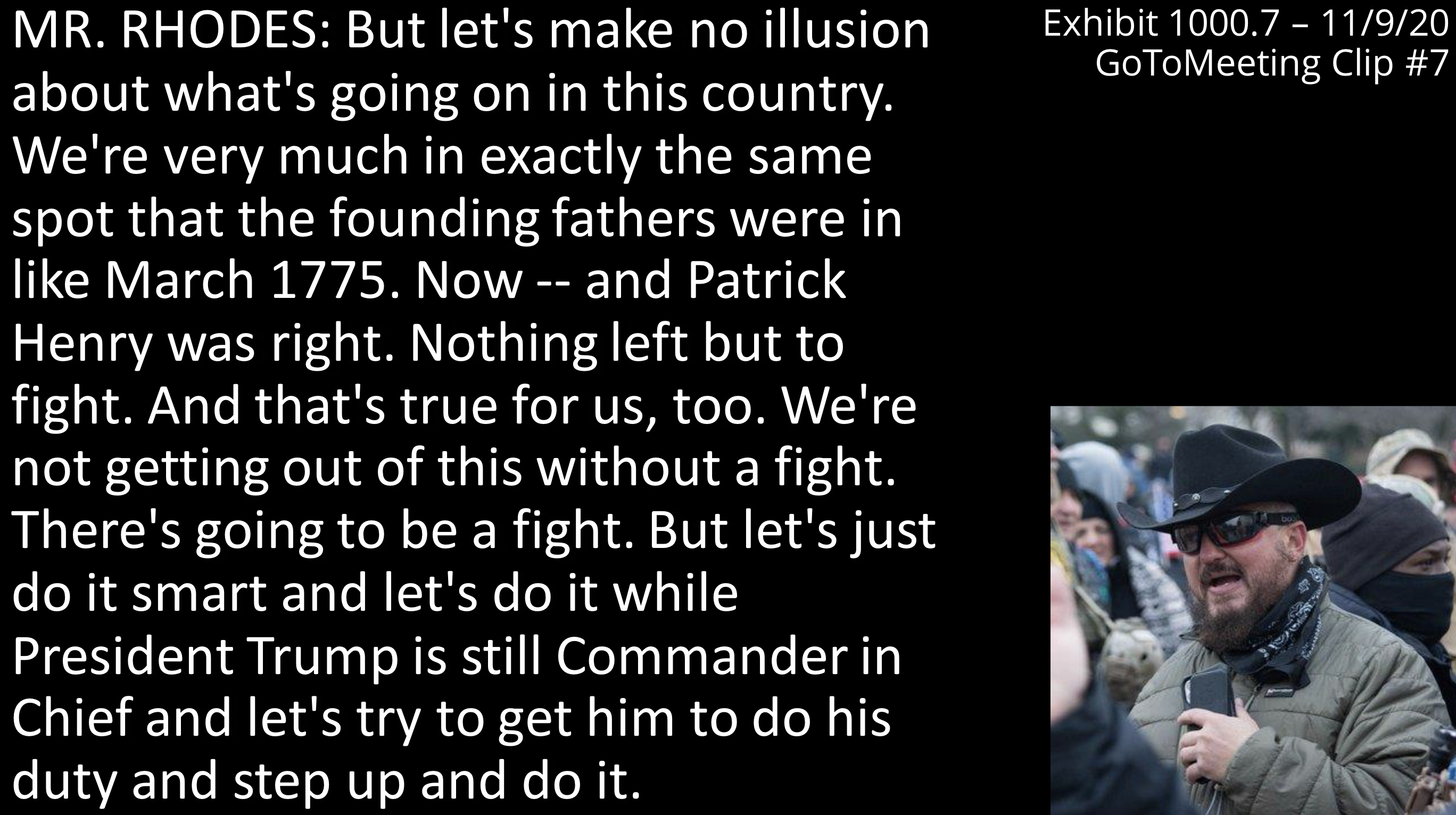
The beginnings of Rhodes’ intent were aired out in trial courtesy of a recorded GoTo Meeting with fellow Oath Keepers on Nov. 9, 2020.. Rhodes didn’t mince words and in fact, his fury was so complete, he scared one Oath Keeper into eventually reporting the call to the authorities. 

They would have to fight to keep Trump in office and this wasn’t a metaphorical “fight.”

“Let’s make no illusion about what’s going on in this country. We’re very much in exactly the same spot that the founding fathers were in like March 1775. Now—and Patrick Henry was right. Nothing left but to fight. And that’s true for us too. We’re not getting out of this without a fight. There’s going to be a fight. But let’s just do it smart and let’s do it while President Trump is still Commander in Chief and let’s try to get him to do his duty and step up and do it,” Rhodes said. 

Trump would not urge his supporters to descend on D.C. until Dec. 19, but prosecutors demonstrated that the Oath Keepers’ seditious conspiracy didn’t simply or only start to exist once Trump called for the “wild” event. 

During that Nov. 9 call, Rhodes’ told members they would need to be willing to travel to Washington and prepare to war with “antifa.” This was something he explained had multiple benefits. 

If they were there to stop “antifa” from attacking Trump supporters, it would give Trump a reason to invoke the Insurrection Act and raise Oath Keepers to his side.

“I’m willing to sacrifice myself for that. Let’s start the fight there, OK? That would give President Trump what he needs frankly,” Rhodes said.

Getting Trump to invoke the Insurrection Act so the “fraudulent” election could be stopped was ideal for Rhodes and as the weeks after the election passed and Trump lost lawsuit after lawsuit challenging the results, his desperation grew. 

On Jan. 6, Rhodes never stepped foot inside the Capitol. He stalked its grounds as he communicated with Oath Keepers on site and just moments before Oath Keepers breached, cell phone data showed Rhodes had called Meggs in what prosecutors argued was an order to get inside the Capitol and plow ahead. Prosecutors said the defendants understood, even without it being said explicitly, that this was a means to stop Congress from doing its duty.  At trial, footage after this call in question appears to show Meggs entering the Capitol as if on cue. 

Rhodes wasn’t indicted for propagandizing. He wasn’t indicted for having an opinion contrary to fact. He wasn’t indicted for wanting Trump to be in office even after Trump lost the election and then lost dozens of lawsuits seeking to overturn the results.

Rhodes wasn’t indicted for writing public letters and posting them online urging Trump to invoke the Insurrection Act in order to stop the “fraudulent” election of Joe Biden, a man Rhodes proclaimed was a “puppet” for communist China. (For the record, Rhodes wrote two of these letters; one was published on Dec. 14 and another on Dec. 23, 2021.) 

And Rhodes certainly wasn’t indicted for merely traveling from Texas to D.C. on Jan. 6 to attend a rally with thousands of other people who showed up to support Trump’s Big Lie. 

Rhodes was charged and convicted of seditious conspiracy, obstructing an official proceeding, and tampering with evidence because his words, when coupled with his conduct and the conduct of the men he oversaw, far exceeded the protections the First Amendment has to offer. 

Rhodes didn’t simply oversee a bunch of loudmouth oafs hand-painting protest signs in a hotel in Virginia before sauntering over to the Capitol to chant outside of it peacefully. 

When he was en route to D.C. from Texas,  bank statements and receipts showed. Rhodes spent more than $10,000 on firearms and gear like sights, scopes, ammunition, and night vision equipment. On their return to Texas after the 6th, Rhodes didn’t stop spending. In fact, he spent at least another $30,000 on weapons and equipment. Jurors saw maps and cell extraction reports that showed how, when, and where Rhodes coordinated these purchases and communications. Jurors saw how Rhodes coordinated with Oath Keeper Joshua James while returning to Texas and how they worked together to collect firearms and tactical gear. And all the while, Rhodes angled to conceal his movements, using his then-girlfriend Kellye SoRelle as a cutout to communicate with Oath Keepers via text through her and her phone. It was revealed to jurors also that James, who pleaded guilty to seditious conspiracy, sent a message to Rhodes as late as Inauguration Day saying, “After this… if nothing happens, it’s Civil War 2.0.” 

When former Oath Keeper Terry Cummings, who traveled with other members to D.C. for the 6th, testified against Rhodes in court, he said not since his time in the military had he ever seen so many guns in one place. 

Rhodes’ defense hinged on the argument that Oath Keepers came to Washington merely to serve as a security force for Trump VIPs attending speeches or rallies. One of those VIPs was ratfucker Roger Stone. Oath Keepers Joshua James and Roberto Minuta were tasked to guard him. Yet they would leave Stone at the hotel and speed towards the Capitol on golf carts as soon as Rhodes called them to his side. Meanwhile, Stone hightailed it out of D.C. 

At other times, the defense claimed Oath Keepers came to Washington to provide medical support as needed. Defendant and former Army medic Jessica Watkins had medical training, that was true, but her defense was undercut by her own admission on the witness stand: She did impede police when she forced her way into the Capitol and pushed past them. 

At sentencing, she wept when she recalled memories of the police officer who was overrun thanks to her conduct.

It seemed at trial the defense’s goalposts shifted depending on which defendant was under questioning or how a witness performed. The disclosed purpose for amassing the weapons cache or going to the Capitol regularly shifted around its edges in the Rhodes trial, and so many stories simply didn’t hold up under the scrutiny of cross-examination or redirect.

Memorably, assistant U.S. Attorney Jeffrey Nestler remarked to jurors during closing arguments in the first Oath Keepers trial that for all the claims of Oath Keepers being an organized security force on Jan. 6,  not one defendant was licensed or insured to provide security services and no one held any contracts for these supposed clients. 

And if the evidence from before Jan. 6 or the day of didn’t sink him, what followed proved Rhodes wanted to overthrow a government where Joe Biden was its executive. On Jan. 10, 2021, while downtown D.C. was still bustling with National Guard left over to protect the Capitol and nearby federal buildings, Rhodes took a meeting in a parking lot in Texas with U.S. veteran Jason Alpers. 

Alpers testified that he had “indirect” ties to the Trump White House but no further description was offered in court. Alpers said he linked up with Rhodes through an associate of Allied Security Operations Group, the same group that led an “audit” of voting machines in Antrim County, Michigan. (Michigan, of course, was one of several battleground states where Trump’s lawyers, including Sidney Powell and others, claimed fraud was pervasive. Powell was sanctioned for her role in pursuing such baseless claims in the courts last week.)

The meeting was set so Rhodes could pass a message to Trump. Alpers would secretly record the exchange. Rhodes was furious. He wouldn’t condemn the violence on the 6th but he had other regrets.

If Trump was going to just let himself be removed illegally, Rhodes remarked, “then we should have brought rifles.”

“We could have fixed it right then and there,” he said on the recording before adding that he would “hang fucking [then Speaker of the House Nancy] Pelosi from the lamppost.”

Furious, he tapped out a message into Alpers’ phone because he expected Alpers would pass it along to his Trump contact. 

Trump would be killed by his enemies if he didn’t act now, Rhodes warned.

‘You must use the Insurrection Act… if you don’t, you and your family will be imprisoned or killed. You and your children will die in prison… you must do as Lincoln did. He arrested congressmen, state legislators and issued a warrant for SCOTUS Chief Justice Taney. Take command like Washington would… Go down in history as a savior of the Republic, not the man who surrendered it… I’m here for you and so are all of my men. We will come help if you need us,” Rhodes wrote. 

He claimed he had 40,000 Oath Keepers backing him and millions of others who felt as they did.

He added: “There’s gonna be combat here on U.S. soil no matter what” and warned that the Biden administration would “disarm us all,” if allowed to take office. 

The message was too extreme for Alpers to pass along. It didn’t help, the veteran testified, that Rhodes’ then-lover Kellye SoRelle, who was also there, was drunk. It put  Alpers off. It was all too unprofessional and his confidence was shaken. On cross-examination, Alpers said he delayed reporting the meeting to the FBI because he didn’t want to get involved any further. 

All of these elements are just slivers of what jurors heard in the weeks-long trial.

There were also several intense days where emotions ran high, including those where the parties started to dig into claims that Oath Keepers went to help Capitol Police after getting inside. 

Meggs, Harrelson, and Watkins attorneys insisted their clients “assisted” U.S. Capitol Police Officer Harry Dunn who was stationed outside then-House Speaker Nancy Pelosi’s office. Armed with a rifle, Dunn told jurors he knew it wouldn’t take much for someone to grab it off him and make a bad situation worse. He told Oath Keepers to leave, he told them they were hurting police; he told them police were “getting the shit kicked out of them.”

The Oath Keepers wouldn’t leave right away though, they hung around him a bit longer instead. When prosecutors asked Dunn on redirect at trial what would have helped him that day, the officer was succinct: if they left, or never come in, that would help. 

So, to review, here are the convictions from the Oath Keepers sedition cases. (It is worth noting that if Rhodes manages to pull off an appeal, he could also be resentenced.)

On seditious conspiracy:

  • Elmer Stewart Rhodes, Kelly Meggs, Roberto Minuta, David Moerschel, Joseph Hackett

On conspiracy to obstruct an official proceeding

  • Kelly Meggs, Jessica Watkins, Roberto Minuta, David Moerschell, Edward Vallejo, Joseph Hackett

On obstruction of an official proceeding

  • Elmer Stewart Rhodes, Kelly Meggs, Jessica Watkins, Kenneth Harrelson, Thomas Caldwell, Roberto Minuta, David Moerschel, Edward Vallejo

On conspiracy to prevent officials from discharging their duties: 

  • Kelly Meggs, Jessica Watkins, Kenneth Harrelson, David Moerschel, Edward Vallejo, Joseph Hackett

On tampering or destruction of evidence

  • Elmer Stewart Rhodes, Kelly Meggs, Kenneth Harrelson, Thomas Caldwell, Roberto Minuta, Joseph Hackett

Impeding officers during a civil disorder:

  •  Jessica Watkins

IS EVERYTHING OLD NEW AGAIN?

When the federal judge presiding over the Hutaree matter tossed all of the sedition charges against those defendants, she explained that prosecutors had failed to prove beyond a reasonable doubt that the Christian militia members took concrete steps to violently revolt against the federal government with the aid of weapons of mass destruction.

The Hutarees were recorded discussing how police were their enemies and how they wanted to kill them. They discussed how a war against the U.S. government was necessary, too. But Judge Victoria Brown ruled that a conspiracy required a specific plot or a knowing agreement to break the law or a knowing intent to join that effort. Guilt by association was not enough, she said, and neither was repugnant conversation.

A Hutaree defense attorney noted in an interview with The Guardian last October when the Oath Keepers went on trial, that when it came to the Hutaree militia, beyond a lack of a plan, there was also “no action taken.” Hutarees may have shared disdain for law enforcement, communications showed, but, he argued, it pretty much stopped there. 

After the sedition acquittals for the Hutarees in 2012, a law professor from Wayne State University noted to the New York Times that the outcome just went to show how difficult it is to prosecute cases involving groups engaged in political speech. The professor also noted how  Hutarees were “a fairly disorganized group” who may have “talked big” but didn’t seem to be doing much otherwise. 

At the Oath Keepers trial, the defense was insistent that because there was not a concrete plan laying out the Oath Keepers’ precise efforts up to, on, or after Jan. 6, the government’s case was overcharged and amounted to a gross infringement on their First Amendment rights. 

But neither Judge Mehta nor the jury believed that was the case for the Oath Keepers who were ultimately convicted of seditious conspiracy. At Rhodes’ sentencing, Judge Mehta was unequivocal on this point, telling Rhodes he posed an “ongoing peril to democracy.” 

He was the one giving orders, Mehta said. 

“He was the one organizing teams that day. He was the reason they were, in fact, in Washington, D.C. Oath Keepers wouldn’t have been there but for Stewart Rhodes, I don’t think anyone contends otherwise. He was the one who gave the order to go, and they went,” he said. 

When the jury was instructed before deliberations, they were told that a conspiracy was defined as two or more people trying to accomplish some unlawful purpose and in order to sustain a seditious conspiracy charge, they must agree that a defendant conspired with at least one other person to oppose the government by force to delay and impede it; or they reached an agreement to use force in the ordinary sense of the word; or simply that they contemplated using force while at least one defendant actually used it. 

The government had no burden, Mehta said, to prove beyond a reasonable doubt that there was an express agreement or an implied one. They just had to prove that the members of the conspiracy met, talked about unlawful objectives, and agreed to some of the details or what the means were by which objectives could be accomplished. The success of that aim was irrelevant. 

Jurors deliberated for three days in the Rhodes trial; jurors in the second trial group took just over a week to reach a verdict. The end results were a mixed bag of verdicts, suggesting that jurors meticulously reviewed each defendant’s conduct. 

Watkins was acquitted of sedition but convicted of conspiracy to obstruct a proceeding, obstructing an official proceeding, conspiracy to prevent officials from discharging their duties, and impeding officers during a civil disorder. She recruited Oath Keepers and coordinated with them to breach the building and disrupt police on Jan. 6, but the jury, in the end, wasn’t fully convinced her role was central to that of a seditious conspiracist. 

The bar to convict remained high even for someone who recorded themselves breaching the building while actively and repeatedly encouraging others to “push, push, push” because the police “can’t hold us.” Before sentencing her to 8.5 years, Judge Mehta remarked that no one would suggest she is Rhodes or even Kelly Meggs. 

“But your role in those events is more than that of a foot soldier. I think you can appreciate that,” he said. 

Will these words haunt an appeal to come? 

When sentencing Rhodes and Meggs, Judge Mehta was far harder on them than their co-defendants also convicted of seditious conspiracy. He handed down an 18-year sentence to Rhodes and 12 years to Meggs with terrorism enhancements applied. The maximum on seditious conspiracy alone is  20 years. Minuta was sentenced to just 4.5 years; Joseph Hackett to 3.5 years. Vallejo and Moerschel received just 3 years. And again, that would include all of the convictions weighed in. 

Mehta emphasized to Rhodes at his sentencing that there was no question he “took up arms and fomented a revolution” on Jan. 6.

“That’s what you did. Those aren’t my words. Those are yours,” Mehta said. “You are not a political prisoner, Mr. Rhodes. You are not here for your beliefs.”

Perhaps this encapsulates the very reason why it matters that the sedition charge was used instead of abandoned early on. The evidence would indicate this wasn’t merely a First Amendment matter. Perhaps it may have been easier for Rhodes or Meggs or other Oath Keepers charged and convicted of seditious conspiracy to wriggle out of an obstruction charge if the focus on sedition wasn’t also on the table to start. 

But whatever the case may be, that’s the recent past. And while important, there’s now an equally if not more important future to ponder just ahead. 

At a time when the U.S. is awash in far-right extremism; when the man who incited the insurrection on Jan. 6 is now twice-indicted yet still running for president and running on a vengeance platform; at a time when he and other right-wing politicians vow to pardon all Jan. 6 defendants if ever given power by the body politic to do it—it will matter what happens with these appeals. 

Will the Oath Keepers convicted of sedition appeal their sentences? Or will they appeal the conviction? Appealing the conviction would seem the likely route given Mehta’s light touch at sentencing for most. And as part of his tough-guy-patriot-against-the-Deep-State-routine, Rhodes has already said he’s willing to do prison time for his beliefs. An appeal on the conviction that could potentially humiliate the U.S. government would seem too tantalizing for a man like Stewart Rhodes to pass up. 

If terabytes of evidence weren’t enough, if hours and hours of video footage weren’t enough, if proclamations and concerted efforts to foment an armed rebellion live on television aren’t enough to maintain the Oath Keepers seditious conspiracy convictions, then one must wonder, what will happen if history repeats itself?

Share this entry

Paul Manafort Remains a Bigger Scandal than Hunter Biden

I haven’t had the time to dig into Gary Shapley’s purported whistleblower claims about the case against Hunter Biden, which several US Attorneys have already disputed.

My read, thus far, matches Andrew Prokop’s: after IRS investigators tried to take steps during a pre-election prohibition period last year, someone in their vicinity leaked to Devlin Barrett, as right-wingers do every pre-election period. That led Delaware US Attorney David Weiss to (justifiably) remove the suspected leakers from the case. As other right wing officials have before, they then ran to Congress and belatedly claimed whistleblower status.

The purported whistleblowers claim that investigative steps — pertaining to allegations about conduct after Biden left the Obama White House — were slow-walked in 2020, during Bill Barr’s tenure as Attorney General. The most serious claim made by the purported whistleblowers is that US Attorneys appointed by Joe Biden refused to file charges against Hunter in the venues where they occurred — MDCA and DC. Merrick Garland, David Weiss, and Matthew Graves have all denied that.

But even if that allegation is true, even if Weiss continues to investigate and substantiates some foreign influence peddling (at this point, limited to 2017, a time when Biden was not in office), the allegations against Hunter Biden would still be far less scandalous than the Paul Manafort case. That’s true because the scale of Manafort’s tax crimes were far worse. That’s true because Manafort has confessed to his foreign influence crime. And that’s true because Trump pardoned Manafort after his former campaign manager lied to investigators about what he did with (since confirmed) Russian agent, Konstantin Kilimnik, during and after the 2016 campaign.

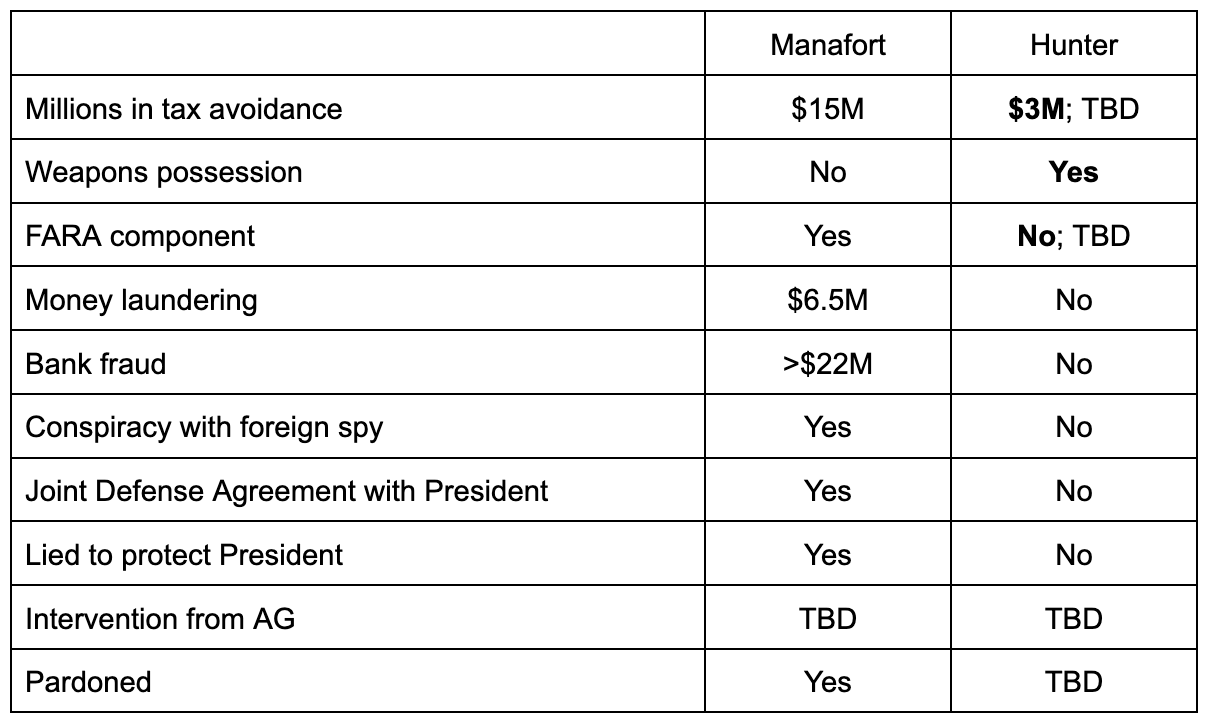
Here’s my understanding of the comparison. The claims against Hunter, in bold, reflect the two Informations docketed as part of the plea deal. All but the pardon TBDs in his case reflect allegations from the so-called whistleblowers that remain unresolved.

Note: I have not listed “lied to protect the president” for Hunter because, as far as I am aware, the President’s son has not made sworn statements to law enforcement — true or false — about matters affecting his father. Manafort did make false statements about matters implicating Trump during his breached cooperation with Robert Mueller’s prosecutors.

A whole pack of DC journalists have chased the IRS allegations, like six year olds do a soccer ball, but with perhaps less consideration of what they’re chasing. They’re doing that even as Trump’s pardons remain largely unreviewed since he announced his run. This manic response to contested IRS claims reflects a choice. Just not a justifiable journalistic one, given the contested allegations to date.

Paul Manafort sources

Millions in tax avoidance: On August 21, 2018, an EDVA jury convicted Manafort of filing false tax returns each year from 2010 to 2014. On September 14, 2018, Manafort pled guilty to tax crimes spanning from 2006 through 2015. Between 2010 and 2014, he failed to report over $15M in income on FBAR.

FARA component: On September 14, 2018, Manafort pled guilty to serving as an unregistered foreign agent from 2006 through 2015.

Money laundering: On September 14, 2018, Manafort pled guilty to laundering over $6.5M in payments, from 2006 through 2016, as part of his FARA scheme.

Bank fraud: In August 21, 2018, an EDVA jury convicted Manafort of two counts of bank fraud, totalling $4.4M. On September 14, 2018, Manafort admitted to over $25M more in bank fraud.

Conspiracy with foreign spy: On September 14, 2018, Manafort pled guilty to a conspiracy to witness tamper with Konstantin Kilimnik. In a 2021 sanctions filing, Treasury stated as fact that Kilimnik is a Russian Intelligence Services agent.

Joint Defense Agreement with President: Before Manafort pled guilty, Rudy Giuliani confirmed that Manafort was part of a Joint Defense Agreement with the President.

Lied to protect President: On February 13, 2019, Amy Berman Jackson ruled that Manafort had breached his plea agreement by — among other things — lying about what he did in an August 2, 2016 meeting with Konstantin Kilimnik at which he described how the campaign planned to win swing states.

Intervention from Attorney General: On May 13, 2020, Manafort was given COVID release to home confinement, even though his prison was at that point low risk and his case did not meet the criteria laid out by Bureau of Prisons. He served less than two years of an over seven year sentence in prison.

Pardoned: On December 23, 2020, Trump pardoned Manafort.

Hunter Biden sources

Hundreds of thousands in tax avoidance: In both 2017 and 2018, Hunter failed to pay full taxes on $1.5M in income ($3M total).

Gun possession: For 11 days in 2018, Hunter possessed a gun in violation of a prohibition on gun ownership by an addict.

Update: Just to give a sense of scale, in his Ways and Means interview, Whistleblower X tried to explain how big the scale of Hunter Biden’s graft was by noting that he and his associates, over five years, got $17.3M.

But Manafort was doing more than that himself.

Share this entry

Susie Wiles Named in A(nother?) Trump-Related Indictment

ABC has identified two more people referred to in Trump’s Espionage Act indictment.

In addition to confirming earlier reports that Molly Michael is Trump Employee 2 — the person who, with Walt Nauta, helped Trump sort through boxes in advance of returning a subset of boxes in January 2022 — ABC describes that Trump Employee 1 is Hayley (née D’Antuono) Harrison.

Sources have also further identified some of the other figures mentioned by Smith’s team in the indictment. Hayley Harrison and Molly Michael are said to be “Trump Employee 1” and “Trump Employee 2,” respectively.

Michael, whose name was previously reported as an individual identified in the indictment, is Trump’s former executive assistant who no longer works for him, while Harrison is currently an aide to Trump’s wife, Melania Trump.

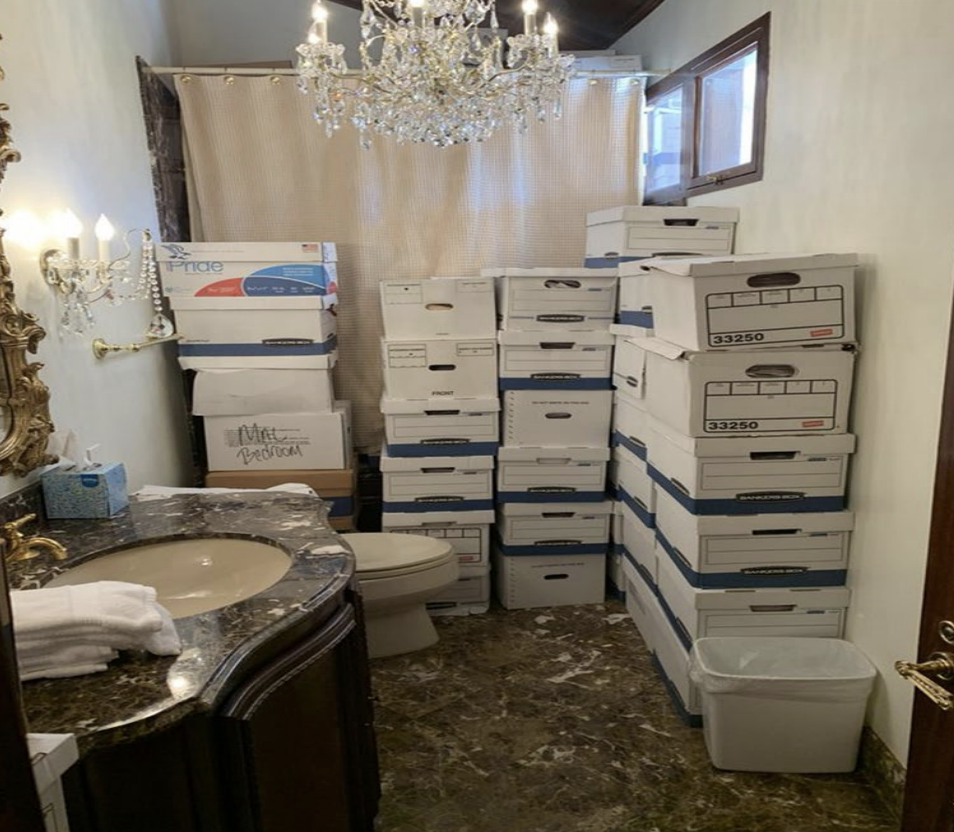
The role of Trump Employee 1 in the indictment is fairly minor: in a discussion with Michael she suggested moving other stuff to storage to make space in the gaudy bathroom for boxes of documents.

People often raise questions about whether she has familial ties with Steve D’Antuono, the former FBI Assistant Director who kept thwarting investigations into Trump; they share a last name but no known familial ties.

More interesting is the role of her spouse, Beau, whom she married last year. Both Beau and Hayley were employed by Trump’s PAC, and Beau was represented (as Cassidy Hutchinson had been) by Stephen Passantino. Beau made two appearances before the January 6 Committee, in the second of which his testimony evolved to match Tony Ornato’s testimony disclaiming Trump’s efforts to go to the Capitol on January 6. Harrison was interviewed in the January 6 investigation late last year.

The Harrisons are a couple in the thick of things.

ABC’s other identification is a much bigger deal — and Trump is making it one. According to ABC, Susie Wiles is the PAC Representative to whom Trump is described as showing a classified map in September 2021.

Susie Wiles, one of Trump’s most trusted advisers leading his second reelection effort, is the individual singled out in Smith’s indictment as the “PAC Representative” who Trump is alleged to have shown a classified map to in August or September of 2021, sources said.

Trump, in the indictment, is alleged to have shown the classified map of an unidentified country to Wiles while discussing a military operation that Trump said “was not going well,” while adding that he “should not be showing the map” to her and “not to get too close.”

[snip]

If the identification of Wiles by sources is accurate, it also raises the prospect that should Trump’s case go to trial prior to the 2024 election, one of the top figures leading his reelection bid could be called to testify as a key witness. Wiles, who previously helped lead Trump’s now-GOP primary opponent Ron DeSantis’s two campaigns for governor, is seen as one of Trump’s most trusted confidants.

She also led Trump’s campaign operations in Florida in 2016, and was later CEO of Trump’s Save America political action committee.

Note that Trump could not be surprised by Wiles’ inclusion in the indictment; the map-sharing incident was widely reported before the indictment.

Still, Wiles’ ID is important for several reasons. Even more than the prospect that Wiles might have to testify during the campaign, which ABC notes, consider how the primary release condition — that Trump not discuss the facts of the case with any witnesses — would affect this. Trump wants to turn being an accused felon into a key campaign plank. He’s running on being a victim. But the contact prohibition would make it more difficult for Trump and Wiles to discuss the best way to do that. And it would make any false claims the Trump campaign made about the prosecution legally problematic, because Wiles is a witness.

That would be true irrespective of Wiles’ role in running Save America PAC, which is the key subject of the fundraising prong of the investigation. But there’s a non-zero likelihood that Wiles’ conduct is being scrutinized for spending money raised for one purpose and spent on another. One way or another, Wiles was involved in a suspected Trump scheme to raise money based off a promise to spend it on election integrity, only to use the money for lawyers representing Trump in other matters.

More interesting still: this may not be Wiles’ first inclusion in a Trump-related indictment. At the very least, Wiles was the former 2016 campaign staffer who had to answer for the multiple contacts Yevgeniy Prigozhin’s trolls made with Trump’s Florida campaign as laid out in the Internet Research Agency indictment, and she may well have been one of the three campaign officials referred to in it.

74. On or about August 15, 2016, Defendants and their co-conspirators received an email at one of their false U.S. persona accounts from a real U.S. person, a Florida-based political activist identified as the “Chair for the Trump Campaign” in a particular Florida county. The activist identified two additional sites in Florida for possible rallies. Defendants and their co-conspirators subsequently used their false U.S. persona accounts to communicate with the activist about logistics and an additional rally in Florida.

75. On or about August 16, 2016, Defendants and their co-conspirators used a false U.S. persona Instagram account connected to the ORGANIZATION-created group “Tea Party News” to purchase advertisements for the “Florida Goes Trump” rally.

76. On or about August 18, 2016, the real “Florida for Trump” Facebook account responded to the false U.S. persona “Matt Skiber” account with instructions to contact a member of the Trump Campaign (“Campaign Official 1”) involved in the campaign’s Florida operations and provided Campaign Official 1’s email address at the campaign domain donaldtrump.com. On approximately the same day, Defendants and their co-conspirators used the email address of a false U.S. persona, [email protected], to send an email to Campaign Official 1 at that donaldtrump.com email account, which read in part:

Hello [Campaign Official 1], [w]e are organizing a state-wide event in Florida on August, 20 to support Mr. Trump. Let us introduce ourselves first. “Being Patriotic” is a grassroots conservative online movement trying to unite people offline. . . . [W]e gained a huge lot of followers and decided to somehow help Mr. Trump get elected. You know, simple yelling on the Internet is not enough. There should be real action. We organized rallies in New York before. Now we’re focusing on purple states such as Florida.

The email also identified thirteen “confirmed locations” in Florida for the rallies and requested the campaign provide “assistance in each location.”

77. On or about August 18, 2016, Defendants and their co-conspirators sent money via interstate wire to another real U.S. person recruited by the ORGANIZATION, using one of their false U.S. personas, to build a cage large enough to hold an actress depicting Clinton in a prison uniform.

78. On or about August 19, 2016, a supporter of the Trump Campaign sent a message to the ORGANIZATION-controlled “March for Trump” Twitter account about a member of the Trump Campaign (“Campaign Official 2”) who was involved in the campaign’s Florida operations and provided Campaign Official 2’s email address at the domain donaldtrump.com. On or about the same day, Defendants and their co-conspirators used the false U.S. persona [email protected] account to send an email to Campaign Official 2 at that donaldtrump.com email account.

79. On or about August 19, 2016, the real “Florida for Trump” Facebook account sent another message to the false U.S. persona “Matt Skiber” account to contact a member of the Trump Campaign (“Campaign Official 3”) involved in the campaign’s Florida operations. On or about August 20, 2016, Defendants and their co-conspirators used the “Matt Skiber” Facebook account to contact Campaign Official 3. [my emphasis]

In the wake of the indictment, Wiles insisted, convincingly, that no official staffer wittingly cooperated with the trolls.

Susie Wiles, who was co-chair of the Trump campaign in Florida in August 2016 and later became the campaign’s chief Florida staffer, said no campaign official was aware of the Russian effort.

“It’s not the way I do the business; it’s not the way the Trump campaign in Florida did business,” she said. “It is spooky. It is awful. It makes you look over your shoulder. It shouldn’t happen. I’m anxious for this to be uncovered so this never happens again.”

Indeed, ultimately, DOJ argued that Prigozhin’s trolls had made approximately 26 real US persons unwittingly serve as agents of Russia, who otherwise should have registered under FARA. Had the Concord Consulting case gone to trial, the interactions of those real people with Prigozhin’s trolls would have been introduced as evidence.

But the focus on Florida led to a real focus on the Wiles family’s real actions tied to Russia. Notably, just days after the June 9, 2016 meeting with Natalia Veselnitskaya and Rinat Akhmetshin, Susie’s spouse Lanny arranged for Veselnitskaya to get a prominent seat at a Magnitsky sanctions hearing.

In fact, her seat had been reserved for her by a Republican consultant with close ties to the Trump campaign.

Lanny Wiles, whose wife, Susie, was then chairing the Trump campaign in Florida, said in an interview that he came early to scout out the seat and was there at the request of Akhmetshin, with whom he was working as a consultant on the sanctions-related adoption issue.

Lanny and Susie Wiles both said she was unaware of his role in the lobbying effort. Lanny Wiles said he was unaware that the Russian lawyer whose seat he was saving had just days earlier met with Trump Jr.

“I wasn’t part of it,” Susie Wiles said.

First Politico, then BuzzFeed, reported that Lanny Wiles had some kind of financial role in Akhmetshin’s anti-Magnitsky lobbying. And the Wiles’ daughter, Caroline, had to be moved from a job in the White House to Treasury after she failed a background check.

That back story is what makes it more interesting that Trump was sharing a classified map with Wiles in 2021.

Update: CNN matches ABC’s identification of Wiles, and adds that Wiles has been interviewed several times.

The campaign adviser, Susie Wiles, has spoken to federal investigators numerous times as part of the special counsel’s Mar-a-Lago documents probe, multiple sources told CNN.

[snip]

During her interviews, sources say that prosecutors repeatedly asked Wiles about whether Trump showed her classified documents. They also inquired about a map and whether she had any knowledge regarding documents related to Joint Chiefs Chairman, Gen. Mark Milley, one source added.

[snip]

Wiles, one of Trump’s closest advisers, is effectively running his third bid for the presidency and has taken an active role in Trump’s legal strategy, including helping find lawyers and helping arrange payment to attorneys representing Trump associates being questioned in the multiple federal and state investigations into the former president.

Wiles is also a close associate of Chris Kise, who is on Trump’s legal team and appeared in court earlier this month when Trump was indicted.

Sources in Trump’s inner circle tell CNN they were blindsided by the news.

Wiles declined to comment to CNN.

Trump campaign spokesperson Steven Cheung told CNN that Wiles would not be taking a step back from the campaign.

“Jack Smith and the Special Counsel’s investigation is openly engaging in outright election interference and meddling by attacking one of the leaders of President Trump’s re-election campaign,” said Cheung.

Perhaps the most interesting detail in the CNN piece is that “sources in Trump’s inner circle” didn’t know this.

Update: A Trump rival (remember that Wiles used to work for DeSantis) finally finds something to attack Trump on — and in a Murdoch rag, no less: Wiles’ ties to China.

Susie Wiles works on Donald Trump’s 2024 campaign and is co-chair of Mercury Public Affairs, which has taken millions of dollars in recent years from Chinese companies such as Yealink, Hikvision and Alibaba.

[snip]

If confirmed, the episode is further complicated by both Wiles’ high standing in the Trump campaign and her firm’s lobbying for potential hostile entities — though a search of the Justice Department’s registry of foreign agents indicated Wiles had not worked directly for those clients.

“Susie could put Trump away for years in just one minute of testimony to Jack Smith,” a rival GOP operative told The Post. “She’s got Trump by the balls, which means she can name her price for her loyalty and Trump can’t say no.”

Share this entry

FBI Saw Itself “Managing What the Elephant Sees and Hears” in Advance of January 6

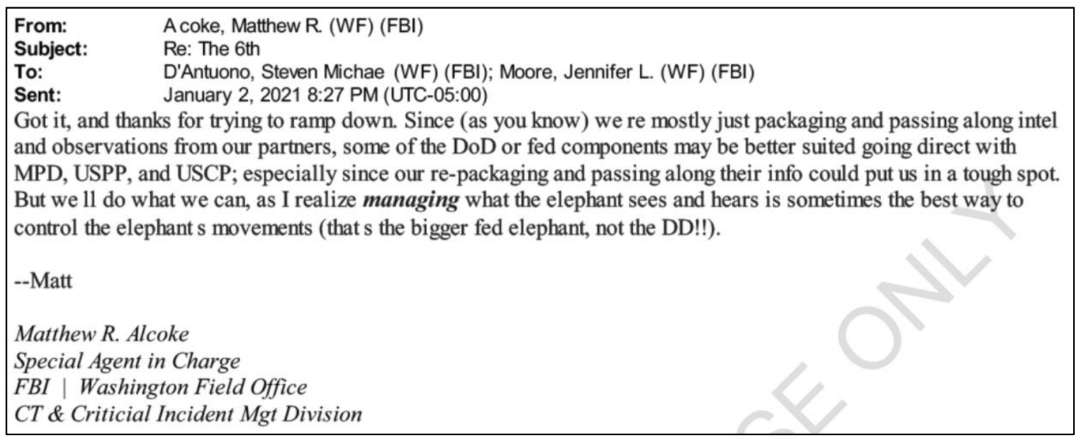
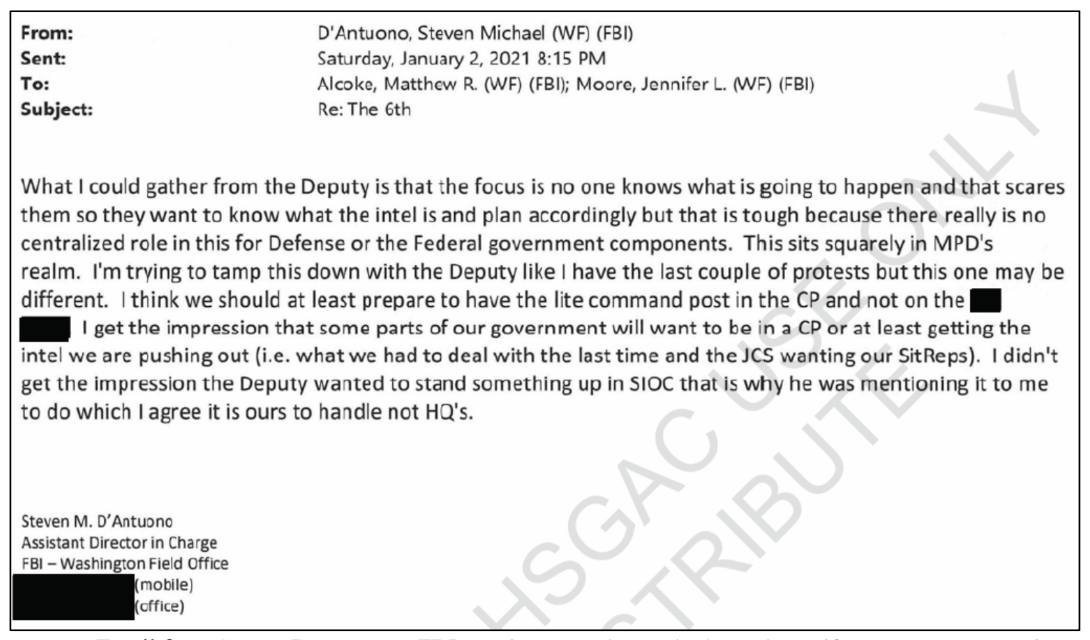
According to a report released yesterday by the Senate Homeland Security and Governmental Affairs Committee (HSGAC), on January 2, 2021, then FBI Washington Field Office Assistant Director Steve D’Antuono came away from some kind of exchange with then Deputy Director David Bowdich and described to two top WFO officials, Matthew Alcoke (in charge of counterterrorism) and Jennifer Moore (in charge of intelligence) how he tried to “tamp down” concerns about or plans for January 6.

Alcoke thanked D’Antuono for “ramp[ing] down” expectations, since really all the FBI’s WFO was doing was passing on information from partners like the DC Cops and Capitol Police.

Alcoke then made a shocking suggestion about intelligence sharing:

[M]anaging what the elephant sees and hears is sometimes the best way to control the elephant’s movements.

He seems to have suggested that the FBI might manage how the Federal government would respond to January 6 by managing what kind of intelligence the FBI passed on — and his assumption was that the FBI was only passing on intelligence from partners, not collecting any of its own.

It turns out that the Federal government — that elephant Alcoke imagined he might control — didn’t respond, not adequately. In the aftermath of that shoddy response, D’Antuono claimed that the FBI had seen nothing other than First Amendment protected activity.

During a briefing with reporters on Friday, Steven D’Antuono, FBI Washington Field Office assistant director in charge, told reporters that the bureau’s threat assessments leading up to Wednesday’s mobbing of the Capitol showed “there was no indication that there was anything other than First Amendment protected activity.”

Virtually every Federal official blamed local cops and the Capitol Police, insisting the Feds weren’t supposed to be the ones moving at all, the Capitol Police were.

D’Antuono, we’ve since learned, repeatedly tried to limit the investigation in the aftermath, playing a key role in thwarting any investigation into Trump’s actions for ten months.

Manage the elephant by controlling what it sees and hears.

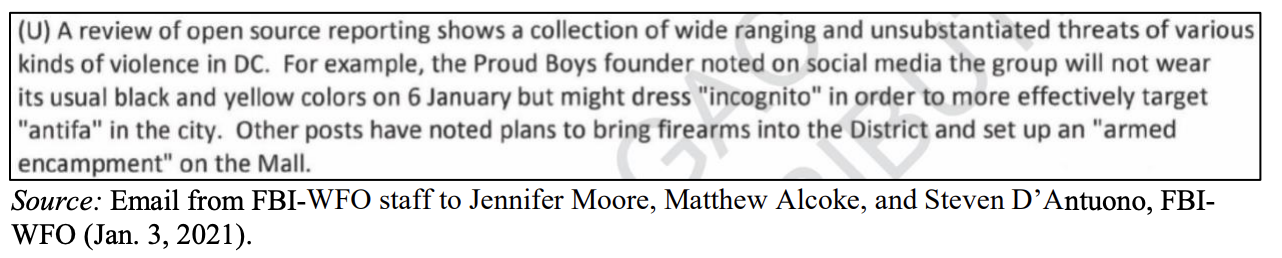
A day after D’Antuono and Alcoke discussed tamping or ramping down, WFO personnel sent D’Antuono, Alcoke, and Moore a summary describing the following open source intelligence:

On January 3rd, an internal WFO email marked “for FBI internal use only” cited “unsubstantiated” open-source reporting that “ranges from threats to the DC water supply to armed insurrection to various groups threatening to kill those with opposing viewpoints.”156 Among the reports cited, the email noted an open-source post regarding January 6th that said “[i]t needs to be more than a protest. We need to kick doors down and fuck shit up” and another user commented, “will kill if necessary.”157

Another social media post stated, “I’m just waiting for the 6th so I can 1776 them… January 6th we burn the place to the ground, leave nothing behind.”158

The internal FBI-WFO email noted that a tipster reported that individuals on fringe websites were discussing an overthrow of the government if President Trump did not remain in office, and stated “[d]ate of attack 01/06.”159 A Parler user stated, “[b]ring food and guns. If they don’t listen to our words, they can feel our lead. Come armed.” 160

The email also reported social media posts that noted plans to bring firearms into the District and “set up ‘armed encampment’ on the [National] Mall,” and that the Proud Boys planned to “dress ‘incognito’ in order to more effectively target ‘antifa’ in the city.”161

A tipster from Georgia told FBI that the Proud Boys were planning to come to D.C. on January 6th and warned “[t]hese men are coming for violence.” 162 Another tipster told FBI that a Proud Boy told her they were planning an attack on January 6th to shut down the government. 163

Another tip stated “there is a TikTok video with someone holding a gun saying ‘storm the Capitol on January 6th.’”164

As the HSGAC report notes, even in spite of the two warnings about the Proud Boys and threats of violence, WFO concluded that this described just First Amendment protected activities.

Despite all of that reporting, the FBI summary concluded, “FBI WFO does not have any information to suggest these events will involve anything other than [First Amendment] protected activity” and that FBI had “identified no credible or verified threat to the activities associated with 6 January 2021.”165 This was also despite the fact that the Proud Boys were known to engage in violence, including at protests in Washington, D.C. in late 2020.166

As Alcoke described, the FBI marked the summary of these warnings “Internal” because sources were sensitive about sharing it outside the FBI.

A day after discussing “tamp[ing] down” concerns with Bowdich, D’Antuono just sent this entire email to the Deputy Director.

I just sent the whole thing, I don’t want him getting a sanitized version of events.

This is a report that attempts to do what January 6 Committee largely abdicated doing, looking at intelligence failures in advance of January 6.

The House Select Committee’s final report found that President Trump engaged in a multipronged effort to overturn the 2020 election by knowingly disseminating false and fraudulent allegations, pressuring state officials to submit false elector slates, pressuring DOJ officials to make false statements alleging election fraud, and calling on supporters to join him in Washington, D.C. on January 6 th and subsequently encouraging them to march on the Capitol.23 The House Select Committee’s report largely focused on President Trump’s role in attempting to overturn the 2020 election, and only briefly discussed federal intelligence efforts in the lead-up to the events of January 6th . 24 The House Select Committee report found that intelligence agencies, including FBI and I&A, had received intelligence on the potential for violence at the Capitol.25 This intelligence included discussions of the Capitol complex’s underground tunnels alongside violent rhetoric, information on the movements of violent militia groups like the Proud Boys and Oath Keepers, and numerous social media posts discussing storming the Capitol.26 The report also found that security agencies did not adequately prepare for and respond to the threat.27

At the direction of U.S. Senator Gary Peters, Chairman of the Homeland Security and Governmental Affairs Committee (HSGAC), and following the Committee’s initial review of the security, planning, and response failures in advance of and during the January 6th attack, Majority Committee staff conducted a subsequent review focused on the intelligence failures leading up to the attack on the U.S. Capitol on January 6th.

What it describes is utterly damning.

Yet, in spite of a laudable effort to do what J6C didn’t do, there are obvious gaps.

First, as described, HSGAC met the same kind of stonewalling others received.

The Committee received responses to many of its questions and numerous document productions from the agencies in its investigation, including DOJ-FBI and DHS-I&A. However, at various points throughout its investigation, the Committee encountered significant delays, incomplete responses, denied document requests (including documents required to be provided to the Committee under federal law), and refusals to make certain witnesses available to the Committee for interviews. The Committee sought to obtain the necessary information through voluntary compliance by the agencies in its investigation, but this lack of full cooperation hinders the ability of the Committee, and Congress more broadly, to effectively and efficiently conduct legitimate oversight of the Executive Branch.

The Chair of HSGAC, Gary Peters, has broad subpoena power. Yet this report remains wildly inadequate to the task of cataloging FBI’s failures to prevent January 6.

Worse, there are several known intelligence problems that it doesn’t address.

For example, it doesn’t chase down warnings floated in both militia leader trials in the last eight months.

It doesn’t pursue what happened after Oath Keeper “Abdullah Rasheed” called into an FBI tip line reporting on the November 9, 2020 GoToMeeting call in which Stewart Rhodes started talking about a revolution.

Listening to the meeting was Abdullah Rasheed, a Marine Corps veteran and a member of the far-right group from West Virginia. During testimony on Thursday at the trial of Mr. Rhodes and four of his subordinates, Mr. Rasheed told the jury that he was so disturbed by what he heard during the meeting that he recorded the conversation and ultimately called the F.B.I. to alert them about Mr. Rhodes.

“The more I listened to the call,” he said, “it sounded like we were going to war against the United States government.”

The testimony by Mr. Rasheed, a heavy-equipment mechanic, was clearly intended to bolster accusations by the government that Mr. Rhodes and his co-defendants — Kelly Meggs, Kenneth Harrelson, Jessica Watkins and Thomas Caldwell — committed seditious conspiracy by using force to oppose Mr. Biden’s ascension to the White House.

[snip]

On Tuesday, prosecutors at the Oath Keepers trial played several clips of Mr. Rasheed’s recording for the jury. The jurors heard Mr. Rhodes make baseless claims about foreign interference in the election and declare that he would welcome violence from leftist antifa activists because that would give Mr. Trump an excuse to invoke the Insurrection Act and call on militias like his own to quell the chaos.

“We’re not getting out of this without a fight,” Mr. Rhodes said. “There’s going to be a fight. But let’s just do it smart, and let’s do it while President Trump is still commander in chief.”

While Mr. Rasheed initially called an F.B.I. tip line to complain about Mr. Rhodes not long after the meeting took place, the bureau did not reach out to him until March 2021, two months after the Capitol was attacked. He also tried to warn other law enforcement agencies, he testified, writing to the Capitol Police that Mr. Rhodes was “a friggin’ wacko that the Oath Keepers would be better without.”

It doesn’t consider whether Shane Lamond, Enrique Tarrio’s MPD buddy who was charged in May with obstructing the investigation into Proud Boy activities in December 2020, tainted FBI’s own understanding of what would occur on January 6.

It only mentions the FBI’s own informants once, describing how FBI’s confidential human sources led the Bureau to believe the number of “protestors” on January 6 would be lower than in November and December — something any passing glance at social media would have debunked.

WFO sent an email that afternoon that appeared to rely only on its confidential human sources and other investigative leads, concluding, “[a]s of today, WFO has no information indicating a specific and credible threat. All [confidential human sources] and Guardians are not indicating anything specific and credible. Most of what WFO is seeing are random chatter with no specificity. […] WFO expects the number of participants to be fewer than the previous times – each time the numbers get smaller.”174

Most importantly, it doesn’t consider how FBI’s decision to pay a bunch of Proud Boys to inform not on the Proud Boys, but on Antifa, guaranteed that FBI would wrongly see things in terms of protestors and counter-protestors. Two witnesses testified at the Proud Boy leader trial that they were never asked to — nor would they have agreed to — inform on their buddies. Descriptions of seven other FBI informants similarly suggest the FBI had tasked a bunch of Proud Boys and friends to narc out Antifa.

If you pay a bunch of gang members to tell the FBI that their largely manufactured adversaries are the same kind of threat, rather than paying them to tell you about the attack on the Capitol the gang has planned, you have tainted your understanding of things at the outset.

And not even the behavior of those with good intelligence on the far right — those very same counter-protestors — led the FBI and DOJ to reconsider that understanding. When anti-fascists didn’t show up, DOJ concluded nothing would happened, not that the people who really did track what the far right had in mind had concluded that January 6 would be something different.

Former Principal Associate Deputy Attorney General Richard Donoghue also told the Committee that then-FBI Deputy Director Bowdich gave a briefing the morning of January 4th to Acting Attorney General Rosen and Donoghue regarding January 6th, and that while they recognized the potential for violence, they felt “relief” that counter-protesters were not expected to attend in large numbers, as there would likely not be “a situation that concerned us so much, where you would have two different political factions fighting in the streets.”324

The HSGAC Report scratches the surface of how badly FBI did in advance of January 6. It suggests that FBI affirmatively tried to prevent the Federal government from responding with due concern.

But it doesn’t begin to consider how the FBI’s own relationship with the Proud Boys, in which the Bureau deemed the militia that would lead the attack on the Capitol as partners rather than adversaries, guaranteed that the FBI would miss the attack.

Share this entry

Moving the Boxes: Trump’s Valet and Alleged Co-Conspirator Buys the Boss a Three-Week Delay in His Trial

According to the motion to seal filed in his case, DOJ warned Walt Nauta he was a target of the stolen documents case on May 24, 34 days ago.

After he and his boss were indicted on June 8, he was issued a judicial summons, alerting him that his prosecution would take place in the Southern District of Florida, which has strict rules requiring a local attorney to appear and remain counsel, and scheduling a June 13 arraignment. That was 19 days ago.

But Nauta was not arraigned on June 13, as Trump was, because he had not yet arranged for local counsel.

That delay was totally excusable. There aren’t that many people in SDFL who are qualified for a case like this in the first place. And those that are may balk at the pre-existing conflict structure here, with Stan Woodward paid by Trump’s PAC, which itself is under criminal investigation. And those aren’t the only ethical concerns I would have about taking on this case.

But today’s delay is far less defensible. Particularly given the theater Woodward created surrounding the event.

Woodward made much of the fact that poor Walt Nauta was stuck on the tarmack yesterday at Newark Airport with flight delays and cancellations due to the same bad weather that I was planning around last Saturday when I was in New York state.

That was all a distraction. Nauta’s presence wasn’t required at the arraignment. Magistrate Judge Jonathan Goodman excused Nauta’s attendance at today’s hearing during Trump’s arraignment.

You only tell that story in a court room to get credulous journalists — like CNN — to report that as the primary reason for the delay. It had no legal import. (Note: Most initial Twitter coverage parroted Woodward’s weather excuse, but most outlets fixed that on publication of their stories.)

The rain had nothing to do with today’s delay. Nauta’s failure, thus far, to retain a Florida attorney was the only reason for the delay.

And there’s certainly reason to wonder whether that delay is intentional. Marc Caputo’s report on Nauta’s search for a Florida lawyer quotes someone “familiar with the discussions” stating that the trial won’t happen before the election, so (or perhaps, “because”) “there’s no rush to” find a lawyer.

The pace of hiring an attorney for Nauta has been slow — as has been the speed with which Trump is beefing up his own criminal defense team. Nauta continues to work for Trump’s organization and Trump’s political committee is financing his employee’s legal representation.

“If you ask three different people in Trump world what’s going on, you’ll get five different answers,” said the source familiar with discussions. “But the reality is there’s no rush to do this. This seems to be their posture: ‘The case is probably going to happen after the election anyway [on Nov. 5, 2024]. So what’s the rush?’”

Speaking to the Messenger before Tuesday’s arraignment hearing got delayed, the source said Nauta would likely have a lawyer within the coming weeks.

So now Nauta is not scheduled to be arraigned until July 6 (his personal appearance has again been excused), a full four weeks after his indictment, and the same day on which Judge Cannon has ordered the defense to weigh in on proposed schedule for the trial.

This is, in my opinion, why Jay Bratt proposed a schedule showing that it is possible to try this case such that it would be done — even assuming three weeks of jury selection and three weeks of trial — before the first primary. Any delay past that schedule comes from Trump. And his alleged co-conspirator, Walt Nauta, whose job is to move boxes for the boss.

What is going to happen is that Trump will cause enough of a delay to push this into the primary season, and once that primary season trial happens, he will wail about how the trial interferes with his right to be elected President on false claims again, so he can steal more classified documents.

And his trusty valet, Walt Nauta, has just bought 23 days of delay for his arraignment to help ensure that happens. He’s moving the boxes again to help his boss obstruct justice.

Update: WSJ has since updated a story that included only the storm excuse to note that the real reason for the delay was that Nauta has not yet retained a lawyer.

Share this entry

The Milley Tape: “Bring Some Cokes in Please!”

CNN obtained copies of the recording described in ¶34 of Trump’s Espionage Act indictment. This is my take.

“This thing just came up.”

Shortly after the CNN clip starts, Trump says, “I have a big pile of papers, this just came up.” He’s saying that, remember, after having transported the documents from Mar-a-Lago to Bedminster for the summer. His comment that, “this just came up,” suggests he was not only carrying these documents around, but reviewing them.

Given the fact that Trump’s lawyers weren’t able to find this document, it means he was reviewing them … before they disappeared forever.

“These are bad sick people”

Trump compulsively shared this document for revenge — the same reason he put together the dumbass Russian binder. It not just speaks to intentional retention of documents, but it shows that he intended, from the start, to retain documents to exact revenge on his perceived detractors.

Note that this is the same reason he released classified information at least once while President — when he shared details about the Josh Schulte investigation with Tucker Carlson on the same day the FBI planned to search Schulte’s home. He did so because of false claims he had been wiretapped, but also did so to blame President Obama for the leak.

Trump’s pathological need for revenge would be very very easy to exploit by anyone willing to push Trump’s buttons.

“You probably almost didn’t believe me, but now you believe me”

As multiple reports regarding this document explained, Trump was lying. This document didn’t come from Milley, it dated back to Milley’s predecessor, sometime in 2019. Nevertheless he kept saying, “this was him, this totally wins my case.”

So it didn’t prove his case. Milley didn’t want to attack Iran, but Trump was using an unrelated document to claim that he did.

But Trump was using it — waving a document he described as highly confidential — to substantiate a false claim.

“She’d send it to Anthony Weiner, the pervert”

Trump and his aide joke about Hillary printing this out and sending it to Anthony Weiner. That’s unsurprising: Trump always rationalized his own mistreatment of information by pointing to Hillary’s email server (this Roger Parloff post is a remarkably thorough debunking of Trump’s claims).

But understand how this comment will appear against the context of the five attacks on Hillary Trump used to get elected, cited in the indictment.

Jack Smith plans to use Trump’s past condemnation of Hillary to show that Trump knew this was wrongful. So even his false quip about Weiner will make this evidence more valuable.

And then, at the end of this recording, Trump called a staffer to bring some cokes, emphasizing how banal sharing classified information was for Trump.

Update: Several people questioned who leaked this in comments. Remember that at an equivalent point in Michael Cohen’s prosecution — when SDNY was about to get the recording Cohen made of Trump ordering a hush payment — Trump released the tape to preempt damage. In that case, Trump would have gotten the recording via discovery, because he was participating in the Special Master review. In this case, Trump independently owns copies of the recording, which was made for his own purpose.

It’s certainly possible someone else (perhaps the journalists who took it) released it. But Trump releasing it — then blaming Jack Smith just as Aileen Cannon gets involved in such issues — would be the most predictable thing ever.

Update: Fixed my misuse of avenge.

Share this entry

Aileen Cannon’s Not-Abnormal Orders

Judge Aileen Cannon just issued three orders in response to the motions I described here as well as a standard Classified Information Procedures Act (CIPA) request. They’ve got people in a panic, so I want to break them down by request and response.

Request 1: Motion to Implement Special Conditions of Release

Before Trump’s arraignment, DOJ asked for no special pre-trial release conditions, aside from Trump not breaking the law anymore. But Magistrate Judge Jonathan Goodman imposed one of his own: that Trump and Walt Nauta not communicate about the facts of the case with witnesses except through lawyers.

Goodman ordered the government to provide defendants with a list of witnesses this covered.

DOJ went beyond this — not only giving Trump and Nauta that list (of 84 witnesses), but also asking to file a sealed version on the docket, without explaining why it was doing so, and also asking Trump and Nauta to sign acknowledgment of the list.

Trump and Nauta objected to that part of it.

Defense counsel takes no position on the government’s motion to seal the list of witnesses, but the defense reserves the right to object to the special condition and the manner in which it was implemented by the government by providing a list of 84 witnesses in purported compliance with the court’s order.

I suggested, among other things, that Trump might oppose this because it could stymie his efforts to fundraise off of being an accused felon.

After that, a media coalition opposed the government motion, asking that any list be filed unsealed.

Cannon’s response, denying the motion without prejudice, basically requires the government to explain why it made the request in the first place.

PAPERLESS ORDER denying without prejudice 33 Government’s Motion to Implement Special Condition of Release. The Government seeks an order implementing a special condition of bond related to Defendants’ communication with eighty-four listed witnesses about the facts of the case, except through counsel [ECF No. 17 p. 4]. The Government conditions its request on the filing of the non-exhaustive list under seal. Defendants take no position on the Government’s seal request but reserve the right to object to the special condition and the manner by which the Government intends to implement it. In the meantime, numerous news organizations have moved to intervene to oppose the Government’s Motion to File Witness List Under Seal, citing the First Amendment and related legal principles 35 . Upon review of the foregoing materials, the Government’s Motion 33 is denied without prejudice, and the Motion to Intervene 35 and accompanying Motions to Appear Pro Hac Vice 36 37 38 39 are denied as moot. The Government’s Motion does not explain why filing the list with the Court is necessary; it does not offer a particularized basis to justify sealing the list from public view; it does not explain why partial sealing, redaction, or means other than sealing are unavailable or unsatisfactory; and it does not specify the duration of any proposed seal. See S.D. Fla. L.R. 5.4(a), (c)(1). The Clerk is directed to return the Pro Hac Vice fees to the filing attorneys. Signed by Judge Aileen M. Cannon on 6/26/2023. (sj00) (Entered: 06/26/2023) [my emphasis]

As written, Cannon, is not reconsidering the limits on contact with witnesses. Rather, she’s asking why the government feels the need to file the list and if so why it needs to be sealed.

Ultimately, Cannon is just shifting the presumptive power before she responds to the media outlets’ request, properly requiring the government to justify sealing something before doing so. As Kyle Cheney laid out in a worthwhile review of her history, Cannon has in the past been receptive to media requests.

Also of note in the proceedings: Cannon partially granted a motion by the Miami Herald to unseal key sealed documents in the case, agreeing to do so with redactions sought by the government.

So DOJ will refile its request with more justification and we’ll learn how Cannon really feels about this pre-release condition.

Request 2: Motion for a Continuance

On the same day, Friday, DOJ also asked for a multi-part motion for a continuance from the August trial date to a December one.

It laid out the following logic:

  1. The matter is not complex, meaning Trump doesn’t need a year to review discovery
  2. The matter does involve classified information, which will require using the Classified Information Procedures Act (CIPA), which takes some time
  3. Also, Trump will need more time to review discovery than the current schedule allows

DOJ provided some legal requests, as well as a proposed timeline.

In response to this request, Cannon asked the defendants what they think:

On or before July 6, 2023, Defendants shall respond to the Government’s Motion for Continuance 34, either individually or in a combined filing.

This is normal.

Request 3: Motion on CIPA

The motion for CIPA, which is mostly boilerplate, reviews how the process works, including steps that are mandated by law. DOJ included a standard order requesting the following:

  • Schedule a CIPA 2 conference to talk about the classified matters at issue
  • Appoint a Court Information Security Officer

In her order, Cannon cited the defendants’ lack off opposition.

The government has conferred with counsel for Defendant Trump and Defendant Nauta about this motion. They have stated that they have no objection to this motion. Counsel for Defendant Nauta, Stanley Woodward, has not yet been admitted pro hac vice or entered an appearance, but the government is providing him a courtesy copy of this pleading.

Then she granted both of these issues, setting the CIPA 2 conference for July 14 and appointing a CISO, both normal steps in this process. She did say,

The Court expresses no view on the other matters addressed in the Government’s Motion.

But those matters are dictated by law.

At this point, neither Cannon nor the defendants’ lawyers know how this works. The conference is the first step in introducing them all to it.

Cannon did say that “Defendants are not required to be present” which is also standard, and would be better here to discuss how this is going to work.

There is nothing to panic about here. Mostly, it seems, Cannon is trying to be careful.

I promise you, I’ll let you know if and when it is time to panic about Judge Cannon’s orders. Thus far, these are reasonable orders.

Share this entry

“Nonzero:” On Evidence-Based Investigations and Rudy Giuliani’s Devices

After the WaPo published its 8,000-word story purporting to describe the January 6 investigation, and after I pointed out key gaps and problems with it, Carol Leonnig reached out to me to find out why I found WaPo’s silence about Rudy Guiliani’s devices so problematic.

Even after my post, Leonnig still understood the exploitation of Rudy’s devices to be limited to the FARA investigation out of SDNY. “I hear you re search of Rudy phones but to be clear that is for probe of lobbying law violations – not a plan to look at Trump orbit plot to overturn elex results,” she described.

To be clear: Her understanding was correct with regards to the known warrant used to seize Rudy’s devices. It was badly wrong with regards to the process used to review them, something that has been public for a long time.

As I first laid out over 18 months ago, after seizing Rudy’s devices, SDNY successfully requested that the Special Master process review everything on Rudy’s devices between January 1, 2018 through the date of seizure, irrespective of scope:

  • April 21, 2021 (Lisa Monaco’s first day on the job): DOJ approved a warrant for Rudy’s devices in SDNY FARA investigation
  • April 29, 2021 (the day after seizure): Citing the Michael Cohen case, SDNY asked Judge Paul Oetken to appoint Special Master
  • August 18, 2021: Special Master Barbara Jones notices a dispute about the range of privilege review, sets schedule for briefing
  • September 3, 2021: SDNY generously offers to limit Special Master review to files post-dating January 1, 2018 through date of seizure
  • September 16, 2021: Judge Oetken rules that the Special Master shall review for privilege all content between January 1, 2018 and date of seizure

Oetken’s decision pertained to more than just timeline. It made clear that the government would conduct any responsiveness review.

First, this Court appointed the Special Master for the purposes of reviewing the materials for privilege, not for responsiveness. While a general exclusion [of material that pre-dated January 1, 2018] as proposed by the Government is appropriate, the imposition of detailed date restrictions or other responsiveness criteria would risk further delay in the review process.

Second, the warrants themselves do not contemplate that an arm of the Court, rather than Government investigators, would conduct a review of the warrant materials for responsiveness, nor is the Court aware of any legal authority mandating such review. To be sure, as the Government acknowledges, the warrants must be executed according to their terms. But the fact that the Court has appointed a Special Master for privilege review in this circumstance does not dictate that such review be expanded to review for responsiveness.

Once this Special Master privilege review finished, then, any content responsive to any probable cause warrant targeting those devices would be available to the government without further privilege review.

Note, when DOJ suggested Barbara Jones to serve as Special Master in Trump’s Florida Special Master matter last September, Trump raised a specific and secret objection to her, though he had raised no such objections after her review of Michael Cohen’s devices in 2018.

Based on that series of decisions — starting with a decision made on Lisa Monaco’s first day, followed by a successful argument that prosecutors, not a Special Master, would do any scope review for responsiveness with warrants (the reverse process as used for James O’Keefe’s phone) — DOJ guaranteed that the January 6 investigation could immediately access Rudy’s content, either based off a plain view discovery of evidence pertaining to a crime (which is how the investigation into Michael Cohen evolved from a FARA investigation to include the hush money payment that is the basis of Alvin Bragg’s indictment), or later warrants obtained as the January 6 investigation progressed. If DOJ obtained a new January 6 specific warrant, Rudy — and any journalists he wanted to complain to — would get no notice, because (as happened repeatedly in the Cohen investigation) the new warrant would be served internally.

DOJ secured the availability of Rudy’s content (pending a new warrant) by September 2021, before Matthew Graves was confirmed and before Thomas Windom was brought in to head up an investigation focusing on Trump’s people, personnel changes that WaPo claims drove the renewed focus on Trump.

In its 8,000-word piece, WaPo raised legitimate concerns about evidence being deleted as DOJ investigated. But within a week of Monaco’s start date, DOJ had preserved the content of Rudy’s devices and started a process that would eventually make it easier for January 6 investigators to access it.

To be sure, we don’t know when or how (via plain view or via a January 6 specific warrant) Rudy’s content was shared with January 6 investigators.

We do know that Special Master Jones prioritized the content on phones that were in current use in April 2021. The first 8 devices she reviewed all included content through seizure. This table shows all the content known to be seized by SDNY; the red rectangle shows the devices, clearly including Rudy’s main phone, Device 1B05, that were reviewed through seizure date.

And, to the limited extent that a sworn declaration from Rudy is reliable, we know that the devices Jones reviewed included all of Rudy’s January 6 content. According to a declaration Rudy submitted in the Ruby Freeman lawsuit, seven of those personal devices seized using a warrant obtained on Lisa Monaco’s first day included all the digital content pertaining to January 6 in his possession at the time.

Apple iPhone 11 ProMax

Apple MacBook Model A22251

Apple iPhone 11 Pro Max

Apple iPad Model: A1709

Apple iPad Model: A2013

Blackberry Model: RGVI6ILW

Apple iPad Model: A1395

[snip]

The TrustPoint One documents consist of all documents that were extracted from the electronic devices taken by the DOJ in April 2021 when the DOJ seized those devices.

The content from the first seven of devices Rudy was currently using was shared with SDNY by November 2, 2021, still before Graves was sworn in as US Attorney in DC. Jones started turning over content from what appears to be Rudy’s main phone on November 11, 2021, with the balance turned over on January 19, 2022.

Again, this information would have been turned over to SDNY, not DC USAO, and we don’t know when and via what means January 6 related content got passed on to DC. But whenever it was, it was available because of decisions made well before WaPo’s timeline, decisions that would have involved approval from people WaPo described as “slow” and “cautious.”

Whatever else it did, the way DOJ did the Special Master review of Rudy’s devices shaved nine months off any investigation pertaining to Trump’s personal lawyer, one of the most central players in Trump’s coup attempt, because whenever DC developed probable cause to access that content, the privilege review would already be done. By comparison, the privilege review for John Eastman and Jeffrey Clark’s content began on June 17, 2022, and NYT describes that privilege reviews of people like Mark Meadows and Cleta Mitchell started after July 2022.

One reason it is likely that Rudy’s content — and not just pressure generated in January 2022 from the January 6 Committee, as WaPo quotes an anonymous source claiming — drove the fake electors investigation is the focus of the investigation. The first fake elector warrants sent in May 2022 (not June, as WaPo implies) as well as those sent in June and November all included Victoria Toensing and Joe DiGenova. Rudy’s known interviews always list the couple as key members of his post-election team. But no one else seems to have cared or figured out what they did. After Rudy listed them in his January 6 interview, the Committee never once raised them again.

Q. Who was on your team at that point [November 5]?

A. You know, it was put out in a press release some days later. So it’s hard to know exactly who joined. Very early on, there was Jenna Ellis, Vicki Toensing, Joseph DiGenova, Boris Epshteyn. That was the main team. We were joined by Christian Bobb about 5 days later, and by — by Katherine Friess, maybe 3 or 4 days later.

So if you look at the list of the team — now, it took about — that was the original team, meaning in the first 3, 4, 5 days. Within about a week or two, I can give you all the names if you want them.

Q. Who else joined the team after that group you just mentioned, lawyers? I’m just talking about lawyers for the moment.

A. Just lawyers, okay. So Toensing, DiGenova, Bob[b], Friess, Ellis, Epshteyn.

Neither appears to have been interviewed; neither is mentioned in the final report. Nor did they get much focus in the investigation. Christina Bobb and Eric Herschmann mentioned them in passing. Sidney Powell described that they may have been at a White House meeting on November 8. Alex Cannon was asked about an urgent demand that the campaign provide Toensing with a paralegal on November 29. Jacqueline Kotkiewicz, a campaign researcher, described doing at least one project for Toensing, the only substance of which that she could remember was a fight over whether “nonzero” meant “zero” or “a number greater than zero.” Cleta Mitchell described connecting Toensing with John Eastman and admitted having, “quite a number of calls with Victoria,” but couldn’t remember the substance. According to an email Mitchell reviewed, Toensing then shared Eastman’s whack theories with state legislators.

Nothing that came from the January 6 Committee explains why Toensing and DiGenova would be a persistent focus of DOJ’s fake electors investigation. But they were. (As I have noted, Boris Epshteyn and Bernie Kerik were also a focus of DOJ subpoenas before they were mentioned in J6C coverage, but unlike Toensing and DiGenova, they soon became a public focus of J6C.)

As far as is public, Toensing’s phone, which was seized in the same week as Rudy’s devices, was only reviewed for the period covered by the FARA warrants, ending in 2019 (though the content would have been preserved if DOJ ever later had an interest that post-dated that). Additionally, she belatedly invoked spousal privilege over all communications on her seized phone with DiGenova.

But Rudy’s phones — or possibly even the Sidney Powell prong of the investigation that was overt by September 2021, another thing WaPo doesn’t mention — might explain why DOJ’s fake elector investigation doesn’t look like the version that got told in the press or the one told by the January 6 Committee, starting a month later.

There’s one other thing. As I laid out here, Ruby Freeman’s lawyers are pursuing further testimony from Kerik, who served as Rudy’s chief investigator after the election. They’re contesting the privilege claims Kerik has sustained from J6C, based off an argument that Kerik’s communications were not created as work product in anticipation of litigation. As Rudy explained to J6C, his team abandoned the plan to sue to overturn the vote after about the first week post-election in favor of going to legislatures, so any work product Kerik created would have been in anticipation of legislative hearings, not litigation. As stated in emails exchanged between lawyers, Rudy is not claiming privilege over Georgia-related work product done in anticipation of sharing information with legislatures (as distinct from litigation).

The position we took was that communications and work product in connection with presenting testimony and evidence before the Georgia Legislature in December 2020 was not privileged. Not that it was privileged but that we were waiving it.

[snip]

I would say that any communications or materials created in anticipation of the December 2020 Georgia Senate hearings are not privileged and should not be withheld.

Rudy had claimed similar communications were privileged in his January 6 Committee deposition given in May 2022, so this is a change in stance.

There are a lot of things that have happened since that could explain the changed posture. A different lawyer, Joe Silbey, is handling Rudy’s civil challenges. Rudy testified last August in Fani Willis’ investigation. Beryl Howell issued a ruling on the application of privilege before her on May 19 of this year (the latter of which Freeman’s lawyers cited in discussions with Kerik lawyer Tim Parlatore). But another possible explanation for Rudy’s willingness to share information on pressuring legislatures when he hadn’t before would be if the material had been deemed non-privileged in the past, perhaps one of the 56 documents on Rudy’s phone over which an initial privilege claim was either withdrawn or overridden.

To the extent it presents a coherent timeline, WaPo’s story largely tells when former FBI Assistant Director Steve D’Antuono vetoed DOJ requests and when formal investigative decisions were made. But such formal decisions always follow evidentiary collection, often by months. That’s especially true here; it’s what Merrick Garland and Lisa Monaco demanded. Even with Stewart Rhodes, whose prosecution this story makes a far more central part of January 6 than Rhodes’ actions merit, this story doesn’t talk about known evidence and cooperating witnesses that advanced the investigation (not even Joshua James, the sole witness who would play a function in WaPo’s narrative). The only mention — at all — of evidence that might drive such decisions describes J6C investigator Timothy Heaphy sharing information about Trump pressuring Pence and others.

But the January 6 fake electors investigation does not resemble the DOJ one, certainly not as to the relative import of Toensing and DiGenova.

The most obvious place that focus might have come from, and come from in time to shape the May 2022 subpoenas, would be Rudy’s phones — phones that DOJ started the process of exploiting well before J6C even started investigating.

Update: Fixed an error re: Matthew Graves’ timeline. He was confirmed on October 28, 2021 but sworn in on November 5. So SDNY started obtaining Rudy’s content before Graves was sworn in.

Share this entry