


Throughout this year, I have argued there are four ways to fight fascism — and doing so through the guise of the Democratic Party (especially DC Democrats) is not yet the best way to do so.
I argued these were the four ways to peacefully fight Donald Trump’s authoritarianism:
Since for many of you, today will be the last normal day of the year, and unless Trump sets off a predictable catastrophe, today will also be the last Nicole Sandler show we do, I wanted to check in on how we’re doing on these four issues.
Start with people in the streets.
If 6.5 million people attended October’s No Kings rallies (some estimates go as high as 7 million), it would amount to about 1.8% of the US population. That would make them the biggest protests in American history, but still just halfway to that 3.5% mark, and not directly in response to a particular outrage. The organizing and openness of those protests was a huge accomplishment and, at the very least, taught a lot of people who had never protested before how to do so.
But it wasn’t enough to oust Trump.
A more interesting measure of people in the streets, however, is Chicago (and other anti-ICE/CBP protests). I have no idea what population of Chicago took part in mobilizing to oppose Stephen Miller’s goons. But there are aspects of that mobilization — perhaps most importantly the way media coverage arose from citizen witness to local media to independent media to mainstream outlets — that provided real lessons in how to thrive in a disastrous media environment.
One point I keep making about this kind of opposition: it does not have to be, and arguably is far more successful if it is not, coincident with the Democratic party. Some of the most powerful moments in Chicago’s opposition came when right wingers in conservative suburbs joined in — holy hell those people were assholes!!
Whatever else Stephen Miller’s terrible dragnets have done, they have renewed civil society in most places the invasions happened.
Both Axios and Politico took a break from Dems in Disarray or ragebait stories this week to instead focus on Hakeem Jeffries, both focusing on Jeffries’ success at getting four “moderate” Republicans to vote for his discharge position extending ObamaCare subsidies for three years.
Time and again this year, Democrats under Minority Leader Hakeem Jeffries have maneuvered to successfully undercut the GOP agenda and put its leaders on the back foot. From a daily drumbeat on health care to the long-running saga over the late sex offender Jeffrey Epstein to a new focus on the rising cost of living, they believe they’re succeeding by making the party in power talk about Democratic priorities, not its own.
Their success was underscored this week when four House Republicans joined a Jeffries-led effort to force a vote on expiring Obamacare insurance subsidies — a major embarrassment for the GOP speaker.
“Our message to Mike Johnson is clear — you can run, but you cannot hide,” Jeffries said as he took a victory lap on the House steps Thursday.
And as Politico notes, it started (actually, two months earlier than they credit) with the Jeffrey Epstein effort.
Indeed, since Tom Massie and Ro Khanna, with Jeffries’ cooperation, chased Mike Johnson away a week earlier in July for fear of Epstein votes, Johnson has largely vacated his majority.
There have been limited instances where Republicans have defected on other issues. Just before the SCOTUS hearing on Trump’s illegal tariffs, for example, a handful of Republicans defected to pass resolutions against Trump tariffs.
Where things may get more interesting in the new year — on top of what is sure to be a frantic effort to fix the healthcare crisis Republicans are causing — is on Russia. The NDAA Trump signed yesterday included a number of restrictions on European and Ukrainian funding and troop alignment, measures that directly conflict with Trump’s National Security Strategy.
In a break with Trump, whose fellow Republicans hold majorities in both the House and Senate, this year’s NDAA includes several provisions to boost security in Europe, despite Trump early this month releasing a national security strategy seen as friendly to Russia and a reassessment of the US relationship with Europe.
The fiscal 2026 NDAA provides $800m for Ukraine – $400m in each of the next two years – as part of the Ukraine Security Assistance Initiative, which pays US companies for weapons for Ukraine’s military.
It also authorizes the Baltic Security Initiative and provides $175m to support Latvia, Lithuania and Estonia’s defense. And it limits the Department of Defense’s ability to drop the number of US forces in Europe to fewer than 76,000 and bars the US European commander from giving up the title of Nato supreme commander.
To be sure, thus far, Congress has done nothing to police Trump when he spends money in ways they tell him not to. But these restrictions (along with a few things to make Whiskey Pete Hegseth behave) might set up a conflict early in the year.
Remember: recruiting defectors actually takes efforts to reach out to them, often the opposite of what people think they want.
And while all that is not enough defectors to stop Trump, Marjorie Taylor Greene may set off a stampede for the exit. And that could make it easier for Jeffries, at least, to continue to pants Mike Johnson.
Democrats have done a good job of seeding the ground to get credit for rescuing the country from Trump-caused catastrophes in healthcare and the economy — and both will exacerbate the other in days ahead.
I’m less sanguine that Democrats have prepared to rescue the country (and claim credit) for other likely Trump catastrophes, like a collapsing AI bubble or epidemic. Laying the ground for both is really critical, in the former case bc AI bros plan to spend big in 2026 in the same way crypto bros did in 2024, and in the former case, because bigots are trying to blame rising measles (and, now, whooping cough) on migrants rather than assholes like RFK Jr.
Democrats are doing surprisingly well to position themselves for 2026, both because they’re overperforming by numbers that suggest they will do well (including in elections, like TN-07, with midyear-levels of turnout), and because they’re matching Republican redistricting efforts (and Stephen Miller’s goon squads mean the redistricting in Texas may not turn out like Trump wants).
But it will be harder to achieve a true Blue Wave than in 2018.
Even as this year’s election results have left many in the party encouraged they can mount a massive blue wave, next year’s battleground is a far cry from 2018 — with fewer Republican-held seats for Democrats to easily target.
Democrats don’t need to win as many seats this time around, netting just three seats rather than two dozen to claim a majority. But the hill to reach a comfortable majority like the 235 seats they held after the last blue wave has grown much steeper, driven by multiple rounds of gerrymandering — including ongoing redistricting in several states that threatens to erode the battlefield even further.
The result is that Democrats could post a bigger national swing than in 2018 and still end up with a slimmer majority than they had after that year.
Where Democrats are doing better is in promising consequences if and when they do get a majority.
I’m more interested in Democrats promising those capitulating to Trump — whether it be law firms or Paramount — that there’ll be consequences in 2027 than I am in discussions about impeachment (except for people like RFK Jr, such discussions will work against other Democratic efforts, IMO).
Such efforts, in my opinion, are one way to do more to lay out Trump’s accountability for predictable disasters.
All in all, opponents of fascism have more momentum than they had when caught flat-footed in January. But there’s still a lot of work to do.

Like many people, I’ve watched From Russia with Lev since it was released the other day.
The documentary tells a story I’ve covered here in real time: of how, with Lev Parnas’ help, Rudy Giuliani solicited dirt on Hunter (and Joe) Biden from foreigners, mobsters, and Russian spies, in hopes of helping Trump stay in office.
As told, with Lev’s spouse Svetlana serving as a key narrator, it’s a compelling, personal story.
I’ve also told — am one of the only people who has told — the story that many people are now asking: why no one went to prison for this caper. The documentary has led many people, understandably, to demand to know why no one (besides Lev, they sometimes say, inaccurately) went to prison for all this, which has, predictably, led to the same conspiratorial bashing of Merrick Garland we saw with the January 6 investigation.
The question is premised on certain choices the filmmakers made: focusing away from Dmitry Firtash and especially from Andrii Derkach (who got involved after Lev was done), crediting the spin of Lev’s attorney, Joseph Bondy, and simplifying the investigation of Hunter Biden. The film doesn’t fill in any of the gaps I noted in Lev’s book, and creates new ones. It creates the appearance that Lev was prosecuted solely to protect Trump from impeachment and that the investigation into Hunter arose solely out of Rudy’s efforts. Those choices make sense for narrative and legal reasons, but as a good story does, it simplifies the issue.
And I promise you, the film vastly understates the corruption that went on. Wildly understates it. One goal I have for Ball of Threads is to unpack what is currently known of that far deeper corruption, but that still just scratches the surface.
The quick explanation of why Rudy didn’t go to prison for this is that:
Trying to hold Garland responsible for failing to prosecute the underlying crime amounts to doing Bill Barr’s propaganda work, because Barr worked relentlessly to protect Rudy.
You can, however, hold Garland responsible for one thing: the continued appointment as Special Counsel of David Weiss, who as a witness to Barr’s corruption, is conflicted in any investigation pursuing Alexander Smirnov’s attempts to criminally frame Joe Biden.
This post explains all that in more detail.
As I said, the film leaves the impression that Lev was arrested to protect Trump during impeachment by silencing the key witness.
But that’s not why Lev went to prison (as a news clip in the movie tacitly admits).
Lev and Igor Fruman (along with David Correia and Andrey Kukushkin) were first charged on October 9, 2019, via indictment that was (according to then US Attorney for SDNY Geoffrey Berman’s memoir) drafted quickly overnight in advance of Lev and Igor’s trip to meet Dmitry Firtash in Vienna. From Berman’s memoir, I’m not 100% sure whether he pushed it because he genuinely feared they were about to flee the country, felt he had to do so before Barr intervened … or for more nefarious reasons.
The charges were:
As Bondy described, the indictment implied that Lev and Igor’s political contributions to Pete Sessions were tied to an attempt to fire Marie Yovanovitch. But that was not charged as FARA.
On September 17, 2020, the indictment was superseded. Lev and Correia’s longterm Fraud Guarantee fraud was added and the charges tied to Muraviev (who was secretly indicted that same day) were bumped up. The paragraph describing a payment to Sessions took out the reference to an Ambassador, describing it instead as to “further their political goals.” There were still no FARA charges though.
Ultimately, Lev was convicted at trial in October 2021 of the GEP and Muraviev donations, and in March 2022, pled guilty to the fraud guarantee charges. He was never charged with FARA violations.
Bondy’s insinuation that SDNY took out the foreign agent aspect to protect Rudy is wholly inconsistent with the warrants (linked below) targeting Lev and Rudy unsealed last year.
They show that the investigation into Lev, which started based on a Campaign Legal Center complaint, initially focused on campaign finance crimes. In August 2019 — after the firing of Marie Yovanovitch but before the disclosure of the Perfect Phone Call — SDNY began to turn to Foreign Agent suspicions (though one of two warrants obtained in August 2019 was not executed). After the arrest, SDNY more aggressively turned to developing the Foreign Agent prong of the investigation. On November 4, 2019, SDNY obtained warrants targeting Rudy (which were not released last year). On December 10, 2019, the Foreign Agent prong continued.
That’s when Bill Barr intervened to kill that prong of the investigation, certainly as it pertained to Rudy, as I’ll lay out below.
After that point, SDNY focused on the Fraud Guarantee fraud.
It’s not that Lev went to prison for this but Rudy did not. On the contrary, Barr worked hard to ensure no one could go to prison on such charges.
While Barr was doing that, SDNY appears to have put that investigation on ice and attempted, without success, to resuscitate once Barr was out of office.
The film makes it sound like SDNY refused Lev’s efforts to cooperate against Rudy and everyone else.
It’s more complicated than that.
SDNY has a rule: To enter into a cooperation agreement with them, one has to plead to all crimes. Geoffrey Berman described it this way in his memoir, explaining why SDNY didn’t give Michael Cohen a cooperation deal.
Cooperation in the Southern District means full cooperation—taking responsibility for all criminal actions, not just a select few. If any one area of a defendant’s life is off limits, we do not recommend leniency in sentencing. (Some districts are more transactional: you give a little, you get a little.)
When defendants agree to this and become cooperating witnesses against others, their testimony is more credible. Our prosecutors can tell juries that if the cooperator is caught lying, the agreement can be revoked and he or she will be prosecuted not only for the crimes covered at trial but for a host of others that the cooperator copped to as part of his agreement.
The SDNY rules also serve as a powerful investigative tool, because when you acquire absolute cooperation, your avenues for making other cases expand dramatically. We often learn of additional criminal activity—whole new threads of wrongdoing that in some instances we knew nothing about.
That’s one reason why SDNY didn’t give Lev a cooperation agreement. As SDNY explained in their sentencing memo for him, Lev’s attorney, Joseph Bondy, proffered information in the months after his arrest in October 2019. But Bondy provided details that were contradicted by the evidence (at the time, Lev may not have understood that FBI had obtained iCloud content he deleted). SDNY then did a reverse proffer on November 6, 2019 (two days after obtaining a warrant for Rudy’s comms), meaning they told Lev and Bondy all the evidence they had against Lev. After that, Bondy replied saying that Parnas was unwilling to plead guilty to the campaign finance crimes charged against him.
After that meeting, Parnas’s counsel wrote the Government to report that he could not “accept responsibility for criminal activity for which he is not guilty,” which based on discussions with counsel, the Government understood to be a reference to, among other things, the campaign finance and false statements offenses of which Parnas now stands convicted.
That’s consistent with Parnas’ own memoir, in which he still attributes the campaign finance stuff as a lack of awareness of the law and of the Russian source of the money he was throwing around.
According to SDNY, that unwillingness to fully accept responsibility continued when Parnas did sit for a proffer on March 5, 2020.
In addition, SDNY was unable to corroborate some of the things Parnas claimed in that March proffer.
[T]he Government was ultimately unable to corroborate significant portions of what Parnas said.
This was during a period when Barr was aggressively trying to limit SDNY’s investigation, so it may not have been Lev’s fault they couldn’t corroborate this stuff.
Finally, DOJ generally has a rule: Cooperating witnesses who chat to the press are usually useless as witnesses. This makes sense for a lot of reasons, not least that it alerts criminal targets of what prosecutors do and don’t know. SDNY told Parnas this early on, in November 2019, and his early 2020 interviews would have only exacerbated this.
At the close of that [November 6, 2019] meeting, the Government informed Parnas that public spectacles, leaks, and social media postings could undermine his credibility and diminish his value as a potential cooperating witness.
Given Barr’s fuckery, I don’t know if Parnas could have pulled off cooperation in any case. But even without it, things he himself did made it virtually impossible he could get a deal from SDNY.
And honestly, it wouldn’t have served his purposes. He needed to come out publicly against Trump, but that was inconsistent with the ability to cooperate criminally. The impeachment was his one shot for accountability, and Congress blew that. (As I was writing this, I considered that, had Democrats made Lev’s testimony more central to impeachment, Republicans might have forced Hunter Biden to testify, as they were threatening at the time; I have long wondered whether Trump’s impeachment defense team had a copy of the laptop.)
The film focuses closely on how, after Trump’s Perfect Phone Call with Volodymyr Zelenskyy was released, onetime Trump defense attorney John Dowd, speaking as a lawyer for Lev and Igor, first refused to cooperate with Congress. Their arrest, days later, put Parnas and Fruman at the mercy of lawyers arranged by Trump, until Parnas hired Bondy.
It is true that their arrest discredited them as witnesses.
But it wasn’t just their arrest that limited the investigation from impacting impeachment. DOJ also did some tactical things to prevent the Trump impeachment from merging with Lev’s prosecution.
When Lev and Igor were arrested, DOJ told the press that Barr had been briefed on the investigation from early in his tenure as Attorney General.
That seems inconsistent with a claim that Barr made in his memoir (which IMO is largely CYA about these matters). Barr claimed he had no awareness of Rudy’s efforts to investigate Biden, and only learned of it from news reports.
By the spring of 2019, I had noticed news stories stating that Giuliani was pushing the Ukrainians to investigate Biden’s role in Shokin’s dismissal. But other than what I glimpsed in the media, I had no knowledge of the former mayor’s activities. During the spring, I expressed my concern about Giuliani with the President. As I was leaving an Oval Office meeting on another topic, I paused briefly to raise the matter.
“Mr. President,” I said, “I don’t think you are being well served by Giuliani at this point. Mueller is over, and Russiagate is dying. Why is Giuliani thrashing about in Ukraine? It is going to blow up—”
“Yeah,” the President said, cutting me off. “I told him not to go over there. It was a trap.” President Trump gave the impression Giuliani had a degree of independence and was going to pull back. I did not press the point.
Even imagining that SDNY kept these details from Barr, by August 14, 2019, it is highly likely that the National Security Division had notice of the focus on Rudy. That’s when possible Foreign Agent charges (and a reference to Marie Yovanovitch) got added to the warrants targeting Lev and Igor.
NSD head John Demers was one of the first people at DOJ to review the Perfect Phone Call. He did so, on August 15, 2019, after SDNY had turned to FARA crimes normally overseen by NSD.
That may explain why DOJ did something that served to insulate the Public Integrity (PIN) review of the Perfect Phone call from the ongoing investigation of Rudy’s efforts with Lev and Igor: Demers and Criminal Division head Brian Benzkowski only had PIN review the transcript of the call, not the full whistleblower complaint. Had investigators done what investigators have been ordered to do since 9/11 with the full complaint, they would have searched on all the references in the complaint, including those in the OCCRP report on Lev and Igor referenced repeatedly in it. That, in turn, should have identified the SDNY investigation, which would have immediately implicated Trump in the investigation.
Effectively, by focusing solely on the transcript, someone at DOJ deliberately blinded that PIN review to an ongoing FARA investigation, thereby eliciting a clean bill of health for Trump.
There’s a lot more that Barr did as the scandal unfolded, as I’ve laid out here and here. But the first thing someone at DOJ did was to gin up a prosecution declination before anyone could tie Trump’s coercion of Zelenskyy with the existing investigation into Lev and Igor.
Barr was nowhere near done.
There seems have been an ongoing cat-and-mouse between SDNY and Barr.
When SDNY got the indictment, according to Berman, they got approval from two PIN prosecutors in the middle of the night, not NSD, which may be why only the campaign finance crimes were in the indictment and only the campaign finance crimes were on the warrants for the searches done the day of arrest (this would have served to hide that part of the investigation from Lev and Igor, too). That’s the biggest piece of evidence that SDNY did not arrest Lev and Igor as a favor for Barr, as he attempted to kill impeachment, but the reverse.
In October, SDNY got warrants to search everything for the FARA crimes. On November 4, 2019, SDNY got warrants targeting Rudy for FARA crimes.
On December 5, 2019, Rudy met, with Barr’s foreknowledge, known Russian asset Andrii Derkach.
And on December 10, 2019, SDNY got further warrants in that investigation.
DOJ had just let Rudy meet with a Russian spy while SDNY had an ongoing investigation into whether Rudy was working with foreign spies. It was insane to let that happen in any case. All the more so given the ongoing investigation from the Sovereign District of New York, as SDNYers like to call themselves.
So Barr had to gut SDNY’s sovereignty.
Barr did several things:
These efforts halted what should have been obvious next steps in the SDNY investigation, ensured Rudy could share information obtained from a known Russian spy with no legal risk, and ordered that some of Rudy’s information be used in an investigation of Joe Biden’s kid. DOJ was literally protecting a Russian influence operation, because it served the interest of the President.
The biggest reason why Rudy didn’t go to prison for this is that Barr protected this entire process, including the solicitation of dirt from a known Russian spy.
While Trump remained in office, SDNY tried several more times to get warrants targeting Rudy, but were denied.
On Lisa Monaco’s very first day on the job, April 21, 2021, SDNY finally obtained warrants targeting Rudy. Merrick Garland’s DOJ did precisely what everyone is wailing for: He immediately permitted prosecutors to advance this long-thwarted investigation.
Based on what we can see, there were at least two limitations on the investigation, however. First, the warrants targeting Rudy did not include the Trump lawyer’s January 29, 2020 interview with Scott Brady. That suggests Rudy’s effort to share dirt from Russian spies was still protected as cooperation rather than confession, even after Garland took over (indeed, that’s what Rudy pointed to to argue he couldn’t be searched at all, his “cooperation” with Barr). Just as importantly, while some of the 2019 warrant affidavits mentioned Donald Trump’s call to Volodymyr Zelenskyy, the 2021 warrants did not. I would be unsurprised if Barr got OLC to write a memo putting all that off limits before they left office.
Aside from that, DOJ’s approach to Rudy Giuliani remained remarkably aggressive, contrary to what virtually every news outlet will tell you. Importantly, SDNY did something no one else has reported: They installed a Special Master and got permission to review Rudy’s content — all Rudy’s post-2017 content — for privilege. Among other things, that freed up content, including at least one document the January 6 Committee did not get, for any other investigations.
Nevertheless, the delay (or possibly corrupt Rudy dead-enders in NY) appears to have killed any chance of pursuing Rudy for his role in soliciting dirt from Russian spies and others to attack Hunter Biden. On November 14, 2022, SDNY informed the court that the grand jury had concluded without filing charges (though Rudy’s lawyer and Hunter Biden laptop co-conspirator, Robert Costello, has never substantiated a declination letter). In a July 25, 2023 declaration in the Ruby Freeman lawsuit, Costello revealed one potential explanation: many of the devices seized from Rudy obtained in April 2021 were corrupted. Costello blamed the FBI’s contractor for making the phones unusable.
Not all the devices were corrupted, however. As noted, the privilege log from Freeman’s case shows a great deal of files pertaining to January 6 were successfully extracted, including a few identifiable files not obtained by the January 6 Committee.
DOJ also seized a phone from Victoria Toensing. But the value of that may have been limited by attorney-client privileged tied to Firtash, the same privilege which has, at times, led Lev (because he was a translator in that relationship) to limit his own comments about Firtash in all this. To fully unpack what happened, you’d need to know what promises Toensing made to Firtash and what Barr knew about them.
In a just world, Bill Barr could be held accountable for the corruption he enabled. But that’s virtually impossible under the structures of impunity our system accords prosecutors and Attorneys General.
I’m neck-deep in a post on the three IG investigations pertaining to Bill Barr’s corrupt conduct.
All of them conclude that however nuts Bill Barr’s conduct was, the expansive authority of the Attorney General means that his actions, including his intervention into the sentencing for Trump’s rat-fucker and his decision to share details of minor infraction by someone whom Barr knew would never be charged for political gain, were within the discretion of the Attorney General.
DOJ IG has spent over four years investigating Barr’s corruption, and thus far, they have always concluded that as Attorney General, Barr’s discretion was so vast that he can break all of DOJ’s rules prohibiting its politicization.
There’s still at least one IG Report including Barr’s conduct outstanding (almost certainly, the ongoing investigation into DOJ getting the communications records of journalists for whom people like Jim Comey might have been a source). But of all the fuckery I know Barr to have committed, I can envision only a few details of his conduct might even remotely end up the focus of criminal investigation.
Even the most corrupt insinuations about Rudy’s efforts, in which Rudy allegedly offered Ihor Kolomoyskyi, Dmitry Firtash, and Mykola Zlochevsky relief from criminal investigations for dirt on Hunter Biden, would be included in this.
Lev explains why in his book: This was deliberately framed as the exact equivalent of Andrew Weissmann’s efforts to flip Firtash for information on Paul Manafort.
Andrew Weissman, who was lead prosecutor for the investigation of Russian collusion in the 2016 Election, had gotten there first. He offered a deal in which Firtash could avoid prison if he testified about the relationship between Trump and Russian President Vladimir Putin. The inclusion of Putin meant that Firtash would never take the deal. Nobody over there wants to make Putin angry.
Nobody else knew about the deal he was offered. Giuliani and Solomon wanted Firtash’s legal team to make it public. His Viennese lawyers were against it, so Firtash was reluctant. Soon, in a heated meeting in Vienna, an argument between some of Firtash’s legal team led to Victoria Toensing, who was on our team, confronting Dan Webb about it months later. Webb — who was connected with Weissmann, William Barr and other heavy hitters — admitted to the deal.
Still, we convinced Firtash that we — who were representing Trump’s interests — could help him with his extradition far more effectively than Weissman. The real goal for us was to get Firtash to use his contacts to pressure President Zelenskyy to announce an investigation of the Bidens. Our pitch was successful, Firtash agreed to hire Giuliani for $1 million. And $200,000 for me to be official translator and to be under the attorney-client privilege umbrella.
Prosecutors trade leniency for information on other crooks all the time. Here, however, it was the Attorney General, who had never served as a prosecutor himself, who would be making those deals, offering leniency to foreign oligarchs if they could offer dirt on Donald Trump’s likely opponent.
It’s unclear whether, and if so what, deals were made: an investigation into Zlochevsky was reportedly shut down in December 2019; investigations into Kolomoyskyi ratcheted up in 2020; and the prior investigation into Dmitry Firtash remains deadlocked on his extradition, as it has been for years.
But these kinds of deals would be consistent with an elaborate effort Barr makes in his book to spin Trump’s pursuit of dirt on the Bidens as a legitimate law enforcement pursuit, the logic of Trump’s impeachment defense taken to its logical conclusion.
It’s all transparent bullshit. But it would also be virtually impossible to debunk at trial, even if you could get beyond the vast discretion of an Attorney General.
There’s one thing I do fault Merrick Garland for: For not removing David Weiss from the investigation into Alexander Smirnov.
By all appearances, Weiss asked to be appointed Special Counsel only after he renewed his focus on Smirnov in July 2023, after receiving, but blowing off, the allegation days before the 2020 election, on October 23, 2020.
Investigating Smirnov’s allegation that Joe Biden accepted a bribe from Burisma was the first thing that focused the investigation onto Biden, after the original prosecutor, Lesley Wolf had successfully avoided that focus for years. It was the first thing that created a real conflict with working for Joe Biden.
And Weiss bases his authority to prosecute Smirnov for lying when he started chasing that hoax on his Special Counsel authority. He could only do so if he were legitimately chasing that hoax as witness testimony.
Here’s the problem with that: David Weiss is a witness in what should be a broader investigation into how a side channel set up by Bill Barr ended up discovering an informant who once met Mykola Zlochevsky and then not vetting the false claims he made. At the very least, there should be an investigation into who — everyone swears it was not Rudy, and Smirnov has at least three other links to people close to Trump — alerted Brady that Smirnov might offer up such claims.
Bill Barr’s deputy ordered David Weiss to accept briefing on this hoax. He ordered him to let Scott Brady snoop on Weiss’ investigation of Joe Biden’s kid. That makes Weiss a witness. Once Smirnov became a subject rather than a witness, that created a conflict that should disqualify Weiss from overseeing an investigation into the former informant and the circumstances that allowed him to make allegedly false allegations against Joe Biden.
Merrick Garland should (at a minimum, though I could argue more broadly) move the primary team prosecuting Smirnov under supervision without such conflicts. A system set up by Bill Barr criminally framed Joe Biden, and a guy who worked with Bill Barr on that case continues to supervise the aftermath.
There’s one more party that demands accountability: The press.
Much of what I wrote in this post is public. It requires diligent reading, but not great access to Donald Trump or anyone else.
Not only has this entire story not been reported by mainstream outlets. Not only did NYT affirmatively obscure Rudy’s role in all this (and therefore Trump’s) in their one attempt to cover it. But one after another journalist — especially at NYT — writes stories that disappear the Hunter Biden pursuit from all of Trump’s abuse of DOJ. Indeed, some outlets, including Rachel Maddow’s parent company, seem to treat Hunter Biden as a gossip rag to drive clicks, rather than the locus of unprecedented corruption. Rather than chasing this story, or even asking Bill Barr direct questions about it, one after another TV star invites him on as if he’s a critic of Trump’s corruption, rather than a key player in it. WaPo’s Will Lewis pointed to a badly conflicted Hunter Biden piece as his antidote against accusations of lefty bias.
Want to know how Rudy Giuliani was allowed to solicit dirt from Russian spies to help Trump get elected, without accountability? Want to know why Barr is considered a critic of Trump rather than his most corrupt enabler? Ask the journalists who lost interest in that story as soon as Rudy released a laptop full of Hunter Biden’s dick pics.
From Russia with Lev begins to reverse all that. But as infuriating as it is, it barely scratches the surface.
Below, every bullet is a known warrant. The ones not linked were described in a passage that failed to be fully redacted in a Lev Parnas filing. This document compares the Foreign Agent focus of the three warrants bolded below.
May 15, 2019: Marie Yovanovitch firing public
September 25, 2019: Disclosure of Perfect Phone call
October 9, 2019: Lev Parnas and Igor Fruman arrested
December 5, 2019: Rudy meets with known Russian asset, Andrii Derkach
December 14, 2019: Barr aide texts him: “Laptop on way to you”
January 3, 2020: Barr establishes dedicated channel to ingest Rudy’s dirt
January 17, 2020: Jeffrey Rosen makes Richard Donoghue a gatekeeper for all Ukraine-related investigations
June 20, 2020: Barr fires Geoffrey Berman
November 2020: SDNY denied authority to seek devices of Rudy Giuliani
January 2021: SDNY denied authority to seek devices of Rudy Giuliani
April 21, 2021: Lisa Monaco sworn in
I realized after I wrote my first post on how Trump trained Republicans to hate rule of law that I didn’t lay out what I meant by that. After all, that first post showed that for decades before Trump ran for President, Republicans were already willing to gin up criminal investigations against people named Clinton for political gain.
If that’s the baseline, what did Trump change? And to what degree was that change driven by Russian interference, which I argued did little more than drop a match on an already raging bonfire in 2016?
So I want to show the trajectory, using this Politico piece about the concerns a bunch of spooks have about Trump’s plans to remake the Deep State in his image. The story is not all that new — there have been a bunch of stories that included Trump’s goal to remake the Deep State in his image, both during his Administration and in more recent descriptions of Trump’s plans for a second term. But it does certain things that make it helpful to explain what I mean.
The spooks described three concerns with Trump in a second term. He would:
POLITICO talked to 18 former officials and analysts who worked in the Trump administration, including political appointees from both parties and career intelligence officers, some who still speak to the former president and his aides and had insight into conversations about his potential second term. A number of them were granted anonymity to avoid provoking backlash and to speak freely about their experience working with him. Others are now vocal Trump critics and spoke publicly.
“He wants to weaponize the intelligence community. And the fact is you need to look with a 360 degree perspective. He can’t just cherry pick what he wants to hear when there are so many U.S. adversaries and countries that don’t wish the U.S. well,” said Fiona Hill, a top Russia adviser on the National Security Council in Trump’s administration who has regularly criticized his policies. “If he guts the intel on one thing, he’ll be partially blinding us.”
Many of the former officials said they opted to speak to POLITICO because they believe the extent to which Trump could remake the intelligence community remains — despite the copious media coverage — underestimated.
Trump’s demands for “loyalty” — often read as a demand to skew findings to fit his political agenda — have not been limited to his spy agencies, but in the intelligence world, those demands carry particularly dire risks, they said.
If Trump is cavalier with his treatment of classified information or material — as alleged in a June 2023 indictment of the former president — it could endanger those who supply much-needed intelligence, said Dan Coats, who served as director of national intelligence early in Trump’s tenure.
Kash Patel gets special mention as someone who would both burn intelligence and spin fantasies by Politico.
Kash Patel, former top adviser to Devin Nunes, a former representative from California, and director of counterterrorism at the National Security Council, served as an informal adviser to Grenell but was also considered for a top post at the CIA. He later became chief of staff to the acting secretary of defense in Trump’s final months. Patel also helped advise on an initiative to declassify material related to the origins of the Russia investigation.
Patel is likely to return to serve under Trump if he is elected, raising worries among current and former intelligence officials about the preservation of sources and methods of U.S. intelligence.
“There were often a lot of appointments that seemed designed to make sure that the intelligence assessments could be shaped to paint certain pictures that simply didn’t match up with what the intelligence community had come up with,” said one former Trump administration intelligence official.
The guy who rose to prominence by turning an investigation into a Russian attack on democracy into a counterattack on the FBI, the guy who spends his time writing children’s books in which he, Kash, protects his liege from imaginary threats from the Deep State, is presumed to be the future steward of Trump’s efforts to politicize the intelligence community.
You could argue that the replacement of civil servants with Trump partisans in the IC is little different than what Trump plans everywhere else in government, if he’s elected. That’s true with regards to the means — gutting civil service protections and replacing them with loyalty oaths to a person rather than the Constitution. But not the effect.
One reason Trump floated putting Kash in charge of the FBI, after all, was because efforts to punish Trump’s enemies weren’t producing the results he desired. The Durham investigation didn’t exact revenge on FBI figures like Jim Comey, Andrew McCabe, and Peter Strzok; when it finished, Kash complained that it “failed” precisely because people who tried to protect the country from Russia weren’t prosecuted for doing so. Five years of investigating the Clinton Foundation failed to find a chargeable crime. After he left government, a Kash Patel charity started funding right wing FBI agents accused of the same thing McCabe and Comey were — improper disclosures — but did so to discredit investigations into the right wing.
An IC led by Kash Patel would not just be a politicized intelligence community, intentionally blinded to the threat from countries like Russia, and by degrading intelligence on certain adversaries corroding the alliances built on that shared intelligence.
But it would be an instrument for exacting loyalty.
That instrument can and would be targeted at disloyal Trump party members. Look at efforts by the GOP House to investigate Cassidy Hutchinson, for example.
It’s not just Jack Smith or Nancy Pelosi’s spouses who get targeted with threats for challenging Trump, but also Don Bacon’s.
This, then, is the trajectory along which Trump has coaxed Republicans. At first, a goodly many Republicans defended the integrity of the Mueller investigation, until they didn’t anymore. With the first impeachment, virtually all Republicans excused Trump’s defiance of their own appropriations choices. With the second, reportedly fearful Republicans made excuses for an attack that threatened their own lives rather than fulfill their constitutional duty to check Trump. Since then, Trump has used his legal woes not only as an electoral plank, but also as leverage to demand that the party continue to pay his bills, diverting funds that otherwise might help to reelect down-ticket candidates.
What used to be the Grand Old Party has become, literally, a criminal protection racket serving one man.
The fate of the party depends on that man defying the law.
In a post examining why Elise Stefanik might have parroted Trump’s assertion that January 6 felons were, instead, hostages, I laid out a taxonomy of potential motives that would convince Republicans to follow Trump down this path. Aside from ideological true believers, I think Republicans are motivated because they’ve fallen for Trump’s grift, they’re afraid, or they calculate they can stay on Trump’s good side long enough to advance their career.
One way or another, a series of individual choices brought Trump’s party to this point.
Moments ago, Mitch McConnell endorsed a man who launched a terrorist attack targeting, among others, McConnell himself.
A series of individual choices have brought the party that used to be Mitch McConnell’s to this point.
Update Mike “Moses” Johnson is bragging about defunding the FBI and DOJ.
In another ploy to get journalists at dick pic-sniffing right wing outlets like JustTheNews and NBC to air false claims, Jim Jordan and James Comer sent the White House a letter demanding any communications the White House had with Hunter Biden or his lawyers about blowing off a subpoena that — the letter itself notes — was issued before the chairmen obtained support of the House to issue impeachment subpoenas.
They base their claim that the President knew his son was going to blow off a subpoena on a misrepresentation of what Press Secretary Karine Jean-Pierre said later that day: that the President was familiar with what his son was going to say.
Look, as you know, Hunter Biden is a private citizen, and so I certainly would refer you to his representatives. Look, the President was certainly familiar with what his son was going to say, and I think what you saw was from the heart from his son. And you’ve heard me say this, you’ve heard the president say this, when it comes to the president and the first lady, they’re proud of him continuing to rebuild his life. They are proud of their son.
Perhaps Jean-Pierre was suggesting Joe Biden knew Hunter would say things like, “James Comer, Jim Jordan, Jason Smith, and their colleagues have distorted the facts,” a true statement similar to comments Joe himself has made. Perhaps Jean-Pierre’s comment meant that Joe Biden knew his son would say that Jordan and Comer, along with Jason Smith, “ridiculed my struggle with addiction [and] belittled my recovery,” something consistent with her own focus on his recovery. Given Jean-Pierre’s observation that “what you saw was from the heart,” perhaps she was referring to Hunter’s tribute to his parents’ love:
During my battle with addiction, my parents were there for me. They literally saved my life. They helped me in ways that I will never be able to repay. And of course they would never expect me to. In the depths of my addiction, I was extremely irresponsible with my finances. But to suggest that is grounds for an impeachment inquiry is beyond the absurd. It’s shameless. There’s no evidence to support the allegations that my father was financially involved in my business because it did not happen.
[snip]
They have taken the light of my Dad’s love — the light of my Dad’s love for me and presented it as darkness.
There is nothing in her statement that confirms foreknowledge that Hunter would blow off the subpoena, something conceded in the letter that her statement only, “suggests that the President had some amount of advanced knowledge that Mr. Biden would choose to defy two congressional subpoenas” [my emphasis].
Nevertheless, serial liar Comer and subpoena scofflaw Jordan use Jean-Pierre’s statement to insinuate that Joe Biden has committed what they themselves call a potentially impeachable offense of dissuading a subpoena recipient from complying with it.
Later on December 13, when asked whether President Biden had watched Mr. Biden’s statement, White House Press Secretary Karine Jean-Pierre stated that President Biden was “certainly familiar with what his son was going to say.”11 Ms. Jean-Pierre declined, however, to provide any further details about the President’s actions or whether the President approved of his son defying congressional subpoenas.12 Nonetheless, Ms. Jean-Pierre’s statement suggests that the President had some amount of advanced knowledge that Mr. Biden would choose to defy two congressional subpoenas.
Under the relevant section of the criminal code, it is unlawful to “corruptly . . . endeavor[] to influence, obstruct, or impede the due and proper exercise of the power of inquiry under which any investigation or inquiry is being had by . . . any committee of either House or any joint committee of the Congress[.]”13 Likewise, any person who “aids, abets, counsels, commands, induces or procures” the commission of a crime is punishable as a principal of the crime.14
In light of Ms. Jean-Pierre’s statement, we are compelled to examine the involvement of the President in his son’s scheme to defy the Committees’ subpoenas.
[snip]
[T]he fact that the President had advanced awareness that Mr. Biden would defy the Committees’ subpoenas raises a troubling new question that we must examine: whether the President corruptly sought to influence or obstruct the Committees’ proceeding by preventing, discouraging, or dissuading his son from complying with the Committees’ subpoenas. Such conduct could constitute an impeachable offense.
11 Press Briefing by Press Secretary Karine Jean-Pierre and NSC Coordinator for Strategic Communications John Kirby. White House Briefing Room (Dec. 13, 2023).
12 Id. 13 18 U.S.C. § 1505 (Obstruction of proceedings before departments, agencies, and committees).
14 18 U.S.C. § 2(a).
Once you wade through all the bad faith and misrepresentation, this is a breathtaking development: Donald Trump’s most vigorous defender in Congress, Jim Jordan, someone who himself defied a subpoena to cover up Trump’s actions, has accused Donald Trump of committing an impeachable offense.
There are a slew of ways that Donald Trump, “prevent[ed], discourag[ed], or dissuad[ed]” witnesses from complying with subpoenas, during both his impeachments, the January 6 Committee, and elsewhere. Most famously, during the first impeachment, for example, Trump attorney Jay Sekulow got Trump to permit Trump attorney John Dowd to represent Lev Parnas and Igor Fruman. In a response to a subpoena that was very similar to the pre-impeachment vote subpoena sent to Hunter Biden, Dowd made a bunch of claims about attorney-client relationships that, with the exception of the tie to Dmitry Firtash, have since been disproven, all in an attempt to deprive Congress of their testimony. While Parnas eventually cooperated with impeachment, neither Fruman nor Rudy did. Indeed, Trump’s entire Administration blew off the inquiry.
Trump did the same with the January 6 inquiry. Trump attempted to pressure Cassidy Hutchinson about her testimony. Even better documented, Robert Costello described that Trump’s lawyer instructed him to withhold materials about a meeting involving a bunch of lawyers but also Mike Flynn based on an attorney-client privilege claim. On Jordan’s logic, Trump should join Bannon in his 4-month contempt sentence for that intervention.
In short, while Comer and Jordan manufactured the claim that President Biden knew Hunter was going to blow off a subpoena, the evidence that Trump has ordered everyone in his orbit to do the same for years is overwhelming.
Once you argue that instructing people to blow off subpoenas merits impeachment, you’ve made the case for a third Trump impeachment.
Comer and Jordan have already surfaced far more evidence supporting an impeachment of Donald Trump than Joe Biden. Three major examples are:
Thanks to Comer and Jordan — with an important assist from Grassley — Republicans have exposed that Trump has been corruptly involved in the Hunter Biden investigation — the Hunter Biden investigation they’re using to impeach Joe Biden — from the start.
But this letter is different.
Comer and Jordan never admitted that all the rest — all the evidence that Trump corruptly ginned up an investigation into Joe Biden’s kid — merited impeachment. They have claimed the opposite, even in the face of Grassley’s stunning claim that Trump’s DOJ shut down an investigation into Zlochevsky opened when Biden was Vice President.
But here, at long last, they’re admitting that Trump’s years-long efforts to stonewall Congress may merit impeachment.
Mind you, the outlets that believed this letter was newsworthy didn’t mention that fact. Instead, they treated Jordan’s stunning hypocrisy as if it were a good faith intervention. They didn’t even mention that Jordan himself blew off a subpoena to protect Trump!
We know why John Solomon — implicated himself in all these events — pretended this was all good faith. Solomon doesn’t pretend to be anything but a pro-Trump propagandist.
But NBC has no excuse. Either it is too stupid to recognize that this Jordan letter is the height of bad faith … or it is too addicted to dick pic-sniffing clicks to explain all that to their readers.
At some point, Jim Jordan’s confession that Donald Trump really did deserve impeachment becomes the story.
Update: I should have included Luke Broadwater — the NYT scribe who can’t do basic things like test the provenance of documents — in the right wing outlets that simply parroted Jordan’s garbage.
Had DOJ followed its own rules in 2019, Donald Trump’s “perfect phone call” with Volodymyr Zelenskyy should have been linked to the ongoing criminal investigation into Lev Parnas. Instead, DOJ limited the review of the criminal referral of the whisteblower complaint in such a way that prevented investigators from making that link. The Parnas warrants recently liberated by NYT reveal that failure was even more damning than previously known.
On August 14, 2019, CIA General Counsel Courtney Elwood told National Security Division head John Demers that someone in the CIA had expressed concerns about the July 25 call. The next day, on August 15, 2019, Demers went to the White House to review the transcript of it.
Mr. Eisenberg and Ms. Elwood both spoke on Aug. 14 to John Demers, the head of the Justice Department’s national security division, according to three people familiar with the discussion. Ms. Elwood did not pass on the name of the C.I.A. officer, which she did not know because his concerns were submitted anonymously.
The next day, Mr. Demers went to the White House to read the transcript of the call and assess whether to alert other senior law enforcement officials. The deputy attorney general, Jeffrey A. Rosen, and Brian A. Benczkowski, the head of the department’s criminal division, were soon looped in, according to two administration officials.
Department officials began to discuss the accusations and whether and how to follow up, and Attorney General William P. Barr learned of the allegations around that time, according to a person familiar with the matter. Although Mr. Barr was briefed, he did not oversee the discussions about how to proceed, the person said.
While DOJ was dawdling over what to do, on August 12, the whistleblower went to Intelligence Community Inspector General Michael Atkinson and filed a formal complaint. ODNI made a criminal referral at the end of August. And then DOJ declined, almost right away, to investigate.
Ms. Elwood and Mr. Eisenberg learned only later about the complaint, filed on Aug. 12, and did not know it was sent by the same officer who had sent the information anonymously to her.
At the end of August, the office of the director of national intelligence referred the allegations to the Justice Department as a possible criminal matter. Law enforcement officials ultimately declined to open an investigation.
I have always pointed out the problem with this tale. Since 9/11, DOJ’s expectation is that when investigators obtain a tip about anything that might pertain to national security, they run it against FBI holdings to see if there’s a known link to any existing investigation.
Had DOJ’s investigators scrutinized the OCCRP story about Lev Parnas and Igor Fruman cited three times in the complaint, had they done searches on all the identifiers implicated by reference in the complaint, they should have found the ongoing investigation into Parnas and Fruman at SDNY. (On review, even the unclassified part of the complaint mentioned people, like Andriy Telizhenko, who were likely the focus of intelligence scrutiny already, though perhaps not yet at FBI.)
But investigators didn’t get the complaint. According to a public confession Kerri Kupec made in September 2019, they got only the call transcript.
“In August, the Department of Justice was referred a matter relating to a letter the director national intelligence had received from the inspector general for the intelligence community regarding a purported whistleblower complaint. The inspector general’s letter cited a conversation between the president and Ukrainian President Zelensky as a potential violation of federal campaign finance law, while acknowledging that neither the inspector general nor the complainant had firsthand knowledge of the conversation,” Kupec said.
Relying on established procedures set forth in the justice manual, the department’s criminal division reviewed the official record of the call and determined based on the facts and applicable law that there was no campaign finance violence [sic] and that no further action was warranted. All relevant components of the department agreed with this legal conclusion, and the department has concluded this matter,” Kupec concluded. [my emphasis]
They didn’t assess the complaint. They assessed the transcript.
That was always a self-evidently corrupt decision — a decision that, if Bill Barr (who definitely knew of the Parnas and Fruman investigation) and Jeffrey Rosen (who likely did) were involved would be provably an effort to prevent investigators from tying the President to Parnas and Fruman.
But the timeline looks worse given something revealed in the warrants from the investigation liberated by the NYT last week.
The indictment used to arrest Parnas and Fruman on October 9, 2019 only charged them for campaign finance crimes: Conspiracy to violate campaign finance law by donating — including to Trump’s PAC and Pete Sessions — in the name of their front company Global Energy Partners, false statements to the FEC about the donation to Trump’s PAC, filing a materially false document to the FEC about the same, and conspiracy to make cannabis-related political donations using foreign money. The Russian source of those funds, Andrey Muraviev was not yet public. And while the donation to Pete Sessions was intimately connected to the firing of Marie Yovanovitch, that wasn’t mentioned in the first indictment.
What appeared in that indictment was consistent with the first two warrants obtained against Parnas and Fruman. The first, served on Google and Yahoo on January 18, 2019, sought evidence of those foreign and straw donor crimes, along with money laundering and fraud. It cited contacts with Sessions’ office, with Ron DeSantis, and even (regarding what the investigation would ultimately show pertained to Fraud Guarantee), Rudy Giuliani. But even in the discussions of Sessions, there was no mention yet of Yovanovitch.
That began to change in the second warrant, served on Apple for iCloud content on May 16, 2019, the first one after Bill Barr would have started getting briefings. That warrant remained focused on those foreign and straw donor crimes, though added false statements for Parnas and Fruman’s claims to the FEC about what they were up to. It added Muraviev to the inquiry. It took out a request to look for communications with individuals who work at “[redacted].”
That second warrant affidavit included a three page section focused on Parnas and Fruman’s recruitment of Pete Sessions to help get Marie Yovanovitch fired. The most striking thing about that second warrant is that SDNY obtained it the day after public notice of her removal, which development it noted in the warrnt. The warrant affidavit appears to have removed a reference to an email sent to Rudy the day after the Campaign Legal Center first disclosed the Parnas and Fruman grift (perhaps upon discovering that it pertained to Parnas’ effort to recruit Rudy into Fraud Guarantee). Still, there was no mention in that second warrant — the one obtained the day after Yovanovitch’s ouster was confirmed — of any foreign agent ties.
On August 14, presumably blissfully unaware of all the efforts to cover up Trump’s extortion attempt in DC, SDNY attempted to get at least two warrants, one requiring Yahoo and Google to provide new email content, everything generated since the January 18 warrant, and another asking for permission to examine the previously obtained content for new crimes. I phrase it that way for two reasons: First, because those warrants were docket number 19 MJ 7593 and 7595; there’s undoubtedly at least one more, 19 MJ 7594, targeting something or someone else (possibly either Muraviev or Pete Sessions). And while Magistrate Judge Henry Pitman approved the warrant permitting SDNY to examine already collected content for new crimes, they bolloxed it somehow. As SDNY explained in an October 17 letter to Judge Oetken,
[T]he Government is not presently able to locate a copy of the August 14 warrant itself, which may be the result of a clerical error, although it is possible a warrant was not submitted in connection with the August 14 application. As such, the Government respectfully requests that the Court review the attached agent affidavit, which was sworn before Judge Pitman on August 14, and issue the attached warrant which would authorize the Government to seize the materials sought in the August 14 application.
But they did get that warrant, 19 MJ 7593, which required Yahoo and Google to provide new content, content that would be scrutinized under SDNY’s expanded focus.
For the first time, SDNY asked for permission to review Parnas and Fruman’s communications for evidence that they or others were unregistered agents of a foreign power under either FARA or 18 USC 951. Those warrants also asked to look for evidence of bribery (a prong of the investigation that appears to have been dropped after interviewing Sessions in the wake of the Parnas and Fruman arrest).
Normally, by the time a US Attorney’s office contemplates such charges, they involve NSD. According to Geoffrey Berman’s book, before SDNY charged Parnas and Fruman, they got Public Integrity’s approval, at 4AM in the middle of the night! It’s certainly possible the “Sovereign District of New York,” as people jokingly describe SDNY’s notorious independence, did not. But it certainly raised the stakes on the tie between Parnas and Fruman and the President.
By the time John Demers reviewed the transcript of Trump’s call with Volodymyr Zelenskyy, the topic of his call had already been made a national security investigation.
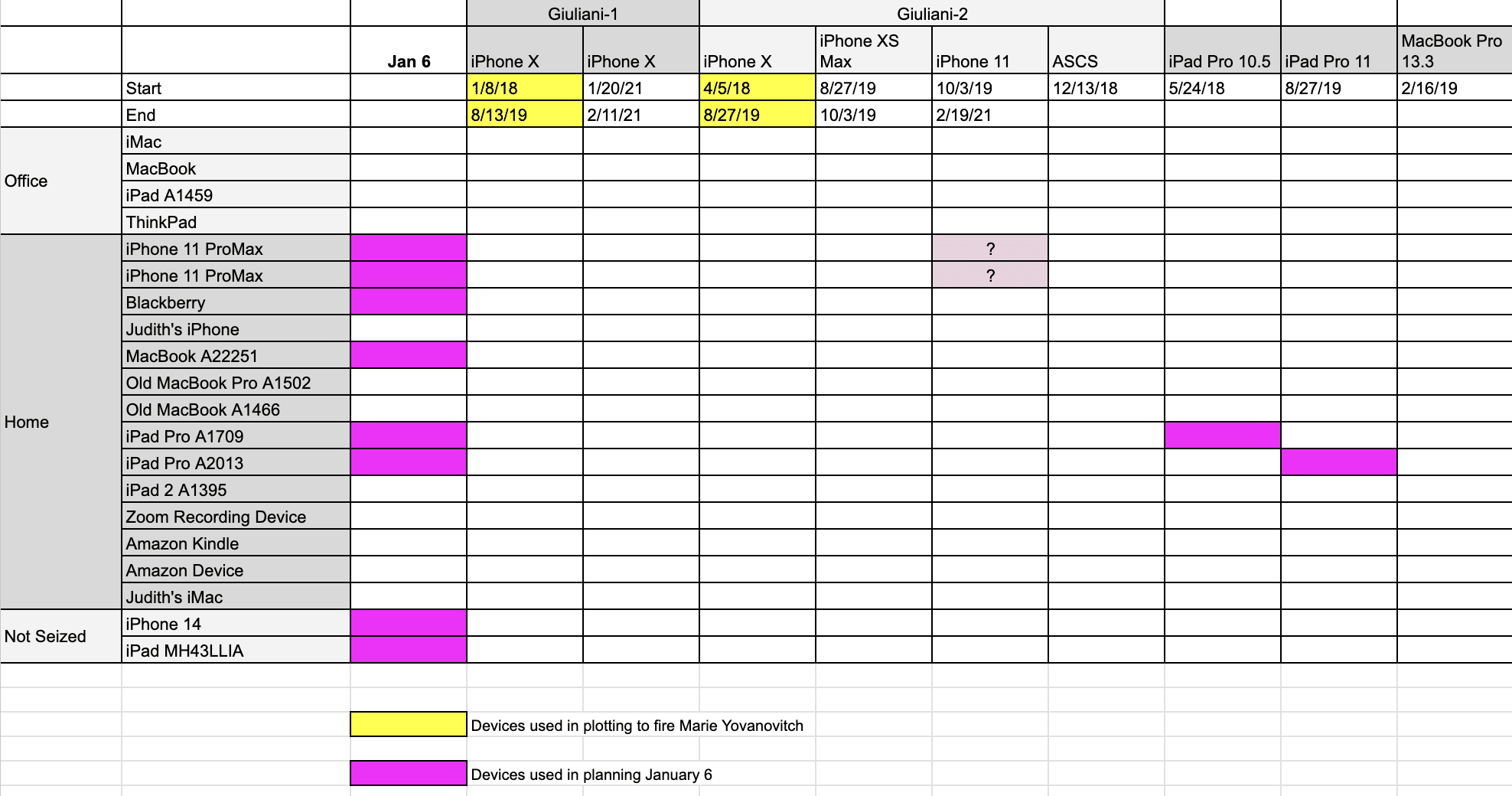
On April 28, 2021, the FBI seized up to 18 devices from Rudy Giuliani. On Tuesday, DOJ unsealed the affidavit behind that seizure.
The affidavit, read in conjunction with Barbara Jones’ Special Master reports, Rudy’s privilege log from the Ruby Freeman lawsuit, and a filing he submitted in that suit provide abundant evidence that the devices FBI seized on April 28, 2021 were more useful for investigating January 6 than any suspected FARA violations involved in the firing of Marie Yovanovitch.
And this goes well beyond Robert Costello’s claim that a number of the devices seized from Rudy were corrupted.
The affidavit, as written, was narrow: it only covered FARA violations tied to the role of Yuriy Lutsenko and other Ukranians in the firing of Ambassador Yovanovitch in spring 2019. While there is evidence cited in the affidavit from a broad period of time (for example, describing Rudy’s public admissions that he did certain things in early 2019 later that year), the last overt act described in the affidavit is of someone — probably Victoria Toensing — texting Rudy on May 9, 2019, complaining that people were asking about whether she had registered under FARA and denying that she had a client.
Remarkably, then, the affidavit asked for — and Judge Paul Oetken authorized — the authority to seize “any and all” devices at Rudy’s office and home almost two years after that last overt act.
Judge Oetken authorized that search and seizure even though one of the phones described in the affidavit — an Apple iPhone X that Rudy first started using on January 20, 2021 — could not possibly have been used in the suspected crime described in the affidavit. And three more of the devices described in it, including another iPhone, were only put in use later in 2019.
I’ve long argued that by September 2021, DOJ at least contemplated obtaining other warrants to access that content (because SDNY successfully argued to do the privilege review on all content that post-dated January 1, 2018). But given the scope of those devices, it looks likely that there was at least one other affidavit presented to Oetken in April 2021, one that would justify seizing those later devices.
This table shows (on the vertical axis) the devices that Rudy says were seized and (on the horizontal axis) the devices that FBI thought they’d find.
While Rudy’s own description of these devices (including the model number of the MacBook used in planning January 6, here listed as A22251) is as unreliable as everything else about him, the FBI didn’t find the two iPhone Xes — one used between January 8, 2018 and August 13, 2019, the other used between April 5 2018 and August 27, 2019, both marked in yellow above — that would have been Rudy’s primary phones during the events described in the affidavit.
Just three devices — two iPads and one iPhone 11 — clearly match the description of what the FBI expected to find.
All of them were, according to Rudy’s description (marked in the vertical “January 6 column”), among those used in planning January 6.
Whichever iPhone 11 they did find is almost certainly device that Special Master Jones labeled as device 1B05, the privilege review of which she described this way:
I next assigned for review the chats and messages that post-dated January 1, 2018 on Device 1B05, which is a cell phone. There were originally 25,481 such items, which later increased to 25,629 after a technical issue involving document attachments was identified. An initial release of non-designated items was made to the Government’s investigative team on November 11, 2021.1
Of the total documents assigned for review, Mr. Giuliani designated 96 items as privileged and/or highly personal. Of those 96 designated items, I agreed that 40 were privileged, Mr. Giuliani’s counsel withdrew the privilege designation over 19, and I found that 37 were not privileged. I shared these determinations with Mr. Giuliani’s counsel, and they indicated that they would not challenge my determination that the 37 items are not privileged. The 40 privileged documents have been withheld from the Government’s investigative team and the remaining 56 were released on January 19, 2022.
1 Additional non-designated items were released on January 19, 2022.
Those 25,000 chats were easily the most voluminous content turned over from any one device to the FBI. Of all the chats that Rudy attempted to withhold from that phone, he ultimately only succeeded in withholding 40 items. 40 chats or texts out of 25,000 total.
262 items in Rudy’s privilege log come from that phone. Another 127 come from a device, 1B09, also used to text about January 6 (including with Mark Meadows), which — given the date scope — must have been among the first devices Jones reviewed. That’s one possible source of a Ken Chesebro document included in the indictment but not identified in the January 6 Report.
And while Rudy withheld those documents from Ruby Freeman, since Jones only permitted Rudy to withhold 43 items total from DOJ, those must have been deemed non-privileged in the Special Master review. (I’ve noted before that there are easily 40 items that clearly relate to Rudy’s own lawyers.)
They were all turned over to DOJ, for use with whatever investigative teams had obtained warrants to access them, no later than January 21, 2022.
This is one thing Rudy accomplished by defaulting on discovery: Withholding from Ruby Freeman, and therefore from a public trial that would precede Republican primaries, documents that were turned over to DOJ in January 2022.
By April 2021 when — using warrants approved on Lisa Monaco’s first day on the job, but nevertheless a year after Bill Barr started obstructing this investigation — the FBI came looking for devices involved in Rudy’s suspected FARA violations tied to getting Marie Yovanovitch, they didn’t find the devices he would have been using at the time.
They did, however, find three devices on which Rudy planned January 6. And because of the way DOJ did the privilege review on those devices, those records would have been made available to any investigators with a lawful warrant no later than January 21, 2022.
In the last few months, NYT asked to and did liberate the warrants in the Lev Parnas investigation and the expansion of the investigation into Rudy Giuliani on Lisa Monaco’s first day on the job.
The Rudy warrants are very tidy. They include:
The Parnas warrants are a godawful mess — the digital equivalent of someone throwing 1,000 pages incorporating 30 or so documents on the floor, intermixing them all, thereby confusing where one document begins and the next ends. Here’s what just half look like: SDNY repeatedly split affidavits across multiple documents.
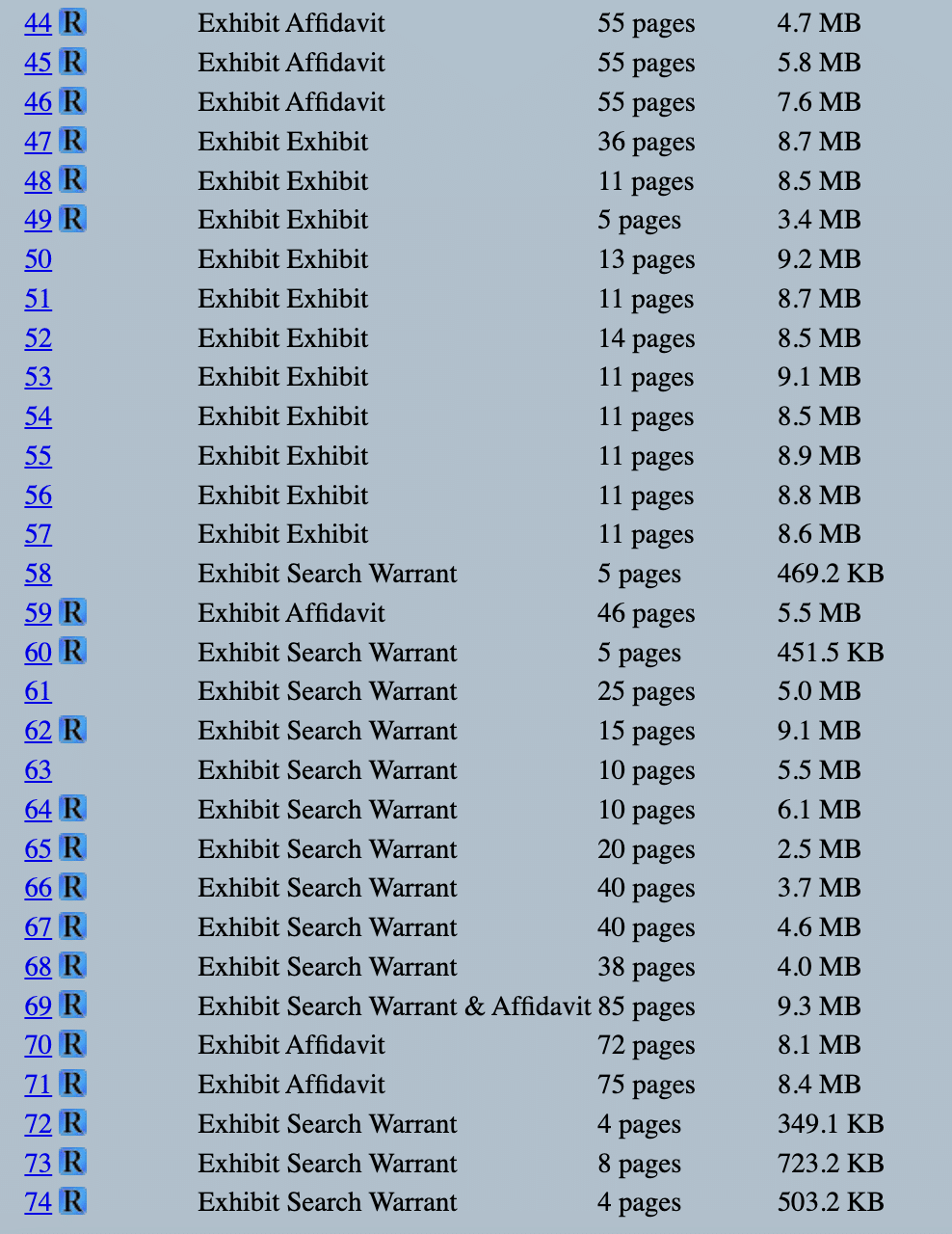
Bad words have been said in the Wheeler home today as a result.
Very bad words. And loudly.
For now, these two affidavits regarding Parnas provide a key introduction:
I suspect the Parnas docket may look like it does to obscure what happened to the investigation when Barr intervened. Notably, while both sets of warrants make it clear that the Bidens were part of the project, there is much less focus on it in the Rudy warrants.
All that said, reviewing the Rudy affidavit, I have zero doubt — zero — that this affidavit was intended to obtain content for more than just the Foreign Agent investigation into Rudy. I was always confident that DOJ had set up that possibility (relatedly, former DOJ spox Anthony Coley pointed to this Politico story as proof that Garland nay-sayers have always been wrong), but there are several signs in this affidavit (which I’ll return to) that was the idea.
That said, as I reported, many of the devices seized with the Rudy warrant were corrupted, making them useless for any investigation.
The reason I have so little patience for NYT’s decision to dedicate the resources of three senior reporters to warn about the dangers of a second Trump term is not that I disagree about the second term. They’re right that it would be far worse.
It’s that the same reporters continue to downplay Trump’s past corruption — some of which Maggie Haberman specifically enabled — and outright ignore the ongoing effects of it.
Imagine how much healthier American democracy would be if the NYT dedicated just half of the time and space that went into the eight, often repetitive stories on this topic to instead lay out how the ongoing effort to impeach Biden is a continuation of Trump’s efforts, made with the assistance of men now deemed to be Russian spies by both the US and Ukraine, to frame Joe Biden?
NYT appears not to have assigned a single reporter to chase down the following allegations that have come out of the GOP impeachment effort:
In short, basic reporting on Republican efforts to impeach Biden show that it, along with key parts (though not necessarily all) of the investigation into Hunter Biden, are simply a continuation of an effort Trump started in 2018 to frame Joe Biden. That is an effort that involved people that both the US and Ukraine have labeled as Russian spies.
Aside from some key articles (linked above), NYT has covered none of this.
Instead, NYT claims the exact opposite. It claims that the effort to gin up a criminal investigation into Joe Biden didn’t succeed.
And neither effort for which he was impeached succeeded. Mr. Trump tried to coerce Ukraine into opening a criminal investigation into Mr. Biden by withholding military aid, but it did not cooperate.
It’s right there, the full-time pursuit of three different House committees, ongoing, with an FD-1023 about Zlochevsky’s changed claims about Biden and Bobulinksi’s FBI report that seems to have close ties to Trump (in which Bobulinski was represented by a known Maggie Haberman source).
NYT tells you the first term wasn’t that bad, because Trump’s efforts failed. Yet what failed was NYT’s reporting on ongoing events.
NYT tells this fairy tale even as they continue to whitewash Bill Barr’s efforts. In a recent 4,000-word story, in which they claimed that the commutation of Jonathan Braun’s sentence “stood out” more than the pre-trial pardon of Steve Bannon issued the same day, NYT gives Barr two paragraphs to claim he tried to clean up pardons.
William P. Barr, a Trump attorney general who had left by the time of the Braun commutation, said when he took over the Justice Department he discovered that “there were pardons being given without any vetting by the department.”
Mr. Barr added that he told Trump aides they should at least send over names of those being considered so the department could thoroughly examine their records. While the White House Counsel’s Office tried to do so, the effort fell apart under the crush of pardon requests that poured in during the final weeks before Mr. Trump left office, according to people with direct knowledge of the process.
It is true that of the eight pardons given before he arrived, there were some doozies, including Joe Arpaio, Dinesh D’Souza, Scooter Libby, and the ranchers whose arson cases sparked the Malheur occupation.
But Barr was utterly complicit in the most abusive pardons Trump gave. Less than two months after he was confirmed based off repeated assurances that giving a pardon in exchange for false testimony was obstruction, Bill Barr wrote a memo declining to prosecute a crime in process, the effort to use pardons to ensure that Paul Manafort, Roger Stone, Mike Flynn, and others continued to lie to cover up Trump’s ties to Russia in the 2016 campaign. The Barr memo did not once mention pardons, even though that was a key thrust of the second volume of the Mueller Report (something Charlie Savage has also noted).
Of course, NYT joins Barr in that complicity. This story finally mentions one of those pardons in its discussion of Trump’s abuse.
His lawyers floated a pardon at his campaign chairman, whom Mr. Trump praised for not “flipping” as prosecutors tried unsuccessfully to get him to cooperate as a witness in the Russia inquiry; Mr. Trump later did pardon him.
But it does not mention that Manafort specifically lied about why he briefed Konstantin Kilimnik campaign information, an act that the Intelligence Community later stated as fact resulted in the sharing of campaign information with Russian intelligence. This is a topic about which NYT has a still uncorrected story, hiding the tie to Oleg Deripaska.
It’s not that Trump pardoned Manafort for “not flipping.” It’s that he pardoned Manafort after he lied about why the campaign manager shared information that Russian spies could use in their attack on US democracy.
And the very link NYT relies on here mentions the Stone pardon, a commutation and then pardon that halted a still ongoing CFAA conspiracy investigation between Trump’s rat-fucker and the Russians (another detail NYT has never reported).
Yes, I absolutely agree. A second Trump term would be worse.
But repeating that, over and over, even while misinforming readers about the ongoing five year effort to frame Joe Biden is not the best way to prevent a second term.
Darren Samuelsohn had a hilarious passage in his version of a story contemplating the prospect of Trump using his second term to seek revenge.
To his credit, unlike the NYT and WaPo versions of this story, he acknowledges that Trump already did this. He even manages to address maybe a quarter of the times when Trump did so, though always missing key details. For example, he describes that Trump fired Jim Comey as revenge, which led to the Mueller investigation.
Consider the firing of James Comey, who the president ousted less than four months into his first term following the FBI director’s public testimony that confirmed an active bureau investigation on potential collusion between Russia and the 2016 Trump campaign. The president’s move there ignited a chain of events leading to Special Counsel Robert Mueller’s appointment, which kept Trump’s White House stuck playing defense for a giant chunk of their four-year term and resulted in a costly series of guilty pleas, legal trials and court convictions for Trump associates that gave way to a series of controversial presidential pardons.
Samuelsohn even mentions “controversial” pardons! — if only in passing. But he doesn’t mention Trump’s concerted demand to prosecute Comey as a result, or the IRS investigation of Comey and Andrew McCabe that the IRS claims was just a wild coincidence.
The funny part is where Samuelsohn describes Rudy Giuliani’s efforts to dig up dirt on Joe Biden as something that, like the Comey firing, led to backlash: impeachment.
Another Trump personal lawyer, Rudy Giuliani, sparked the first House impeachment of the president in the aftermath of his mission to conjure up an investigation of the Biden family in Ukraine.
But then two topics — the Durham investigation and Trump’s revenge against Tom Emmer for voting to certify the 2020 election — and two paragraphs later, Samuelsohn introduces Abbe Lowell’s attempt to subpoena Trump as “another front.”
Or on another front, Hunter Biden’s lawyers earlier this month asked for a federal court’s permission to subpoena Trump, Barr and other senior Trump-era DOJ officials as they argue against “a vindictive or selective prosecution arising from an unrelenting pressure campaign beginning in the last administration, in violation of Mr. Biden’s Fifth Amendment rights under the Constitution.”
This is not “another front”! This is confirmation that the effort attributed here to Rudy continues to this day, is a central factor in the 2024 election to return to the White House.
As I noted, the requested subpoenas specifically ask for communications with, “attorney for President Trump (personal or other),” and the request for communications, “discussing any formal or informal investigation or prosecution of Hunter Biden,” should cover any copy of the Perfect Phone Call to Volodymyr Zelensky that Trump might have in his personal possession.
The subpoena is a request for records showing the tie between Rudy’s efforts and the still ongoing investigation into Hunter Biden, which has since morphed into the rationale for Republicans’ own impeachment stunt.
The tie is not imagined. Among other things, Lowell points to records showing then-PADAG Richard Donoghue scheduling a briefing with David Weiss’s team on October 23, 2020. The briefing transferred the FD-1023 created as a result of Bill Barr’s effort to set up an intake process for the dirt Rudy obtained from Russian agents and others.
In fact, all the details of the investigation that Joseph Ziegler has shared raise questions whether there would ever have been a Hunter Biden grand jury investigation were it not for the dirt Ukrainians — possibly downstream of and ultimately directly tied to Rudy’s efforts to obtain dirt on Hunter Biden — shared with DOJ in 2019.
To be sure, Ziegler claims credit.
In his original testimony to House Ways and Means, Zeigler described that he decided to investigate the former Vice President’s son based off a Suspicious Activity Report tied to a social media site involving sex workers. From there, he read about Hunter’s contentious divorce. And from that he decided to launch a criminal investigation.
I started this investigation in November of 2018 after reviewing bank reports related to another case I was working on a social media company. Those bank reports identified Hunter Biden as paying prostitutes related to a potential prostitution ring.
Also included in those bank reports was evidence that Hunter Biden was living lavishly through his corporate bank account. This is a typical thing that we look for in tax cases — criminal tax cases, I should say.
In addition, there was media reporting related to Hunter Biden’s wife, ex-wife, divorce proceedings basically talking about his tax issues. And I wanted to quote some of the things that were said in her divorce filing which was public record.
“Throughout the parties’ separation, Mr. Biden” — referring to Hunter Biden — “has created financial concerns for the family by spending extravagantly on his own interests, including drugs, alcohol, prostitutes, strip clubs, gifts for women with whom he had sexual relationships with, while leaving the family with no funds to pay legitimate bills.
“The parties’ outstanding debts are shocking and overwhelming. The parties have maxed-out credit card debt, double mortgages on both real properties they own, and a tax debt of at least $300,000.”
This is all the information that I had in my hand in November when I wanted to open this investigation.
His supervisor, Matt Kutz, treated the investigation of the former Vice President’s son as a sensitive matter and demanded more evidence before letting Ziegler open the investigation.
After discussing the case with my previous supervisor at the time, Matt Kutz, he made a decision to look into the case further before sending it — sending the case up for referral.
[snip]
My manager at the time told me, “No, you cannot do that. That’s a tax disclosure issue.” I didn’t agree with him because there’s been multiple instances where we do that. That’s a normal part of our job. But he was my manager, and I wasn’t going to fight him on it, and he told me that I had to open this up the normal tax administrative way that we would do [for] these cases.
[snip]
[H]e said a political family like this, you have to have more than just an allegation and evidence related to that allegation. In order for this case to move forward, you basically have to show a significant amount of evidence and similar wrongdoing that would basically illustrate a prosecution report.
So he’s basically telling me that I have to show more than just non-[filed] tax returns and the information from the ex-wife in the divorce proceedings.
During Democrats’ questioning, Ziegler described how persistent were his efforts to find some basis to open an investigation into Hunter Biden.
Mr. [Ziegler]. My initiation packet, so sending the case forward to get — we call it subject case. It’s an SCI. It’s elevating the case to actually working the investigation.
My first one showed the unfiled returns and the taxes owed for 2015 and that was it on my first package. So that was the wrongdoing that we were alleging.
And my supervisor goes: You don’t have enough. You need to find more.
So I kept digging for more and more. And even after that point, he goes: You haven’t found enough.
So I ended up searching bank reports that [I] ran on the periphery of what we were looking at.
So I ran bank reports for Burisma, and in those bank reports I had found additional payments that Hunter had received. And then at that point I had found that Hunter did not report the income for 2014 related to Burisma.
So now I had a false return year. So that alone — it was basically so much evidence that I put in there — allowed us to elevate the case.
It took Ziegler three attempts before he was able to show enough evidence of wrong-doing that Kutz would agree to send the referral to DOJ Tax. That’s what led to the decision — at first, Ziegler attributed the decision to Bill Barr personally, though subsequently retracted that claim — to merge his IRS investigation with one Delaware had opened in January 2019.
So after three of these initiation packages, he finally allowed me to push this forward to DOJ Tax for their review.
So the way that our grand jury cases — or the way — I’m sorry. The way that our cases work is when the case is referred from IRS to DOJ Tax, the case has to go through our ASAC and SAC, and then it goes to DOJ Tax where they review and approve it and send it to the appropriate venue or jurisdiction.
So in [or] around March or April of 2019, the case went up to DOJ Tax.
And at that time we were told that William Barr made the decision to join two investigations together. So at that point in time I had found out that Delaware had opened up an investigation related to the bank reports and that that occurred in January of 2019, so 2 months after I started mine.
So when I found out about their case and was told that we had to merge the two, I did a venue analysis. I showed them that, “Hey, the venue’s in D.C. It’s not in Delaware. We need to work this in D.C.” But, ultimately, I was overruled, and it was determined to send the case, join the two case together, and work everything under Delaware. [my emphasis]
Here and elsewhere, Ziegler (working from memory) obscures details of this timeline: about when he came to learn of the Delaware investigation and when he submitted his finalized package for DOJ Tax.
In an email Ziegler sent in April 2019, though, he memorialized that, “Approx. February 2019 — My SSA advised me about the Delaware USAO looking into Robert Doe subsequent to the [Suspicious Activity Report]” on which Ziegler himself had predicated his investigation. That same email described submitting the package to DOJ Tax on April 12, 2019.
Two weeks later, his supervisor relayed the news that the case would end up in Delaware.
Jason Poole telephoned me and advised after inter‐department discussions well above his level, it is highly likely the Robert Doe case will go to the Delaware USAO for investigation.
So while Ziegler may have decided to pursue the former Vice President’s son based on payments to sex workers and divorce records before Delaware opened an investigation, DOJ Tax had not even considered whether this merited a criminal investigation until April 2019, at which point someone high up — possibly even the Attorney General himself — decided Delaware would oversee the case.
By that point, Delaware had been investigating for up to three months, and Ziegler had known that for two months.
That’s important because, if we can believe Johnathan Buma (I raised some cautions about his claims here), the FBI got a tip about Hunter Biden from two Ukrainians with ties to that country’s Prosecutor General’s Office in January 2019.
In January, 2019, DYNAMO, ROLLIE and THE ECONOMIST were taken to the US Attorney’s Office in downtown Los Angeles, where they presented severd of these schemes to an Assistant United States Attorney (AUSA), who was interested in pursuing money laundering cases in violation of the FCPA, which implicated US entities or persons. THE ECONOMIST’s presentation included detailed information concerning several multi-million and multi-billion dollar schemes. The information was based on an extrapolation of open-source information from Ukraine, as well as insight from THE ECONOMIST’s consulting work in the PGO and ROLLIE’s foundation. One of the described scenarios alleged Hunter Biden (Hunter) had been given a lucrative position on the board of directors of the energy company, Burisma Holdings Limited (Burisma), and was likely involved in unreported lobbying and/or tax evasion.
This approach from people affiliated with Ukraine’s Prosecutor General’s Office (my earlier post provides descriptions of those ties) came months after Rudy Giuliani first tasked Lev Parnas with finding this dirt in November 2018 and after Trump had gotten personally involved.
Later that month [on December 6], I attended a Hanukkah celebration at the White House where Giuliani and Trump were both present. Trump approached me briefly to say, “Rudy told me good things. Keep up the good work.” Then he gave me a thumbs-up in approval.
By January 2019, Parnas was in communications with both Viktor Shokin and Yuri Lutsenko, both of whom might have had ties to Rollie and the Economist. On January 26, Lutsenko shared a package of information on Burisma that, again, has similarities to what Rollie shared that same month.
According to Buma, sometime after the January 2019 presentation Rollie and The Economist made to the Los Angeles US Attorney’s Office, Buma submitted an FD-1023 about their package and spoke to two FBI case agents located in Baltimore on the already ongoing investigation into Hunter Biden about it.
After receiving the presentation from ROLLIE and THE ECONOMIST, THE ECONOMIST provided me a thumb drive with some supporting documentation, much of which was in the Ukrainian language, which I do not speak. After I submitted my FD-1023 reports on this information, I was put in touch with two agents working out of the Baltimore office on a case based in Delaware involving Hunter. I spoke on the phone with these agents, who were very interested in the information due to its relation to their ongoing investigation that was mostly involving allegations of Hunter’s involvement with drugs and prostitution. Information derived from ROLLIE and THE ECONOMIST had previously been found to be credible, so this was handled carefully and quickly transferred over to the agents in Baltimore and was serialized in their case file.
As Buma described it, by the time this information showed up in the press, it had become clear that Rollie and the Economist shared the information for influence purposes tied to Joe Biden’s run for the presidency, not law enforcement.
[T]he derogatory information concerning the Bidens and Burisma quickly emerged in domestic US. media, suggesting that it was being provided for political influence rather than law-enforcement purposes.
But that didn’t prevent the Ukrainians from being invited, some time after June 26, 2019, to attend an event associated with the White House at which Rollie gave Mike Pompeo the same package of derogatory information on Hunter Biden. And somewhere along the line, Buma’s primary source who introduced them to the Los Angeles US Attorney’s Office had direct contact with Rudy Giuliani.
The precise relationship between Rollie and The Economist and Rudy’s efforts, started month earlier, remains obscure. But both had begun well before Ziegler’s pitch to DOJ Tax to investigate Hunter Biden criminally, and it’s likely that Delaware had the FD-1023 from the Ukrainians before DOJ Tax approved the investigation.
And by that point, in April 2019, Ziegler’s supervisor — the same guy who insisted he needed more than payments to sex workers to open an investigation into a politically sensitive figure — started documenting the demands for just such an investigation.
Around the same time in 2019, I had emails being sent to me and the Hunter — and the prosecutors on the case, the Hunter Biden prosecutors, from my IRS supervisor. So this was Matt Kutz still.
From what I was told by various people in my agency, my IRS supervisor, Matt Kutz, created memos which he put in the investigative files regarding the investigation potentially violating the subject’s Sixth Amendment rights. He also referred to Donald Trump’s tweets at the time.
[snip]
Q Okay. You’re talking about 2019. You were mentioning the fact that there was a George Murphy that was writing memos or emails and documenting some of his conclusions that were on the other side regarding this case.
Could you tell us more about him? What’s his title and who is he and how does he relate to you in terms of your chain of command?
A So it was actually Matthew Kutz. He was my supervisor at the time and from the articles that he was sending me, I would say he had more of a liberal view than I had and it was pretty obvious from the things he would send me and discuss. And that’s just me making an observation.
So I later found out about these memos that were put in the file regarding the issues that he saw with the investigation, the fact that we even had it opened. So I only learned about those after. And then it came to a point to where he’s sending us so many media articles about different issues that I had to tell him stop, please.
And I had to go around him. And that’s when I went to my ASAC at the time, George Murphy, who was above him.
MAJORITY COUNSEL 2. Off the record.
MAJORITY COUNSEL 1. Off the record. [Discussion off the record.]
MAJORITY COUNSEL 1. On the record.
Mr. [Ziegler]. So these articles were a lot about — were a lot of articles regarding Trump and getting a fair investigation and things related to that, Trump’s tweets and stuff like that. So, that’s what drew me to my conclusion.
BY MINORITY COUNSEL 1: Q What was the purpose behind him sending you the Trump tweets? What was he trying to get at, or was he trying to give you more information for your case? Why would he send those, or do you know?
A Yeah, I think he was bringing up concerns with potentially us prosecuting the case down the road, potential issues we’re going to incur. I don’t remember the exact email that he sent that caused me to be — that he had to stop sending me some of the news articles, because it wasn’t even the fact that he was sending me these news articles. It was the opinion he was providing in those emails that I did not agree or that I did not — not agree with but did not think was appropriate.
Gary Shapley replaced Kutz in 2020 — possibly because Kutz insisted on documenting the demands from the President for Ziegler’s thinly-predicated investigation — around the same time Bill Barr set up a means to ingest Rudy’s dirt.
But in 2019, Kutz was documenting in real time the problem with pursuing the son of Donald Trump’s opponent while Donald Trump demanded such investigations via Tweet.
It’s in the case file.
Trump’s demands for an investigation into Hunter Biden were deemed by the IRS SSA to be problematic influence on the case in 2019. Yet that investigation continues, now bolstered by Special Counsel status, and is the basis for the GOP impeachment pitch.
Samuelsohn’s rag has a reporter, Stephen Neukam, covering the GOP impeachment stunt almost half time (though Neukam apparently hasn’t bothered to cover the Scott Brady testimony that lays out even more details of how Barr set up a means to filter Rudy’s dirt into the Hunter Biden investigation, evidence that — contra Ziegler — Barr was “weigh[ing] in, or seek[ing] updates on the investigation after those cases were joined”). Barr has confirmed, on the record, knowledge of how information was shared from Brady to Weiss.
Yet Samuelsohn describes Rudy’s intervention as something past, something unrelated to the future prospect of Trump ordering up investigations into his rivals.
You cannot understand the GOP impeachment pitch — you cannot claim to be doing journalism on the Republican effort to impeach Hunter Biden’s father — unless you understand the ties between Rudy’s efforts and the Hunter Biden investigation.
You can write all you want about how institutional guardrails might stymie Trump’s efforts to politicize DOJ in the future. But if you gloss over evidence that those guardrails failed in Trump’s past Administration, if you ignore how Trump’s success at politicizing DOJ continues to have repercussions to this day — indeed, continues to be a central issue in the election — then you’re not really addressing the threat Trump poses, past and future.
Update: Fixed date of October 23 briefing.