Posts

Trump’s File B-076: Calvinball Ping Pong

I spent part of last weekend attempting to understand how Judge Cannon might explain throwing out Raymond Dearie’s work plan (which included a rolling process designed to finish up by November 30). This is what I came up with (by all means please let me know if I’ve made errors, but otherwise, don’t invest too much in this because the big takeaway is that Judge Cannon is playing Calvinball, so the current rules mean little).

What Cannon appears to have done is with no formal notice of what the deadline was or even that ten plus five was no longer operative, treat Dearie’s September 23 filing as his final action in setting the plan, but along the way use her own five day deadline for complaints instead of the September 27 deadline Dearie gave, which is the only way Trump’s temporal complaint would be timely yet have her order not be days premature.

The next day, with no notice of any new deadline, Cannon issued her order throwing out most of Dearie’s plan. I’ve spent hours and days looking at this, and there’s no making sense of the deadlines. Certainly, this could not have happened if any of Dearie’s deadlines had been treated as valid.

DOJ took a look at what Cannon had done and moved the 11th Circuit to accelerate the review process. They cited a number of reasons for the change in schedule. They described that Cannon sua sponte extended the deadline on the review to December 16.

On September 29, subsequent to the parties’ submission of letters to Judge Dearie, the district court sua sponte issued an order extending the deadline for the special master’s review process to December 16 and making other modifications to the special master’s case management plan, including overruling the special master’s direction to Plaintiff to submit his designations on a rolling basis.

Depending on how you make sense of Cannon’s Calvinball deadlines, it was a sua sponte order, because Trump’s complaint about the deadlines (not to mention his complaints generally) came in after the deadline attached to the Dearie plan that Cannon seems to treat as his final official action.

I think what really happened is that Cannon fired Dearie without firing him in response to being told by the 11th Circuit she had abused her authority, ensuring not only that nothing he decides will receive any consideration, but also ensuring that he has almost no time to perform whatever review role he has been given.

Effectively, Judge Cannon has just punted the entire process out after the existing appeals schedule, at which point — she has made clear — she’ll make her own decisions what government property she’s going to claim Trump owns.

I believed, when I wrote that a week ago, Judge Dearie would have no real say in the process until November 14 (see the timeline below), after Trump had made designations on all the seized documents and then spent ten days fighting over those designations with DOJ.

I don’t know what Dearie thought, but on October 4 — one day after receiving the designations from the filter team materials, five days after Cannon’s order — he canceled a scheduled October 6 status hearing, citing the order.

Then, yesterday, he had a say, issuing an order in response to the filter team designations he received on October 3. The order did the following:

  • Reveal a set of about 35 pages of Category A files that Trump had raised no attorney-client privilege over (marked in turquoise below)
  • Ordered the Privilege Review Team to provide those files to the Case Team by October 10 so they can review Trump’s Executive Privilege and Presidential Records Act claims
  • Indicated he would “promptly issue a report making recommendations” about Trump’s attorney client privilege claims as to the remaining Category A and Category C documents
  • In fact of a dispute over whether Dearie should make a privilege designation on file B-076, confirmed there was no dispute about the document in question because Trump made no privilege claim over it
  • Ordered DOJ to return the originals of all the Category B documents to Trump by October 10, including file B-076
  • Set a status hearing for October 18

As I laid out here, Category A documents are government documents involving some legal issue. Category B documents are the personal documents (including those pertaining to Trump’s health, taxes or accounting) that DOJ proposed returning 38 days ago. Category C is a new category, possibly limited to this document turned over to the filter team after the initial filter team inventory was completely,

On Monday, September 26, counsel for the Privilege Review Team provided Plaintiff’s counsel with another example of filter failure. The email in question was identified by the “FBI case team,” and returned to the Privilege Review Team, which is characterizing the communication as non-privileged. Plaintiff believes the email falls squarely into the category of attorney-client privileged.

Possibly it includes different kinds of documents (such as the call logs) that don’t precisely fit the other two categories.

Here’s what we know of the designations so far, with turquoise being things Dearie cleared to share with the Case Team. (I’ve marked items Trump has claimed no privilege over with an N, items he has claimed privilege over parts of with a P, items that he must be claiming privilege over with a Y, and used question marks for items that, because of the additional category, I’m not certain about.)
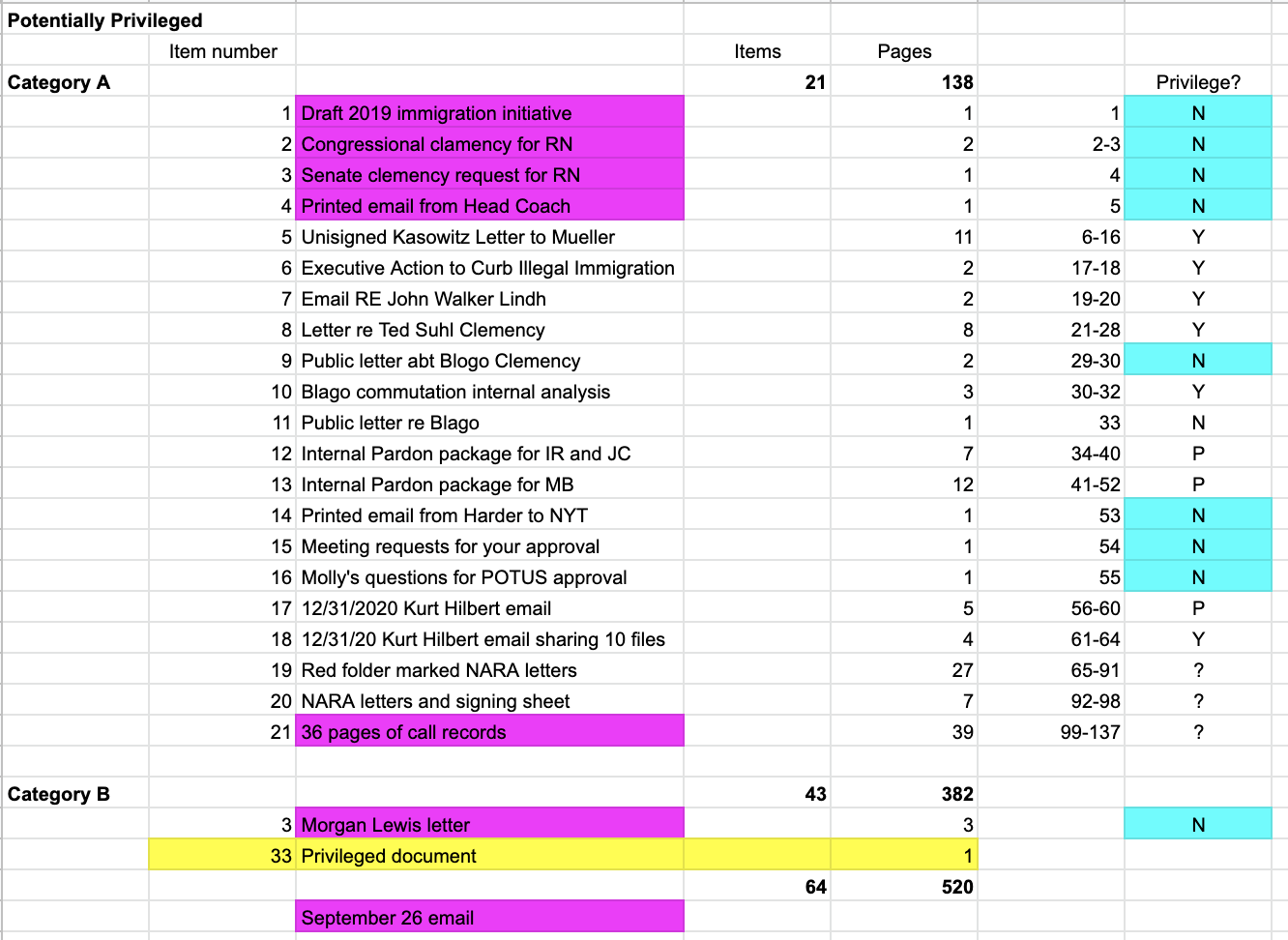
 

Here’s what happens next, best as I can tell according to the rules of Calvinball.

First by Monday, DOJ will give all the original documents in Category B back. That seems to comply with Judge Cannon’s plans, because according to Judge Cannon’s original order, if both sides agree on the privilege designation for a file, it “shall be handled in accordance with the parties’ agreement.”

If the Privilege Review Team agrees with Plaintiff’s position, the subject document shall be handled in accordance with the parties’ agreement. If the Privilege Review Team disagrees with Plaintiff’s position, the dispute shall go to the Special Master for a report and recommendation and, if either party objects to the report and recommendation, to the Court for de novo review and decision. Failure to object to a report and recommendation within five (5) calendar days shall result in waiver of that objection.

Both sides say Trump should have the originals, and by Monday — a federal holiday — Trump will have the originals back. As I’ve written, that will eliminate one of the harms that Judge Cannon deliberately inflicted on Trump in order to justify getting involved.

It’s the other part of the order I find more interesting: If someone objects to what Dearie has done, they’ve got five calendar days — so until October 12 — to complain to Cannon so she can overrule Dearie.

One side has complained about what Dearie did to not make a privilege determination on B-076, because there’s no dispute: Trump has not claimed privilege over it. Making the determination wasn’t controversial. Rather, deciding to make the determination at all is what one side has complained about.

Document B-076 is a one-page document from Morgan Lewis, the law firm involved in Trump’s taxes.

It’s significant because the duplicate (item 3, which is four copies of the same one-page letter) is one basis for Judge Cannon’s claim that DOJ had made a filter failure. Here’s how the filter team has described it.

An additional seventh box was transferred to the custody and control of the Privilege Review Team agents on August 10 ,2022, after a Case Team agent observed a document on Morgan Lewis letterhead comingled with newspapers.6 Consistent with the filter protocol set forth in the Affidavit, the Case Team stopped its review of the entire box and provided it to the Privilege Review Team agents to conduct a review to identify and segregate potentially privileged materials.

6That document is item Number 3 in Exhibit B (FILTER-B-065 to FILTER-B-068). Also contained within the seventh box were Item Numbers 1 to 4 in Exhibit A (FILTER-A-001 to FILTER-A-005), which the Privilege Review Team agents identified as potentially privileged after receiving custody and control of the box.

And here’s how Judge Cannon used that document (among others) to claim both that Trump was being deprived of personal tax documents and that the filter process had failed.

According to the Privilege Review Team’s Report, the seized materials include medical documents, correspondence related to taxes, and accounting information [ECF No. 40-2; see also ECF No. 48 p. 18 (conceding that Plaintiff “may have a property interest in his personal effects”)]. The Government also has acknowledged that it seized some “[p]ersonal effects without evidentiary value” and, by its own estimation, upwards of 500 pages of material potentially subject to attorney-client privilege [ECF No. 48 p. 16; ECF No. 40 p. 2]

[snip]

Review is further warranted, as previewed, for determinations of privilege. The Government forcefully objects, even with respect to attorney-client privilege, pointing out that the Privilege Review Team already has screened the seized property and is prepared to turn over approximately 520 pages of potentially privileged material for court review pursuant to the previously approved ex parte filter protocol [ECF No. 48 p. 14]. In plain terms, the Government’s position is that another round of screening would be “unnecessary” [ECF No. 48 p. 22]. The Court takes a different view on this record.

To begin, the Government’s argument assumes that the Privilege Review Team’s initial screening for potentially privileged material was sufficient, yet there is evidence from which to call that premise into question here. See In re Sealed Search Warrant & Application for a Warrant by Tel. or Other Reliable Elec. Means, 11 F.4th at 1249–51; see also Abbell, 914 F. Supp. at 520 (appointing a special master even after the government’s taint attorney already had reviewed the seized material). As reflected in the Privilege Review Team’s Report, the Investigative Team already has been exposed to potentially privileged material. Without delving into specifics, the Privilege Review Team’s Report references at least two instances in which members of the Investigative Team were exposed to material that was then delivered to the Privilege Review Team and, following another review, designated as potentially privileged material [ECF No. 40 p. 6]. Those instances alone, even if entirely inadvertent, yield questions about the adequacy of the filter review process.13

13 In explaining these incidents at the hearing, counsel from the Privilege Review Team characterized them as examples of the filter process working. The Court is not so sure. These instances certainly are demonstrative of integrity on the part of the Investigative Team members who returned the potentially privileged material. But they also indicate that, on more than one occasion, the Privilege Review Team’s initial screening failed to identify potentially privileged material. The Government’s other explanation—that these instances were the result of adopting an over-inclusive view of potentially privileged material out of an abundance of caution—does not satisfy the Court either. Even accepting the Government’s untested premise, the use of a broad standard for potentially privileged material does not explain how qualifying material ended up in the hands of the Investigative Team. Perhaps most concerning, the Filter Review Team’s Report does not indicate that any steps were taken after these instances of exposure to wall off the two tainted members of the Investigation Team [see ECF No. 40]. In sum, without drawing inferences, there is a basis on this record to question how materials passed through the screening process, further underscoring the importance of procedural safeguards and an additional layer of review. See, e.g., In re Grand Jury Subpoenas, 454 F.3d 511, 523 (6th Cir. 2006) (“In United States v. Noriega, 764 F. Supp. 1480 (S.D. Fla. 1991), for instance, the government’s taint team missed a document obviously protected by attorney-client privilege, by turning over tapes of attorney-client conversations to members of the investigating team. This Noriega incident points to an obvious flaw in the taint team procedure: the government’s fox is left in charge of the appellants’ henhouse, and may err by neglect or malice, as well as by honest differences of opinion.”).

In other words, this Morgan Lewis document is one of the central documents to Cannon’s argument that the FBI is not to be trusted, that the investigative team has been tainted, that poor Donald Trump is being deprived of his personal tax records.

And Dearie has now made public that that’s bullshit.

But Trump, who didn’t claim it was privileged, now has the opportunity — by October 12 — to complain to Cannon that his hand-picked Special Master is being mean again.

And that would happen before DOJ submits its merits brief to appeal Cannon’s decision to get involved in the first place, which is due on October 14.

Regardless of the error that the 11th Circuit already ruled Cannon had made by intervening, Dearie has now eliminated much of the claimed harm that Cannon invented to intervene. He has ordered returned all the personal medical and tax documents that Cannon used to claim he was being deprived of very sensitive documents. And he has confirmed that for one of three claimed filter failures — the only one, importantly, pertaining to a non-governmental document — was not a privileged document at all.

Trump could ask Cannon to overrule Dearie for even making that public. But that would make it clear — and public for DOJ’s brief — that Cannon was once again intervening to create a harm she could then invoke to claim a need to intervene.

I don’t know whether under Judge Cannon’s Calvinball rules Dearie was supposed to take these steps at all. But if she wants to override them (again), it’ll make it clear that she’s simply creating harms to excuse her intervention.

Update: Reworded the B-076 language per nedu’s comments.

Timeline

September 29, 2022: Cannon order alters Dearie work plan

September 30, 2022: DOJ motion to extradite 11th Circuit appeal

October 3, 2022; Trump response to 11th Circuit; motion to seal privilege log; original privilege status report unsealed; Potentially privileged material designations submitted (under seal)

October 4, 2022: Trump SCOTUS appeal of part of 11th Circuit decision; Dearie cancels October 6 status hearing

October 5: Vendor selected

October 7: Dearie issues order on filter team materials, sets October 10 and October 20 deadlines (in bold)

October 10: Deadline to return originals of Category B documents to Trump

October 11: DOJ Reply to Trump Emergency Motion at SCOTUS

October 12: Deadline to complain to Cannon about Dearie’s October 7 order

October 13: DOJ provides materials to Trump

By October 14: DOJ provides notice of completion that Trump has received all seized documents

On or before October 14: DOJ revised deadline to 11th Circuit

October 18: Phone Special Master conference

October 19: Original deadline for DOJ appeal to 11th Circuit

October 20: Deadline for disputes about Executive Privilege and Presidential Records Act on filtered material

21 days after notice of completion (November 4): Trump provides designations for all materials to DOJ

November 8: Election Day

November 10, 2022: Trump revised deadline to 11th Circuit

10 days after receiving designations (November 14): Both sides provide disputes to Dearie

November 17, 2022: DOJ revised reply to 11th Circuit

30 days after DOJ appeal (November 18): Original Trump response to 11th Circuit

21 days after Trump reply (December 9): Original DOJ reply to 11th Circuit

December 16: Dearie provides recommendations to Cannon

January 3: New Congress sworn in

No deadline whatsoever: Cannon rules on Dearie’s recommendations

Seven days after Cannon’s no deadline whatsoever ruling: Trump submits Rule 41(g) motion

Fourteen days after Cannon’s no deadline whatsoever ruling: DOJ responds to Rule 41(g) motion

Seventeen days after Cannon’s no deadline whatsoever ruling: Trump reply on Rule 41(g)
Share this entry

After 37 Days, Raymond Dearie Ends the Harm Judge Aileen Cannon Deliberately Inflicted on Donald Trump

As I have written, by her own standards, Aileen Cannon deliberately inflicted harm on Donald Trump in order to justify her intervention in the Trump warrant. On September 5, she ruled that being deprived of his own documents would inflict harm.

being deprived of potentially significant personal documents [] creates a real harm

But on September 1, she refused the request by DOJ’s filter attorneys to return the Category B documents identified in the filter team status update, all the most obviously personal documents seized.

Cannon then pointed to those personal documents in the language justifying her intervention.

The second factor—whether the movant has an individual interest in and need for the seized property—weighs in favor of entertaining Plaintiff’s requests. According to the Privilege Review Team’s Report, the seized materials include medical documents, correspondence related to taxes, and accounting information [ECF No. 40-2; see also ECF No. 48 p. 18 (conceding that Plaintiff “may have a property interest in his personal effects”)].

All of those personal documents were Category B documents.

Cause the harm, then intervene to fix it.

Raymond Dearie has finally ameliorated the harm Judge Cannon was personally responsible for sustaining against Trump since September 1.

Since both sides agreed that DOJ can give back those Category B documents, he ordered DOJ to give back those originals.

The parties also agree that the original Filter B Materials should be returned to Plaintiff. Id. Accordingly, the Court directs the Privilege Review Team to release the original Filter B Materials to Plaintiff by October 10, 2022.

So by October 10, DOJ will finally be able to end the harm that Judge Cannon was sustaining. Altogether, Cannon will have been responsible for at least 37 out of 60 days harm done so far, and possibly as many as 40 days out of 63 days of harm total that she says was done to Donald Trump.

Share this entry

Judge Aileen Cannon Treated a Public Letter about Trump’s Health as More Sensitive than America’s National Security

As I have shown, had Judge Aileen Cannon left well enough alone, the government would have handed all Category B documents identified by the filter team back to Trump on September 1. Instead, she deliberately inflicted what she herself deemed to be further harm on Trump to justify intervening in the search of Trump’s beach resort.

And now she may have caused even more harm. That’s because, by means that are not yet clear (but are likely due to a fuck-up by one of Cannon’s own staffers), the inventories from both Category A (government documents that deal with a legal issue) and Category B (more personal documents) were briefly posted on the docket. (h/t Zoe Tillman, who snagged a copy)

Those inventories not only show Cannon’s claims of injury to Trump were even more hackish than I imagined. But it creates the possibility that DOJ’s filter team will attempt to retain some of the documents included in Category B, notably records pertaining to the Georgia fraud attempts and January 6, they otherwise wouldn’t have.

Start with the hackishness. The harm that Cannon sustained to justify intervening consisted of preventing DOJ from returning, “medical documents, correspondence related to taxes, and accounting information” to Trump, “depriv[ing Trump]of potentially significant personal documents.” Cannon made DOJ withhold such documents from Trump for a least two additional weeks and then used it to argue that Trump had a personal interest in what DOJ claims are mostly government documents and press clippings.

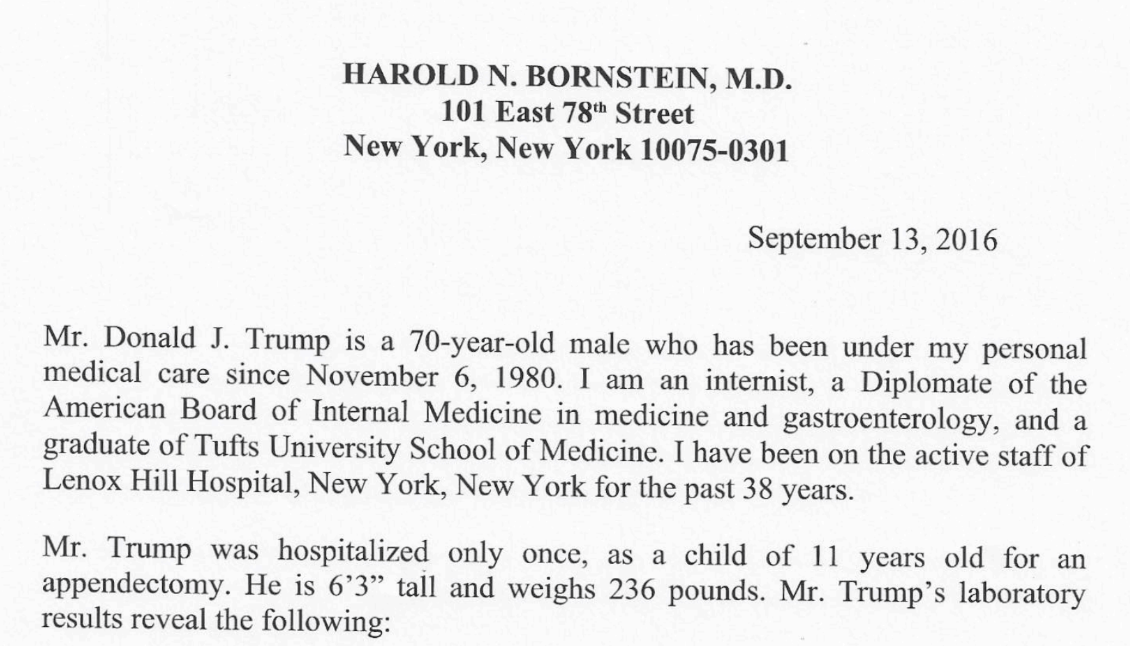
The single solitary medical document pertaining to Trump (there’s a Blue Cross explanation of benefits that appears to pertain to someone else) is this letter from Trump’s then-personal physician released during the 2016 Presidential campaign.

Not only was it publicly released over six years ago, but details of medicines left off the report and Trump’s role in dictating an earlier version of the letter were widely reported in 2017.

Aileen Cannon held up a national security investigation into highly sensitive documents stored insecurely at a beach resort targeted by foreign intelligence services, in part, because the FBI seized a public letter than had been released as part of a political campaign six years ago.

She personally halted efforts to keep the United States safe, in part, to prevent leaks of a document that Trump released himself six years ago.

But that’s not all she did.

There are documents in both Category A and Category B that may be responsive to subpoenas from the January 6, the DOJ investigation, and Fani Willis’ Georgia investigation.

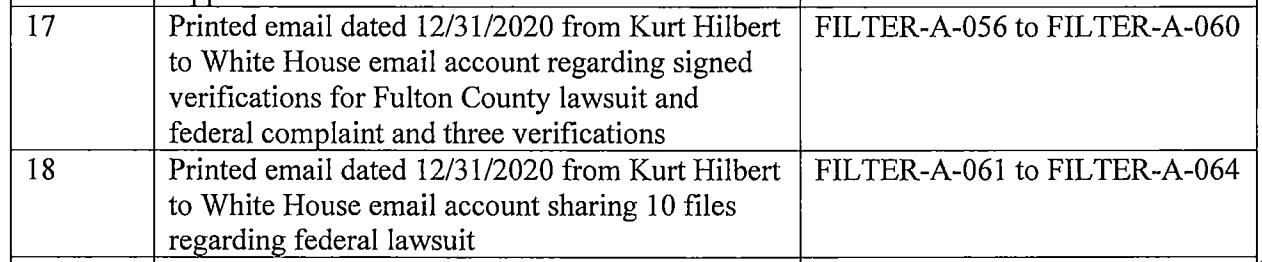
The December 31, 2020 email from Kurt Hilbert pertaining to Fulton County lawsuits is likely the one investigators turned over to the filter team on September 26 (which Trump’s lawyers claim is privileged).

For some unknown reason (probably that it was sent to the White House, which DOJ considers a waiver of privilege), DOJ put it in Category A.

There are several uninteresting Georgia-related documents included among Category B documents — the Civil Complaint in Trump v. Kemp, retainer agreements pertaining to various Fulton County lawsuits, a retention agreement with Veen, O’Neill, Hartshorn, and Levin, along with another folder with retention agreements pertaining to Fulton County. But this file, including a letter to Kurt Hilbert with a post-it note from Cleta Mitchell, might be more interesting.

There’s also a document pertaining to Joe DiGenova regarding appointing a Special Counsel (as well as might be an effort to get Pat Cipollone to complain about Saturday Night Live’s taunts of Trump).

The DiGenova document might pertain to any number of topics, but like Cleta Mitchell, he has been named in DOJ subpoenas on election fraud.

Similarly, there are documents that might be responsive to and of interest to Tish James in her investigation of Trump’s fraud. Those include:

  • 5 copies of the same one-page letter from Morgan Lewis about taxes
  • A document about a restrictive covenant agreement
  • A confidential settlement between the PGA and Trump Golf
  • Several IRS Form 872s, including one in a folder marked NYC 8/10 (the date of Trump’s deposition with Tish James)
  • An IRS Form 2858 with Molly’s name on it (almost certainly Molly Michael)
  • A signed tax return disclosure consent form

The desk drawer also includes details of Alina Habba’s retention agreements and payments, which she would have found when she searched the drawers to ensure there were not tax documents in there.

The tax documents are likely uninteresting. Some (especially the Hilbert documents) may already be in investigators hands. But the point remains: By preventing DOJ from turning over these Category B documents to Trump on September 1 like they requested permission to do, Cannon has now given DOJ an opportunity to argue these document are not privileged, possibly even that they’re responsive to various subpoenas that might be crime-fraud excepted.

With the exception of the Hilbert emails to the White House, DOJ may still return these — fighting over them may be more trouble than it’s worth. But because this inventory got released, it will now be clear what Trump’s lawyers are attempting to hide. It may even give James or Willis opportunity to subpoena the documents anew.

And it will be clear that Aileen Cannon endangered the United States, in part, based off a claim that a medical record that Trump himself released six years ago is more important than some of the government’s most sensitive documents.

As Tillman noted in her piece on the inventory, there are also details of some of the clemency packages Trump reviews. Those include pardons for Rod Blagojevich, what are probably two Border Patrol agents convicted for shooting a drug smuggler, Ignacio Ramos and Jose Compean, and Michael Behanna, a soldier courtmartialed for killing an Iraqi prisoner, as well as the commutation of Ted Suhl. There’s also one for an “RN” that might be Ronen Nahamani, whose clemency a bipartisan group of politicians supported, including Matt Gaetz. The inclusion of all these clemency packages makes it more likely that Roger Stone’s was among them — though by description, Stone’s pardon was in another drawer of a desk in Trump’s office.

One of the other main categories of Category A documents are letters to NARA, something likely covered by the part of the warrant authorizing the seizure of communications about classified records.

Share this entry

How Trump’s SCOTUS Appeal Shows Why He’s Got a Weaker Legal Argument than a [Former] Gitmo Detainee

Trump has appealed the part of the 11th Circuit’s decision that ruled DOJ did not have to share classified documents as part of the Special Master process. Trump did not appeal the part of the decision lifting the stay on using the classified documents as part of the criminal investigation.

The parts of this pertaining to classified documents and Presidential authority are even more of a shit-show than the 11th Circuit response was, and for an audience that has actually considered these issues.

But parts of it are jurisdictional and would not be frivolous if this were simply a discovery dispute (as Chris Kise treats it), and not one pertaining to classified information. But it does pertain to classified records.

And that’s why I think this is the most important part of the argument. Trump attempts to dismiss the government’s argument that it could appeal Judge Cannon’s order that it share classified records with Judge Raymond Dearie and Trump.

In its reply before the Eleventh Circuit, the Government made a fleeting statement that orders to disclose classified information are immediately appealable as collateral orders. App. F at 10 (citing Mowhawk Indus., 558 U.S. at 113 n.4; Al Odah v. United States, 559 F.3d 539, 542–44 (D.C. Cir. 2009)). This assertion is without merit.

[snip]

In Al Odah, the Government appealed from an order granting defendant’s counsel access to unredacted “classified” information. 559 F.3d at 543. The District of Columbia Circuit, applying the Cohen test, determined it had jurisdiction to hear the appeal of the collateral order in that case. Id. at 543-44. However, the present case is distinguishable from Al Odah, primarily due to whom the “classified” or “privileged” documents are being disclosed. Unlike in Al Odah, where the unredacted classified documents were ordered to be disclosed to defendant’s counsel, here the materials in question will be provided to the Special Master—a Senior United States District Judge with years of FISA court experience. As Special Master, Judge Dearie will effectively act as an arm of the District Court. It can hardly be suggested that Judge Dearie’s review of these records is in any way akin to dissemination of previously unshared, unredacted, classified information to counsel for Guantanamo Bay detainees.

Additionally, the fact this dispute involves potential Presidential records14 creates a fundamental and significant distinction. Since any purported “classified records” may be Presidential records, President Trump (or his designee, including a neutral designee such as a special master) has an absolute right of access to same under the Presidential Records Act (“PRA”). 44 U.S.C. § 2205(3). Accordingly, President Trump (and, by extension, the Special Master) cannot in any event be denied access to those documents. Given this absolute right of access under the PRA, there is therefore no valid basis to preclude such review. Moreover, there cannot possibly be any valid claim of injury resulting from a statutorily authorized grant of access to a former President and/or his designee.

The Government argued on appeal, without explanation, that showing the purportedly classified documents to Judge Dearie would harm national security. App. D at 17. However, in seeking to stay the Injunction Order pending appeal, the Government then argued it needed to use those same documents to interview witnesses and submit to the grand jury. ECF No. 69 at 17. These positions cannot be reconciled.

14 Even the Government’s own Motion for Stay in the Eleventh Circuit acknowledged the obvious, that any purported “classified records” may be Presidential records. App. D at 10 [my emphasis]

At first, Trump argues that Cannon has not ordered DOJ to share classified records with anyone but Dearie. That’s false: She ordered DOJ to share classified records with Trump’s lawyers.

In fact, in the very next paragraph, Trump admits that Cannon’s order is worse to that in Al Odah a DC Circuit case decided per curiam by a panel including Merrick Garland. Fawzi Khalid Abdullah Fahad Al Odah was a plaintiff in a habeas petition — as an enemy combatant he hadn’t and never was charged with a crime — but he was challenging indefinite detention with inadequate due process. By comparison, Trump has not been charged and if and when he is charged, his lawyers will get to see the classified evidence against him. For now, he’s just a plaintiff and the record is uncontested that the warrant executed on his beach resort involved no gross abuse of his rights.

Without acknowledging that the claim Cannon only ordered DOJ to share with Dearie is false, Trump makes the argument that DOJ should have to share with Trump’s designees under the Presidential Records Act. As DOJ has already noted, of course, that’s only true of the records are where they are supposed to be: In the possession of the Archives. They’re not, and that’s part of the problem.

Another part of the problem is that, elsewhere in this appeal, Trump unquestioningly invokes EO 13526, which governed classified information for the entirety of his term and still does. As I’ve noted, that explicitly says even former Presidents must get waivers of Need to Know requirements to access classified information. Trump never changed that order before he became a former President.

In the next paragraph, Trump then complains that DOJ might complain about sharing all of this information with Dearie (and Trump’s lawyers) but might decide to share some of the information with witnesses. Again, elsewhere in this appeal, Trump unquestioningly invokes Navy v. Egan, which is the Supreme Court precedent that says the President — not the former President — gets to decide who needs access to classified information or not.

And nowhere in this argument do Trump’s lawyers admit something that DOJ laid out explicitly before the 11th Circuit: At least one of them, Evan Corcoran, is a witness or possibly even a co-conspirator (DOJ referred to his lawyers, plural, as potential witnesses, suggesting Lindsey Halligan (who was at Mar-a-Lago during the search) or Jim Trusty has had a role in the obstruction process as well. Of course, Trump also neglects to mention the obstruction part of the investigation, which makes all documents with classification marks proof that Trump defied a subpoena.

In other words, Trump is even more poorly situated than Al Odah, who at least had lawyers uninvolved in his potential security concerns. The only one of Trump’s lawyers who’s definitely not a witness, Kise, is also the one who recently was a registered agent of Venezuela.

As I keep saying in this matter, no one really knows how any of this will turn out. Trump’s argument that Ginni Thomas’ favorite President is no Gitmo detainee surely will work with Clarence, who will decide whether to take this appeal (or ask the entire court to weigh in). But along the way, Trump has compared himself unfavorably — legally, at least — with a former Gitmo detainee.

Update: This tweet thread from Steve Vladeck notes that Trump never describes what irreparable harm he faces if Dearie can’t review the classified records now.

Update: One more thing Trump doesn’t tell SCOTUS: That Judge Cannon has altered her own order, taking the classified documents out of it altogether, which makes Vladeck’s point about emergency relief even more hysterical.

Update: Justice Thomas has given the government a week to respond, which suggests even he doesn’t see this as the emergency it would have to be for SCOTUS to get involved.

Share this entry

Aileen Cannon Deliberately Harmed Trump To Create an Excuse to Help Him

On September 5, Judge Aileen Cannon ruled that depriving Donald Trump of personal items constituted “real harm.”

being deprived of potentially significant personal documents [] creates a real harm

Yesterday, the newly unsealed filter team status report revealed that, for two weeks, Judge Cannon deliberately inflicted that harm on Trump.

That’s because on August 30, DOJ’s filter team told her that they wanted to return the original copies of documents designated as Category B — 43 sets of documents amounting to 382 pages of documents — to Trump.

[T]he PrivilegeReview Team proposes to return the originals and provide a Bates-stamped control copy to the Plaintiff. Many of these materials do not appear to be privileged (although one appears to be.11), but they are all either legal in nature (e.g.,settlement, non-disclosure, and retainer agreements) or otherwise potentially sensitive, and they do not appear to be themselves government or Presidential Records or classified documents.

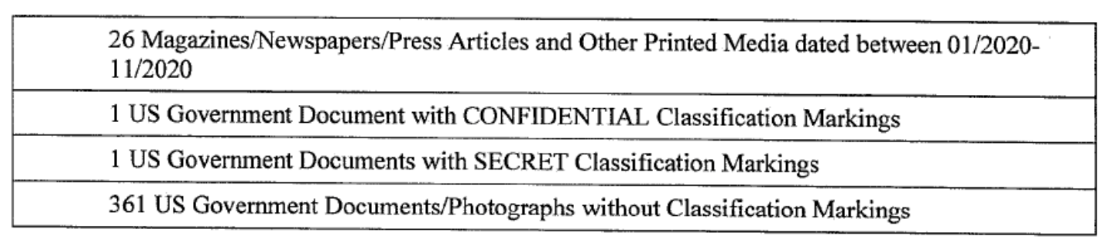
These documents were lawfully seized: many were likely in the desk drawer in which Trump also had a document marked Confidential and another document marked Secret. The others would have been seized from the storage closet where Trump was hiding 79 documents with classification markings. But on August 30, DOJ proposed to Aileen Cannon that they give them back.

Then, the next day, on September 1, filter attorney Benjamin Hawk asked for permission to pursue “the proposal that we offered,” which, in addition to providing Trump with Bates-stamped copies of all the documents treated as potentially privileged, would also include (per the status report that had been discussed at length in the hearing) giving him the originals back.

MR. HAWK: Your Honor, if I may.

THE COURT: Yes.

MR. HAWK: We would like to seek permission to provide copies — the proposal that we offered, Your Honor, provide copies to counsel of the 64 sets of the materials that are Bates stamped so they have the opportunity to start reviewing. THE COURT: I’m sorry, say that again, please.

MR. HAWK: The privilege review team would have provided Bates stamped copies of the 64 sets of documents to Plaintiff’s counsel. We would like to seek permission from Your Honor to be able to provide those now, not at this exact moment but to move forward to providing those so counsel has the opportunity to review them and understand and have the time to review and do their own analysis of those documents to come to their own conclusions. And if the filter process without a special master were allowed to proceed, we would engage with counsel and have conversations, determine if we can reach agreements; to the extent we couldn’t reach agreements, we would bring those before the Court, whether Your Honor or Judge Reinhart. But simply now, I’m seeking permission just to provide those documents to Plaintiff’s counsel.

THE COURT: All right. I’m going to reserve ruling on that request. I prefer to consider it holistically in the assessment of whether a special master is indeed appropriate for those privileged reviews. I think Mr. Bratt is hoping to get a few more minutes in.

In response to a request to (among other things) give the originals of Trump’s personal documents back, Cannon declined to approve the request. Had she approved it, 382 pages of personal documents would have been back in Trump’s custody right away. He would no longer have been deprived of those potentially significant personal documents. The harm that Cannon said was caused by his deprivation of those documents would be ended.

And that is precisely the harm she cited when she first ruled that a Special Master had to review the documents that she had prevented DOJ from returning to Trump. Indeed, she claimed there was a dispute about the very personal property that DOJ had tried to give back five days earlier.

Although some of the seized items (e.g., articles of clothing) appear to be readily identifiable as personal property, the parties’ submissions suggest the existence of genuine disputes as to (1) whether certain seized documents constitute personal or presidential records, and (2) whether certain seized personal effects have evidentiary value. Because those disputes are bound up with Plaintiff’s Rule 41(g) request and involve issues of fact, the Court “must receive evidence” from the parties thereon. See Fed. R. Crim. P. 41(g) (“The court must receive evidence on any factual issue necessary to decide the motion.”). That step calls for comprehensive review of the seized property.

Review is further warranted, as previewed, for determinations of privilege. The Government forcefully objects, even with respect to attorney-client privilege, pointing out that the Privilege Review Team already has screened the seized property and is prepared to turn over approximately 520 pages of potentially privileged material for court review pursuant to the previously approved ex parte filter protocol [ECF No. 48 p. 14]. In plain terms, the Government’s position is that another round of screening would be “unnecessary” [ECF No. 48 p. 22]. The Court takes a different view on this record.

By that point, she had personally been responsible for depriving Trump of 382 pages of documents for five days.

She would cite back to this passage, claiming a dispute including over documents DOJ had tried to give back, when she refused to stay her injunction on investigating the classified documents.

To further expand the point, and as more fully explained in the September 5 Order, the Government seized a high volume of materials from Plaintiff’s residence on August 8, 2022 [ECF No. 64 p. 4]; some of those materials undisputedly constitute personal property and/or privileged materials [ECF No. 64 p. 13]; the record suggests ongoing factual and legal disputes as to precisely which materials constitute personal property and/or privileged materials [ECF No. 64 p. 14]; and there are documented instances giving rise to concerns about the Government’s ability to properly categorize and screen materials [ECF No. 64 p. 15]. Furthermore, although the Government emphasizes what it perceives to be Plaintiff’s insufficiently particularized showing on various document-specific assertions [ECF No. 69 p. 11; ECF No. 88 pp. 3–7], it remains the case that Plaintiff has not had a meaningful ability to concretize his position with respect to the seized materials given (1) the ex parte nature of the approved filter protocol, (2) the relatively generalized nature of the Government’s “Detailed Property Inventory” [ECF No. 39-1], and (3) Plaintiff’s unsuccessful efforts, pre-suit, to gather more information from the Government about the content of the seized materials [ECF No. 1 pp. 3, 8–9 (describing Plaintiff’s rejected requests to obtain a list of exactly what was taken and from where, to inspect the seized property, and to obtain information regarding potentially privileged documents)]. [my emphasis]

The only dispute here was between Cannon and the government! They had already asked to give Trump’s personal documents back, and she refused to grant permission to do that.

And Cannon pointed to those personal items — items the government had already tried to give back — when she refused to lift her injunction on investigating classified documents.

Again, the September 5 Order imposes a temporary restraint on certain review and use of the seized materials, in natural conjunction with the special master process, only for the period of time required to resolve any categorization disputes and rule on Plaintiff’s Rule 41(g) requests. This restriction is not out of step with the logical approach approved and used for special master review in other cases, often with the consent of the government, and it is warranted here to reinforce the value of the Special Master, to protect against unwarranted disclosure and use of potentially privileged and personal material pending completion of the review process, and to ensure public trust.

[snip]

And the Court remains firmly of the view that appointment of a special master to conduct a review of the seized materials, accompanied by a temporary injunction to avoid unwarranted use and disclosure of potentially privileged and/or personal materials, is fully consonant with the foregoing principles and with the need to ensure at least the appearance of fairness and integrity under unprecedented circumstances.

As I have noted, there was just one clearly privileged document among the 11,000 seized on August 8. DOJ had tried to give it, along with some personal documents, back on August 30. Yet that is precisely what Cannon pointed to — the harm that she herself was sustaining — in her justification to hold up an investigation into 103 highly classified documents stored in a beach resort targeted by foreign spies.

She put the entire country at risk because of a harm she herself continued an extra two weeks.

And that’s not the only harm that Judge Cannon inflicted on Trump to justify interfering in this case.

First, we now know that her reference to tax and medical and accounting information was to the Category B documents — the ones that DOJ had already attempted to give back.

According to the Privilege Review Team’s Report, the seized materials include medical documents, correspondence related to taxes, and accounting information [ECF No. 40-2;

I had mistakenly believed she was relying on the privilege status report — a document which the filter attorneys had said could safely be shared publicly. The status report doesn’t mention those specific documents at all (unless the Morgan Lewis document explicitly referenced accounting). Those references are to still-sealed information.

She’s the leak she claimed threatened Trump’s reputation.

Worse still, it’s now clear those really may be Trump’s personal accounting and tax documents (something that I previously thought was unlikely). If so, Cannon’s reference to that still-sealed information revealed to Tish James that documents potentially responsive to subpoenas — documents that Alina Habba swore did not exist — may soon be found at Mar-a-Lago.

Since she got this lawsuit, Judge Cannon has been doing backflips to try to help Trump. That goes so far as inflicting harm that she then uses to justify intervening.

Share this entry

What Happened with the Potentially Privileged Documents Seized from Mar-a-Lago

Yesterday, SDFL AUSA Anthony Lacosta filed a sealed letter to Special Master Raymond Dearie along with the log laying out any disputes between the government and Trump over his potentially privileged documents.

Subsequent to that, Judge Aileen Cannon ordered unsealed the status report that Lacosta and Benjamin Hawk filed back on August 30. I will explain the two kinds of damage Judge Cannon did to Donald Trump in order to create an excuse to intervene in this matter — as I keep saying, Cannon caused the harm she intervened to fix.

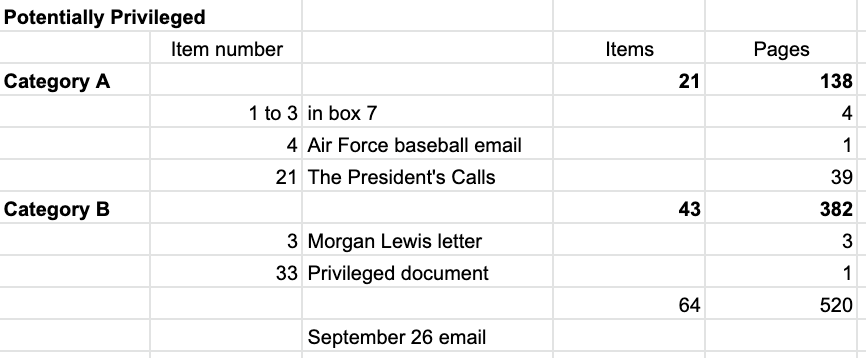
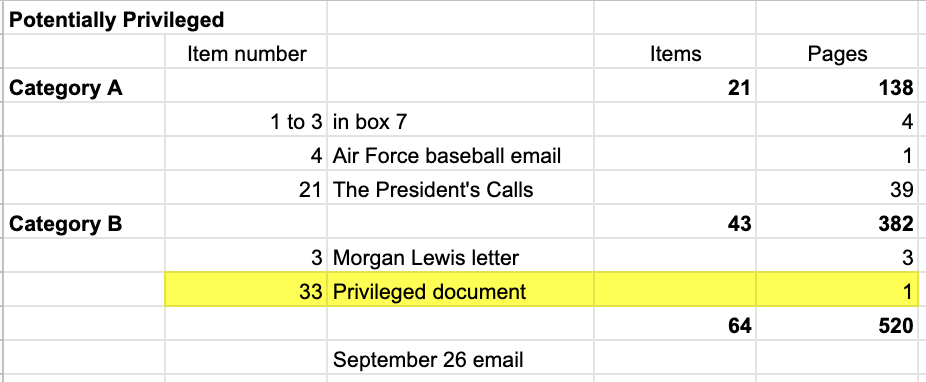
For now, I want to talk about what happened with the potentially privileged material. Here’s a table of what we know about those documents.

Note that one page privileged document, item B-33. At least per the filter team, it may be the only clearly privileged document seized, one page out of 11,000 documents.

The warrant to search Trump’s beach resort required a privilege team to search his office. But (as members of that team explained in the hearing on September 1), they instead did the initial search of both the storage room and Trump’s office. As a result, the privilege team segregated 6 sets of information, which were catalogued on what I’ve called the SSA Receipt. The revised detailed inventory describes these boxes this way (note, these descriptions probably exclude the potentially privileged material, which is inventoried separately):

Item 4, which the status report describes as “the entire contents of a single drawer” in Trump’s office.

Three passports were originally in this drawer, which is why they were seized. They were returned on August 15. These documents were appropriately seized under the warrant because there were two classified documents in the drawer.

Items 29 through 33, which were in the Storage Room.

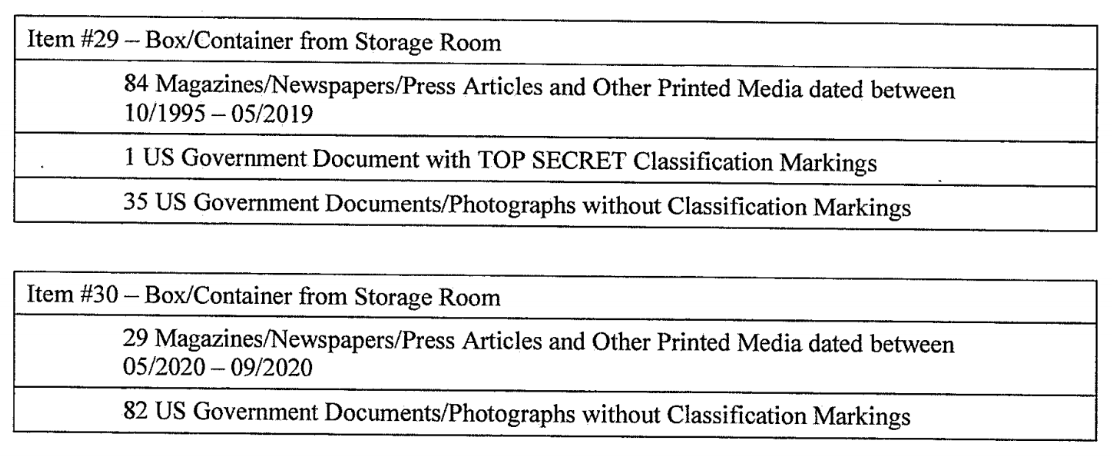
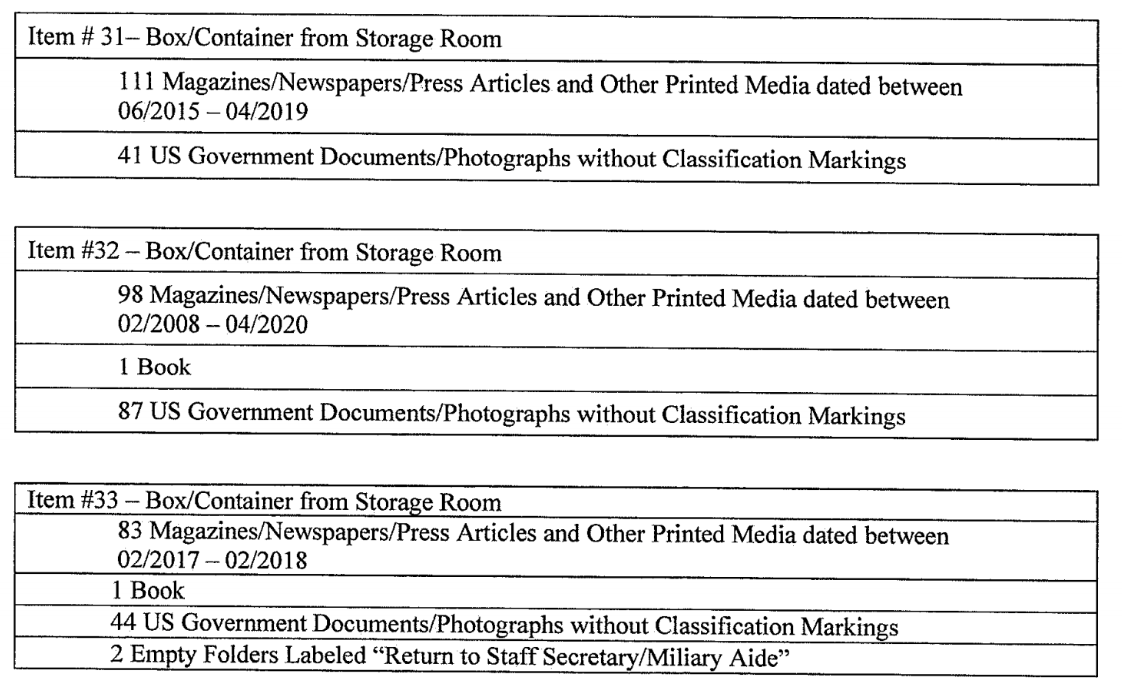
These boxes would have been appropriately seized under the warrant because all were stored in the place where boxes storing classified documents were stored. In fact, Item 29 had a Top Secret document in it and Item 33 has two empty staff secretary folders in it. Additionally, all are described to contain government documents, which were also authorized for seizure.

Two days after the search, on August 10, a Case Agent found a 3-page letter from law firm Morgan Lewis, “comingled with newspapers;” Morgan Lewis’ Sherri Dillon was named in Tish James’ motion to compel Trump’s deposition. So they sent the entire box to the privilege team, as described in the warrant. The box also included 4 pages of government documents treated as potentially privileged, including an email from the Air Force Academy’s coach.

By August 11, the privilege team had segregated out anything that  met their over-inclusive standard for potentially privileged documents from the rest of the documents, then sent the 7 boxes to the investigative team (which is, presumably, what led to the return of the passports days later).

On August 25, a case agent provided one more document to the privilege team:

39-page set of materials that appears to reflect the former President’s calls. (The majority of pages are titled “The President’s Calls” and include the Presidential Seal.) Specifically, the document contains handwritten names, numbers, and notes that primarily appear to be messages, as well as several pages of miscellaneous notes.

One of these messages was from “Rudy,” though did not appear to constitute legal advice.

The privilege team separated all these potentially privileged documents into two categories:

Category A

This category includes 21 sets of documents for a total of 138 pages. Most are, “primarily government records, public documents, and communications from third parties,” which could not qualify as privilege. One document is a 3-page email to a White House email account, which the government maintains constitutes a waiver to attorney-client privilege. As noted, another is a printed email from the Air Force Academy’s head baseball coach with the word “PatC” on it.

For example, the Privilege Review Team agents identified and segregated a printed email exchange between the U.S. Air Force Academy’s head baseball coach and the White House because “PatC” (perhaps a reference to White House Counsel Pat Cipollone) was written on the document in black marker (Item Number 4 in Exhibit A at FILTER A-005).

Another, as noted above, is one of the phone messages from the President’s Calls (we know this is a phone message because both are described as Item 21 in Category A), from “Rudy” and appearing to be a topic unrelated to legal advice.

Category B

This category consists of 43 sets of documents, for a total of 382 pages. The status report describes those as,

legal in nature (e.g., settlement, non-disclosure, and retainer agreements) or otherwise potentially sensitive, and they do not appear to be themselves government or Presidential Records or classified documents.

According to the privilege team, just one of those documents appeared to be privileged. But way back on August 30, they proposed to give the originals of all these documents back to Trump. Then they tried again on September 1. Trump had to wait two more weeks before receiving these documents, so that Judge Cannon could use them as her basis for intervening in the case.

September 26 email

According to Trump’s objections, on September 26, the government provided an email newly identified by case agents (presumably in the course of reviewing the inventory). The government maintains the email is not privileged but Jim Trusty claims it is.

On Monday, September 26, counsel for the Privilege Review Team provided Plaintiff’s counsel with another example of filter failure. The email in question was identified by the “FBI case team,” and returned to the Privilege Review Team, which is characterizing the communication as non-privileged. Plaintiff believes the email falls squarely into the category of attorney-client privileged.

In addition to the document sorting, before the filter team shared any photographs documenting the search, both the filter agents and the filter attorneys reviewed the photographs to ensure no privileged documents were captured in the photo.

Update: Added explanation for Morgan Lewis letter, h/t Simon. Added observation that there may be only a single privileged page in the whole seizure. Corrected numerical error.

Share this entry

Aileen Cannon’s Calvinball Special Master

In the first paragraph of her order reversing Raymond Dearie’s order that Trump verify the inventory DOJ provided, Aileen Cannon identified three documents by name: Dearie’s amended case management plan, dated September 23, Trump’s objections, which were originally sent to Dearie on September 25 but which she may have only seen on September 28, and a government filing she renames, which was originally titled, “Motion to Modify and Adopt the Amended Case Management Plan with Comments on the Amended Plan and Plaintiff’s Objections.” That was filed on September 27.

THIS CAUSE comes before the Court upon the Amended Case Management Plan (the “Plan”) [ECF No. 112], filed on September 23, 2022. The Court has reviewed the Plan, Plaintiff’s Objections [ECF No. 123-1], Defendant’s Response to Plaintiff’s Objections and Motion to Modify and Adopt the Plan [ECF No. 121], and the full record.

Later in her order, when she discusses Dearie’s own order that Trump confirm the inventory before the start of the designations, she describes the deadline he set for the inventory verification as September 30, then notes in a footnote that he modified that deadline in an interim report to her on September 27.

In addition to requiring Defendant to attest to the accuracy of the Inventory, the Plan also requires Plaintiff, on or before September 30, 2022, to lodge objections to the Inventory’s substantive contents.2

2 The Special Master’s Interim Report No. 1 modified this deadline to October 7, 2022 [ECF No. 118 p. 2].

Those two details are a tell to understand what, bureaucratically, Cannon imagines she did on Thursday. On Thursday, she was overruling Dearie’s plan as it existed on September 23, not as it existed on September 27.  She was effectively taking over the review starting on September 23, but without telling anyone that or explaining what deadlines applied.

It’s a way — and was used as a way in this instance — to make Dearie entirely superfluous, a mere showpiece to give her own direct intervention to give Trump his way the patina of legitimacy.

Start with Cannon’s order appointing Dearie, dated September 15. It required that Dearie submit a plan to her within ten days, so by September 25.

Within ten (10) calendar days following the date of this Order, the Special Master shall consult with counsel for the parties and provide the Court with a scheduling plan setting forth the procedure and timeline—including the parties’ deadlines—for concluding the review and adjudicating any disputes.

She set a five day deadline for the parties to object to that order, after which she would review the matter de novo.

The parties may file objections to, or motions to adopt or modify, the Special Master’s scheduling plans, orders, reports, or recommendations no later than five (5) calendar days after the service of each, and the Court shall review those objections or motions, and any procedural, factual, or legal issues therein, de novo. Failure to timely object shall result in waiver of the objection.

The day after the 11th Circuit overruled her injunction on classified documents, on September 22, Cannon issued an order that everyone thought was just her acknowledging that the classified documents were no longer covered by the order (that’s not technically true, and I think she doesn’t believe it’s true even now, but it took the classified documents out of Dearie’s work plan). In taking out the reference to classified documents, it also took out this entire paragraph, including the bolded language about interim reports.

The Special Master and the parties shall prioritize, as a matter of timing, the documents marked as classified, and the Special Master shall submit interim reports and recommendations as appropriate. Upon receipt and resolution of any interim reports and recommendations, the Court will consider prompt adjustments to the Court’s orders as necessary. [my emphasis]

I raised it at the time, people poo pooed my concern (and scolded Dearie for raising it later). But this was the moment when Cannon told Dearie to fuck off, only without telling him she had done that.

Shortly after that, on day 7 after his appointment, Dearie submitted to the two sides his original plan. He gave them until September 27 to raise objections.

This Case Management Plan shall be filed on the docket and deemed served on each party today. The parties may file objections to, or motions to adopt or modify, the foregoing Case Management Plan by September 27, 2022. Failure to timely object shall result in waiver of the objection. See Appointing Order, ¶ 11; Fed. R. Civ. P. 53(f).1

1. To the extent the parties file objections with the Court as to this Case Management Plan, the deadlines set forth above shall remain in effect while such objections are pending.

Clearly, at that point, he believed he would have time to address any concerns himself. The work plan included his plan to use (and pay, as the only paid employee) retired Magistrate Judge James Orenstein to help with the review.

On September 23, DOJ informed Dearie that Trump still hadn’t contracted with a vendor to scan the documents, and asked for a one business day extension, but still with the expectation that Trump would arrange the contract (since he is paying). DOJ also asked him to tweak his order to make it clear the inventory would not include the potentially privileged documents. They noted that Trump still hadn’t provided his proposed protective order, which had been due September 20, which would have held up the document scanning anyway.

Later that day, Trusty filed a protective order.

Dearie issued an updated work order, with the same September 27 deadline for changes. It also still included his plan to hire Orenstein. I believe this is the work order Cannon took as operative on Thursday.

Also on September 23, Dearie issued a protective order that (the docket entry noted) had been approved by Cannon. It sided with Trump that he didn’t have to share the name of his reviewers, something that was made less urgent after the 11th Circuit had taken the classified documents out of the work plan.

On September 25, on Dearie’s original deadline for filing a work plan with Cannon (but before the date he provided for changes), Jim Trusty emailed Dearie his three objections: they didn’t want to affirmatively confirm the inventory, they didn’t want to distinguish between Executive Privilege that could and could not be shared with the Executive Branch, and they didn’t think they had to brief the appropriateness of filing a Rule 41(g) motion to Cannon rather than to Reinhart. This was not docketed and Judge Cannon is not listed as a recipient of this email. Chris Kise was on the signature block of this letter.

The next day, September 26, the second public deadline (after the protective order, which Trump missed), DOJ filed a revised and sworn affidavit. That was also the deadline for Trump to designate all the potentially privileged files he had had since September 16.

A bunch of things happened on September 27. I’ll treat them in the order they appear in the docket, which looks like this:

First, Dearie filed a staffing proposal to Cannon, noting that the window for the two sides to object to it had expired. This was the first moment that the staffing got separated from his work plan.

No party has submitted any comment to the foregoing proposal, and the time for such comment has lapsed. Accordingly, the undersigned respectfully submits the foregoing proposal to the Court for approval.

Then Dearie filed an interim report to Cannon. In it, he recommended Cannon add back in the language authorizing interim reports that she struck along with language about classified documents.

Interim Reports and Adjustments to Prior Orders. In the original Appointing Order, the Court directed that “the Special Master shall submit interim reports and recommendations as appropriate. Upon receipt and resolution of any interim reports and recommendations, the Court will consider prompt adjustments to the Court’s orders as necessary.” Appointing Order ¶ 6. However, the Court later struck that language as part of its order implementing an unrelated ruling by the Eleventh Circuit. As the language quoted above as to interim reports and adjustments to prior orders is consistent with the Eleventh Circuit’s ruling and the efficient administration of the Appointing Order as amended, the undersigned respectfully recommends that the Court issue an order reinstating that language.

His interim report clearly expected he’d get one more shot to resolve disputes. In it, he said the parties would have until October 2 to respond.

This Interim Report and Recommendation shall be filed on the docket and deemed served on each party today. The parties may file objections to, or motions to adopt or modify, the foregoing report and recommendation by October 2, 2022

Next, there’s a sealed (and still sealed) order.

Then Cannon approved Dearie’s staffing plan, but declined to replace the language in her original order that permitted interim reports.

The Court takes no other action at this time, recognizing that the Order Appointing Special Master authorizes the Special Master to file reports and make recommendations as appropriate.

It was not clear at the time, but this effectively told Dearie that his understanding of how things would work — that he could issue interim reports and only after that Cannon would intervene — had been changed in the wake of the 11th Circuit ruling on classified documents. Effectively, Cannon told Dearie on September 27 she had taken over the work plan on September 23. That’s why, I suspect, that she only cited his September 27 Interim Report in a footnote. She basically ignored everything he did after September 23.

After that, DOJ filed its request for another deadline extension, along with its objections to Trump’s objections received two days earlier.

On September 28, Trump for the first time raised timeline concerns in writing, also claiming that DOJ had told Trump there were 200,000 pages (as I’ve written here, that’s virtually impossible; I suspect it came from the work order DOJ provided to solicit the vendor). The letter was not signed by Kise, and raised a lot of bogus claims about privilege (and also seemed to indicate that Trump had already missed the privilege deadline). Along with those concerns about timing, Trump filed his complaints, which (at least based on the public record) was the first time Cannon would have seen the complaints; the docket exhibit is what she cited in her order.

Working under Dearie’s deadline, DOJ had four more days to respond to Trusty’s probably bogus claims of 200,000 documents and to rebut the privielge claims. Working off a five day deadline from Dearie’s submission of his amended work order on September 27, DOJ also had four more days. Working under Cannon’s original deadline — five days after Dearie’s original deadline of September 25 — they had two more days. Under Dearie’s September 23 order, the final deadline was September 27.

What Cannon appears to have done is with no formal notice of what the deadline was or even that ten plus five was no longer operative, treat Dearie’s September 23 filing as his final action in setting the plan, but along the way use her own five day deadline for complaints instead of the September 27 deadline Dearie gave, which is the only way Trump’s temporal complaint would be timely yet have her order not be days premature.

The next day, with no notice of any new deadline, Cannon issued her order throwing out most of Dearie’s plan. I’ve spent hours and days looking at this, and there’s no making sense of the deadlines. Certainly, this could not have happened if any of Dearie’s deadlines had been treated as valid.

DOJ took a look at what Cannon had done and moved the 11th Circuit to accelerate the review process. They cited a number of reasons for the change in schedule. They described that Cannon sua sponte extended the deadline on the review to December 16.

On September 29, subsequent to the parties’ submission of letters to Judge Dearie, the district court sua sponte issued an order extending the deadline for the special master’s review process to December 16 and making other modifications to the special master’s case management plan, including overruling the special master’s direction to Plaintiff to submit his designations on a rolling basis.

Depending on how you make sense of Cannon’s Calvinball deadlines, it was a sua sponte order, because Trump’s complaint about the deadlines (not to mention his complaints generally) came in after the deadline attached to the Dearie plan that Cannon seems to treat as his final official action.

I think what really happened is that Cannon fired Dearie without firing him in response to being told by the 11th Circuit she had abused her authority, ensuring not only that nothing he decides will receive any consideration, but also ensuring that he has almost no time to perform whatever review role he has been given.

Effectively, Judge Cannon has just punted the entire process out after the existing appeals schedule, at which point — she has made clear — she’ll make her own decisions what government property she’s going to claim Trump owns.

Timeline

September 15, 2022: Cannon opinion denying stay; Cannon’s order of appointment; Raymond Dearie declaration

September 16, 2022: DOJ motion for a stay

September 19, 2022: DOJ topics for initial Dearie conference; Trump topics for initial Dearie conference

September 20, 2022: Trump 11th Circuit response; DOJ 11th Circuit reply

September 21, 2022: 11th Circuit opinion granting stay

September 22, 2022: Cannon order removing documents marked as classified from Seized Materials covered by her order; Dearie proposed work plan

September 23, 2022: Protective order; amended case management plan; motion for extension of time

September 25, 2022: Trump objections to Dearie order (released on September 28)

September 26, 2022: Sworn affidavit with more detailed inventory; Julie Edelstein

September 27, 2022: Dearie interim report; Staffing proposal; Government motion for extension and to adopt case management plan

September 28, 2022: Trump objection that DOJ didn’t ask for enough additional time

September 29, 2022: Cannon order alters Dearie work plan

September 30, 2022: DOJ motion to accelerate 11th Circuit appeal

Share this entry

“Somewhat Convoluted:” Debunking the Judge Cannon Claims

Before I went to sleep last night, I suggested there was some suspense about whether journalists would accurately report the power grab Judge Aileen Cannon made yesterday. Who was I kidding? Rather than report what happened, virtually all news coverage simply quoted what Cannon claimed she had done. Not only didn’t the press call out Cannon’s own misrepresentations, but they introduced some of their own.

First, some outlets had suggested that Raymond Dearie had set really aggressive deadlines and Cannon simply altered them. That’s not really accurate. Cannon definitely tweaked with how Dearie would deal with the disputes (mandating a single report from Trump rather than cascading productions, a decision that Trump will cite next month when they ask for an extension). But her original order didn’t mandate any interim deadlines on the review itself (meaning, she can’t say the delay in hiring a vendor changed her own timeline); she just gave Raymond Dearie deadlines and timeframes during which the parties could challenge his decisions. The new interim deadlines she provided are premised on when Trump first receives the materials, so the delay Trump introduced by stalling on a vendor may not affect the process all that much. Dearie’s own deadlines were timed to meet Cannon’s deadline. So effectively, Cannon has simply arbitrarily extended her own deadline by 17 days, from November 30 to December 16.

Finally, in light of delays in securing an appropriate vendor to scan and make available the Seized Materials to Plaintiff and the Special Master, and recognizing the more precise quantification of the implicated pages of material [ECF No. 123 p. 1 (describing that the 11,000 documents approximate 200,000 pages of materials)], the Court hereby extends the end date for completion of the Special Master’s review and classifications from the prior date of November 30, 2022 [ECF No. 91 p. 5], to December 16, 2022. This modest enlargement is necessary to permit adequate time for the Special Master’s review and recommendations given the circumstances as they have evolved since entry of the Appointment Order.

As I note below, that happens to delay the end of Dearie’s work until after such time as the appeal will be fully briefed.

Cannon bases her timeline on three things. First, there’s the delay Trump introduced in getting a vendor (a delay Jim Trusty telegraphed at the hearing before Dearie). Cannon currently envisions the two sides having to agree on a vendor, so Trump may be able to delay the process further still.

Cannon also bought Trump’s claim there are 200,000 pages of materials. As I’ll show in a follow-up, she timed her order in such a way as to prevent DOJ from correcting this claim. I suspect it comes from a draft work order DOJ gave to Trump, but we shall see if and when DOJ explains that it’s impossible for there to be 200,000 documents in the 27 seized boxes plus Trump’s desk drawers.

Cannon also has decided that it will take three weeks to do the review based off her claim that it took DOJ three weeks to do a preliminary review of the seized material.

For context, it took Defendant’s Investigative Team approximately three weeks to complete its preliminary review of the Seized Material [ECF No. 39 p. 1].

She bases that off the interim status report from DOJ, which doesn’t say how long the review took. Rather, it says,

As of the date of this filing, the investigative team has completed a preliminary review of the materials seized pursuant to the search warrant executed on August 8, 2022, with the exception of any potentially attorney-client privileged materials that, pursuant to the filter protocols set forth in the search warrant affidavit, have not been provided to the investigative team.

DOJ would have said the same thing whether they finished their review minutes before filing this status report or two weeks earlier. Cannon simply invented the claim that DOJ had only just finished the review on August 30, three weeks after the seizure.

Cannon likewise misrepresents the nature of Trump’s objection to the inventory review and what the inventory review would have been (and reporters made her misrepresentation worse).

In addition to requiring Defendant to attest to the accuracy of the Inventory, the Plan also requires Plaintiff, on or before September 30, 2022, to lodge objections to the Inventory’s substantive contents.2

[snip]

Plaintiff objects to the pre-review Inventory objection requirement, citing the Court’s Order Appointing Special Master [ECF No. 91] and the current inability to access the Seized Materials [ECF No. 123-1 p. 1].

[snip]

There shall be no separate requirement on Plaintiff at this stage, prior to the review of any of the Seized Materials, to lodge ex ante final objections to the accuracy of Defendant’s Inventory, its descriptions, or its contents.

2 The Special Master’s Interim Report No. 1 modified this deadline to October 7, 2022 [ECF No. 118 p. 2].

Here’s what Trump’s objection actually said:

To help find facts, the appointing order authorized a declaration or affidavit by a Government official regarding the accuracy of the Detailed Property Inventory [ECF 39-1] as to whether it represents a full and accurate accounting of the property seized from Mara-Lago. Appointing Order ¶ 2(a). The Appointing Order contemplated no corresponding declaration or affidavit by Plaintiff, and because the Special Master’s case management plan exceeds the grant of authority from the District Court on this issue, Plaintiff must object. Additionally, the Plaintiff currently has no means of accessing the documents bearing classification markings, which would be necessary to complete any such certification by September 30, the currently proposed date of completion. [my emphasis]

The material he couldn’t review was limited to documents with classification markings, not the documents as a whole. And as Cannon notes in a footnote (there’s a reason it’s in the footnote, which I’ll come back to in a follow-up), Dearie had given Trump the same four days after receiving the materials to review the inventory after he adjusted the deadlines. In spite of the fact that Dearie’s most recent order only envisioned this verification to happen after Trump got the material, Cannon calls it a “pre-review” and “ex ante” process, suggesting Trump would have had to verify the inventory blind.

Perhaps Cannon’s most cynical move, however, came in her order dismissing Dearie’s suggestion that the two sides might have to brief whether Trump should file a Rule 41(g) in this court or before Bruce Reinhart.

As explained in the Court’s previous Order, Plaintiff properly brought this action in the district where Plaintiff’s property was seized [see ECF No. 64 p. 7 n.7 (citing Fed. R. Crim. P. 41(g); United States v. Wilson, 540 F.2d 1100, 1104 (D.C. Cir. 1976); In the Matter of John Bennett, No. 12-61499-CIV-RSR, ECF No. 1 (S.D. Fla. July 31, 2012))].

The 11th Circuit has already ruled that intervening absent any evidence of callous disregard for Trump’s rights was an abuse of discretion.

We begin, as the district court did, with “callous disregard,” which is the “foremost consideration” in determining whether a court should exercise its equitable jurisdiction. United States v. Chapman, 559 F.2d 402, 406 (5th Cir. 1977). Indeed, our precedent emphasizes the “indispensability of an accurate allegation of callous disregard.” Id. (alteration accepted and quotation omitted).

Here, the district court concluded that Plaintiff did not show that the United States acted in callous disregard of his constitutional rights. Doc. No. 64 at 9. No party contests the district court’s finding in this regard. The absence of this “indispensab[le]” factor in the Richey analysis is reason enough to conclude that the district court abused its discretion in exercising equitable jurisdiction here. Chapman, 559 F.2d at 406

Even ignoring that two Trump appointees have already told Cannon she was wrong, the sentence before the one Cannon cites here notes the absurdity of filing for a Special Master and a Rule 41(g) motion in the same effort, calling it “somewhat convoluted.”

As previewed, Plaintiff initiated this action with a hybrid motion that seeks independent review of the property seized from his residence on August 8, 2022, a temporary injunction on any further review by the Government in the meantime, and ultimately the return of the seized property under Rule 41(g) of the Federal Rules of Criminal Procedure. 6 Though somewhat convoluted, this filing is procedurally permissible7 and creates an action in equity.

Yet even after straining to approve this in her first review and then getting smacked down by the 11th, Cannon still persists in envisioning that she’ll be able to take government property and give it to Trump.

I suspect Cannon’s wrong about at least one more thing — whether Trump has complied with his deadline to mark privileged material. These issues, however, all exhibit the same dishonesty we’ve seen in the past.

Yet the very same press that Judge Cannon is blowing off nevertheless failed to identify any of these problems.

Current Schedule

September 26: Trump provides designations on potentially privileged materials

October 3: Both sides identify areas of dispute on potentially privileged designations

October 5: Finalize a vendor (Cannon fashions this as a common agreement, giving Trump ability to delay some more)

October 13: DOJ provides materials to Trump (Cannon does not note this does not include classified documents)

By October 14: DOJ provides notice of completion that Trump has received all seized documents

October 19: Deadline for DOJ appeal to 11th Circuit

21 days after notice of completion (November 4): Trump provides designations to DOJ

November 8: Election Day

10 days after receiving designations (November 14): Both sides provide disputes to Dearie

30 days after DOJ appeal (November 18): Trump reply to 11th Circuit

21 days after Trump reply (December 9): DOJ reply to 11th Circuit

December 16: Dearie provides recommendations to Cannon

January 3: New Congress sworn in

No deadline whatsoever: Cannon rules on Dearie’s recommendations

Seven days after Cannon’s no deadline whatsoever ruling: Trump submits Rule 41(g) motion

Fourteen days after Cannon’s no deadline whatsoever ruling: DOJ responds to Rule 41(g) motion

Seventeen days after Cannon’s no deadline whatsoever ruling: Trump reply on Rule 41(g)
Share this entry

Aileen Cannon Is Stiff-Arming the Press

I’m going to write up what really happened yesterday — as predicted, virtually all outlets I’ve seen simply quoted what Aileen Cannon claimed she had done, rather than describing what she had actually done.

Before I do that, I want to note that Judge Cannon is stiff-arming the same press that is reporting so credulously on her interventions.

Back on August 31, the press coalition that does such things moved to intervene in the case. Most of it was the same boilerplate the coalition uses for all such motions, but they did cite both sides in the matter calling for transparency.

Former President Trump himself has called for greater transparency. See, e.g., ECF No. 1, at pp. 2-3 (noting personal desire for more openness). The Government has stated likewise. See, e.g., ECF No. 1, at pp. 9-10 (detailing Attorney General Merrick Garland’s statements on why the Government sought to unseal certain search warrant records); see also ECF No. 48, at p. 2 n.1 (noting that the Government is “prepared . . . to unseal the more detailed receipt”).

They described that the government did not oppose the motion and Trump took no position on it. They asked to be heard on the matter on September 1.

The next day, Judge Cannon released the detailed inventory the government had submitted (it has since submitted a slightly revised inventory, but didn’t address the press access.

After the government moved to unseal the privilege status report on September 8, the press coalition submitted their own request for unsealing.

Then, after two weeks had elapsed since their initial motion, the press coalition tried again. They pointed out that if anyone wanted to oppose their intervention, the two week deadline to do so had expired. And they noted that the privilege review status report still remained under seal.

The News Media further note that certain records remain under seal in this matter, namely those docketed at ECF No. 40. The News Media understand ECF No. 40 to contain the Government’s submission regarding its Privilege Review Team’s Notice of Status of the Filter Process. The Government filed a motion to unseal that document (less Exhibits A and B to that filing) on September 8, 2022. See ECF No. 71. The News Media filed a further motion to unseal that court record on September 9, 2022. See ECF No. 79.

But Judge Cannon has simply ignored those requests.

There’s an obvious reason she did so: In her September 5 order first appointing a Special Master, she made claims based on that sealed status report. The claims are not only probably false, but she effectively double counted the potentially privileged materials as both potentially privileged and personal. That was the means by which she found that Trump had a possessory interest in the items seized on August 8. So she likely can’t allow that status report to be unsealed, because if it were, her deceit would become evident.

Ironically (or perhaps cynically), Cannon cited the importance of the perception of fairness in that same ruling relying on the status report she won’t let the press see.

A commitment to the appearance of fairness is critical, now more than ever.

[snip]

As Plaintiff articulated at the hearing, the investigation and treatment of a former president is of unique interest to the general public, and the country is served best by an orderly process that promotes the interest and perception of fairness. See supra Discussion III–IV; see also In re Search Warrant Issued June 13, 2019, 942 F.3d at 182 (“[A]n award of injunctive relief in these circumstances supports the ‘strong public interest’ in the integrity of the judicial system.” (quoting United States v. Hasting, 461 U.S. 499, 527 (1983) (Brennan, J., concurring in part and dissenting in part))).

[snip]

“[E]fficient criminal investigations are certainly desirable,” In re Search Warrant Issued June 13, 2019, 942 F.3d at 181, but so too are countervailing considerations of fair process and public trust.

But she only maintains this perception by stiff-arming the press and hiding that status report.

Thus far, she has gotten away with it. Not only isn’t the press calling her out for stiff-arming them, but they continue to quote what she says rather than reporting on what she does.

Update, 10/4: After she ordered the status report unsealed, Judge Cannon granted the motion to intervene prospectively.

Share this entry

Aileen Cannon Stomps on the Scales of Trumpy Injustice

Aileen Cannon, without explaining why she was intervening, just rewrote Judge Raymond Dearie’s work plans regarding the Special Master review. This was effectively a de novo review before Dearie issued his final decision in the matter.

With no justification (particularly given the way Dearie has ceded to multiple issues Trump has raised), and after having been scolded by the 11th Circuit for her improper claims of jurisdiction, she effectively just eliminated any claim that the Special Master Trump picked and she appointed is a neutral observer.

Altogether she:

  • Excused Trump from having to lodge challenges to the inventory (while misrepresenting the current deadlines for doing so)
  • Accepted Trump’s claims about the timing of vendors even though DOJ assumed that part of the task
  • Bought Trump’s dodgy claim there are 200,000 pages of documents before DOJ could lodge a correction
  • Ignored Trump’s own hints they missed the one deadline they’ve faced so far
  • Invented claims about how long it took DOJ to conduct an initial review
  • Extended her own deadlines to make sure that nothing would happen until after midterms
  • Claimed (even after the 11th Circuit said differently) that there was no jurisdictional dispute over Rule 41(g) motions

I’ll further substantiate these details tomorrow.

It’s an obvious power grab to ensure her own intervention doesn’t backfire on Trump.

Nothing is surprising about this. It’s not even surprising how shamelessly she has intervened.

The only matter of suspense is how honestly reporters will report this naked power grab.

Share this entry