
Shot By Government Forces or Victim of His Own Bomb: How Did Bahrain Teen Die?

The situation in Bahrain continues to spiral out of control. As Human Rights Watch noted, Barack Obama even included a reference to sectarian tensions there threatening democracy and regional stability in his September address to the UN General Assembly, but the US ambassador promptly walked the statement back, extolling Bahrain’s position as a “progressive outpost in the Middle East”. More recently, a document has leaked in which Bahrain is seeking over a million and a half canisters of tear gas. That’s more than one canister per citizen of the country. As the New York Times reports, the US has blocked shipment of tear gas to Bahrain (most likely because of all the photos that were posted of “Made in USA” stamps on the canisters used when the government first began cracking down and were still seen up to a year later, but the Times doesn’t mention that bit).

Today, we learn of the tragic death of Ali Khalil al-Sabbagh, who was only seventeen. How he died is very much dependent on whose story you accept. Here is a video report from Reuters:

[youtuber youtube=’http://www.youtube.com/watch?v=ELD0VV7ZZuk’]

Dead at the hands of his own bomb. Hmm. The last time bombs were an issue in Bahrain, there were a number of questions about whether “activists” or John Timoney’s infiltrators were responsible. PressTV has a very different explanation for what happened, and they even have a gruesome photo that appears to support their contention that al-Sabbagh was shot in the head by government forces:

[youtuber youtube=’http://www.youtube.com/watch?v=118p0IFOhnQ’]

About the only issue on which the competing narratives agree is that the Bahraini government wanted to arrest al-Sabbagh. PressTV notes that his father now has been arrested, as well.

How the US responds to Bahrain’s continuing human rights violations will be very interesting to follow as one of the many areas that could be impacted by the growing rift between the US and Saudi Arabia. The Saudis are the primary backers of Bahrain’s minority Sunni ruling family. Iran, to whom the US may be at least partially pivoting, supports Bahrain’s majority Shiite citizens. With US-Saudi relations cooling, the base for the US Fifth Fleet now becomes the only US tie to Bahrain’s government.
Share this entry

Carmen Ortiz Blows Off Dzhokhar Tsarneav’s Request on His Own Involvement in Waltham

As AP reported, the government reported in motion opposing his discovery requests that Ibragim Todashev told them his brother participated in the 2011 Waltham triple murder.

In any event, the government has already disclosed to Tsarnaev that, according to Todashev, Tamerlan Tsarnaev participated in the Waltham triple homicide. Any benefit to Tsarnaev of knowing more about the precise “nature and extent” of his brother’s involvement does not outweigh the potential harm of exposing details of an ongoing investigation into an extremely serious crime, especially at this stage of the proceedings.

But the motion doesn’t address the full extent of Dzhokhar’s request, which asked for,

All documents concerning the investigation of the triple homicide in Waltham, MA on September 10-11, 2011, including without limitation documents concerning the alleged involvement of Tamerlan Tsarnaev, Ibragim Todashev, and/or our client in those murders. [my emphasis]

I’m not saying the government is wrong on the law in this case, and I do wonder whether they didn’t address this because they suspect Dzhokhar was involved in the murder (which would provide the existence of such information more protection).

But I do note their response focuses on whether they have information on Tamerlan and/or Ibragim (the latter of which they say would not be discoverable), not on whether they have information on any involvement Dzhokhar might have had in the killings.

Share this entry

The USAID vs SIGAR Pissing Contest

Reuters has a riveting exclusive today in which they have been given a treasure trove of documents from which they have reported on documentation that a contractor involved in USAID highway construction in Afghanistan is employing a subcontractor who is a member of the Haqqani network:

Much of the evidence against Zadran is classified, but the cache of documents given to Reuters by U.S. officials on condition of anonymity show that he has close business ties with the Haqqani network’s leader, Sirajuddin Haqqani.

The Haqqanis, Islamist insurgents who operate on both sides of the Afghanistan-Pakistan border, are believed to have introduced suicide bombing into Afghanistan.

The links between Zadran and the insurgency include him teaming up with Saadullah Khan and Brothers Engineering and Construction Company (SKB), believed to be one of Sirajuddin Haqqani’s companies.

Together they won a $15 million contract to help build a road between the towns of Gardez and Khost in Afghanistan’s east for the U.S. Agency for International Development (USAID) in 2011.

“The owners of these companies are facilitators and commanders of the Haqqani Network,” one U.S. government memorandum says.

This problem fits into the overall work that SIGAR has been doing recently in which they comment on the lack of control and auditing on funds once they are turned over from USAID and other agencies to the Afghan government for disbursement. And huge amounts of money are involved:

The inability over many years to stop firms believed to be supporting the insurgency from winning multi-million-dollar contracts exposes the lack of control that donors have over cash once it is handed over to the Afghan government.

Those transfers make up an increasing proportion of aid. U.S. federal agencies want more than $10.7 billion for reconstruction programs in 2014, SIGAR says, and the government has promised at least half will be granted directly to Afghan institutions to spend as they see fit.

SIGAR has clearly upset a number of folks with their work on this front. Back on October 10, the Atlantic carried a hit piece against SIGAR (I owe Marcy a huge thank you for alerting me to the article) in which we are supposed to believe that USAID has built a public health system in Afghanistan that in just a few years has added 20 years to life expectancy while dropping child mortality by half. And the article would have us believe that this wonderful new system is at risk of being shut down because of SIGAR’s campaign against funds being disbursed by the Afghan government without an audit trail:

John Sopko is the U.S. government’s chief auditor for Afghanistan and a former prosecutor with years of experience on Capitol Hill. In September, Sopko’s office—the Special Inspector General for Afghanistan Reconstruction, or SIGAR—issued a report calling for the suspension of USAID’s $236 million in aid for basic health care in Afghanistan.

Why shut down such a successful program? The short answer is that SIGAR’s is a peculiar concept of caution.

Strikingly, the auditors’ report calling for the funding freeze for the health program doesn’t claim any evidence of serious fraud or waste. Instead, it raises hypothetical concerns about the Afghan government’s ability to manage aid money well, including evidence that some salaries were paid in cash, as well as the absence of double entry bookkeeping.

There is a huge problem with the underlying premise of “such a successful program”, though. It is fabricated bullshit. Here is how the hit piece frames their argument on the successes: Read more

Share this entry

On the 12th Day of Christmas, the NSA Gave to Me … 12 “Terrorism Supporters”

Dianne Feinstein is writing op-eds again. Of course, I’m not actually recommending you read her defense of the phone dragnet program — though I do recommend this rebuttal of her claims from ACLU’s Mike German.

In other words, the problem was not that the government lacked the right tools to do its job (it had ample authority to trace Mihdhar’s calls). The problem was that the government apparently failed to use them.

But I do want to look at how DiFi dances around the debunked claims about all the plots the dragnet have stopped.

Since its inception, this program has played a role in stopping roughly a dozen terror plots and identifying terrorism supporters in the U.S.

Her claim is grammatically false, of course. Of the 2 known of these 12 cases where Section 215 was useful, with just one — when it was used to identify an unknown phone of one already identified accomplice of Najibullah Zazi — was a plot actually stopped. In the other, all Section 215 did was identify a supporter of terrorism, Basaaly Moalin. And even there, the FBI itself believed Moalin sent money to al-Shabaab not so much to support terrorism, but to support expelling (US backed) Ethiopian invaders of Somalia.

So while she could say that on 12 occasions Section 215 has helped stop a plot or identified terrorism supporters, what she has said is — surprise surprise! — a lie.

But I am rather amused at how close DiFi gets to arguing a dragnet of every Americans’ phone based relationships is worthwhile because it has found 12 guys who support, but do not engage in, terrorism.

Share this entry

FBI Says the FBI Wasn’t Surveilling the Tsarnaevs

After years of questions about certain oddities in the Federal government’s treatment of Anwar al-Awlaki, Robert Mueller said this in one of his last public comments as Directof the FBI.

“I am not personally familiar with any effort to recruit Anwar al-Awlaki as an asset  — that does not mean to say there was not an effort at some level of the Bureau (FBI) or another agency to do so,”  Mueller said.

Which is why I find the specific wording of this statement, issued in response to questions Chuck Grassley is raising, to be so interesting.

Previously, members of the Joint Terrorism Task Force have responded to similar questions relating to whether or not the FBI, Boston Police, Massachusetts State Police or other members of the Joint Terrorism Task Force knew the identities of the bombers before the shootout. Members of the Joint Terrorism Task Force did not know their identities until shortly after Tamerlan Tsarnaev’s death when they fingerprinted his corpse. Nor did the Joint Terrorism Task Force have the Tsarnaevs under surveillance at any time after the Assessment of Tamerlan Tsarnaev was closed in 2011. The Joint Terrorism Task Force was at M.I.T., located in Cambridge, MA, on April 18, 2013, on a matter unrelated to the Tsarnaev brothers. Additionally, the Tsarnaev brothers were never sources for the FBI nor did the FBI attempt to recruit them as sources.

There has been recent reporting relating to whether or not the FBI, Boston Police, Massachusetts State Police or other members of the Joint Terrorism Task Force knew the identities of the bombers before the shootout with the alleged marathon bombing suspects, and were conducting physical surveillance of them on April 18, 2013. These claims have been repeatedly refuted by the FBI, Boston Police, and Massachusetts State Police.

To be absolutely clear: No one was surveilling the Tsarnaevs and they were not identified until after the shootout. Any claims to the contrary are false. [my emphasis]

I mean, sure, “No one” ought to include “not any agency or private entity, including those not listed here,” but maybe it doesn’t.

Share this entry

NSA’s Section 702 Success: 150 Gigs of Defense Contractor Data Protected

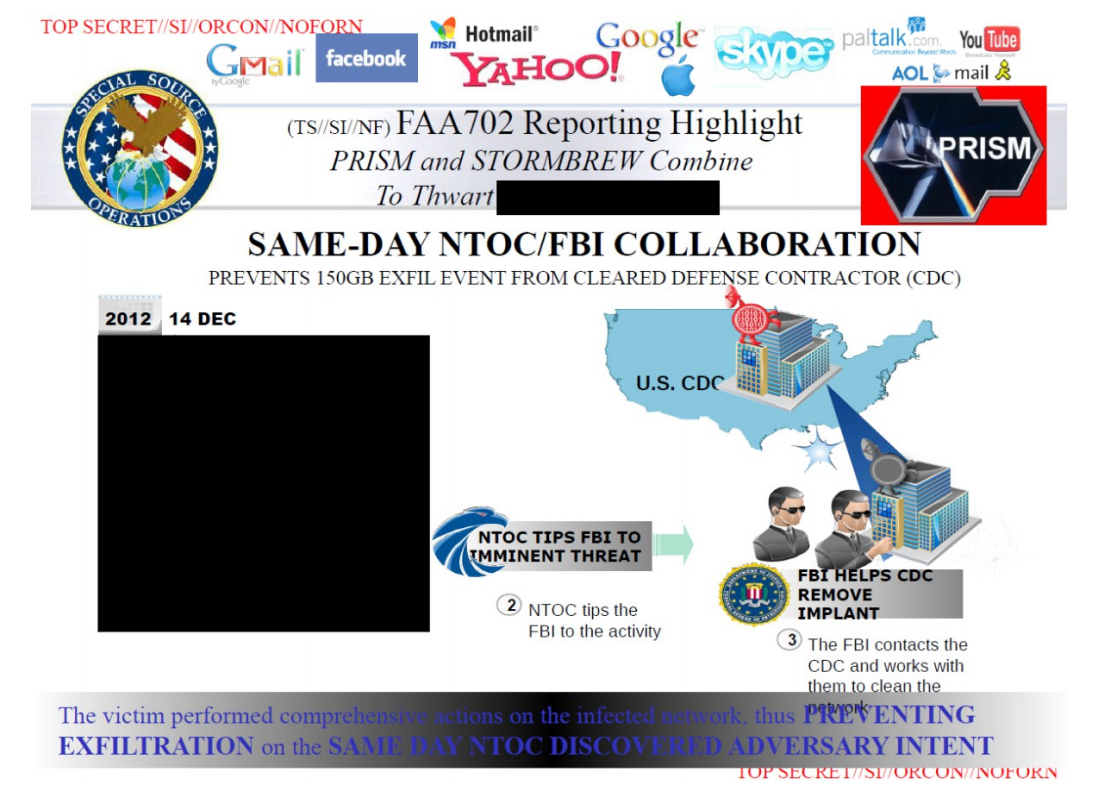
Screen shot 2013-10-21 at 9.59.11 AMOver four months ago, I noted that the most impressive success touted in James Clapper’s fact sheet on Section 702 pertained to cybersecurity, not terrorism.

Communications collected under Section 702 have provided significant and unique intelligence regarding potential cyber threats to the United States, including specific potential network computer attacks. This insight has led to successful efforts to mitigate these threats.

Le Monde, as part of its package on US spying on France, published yet another version of the PRISM slide presentation, including this slide (and 2 others that haven’t been published before; h/t Koen Rouwhorst).

While I’m not sure we’re yet looking at the complete PRISM slideset, at least as it stands, this slide tells the sole success story in the presentation. It describes how, on December 14, 2012, the NSA/CSS Threat Operations Center alerted the FBI to an implant on a Defense contractor’s network. The FBI and the contractor managed to take action that same day to prevent the exfiltration of 150G of data.

And thus using upstream collection (the slide cites Stormbrew), the NSA managed to do something equivalent to stopping China from getting yet another module of data on the F-35 development to go along with all the other data it has stolen.

While I’m glad the NSA prevented yet more tax dollars to be wasted on secrets China (or someone like them) was going to steal anyway, I am rather interested that this gets touted internally as Section 702’s big success story.

After all, Keith Alexander has been chanting terror terror terror terror for the last four months. It turns out — as I’ve been saying all along — it’s not about the 54 mostly overseas plots Section 702 has helped to thwart, it’s about cybersecurity.

Moreover, it doesn’t involve someone’s personal communications access via PRISM. It involves upstream collection (this also suggests when NSA describes searching for “selectors” in upstream collection, it searches on more than just emails and phone numbers, as it has previously suggested).

Again, this success is in no way a bad thing–kudos to the NSA for catching this.

It just highlights how we’re being sold a dragnet to protect against hackers based on fear of terrorists.

Update: In a Guardian post today, I argue Obama should use the replacement of Keith Alexander as an opportunity to break up NSA.

Metaphorically, the NSA has pursued its search for intelligence by partly disabling the locks to all our front doors. Having thus left us exposed, it demands the authority to be able to enter our homes to look around and see if those disabled locks have allowed any nasty types to get in.

Given the way the NSA’s data retention procedures have gone beyond the letter of the law to allow them to keep Americans’ data if it presents a threat to property (rather than just a threat of bodily harm), while the NSA is looking for nasty types, they might also make sure you don’t have any music or movies for which you don’t have a receipt. Thus it has happened that, in the name of preventing invaders, the NSA has itself invaded

Share this entry

US Isn’t Collecting Only Electronic Data On You — Huge Biometric Database Under Construction, Too

Edward Snowden’s revelations have shed much light on how secret government programs are collecting huge amounts of telephone, email and other electronic data generated by every US citizen even though, as Marcy has shown repeatedly, claims that collecting all of this data have enabled the capture of terrorists turn out to be significantly overblown. Sadly, it’s not just records of our communications that the government is collecting. The FBI is taking the lead in putting together what it calls Next Generation Identification. This program will expand the conventional FBI fingerprint database to include significant amounts of biological, or biometric data. From the FBI’s own description:

The future of identification systems is currently progressing beyond the dependency of a unimodal (e.g., fingerprint) biometric identifier towards multimodal biometrics (i.e., voice, iris, facial, etc.). The NGI Program will advance the integration strategies and indexing of additional biometric data that will provide the framework for a future multimodal system that will facilitate biometric fusion identification techniques. The framework will be expandable, scalable, and flexible to accommodate new technologies and biometric standards, and will be interoperable with existing systems. Once developed and implemented, the NGI initiatives and multimodal functionality will promote a high level of information sharing, support interoperability, and provide a foundation for using multiple biometrics for positive identification.

Wait. See that “etc.” in the “voice, iris, facial, etc”? Given the government’s behavior on electronic data, throwing in an “etc.” on biometric data is pretty unnerving. Impressive work is being done by the Electronic Privacy Information Center to shed light on just what the government is up to with Next Generation Identification. Here is their description of the program:

The Federal Bureau of Investigation is developing a biometric identification database program called “Next Generation Identification” (NGI). When completed, the NGI system will be the largest biometric database in the world. The vast majority of records contained in the NGI database will be of US citizens. The NGI biometric identifiers will include fingerprints, iris scans, DNA profiles, voice identification profiles, palm prints, and photographs. The system will include facial recognition capabilities to analyze collected images. Millions of individuals who are neither criminals nor suspects will be included in the database. Many of these individuals will be unaware that their images and other biometric identifiers are being captured. Drivers license photos and other biometric records collected by civil service agencies could be added to the system. The NGI system could be integrated with other surveillance technology, such as Trapwire, that would enable real-time image-matching of live feeds from CCTV surveillance cameras. The Department of Homeland Security has expended hundreds of millions of dollars to establish state and local surveillance systems, including CCTV cameras that record the routine activities of millions of individuals. There are an estimated 30 million surveillance cameras in the United States. The NGI system will be integrated with CCTV cameras operated by public agencies and private entities.

So just as the government has moved far beyond tapping communications only with a warrant to include the communications of innocent civilians, biometric identifiers of innocent civilians will be included in NGI alongside identifiers of known criminals. And what could possibly go wrong with our information being assembled in this way? Here’s how EPIC says the database will be built and maintained: Read more

Share this entry

Dianne Feinstein Didn’t Mean to Mislead the Senate into Extending FAA, Promise!

Charlie Savage has a story describing how, after Solicitor General Don Verrilli got caught lying to SCOTUS about whether defendants busted using FISA Amendments Act would have the opportunity to challenge it in court, DOJ has now decided to adopt a different standard for disclosure of such information.

National security lawyers and a policy advisory committee of senior United States attorneys focused on operational worries: Disclosure risked alerting foreign targets that their communications were being monitored, so intelligence agencies might become reluctant to share information with law enforcement officials that could become a problem in a later trial.

But Mr. Verrilli argued that withholding disclosure from defendants could not be justified legally, officials said. Lawyers with several agencies — including the Federal Bureau of Investigation, the N.S.A. and the office of the director of national intelligence — concurred, officials said, and the division changed the practice going forward.

I’ll return to the import of this debate later.

As part of the story, Savage describes why Adel Daoud, who had been named by Dianne Feinstein last year during the FAA reauthorization debate, won’t get access to any wiretapping information, at least not from her. He links to court documents in which the Senate’s lawyer, Morgan Frankel, claims they don’t have to turn over anything under Speech and Debate, but that in any case, DiFi never meant to suggest FAA had identified the terrorists whose cases she invoked to scare the Senate into reauthorizing FAA.

Here’s what she said (the underlined comments were cited by Frankel):

There is a view by some that this country no longer needs to fear attack. I don’t share that view, and I have asked the intelligence committee staff to compile arrests that have been made in the last 4 years in America that have been made between 2009 and 2012. There are 100 arrests that have been made between 2009 and 2012. There have been 16 individuals arrested just this year alone. Let me quickly review some of these plots. Some of these may arrests [sic] come about as a result of this program. Again, if Members want to see the specific cases where FISA Amendments Act authorities were used, they can go and look at the classified background of these cases.

[lists 9 of the 16 arrests, including Daoud’s]

So I believe the FISA Amendments Act is important and these cases show the program has worked. As the years go on, I believe good intelligence is the most important way to prevent future attacks.

Information gained through programs such as this one — and through other sources as well — is able to be used to prevent future attacks. So, in the past 4 years, there have been 100 arrests to prevent something from happening in the United States, some of these plots have been thwarted because of this program.

And here’s how the Senate Legal Counsel Morgan Frankel dismissed these claims.

Notwithstanding that she was speaking in support of reauthorization of Title VII of the Foreign Intelligence Surveillance Act, Senator Feinstein did not state, and she did not mean to state, that FAA surveillance was used in any or all of the nine cases she enumerated,

Read more

Share this entry

Why We Can’t Save Mohamed Osman Mohamud

Remember how Mohamed Osman Mohamud’s father, Osman Barre, called the FBI in hopes they might help him turn his son away from extremism? Instead of helping, they sent informant after informant after him, to catch him in a terrorist sting.

FBI success story and human and societal failure!

Will McCants has the story of a new, laudable effort to pool funds and invest in countering extremism rather than killing it, largely by getting funds to NGOs in affected countries.

But it won’t help someone like Osman Barre, who worries that his son is getting enthralled with violence. Because donors are worried that if they help a Mohamed Mohamud and he does attack something, they’ll be charged with material support for terror.

Although it represents perhaps the most important part of CVE, most governments and NGOs have been leery of trying to turn around young men and women who have expressed support for terrorist organizations — and are thus in prime positions to be recruited — but have not broken any laws. This is because they worry about violating laws against support for designated terrorist organizations. For example, a government development agency or an NGO will not want to put an al-Shabab fanboy — even a law-abiding one — in their programs for fear of being seen as aiding a terrorist group. And, even they decide it’s acceptable to try and reform the al-Shabab fanboy, they risk huge political backlash if he later engages in terrorism.

A cynic might suggest the material support laws — and the Holder v. Humanitarian Law Project decision that held even well-designed support might merit criminal penalties — is set this way to generate a continued supply of FBI success stories.

Share this entry

US Deports Ibragim Todashev’s Girlfriend

The Guardian and Boston Magazine report that Tatiana Gruzdeva, the woman whom FBI had apparently detained to pressure Ibragim Todashev to cooperate, is now back in Moldova after being deported to Russia. Gruzdeva had claimed she was deported for granting an interview to Boston Magazine, and that outlet quotes a lawyer explaining how that might be the case.

[I]mmigration lawyers Susan Church and Jeremiah Freedman told me Gruzdeva was most likely given something called an order of supervision—and yes, they said, under an order of supervision, the feds can deport her for speaking to the media.

Church says this proviso matches Gruzdeva’s account that she was given a one-year extension to stay in America and that she was allowed to file for work papers. Orders of supervision are usually given under another legal provision called deferred action. Church says it’s common for people to file for work under these circumstances.

According to Freedman, orders of supervision can include certain requirements like not speaking to the press. “If you violate the conditions of your order of supervision,” he said, “they pick you up and put you in jail again.” And Church says these requirements don’t have to be explicit. “A person who has an overstay really doesn’t have any legal rights,” said Church. “They could be picked up at any time.”

“That is really a privilege that is not extended to many people,” said Church,

I’m as interested in this account for what it says about Gruzdeva’s likely status — deferred action — as the explanation for how speaking to Boston Magazine could get her deported. Because, from what I’ve seen, such an extension along with work privileges is virtually unheard of in the immigration context, even for people who are far more cooperative with law enforcement than we at least understand Gruzdeva to have been.

So Gruzdeva gets that privilege, and while released spends a lot of time with Todashev’s father, Abdulbaki, who is a government official in Grozny. When her roommate, Ashurmamad Miraliev. who had been close friends with Todashev and also spent time with Abdulbaki, was arrested, she went public, which led not only to accusations the FBI was recruiting members of this community as informants, but also ultimately to Gruzdeva’s loss of that privilege and her deportation. While in the US, Abdulbaki was interviewed by the FBI and other law enforcement. And according to the Guardian, Gruzdeva was debriefed in Moscow before she traveled onto Moldova.

So what is the FBI (and another unnamed federal agency, on whose request Miraliev is being detained) really after here?

Share this entry