The False Flag Waves in the Fog

“Absolute nonsense!” Israel has responded to Mark Perry’s “False Flag” claim that Mossad agents recruited Jundallah members by posing as CIA officers. They’ve responded clearly, they claim, because they don’t want US-Israeli intelligence cooperation to get as bad as it did when we caught Jonathan Pollard spying for Israel.

But I’m just as interested in the “proof” Israel offers that this didn’t happen: that Meir Dagan is still welcome in Washington.

The senior Israeli government official said that if there were any truth the claims in Perry’s report, Meir Dagan, the head of the Mossad at the time of the alleged operation, would have been declared a persona non grata in the U.S. and that “Dagan’s foot would not have walked again in Washington”.

Now, it is true that Dagan ran Mossad at the time–2007-2008–when the recruitment in question is alleged to have taken place. And it is true that under Dagan Mossad got rather embarrassingly caught using US (and other Western allies’ passports to facilitate their assassination squads in the Dubai assassination of Quds Force surrogate Mahmoud al-Mabhouh.

But it is also notable that Dagan has made a series of increasingly strident remarks against war with Iran and for the kind of engagement that the latest scientist assassination seems designed to undercut. And then there’s the presumably intentional irony in the statement: Dagan’s ability to travel is limited not by his welcome among Western allies, but because Bibi Netanyahu revoked Dagan’s diplomatic passport last summer in response to his efforts to prevent war against Iran. Since traveling without diplomatic immunity would expose him to arrest for acts that include the al-Mabhouh assassination, Dagan, the former head of Israel’s assassination agency, cannot travel freely to prevent such assassinations in the future.

In other words, this is a very witty but nevertheless quite serious reminder that the same people now trying to find a peaceful path forward are themselves thoroughly implicated in the same crimes they now disown. This is Bibi’s camp reminding that everyone has been breaking the rules in ways that could cause significant legal trouble.

Right on cue, Iran has sent diplomatic notes to both the US and Britain, claiming that the CIA is behind the most recent assassination.

The message addressed to the U.S. government, read, “According to authentic documents and reliable information, the assassination plot was directed, supported, and planned by the U.S. Central Intelligence Agency (CIA) and was carried out with the direct involvement of the agents affiliated with this organization, and the government is directly responsible for it and should be answerable based on international regulations and rights and bilateral commitments.”

[snip]In the protest note, Iran also said, “The Islamic Republic of Iran condemns the inhumane assassination, calls on the U.S. government to provide an immediate explanation, seriously warns about its repercussions, and calls on the (U.S.) government to stop supporting any kind of anti-humanitarian terrorist action against the lives of Iranian citizens, which is in contravention of international rights and the relevant commitments and pose a serious danger to international peace and security. In addition, the government of the Islamic Republic of Iran reserves the right to pursue the issue.”

In the note addressed to the British government, the Foreign Ministry pointed to the remarks that MI6 chief Sir John Sawers made on October 28, 2010, in which he said, “Stopping nuclear proliferation cannot be addressed purely by conventional diplomacy. We need intelligence-led operations to make it more difficult for countries like Iran to develop nuclear weapons.”
The note read, “The Foreign Ministry of the Islamic Republic of Iran takes into consideration the fact that the assassinations of Iranian scientists began right after the announcement of the very attitude of the British government by Mr. John Sawers, the head of Britain’s Secret Intelligence Service, and once again expresses its protest about the repercussions of the mentioned attitude of the British government and holds the country responsible for such terrorists acts.”

Gosh, Iran could have drafted these letters using the letters the US issued after it busted the Scary Iran Plot allegedly involving Manssor Arbabsiar as a model! (Which reminds me. Has anyone checked in on the Saudi involvement to defeat Iran, of late? And what they–and the Pakistanis–think about Israelis purportedly running terrorists out of Pakistan?)

Remember, too, according to Perry’s “False Flag,” the recruitment of the Jundallah members–by whomever–largely took place in London, “under the nose of U.S. intelligence officers.” So if Perry’s piece was meant as preemptive inoculation against evidence his sources knew might be revealed, it would not be surprising if such evidence implicated both the US and Britain.

Now, if it weren’t for the latent lethality behind all this posturing (and if weren’t so clear that, whatever Iran has, Israel surely has evidence of our complicity here, if they ever feel the need to reveal it), this might be a somewhat amusing and overdue spat between Israel and the US.

But as it is, it seems the winner of this conflict between Israeli and US neocon Hawks (some of who presumably remain in government positions) on one side, and those trying to avoid war (if not regime change) on the other threatens may depend most on who wins the infowar that has broken out. Clearly, all sides have the goods on the others, but no one can risk having all this damning information come out.

Update: Corrected post to reflect that Mossad did not use US passports in the Dubai hit.
Share this entry

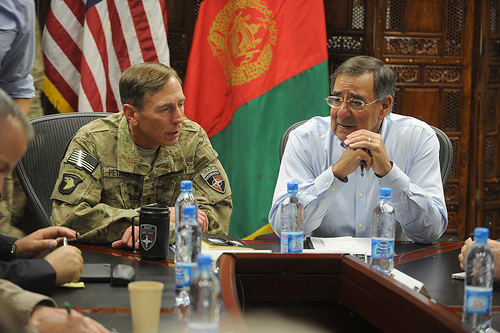
After Trading Jobs, Petraeus and Panetta Have Traded Sides in Military vs. Intelligence Differences

Mid-trade photo of David Petraeus, left, and Leon Panetta in July, 2011 in Kabul when Petraeus headed ISAF/NATO and Panetta had just taken over as Defense Secretary. (Department of State photo via Flickr)

What a difference a year makes.

Here is the New York Times with some of the fallout from the Afghanistan National Intelligence Estimate prepared in December, 2010, in an article published about a week after the report was supplied to Congress:

American military commanders and senior Pentagon officials have already criticized the reports as out of date and say that the cut-off date for the Afghanistan report, Oct. 1, does not allow it to take into account what the military cites as tactical gains in Kandahar and Helmand Provinces in the south in the six weeks since. Pentagon and military officials also say the reports were written by desk-bound Washington analysts who have spent limited time, if any, in Afghanistan and have no feel for the war.

“They are not on the ground living it day in and day out like our forces are, so they don’t have the proximity and perspective,” said a senior defense official who spoke on the condition of anonymity because he did not want to be identified while criticizing the intelligence agencies. The official said that the 30,000 additional troops that Mr. Obama ordered to Afghanistan in December 2009 did not all arrive until September, meaning that the intelligence agencies had little time to judge the effects of the escalation. There are now about 100,000 American forces in Afghanistan.

/snip/

The dispute also reflects the longstanding cultural differences between intelligence analysts, whose job is to warn of potential bad news, and military commanders, who are trained to promote “can do” optimism.

A new National Intelligence Estimate for Afghanistan has been prepared and the Los Angeles Times yesterday reported on the estimate and its responses, including this:

The findings prompted a sharp response from Marine Corps Gen. John Allen, the U.S. commander of Western forces in the war, and Ryan Crocker, the U.S. ambassador to Afghanistan, who filed their objections in a one-page written dissent. The comment was also signed by Marine Corps Gen. James Mattis, commander of Central Command, and Adm. James Stavridis, supreme allied commander of the North Atlantic Treaty Organization.

Military and Pentagon officials argued that assumptions used by intelligence agencies were flawed.

“It assumes a quicker drawdown of U.S. support to the Afghan government than a lot of people are projecting, ” said one U.S. official familiar with Pentagon thinking, speaking of the assessment.

Military officials also cited what they claim are gaps in the intelligence agencies’ understanding of the Taliban leadership’s thinking, the officials said.

Although the details differ, the response by the military to the intelligence community’s assessment of Afghanistan is the same. In the face of sober doubts about progress from the intelligence community, the military’s “can-do” attitude claims that things are better than presented in the intelligence estimate, especially in the more recent events that weren’t included in the analysis or in anticipated events that the military sees as more positive than the intelligence community does.

What is remarkable about these two responses from the military (and the two analyses from the intelligence community) is that the two most visible heads of these communities have traded places between the two reports being issued. Read more

Share this entry

Pissing on the Peace Process(es)

[youtube]_TMq3m_Oli4[/youtube]
I hope to get around to saying more about the latest assassinated Iranian scientist, but in the meantime, I wanted to point out a coincidence of timing.

Jim Lobe argues convincingly that the assassination of Mostafa Ahmadi-Roshan was likely designed to scuttle any efforts to dial down the rhetoric between Iran and the US.

My sense of the last week or so was that the mostly verbal confrontation between Iran and the U.S., particularly regarding the Strait of Hormuz, was spinning out of control much more rapidly than anyone had expected and that the possibility of a conflict had suddenly become very real in ways the Obama administration certainly never intended. (See Anne-Marie Slaughter’s CNN column, “Saving Face and Peace in the Gulf,” as an example of “this is getting really dangerous all of a sudden”. Until last fall, of course, she was Clinton’s director of policy planning and a very influential figure in the administration.) So there seemed to be a real effort to dial things back, expressed not only in repeated statements by senior administration officials, including Clinton, emphasizing Washington’s readiness to negotiate, but also, if the always well-informed Laura Rozen is to be believed, a lot of diplomatic — some of it, I’m sure, behind the scenes — manoeuvring to get the P5+1 process back into gear, with Turkey serving as the convenor/mediator.

Under these circumstances, the timing of today’s assassination was particularly remarkable. Among other things, it makes me believe that the U.S., which condemned the attack and categorically denied any role in it (See Clinton’s statement in her press conference with the Qatari Prime Minister here), was not in fact involved.* That leaves two obvious suspects: 1) Israel and 2) a faction within the Iranian regime. If there was indeed an Israeli hand behind it, the assassination was not just an effort to set back the Iran’s nuclear program and induce fear among other scientists working on it. I think it was also a provocation designed to 1) blow up prospects for progress in any p5+1 negotiations that might convene over the next month or so; 2) strengthen hard-line factions in Tehran that oppose negotiations; and 3) possibly provoke retaliation that will further escalate tensions, if not armed conflict. Of course, all three of these overlap and reinforce each other. If it was an internal Iranian faction, which, frankly, I find more difficult to believe, both 1) and 2) above also apply.

It makes sense. Everyone with a brain believes this was an Israeli op, and it’s safe to conclude that Israel wants to press us towards actual conflict.

Now consider DDay’s take on the video, apparently of Marines pissing on Taliban corpses, posted anonymously to YouTube.

Taliban negotiators approaching discussions on a peace deal with the United States claim that the talks will not be derailed by the emergence of a new video showing Marines urinating on dead Taliban soldiers.

Read more

Share this entry

Zardari Flees to Dubai Again Under Cover of “One Day” Trip: Is He Finished?

[youtube]http://www.youtube.com/watch?v=kfqrl17tZCw[/youtube]

Events continue to unfold at a very rapid pace in Pakistan. On Tuesday, I had noted, in comments to my post on the constitutional crisis facing the country over implementing the repeal of the National Reconciliation Ordinance, that Dawn was reporting that Pakistan’s President Asif Ali Zardari had said that he is ready to resign if that is what his political party desires. Further, Zardari had called for a meeting of Parliament for today, along with a meeting just before that with high officials in his PPP political party.

In the meantime, Wednesday was very eventful, as the civilian government and military traded multiple charges back and forth over the continuing memogate controversy. In the midst of that tussle, Prime Minister Yusuf Raza Gilani fired the country’s defense secretary and the military announced a new head for a “brigade known for its prominent role in coups”.

Today, it appears that Zardari has once again fled to Dubai. Both a scheduled medical follow-up to last month’s hospitalization in Dubai and a wedding have been given as reasons for this trip. So far, I’ve seen no mention in any of the stories on his departure of the Parliament meeting and political party meeting that he had called for today. Neither a “scheduled” medical trip nor a trip for a wedding make sense as explanations for a sudden trip which cancels these hastily called meetings. Despite the explanation that this is a one day trip, I’d be very surprised if he chooses to return to Pakistan.

Reuters reports on Zardari’s departure:

Pakistani President Asif Ali Zardari flew to Dubai on a scheduled one-day trip on Thursday, a member of the ruling party and sources said, while tensions grew over a memo seeking U.S. help in preventing a coup by Pakistan’s powerful military.

/snip/

Relations between Pakistan’s civilian government and the military have reached their lowest point since a coup in 1999, reducing the chances that the leadership can take on the country’s enormous social and economic challenges.

Military sources say that while they would like Zardari to go, it should be through constitutional means, not another of the coups that have marked Pakistan’s almost 65 years of independence.

“There is no talk in the military of a takeover,” a mid-level army officer, who requested anonymity because he was not authorized to speak on the matter, told Reuters.

“I don’t foresee a military coup.”

The stage is set, of course, for the “constitutional” removal of Zardari, as his government has a deadline of Monday for responding to the Supreme Court on the NRO case. As noted earlier this week, the Supreme Court has threatened to find the civilian government unfit to rule if it does not respond properly to its rulings. Zardari’s sudden departure, only four days before that deadline, would appear to be an admission that he and his government have no response to the charges.

Meanwhile, as if the Supreme Court breathing down its neck weren’t enough, the Zardari government has further enraged the military with the firing of the defense secretary: Read more

Share this entry

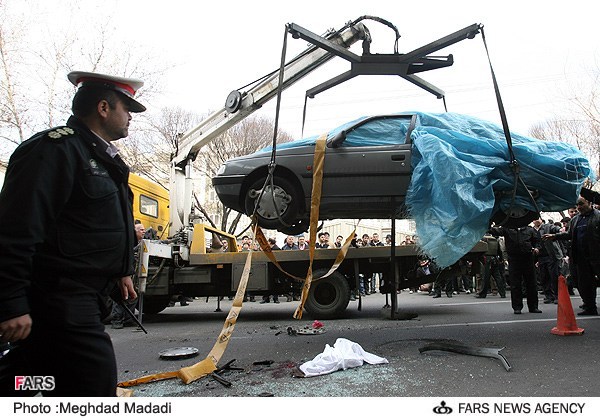
Iran Begins Uranium Enrichment at Qom Tuesday, Enrichment Scientist at Natanz Assassinated Wednesday

Fars News photo of the aftermath of the bomb that killed Mostafa Ahmadi-Roshan.

US Secretary of State Hillary Clinton railed Tuesday against Iran’s beginning of operations at its Qom uranium enrichment facility, which is buried deep within a mountain to protect it from bunker-buster bombs. Less than 24 hours later, the Deputy Director of the Natanz enrichment facility was assassinated when a bomb attached to his car exploded in northern Tehran. Iran is blaming Israel,citing similarities of this attack with two previous attacks on Iranian nuclear scientists, attacks in which Iran says the US also was complicit.

Despite the fact that Iran’s new uranium enrichment plant at Qom is designed to enrich uranium to only 20%, well short of the 90%+ that is needed for nuclear weapons, the US response to the start of operations there paints it as a highly provocative act:

“This step once again demonstrates the Iranian regime’s blatant disregard for its responsibilities and that the country’s growing isolation is self-inflicted,” Clinton said in a statement.

/snip/

“The circumstances surrounding this latest action are especially troubling,” Clinton said.

“There is no plausible justification for this production. Such enrichment brings Iran a significant step closer to having the capability to produce weapons-grade highly enriched uranium.”

Clinton rejected Iran’s assertion that it needed to enrich uranium to produce fuel for a medical research reactor, saying Western powers had offered alternatives means of obtaining such fuel but their offers had been rejected by Tehran.

Remarkably, Clinton also called for Iran to return to the “P5+1” talks, apparently having missed Iran’s Foreign Minister stating last week that Iran is ready to return to these critical talks aimed at diffusing the tension over Iran’s nuclear technology.

It appears that the US is having a bit of trouble with message management over its actions in relation to Iran. Over at Moon of Alabama, b reports on an embarrassing incident yesterday in which transcription from a “senior administration official” in the Washington Post got a bit too candid and had to be revised. Read more

Share this entry

While NY Times Agitates for Resumption of Drone Strikes, Peace Talks Set to Add Afghanistan, Haqqani Network

Over the weekend, the New York Times published a piece whose headline seemed to cry out that drone strikes in Pakistan need to resume: “Lull in Strikes by U.S. Drones Aids Militants in Pakistan”. In reading the article, it is difficult to find strong evidence for the claim that the lull in strikes has helped militant groups. While the article does note a slight uptick in some forms of violence, there have been no major attacks on US forces in Afghanistan as one would expect if the insurgent groups truly had gained significant additional strength and operational capability. An alternative reading of the lull in strikes, however, is that it has provided an important opening for negotiations aimed at ending hostilities in Afghanistan. Two very important developments on that front are now in place, as Afghanistan is sending a delegation to Qatar to visit the newly established Taliban office there and the Express Tribune reports that the US is ready for the Haqqani network to take part in the peace negotiations. In the meantime, the Express Tribune also reports that negotiations between Pakistan and the US have nearly reached the point that drone strikes will resume. If the strikes resume, will progress in the peace talks be slowed or halted?

The poor footing on which the Times bases its claim that insurgents have been aided by the suspension of drone attacks is given away in the opening sentence of the article:

A nearly two-month lull in American drone strikes in Pakistan has helped embolden Al Qaeda and several Pakistani militant factions to regroup, increase attacks against Pakistani security forces and threaten intensified strikes against allied forces in Afghanistan, American and Pakistani officials say.

Attacks on the US have not increased, we only have American and Pakistani officials saying that “intensified” strikes on NATO forces are possible or threatened. As for the increase in attacks on Pakistani security forces, we have this:

Other militant groups continue attacking Pakistani forces. Just last week, Taliban insurgents killed 15 security soldiers who had been kidnapped in retaliation for the death of a militant commander.

The spike in violence in the tribal areas — up nearly 10 percent in 2011 from the previous year, according to a new independent report — comes amid reports of negotiations between Pakistan’s government and some local Taliban factions, although the military denies that such talks are taking place.

So that’s it when it comes to documentation of the strengthening of militant groups: a 10% increase for the year in violence in tribal areas, when the drone “pause” has only been for the last two months or so, with earlier shorter pauses over the Raymond Davis incident and the killing of Osama bin Laden.

The article also notes that the drones have not stopped flying, it’s just that they are not launching missiles. Perhaps US intelligence personnel will take this opportunity to improve the quality of their intelligence so that fewer innocent civilians will be at risk when missile strikes resume.

Meanwhile, we learn that the newly established office for the Taliban in Qatar is about to be visited by a delegation from Afghanistan’s High Peace Council: Read more

Share this entry

The Upside of Evidence-Free Nuke Accusations Against Iran? We Can Declare Victory!

One would think that, within a month of the US finally withdrawing its troops (leaving behind a vast mercenary force) from the nearly nine year nightmare in Iraq that was launched on the basis of evidence-free accusations, and only days after President Obama signed into permanency his ability to detain citizens forever without providing a shred of evidence, the Washington Post would refrain from giving Joby Warrick a chance to yammer again from the basis of unsupportable allegations that Iran is actively pursuing nuclear weapons. But this is the Post we’re talking about, and the same bill that gave Obama indefinite detention powers also tightened the screws on Iran, so it was necessary to bring Warrick out to put forth the latest transcribed version of US spin.

Warrick’s piece, at the time of this writing, is occupying the most prominent position on the home page of the Post’s website, where it has the teaser headline “Iran fears worst as West steps up pressure”. Clicking through to the article gives the headline “As currency crisis and feud with West deepen, Iranians brace for war”. The overall spin that the US is projecting through this transcription is that both the Iranian government and Iranian citizens are feeling the almighty power of the US sanctions and that they are in a state of depressed resignation to the inevitability of war, while the US government is seeing that its brilliant moves are paying off and we just might not need to proceed to the point of an overt attack. I guess that is the upside of moving forward with public sanctions (and covert actions that already constitute a full-on war) based on manufactured evidence: it is also possible to manufacture evidence that allows us to declare victory and (hopefully) move on.

There is, of course, a flip side to that same argument. As commenter Dan succinctly put it in my post from yesterday where we were discussing the risk of all-out war stemming from the US sanctions:

All this risk to punish a country for something no one has proven it has done.

With that as background, here is how the Post article opens:

TEHRAN — At a time when U.S. officials are increasingly confident that economic and political pressure alone may succeed in curbing Iran’s nuclear ambitions, the mood here has turned bleak and belligerent as Iranians prepare grimly for a period of prolonged hardship and, they fear, war.

A bit further along, we get the US gloating on its “successful” approach:

The sense of impending confrontation is not shared in Washington and other Western capitals, where government officials and analysts expressed cautious satisfaction that their policies are working. Read more

Share this entry

On Strategy, Drones, and Climate Change

Try this exercise.

Open up the new Defense Strategic Guidance DOD released today. Hit Ctrl-F. Type in “drone.” Count how many times the word appears in the strategic document that is supposed to guide us through 2020.

Now do the same, Ctrl-F, “Climate change.” Count the mentions of the phenomenon that will cause accelerating amounts of instability between now and 2020.

The number of appearances, for both phrases, is zero.

Zero.

DOD just rolled out new strategic guidance without once mentioning the fancy new toys that are a cornerstone of their new-and-improved small footprint strategy or the phenomenon that will serve as significant a disruptive force as terrorism, China, and cyberwar in the next 8 years, all things that show up in this defense strategy.

And all that in a defense strategy that basically forswears large scale stability operations (AKA Iraq and Afghanistan).

Conduct Stability and Counterinsurgency Operations. In the aftermath of the wars in Iraq and Afghanistan, the United States will emphasize non-military means and military-to-military cooperation to address instability and reduce the demand for significant U.S. force commitments to stability operations. U.S. forces will nevertheless be ready to conduct limited counterinsurgency and other stability operations if required, operating alongside coalition forces wherever possible. Accordingly, U.S. forces will retain and continue to refine the lessons learned, expertise, and specialized capabilities that have been developed over the past ten years of counterinsurgency and stability operations in Iraq and Afghanistan. However, U.S. forces will no longer be sized to conduct large-scale, prolonged stability operations.

Mind you, the defense strategy doesn’t ignore stability–which it mentions ten more times than it does drones or climate change. But in a thoroughly Rumsfeldian manner, it seems to just believe stability … happens.

All in a time when America’s neoliberal economic policies (“commerce,” “prosperity,” and “economic growth”–at 2, 4, and 1–also show up more times than drones or climate change) also contribute to instability and where more and more countries seem to be falling as states.

Now, partly, the defense strategy forswears large scale stability operations, because this entire strategy is an effort to pretend it’s cutting $487 billion over ten years when it’s really just ending two expensive wars, refocusing from Europe to Asia, and assuming we’ll make do with things like Special Forces and those drones the strategy doesn’t mention. To a significant degree, this new defense strategy is a pre-emptive (and thoroughly successful, from the looks of things) attempt to convince the press that DOD is suffering under the same rules of austerity the rest of us are, while really only moving some shells around on a card table.

I suspect the defense strategy also forswears large scale stability operations–AKA nation building–because we suck at it, and no President wants to embrace something we’ve failed at for ten years straight, no matter how important for our security. (Note, it does say it will retain the ability to “regenerate”–like a lizard’s limb–stability operations if the need arises. How we’re going to regenerate something we never had, I don’t know.)

So rather than explaining what we’re going to do with all the countries we destabilize with drone campaigns (AKA Pakistan) or what we’re going to do as Bangladesh and North Africa and the Horn of Africa and much of Southeast Asia increasingly suffer from droughts or floods, setting off catastrophe and migration and more failing central governments, we’re just going to assume stability … happens.

It’s a nice strategy (and an even neater trick, convincing journalists that an increase in defense spending equates to a cut). I’m all in favor of ending these big land wars. But the whole thing also seems to be a strategy for fostering instability as much as one to prevent it. And it doesn’t even consider two of the most destabilizing forces on the horizon in the next 8 years.

Update: Bill Michtom had to remind me that 2020 is 8, not 18, years away.

Share this entry

The McChrystal Apologists Ignoring McChrystal’s Own Take

The WSJ has a scathing critique of Michael Hastings’ The Operators (see Spencer’s more interesting take here). While it complains that Hastings doesn’t profile local indigenous groups and conflates hating the Afghan war with being antiwar, its chief complaint is that “antiwar” journalists damage war efforts.

During the Vietnam War, the generation of David Halberstam and Neil Sheehan transformed America’s mainstream media into a hotbed of antiwar and antimilitary muckraking. By the time a major war effort returned, in 2003, that generation had grown too old to visit the trenches, allowing the emergence of Generation X reporters like Dexter Filkins and George Packer, who did not share their predecessors’ contempt for the military. Most Americans welcomed the change.

Not so Michael Hastings, as we learn in “The Operators,” his account of events in Afghanistan from 2008 to 2011. Mr. Hastings asserts that this generational change drove him to write “The Runaway General,” the Rolling Stone article of June 2010 that doomed the career of Gen. Stanley McChrystal, commander of coalition forces in Afghanistan. With characteristic acerbity, Mr. Hastings laments that his press colleagues have abandoned the spirit of Vietnam, when “war had been exposed as the Giant Lying Machine, in Halberstam’s words.” Instead, he says, they write glowing profiles of generals and other officials in the hope of gaining greater access to sources.

Mr. Hastings singles out, as an example of such truckling, “Stanley McChrystal’s Long War,” an October 2009 profile by Mr. Filkins in the New York Times. Yet the most cursory reading of that piece reveals that Mr. Filkins soberly detailed Gen. McChrystal’s mistakes as well as his triumphs. Mr. Filkins is perhaps now a target because he publicly expressed doubts about “The Runaway General” after its publication. Charlie Rose, on his PBS program, asked Mr. Filkins about quotes in the article that appeared to show Gen. McChrystal and his staff disrespecting President Obama, Vice President Biden, National Security Adviser James Jones and Special Representative Richard Holbrooke, not to mention the French. Mr. Filkins responded: “I spent a lot of time with General McChrystal and the people around him, and I never heard that.”

[snip]

Like David Halberstam and Neil Sheehan, Mr. Hastings ignores the harm that his reporting caused to America’s overseas interests. The firing of Gen. McChrystal removed the one American who enjoyed the confidence of Afghan President Hamid Karzai and of Ashfaq Parvez Kayani, chief of staff of Pakistan’s army.

Hastings is a bad journalist, according to reviewer Mark Moyar, because he exposes that war is built on lies. (Never mind that Moyar provides no proof for his claim that “most Americans” welcomed having shills cover wars rather than journalists.)

Which is why McChrystal’s own comments about war and lies–as reported by Hastings–are so interesting. McChrystal–who, as Hastings reminded, had been a spokesperson during the Iraq War–admitted that the military co-opted the media to cover up the (correct) fact that they believed the war was a bad idea.

We started talking about larger issues within the media, which I felt he was in a unique position to discuss. McChrystal was a spokesperson at the Pentagon during the invasion of Iraq in March of 2003, his first na­tional exposure to the public.

“We co-opted the media on that one,” he said. “You could see it com­ing. There were a lot of us who didn’t think Iraq was a good idea.”

Read more

Share this entry

The Campaign in Afghanistan: Neutralizing Petraeus, Though Not the Taliban?

Rolling Stone just published an excerpt from Michael Hastings’ new book, The Operators.

Click through to read the whole thing (I expect Jim will weigh in as well). But for the moment, consider the irony of this passage, given all that has transpired.

I asked him about Petraeus. He said his relationship with Petraeus was “complex.” He’d replaced Dave three times in five years in jobs. “You know, I’ve been one step behind him.”

Petraeus had uncharacteristically kept a low profile over the past year. He didn’t seem to want to get publicly attached to the war in Afghani­stan. He’d had his triumph in Iraq, and military officials speculated that he knew there was no way the Afghanistan war was going to turn out well. That it was a loser, and he was happy enough to let McChrystal be left holding the bag.

“He couldn’t command this,” McChrystal said. “Plus, he’s one and ‘oh.’ This one is very questionable.”

Petraeus had been “wonderfully supportive,” though, despite the competition between the two. Within military circles, there was a long-standing debate over who should get more credit for what was considered the success in Iraq—McChrystal running JSOC in the shadows, or Pe­traeus for instituting the overall counterinsurgency strategy. After Obama took office, the White House had told Petraeus to stay out of the spot-light—they were worried about the general’s presidential ambitions and they were afraid he would overshadow the young president, McChrystal explained.

The White House told McChrystal, “‘We don’t want a man on horse­back.’ I said I don’t even have a horse. They are very worried about Pe­traeus. They certainly don’t have to be worried about me,” McChrystal said. “But Petraeus, if he wanted to run, he’s had a lot of offers. He says he doesn’t want to, and I believe him.”

“I think he seems like a smart enough guy that in 2012, as a journal­ist, as someone who covered the campaign—” I started to say.

“Do you think he could win?” McChrystal asked me.

“Not in 2012,” I said. “I think in 2016 it would be a no-brainer. But I’ve seen it happen to these guys who get built up, built up, built up . . . If he steps into it in 2012, the narrative is ‘Oh, he shouldn’t have done that. Is that a dishonorable thing to do for an honorable general?’ And that is the narrative. That’s the first cover of Time.” [my emphasis]

McChrystal speculates to Hastings about the Obama Administration’s insecurity regarding David Petraeus (a speculation I agree with). That’s why, McChrystal claims, the showboat Petraeus had gotten so quiet.

But McChrystal offered another reason for Petraeus’ silence: Petraeus wanted to stay away from the taint of Afghanistan, which everyone seemed sure wasn’t going to work out so well.

So after Hastings’ original article–revealing the frank comments of McChrystal’s staffers came out, what happens? Petraeus has to follow McChrystal, commanding the war that everyone seems anxious to blame someone else for. Obama gets rid of McChrystal, but also taints Petraeus with precisely the stinker war he seems to want to avoid.

Mind you, Petraeus has since moved on, now commanding the purportedly secret drone campaigns in other countries.

Still, read now, against the background of Administration attempts (partly negotiated by Petraeus, I wonder?) to get a face-saving peace with the Taliban, it seems all the more sordid.

Afghanistan–where a purportedly broke America continues to dump billions of dollars–seemed to be treated more as a battleground for arrogant men to fight their own political battles than a war anyone aspired to winning.

Share this entry