The Christie Ouster and the Flynn Hiring

The Guardian has an excerpt from Michael Lewis’ new book, The Fifth Risk, which happens to be the chapter focusing on Trump’s transition team. On top of describing how Trump believed spending money, as required by law, to pay a transition team amounted to stealing his own money, the excerpt includes this account of Chris Christie’s firing.

Not long after the people on TV announced that Trump had won Pennsylvania, Jared Kushner grabbed Christie anxiously and said: “We have to have a transition meeting tomorrow morning!” Even before that meeting, Christie had made sure that Trump knew the protocol for his discussions with foreign leaders. The transition team had prepared a document to let him know how these were meant to go. The first few calls were easy – the very first was always with the prime minister of Great Britain – but two dozen calls in you were talking to some kleptocrat and tiptoeing around sensitive security issues. Before any of the calls could be made, however, the president of Egypt called in to the switchboard at Trump Tower and somehow got the operator to put him straight through to Trump. “Trump was like … I love the Bangles! You know that song Walk Like an Egyptian?” recalled one of his advisers on the scene.

That had been the first hint Christie had of trouble. He had asked Kushner what that was about, and Kushner had simply said, Trump ran a very unconventional campaign, and he’s not going to follow any of the protocols.

[snip]

Christie was scheduled to brief the Trump children, Kushner and the other members of Trump’s inner circle. He was surprised to find, suddenly included in this group, retired army lieutenant general Michael Flynn. Flynn was a jobseeker the transition team had found reasons to be extremely wary of. Now he wanted to be named Trump’s national security adviser, which was maybe the most important job in the entire national security apparatus. The national security team inside the Trump transition – staffed with senior former military and intelligence officials – had thought that was an especially bad idea. Flynn’s name was not on the list. But here he was, in the meeting to decide who would do what in the Trump administration, and Ivanka was asking him which job he would like to have.

Before Christie could intercede, Bannon grabbed him and asked to see him privately. Christie followed Bannon to his office impatiently. Hey, this is going to have to be quick, said Christie.

It’s really quick, said Bannon. You’re out.

Why? asked Christie, stunned.

We’re making a change.

“OkayOK, what are we changing?

You.

Why?

It’s really not important.

A week after Christie, along with former HPSCI Chair Mike Rogers, got purged from the Transition Team, I wrote a post that concluded this way.

One of the first things Trump has done has been to ensure agreement in its national security team on this point: that by letting our Middle Eastern allies arm al Qaeda-allied fighters, the Obama Administration created the mess that is in Syria.

And unanimity on that point — accompanied by what is sure to be a very ugly campaign of recriminations against the Obama Administration for cooking intelligence (even aside from the merit of this claim, Flynn has been bitter about his firing for what he sees as objecting to this cooked intelligence) — will provide the basis for Trump to work with Putin on ending the civil war in Syria to Bashar al-Assad’s advantage.

When I wrote that post, this text I received less than 15 hours after the polls closed, from someone I later came to conclude was involved in the election attack, was in my mind.
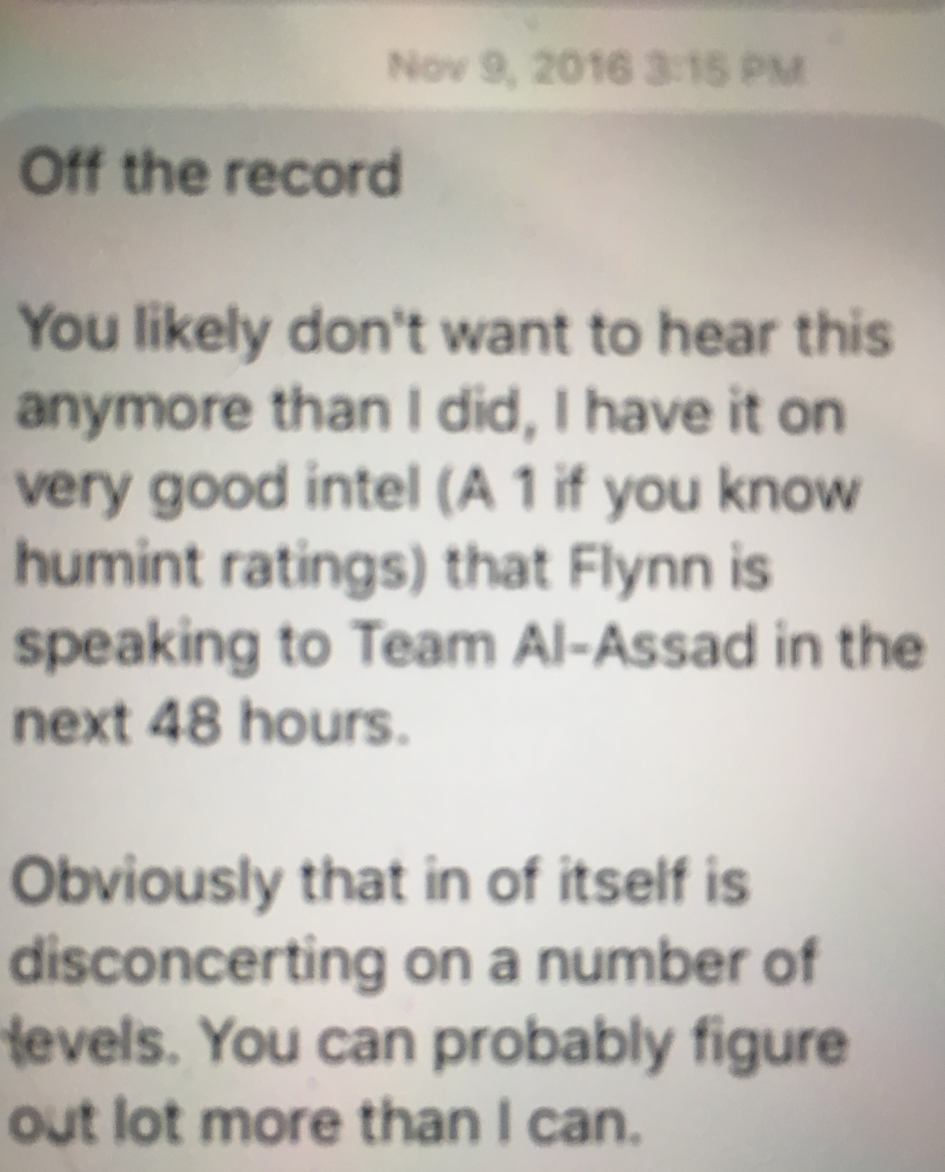
The text continued, in part, “clearly this confirms key role for Trump admin.”

As I surmised two years ago, there was a close tie between the moment Christie and other Republican realists got fired and when Flynn got picked.

According to this Michael Lewis account, though, the tie is far more direct than I imagined. The moment that Flynn got hired is the moment that Chris Christie got fired.

As I disclosed in July, I provided information to the FBI on issues related to the Mueller investigation, so I’m going to include disclosure statements on Mueller investigation posts from here on out. I will include the disclosure whether or not the stuff I shared with the FBI pertains to the subject of the post. 
Share this entry

Can Senator Feinstein Block The Appointment of Rachel Mitchell?

As you know by now, Maricopa County (Arizona) sex crimes unit chief Rachel Mitchell has been deemed by Chuck Grassley and the Senate Judiciary Republicans as their front person to examine Dr. Christine Blasey Ford. From NBC News:

The woman chosen by Senate Judiciary Committee Republicans to question Supreme Court nominee Brett Kavanaugh’s accuser will be in an unusual position when she goes face-to-face with Christine Blasey Ford on Thursday.

Senate Judiciary Committee Chairman Chuck Grassley announced Tuesday that he hired Rachel Mitchell, an outside attorney to question Kavanaugh and Ford, on behalf of the 11 male Republicans on the committee — despite Ford’s wishes to be questioned by the senators themselves about her accusation that Kavanaugh sexually assaulted her when the two were teenagers.

So, the eleven old white men of the SJC want a female stand in to make their evisceration and shining on of putative kidnapping, sexual assault and attempted rape victim Dr. Ford. Because the optics the GOP men, and men are the only sex that has ever served for Republicans on SJC, looked too ugly for even them.

But is this unprecedented move, clearly designed with public optics and maximal humiliation of Dr. Ford even appropriate? Maybe not!

Now, I am not a Senate Rules expert, but a comment made me go do a little digging. Here is the text of the the most recent version of the United States Senate Standing Rules, Orders, Laws, And Resolutions. Here, specifically, is the section, contained in Chapter 43 thereof, in §4301(i)(3) relating to committee retention of consultants:

(3) With respect to the standing committees of the Senate, any such consultant or organization shall be selected by the chairman and ranking minority member of the committee, acting jointly. With respect to the standing committees of the House of Representatives, the standing com- mittee concerned shall select any such consultant or organization. The committee shall submit to the Committee on Rules and Administration in the case of standing committees of the Senate, and the Committee on House Oversight in the case of standing committees of the House of Representatives, information bearing on the qualifications of each consultant whose services are procured pursuant to this subsection, including organizations, and such information shall be retained by that committee and shall be made available for public inspection upon request. (Emphasis added)

So, Senator Feinstein, is this indeed the case? If so, why would you assent to appointment of a prosecutorial thug like Rachel Mitchell to examine the putative victim here, Dr. Ford?

Rachel Mitchell is currently head of the Sex Crimes Unit in the Maricopa County Attorney’s Office (MCAO). She has served under three heads of the MCAO, but she was elevated to her current position because she was an extremist who fit the desired bill by the notorious former MCAO head, Andrew Thomas. As you may recall, Andy Thomas not only had to leave the MCAO in disgrace, but subsequently was disbarred for his zealotry. And that kind of craven zealot is exactly who Rachel Mitchell identified with and was promoted by back in January of 2005. And is Mitchell always hard on sex criminals? No, in fact her past also includes sweetheart deals to abusive clergy members in politically charged cases.

Rachel Mitchell is one of the worst choices imaginable for the current task. It is a heinous move by Chuck Grassley and a direct and complete screw you to Dr. Ford and sexual abuse and rape victims across the United States and world.

And the “screw you” to victims is especially salient with the existence of additional putative victims of Brett Kavanaugh’s drunken debauchery. Not only is there Debbie Ramirez, who did not seek to come forward, but was located because friends and classmates of hers and Kavanaugh, while Kavanaugh was at Yale, started recalling her victimization and talking about it. Jane Mayer has more on that, not to mention her and Ronan Farrow’s original reporting on Ramirez.

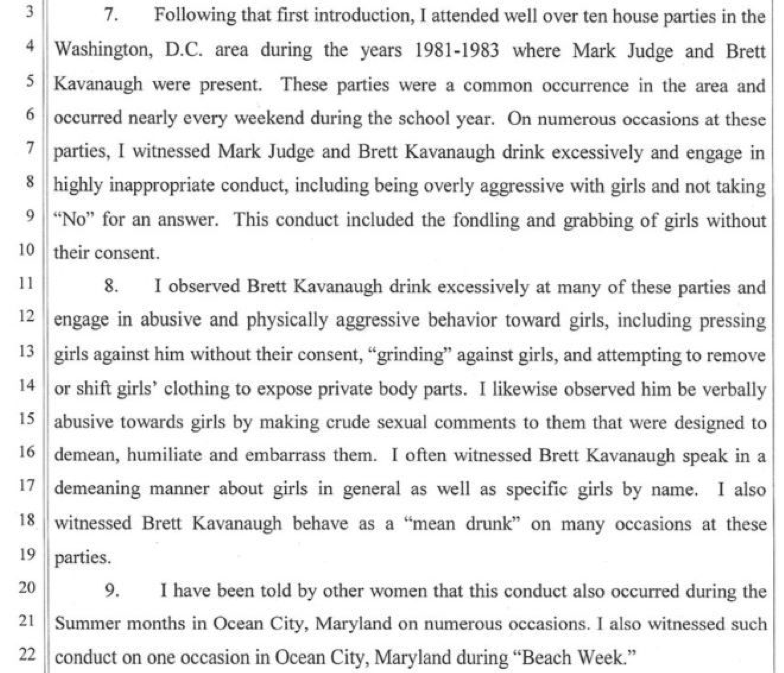
And, just as of an hour or two ago, yet another troubling story of Brett Kavanaugh’s misogyny and conduct has been made public by her lawyer Michael Avenatti. Julie Swetnick has issued a sworn affidavit that is chilling. Swetnick is a A 1980 graduate of Gaithersburg High School in Gaithersburg, Maryland, and has has held multiple security clearances for work done at the Treasury Department, U.S. Mint, IRS, State Department and Justice Department. In short, she is a more than credible person who has put her statement under oath and penalty of perjury.

Here is her affidavit, and it is chilling. It describes what now seems obvious, Brett Kavanaugh and his friend Mark Judge were part of a group of a private boys school wilding gang that drank to excess regularly mistreated women. Judge and Kavanaugh were “joined at the hip” according to Swetnick. She further states:

There is more, much more, including descriptions of girls, including Ms. Swetnick herself, being knocked out with spiked punch and gang raped.

And that is where we find ourselves today. It appears that Senator Feinstein can put the kibosh on the craven hiring of a zealot prosecutorial thug like Rachel Mitchell and, further, can with the help of any and all Republican Senators of conscience, slow down this train wreck and investigate the claims and give a real hearing. That means someone among Jeff Flake, Lisa Murlowski, Susan Collins, or another, needs to step up and do the right thing. Will they? Will Senator Feinstein?

Within the last minute, Senator Feinstein has issued the following statement:

Washington—Following the release of a sworn affidavit from Julie Swetnick detailing new allegations of sexual assault by Brett Kavanaugh, all 10 Democratic members of the Senate Judiciary Committee today urged President Trump to immediately withdraw the nomination or order an FBI investigation into all allegations.

The senators wrote: “We are writing to request that you immediately withdraw the nomination of Brett Kavanaugh to be an Associate Justice on the Supreme Court or direct the FBI to re-open its background investigation and thoroughly examine the multiple allegations of sexual assault.

“Judge Kavanaugh is being considered for a promotion. He is asking for a lifetime appointment to the nation’s highest court where he will have the opportunity to rule on matters that will impact Americans for decades. The standard of character and fitness for a position on the nation’s highest court must be higher than this. Judge Kavanaugh has staunchly declared his respect for women and issued blanket denials of any possible misconduct, but those declarations are in serious doubt.”

That is a nice statement, but there appears to be so much more that Senator Feinstein can do Jeff Flake just took to the Senate Floor and, despite some words of empathy, wholeheartedly accepted that tomorrow’s sham hearing in SJC is all that there will ever be. While Flake appeared close to tears, he, as usual, said and intends to do nothing admirable and/or heroic.

It is a sad show we are watching. The hallowed halls of the Supreme Court deserve better, and so too do the American people.

Share this entry

On Rosenstein, We Shall See …

For a panicked two hours today, it appeared that Rod Rosenstein had either resigned or been fired. Instead, he was attending a regularly scheduled Principal’s Committee after having talked at some length to Trump and John Kelly about the NYT report he was acting erratically in the wake of Trump firing Jim Comey and boasting that he had done so to end the Russian investigation (though the NYT’s reporting wasn’t even that responsible).

The two men will meet again Thursday, as Trump’s SCOTUS nominee gets grilled about an increasing number of sexual assault accusations, to decide Rosenstein’s future.

It’s not entirely clear who would then oversee Mueller if Rosenstein gets fired, but Marty Lederman argues according to normal succession, Solicitor General Noel Francisco would supervise Mueller, but because he has a conflict, it’d likely fall to OLC head Steve Engel.

Those are ordinarily the AG’s functions, not the DAG’s, and unless there’s been a change, DOJ’s view is that the AG’s functions/duties can’t be performed by an “acting” officer (i.e., no “double-acting”). So the responsibility to oversee those investigations would fall to Solicitor General Noel Francisco. Francisco, however, is probably recused from the Russia investigation (at a minimum), because Jones Day, his former firm, represents the Trump Campaign (unless there’s been a change). NF has recused from all SCOTUS cases where Jones Day represents a party, including in the new Term. If NF recuses from supervising Mueller, and any other investigations involving the Trump campaign, those AG functions presumably would be performed by Assistant AG for OLC Steve Engel.

In either case, Jeff Toobin declares that one way or another, that means Mueller is finished.

This issue of who, technically, would be in charge of Mueller is an important one, but it’s not nearly as significant as the broader issue raised by Rosenstein’s likely departure. The President is in charge of the executive branch, and Mueller, as the special counsel, is a subordinate in that branch of the government. If Trump is determined to fire Mueller, or to constrict his investigation in untoward ways, he and his advisers will figure out a way to do it. There is little doubt that the President could ultimately find a compliant Justice Department official to carry out his order of execution. In other words, the massacre this week may lead to another, like the one on a Saturday night in 1973 when Richard Nixon fired Archibald Cox, the Watergate special prosecutor. This modern version would be an abuse of power of the most profound sort. Firing Mueller—who has been investigating Trump and his campaign and Administration for a year and a half—would be the very definition of a high crime and misdemeanor, as impeachable offenses are defined in the Constitution. But would the Republicans who control Congress see it that way?

Put another way, the real question is whether there is any political will among the Republicans who run the legislative branch of government to check Trump’s power.

My guess is what happens between now and Thursday matters a lot. It’s possible, for example, that the Trump Administration could implement some plan to put an even more competent hatchet man in place behind Rosenstein (or get him to resign, which would leave more options). Or it’s possible that Mueller has key indictments sufficiently developed to roll them out in the next day or so (though there’s no grand jury before Thursday at the earliest). I think it even possible that Rosenstein will not only be able to explain the NYT report away (in part by suggesting that it’s just an Andrew McCabe attempt to get back at Trump), but also explain why things will be worse for Mueller if he does fire him.

So we shall see.

Share this entry

On KT McFarland’s Belated Unforgetting of the Truth

The WaPo has an important story about how KT McFarland decided to unforget key details about her role in coaching Mike Flynn through reassuring Russia, on December 29, 2016, that the Trump Administration would ease off on sanctions. McFarland lied about whether sanctions were discussed in a summer 2017 interview with the FBI, then her memory seems to have cleared up after the Mike Flynn plea deal.

When FBI agents first visited her at her Long Island home in the summer of 2017, McFarland denied ever talking to Flynn about any discussion of sanctions between him and the ambassador, Sergey Kislyak, in December 2016 during the presidential transition.

For a time, investigators saw her answers as “inconsistent,” putting her in legal peril as the FBI tried to determine if she had lied to them.

[snip]

Not long after Flynn’s plea, McFarland was questioned by investigators again about her conversations with Flynn, and she walked back her previous denial that sanctions were discussed, saying a general statement Flynn had made to her that things were going to be okay could have been a reference to sanctions, these people said.

McFarland’s account does not answer the question of what the president knew or didn’t know about Flynn’s interactions with the ambassador, these people said.

McFarland didn’t respond to multiple requests for comment, including emails and calls to her home.

Eventually, McFarland and her lawyer Robert Giuffra were able to convince the FBI that she had not intentionally misled the bureau but had rather spoken from memory, without the benefit of any documents that could have helped her remember her exchanges with Flynn about the Kislyak conversations, these people said.

This is thoroughly unsurprising, and it probably has as much to do with McFarland withdrawing her nomination to be Ambassador to Singapore as did any concerns about a confirmation hearing where her past lies to Congress would be an issue. It explains part (though just part) of the Transition Team’s outrage that Mueller had obtained emails that the Trump people would have otherwise claimed privilege over. By doing that, Mueller caught McFarland (and, likely, a number of other people) in lies by showing their extensive communications that contradicted the emails.

Nor is it surprising that McFarland was able to clear up her testimony (indeed, the WaPo notes that Sean Spicer was telling similar lies as McFarland was telling, so he may have also had to have cleaned up testimony). She’s got a serious attorney, Robert Giuffra, and unlike George Papadopoulos she (presumably) didn’t do anything stupid, like deleting her entire Facebook account, when she tried to clean up her lies. That happens in cases like this (especially where the witnesses are powerful enough to fight a false statements case aggressively). Remember that Karl Rove cleaned up his testimony in the Plame investigation four different times.

Indeed, similar unforgettings have probably happened in the wake of each plea deal, or with the unveiling that Mueller obtained search warrants for at least five AT&T phones (and probably a similar number of Verizon phones) in the wake of the Rick Gates plea. That’s what I meant when I suggested that the Paul Manafort plea may set off a kind of mass Game Theory, as each of up to 30 co-conspirators consider whether they want to change their testimony before the former campaign chair clarifies it to Mueller for them, or before their fellow rats jump ship first.

They’re trying to stave off an awful game of prisoner’s dilemma.

Consider if you’re one of the other 37 (which might be down to 34 given known cooperators, or maybe even fewer given how uncertain Rudy seems to be about Don McGahn’s third session of testimony) members of the Joint Defense Agreement, especially if you’re one who has already testified before the grand jury about matters that Manafort (and Gates) might be able to refute. So long as there’s no chance Trump will be touched, you’re probably still safe, as you can count on Trump rewarding those who maintain the omertà or at the very least working to kill the Mueller inquiry shortly after the election.

But if you have doubts about that — or concerns that other witnesses might have doubts about that — you still have an opportunity to recall the things you claimed you could not recall a year ago. Depending on how central your testimony is, you might even be able to slip in and fix your testimony unnoticed.

So each of 37 (or maybe just 30) people are considering whether they have to recalculate their decisions about whether to remain loyal to the President or take care of themselves.

While I suspect Mueller has key players in the case in chief largely sewn up, this should accelerate the process and make any prosecutions easier (assuming the NYT doesn’t get Rosenstein fired before then).

So one takeaway from this story — told probably eight months after the fact — is that Mueller has been slowly chipping away at the omertà, and that process will only keep getting easier (in part because virtually none of these people have any decent operational security).

But the other takeaway, and the likely explanation for it coming out, is that my assessment of why the Transition squawked so loudly last year is correct: they wanted to hide how closely Donald Trump micromanaged the sanctions conversation with Sergei Kislyak, and so both Flynn and McFarland lied about it, then subsequently cleaned up their lies. That puts Donald Trump attempting to deliver the quo of the quid pro quo.

Trump may be answering the take home exam he told Mueller he’d be willing to complete, which includes this question, which got added in the wake of Flynn’s plea and probably McFarland’s revised testimony: What discussions did you have during the campaign regarding Russian sanctions?

The correct answers to that question are getting narrower and narrower.

Update: Fixed syntax of Spicer description.

As I disclosed in July, I provided information to the FBI on issues related to the Mueller investigation, so I’m going to include disclosure statements on Mueller investigation posts from here on out. I will include the disclosure whether or not the stuff I shared with the FBI pertains to the subject of the post. 
Share this entry

Rob Goldstone Continues to Work the Press to Spin His Role in the June 9 Meeting

There’s a really funny line in Rosalind Helderman’s profile of Rob Goldstone in conjunction with the release of his book. First, Helderman comically asserts that Goldstone — who did an interview for a long piece in the British Times that helped witnesses coordinate their stories last November — kept his mouth shut about his testimony.

Goldstone has emerged as a rare independent voice in the Russia story — one of the few witnesses who voluntarily sat with any investigator who asked and, out of courtesy to the process, kept his mouth shut along the way.

Helderman suggests she would know about witnesses who had provided testimony to investigators even if they kept their mouths shut. While it’s true that Helderman gets leaks from places few other journalists do (indeed, it’s one reason I did not share everything I knew with certain investigators, to prevent leaks through her), I’m fairly certain that a pretty significant number of witnesses have managed to stay quiet.

The comment is all the funnier given how the at-times-conflicting-with-the-sworn-record WaPo story ends, with Goldstone falsely claiming that the first time he started thinking of the June 9 meeting again after it happened was when the WaPo called him on July 9 and asked him if he set up the meeting.

Then, he said, he did his best to put the meeting out of his mind — until more than a year later, when the New York Times broke the news of the gathering.

Sitting at lunch at a cafe in Greece the next day, he received a call from a Post reporter, inquiring if he had set up the encounter.

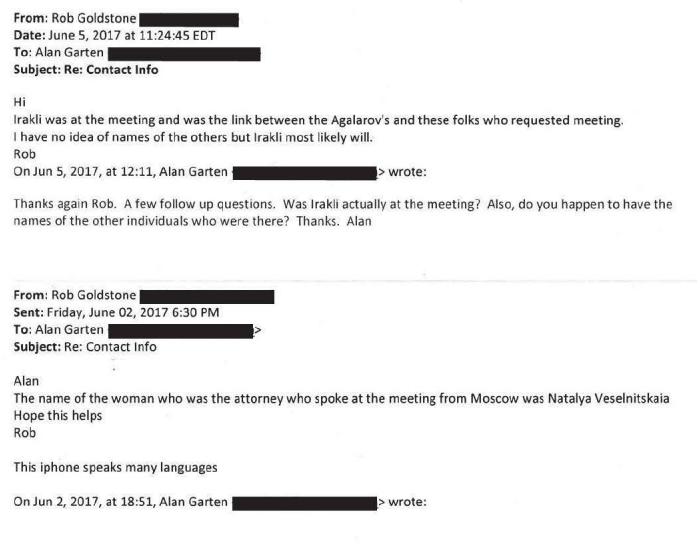
The claim is false on a number of fronts. Goldstone made some efforts (albeit, according to his sworn testimony, reluctantly) to set up a November meeting following up on the June 9 meeting. And he started thinking about the meeting again at least at least as early as June 2, 2017, when Trump Organization lawyer Alan Garten reached out to him to learn more details about the meeting that Don Jr was denying ever took place.

Goldstone’s silence on both those details in his WaPo profile puts his actions in much more favorable light than they really were. They hide how substantive the meeting was treated by both sides.

And I find all that pretty amusing given that Goldstone doesn’t name which Post reporter reached out to him in July 2017.

Here’s that story’s byline:

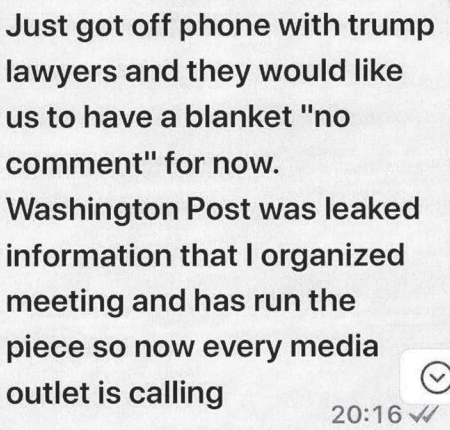
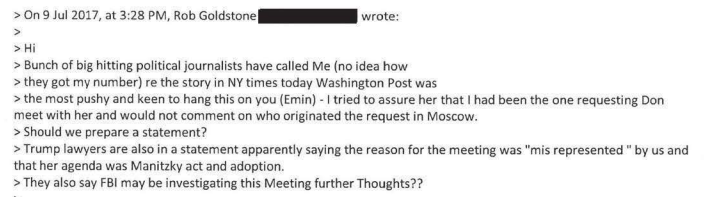
And the reason that’s important is because, at least according to Goldstone on July 9, 2017, his involvement in the meeting got leaked.

His insinuation to Emin Agalarov (in a comment that makes clear he spoke with Helderman, not Hamburger) was that the Trump people had leaked his name to preemptively blame the Agalarov side for misrepresenting the meeting.

Whether or not Goldstone is correct about who leaked his involvement is actually a fairly important detail in the investigation. In any case, the story of the mutual recriminations between the Trumps and Agalarovs really reveals how early both sides realized the meeting was going to cause real problems for the Trumps.

Which is all the more reason for journalists to be honest about where there are and are not leaks.

As I disclosed in July, I provided information to the FBI on issues related to the Mueller investigation, so I’m going to include disclosure statements on Mueller investigation posts from here on out. I will include the disclosure whether or not the stuff I shared with the FBI pertains to the subject of the post. 
Share this entry

The Shiny Object of the May 2017 Russian Investigation: The Evidence Mostly Came in after August 1

There’s a reason today’s NYT story so infuriates me — to say nothing of Trump’s efforts to declassify documents from the Russia investigation that, because of the personnel moves of virtually everyone involved, would mostly end by August 1, 2017.

That’s because it’s clear that — because Peter Strzok lost an August 2016 battle to investigate more aggressively in summer and fall 2016 — DOJ, FBI, and then Mueller were only obtaining key information around about August 1, 2017, a year later. It’s no surprise, then, that (as the frothy right has been obsessing about recently) Lisa Page and Strzok weren’t sure if there was evidence of “collusion” on May 17, 2017. Of course they weren’t. The government hadn’t started collecting the evidence in earnest yet.

Consider the following investigative steps:

FBI appears not to have sent a preservation request to Government Services Administration for George Papadopoulos’ material until March 9, 2017, and they appear not to have pursued his privately held call records (especially the Facebook ones that would have revealed the existence of Ivan Timofeev) until some time later.

On June 6, 2017, the Mueller team was still debating whether they would access Section 702 materials, something they otherwise do routinely with assessments, to say nothing of fully predicated national security investigations.

The John Dowd letter wrongly claiming unprecedented cooperation reveals that Mueller started to receive the documents requested by congressional committees on July 21; that would presumably be the first that the government obtained the version of the June 9 emails that included Paul Manafort’s replies.

Copies of all documents provided to the committees by the Campaign, and all search term lists and the privilege log, were also provided to the Special Counsel.

  • By letter dated May 17, 2017, the Campaign received a request for documents from the Senate Select Committee on Intelligence (SSCI).
  • By letter dated June 7, 2017, the Campaign received a request for documents from the House Permanent Select Committee on Intelligence (HPSCI). The records requested included records generated from June 16, 2015, to 12pm on January 20, 2017, and hence, included the transition period.
  • The Campaign voluntarily responded to these requests by providing 840 documents on July 21, 2017, and another set of 4,800 documents on July 31, 2017. By letter dated July 19, 2017, the Campaign received a request for documents from the Senate Judiciary Committee (SJC).

Mueller sent a preservation request for Transition materials on June 22. He obtained all the emails and devices from 13 transition staffers in late August.

Specifically, on August 23, 2017, the FBI sent a letter (i.e., not a subpoena) to career GSA staff requesting copies of the emails, laptops, cell phones, and other materials associated with nine PTT members responsible for national security and policy matters. On August 30, 2017, the FBI sent a letter (again, not a subpoena) to career GSA staff requesting such materials for four additional senior PTT members.

The list of documents the White House provided, organized by Bates number, show that some key documents couldn’t have come in until July 2017. Indeed, documents pertaining to Comey’s firing appear to be the last of the document sets obtained, sometime after the disclosure of the June 9, 2016 meeting in July 2017.

BuzzFeed’s big scoop on financial transfers between Aras Agalarov and Ike Kaveladze around the time of the June 9 meeting shows banks didn’t start looking for such suspicious transfers until after the June 9 meeting was disclosed on July 8, 2017.

None of these transactions was discovered until 2017, after the New York Times revealed the Trump Tower meeting. Shortly after that report, investigators asked financial institutions to look back at their accounts to learn how money flowed among the people who planned and attended the meeting: Agalarov; Kaveladze; Agalarov’s pop star son, Emin; their employee, Rob Goldstone, who sent the original email to Trump Jr.; and others.

To unearth connections between some of their accounts, banks took an extraordinary step: They invoked a provision of the Patriot Act — a post-9/11 law that included new tools to track money laundering and terrorist financing. That provision, rarely used in the Trump-Russia investigation, allowed the banks to share information about customers with one another.

Three financial institutions — Citibank, JP Morgan Chase, and Morgan Stanley — discovered the $3.3 million that flowed from Agalarov to Kaveladze.

My interview with the FBI (I believe I was the second source about one aspect of what I shared, but believe I was the first about the stuff that tied more obviously to the campaign) was July 14. I believe my materials were moved under Mueller when Ryan Dickey got moved under Mueller in November, 2017.

So the constant six-year old soccer chases by journalists trying to learn what happened in May 2017 — when things were chaotic because Trump was breaking all norms and firing people who actually weren’t investigating that aggressively — to the detriment of attention on what happened in the months thereafter really does a huge disservice to the truth. The investigation into Trump’s conspiracy with Russia started in earnest around about August 1, 2017. Once the government actually started looking for evidence, I imagine the evidence of conspiracy was pretty obvious.

As I disclosed in July, I provided information to the FBI on issues related to the Mueller investigation, so I’m going to include disclosure statements on Mueller investigation posts from here on out. I will include the disclosure whether or not the stuff I shared with the FBI pertains to the subject of the post. 
Share this entry

The NYT “Scoop” Appears To Be an Effort to Spin Opening an Investigation into Trump as an Erratic Act

I’d like to point out something strongly suggested by the stories based on gossiping about Andrew McCabe memos. These stories portray what people not at a meeting that took place just after Comey’s firing think happened at the meeting based off hearing about memos memorializing them. From the WaPo’s far more responsible version of the story, we know that Lisa Page was also present at the meeting.

Another official at the meeting, then-FBI lawyer Lisa Page, wrote her own memo of the discussion which does not mention any talk of the 25th amendment, according to a second person who was familiar with her account.

And the WaPo’s version of the “wire” comment puts it in context, making it clear that Rosenstein was questioning how they could investigate the President.

That person said the wire comment came in response to McCabe’s own pushing for the Justice Department to open an investigation into the president. To that, Rosenstein responded with what this person described as a sarcastic comment along the lines of, “What do you want to do, Andy, wire the president?”

Now go back to earlier in the week, to the frothy right rehashing some texts Page and Peter Strzok sent, talking about opening an investigation into … someone, while Andrew McCabe was Acting Director. (Apologies for the Fox slurs about Page and Strzok.)

Text messages from disgraced FBI figures Peter Strzok and Lisa Page, discussing whether to open a “case” in a “formal chargeable way” after Director James Comey was fired, are under fresh scrutiny after Page told congressional investigators there was no evidence of Russian collusion at the time, according to three congressional sources.

Two hours after Comey’s termination became public on May 9, 2017, Strzok, a now-former FBI agent, texted Page, his then-colleague and lover: “We need to open the case we’ve been waiting on now while Andy is acting.”

“Andy” is a reference to then-Deputy Director Andrew McCabe who temporarily took over the bureau until Christopher Wray was confirmed as director in August 2017.

Page, a former FBI attorney, replied to Strzok: “We need to lock in (redacted). In a formal chargeable way. Soon.”

Strzok concurred. “I agree. I’ve been pushing and I’ll reemphasize with Bill,” believed to be Bill Priestap, the head of the FBI’s counterintelligence division.

Finally, here’s the WaPo version of Michael Bromwich’s description of the memos.

McCabe’s lawyer, Michael Bromwich, said in a statement that his client “drafted memos to memorialize significant discussions he had with high level officials and preserved them so he would have an accurate, contemporaneous record of those discussions. When he was interviewed by the special counsel more than a year ago, he gave all of his memos — classified and unclassified — to the special counsel’s office. A set of those memos remained at the FBI at the time of his departure in late January 2018. He has no knowledge of how any member of the media obtained those memos.”

These are “significant memos” and went right to Mueller when he was appointed. The kind of memos that might back investigative decisions, such as whether to open an investigation into the President.

So what the NYT spin of the story is about is suggesting that at the moment when DOJ opened an investigation into the President, the guy who opened it was “acting erratically.” Presumably based off the third-hand opinions of people like Jim Jordan, who knows a bit about acting erratically. It’s also about whether a discussion of removing the President took place at the same meeting where a discussion of investigating him did.

Likely, the messages are muddled, because they always are when getting laundered through Jim Jordan’s feverish little mind.

Update: NYT has now updated their story with two details designed to rebut the more responsible reporting of other outlets. First, they cite their sources claiming — without having to explain — that Rosenstein spoke about recording the President on another occasion, with the suggestion that that time it wan’t sarcastic.

Mr. Rosenstein also mentioned the possibility of wearing a wire on at least one other occasion, the people said, though they did not provide details.

More remarkably, they include a paragraph that reveals their original story was inaccurate as to timing. To rebut WaPo’s report that Lisa Page’s version of events don’t include the reference to the 25th Amendment, the NYT has now decided there were “at least two meetings that took place on May 16” (but note the knowledge of their sources all appears to come from memos, not from witnessing the events).

At least two meetings took place on May 16 involving both Mr. McCabe and Mr. Rosenstein, the people familiar with the events of the day said. Mr. Rosenstein brought up the 25th Amendment during the first meeting of Justice Department officials, they said. He did not appear to talk about it at the second, according to a memo by one participant, Lisa Page, a lawyer who worked for Mr. McCabe at the time, that did not mention the topic.

Well, okay, maybe that’s true. But that utterly demolishes some key premises of the story as originally written. The story collapses the timing of all this, emphasizing that it happened just two weeks into the job.

Mr. Rosenstein was just two weeks into his job. He had begun overseeing the Russia investigation and played a key role in the president’s dismissal of Mr. Comey by writing a memo critical of his handling of the Hillary Clinton email investigation. But Mr. Rosenstein was caught off guard when Mr. Trump cited the memo in the firing, and he began telling people that hefeared he had been used.

[snip]

The president informed them of his plan to oust Mr. Comey. To the surprise of White House aides who were trying to talk the president out of it, Mr. Rosenstein embraced the idea, even offering to write the memo about the Clinton email inquiry. He turned it in shortly after.

A day later, Mr. Trump announced the firing, and White House aides released Mr. Rosenstein’s memo, labeling it the basis for Mr. Comey’s dismissal. Democrats sharply criticized Mr. Rosenstein, accusing him of helping to create a cover story for the president to rationalize the termination. [my emphasis]

All this suggests the response was a direct response to the Comey firing.

And while the story does note the meetings take place a week later, the update emphasizes the actual date.

A determined Mr. Rosenstein began telling associates that he would ultimately be “vindicated” for his role in the matter. One week after the firing, Mr. Rosenstein met with Mr. McCabe and at least four other senior Justice Department officials, in part to explain his role in the situation. [my emphasis]

The “wire the president” comment (and the 25th Amendment one, if it did happen as described) took place on May 16, almost a week later.

One week after the firing, Mr. Rosenstein met with Mr. McCabe and at least four other senior Justice Department officials, in part to explain his role in the situation.

In this update, the NYT also took out language about Rosenstein wondering about motive.

wondered whether Mr. Trump had motives beyond Mr. Comey’s treatment of Mrs. Clinton for ousting him, the people said.

By May 16, of course, Rosenstein wouldn’t have to wonder about Trump’s motives, because he had already gone on TV and explained what his motive was — it was to end the Russia investigation.

More troublingly, he had taken a meeting with Sergei Lavrov and Sergei Kislyak — the latter of whom was a key figure in any conspiracy investigation — without American press present at which he shared highly sensitive Israeli secrets. While the public didn’t know it yet, at the meeting Trump also said he fired Comey to ease the pressure on him.

More importantly, if there were two meetings — one on whether Trump was handling the FBI hiring properly, and one on whether to open an investigation into the President — then it means those different topics have a different meaning. One meeting was about whether Trump was capable of doing the job, the other was about whether he had broken the law.

Anyway, what we’re not getting is any real understanding of the real context of these comments.

Share this entry

NYT Gives Trump His Excuse to Fire Rod Rosenstein

The NYT has an inflammatory article claiming that Rod Rosenstein floated recording the President and/or invoking the 25th Amendment in the days after Trump fired Jim Comey. Here’s how they describe their sources for that allegation.

Several people described the episodes, insisting on anonymity to discuss internal deliberations. The people were briefed either on the events themselves or on memos written by F.B.I. officials, including Andrew G. McCabe, then the acting bureau director, that documented Mr. Rosenstein’s actions and comments.

Not a single one of these people, by this description, was actually a witness to the episodes. Indeed, by description, none of them have even read the memos memorializing the events directly, but have instead simply been briefed secondhand.

Which means the NYT gives far, far greater weight in this story on people who are third-hand from the story than, for example, either Rod Rosenstein himself or a person who was present and issued a statement, who says this whole story takes a sarcastic comment and treats it as truth.

Rosenstein disputed this account.

“The New York Times’s story is inaccurate and factually incorrect,” he said in a statement. “I will not further comment on a story based on anonymous sources who are obviously biased against the department and are advancing their own personal agenda. But let me be clear about this: Based on my personal dealings with the president, there is no basis to invoke the 25th Amendment.”

A Justice Department spokeswoman also provided a statement from a person who was present when Mr. Rosenstein proposed wearing a wire. The person, who would not be named, acknowledged the remark but said Mr. Rosenstein made it sarcastically.

All that leads the NYT to the paragraph where they let a bunch of third hand sources to the events claim this is proof that Rosenstein was acting erratically when he made the decision to appoint Robert Mueller.

[T]hey called Mr. Rosenstein’s comments an example of how erratically he was behaving while he was taking part in the interviews for a replacement F.B.I. director, considering the appointment of a special counsel and otherwise running the day-to-day operations of the more than 100,000 people at the Justice Department.

Finally, in a week where Trump is desperate to release documents that will discredit the investigation closing in on himself, Andrew McCabe’s attorney, Michael Bromwich raises real questions about how the NYT might get memos McCabe wrote documenting Rosenstein’s behavior.

His memos have been turned over to the special counsel investigating whether Trump associates conspired with Russia’s election interference, Robert S. Mueller III, according to a lawyer for Mr. McCabe. “A set of those memos remained at the F.B.I. at the time of his departure in late January 2018,” the lawyer, Michael R. Bromwich, said of his client. “He has no knowledge of how any member of the media obtained those memos.”

The insinuation is clear: in an attempt to accuse Rosenstein of things known to set off the President (notably, being recorded), someone took memos McCabe wrote and read them to people who would then leak them to the NYT.

I hope the clicks and access are worth giving third hand sources more weight than actual witnesses.

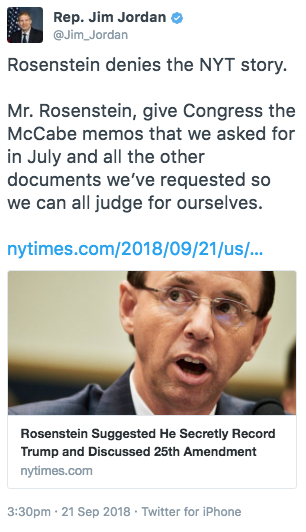
Update: And Jim Jordan pipes up, sounding very much like he could be one of the sources for this story.

Share this entry

The Assange Exfiltration Would Have Taken Place in the Wake of Joshua Schulte Tor Activity

The Guardian has a wild story about a joint Ecuadorian-Russian attempt to spring Julian Assange from the embassy. The idea was that he’d be snuck out of the Embassy in a diplomatic vehicle and sent to live in either Russia or Ecuador.

Sources said the escape plot involved giving Assange diplomatic documents so that Ecuador would be able to claim he enjoyed diplomatic immunity. As part of the operation, Assange was to be collected from the embassy in a diplomatic vehicle.

Four separate sources said the Kremlin was willing to offer support for the plan – including the possibility of allowing Assange to travel to Russia and live there. One of them said that an unidentified Russian businessman served as an intermediary in these discussions.

A single source claims that the plan was supposed to take place on Christmas Eve of last year.

The operation to extract Assange was provisionally scheduled for Christmas Eve in 2017, one source claimed, and was linked to an unsuccessful attempt by Ecuador to give Assange formal diplomatic status.

[snip]

Assange’s Christmas Eve escape was aborted with just days to go, one source claimed. Rommy Vallejo, the head of Ecuador’s intelligence agency, allegedly travelled to the UK on or around 15 December 2017 to oversee the operation and left London when it was called off.

In February Vallejo quit his job and is believed to be in Nicaragua. He is under investigation for the alleged kidnapping in 2012 of a political rival to Correa.

I’m not 100% convinced about that timing for two reasons. First, because related events — Assange receiving Ecuadorian citizenship and Ecuador requesting he be given diplomatic status — only got reported in January.

The Foreign Office has turned down a request from the Ecuadorian government to grant the WikiLeaks founder, Julian Assange, diplomatic status as a means of breaking the stalemate over his continued presence in the UK.

The development comes amid reports that Assange – an Australian who has been holed up in the Ecuadorian embassy for more than five years – has recently become a citizen of the South American state.

If awarded the status of a diplomat, it is thought, Assange could obtain certain rights to legal immunity and might be able to leave the embassy in Knightsbridge, and eventually the UK, without being arrested for breaching his former bail conditions.

Also, when Fidel Narváez denied involvement to the Guardian, he denied meetings with Russia this year, not last (though that’s just as likely non-denial denial).

Two sources familiar with the inner workings of the Ecuadorian embassy said that Fidel Narváez, a close confidant of Assange who until recently served as Ecuador’s London consul, served as a point of contact with Moscow.

In an interview with the Guardian, Narváez denied having been involved in discussions with Russia about extracting Assange from the embassy.

Narváez said he visited Russia’s embassy in Kensington twice this year as part of a group of “20-30 more diplomats from different countries”. These were “open-public meetings”, he said, that took place during the “UK-Russian crisis” – a reference to the aftermath of the novichok poisoning of Sergei and Yulia Skripal in March.

That said, assuming the diplomatic request went in sometime in advance of the reporting on it, then the timing does make sense.

And that’s interesting because it would mean the Ecuadorian-Russian attempt to exfiltrate Assange would have happened in the wake of accused Vault 7 leaker Joshua Schulte endangering his bail by hopping on Tor to do … we don’t know what. Whatever he did, however, it led to Schulte’s detention in MCC and ultimately his delayed indictment for leaking the Vault 7 documents.

November 9, 2017: Wikileaks publishes Vault 8 exploit

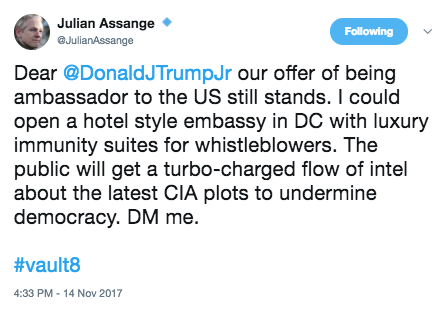
November 14, 2017: Assange posts Vault 8 Ambassador follow-up

November 14, 2017: Arrest warrant in VA

November 15, 2017: Charged in Loudon County for sexual assault

November 16, 2017: Use of Tor

November 17, 2017: Use of Tor

November 26, 2017: Use of Tor

November 29, 2017: Abundance of caution, attorney should obtain clearance

November 30, 2017: Use of Tor

December 5, 2017: Use of Tor, Smith withdraws

December 7, 2017: NYPD arrests on VA warrant for sexual assault

December 12, 2017: Move for detention, including description of email and Tor access

Separately, since the defendant was released on bail, the Government has obtained evidence that he has been using the Internet. First, the Government has obtained data from the service provider for the defendant’s email account (the “Schulte Email Account”), which shows that the account has regularly been logged into and out of since the defendant was released on bail, most recently on the evening of December 6, 2017. Notably, the IP address used to access the Schulte Email Account is almost always the same IP address associated with the broadband internet account for the defendant’s apartment (the “Broadband Account”)—i.e., the account used by Schulte in the apartment to access the Internet via a Wi-Fi network. Moreover, data from the Broadband Account shows that on November 16, 2017, the Broadband Account was used to access the “TOR” network, that is, a network that allows for anonymous communications on the Internet via a worldwide network of linked computer servers, and multiple layers of data encryption. The Broadband Account shows that additional TOR connections were made again on November 17, 26, 30, and December 5.

[snip]

First, there is clear and convincing evidence that the defendant has violated a release condition—namely, the condition that he shall not use the Internet without express authorization from Pretrial Services to do so. As explained above, data obtained from the Schulte Email Account and the Broadband Account strongly suggests that the defendant has been using the Internet since shortly after his release on bail. Especially troubling is the defendant’s apparent use on five occasions of the TOR network. TOR networks enable anonymous communications over the Internet and could be used to download or view child pornography without detection. Indeed, the defendant has a history of using TOR networks. The defendant’s Google searches obtained in this investigation show that on May 8, 2016, the defendant conducted multiple searches related to the use of TOR to anonymously transfer encrypted data on the Internet. In particular, the defendant had searched for “setup for relay,” “test bridge relay,” and “tor relay vs bridge.” Each of these searches returned information regarding the use of interconnected computers on TOR to convey information, or the use of a computer to serve as the gateway (or bridge) into the TOR network.

Which is to say, things were falling apart in this period. And the response, tellingly, was for the Russians to try to find a way to exfiltrate Assange.

Update: Reuters describes the timing as still more problematic.

Ecuador last Dec. 19 approved a “special designation in favor of Mr. Julian Assange so that he can carry out functions at the Ecuadorean Embassy in Russia,” according to the letter written to opposition legislator Paola Vintimilla.

“Special designation” refers to the Ecuadorean president’s right to name political allies to a fixed number of diplomatic posts even if they are not career diplomats.

But Britain’s Foreign Office in a Dec. 21 note said it did not accept Assange as a diplomat and that it did not “consider that Mr. Assange enjoys any type of privileges and immunities under the Vienna Convention,” reads the letter, citing a British diplomatic note.

More and more this looks like an attempt to legally exfiltrate him.

Share this entry

The Committee Playing Games with Perjury Referrals Swears They Can Make Mark Judge Tell the Truth without Testifying

Chuck Grassley and the other Republicans on the Senate Judiciary Committee are still trying to push Christine Blasey Ford testimony through in time to vote Kavanaugh out of the committee next week. As part of that, a Grassley Counsel who asserted, “Unfazed and determined. We will confirm Judge Kavanaugh,” is also boasting about his tough questioning in lieu of a formal investigation. As part of that, SJC Republicans are asserting that they “obtained a statement under penalty of perjury” from Mark Judge, who really doesn’t want to testify, in part because he has written extensively about his own misogyny and alcohol abuse.

Right.

This is the committee, remember that referred Christopher Steele to the FBI for lying to the FBI, but that refuses to make Don Jr testify a second time to clarify problems with his testimony, much less refer him to FBI for lying about a second meeting at which he accepted election assistance from a foreign government (actually two: the Saudis and the Emirates).

Chuck Grassley has already demonstrated his view of lying to the committee: He’s perfectly okay with it, so long as helps Republicans.

So that statement from Mark Judge, without public testimony, is absolutely worthless.

Share this entry