The Disposition of Informants and Citizens
A lot of the commentary about Craig Whitlock’s Tuesday article on three alleged al Shabaab members rendered to the US focused on whether he accurately described this rendition–to a law enforcement proceeding and not, as happened under Bush, to a black site–or not.

But I was more interested in whether the treatment of these three–Swedish citizens Ali Yasin Ahmed and Mohamed Yusuf and Madhi Hashi, a Somali who was raised in the UK, got citizenship there when he was 14, only to have it stripped shortly before he was detained–was indicative of the so-called disposition matrix first reported back in October then reportedly put on hold after Obama beat Mitt.

Consider the timing of both series of events. Hashi was stripped of his British citizenship in June. Shortly thereafter he disappeared from his home in Mogadishu. All three men were in detention in Djibouti by August. On October 18–five days before the first reporting on the disposition matrix–a grand jury returned a sealed indictment against the three. On November 14–conveniently after the election–the US government officially took custody of the men, thereby violating the intent of last year’s NDAA by bringing foreigners onto US soil. And on December 21, while most people were distracted by holidays and fiscal cliffs, the men were arraigned in the Eastern District (curiously, not the Southern District) of New York.

All of which took place as hints of this disposition matrix–an effort to map out contingencies for alleged extremists in a range of different positions–were reported.

“We had a disposition problem,” said a former U.S. counterterrorism official involved in developing the matrix.

The database is meant to map out contingencies, creating an operational menu that spells out each agency’s role in case a suspect surfaces in an unexpected spot. “If he’s in Saudi Arabia, pick up with the Saudis,” the former official said. “If traveling overseas to al-Shabaab [in Somalia] we can pick him up by ship. If in Yemen, kill or have the Yemenis pick him up.”

In other words, the rendition of these three men–in addition to whatever else it was, and I think the case that it was a legitimate use of US law enforcement is thus far weak, though still preferable to a drone strike against the three–seems like a test drive of this disposition process.

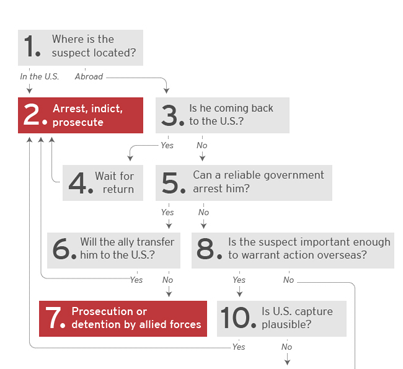
Which is why I find it so interesting that two wired up commentators like Daniel Byman and Benjamin Wittes have rolled out what they represent to be the flow chart–they even call it the disposition matrix–the Obama Administration uses if it believes you’re a terrorist.

Because that flow chart is not just incomplete, but factually wrong on several points.

Take step 11, which asks whether a person overseas is an operational leader or not.

Propagandists, to some degree, are also protected under U.S. law. Glorifying jihad and saying that Americans fighting in Iraq and Afghanistan, or even living ordinary lives stateside, deserve death, is not in itself a crime. So even Anwar al-Awlaki, who inspired Americans and Western Muslims in general to take up jihad, was not aggressively targeted until he was linked to attacks on U.S. airlines and aviation targets in the United Kingdom — thus going from “propagandist” to “operator.” Non-operational figures abroad — however dangerous — will tend to be tolerated to the extent they cannot be captured.

The claim that Awlaki was “not aggressively targeted until he was linked to attacks on U.S. airlines” is false. JSOC targeted him the day before the Intelligence Community first started tying him to operations.

But the case of these three men also illustrates the grey areas of this matrix. Presumably, their path would go:

1. Where is the suspect located? Abroad.

3. Is he coming [back to] the US? No. [As far as we know, none were ever in the US]

5. Can a reliable government arrest him? Yes.

6. Will the ally transfer him to the US? Yes.

2. Arrest, indict, prosecute.

As a threshold matter, what happened before this matrix–at least for Hashi–is that the suspect was returning to the UK when his “disposition” process started. As far back as April 2009, MI5 was blackmailing Hashi and his friends to turn informants.

Five Muslim community workers have accused MI5 of waging a campaign of blackmail and harassment in an attempt to recruit them as informants.

The men claim they were given a choice of working for the Security Service or face detention and harassment in the UK and overseas.

[snip]

Madhi Hashi, a 19-year-old care worker from Camden, claims he was held for 16 hours in a cell in Djibouti airport on the orders of MI5. He alleges that when he was returned to the UK on 9 April this year he was met by an MI5 agent who told him his terror suspect status would remain until he agreed to work for the Security Service. He alleges that he was to be given the job of informing on his friends by encouraging them to talk about jihad.

After that he returned to Somalia and married. In June, he was stripped of his citizenship, and then disappeared even before he could have appealed the decision.

In June 2012, a letter delivered to Hashi’s family home in London informed him that the home secretary Theresa May had decided to strip him of his British citizenship, claiming he had been ‘involved in Islamist extremism’.

The letter added that he had four weeks to appeal, but he disappeared before he was able to act.

A man later contacted his family in Somalia claiming he had been held alongside Hashi in a Djibouti jail.

Mahdi’s father Mohamed Hashi told the Bureau: ‘He said [Hashi] was fingerprinted and his DNA was taken, and they found out that he was a British citizen and contacted the British consulate – but the British said sorry, we took his citizenship away from him and we can’t help him.’

And somewhere along the line, Hashi got transferred from Somalia (does that count as a reliable government?) to Djibouti, which has largely become an appendix to the US base there.

Then Hashi sat in Djibouti for up to four months, undergoing who knows what kind of interrogations and under whose authorities. That grey zone interrogation curiously doesn’t show up on Byman and Wittes’ matrix, though such extended interrogations leading to US prosecutions are becoming more and more frequent.

Finally, note the US focus of the matrix: US presence, “return to” US, US prosecution.

In this case, all for crimes connected with a group with which we’re not at war (though we have declared it a terrorist organization). (In his piece on renditions, Whitlock correctly points to Ahmed Warsame as a direct precedent, but in that case Warsame was conspiring with AQAP, against which we are at war.)

The indictments, too, are interesting. Not only do both the October indictment and the November superseding indictment obscure the timeline involved by stating only the alleged crimes occurred from 2008 (before the Brits started harassing Hashi) until 2012 (when he was detained). But the superseding indictment adds the weaker charge of conspiracy to commit material support, suggesting some concern about the strength of the material support charge itself. In press releases but not the indictments, the government claims the men were training at a suicide bomber camp, but even after having Djibouti detain Hashi for 5 months and then detaining him secretly here for a month, they apparently don’t tie any charge to that alleged suicide bomb training.

Given the timing of all this, I wonder whether the celebrated British-recruited Saudi-run UndieBomb infiltrator was once buddies with Hashi, and they rolled Hashi up in the aftermath of that plot?

In any case, the most likely thing that will come out of this “disposition” is that, having refused to become an informant, Hashi will spend the rest of his life living in US taxpayer funded prisions, without the government actually accusing him of plotting against the US.

Maybe he did, in which case the disposition matrix worked. But that’s why we used to demand transparency (and no five month period without due process) for this kind of thing

In short, this rendition might be an improvement over the drone strikes. But if it is, the government has not made the case it is.


Share this entry

The DOD Targeted Killing Memo Not Addressed to DOD

I’m still deep in the weeds of Judge Colleen McMahon’s opinion rejecting the NYT and ACLU’s efforts to get the legal basis for killing Anwar al-Awlaki, The Child (as McMahon calls Anwar’s son Abdulrahman), and Samir Khan.

I observed yesterday that McMahon strongly hinted that the DOD OLC memo identified by the government in response to the FOIA may not be the legal authority under which Awlaki was ultimately killed. She seems to suggest the DOD memo may not have been relied on, and there may be some other document that authorizes the government–possibly the CIA–to kill Awlaki.

And from that I wondered whether the June 2010 memo that both Scott Shane and Charlie Savage had tips on, and which Savage described in detail, was the DOD memo, not the memo used.

There’s another detail of all this that was apparent before but which McMahon emphasizes.

The DOD memo was not addressed to the DOD.

DoD also excepts to disclosure of this document [the OLC memo] (though it was apparently not prepared for or directed to the Defense Department),

[snip]

That may be so, but it is sheer speculation that this particular OLC memorandum–addressed to the Attorney General “pertaining to the Department of Defense” and “regarding a potential military operation in a foreign country”–contains the legal analysis that justifies the Executive Branch’s conclusion that it is legal in certain circumstances to target suspected terrorists, including United States citizens, for killing away from a “hot” field of battle. [my emphasis]

She’s right. Here’s how OLC’s John Bies described the document.

OLC identified one OLC opinion pertaining to the Department of Defense marked classified as responsive to the Shane and Savage requests. That OLC opinion contains confidential legal advice to the Attorney General, for his use in interagency deliberations, regarding a potential military operation in a foreign country.

This is interesting for several reasons.

As I said, the memo Savage described was written in June 2010. Six months before, on December 24, 2009, JSOC–that is, DOD–tried to kill Awlaki. They did so the day before (according to the William Webster report and subsequent Intelligence Community testimony) the IC came to believe Awlaki was operational. And while sources subsequently told Dana Priest that Awlaki wasn’t the primary target of that drone strike and only afterwards got added to the JSOC target list (though he was still added six months before the one memo we know about), a cable released by WikiLeaks makes it fairly clear that then Yemeni President Ali Abdullah Saleh believed Awlaki was a direct target of that strike.

Whether the June 2010 memo is the disclosed OLC memo or not, it’s clear it was written after the government had already tried to kill Awlaki, and had done so at a time when he was understood to be a really obnoxious propagandist, but not–as the OLC memo laid out would be required to justify targeting–an operational leader of al Qaeda. And yet it is being protected (this is true whether or not it is the DOD memo, because the CIA documents were exempted for this reason as well) as a predecisional document.

That suggests that JSOC–whose actions were controlled by CentCom, which was then headed by David Petraeus, who would be in charge of CIA when Awlaki was killed by a strike understood to be a CIA one–may have tried to kill Awlaki without having OLC legal guidance in hand authorizing it.

Though note there is an entirely different possibility, which is that the DOD memo is much older, written before the time the US killed Kamal Derwish much as they did Samir Khan and as they claim to have tried to kill Awlaki the first time, by treating him as collateral damage to a strike on someone else.

They may not have had legal guidance, but they had the President’s personal sign-off (remember, too, that the cables discussing the first attempted strike on Awlaki were copied to the White House).

As part of the operations, Obama approved a Dec. 24 strike against a compound where a U.S. citizen, Anwar al-Aulaqi, was thought to be meeting with other regional al-Qaeda leaders. Although he was not the focus of the strike and was not killed, he has since been added to a shortlist of U.S. citizens specifically targeted for killing or capture by the JSOC, military officials said.

And if the revealed memo is the DOD one, when OLC finally wrote legal guidance covering DOD that would have authorized the December 24, 2009 strike on Awlaki (except that the intelligence clearly did not, at that point, support it), they may have addressed that opinion not to DOD, but to the Attorney General.

There are two more interesting details of this.

First, the only document revealed in the FOIA response that claimed a Presidential privilege–revealed in the OIP Vaughn Index and also discussed by the OLC–is a January 18, 2010 set of draft talking points for an Eric Holder briefing of the President. In the days after DOD first tried to kill Awlaki and around the same time, according to Priest’s not entirely credible sources, that Awlaki was added to the JSOC kill list, Eric Holder briefed the President about legal issues relating to killing Awlaki. And (if the June 2010 memo is the disclosed one) six months later OLC wrote Holder a memo authorizing a DOD strike.

Note, too, that OLC was fully forthcoming with the documents it had pertaining to the Awlaki targeting. DOJ’s Office of Information Policy, which is in charge of responding to FOIAs including the Attorney General and Deputy Attorney General, was not.

All of this is really inconclusive. Though unless the DOD memo is a much older one, it seems to indicate JSOC targeted Awlaki on Presidential authority, not OLC guidance.

This is, to be clear, inconclusive, since we don’t know whether the DOD memo really is the memo Savage described.

But it appears more and more like what happened with torture: which is that the spooks were executing the program under Presidential authority–that is, under the Gloves Come Off Memorandum–and only after someone complained internally about the legal sketchiness of it all, did they go about getting an OLC opinion sanctioning the actions that had already happened.

Share this entry

Why Not Have a Hearing on Civilian Drone Casualties?

Yesterday, I suggested that Mike Rogers and Dutch Ruppersberger’s certainty that public accounts of drone casualties are overstated may say more about our failed intelligence oversight than it does about the number of civilians who have died in our drone strikes.

Later yesterday, Steven Aftergood posted a must read reflection on how our intelligence oversight has backed off public accountability. I’ll have more to say about Aftergood’s post, but for the moment I wanted to look at a measure of public accountability he uses: the number of public oversight hearings, particularly those with outside experts.

Over the past decade, however, the Committee’s priorities appear to have changed, to the detriment of public accountability.  In fact, despite the Committee’s assurance in its annual reports, public disclosure even of the Committee’s own oversight activities has decreased.

In 2012, the Committee held only one public hearing, despite the prevalence of intelligence-related public controversies.  That is the smallest number of public hearings the Committee has held in at least 25 years and possibly ever.  A non-governmental witness has not been invited to testify at an open Committee hearing since 2007.

Breaking! Under Dianne Feinstein’s leadership, the Senate Intelligence Committee has had its fewest public hearings in at least 25 years!

Aftergood’s point, though, suggests one remedy for the problem with Mike Rogers’ boasting (or more lucrative assurances from DiFi that her oversight is all we need on drone strikes).

Why not have a public hearing at which the major contributors to the discussion of drone casualties testify in the same place?

The Intelligence Committees could invite both The Bureau for Investigative Journalism and the AP to explain how they conducted independent assessments of civilian casualties and what those assessments showed. They could invite Peter Bergen to explain his dubious numbers publicly (at one point, after all, Bergen actually knew as much about Osama bin Laden as the people hunting him in secret).  They could invite Pepperdine professor Gregory Neal–who has a paper saying that when the government uses its collateral damage estimation process, it does a remarkably good job at keeping collateral damage low, but admits that “due to the realities of combat operations, the process cannot always be followed.” Hell, they could even invite John Brennan to lie publicly about civilian casualties, as he has done in the past. Maybe, too, Brennan can explain how all militant age men are treated and counted, by default, as militants.

The point is there is a partial remedy to the grave problems with the cognitive challenges overseers like Mike Rogers and Dianne Feinstein face. One of those is to publicly accept the testimony of those who have different investments than the intelligence community.

Right now, continuing to rest the drone program’s legitimacy on repeated public calls to “trust me” actually undermines its legitimacy.

Sadly, resting our national security policy on repeated “trust mes” appears to be what Rogers and Feinstein like.

Share this entry

Colleen McMahon’s Cheshire Cat: CIA’s Stephen Preston

As you no doubt remember from Alice in Wonderland, the Cheshire Cat keeps disappearing. Indeed, the cat’s habit of disappearing at will presents an insurmountable challenge to the Queen’s normally simple rules on executions.

When [Alice] got back to the Cheshire Cat, she was surprised to find quite a large crowd collected round it: there was a dispute going on between the executioner, the King, and the Queen, who were all talking at once, while all the rest were quite silent, and looked very uncomfortable.

The moment Alice appeared, she was appealed to by all three to settle the question, and they repeated their arguments to her, though, as they all spoke at once, she found it very hard indeed to make out exactly what they said.

The executioner’s argument was, that you couldn’t cut off a head unless there was a body to cut it off from: that he had never had to do such a thing before, and he wasn’t going to begin at HIS time of life.

The King’s argument was, that anything that had a head could be beheaded, and that you weren’t to talk nonsense.

The Queen’s argument was, that if something wasn’t done about it in less than no time she’d have everybody executed, all round. (It was this last remark that had made the whole party look so grave and anxious.)

Alice could think of nothing else to say but ‘It belongs to the Duchess: you’d better ask HER about it.’

‘She’s in prison,’ the Queen said to the executioner: ‘fetch her here.’

And the executioner went off like an arrow. The Cat’s head began fading away the moment he was gone, and, by the time he had come back with the Duchess, it had entirely disappeared; so the King and the executioner ran wildly up and down looking for it, while the rest of the party went back to the game.

While Judge Colleen McMahon’s reference to Alice was probably just an offhand reference, I submit that she’s got a Cheshire Cat right in the middle of her ruling: CIA General Counsel Stephen Preston and the Gloves Come Off Memorandum of Notification.

As you read her ruling, it’s helpful to remember that she has seen some materials that plaintiffs ACLU and NYT have not. Moreover, this ruling was not sufficient to her argument. She has also written a classified Appendix.

This opinion will deal only with matters than have been disclosed on the public record. The Government has submitted material to the Court ex parte and for in camera review. Certain issues requiring discussion in order to make this opinion complete relate to this classified material. That discussion is the subject of a separate, classified Appendix to this opinion, which is being filed under seal and is not available to Plaintiff’s counsel.

As a threshold matter, then, it is perhaps judicious to assume that any big holes in McMahon’s ruling are dealt with, by necessity, in that Appendix.

There is one obvious, glaring hole (though I am biased, given that I was the first to point to it in the government’s filings): her analysis of whether the government’s searches for documents was adequate. After laying out the relevant standard (page 35), she simply lists the Government’s explanation of its searches–one of which is a classified CIA declaration–and concludes,

This court has reviewed these explanations and concludes that the searches by the responding agencies comported with their statutory obligations.

Again, I’m biased, having pointed out all sorts of reasons why the searches were inadequate, but for McMahon to conclude they were, there must be more compelling evidence in that classified declaration, and she should have to explain how those facially inadequate searches were adequate.

But consider her treatment of a different document I’ve found missing in the past: Preston’s very public speech obliquely covering targeted killing. McMahon acknowledges (page 20) that the plaintiffs have included that in their list of public statements Obama officials have made about targeted killing, but she doesn’t give it the detailed treatment she gives several other speeches by John Brennan, Harold Koh, President Obama, Jeh Johnson, and Eric Holder.

I find that significant given that Preston laid out different logic for the legality of targeted killing than the others did, situating it in Article II rather than in the AUMF.

Preston checks off the first box–authorization under US law before the op–by looking to Article II, not the AUMF Congress passed.

First, we would confirm that the contemplated activity is authorized by the President in the exercise of his powers under Article II of the U.S. Constitution, for example, the President’s responsibility as Chief Executive and Commander-in-Chief to protect the country from an imminent threat of violent attack. This would not be just a one-time check for legal authority at the outset. Our hypothetical program would be engineered so as to ensure that, through careful review and senior-level decision-making, each individual action is linked to the imminent threat justification.

A specific congressional authorization might also provide an independent basis for the use of force under U.S. law. [my emphasis]

That’s interesting for several reasons. First, it situates the authority to use lethal force not in the stated basis OLC is using–the one SCOTUS has affirmed (sort of), but in Article II. Just where John Yoo would look to situate it.

This also means that CIA maintains it has this authority–presuming a Presidential Finding–outside the context of a declared war.

The memo described by Charlie Savage, like all the other speeches, relies on the AUMF.

Mr. Awlaki, who was born in New Mexico, was also accused of playing a role in a failed plot to bomb two cargo planes last year, part of a pattern of activities that counterterrorism officials have said showed that he had evolved from merely being a propagandist — in sermons justifying violence by Muslims against the United States — to playing an operational role in Al Qaeda in the Arabian Peninsula’s continuing efforts to carry out terrorist attacks.

Other assertions about Mr. Awlaki included that he was a leader of the group, which had become a “cobelligerent” with Al Qaeda, and he was pushing it to focus on trying to attack the United States again. The lawyers were also told that capturing him alive among hostile armed allies might not be feasible if and when he were located.

Based on those premises, the Justice Department concluded that Mr. Awlaki was covered by the authorization to use military force against Al Qaeda that Congress enacted shortly after the terrorist attacks of Sept. 11, 2001 — meaning that he was a lawful target in the armed conflict unless some other legal prohibition trumped that authority.

Preston’s speech suggests that if OLC were writing a memo authorizing the CIA to kill Awlaki–as distinct from a memo authorizing DOD to kill him–it wouldn’t necessarily situate the authority in the AUMF. And from that we can surmise that DOJ might have an entirely different memo for CIA than for DOD, with the one described by Savage being the DOD one.

I’ve suspected that’s the case for quite some time (I’ll try to rewrite the 2 very long unpublished posts laying this out).

But I suspect it even more so now.

About 30 pages of McMahon’s opinion addresses why DOD can withhold OLC opinions it has acknowledged. As part of that discussion, she asserts the NYT only wants the DOD opinion.

The Times sole apparent goal at this point is to get a hold of the OLC-DoD Memo, which, it assumes, contains the final legal analysis and justification it seeks.

The ruling doesn’t note this, but I think NYT is doing more than assume here. Savage suggested, after all, that the memo he described was the memo that governed the killing of Awlaki.

But the document that laid out the administration’s justification — a roughly 50-page memorandum by the Justice Department’s Office of Legal Counsel, completed around June 2010 — was described on the condition of anonymity by people who have read it.

So I assume he was told that the memo described to him was the memo that governed the killing a full 15 months later, at a time when CIA had taken over the lead in drone killings in Yemen from DOD.

But McMahon leaves a lot of suggestions that this is not the case, particularly in this long passage explaining why deliberative privilege governs the DOD memo the government has acknowledged. (Thoughout this section, bold emphasis mine, italics McMahon’s, and citations omitted.)

But there is no suggestion, in any of those speeches or interviews, that the legal reasoning being discussed is the reasoning set out in the OLC-DoD Memo, a document which the Government acknowledges exists. This document, unlike the OLC opinions on local enforcement of immigration laws, has never been mentioned in any public statement. For that matter, OLC has never been mentioned in any public statement; none of the speeches attribute any legal principles announced to OLC or to any opinion it has issued.

Indeed, she even quotes from a colleague’s opinion raising the possibility of other memos addressing the same topic.

My colleague Judge Scheindlin noted [in National Day Laborer Organization v ICE], “[U]nless the defendants have unlawfully withheld other legal memoranda from plaintiffs and this Court, it was the only document comprehensively laying out the legal authority for making Secure Communities mandatory. Thus, the analysis in the Memorandum seems to be the only rationale that the agency could have relied upon and adopted as the legal basis for the policy.”

In this case, however, there is no evidence that the Government “continually relied upon and repeated in public the arguments made” specifically in the OLC-DoD Memo. Read more

Share this entry

Judge Invokes Alice in Wonderland in Denying NYT and ACLU Targeted Killing FOIAs

“YOU’D better not talk!’ said Five. ‘I heard the Queen say only yesterday you deserved to be beheaded!’

‘What for?’ said the one who had spoken first.

‘That’s none of YOUR business, Two!’ said Seven.

[snip]

‘And who are THESE?’ said the Queen, pointing to the three gardeners who were lying round the rosetree; for, you see, as they were lying on their faces, and the pattern on their backs was the same as the rest of the pack, she could not tell whether they were gardeners, or soldiers, or courtiers, or three of her own children.

‘How should I know?’ said Alice, surprised at her own courage. ‘It’s no business of MINE.’

The Queen turned crimson with fury, and, after glaring at her for a moment like a wild beast, screamed ‘Off with her head! Off—’

Alice in Wonderland


The Alice-in-Wonderland nature of this pronouncement is not lost on me; but after careful consideration, I find myself stuck in a paradoxical situation in which I cannot solve a problem because of contradictory constraints and rules–a veritable Catch-22. I can find no way around the thicket of laws and precedents that effectively allow the Executive Branch of our Government to proclaim as perfectly lawful certain actions that seem on their face incompatible with our Constitution and laws, while keeping reasons for their conclusion a secret.

Judge Colleen McMahon’s decision denying ACLU and NYT FOIA for targeted killing rationale NYT already published and government repeatedly discussed


Share this entry

Bipartisan Agreement: Garbage into Intel Oversight, Garbage Out

House Intelligence Chair Mike Rogers made headlines on Monday by responding to a last ditch Dennis Kucinich call for more review of drone strikes by claiming that public reports on civilian casualties are “wildly wrong.”

“I think that you would be shocked and stunned how wrong those public reports are about civilian casualties,” Rogers said on the House floor.

“Those reports are wrong. They are not just wrong, they are wildly wrong. And I do believe that people use those reports for their own political purposes outside of the country to try to put pressure on the United States,” Rogers said.

And because House Intel Ranking Member Dutch Ruppersberger joined Rogers’ claims, some have taken this as magic bipartisan proof that the many indices that have done independent reviews of intelligence community claims about civilian drone casualties are wrong.

The ranking Democrat on the Intelligence Committee, Rep. Dutch Ruppersberger (D-Md.), said he agreed with Rogers’s assessment, but also did not reveal anything more specific.

“Unfortunately, there are some casualties, very minor,” he said. “What you read in the media is usually not what the facts are.”

I have already noted what happens when Gang of Four members who purportedly serve as the foundation of our oversight over the intelligence community turn into talking heads defending it.

Ruppersberger’s inconsistency on this point reminded me that after the super secret drone killing of some American citizens last year, the Gang of Four all weighed in to assure Americans that Anwar al-Awlaki’s death was “legitimate” because there had been “a process.” The Gang’s loquacity contrasted sharply with the Administration’s silence on the very same issue, one reiterated since in the Administration’s Glomar claims about topics the Gang of Four feels welcome to discuss. That contrast is all the more troubling given that Ruppersberger admitted that the Gang of Four does not know who is on the Kill List (and therefore didn’t really know whether the killing of Samir Khan was “legitimate”).

It’s all very neat. Not only does the Gang of Four enjoy immunity from prosecution under the Speech or Debate Clause. But they were–and presumably are–serving as journalistic sources on topics about which they aren’t (though legally should be) fully informed.

Last week Julian Sanchez and Mike Masnick rehashed an earlier version of this, when the Bush Administration armed the Intelligence Committees with talking points that would reinforce their lies that the Terrorist Surveillance Program constituted the entirety of the illegal wiretap program.

Note what that does to the whole question of “legitimacy.” The Gang of Four only knows what Administration and agency officials tell them.  Yet, even in spite of potential and real limits to their knowledge of a program (and a history of deliberately misleading briefings on such topics), they will weigh in and declare something “legitimate.”

But this case is all the more interesting because Kucinich was specifically pushing his colleagues–these overseers–to question their knowledge on this front.

Look at the consequences of civilian casualties … raise questions about the information that’s being given to you,” Kucinich said.

That is, Kucinich was raising a process question–one that goes to the heart of the cognitive problem intelligence overseers have, which is that they rely exclusively on those they are purportedly overseeing for the knowledge they use to exercise that oversight.

And rather than telling us what the real tally was, or even explaining how he knew his knowledge was better than that of people who have sent independent journalists to double check tallies, Rogers simply insisted that he knows best.

Based, by all appearances, solely on the very narrow information those he oversees choose to give him.

Share this entry

Iran Claims to Have Decoded All Data From Captured ScanEagle and RQ-170 Drones: What Did They Learn?

Iran has published reports in which it claims to have decoded all data carried by the recently captured ScanEagle drone and the RQ-170 Sentinel drone captured last year. As proof of this decoding, Iran provided descriptions of the missions flown by the surveillance drones. The described mission for the ScanEagle fits well with what would be expected for its use, but the description for the RQ-170 conflicts with widely published accounts in the US media.

The decoding of the mission for the ScanEagle was reported last week, just one day after it was captured:

“Yes, we have fully extracted the drone’s data…,” the IRGC Public Relations Department said on Wednesday, referring to the ScanEagle drone — a long-endurance aircraft built by Insitu, a subsidiary of Boeing.

“The drone, in addition to gathering military data, used to pursue gathering data in the field of energy, especially the transfer of oil from Iran’s oil terminals,” the department said.

It said that the capture of the aircraft helps discovery of “what kind of data they (the Americans) are after.”

This report for the ScanEagle fits well with what we were told about the use of ScanEagles in the region when Iran first made the claim of capturing this drone. However, the report today on decoding data from the RQ-170 Sentinel drone captured last year is more confusing: Read more

Share this entry

Assume Obama Drone Rules Dead

There’s been a series of moves and trial balloons among Obama’s national security lawyers that lead me to assume that any effort to apply some regularity and the patina of legality to the drone program is dead.

First, after some reporting that he might replace Eric Holder as Attorney General, DOD General Counsel Jeh Johnson instead announced his resignation, effective the moment the New Year’s ball drops.

Mr. Johnson, who was general counsel to the Air Force during the Clinton administration, was a key legal adviser and fund-raiser for then-Senator Obama during his run for the presidency in the 2008 campaign. On Thursday, he sent Mr. Obama a letter saying that he would resign effective midnight on Dec. 31.

“Thank you for the opportunity to be part of your campaign, your transition, and your Administration,” Mr. Johnson wrote. “Thank you also for the best clients I will ever have: Robert Gates, Leon Panetta, and the men and women of the U.S. military.”

Mr. Johnson, a former prosecutor, has been mentioned as a potential attorney general should Eric H. Holder Jr. step down in Mr. Obama’s second term. That speculation has been centered more among his colleagues in the Pentagon rather than among civilian law enforcement officials, however.

In his current job, Mr. Johnson worked closely on internal debates about the scope and limits of the government’s power to hold terrorism suspects in indefinite detention and to target them with drone strikes in places like Yemen and Somalia. In those debates he generally sought broader latitude for the government than some others, notably State Department officials.

But Mr. Johnson took a more restrained position than some colleagues during the NATO-led air war in Libya. As American participation in the effort neared an apparent 60-day limit imposed by the War Powers Resolution for hostilities that had not been authorized by Congress, he urged pulling back on direct combat activities – like missile strikes – but was overruled by the White House.

Now, as Charlie Savage notes, the reports that Johnson might be named Attorney General seemed to come from Johnson’s backers, not the White House. And as Savage reports, Johnson’s role has been mixed. While he pushed for more flexibility–particularly with drones themselves–he did try to hew to rule of law in other areas. And he recently suggested that the AUMF the government has operated under will one day (I would argue, already has) effectively been vacated because core al Qaeda has been disrupted so thoroughly.

I do believe that on the present course, there will come a tipping point – a tipping point at which so many of the leaders and operatives of al Qaeda and its affiliates have been killed or captured, and the group is no longer able to attempt or launch a strategic attack against the United States, such that al Qaeda as we know it, the organization that our Congress authorized the military to pursue in 2001, has been effectively destroyed.

At that point, we must be able to say to ourselves that our efforts should no longer be considered an “armed conflict” against al Qaeda and its associated forces; rather, a counterterrorism effort against individuals who are the scattered remnants of al Qaeda, or are parts of groups unaffiliated with al Qaeda, for which the law enforcement and intelligence resources of our government are principally responsible, in cooperation with the international community – with our military assets available in reserve to address continuing and imminent terrorist threats.

Once core al Qaeda has been decimated (which they have been), Johnson said, the military must become solely a reserve force, with intelligence and law enforcement leading the fight.

In many ways, the speech reads, in hindsight, like a valedictory, listing Johnson’s personal accomplishments at DOD (notably, the repeal of Don’t Ask Don’t Tell). But it also calls for conventional legal limits to the war on terror.

And then, days after delivering that speech, Johnson was not only not named to replace Holder, but was himself on the way out the door.

Then the day after Johnson’s departure announcement, came State Department Counselor Harold Koh’s.

That one I find more troubling. While it might just be tied to Yale’s desire to have Koh do his job again (though those transitions usually happen in August, not December), and while Hillary’s departure may explain Koh’s departure (though Hillary isn’t leaving for some time yet), Koh’s departure comes just weeks after Scott Shane’s report that the attempt to put order to the drone program–which had first been reported before the election–had stalled after the election. I suggested then that the Shane report might be an effort from those trying to put more legal regularity to the drone program–an effort undoubtedly led by Koh–to force John Brennan to carry through on his earlier plans. Matthew Aid confirmed that the drone rules, at least, if not the leak to Shane, came from those in State (again, this must be Koh) and DOJ who recognized the drone program didn’t really fly under international law.

A State Department official who recently left his post for a better paying job in the private sector admitted that there is deep concern at State and Justice that sooner or later, a court in the U.S. or in The Hague will issue a ruling on the question of the legality of these missions, which many in Washington fear will go against the U.S. government position that these strikes are legal.

So whether Koh left because he lost this fight with Brennan or because of academic schedules and Hillary’s upcoming departure, in his absence, the drone rules Koh pushed for are far less likely to happen.

Then there’s the news–this one, unlike reports of Johnson as Attorney General, sourced to the Administration itself–that Stephen Preston, currently CIA’s General Counsel, may replace Johnson at DOD.

Read more

Share this entry

Tom Coburn Takes on the Zombie Apocalypse

I tell you, if Tom Coburn just stuck to shutting down the most egregious Homeland Security fearmongering boondoggle abuses rather than shutting down government itself, I might grow to love the man.

His latest effort (for which some of his staffers appear to have staged a very fun photo shoot) takes on the stupid things localities bought under the $7.1 billion Urban Area Security Initiative, which was originally intended to help likely terrorist targets (like NYC) prepare against an attack, but which turned into a big boondoggle for towns unlikely to be targeted.

The describes how Keene, NH (home of the Free State Project) tried to use a grant to buy its 40-cop police department–which has faced just one murder in the last two years–an armored vehicle to protect its annual pumpkin festival. Keene was not alone; the report has several pages dedicated to the graft Lenco Armored Vehicles has been conducting selling governments in Waukesha, WI and Santa Barbara, Carlsbad, Escondido, and Fontana, CA BearCats they have no need for using sole source bids.

The report attacks Pittsburgh for having bought an LRAD–which it used during the G-20–as “a kinder and gentler way to get people to leave.” It also describes how San Diego County used an LRAD to protect a speaking event with Darrell Issa, Duncan Hunter, and Susan Davis.

But the centerpiece of the report is the description of how first responders used grant money to attend a training session in a San Diego resort at which they were entertained by a Zombie Apocalypse simulation billed as “a very real exercise, this is not some type of big costume party.”

One notable training-related event that was deemed an allowable expense by DHS was the HALO Counter-Terrorism Summit 2012. Held at the Paradise Point Resort & Spa on an island outside San Diego, the 5-day summit was deemed an allowable expense by DHS, permitting first responders to use grant funds for the $1,000 entrance fee. Event organizers described the location for the training event as an island paradise: “the exotic beauty and lush grandeur of this unique island setting that creates a perfect backdrop for the HALO Counter-Terrorism Summit.

[snip]

The marquee event over the summit, however, was its highly-promoted “zombie apocalypse” demonstration. Read more

Share this entry

So Much for David Petraeus’ Aspirations in Libya

As I said earlier, the main gist of the Petraeus tapes–Roger Ailes’ attempt to get him to run for President–is neither shocking nor all that interesting (though it is amusing).

But I can’t help but laugh at the irony of this detail. As Petraeus tries to explain to a rather thick Kathleen MacFarland why he thinks the CIA Director job would be “a quite significantly meaningful position,” he talks about the Libya intervention. He starts that discussion by predicting that CIA will run much of what we do in Libya (remember, this conversation took place on April 16, 2011, just after the US ostensibly turned the Libyan war over to NATO, but six months before Qaddafi was killed).

Petraeus: Well, look, I mean, I can do math and reason, as well. But an awful lot of what we do in the future — believe it or not in Libya, right now, perhaps . . .

Q: Yeah.

Petraeus: . . . is what that organization can do.

He then tries to explain to MacFarland that the CIA is a national treasure (It takes Petraeus several times before he gets her to understand he’s talking about the CIA, not Libya or covert ops generally).

Petraeus: Well, so we’ll see what happens. Look, he gets to pick the chairman he wants, and the guy he’s comfortable with. That’s the deal. And if they’re uncomfortable with a guy who they know will be heard, then okay, so be it. That’s his choice.

Q: But you’re looking at something like the other one as potentially where you make the difference in Libya.

Petraeus: I think you can make a huge difference. I think that’s a national asset — I think it’s a treasure.

Q: Libya?

Petraeus: No, I’m talking about the organization.

Q: Oh, you mean covert ops.

Petraeus: I think that organization is full of just, heroes. Unsung heroes, which is the way they want to be. And again, so . . .

He then makes a more interesting move (most of which she again misses). “We’re not going to do much more,” says the Neocon looking for more countries to overthrow, but we “did Libya.”

Q: And I agree with you. With the Arab Spring, you lose or you win it on covert . . .

Petraeus: If you look at . . . we’re not going to go out, do much more, I don’t think — I mean, I was surprised we did Libya.

Q: Oh, that was insane.

And so if we’re only going to overthrow countries via covert means rather than hot wars, it means DOD’s budgets will be cut.

Petraeus: I mean, we’ve got . . . so if that’s the extent of what we’re going to do, we’re going to be retrenching militarily.

Petraeus: Again, you’re going to take big budget cuts, and it’s going to be all about . . . it’s going to be the post-, sort of the early 1990s kind of stuff.

And what’s the fun of being a top General during a time of budget cuts, after all?

But if DOD’s budget is getting cut, it will mean CIA’s budget will grow (this time it takes Petreaus four tries to get this through to her; really, does Fox pay this woman? She’s an “analyst”??).

Q: Yeah. It’ll be the “peace dividend” after Iraq, and after Afghanistan, it’ll be the peace dividend. Libya is a little bit of a screw-up on that.

Petraeus: Yeah. Yeah. But on the other hand, the other folks — on the other hand — I think are going to be in a growth industry.

Q: You mean Obamacare . . .

Petraeus: No, intelligence.

Q: Oh, the bad guys?

Petraeus: Yeah, the intelligence community, I think, is going to be . . .

Q: The bad guys, or our — you mean our intelligence community?

Petraeus: Our intelligence community. Going to have to be. I mean, there’s so much going on.

Effectively, David Petraeus was explaining his MOAR DRONZ policy to MacFarland before he even accepted the CIA job.

Read more

Share this entry