Detroit’s Emergency and Its Institute of the Arts
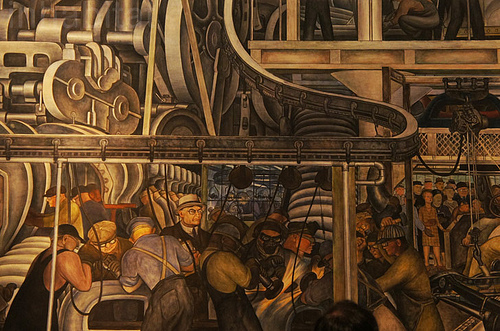
Last week, Rick Snyder announced he’d disenfranchise the 700,000 mostly African American residents of Detroit in a bid to solve the city’s seemingly intractable financial problems.
The Emergency Manager he’ll appoint is expected to come in and cut the wages of the city’s middle class workers and sell off Detroit’s assets like Belle Isle. Along with Belle Isle, observers expect Detroit’s excellent art museum, Detroit Institute of the Arts, home of some of the best Diego Rivera murals in the world, his tribute to Industry, to be sold.
Oddly, it’s the museum that offers a better solution for Detroit’s problems, and not just because the mural depicts people of all skin colors working side-by-side.
Last fall, the counties surrounding Detroit decided that the museum — one of the few shining glories in Detroit — served to the entire Southeast MI region, and voted to pass a millage to fund it. The vote was significant because the museum (heck, the communist murals themselves) has suffered from the same fate as the city itself: glory days when the city was booming, hard times when white flight began the process that has brought us where we are today, and then abandonment by the state.
Though the DIA began as an independent nonprofit in 1885, it quickly turned to the City of Detroit for financial help, and in 1919, it became a city department. The pattern was set: In good economic times, things were swell, but downturns were devastating. When the city nearly went belly-up in the 1970s, the state took over funding the museum — but only after it closed doors for three weeks in 1975.
The status quo held until John Engler swept into the governor’s office. Philosophically opposed to arts funding, he cut state arts spending by 46% in 1991.
The millage campaign to support museum elicited some of the same emotions that Detroit’s failure now has — though in much more muted form. DIA was managed by corrupt people; why should anyone get a bailout. But ultimately, just enough voters recognized that DIA is part of SE MI’s community, that voters came up with the money.
Opponents also cite a range of other concerns, from a reluctance among some suburbanites to subsidize a museum in Detroit and consider the tax “a bailout,” to the feeling that those who use the museum should be the ones who pay for it.
Those who favor the millage counter that the museum has already been raising an average of $16 million per year. As metro Detroit’s greatest cultural treasure with a regional audience, the responsibility to fund it should cut across county lines, advocates say.
“There’s no major city in the world without a major museum,” said Oakland County Executive L. Brooks Patterson, a prominent Republican who supports the millage.
“Taxes go to projects that are worthy, whether we use them or not,” Patterson said, noting that when he travels around the world to recruit business, he is always asked about schools, neighborhoods and cultural amenities. “The DIA is a huge opportunity for me to answer that question in a positive way. It’s an economic development tool for me.”
Last fall, the voters of SE MI chose to regionalize one of the cultural jewels of Detroit. Read more →