Last Week in Deferred and Non-Prosecution Agreements: Arming China and Stealing Trillions from Municipalities

I’m so old I remember the time, four years ago, when Democrats hated Deferred Prosecution Agreements.

Back in the days when Chris Christie, former US Attorney, was challenging Jon Corzine, once and future bankster, to be governor of New Jersey, Democrats made hay of the significant numbers of DPAs Christie signed, mostly with a series of medical device companies busted for kickbacks. After it was revealed Christie had picked his former boss, John Ashcroft, to make $52 million monitoring one of those medical device companies, it became a convenient way to show the corporatist corruption of Christie.

There was even a bit of discussion, in early 2009, about whether DPAs made banks more likely to engage in fraud because they assumed they’d get a DPA rather than a prosecution. Those discussions largely centered on the two DPAs AIG got in the mid-00s for fraudulently hiding its risk, which nevertheless didn’t prevent AIG from taking on so much risk it blew up the entire financial system. One of the monitors of those DPAs–who arguably should have but didn’t see AIG’s ongoing fraud–was a guy by the name of James Cole. He’s now the Deputy Attorney General.

And as recently as 2010, NJ Congressman Bill Pascrell had this to say, in response to the publication of a GAO report showing some improvement but greater need for oversight over DPAs.

One cannot ignore the spike of 38 deferred prosecution agreements in 2007, up from a mere four agreements in 2003. That proves that what was supposed to be an option to be used in rare circumstances had become the norm at the Department of Justice.

[snip]

It is imperative that the Congress reign in the unmitigated power that federal prosecutors hold to serve as judge, jury and sentencer in the deferred prosecution process.

And yet I have heard very little about the two DPAs signed last week–perhaps because big corporate impunity has become such a common occurrence in the post-crash era.

First, there’s the deal Pratt & Whitney and two subsidiaries signed for evading export restrictions to help China build an attack helicopter. Effectively Pratt & Whitney laundered their production of some development helicopters–plus the military grade engine control module software to go with them–through a Canadian subsidiary. And when they finally admitted they had deliberately avoided US export restrictions on military equipment, they lied to DOJ about doing so. While they have to pay a $75 million fine, some of the charges are being deferred. And no individual has been charged with helping China get a helicopter designed to attack tanks.

So DOJ’s punishment for a defense contractor to put Chinese civil contracts ahead of US national security is a big fine, deferred prosecution, but no jail time.

Even more troubling is the Non-Prosecution Agreement signed with Barclays over its manipulation of the LIBOR rate. Effectively, during the heady bubble days, Barclays colluded to lie about the interbank lending rate to maximize its own trades; as finance was crashing and Barclays itself had to pay higher rates for credit, it lied about that to imply the bank was healthier than it was. And while between DOJ, Commodity Futures Trading Commission, and Britain’s Financial Services Authority, Barclays will have to pay around $475 million in fines, and while CFTC imposed the kind of mandated fixes that DOJ normally would under a DPA, Barclays is basically scot-free for colluding to lie about a rate that affects people throughout the financial system.

Matt Taibbi explains why this is so important: because when the banks said the LIBOR rate was lower than it really was, a lot of investors got a smaller return on their LIBOR-tracked investments than they otherwise would have.

A sizable chunk of the world’s adjustable-rate investment vehicles are pegged to Libor, and here we have evidence that banks were tweaking the rate downward to massage their own derivatives positions. The consequences for this boggle the mind. For instance, almost every city and town in America has investment holdings tied to Libor. If banks were artificially lowering the rates to beef up their trading profiles, that means communities all over the world were cheated out of ungodly amounts of money.

Read more

Share this entry

Rocket Pitches A No Hitter; DOJ Whiffs A Golden Sombrero+2

Six up, and six down for William Roger Clemens. From Jim Bambach at Newsday:

Former Yankees pitcher Roger Clemens was acquitted Monday on all six counts in his trial on charges he lied to Congress when he denied using performance-enhancing drugs, ending a 41/2-year battle to clear his name.

The jury deliberated for less than 12 hours before reaching a verdict, capping a two-month trial at which 46 witnesses appeared, including the wives of Clemens and accuser Brian McNamee.

Yep, six counts alleged, six counts acquitted on. Not a hit on any of them. And if the jury deliberations had not have been broken up by a weekend, the verdict may well not have taken even the nine plus hours it did. From the clear call of the unanimous verdicts, I would also hazard a guess that the jury may not even have been out the short time it was but for the fact lead Clemens defense attorney Rusty Hardin opened a wee door in cross-examining the tainted prosecution star witness Brian McNamee, allowing for, eventually superfluous, rebuttal evidence to come in by the DOJ to try to bolster their flawed criminal witness McNamee. Even that was clearly nowhere enough for the wise jury.

The entire substantive DOJ case flowed through two discredited and sham witnesses, Brian McNamee and the always questionable Fed Investigator Jeff Novitsky. If they were not discredited before, let the record reflect they are now.

More from Bambach:

Clemens’ attorney Rusty Hardin called his client “a helluva man.”

“This is a celebration for us,” Hardin said. “Let me tell you something. Justice won out.”

The loss was a blow to the Justice Department and the prosecution, which last year caused a mistrial on the second day of the trial.

Prosecutors declined to comment on their way out of the courthouse.

Yes, the Brave Sir Robin like crack prosecutors at DOJ so ethically turned their heads and fled like Sir Robin. Brave Sir Robin.

The focus, though, is easy to peg on Brian McNamee, and does he deserve it. But, remember, the single person who pushed this puppet theater, in addition to George Mitchell and corporate interest, Bud Selig, was Jeff Novitsky. One still wonders if the story of the MLB, IRS, DEA, HOS/GRC(Waxman/Congress) and Novitsky “workgroup” will ever be fully disclosed; but the Read more

Share this entry

“Cozy Ties Between Regulators, Politicians and Utilities” Gives New Nuke Agency in Japan, Business as Usual on Wall Street

Reuters reports this morning that Japan’s lower house of parliament has passed a law authorizing creation of a new nuclear regulatory agency. The second paragraph of the story stands out to me:

The 2011 Fukushima disaster cast a harsh spotlight on the cozy ties between regulators, politicians and utilities – known as Japan’s “nuclear village” – that experts say were a major factor in the failure to avert the crisis triggered when a huge earthquake and tsunami devastated the plant, causing meltdowns.

The underlying cause of the “nuclear village” where regulators are captured by the industry they regulate and the politicians also are owned by the same system applies equally as well to the situation that enabled the meltdown of global financial markets in 2008. There is far less recognition of the village aspect of Wall Street’s lack of regulation in the financial crisis, and where there have been moves ostensibly toward regulation or even prosecution of crimes, they have been a sham:

On March 9 — 45 days after the speech and 30 days after the announcement — we met with Schneiderman in New York City and asked him for an update. He had just returned from Washington, where he had been personally looking for office space. As of that date, he had no office, no phones, no staff and no executive director. None of the 55 staff members promised by Holder had materialized. On April 2, we bumped into Schneiderman on a train leaving Washington for New York and learned that the situation was the same.

Tuesday, calls to the Justice Department’s switchboard requesting to be connected with the working group produced the answer, “I really don’t know where to send you.” After being transferred to the attorney general’s office and asking for a phone number for the working group, the answer was, “I’m not aware of one.”

The promises of the President have led to little or no concrete action.

In fact, the new Residential Mortgage-Backed Securities Working Group was the sixth such entity formed since the start of the financial crisis in 2009. The grand total of staff working for all of the previous five groups was one, according to a surprised Schneiderman. In Washington, where staffs grow like cherry blossoms, this is a remarkable occurrence.

We are led to conclude that Donovan was right. The settlement and working group — taken together — were a coup: a public relations coup for the White House and the banks. The media hailed the resolution for a few days and then turned their attention to other topics and controversies.

But for 12 million American homeowners, collectively $700 billion under water, this was just another in a long series of sham transactions.

Perhaps in homage to the Schneiderman and other sham units, the Reuters article on Japan’s new agency does show a bit of caution regarding the new agency:

The legislation, however, swiftly came under fire for appearing to weaken the government’s commitment to decommissioning reactors after 40 years in operation, even as it drafts an energy program to reduce nuclear power’s role.

Under a deal ending months of bickering by ruling and opposition parties, the new regulatory commission could revise a rule limiting the life of reactors to 40 years in principle.

“Does this reflect the sentiment of the citizens, who are seeking an exit from nuclear power?” queried an editorial in the Tokyo Shimbun daily. “Won’t it instead make what was supposed to be a rare exception par for the course?”

And as for the coziness between politicians in the US and the financial industry, we need look no further than Wednesday’s appearance by Jamie Dimon before the Senate Banking, Housing and Urban Affairs Committee. One of Marcy’s tweets during the hearing says all we need to know about that “hearing”:

BOB CORKER WIPE THAT SPOOGE FROM YOUR CHIN RIGHT NOW!

Japan’s response to its meltdown has been to shut down all nuclear plants while the framework for how they will operate if they are allowed to restart is debated. Imagine how much better off the world would be if JP Morgan Chase and Goldman Sachs had been shut down while a proper regulatory framework for them was developed.

Share this entry

JPM and ING: Some Trading with the Enemy Is More Equal than Other Trading with the Enemy

ING just signed a $619M settlement with Treasury for sanctions violations, largely with Cuba, but also with Iran, Burma, North Korea, Sudan, and Syria. Aside from the fact that that’s the biggest sanctions settlement ever, I’m interested in it because of just how different Treasury’s publication of ING’s settlement looks from JPMC’s $88.3M settlement last August.

The difference largely comes down to one big detail: Treasury didn’t release the actual settlement with JPMC, but did with ING. Rather than the JPMC settlement, Treasury released just a PDF version of the public announcement on a blank sheet of paper (compare smaller civil penalties, for example, where they release just a link and a PDF of the details, link and PDF). With ING, the settlement appears in full, on letterhead, with the signatures of ING’s General Counsel and Vice Chair at the bottom, not far below the terms of the settlement. And the settlement reads like an indictment, with a 6 pages of factual statements. Indeed, ING signed Deferred Prosecution Agreements with both the NY DA and DC US Attorneys Offices.

And the information included in the settlement is quite interesting. Most interestingly, the settlement describes how ING manipulated SWIFT reporting to hide its transfers with restricted countries.

Beginning in 2001, ING Curacao increasingly used MT 202 cover payments to send Cuba-related payments to unaffiliated U.S. banks, which would not have to include originator or beneficiary information related to Cuban parties. For serial payments, up until the beginning of 2003, NCB populated field 50 of the outgoing SWIFT MT 103 message with its own name or Bank Identifier Code, Beginning in the second quarter of 2003, NCB populated field 50 with its customer’s name, but omitted address information. ING Curacao also included its customer’s name, but no address information, in field 50 of outgoing SWIFT messages.

Read more

Share this entry

Why The DOJ Can’t Prosecute Banksters: Map of Clemens Investigation

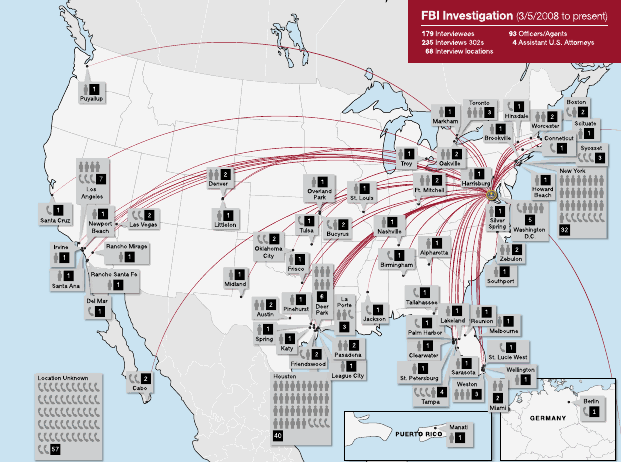
At a time when there are still no significant prosecutions of major players, banks and investment shops responsible for the financial fraud that nearly toppled the world economy and is still choking the US economy, we get an explanation why from an unlikely source – the Roger Clemens trial in Judge Reggie Walton’s courtroom in the DC District. During defense examination of FBI special agent John Longmire today, a map of the FBI/DOJ investigation of Roger Clemens, who was accused of lying about getting a few steroid shots in the late 90s and early 2000s, was displayed. We are now two full months into the second trial of Roger Clemens stemming from this investigation.

Any more questions on why DOJ cannot get around to prosecuting banksters??

Share this entry

Foreclosure Fraud: The Most Dangerous Panel in the World

They’ve scheduled DDay’s Netroots Nation foreclosure fraud panel–with Lynn Szymoniak, Malcom Chu, and Neil Barofsky–in a room with no streaming, and President Obama is holding a press conference to conflict with it. Which suggests this is the most dangerous panel in the world.

So I’m gonna liveblog it.

DDay introduces Barofsky as the first George Bush appointee to speak at Netroots Nation. Says Szymoniak made the name Linda Green famous. Chu is a Springfield MA foreclosure activist.

DDay: We told Eric Schneiderman’s Chief of Staff we could fit him in. I don’t see him here. We’ll put a seat here for Elijah. It occurs I could call this panel “Foreclosure Fraud, the first 5000 years.” Elizabeth Warren, Jeff Merkley, nothing has changed. Dissipation of a lot of the leverage that the regulators have.

Read more

Share this entry

The Banksters and the Cartels

Two Colombian economists decided to see who’s getting money off the illegal drug trade. And they discovered that American and British banks are getting a big chunk of the profits. (h/t Chris from Americablog) That’s because the cartels are laundering their proceeds through those banks.

The most far-reaching and detailed analysis to date of the drug economy in any country – in this case, Colombia – shows that 2.6% of the total street value of cocaine produced remains within the country, while a staggering 97.4% of profits are reaped by criminal syndicates, and laundered by banks, in first-world consuming countries.

Mind you, I’m not sure the analysis would be that different for any agricultural export. Even for food, farmers make less than 12% of all the money spent.

But one of the factors, the economists contend, is that the US more stringently polices money laundering in Colombian banks than in US ones.

Colombia’s banks, meanwhile, said Mejía, “are subject to rigorous control, to stop laundering of profits that may return to our country. Just to bank $2,000 involves a huge amount of paperwork – and much of this is overseen by Americans.”

“In Colombia,” said Gaviria, “they ask questions of banks they’d never ask in the US. If they did, it would be against the laws of banking privacy. In the US you have very strong laws on bank secrecy, in Colombia not – though the proportion of laundered money is the other way round. It’s kind of hypocrisy, right?”

I have noted (as does the Guardian), how banks like Wachovia used drug proceeds to help offset their losses from the mortgage bubble shitpile. I have noted how much less stringent we were in rooting out all the crime than we are with other banks, such as the Lebanese Canadian Bank. And I noted Citi’s recent wrist slap for allowing money laundering in the same shitpile period.

This article shows the other side to that: while our banksters get rich off of crime here, Colombia and Mexico and Honduras suffer the violence that results. That really has to change.

Share this entry

Only Banks Might Want to Review How Criminal Banks Are

The other day, I noted how–days after his department reported that suspected bankster crimes are growing quickly and terrorist financing crimes are going down–Treasury Department fired FinCEN head, Jim Freis. Given some of the reporting describing the firing, which explained that Treasury wanted to focus on things like terrorist financing whereas Fries had been focusing on things like mortgage fraud, I wondered whether Treasury fired Freis, in part, for showing that the emphasis on terrorism resulted in the neglect of bankster crimes.

Today, FinCEN sent out notice of a survey to determine how useful that report and another yearly report–on Tips and Trends–they produce are (note, the email notice says an invitation to the survey is here, but as of 8:15 it is not).

As a subscriber to e-mail updates from the United States Department of Treasury’s Financial Crimes Enforcement Network (FinCEN), FinCEN invites you to participate in a survey assessing the value of two of our recurring publications:  The SAR Activity Review-Trends, Tips & Issues and The SAR Activity Review-By the Numbers.  This invitation has been sent to you in follow up to FinCEN’s prior e-mail notification.  A copy of that notice and this invitation can be found on FinCEN’s official website at http://www.fincen.gov/hotTopics.html

To participate in this completely voluntary survey, please click on the following link: https://svy.cfigroup.com/cgi-bin/qwebcorporate.dll?idx=HWGKEN   Please note that this link will direct you to a website hosted by the CFI Group, which FinCEN has commissioned to conduct this survey.  FinCEN has obtained permission from the Office of Management and Budget through control number 1090-0007 to conduct this survey in accordance with the Paperwork Reduction Act (44 U.S.C. § 3501-3520) and its implementing regulations (5 C.F.R. Part 1320).

Through the survey, we hope to learn more about your needs and identify opportunities to improve these products.  The results of the survey will be reported to FinCEN only in the aggregate; individual responses will be grouped anonymously along with those of other FinCEN customers.

Read more

Share this entry

Did Treasury Fire Jim Freis for Showing that Banksters Are a Bigger Problem than Terrorists?

As I noted earlier, a few weeks ago Treasury fired the head of FinCEN, Jim Freis. (FinCEN makes sure that financial institutions report whatever evidence of potential crimes they’re seeing.)

American Banker reported that Treasury wanted “additional focus on international areas such as terrorist financing,” and less focus on “other financial crimes such as mortgage fraud.”

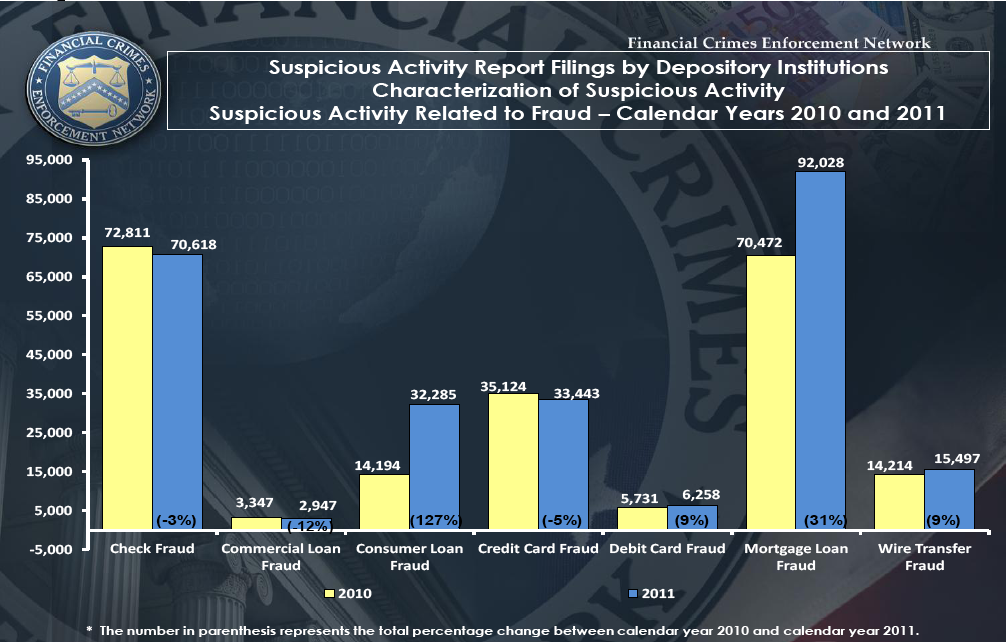
Three days before he was fired, FinCEN released this report, showing in aggregate what all of last year’s Suspicious Activity Reports revealed. It shows that among the SARs from depository institutions (which make up over half of all SARs), reports of terrorist financing and hacking (computer intrusion) are going down, while reports of behavior targeting consumers–mortgage and consumer loan fraud–are going up (though it notes the mortgage loan fraud reports are inflated because some date from years ago).

  • Reports of Terrorist Financing declined 14%, from 711 instances in 2010 to 609 for the same period in 2011.
  • The number of depository institution SARs identifying Mortgage Loan Fraud as a Characterization of Suspicious Activity continued to rise (up 30.6% in calendar year 2011). Quite markedly, Mortgage Loan Fraud is the only summary characterization that has experienced an increase every year since 1996, with the past two years (2010 and 2011) accounting for nearly 37% of all noted instances of this specific activity for the last decade. Note that depository institutions may submit Mortgage Loan Fraud SARs well past the actual date of the activity. This upward spike in mortgage fraud counts is in predominant part attributable to mortgage repurchase demands and special filings generated by several institutions.4
  • Of the eleven reportable suspicious activities that experienced decreases, none saw greater than Computer Intrusion, falling 21% in 2011 as compared to those filed in 2010. For the second year in a row, this drop is amongst the largest of any of the defined summary characterizations.
  • Though having experienced decreases in 2009 and 2010, the number of reports indicating Consumer Loan Fraud (in whole or part) significantly rose in 2011, up 127% from the prior year.

Such trends are similar to what the report shows in the securities and futures industries, with an even bigger drop in terrorist financing and big gains in futures fraud, embezzlement, and insider trading.

  • Embezzlement/Theft saw the second largest gain of any of the suspicious activities reported in SAR-SF filings, rising 38% in CY2011. However, of the 21 Types of Suspicious Activity listed, Futures Fraud saw the biggest rise (up 85%) for the same year, increasing from 20 instances in 2010 to 37 instances in 2011.
  • Likewise, Insider Trading (+34%) and Forgery (+19%) also experienced double-digit growth, making them the only two distinct activities that have continued to rise every year since 2003.
  • Of those activity types showing a decrease, Bribery/Gratuity (down 74%) and Terrorist Financing (down 59%) both saw a sizeable drop between 2010 and 2011, with the former down from 69 reported instances last year to just 18 in 2011 and the latter falling from 46 instances in 2010 to a low of 19 twelve months later.

Remember, SARs are not a reflection of what Freis demands (nevermind the fact he’s been on the job when things like terrorist financing were higher). Rather, this is what banks and securities firms self report, as mandated by law, about what they’re seeing in their own records.

Jim Freis showed that terrorism is getting better and bankster crimes are getting worse. And then Treasury fired him.

And the report from American Banker suggests that by replacing Freis, Treasury may intend to have FinCEN dictate what financial institutions prioritize. Which will mean terrorism–and not the crimes of banksters–will once again be the focus.

Fincen is likely to take a higher profile when it receives new leadership. In the immediate aftermath of the Sept. 11 attacks, Fincen was very active in dealing with bank regulatory matters, including helping to shape policy on anti-money laundering requirements. But the financial crisis largely pushed Fincen to the side and the agency focused on many of its other responsibilities. Treasury appears to want Fincen to take a larger role in terrorist financing activities and possibly reassert itself in the bank regulatory sphere. In past few years, banks have not had to focus on what Fincen’s agenda was. A more assertive Fincen changes the equation.

FinCEN offers one objective read of the relative prevalence of various forms of financial crime. And last year, it showed that banksters were a growing problem and terrorists a shrinking one.

And that message was so dangerous to the powers that be, it appears, Treasury decided to kill the messenger.

Share this entry

Will Treasury Hire the Guy Who Allowed JP Morgan Help Iran Launder Money?

Two weeks ago, Treasury fired the guy in charge of FinCEN (the part of Treasury that enforces and tracks Suspicious Activities Reports), Jim Freis, reportedly (pay wall) because he wanted to focus on law enforcement and financial crimes, rather than a more focused counterterrorism focus.

The issue wasn’t Fincen’s speed or personality conflicts, but more about control. To put it simply, Treasury wants more oversight of Fincen’s activities, including additional focus on international areas such as terrorist financing. “Fincen ought to be better integrated and tethered to the policy issues that relate to money laundering, terrorist financing and economic sanctions on behalf of the U.S. government. It’s not as well integrated as it should be,” said a senior administration official who spoke on condition of anonymity.

Freis saw Fincen’s role as more independent, and was primarily concerned with the agency’s role in supporting law enforcement agencies as well as tackling other financial crimes such as mortgage fraud.

And if that isn’t enough to make you wonder about this Administration’s commitment to making banks obey the law, consider that the apparent leading candidate to replace Freis is JP Morgan’s anti-money laundering VP, William Langford.

In December 2009, when JPMC extended a $2.9 million loan to the Islamic Republic of Iran Shipping lines, in violation of WMD sanctions, Langford was the VP at JPMC in charge of money laundering. He was there, too, when JPMC decided not to self-disclose the loan until they had almost been repaid.

In the months before March 2011, when JPMC repeatedly claimed it didn’t have 20 documents relating to a wire transfer with Khartoum? Langford was at JPMC for that too.

The 9 wire transfers since April 2006 in violation of a range of sanctions? He was there for most of those.

And he was probably at JPM–though just barely–when JPMC transferred $20M in gold bullion–a ton of gold!–for an Iranian bank?

Now, presumably all this money laundering and sanctions violating happened in remote corners of JPMC, far from Langford’s views (though you would think his office would be involved in the non-responsive answers about the Khartoum documents and decisions about when and whether to self-disclose some of these violations). There is no reason to believe Langford facilitated any of this money laundering and sanctions violating.

Still, even aside from the whole revolving door problem, from the centrality of JPMC in both the MF Global and JPMC’s won Fail Whale investigations, it seems like Treasury might hire someone who couldn’t keep one bank in line, much less all of them.

Share this entry