Why Should We Believe Solicitors General about Warrantless Wiretapping

I’m working on a longer post about the arguments in Amnesty v. Clapper today.

But I wanted to point to this passage from the transcript, in which Solicitor General Don Verrilli responded to Justice Ginsburg’s suggestion that the FISA Court didn’t exercise very rigorous oversight, given that it had only ever rejected one application.

JUSTICE GINSBURG: Is there much of a speculation involved in how — I think it’s only one time, and it was under the pre-amended statute, that the FISA court ever turned down an application

GENERAL VERRILLI: Yes, but that, Your Honor, is, I think, not a fair assessment of the process. It’s really very much an iterative process in which there’s a dialogue between the executive branch and the FISA court in which the court can demand more information, raise objections. Those get worked out, and then there’s a final order.

So I don’t think it’s fair to infer from the fact that there’s only one rejection that this — that it’s a process that isn’t rigorous.

But there was evidence in the court room today to show how false such assurances are.

You see, Ted Olson was in the room. He was there to argue a copyright case heard just after Amensty v. Clapper. And as I have noted before, the government actually sent Olson–back when he was Solicitor General–to argue before the FISA Court of Review without disclosing the warrantless wiretapping program to him. He made a number of claims about how “lawful” the government’s activities were when, in fact, they weren’t.

Given that the government has lied to FISCR before, and given that Solicitors General apparently don’t get briefed on what the government does with warrantless wiretapping, is there any reason we should believe this Solicitor General about the FISA Court’s oversight?

Share this entry

Michael Hayden, Privacy and Counterterrorism Frugality Champion

Of 1,423 words in an article questioning whether deficit hawkery might cut the domestic spying budget, Scott Shane devotes over a sixth–roughly 260–describing what former NSA and CIA Director Michael Hayden thinks about the balances between funding and security.

Remarkably, none of those 260 words disclose that Hayden works for Michael Chertoff’s consulting group, which profits off of big domestic spying. This, in an article that cites Chertoff’s electronic border fence among the expensive counterterrorism duds that were subsequently shut down (Shane mentions “puffer” machines as well, but not the Rapiscan machines that Chertoff’s group lobbied for, which are now being withdrawn as well).

And then there’s a passage of Shane’s article that touches on topics in which Hayden’s own past actions deserve disclosure.

Like other intelligence officials after 2001, Mr. Hayden was whipsawed by public wrath: first, for failing to prevent the Sept. 11 attacks, and then, a few years later, for having permitted the National Security Agency to eavesdrop on terrorism suspects in the United States without court approval.

Perhaps, as a result, he often says that the American people need to instruct the government on where to draw the line. He told an audience at the University of Michigan last month, for instance, that while a plot on the scale of the Sept. 11 attacks was highly unlikely, smaller terrorist strikes, like the shootings by an Army psychiatrist at Fort Hood in Texas in 2009, could not always be stopped.

“I can actually work to make this less likely than it is today,” Mr. Hayden said. “But the question I have for you is: What of your privacy, what of your convenience, what of your commerce do you want to give up?”

To be fair, Shane counters Hayden’s claims by noting that “secrecy … makes it tough for any citizen to assess counterterrorism programs.”

But he doesn’t mention one of the biggest examples where Hayden–where anyone–chose both the most expensive and most privacy invasive technology: the wiretap program Hayden outsourced to SAIC rather than use in-house solutions.

As Thomas Drake has made clear, by outsourcing to SAIC, Hayden spent 300 times as much as he would have with the in-house solution.

One of them was Lieutenant General Michael Hayden, the head of the agency: he wanted to transform the agency and launched a massive modernization program, code named: “Trailblazer.” It was supposed to do what Thin Thread did, and more.

Trailblazer would be the NSA’s biggest project. Hayden’s philosophy was to let private industry do the job. Enormous deals were signed with defense contractors. [Bill] Binney’s Thin Thread program cost $3 million; Trailblazer would run more than $1 billion and take years to develop.

“Do you have any idea why General Hayden decided to go with Trailblazer as opposed to Thin Thread, which already existed?” Pelley asked.

[snip]

Asked to elaborate, Drake said, “Careers are built on projects and programs. The bigger, the better their career.” [my emphasis]

Along the way, Hayden repeatedly blew off Congressional staffer Diane Roark’s inquiries about privacy protection.

When Binney heard the rumors, he was convinced that the new domestic-surveillance program employed components of ThinThread: a bastardized version, stripped of privacy controls. “It was my brainchild,” he said. “But they removed the protections, the anonymization process. When you remove that, you can target anyone.” He said that although he was not “read in” to the new secret surveillance program, “my people were brought in, and they told me, ‘Can you believe they’re doing this? They’re getting billing records on U.S. citizens! They’re putting pen registers’ ”—logs of dialled phone numbers—“ ‘on everyone in the country!’ ”

[snip]

[Former HPSCI staffer Diane Roark] asked Hayden why the N.S.A. had chosen not to include privacy protections for Americans. She says that he “kept not answering. Finally, he mumbled, and looked down, and said, ‘We didn’t need them. We had the power.’ He didn’t even look me in the eye. I was flabbergasted.” She asked him directly if the government was getting warrants for domestic surveillance, and he admitted that it was not. [my emphasis]

So it’s not just disclosure of all the ways Hayden has and does profit off of continued bloated domestic surveillance that Shane owes his readers: he also should refute Hayden’s claims about the relationship between cost, privacy, and efficacy.

Michael Hayden’s SAIC-NSA boondoggle is one case where secrecy no longer hides how much money was wasted for unnecessary privacy violations.

Yet somehow, that spectacular example of the unnecessary waste in domestic spying doesn’t make it into the 260 words granted to Hayden to argue we need continued inflated spending.

Share this entry

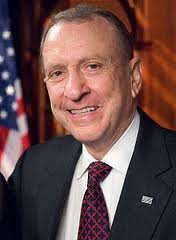
R.I.P. Senator Specter, You Will Be Missed

The Snarlin has ceased; via CBS News:

US Senator Arlen Specter, whose political career took him from Philadelphia City Hall to the US Congress, died Sunday morning at his home in Philadelphia at the age of 82 from complications of non-Hodgkins Lymphoma. He was born February 12, 1930.

His career was marked by what the pundits and Specter himself called “fierce independence.” But long before Specter ever stepped onto the Senate floor in Washington DC, he made it into national prominence by serving as assistant counsel for the Warren Commission, which investigated the 1963 assassination of Pres. John F. Kennedy.

Specter postulated the controversial “single-bullet theory” that was eventually embraced by the panel and still stands to this day, despite the cry of conspiracy theorists who say there was more than one gunman in Dallas that November day.

“Admittedly a strange path for a bullet to take, but sometimes truth is stranger than fiction,” Specter said.

We have had a complicated relationship with Arlen Specter here at Emptywheel, sometimes castigating him, sometimes praising him, sometimes laughing at him, sometimes laughing with him. Specter engendered all those things. But I always sensed a very decent heart beating underneath Specter’s surface, even if it was all too often masked by his votes for, and often vociferous support of, ever more destructive policies of the right.

For this, Specter earned the nickname “Scottish Haggis” here in the annals of Emptywheel. The term had its root in Mr. Specter’s predilection for Scottish Law, and goes all the way back to the original incarnation at The Next Hurrah. For a number of reasons, offal and otherwise, it was a nickname that stuck and seemed appropos and seemed to reflect the complicated nature of Senator Specter.

On a personal note, I did not have an abundance of interaction with Sen. Specter and his office, but in that which I did have, I found him and his office to be beyond both kind and professional. One instance stands head and shoulders above the others, and surrounded the Obama scuttled nomination of Dawn Johnsen to be head of the Office of Legal Counsel (OLC). It was my contention from the outset that the whip count votes were there to confirm Professor Johnsen for the job she was perfect for. And, in the roiling aftermath of the Bush/Cheney unitary executive excesses, the country desperately needed Johnsen’s intellectual sense of honesty and Constitutional integrity.

The only reason Dawn Johnsen did not get confirmed as OLC head was Barack Obama used her as false bait and cat nip for the more noisy progressive liberals. It was a glaring sign of depressing things to come from the not nearly as Constitution minded Barack Obama as had been pitched in his election run. Not only could Johnsen have been confirmed, as I pointed out before, she could also have been recess appointed by Obama. Despite all the ridicule I took at the time, that point has been proved conclusively by the later recess appointment of Richard Cordray to be head of the CFPB (another instance of Obama using a supremely qualified progressive, Elizabeth Warren, as bait and then hanging her out to dry).

The point was never that Dawn Johnsen couldn’t be confirmed, it was that Barack Obama and the insiders of his White House did not want her confirmed into leadership of the OLC. I knew that from talking to several inside the DOJ and Senate Judiciary Committee, but that was all off the record. When I found an obscure old comment from Arlen Specter indicating he was willing to support a cloture vote for Johnsen as far back as his second meeting with Dawn Johnsen on or about May 12, 2009, it was by then an old, and quite obscure comment. Specter could have walked it back or dissembled on the subject.

Arlen Specter didn’t walk it back or dissemble, instead he personally confirmed it to me. With the already in the bag vote of Sen. Richard Lugar, that was the 60 votes for Dawn Johnsen at OLC. Specter knew it would infuriate both the GOP and the Obama White House, and he knew exactly what story I was writing. He stood up. Oh, and, yes, he knew about “Scottish Haggis” too. The man had a sense of humor.

For the above vignette, and several others, I will always have a soft spot in my heart for Snarlin Arlen Specter. His life and work in government spanned over five decades, he has got my salute today.

Sen. Specter repeatedly had to fight off serious cancer, and he did so with aplomb, courage and his good humor. He also was a tireless champion for the NIH and funding of cancer and stem cell research. When confronted with the last battle, the one which finally took him, Specter was upbeat, defiant and determined to get back to his part time hobby of stand up comedy. May the Scottish Haggis have many laughs wherever he may travel.

Share this entry

Ford Motor Company Has a TIDE Report

I’ll have plenty to say about the Pemanent Subcommittee on Investigation’s report on how terrible DHS’s fusion centers are. The short version: they’re nearly worthless and a big waste of money.

But since DHS is so crappy, it says something that they find the National Counterterrorism Center’s Terrorist Identities Datamart Environment database to be equally crappy.

While reporting information on an individual who is listed in the TIDE database sounds significant, the Subcommittee found that DHS officials tended to be skeptical about the value of such reporting, because of concerns about the quality of data contained in TIDE.156

156 Although NCTC describes its TIDE database as holding information on the identities of known and suspected terrorists, DHS officials – who interacted with TIDE data on a daily basis, as they reviewed reporting not only from state and local law enforcement encounters but from encounters by DHS components – said they found otherwise. “Not everything in TIDE is KST,” DHS privacy official Ken Hunt told the Subcommittee, using a shorthand term for “known or suspected terrorist.”

Would you buy a Ford?” one DHS Senior Reports Officer asked the Subcommittee staff during an interview, when he was asked how serious it was for someone to be a match to a TIDE record. “Ford Motor Company has a TIDE record.”

The report’s footnote goes on to describe how DHS’s crappy reporting and NCTC’s crappy reporting reinforced each other.

Ole Broughton headed Intelligence Oversight at I&A from September 2007 to January 2012. In an interview with the Subcommittee, Mr. Broughton expressed the concern DHS intelligence officials felt working with TIDE data. In one instance, Mr. Broughton recalled he “saw an individual’s two-year-old son [identified] in an HIR. He had a TIDE record.” Mr. Broughton believed part of the problem was that intelligence officials had routinely put information on “associates” of known or suspected terrorists into TIDE, without determining that that person would qualify as a known or suspected terrorist. “We had a lot of discussion regarding ‘associates’ in TIDE,” Mr. Broughton said.

Mark Collier, who served as a Senior Reports Officer and briefly as chief of the Reporting Branch, recalled another case. An HIR was drafted concerning an incident with a TIDE match, but the TIDE record was based on an FBI inquiry. Later on the FBI ended its inquiry and cleared the individual of any connection to terrorism – but because DHS had filed an HIR on the person, the individual’s record was kept active in TIDE.

This reinforcement process carried over into DHS reports that were quashed on First Amendment grounds. Repeatedly, fusion center staffers submitted reports on speech and religion related activities solely because there was some tie between them and TIDE.

One draft reported on a list of reading suggestions by a Muslim community group, “Ten Book Recommendations for Every Muslim.” The report noted that four of the titles were authored by individuals with records in a U.S. intelligence counterterrorism database, the Terrorist Identities Datamart Environment (TIDE).

[snip]

Another cancelled draft HIR reported on a U.S. citizen visiting and giving a lecture at a mosque. The draft contained no derogatory information on the speaker, or the mosque, although it noted that the speaker was once the head of a U.S. Islamic school that had a record in the TIDE database. “There is concern,” the drafting officer wrote in his initial submission, “that [the subject’s] visit . . . could be to strengthen ties with the . . . mosque as well as to conduct fundraising and recruiting for the sake of foreign terrorist organizations.”

Now, as I said, a civil liberties and privacy review (which I’ll discuss at more length in a later post) quashed these particular reports because they recorded protected speech. But imagine how many similar reports remain in NCTC or FBI’s files, given that they have more leeway to record First Amendment protected activity?

Soon, we’ll have the entire marketing plan of Ford Motor Company in our terrorist databases.

Share this entry

I Don’t Think Luddite Means What CNN Thinks It Means

CNN’s Security Clearance blog thinks it has exposed Janet Napolitano as a Luddite.

Napolitano said she does not use email “at all.”

“For a whole host of reasons. So, I don’t have any of my own accounts and that, you know, I’m very secure,” Napolitano noted at a Washington conference about cyber security.

“Some would call me a Luddite but you know. But that’s my own personal choice and I’m very unique in that regard I suspect,” Napolitano added.

Of course, she’s not unique at all and–given her fondness for highly sophisticated data mining–not a Luddite.

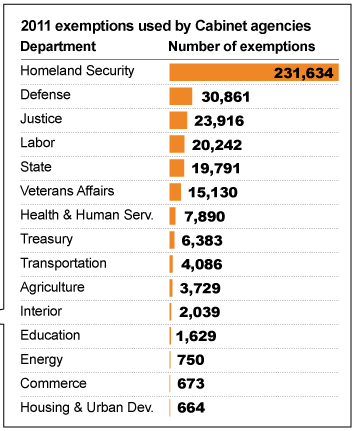
CNN might consider two things before they conclude Napolitano doesn’t have email because she eschews technology. First, the graphic above, which Bloomberg put together to show how unresponsive Obama’s Administration is to FOIA requests. Part of the reason why DHS claims so many FOIA exemptions is the sheer number of FOIAs they get. But there have been other examples to show that Napolitano’s agency doesn’t much like transparency.

And then consider why other people who don’t use–or claim not to use–email did so. People like Scooter Libby, whose office also happened to disappear a good number of emails responsive to a criminal investigation. The most logical explanation for someone–particularly someone who avoids transparency in general–to avoid email is because it is FOIAable, it serves as a record of discussions that might be embarrassing.

So my guess is that one of the main reasons why Napolitano doesn’t use email is to avoid getting into trouble with it.

After all, like Scooter Libby, she knows as well as anyone the kinds of things the government and others can find in someone’s email box.

Share this entry

Maybe Congress Doesn’t Want Constituents to Know Surveillance Has Spiked Under Obama?

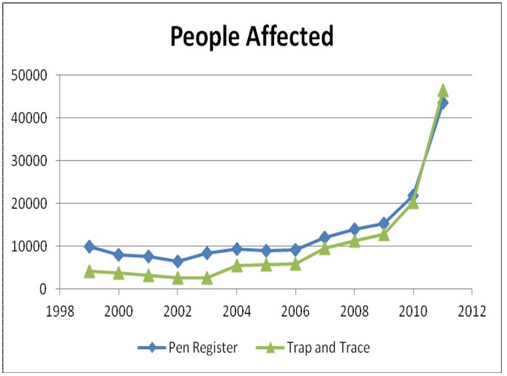
The ACLU sued the government to get it to release the reports on how much DOJ has used Pen Registers and Trap and Trace devices to get criminal suspects’ phone and email call records.

The records show a sharp increase in the use of PR/TT requests. Of particularly note, three times as many people have had their records turned over to DOJ under Obama.

In its post on the topic, ACLU notes that whereas, under Bush, neither Congress nor the public were getting these records, Obama’s Administration has submitted the reports in timely fashion, but Congress has not released the reports.

When no reports surfaced in 2010 and 2011, the ACLU filed a FOIA request to obtain them. After our request received no response, we filed suit to enforce it.

Although the Justice Department has in the past repeatedly failed to submit the annual reports to Congress, it appears that it has now cleaned up its act. Both the 2010 and 2011 reports were submitted to Congress in compliance with the reporting requirement. Unfortunately, Congress has done nothing at all to inform the public about the federal government’s use of these invasive surveillance powers. Rather than publishing the reports online, they appear to have filed them away in an office somewhere on Capitol Hill.

This is unacceptable. Congress introduced the pen register reporting requirement in order to impose some transparency on the government’s use of a powerful surveillance tool. For democracy to function, citizens must have access to information that they need to make informed decisions—information such as how and to what extent the government is spying on their private communications. Our representatives in Congress know this, and created the reporting requirement exactly for this reason.

It shouldn’t take a FOIA lawsuit by the ACLU to force the disclosure of these valuable reports. There is nothing stopping Congress from releasing these reports, and doing so routinely. They could easily be posted online, as the ACLU has done today.

Of course, Congress didn’t require DOJ to share this information with actual citizens; it only required DOJ share the information with Congress. Republicans have no incentive to turn over records that show Obama’s DOJ has investigated crime (in particularly the drug trafficking these records are most often used to investigate) more aggressively than Bush did. And Democrats have no incentive to show their President has trampled privacy. And given the likelihood these records are being used in creative new ways, neither party has an incentive giving people more reason to question how PR/TT are being used (I’ve long noted that their used started to rise after Bush’s illegal wiretap program got exposed, and suspect there may be a connection).

In short, Congress is complicit in hiding the extent to which increasing numbers of Americans are being surveilled by the government.

But that shouldn’t be a surprise at this point.

Share this entry

Chris Hedges et. al Win Another Round On the NDAA

You may remember back in mid May Chris Hedges, Dan Ellsberg, Jennifer Bolen, Noam Chomsky, Alexa O’Brien, Kai Wargalla, Birgetta Jonsdottir and the US Day of Rage won a surprising, nee stunning, ruling from Judge Katherine Forrest in the Southern District of New York. Many of us who litigate felt the plaintiffs would never even be given standing, much less prevail on the merits. But, in a ruling dated May 16, 2012, Forrest gave the plaintiffs not only standing, but the affirmative win by issuing a preliminary injunction.

Late yesterday came even better news for Hedges and friends, the issuance of a permanent injunction. I will say this about Judge Forrest, she is not brief as the first ruling was 68 pages, and todays consumes a whopping 112 pages. Here is the setup, as laid out by Forrest (p. 3-4):

Plaintiffs are a group of writers, journalists, and activists whose work regularly requires them to engage in writing, speech, and associational activities protected by the First Amendment. They have testified credibly to having an actual and reasonable fear that their activities will subject them to indefinite military detention pursuant to § 1021(b)(2).

At the March hearing, the Government was unable to provide this Court with any assurance that plaintiffs’ activities (about which the Government had known–and indeed about which the Government had previously deposed those individuals) would not in fact subject plaintiffs to military detention pursuant to § 1021(b)(2). Following the March hearing (and the Court’s May 16 Opinion on the preliminary injunction), the Government fundamentally changed its position.

In its May 25, 2012, motion for reconsideration, the Government put forth the qualified position that plaintiffs’ particular activities, as described at the hearing, if described accurately, if they were independent, and without more, would not subject plaintiffs to military detention under § 1021. The Government did not–and does not–generally agree or anywhere argue that activities protected by the First Amendment could not subject an individual to indefinite military detention under § 1021(b)(2). The First Amendment of the Read more

Share this entry

Remember When Obama Thought the FISA Amendments Act Was Imperfect?

Four years ago, when Obama caved and supported the FISA Amendments Act, he said in part,

I want to take this opportunity to speak directly to those of you who opposemy decision to support the FISA compromise.

This was not an easy call for me. I know that the FISA bill that passed the House is far from perfect. I wouldn’t have drafted the legislation like this, and it does not resolve all of the concerns that we have about President Bush’s abuse of executive power. It grants retroactive immunity to telecommunications companies that may have violated the law by cooperating with the Bush Administration’s program of warrantless wiretapping. This potentially weakens the deterrent effect of the law and removes an important tool for the American people to demand accountability for past abuses.

[snip]

Given the choice between voting for an improved yet imperfect bill, and losing important surveillance tools, I’ve chosen to support the current compromise. I do so with the firm intention — once I’m sworn in as President — to have my Attorney General conduct a comprehensive review of all our surveillance programs, and to make further recommendations on any steps needed to preserve civil liberties and to prevent executive branch abuse in the future.

[snip]

I do promise to listen to your concerns, take them seriously, and seek to earn your ongoing support to change the country. That is why we have built the largest grassroots campaign in the history of presidential politics, and that is the kind of White House that I intend to run as President of the United States — a White House that takes the Constitution seriously,conducts the peoples’ business out in the open, welcomes and listens to dissenting views, and asks you to play your part in shaping our country’s destiny.

Since that time, Obama’s DOJ has litigated the FISA Amendments Act so aggressively that it has, in fact, completely gutted the deterrent effect of the law. It has refused to share with all of Congress what activities the government actually conducts under the law, much less with American citizens. It has refused to tell Congress–even the Intelligence Committees–how many Americans have been spied on under the program. And it has been caught violating the Fourth Amendment.

And yet here’s what Obama’s Administration said today about the extension for the FISA Amendments Act, which essentially will extend the bill Candidate Obama once admitted still had problems for five years, all the way through his second term.

The Administration strongly supports H.R. 5949. The bill would reauthorize Title VII of the Foreign Intelligence Surveillance Act (FISA), which expires at the end of this year. Title VII of FISA allows the Intelligence Community to collect vital foreign intelligence information about international terrorists and other important targets overseas, while providing protection for the civil liberties and privacy of Americans. Intelligence collection under Title VII has produced and continues to produce significant information that is vital to defend the Nation against international terrorism and other threats. The Administration looks forward to working with the Congress to ensure the continued availability of this critical intelligence capability.

Change we can believe in.

Share this entry

Obama Looking for Structures to Ensure He Abides by Rule of Law


Noah Shachtman does a good job of fact checking Obama’s claims about his drone program in a recent interview with Jessica Yellin.

But I’d like to push further on his comments about Obama’s claims to give Anwar al-Awlaki and Samir Khan (to say nothing of Abdulrahman al-Awlaki) due process by pointing to the way he ends this bit:

Our most powerful tool over the long term to reduce the terrorist threat is to live up to our values and to be able to shape public opinion not just here but around the world that senseless violence is not a way to resolve political differences. And so it’s very important for the President and for the entire culture of our national security team to continually ask tough questions about, are we doing the right thing? Are we abiding by rule of law? Are we abiding by due process? And then set up structures and institutional checks so that you avoid any kind of slippery slope into a place where we’re not being true to who we are.

Having started by saying that drones are just a tool, he ends up by saying that we will vanquish terrorism by upholding our values–rule of law and due process.

And then the Constitution Professor President describes “set[ting] up structures and institutional checks” to make sure that we deliver rule of law and due process.

This, from the guy whose Administration refused to litigate a suit from Anwar al-Awlaki’s father to make sure it was upholding the standards Obama claimed in this interview in Awlaki’s case.

This, from the guy whose Administration has claimed state secrets to make sure no court can review the claims of people who have been rendered or tortured or illegally wiretapped.

This, from the guy who wouldn’t do the politically difficult things to have Khalid Sheikh Mohammed tried–and surely, convicted–before a civilian court in NYC.

He’s looking for structures and institutional checks to make sure we don’t go down that slippery slope where we forget rule of law. And yet his Administration has repeatedly avoided the one mandated by the Constitution: courts.

Which, according to his own logic, means he’s not using the tool that would best work to keep us safe from terrorism.

Share this entry

With What Databases Has NCTC Cross-Referenced with FBI’s 12 Million iDevice User IDs?

Update, 6/13/13: For those coming to this via my Twitter link, subverzo reminded me that this turned out to be a false claim. The data came from an Apple developer, not from FBI. 

Sorry for the confusion.

As you may have heard, Anonymous and AntiSec hacked into a database of 12 million Apple Universal Device IDs that were in an FBI officer’s laptop and released 1 million of them, ostensibly so some people could identify if their device was one of those FBI was tracking.

They claimed to have tapped into a Dell laptop owned by Special Agent Christopher K. Stangl, an FBI cyber security expert. They downloaded several files, including one that contained “12,367,232 Apple iOS devices including Unique Device Identifiers (UDID)” and other personal information, they wrote in a text file published online. “[The] personal details fields referring to people appears many times empty leaving the whole list incompleted [sic] on many parts. no other file on the same folder makes mention about this list or its purpose.”

While it’s not immediately clear what the FBI is doing with the Apple UDIDs and detailed information on device owners, Gizmodo pointed out that the acronym “NCFTA” could stand for the National Cyber-Forensics & Training Alliance, a nonprofit that acts as an information-sharing gateway between private industry and law enforcement.

These are unique identifiers for things like iPhones and iPads that have long presented the risk of tying someone’s identity to an individual device.

There are multiple ways FBI could have collected this information–either using an NSL or Section 215 request or an insecure transmissions to an ad or game server. And no one knows how the FBI was using it. Whatever you think about Anonymous, we may finally learn more about how the government is tracking geolocation.

But here’s one other concern. Assuming that’s an official FBI database, not only the FBI has it, but also the National Counterterrorism Center. And they’ve got access to whatever federal databases they want to cross-check with existing counterterrorism databases. And one of the few checks we have on the use of our data in this way is a Privacy Act SCOTUS just watered down.

This is a massive amount of data the government likely has no good excuse for having collected, much less used. But it’s likely just one tip of a very big iceberg.

Share this entry