Fourth Circuit Guts National Security Investigative Journalism Everywhere It Matters

The Fourth Circuit — which covers CIA, JSOC, and NSA’s territory — just ruled that journalists who are witnesses to alleged crimes (or participants, the opinion ominously notes) must testify in the trial.

There is no First Amendment testimonial privilege, absolute or qualified, that protects a reporter from being compelled to testify by the prosecution or the defense in criminal proceedings about criminal conduct that the reporter personally witnessed or participated in, absent a showing of bad faith, harassment, or other such non-legitimate motive, even though the reporter promised confidentiality to his source.

With this language, the Fourth applies the ruling in Branzburg — which, after all, pertained to the observation of a drug-related crime — to a news-gathering activity, the receipt of classified information for all the states in which it most matters.

The opinion goes on to echo DOJ’s claims (which I recalled just yesterday) that Risen’s testimony is specifically necessary.

Indeed, he can provide the only first-hand account of the commission of a most serious crime indicted by the grand jury –- the illegal disclosure of classified, national security information by one who was entrusted by our government to protect national security, but who is charged with having endangered it instead.

[snip]

There is no dispute that the information sought from Risen is relevant. Moreover, it “can[not] be obtained by alternative means.” Id. at 1139. The circumstantial evidence that the government has been able to glean from incomplete and inconclusive documents, and from the hearsay statements of witnesses with no personal or first-hand knowledge of the critical aspects of the charged crimes, does not serve as a fair or reasonable substitute.

[snip]

Risen is the only eyewitness to the crime. He is inextricably involved in it. Without him, the alleged crime would not have occurred, since he was the recipient of illegally-disclosed, classified information. And it was through the publication of his book, State of War, that the classified information made its way into the public domain. He is the only witness who can specify the classified information that he received, and the source or sources from whom he received it.

[snip]

Clearly, Risen’s direct, first-hand account of the criminal conduct indicted by the grand jury cannot be obtained by alternative means, as Risen is without dispute the only witness who can offer this critical testimony.

This language will enhance the strength of the reservation DOJ made to its News Media Policies, allowing it to require testimony if it is essential to successful prosecution.

The only limit on the government’s authority to compel testimony under this opinion is if the government is harassing the journalist, which (with proof of the way the government collected phone records, which remains secret) might have been proven in this case. There is a strong case to be made that the entire point of this trial is to put James Risen, not Jeffrey Sterling, in jail. But Leonie Brinkema has already ruled against it. I think the subpoena for 20 AP phone lines might rise to that level as well, except that case is being investigated in the DC Circuit, where this ruling doesn’t apply.

This pretty much guts national security journalism in the states in which it matters.

Golly. It was just last week when the press believed DOJ’s News Media Guidelines would protect the press’ work.

Share this entry

DOJ’s News Media Policies Reserved the Authority to Force James Risen to Testify

James Risen’s lawyer, Joel Kurtzberg, argues that the News Media Policies released by DOJ last week mean his client should not have to testify in the Jeffrey Sterling case. (As I understand it, Michael Isikoff made a similar argument while moderating a panel including Eastern District of VA US Attorney Neil MacBride today too, though MacBride reportedly dodged any answer.) In a letter to the Fourth Circuit (which has been sitting on this decision for well over a year), he cites two paragraphs from the Policies — one affirming DOJ’s promise to access “member of the news media” materials only as a last resort, and another one calling for the “appropriate balance” between two competing interests of “protecting the American people” and “free press” — and then claims,

the standard that the DOJ now articulates in the report is the very same standard that the government argues should not be applied to Mr. Risen by the court in this case. The DOJ’s recent change in position is nothing less than an admission that the legal standard it asks this court to apply provides wholly inadequate protection for the interests at stake in this case.

Unfortunately, I think Kurtzberg misreads the way DOJ has specifically left Risen unprotected.

The first paragraph Kurtzberg cites ends,

The Department’s policy is to utilize such tools only as a last resort after all reasonable alternative investigative steps have been taken, and when the information sought is essential to a successful investigation or prosecution.

DOJ’s rules used to be interpreted to say sources would have to testify only if their testimony (or records) was necessary to identify their source or the content of the leak. This is the standard Leonie Brinkema used when she ruled Risen didn’t have to testimony because the government had already identified his source.

But with the language reserving the right to access journalist records or testimony if it is “essential to a successful prosecution,” DOJ has specifically reserved the right to do what they are doing in the Sterling case.

Indeed, their appeal of Brinkema’s decision argues that Risen must testify because it is crucial to the prosecution.

Risen is the only eyewitness to the crime and, as the recipient of the classified information at issue, he is inextricably linked to the criminal conduct. Risen’s testimony is the only direct evidence of Sterling’s guilt; no circumstantial evidence, or combination thereof, is as probative as Risen’s testimony or as certain to foreclose the possibility of reasonable doubt The information Risen can provide is therefore relevant and unavailable from other sources, and the government has demonstrated a compelling need for Risen’s testimony.

That is, even though DOJ has a slew of other evidence they say will prove Jeffrey Sterling was Risen’s source about a botched effort to deal Iran bad nuclear blueprints, they maintain Risen’s testimony is still irreplaceable for the trial.

They argue his testimony is “essential to a successful prosecution,” precisely one of the reservations DOJ included in their policies.

I’m not saying this is what the policy should be or that Risen’s testimony really is essential. I am saying DOJ seems to have included language that, according to them, at least, excludes Risen from protection.

I also am saying that journalists who celebrated these policies for their improvements in some areas have overestimated the degree to which DOJ really wants to change its approach to journalists involved in leak investigations.

Share this entry

Negative Manning Decision and the Future of Investigative Journalism

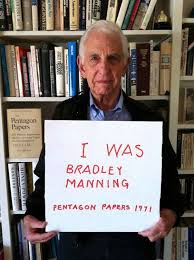
imagesLittle more than few hours ago, a critical ruling was handed down by Judge Denise Lind in the Bradley Manning UCMJ prosecution ongoing at Fort Meade. The decision was on based on this motion by the defense seeking dismissal of the “Aiding the Enemy” charge, among others in the prosecution.

To make a long, even if sadly predictable, story short, the motion was denied by Judge Lind and the charge will proceed to determination on the merits. This is, to be sure, a nod to the prosecution (which is actually the standard in such motions for directed verdicts during trials; that is the facts are taken in the light most favorable to the non-moving party, the government). It is also, obviously, a blow to the defense, although undoubtedly an expected one for defense attorney David Coombs. There is a very outside chance of a silver lining I will discuss below.

Julie Tate at the Washington Post sets the table:

The motion to dismiss the charge was filed July 4 by Manning’s civilian defense attorney. He argued that the government had failed to show that Manning “had ‘actual knowledge’ that by giving information to WikiLeaks, he was giving information to an enemy of the United States.” He said the government did introduce evidence “which might establish that PFC Manning ‘inadvertently, accidentally, or negligently’ gave intelligence to the enemy,” but that this was not enough to prove the most serious charge against him, known as an Article 104 offense.

On two separate occasions, Lind, an Army colonel, had questioned military prosecutors about whether they would be pursuing the charge if the information had been leaked directly to The Washington Post or the New York Times. Each time, the prosecution said it would. That troubles advocates for whistleblowers, who fear that the leaking of national defense information that appears online, as it inevitably does, can be construed as assisting the enemy.

If convicted of aiding the enemy, Manning, an intelligence analyst who served in Iraq, could face life in prison.

That describes the motion and the stakes as to Manning. Julie’s article also gives more particulars on the denial this morning, and is worth a read. For a tick tock, please see the continuously good coverage by Kevin Gosztola of Firedoglake.

But as enormous as the stakes are for Bradley Manning, the enterprise of investigative journalism is also on trial, even if in an indirect manner.

Yet another journalist who has tirelessly, and superbly, covered the Manning prosecution, Alexis O’Brien, has written at the Daily Beast, the stakes for investigative journalism are also life and/or death in the face of the security/surveillance state. Citing the in court, and on the trial record, compelling testimony of Professor Yochai Benkler of Harvard Law School, Alexis related:

In a historic elocution in court last week, Prof. Yochai Benkler, co-director of the Berkman Center for Internet and Society at Harvard Law School, told Lind that “the cost of finding Pfc. Manning guilty of aiding the enemy would impose” too great a burden on the “willingness of people of good conscience but not infinite courage to come forward,” and “would severely undermine the way in which leak-based investigative journalism has worked in the tradition of [the] free press in the United States.”

“[I]f handing materials over to an organization that can be read by anyone with an internet connection, means that you are handing [it] over to the enemy—that essentially means that any leak to a media organization that can be read by any enemy anywhere in the world, becomes automatically aiding the enemy,” said Benkler. “[T]hat can’t possibly be the claim,” he added.

Benkler testified that WikiLeaks was a new mode of digital journalism that fit into a distributed model of emergent newsgathering and dissemination in the Internet age, what he termed the “networked Fourth Estate.” When asked by the prosecution if “mass document leaking is somewhat inconsistent with journalism,” Benkler responded that analysis of large data sets like the Iraq War Logs provides insight not found in one or two documents containing a “smoking gun.” The Iraq War Logs, he said, provided an alternative, independent count of casualties “based on formal documents that allowed for an analysis that was uncorrelated with the analysis that already came with an understanding of its political consequences.”

Those really are the stakes in the, now, not all that new age of digital journalism. When the prosecutors in the Manning trial, upon direct questioning by Judge Lind as to whether they would still prosecute Manning if his leaks had been delivered straight to the New York Times or Washington Post, it had to be a wake up call for traditional media. Or so you would think. But, really, the outrage has been far greater over the James Rosen/Fox subpoena that could, and arguably should, be considered relative peanuts.

But, Yochai Benkler is right as to the import of the consideration as to Wikileaks in the Manning case.

In closing, the one slim and thin ray of limited hope from today’s ruling by Denise Lind: If I were Lind and cared at all about the ultimate verdict on Pvt. Bradley Manning, I too would have made this ruling. Why, you ask? Well, because a dismissal on the motion would have been the equivalent of a directed verdict on the law and would be far easier to overturn on appeal than a decision on the merits that the government has not met its burden of proof. Is this possible; sure, it certainly is. Is this likely; no, I would not make any substantial bets on it.

Share this entry

Wherein Alexander the Great Conquers the World

“Collect it all,” an anonymous source describes General Keith Alexander’s approach to data, in a bizarre WaPo profile this morning.

The article includes several anonymous condemnations of Alexander the Great’s approach.

  • “But even his defenders say Alexander’s aggressiveness has sometimes taken him to the outer edge of his legal authority.”
  • “Some in Congress complain that Alexander’s NSA is sometimes slow to inform the oversight committees of problems, particularly when the agency’s eavesdroppers inadvertently pick up communications that fall outside the NSA’s legal mandates.”
  • “Even close allies have fretted about the concentration of so much responsibility — not to mention influence — in a single individual.”

It also provides details of why he is so dangerous.

  • “Alexander has argued for covert action authority, which is traditionally the domain of the CIA, individuals familiar with the matter say.”
  • “He has been credited as a key supporter of the development of Stuxnet, the computer worm that infected Iran’s main uranium enrichment facility in 2009 and 2010 and is the most aggressive known use to date of offensive cyberweaponry.”
  • “‘He is the only man in the land that can promote a problem by virtue of his intelligence hat and then promote a solution by virtue of his military hat,’ said one former Pentagon official,”
  • Private companies should give the government access to their networks so it could screen out the harmful software. The NSA chief was offering to serve as an all-knowing virus-protection service, but at the cost, industry officials felt, of an unprecedented intrusion into the financial institutions’ databases.”

But the entire article — which focuses far more closely on Alexander the Great’s cybersecurity and cyberwar activities than terrorism — pretends to be about terrorism.

For NSA chief, terrorist threat drives passion to ‘collect it all,’ observers say

In late 2005, as Iraqi roadside bombings were nearing an all-time peak, the National Security Agency’s newly appointed chief began pitching a radical plan for halting the attacks that then were killing or wounding a dozen Americans a day.

At the time, more than 100 teams of U.S. analysts were scouring Iraq for snippets of electronic data that might lead to the bomb-makers and their hidden factories. But the NSA director, Gen. Keith B. Alexander, wanted more than mere snippets. He wanted everything: Every Iraqi text message, phone call and e-mail that could be vacuumed up by the agency’s powerful computers.

“Rather than look for a single needle in the haystack, his approach was, ‘Let’s collect the whole haystack,’ ” said one former senior U.S. intelligence official who tracked the plan’s implementation. “Collect it all, tag it, store it. . . . And whatever it is you want, you go searching for it.”

The unprecedented data collection plan, dubbed Real Time Regional Gateway, would play a role in breaking up Iraqi insurgent networks and significantly reducing the monthly death toll from improvised explosive devices by late 2008. It also encapsulated Alexander’s controversial approach to safeguarding Americans from what he sees as a host of imminent threats, from terrorism to devastating cyberattacks.

This approach (which appears to be sheer regurgitation on the part of one of WaPo’s writers, perhaps not surprising given Joby Warrick’s contributions) replicates both David Petraeus’ false claims about the surge winning the war in Iraq (rather than bribes to delay the violence that is exploding again) and the very legal ploy I’ve described is built into FISA programs.

That is, every time NSA proposes some vast new expansion of its collection, it does so by pointing to the Terror Terror Terror threat (whether or not that’s the chief threat at hand). People within National Counterterrorism Center troll their files to build up the threat as urgently as possible, including using tortured evidence. And then they pull that together into a justification that probably looks just like the first paragraphs of this article as self-justification.

And remember, Alexander the Great was resuming comprehensive collection on Iraq after Jack Goldsmith had limited it to terrorists in 2004 (presumably after he and others discovered comprehensive collection includes eavesdropping on calls from servicemen calling home).

And by using the Terror Terror Terror threat, Alexander the Great can invoke the certainty of death to describe proposals that include camping on the most private bank websites to hunt for malware (to say nothing of offensively attacking other states).

“Everyone also understands,” he said, “that if we give up a capability that is critical to the defense of this nation, people will die.”

Once you get beyond the initial several paragraphs of propaganda, the story makes clear that a number of people — and not just Jeff Merkley, who is one of the named critics — are beginning to realize this is too much.

But by the time you get there, Alexander the Great has conquered the world.

“Collect it all.”

Share this entry

Why “Members of the News Media” Should Welcome a Shield for the Act of Journalism

As I noted in this piece, the new policies DOJ rolled out in the wake of the AP and James Rosen revelations applies explicitly to “members of the news media,” not journalists per se. The definition might permit the exclusion of bloggers and book writers, not to mention publishers like WikiLeaks.

I’ve been asked what I think a better solution is. My answer is to define — and then protect — the act of journalism, not the news media per se.

That approach would have several advantages over protecting “the news media.” First, by protecting the act of journalism, you include those independent reporters who are unquestioningly engaging in journalism (overcoming the blogger question I laid out, but also those working independently on book projects, and potentially — though this would be a contentious though much needed debate — publishers like WikiLeaks), but also exclude those news personalities who are engaging in entertainment, corporate propaganda, or government disinformation.

But protecting the act of journalism rather than “news media” would also serve to exclude another group that should have limited protection. Included within DOJ’s definition of those it is protecting here are not just the reporters who work for the news media, but also the managers.

“News media” includes persons and organizations that gather, report or publish news, whether through traditional means (e.g., newspapers, radio, magazines, news service) or the on-line or wireless equivalent. A “member of the media” is a person who gathers, reports, or publishes news through the news media.

While I absolutely agree that, say, AP’s editors should have had their phone records protected as they contemplated withholding the UndieBomb 2.0 story after the White House request (those records were included in the subpoena) — that is, as they engaged in a journalistic role. That would protect any discussions they had with sources or other experts to challenge the government’s claim about damage, for example. But the communications of a Tim Russert being pressured after the fact about a critical story by the Vice President’s Chief of Staff should not be protected. Nor should WaPo CEO Katharine Weymouth’s discussions with huge donors like Pete Peterson or potential salon sponsors. While I suspect DOJ sees real benefit in protecting these cocktail weenie means of pressure on news media (as do, undoubtedly, some of the executives involved), I see no journalistic reason to do so.

Moreover, in an era where WaPo is really a testing firm with a journalistic rump and NBC is really the TV content wing of a cable supplier, should we really be protecting the “news media” with no limits? (Bloomberg, I think, presents the most fascinating question here, particularly given their recent spying on users of Bloomberg terminals; where does the journalistic protection for companies that primarily provide privatized information begin and end?)

But even within the scope of Friday’s guidelines, there’s a reason the members of the news media should favor protecting the act of journalism rather than membership in news media.

That’s because two of the most important passages in the new News Media Policies refer to newsgathering activities as a further modification to its otherwise consistent discussion of members of the news media. The phrase appears in what amounts to a mission statement describing why this issue is important.

As an initial matter, it bears emphasis that it has been and remains the Department’s policy that members of the news media will not be subject to prosecution based solely on newsgathering activities. Furthermore, in light of the importance of the constitutionally protected newsgathering process, the Department views the use of tools to seek evidence from or involving the news media as an extraordinary measure. The Department’s policy is to utilize such tools only as a last resort, after all reasonable alternative investigative steps have been taken, and when the information sought is essential to a successful investigation or prosecution.

This is a weird passage, in that it both admits the “newsgathering process” is constitutionally protected, presumably for all, but then suggests the protections within this policy will only apply to members of the news media (one limitation) who cannot be prosecuted exclusively for their newsgathering activities (a second limitation).

Note the parallel limitation in a number of DOJ’s surveillance and investigative guidelines — which say people cannot be investigated solely for their First Amendment protected activities — has not provided adequate protection to Muslims engaging in speech and religion.

The policies again invoke “newsgathering activities” in the passage describing the news media protections in DOJ’s treatment of the Privacy Protection Act.

First, the Department will modify its policy concerning search warrants covered by the PPA involving members of the news media to provide that work product materials and other documents may be sought under the “suspect exception” of the PPA only when the member of the news media is the focus of a criminal investigation for conduct not connected to ordinary newsgathering activities. Under the reviews policy, the Department would not seek search warrants under the PPA’s suspect exception if the sole purpose is the investigation of a person other than the member of the news media.

By limiting protections offered to members of the news media to “ordinary newsgathering activities,” DOJ has just punted one of the crucial issues underlying the James Rosen affidavit (and, along with it, DOJ’s efforts to prosecute WikiLeaks). Because it still permits DOJ to decide, potentially in secret (though, as a laudable part of the new policy, with the input of the Public Affairs Director and the Privacy and Civil Liberties Officer), what constitutes “ordinary newsgathering activities.” And some of the things the FBI officer apparently decided  in that case did not constitute ordinary newsgathering activities, but instead provided evidence that Rosen was part of a conspiracy to commit espionage, include:

  • Soliciting disclosure of intelligence information, including documents, on North Korea
  • Using (in the FBI officer’s description) “covert email communications as a means of compartmentalizing the information” — this includes use of a pseudonym and a code for facilitating non-email communication
  • Exploiting a source “like a rag doll” and the source’s vanity (according to defendant Stephen Jin-Woo Kim’s descriptions); employing flattery (according to the FBI officer’s description)
  • Providing other news articles in advance of their publication to a source not used on that story

While there are other protections for news media in these new policies (including protections from non-NSL Administrative orders, review before using such investigative methods, reporting on how much investigation of news media occurs, and what amount to increased minimization procedures for news media contact information), this is one of the critical new protections in this policy.

If DOJ decides that protecting sources and methods, soliciting information, and sucking up to sources do not constitute “ordinary newsgathering activities,” then how useful are the protections?

DOJ has announced its intention to respect ordinary newsgathering activities and even recognized constitutional protections for them, sort of (I look forward to the legal cases that cite that language, anyway). But until there’s a common understanding about when such activities constitute journalism and when they constitute spying, the protection has limited value.

If the ultimate idea is to protect newsgathering activities, then why not establish what those activities are and then actually protect them, regardless of whether they are tied to a certain kind of institution?

Share this entry

Spying on Americans: A “Team Sport” Since 2004

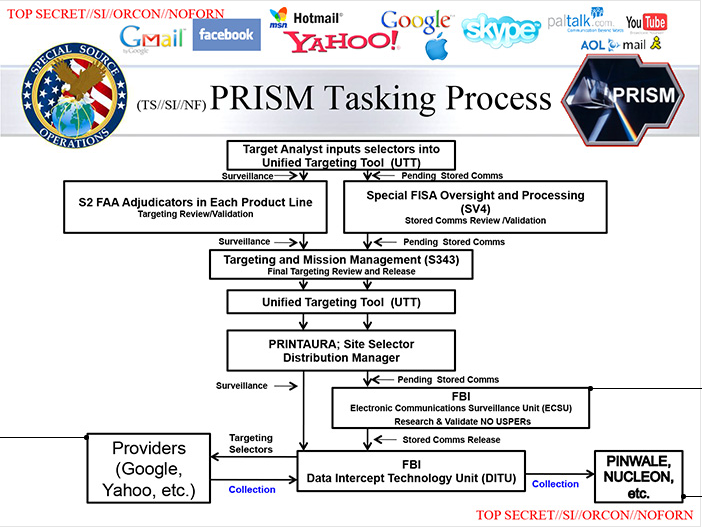
Screen shot 2013-07-11 at 6.25.06 PMOne of the more colorful revelations in today’s Guardian scoop is the newsletter piece that describes increased sharing of PRISM (Section 702) data with FBI and CIA.

The information the NSA collects from Prism is routinely shared with both the FBI and CIA. A 3 August 2012 newsletter describes how the NSA has recently expanded sharing with the other two agencies.

The NSA, the entry reveals, has even automated the sharing of aspects of Prism, using software that “enables our partners to see which selectors [search terms] the National Security Agency has tasked to Prism”.

The document continues: “The FBI and CIA then can request a copy ofPrism collection of any selector…” As a result, the author notes: “these two activities underscore the point that Prism is a team sport!”

But that’s something that has actually been built into the program for years. While the Joint IG Report on the illegal wiretap program claimed,

NSA also was responsible for conducting the actual collection of information under the PSP and disseminating intelligence reports to other agencies such as the Federal Bureau of Investigation (FBI), the Central Intelligence Agency (CIA), and the Office of the Director of National Intelligence (ODNI) National Counterterrorism Center (NCTC) for analysis and possible investigation.

The Draft NSA IG Report explained,

Coordination with FBI and CIA. By 2004, four FBI integrees and two CIA integrees, operating under SIGINT authorities in accordance with written agreements, were co-located with NSA PSP-cleared analysts. The purpose of co-locating these individuals was to improve collaborative analytic efforts.

And the minimization procedures released by the Guardian (which date to 2009), make it clear NSA can provided unminimized content to CIA and FBI on whatever selectors they request.

6(c)

(1) NSA may provide to the Central Intelligence Agency (CIA) unminimized communications acquired pursuant to section 702 of the Act. CIA will identify to NSA targets for which NSA may provide unminimized communications to CIA. CIA will process any such unminimized communications received from NSA in accordance with CIA minimization procedures adopted by the Attorney General, in consultation with the Director of National Intelligence, pursuant to subsection 702(e) of the Act.

(2) NSA may provide to the FBI unminimized communications acquired pursuant to section 702 of the Act. FBI will identify to NSA targets for which NSA may provide unminimized communications to the FBI. FBI will process any such unminimized communications received from NSA in accordance with FBI minimization procedures  adopted by the Attorney General, in consultation with the Director of National Intelligence, pursuant to subsection 702(e) of the Act.

And none of that should be surprising, given the tasking slide — above — that was first published by the WaPo. FBI, at least, is solidly in the midst of this collection, for a program deemed to be foreign intelligence collection.

There have been a variety of claims about all this team sport participation. But I’m not convinced any of them explain how all this works.

And in perhaps related news, the Fifth Circuit today said that Nidal Hasan could not have access to the FISA material on him, in spite of the fact that William Webster published a 150 page report on it last year. Legally, that material should be utterly distinct from PRISM, since a wiretap on Anwar al-Awlaki would require a specific FISA warrant (and the latest Guardian scoop refers to expanded cooperation since 2012). But I suspect the reason Hasan, the FISA evidence against whom has already been extensively discussed, can’t see it is because we would see what this actually looks like from the FBI side.

DOJ has to protect its team, you know.

Share this entry

“Is This the New Espionage?” CBS Asks of Leaking Government Files, While Airing Leaked Government Video

“Is this the new espionage,” CBS asks, “the spy who believes, for the good of his country, he must reveal its secrets?”

CBS then chooses to give former NSA Director Michael Hayden — who oversaw the NSA when it engaged in an unprecedented illegal surveillance program — airtime to ask,

What kind of sense of moral superiority does it take, to feel like your moral judgment trumps the moral judgment of not one but two Presidents, both houses of Congress, and bipartisan majorities, the American court system, and 35,000 of your coworkers at the NSA?

Congratulations to CBS for at least visually tying Hayden to his gravy train at Chertoff Group, a firm associated with profiting off of “security solutions” (like Rapiscan) that end up being too costly and ineffective.

Hayden then tries to get in the head of Bradley Manning and Edward Snowden.

These two most recent cases — Private Manning and Mr. Snowden — they’re a bit different. They’re probably doing it for ideology and almost this romantic, absolute commitment to transparency.

I’ll come back to Hayden and his very amusing outrage in a second.

But did you notice what else CBS did in this clip?

They aired a leaked CIA/FBI film produced as part of Obama’s Insider Threat program, the program that also pushes government employees to spy on their coworkers.

And while CBS later admits, several minutes into this clip, that Snowden “is not a spy,” it sure seems funny for them for have first asked if leaking spy agency materials is “the new Espionage” in a piece that itself airs leaked spy agency material.

You’d think the obvious conclusion would be that Snowden’s action is the old journalism?

So back to Michael Hayden.

CBS barely discusses the law in this clip. I mean, sure, they talk about the convicted spies Robert Hanssen and Aldrich Ames and mention the law, Espionage. But they don’t mention FISA — one of several laws that Michael Hayden broke — nor do they mention war crimes that some of Bradley Manning’s disclosures revealed.

Which is sort of odd given that according to these whistleblowers’ own descriptions of their motives, both men talked about the laws they at least perceived their government to be grossly violating. (And the Draft NSA IG Report Snowden leaked provides more details on Hayden’s unpunished crimes than we’ve gotten before.)

By the way, when Hayden claims “the American court system” sides with him? He forgets Vaughn Walker’s ruling that, in fact, the government had illegally wiretapped al-Haramain during that window when Hayden agreed to continue the program even though the Acting Attorney General Jim Comey had deemed it illegal.

CBS decided to invite a criminal, Michael Hayden, on to attack the actions of a man who had provided the public additional evidence of his crimes. The clip ends with Hayden warning about how much more empowered insider threats are.

What is new that in this modern connected era the trusted insider who betrays us is far more empowered to do damage far greater than these kinds of folks were able to do in the past and so we just have to be more vigilant.

Perhaps the question we ought to be asking is not “is this the new espionage” but “who is the greater insider threat risk, Edward Snowden or Michael Hayden?”

Share this entry

US Big-Footing Extraterritoriality Again

The Irish High Court has rejected the request for an arrest warrant for Edward Snowden. While most aspects of the request were in order — the timing of the alleged crimes, Snowden’s role in them — the US somehow neglected to mention where the alleged crimes had occurred. And that’s a problem because if stealing and leaking outside of Ireland is not an Irish crime, Ireland wouldn’t be able to extradite Snowden if he allegedly stole and leaked documents in outside of the US.

Judge Mac Eochaidh said he was satisfied that the US request met a number of the conditions set out in the relevant act for him to grant the arrest warrant. These included the fact it set out the time when the alleged offences took place, the circumstances in which the offences were committed and the degree of involvement of Mr Snowden in the commission of the alleged offences.

However, the judge observed that the request did not state where the offences actually took place – a condition that must be met by such applications.

“The question of where the offence took place is not a minor detail but is a matter which could have very serious consequences in any further stage that might be reached in an extradition process,” the judge wrote.

“That is because if it is the case that the offences took place outside of the territory of the United States of America, the question will arise as to whether there is extraterritorial effect in respect of the US offences, but more importantly, whether the Irish equivalent offences have an extraterritorial effect or aspect to them.”

He continued: “There would need to be sufficient similarity between the two offences in order for there to be an extradition.”

Presumably, the US will come back and say that Snowden stole documents, at least, in Hawaii, and therefore within the US, even if he didn’t leak them until he got to Hong Kong. Unless, of course, revealing what their contractor-hacker was allowed to do with data would get awkward for the US.

Still, given the way the US loves to big-foot extraterritoriality (including in the Viktor Bout case), you have to wonder whether they knew this would be a problem and tried to just ignore silly things like jurisdiction.

Share this entry

On the Meanings of “Dishonor” and “Hack”

The former NSA IG (and current affiliate of the Chertoff Group profiteers, though he didn’t disclose that financial interest) Joel Brenner has taken to the pages of Lawfare to suggest anyone trying to force some truth out of top Intelligence Community officials is dishonorable.

On March 12 of this year, Senator Ron Wyden asked James Clapper, the director of national intelligence, whether the National Security Agency gathers “any type of data at all on millions or hundreds of millions of Americans.”

“No, sir,” replied the director, visibly annoyed. “Not wittingly.”

Wyden is a member of the Senate Select Committee on Intelligence and had long known about the court-approved metadata program that has since become public knowledge. He knew Clapper’s answer was incorrect. But Wyden, like Clapper, was also under an oath not to divulge the story. In posing this question, he knew Clapper would have to breach his oath of secrecy, lie, prevaricate, or decline to reply except in executive session—a tactic that would implicitly have divulged the secret. The committee chairman, Senator Diane Feinstein, may have known what Wyden had in mind. In opening the hearing she reminded senators it would be followed by a closed session and said,  “I’ll ask that members refrain from asking questions here that have classified answers.” Not dissuaded, Wyden sandbagged he [sic] director.

This was a vicious tactic, regardless of what you think of the later Snowden disclosures. Wyden learned nothing, the public learned nothing, and an honest and unusually forthright public servant has had his credibility trashed.

Brenner of course doesn’t mention that Clapper had had warning of this question, so should have provided a better non-answer. Later in his post, he understates how revealing telephone metadata can be (and of course doesn’t mention it can also include location). He even misstates how often the phone metadata collection has been queried (it was queried on 300 selectors, not “accessed only 300 times”).

But the really hackish part of his argument is in pretending this whole exchange started on March 12.

It didn’t. It started over a year ago and continued through last week when Keith Alexander had to withdraw a “fact sheet” purporting to lay out the “Section 702 protections” Americans enjoy (see below for links to these exchanges).

The exchange didn’t start out very well, with two Inspectors General working to ensure that Wyden and Mark Udall would not get their unclassified non-answer about how many Americans are surveilled under Section 702’s back door until after the Intelligence Committee marked up the bill.

But perhaps the signature exchange was this October 10, 2012 Wyden letter (with 3 other Senators) to Keith Alexander and Alexander’s November 5, 2012 response.

On July 27, 2012, Alexander put on a jeans-and-t-shirt costume and went to DefCon to suck up to hackers. After giving a schmaltzy speech including lines like, “we can protect the networks and have civil liberties and privacy,” DefCon founder Jeff Moss asked Alexander about recent Bill Binney allegations that the NSA was collecting communications of all Americans. Wired reported the exchange here.

It was this exchange — Keith Alexander’s choice to make unclassified statements to a bunch of hackers he was trying to suck up to — that underlies Wyden’s question. And Wyden explicitly invoked Alexander’s comments in his March 12 question to Clapper.

In Wyden’s letter, he quoted this, from Alexander.

We may, incidentally, in targeting a bad guy hit on somebody from a good guy, because there’s a discussion there. We have requirements from the FISA Court and the Attorney General to minimize that, which means nobody else can see it unless there’s a crime that’s been committed.

Wyden then noted,

We believe that this statement incorrectly characterized the minimization requirements that apply to the NSA’s FISA Amendments Act collection, and portrays privacy protections for Americans’ communications as being stronger than they actually are.

This is almost precisely the exchange that occurred last week, when Wyden and Udall had to correct Alexander’s public lies about Section 702 protections again. 8 months later and Alexander is reverting to the same lies about protections for US Persons.

In the letter, Wyden quoted from Alexander again,

You also stated, in response to the same question, that “…the story that we have millions or hundreds of millions of dossiers on people is absolutely false. We are not entirely clear what the term “dossier” means in this context, so we would appreciate it if you would clarify this remark.

And asked,

Are you certain that the number of American communications collected is not “millions or hundreds of millions”? If so, then clearly you must have some ability to estimate the scale of this number, at least some range in which you believe it falls. If this is the case, how large could this number possibly be? How small could it possibly be?

Does the NSA collect any type of data at all on “millions or hundreds of millions of Americans”?

This last question was precisely the question Wyden asked Clapper 5 months later on March 12 (Alexander’s response in November didn’t even acknowledge this question — he just blew it off entirely).

As Wyden emphasized, Alexander is the one who chose to make misleading assertions in unclassified form, opening up the door for demands for an unclassified response.

Since you made your remarks in an unclassified forum, we would appreciate an unclassified response to these questions, so that your remarks can be properly understood by Congress and the public, and not interpreted in a misleading way.

In other words, Brenner presents the context of Wyden’s question to Clapper completely wrong. He pretends this exchange was about one cleared person setting up another cleared person to answer a question. But Brenner ignores (Wyden’s clear invocation of it notwithstanding) that this exchange started when a cleared person, General Alexander, chose to lie to the public.

And now that we’ve seen the minimization standards, we know just how egregious a lie Alexander told to the hackers at DefCon. It’s bad enough that Alexander didn’t admit that anything that might possibly have a foreign intelligence purpose could be kept and, potentially, disseminated, a fact that would affect all Americans’ communications.

But Alexander was talking to high level hackers, probably the group of civilians who encrypt their online communications more than any other.

And Alexander knows that the NSA keeps encrypted communications indefinitely, and with his say-so, can keep them even if they’re known to be entirely domestic communications.

In other words, in speaking to the group of American civilians whose communications probably get the least protections from NSA (aside from the encryption they themselves give it), Alexander suggested their communications would only be captured if they were talking to bad guys. But the NSA defines “those who encrypt their communications” as bad guys by default.

He was trying to suck up to the hackers, even as he lied about the degree to which NSA defines most of them as bad guys.

Brenner gets all upset about his colleagues being “forced” to lie in public. But that’s not what’s going on here: James Clapper and, especially, Keith Alexander are choosing to lie to the public.

And if it is vicious for an intelligence overseer to call IC officials on willful lies to the public, then we’ve got a very basic problem with democracy. Read more

Share this entry

Alberto Gonzales and Internet Data Mining

I was going to leave this speculation well enough alone. But George W Bush decided to interrupt his dog painting to defend Obama’s surveillance dragnet.

Bush also defended the surveillance program, which began during his administration after 9/11, saying the programs guarantee civil liberties are protected.

“I put the program in place to protect the country and one of the certainties is civil liberties were guaranteed,” Bush said.

So here goes.

In his book, Jack Goldsmith describes Alberto Gonzales siding against David Addington in a debate just once, only to have George Bush override the then White House Counsel.

Addington’s hard-line nonaccommodation stance always prevailed when the lawyers met to discuss legal policy issues in Alberto Gonzales’ office. During these meetings, Gonzales himself would sit quietly in his wing chair, occasionally asking questions but mostly listening as the querulous Addington did battle with whomever was seeking to “go soft.” It was Gonzales’ responsibility to determine what to advise the president after the lawyers had kicked the legal policy matters around. But I only knew him to disagree with Addington once, on an issue I cannot discuss, and on that issue the president overruled Gonzales and sided with the Addington position. [my emphasis]

The issue Goldsmith could not discuss could be torture or prisoner transfers or something entirely unknown, but the data mining at the heart of the hospital confrontation is clearly one candidate.

There’s no overt evidence Gonzales tried to do the right thing on the illegal surveillance program. After all, even after Bush agreed to put the program right on March 12, 2004, Gonzales still objected to Goldsmith and Jim Comey’s first advice on the program. After Goldsmith laid out his initial advice on March 15, Gonzales wrote a memo saying,

Your memorandum appears to have been based on a misunderstanding of the President’s expectations regarding the conduct of the Department of Justice. While the President was, and remains, interested in any thoughts the Department of Justice may have on alternative ways to achieve effectively the goals of the activities authorized by the Presidential Authorization of March 11, 2004, the President has addressed definitively for the Executive Branch in the Presidential Authorization the interpretation of the law.

This led Comey to write up his resignation letter on March 16. “[A]lthough I believe this has been one of [DOJ’s] finest hours, we have been unable to right that wrong.” Three days later, Bush modified his March 11 Authorization, directing NSA to stop collecting Internet metadata within a week.

Of course, three months later, the Administration resumed collection of Internet metadata using the FISC PR/TT order. That was within days of Goldsmith’s departure, though he had announced his departure a month earlier and Comey, obviously, stuck around for over a year longer.

So still no evidence the Internet data mining was the issue on which Gonzales tried to stand up to Addington.

But let’s jump ahead to the circumstances of Alberto Gonzales’ resignation in August 2007. At the time, his sudden and confusing resignation was attributed to the multiple scandals embroiling him — chiefly the US Attorney firing scandal, but also Gonzales’ Clapper-like lies about the illegal wiretap program before the Senate a month earlier. But for some reason, Gonzales did not benefit from the kind of sinecure every other former Bush official — even James Comey, who went to Lockheed — enjoyed upon departure, which you would have thought he’d get after lying to protect the President.

Then, a year after Gonzales’ departure, we learned that in the weeks before he resigned, White House Counsel Fred Fielding had narced him out for storing a bunch of Top Secret CYA documents in a briefcase in his closet. Read more

Share this entry