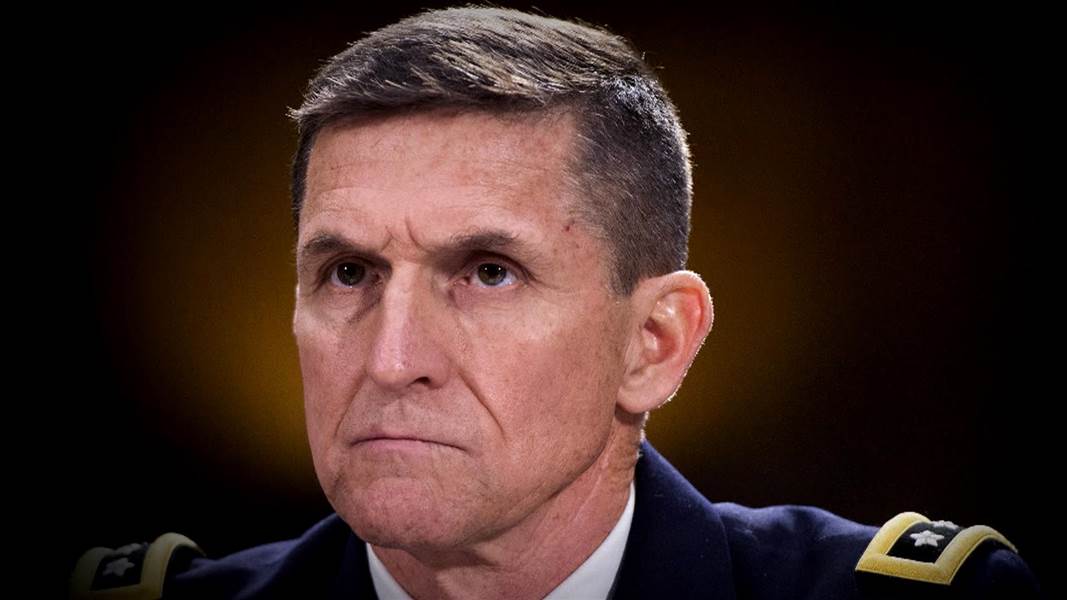
Even after Learning the FBI Was Investigating, Trump Berated Flynn for Not Being Obsequious Enough to Putin

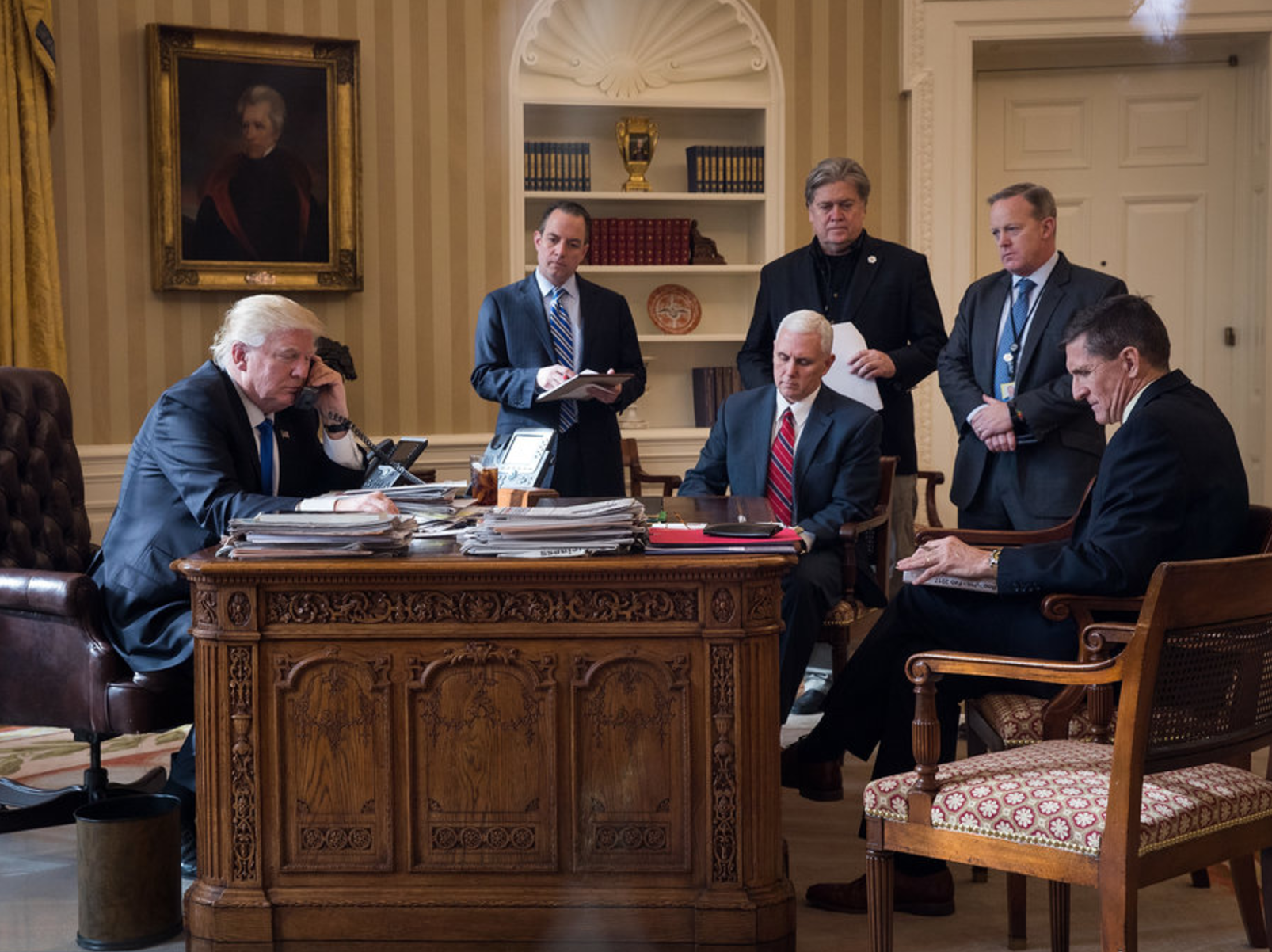
The Independent has a story that is being taken as news: That Trump berated then National Security Advisor Mike Flynn in from of Theresa May for not telling him that Vladimir Putin had called.

Theresa May’s former Chief of Staff, Nick Timothy, described Trump shouting in the middle of a formal luncheon.

Mr Timothy spoke about a “fairly extraordinary” lunch during which Mr Trump shouted at his then-national security advisor Michael Flynn.

“Somebody just mentioned in passing that Vladimir Putin had asked for a call with him, and right in front us he absolutely shouted down Mike Flynn,” he said.

“Like really shouted. This was at a formal dinner with butlers and fancy crockery – and he was properly shouting at him down the table.”

Mr Timothy said the president yelled: “If Putin wants a call with me you just put him through.”

It’s not actually a new story. Trump told a version of the story himself in real time, to Jim Comey, at the same dinner where he asked for loyalty from the FBI Director. According to Jim Comey’s memo memorializing the January 27 dinner, Trump raised the incident in an attempt to convince Comey that he, Trump, believed Flynn had poor judgment.

He then went on to explain that he has serious reservations about Mike Flynn’s judgement and illustrated with a story from that day in which the President apparently discovered during his toast to Teresa May that [Putin] had called four days ago. Apparently, as the President was toasting PM May, he was explaining that she had been the first to call him after his inauguration and Flynn interrupted to say that [Putin] had called (first, apparently). It was then that the President learned of [Putin’s call] and he confronted Flynn about it (not clear whether that was in the moment or after the lunch with PM May). Flynn said the return call was scheduled for Saturday, which prompted a heated reply from the President that six days was not an appropriate period of time to return a call from the [President] of a country like [Russia]. This isn’t [redacted] we are talking about.”) He said that if he called [redacted] and didn’t get a return call for six days he would be very upset. In telling the story, the President pointed his fingers at his head and said “the guy has serious judgment issues.”

But the differences in the story — with Timothy emphasizing that Trump was pissed for not putting Trump on the phone with Putin immediately, as compared to Trump’s claim that he was pissed because Flynn scheduled the return call six whole days later — are notable (if subtle), particularly when read in context.

We’ve known for some time that Sergey Kislyak first started tying to schedule a call between Trump and Putin during his December 29, 2016 call with Flynn, when Flynn asked Russia to keep any retaliation against US sanctions measured; the meeting itself was even mentioned in the original David Ignatius column that revealed the call. But we now have some of the transcripts of those calls. Those transcripts show how Kislyak pitched the meeting — and the January 21 date — even before Flynn raised the sanctions (Kislyak was also pushing for public US participation in a Turkish-Russian “peace” initiative on Syria to be held the first week of the Administration, something else included in KT McFarland’s cover story for the call).

KISLYAK: I mean heads up, we wanted you to know this. And the third final uh, point, General, is uh, I am entrust to convey through you to Seer- uh to President Elect, proposal from the Kremlin. Maybe to organize a conversation over the secure video line that starting on the twentieth would be available to Mr. Trump. And it’s there, certainly, uh – uh, between the White House and the Kremlin. And our proposal is to have the conversation on the twenty.first between our Presidents. And the idea of Mr. Putin is first of all to congratulate uh, your President Elect or the President, at the time, and maybe to discuss small number~ briefly, of issues that are on our agenda. So his proposal is on the twenty-first of January.

FLYNN: Okay. Ummm

[Timestamp: 05:20]

KISLYAK: Is by security video. Secure video line.

Then, on December 31, after Kislyak told Flynn that Putin had considered Flynn’s request not to escalate before deciding not to even respond, Flynn offered up that “the boss is aware” of the request for a January 21 secure call. Flynn acknowledged Kislyak was trying to schedule it for the day after the inauguration, but did not commit to that date.

FLYNN: I haven’t gotten, I haven’t gotten a, uh, confirmation on the, on the, uh, secure VTC yet, but the, but the boss is aware and so please convey that

KISL YAK: I will

FLYNN: And we can set that up Fairly quickly and well have at I don’t want to go through, I don’t want to go through a big, uh, uh, gyration of, you know, what is on the agenda. I think the agenda just needs to be a couple of simple things uh, and let the two talk about, let the two communicate if, if we end up having it on the 21st, if not

KISL YAK:

Absolutely, FLYNN: the 21st, then what we, we, uh, may end up, you know, sometime very close after just because other, other scheduled events, if that makes sense. Okay. [my emphasis]

Then, the day before inauguration, Kislyak left a message reiterating Russia’s request to speak “after the inauguration,” and reminding Flynn of their conversation — a conversation that had been revealed by David Ignatius, leading Flynn to start lying publicly about the request he had made on it.

KISLYAK: Good morning, General. This [sic] Sergey Kislyak, Russian ambassador. I, uh, apologize that I disturb you but I wanted to check whether you have, um, uh, answer to the idea of our two presidents speaking, uh, re-… uh, after the inauguration. You remember our conversation and we certainly would appreciate any indication as to when it is going to be possible. Uh, I would appreciate your calling back and telling me where we are. Thank you so much. All the best.

And then, according to the public story, Putin called to congratulate Trump on January 21, the call for January 28 got scheduled at some point, and on January 27, Trump had a public meltdown about how all that had gone down. In both versions of the story, Trump was pissed that Flynn hadn’t been responsive enough to Putin. In Trump’s version, however, he claimed to be unaware Putin wanted to call on January 21; Mike Flynn told Kislyak he knew of that all along (and the public record shows that Trump knew that Putin placed the call no later than a presser immediately before the lunch in question).

What happened the day before is instructive. On January 26, 2017, the day before Trump had an embarrassing meltdown because his National Security Advisor wasn’t prioritizing a call with Vladimir Putin that Trump first learned about — in the context of secret requests of Russia — weeks earlier, Trump learned that the FBI not only knew of the calls with Kislyak, but knew the substance of his calls with the Russian Ambassador. Trump learned that the FBI found those calls — in one of which Flynn affirmed that Trump knew of the call request — problematic.

On January 26, 2017, Acting Attorney General Sally Yates contacted White House Counsel Donald McGahn and informed him that she needed to discuss a sensitive matter with him in person. 142 Later that day, Yates and Mary McCord, a senior national security official at the Department of Justice, met at the White House with McGahn and White House Counsel’s Office attorney James Burnham. 143 Yates said that the public statements made by the Vice President denying that Flynn and Kislyak discussed sanctions were not true and put Flynn in a potentially compromised position because the Russians would know he had lied. 144 Yates disclosed that Flynn had been interviewed by the FBI. 145 She declined to answer a specific question about how Flynn had performed during that interview, 146 but she indicated that Flynn’s statements to the FBI were similar to the statements he had made to Pence and Spicer denying that he had discussed sanctions.147 McGahn came away from the meeting with the impression that the FBI had not pinned Flynn down in lies, 148 but he asked John Eisenberg, who served as legal advisor to the National Security Council, to examine potential legal issues raised by Flynn’s FBI interview and his contacts with Kislyak. 149

That afternoon, McGahn notified the President that Yates had come to the White House to discuss concerns about Flynn.150 McGahn described what Yates had told him, and the President asked him to repeat it, so he did. 151 McGahn recalled that when he described the FBI interview of Flynn, he said that Flynn did not disclose having discussed sanctions with Kislyak, but that there may not have been a clear violation of 18 U.S.C. § 1001. 152 The President asked about Section 1001, and McGahn explained the law to him, and also explained the Logan Act. 153 The President instructed McGahn to work with Priebus and Bannon to look into the matter further and directed that they not discuss it with any other officials. 154 Priebus recalled that the President was angry with Flynn in light of what Yates had told the White House and said, “not again, this guy, this stuff.” 155

When telling the FBI Director about Flynn’s failures to set up a call with Putin on January 21 that Putin’s Ambassador had asked for in the very same call where Trump’s National Security Advisor had made an ask that undermined Obama’s punishment of Russia for tampering in American democracy, Trump described it (in the same conversation where he asked Comey for loyalty) as poor judgment.

It’s unclear why Trump did that, in a dinner meeting fairly obviously designed to undermine FBI scrutiny of why Flynn did what he did.

But if Trump believed that Flynn exercised poor judgment, it would mean he judged that Flynn should have made good on the request that Kislyak made in the same call where Trump , via Flynn, made a request. It would have meant, in context, that Trump believed Flynn should have showed more subservience to Putin.

Share this entry

Kevin Clinesmith Ordered to Cooperate with People Not on John Durham’s Team

According to multiple reports and live-tweeting from his plea hearing last week, John Durham is relying, in part, on former FBI Agents to conduct his investigation into an investigation he may not understand.

Mr. Durham is relying on a team of prosecutors, including Nora R. Dannehy and Neeraj Patel, from Connecticut, as well as former and current F.B.I. agents to complete his investigation. Anthony Scarpelli, a top prosecutor from the U.S. attorney’s office in Washington, was detailed to the team along with a federal prosecutor from Manhattan, Andrew DeFilippis.

Two former F.B.I. agents, Timothy Fuhrman and Jack Eckenrode, are also assisting. An F.B.I. agent who oversaw public corruption in Chicago and served in Ukraine as an assistant legal attaché, Peter Angelini, has also joined Mr. Durham’s team.

That’s important because of a detail in the Kevin Clinesmith plea deal that the frothy right has totally misrepresented. The plea deal includes a paragraph — addressing the “use of self-incriminating information,” not cooperation — that requires Clinesmith’s cooperation with the FBI, not prosecutors.

10. Use of Self-Incriminating Information

As an express condition of this agreement, the defendant agrees to be personally debriefed by the Federal Bureau of Investigation (“FBI”) regarding the FBI’s review of Foreign Intelligence Surveillance Act (“FISA”) matters and any information he possesses, direct or indirect, that should be brought to the attention of the Foreign Intelligence Surveillance Court (“FISC”). The Government agrees pursuant to U.S.S.G. § 1B1.8(a), that information provided by your client pursuant to this Agreement or during the course of the aforementioned debriefing, and about which the Government had no prior knowledge or insufficient proof in the absence of the debriefing, will not be used at the time of sentencing for the purpose of determining the applicable guideline range. However, all information provided by the defendant may be used for the purposes and in accordance with the terms identified in U.S.S.G. § 1B1.8(b).

The paragraph even describes the topic of Clinesmith’s mandated cooperation: working with the FBI to figure out if there’s anything further he worked on that must be noticed to the FISA Court.

On December 5, then presiding FISA Judge Rosemary Collyer (she has been succeeded by James Boasberg, who also presides over Clinesmith’s prosecution) ordered the government to check every FISA application Clinesmith had been involved with to make sure he hadn’t done anything similar on other applications.

(1) Identify all other matters currently or previously before this Court that involved the participation of the FBI OGC attorney whose conduct was described in the Preliminary Letter and Supplement Letter;

(2) Describe any steps taken or to be taken by the Department of Justice or FBI to verify that the United States’ submissions in those matters completely and fully described the material facts and circumstances; and

(3) Advise whether the conduct of the FBI OGC attorney bas been referred to the I appropriate bar association(s) for investigation or possible disciplinary action.

Nothing in the public record indicates that FBI has completed this review. Which means the FBI still needs Clinesmith’s help to review the cases he worked on.

So the language here covers what happens if, in the course of this review, FBI finds other cases where he doctored the record or somehow lied to the FISA Court.

The emphasis on cooperating with the FBI (and Durham’s heavy reliance on retired FBI Agents) should have been hint enough that this is not some grand cooperation agreement that will land Jim Comey and John Brennan in prison. But there’s another clue. The plea deal specifically says the government will not file any downward departure for sentencing.

In addition, your client acknowledges that the Government is not obligated and does not intend to file any post-sentence downward departure motion in this case pursuant to Rule 35(b) of the Federal Rules of Criminal Procedure.

There’s no cooperation agreement because there’s nothing on the table for Clinesmith to cooperate on, except to avoid further exposure.

And the plea agreement says there’s nothing more (some plea agreements have sealed addendums).

There’s no upside promised in this plea agreement. Which means Clinesmith has not promised to deliver any heads on a platter for the frothers.

Share this entry

Former Daily Caller Editor Reveals He Was Forced to Publish Oleg Deripaska

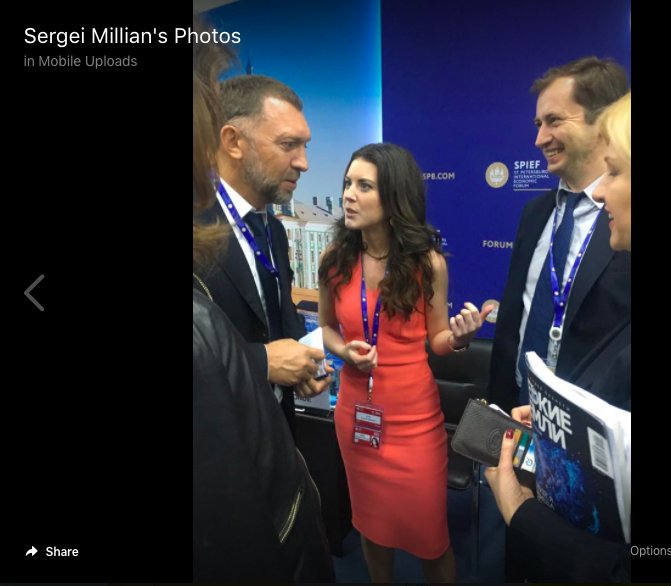
In the wake of the Senate Intelligence Report’s scathing description of Oleg Deripaska’s key role in Russia’s 2016 election interference, a former editor from the Daily Caller, Eric Owens, reveals that his bosses — Tucker Carlson and Neil Patel — forced him to publish an Oleg Deripaska column that he recognized as sloppy propaganda.

Back in 2018, I was the opinion editor for The Daily Caller. I had worked for the website for about five years as a journalist and editor. I really believed in what we were doing. I believed in what founders Tucker Carlson and Neil Patel said they were building. (More on that later.)

In early March 2018, Deripaska submitted an opinion piece to The Daily Caller. He didn’t submit it directly to me or through the Caller’s conventional submissions process. Presumably, villainous Russian billionaires are above such hoi polloi procedures. Instead, Daily Caller publisher Patel contacted me directly one day saying he had received Deripaska’s op-ed. He wanted to know how I felt about it.

I hated it. Anyone with a passing knowledge of European politics would know who Deripaska is and what he represents. I had been in the U.S. foreign service for a bit, so, of course, I knew.

More importantly, Deripaska’s op-ed itself was—and remains—an extraordinary exercise in audacious Russian propaganda.

[snip]

[I]n the case of the 2018 Deripaska op-ed, which I myself published and placed despite my own doubts and qualms, The Daily Caller was the plaything of a Russian billionaire working directly with Russian spies who used conservative media to spout completely false and fabulous conspiracy theories.

At the time, I suggested Deripaska’s column seemed to be an attempt to get ahead of disclosures like we saw in the DOJ IG and SSCI Reports, which make it clear that Deripaska was working both sides of the dossier, ratcheting up the legal pressure on Paul Manafort even while sending Konstantin Kilimnik on errands of “collusion” with him.

Then, after explaining on what authority he is sharing all this information — “My lawyer testified these facts to the Senate Intelligence Committee on Nov. 3,” — Deripaska claims third hand that Jones told his lawyer that Fusion is a “shadow media organization helping the government,” funded by a “group of Silicon Valley billionaires and George Soros.”

Among other things then, this is a very crafty attempt to get information submitted to the close-lipped SSCI, but probably not to SJC or HPSCI where everything leaks, into the public.

So Deripaska, presumably using one hell of a ghost writer, manages to spin a Paul Singer funded effort as a Soros cabal.

As noted above, there’s good reason to believe that Deripaska is the mastermind of the entire strategy of discrediting the dossier as a way to discredit the Mueller investigation. The last time he tried to discredit the investigation directly, prosecutors dinged Paul Manafort for violating the gag rule in the DC case; any bets they have the red line of this effort? Yet the name Manafort doesn’t appear here, so perhaps (especially as Manafort is officially on the clock in EDVA after his arraignment today as well as DC) Deripaska’s just getting around the gag.

As you read this work of art (really!), keep the following in mind: for all that Deripaska puts the focus on Jones and Nuland, he never gets around to explaining why Chuck Grassley thinks he had a role in the dissemination of the dossier, too. Or why he demanded immunity to testify to SSCI. At that level this may be an attempt to get ahead of disclosures about his role in the dossier.

Kudos to Owens for revealing the back story to this column and for disavowing the swamp of frothy right wing media.

The Daily Caller is no longer an alternative news organization. Breitbart is no way in hell any kind of alternative news organization.

These aren’t alternative news websites. Too many times, they are alternative realities, complete with alternate sets of facts. It’s an epistemological nightmare.

But the available evidence suggests Owens is wrong when he attributes the placement to clickbait.

I can’t speak for Patel or for Carlson, who had largely left The Daily Caller for cable-news stardom by then, but the general sentiment at the Caller always seemed to be that all publicity—and, of course, all those precious, precious page views—was wonderful. The throng of page views was certainly good for my little opinion section, which had been downright beleaguered before I took over.

As I noted at the time, Deripaska’s column was entirely coherent with one of the Daily Caller’s most assiduous journalistic efforts, Chuck Ross’ efforts to make everything about the Russia story into the dossier and the dossier into a discredited rag, with absolutely no reflection on the implications if it got filled with disinformation. Chuck Ross’ journalistic project has been, for years, to fulfill precisely the strategy that Paul Manafort pitched after returning from a meeting with one of Deripaska’s GRU-linked aides, to conflate the dossier with the Russian investigation and as it became increasingly clear that the dossier had been soaked in disinformation, thereby discredit the entire effort to protect America from people like Deripaska.

It’s important that Owens reveal that the people running the Daily Caller forced him to publish obvious propaganda.

It just raises questions about the continuity between that decision and the non-stop focus pretending the dossier equals the Russian investigation.

Share this entry

SSCI’s Asymmetric Interest in Partisan Use of Oppo Research

As I’ve said in past post, the SSCI Report on Russia is better than I expected, but it has some significant gaps (which I’ll discuss in more detail once I’m done reading the whole thing). One fairly inexcusable asymmetry in the committee’s interests, however, pertains to how the two parties dealt with the oppo research floating around in the summer of 2016.

Here’s some of the discussion of SSCI’s effort to figure out how much of Steele’s information got back to both the Clinton campaign and the DNC.

(U) Simpson implied in his interview with the Committee-but would not state outright-that Perkins Coie knew he had hired a subcontractor, along with pursuing other overseas iines of inquiry. 5722 In his book, Simpson said that Elias “had never even heard of Steele. While Elias was aware that Fusion had engaged someone outside the United States to gather information on Trump’s ties to Russia, he did not ask who it was or what the person’s credentials were.”5723 –

(U) Elias represented that the charges associated with Fusion GPS were around $60,000 per month, unevenly split between the Clinton Campaign and the DNC, including the $10,000 per-month fee paid to Perkins Coie.5724

(U) The Committee was unable to fully establish how much of the Steele information was actually transferred to the DNC and the Clinton Campaign. As a general practice, Fusion GPS passed research back to Elias weekly, sending both original source materials and summary documents.5725 Simpson would not say whether or when he gave the memos to Perkins Coie.5726 Elias, through counsel, did not provide details on what information he provided to the DNC or the Clinton Campaign, citing attorney-client privilege. His attorneys conveyed that he provided “advice on communications strategies and the information from.Fusion when warranted. Such information was infrequent, provided orally, and given to both the Clinton Campaign and the DNC.”s121

(U) Robby Mook told the Committee that counsel starting in the summer had briefed him, Podesta, Clinton Campaign Communications Director Jen Palmieri, Jake Sullivan, and Glenn Caplan (a communications staffer) on “pieces of the reporting” in the dossier.5728 The briefings were oral, generally, but Mook remembered one paper memo that counsel distributed then retrieved at the end of the meeting.5729 Palmieri told the Committee she never saw the dossier during the campaign, but she also recalled the Elias briefings: “I don’t recall the term ‘dossier’ being used. He had reports. Some of the things … that I know are in the dossier. Some of the things that I have read are in the dossier I had heard about from Marc, including the famous encounter at the hotel.”573° Congresswoman Debbie Wasserman Schultz told the Committee she had no awareness of the dossier, Steele, or Simpson, until the dossier and those names appeared in the press.5731

(U) The Committee also asked Mook whether he fourid the briefings by Elias to be alarming enough to warrant sharing the information with law enforcement. Mook said “No, I don’t recall ever feeling like we had sufficient evidence to go to law enforcement with anything. “5732

SSCI not only interviewed key people from both the campaign and the party (elsewhere, the report also describes what Donna Brazile and John Podesta knew, when), but it tried to understand the communication between them, even though that communication was attorney-client privileged in the same way coordinated attempts to doctor statements to the committee were privileged.

Here is the extent of SSCI’s curiosity in response to learning, from Rick Gates’ 302s and the Mueller Report, that the Trump campaign was working with the RNC to optimize WikiLeaks releases.

(U) Nonetheless, a possible WikiLeaks release appeared central to the Campaign’s · strategic focus. For example, after the June 12 announcement by Assange, Gates described learning from Manafort that the RNC was “energized” by the potential of a WikiLeaks release. Further, Manafort told Gates that the RNC was going to “run the WikiLeaks issue to ground.”1492 Trump and Kushner were reportedly willing to “cooperate” with the RNC’s efforts on this front, overcoming their earlier skepticism of working with the RNC, and demonstrating that both were focused on the possibility of WikiLeaks. releasing Clinton documents. 1493

1492 (U) FBI, FD-302, Gates 4/10/2018. Gates also said that the RNC “indicated they knew the timing of the upcoming releases,” but did not convey who specifically had this information, how it was acquired, or when. The RNC has denied that it had advance knowledge of the timing of WikiLeaks releases.

1493 (U) Ibid It is not clear to the Committee exactly when the notion of cooperation between the RNC and the Campaign arose, and Kushner never mentioned it in any interviews with the Committee. However, the context of these statements suggests that this was in response to early warnings about a pending WikiLeaks d9cument dump and before the July 22 release occurred. The Committee did not examine the RNC’s activity or its interactions with the Campaign on this topic. [my emphasis]

This is supposed to be a counterintelligence investigation of the ways that dalliances with foreign actors might compromise American security. RNC efforts to maximize the impact of documents stolen by Russia had just as much a possibility of compromising those involved as Trump’s own efforts.

And yet, SSCI was far more concerned about Democratic awareness of a report that — the SSCI report makes clear — was done by a guy (Steele) described as having no partisan leanings besides being anti-Putin working for a guy (Glenn Simpson) who didn’t much care for the Clintons but who wanted to make a buck off research already completed.

Share this entry

Running Thread of emptywheel’s Running Threads on the SSCI Report

I’ve been doing running Twitter threads on each chapter of the SSCI Russia Report. It has gotten too unwieldy for Twitter, so I’ll collect all those threads here:

Here are the posts I’ve written so far:

Share this entry

SSCI’s Timidity on Trump Tower Moscow

The SSCI Report on Russia is better, in some ways, than I expected (though weak in others).

But on a key issue — the multiple Trump Tower deals floated during the course of the election — it is inexcusably timid.

The report lays out the three offers we know from the Mueller Report:

  • A Trump Tower deal negotiated through Felix Sater, involving sanctioned banks and GRU-linked middle men and the involvement of people close to Putin
  • A deal brokered by Georgian-American Giorgi Rtskhiladze that included buy-off from the Mayor of Moscow
  • Outreach — in which Ivanka was a party — from the Director of a large energy company, Dmitry Klokov, which was tied to a meeting with Putin

Along the way, the report notes that Felix Sater (whose colorful background it lays out) was not entirely forthcoming even in his April 4, 2018 interview, long after he appears to have cleaned up some discrepancies with the Mueller team (though his later Mueller 302s have been withheld, in part for source endangerment issues, and it’s not clear the committee obtained them). Specifically, Sater was not clear who was involved in scheduling a possible trip for Cohen in December 2015, Felix Shmykov (who had ties to GRU) or Felix Dvoskin (who had ties to FSB and ran a bank operating in Crimea).

Sater told the Committee that although he never had direct communication with Kostin, Kostin was indirectly contacted about the project “through people in Moscow.”2719 Sater recalled that a contact in Moscow, whom he identified only as “Danny,” “indicated that he [Danny] spoke to people at VTB and that they would be on board.”2720 Sater also told the Committee that he used Evgeny Shmykov, the former Russian intelligence officer, as a conduit to VTB.2721

[snip]

On December 19, 2015, Sater emailed and sent a text message to Cohen requesting that Cohen call him because he had “Evgeny on the other line.”2778 Sater told the Committee in his interview prior to the release of the SCO Report that his references to Evgeny were, to his recollection, Evgeny Shmykov. According to the SCO, however, Sater’s reference to “Evgeny” on the December 19 message was a reference to Evgeny Dvoskin, who at the time was associated with a Russian bank operating in Crimea.2779 Through counsel, Sater later represented to the Committee that he may have used both Shmykov and Dvoskin at varying times.2780 As a result, while·this particular outreach appears to involve Dvoskin, the identity behind Sater’s other references to “Evgeny” remains unclear.

(U) Dvoskin is strongly connected to Russian organized crime and the Russian intelligence services, particularly the FSB.2781

There’s no unredacted discussion of whether Cohen was asked about the wisdom of pitching real estate deals with people involved in Russian intelligence. He was, however, asked about the wisdom of pitching real estate deals with sanctioned banks.

He didn’t much care.

As noted infra, both VTB Bank and GenBank were sanctioned by the U.S. Government under its Ukraine-related sanctions program targeting Russian government-connected entities. Cohen was unaware of these sanctions targeting either bank, and stated that, in addition, it “didn’t matter to me” whether the banks were sanctioned. Cohen explained that he believed the Russian developer, not the Trump Organization, would be responsible for financing the deal, and thus Cohen did not think that any sanctions “would have been a problem.”

And while the report twice laid out that the committee did not receive key emails showing high level Russian involvement in the deal, it didn’t chase down Cohen’s claim that Trump Organization managed that document request, not even when the report elsewhere admits that other documents were withheld from Trump Organization.

(U) On other matters, multiple emails between Michael Cohen and Russian government officials-which were responsive to the Committee’s document request-were never produced to the Committee. The withheld emails included outreach to the Kremlin’s press office seeking to speak with Putin’s chief of staff, Sergei Ivanov, as well as a response from Dmitri Peskov’ s assistant seeking to discuss the Trump Moscow project. During Cohen’s initial interview, , Cohen’s then-counsel Stephen Ryan told the Committee that Cohen was not involved in the production of documents to the Committee.3009 Ryan stated that Cohen’s emails from his Trump Organization account were produced to Cohen and his counsel by the Trump Organization “off the Trump [Organization] server.”3010 During that same interview, Cohen made false statements to the Committee about these communications with Russian government officials.3011 Cohen also transmitted his false statements about his outreach to the Kremlin on the project to the press and to the public generally; giving the false impression that Cohen had not communicated in a substantive way with the Russian government regarding the project.3012

(U) Cohen eventually pleaded guilty to making intentionally false statements to this Committee and to the HPSCI related to the Trump Tower project.3013 Cohen eventually admitted to receiving an email response from a Russian government employee; ultimately, he admitted contacting her and conducting a substantive conversation about the Trump Moscow project in January 2016.3014 Cohen told the Committee that the email response, which he never produced to the Committee, was never provided to him by the Trump Organization, another member of the alleged JDA.3015 The Committee was unable to determine the accuracy of this claim. However, if true, this lends support to the conclusion that Cohen’s initial false statements to the Committee were aided by other members of the alleged IDA, namely the Trump Organization.

The report also doesn’t address (as it does in the WikiLeaks section) Trump’s demonstrable lies about Trump Tower, even though those lies are even more clear cut than his lies on WikiLeaks. After Trump claimed to have no recollection of any of this, he went out to the press and said stuff that made it clear he had very clear recollections about the real estate deals he was negotiating while running for President.

In addition to the three well known deals, the SSCI Report describes a fourth, one pitched by Boris Epshteyn to Eric Trump.

Virtually the entire description of this deal is redacted in the report, suggesting either that it’s something Trump has ongoing interest in covering up or it’s something that the Intelligence Community believes has sensitive counterintelligence import.

In addition to the Epshteyn to Eric Trump channel, however, three details are not redacted:

Like the Rtskhiladze pitch, this one included involvement from the Moscow city government.

In the spring of 2016, Epshteyn received the proposal from contacts he had in the Moscow city government, and shared it with Eric Trump, with whom Epshteyn had long been friends.

[snip]

In early 2016, these same individuals affiliated with the Moscow city government reengaged Epshteyn about a potential Trump deal in Russia, ultimately sending him blueprints for a hotel.2998 According to the email chain produced by Epshteyn, the blueprints originated with a secretary for Cheremin in April 2016. Cheremin’s secretary forwarded the plans to an email address that included the name Shutenko, likely affiliated with Oleg Shutenko, Cheremin’s deputy in the Moscow city government.2999

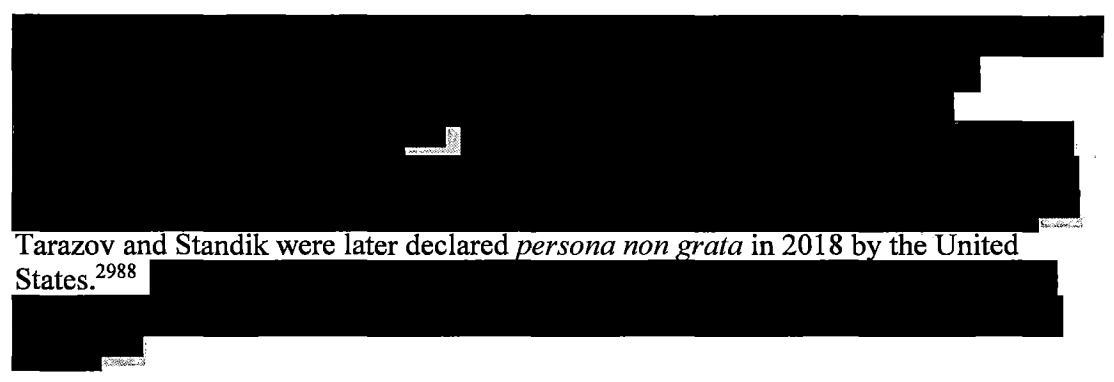
According to a heavily redacted bullet, it appears to involve two people thrown out of the US in 2018 as part of sanctions imposed after the Skripal assassinations, which may suggest they were believed to be spies.
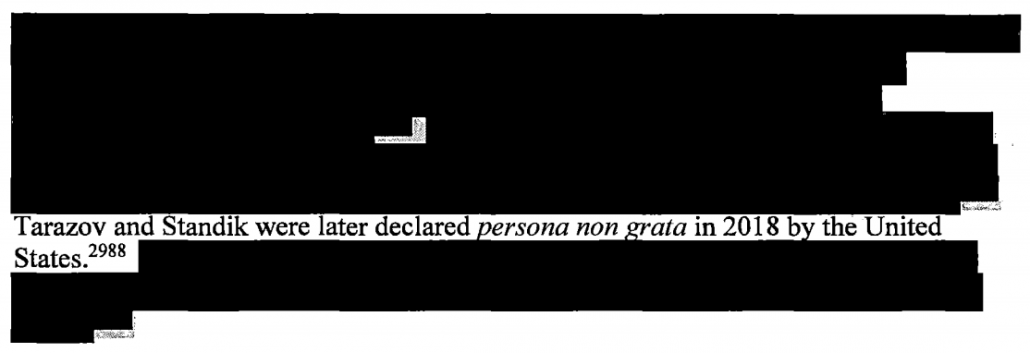
Finally, the deal had some tie to Rossotrudnichestvo, an NGO implicated in the false claims about a Michael Cohen meeting in Prague.

The Rossotrudnichestvo reference came in the last and most inflammatory dossier report:

[redacted] provided further details of these meeting/s and associated anti-CLINTON/Democratic Party operations. COHEN had been accompanied to Prague by 3 colleagues and the timing of the visit was either in the last week of August or the first week of September. One of their main Russian interlocutores was Oleg SOLODUKHIN, operating under Rossotrudnichestvo cover. According to [redacted], the agenda comprised questions on how deniable cash payments were to be made to hackers who had worked in Europe under Kremlin direction against the CLINTON campaign and various contingencies for covering up these operations and Moscow’s secret liaison with the TRUMP team more generally.

This doesn’t mean the Cohen reference is true!! But it is another tidbit that suggests that, to the extent the dossier was filled with disinformation, it served to muddle actual events that happened.

According to the SSCI Report, Eric Trump wasn’t all that enticed by this offer (which appears to have had none of the improbable grandeur of the Sater deal).

Except they didn’t bother to get him on the record saying that personally. It relied exclusively on Epshteyn’s representation of the deal.

(U) Epshteyn recalled sharing these blueprints with Eric Trump and discussing the offer with him. 3000 According to Epshteyn, Eric Trump said that he would “take a look” and that the opportunity “[c]ould be interesting,” but that his overall reaction was “extremely tepid.”3001 Epshteyn claimed that nothing ever came of the offer.3002

(U) The Committee did not seek to interview Eric Trump. The Committee does not have further information related to what action, if any, was taken by the Trump Organization on the proposal.

And it did so even though it had evidence that Trump Organization was part of an organized effort to lie to the committee about a different Russian real estate deal, in part by withholding responsive documents.

So it’s not, just, that SSCI declined to explain why it was so problematic from a counterintelligence standpoint that a Presidential candidate kept entertaining the kind of real estate deal in Russia he had been chasing for over a decade during the election, and at least two of those deals involved Russian intelligence operatives.

It’s that for one of the deals — a deal that, if the redactions are any indication, poses significant counterintelligence concern — SSCI just didn’t bother checking.

Ron Wyden has complained that the committee refused to follow the money of any of this. And with this fourth Trump Tower deal, they weren’t even willing to demand they got the paper trail.

Share this entry

SSCI Confirms that Mueller Considered CFAA Charges for Don Jr.

One of the most useful things about the SSCI Report is how much content from the interviews and redacted portions of the Mueller Report it made public.

I’ll have several follow-ups talking about what it shows (beyond that DOJ is badly abusing the FOIA process to suppress damaging information) and what the difference choices about story-lines say about the investigation into Trump.

But for now, this disclosure is predictable, but important. Mueller considered CFAA charges for Don Jr’s use of a password obtained from WikiLeaks to access a non-public website.

WikiLeaks contacted the Trump Campaign directly, through Donald Trump Jr., on sev:eral occasions. On September 21, WikiLeaks used a direct message on Twitter to reach out to Trump Jr. for a comment about a website, “putintrump.org,” and provided Trump Jr. a password to access the website before it launched.1725 Trump Jr. responded, “Off the record I don’t know who that is, but I’ll ask around.”1726 He then forwarded the message to senior Campaign officials in an email, and asked for their thoughts, indicating that he had visited the website:

Guys I got a weird Twitter DM.from wikileaks. See below. I tried the password and it works and the about section they reference contains the next pie in terms of who is behind it. Not sure if this is anything but it seems like it’s really wikileaks asking me as /follow them and itis a DM Do you know the people mentioned and what the conspiracy they are looking for could be? These are just screen shots but it’s a fully built out page claiming to be a PAC let me know your thoughts and if we want to look into it. 1727

Trump Jr. expressed concern about the webpage, though not about WikiLeaks itself: “The way they asked the question it almost seemed like there was some connection we should be aware of though. Do any of the political people recognize the names there?”1728 Some members of the Campaign responded to Trump Jr., but he did not communicate further with Wik1Leaks on the topic. 1729

(U) Email, Trump Jr. to Conway, Bannon, Kushner, Bossie, and Parscale, September 21, 2016 (DJTFP00023909-23911) (attaching screenshots of Twitter direct message from WikiLeaks). The email garnered some responses. Brad Parscale suggested setting up a competing website so that “searches come to us.” Email, Parscale to Trump Jr. et al., September 21, 2016 (DJTFP00023912). Jared Kushner forwarded the email to Hope Hicks without comment. Email, Kushner to Hicks, September 21, 2016 (DJTFP00023916-23918). The SCO declined to charge Trump Jr. for violating the Computer Fraud and Abuse Act based on his unauthorized use of the password to access the website. See SCO Report, Vol. I, p. 179.

Let me be clear: It would have been a gross abuse of the CFAA to charge this, the kind of thing DOJ has tried in rare instances, to be rightly rebuked in legal commentary. Mueller made the right decision not to charge this.

But, as SSCI’s success at releasing this information makes clear, there’s no reason to redact this information (or other information discussing the various criminal theories used with the failson). Don Jr is not — as Billy Barr claimed when he described his privacy redactions — in any way a tangential third party to his father’s campaign. And the underlying conduct here has long been public. There’s no reason to hide the discussion of why Mueller (correctly) decided not to charge this conduct.

Share this entry

Trump Tried to Claim Privilege Over a Document Flynn Claimed to Not Remember

I’m beginning to read the SSCI Russia Report. I’m sure I’ll have a running slew of posts as I go.

SSCI was quite peeved about Trump’s expansive claims of Executive Privilege, extending even to its Transition members (SSCI noted that Obama officials were all willing to share details of communications directly with Obama).

One example of a crazy-ass privilege claim came pertained to Mike Flynn’s aide during the Transition, Sarah Flaherty. The White House claimed privilege over a document and provided this description of the document to the committee, which omitted even that it pertained to Russia.

One of these documents was described to Committee counsel as an undated eight-paragraph memorandum with a sticky note dated January 9, 2017, from Flynn to McFarland stating: “re: [a foreign nation] for your consideration.” The paragraphs were further summarized as follows:

(U) 1: Discussion identifying foreign government internal personnel movements.

(U) 2: Recitation of the author’s assessment of the foreign government’s view of areas ,of long-term strategic concern shared with the U.S.

(U) 3: ·Assessment of the foreign government’s view concerning the effect ofpost-1992 U.S. policies for both countries.

(U) 4: Discussion of the author’s view of challenges facing the President (broad), especially in the national security area:

(U) 5: List of issues for the U.S. involving the foreign government and the author’s observation regarding the degree of connection or non-conriection to the foreign government:

(U) 6: Expresses a need for a plan to make progress on strategic matters, not specifically tied to the foreign government.

(U) 7: Author’s assessment that the foreign-government and the people of the foreign nation have substantial goodwill towards the President-elect.

(U) 8: Suggestion/proposal for possibilities of engagement with the foreign government. 32

Don McGahn claimed it was privileged because it had been prepared for a top official and concerned foreign policy.

But SSCI figured out what the document was. It was a memo provided by Robert Foresman, who adapted it from one an oligarch’s associate did.

Based on the description, the Committee identified the memorandum as- a document already in its possession, produced by Robert Foresman-who· was not a member of the Campaign nor the Transition Team-and written to Flynn.34 The Committee also knew from its investigation that Foresman had adapted a substantial part of the memorandum from another document shared by Allen Vine, who is an associate of the Putin-linked Russian oligarch Suleiman Keriniov.35 The Committee’s position was that the document could not be privileged: it was not drafted by a member of the Transition Team and had, in part, originated with a close associate of a Kremlin insider. Committee counsel informed the WHCO of the general contours of these facts (though not specific names or the details of how it had acquired the information). WHCO subsequently dropped its claim of potential executive privilege and produced the document to the Committee.

What makes this expansive claim of privilege all the nuttier is when Mueller asked Flynn about the two meetings he had with Foresman, in what was the last known question Mueller (as opposed to EDVA) asked of him, Flynn claimed he didn’t remember either one.

It’s really not clear Flynn ever really cooperated with Mueller. Which is, I guess, why Billy Barr is going to such lengths to ensure he’ll be rewarded for not doing so.

Share this entry

“These Actions Have Targeted Not Only against Russia, But Also Against the President Elect”

Given the news that Donald Trump is considering pardoning Edward Snowden, there has been a lot of discussion about why Trump would do this.

It’s actually not a deviation from past actions. Just seven days after the election, Trump’s rat-fucker started working on a pardon for Julian Assange, something that Trump offered a very circumscribed answer to Mueller about. He continued to entertain such proposals, and even ordered then CIA Director Mike Pompeo to consider a theory purporting to undermine the Russian attribution of the hack, one understood to be tied to an Assange pardon.

And on March 15, 2017, Trump shared information with Tucker Carlson that would have tipped off Joshua Schulte that the FBI considered him the culprit behind the Vault 7 leaks. While Trump shared that information hours before the FBI searched Schulte’s residence and seized his passports (including a diplomatic passport he never returned to CIA), there’s no evidence that information was made public before the FBI confronted Schulte that night. Had it, though, Trump’s comments might have led Schulte to accelerate a trip to Mexico he already had scheduled. John Solomon would even go on to blame Jim Comey for not pardoning Assange in advance of the Vault 7 releases.

So Trump has repeatedly undermined the prosecution of people who released large amounts of intelligence community secrets. Snowden would just be part of a pattern.

There’s some complaint that Trump opponents — including Adam Schiff — have suggested Trump would do this (dramatically altering his prior stance) because of Putin.

In fact, Russia has deliberately encouraged Trump to believe Russia and Trump were on the same side, opposed to the US intelligence community, since weeks before he was even inaugurated.

When, on December 31, 2016, Sergey Kislyak called Mike Flynn to tell him that his intervention to undermine sanctions on Russia for interfering in the 2016 election had succeeded in persuading Putin to take no action, Kislyak told Flynn that Russia considered the sanctions — for a hostile attack on this country!!! — to be an attack targeting not just Russia, but Trump himself.

KISLYAK: Uh, you know I have a small message to pass to you from Moscow and uh, probably you have heard about the decision taken by Moscow about action and counter-action.

FLYNN: yeah, yeah well I appreciate it, you know, on our phone call the other day, you know, I, I, appreciate the steps that uh your president has taken. I think that it is was wise.

KISLYAK: I, I just wanted to tell you that our conversation was also taken into account in Moscow and …

FLYNN: Good

KISLYAK: Your proposal that we need to act with cold heads~ uh, is exactly what is uh, invested in the decision.

FLYNN: Good

KISLYAK: And I just wanted to tell you that we found that these actions have targeted not only against Russia, but also against the president elect.

FLYNN: yeah, yeah.

“Yeah, yeah,” Trump’s weak-kneed National Security Advisor with 30 years intelligence experience said in reply.

We don’t need to speculate about whether Russia has encouraged Trump to view Russia as an ally against a hostile American Intelligence Community. We have proof. And even Mike Flynn, with a victim complex only a fraction as Yuge as Trump’s own, simply nodded along.

I mean, if Trump does pardon Snowden, by all means he should accept it — it likely would save his life.

But if you believe Trump is considering this out of any belief in whistleblowing or transparency — or even opposition to the surveillance that has ratcheted up and gotten less accountable under his Administration — you’re simply deceiving yourself.

And, yes, there is concrete evidence that Russia has cultivated Trump’s antagonism against the IC — well before Trump’s own actions led the FBI investigate him personally — so much that he might pardon Snowden to harm them.

Share this entry

Billy Barr’s DOJ Throws the Book at Someone Not Named Mike Flynn for Reneging on a Plea Agreement

Last week, the government moved to vacate the guilty plea of Minh Quang Pham because, in violation of his plea agreement, Pham tried to get one of the counts against him thrown out based on an intervening Supreme Court precedent. On top of a new development in a controversial counterterrorism case (one that, because Pham’s admitted actions for AQAP were primarily contributing his graphic design skills, could have interesting implications for Julian Assange’s extradition), the development is an example of what Bill Barr’s DOJ does when defendants not named Mike Flynn renege on the terms of their plea agreement.

Pham is a Vietnamese-Brit who, for a brief period, helped Samir Khan produce Inspire Magazine. Theresa May, while Home Secretary, tried to strip him of his British citizenship, presumably so he could be expelled and drone killed like some other immigrants to the UK with ties to terrorism. When it became clear that effort might fail, the US indicted Pham on Material Support, obtaining military training from a terrorist organization, and possessing a weapon.

There have always been some unexplained aspects of Pham’s story. He claims that he willingly left AQAP, returned to the UK with help from the government, where he lived peaceably until he was arrested. Nevertheless, in four FBI interviews he had while in custody but not recorded (the FBI claimed that because he was still in transit, he was not covered by an FBI rule requiring custodial interviews be recorded), he admitted to getting a bomb-making lesson from Anwar al-Awlaki. He later contested those interviews, but the government used testimony from Ahmed Warsame (another AQAP affiliate was also interrogated in custody while “in transit”) against him. In 2016, Pham pled guilty to three of the charges against him: conspiring to provide material support, conspiring to receive military training, and possessing a weapon. He was sentenced to forty years in prison, of which 30 were tied to the weapons charge, and sent to Florence SuperMax.

Last year in US v Davis, the Supreme Court held that the law used to impose the possessing a weapons charge and with it the long prison sentence against Pham was constitutionally vague.

Over the course of months, Pham worked to get representation to have his case reconsidered under US v Davis, an effort that was badly delayed both by his incarceration in SuperMax and COVID.

Which, after some negotiations between Pham and the government, led to last week’s action. Because US v Davis means Pham’s conviction for the weapons charge must be dismissed, the government argues they are entitled to throw out Pham’s plea deal, and move towards a trial, including new charges.

As set forth in more detail below, the Government respectfully submits that the Court should reinstate the charges contained in the Indictment. The Government dismissed those charges at sentencing pursuant to the Plea Agreement, and only as consideration for the defendant’s guilty plea to the subset of offenses set forth in the Plea Agreement. Neither the terms of the Plea Agreement nor controlling law in this Circuit prevent the Government from reinstating the previous charges against Pham under these circumstances. To the contrary, the defendant’s Plea Agreement expressly preserved the Government’s right to do so should the defendant’s “convictions” be “vacated for any reason.” (Ex. A. at 8). Accordingly, the Government seeks to vacate Pham’s convictions, reinstate the charges in the Indictment, and proceed to trial.

[snip]

Although it is axiomatic that “when a defendant breaches his plea agreement, the Government has the option to . . . treat it as unenforceable,” United States v. Cimino, 381 F.3d 124, 128 (2d Cir. 2004), the Court need not decide whether Pham’s filing of a Section 2255 motion constituted a breach of the plea agreement to grant the Government’s motion. “Whether [Pham] breached his contract or acted properly in negating it is largely irrelevant to this issue. Despite the change in law, [Pham] remained free to comply with the plea bargain. By taking advantage of the opportunity to vacate his conviction under [Davis], [Pham] chose to void his agreement with the government. That choice relieved the government from its contractual obligations, and explains why double jeopardy does not apply.” Podde, 105 F.3d at 821 n.6 (internal citations omitted).

In addition to moving to try Pham on the five existing charges (presumably, on the four that remain after Davis), the government plans to charge Pham with an attempted terrorist attack, in part to make sure they can charge Pham with something if the existing plea deal is upheld.

Separate from the application for reinstatement of charges, the Government respectfully informs the Court and defense counsel that the Government intends to file additional charges against Pham based on additional evidence secured following his conviction and sentencing.

The evidence at issue includes (1) video recordings showing the defendant constructing and detonating a test explosive device virtually identical to the one Pham told law enforcement was to be used in his planned suicide attack on Americans and Israelis at Heathrow International Airport; (2) video recordings of Pham associating with high-ranking members of AQAP; (3) a video recording of Pham describing his goal of waging jihad and his desire to martyr himself; and (4) a document containing instructions for executing the attack upon Pham’s return to London. The Government reviewed this evidence with defense counsel during a meeting on December 5, 2019, and produced a copy of the evidence to the defense on or about March 24, 2020.

Based on this evidence, the Government expects to seek additional charges related to the defendant’s attempted attack at Heathrow, including a violation of Section 924(c) predicated on the use and possession of a destructive device in furtherance of one or more additional crimes of violence committed in connection with the plot. This conduct, and the anticipated charges based upon it (which are subject both to approval by other components of the Department of Justice and presentation to the grand jury), are not covered by the provisions of the Plea Agreement defining the conduct for which “the defendant will not be further prosecuted criminally by this Office.” (Ex. A at 2). Accordingly, while the Government will not proceed with a superseding Indictment until after the Court rules on the reinstatement of the original charges of the Indictment, the Government expects to seek those additional charges whether or not it is also able to proceed on the previously dismissed counts.

Now, I’m not suggesting, at all, that there’s an equivalence in the actions of Pham and Mike Flynn. Even assuming some of Pham’s complaints about his interrogation and the disproportionate responsibility the government attributed to him over Warsame are true, he still admits he sought to participate in a terrorist organization.

But where a comparison is apt is the plea agreement. Like Pham, the government included language in Flynn’s plea agreement that if his conviction were vacated for any reason, he can be charged for the uncharged conduct tied to his plea agreement — which in Flynn’s case are the Foreign Agent charges that carry a possible sentence of 15 years. Flynn is arguing that he has not yet been convicted, though that’s currently among the many issues under dispute.

And the comparison is apt because (the government has argued, though Flynn disagrees) Flynn reneged on the cooperation included in his plea agreement.

For other people, Bill Barr’s DOJ has thrown the book when a defendant has reneged on his plea deal. In Flynn’s case, however, Barr’s DOJ is doing back flips to try to blow up the existing conviction.

Pham’s case will be quite interesting in any case, if it goes to trial (and the government has effectively already told him they intend to keep him in prison for life anyway, so he has no incentive not to contest this aggressively). But it’s also a worthy lesson in what normally happens when a defendant blows up a plea deal like Mike Flynn has.

Share this entry