Iran Loads Domestically Produced Fuel Plates into Tehran Reactor

In a move that is sure to disappoint war hawks who have been convinced that Iran’s enrichment of uranium to 20% has been to produce material for further enrichment to the 90%+ needed for nuclear weapons, Iran today very publicly had President Mahmoud Ahmadinejad load the first domestically produced nuclear fuel plates (which use 20% enriched uranium) into the Tehran reactor which is used to produce medically useful radioisotopes.  From Mehr News:

The Tehran reactor was loaded with domestically produced nuclear fuel plates during a ceremony held on Wednesday to unveil Iran’s latest nuclear achievements.

President Mahmoud Ahmadinejad, Foreign Minister Ali Akbar Salehi, Supreme National Security Council Secretary Saeed Jalili, Atomic Energy Organization of Iran Director Fereydoun Abbasi, presidential aide Mojtaba Hashemi-Samareh, the Chinese and Russian ambassadors to Iran, and a number of other foreign diplomats attended the event.

During the ceremony, a number of domestically produced radioisotopes, which are used for the treatment cancer, were also unveiled.

The same article also noted that Iran has increased its capacity for low-grade enrichment to 3.5%:

On Wednesday, the first cascade of a new generation of centrifuges was also installed at the Natanz nuclear enrichment facility and was brought on line.

With the installation of the new centrifuges, the capacity of the facility for the production of 3.5 percent enriched uranium was increased by 50 percent.

Further frustrating those who want to say Iran is moving rapidly toward construction of a nuclear weapon, Iran also took the next formal steps toward re-establishment of the Group 5 + 1 negotiations on nuclear technology:

Iran’s chief negotiator and Supreme National Security Council (SNSC) Secretary Saeed Jalili sent a reply to EU foreign policy chief Catherine Ashton’s letter about talks between Tehran and the six world powers, and welcomed resumption of negotiations between the two sides.

According to the secretariat of Iran’s Supreme National Security Council, in the letter which was delivered to Ashton’s office on Wednesday, Jalili welcomed the readiness of the Group 5+1 (the five permanent UN Security Council members – Russia, China, Britain, France and the US plus Germany) to resume talks with Iran.

The Iranian chief negotiator underlined in his letter that returning to the negotiation table would be the best means to broaden cooperation between the two sides.

Despite the fear-mongering over Iran developing a nuclear weapon, Iran provided its alternate explanation yet again for why it had to produce its own 20% enriched uranium for the Tehran reactor:

After Iran announced to the IAEA that it had run out of nuclear fuel for its research reactor in Tehran, the Agency proposed a deal according to which Iran would send 3.5%-enriched uranium and receive 20-percent-enriched uranium from potential suppliers in return, all through the UN nuclear watchdog agency.

The proposal was first introduced on October 1, 2010, when Iranian representatives and diplomats from the Group 5+1 held high-level talks in Geneva.

But France and the United States, as potential suppliers, stalled the talks soon after the start. They offered a deal which would keep Tehran waiting for months before it could obtain the fuel, a luxury of time that Iran could afford as it was about to run out of 20-percent-enriched uranium.

Stay tuned for further developments to see how Iran’s use of a large portion of its 20% enriched uranium in the Tehran reactor will still result in their being described as on the fast track to a weapon by those who want a war there.
Share this entry

UN Finds Cluster Munition Evidence in Libya, PressTV Runs Video of US Cluster Bombs in Afghanistan

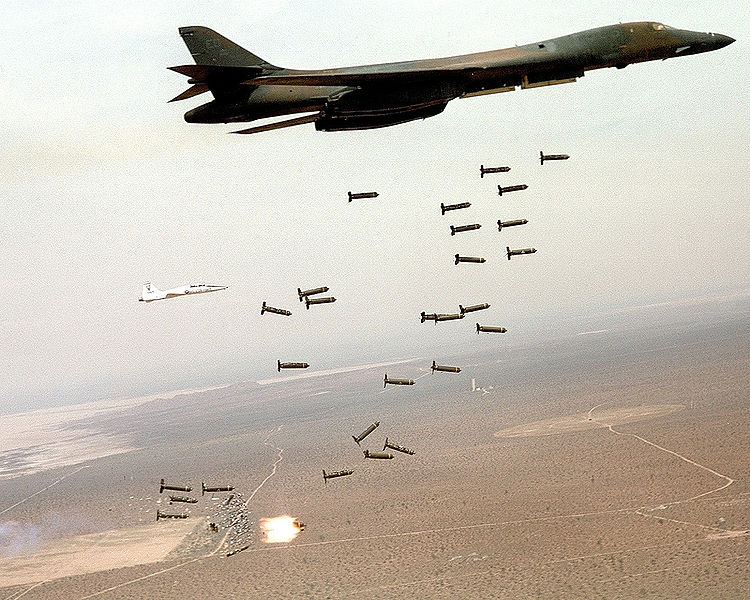
B1 bomber dropping cluster bombs. (US Air Force photo from Wikimedia Commons)

In the At War blog on the New York Times website, it was reported yesterday that the UN has found additional evidence of the use of cluster bombs in Libya. The munitions found appear to have been used by pro-government forces:

Civilian de-miners working in Libya have found another type of cluster bomb used last year during the war that overthrew Col. Muammar el-Qaddafi, according to the United Nations and Mines Advisory Group, or MAG, a nongovernment organization helping to clean up areas littered with mines and unexploded ordnance.

/snip/

About 30 of the submunitions were found, some exploded, others not, near the main road about 20 miles from the southern gate of Ajdjabiya, according to Ivica Stilin, MAG’s technical operations manager in Libya.

/snip/

Mr. Stilin said the evidence pointed to the Libyan Arab Republic Air Force’s having dropped the bomblets in March 2011. The discovery also aligned with a photo analysis made at that time by David Cencio, an Italian aviation blogger who closely followed the war. In a post on March 14, 2011, Mr. Cencio noted that a photograph made several days before by Marco Longari of Agence France-Presse-Getty appeared to show a Libyan Su-22 flying at low-elevation carrying RBK-250’s.

Only after the reader scrolls through eight paragraphs and a second photo below the headline photo do we find the notation that the US has not joined in the world ban on cluster munitions:

The use of cluster munitions has been widely banned under international convention, though several nations — including Libya, China, Russia and the United States – have not signed the convention. NATO has publicly said that neither its forces nor any of the foreign military armies that participated with the alliance in the conflict used cluster munitions.

Just one day after that post at the Times website, Iran’s PressTV has put up a new story (warning: the video is set on auto-play) today claiming to have video of US cluster bomb usage in Afghanistan. There is no date on the video and the accompanying story with the video does not explicitly state that the video is recent. Note that the image at the very beginning of the PressTV video, which is also the image shown when the video loads before being played, is the US Air Force photo found on Wikimedia Commons which I included above. Here is a part of the description from the PressTV story:

New footage has emerged showing US-led warplanes dropping cluster bombs in war-torn Afghanistan, Press TVreports.

The US-led forces have used cluster munitions since their invasion of Afghanistan in 2001. The bombings have caused huge loss of life and property damage.

Apart from the civilians who fall victim to such bombs during the raids, other people continue to be killed by bomblets that do not detonate upon impact.

/snip/

The US and Israel are the world’s top producers of cluster bombs. Washington and Tel Aviv have refused to sign the Convention on Cluster Munitions which has been in force since 2010.

The Afghanistan situation regarding cluster bombs is quite intriguing. On December 3, 2008, Afghanistan surprisingly defied the lame-duck Bush administration and signed the cluster bomb treaty: Read more

Share this entry

“Quiet Lobbying Campaign” For SOCOM: Hollywood Movie, President’s Campaign Slogan

[youtube]http://www.youtube.com/watch?v=ZnlPgo9TaGo[/youtube]

Coming so quickly on the heels of Lt. Col. Daniel Davis documenting the depraved level of lying that characterizes the primary mode of action for many at the top levels in our military, it’s galling that Admiral William McRaven would take to the front page of today’s New York Times to advance his efforts–hilariously and tragically labeled by the Times as a “quiet lobbying campaign”–to gain an even freer hand for the Special Operations Command, which he heads.

Never forget that it was from within Special Operations that Stanley McChrystal shielded Camp NAMA, where torture occurred, from the International Committee of the Red Cross. Never forget that it was Special Operations who instituted the dark side of the COIN (counterinsurgency) campaign in Afghanistan that relied on poorly targeted night raids that imprisoned and tortured many innocent civilians. Never forget that Dick Cheney and Donald Rumsfeld bypassed the normal chain of command to work directly with Stanley McChrystal when he headed JSOC, sending McChrystal on missions not reported to area command. This relationship with Cheney and Rumsfeld had a strong effect on JSOC, as noted by Jeremy Scahill:

Wilkerson said that almost immediately after assuming his role at the State Department under Colin Powell, he saw JSOC being politicized and developing a close relationship with the executive branch.

Among the military commanders being bypassed by Cheney and Rumsfeld was the head of SOCOM, the position that McRaven (who was McChyrstal’s deputy when most of McChrystal’s war crimes were carried out) now occupies, but this same attitude of teaming with the executive branch to bypass the regular defense chain of command has survived intact.

Today’s article in the Times opens this way:

As the United States turns increasingly to Special Operations forces to confront developing threats scattered around the world, the nation’s top Special Operations officer, a member of the Navy Seals who oversaw the raid that killed Osama bin Laden, is seeking new authority to move his forces faster and outside of normal Pentagon deployment channels.

The officer, Adm. William H. McRaven, who leads the Special Operations Command, is pushing for a larger role for his elite units who have traditionally operated in the dark corners of American foreign policy. The plan would give him more autonomy to position his forces and their war-fighting equipment where intelligence and global events indicate they are most needed.

At least the Times does pay a short homage to the quaint, old way of the chain of command as it currently exists:

While President Obama and his Pentagon’s leadership have increasingly made Special Operations forces their military tool of choice, similar plans in the past have foundered because of opposition from regional commanders and the State Department. Read more

Share this entry

Honorable Military Whistleblower: Why Daniel Davis Is and Bradley Manning Is Not

One of the hottest, and most important, stories of the last week has been that broken by Scott Shane in the New York Times, on February 5th, of Army Lt. Col. Daniel L. Davis’ stunning report on the unmitigated duplicity and disaster that characterizes the American war in Afghanistan. It painted the story of a man, Davis, committed to his country, to his service and to the truth but internally tortured by the futility and waste he saw in Afghanistan, and the deception of the American public and their Congressional representatives by the Pentagon and White House.

And then, late last month, Colonel Davis, 48, began an unusual one-man campaign of military truth-telling. He wrote two reports, one unclassified and the other classified, summarizing his observations on the candor gap with respect to Afghanistan. He briefed four members of Congress and a dozen staff members, spoke with a reporter for The New York Times, sent his reports to the Defense Department’s inspector general — and only then informed his chain of command that he had done so.

Concurrent with Shane’s NYT article, Davis himself published an essay overview of what he knew and saw in the Armed Forces Journal.

The one thing that was not released with either Shane or Davis’ article was the actual Davis report itself, at least the unclassified version thereof. The unclassified Davis report has now been published, in its entire original form, by Michael Hastings in Rolling Stone in The Afghanistan Report the Pentagon Doesn’t Want You to Read.

The report is every bit as detailed, factually supported and damning as the articles by Shane and Davis portrayed. It is a must, but disturbing, read. If the American people care about economic waste and efficacy and morality of their foreign military projection, both the Obama Administration and the Pentagon will be browbeat with the picture and moment of sunlight Daniel Davis has provided. Jim White has penned an excellent discussion of the details of the Davis report.

My instant point here, however, is how Davis conducted himself in bringing his sunlight, and blowing the whistle, on wrongful US governmental and military conduct. Davis appears to have attempted to carefully marshal his evidence, separated the classified from the unclassified, released only unclassified reportage himself and to the press, taken the classified reportage to appropriate members of Congress and the DOD Inspector General, and notified his chain of command. Davis insured that, while the classified information and facts were protected from inappropriate and reckless release, they could not be buried by leveraging his unclassified press publication. In short, Daniel Davis is the epitome of a true military whistleblower, both in fact, and Read more

Share this entry

Lt. Col. Daniel Davis’ Truth-Telling Continues: Long Report Published by Rolling Stone

Speaking truth to power is a brave act wherever it is carried out. But when that power is the strongest military force on earth and the one speaking truth is coming from within the ranks of that force to point out blatant lies promulgated at the very top of the organization, then it is indeed a rare form of bravery.

Earlier this week, Lt. Col. Daniel L. Davis published a short report in the Armed Forces Journal and coupled that with discussions with the New York Times’ Scott Shane for an article hitting on the same subject area. In those reports, we learned that Davis had prepared much longer reports, both a classified one which he shared with several members of the House of Representatives and the Senate, and a non-classified one which he intended to publish. In the Armed Forces Journal piece, Davis noted that he intended to publish the longer report at his afghanreport.com website, and in an editor’s note, it was pointed out that “At press time, Army public affairs had not yet ruled on whether Davis could post this longer version.” In a very interesting twist, Davis’ long report now has been published, but not at his website. Instead, Michael Hastings, whose The Runaway General article at Rolling Stone eventually resulted in the firing of Stanley McChrystal, has posted Davis’ report (pdf) at the Rolling Stone website, along with a brief introduction from Hastings. There will be a post soon from bmaz addressing Davis’ approach to whistle-blowing and his treatment of classified information.

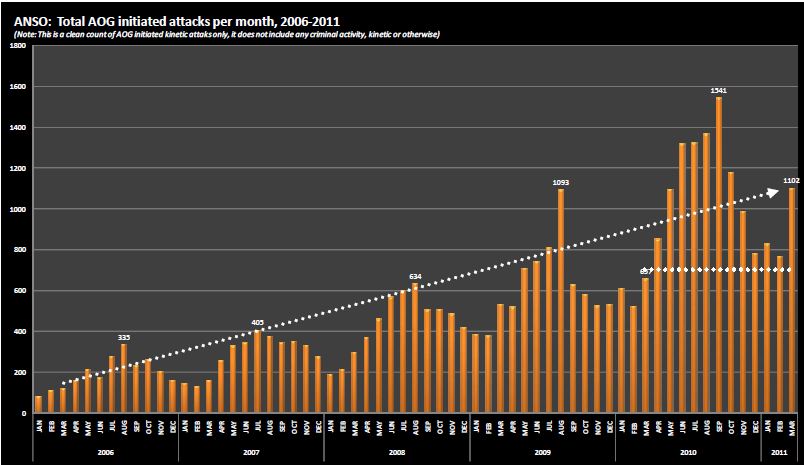
The ANSO figure on which Davis based his final point. Link to original ANSO (pdf) report: http://www.ngosafety.org/store/files/ANSO%20Q1%202011.pdf

The Lies

Davis’ thesis in the longer report remains unchanged from the original. He maintains that despite persistent claims by top military brass that progress is being made in Afghanistan, there is in fact no progress. Violence continues on a steady increase and Afghan forces are nowhere near a point where they can maintain security in the absence of ISAF forces. On the final page, he has this to say about his “final take-away” from the report. He prepared a graphic based on the one reproduced above:

If there were only one thing I could ask you to take away from this rather lengthy brief, it would be this one page. Below you see charted over time, the rising violence from the end of 2005 through the first quarter 2011 (chart source: ANSO, 2011). All spin aside, you see regardless of who was in command, what strategy they used, or what claims they made, nothing impacted the rising arc of violence from 2005 through today. The one thing, however, that has never changed: the upward arc of violence, which continues its rise and is expected to continue at least through this summer. Read more

Share this entry

Not So Great Expectations: Paying the Price of Hubris in Iraq, Afghanistan

Developments over the past few days on several different fronts are coming together in a way that outlines just how arrogantly the US conducted the wars in Iraq and Afghanistan and how the consequences of that hubris are now diminishing the previously dominant role for the US in the region going into the future. At the same time, these developments drive home the message of the terrible waste of lives and money the war efforts have been.

In today’s New York Times, we learn that the staff at the gargantuan US embassy in Baghdad is about to be cut in half. It appears that one of the driving forces behind these cuts is that the Iraqis are not making it easy for embassy personnel to move freely into and out of the country:

At every turn, the Americans say, the Iraqi government has interfered with the activities of the diplomatic mission, one they grant that the Iraqis never asked for or agreed upon. Prime Minister Nuri Kamal al-Maliki’s office — and sometimes even the prime minister himself — now must approve visas for all Americans, resulting in lengthy delays. American diplomats have had trouble setting up meetings with Iraqi officials.

Perhaps Mr. al-Maliki should study the activities of the US Customs Service if he really wants to learn how to make it even clearer to selected foreigners that he doesn’t want them in his country.

But al-Maliki is not the only elected Iraqi official who sees an opportunity to repay the US for the hubris it has shown the region, as the Times quoted Nahida al-Dayni, whom they described as “a lawmaker and member of Iraqiya, a largely Sunni bloc in Parliament” with regard to the embassy compound:

The U.S. had something on their mind when they made it so big. Perhaps they want to run the Middle East from Iraq, and their embassy will be a base for them here.

That US actions in the Middle East would have prompted such an attitude among local officials should have been foreseen, but the Times article informs us that the State Department seems to have been hit by a bit of shock and awe: Read more

Share this entry

World Approach to “Peace” in Syria: Arm Both Sides

[youtube]http://www.youtube.com/watch?v=bE4tpmzb9SQ[/youtube]

The carnage in Syria continues unabated, with government forces shelling citizens, especially in the city of Homs. Qatar’s minister for international cooperation described Sunday’s veto of the UN Security Council resolution by Russia and China in this way:

Khaled al-Attiyah, Qatar’s minister for international co-operation,  said the vetoes sent “a very bad signal to Assad that there (is a) license to kill.”

Russia claims they are working for a peaceful settlement in Syria, with Foreign Minister Sergei Lavrov in Damascus now to speak to Assad:

Lavrov told Assad, according to Russia’s RIA news agency: “Every leader of every country must be aware of his share of responsibility. You are aware of yours. It is in our interests for Arab peoples to live in peace and agreement.”

Lavrov, whose government wields rare leverage in Syria as a major arms supplier to Damascus, said Assad assured him he was committed to halting bloodshed by both sides and that he was ready to seek dialogue with all political groups in Syria.

But the arms that Russia has been supplying to Assad are still being put to use against Syria’s citizens. From the same Reuters article:

Opposition activists said the fresh assault on Homs came after 95 people were killed on Monday in the city of one million, Syria’s third biggest. More than 200 were reported killed there by sustaining shelling on Friday night.

“The bombardment is again concentrating on Baba Amro (district of Homs). A doctor tried to get in there this morning but I heard he was wounded,” Mohammad al-Hassan, an activist in Homs, told Reuters by satellite phone. “There is no electricity and all communication with the neighborhood has been cut.”

A further 19 people were killed and at least 40 wounded in Tuesday’s barrage, activists said. Some reported fighting between army defectors and government forces trying move into areas the rebels hold in Homs.

Reflecting the total failure in what passes for world “diplomacy”, the response from the West is to arm the citizens of Syria to fight back against government forces who were armed by Russia. The approach starts out positively, as an attempt to prevent the arming of the Syrian government, but by the time Joe Lieberman gets involved, it goes terribly astray: Read more

Share this entry

Col. Davis Goes to Washington: A One-Man Battle for Truth-Telling About Afghanistan

When separate classified reports casting doubt on the military’s claims of progress in the Afghanistan war were discussed in the New York Times on January 20 and then by BBC (and Times of London) on February 1, my response to both incidents was to blame upper-level military figures for releasing the damaging information in order to reach the higher goal (for them) of maintaining the war effort in Afghanistan beyond the planned hand-off to Afghan forces. The timing seemed to fit well with a hope on their part that Republican presidential candidates would grab onto a campaign promise not to end the US war effort. However, after the second leak, I did receive one third- or fourth-hand report suggesting that it had been leaked by senior military officer upset by the lack of progress in Afghanistan who most definitely did not aim to prolong the war effort there.

With the publication of a story about him in today’s New York Times and publication yesterday of his own statement in the Armed Forces Journal, Lt. Col. Daniel L. Davis becomes the first mid-level officer willing to speak out about the lack of progress in Afghanistan and the military’s insistence on painting a false picture of success. [It should be noted up front that it seems quite unlikely Davis is behind either of the earlier leaks, as evidenced by the steps he has taken to separate public from classified information in the actions he has taken.] The Times article, titled “In Afghan War, Officer Becomes a Whistle-Blower”, describes the actions Davis has taken:

Since enlisting in the Army in 1985, he said, he had repeatedly seen top commanders falsely dress up a dismal situation. But this time, he would not let it rest. So he consulted with his pastor at McLean Bible Church in Virginia, where he sings in the choir. He watched his favorite movie, “Mr. Smith Goes to Washington,” one more time, drawing inspiration from Jimmy Stewart’s role as the extraordinary ordinary man who takes on a corrupt establishment.

And then, late last month, Colonel Davis, 48, began an unusual one-man campaign of military truth-telling. He wrote two reports, one unclassified and the other classified, summarizing his observations on the candor gap with respect to Afghanistan. He briefed four members of Congress and a dozen staff members, spoke with a reporter for The New York Times, sent his reports to the Defense Department’s inspector general — and only then informed his chain of command that he had done so.

The statement in the Armed Forces Journal opens in this way:

I spent last year in Afghanistan, visiting and talking with U.S. troops and their Afghan partners. My duties with the Army’s Rapid Equipping Force took me into every significant area where our soldiers engage the enemy. Over the course of 12 months, I covered more than 9,000 miles and talked, traveled and patrolled with troops in Kandahar, Kunar, Ghazni, Khost, Paktika, Kunduz, Balkh, Nangarhar and other provinces.

What I saw bore no resemblance to rosy official statements by U.S. military leaders about conditions on the ground. Read more

Share this entry

When Was the Last Time a Pope Was Shit-faced Drunk On the Streets of Paris?

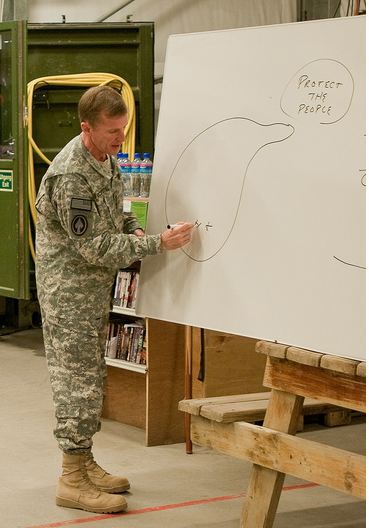
Just a month before parading drunkenly through the streets of Paris, McChrystal drew a fail whale to describe his COIN strategy. (detail from an ISAFMedia photo)

The answer to that question is actually early on the morning of April 17, 2010, at least if you read chapter 11 of Michael Hastings’ “The Operators” (the chapter is titled “Totally Shit-faced”).

Well, it was Stanley McChrystal and his entourage who were shit-faced drunk on the streets of Paris, but one of McChrystal’s many nicknames is The Pope. It comes from Dalton Fury’s fawning profile (pdf): “Later on, about the time he started to wear shiny silver stars, we started to refer to him as The Pope.” To drive his point home, Fury’s profile was also titled “The Pope”.

A much different version of Stanley McChrystal is found in Hastings’ book. He paints a vivid picture of McChrystal and his closest aides, where the group can be viewed as “operators” whose primary role was to manage public profiles while putting the best possible spin on what happened, rather than really achieving the objectives of the war which they commanded.

As part of the briefing that McChrystal is shown delivering in the photo on the left, from March of 2010, you can see his “protect the people” message. This was but one aspect of the overall strategy of his COIN (counterinsurgency) approach that was aimed at the proverbial battle for “hearts and minds”.

Early in Hastings’ book, we see Hastings visiting McChyrstal and his aides in Paris. After Hastings sits in on a meeting in which McChrystal is preparing to deliver a speech at the Ecole Militaire later that evening, Hastings steps outside with an aide:

After the meeting, I waited outside the hotel for Duncan. I noticed an Arab guy, around five-feet-five, walking by in shorts and sneakers. I continued to smoke my cigarette. Duncan and I walked to the Metro to catch a train to the Ecole Militaire. At the top of the Metro steps, I saw the same Arab guy again.

“Hey, man, do people really spy on you guys?”

“Yes, they try,” Duncan said.

“I think I just saw a guy I’d seen earlier walking by the hotel.”

“He’s not doing a very good job then, is he?”

So here we have the leader of NATO’s military effort in Afghanistan visiting Paris to promote cooperation within the coalition. McChrystal is also using his operators to push the aspects of his “new” COIN strategy that will protect the people of Afghanistan and to put the coalition into a better relationship with the people of Afghanistan who practice a conservative version of Islam. The group knows it is under scrutiny by Arab spies.

Despite all those important background points, and despite the fact that the entourage rented a significant portion of a large hotel and undoubtedly could have socialized in a reserved meeting room there, after the lecture and after dinner, the group went to Kitty O’Shea’s Irish pub, which Hastings described as “right around the corner from the hotel”.`They weren’t exactly discreet: Read more

Share this entry

Your Summer Schedule: Vacation, Beach, Iran War

Man, if Leon Panetta doesn’t get into trouble for revealing details of Anwar al-Awlaki’s targeting or confirming that Pakistani doctor Shikal Afridi was working for the CIA when he collected DNA from Osama bin Laden’s compound, I wonder if he’ll get in trouble for (apparently) telling David Ignatius when Israel will attack Iran?

Panetta believes there is strong likelihood that Israel will strike Iran in April, May or June — before Iran enters what Israelis described as a “zone of immunity” to commence building a nuclear bomb.

Now perhaps this is another sanctioned leak meant to ruin Bibi Netanyahu’s surprise (though I’m not sure how Iran would prepare to defend against an Israeli attack).

If so, Ignatius’ article sure sends a divided message. On one hand, it suggests the US would not participate.

The administration appears to favor a policy of staying out of the conflict, unless Iran hits U.S. assets, which would trigger a strong U.S. response.

This U.S. policy — signaling that Israel is acting on its own — might open a breach like the one in 1956, when President Eisenhower condemned an Israeli-European attack on the Suez Canal.

Yet at the same time it lays out the circumstances under which the US would get involved.

Administration officials caution that Tehran shouldn’t misunderstand: The United States has a 60-year commitment to Israeli security, and if Israel’s population centers were hit, the United States could feel obligated to come to Israel’s defense.

I’m sure the Israelis would never be able to cock up a Scary Iran Plot targeted at Tel Aviv.

What Ignatius doesn’t emphasize–though he does hint at it–is the real reason for this schedule.

Complicating matters is the 2012 presidential campaign, which has Republicans candidates clamoring for stronger U.S. support of Israel.

Bibi’s biggest political donor, Sheldon Adelson, has already dumped $10 million into the GOP primary. To imagine that Bibi is not, at the same time, gaming out how the electoral schedule might play into the optimal time to pick a war with Iran is naive.

Which, I guess, may be why Panetta is blabbing this particular detail.

Share this entry