Pakistan Issues New Warning to US; Mullen Accusations Softened
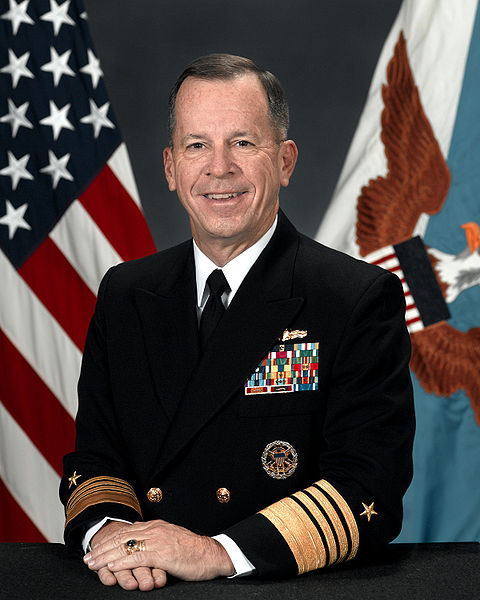
Joint Chiefs Chair Admiral Michael Mullen

There are new developments this morning in the latest war of words between the US and Pakistan.  Pakistan’s Express Tribune reports that an official familiar with what transpired claims that the head of Pakistan’s ISI informed CIA chief David Petraeus last week that should the US take unilateral military action against the Haqqani network in Pakistan, then Pakistan “will be forced to retaliate”.  At the same time, anonymous sources are telling the Washington Post that Joint Chiefs Chair Michael Mullen’s remarks last week to the Senate Armed Services Committee were “overstated”.  That is especially significant since the Express Tribune article notes that Mullen’s remarks played a role in the ISI getting to the point of issuing its warning to the CIA.

From the Express Tribune:

The effort to ensure that diplomacy and calmer heads prevail at a time of fragile relations between Pakistan and the United States is on. However, the effort notwithstanding, Islamabad has made it clear to Washington that, if it comes down to it, Pakistan will be forced to retaliate if American forces attempt to launch a unilateral strike on the country’s tribal belt.

The message was personally delivered by Inter-Services Intelligence agency (ISI) Chief Lt General Ahmed Shuja Pasha to Central Intelligence Agency (CIA) chief General David Petraeus during his recent trip to Washington, said an official familiar with the development.

The official, who spoke on condition of anonymity, told The Express Tribune that Pasha had informed his counterpart that the Pakistani people will not tolerate any US misadventure and in that case the government will be left with no other option but to retaliate.

Senior ISI members, the official said, had felt ‘betrayed’ by the blunt assessment of the US Chairman Joint Chiefs of Staff Admiral Mike Mullen that the spy agency had links with the Afghan Taliban-allied Haqqani network. In a stinging remark, Mullen accused ISI of supporting one of the most feared Afghan insurgent groups to target US forces stationed in Afghanistan.

The article goes on to point out that numerous high level meetings between US and Pakistani officials continue.

Meanwhile, back in the US:

Adm. Mike Mullen’s assertion last week that an anti-American insurgent group in Afghanistan is a “veritable arm” of Pakistan’s spy service was overstated and contributed to overheated reactions in Pakistan and misperceptions in Washington, according to American officials involved in U.S. policy in the region.

The internal criticism by the officials, who spoke on the condition of anonymity because they did not want to challenge Mullen openly, reflects concern over the accuracy of Mullen’s characterizations at a time when Obama administration officials have been frustrated in their efforts to persuade Pakistan to break its ties to Afghan insurgent groups.

It turns out that the primary evidence linking the US Embassy attack and the Haqqani network is not as clear-cut as some in Washington were claiming. Although Mullen claims to have been unaware of the cell phone evidence when he made his remarks, cell phones found on some of the attackers are widely cited as evidence of close Haqqani network-ISI coordination in the attack:

One official said the phones were used to make repeated calls to numbers associated with the Haqqani network, as well as presumed “ISI operatives.” But the official declined to explain the basis for that conclusion.

The senior Pentagon official treated the assertion with skepticism, saying the term “operatives” covers a wide range of supposed associates of the ISI. “Does it mean the same Haqqani numbers [also found in the phones], or is it actually uniformed officers” of Pakistan’s spy service?

There will undoubtedly be several more twists and turns to this story over the next few weeks, but for now it appears that the US is making a small effort to walk back its most incendiary comments while Pakistan is digging in more firmly on its position.
Share this entry

Cover-up Specialist Mark Martins Chosen as Gitmo Chief Prosecutor

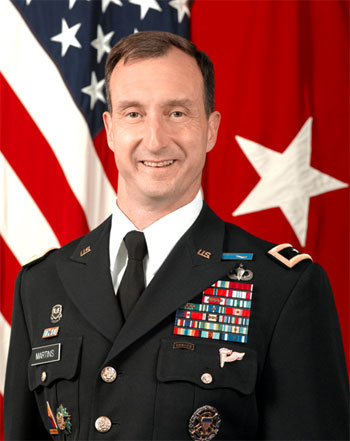
Brigadier General Mark Martins, CEO of Cover-ups R Us.

On Sunday, Carol Rosenberg informed us that there will be a new Chief Prosecutor in charge of military commissions at Guantanamo:

The Obama administration’s handpicked choice to run prosecutions at the Guantánamo war crimes court is pledging a new era of transparency from the remote base, complete with near simultaneous transmissions of the proceedings to victims and reporters on U.S. soil.

Army Brig. Gen. Mark Martins made the disclosure in a profile published Sunday in the Weekly Standard that likened the West Point, Oxford and Harvard Law graduate to a James Bond-style problem solver. It also cast Martins as “The Rebrander” of the at-times denounced military commissions system, which Barack Obama scorned as a candidate and senator then reformed with Congress as president.

Despite the Weekly Standard’s fawning profile of Martins as some sort of savior to the system who will lend an air of legitimacy to the military commissions, Martins is in reality a hack who is dragged out periodically by the Pentagon to cover up its worst abuses. Martins was chosen by Obama to head the committee that attempted to re-brand indefinite detention as legal, has served as Commander and Deputy Commander of JTF 435, the notorious JSOC group charged with running detention programs in Afghanistan, has served as legal adviser to David Petraeus, and, in the most outrageously named position of all, now commands “the newly established Rule of Law Field Force-Afghanistan”.

Here is how Martins’ recent positions are spun in his official biography from which I took the quote on his current position:

Brigadier General Martins assumed command of the newly established Rule of Law Field Force-Afghanistan on 1 September 2010. During the previous year, he served as the first Commander of Joint Task Force 435 and then as its first Deputy Commander upon Senate Confirmation of Vice Admiral Robert Harward. In these roles, Brigadier General Martins led the effort to reform United States detention operations in Afghanistan. Immediately prior to his deployment to Afghanistan, Brigadier General Martins co-led the interagency Detention Policy Task Force created by the President in January 2009.

Martins’ career, then, consists of using his “West Point, Oxford and Harvard Law” degrees to cover up the blatantly illegal indefinite detention policy of the US, along with justifying torture and improper arrest of civilians in night raids in Afghanistan.

Back in April of 2010, I described how Martins had been chosen first to review detention policy and then to go to Afghanistan to implement the “new” policy he had designed. Here is how that description ended:

I fail to see how the process described above is any kind of improvement in achieving release of prisoners who have been improperly detained. This description of the process also serves to expose as a sham the entire Special Task Force’s charge of improving how the US handles prisoners. And right in the middle of this mess is Obama’s hand-picked (through Gates) architect of the process, who now is dutifully overseeing its implementation.

There is no getting around the fact that it would have been known that Martins would come up with a program designed to continue the efforts to cover up the imprisonment of innocent citizens. As I noted above, his previous assignments overlap with previous significant cover-ups. Also, as just one more example, Martins wrote an article (pdf) in 2004 that lovingly described the legal justification for the Commander’s Emergency Response Program (CERP) in Iraq. This program was in reality so loosely set up that it has been the subject of significant attention for misuse of funds.

So while there is perhaps an improvement of conditions for reporters such as Rosenberg who will be covering the proceedings of the military commissions with the advent of near real-time broadcasts of the hearings, don’t expect any sudden changes in favor of the rule of law. Mark Martins has built his career around covering up the worst of Pentagon abuses and he now is in charge of covering up what can be considered its most prominent legal quagmire. Martins was chosen for this position precisely because the Pentagon knows it can count of him to promote the status quo while lending a false air of legitimacy.

Share this entry

Continued Escalation in US-Pakistan Rhetoric

[youtube]http://www.youtube.com/watch?v=RdReptYAbk4[/youtube]

The dramatic accusations made by Joint Chiefs Chairman Michael Mullen in yesterday’s Senate Armed Services Committee hearing provoked immediate, strong reactions from Pakistan. Here is how the Washington Post described Mullen’s testimony:

Last week’s attack on the U.S. Embassy in Kabul and a Sept. 10 truck bombing that killed five Afghans and wounded 77 NATO troops were “planned and conducted” by the Pakistan-based Haqqani network “with ISI support,” said Adm. Mike Mullen, chairman of the Joint Chiefs of Staff. The ISI is the Pakistani military’s Inter-Services Intelligence agency.

“The government of Pakistan and most especially the Pakistani army and ISI” have chosen “to use violent extremism as an instrument of policy” to maintain leverage over Afghanistan’s future, Mullen testified during a hearing of the Senate Armed Services Committee. Defense Secretary Leon E. Panetta also testified.

As seen in the video above, Mullen’s remarks provoked a sharp response from Pakistani Foreign Minister Hina Rabbani Khar:

“You will lose an ally,” Khar told Geo TV in New York in remarks broadcast on Friday.

“You cannot afford to alienate Pakistan, you cannot afford to alienate the Pakistani people. If you are choosing to do so and if they are choosing to do so it will be at their (the United States’) own cost.”

Pakistani Prime Minister Yousuf Raza Gilani also chimed in. From GEO:

The United States should take care of the feelings of 180 million people of Pakistan while issuing statements or commenting on important issues, said Prime Minister Yousuf Raza Gilani on Friday.

/snip/

He said, “Our 180 million people want to defend their motherland and its sovereignty”.

“US cannot live with us and without us,” he said and added “thus the United States should avoid sending ‘wrong messages’ which would affect the bilateral ties”.

From these comments, it is clear that both Khar and Gilani are warning the US that Pakistan could withdraw all cooperation if the war of words continues.

I will stand by the prediction I made yesterday:

Should the US be successful in attaching some sort of cooperation requirement for US funding to flow to Pakistan, look for some sort of token move by Pakistan that will provide even more heated rhetoric. The situation likely will then be resolved by Pakistan grudgingly cooperating in an action against the Haqqani network. The most important point to watch for in this current “crisis” will be to see just how high in the Haqqani network Pakistan is willing to go in sacrificing a part of it to the US in order to keep their seemingly endless supply of US funds flowing.

Stay tuned for further developments.

Share this entry

Once Again, US Ratchets Up Rhetoric Against Pakistan

The pattern by now is all too familiar.  Once again, the US is ratcheting up its rhetoric against Pakistan.  Earlier instances included the “crisis” when the US killed three Pakistani soldiers and Pakistan responded by closing strategic border crossings.  This was followed by the Raymond Davis fiasco. Then came exchanges of bluster over the US unilateral action that took out Osama bin Laden.  Now, the target of US ire is the cozy relationship between the Haqqani network and Pakistan’s intelligence agency, the ISI.

Reporting for Reuters, Mark Hosenball and Susan Cornwell tell us this morning that some in the US intelligence community are now assigning a direct role for ISI in the Haqqani network attack on the US embassy in Kabul:

Some U.S. intelligence reporting alleges that Pakistan’s Inter Services Intelligence directorate (ISI) specifically directed, or urged, the Haqqani network to carry out an attack last week on the U.S. Embassy and a NATO headquarters in Kabul, according to two U.S. officials and a source familiar with recent U.S.-Pakistan official contacts.

The article informs us that the Senate Appropriations Committee has added to the pressure on Pakistan:

The Senate committee approved $1 billion in aid to support counter-insurgency operations by Pakistan’s military, but voted to make this and any economic aid conditional on Islamabad cooperating with Washington against militant groups including the Haqqanis.

A series of high-level meetings between US and Pakistani officials also has taken place over the last week to hammer home these allegations against Pakistan, despite this warning in the Reuters article:

However, U.S. officials cautioned that the information that Pakistan’s spy agency was encouraging the militants was uncorroborated.

A series of articles on the website for Pakistan’s Dawn news agency provides some perspective on the coverage of the issue in Pakistan.  One article provides a forum for Interior Minister Rehman Malik after his meeting with FBI Director Robert Mueller yesterday: Read more

Share this entry

Relentless Expansion of the Great War on Terror Despite Achieving Primary Goal

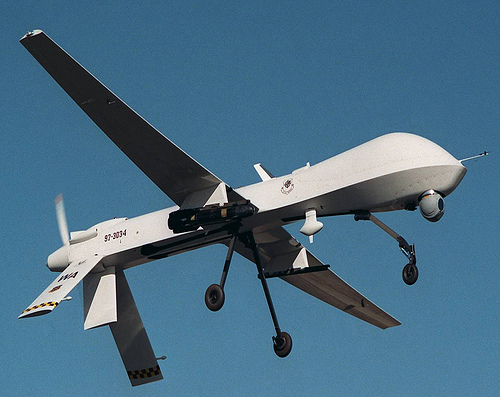
Predator drone (US Air Force photo)

It is widely acknowledged that with the death of Osama bin Laden and a number of other high level leaders, al Qaeda is severely crippled in its one-time haven of Pakistan.  Rather than acknowledging this victory in the primary objective of Authorization for the Use of Military Force in Afghanistan (passed on September 18, 2001 in response to the 9/11 attacks) and beginning to phase out the War on Terror, the US instead is finding a new target in Pakistan and building bases from which to launch even more drone attacks in Africa and the Arabian Peninsula, moves which amount to a significant expansion of the war effort.

In Pakistan, the Washington Post reports that the US is applying extreme pressure on Pakistan to dissolve the relationship between the ISI (Pakistan’s intelligence service) and the Haqqani network:

The Obama administration has sharply warned Pakistan that it must cut ties with a leading Taliban group based in the tribal region along the Afghan border and help eliminate its leaders, according to officials from both countries.

In what amounts to an ultimatum, administration officials have indicated that the United States will act unilaterally if Pakistan does not comply.

This threat of unilateral action is unlikely to be seen as mere bluster since the hit on bin Laden was unilateral.

It turns out that the Haqqani network is yet another example of a group the US helped to form only to become one of its targets:

The organization was formed by Jalaluddin Haqqani as one of the resistance groups fighting the Soviet occupation of Afghanistan in the 1980s, with U.S. and Pakistani assistance. In the Afghan civil war that followed, Haqqani sided with the Taliban forces that took power in Kabul in 1996. His fighters fled after the Taliban overthrow in late 2001 to Pakistan, where U.S. intelligence officials think they are in close coordination with al-Qaeda forces.

Pakistani intelligence maintained close connections to the network, now operationally led by Sirajuddin Haqqani, the founder’s son, as a hedge against the future in Afghanistan.

The Post article goes on to speculate that the Haqqani network’s attack on the US embassy in Kabul last week may have been final act to drive such strong language coming from Washington.

As if the declaration of a new enemy in Pakistan worthy of unilateral US action were not enough in the escalation of US war efforts, we also learn from the Washington Post that a new network of bases for drones is being built:

The Obama administration is assembling a constellation of secret drone bases for counterterrorism operations in the Horn of Africa and the Arabian Peninsula as part of a newly aggressive campaign to attack al-Qaeda affiliates in Somalia and Yemen, U.S. officials said.

One of the installations is being established in Ethi­o­pia, a U.S. ally in the fight against al-Shabab, the Somali militant group that controls much of that country. Another base is in the Seychelles, an archipelago in the Indian Ocean, where a small fleet of “hunter-killer” drones resumed operations this month after an experimental mission demonstrated that the unmanned aircraft could effectively patrol Somalia from there.

The U.S. military also has flown drones over Somalia and Yemen from bases in Djibouti, a tiny African nation at the junction of the Red Sea and the Gulf of Aden. In addition, the CIA is building a secret airstrip in the Arabian Peninsula so it can deploy armed drones over Yemen.

Recall that just last week, the Obama administration was depicted as being in an internal debate on the legality of expanding the drone war outside of Pakistan to these very areas where the bases are being built.  Considering that the bases are now already under construction, last week’s “debate” story would appear to have been nothing more than a mere academic exercise whose outcome had already been determined.

Only a fool would bet against Washington choosing more war in more locations.

Share this entry

Despite Accuracy Improvement, Huge Increase in Afghan Night Raids Detains More Innocent Civilians

US soldiers on night raid Nov. 22, 2010. (US Army photo)

In Friday’s post, I noted in passing the recent revelation that only about 50% of night raids had accurate targeting.  A new report (pdf) released today by the Open Society Foundations and The Liaison Office informs us that targeting for night raids in Afghanistan is now about 80% accurate, but because the rate of raids has increased more than five-fold, the number of innocent civilians detained in the night raids continues to go up.  As one might expect, the backlash from these improper detentions is significant and likely contributes to the increased rate of insurgent attacks.

The press release announcing the report provides a broad picture of the findings:

Ten years after the invasion of Afghanistan, security is at its worst level since the fall of the Taliban. U.S. and NATO forces argue that night raids are their best tool against insurgents, but a new report by the Open Society Foundations and The Liaison Office finds that the cost of the raids outweighs the benefits.

/snip/

An estimated 12 to 20 night raids now occur per night, resulting in thousands of detentions per year, many of whom are non-combatants. Mass detention operations, holding entire villages for questioning on site for prolonged periods of time, may violate international prohibitions against indiscriminate detention, the report found.

Civilians feel caught between the warring parties, and often blame international forces. As one man from Nangarhar, interviewed in the report said, “They claim to be against terrorists, but what they are doing is terrorism. It spreads terror. It creates more violence.” Weak accountability mechanisms where civilian casualties and mistaken detention occur and a failure to explore alternatives to night raids further increase anger over the raids. Read more

Share this entry

Cheney’s War Plan for Afghanistan? Deny Safe Haven To–But Not Destroy–Al Qaeda

[youtube]ywIqvCojtsQ[/youtube]

According to Dick Cheney, our objective in Afghanistan was, from the very beginning, not about defeating al Qaeda, but rather, defeating the Taliban, while denying al Qaeda a safe haven in Afghanistan.

At least that’s what he says in a passage explaining why he was talking about Iraq in the days after 9/11. He says,

Although we had discussed Iraq earlier in the day [on September 14], I also took time now to say that Afghanistan, where the 9/11 terrorists had trained and plotted, should be first. I believed it was important to deal with the threat Iraq posed, but not until we had an effective plan for taking down the Taliban and denying al Qaeda safe haven in Afghanistan. (334)

Note what he describes the goal as being: “taking down the Taliban,” not “taking out al Qaeda.” The al Qaeda-related goal Cheney describes for Afghanistan is simply denying them a safe haven.

And thus–in the context of this discussion about why the Bush Administration focused on Iraq so quickly after 9/11, at least–he excuses himself for letting Osama bin Laden escape at Tora Bora, for letting OBL find a haven in Pakistan that would keep him safe for a decade, and for drawing troops away for use in Iraq before actually beating al Qaeda. It was all in the plan, according to Cheney.

Tellingly, his sole discussion of anything relating to Tora Bora (actually, a strategy discussion that happened a month before the December 2001 battle there) doesn’t call it Tora Bora, doesn’t mention that OBL was holed up there (even though Cheney all-but acknowledged we knew he was at the time), and didn’t admit Bush Administration blunders let OBL get away.

[General Tommy] Franks also reported on the campaign under way to destroy the massive cave complexes in which the Taliban lived and hid. He had about 150 caves on a target list, he said, and estimated the count would go to 1,000. (345)

Cheney separates the discussion of bombing caves in Afghanistan from that describing General Franks making plans for Iraq by 24 pages, obscuring the fact that Franks was focused on developing an Iraq plan at the time he refused to send in American troops to trap OBL in Tora Bora.

Admittedly, Cheney does remember to include taking out al Qaeda among the objectives a few pages after his initial description of US goals in Afghanistan.

Our objective was to take out al Qaeda, take down the Taliban, and prevent Afghanistan from being used as a base for further operations. (340)

But it feels so contrived, particularly coming just before this passage insisting that the government remained focused on OBL.

We were also very focused on getting Osama bin Laden. None of us believed that capturing or killing him would end the terrorist threat, but he was the leader of the organization that had launched the 9/11 attacks, and having him in custody–or dead–would be a powerful symbol of our determination. Tracking him down was certainly one of our top priorities. I was gratified that after years of diligent and dedicated work, our nation’s intelligence community and our special operations forces were able on May 1, 2011, to find and kill bin Laden. (341)

If you’re so petty you can’t even mention President Obama’s name in the list of those who managed to finally get OBL, clearly you have either some insecurity that Obama succeeded where you failed, or that first formulation–basically, a whack-a-mole forever war that “denies safe haven” for terrorists in one after another country, Afghanistan, Iraq, Pakistan, Yemen, Somalia, but never ends the war–was always the plan.

Share this entry

Maybe Iraq Should Just Replace Idaho as Our 50th State

Back when Tony Fratto was arguing that we should shut down post offices because he uses the InterToobz and therefore only ventures into an actual post office once a year, I noted that we would effectively be kicking huge portions of our rural areas out of our country if we presumed everyone could replace the postal service with broadband, as the map here makes clear.

The NYT has a story focusing on one of the places Fratto is apparently willing to lose as part of this country: Idaho, which just got rated as the state with the worst broadband access. The story starts with an anecdote of how bears brought down a manufacturing company’s broadband. But I was particularly struck by this quote.

“We have a guy here who was dropped into remote, isolated areas of Iraq to set up their telecommunications systems,” said Christine L. Frei, director of the Clearwater Economic Development Association in Lewiston. “He told me, ‘We had better communications in Iraq than you have in central Idaho.’ ”

So Iraq can have broadband, but not ID. And Pocatello, ID, the city with the worst download speeds in the nation, stands to lose one of its post offices, as do 22 other cities in the state. Maybe they can just replace the postal workers with bears…

Meanwhile, it’s not just postal services that Republicans would rather build in Iraq than in Idaho. All those Republicans refusing to fund schools and infrastructure to create jobs were happy to use deficit spending to do so in Iraq and Afganistan.

Majority Leader Eric Cantor (R-VA) voted for over $120 billion to rebuild Iraq and Afghanistan, funds that were used to construct and repair schools, roads, bridges, and other critical infrastructure.

Now, Cantor is opposing President Obama’s proposal to spend $30 billion to modernize 35,000 American schools. Reuters has the story:

U.S. House Republican Leader Eric Cantor said on Monday he will not support President Barack Obama’s proposal to renovate U.S. schools as part of the administration’s bill to spur job growth.

He added that Obama should focus instead on cutting federal regulations that he says kill U.S. jobs…

The president’s proposal is a modest effort. The total maintenance and repair backlog at U.S. schools is estimated at $270 billion to $500 billion. While the funding Obama is proposing is fully offset, Cantor voted to build schools in Iraq and Afghanistan with deficit spending.

These things–schools and highways and post offices–are what make us a country, a country that includes cities and suburbs and rural areas. But Republicans think we can’t or don’t need to afford to be a country anymore.

Republicans are literally choosing to fund our empire over our own country. I guess that makes it clear where their priorities lie.

Share this entry

The World Should Have Revolted Over America’s Illegal War on Iraq

You may have seen discussions about this project around the Toobz. In it, scholars use supercomputers to analyze the tone of news coverage. Their results from Egypt and Tunisia–showing low sentiment right before this year’s revolutions–suggest you can predict volatile events with such analysis.

I decided to look further at the study, not least, because of Dianne Feinstein’s complaint earlier this year that the CIA had totally missed stirrings of rebellion in both countries.

Feinstein set a skeptical tone at the opening of the hearing, saying Obama and other policymakers deserved timely intelligence on major world events. Referring to Egypt, she said, “I have doubts whether the intelligence community lived up to its obligations in this area.”

After the hearing, Feinstein said she was particularly concerned that the CIA and other agencies had ignored open-source intelligence on the protests, a reference to posts on Facebook and other publicly accessible Web sites used by organizers of the protests against the Mubarak government.

Speaking more broadly about intelligence on turmoil in the Middle East, Feinstein said, “I’ve looked at some intelligence in this area.” She described it as “lacking . . . on collection.”

According to DiFi, the CIA missed the Arab Spring because they weren’t monitoring open source materials (an argument that WikiLeaks cables seem to confirm). And this study is all the more damning for our intelligence community, because this study uses their own (actually, Britiain’s) open source collection.

Recognizing the need for on–the–ground insights into the reaction of local media around the world in the leadup to World War II, the U.S. and British intelligence communities formed the Foreign Broadcast Information Service (FBIS — now the Open Source Center) and Summary of World Broadcasts (SWB) global news monitoring services, respectively. Tasked with monitoring how media coverage “varied between countries, as well as from one show to another within the same country … the way in which specific incidents were reported … [and] attitudes toward various countries,” (Princeton University Library, 1998) the services transcribe and translate a sample of all news globally each day. The services work together to capture the “full text and summaries of newspaper articles, conference proceedings, television and radio broadcasts, periodicals, and non–classified technical reports” in their native languages in over 130 countries (World News Connection, 2009) and were responsible for more than 80 percent of actionable intelligence about the Soviet Union during the Cold War (Studeman, 1993). In fact, news monitoring, or “open source intelligence,” now forms such a critical component of the intelligence apparatus that a 2001 Washington Post article noted “so much of what the CIA learns is collected from newspaper clippings that the director of the agency ought to be called the Pastemaster General.” (Pruden, 2001)

While products of the intelligence community, FBIS and SWB are largely strategic resources, maintaining even monitoring coverage across the world, rather than responding to hotspots of interest to the U.S. or U.K. (Leetaru, 2010). A unique iterative translation process emphasizes preserving the minute nuances of vernacular content, capturing the subtleties of domestic reaction. More than 32,000 sources are listed as monitored, but the actual number is likely far lower, as the editors draw a distinction between different editions of the same source. Today, both services are available to the general public, but FBIS is only available in digital form back to 1993, while SWB extends back more than three decades to 1979, and so is the focus of this study. During the January 1979 to July 2010 sample used in this study, SWB contained 3.9 million articles. The only country not covered by SWB is the United States, due to legal restrictions of its partner, the CIA, on monitoring domestic press.

If you believe that study author Kalev Leetaru’s research is valid (I think it’s very preliminary), then you basically grant that using his data analysis methods would have warned our intelligence services that the unrest in North Africa was exceptionally high.

But that’s not what I found most intriguing about Leetaru’s research.

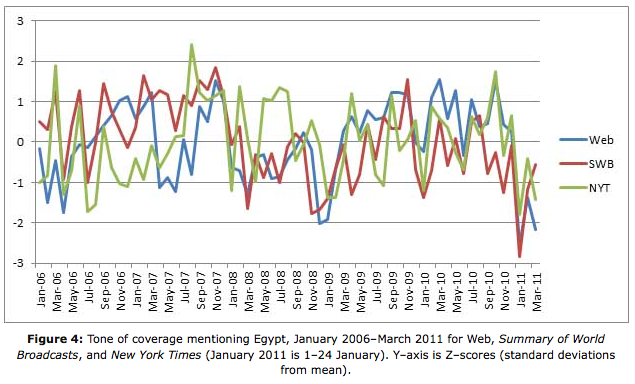
To measure whether the data from the SWB was an outlier, Leetaru compared how trends he saw from that data compared to the NYT and English language news more generally.

And as he explains, they generally track during this period, though with key deviations.

To verify that these results are not merely artifacts of the SWB data collection process, Figure 4 shows the average tone by month of Summary of World Broadcasts Egyptian coverage plotted against the coverage of the New York Times (16,106 Egyptian articles) and the English–language Web–only news (1,598,056 Egyptian articles) comparison datasets. SWB has a Pearson correlation of r=0.48 (n=63) with the Web news and r=0.29 (n=63) with the New York Times, suggesting a statistically significant relationship between the three. All three show the same general pattern of tone towards Egypt, but SWB tone leads Web tone by one month in several regions of the graph, which in turn leads Times tone. All three show a sharp shift towards negativity 1–24 January 2011, but the Times, in keeping with its reputation as the Grey Lady of journalism, shows a more muted response.

That is, for these events, local coverage was both more attuned to a change in sentiment and more reflective of the volatility of it. Or to put it another way, the NYT was slow to consider Egypt a major story, and never thought it was as big of a deal as the rest of the world did.

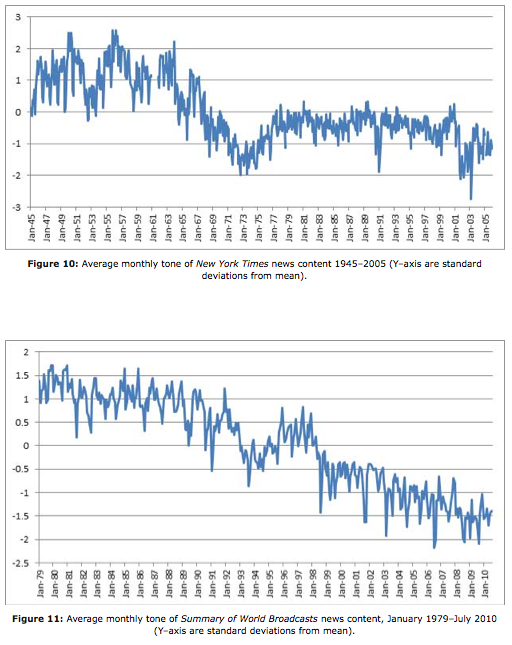
A far more interesting comparison of how the NYT outlook compared with the rest of the world comes in these two graphs, which show the NYT sentiment from 1945 to 2005 and the SWB sentiment from 1979 to 2010 (caution–neither the X nor Y axes here use the same scale; click to enlarge or go to the study for larger images).

You can sort of pick out events that might be driving sentiment on both scales. And they don’t entirely line up. Just as an example, the US seems to have reacted far more strongly–2 deviations as compared to .5 deviation–to what appears to be the first Gulf War in January 1991.

But note where both data sets converge more closely: with our second war against Iraq, with even the chief cheerleader for war, the NYT, measuring in the high 2 deviations from the mean in early 2003, and the international SWB measuring almost 2 deviations from the mean.

Significantly, the study shows that Egyptian sentiment before they revolted was in the 3+ range–more incensed than we were with the Iraq invasion, but not by much; whereas sentiment in Tunisia and Libya was less negative. Were we that close to revolting?

Now, I could be misreading both the stats and the explanation for the global bad mood as we lurched toward war against Iraq (though it also shows up in the Egyptian and Tunisian graphs; the sentiment is least severe in Libya). But if I’m not, it raises questions about what was driving the sentiment. In Europe especially and even in the US, there were huge protests against the war, though we never seemed all that close to overthrowing the war-mongers in power. I wonder, too, whether the sentiment also reflects the ginned up hatred toward Saddam Hussein. That is, it may be measuring negative sentiment, but partly negative sentiment directed against an artificial enemy.

So are these graphs showing that we were even closer to revolt than those of us opposed to the war believed? Or is the NYT graph showing that warmongers reflect the same nasty mood as people attempting to prevent an illegal war?

In any case, the NYT coverage reflected the crankiest mood in the US of the entire previous half century, significantly worse than the VIetnam period. I knew I was cranky; I wasn’t entirely sure everyone else was, too.

Share this entry

Nothing Like a Third Forever War to Boost the Confidence of the Military-Industrial Complex

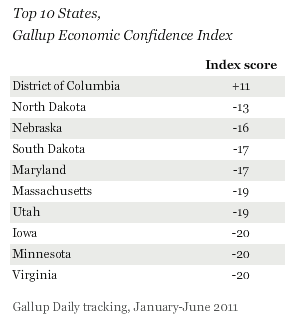
Digby points to Gallup polling numbers showing that Washington DC is the only place in the country that has improving confidence.

See, David Plouffe was right. People are feeling better about their economic prospects. At least, the people within his little bubble are.

But he might want to think about why people in his bubble are feeling good about their economic prospects.

First, because they–and neighboring states VA and MD, also among the most confident states–have been the recipients of 10 years of stimulus, supporting government-created jobs, the kind of jobs he likes to pretend don’t exist. Stimulus makes jobs which makes people feel good (and it’s worth noting that MI, which has benefited form a disproportionate share of stimulus sent to the midwest, is not among the 10 most grumpy states).

Plus, all these people living well off their Military-Industrial stimulus have reason to celebrate, as we’ve recently added another forever war for them to profit off of.

And then there’s another key industry that DC residents will be profiting off of: the upcoming billion dollar Presidential campaign, now kicking off in grand style. Heck, analyzing who eats fried butter more authentically will even provide job security for DC journos for the next 15 months.

Finally, how much do you think the lobbyist industry will rain down on Congress for having brought the country to the edge of an abyss as a political stunt? How much do you think the lobbyist industry will invest in SuperCongress?

Sure, it’s a great time to be in DC.

I don’t know why the rest of the country just can’t be grateful that at least DC is doing well.

Update: As if on cue, The WaPo describes the confidence fairies that have benefited from federal stimulus, then raises concerns that this gravy train of unlimited stimulus might soon end. (h/t Teddy)

Millions of dollars worth of federal contracts transformed Anita Talwar from a government accounting clerk into a wealthy woman — one who can afford a $2.8 million home with its own elevator, wine cellar and Swarovski crystal chandeliers in the Washington suburbs.

Talwar, a 59-year-old immigrant from India, had no idea that she and her husband would amass a small fortune when she launched a company providing tech support to the federal government in 1987. But she shrewdly took advantage of programs for minority-owned small businesses and rode a boom in federal contracting.

[snip]

Anita Talwar’s success — and that of hundreds of other contractors like her — is a key factor driving the explosion of the region’s wealth over the last two decades. It has also exacerbated the gap between high- and low-wage workers, which is wider in the D.C. area than almost anywhere else in the U.S.

[snip]

The new Washington is a global business hub with thriving technology, biotech and communications industries. Only 12 percent of workers are federal employees. But the federal government remains an engine of job creation, outsourcing its tech support and other services to contracting firms ringing the Capital Beltway, a phenomenon that exploded in the years after 9/11.

More than $80 billion in federal contracting dollars will flow to the region this year, up from $4.2 billion in 1980, according to Stephen Fuller, director of the Center for Regional Analysis at George Mason University. Adjusted for inflation, that’s a seven-fold increase. A third of the region’s gross regional product now comes from federal spending.

But that tide is likely to slow because of a $1 trillion debt-reduction package approved earlier this month by Congress and President Obama. In the coming months, a bipartisan“supercommittee” will be searching for another $1.5 trillion in savings. Defense contractors are already bracing themselves for deep cuts in military spending.

Share this entry