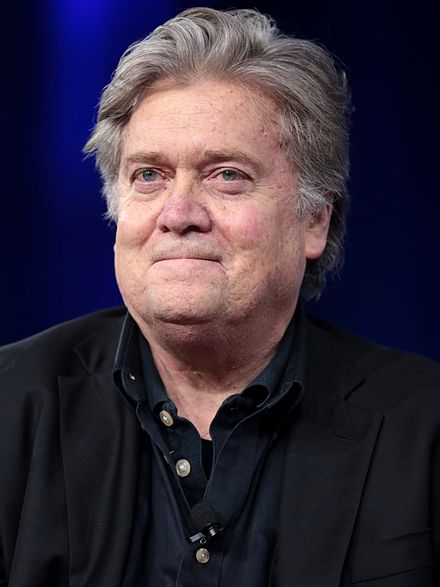
How Did Intended Victim Mike Pence Testify?

As a million outlets have reported, 21 months after Merrick Garland set up a framework that could obtain a for waiver executive privilege for January 6 without violating DOJ contact guidelines, 15 months after all January 6 investigations had converged on Mike Pence, over a year after investigators won precedents that made it possible, yesterday Mike Pence testified to a January 6 grand jury for around five hours.

This is definitely important news, but it is not new news. Given the recent precedent of then still sitting Vice President Dick Cheney giving a transcribed interview for presentation to the CIA Leak case grand jury in August 2004, it’s also not anywhere near as unprecedented as some outlets are hyping.

In fact, it’s so predictable, I’ve republished below, in its entirety, the post I wrote in November (before Jack Smith’s appointment) arguing that the publication of Pence’s book made this testimony far easier, and necessary, to get.

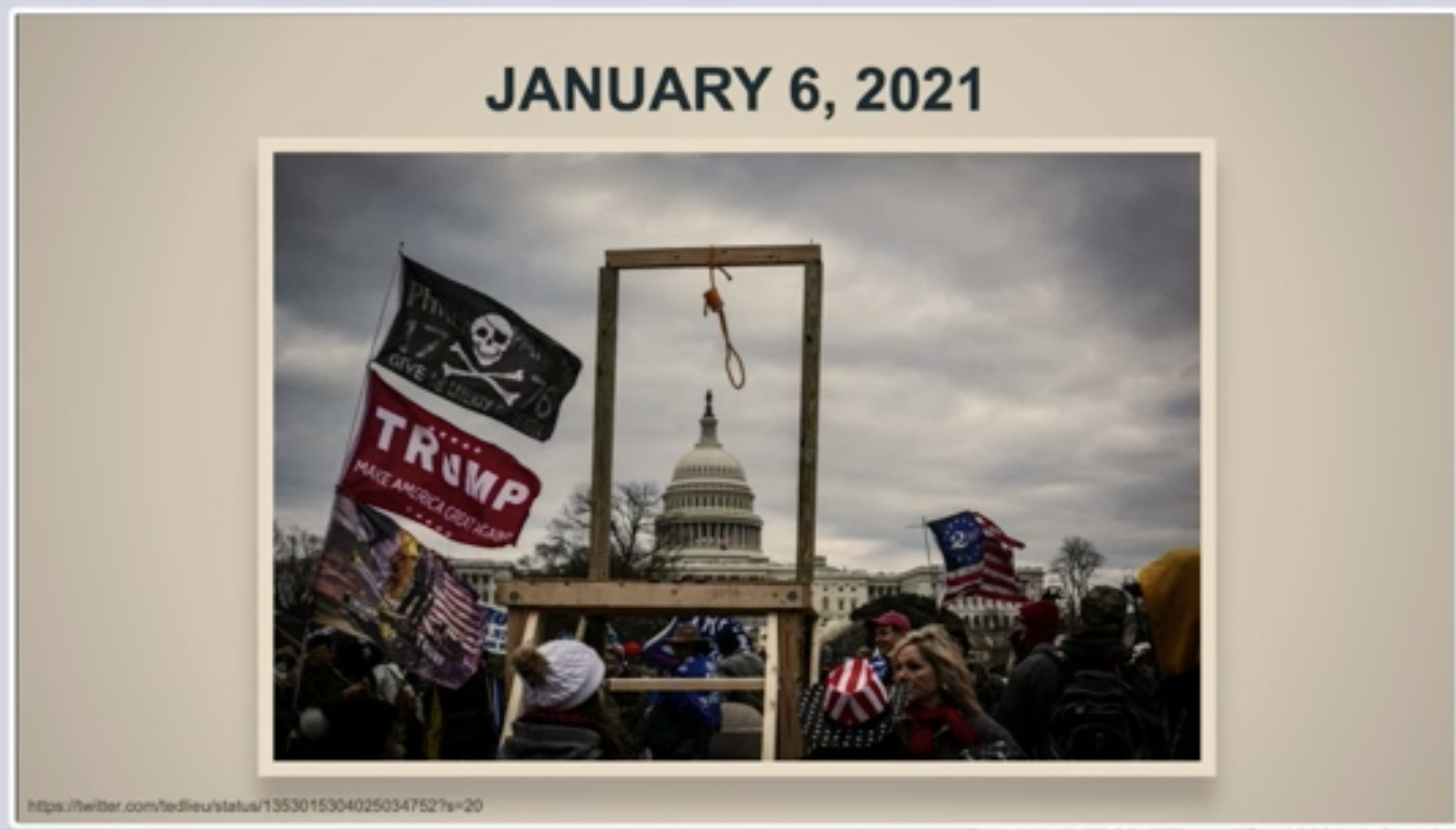
A witness with crucial testimony to a grand jury investigation testified before the grand jury. Far more importantly, the chief intended victim of a violent attack testified to the grand jury.

Little from this interview will be entirely new to prosecutors. I bet they even had a copy of Pence’s book with sticky tabs marking key pages. What will be important — and could even impact Smith’s charging decision — is whether Pence continued to shade the truth to protect Trump in some key episodes, or provided more honest testimony under oath.

It may actually matter whether Pence testified that he believed all Trump’s efforts to undermine the election outcome were justified. How Pence testified about his response to Trump’s focus on the rally on December 19 may matter (his role in a meeting with members of Congress on December 21 may be protected under the decision affording him Speech and Debate protection, which is a damned shame).

How Pence told this part of his January 6 story — the meeting he had on January 11 with Trump in its aftermath — may be one of the most important details of Pence’s testimony.

I met with the president on Jan. 11. He looked tired, and his voice seemed fainter than usual. “How are you?” he began. “How are Karen and Charlotte?” I replied tersely that we were fine and told him that they had been at the Capitol on Jan. 6. He responded with a hint of regret, “I just learned that.” He then asked, “Were you scared?”

“No,” I replied, “I was angry. You and I had our differences that day, Mr. President, and seeing those people tearing up the Capitol infuriated me.”

He started to bring up the election, saying that people were angry, but his voice trailed off.

I told him he had to set that aside, and he responded quietly, “Yeah.”

I said, “Those people who broke into the Capitol might’ve been supporters, but they are not our movement.” For five years, we had both spoken to crowds of the most patriotic, law-abiding, God-fearing people in the country.

For the public version, Pence described being angry at the rioters. He described being angry that they had targeted the Capitol building.

But just beneath the surface of this description is the disagreement Pence had with Trump. Just beneath the surface of this description is the obvious tie between Trump’s incitement and those rioters. Just beneath the surface of this description is the fact that Trump targeted those rioters at Pence. At Karen Pence. At Charlotte Pence.

Just beneath the surface of this description is Pence’s anger at Trump, not just the rioters.

How Pence described being the victim of Trump’s incitement matters. It’ll matter for the confidence with which Smith may have in a case relying on this testimony. It’ll matter for how convincing this case would be for a jury.


After a Year of Executive Privilege Fights, Mike Pence Just Tweeted It Out

The WSJ has published an excerpt — the parts relating to January 6 — from the Mike Pence book coming out next week. It includes descriptions of the following conversations with the then-President, at least some of which Pence was the only witness:

  1. Lunch on November 16, 2020, at which Trump said, “2024 is so far off.”
  2. A call on December 5, on which Trump raised the possibility of challenging the vote.
  3. A December cabinet meeting.
  4. A December 19 conversation in which Trump mentioned plans for the January 6 rally (which Pence claims to have thought was a “useful” idea).
  5. A January 1, 2021 phone call in which Pence told Trump he opposed Louie Gohmert’s lawsuit arguing that Pence had discretion to decide which votes to count. Trump accused his Vice President of being “too honest” and informed him that, “People are gonna think you’re stupid,” for choosing not to claim the power to throw out votes.
  6. A call on January 2 on which Trump said that if Pence, “wimp[ed] out,” he would be “just another somebody.”
  7. A meeting involving John Eastman and others on January 4.
  8. A meeting involving John Eastman in the Oval Office on January 5.
  9. The call Trump made to Pence on January 6 where he again called Pence a wimp.
  10. A meeting on January 11, where in response to Trump’s question whether he was scared on January 6, Pence said he was angry, purportedly just about the people “tearing up the Capitol.”
  11. An exchange inside the Oval Office during which Trump told Pence “Don’t bother” to pray for him.

Every one of these conversations are ones that would traditionally have been covered by Executive Privilege. Trump claimed such exchanges were covered by Executive Privilege starting over a year ago. Both Pence’s top aides — Greg Jacob and Marc Short — and three White House Counsels claimed such exchanges were covered by Executive Privilege this summer, and only in recent weeks did Beryl Howell override the claims of Pence’s people.

And yet, all the while, this book was in the works, including just on this topic, eleven conversations directly with the former President, many of them conversations to which Pence was the only witness.

Much of this description is self-serving (as most autobiographies are), an attempt to craft his support for challenging the election but not rioting. The excerpt, at least, does not disclose the advice that led him to reject Trump’s demand that he throw out votes.

This passage, in particular, seems to project any testimony that Eastman knew the request of Pence was illegal onto Greg Jacob, not himself.

On Jan. 4, the president’s chief of staff, Mark Meadows, summoned me to the Oval Office for a meeting with a long list of attendees, including the legal scholar John Eastman. I listened respectfully as Mr. Eastman argued that I should modify the proceedings, which require that electoral votes be opened and counted in alphabetical order, by saving the five disputed states until the end. Mr. Eastman claimed I had the authority to return the votes to the states until each legislature certified which of the competing slate of electors for the state was correct. I had already confirmed that there were no competing electors.

Mr. Eastman repeatedly qualified his argument, saying it was only a legal theory. I asked, “Do you think I have the authority to reject or return votes?”

He stammered, “Well, it’s never been tested in the courts, so I think it is an open question.”

At that I turned to the president, who was distracted, and said, “Mr. President, did you hear that? Even your lawyer doesn’t think I have the authority to return electoral votes.” The president nodded. As Mr. Eastman struggled to explain, the president replied, “I like the other thing better,” presumably meaning that I could simply reject electoral votes.

On Jan. 5, I got an urgent call that the president was asking to see me in the Oval Office. The president’s lawyers, including Mr. Eastman, were now requesting that I simply reject the electors. I later learned that Mr. Eastman had conceded to my general counsel that rejecting electoral votes was a bad idea and any attempt to do so would be quickly overturned by a unanimous Supreme Court. This guy didn’t even believe what he was telling the president.

By context, Pence asked Eastman whether Eastman thought Pence had “the authority to reject or return votes.” Eastman’s response, without qualification that he was addressing just one of those two items, was that, “it’s never been tested in the courts.” Then, by Pence’s telling, he directly told the then-President that Eastman had only said that returning votes to the states would be illegal. But that’s not what Eastman responded to! He responded to both, and did so in front of Trump.

By stating that Eastman later told his general counsel, Greg Jacob, that the Supreme Court would overturn any effort to reject the votes, rather than just return them, Pence is making Jacob the key witness, and he’s telling the story in such a way that Trump was not directly a witness to the conversation.

Maybe it really happened like Pence tells it. Maybe not. There were other attendees (including, probably, Jacob), and some of them have likely already described what they saw to the grand jury.

But this protective telling of the story is particularly interesting given this description of how, on January 1, Pence told Trump he didn’t have the authority to decide which votes to count.

Early on New Year’s Day, the phone rang. Texas Rep. Louie Gohmert and other Republicans had filed a lawsuit asking a federal judge to declare that I had “exclusive authority and sole discretion” to decide which electoral votes should count. “I don’t want to see ‘Pence Opposes Gohmert Suit’ as a headline this morning,” the president said. I told him I did oppose it. “If it gives you the power,” he asked, “why would you oppose it?” I told him, as I had many times, that I didn’t believe I possessed that power under the Constitution.

This is the first, in the excerpt, that he describes telling this to Trump. But he also says he had already told him the same, “many times.” The circumstances of those conversations would be really critical for pinpointing the timeline of Trump’s machinations and the extent that Pence warned him they were illegal.

For months, the press has been squawking about how unprecedented it would be to subpoena the former Vice President. But he just made the case for doing so, right here.

Share this entry

“Lock Him Up!” Trump Calls on Congress to Halt the Criminal Investigation into Joe Biden

Yesterday, four Trump lawyers sent House Intelligence Chair Mike Turner a really risky letter. CNN first reported on the letter.

Boris Epshteyn, who had allegedly been leading Trump’s defense in that investigation, did not sign the letter.

The letter responds to the news that Turner and other Gang of 8 members have recently been given access to the documents found at Donald Trump, Joe Biden, and Mike Pence’s properties.

We understand that DOJ is making the documents marked classified available for your review, and this letter provides the Committee with information that we suspect DOJ has not disclosed to it.

It doesn’t cite its source of information about those reviews, which is one way to obscure that the Gang of 8 actually began to get such access by April 11, two weeks ago.

Since Mike Turner and other Gang of 8 members started reviewing the documents, two things have happened.

First, Joe Biden announced his reelection campaign, without waiting on Special Counsel Robert Hur to report the results of his investigation into Biden for mishandling classified information.

And, about a month after Evan Corcoran testified in a crime-fraud excepted appearance before the grand jury, Boris Epshteyn spent two days last week chatting with Jack Smith’s prosecutors. (Like Epshteyn, Corcoran did not sign this letter, but that’s because his partners forced him to recuse from the investigation after he testified.) Even though Epshteyn has been a likely source for a lot of the press reports on the various investigations into which he has or had visibility, I’m not aware of any report describing his testimony, much less why he testified without any report of a subpoena.

Contemplate the significance of the first item — Biden’s reelection announcement — as you consider the purported point of the letter. Donald Trump — the guy who won the presidency with non-stop chants of “Lock her up!” in 2016 — claims to think that an investigation analogous to the one that targeted Hillary Clinton in 2015 to 2016 is improper.

A legislative solution by Congress is required to prevent the DOJ from continuing to conduct ham-handed criminal investigations of matters that are inherently not criminal.

[snip]

What is consistent in all three of these cases is that the document handling procedures in the White House are flawed and DOJ is not the appropriate agency to conduct investigations pertaining to the mishandling or spillage of classified material.

Conclusion

The solution to these issues is not a misguided, politically infected, and severely botched criminal investigation, but rather a legislative solution. DOJ should be ordered to stand down, and the intelligence community should instead conduct an appropriate investigation and provide a full report to this Committee, as well as your counterparts in the Senate. Armed with the appropriate knowledge, we respectfully suggest that your Committee hold hearings and make legislative changes to:

1. Correct classified document handling procedures in the White House;

2. Standardize document handling and storage procedures for Presidents and Vice Presidents when they leave office; and

3. Formalize procedures for investigations into the mishandling or spillage of classified material, to prevent future situations where DOJ is inappropriately assigned to conduct an investigation.

President Trump’s legal team would be happy to meet with you or your staff to assist in any way necessary to address these issues. Please know that despite the differences in the cases, we do not believe that any of these three matters should be handled by DOJ as a criminal case. Rather, the stakeholders to these matters should set aside political differences and work together to remediate this issue and help to enhance our national security in the process. [my emphasis]

Donald Trump is asking Congress to intervene to halt not just into the investigation into him — and make no mistake, that is what he’s doing. But he’s also asking Congress to halt the investigation into his opponent!

Having won the presidency in 2016 by demanding the investigation into Hillary be more punitive, he’s now asking Congress to halt the investigation into Joe Biden.

Having won the presidency in 2016 by succeeding in highlighting Hillary’s negligence for mishandling classified information, Trump now wants to forego the opportunity to pursue the same approach in 2024.

At the very least, that’s a pretty good sign that he and his lawyers don’t believe their own claims that the known facts about Biden’s mishandling of classified information are worse than the known facts about Trump’s.

4 Of course, we also recently learned from media reports that President Biden possessed
marked documents in a “personal” folder at the Penn-Biden Center – strong evidence
that he intentionally possessed then after he or someone else secretly removed them,
from the Senate SCIF at least 14 years earlier when he was the Senator from Delaware.
We also now know that after DOJ learned about President Biden’s possession of
classified documents at the Penn-Biden Center, it allowed his personal attorneys to
search for and collect documents from his residence in Delaware making the specific
locations of the documents in the residence difficult, and perhaps impossible, to
determine. And, it has since been publicly reported that there could be even more
classified documents in the 1,850 boxes that Mr. Biden shipped to the University of
Delaware in 2012. https://www.cnn.com/2-23/02/15/politics/biden-delawaresearch/index.html. DOJ’s reaction to all of this is stunningly different from how it
responded to President Trump’s offer of cooperation regarding the boxes stored at Mara-Largo. [sic: Trump’s lawyers misspell Mar-a-Lago in several different ways in the letter]

[snip]

When documents were found in President Joseph Biden’s Penn-Biden Center office, despite clear indicators that his violations were more likely the result of willful misconduct, DOJ treated him very differently by forgoing any attempts at manufacturing conflict, while implicitly approving the spoliation of evidence.

The applicable criminal statute prohibits “willful retention” of national defense information, not mere possession. See 18 U.S. § 793 (e). To prove willful retention, a prosecutor must first establish that the possession was knowing. Despite media spin to the contrary, this is the key element that distinguishes President Trump’s retention of documents from that by President Biden. Evidence of knowing possession can be readily inferred from the length of time that President Biden possessed the marked documents since leaving office and the fact that they were moved and stored at multiple locations. In comparison, the materials found at Mar-a-Lago were still stored in the same GSA boxes in which they left the White House, untouched in the relatively short time since the end of President Trump’s term. Perhaps the most damning fact for President Biden is that he possessed marked documents from his time in the Senate—a body that maintains all marked documents in a SCIF, unlike the White House. Further, as you are no doubt aware and as mentioned earlier in this letter, media reports have indicated that classified documents were contained in a folder labeled “personal,”8 which is much more powerful evidence of knowing retention than documents being randomly dispersed into boxes by moving teams.

8 See, e.g., Jamie Gangel et al., “Exclusive: U.S. intelligence materials related to Ukraine, Iran and UK found in Biden’s private office, source tells CNN,” CNN (Jan. 10, 2023), https://www.cnn.com/2023/01/10/politics/biden-classified-documents-iran-ukraineunited-kingdom-beau-funeral/index.html.

There is not a chance in hell that Trump would forgo an opportunity to make this race about Biden’s mishandling of classified information if he really believed that Biden’s “violations were more likely the result of willful misconduct.”

Not a chance in hell!

But then, there’s abundant reason to believe that the four lawyers know they’re blowing smoke (to Congress). Heck, I’m so sure of it I think Mark Warner should invite all four of them to give sworn testimony to the Senate Intelligence Committee.

There are the claims this letter makes that conflict with known testimony, such as that Trump didn’t review any of the documents in the boxes ultimately returned to the Archives.

However, due to other demands on his time, President Trump subsequently directed his staff to ship the boxes to NARA without any review by him or his staff.

There are the claims this letter makes that conflict with known details about the case, such as that, because Trump was too busy starting an insurrection, he didn’t have the ability to send his documents to a GSA-leased facility.

When President Trump left office, there was little time to prepare for the outgoing transition from the presidency. Unlike his three predecessors, each of whom had over four years to prepare for their departure upon completion of their second term, President Trump had a much shorter time to wind up his administration. White House staffers and General Service Administration (“GSA”) employees quickly packed everything into boxes and shipped them to Florida. This was a stark change from the standard preparations made by GSA and National Archives and Records Administration (“NARA”) for prior administrations. As NARA acknowledged in a Press Statement it issued on October 11, 2022:

The National Archives and Records Administration (NARA), in accordance with the Presidential Records Act, assumed physical and legal custody of the Presidential records from the administrations of Barack Obama, George W. Bush, Bill Clinton, George H.W. Bush, and Ronald Reagan, when those Presidents left office. NARA securely moved these records to temporary facilities that NARA leased from the General Services Administration (GSA), near the locations of the future Presidential Libraries that former Presidents built for NARA. All such temporary facilities met strict archival and security standards, and have been managed and staffed exclusively by NARA employees.2

Investigators paid by the lead writer of this letter, Tim Parlatore, found two additional documents with classification marks in what is reportedly a GSA-leased facility in Florida.

Lawyers for Donald Trump found at least two items marked classified after an outside team hired by Trump searched a storage unit in West Palm Beach, Fla., used by the former president, according to people familiar with the matter.

[snip]

Emails released by the General Services Administration, which assists former presidents during their transition to private life, show that the government agency helped rent the storage unit at a private facility in West Palm Beach on July 21, 2021. The unit was needed to store items that had been held at an office in Northern Virginia used by Trump staffers in the months just after he left office.

There’s the claim that DOJ dictated the timing of the June 3 document pick-up, when the record shows Evan Corcoran called FBI and told them to come down the next day.

Ultimately, President Trump’s legal team complied with DOJ’s demands, performing as diligent a search as they could by Mr. Bratt’s arbitrary deadline, and submitted a certification that affirmed the same.

And this letter repeats a bullshit claim that Trump’s lawyers have chanted from the start of his attempts to sucker the press: that the only thing Jay Bratt requested after he had seen the storage room at Mar-a-Lago was to put a lock on the facility.

Although Mr. Corcoran told the DOJ representatives that they were not going to go through boxes together that day, he fully expected DOJ to ask to return to Mar-a-Largo and examine all the boxes. Mr. Bratt reinforced this belief when, five days later, he wrote to Mr. Corcoran requesting that an additional lock be placed on the door. The lock was soon installed, and the boxes kept under lock and key in a facility guarded by armed Secret Service agents.

It’s like Tim Parlatore thinks Mike Turner’s staffers are too stupid to review the unsealed affidavit, which reveals that Bratt’s letter says something else entirely: that the storage facility is not a secure facility authorized to store classified documents.

As I previously indicated to you, Mar-a-Lago does not include a secure location authorized for the storage of classified information. As such, it appears that since the time classified documents (the ones recently provided and any and all others) were removed from the secure facilities at the White House and moved to Mar-a-Lago on or around January 20, 202 1, they have not been handled in an appropriate manner or stored in an approptiate location. Accordingly, we ask that the room at Mar-a-Lago where the documents had been stored be secured and that all of the boxes that were moved from the White House to Mar-a-Lago (along with any other items in that room) be preserved in that room in their current condition until further notice.

Because the staffers that deal with this document have security clearance they surely want to keep, they’ll undoubtedly know that this is a reference to CFR standards for storage, not a request to add an almost certainly non-compliant lock.

And that’s why I think this letter was ill-advised.

These are just the obvious, affirmatively false things in the letter. There’s a whole bunch more that Trump’s lawyers simply ignore, such as the surveillance video showing Trump’s staffers moving boxes out of the storage facility in advance of the search they’re claiming here was a diligent search or the fact that FBI found 70-some classified documents in the storage facility of which Corcoran had claimed to have done a diligent search.

The only way this document could have the desired effect is if Mike Turner likes being lied to, or is so in the tank that — like Richard Burr before him — he’s willing to risk his own legal exposure to obstruct a criminal investigation.

And that’s assuming Warner didn’t subpoena any or all of these lawyers to repeat these farcical claims to Congress under oath.

All that’s before you consider the asymmetry. Trump’s lawyers — just one of whom (they admit) actually has clearance — acknowledge they have no fucking clue what FBI caught Trump hoarding.

Despite our requests to DOJ, it has refused to tell us whether in its judgment any of the documents remain classified. Similarly, DOJ has refused to allow for inspection of the documents at any time during the last eight months despite the fact that one of our attorneys has sufficient clearance to view the majority of the documents marked as classified.

Mike Turner does know.

Trump’s lawyers claim — or rather confess — that among the files he originally had in his beach resort were call briefings with foreign officials, just like the ones hidden from Congress in the first impeachment.

The vast majority of the placeholder inserts refer to briefings for phone calls with foreign leaders that were located near the schedule for those calls.

Again, I can only imagine how stupid Parlatore thinks Turner’s staffers are to confess this.

But even I know that many of the things Trump kept after DOJ subpoenaed them are not similar. Even I know that Trump compiled two classified documents with messages from a pollster, a book author, and a faith leader. And Mike Turner has reviewed these documents and he knows it too. And I know that he knows it.

So unless Mike Turner is totally in the tank for Trump — worse even than Burr was! — this letter risks pissing Turner off.

Last month, before Evan Corcoran was forced to give crime-fraud excepted testimony against Trump and before Boris Epshteyn spent two days chatting with Jack Smith’s prosecutors, Tim Parlatore — lead author of this insulting letter — said the following about Epshteyn’s role in the stolen documents case.

Mr. Epshteyn’s legal role with Mr. Trump, while less often focused on gritty legal details, has been to try to serve as a gatekeeper between the lawyers on the front lines and the former president, who is said to sometimes roll his eyes at the frequency of Mr. Epshteyn’s calls but picks up the phone.

“Boris has access to information and a network that is useful to us,” said one of the team’s lawyers, Timothy Parlatore, whom Mr. Epshteyn hired. “It’s good to have someone who’s a lawyer who is also inside the palace gates.”

Mr. Parlatore suggested that he was not worried that Mr. Epshteyn, like a substantial number of other Trump lawyers, had become at least tangentially embroiled in some of the same investigations on which he was helping to defend Mr. Trump.

“Absent any solid indication that Boris is a target here, I don’t think it affects us,” Mr. Parlatore said.

Neither Corcoran nor Epshteyn signed this letter. It’s not yet clear why Epshteyn didn’t.

And that’s as telling as the embarrassing false claims that it makes.

Share this entry

Tucker Carlson Nipped from Fox

Fox just announced that Tucker Carlson is out, effectively immediately.

I doubt this is Dominion related. It was too sudden. He signed off Friday pitching his show today and Fox was until minutes ago previewing the show.

Plus, Tucker is both less culpable for the specific claims in Dominion than Maria Bartiromo, and far more important for Fox viewership.

Update: As Rayne linked in comments, it is Dominion related, but it seems to be because of the things Fox discovered Tucker had said about management, not about his defamation of Dominion.

But it was Carlson’s comments about Fox management, as revealed in the Dominion case, that played a role in his departure from Fox, a person familiar with the company’s thinking told The Post.

“Do the executives understand how much credibility and trust we’ve lost with our audience?” Carlson wrote to a colleague in a message a day after Fox, like other media outlets, called the election for Joe Biden. In another message, he referred to management with an expletive: “Those f—–s are destroying our credibility.” He later wrote: “A combination of incompetent liberals and top leadership with too much pride to back down is what’s happening.”

Tucker’s Executive Producer is also out, though, so it’s likely more than just that.

Share this entry

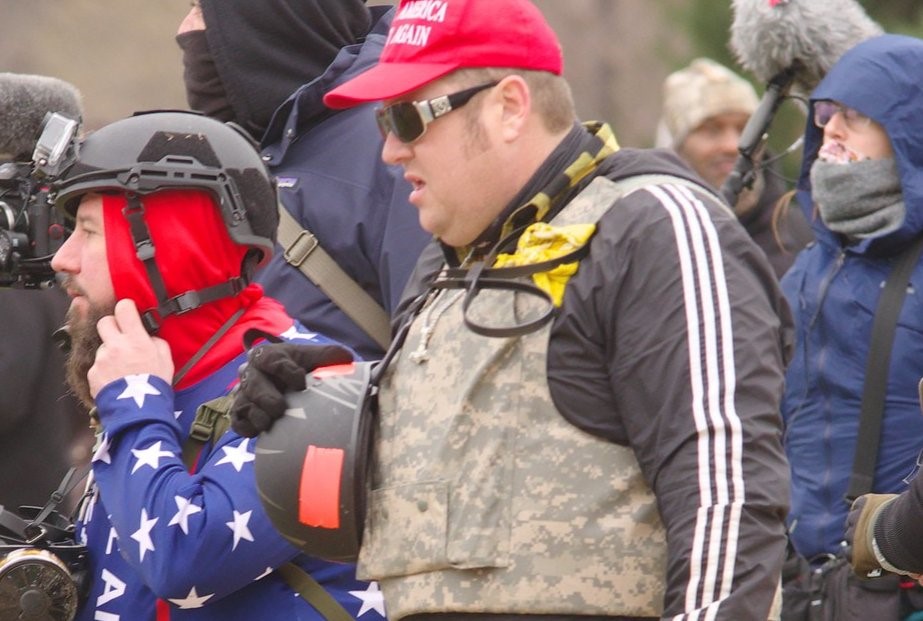
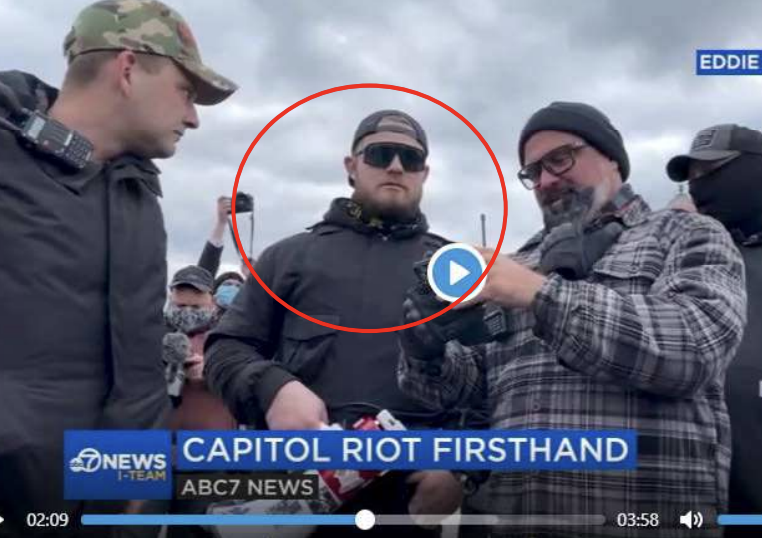
The Hot Seat: Two Proud Boys testifying at seditious conspiracy trial unravel on the witness stand

From emptywheel: Thanks to the generosity of emptywheel readers we have funded Brandi’s coverage for the rest of the trial. If you’d like to show your further appreciation for Brandi’s great work, here’s her PayPal tip jar.

It was a risky move by Proud Boy defendants Zachary Rehl and Dominic Pezzola to take the witness stand. So it is for any criminal defendant. A skilled prosecutor can unwind even the most robust witness without alerting their subject to it until it is too late. 

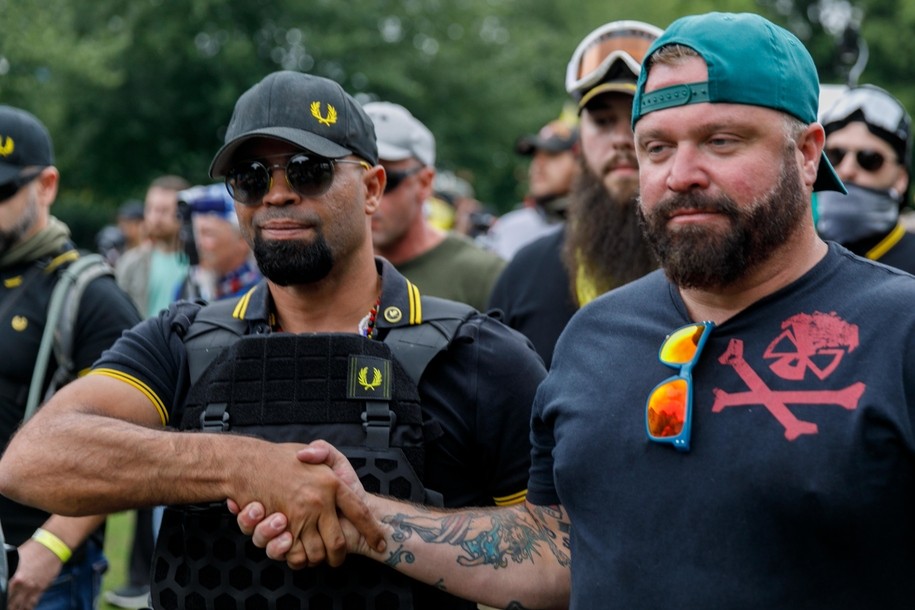
It took four months of hearing evidence in the Proud Boys seditious conspiracy trial—which enters closing arguments on Monday—but this past week, jurors got it straight from the source when two of five Proud Boys on trial testified for once and all: Zachary Rehl and Dominic Pezzola. 

Their respective testimonies were often combative, the tension frequently high. Each man started out confident and cocksure, but the more Justice Department prosecutors pushed Rehl and Pezzola around the edges of their testimony, the more the men relinquished whatever tight grip they had over themselves when testifying under the far more amenable gaze of their own attorneys. 

Both sides have now rested and on Friday, jury instructions were issued. All that is left are closing arguments. It will be those final words that the jurors will have ringing in their ears when the book finally closes on this trial. But no matter how sweeping or evocative those final arguments may be, some of the trial’s most potent moments,  for better or worse, will belong to the testimony of two Proud Boys who favored speaking instead of silence. 

ZACHARY REHL: “Not that I recall.”

Zachary Rehl was one of two Proud Boy defendants to take the witness stand, and when under cross-examination by Assistant U.S. Attorney Erik Kenerson, his tone was often sharp, his face taut and eyes hard as he grew impatient with a barrage of questions from the federal prosecutor. 

The 37-year-old man’s face, which looks much younger than his years, was more softly animated when he spoke to his own attorney Carmen Hernandez. With her, his testimony would spill out rapidly as he told a jury that has now heard evidence for four months: there was no conspiracy to storm the Capitol on Jan. 6, 2021. There was no plan to stop proceedings nor impede law enforcement from doing their duty, he said again and again under oath. 

Police, he claimed, let protesters pass through barriers. He said he never saw any significant violence directed at law enforcement and didn’t realize there had been such conduct until later, though on the stand he conceded to witnessing “scuffles” between rioters and police. (He would distinguish “rioters” from “protesters” often.) But, again, he offered, there was no attempt by him to assault any officers while he was on Capitol grounds.

On this point, the son and grandson of a Philadelphia police officer was adamant and he would turn to face the jury as he said this, his eyes searching theirs to validate him.

But he didn’t turn to face the jury when Kenerson started walking Rehl through a sequence of video clips from the 6th, including those that his attorney tried and failed to keep out of evidence after they emerged following a weekend break in proceedings.

The prosecutor had Rehl identify himself in footage shot close-up and Rehl positively identified himself as wearing a black jacket, black goggles, a camouflage hat with orange writing, and a gaiter that appeared to have a chevron or some sort of triangular pattern on it.

When Kenerson asked Rehl if he recalled being by the giant media tower erected outside of the Capitol on Jan. 6 before entering the building, Rehl readily offered, he was  “around there.” 

But when asked if he could recognize a man in attire appearing identical to his at a slightly greater distance near this location, Rehl started to lock up. The man appeared to be wearing the same clothes Rehl had just identified as his own at closer range. And at this angle, appearing at a distance, the man appeared to be holding something dark in his hand. Rehl, with his brow furrowed, leaned into the monitor at the witness box and told the jury he couldn’t say what it was that the man was holding. 

Zooming in and out, the footage rolling back and forth, Kenerson pressed: Was this, in fact, his attire? Was this man Rehl? Was this his arm extended toward officers as he held something in his hand? 

“A lot of people wore the same clothes that day”, Rehl said. “I can’t confirm or deny that’s me.”

For several tense minutes, Rehl could not or would not confirm hardly anything presented to him including whether the color of clearly black sunglasses or goggles covering the man in question’s face in the sequence were in fact black. 

“Are they pink?” Kenerson asked incredulously, triggering a storm of objections from defense counsel.

Rehl’s demeanor became more irritated from that point forward and the gloves came off. He insisted the footage was “very blurry,”  although he would eventually concede as cross continued that the gaiter in question was “close” to the pattern of his own. The coat was similar too, but he wouldn’t say whether the more distinctive camouflage hat was his. Going around and around like this with Rehl, Kenerson eventually asked the Proud Boy outright if he assaulted any police before entering the Capitol with pepper spray.

“No,” Rehl said. 

Playing footage frame by frame that prosecutors said came from a bodyworn police camera, a man who prosecutors suggest is Rehl has a device in his hand. 

“I can’t tell but I would imagine it’s an OSMO,” Rehl said, referencing a small camera or recording device.

“Does a small recording device usually have streams coming out of them?” Kenerson asked.

Rehl said he couldn’t see a canister and could only see a hand. He conceded he could see “streaks” in the footage but not “spray” in the direction of police. He questioned the integrity of the evidence. The hand was holding something, he admitted, but if it was his hand, he said, it would be a camera. 

“Mr. Rehl, you’ve had overnight to think about it. You were spraying in the direction of police officers near the media tower on Jan. 6, 2021?” Kenerson asked. 

Rehl, who had been so emphatic of so much else in his testimony about Jan. 6, or about himself, or the Proud Boys as a whole, replied coolly: “Not that I recall.”

The prosecutor elicited from Rehl that after he left the area near the media tower, he was ultimately able to advance further onto the upper west plaza of the Capitol before going inside. Positioned high above, and as police were being overrun on both the west and east sides of the complex, he snapped a photo and narrated to Proud Boys in a text sent at 2:29 p.m: “civil war started.”

On redirect, he didn’t deny sending the message and instead claimed he was “basically mocking all the news we were hearing prior to the event,” he said.

He added that he was being “ironic.” 

“It’s all just a very peaceful scene, we were just standing around,” Rehl told his attorney.

Hernandez tried to steady the ship: “Is that your opinion today that everything that happened that day was irony?”

“Oh no no no,” Rehl said. 

When he went through his phone, after the fact, he said he realized what had happened. 

“It was a terrible day, a lot of bad stuff happened,” he said.

Nonetheless, he told the jury he was “proud of the turnout.” But on Jan. 7, as he started to “go through things and see what happened that day” he didn’t want to “associate” with it. 

And then with a remark that could cut both ways for a jury who had only just watched Rehl’s temper rise and flare, Rehl said: “Previously, I tried to have a good persona and that’s what I try to portray.” 

The scenes that unfolded around him as he got past police and pushed inside the complex didn’t strike him as unusual. 

“Nothing out of the ordinary for a protest?” Kenerson would ask him before ending Rehl’s cross-examination.

The prosecutor’s question was a direct quote from Rehl’s time on direct when described what he witnessed in Washington some 800 days ago now. 

“Nothing out of the ordinary for a protest,” Rehl repeated. 

“No further questions,” Kenerson said. 

Isaiah Giddings, (who Rehl testified came to D.C. with him and at least two other individuals, Brian Healion and Freedom Vy) said in his statement of offense to law enforcement that Rehl had asked other rioters on the 6th whether they had any “bear spray.” According to Giddings’s statement, Rehl never got it. 

In court, Rehl denied realizing he was in Senator Jeff Merkley’s office when he stopped in to have a smoke. But he admitted to lighting up and told the jury he regretted it. So many others were milling around smoking inside, he explained, he figured he would do the same. 

When asked on his last day on the stand, Rehl was able to identify his fellow Philly Proud Boy Giddings as one of the individuals in the lawmaker’s office with him. When Kenerson had asked him if he could remember what Giddings wore on the 6th, he couldn’t recall. When Hernandez played a video from inside Merkley’s office for the jury, he said he “thought Freedom and Brian might be there but I don’t see them.” 

“The door was already open when I got there,” he said. 

Rehl, perhaps still smarting from Kenerson’s cross, quipped that he didn’t think he “would be charged nine felonies” for smoking in the Capitol. 

When former West Virginia Proud Boy leader Jeff Finley testified, Assistant U.S. Attorney Nadia Moore asked Finley if it was Rehl’s idea to go inside the Capitol on Jan. 6.

“We discussed it. I was part of that discussion,” Finley testified in March.

“My question is: did he ask you, ‘you wanna go in?’” Moore said. 

Finley shrugged his shoulders as he sat in the witness box, his face mostly emotionless, and said: “I guess.”

He said he understood at the time they entered the Capitol, police did not want them there. Rehl would deny having a clear understanding of this when he would finally testify weeks later. 

Finley also admitted that he stopped by Merkley’s office and took a selfie. He said he took it in the doorway of the lawmaker’s office. After the 6th, Finley began deleting photos and advised other Proud Boys to do the same. He told the jury it was because he feared doxxing by the left if their devices were captured. Like Rehl, Finley was often curt with prosecutors but unlike Rehl, far more forthcoming. And unlike Rehl, Finley had already pleaded guilty, copping to a misdemeanor charge for entering restricted grounds. He’s serving a 75-day prison sentence.

Jurors saw text messages too that Rehl, a former U.S. Marine, sent to his mother on the night of Jan. 6 when he told her how “fucking proud” he was of the “raid” on the U.S. Capitol.

 It had “set off a chain reaction of events throughout the country” he gushed. 

He sent his mother a message in December 2020 as well after things had turned bloody in D.C. following a pro-Trump “Stop the Steal” rally. 

Four Proud Boys had been stabbed and a woman, who Rehl told the jury he suspected was “antifa,” had been brandishing a knife on the street that night. 

Footage that circulated among the far right network on their private channels as well as on public ones on Parler and Telegram showed the woman being cracked over the head with a helmet before crumpling to the ground. Impressed and celebratory “oohs” and “ahs” emanated from Proud Boys surrounding the grim scene. 

Prosecutors argue this graphic footage was something that Rehl and Proud Boys used as a recruitment tool ahead of the 6th and that it was a point of pride for them to display their violent tendencies.

Records extracted from Rehl’s device after his arrest show he sent the video to his mother. 

He blanched at the suggestion from prosecutors that he shared the clip with his mother because he was proud of the violence and any Proud Boys’ handiwork in it.  

To the contrary, he testified, he didn’t want his mother to think Proud Boys were the aggressors. 

“I didn’t want my mom of all people thinking we’re just going around being freaking bullies to people in the street,” Rehl said in court last week. 

When squaring off with the Justice Department, however, Kenerson brought out a series of text messages from 2020 that he argued showed Rehl had long wanted to “fast track” members into the Proud Boys who were the bullying type. He wanted members who were “ready to crack skulls” and wanted recruits “physically ready” for rallies. 

Rehl disagreed with the interpretation. He was joking, he said, when he told a fellow Proud Boy in one message he wanted all of their guys “to be jacked. LOL” 

“I was looking for guys who could hold their own. Doesn’t mean looking for violence,” he told Kenerson sharply.  

Rehl called much of this talk “street language.” 

There was always some such euphemism Rehl had on hand to describe his communications. He defended the Proud Boys as no more than a fraternity that liked to drink hard, “talk shit” or “bluster” and dabble in political activism to have their “voices heard” when they felt the need or weren’t partying.   

That dabbling, he admitted, included trips where he and his chapter members traveled from their Pennsylvania homes to attend events where they wanted to make a presence, like in Kalamazoo, Michigan, or St. Louis, Missouri, or Fayetteville, North Carolina. Or Washington, D.C.

Texts in evidence between Rehl’s co-defendant Joe Biggs and Henry Tarrio dated Dec.19 offered jurors a look into where the Proud Boys seemed to stand at that time. It was Biggs who wrote that when it came to recruitment efforts, they needed to forgo finding “losers who wanna drink.”

“Let’s get radical and get real men,” Biggs told Tarrio on Dec. 19. 

In this same exchange, Tarrio replied: “The drinking stuff helps mask and recruit. Although some chapters don’t leave their bars and homes.”

“No one looks at us from our side and sees a drinking club,” Biggs responded later in the chain to Tarrio. “They see men who stand up and fight. We need to portray a more masculine vibe.” 

Biggs would buy his airline tickets to D.C. the next day, telling Tarrio he was booked from Jan. 5 to Jan. 7. 

Within 24 hours of that conversation between Biggs and Tarrio, the Ministry of Self-Defense was stood up. 

According to prosecutors, it was then that Zachary Rehl, Ethan Nordean, Charles Donohoe, and a slew of other Proud Boys like Aaron Wolkind and John Stewart—alleged “tools” of the conspiracy—were added to MOSD. Donohoe has pleaded guilty to conspiracy to obstruct an official proceeding and assaulting an officer.

Jeremy Bertino, who has already pleaded guilty to seditious conspiracy and testified against the defendants at trial, would come aboard a few days later on Dec. 23. As for Dominic Pezzola, prosecutors say the Rochester, New York Proud Boy, and former U.S. Marine wouldn’t join the conspiracy until Jan. 2, 2021, when he was officially added into the MOSD chat group. 

Sitting inside the E. Barrett Prettyman courthouse just a few blocks from where he once stood shoulder to shoulder with rioters wildly overwhelming police, Rehl resisted the Justice Department’s allegations about MOSD’s real purpose and he tried to slap away suggestions that Proud Boys relied on violence as a key mechanism bonding their “western chauvinist” group.  

When prosecutors showed the jury evidence tied to an August 2020 rally organized against human sex trafficking and sexual assault in Fayetteville, North Carolina, Rehl grew particularly pointed. The rally was uneventful despite concerns that it would turn ugly when busloads of “antifa” would show up. (A rumor that circulated widely and never came to pass). Kenerson then showed texts suggesting Rehl’s history of being primed to take matters into his own hands when he saw fit. 

Pulling up messages extracted from Rehl’s devices, Kenerson asked him if he said he wanted to “fuck up antifa” at the North Carolina rally if they showed. Without missing a beat, Rehl said in court: “Actually, you know what, yes I did.” 

And, he added, he would have used “any can of mace I had” to stop anyone who would have stood in opposition to the people attending that rally that day. 

“You said you were going to beat them with a 12-inch dildo you picked up?” Kenerson asked. 

“Yes. Again, preparing for the worst,” Rehl said. 

Rehl said Proud Boys only ever “prepared for the worst.” 

Rehl said he wanted “the legal process to play out” on Jan.6 and his intentions were well-meaning. 

“I didn’t go in until I thought there wasn’t anyone in there,” he has said. “The Capitol was a public building. I thought it was fair game to go in.” 

On Jan. 7 in a Proud Boy chat entered into evidence dubbed “Philly PB E-Board,” Rehl lamented in the cold morning light: “Looking back, it sucked. We shoulda held the capital. After Trump conceding today, it all seemed like a waste.” 

Another Proud Boy, using the handle “Rod (Venezuela)” offered, “they should have let them finish the counting and when they didn’t accepted [sic] the challenges, rush in and set fire to that shit.” 

“Yup,” Rehl replied 24 minutes later. 

Rehl told Kenerson, “I see what you’re trying to do here,” and said his reply was to something else in the chat thread. 

In another message from Jan. 7, Rehl wrote on the “E-Board”: “The reason it feels like a waste is because all of these politicians getting scared and realizing they need to answer for this fraud, their [sic] all turning their back on Trump and cucking, they are doubling down on their actions. Everyone shoulda showed up armed and took the country back right away. And fuck you FBI yeah I’m mad.” 

Rehl testified on direct that he believed Trump’s “last stand” to change the election results had been in December. He said people had held out hope that Trump could “pull a rabbit out of his hat” on the 6th but he also testified that he knew better. 

Personally, he said, he didn’t think Trump could pull a rabbit from his hat. He vowed over and over in court that he wanted a legal, constitutional process to unfold. There was never a conspiracy among him or any other Proud Boy to stop those processes or obstruct Congress from taking the necessary steps in the nation’s transfer of presidential powers. 

“I said some fucked up shit the day afterward,” Rehl told Kenerson on April 17. 

“But you just testified, you were only [concerned] about voting and yet you concluded, ‘everyone shoulda showed up armed?’” Kenerson asked. 

“Shoulda, woulda coulda. As opposed to the legal way,” Rehl said. “We didn’t do it that way.”


DOMINIC PEZZOLA: “Corrupt trial… fake charges”

Things had started out strong for Dominic Pezzola when he first took the witness stand this past week. He didn’t look anything like the man in the video footage jurors had seen of him for several weeks, particularly as the trial first began and prosecutors shared evidence of things like Pezzola’s victory smoke inside of the U.S. Capitol after he bashed open a window and hoisted himself and other rioters inside. 

The former Marine—a battalion known for its “first in, last out” mentality—was one of the first rioters to get inside the Capitol. 

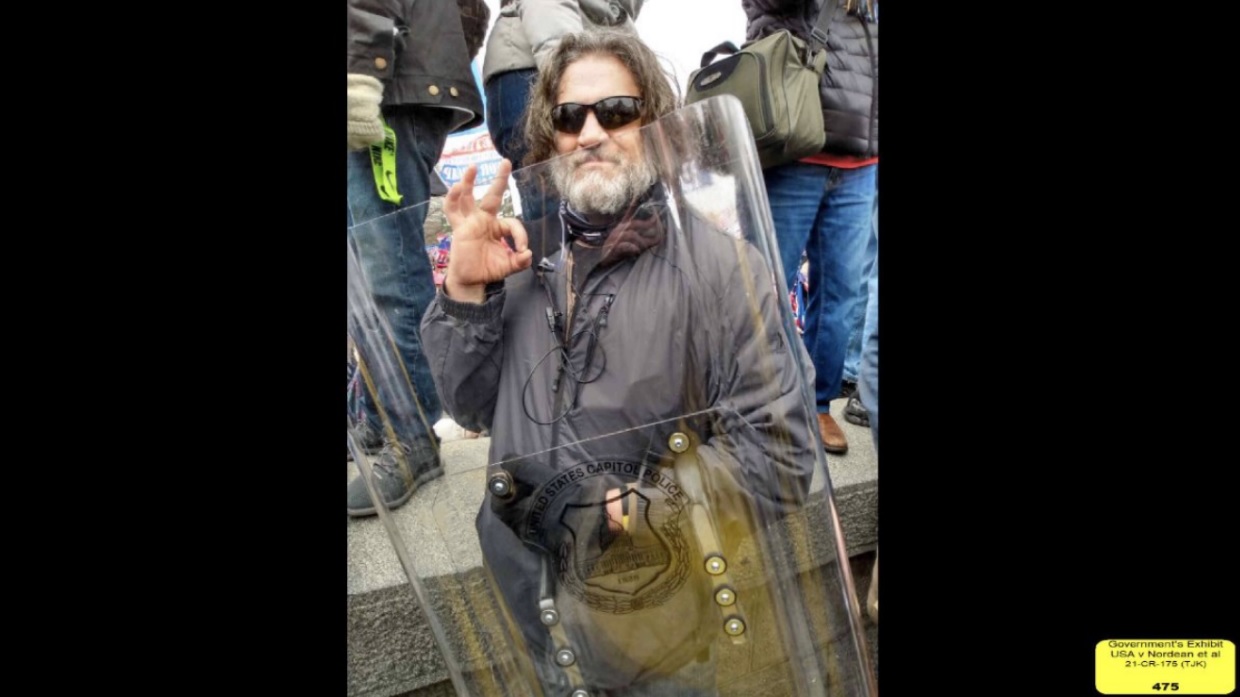
He faces a slew of charges alongside his co-defendants though he is unique in that he faces a robbery charge for his alleged taking of a police riot shield from U.S. Capitol Police officer Mark Ode. Ode testified at trial in February that his experience on Jan. 6 was “terrifying” as he scrambled to replenish officers who were being overwhelmed by rioters invading the building and grounds. 

Rioters were using “some type of chemical spray;” he testified and at one point “it looked like a [person was holding a] small fire extinguisher walking around spraying officers.” It took Ode more than 10 minutes to recover his vision after he was doused.

Under questions from prosecutor Nadia Moore on Feb. 7, Ode said when he was knocked to the ground it was because he was being pulled down as he clung to his shield with one hand before it was wrestled away from him. 

On the witness stand, in a suit and tie, and sometimes with dark-rimmed glasses framing his face, salt and pepper hair, and beard neatly cut, Pezzola started his testimony by communicating what sounded a lot like genuine remorse about what had happened.

“I’m ready to do this,” Pezzola told attorney Steven Metcalf on first day before the jury. “I’m taking the stand today to take responsibility for my actions on Jan. 6 and I’m also taking the stand to explain how these men that I’m indicted with should not be roped into my actions.” 

Willing to cast himself apart from his co-defendants, Pezzola first couched his testimony with a folksy, warm delivery. 

“There was no conspiracy, it never existed,” Pezzola said. 

It was “the craziest damn thing,” he testified. 

“So, I got caught up in the craziness. I trespassed at the first breach, second, I think there may have been a third, I basically trespassed all the breaches and during the scuffle and whole shield incident, I did grab onto the shield and pulled onto it for fear of my own life because deadly force was being used on us by police,” he said.

Pezzola would tell the jury that he acted out a flash of adrenaline that coursed through his body and made him feel as if he were on “autopilot.” 

When he grabbed the shield it happened in a “split second,” he said. Someone else had grabbed it from police, he claimed, and then he grabbed it. And then, he turned to the jury while he confidently declared: “And we’ll have the proof to show this.” 

The Rochester, New York Proud Boy said he was upset as he “watched mothers grabbing their children to get them out of the way to avoid flashbangs.” (The next day on the witness stand he would clarify, “children” meant teenagers.) Elderly protesters, he said, had their “eyes split open” and people had “faces full of pepper spray.” 

“I was upset,” Pezzola said. 

What fueled his outrage to the point that he began screaming at police, he testified, was an injury sustained by another man, rioter Joshua Matthew Black. Black, who is not a Proud Boy, was found guilty this January for entering and remaining on restricted grounds with a deadly weapon. Black was carrying a knife and made it all the way to the Senate floor despite taking a munition to the face shot at him by police who were repelling him, Pezzola, and thousands of others in the crowd. 

Notably, Black posted social media videos after the 6th saying that he joined the mob and crossed barriers to get inside the Capitol because he wanted to “plead the blood of Jesus over it.”   

Black also claimed that he was shot in the face while he was attempting to help a police officer who “was on the ground with boots coming down on him.” 

Pezzola said after Black was shot, he got in closer for a “bird’s eye view of the damage it had done to him.”

“I knew if it had been a few inches higher that shot would have been fatal,” he said.

On direct, Pezzola spent considerable time telling jurors he was in “disbelief” of how police treated “unarmed crowds just pushing against riot shields.”

Things were “dire,” for them he testified. Things were “deadly.” 

Pezzola never saw combat during his time in the military but he compared the use of less-than-lethal munitions by police on the 6th akin to being “underfire by a machine gun or something.”

The military had taught him to ignore his flight response, he said. He claimed “flash bangs” soared into the crowd at a rapid clip but he wasn’t going to turn around or walk away. He was going to “neutralize the danger,” he said. 

Whether or not tales of his perceived heroics in the face of bodily harm were convincing to jurors, there was a palpable missing link in his narrative. 

Pezzola expounded on direct about “rubber bullets” whizzing past his eyes, head, and face. Yet at no point over the months of evidence presented from either side, has any video or photographic evidence emerged showing Pezzola hoisting the police riot shield in a defensive posture over his head or face. On the stand he said he covered his head and remembered bullets hitting right by where his head would have been, but those flew by, he claimed, when he was on the ground in the scuffle. 

When Kenerson pressed him, Pezzola couldn’t recall the moment he might have used the shield to cover his head. It was a “fog of war type thing,” he said. It was a “vague recollection.”

Footage did, however, show Pezzola carrying the shield, ascending Capitol steps with the shield, and then using the shield to smash apart a window. He also found time to take a selfie with it. In other video footage presented in court, Pezzola can be heard replying “yeah” when a man asks him if he had stolen a police shield. 

Pezzola said he only said that to get the person asking questions “out of my hair.” 

Once he was atop the scaffolding, video evidence shows Pezzola screaming at police: “You better be fucking scared! Yeah, you better be fucking scared! We ain’t fucking stopping. Fuck you. You better decide what side you’re on motherfuckers. You think antifa is bad, just you wait.”

In court, Metcalf asked Pezzola: “Did you use that shield to damage any property?”

“I did. When I made it up to the terrace… I did break one pane of glass. One. Someone used a two-by-four… it’s been proven over and over it was less than $1,000,” Pezzola said. 

This is a point that he emphasized more than once as he testified, saying that each pane only cost $774. Further, according to Pezzola, a pane to the left of the one that he broke with the riot shield was already shattered by the two-by-four and therefore: “I struck a completely destroyed pane of glass with a shield,” Pezzola told AUSA Kenerson.

 “I wouldn’t consider it a pane anymore,” he said. 

When Kenerson asked him if he was saying he thought he did no damage, Pezzola smiled wryly at the attorney and told him he was just “twisting his words.”

Where he had been cool, calm, and seemingly collected on direct, Pezzola’s demeanor changed abruptly on cross. He grew more defensive and his tone more abrasive and angry. He smirked regularly or laughed under his breath at Kenerson’s questions.  

“Your goal of busting the window was to have someone to listen to you?” Kenerson asked. 

“Correct,” Pezzola said. 

They were there to express their First Amendment rights, he said. They were “trespassing,” he admitted, but this was the way to “have their voices heard.”

“And this was the way to get the government to listen to you?” Kenerson asked again, footage of him entering the Capitol still on the screen for jurors. 

“At this moment? Correct,” Pezzola said. 

Besides a claim of self defense from police he deemed overzealous, the Proud Boy and his attorney also played down the alleged robbery of the shield by playing up the fact that Pezzola gave the shield back to another police officer before leaving the building. Nonetheless, on cross, the 43-year-old Proud Boy said that was a “last-minute decision.” 

Pezzola met with Charles Donohoe after he got the shield and together, they and Proud Boy Matthew Greene of New York, who testified at trial and has pleaded guilty to conspiracy and obstruction already, moved toward a concrete wall. Donohoe would help him carry the shield for a time, Pezzola affirmed. Jurors also saw a text message Donohoe sent to Rehl and other Proud Boys on Telegram moments after Pezzola got the shield.

When describing his military service to the jury, Pezzola took pains to highlight his experience with antiarmor rockets and crowd control, but in fact, he was never a military police officer, and his very limited experience using flash bangs was restricted to his short stint in the Marines more than 20 years ago. When prosecutors asked him if he was aware that police used sting balls on Jan. 6, a device that delivers less damage than a flash bang, Pezzola refuted it. 

Whatever was used, they were used improperly, he said. 

When Kenerson asked Pezzola how he knew this to be true, he elicited that the only training the Proud Boy had received on crowd control was from a few handouts he received while serving in the military. 

He had no training on “sting balls” he conceded, but that didn’t stop him from offering his non-expert testimony on their deadliness. 

“You’ve never worked with police and you have never taken their protocols?” Kenerson asked. 

“No,” Pezzola replied. “But I know police brutality when I see it.” 

“So the standard you’re applying here is the Dominic Pezzola standard?” Kenerson said. 

“You don’t need to be trained to know that an explosive can kill you,” he said. 

Pezzola emphasized again how he was “afraid for his life” and then footage played in court of him hoisting the riot shield in the air—though not defensively over his head—while he chanted “USA! USA! USA!”

Underpinning the prosecution’s charges is its “tools theory,” which argues that Proud Boys activated their conspiracy to stop proceedings by relying on fellow Proud Boys and “normies” or average protesters alike, in large numbers to aid them, wittingly or not, on Jan. 6.

To that end, prosecutors showed Pezzola video from outside of the Capitol near the Peace Monument. Pezzola testified that he heard a “ruckus” near that area while he was near a line of food trucks. He went off to investigate. It just so happened that when he arrived, barriers were knocked over already, he said.

Kenerson pointed out in footage from the first breach near the Peace Monument that quite “fortuitously” Pezzola appeared at the breach with a Proud Boy from New York right behind him identified as “Hooks.” Hooks was grabbing onto Pezzola as they flowed past police. But Hooks wasn’t with him at the food trucks. 

It was a “contained area,” Pezzola said, adding that he was bound to run into somebody he knew.

When New York Proud Boy William Pepe was seen pulling down barricades in video footage and Kenerson started to ask about it, Pezzola deflected immediately to invoking a highly-favored conspiracy theory that it was rioter and former Oath Keeper Ray Epps who told him and others to breach the barriers and go inside the Capitol. 

Pezzola then suggested to jurors that Epps was a government informant. 

“Mr. Pezzola, you have absolutely no evidence that Ray Epps is a government informant, do you?” Kenerson said. 

“I’ve seen no evidence he isn’t,” Pezzola shot back. 

There was plenty of evidence of his fellow Proud Boys “bumping into” Pezzola on the 6th at critical times, however. 

Like when Pezzola was first approaching the scaffolding, he identified himself in a series of frames from this area and then identified fellow Proud Boys William Pepe, Art Lashone (who he came to D.C. with) and again, “Hooks” and other Proud Boys. After he left the Capitol, he would see Greene again at his hotel, he said, and another Proud Boy identified in court as “Ronie.” When someone asked whether “Ronie” had bear-sprayed a police officer, Pezzola couldn’t say whether he recalled the conversation. He also couldn’t remember what he thought or said when Jeremy Bertino messaged Proud Boys around this time either to tell them they “should have gone further.” 

Pezzola’s temper grew most hot when Kenerson grilled him about his reasons for joining the Proud Boys. Where a day before Pezzola had smiled sheepishly and even laughed as he remarked that at 43 years old, he may have been “too old” to be a Proud Boy when he joined, he was downright surly when Kenerson asked him about his convictions that a “civil war was imminent” in the weeks before Jan. 6. 

It was a fact that the “other side” was trying to destroy the nation, Pezzola said. 

He and his way of life were under daily attack, he said. 

In a letter found in his property after his arrest, Pezzola once wrote at length about his hopes and fears, and his anxieties of a takeover of America by “radical socialists” or communists. Prosecutors say the letter was one Pezzola intended to submit to the Proud Boys when applying to join the organization. This was sometimes a requirement for prospects to the organization in late 2020.  

“You wanted to stand first on line to protect those you love and what you stand for?” the prosecutor asked. 

Angry and defensive, Pezzola testified: “That’s correct and that’s in line with standing against this corrupt trial with your fake charges.” 

He called the trial “fake” at another point too when Kenerson brought up social media posts Pezzola had upvoted or liked, including those from Tarrio and others, like one from Proud Boy Jeremy Bertino who said if the government wanted to declare war on the American people, they could have it. 

Pezzola boiled over. 

“At this point, if I didn’t have a case, I would probably bring up things like this too,” he sniped. 

Kenerson nodded passively and brought up a photo of Pezzola on the ground appearing to wrestle a riot shield away from an officer. 

“So is this fake evidence to you?” he said. 

“I say you interpret it fakely… this is a phony trial because of the way you’re trying to push it off,” Pezzola said. 

Like Rehl, Pezzola denied there was any “plan” on Jan. 6. Maybe they planned to storm the liquor store, he said, but that was it. Otherwise, when he got to D.C. on the 5th, he had no idea what to expect. He wanted to hear Trump speak. On the morning of the 6th, Pezzola said at first he didn’t know who was in charge. It was a “mishmash” of people, he testified initially. Then he said he assumed his now co-defendant Ethan Nordean was in charge because he held a megaphone. Then he said when they started marching to the Capitol, he knew that whoever was in front was leading the group. Extensive video footage played for the jury has shown Nordean and Biggs and Rehl were always at the front of the marching group with Nordean and Biggs specifically commanding the marching group consisting of dozens of Proud Boys to stop or go.

With yet more of his machismo to display, Pezzola finally said Nordean was in charge of the group. 

But “not of me,” he said. 

He was in control of himself. 

At trial, prosecutors also worked to pick apart whatever credibility Pezzola may have lent to his testimony by bringing out details about his lies to the FBI in the early days following his arrest.

In March 2021, while he was incarcerated, Pezzola claimed that he witnessed—firsthand—his co-defendant Joe Biggs and another man, Ryan Samsel, speak to each other moments before the very first breach of the Capitol. Pezzola told the FBI he saw Biggs flash a gun—a 9MM Beretta—and then he said Biggs told Samsel he better “defend his manhood” by plowing past police to prove he wasn’t antifa.

In court, Pezzola testified that he lied about this episode to the FBI at least twice because he thought it would improve his conditions at the jail where he was being held before this trial began. Video footage from the 6th shows Samsel and Biggs speaking but it has not yet been made clear what Samsel said to Biggs in that moment or vice versa. Samsel goes on trial later this summer. 

Pezzola said Samsel was detained in the jail cell next to him initially, and told him this story. Right away Pezzola said he knew it was fake but he nonetheless saw the story as a one-way ticket out of solitary confinement or to receiving his medication he was cut off from or for better “soy free” food that he wasn’t allergic to. He was eventually moved. 

Pezzola also told the FBI that when he was at the Peace Circle, he saw a group of Proud Boys harassing a young boy wearing a Black Lives Matter shirt and that he saw Samsel defend the boy and that later, Pezzola even escorted the boy away from the scene. All of that was untrue, all of it a lie. But admitting that it was a lie specifically more than once or twice in court was a visible struggle for Pezzola.  He time and again met Kenerson’s questions about the veracity of his statements to the FBI with the retort: “I wasn’t there” instead of “that’s not true” or “I lied.”

Though Pezzola testified that he believed the lie about Biggs is what ultimately got him moved into better conditions, Kenerson pointed out how self-serving Pezzola had been. He only got a hand up by falsely incriminating Joe Biggs. 

Pezzola seemed offended by the suggestion. Where loyalty to the Proud Boys was often just under or at the surface of his testimony, and he proudly proclaimed that he had refused to cooperate with the DOJ or take a plea deal, two years ago Pezzola seemed to sing a different tune. 

His attorney at the time, Jonathan Zucker, appeared to express interest in a plea agreement for Pezzola, saying that the father of two teenage girls was “consumed with guilt” and wanted to “disavow and seek to sever any relationship and involvement in future activities of the Proud Boys or similar groups.” 


Share this entry

Glenn Greenwald Keeps Bitching about a Law Requiring Notice If You’re Funded by Russian Spies

The other day, DOJ announced charges in two cases related to FSB efforts to recruit in the US and overseas. Neither set of allegations was entirely new. But what got added to the allegations is of some interest.

Certainly, the fact that American citizens got charged in a Florida case for not disclosing that their political activism was funded, in part, by the FSB, seems to be of interest to Glenn Greenwald. The charges, along with a few overt acts, and the names of two FSB colleagues are what got added to an earlier indictment against the FSB handler, Aleksandr Ionov, filed last July.

Glenn won’t shut up about those charges, making appearances on Glenn Beck and Tucker Carlson’s show so all of them could lie about why members of the African People’s Socialist Party were charged.

The members of the APSP weren’t charged because they disagree with Joe Biden. They weren’t charged because they oppose the war in Ukraine.

They were charged because after one, Omali Yeshiteli, went on an all-expenses paid trip to Russia in 2015, the group started getting funding and completing requests for their FSB handler, Aleksandr Ionov, who ran a front called the Anti-Globalization Movement of Russia. For example, shortly after the trip, Ionov wrote the group and asked them to start a petition against the genocide of the African people in the US so that AGMR could start using it as propaganda. And when Russia needed someone to legitimize the “Donetsk People’s Republic,” in 2020, Ionov contacted the Floridians to publicly do so. And when Russia wanted to protest Twitter’s restrictions on Russian disinformation after the Ukraine invasion, Ionov flew one of the Americans to San Francisco to make it happen.

Russia wanted to be able to point to a certain kind of dissidence in the US, so they paid money to help sustain it. And the Americans didn’t disclose that they knew they were working with agents of Russia.

Glenn thinks only rich people like Tony Podesta should be held to foreign agent laws (Podesta wasn’t charged under a different law, FARA, for hiding his ties to a Ukrainian front group that Paul Manafort set up because he was paid by Manafort, and in any case, Glenn didn’t think much of Manafort’s charges for hiding the ties in real time). Glenn doesn’t think other people should have to disclose if they’re taking money — after they go on trips to Russia and start spouting Russian talking points non-stop from that point forward — from Russian spies.

It’s an interesting cause for Glenn and Tucker — who has his own curious tale about Russian ties — to champion.

Which brings us to the other case.

It charges Natalia Burlinova with attempting to do what Ionov succeeded in doing: getting Americans and others to unwittingly act as agents of Russia by recruiting them through her Russian government backed NGO, Creative Diplomacy, or PICREADI.

Burlinova was sanctioned — along with Ionov — last year, which suggests they may have a tie, perhaps the FSB officer they both report to.

Since she was already sanctioned, which would likely prevent her from traveling in any case, this complaint serves largely as a speaking document, which allows everyone she has had prior association with to understand her ties to the FSB.

For example, the complaint provides a detailed description of a trip she made to the US in 2018 and the emails the American participants sent to Burlinova after meeting with her. It doesn’t provide the content of the emails — but it makes those who sent them aware that the FBI knows what got sent.

Of even more interest is an article a former participant of Burlinova’s event wrote in 2020. Without explaining how he received it, Burlinova’s FSB handler sent it to her and said it’d be a really huge deal if it were published.

On October 30, 2020, the FSB Officer forwarded to Burlinova an article written by a participant in the 2019 Meeting Russia program, which argued that Russian malign influence efforts were actually legitimate uses of state soft power. The FSB Officer commented to Burlinova that the article was a huge result for them and would be revolutionary if printed by a named English-language newspaper in the United States and a named English-language newspaper in Europe.

The complaint doesn’t tell us whether it was published (update: it was this one, which was also posted on Burlinova’s site; h/t Alex Finley). But the description would be plenty for its author to understand that it had been the focus of internal discussion at the FSB.

Both these indictments necessarily focus on the US, but both conspiracies are international. Laying out the charges in the US and arresting anyone that would one day be arrested might something the FBI would want to do before sharing the underlying intelligence with allies.

And some of the details describe the greater international success of this effort. One of Burlinova’s biggest successes, for example, came in seeing two former participants in her yearly event elected to parliament.

On October 5, 2018, Burlinova informed the FSB Officer about two prior participants in another Russian public diplomacy program in which Burlinova had been involved. Burlinova reported that the two prior participants, both of whom resided in a European country, were running for public office. Burlinova stated that these were the results that take years to come into fruition. The FSB Officer responded that this was truly the result for which they were striving and requested that Burlinova provide more information about these prior participants and the election for public office so that the FSB Officer could prepare a report. The two candidates ran for parliamentary positions; one won in that election, and the other was elected subsequently to parliament.

Again, we don’t know which members of parliament these are and in which country, but others in their country likely recognize it.

A report in the WaPo — the timing of which may be coincidental or may explain why DOJ rolled out the charges earlier this week — describes the stakes. It describes the Kremlin’s involvement in the red-brown coalition opposing the Ukraine war in Germany.

The coming together of political opposites in Berlin under the banner of peace had been percolating for months, though the union remains ad hoc and unofficial. But marrying Germany’s extremes is an explicit Kremlin goal and was first proposed by senior officials in Moscow in early September, according to a trove of sensitive Russian documents largely dated from July to November that were obtained by a European intelligence service and reviewed by The Washington Post.

The documents record meetings between Kremlin officials and Russian political strategists, and the Kremlin’s orders for the strategists to focus on Germany to build antiwar sentiment in Europe and dampen support for Ukraine. The files also chronicle the strategists’ efforts to implement these plans and their reports back to the Kremlin. The documents do not contain any material that records communications between the Russian strategists and any allies in Germany. But interviews show at least one person close to Wagenknecht and several AfD members were in contact with Russian officials at the time the plans were being drawn up.

Like the Florida effort, the German one features manifestos written by the Kremlin.

The aim of a new political formation, according to a document dated Sept. 9, would be to win “a majority in elections at any level” in Germany and reset the AfD to boost its standing beyond the 13 percent the party was polling at then. The reset, laid out among the documents in a proposed manifesto for the AfD that was written by Kremlin political strategists, includes forging the AfD into the party of “German unity” and declaring sanctions on Russia as counter to German interests.

[snip]

It is not clear from the documents how the political strategists working with the Kremlin attempted to communicate with members of the AfD or other potential German allies about Moscow’s plans. But soon after the Kremlin gave the order for a union to be forged between Wagenknecht and the far right, AfD deputies began speaking in support of her in parliament and party members chanted her name at rallies. Björn Höcke, chairman of the AfD in Thüringen in eastern Germany, publicly invited her to join the party.

This is the same kind of effort — but much more impactful — as the Ionov one was fostering in the US (though the right wing secessionist described in it as an unindicted co-conspirator, understood to be Louis Marinelli, was not arrested).

And it’s the kind of horseshoe leftist that Greenwald once posed as before he joined up with Tucker full time … most recently to claim these socialists were arrested for their dissidence and not because they were hiding ties with Russian spies.

Update: RFERL did a bunch of interviews with people who attended Burlinova’s program, some who were shocked about the FSB tie, some who were quite blasé about it.

Share this entry

Fox Settles With Dominion: There Was Gambling At Cafe Rick’s Casino

The nuts and graphs are here courtesy of the New York Times:

“The judge in the Fox News defamation case said on Tuesday that the case was resolved, abruptly ending a long-running dispute over misinformation in the 2020 election just as a highly anticipated trial was about to begin.

It was a last-minute end to a case that began two years ago and after the disclosure of hundreds of thousands of pages of documents that peeled back the curtain on a media company that has long resisted outside scrutiny. The settlement included a $787.5 million payment from Fox, according to Justin Nelson, a lawyer for Dominion.

“The truth matters. Lies have consequences,” he said outside the courthouse. “Over two years ago, a torrent of lies swept Dominion and election officials across America into an alternative universe of conspiracy theories causing grievous harm to Dominion and the country.”

Dominion had originally sought $1.6 billion in damages. Fox Corporation said in a statement that “we acknowledge the court’s rulings finding certain claims about Dominion to be false.”

It added: “We are hopeful that our decision to resolve this dispute with Dominion amicably, instead of the acrimony of a divisive trial, allows the country to move forward from these issues.”

The agreement was reached a few hours after a jury in Wilmington, Del., was selected on Tuesday, just as opening statements were expected to begin. Lawyers for both sides had been preparing to make their cases to the jury, their microphones clipped to their jacket lapels.

The sudden settlement means no high-profile Fox figures — including those who privately expressed concerns about the veracity of claims being made on its shows — will have to testify. The expected witness list had included Fox executives, including Rupert Murdoch, the chairman of Fox Corporation, and the hosts Tucker Carlson, Sean Hannity and Maria Bartiromo.

It was the latest extraordinary twist in a case that had promised to be one of the most consequential against a media organization in a generation.

The trial had been expected to be a major test of the First Amendment, raising questions about whether defamation law adequately protects victims of misinformation campaigns.

While the settlement avoids a lengthy trial, it still results in a rare instance of accountability for attempts to delegitimize President Biden’s victory. Few people or organizations have faced legal ramifications for claims related to electoral fraud that were brought by former President Donald J. Trump or his supporters.

Dominion sued Fox in early 2021, arguing that its reputation was badly damaged when Fox repeatedly aired falsehoods about its voting machines. Fox denied wrongdoing, saying that it had merely reported on newsworthy allegations that were coming from Mr. Trump and his lawyers and that it was protected in doing so by the First Amendment.

Judge Eric M. Davis had previously ruled that statements Fox had aired about Dominion were false, and functionally limited some of its potential defenses by deciding that its lawyers could not argue that it broadcast false information on the basis that the allegations were newsworthy.

At trial, a jury would have been tasked with answering the question of whether Fox had acted with “actual malice” — a legal standard meaning it had knowingly broadcast lies or had recklessly disregarded obvious evidence that the statements were untrue.”

Personally, I am shocked to find such gambling here in Ricks Cafe. Or not so much. Am feeling pretty good about my post yesterday morning.

I’ll leave it at that for now. Who could have known?

And for the inevitable dopes that will wander in to say “Ohhh, this was not enough!”, or “Ohhh there needed to be more admission and contrition!”, please stop. This was a fine and appropriate settlement. This case was NEVER about you and your politics, it was a jury trial case, which was NEVER going to be about you. Stop now.

Share this entry

Rudy Giuliani Claims He’s Shooting Blank Documents

Ruby Freeman and her daughter Shaye Moss have, as Beryl Howell invited them to do, moved to compel Rudy Giuliani to comply with discovery in their defamation lawsuit. The two 2020 Georgia election workers sued for the damage caused by the lynch mob Rudy summoned by falsely claiming they were attempting to steal votes after he saw a video showing Moss passing her mother a ginger mint.

The motion and all its exhibits are here.

What seems to be happening is that Rudy, having had his phones seized in 2021 and successfully avoided — thus far — charges for his Ukraine influence-peddling, is deliberately slow-walking discovery here to avoid identifying any devices or records that prosecutors can use in that investigation, the Georgia investigation, or Jack Smith’s January 6 one, all while sustaining a story that is already starting to fall apart.

As described in the motion to compel, Rudy’s non-compliance has included:

  • Refusing to turn over any phone or financial records
  • Refusing to explain what accounts and devices he has included in his searches
  • Failing to search for texts and messaging apps from the phones seized in 2021
  • Providing discovery based on much earlier requests from the January 6 Committee and Dominion’s lawsuit against him, rather than the requests from Freeman’s lawyers
  • Providing documents on Hunter Biden along with one Pentagon City Costco receipt
  • Others — like Bernie Kerik and Christina Bobb — similarly refusing to comply
  • Claiming, then disclaiming, reliance on “unknown GOP operatives” for the false claims made about Freeman
  • Refusing to describe how he became aware of the surveillance footage on which he based his false claims about Freeman and Moss

As a reminder, back on April 21, 2021, DOJ obtained a warrant for around 18 of Rudy’s phones in conjunction with the investigation into Rudy’s Ukrainian influence peddling that Bill Barr had successfully obstructed. By September of that year, DOJ had convinced Judge Paul Oetken to have Special Master Barbara Jones to review all the contents on his phones, not just that pertaining to the Ukraine warrants. Since then, I’ve been arguing that DOJ could — and at this point, almost certainly has — obtained that content for use in the January 6 investigation.

Dominion sued Rudy back in 2021. The January 6 Committee subpoenaed Rudy in January 2022 and interviewed him in May 2022. Those are the discovery requests on which Rudy is attempting to rely in this suit, rather than doing searches specific to the requests made by Freeman’s lawyers.

But after May 2022, Rudy’s exposure in Georgia went up. In addition to Freeman’s lawyers filing their amended complaint on May 10, 2022, Fani Willis convened her grand jury on May 2, 2022, subpoenaed Rudy to testify in June 2022, and he testified in August. It is virtually certain that Rudy gave answers to Willis — at the very least, about what he knew of Trump’s call to Brad Raffensperger on January 2 — that subsequent testimony has since disputed and on which topic he has since amended his interrogatory response.

The materials in this motion reveal that Rudy’s lawyer in this matter (Joe Sibley — who represented Christina Bobb in a J6C deposition that conflicts with Rudy’s answers here, though Robert Costello was present for Rudy’s March deposition) at first promised thousands of documents to Freeman’s lawyers, while claiming that most documents would be unavailable because of the Special Master process tied to the Ukraine investigation. Last July 12, Rudy provided 1,269 documents he had also turned over to Dominion’s much earlier request, which Freeman’s lawyers describe as, “his first and only substantial document production to date.”

Then, on August 3, Robert Costello made a showy announcement that SDNY had ended the Special Master process, which is not the same thing as getting a letter that he’s not a subject of that investigation anymore. Shortly thereafter, Freeman’s attorneys pointed out that the excuse Rudy had been using to limit his discovery in this case was no longer operative. He had the phones that — he claimed — included all his communications from the period during which he had started the conspiracy theories about Freeman.

After that showy announcement from Costello on August 3, things changed dramatically. In September, Sibley told Freeman’s lawyers there were 18,000 documents relevant to discovery in the materials seized from his phone. A month later, he said there were 400. In October, Rudy turned over 177 of those documents, 51 of which were blank. Since then, Sibley seems to have provided answer after answer that amounted to throwing up his hands when describing the state of Rudy’s discovery.

Rudy is quite literally attempting to claim he can only shoot blank documents in hopes of getting through this discovery process.

In his March 2023 deposition, Rudy claimed that the physical phones returned by SDNY — which he says only happened in August — were “wiped out.” What actually seems to have happened is that he hasn’t figured out how to access the content saved to the cloud by discovery vendor TrustPoint, and may not have tried to access the phones themselves, which I believe Costello had publicly claimed to have been returned earlier last year.

But far and away the best way to understand his answers are that, first of all, he and Bobb gave materially inconsistent answers while being represented by Sibley, most notably on the topic of whether they participated in the Brad Raffensperger call, which Bobb said they did and Rudy originally claimed — and presumably claimed to Fani Willis’ grand jury — that they had not.

Just as importantly, Rudy may be aware of both messaging apps and phone accounts that he’s not certain prosecutors in SDNY, Georgia, or DC have identified, so he’s refusing to be forthcoming about all the devices and phone accounts he used. There are probably communications from his phones that Costello successfully claimed were privileged during the SDNY Special Master process, which would be obviously crime-fraud excepted in any proceeding before someone who knows the January 6 investigation well. Prosecutors in both SDNY and DC will be able to tell after a quick review of exhibits included with this motion to compel whether Rudy’s claims about the status of the phone content from TrustPoint are accurate.

And therein lies the risk of the game that Rudy is playing.

This would be an obviously bullshit response before any judge, including Carl Nichols (who is presiding over the much more leisurely Dominion suit against Rudy).

But by luck of the draw, he’s attempting this stunt before Beryl Howell, who even on good days does not suffer fools at all, much less gladly, and who until just a month ago was the Chief Judge presiding over all the grand jury proceedings in DC, including the January 6 investigation. She’s one of just two or three judges who knows whether DOJ asked for and obtained a warrant to get the stuff from Rudy’s phones in SDNY. If they did (and I’d bet a very good deal of money they did), she would have seen an affidavit explaining in what form DC USAO understood that phone content to be, and if they did, she has likely overseen discussions about any further attorney-client protections DOJ had to adhere to. If DC USAO obtained warrants for other cloud content, she might also know about any accounts that Rudy is not disclosing to Freeman, including those whose email and phone accounts Rudy consistently used as a proxy. She likely has a sense of how many phone accounts DOJ has identified for Rudy, none of the call records of which would be subject to attorney-client protection. She may know of other aliases that Rudy used in his assault on the election.

Rudy is pulling this contemptuous stunt in front of the one judge who may know the extent to which he’s bullshitting.

Which may be why, at a few points in Freeman’s Motion to Compel, her attorneys note that they’re only asking for modest relief, basically just leverage to get Rudy to actually answer the questions, as well as attorney fees for their time he has wasted.

But Judge Howell? Well, if she wants to use her discretion to provide expanded relief, Freeman’s lawyers say, they’d be open to that too.

The relief Plaintiffs seek in this Motion is narrow, while recognizing that the Court in its discretion may enter additional forms of relief, including sanctions. Plaintiffs reserve all rights relating to seeking expanded forms of relief in the future.

At this point, there are at least two criminal investigations into Rudy and two civil suits — January 6, Georgia, Dominion, and this suit. Even before reviewing his J6C transcript, it’s easy to identify plenty of ways his evolving answers here, amended in part because of inconsistent testimony given before the J6C, conflict with what he must have answered before the Georgia grand jury, which could start issuing indictments any day.

Juggling all that legal exposure would be difficult for a sober, organized man with little real legal exposure.

For Rudy, though, this insane approach may be, at best, a futile attempt to limit the damage this civil case can do to his criminal exposure.

Share this entry

Dominion v. Fox – Now What?

Members of the Emptywheel community are on top of almost everything. So you probably know that late over the weekend, the judge in the Dominion v. Fox defamation trial in Wilmington Delaware continued the trial. For one day, moving the continuation of jury selection from this morning, Monday, to the same time, 9:00 am, tomorrow, Tuesday.

That caused quite a stir on the internet, but, as the judge explained today, is quite common, although he did not say why it had been done in this case.

The speculation is that it was to give one extra day past the weekend for the parties to contemplate settlement. Courts, especially a rapid moving one like the Delaware Court, rarely do that on their own. One or both parties have to request it. Was it Fox, Dominion, or both?

Then late last night, there were reports there had been no settlement reached. That is not surprising in the least, as Sunday would have just been the start, any really settlement would come Monday. So far, so good, but now what?

Short answer is that is unclear. Even today is not a drop dead deadline. Trials can be settled even during jury voir dire or into arguments and evidence. I would very much think the judge here would rather it be sooner rather than later, but doubt given the strain on the court, would probably accept it at any point.

The internet hills are alive with the sound of (almost always) non-trial lawyers yammering that Dominion should “not” settle, because the “public” is entitled to this spectacle.

What a load of bullshit. There are two parties to this civil litigation, and the “public” is not one of them. But the two actual parties in interest, Dominion and Fox have their own interests and needs that obliterate public call for a show trial for their puerile amusement, and “popcorn” moment.

Attorney Brad Moss noted:

“For those asking why Dominion might settle, there are at least three things to remember:

1) non-trivial chance the pre-trial rulings get reversed on appeal and the whole thing is tossed;

2) trials are a wild card; and

3) if they can accomplish their primary goals, why not?”

Attorney Peter Zeidenberg, who this blog knows well if you go far enough back, said:

“Better reason: the damages case for $1.6B is pretty weak. If awarded it could easily get tipped on appeal. $500M would be a tempting offer.”

Frankly, I agree with both on this. Will the case settle? I have no idea, but there are good reasons for both parties to try. And it would certainly thrill the court. There is a lot of sense in making the attempt.

Share this entry

Christina Bobb’s Rent-an-Attorney-Client Cut-Out Computer

Back in March, ABC reported that Fani Willis wanted to interview Christina Bobb in the probe of Trump’s attempt to overturn Georgia election results.

Smart commentators on that investigation, like Lawfare’s Anna Bower, suggested that Willis’ team likely had discovered, as they worked their way through the January 6 Committee transcripts released after Willis’ grand jury had expired, that whereas Bobb has always publicly claimed to have nothing to do with efforts to overturn Georgia’s election (she focused on Arizona, Nevada, and, in her J6C interview she belatedly admitted, Michigan), she revealed much later in the interview that she had first met Mark Meadows when she sat in on Trump’s call to Brad Raffensperger.

Bobb’s description of the call is pretty nutty.

Q Did you have any interactions with him in the post-election period?

A I — sorry. My phone is ringing. Okay. Yeah, one. One that I remember was the phone call, the Brad Raffensperger phone call. I was in Meadow’s office with Rudy, I think Katherine [Friess] was there. There may have been one other person there, but we listened in on the call from Meadows’ office.

Q Had you met him before that?

A No. I don’t think so.

Q Do you remember — go ahead. I’m sorry.

A No. I don’t think — I think that was the first time I met him.

Q Do you remember talking to him before that, even if not in person?

A No. I never did.

Q When you gathered for that call, what was his expectations for the call? What was the purpose of that call?

A I think to listen and, you know, be available as needed, but I think the whole point was just to listen.

Q Did he say anything about what the President was or was not going to request or seek by this call?

A No.

Q Do you remember if Mr. Meadows expressed any concerns about having this call?

A No. I don’t think he did, but I don’t remember, but I don’t remember him expressing any concerns.

Q Were you able to hear the call that the President had with Secretary Raffensperger?

A Yes.

Q What happened afterwards, when you were sitting there and, you know, the phone is hung up now?

A Nothing. We chit-chatted and left. It was — it was an unremarkable call.

I know the media has sensationalized it, but none of us thought anything of it. It was just a call and that was it.

Q I mean, the President of the United States asked the Secretary of State to find enough folks to ensure his victory in Georgia. I mean, he used those words, I’m just asking you to find votes.

A That is a gross misrepresentation of the phone call. It was a perfectly fine phone call. If you look at the transcript, he was not asking anything improper. He wasn’t asking him to do anything illegal.

There was a lot of indicators of fraud. That’s what he was talking about. He was not — nobody in the room thought there was anything wrong with the phone call. I think it was perfectly fine.

Nuttier still, after she defended it as a “perfectly fine” call, she explained that she and “at least two dozen” others sat in on it because, “we knew somebody was going to record it [and] release it.”

Q So I understand your perspective, but I did want to ask you that, what you just got to is that after the call, did anybody express any concern, reservation, have any thoughts about what had just happened in that call?

A No. But there were a lot of people on the call. Like there were probably at least two dozen, like there was, you know, half a dozen of us in the room, but then there were other — there were a lot of other people on the call.

We knew somebody was going to record it. We knew somebody was going to release it. We knew the media was going to twist it, which was exactly what happened, but nobody was concerned about it. Our concern was, was it a legitimate phone call and did the President say anything improper. And at the end of the call, we all thought no. Like it was totally fine. There was nothing wrong with it. So we didn’t think anything of it, and we chit-chatted and left.

As she describes it, she and twenty people were on the call as a prophylactic against the outcry when one of those twenty people or someone from Raffensperger’s team released the call to the press.

Bobb also admitted in the interview to witnessing Rudy Giuliani’s call to pressure Rusty Bower to overturn the Arizona vote, and described that she may have been Rudy’s representative on a different fake elector call.

Bobb did a whole lot of witnessing during this period for someone who had never left propaganda outlet OAN during the entire post-election period, when she was also claiming to play a role covered by attorney-client privilege.

That’s an interesting dynamic behind the reason I finally slogged through her transcript, to understand certain questions Jack Smith has been asking about the stolen documents investigation, particularly why Boris Epshteyn asked Bobb to be the gal who certified a declaration she hadn’t written.

It turns out there were at least two details in her J6C transcript that raise interesting questions about her role in the stolen documents case. First, in this April 21, 2022 deposition, Bobb revealed that she had had interactions with Alex Cannon after Joe Biden’s inauguration.

Q How about Alex Cannon?

A At that time, no.

Q You said at that time. Have you interacted with him since January 20, 2021?

A Yes.

Q Unrelated to the events we are talking about today, January 6 and the lead up?

A Yes. Correct.

In reporting on Bobb’s role in the June 3 subpoena response, she claimed to have no prior interaction with Evan Corcoran, who wrote the declaration. But interaction with Cannon would reflect ongoing involvement in purportedly legal matters after the coup attempt.

And consider the kind of lawyering her J6C testimony described her to be (and remember that other witnesses said she played no legal role, but was just involved in communication).

When the committee asked about the mid-December 2020 memo recommending that Trump invoke national security as an excuse to seize the voting machines — which, metadata shows, Bobb authored, and which, the interview revealed, she had not provided in response to a subpoena — she explained that she didn’t really author it. She just went to lunch with Phil Waldron and wrote down what he said. And then emailed what he said back to him.

I started the document, took their notes down, whatever. And then Colonel Waldron asked me to email it to him, which I did. What happened with it from there, I don’t know.

So I don’t know. I’m not sure that this — I don’t know. I don’t know if this is — this looks like what I originated on my computer, but I think it went past whatever I had done, because what I had done, I think — when I say I had done, I started the document. They wanted to work on it. They used my computer to work on it, and then when they were done doing whatever they were doing, said, hey, can you email this.

And I think that’s probably it, but I am not — you know what I mean, like, I don’t know what they changed after it left my computer.

Q Yes.

A But I had some role in initiating something like this in the sense that I had a computer that people wanted to use, and that was it.

As investigators probed this remarkable story, Bobb said Waldron was with someone named Mike but not that Mike, Mike Flynn, because she knows him, and maybe Sidney Powell but she doesn’t know.

Q Okay. All right. So let me unpack some of that. You are with Colonel Waldron. Who else is there?

A It was people that he was working with. I don’t know their names. know there was a guy named Mike. I don’t know his last name. And it was folks that — like it was the machine team folks that, you know, I didn’t really know them.

[snip]

Q What about Sidney Powell?

A She may have been. I don’t know. Like because I gave them my computer, they finished doing whatever they were doing. While they were doing that, I was working from my phone and taking calls, so I would step out and come back in.

So to the extent someone came in and out, I don’t know, you know.

As things progressed, Bobb included details that might explain a Google search from her computer of the statutes invoked, but insisted she “literally just like formatted it.” And provided the title.

Q When you started working on this, or what became this document, were you working with something else as an example? Like did you have another executive order that you used as a model?

A Probably. And I wasn’t — like I probably just found one and put it together, but just so you know, I was not putting — I didn’t do the substance and stuff of this. Like the authorities that they used and all that, I didn’t do that. I just literally just like formatted it.

[snip]

Q And were you typing up from scratch or did you have something else that you were modifying?

A I wasn’t typing it. So the — like I probably — I probably did pull up an executive order just to see like the title, but literally past the title, I did not provide that content.

Q Okay. You gave your computer to Mr. Waldron. Is he the one that was typing on your computer when they were working on this document?

A He did some of it, and then this guy Mike, whoever he was, was doing some of it. I don’t know. It was like they were brainstorming collectively and working. I don’t know.

Q One of the things you mentioned there in the authorities, just past those that you referred to, are National Security Presidential Memoranda 13 and 21.

Did you have anything to do with inserting those?

A No. I had nothing to do with the authorities.

[snip]

Q No. Do you remember Colonel Waldron or Mike or anybody else typing —

A Colonel — I’m sorry. I don’t mean to interrupt you.

Q That’s okay. Do you remember them talking about presidential  memoranda?

A I remember vaguely, like I don’t have a good recollection. I’m going to give you what I think I remember. And I remember it sounded like they wanted to do something intelligence related, and EO 12333 is like the standard intelligence authority.

So I remember thinking that that made sense. And then I remember thinking I have no idea what they are doing with the other stuff. That’s the extent of my memory.

Q Okay. As far as the next paragraph it says, I, Donald J. Trump, President of the United States, find that the forensic reports of the Antrim County, Michigan, voting machines released on December 13th — and then it goes on.

Did you have any role in writing this either as a scribe or something that you came 20 up with?

In the middle of a deposition where she turned on attorney-client privilege at will, she described herself here as a “scribe.”

A I definitely didn’t come up with it. I could have been a scribe. I mean, I was — I was a scribe for a lot of things. And, like I said, I started this document.

I don’t — like I’ve also said, I don’t have the information on Dominion voting systems.

So if I physically typed this out, I had to have someone dictate it to me because I don’t have this information.

Q Tell us about the conversations you had with Mike and Colonel Waldron about this. Like what was the purpose of it, as you started to draft and pull up an example —

A I didn’t — I honestly didn’t have a whole lot. They had mentioned that they were brainstorming some type of proposal to see if there was some government action to be taken on machines or whatever. I don’t know a lot about the machines. I don’t have a lot of information on the machines. And I was more curious about the authorities because, you know, I didn’t know what authority they would use to do it.

And the two documents, one being DOD, one being DHS makes sense because I remember, you know, there was posse comitatus issue and they were talking about, you know, like DHS needs to be the lead because the military can’t do it, whatever. I don’t know. I don’t even think I weighed — I do not remember weighing in on anything substantive about this.

And the legal advice? In spite of her awareness that the memo distinguished between DOD and DHS, the agency for which she had only recently been an attorney, she didn’t have anything to do with the shitty legal advice, she says.

Q Okay. So that was going to be my next question. Without disclosing any legal advice you may have provided, were you asked to provide legal advice about this and weigh in from your perspective as a lawyer?

A I don’t think so. No.

[snip]

What do you remember about any discussions related to the appointment of a special counsel in connection with this document?

A I have limited — like I have hazy recollection, but based on the fact that it says “her,” I’m guessing they were probably thinking Sidney would get appointed, but I can’t confirm that.

Q Okay. Do you know why Colonel Waldron wanted Sidney to be appointed as a special counsel?

Q I don’t

[snip]

Q Now, working on their — on your computer, how does it get to that? And I’m sorry if you already said this.

A Yeah, that’s okay. When they were done with it, they gave me my computer back and said — I don’t remember who said it, but it was probably Phil said can you email this to Phil, or can you email this to me. And I sent it to Phil from there, and that was it.

This testimony is positively amazeballs.

And whether there’s a scrap of truth to Bobb’s claim that she, on a topic about which she fancied herself playing a legal role, simply gave her computer to non-lawyers (and maybe Sidney Powell) so they could draft a memo providing advice to the President of the United States, about a topic — national security law — on which she claims some expertise, that she would then blindly email to them without first reviewing, whether there’s a shred of truth to any of this or not, it certainly explains why Boris Epshteyn would think Bobb might be a good candidate to participate in an effort to dupe the FBI as they investigated stolen classified documents. It also may explain why she disclaimed playing a legal role when she testified in October, so she could offer the FBI a similar story about playing the same kind of dumb cut-out for legal advice.

Christina Bobb, in an interview in which she was warned that any lies could be prosecuted as False Statements (though in which she was not placed under oath), told an absolutely fantastic story about how her computer came to write a historically shocking document in the run-up to an insurrection, but she had nothing to do with what her computer wrote.

Share this entry

“$$$$$$:” Josh Dawsey Comes Full Circle on Trump’s Fundraising Corruption

I’m going to share something I’ve been laughing to myself about for months, since before I wrote this post on how the financial aspect of Jack Smith’s investigation would be a way to break through the otherwise formidable wall of lawyer-witnesses between investigators and Trump’s crimes.

There’s a reason why the fundraising aspect of Trump’s Big Lie has been accessible to investigators, even beyond the fact that there’s boatloads of financial evidence available with a subpoena. That’s because reporters, including Josh Dawsey, were able to track Trump’s fundraising in real time back in 2020, and when they saw what he was doing, they asked the Director of Communications for Trump’s campaign, Tim Murtaugh, about it.

Heck, Dawsey even wrote a story on December 1, 2020, over a month before the Big Lie led to an insurrection, reporting on this scam.

President Trump’s political operation has raised more than $170 million since Election Day, using a blizzard of misleading appeals about the election to shatter fundraising records set during the campaign, according to people with knowledge of the contributions.

The influx of political donations is one reason that Trump and some allies are inclined to continue a legal onslaught and public relations blitz focused on baseless claims of election fraud, even as their attempts have repeatedly failed in court and as key states continue to certify wins for President-elect Joe Biden.

Much of the money raised since the election is likely to go into an account for the president to use on political activities after he leaves office, while some of the contributions will go toward what is left of the legal fight.

[snip]

The donations are purportedly being solicited for the Official Election Defense Fund, whose name is featured prominently atop the Trump campaign’s website.

There is no such account, however. The fundraising requests are being made by the Trump Make America Great Again Committee, a joint fundraising effort of the Trump campaign and the Republican National Committee. As of Nov. 18, that committee also shares its funds with Save America, a new leadership PAC that Trump set up in early November and that he can use to fund his activities after the presidency.

Dawsey appears to have gotten no response from Murtaugh.

What happened with his inquiry instead — along with one Politico’s Maggie Severns sent on November 11 and a follow-up question CNN’s Jeremy Diamond sent on November 24 — is that Murtaugh, who could have no conceivable attorney client privilege, sent the query to Justin Clark, who otherwise would have attorney-client privilege, along with a bunch of other senior campaign officials, to ask whether they should “still ignore” press inquiries about the fundraising.

In the case of Dawsey’s email, they said things like this to each other:

On Nov 30, 2020, at 7:03 PM, Tim Murtaugh <[email protected]> wrote:

I side with no comment. He’s going to write about the split and if we say stuff about legal expenses it will serve to highlight the argument that the fundraising pitch is misleading.

From: Jason Miller <[email protected]> Sent: Monday, November 30, 2020 7:24 PM

To: Tim Murtaugh <[email protected]> Cc: Sean Dollman <[email protected]>; Justin Clark <[email protected]>; Bill Stepien <[email protected]>

Subject: Re: [EXTERNAL]$$$$$$

Fair points. Sean -what are the reporting deadlines for these respective entities -12/15? It will be tougher to dodge such answers after reporters can find it themselves.

[snip]

Re: [EXTERNAL]$$$$$$

We should talk tomorrow about whether to just announce this by press release like we would any other fundraising announcement. If we have the numbers we can discuss how the breakdown among entities needs to be messaged. Also key, as Jason pointed out, that POTUS is on board with how it will be described. [my emphasis]

In response to Dawsey’s query back on November 30, 2020, Murtaugh, Clark, Jason Miller, CFO Sean Dollman, and Campaign Manager Bill Stepien exchanged emails recognizing that the fundraising pitch they were using was misleading, strategizing how they were going to continue to distract journalists from the misleading aspect of their pitches after they had to disclose their fundraising, and noting that they were going to ask Trump if he was comfortable with them fluffing journalists on how they were misleading small donors.

And Murtaugh, because he had no conceivable privilege in these exchanges, sent this exchange to the January 6 Committee and, I assume, to DOJ when they subpoenaed him.

That’s why I find it hilarious that Dawsey, in a report on a new set of subpoenas sent out in March that follow ones sent in December or November and September, wonders whether prosecutors will find the same kind of damning evidence that Trump’s campaign knew they were engaged in fraud as the Steve Bannon Build the Wall fraud did.

It’s unclear whether prosecutors will find similar kinds of evidence to support an indictment in this case.

I’m pretty sure they’ll find it, because that evidence has your name on it, Josh! One way Jack Smith will prove that Trump’s people knew they were lying to the rubes sending in their spare cash is by showing how panicked the campaign was when people like Dawsey started to ask about it.

WaPo suggests the subpoenas he describes disclose “the breadth of Smith’s investigation” and claims this prong of the investigation follows the release of the January 6 Committee Report.

The special counsel’s increased interest in fundraising follows the December release of the final report of the House select committee that investigated the Jan. 6 attack, which concluded that the Trump campaign and Republican National Committee’s joint fundraising operation brought in $250 million between the November election and Jan. 6, sending as many as 25 emails to supporters each day, many claiming that the election had been “rigged” or that Democrats had tried to steal the presidency and urging people to join the “Trump Army.” The Trump campaign sent several emails on Jan. 6 itself, including one declaring, “TODAY. This is our LAST CHANCE … The stakes have NEVER been higher. President Trump needs YOU to make a statement and publicly stand with him and FIGHT BACK.”

But not only have other outlets been reporting on it, CNN reported in December that this financial prong of the probe (which like NYT, they reported in September) had been going on, at that point, for a year, though the PAC prong of it may have post-dated the J6C presentation of this scam last June.

Another top prosecutor, JP Cooney, the former head of public corruption in the DC US Attorney’s Office, is overseeing a significant financial probe that Smith will take on. The probe includes examining the possible misuse of political contributions, according to some of the sources. The DC US Attorney’s Office, before the special counsel’s arrival, had examined potential financial crimes related to the January 6 riot, including possible money laundering and the support of rioters’ hotel stays and bus trips to Washington ahead of January 6.

In recent months, however, the financial investigation has sought information about Trump’s post-election Save America PAC and other funding of people who assisted Trump, according to subpoenas viewed by CNN. The financial investigation picked up steam as DOJ investigators enlisted cooperators months after the 2021 riot, one of the sources said.

That may be why Merrick Garland has been saying the investigation was following the money since October 2021, at which point the similar fraudulent fundraising investigation into Sidney Powell was reported by … the Washington Post.

The investigation into fundraising fraud is important by itself for the (outside) possibility it’ll lead Trump’s supporters to turn on him for cheating them. It could help to prove that Trump’s efforts to obstruct the vote certification on January 6 were “corrupt” by any definition of the term that the DC Circuit will ultimately adopt. But it likely also serves as a useful prosecutorial tool not just because it had a public-facing aspect that resulted in non-privileged conversations like the one above, but also because a goodly number of Trump people who weren’t implicated in the actual election theft were involved and cognizant of the financial fraud.

Share this entry