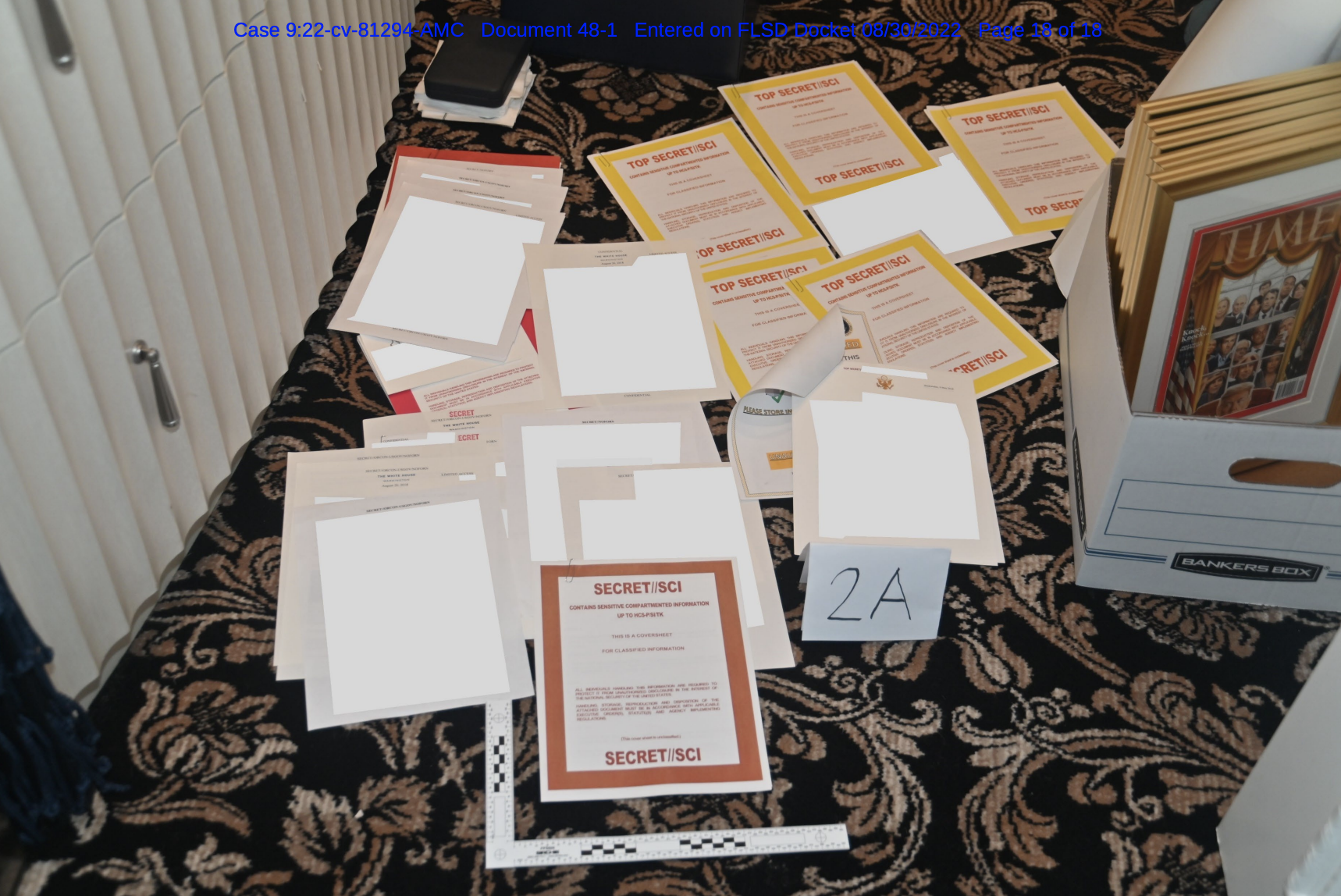
Kash Patel’s Immunized Testimony Is about Premeditation, Not (Just) about Declassification

Thankfully, the NYT has written a second story reporting that DOJ is considering asking Beryl Howell to give Kash Patel use immunity in the Trump stolen document investigation, because I was about to go back and write about the first one.

Earlier this month, the prosecutors summoned Mr. Patel to testify before a grand jury in Washington hearing evidence about whether Mr. Trump had mishandled classified documents and obstructed justice when he refused to return the records to the government.

Mr. Patel repeatedly invoked his Fifth Amendment right against self-incrimination. In response, prosecutors asked a top federal judge in Washington to compel Mr. Patel to answer questions — a move Mr. Patel’s lawyers have strenuously opposed. The question now is whether the Justice Department will grant him immunity in order to secure his testimony.

The first was newsworthy — as I laid out in this thread and as Jay Kuo wrote up in this piece — for its silence about the fact that Stanley Woodward is the defense attorney for both people described in the story (the other was Walt Nauta, the valet who moved documents around before Evan Corcoran did a search of what was left).

Woodward represents a slew of key defendants who might serve as firewalls in a larger and much more damning crime: in addition to Patel and Nauta, Dan Scavino, Peter Navarro, Oath Keeper Kelly Meggs (who has ties to Roger Stone), and the guy who kicked off the entire riot, Ryan Samsel. Woodward’s a decent defense attorney (not least because, unlike many Trump attorneys, he is a defense attorney), but he’s got a conspiracy streak that should be accounted for when reporting on his representation of events.

Both NYT stories portray Patel’s unnamed attorneys as resisting the move to immunize him.

In response, prosecutors asked a top federal judge in Washington to force Mr. Patel to testify — a move fought by Mr. Patel’s lawyers, who are concerned the government wants to use Mr. Patel’s own statements to incriminate him. [first]

[snip]

The push for the testimony has also created friction between the Justice Department and Mr. Patel’s lawyers, who have argued that the department could use his statements against him if they build out a larger obstruction investigation. [second]

This is, frankly, silly reporting. Stanley Woodward doesn’t get a choice in whether Patel is immunized. That’s the point: You immunize a witness to compel his testimony. And defense attorneys and prosecutors are adversarial; there is supposed to be “friction” between them. That’s the nature of an adversarial system.

Including these claims in the story without explaining the import of compelled testimony does a disservice to readers and makes the story far more of vehicle for obstruction.

Best as I can tell (it’s hard to tell, because the part of the earlier story addressing immunity was so muddled), this version of the story adds no new news except for the self-congratulatory detail that Trump only learned that Kash took the Fifth from the earlier story.

Mr. Trump first learned that Mr. Patel had invoked the Fifth Amendment when The New York Times reported it on Monday, according to person briefed on the matter.

This is not actually interesting unless you’re a NYT reporter or someone like Stanley Woodward wanting to make clear he’s not directly consulting on these defense issues in advance with Trump himself, which is different than consulting with someone like Boris Epshteyn, who (unlike Woodward) is not a defense attorney but nevertheless is purportedly in charge of Trump’s defense. It just so happens that these anonymously sourced stories provide all the details that Trump would need and Woodward would want public to make sure he still got paid. (Not addressed, however, is a reference in the earlier story boasting about the treatment of the video surveillance that would have led to changed testimony from Nauta.)

Sadly, this story utterly misses several key points about the import of Kash Patel’s testimony.

First, consider Kash’s potential responses if Beryl Howell does grant him use immunity. Either he testifies truthfully, he lies, or he still refuses to testify and gets jailed for contempt. This is the real tension that Woodward is getting at — what should Kash do if he is immunized, as if the story is begging for directions from those paying the bills. While Trump was still President, the answer was easy: lie and await a pardon. It’s more complicated when you’re firewalling someone who may not return to the presidency anytime soon.

More importantly, consider possible reasons why Kash might have invoked the Fifth, if it was anything more than an attempt to avoid testifying in the absence of Executive Privilege claims.

NYT — which has spread the cover story that the only Russian documents Trump attempted to disseminate as he left office were the unclassified Strzok-Page texts (ABC had a detailed story about what really happened) — says that this is all about whether Kash’s claims that Trump declassified the documents he stole are true.

Federal prosecutors investigating former President Donald J. Trump’s handling of national security documents want to question one of his confidants about a claim that Mr. Trump had declassified national security documents he took when he left the White House.

[snip]

But the Justice Department’s interest in questioning Mr. Patel about the claim shows that prosecutors see it as potentially relevant to their investigation into the handling of the documents and whether Mr. Trump or his aides obstructed the government’s efforts to reclaim them.

If all Kash was asked about was whether — at a time when he was supposed to be running the Pentagon but instead happened to be at the White House at the precise moment Trump waved a magic wand to mass declassify documents he intended to steal — Trump had really declassified those documents, there’d be little cause to invoke the Fifth and he would have invoked Executive Privilege instead. If Trump didn’t declassify the documents, Kash would be admitting to lying in Breitbart, which is not only not a crime, but it is generally assumed of columns that appear in Breitbart.

If Trump actually did declassify these documents with Kash as a witness, Kash has no legal exposure whatsoever.

So (again assuming Kash invoked the Fifth because he believed he had real exposure himself, which may not be the case), what might be those possible areas of exposure? Some possibilities include [these are hypotheticals]:

  • At some time before January 20, 2021, Kash and Trump coordinated to select a group of documents — including the Russian binder, but also (per the Breitbart piece quoted in the search affidavit) the Ukraine quid pro quo and other topics of national security import — that Trump would steal when he left; this is consistent with a great deal of what Kash has said publicly.
  • The Russian binder did circulate and because the declassification process was never finalized before Trump left office — and appears not to have been finalized at all — any classified documents in it would expose the person circulating the binder to Espionage Act charges himself. If an unredacted Carter Page application were included, it would expose the person to FISA violations as well, as I noted in August.
  • Trump and Kash both know that he never declassified the documents he stole, but leading up to May 5 — at a time when Trump was trying to stave off further investigation and even before FBI reviewed the boxes returned in January — they coordinated the false Breitbart column and the false claims about declassification since.
  • The decision to make Kash and John Solomon Trump’s representatives to the Archives was an effort to assess what was stolen.
  • Kash was in some way part of the curating process of choosing which stolen classified documents to retain after 2021, effectively a continuation of the role he started to play in 2017, for which he was rewarded handsomely.

Again, all of these are strictly hypothetical! But they more closely match the known facts than the cover story that Trump was only disseminating unclassified Strzok texts.

And for all the NYT’s focus on obstruction — goddamnit, Mike Schmidt, will you never tire of reporting that Trump is primarily exposed to obstruction?!?! — many of these actions would expose Patel not just to obstruction, but to charges under the Espionage Act himself (and, as I noted, potentially FISA).

I described on August 12 — four days after the search — that if Trump asked Kash or John Solomon to access the stolen classified documents at Mar-a-Lago, then it would expand Trump’s exposure under the Espionage Act.

If Trump and Kash worked together while still in the White House to select a bunch of classified documents to steal and further disseminate, it might expose one or both to 793d.

(d)Whoever, lawfully having possession of, access to, control over, or being entrusted with any document, writing, code book, signal book, sketch, photograph, photographic negative, blueprint, plan, map, model, instrument, appliance, or note relating to the national defense, or information relating to the national defense which information the possessor has reason to believe could be used to the injury of the United States or to the advantage of any foreign nation, willfully communicates, delivers, transmits or causes to be communicated, delivered, or transmitted or attempts to communicate, deliver, transmit or cause to be communicated, delivered or transmitted the same to any person not entitled to receive it, or willfully retains the same and fails to deliver it on demand to the officer or employee of the United States entitled to receive it; or

If, before DOJ started making the more formalized requests for Trump to return the stolen documents (and so at a time when Trump might plausibly claim he was still sorting through his documents), Kash disseminated them forward from Mar-a-Lago, it might expose one or both to 793f.

(f)Whoever, being entrusted with or having lawful possession or control of any document, writing, code book, signal book, sketch, photograph, photographic negative, blueprint, plan, map, model, instrument, appliance, note, or information, relating to the national defense, (1) through gross negligence permits the same to be removed from its proper place of custody or delivered to anyone in violation of his trust, or to be lost, stolen, abstracted, or destroyed, or (2) having knowledge that the same has been illegally removed from its proper place of custody or delivered to anyone in violation of its trust, or lost, or stolen, abstracted, or destroyed, and fails to make prompt report of such loss, theft, abstraction, or destruction to his superior officer—

If Kash coordinated with Trump to try to create post hoc justification to keep the stolen classified documents — including with the Breitbart column and his subsequent claims about declassification — it might expose both to 793g.

(g)If two or more persons conspire to violate any of the foregoing provisions of this section, and one or more of such persons do any act to effect the object of the conspiracy, each of the parties to such conspiracy shall be subject to the punishment provided for the offense which is the object of such conspiracy.

Again, this post involves a lot of hypotheses (though with the advantage that, unlike the NYT, I’m not under the illusion that the only Russian documents Trump planned to disseminate were unclassified Strzok texts). But this is an absolutely critical thought experiment (especially when trying to assess venue, as Brandon Van Grack did here) because the question before DOJ is not, and never was, solely whether a former President refused to return documents he might implausibly claim to have declassified.

The question has always been about whether Trump had a premeditated plan to steal classified documents, and what Trump did with the classified documents after he stole them. Every single one of Kash’s claims to be privy to a purported declassification are also claims about premeditation and dissemination to people not authorized to have classified documents.

And that’s why he’d have a credible Fifth Amendment claim.

It would be unprecedented to charge a former President with violating 18 USC 793e for refusing to return classified documents — though I think DOJ has a clear case (with the South Florida venue that Van Grack explains in his piece) for documents retained between June 3 and August 8.

But if DOJ had evidence that Trump had a premeditated plan to steal classified documents and disseminate them to frothers — some with suspect associates — it would expand his exposure into crimes that are not close calls at all.

And that’s why the decision whether to immunize Kash is not the hard trade-off that people are making it out to be. DOJ may or may not be able to mount a case against Kash himself. But if he were a key witness in a 793g case, it would make the gravity of crimes charged under the Espionage Act far more clearcut, even if charged in Florida. It would make any case against Trump far easier to prove.

Kash Patel is not primarily a witness about whether Trump declassified the documents he stole. He’s a witness about whether Trump had a premeditated plan to steal classified documents and disseminate them to people not entitled to have them. And that’s why the serial reports about DOJ seeking to immunize Kash’s testimony are interesting.

Share this entry

Friends of Sedition: The Networked January 6 Conspiracy

I’d like to look at several developments in recent days in the interlocking January 6 investigations.

First, as I noted Friday, the January 6 Committee subpoena to the former President focuses closely on communications with or on behalf of him via Signal. It specifically asks for communications with the Proud Boys and Oath Keepers (including on Signal). And Roger Stone is the first person named on the list of people all of whose post-election communication with Trump (including on Signal) the Committee wants. Clearly, the Committee has obtained Signal texts from others that reflect inclusion of the then-President and expects they might find more such communications, including some involving Stone and the Proud Boys and Oath Keepers.

Then, on Friday, one of the the main Proud Boy prosecutors, Erik Kenerson, asked to continue Matthew Greene’s cooperation for another 120 days, which would put the next status update in late February, over a month after the Proud Boy leader’s trial should be done. There are, admittedly, a great number of Proud Boy defendants who will go to trial long after that, but Greene doesn’t know many of them (he had just joined the Proud Boys and mostly interacted with other New York members like Dominic Pezzola). Nevertheless, prosecutors seem to think he may still be cooperating after the first big trial.

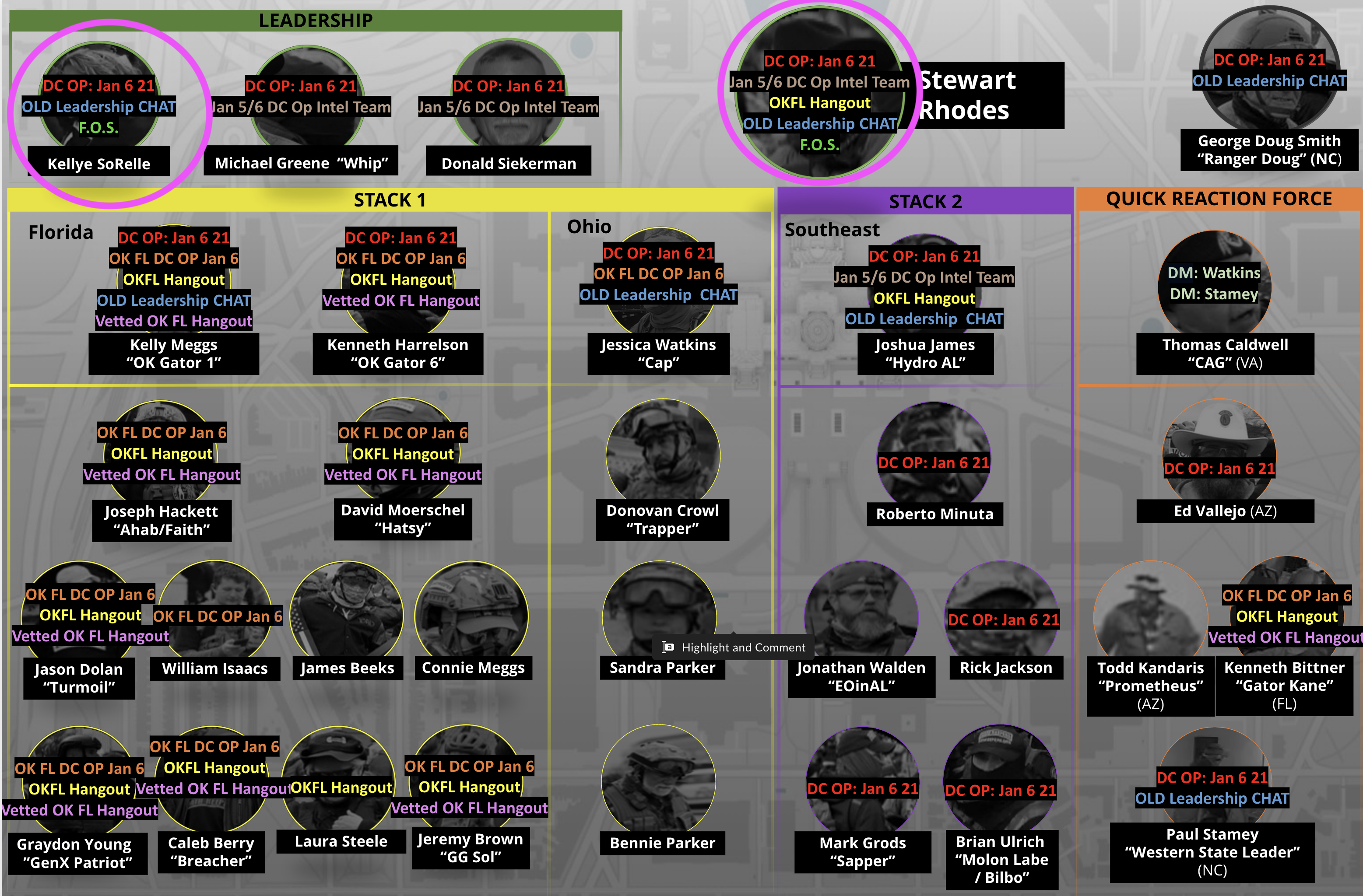
Those details become more interesting given how DOJ is presenting the Oath Keeper conspiracy at trial. Last Thursday, DOJ added the various communication channels each participant was subscribed to on their visual guide of the various co-conspirators.

It’s not surprising they would do that. To prove the three conspiracies these defendants are charged with, DOJ needs to prove each entered into an agreement to obstruct the vote certification, obstruct Congress, and attack the government. DOJ is relying on the various statements in advance of (and, for sedition, after) January 6 to show such intent. The fact that an intersecting collection of Signal channels incorporated most of the charged defendants will go a long way to show they were all willfully part of these three conspiracies.

But as you can see with Elmer Stewart Rhodes and Kellye SoRelle (circled in pink), DOJ has included Stone’s Signal channel — Friends of Stone — along with the Oath Keeper ones. As DOJ laid out last week, in addition to Rhodes and SoRelle, Enrique Tarrio, Alex Jones, and Ali Alexander were on the FOS channels, in addition to Stone himself.

DOJ has included things Rhodes said on the FOS chat in its timeline leading up to and on January 6. Significantly, at 2:28 on January 6, Rhodes informed the FOS chat that they were at “the back door of the Capitol.” (See the context in Brandi Buchman and Roger Parloff live threads.)

The thing is, many of the participants in FOS that prosecutors have, thus far, identified as participating in the chat (SoRelle, Ali Alexander, and Alex Jones) and most of the Oath Keepers were there on the East side of the Capitol or had only recently left. So was Owen Shroyer, who was also on FOS; he had been on the top of the stairs with Alexander and Jones.

Enrique Tarrio is one exception. He wasn’t present at the East side of the Capitol, but he was following along closely on social media — and likely already knew what was happening on the East side of the Capitol from Joe Biggs, who went through the East doors right along with the Oath Keepers.

Which means the only person mentioned so far who now needed to be told where the Oath Keepers were was Stone, back at the Willard.

We learned one more thing recently, at the last January 6 Committee hearing.

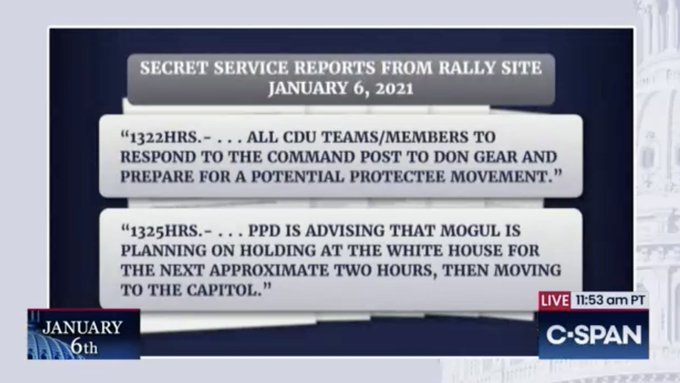
At 1:25PM — after the attack on the Capitol had started — Trump’s Secret Service detail was still planning on bringing him to the Capitol two hours later, around 3:30. That was after, per a video clip in which Nancy Pelosi said she would punch Trump if he showed up, Secret Service told Pelosi they had talked him out of coming.

But 18 minutes after Rhodes told the Friends of Stone list where the Oath Keepers were, at 2:46, Joseph Hackett came out of the Capitol and looked around, as if he was expecting someone to show up.

The fact that Rhodes was updating the FOS list from the Capitol suggests he may have been getting feedback from Stone and whoever else was on the list, including those who may have been coordinating with the then-President.

And whatever else DOJ’s use of the FOS list as part of this conspiracy does, it establishes the basis to argue that those coordinating on the FOS list were, themselves, in a conspiracy together: Rhodes and SoRelle with Tarrio (whom both met in the parking garage) and Alex Jones and Ali Alexander and Stone.

Just as importantly, it would network the conspiracies. That would put all the various Proud Boys taking orders from Tarrio in a conspiracy with those on the FOS list. It would put all the Oath Keepers conspiring with Rhodes and SoRelle in a conspiracy with those on the FOS list.

And it would put those on the FOS list in a conspiracy with those directing the attack on the Capitol.

I laid out over 14 months ago that, if DOJ were to charge Trump in conjunction with the attack on the Capitol, it would likely be part of an intersecting conspiracy with those already being charged.

Finally, if DOJ were to charge Trump, they would charge him in a conspiracy to obstruct the vote count that intersected with some of the other conspiracies to obstruct the vote count, possibly with obstruction charges against him personally. In general, I don’t think DOJ would charge most of Trump’s discrete acts, at least those conducted before January 20, as a crime. There are two possible exceptions, however. His call to Brad Raffensperger, particularly in the context of all his other efforts to tamper in the Georgia election, would have been conducted as part of campaigning (and therefore would not have been conducted as President). It seems a clearcut case of using threats to get a desired electoral outcome. It’s unclear whether Trump’s request that Mike Pence to commit the unconstitutional action — that is, refusing to certify the winning electoral votes — would be treated as Presidential or electoral. But that demand, followed closely with Trump’s public statements that had the effect of making Pence a target for assassination threats, seems like it could be charged on its own. Both of those actions, however, could and would, in the way DOJ is approaching this, also be overt acts in the conspiracy charged against Trump.

In the last two weeks, DOJ has started to show how those conspiracies intersect.

Unsurprisingly, they intersect right through the former President’s rat-fucker.

Update; Corrected Pelosi timing, per Nadezhda.

Update: Tried to clarify that Tarrio was on the chat but was not (as the Oath Keepers, Jones, and Alexander were) on the East side of the Capitol.

Share this entry

Trump Subpoena: The Revolution Will Not Be Signaled

The January 6 Committee has released the subpoena it sent to the former President.

It requires document production by November 4 and a deposition starting on November 14. Notably, the first deadline is before the election.

It focuses not just on Trump’s attempt to overturn the election, summon mobsters, and raise money off of it. There are several questions focused on obstruction: both document destruction and witness tampering.

The witness tampering one reads:

All documents, including communications sent or received through Signal or any other means, from July 1, 2021, to the present, relating or referring in any way to the investigation by the Select Committee and involving contacts with, or efforts to contact: (1) witnesses who appeared or who were or might be expected to appear before the Select Committee, including witnesses who served as White House staff during your administration, who served as staff for your 2020 campaign, and who served or currently serve in the United States Secret Service; or (2) counsel who represented such witnesses. The documents referenced in (1) and (2) include but are not limited to any communications regarding directly or indirectly paying the legal fees for any such witnesses, or finding, offering, or discussing employment for any such witnesses, and any communications with your former Deputy Chief of Staff Anthony Ornato or any employee of the Secret Service with whom you interacted on January 6, 2021.

The subpoena mentions Signal at least 13 times. Which strongly suggests the President was in direct communication with some of the coup plotters via the mobile app.

The Trump associates named in the subpoena include:

  • Roger Stone
  • Steve Bannon
  • Mike Flynn
  • Jeffrey Clark
  • John Eastman
  • Rudy Giuliani
  • Jenna Ellis
  • Sidney Powell
  • Kenneth Chesebro
  • Boris Epshteyn
  • Christina Bobb
  • Cleta Mitchell
  • Patrick Byrne

The subpoena even asks him for communications involving the Oath Keepers, Proud Boys, “or any other similar militia group or its members” from September 1, 2020 to the present.

The subpoena also asks the former President for all communications devices he used between November 3, 2020 and January 20, 2021. In the Stone trial, there were about nine devices identified on which he may have received a call during the 2016 election, and there are several others — such as that of his then bodyguard Keith Schiller — who weren’t discussed in the trial. Tony Ornato also receives a close focus in this subpoena; I wonder if he was receiving calls for the then-President on the Secret Service phone that has since been wiped.


Share this entry

Bill Barr Complains that His Special Counsel Was Unable to Match Robert Mueller’s Record of Success

Even before the Igor Danchenko trial, Billy Barr declared victory in defeat — arguing that if John Durham could just “fill in a lot of the blanks as to what was really happening,” the inevitable acquittal would still give Durham an opportunity to spin fairy tales about what Durham imagines happened.

“What these cases show is that these are difficult cases to win,” Barr said. “There’s a reason it takes so long, and you have to build up the evidence because at the end of the day, you’re going before these juries that aren’t going to be disposed to side with the people they view as supporting Trump.”

Danchenko is slated to go on trial next month on charges of lying to the FBI about the Steele dossier, for which he was the main source. The dossier claimed that Trump and members of his campaign and company had established extensive ties to the Russian government and had colluded during the 2016 election.

The trial is widely expected to be the final criminal prosecution from Durham’s investigation before he submits a report of his findings to Attorney General Merrick Garland.

But despite Durham’s limited success in the courtroom, Barr defended the investigation he ordered, saying the courtroom was allowing Durham to establish a record of what had occurred with the so-called Russiagate investigation.

“I think Durham got out a lot of important facts that fill in a lot of the blanks as to what was really happening,” Barr said. “My expectation is … the Danchenko trial will also allow for a lot of this story to be told, whether or not he’s ultimately convicted. I hope he’s convicted, but if he isn’t, I still think it provides an avenue to tell the story of what happened.”

Like an obedient puppy, Durham did use the trial as an opportunity to get extraneous details into the public record. On top of the $1 million dollar offer that Brian Auten said, vaguely, Christopher Steele might have gotten if he had corroborated the dosser — which has been treated like an FBI attempt to bribe a source for dirt on Trump and as the most exonerating possible detail, rather than an effort to investigate a real threat to the country — Durham went out of his way to give the full names of people at various meetings so Carter Page and Donald Trump can add them to lawsuits.

Mind you, along the way, the trial also revealed the FBI’s own assessment of Danchenko’s cooperation, which contributed to 25 investigations and which Barr burned to a crisp by exposing him, with Lindsey Graham’s help, as a source in 2020.

Q. And you were concerned, in July of 2020, when you became aware that Attorney General Barr was going to release a redacted version of Mr. Danchenko’s interview in January of 2017?

A. Yes.

Q. You were upset about that?

A. I was.

Q. You found out about that during a telephone conference, right?

A. I did.

Q. And you disagreed with that decision?

A. I did.

Q. The OIG had already completed a report on that investigation, correct?

A. Yes.

Q. And you thought that the release of that document was dangerous?

A. Yes.

Q. You even wrote up a memo of that phone call you were on in July of 2020 where you learned that they were going to publish a redacted version of his interview, correct?

A. I did.

[snip]

Q. And within an hour of Mr. Danchenko’s January interview being released to the senate judiciary committee, the senate judiciary committee, I won’t say who, released it to the public?

A. They did.

[snip]

Q. So, Agent Helson, you wrote in October of 2020 that from 2017 until present day, Mr. Danchenko had provided information on at least 25 FBI investigations assigned to at least six field offices?

A. Correct.

Q. In addition, he aided the United States Government by introducing the United States Government to a sub-source who had provided additional information separate to his report, correct?

A. Correct.

[snip]

Q. And it’s noted that he — his reporting contributed to at least 25 active FBI investigations.

[snip]

Q. In July of 2020 his identity became public after the release of the redacted version of his interview in January of 2017. Since that public disclosure, he has received threatening messages via social media and email. It’s resulted in significant damage to his reputation from false and baseless claims aimed to undermine his credibility. Those are your words, correct?

A. Correct.

Q. The Washington Field Office had assessed that this will have negative ramifications with respect to his ability to provide for his family via personal income for the foreseeable future, correct?

A. Correct.

Q. And while the FBI cannot promise complete anonymity to anyone who provides information, his identity became public only after the decision was made to release the redacted version of his interview, correct?

A. Correct.

Q. As a result of that act, his ability to continue to provide information viable to the FBI is diminished as is his ability to provide financial support to his family.

After the trial, Barr has been spending time on Fox News declaring — as much of the frothy right has — that this record, of how he deliberately harmed national security for revenge, exposed the corruption of what Barr calls “Russiagate,” the moniker frothers use to distract from the real substance of the Russian investigation.

I was disappointed, obviously. I think they did a good job prosecuting the case. Their ability to put evidence on, in a very difficult case, was limited by some rulings, and they weren’t able to get access to some witnesses overseas. So it was a tough — it was a tough case, so this should show people that it’s hard to win these cases, and sometimes it takes time to … to achieve justice. But as people say — I think Andy McCarthy said — the real public interest being served here was exposing the full extent of the corruption that was involved in Russiagate [sic] and the abuse by the FBI in that whole episode. And I think Durham is going to get a report out that’s gonna lay out all the facts.

Barr and everyone else are pointing to the exposures they and Durham made to justify their actions because they didn’t have evidence to support their claims.

Barr is whining that getting false statements convictions is hard. But Robert Mueller was able to prove that:

  • Alex Van der Zwaan lied to cover up his efforts, in conjunction with Konstantin Kilimnik and Rick Gates, to cover up Manafort’s effort to spin Ukraine’s politicized Yulia Tymoshenko prosecution during the 2016 election
  • George Papadopoulos lied to cover up his advance knowledge of the Russian effort to help Trump
  • Mike Flynn lied to cover up his back channel calls with Sergei Kislyak to undermine Obama Administration policy (and also that he was a paid agent of Turkey during the campaign)
  • Michael Cohen lied to hide the secret negotiations he had directly with the Kremlin about an impossibly lucrative real estate deal
  • Paul Manafort conspired to cover up a front organization he set up with Konstantin Kilimnik and (at a preponderance of the evidence standard) lied to cover up his August 2016 meeting with Kilimnik
  • Roger Stone lied and intimidated Randy Credico to cover up his real back channel to the Russian operation

I mean, Robert Mueller had no problem getting convictions, whether from guilty pleas, jury verdicts, or (in the case of Manafort’s lies about the August 2, 2016 meeting) a judge’s ruling.

One reason he had no problem was that these defendants were generally guilty of a lot more than just lying. It’s a lot easier to get Flynn to admit he lied about his back channel discussions with the Russian Ambassador, after all, when he was also on the hook for secretly being an agent of Turkey. It’s lot easier to get Papadopoulos to admit he lied about his advance warning of the Russian operation when he’s trying to stave off foreign agent charges tied to Israel. It’s a lot easier to get a jury verdict against Stone when he spent months plotting out his lies with multiple people on emails.

Mueller wasn’t able to get false statement verdicts from everyone, mind you. For example, because Steve Bannon and Erik Prince deleted their texts from early January 2017, Mueller did not charge them for false statements made to cover up meetings to set up a back channel with UAE and Russia. That’s one lesson that Durham should have taken to heart: Absent the mobile app records from Sergei Millian and Igor Danchenko, he had no way of knowing whether Millian called Danchenko on July 26, 2016.

That’s not the only evidentiary complaint Barr makes here. He’s complaining that Durham was unable to get hearsay admitted against Danchenko. He’s angry that Durham was not permitted to introduce Millian’s wild Twitter boasts as evidence without requiring Millian to show up and make those claims under oath. And he’s complaining that Durham wasn’t able to introduce his pee tape conspiracies without charging it.

But the most alarming of the former Attorney General’s statements — before and after the trial — embrace the notion that it is a proper goal of failed prosecutions to expose information that does not rise to the level of criminality.

As I’ll show in a follow-up, the Durham fiasco is part of a piece of Barr’s larger actions, both his other failed prosecutions — most notably, that of Greg Craig — but also his efforts to undo the convictions for which there was no reasonable doubt of guilt.

It’s not enough to talk about Durham’s unprecedented failure … it’s not enough to note that Durham and his prosecutors repeatedly failed to take basic investigative steps before embracing and charging conspiracy theories that juries didn’t buy … it’s not enough to note how, in an attempt to prove those conspiracy theories, Durham and his prosecutors and abused the prosecutorial system.

Durham’s entire project is a continuation of Barr’s unprecedented politicization of DOJ, one that not only places Republicans attempting to secretly work for hostile nations above the law, but that has made the country far less safe in many other ways.

It’s not just Durham prosecuted two men without any real hope of winning conviction, all to expose things that aren’t crimes. It’s that Billy Barr hired him to do just that.

Share this entry

In Both Bannon and Stolen Document Cases, Trump’s Associates Claim He Is Still President

Update: Judge Carl Nichols has sentenced Steve Bannon to four months in jail but has, as I predicted, stayed the sentence pending Bannon’s appeal. 

Twice in a matter of hours, filings were submitted to PACER in which lawyers interacting with Trump claimed the former President still exercised the power of President, well past January 20, 2021.

Accompanying a response to DOJ’s sentencing memo for Steve Bannon, for example, his lawyer Robert Costello submitted a declaration claiming that because Bannon had appeared before Congressional committees three times to testify (in part) about things he did while at the White House, he was right to expect that the January 6 Committee would treat him the same way — for events that long postdated his service in the White House — as they had for topics that included his White House service,

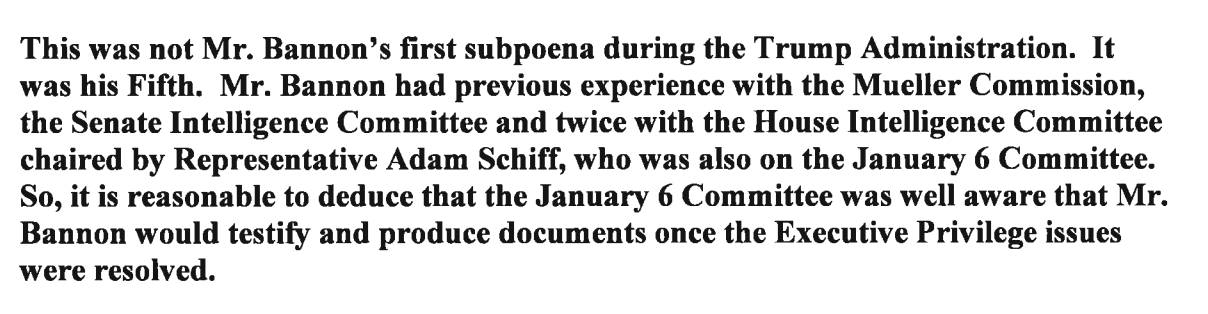
It’s not just that Costello is claiming that Bannon is claiming actions he took three years after he left the White House could be privileged. Just as crazy is Costello’s claim that this subpoena came “during the Trump Administration.”

Nuh uh. That guy was not President anymore in October 2021, when Bannon was subpoenaed.

More interesting are DOJ’s explanations for disputes between them and Trump over the documents he stole.

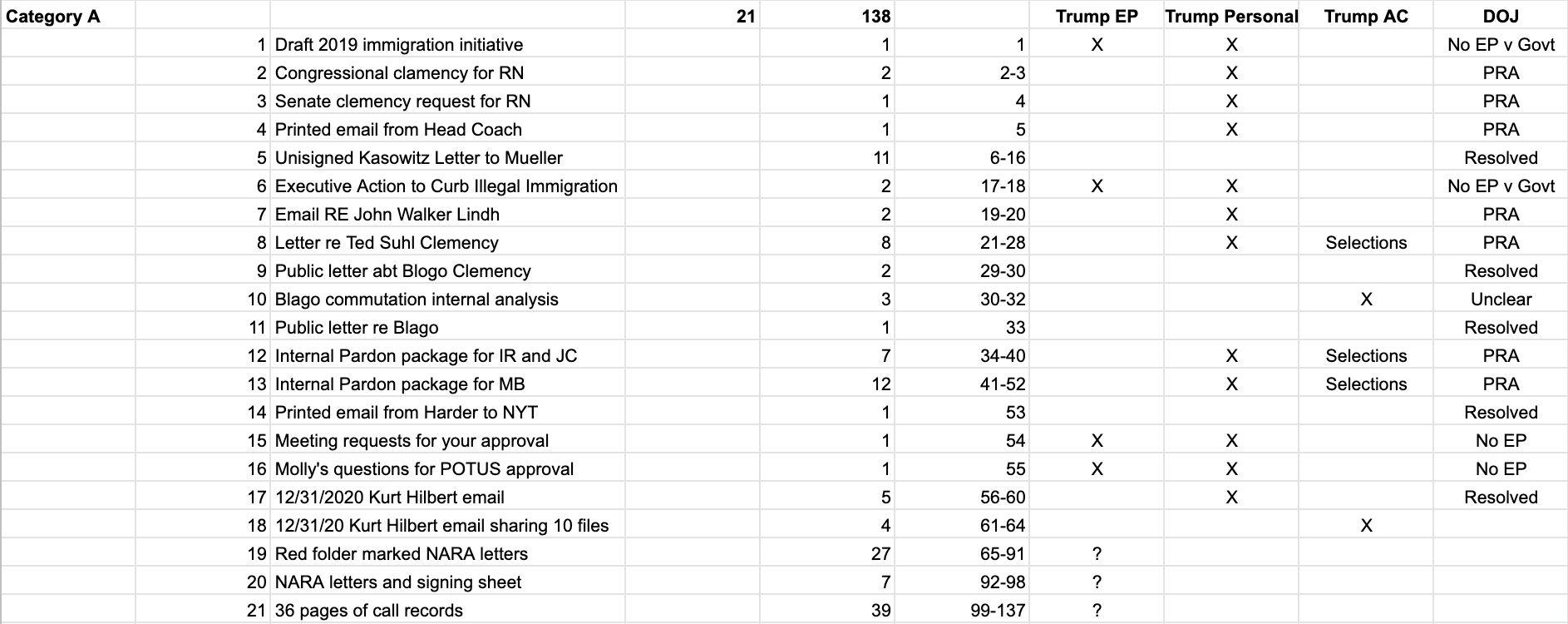
Best as I understand, this table shows the disputes, thus far.  (Trump’s attorney-client claims are those documents not mentioned here, though I’ve put question marks for the last three documents because there’s a Category C that may include some of those.)


As the government notes in its dispute of Trump’s claims, he identified most of these as personal, even documents that were solidly within his duties as President. This extends even so far as a letter the Air Force Academy baseball coach sent Trump, item 4.

The last of the nine documents (4) is a printed e-mail message from a person at one of the military academies addressed to the President in his official capacity about the academy’s sports program and its relationship to martial spirit. The message relates at a minimum to the “ceremonial duties of the President” (44 U.S.C. § 2201(2)) if not to his Commander-in-Chief powers.

The most important of those may be the clemency packages.

Six of the nine documents (2, 3, 7, 8, 12, 13), are clemency requests with supporting materials and relate to the President’s “Power to grant Reprieves and Pardons for Offences against the United States, except in Cases of Impeachment.” U.S. CONST. Art. II, § 2, cl. 1. Those requests were received by Plaintiff in his capacity as the official with authority to grant reprieves and pardons, not in his personal capacity.

For reasons I’ll return to, I think DOJ now believes that whatever document had classification markers in the packet that included clemency for Roger Stone and some kind of information about a French President is no longer classified. So the determination regarding whether Trump can treat pardons as personal gifts is likely to affect the ultimate resolution regarding the Stone clemency document, too.

But for those before the parties, Trump is claiming that people made personal requests for pardons of him, not requests to him in his role as President. That’s a dangerous premise.

More contentious still are Trump’s claims of Executive Privilege over four documents. Two pertain to his immigration policies. With that claim of Executive Privilege, he’s basically attempting to keep deliberative discussions about immigration out of the hands of the government.

Crazier still, though, are two documents that must reflect the operation of his post-presidential office. Both sides agree that item 15 — “meeting requests for your approval” — and item 16 — “Molly’s questions for POTUS approval” — are personal, even in spite of the reference to “POTUS.” Likely, they reflect the fact that Molly Michael, who had been Trump’s Executive Assistant at the end of his term, and who continued to work for him at Mar-a-Lago, continued to refer to him as “POTUS” after he had been fired by voters. That’s not unusual — all the flunkies surrounding Trump still call him President. But that means those two documents actually reflect the workings of Trump’s office since he left the White House.

And Trump has claimed Executive Privilege over them.

That’s ridiculous. But it’s tantamount to trying to suggest that anything involving him, personally, still cannot be accessed for a criminal investigation. Or maybe it reflects that he really, really doesn’t want the government to retain these two seemingly innocuous records.

As DOJ notes in their filing, even if both sides agree that these records are personal, DOJ can still argue they have cause to retain the documents for evidentiary purposes.

Although the government offers its views on the proper categorization of the Filter A documents as Presidential or personal records as required by the Order Appointing Special Master (ECF 91, at 4) and Amended Case Management Plan (ECF 125, at 4), that categorization has no bearing on whether such documents may be reviewed and used for criminal investigative purposes and does not dictate whether such documents should be returned to Plaintiff under Criminal Rule 41(g). Personal records that are not government property are seized every day for use in criminal investigations. And the fact that more than 100 documents bearing classification markings were commingled with unclassified and even personal records is important evidence in the government’s investigation in this case.

As DOJ noted in their 11th Circuit Appeal (filed after reviewing these records),

Moreover, unclassified records that were stored in the same boxes as records bearing classification markings or that were stored in adjacent boxes may provide important evidence as to elements of 18 U.S.C. § 793. First, the contents of the unclassified records could establish ownership or possession of the box or group of boxes in which the records bearing classification markings were stored. For example, if Plaintiff’s personal papers were intermingled with records bearing classification markings, those personal papers could demonstrate possession or control by Plaintiff.

Second, the dates on unclassified records may prove highly probative in the government’s investigation. For example, if any records comingled with the records bearing classification markings post-date Plaintiff’s term of office, that could establish that these materials continued to be accessed after Plaintiff left the White House.

These two documents, which both sides seem to agree reflected Trump’s office workings after he had left the Presidency, were probably intermingled with classified records. As DOJ notes, that likely shows that either Trump and/or Molly Michael had access to these classified records after neither had clearance to do so anymore.

Which might explain why Trump is trying to withhold these documents: because it is evidence not just that he continued to access stolen classified documents after he left the Presidency, but that he treated classified documents in such a way that someone else was able to too, which could be charged as another crime under the Espionage Act.

As I noted, Trump is now claiming that DOJ got some of these wrong, so it’s possible they’re rethinking their claim that Trump continued to be entitled to Executive Privilege as a private citizen. The claim of Executive Privilege over something both sides agree doesn’t pertain to the Presidency would just be another form of obstruction.

But in all phases of his post-Presidential efforts to avoid accountability, all those around Trump continue to indulge his fantasy that he still retains the prerogatives of the office.

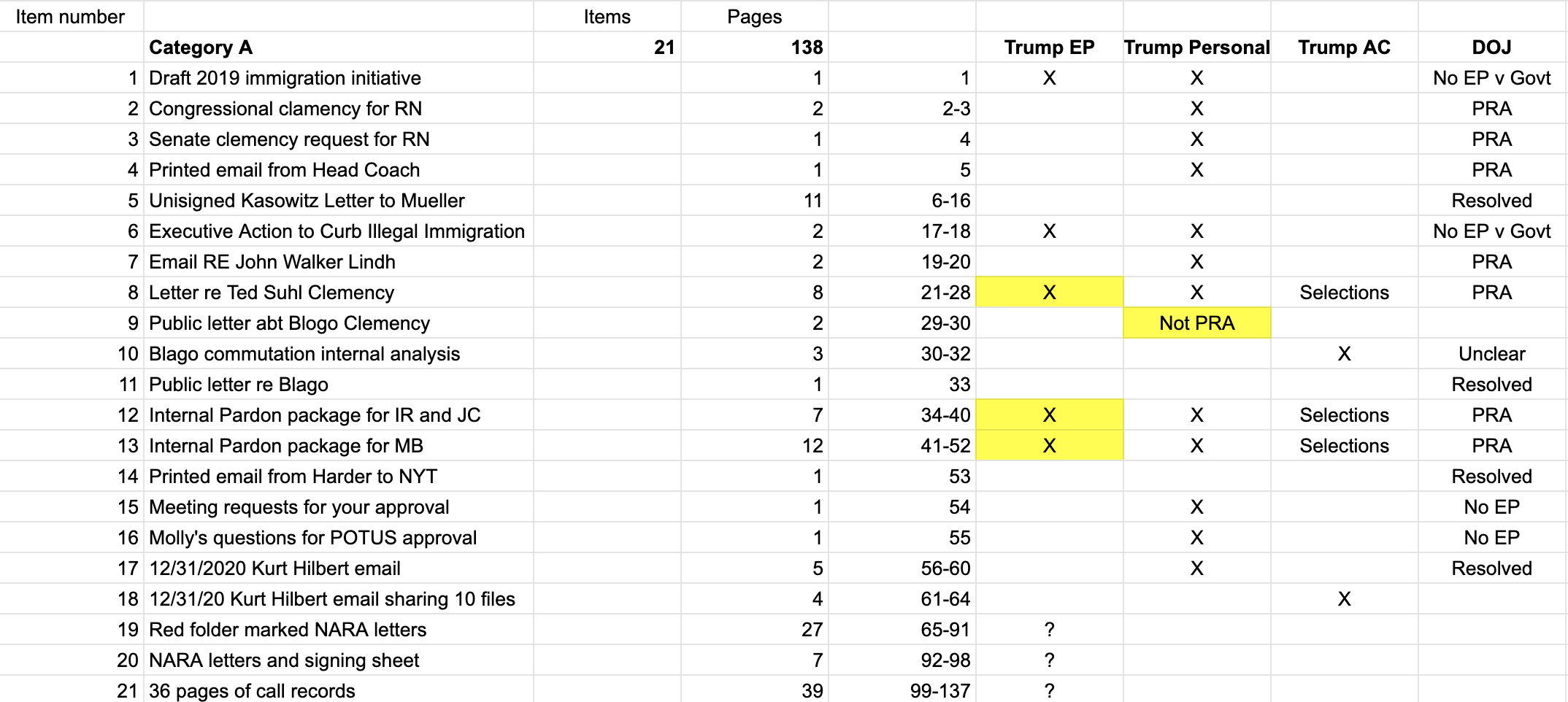
Update: Trump has filed his dispute about DOJ’s filing. The highlighted cells in the table above reflect the changed determinations. Notably, Trump has withdrawn privilege claims regarding the likely office records that post-date his move to MAL. But he added EP designations to clemency packages.

My suspicion is that this reflects a changed strategy about how to avoid accountability for the most things, not any real dispute raised before DOJ filed.

Share this entry

Jim Trusty Tells Hand-Picked Special Master Raymond Dearie to Fuck Off

At the beginning of a status hearing before Raymond Dearie the other day, Jim Trusty suggested they had until November 12 to submit their designations on privilege for the remaining 21,792 pages of documents. DOJ attorney Julie Edelstein corrected him, and said their deadline was November 2.

Per Aileen Cannon’s order throwing out much of Dearie’s proposed work plan and extending deadlines, that appears to be right. That order set that deadline for 21 days after DOJ issued a notice of completion to indicate Trump had the documents with a spreadsheet to track everything.

No later than twenty-one (21) calendar days after the receipt of Defendant’s Notice of Completion, Plaintiff shall provide the Special Master and Defendant with one comprehensive, annotated copy of the spreadsheet described above that specifies, for each document, whether Plaintiff asserts any of the following:

a. Attorney-client communication privilege;

b. Attorney work product privilege;

c. Executive Privilege;

d. Presidential Record within the meaning of the Presidential Records Act; and

e. Personal record within the meaning of the Presidential Records Act.

Plaintiff’s designations shall be on a document-by-document basis.

On paper, at least, it seems that Edelstein is correct. DOJ submitted their notice of completion on October 12 (two days before Cannon’s deadline). The deadlines that trigger off that should be November 2 (for Trump to submit designations) and November 12 (to submit disputes to Dearie).

It’s worth keeping that deadline dispute in mind as you consider what Jim Trusty did last night.

First, DOJ submitted a letter purporting to summarize the disputes between the two sides about the privilege determinations for fifteen documents that Dearie must issue a ruling on. I’ll come back to those in a follow-up; the important detail is the document shows Trump making ridiculous claims. As a reminder, this page has links to most documents from the stolen document case and my posts.

Hours later, Jim Trusty filed a letter saying that Trump’s team believed both sides were going to file a joint document, and because DOJ hadn’t and because Trump doesn’t agree with some of DOJ’s designations, they’re not going to file their disputed items until October 24, Monday.

As noted in the Defendant’s October 20, 2022 submission (ECF 150) the parties met and conferred regarding Filter A documents on October 19, 2022. Up until receipt of the Defendant’s October 20, 2022 filing, we anticipated that there would be a joint submission and an exchange between the parties preceding that joint submission to confirm both parties’ positions. This is consistent with the process that was undertaken for the October 3, 2022 joint submission with the Filter Team. Instead, the government filed its own log and presented its legal positions on the documents for which there is dispute between the parties.

Unfortunately, the log submitted by the government is not fully accurate as to the Plaintiff’s position on various documents.

In light of these facts, the Plaintiff will file our position on the documents that remain in dispute by the close of business on October 24, 2022.

Since Aileen Cannon decided to override Dearie and start changing deadlines randomly and unilaterally, it has been unclear what the deadlines or workplan will be on this case — the single certain thing is that, in the end, Trump will complain about Dearie’s designations and Cannon will review them de novo. Both Cannon’s original order and her Calvinball order overriding Dearie set initial deadlines for privileged determinations, but have no follow-up deadlines.

But in an October 7 order, Dearie did set deadlines. Trump’s 5-day deadline to complain about any orders has passed, and unless the Cannon Calvinball has gotten really tricksy, I’m not aware of anything overriding that deadline.

And that deadline was yesterday.

Trusty had enough time to review the DOJ filing and disagree and at least note about which items there’s a disagreement. There are only 15 documents here!!

But instead, Trump responded to the public docketing of his absurd claims by spending the time to write up a letter announcing he was taking his toys and going home for the weekend to pout. The best way to understand this action is that Trump simply doesn’t believe Judge Dearie has any authority to require actions of him.

And so Dearie could take the DOJ report and issues rulings, which might result in a report that came out early enough before the election for Cannon to have to overrule them before it. But if that happens, Trump will simply say he wasn’t part of that process.

Update: Dearie has noted that Trump’s response is untimely and given him until end of business today.

Dates

October 7: Dearie issues order on filter team materials, sets October 10 and October 20 deadlines (in bold)

October 10: Deadline to return originals of Category B documents to Trump

October 11: DOJ Reply to Trump Emergency Motion at SCOTUS

October 12: Deadline to complain to Cannon about Dearie’s October 7 order; Notice of Completion submitted

October 13: DOJ provides materials to Trump

By October 14: DOJ provides notice of completion that Trump has received all seized documents

On or before October 14: DOJ revised deadline to 11th Circuit

October 18: Phone Special Master conference

October 20: Deadline for disputes about Executive Privilege and Presidential Records Act on filtered material

October 24: Date Trump unilaterally declares his deadline to comply with Dearie’s order

November 2 (21 days after notice of completion): Trump provides designations for all materials to DOJ

November 8: Election Day

November 10, 2022: Trump revised deadline to 11th Circuit

November 12 (10 days after notice of complete): Both sides provide disputes to Dearie

November 17, 2022: DOJ revised reply to 11th Circuit

December 16: Dearie provides recommendations to Cannon

January 3: New Congress sworn in

No deadline whatsoever: Cannon rules on Dearie’s recommendations

Seven days after Cannon’s no deadline whatsoever ruling: Trump submits Rule 41(g) motion

Fourteen days after Cannon’s no deadline whatsoever ruling: DOJ responds to Rule 41(g) motion

Seventeen days after Cannon’s no deadline whatsoever ruling: Trump reply on Rule 41(g)

Share this entry

John Eastman Emails Show Trump Knowingly Lied in Georgia Lawsuit

The January 6 Committee and John Eastman continue to fight over how many of his emails he can withhold from the Committee under a claim of attorney-client (and related) privilege.

Judge David Carter just ruled on what may be the last 500-so emails.

He ordered Eastman to turn over eight additional emails under a crime-fraud exception.

The more interesting set of four involve discussions about whether Trump should fix numbers he knew to be false before he filed a Federal lawsuit in Georgia.

Four emails demonstrate an effort by President Trump and his attorneys to press false claims in federal court for the purpose of delaying the January 6 vote. The evidence confirms that this effort was undertaken in at least one lawsuit filed in Georgia.

On December 4, 2020, President Trump and his attorneys alleged in a Georgia state court action that Fulton County improperly counted a number of votes including 10,315 deceased people, 2,560 felons, and 2,423 unregistered voters.69 President Trump and his attorneys then decided to contest the state court proceeding in federal court, 70 and discussed incorporating by reference the voter fraud numbers alleged in the state petition. On December 30, 2020, Dr. Eastman relayed “concerns” from President Trump’s team “about including specific numbers in the paragraph dealing with felons, deceased, moved, etc.”71 The attorneys continued to discuss the President’s resistance to signing “when specific numbers were included.”72 As Dr. Eastman explained the next day:

Although the President signed a verification for [the state court filing] back on Dec. 1, he has since been made aware that some of the allegations (and evidence proffered by the experts) has been inaccurate. For him to sign a new verification with that knowledge (and incorporation by reference) would not be accurate.73

President Trump and his attorneys ultimately filed the complaint with the same inaccurate numbers without rectifying, clarifying, or otherwise changing them. 74 President Trump, moreover, signed a verification swearing under oath that the incorporated, inaccurate numbers “are true and correct” or “believed to be true and correct” to the best of his knowledge and belief.75

The emails show that President Trump knew that the specific numbers of voter fraud were wrong but continued to tout those numbers, both in court and to the public. The Court finds that these emails are sufficiently related to and in furtherance of a conspiracy to defraud the United States. Accordingly, the Court ORDERS Dr. Eastman to disclose these four communications to the Select Committee.76

69 As discussed in the previous orders, President Trump’s own U.S. Attorney General said that his investigators found no evidence of fraud on a scale that would have changed the outcome of the election, but President Trump and his attorneys continued to file dozens of lawsuits in states he lost, seeking to overturn the results. First Order at 5. By early January, more than sixty court cases alleging fraud had been dismissed for lack of evidence or lack of standing. Id. at 6. See also J. M. Luttig et al., Lost, Not Stolen: The Conservative Case that Trump Lost and Biden Won the 2020 Presidential Election (July 2022) (examining every count of every case of election irregularities brought by President Trump’s team in six battleground states and concluding that “Donald Trump and his supporters had their day in court and failed to produce substantive evidence to make their case”), https://perma.cc/MKC4-BV3Q.

70 See Trump v. Kemp, 511 F. Supp. 3d 1325, 1330 (N.D. Ga. 2021) (“Plaintiff’s motion for expedited declaratory and injunctive relief asks this Court to take the unprecedented action of decertifying the results of the presidential election in Georgia and directing the Georgia General Assembly to appoint presidential electors.”)

71 59643.

72 59390.

73 60742.

74 See generally Model Rules of Pro. Conduct r. 3.3 cmt. 5 (Am. Bar Ass’n 1983) (noting that the duty requiring “that the lawyer refuse to offer evidence that the lawyer knows to be false, regardless of the client’s wishes” is “premised on the lawyer’s obligation as an officer of the court to prevent the trier of fact from being misled by false evidence”), https://perma.cc/3PB5-CGRM; see also Christensen, 828 F.3d at 805 (“[C]onduct by an attorney that is merely unethical, as opposed to illegal, may be enough to vitiate the work product doctrine.”).

75 In an attempt to disclaim his responsibility over the misleading allegations, President Trump’s attorneys remove the numbers from the body of complaint (but nonetheless incorporate them by reference) and add a footnote that states President Trump is only relying on information that was provided to him. See 61108. But, by his attorneys’ own admissions, the information provided to him was that the alleged voter fraud numbers were inaccurate. See 60742.

76 59643; 59390; 60742; 61108. For document 59643, only the first page (Chapman059643) requires disclosure. For document 60742, Dr. Eastman may redact emails sent before Thursday, December 31, 2020 12:00 PM MST. For document 61108, Dr. Eastman may redact emails sent before Thursday, December 31, 2020 7:43 AM.

These emails are going to have all sorts of ramifications — in Fani Willis’ investigation and the DOJ investigation. And they’ll likely make it easier for both Willis and Thomas Windom (who is leading the Trump fraud investigation) to obtain related emails that were seized from Mar-a-Lago.

Share this entry

Judge Aileen Cannon Risked the Safety of the Country to Protect Two Probably Public Letters

There’s a detail from yesterday’s Raymond Dearie hearing that I’ve seen no other journalist cover: that filter team attorney Anthony Lacosta described sending a public link of this document to Trump attorney Jim Trusty on September 30.

If it’ll help the parties, I sent email to Trusty on 9/30 that sent a copy of letter at issue. I sent link, they appear to be the same, all that’s missing is signature.

We know from the privilege inventory that was accidentally docketed that it’s an 11-page letter from then Trump attorney Marc Kasowitz to Robert Mueller.

Lacosta mentioned that the letter had been published. That must mean the letter is this one, published by the NYT on June 2,2018 (here’s the text for those who can’t access the NYT).

As I noted weeks ago, this document from the same inventory also is almost certainly a letter released publicly years ago, too.

Harold Bornstein, who was then Trump’s personal physician, released a one-page letter dated September 13, 2016 as part of Trump’s campaign for President.

In other words, two of the documents that Judge Aileen Cannon pointed to in order to claim that Trump was suffering a grave harm that justified enjoining an ongoing criminal investigation into some of the most sensitive documents in US government have probably been public for years. Indeed, the Bornstein letter was released by Trump himself.

Here’s how the government described the harm Judge Cannon caused to the United States by enjoining DOJ’s access to these documents in their appeal to the 11th Circuit.

a. The government has a “demonstrated, specific need” for the records bearing classification markings

The government’s need for the records bearing classification markings is overwhelming. It is investigating potential violations of 18 U.S.C. § 793(e), which prohibits the unauthorized retention of national defense information. These records are not merely evidence of possible violations of that law. They are the very objects of the offense and are essential for any potential criminal case premised on the unlawful retention of the materials. Likewise, these records may constitute evidence of potential violations of 18 U.S.C. § 2071, which prohibits concealment or removal of government records.

The records bearing classification markings may also constitute evidence of potential violations of 18 U.S.C. § 1519, prohibiting obstruction of a federal investigation. As described above, on May 11, 2022, Plaintiff’s counsel was served with a grand-jury subpoena for “[a]ny and all documents or writings in the custody or control of Donald J. Trump and/or the Office of Donald J. Trump bearing classification markings.” DE.48-1:11. In response, Plaintiff’s counsel produced an envelope containing 37 documents bearing classification markings, see MJ-DE.125:20-21, and Plaintiff’s custodian of records certified that “a diligent search was conducted of the boxes that were moved from the White House to Florida” and that “[a]ny and all responsive documents accompany this certification,” DE.48-1:16. As evidenced by the government’s subsequent execution of the search warrant, all responsive documents did not in fact accompany that certification: more than 100 additional documents bearing classification markings were recovered from Plaintiff’s Mar-a-Lago Club. Those documents may therefore constitute evidence of obstruction of justice.

The government’s compelling need for these records is not limited to their potential use as evidence of crimes. As explained in the stay proceedings, the government has an urgent need to use these records in conducting a classification review, assessing the potential risk to national security that would result if they were disclosed, assessing whether or to what extent they may have been accessed without authorization, and assessing whether any other classified records might still be missing. The district court itself acknowledged the importance of the government’s classification review and national security risk assessment. DE.64:22-23. The government has further explained, including through a sworn declaration by the Assistant Director of the FBI’s Counterintelligence Division, why those functions are inextricably linked to its criminal investigation. DE.69-1:3-5. For example, the government may need to use the contents of these records to conduct witness interviews or to discern whether there are patterns in the types of records that were retained. The stay panel correctly concluded that a prohibition against using the records for such purposes would cause not only harm, but “irreparable harm.” Trump, 2022 WL 4366684, at *12; see also id. at *11. Plaintiff has never substantiated any interest that could possibly outweigh these compelling governmental needs, and none exists.

b. The government has a “demonstrated, specific need” for the remaining seized records The government also has a “demonstrated, specific need” for the seized unclassified records. The FBI recovered these records in a judicially authorized search based on a finding of probable cause of violations of multiple criminal statutes. The government sought and obtained permission from the magistrate judge to search Plaintiff’s office and any storage rooms, MJ-DE.125:37, and to seize, inter alia, “[a]ny physical documents with classification markings, along with any containers/boxes (including any other contents) in which such documents are located, as well as any other containers/boxes that are collectively stored or found together with the aforementioned documents and containers/boxes,” MJ-DE.125:38. The magistrate judge thus necessarily concluded that there was probable cause to believe those items constitute “evidence of a crime” or “contraband, fruits of crime, or other items illegally possessed.” Fed. R. Crim. P. 41(c)(1), (2); see MJ-DE.57:3.

That is for good reason. As an initial matter, the unclassified records may constitute evidence of potential violations of 18 U.S.C. § 2071, which prohibits “conceal[ing]” or “remov[ing]” government records. Moreover, unclassified records that were stored in the same boxes as records bearing classification markings or that were stored in adjacent boxes may provide important evidence as to elements of 18 U.S.C. § 793. First, the contents of the unclassified records could establish ownership or possession of the box or group of boxes in which the records bearing classification markings were stored. For example, if Plaintiff’s personal papers were intermingled with records bearing classification markings, those personal papers could demonstrate possession or control by Plaintiff.

Second, the dates on unclassified records may prove highly probative in the government’s investigation. For example, if any records comingled with the records bearing classification markings post-date Plaintiff’s term of office, that could establish that these materials continued to be accessed after Plaintiff left the White House. Third, the government may need to use unclassified records to conduct witness interviews and corroborate information. For example, if a witness were to recall seeing a document bearing classification markings next to a specific unclassified document (e.g., a photograph), the government could ascertain the witness’s credibility and potentially corroborate the witness’s statement by reviewing both documents.

In short, the unclassified records that were stored collectively with records bearing classification markings may identify who was responsible for the unauthorized retention of these records, the relevant time periods in which records were created or accessed, and who may have accessed or seen them. [my emphasis]

The government needs to figure out whether Trump’s negligence caused any compromise of highly sensitive documents.

But Judge Cannon decided that letters Trump released to impress voters are more important.

Share this entry

Judge Dearie Confirms Trump Has Claimed Executive Privilege Over a Personal Document

Raymond Dearie just held his second public status conference in the Trump Special Master proceeding. He had the government explain why, after Trump’s team claimed there were 200,000 pages to review, the total ended up being 22,000.

AUSA Steve Morrison explained that the estimate came from a vendor, which developed its own estimate based off a standard business letter length of just under 20 pages per document, times the 11,000 documents. He noted that the 32 boxes that had been seized could not possibly have fit that much; he gave 82,000 as the max amount.

Mostly, it seemed, Dearie called the conference to express frustration with the paucity of the descriptions behind the designations so far, and concern that he’ll get 11,000 versions of that in November. Several times, he said he wanted an idea of how many disputes to expect on November 12, when he gets the items about which there remains a dispute, so he can at least figure out whether he needs more staff.

There were some specific questions, though.

For example, he asked why the two sides hadn’t been able to decide whether the government already had a copy of what is described as Item 5 in this accidentally docketed inventory, a letter from Marc Kasowitz to Robert Mueller. After some squabbling, Dearie complained, “I have no patience for either one of you on this point. If it’s in Department of Justice possession, either produce it or make a representation it’s in DOJ possession.” Filter Counsel Anthony Lacosta described that he sent Jim Trusty a link on September 30 showing a publicly produced version of the letter that seems to be an exact copy of the one seized. That means it must be this letter published by the NYT on June 2, 2018 (the second one on the page).

Dearie also noted that there was nothing in the four pardon packages included that indicated any legal advice had been given — which suggests Trump is claiming a privilege that should not stand over those as well.

Perhaps most importantly, Dearie indicated that there’s one letter of the documents discussed so far that Trump has claimed is a personal document but over which he has claimed Executive Privilege.

I see a doc for which claim there’s a personal doc, and also a claim that Executive Privilege covers it. Unless I’m wrong, there’s a certain incongruity there. Perhaps plaintiff’s counsel will address that in submission.

That is, Trump is doing precisely what the law doesn’t envision.

And among other things, Dearie is making that clear as the challenge to Judge Cannon’s intervention proceeds at the 11th Circuit.

Udpdate: Corrected documents/pages error in first paragraph.

Share this entry

1,500 Investigative Subjects: A Competent Google GeoFence Motion to Suppress for January 6

For some time, I’ve been waiting for a January 6 defendant to (competently) challenge the use of a Google GeoFence as one means to identify them as a participant in January 6. (There have been incompetent efforts from John Pierce, and Matthew Bledsoe unsuccessfully challenged the GeoFence of people who livestreamed on Facebook.)

The motion to suppress from David Rhine may be that challenge. Rhine was charged only with trespassing (though he was reportedly stopped, searched, and found to be carrying two knives and pepper spray, but ultimately released).

As described in his arrest affidavit, Rhine was first identified via two relatively weak tips and a Verizon warrant. But somewhere along the way, the FBI used the general GeoFence warrant they obtained on everyone in the Capitol that day. Probably using that (which shows where people went inside the Capitol), the FBI found him on a bunch of surveillance video, with his face partly obscured with a hat and hoodie.

The motion to suppress, written by Tacoma Federal Public Defender Rebecca Fish, attempts to build off a ruling in the case of Okello Chatrie (and integrates materials from his case) to get the GeoFence used to identify Rhine and everything that stemmed from it thrown out.

The three-step GeoFence Warrant and the returns specific to Rhine are sealed in the docket.

But the MTS provides a bunch of the details of how the FBI used a series of warrants to GeoFence the crime scene.

First, as Step 1, it got a list of devices at the Capitol during the breach, either as recorded in current records, or as recorded just after the attack. At this stage, FBI got just identifiers used for this purpose, not subscriber numbers.

The geofence warrant requested and authorized here collected an alarming breadth of personal data. In Step 1, the warrant directed Google to use its location data to “identify those devices that it calculated were or could have been (based on the associated margin of error for the estimated latitude/longitude point) within the TARGET LOCATION” during a four-and-a-half hour period, from 2:00 p.m. until 6:30 p.m. Ex. A at 6. The target location—the geofence—included the Capitol Building and the area immediately surrounding it, id. at 5, which covers approximately 4 acres of land, id. at 13. Indeed, the warrant acknowledges that “[t]o identify this data, Google runs a computation against all stored Location History coordinates for all Google account holders to determine which records match the parameters specified by the warrant.” Ex. A at 26 (emphasis added). Though not spelled out with clarity in the warrant itself, the warrant ordered that the list provided in step 1 not include subscriber information, but that such information may be ordered at a later step. See id. at 6; see also id. at 25 (“This process will initially collect a limited data set that includes only anonymous account identifiers, dates, times, and locations.”).

This yielded 5,723 unique devices (note, the MTS points to Google filings from the Chatrie case to argue that only a third of Google’s users turn on this location service).

Google ultimately identified 5,653 unique Device IDs that “were or could have been” within the geofence, responsive to the first step of the warrant. Ex. B (step 2 warrant and application) at 6. However, Google additionally searched location history data that Google preserved the evening of January 6. When searching this data, as opposed to the current data for active users at the time of the search, Google produced a list of 5,716 devices that were or could have been within the geofence during the relevant time period. Id. Google additionally searched location history data that Google preserved on January 7. When searching this data, Google produced a list of 5,721 devices that were or could have been within the geofence during the relevant time period. Id. The three lists combined yielded a total of 5,723 unique devices that Google estimated were or could have been in the geofence during the four-and-a-half hour period requested. Id. at 7.

In Step 2, the FBI asked Google to identify devices that had been present at the Capitol before or after the attack — an attempt to find those who were there legally. That weeded the list of potentially suspect devices to 5,518.

In this case, the second step of the geofence warrant was also done in bulk, given the lack of specificity as to the people sought. In the initial warrant, the Court ordered Google to make additional lists to eliminate some people who were presumptively within the geofence and committed no crimes. First, the warrant ordered Google to make a list of devices within the geofence from 12:00 p.m. to 12:15 p.m. on January 6. And second, the warrant ordered Google to make a list of devices within the geofence from 9:00 p.m. to 9:15 p.m. Ex. A at 6.

[snip]

Google provided these lists to the government in addition to the lists detailed above. Google identified 176 devices that were or could have been within the geofence between 12:00 p.m. and 12:15 p.m., and 159 devices that were or could have been within the geofence between 9:00 p.m. and 9:15 p.m. Ex. B at 6. The government ultimately subtracted these devices from those that they deemed suspect. Id. at 7. However, this still left 5,518 unique devices under the government’s suspicion. See id. The original warrant contemplated the removal of devices that were present at the window before and after the primary geofence time because the government asserted that the early and late windows were times when no suspects were in the Capitol Building, but legislators and staff were lawfully present. Ex. A at 27. However, the original warrant also indicated that “The government [would] review these lists in order to identify information, if any, that is not evidence of crime (for example, information pertaining to devices moving through the Target Location(s) in a manner inconsistent with the facts of the underlying case).” Ex. A at 6.

Aside from comparing the primary list with the lists for the early and late windows, the government appeared to do no culling of the device list based on movement. Rather, the government used other criteria to decide which devices to target for a request for subscriber information. 3.

The government then asked for the subscriber information of anyone who showed up at least once inside the Capitol (as the MTS notes, Google’s confidence levels on this identification is 68%). That identified 1,498 devices.

In step 3, as relevant to this case,4 the government sought subscriber information—meaning the phone number, google account, or other identifying information associated with the device—for two different categories of people. First, the government sought subscriber information for any device for which there was a single data point that had a display ratio entirely within the geofence. Ex. B at 7. In other words, the government sought identifying information for any device for which Google was 68 percent confident the device was somewhere within the geofence at a single moment during the four-and-a-half hour geofence period. Again, the government equated presence to criminality. The government sought and the warrant ordered Google to provide identifying information on 1,498 devices (and likely people) based on this theory. See id.

It also asked for subscriber information from anyone who had deleted location history in the week after the attack, which yielded another 37 devices.

Second, the government sought identifying subscriber information for any device where location history appeared to have been deleted between January 6 or 7 and January 13, and had at least one data point where even part of the display radius was within the geofence. See Ex. B at 7–8. The government agent asserted that such devices likely had evidence of criminality because: “Based on my knowledge, training, and experience, I know that criminals will delete their Google accounts and/or their Google location data after they commit criminal acts to protect themselves from law enforcement.” Id. at 8.

[snip]

The theory that potentially changed privacy settings or a deleted account as indicative of criminality led the government to request identifying information for 37 additional devices (and likely people). Ex. B at 8.

The MTS notes that at a later time, the FBI expanded the scope of the GeoFence for which they were seeking subscriber information, but that’s not applicable to Rhine.

4 Discovery indicates that the government later sought substantially more data from geofences in areas next to, but wholly outside of, the Capitol Building. However, Mr. Rhine addresses here the warrants and searches most relevant to his case.

The GeoFence was one of a number of things used to get the warrant to search Rhine’s house and digital devices.

I’ll hold off on assessing the legal merit of this MTS (though I do plan to share it with a bunch of Fourth Amendment lawyers).

For now, what is the best summary I know of how the known Google GeoFence reveals how the FBI used it: first obtaining non-subscriber identifiers for everyone in the Capitol, removing those who were by logic legally present before the attack, and then obtaining subscriber information that was used for further investigation.

And that GeoFence yielded 1,500 potential investigative subjects, which may be only be a third of Google users present (though would also by definition include a lot of people — victims and first responders — who were legally present). Which would suggest 4,500 people were inside the Google GeoFence that day, and (using the larger numbers) 15,000 were in the vicinity.

As I keep saying, the legal application here is very different in the Chatrie case, because everyone inside the Capitol was generally trespassing, a victim, a journalist, or a first responder.

To make things more interesting, Rudolph Contreras, who is the FISA Court presiding judge, is the judge in this case. He undoubtedly knows of similar legal challenges that are not public from his time on FISC.

Which may make this legal challenge of potentially significant import.

Share this entry