The Press Gets Utterly Snookered on the White House Rebranding of the Same Old Unrelenting Obstruction of Congressional Prerogatives

Yesterday, the White House sent a letter to Nancy Pelosi and just some of the Committee Chairs conducting parts of an impeachment inquiry into the President, purporting to refuse to participate in that impeachment inquiry. Since then, there has been a lot of shocked coverage about how intemperate the letter is, with particular focus on the fact that White House Counsel, Pat Cipollone, used to be considered a serious lawyer. There has been some attempt to analyze the letter as if it is a legal document and not instead the President’s rants packaged up in Times Roman and signed by one of his employees. A number of outlets have thrown entire reporting teams to do insipid horse race coverage of the letter, as if this is one giant game, maybe with nifty commercials on during halftime.

None I’ve seen have described the letter as what it is: an attempt to rebrand the same old outright obstruction that the White House has pursued since January.

The tell — for those teams of well-compensated journalists treating this as a factual document — might have been the addressees. While the letter got sent to Adam Schiff, Eliot Engel, and Elijah Cummings, it did not get sent to Jerry Nadler, who has been pursuing an impeachment inquiry of sorts since the Mueller Report came out. The White House knows Nadler is also part of the impeachment inquiry, because even as the White House was finalizing the letter, Trump’s DOJ was in DC Chief Judge Beryl Howell’s courtroom fighting a House Judiciary request for materials for the impeachment inquiry. In the hearing, DOJ literally argued that the Supreme Court’s 8-0 US v. Nixon was wrongly decided.

Howell picked up on that point by pressing DOJ to say whether then-U.S. District Court Chief Judge John Sirica was wrong in 1974 to let Congress access a detailed “road map” of the Watergate grand jury materials as it considered President Richard Nixon’s impeachment.

Shapiro argued that if the same Watergate road map arose today, there’d be a “different result” because the law has changed since 1974. She said the judge wouldn’t be able to do the same thing absent changes to the grand jury rules and statutes.

Howell sounded skeptical. “Wow. OK,” she replied.

DOJ also argued that Congress would have to pass a law to enshrine the principle that this binding Supreme Court precedent already made the law of the land.

In the HJC branch of the impeachment inquiry, the few credible claims made in yesterday’s letter — such as that Congress is conducting the inquiry in secret without the ability to cross-examine witnesses or have Executive Branch lawyers present — are proven utterly false. And with the claims made in yesterday’s hearing, the Executive demonstrated that they will obstruct even measured requests and negotiations for testimony.

The Trump White House obstructed normal Congressional oversight by absolutely refusing to cooperate.

The Trump White House obstructed an impeachment inquiry focused on requests and voluntary participation.

The Trump White House obstructed an impeachment inquiry where subpoenas were filed.

The Trump White House obstructed an impeachment inquiry relying on whistleblowers who aren’t parties to the White House omertà.

The Trump White House obstructed what numerous judges have made clear are reasonable requests from a co-equal branch of government.

Nothing in the White House’s conduct changed yesterday. Not a single thing. And any journalist who treats this as a new development should trade in her notebooks or maybe move to covering football where such reporting is appropriate.

It is, however, a rebranding of the same old unrelenting obstruction, an effort to relaunch the same policy of unremitting obstruction under an even more intransigent and extreme marketing pitch.

And that — the need to rebrand the same old obstruction — might be worthy topic of news coverage. Why the White House feels the need to scream louder and pound the table more aggressively is a subject for reporting. But to cover it, you’d go to people like Mitt Romney and Susan Collins, who already seem to be preparing to explain votes against the President. You even go to people like Lindsey Graham, who is doing ridiculous things to sustain Rudy Giuliani’s hoaxes in the Senate Judiciary Committee — but who has condemned the principle of making the country dramatically less safe for whimsical personal benefit in Syria. Or you go to Richard Burr, who quietly released a report making it clear Russia took affirmative efforts to elect Trump in 2016.

This week, Trump looked at the first few Republicans getting weak in the knees and his response was to double down on the same old policies, while rolling out a campaign trying to persuade those weak-kneed members of Congress who are contemplating the import of our Constitution not to do so.

The President’s former lawyer testified earlier this year, under oath, that this has always been a branding opportunity to Donald Trump.

Donald Trump is a man who ran for office to make his brand great, not to make our country great. He had no desire or intention to lead this nation – only to market himself and to build his wealth and power. Mr. Trump would often say, this campaign was going to be the “greatest infomercial in political history.”

His latest attempt to cajole Republican loyalty is no different. It’s just a rebranding of the same intransigence. Treating it as anything but a rebranding is organized forgetting of what has taken place for the last nine months, and journalists should know better.
Share this entry

Jared Kushner’s Pervasive Corruption Pops Up In Surprising Ways

Jim here again.

I’ve been trying to do my homework to catch up on the tremendous work done by Elijah Cumming’s House Oversight Committee on the Michael Flynn-IP3 scandal that I wrote about quite a bit back when we first learned about it. So far, I’ve found reports they issued on February 19 and July 29 of this year. One thing that stood out to me as I perused the timeline in the February report was the reminder that Westinghouse, the nuclear reactor company that was in Chapter 11 but figured prominently in IP3’s plans was purchased by Brookfield Business Partners, which is a subsidiary of Brookfield Asset Management. The Committee pointed out that while this purchase was still subject to approval, Brookfield Asset Management entered a contract to Jared Kushner’s white elephant property at 666 Fifth Avenue. Recall that Kushner owed much more on the property than it was worth, and by all rights it should have completely ruined Kushner financially.

The corruption of this situation is staggering in its brazenness. Here’s a New York Times article from July of 2018 that put it into full perspective:

Eighteen months into Jared Kushner’s White House tenure, his family’s real estate firm is deepening its financial relationships with institutions and individuals that have a lot riding on decisions made by the federal government.

In the latest example, an arm of Brookfield Asset Management is close to completing an investment of up to $700 million in the Kushner family’s tower at 666 Fifth Avenue in Manhattan. The deal will be a boon to the Kushners, who are struggling to recoup their investments in their flagship building.

At the same time, another Brookfield unit is awaiting the Trump administration’s approval of its acquisition of the nuclear-power company Westinghouse Electric. The deal is being reviewed by the Committee on Foreign Investment in the United States, made up of senior federal officials who consider the potential national security risks of transactions involving foreign companies. Brookfield’s headquarters are in Canada.

Looking further into just when each deal closed, we see the Westinghouse purchase closed on August 1 of 2018, while the Brookfield investment in 666 Fifth Avenue closed a mere two days later. Cummings’ committee obviously sees the craven corruption in the White House point person for Saudi Arabia having his largest financial failure bailed out just as soon as the government cleared the Westinghouse purchase that the folks who want to make a lot of money in Saudi Arabia through Westinghouse nuclear reactors being sold there. The Times article also sees this corruption, pointing out that the real estate deal was announced at the very time that government approval was still pending. That the real estate deal didn’t close until after Westinghouse seems to support that assistance on the approval was needed before Kushner would get bailed out.

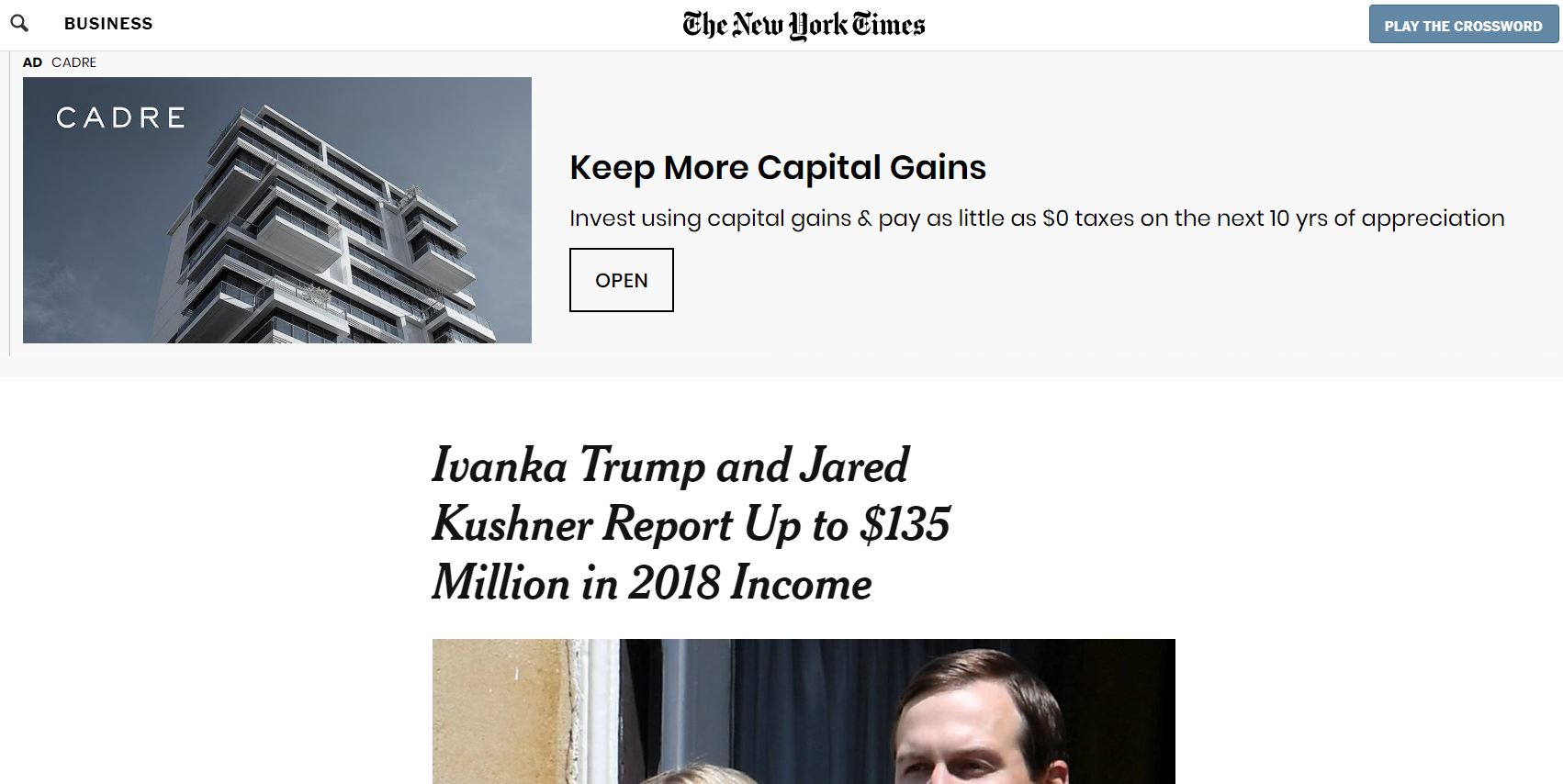
But Kushner’s corruption is even more pervasive and more craven than that. For further background, I decided to look at the Times’ reports on Kushner’s financial statements for 2017 and 2018. The numbers that were announced were that in 2017, Kushner and Ivanka Trump declared joint income of between $82 million and $222 million. For 2018, that number “dropped” to between $29 million and $135 million. But it was when I first opened the article on the 2018 income that my jaw really dropped. Here is a partial screenshot of what I saw:

See the ad? What, you might ask, is Cadre, and how can it recruit folks who want to invest for 10 years and pay zero taxes? Well, Cadre is partially owned by none other than Jared Kushner. I had been looking at Cadre before I got to the Times article on 2018 income. So Google ads and the New York Times ad system worked together to assume I’d like to see Cadre if I’m looking into Kushner’s income. Jared Kushner’s corruption is so pervasive that even Google ads help you to see it when you look him up.

Share this entry

Trump Specifically Ensured Republicans Wouldn’t Know about His Extortion

Kurt Volker’s prepared testimony from yesterday has been released. It is very unconvincing in several places, particularly read in conjunction with his texts that makes it clear there was a quid pro quo tied to security assistance and aid. Most charitably, it reads like the narrative of someone whose intentions were good, but in denial about his actions in service of an ultimate outcome — the continued provision of aid to Ukraine.

As is well documented, I had long supported lifting the ban on lethal defensive assistance to Ukraine, advocated for the supply of javelin anti-tank systems, advocated for an increase in U.S. assistance, and urged other nations to provide more assistance as well.

The issue of a hold placed on security assistance to Ukraine also came up during this same time I was connecting Mr. Yermak and Mayor Giuliani. I did not perceive these issues to be linked in any way.

On July 18, I was informed that at an interagency (sub-PCC) meeting, OMB had said that there was a hold being placed on Congressional Notifications about security assistance to Ukraine. No reason was given.

A higher level interagency meeting (PCC) was then scheduled to take place to discuss the issue on July 23. I met in advance with the individual who would represent the State Department at that meeting, Assistant Secretary of State for Pol-Mil Affairs, R. Clarke Cooper. I stressed how important it was to keep the security assistance moving – for Ukraine’s self-defense, deterrence of further Russian aggression, as a symbol of our bilateral support for Ukraine, and as part of having a strong position going into any negotiations with Russia. He fully agreed and intended to represent that position at the PCC meeting. I also had separate conversations with the Pentagon and NSC staff to reiterate the same position.

I was told later that there was no outcome from the PCC meeting. That said, I was not overly concerned about the development because I believed the decision would ultimately be reversed. Everything from the force of law to the unanimous position of the House, Senate, Pentagon, State Department, and NSC staff argued for going forward, and I knew it would just be a matter of time.

As well, Volker avoids admitting this was partly about inventing dirt on Joe Biden by treating the possibility of election interference as credible, without any basis (and it’s clear he conducted this projection repeatedly in real time).

Concerning the allegations, I stressed that no one in the new team governing Ukraine had anything to do with anything that may have happened in 2016 or before – they were making TV shows at the time. Mr. Lutsenko, however, would remain in place until a new government was seated in a month or more. It was important to reach out and provide strong U.S. support for President-elect Zelenskyy.

I also said at that July 19 meeting that it is not credible to me that former Vice President Biden would have been influenced in anyway by financial or personal motives in carrying out his duties as Vice President. A different issue is whether some individual Ukrainians may have attempted to influence the 2016 election or thought they could buy influence: that is at least plausible, given Ukraine’s reputation for corruption. But the accusation that Vice President Biden acted inappropriately did not seem at all credible to me.

But the key new detail in Volker’s statement, beyond what we already knew, is confirmation that not only did OMB freeze assistance to Ukraine, but it also froze notifications about security assistance to Congress, effectively hiding the fact that Trump was using the aid authorized by Congress to extort election assistance from Ukraine.

On July 18, I was informed that at an interagency (sub-PCC) meeting, OMB had said that there was a hold being placed on Congressional Notifications about security assistance to Ukraine. No reason was given.

Withholding the aid is something Republicans were on the record opposing. Indeed, Mitch McConnell claims (credibly or not) that even he was not informed that Trump was withholding the aid to extort campaign assistance.

Senate Majority Leader Mitch McConnell (R-Ky.) said he was not provided an explanation for why the Trump administration held up aid to Ukraine when he pressed senior officials on the matter over the summer.

“I was not given an explanation,” McConnell told reporters Tuesday as the congressional furor grew over President Trump’s interactions with Ukrainian President Volodymyr Zelensky.

McConnell said he spoke to Secretary of Defense Mark Esper and Secretary of State Mike Pompeo twice about the matter without receiving clarification for the delay in $391 million in aid to Ukraine.

“I was very actively involved in advocating [for] the aid. I talked to the secretary of Defense, the secretary of State once,” he said.

“The good news was it finally happened,” he added, noting the administration finally released the aid. “I have no idea what precipitated the delay.”

Whatever other story Republicans want to tell to excuse this behavior (and, as I said, McConnell’s claim here reads like CYA), Republicans should be furious that, first, Trump ignored the stated will of Congress on something they all claimed to care about and, second, that Trump’s OMB very specifically froze them out of notice they were entitled to have, as Congress.

Again, this scandal is not just about Trump demanding that other countries help him get reelected. It’s also about Trump defying the will of Congress to obtain leverage to extort that aid. Now we know that he even deliberately kept Congress in the dark about what he was doing.

Republicans surely will continue to excuse this behavior. But by doing so, they are utterly emasculating the prerogatives of Congress to do so.

Update: Multiple sources suggest that by August 31, Ron Johnson knew why aid was being held up, and by September 12, McConnell and James Inhofe did too.

Share this entry

Hitting the Fan: Volker’s Text Messages Released

[NB: Check the byline, thanks! ~Rayne]

Around 10:00 p.m. last night, House Democrats released partial transcripts of text messages between former U.S. Special Representative for Ukraine Kurt Volker and other officials, including:

William B. “Bill” Taylor, Charge d’Affaires for the U.S. Embassy in Ukraine;
Gordon Sondland, U.S. Ambassador to the European Union;
Andrey Yermak, Aide to Ukraine’s president Volodymyr Zelensky;
Rudy Giuliani, in his role as Trump’s agent;

and others.

The specific texts released had already been “leaked” out of context, according to the cover letter accompanying the partial transcripts sent to members of the Intelligence, Oversight and Reform, and Foreign Affairs Committees, subsequently shared at the Foreign Affairs Committee’s website.

You can read the letter and transcript at this link.

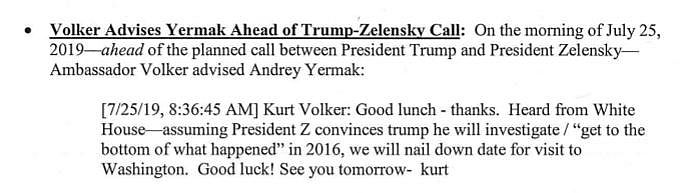
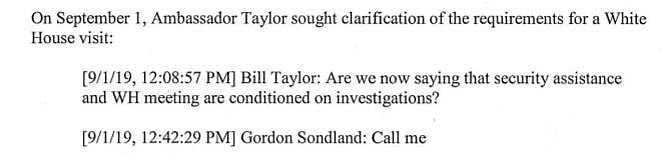
The transcripts suggest the entire State Department knew about the quid pro quo — the release of delayed military and financial assistance in exchange for investigations intended to aid Trump’s personal political aims including re-election. The quid pro quo also looks obvious:

Only one person recognized this effort as problematic: Bill Taylor, who assumed some of the responsibilities of recalled ambassador Marie Yovanovitch.

There’s more than one quid pro quo outlined in the transcripts, not readily acknowledged in the media. Less obvious is the trade-off of an agreement to a scripted statement in exchange for an invitation to visit the White House. Such a visit would be a validation of support for Zelensky’s young presidency and a thumb in the eye to Vladimir Putin, bolstering Zelensky’s image with Ukraine’s public.

Community member harpie pointed to a statement on camera at 8:28 AM on August 9 by Trump which fits in the middle of the negotiations, suggesting Trump was fully aware of the exchange.

TRUMP: I think he’s [Zelensky] going to make a deal with President Putin, and he will be invited to the White House, and we look forward to seeing him. He’s already been invited to the White House and he wants to come. And I think he will. He’s a very reasonable guy. He wants to see peace in Ukraine. And I think he will be coming very soon, actually.

(source: Aaron Rupar)

The transcripts suggest that Zelensky’s aide/adviser Yermak has been identified as ethically flexible — amenable to this quid pro quo and willing to present it to Zelensky. Yermak’s background is in film/TV production, similar to several of Zelensky’s administration. Only a couple of Zelensky’s team appear to be lawyers, one of which has been barred from holding public office (Andriy Bohdan, appointed to equivalent of Chief of Staff). In the text messages Yermak appears to keep Zelensky at arm’s length from the negotiations, but this may be due to the limited amount of texts released; Zelensky may have been wholly involved on a more direct basis.

~ ~ ~

Compounding the pressure on House Dems to act is Trump’s increasingly overt behavior, asking China yesterday on camera to investigate both of his 2020 political rivals, Joe Biden and Elizabeth Warren.

China has now issued a statement in response:

Now that we know how this works in Trumplandia, we can interpret the unexpressed portion of this statement: China will not interfere in U.S. domestic affairs and the U.S. should not interfere in China’s domestic affairs — including Hong Kong.

We can only wonder at what else was in the text transcripts not yet disclosed, and how Trump will react if yesterday was just the beginning act of this program.

Share this entry

Trump Is Being Impeached for Harming America to Extort Campaign Help

There’s a narrative solidifying among journalists that Democrats are conducting an impeachment inquiry (at least as it pertains to Ukraine) into whether Trump solicited foreign help for an election.

Even setting aside that on the call with Volodymyr Zelensky, Trump first asked Ukraine’s president to provide “evidence” backing Russian disinformation about the last election, foreign election assistance is not (all) Trump is being impeached for. Trump is being impeached for pursuing US policies that serve to coerce his foreign partners into helping him win the 2020 election.

His demand that China start an investigation into the Bidens was separated from his assertion that “if they don’t do what we want, we have tremendous power” by less than 30 seconds.

We’re looking at a lot of things. China’s coming in next week. We’re going to have a meeting with them. We’ll see. But we’re doing very well. Some of the, uh, numbers are being affected by all of the nonsense, all of the politics going on in this country, but the Democrats, I call them the do-nothing Democrats because they do nothing for this country. They don’t care about this country. But, uh, the numbers really are looking very good going into the future. So we’ll see. I have a lot of options on China. But if they don’t do what we want, we have tremendous power.

[comment on how he wants Zelensky to investigate the Bidens]

And by the way, likewise, China should start an investigation into the Bidens. Because what happened in China is just about as bad as what happened with uh, with Ukraine.

And a key part of the whistleblower’s complaint is that,

On 18 July, an Office of Management and Budget (OMB) official informed Departments and Agencies that the President “earlier that month” had issued instructions to suspend all U.S. security assistance to Ukraine. Neither OMB nor the NSC staff knew why this instruction had been issued. During interagency meetings on 23 July and 26 July, OMB officials again stated explicitly that the instruction to suspend this assistance had come directly from the President, but they still were unaware of a policy rationale. As of early August, I heard from U.S. officials that some Ukrainian officials were aware that U.S. aid might be in jeopardy, but I do not know how or when they learned of it.

Trump held up the money, which had been appropriated by Congress, overruling John Bolton’s and some other national security advisors’ counsel (which may be why Bolton was excluded from the call), as well as that of some Republican Senators. At least some of the Ukrainians in the loop claimed to be blindsided by the freeze and talked about how the freeze made Ukraine more vulnerable vis a vis Russia. Trump restored the aid only after Congress forced him to, even as the whistleblower complaint was breaking.

In short, Trump was defying Congress’ orders, and his excuses (that he was trying to get Ukraine to work on corruption) don’t hold up.

Trump has a lot of leeway to set the foreign policy of the US (but not in defiance of Congressional budgetary guidance). But he has come very close to suggesting that he is setting the foreign policy priorities of the country in such a way as to get leverage over other countries to help him politically.

And DOJ, when receiving this whistleblower complaint, did not review whether this amounts to extortion or bribery, the latter of which is specifically enumerated as an offense demanding impeachment in the Constitution.

This is what impeachment is about: Trump is considering inflicting more damage on farmers and manufacturers and this summer helped an adversary (admittedly the one who helped him get elected the last time), all in an effort to coerce help from foreign leaders.

Update: Fox just obtained encrypted texts showing that temporary Ambassador to Ukraine William Brockenbrough Taylor Jr. said “it’s crazy to withhold security assistance for help with a political campaign,” which would appear to make the intent clear.

Share this entry

Was The Trump Phone Call With Zelensky Paused For Discussion On US Side?

It’s Jim here.

Much has been made about the apparent discrepancy between the length of the rough transcript of the Donald Trump-Volodymyr Zelensky telephone call on July 25. The best analysis I’ve seen on this topic is in today’s Washington Post, where the number of words in a transcript and the reported duration of the corresponding call were compared for this call and for another conversation where interpreters were needed on both ends of the call:

The memorandum of Trump’s call with Zelensky appears remarkably different in speed and content from the full transcripts of calls between President Trump and foreign leaders The Washington Post obtained in 2017.

The transcript of a 24-minute call with Australian Prime Minister Malcolm Turnbull, in which both the participants spoke English, included roughly 3,200 words, or about 133 words per minute. A 53-minute call with then-Mexican President Enrique Peña Nieto, in which both Trump and the Mexican president spoke through interpreters, included roughly 5,500 words, or about 102 words per minute.

The White House summary of Trump’s 30-minute call with Zelensky — which included interpreters because Zelensky spoke Ukrainian while Trump spoke English — includes fewer than 2,000 words, or roughly 65 words per minute. That suggests that the rough transcript of the Zelensky call includes about half the number of words that would be expected if the call had proceeded at the same or similar pace as the previous calls.

The article also notes the presence of the ellipses and does a good job of tying each instance of the ellipses to the contexts where they appear. The first two are in Trump’s discussion of Crowdstrike and the third relates directly to Joe Biden.

The article also does a great job of debunking one White House theory put forward about the ellipses, claiming that they merely indicate that Trump’s voice trailed off. However, the article documents that past practice was to insert “[inaudible]” to mark such trailing off, so this doesn’t match what was done in the past.

Of course, the simplest explanation that many are going with here is that Trump may have said something so incriminating and outrageous that the White House simply couldn’t allow it to get out, and so they edited it out. But I began to wonder if there might be something else that happened here, in addition to eliding incriminating evidence.

Is it possible that intelligence agents monitoring the call heard something so improper that they put the call on the electronic equivalent of “hold” and communicated to Trump directly that he had gone over the line? Coupling that thought with the knowledge from the whistleblower complaint that there were other instances where Trump transcripts were hidden on the code-word server, I wondered if there had ever been a press report of a Trump phone call being briefly interrupted. Early in my searching, I hit on an article that fits into this idea incredibly well. It has the bonus that it applies to the first known phone call between Trump and Vladimir Putin. What I found was a Reuters article dated February 9, 2017:

In his first call as president with Russian leader Vladimir Putin, Donald Trump denounced a treaty that caps U.S. and Russian deployment of nuclear warheads as a bad deal for the United States, according to two U.S. officials and one former U.S. official with knowledge of the call.

When Putin raised the possibility of extending the 2010 treaty, known as New START, Trump paused to ask his aides in an aside what the treaty was, these sources said.

The article goes on to deliver what now seems to be an incredibly important tidbit in what would have been seen at the time as a meaningless aside from Sean Spicer:

The White House declined to comment on the details of the call. White House spokesman Sean Spicer said Trump knew what the New START treaty is but had turned to his aides for an opinion during the call with Putin. He said the notes from the call would not have conveyed that.

So, Spicer informs us that at least this once, a call was put on hold for discussions on the US side. More importantly, he states that such discussion would not have appeared in the notes from the call.

Is that what happened on July 25? Was the Trump-Zelensky call put on hold for the US side to speak privately with Trump? If so, it seems that such a discussion could account for at least part of length deficit for the rough transcript. It would also be something worthy of intense followup. Was the discussion primarily with political staff, as claimed by Spicer for the first Putin call, or were members of the intelligence community warning against where Trump had taken the conversation?

Share this entry

House Committees’ Deposition: U.S. Special Representative for Ukraine Kurt Volker

[NB: Check the byline, thanks!]

If yesterday’s blizzard of disinformation tweets is any kind of measure, the GOP is worried about today’s interview of the former U.S. Special Representative for Ukraine, Kurt Volker, before the House Permanent Select Committee on Intelligence, Committee on Foreign Affairs, and the Committee on Oversight and Reform. You may recall he resigned from his role as a diplomat last Friday.

In a letter sent to Secretary of State Mike Pompeo on September 27, it looked as if the biggest questions for State personnel would arise from what it was Giuliani was doing in and about Ukraine.

… The Department has also acknowledged that Special Representative for Ukraine Kurt Volker played a direct role in arranging meetings between Rudy Giuliani, wo has no official role in the U.S. government, and representatives of President Zelensky.5 In addition, the whistleblower complaint indicate that “multiple U.S. Officials” were “deeply concerned by what they viewed as Mr. Giuliani’s circumvention of national security decisionmaking processes to engage with Ukrainian officials and relay messages back and forth between Kyiv and the President”6 These officials reported that “State Department officials” had spoken with Mr. Giuliani “in an attempt to ‘contain the damage’ to U.S. national security,” as well as to the new Ukrainian administration to help it “understand and respond to “Mr. Giuliani’s backchanneling.7

Whew. When you put it that way one can well understand the frustration of former member of parliament and presidential adviser Serhiy Leschenko when he wrote in a recent op-ed,

… Giuliani and his associates are trying to drag our newly elected president, Volodymyr Zelensky, into a conflict between two foreign political parties, drastically limiting Ukraine’s room for maneuver in respect to the United States, perhaps its most important international partner. …

Today’s deposition is part of what the letter from the committees to Pompeo called “part of the impeachment inquiry.” It’ll be valuable as part of the investigative process determining culpability and to what degree on the part of participants who may have been manipulating U.S. foreign policy for the benefit of Trump’s re-election campaign.

But it will also be valuable for our relationship with Ukraine. They need to see the U.S. living up to its promise as a democracy while identifying where our relationship with Ukraine was hijacked.

The questions may be fairly simple:

— what was the understanding of Volker or other State Department personnel about the nature of Rudy Giuliani’s relationship to the U.S. government?
— did Volker every hear of Giuliani having meetings with Ukrainians prior to the July 25 call? What did the meetings entail and was each meeting debriefed with State?
— did Rudy Giuliani ask Volker or other State Department personnel for assistance in contacting Zelensky or other Ukraine officials?
— did Volker or the State Department ever ask Giuliani to contact Zelensky or other Ukraine officials?
— if anyone from State Department did ask, who was it and under what context did they make this request?
— were Volker and/org other State Department personnel asked by Giuliani or others to disparage former ambassador Marie Yovanovitch or in any way hamper her diplomatic work?
— did Volker and/or other State Department personnel ever see or hear Ukraine officials encouraged to disparage former ambassador Marie Yovanovitch or in any way hamper her diplomatic work?
— what did Volker know about the July 25 phone call between Trump and Zelensky, ex. attendees at the White House, or participating remotely like from Ukraine?
— did subsequent meetings between Volker and Ukraine officials imply a quid pro quo agreement, aid for a deliverable?
— did the diplomatic office in Ukraine have its own transcript, complete or partial, or a memorandum of telephone conversation for the July 25 call?

I’m sure there’s more to be asked but these are pretty important questions. What about you? What would ask and how if you were in charge of this interview?

There’s a strong chance Pompeo, the Department of Justice, or the White House may interfere and prevent Volker’s deposition. We’ll see.

Timing of the deposition isn’t clear; I haven’t been able to find it anywhere. The deposition doesn’t appear to be open, either, as I see nothing on the calendars I’ve checked. If you find information please share it in comments.

Share this entry

ODNI GC Klitenic: President Has Sole Authority Over Security Clearances, But Is Not Member Of Intelligence Community

Jim here again.

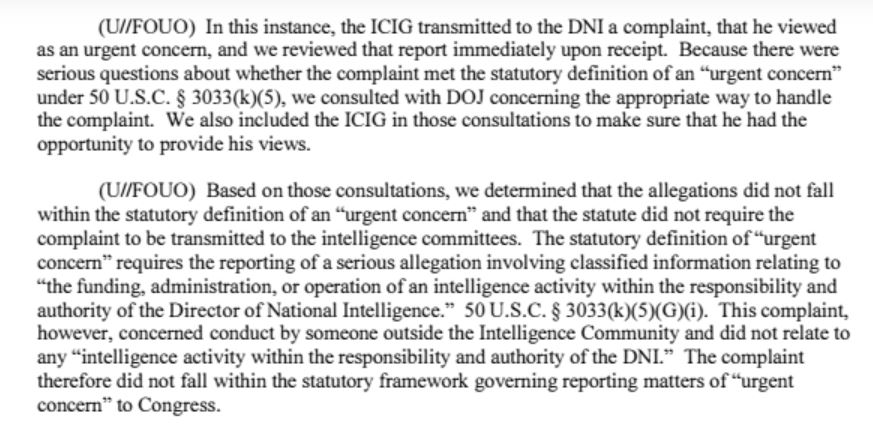
I want to go all the way back to September 13 in the Ukraine whistleblower saga. Recall that at this time, we strongly suspected but did not yet know that the complaint centered on President Trump. Congress was clamoring for the report from the Inspector General of the Intelligence Community to be released and for testimony from ICIG Michael Atkinson and/or Acting Director of National Intelligence Joseph Maguire. In response to those Congressional demands, the General Counsel of the Office of the Director of National Intelligence, Jason Klitenic, issued a letter in which he provided the rationale for his decision that Atkinson was not required to pass the complaint along to Congress even though Atkinson had come to the conclusion that the report was credible and represented an urgent concern that merited sharing with Congress. Because Trump eventually relented on the issue of the report and released it, the narrative has moved quickly beyond Klitenic’s actions. But let’s look at his primary justification for ruling that this report should not be disclosed:

Yesterday, Marcy went into the details of what transpired within DOJ in the Office of Legal Counsel during these deliberations, but here I want to concentrate just on how Klitenic relied on OLC’s interpretation to come to the conclusion that one of the two most important determining factors in stating that Atkinson could not forward the complaint to Congress was that it applied to “someone outside the Intelligence Community”. Knowing as we do now that the complaint did indeed focus on Trump’s words and actions, Klitenic is stating clearly that the President is outside the Intelligence Community. This is really rich coming from Klitenic, because just about two weeks before the Trump-Zelensky phone call, Klitenic had helped to shut down the Congressional investigation of the scandal surrounding the issuance of security clearances within the Trump White House.

I’ve not yet found Klitenic’s letter of July 10, 2019 that was sent in response to a letter from Senators Warner, Feinstein, Menendez and Reed on March 8, 2019 demanding that then-Director of National Intelligence Dan Coats and Atkinson “review compliance by the Executive Office of the President (EOP) with policies and procedures governing security clearances and access to secure compartmented information (SCI)”. Note that Klitenic’s response is well past the 60 day window the Senators granted for a response. Here is Atkinson on July 22, where he cites Klitenic’s letter and interpretation:

So, on July 10, 2019, Klitenic ruled that the President alone has authority of who is granted a security clearance and even who gets access to SCI. Recall that one of the central figures of this security clearance scandal was none other that Jared Kushner. His clearance was originally denied and Trump overruled the denial. One whistleblower on the security clearances, Tricia Newbold,was so incensed over Trump’s actions that she went public, as noted in this April 1 article in the Washington Post.

Lucky for Kushner that he still has SCI access since it appears that records of Trump conversation’s with Jared’s BFF Mohammad bin Salman have been stashed at that level of classification. It is even more lucky for Kushner that although his father-in-law is not a member of the Intelligence Community, many of his most important conversations live well-buried within it.

Finally, many of you know that I am a diehard fan of college baseball. So of course when I looked at Klitenic’s biography, I couldn’t help noticing that he claims to have been an All-American baseball pitcher in college. That claim does indeed check out, although in true trash talk fashion I would add the asterisk that Johns Hopkins competes in Division III in baseball. One can’t help wondering at this point when Chief Justice John Roberts, who at his confirmation stated his job is to “call balls and strikes” will be ruling on pitches made by Klitenic.

Share this entry

At Time of Trump-Zelensky Call, Mulvaney Was Already Under Notice From Cummings, Engel and Schiff Not to Hide Records

Note the byline.

In perusing the House Oversight Committee website while looking for something else, I ran across this remarkable letter dated February 21, 2019. It is addressed to Mick Mulvaney as Acting White House Chief of Staff and is from Elijah Cummings, Chair of the House Committee on Oversight and Reform, Eliot Engel, Chair of the House Committee on Foreign Affairs and Adam Schiff, Chair of the House Permanent Select Committee on Intelligence. The letter is part of an ongoing effort by Congress to obtain records from meetings between Donald Trump and Vladimir Putin that occurred in Hamburg on July 7, 2017 and in Helsinki on July 16, 2018.

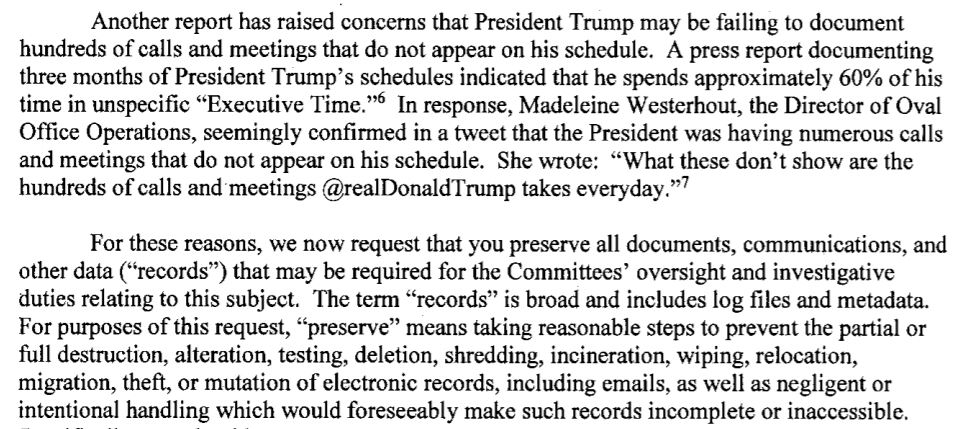
The letter reprises press reports of Trump confiscating notes from interpreters and having a general reputation for tearing up documents. Although prompted by their frustration in getting records from these two meetings, the three committee chairmen expand the scope of their direction to Mulvaney to preserve records:

Recall that the Trump-Zelensky phone call took place on July 25, 2019, just over five months after the letter was sent. It seems particularly on point that the letter warned Mulvaney against “relocation” as well as “intentional handling which would foreseeably make such records incomplete or inaccessable”. Certainly, by relocating the Situation Room’s transcript to the code-word level computer system, Mulvaney (or other actor(s) in the White House) did indeed make the record incomplete and essentially inaccessible until the whistleblower complaint forced the publication of a partial transcript.

And how did the White House respond to the letter? The return letter came from White House Counsel Pat Cipollone exactly one month later, blowing off the request for records from the two Trump-Putin meetings in its entirety, citing a claim that the President alone conducts foreign policy. And yet, the letter claimed that the White House fully complies with the Presidential Records Act, under which the three committee chairmen had submitted their request.

I’m wondering if this letter, with its highly specific warning, will increase the legal difficulties for Mulvaney once the impeachment investigation spotlight begins to point his direction.

Share this entry

Hidden until Now: Trump Admitted 2016 Russian Interference in Lavrov-Kislyak Meeting

[NB: Note the byline, thanks!]

If you though the dam was beginning to crack after House Speaker Pelosi announced an impeachment inquiry would begin on Tuesday, or after the release of the July 25 memo on Wednesday, or the release of the whistleblower complaint followed by acting Director of National Intelligence Joseph Maguire’s testimony yesterday, you ain’t seen nothing yet.

The Washington Post published this article at 8:26 p.m.:

Trump told Russian officials in 2017 he wasn’t concerned about Moscow’s interference in U.S. election

Here’s the first two grafs:

President Trump told two senior Russian officials in a 2017 Oval Office meeting that he was unconcerned about Moscow’s interference in the 2016 U.S. presidential election because the United States did the same in other countries, an assertion that prompted alarmed White House officials to limit access to the remarks to an unusually small number of people, according to three former officials with knowledge of the matter.

The comments, which have not been previously reported, were part of a now-infamous meeting with Russian Foreign Minister Sergei Lavrov and Russian Ambassador Sergey Kislyak, in which Trump revealed highly classified information that exposed a source of intelligence on the Islamic State. He also said during the meeting that firing FBI Director James B. Comey the previous day had relieved “great pressure” on him.

Emphasis mine.

We’ve known about this particular conversation Trump had with Lavrov and Kislyak. We’ve known he damaged a source in the process while admitting to obstruction of justice.

But we didn’t know there was more to this conversation — like admitting he knew the Russians ‘aided’ his election, or airing out our dirty foreign policy to a country with which we have not had good relations. “Unconcerned,” WaPo’s team said; sure, why would Trump be worried at all about the contributions that ensured his occupation of the White House? It’s simply a matter of fact, right?

And we didn’t know Trump’s lack of concern about election interference in front of Lavrov and Kislyak, which offered an implicit permission slip to continue interference here and elsewhere.

Nor did we know that White House officials hid the rest of this Oval Office conversation, limiting its access to a very small need-to-know circle. It’s not clear whether this meant the contents of this highly-sensitive conversation were retroactively classified and squirreled away in the code-word classified system set aside for sensitive intelligence information where the July 25 Trump-Zelensky conversation transcript had been stored.

We don’t know now whether Special Counsel’s Office had any inkling the content of this particular conversation may have been hidden, or that other transcripts responsive to its investigation may have been locked away in that code-word classified system.

If Trump knew about this at all, and any of this hidden content was responsive to Mueller’s investigation, it’s yet another obstructive act.

Any of the White House officials who enabled this content sequestration process may also have obstructed justice if the hidden material was responsive to requests or subpoenas. Who knew about these material, when they learned about it, and why they didn’t come forward sooner will be a subject of the impeachment inquiry.

We also need to know what other exposures are contained within and without the code-word classified system and whatever other ad hoc retention system was employed by a small cadre of White House staff.

What else has been used as leverage against the U.S. that we the people and our representatives know nothing about?

What’s additionally worrisome: we’re learning in a rather slapdash fashion as the proverbial rats flee the sinking S.S. Trump — like the ‘three former officials with knowledge of the matter’ cited as sources for this story. How many of them have already been monitored by foreign intelligence, marked as potential assets, witting or unwitting, because they are known to have participated in this secret content sequestration process?

How many of these ‘former officials with knowledge of the matter’ have been silent because of Trump’s obsessive use of nondisclosure agreements?

How many of them have talked among themselves — neaning others under Trump’s NDAs — about this secret content sequestration process and its contents?

How many of this circle of need-to-know or in-the-know are also GOP leadership like Senator Mitch McConnell or Senator Lindsey Graham? How many of them have already been compromised because of this knowledge?

It’d certainly explain a few things like McConnell’s refusal to do anything substantive about election security. Or Graham’s about-face after a round of golf with Trump.

If you’re reading this, Speaker Pelosi, ramp up the impeachment team. Get that full House vote organized to authorize the inquiry and the necessary personnel. It’s past time.

Share this entry